Why moving clocks run slow, Δt=γΔt0, moving rulers shrink, L=L0/γ, and nothing with mass can reach the speed of light c, where the Lorentz factor γ=1/1−v2/c2 grows without limit.
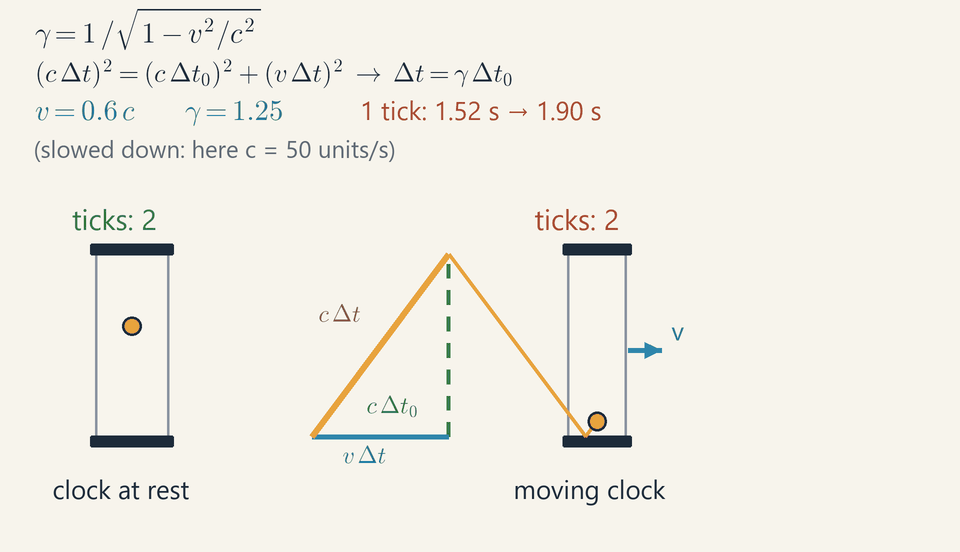
Two identical light clocks: the one at rest ticks with light going straight up and down, while the moving one's light zig-zags along a longer path and falls behind.
Light needs no medium: its speed, about 300,000 km every second, is the same for every observer, however fast they move.
A moving clock's light zig-zags along a longer path at that same speed, so the moving clock ticks more slowly.
Everything moving with the clock slows alike: the traveller notices nothing, but muons from the upper air live long enough to reach the ground.
Moving objects are measured shorter along their direction of motion, but not across it.
Nothing with mass can reach the speed of light: each push adds less extra speed than the one before.
Throw a stone from a boat gliding across a calm lake. The ripples spread through the water at their own pace, whatever the boat is doing, so from the boat the ripples in front seem to crawl away while those behind race off. Waves in water or in air travel through a medium, and the speed you measure depends on how you move through it.
Physicists long thought light worked the same way, as a wave in an invisible “ether” filling space. The Earth circles the Sun at 30 km/s, so light should seem slightly faster in one direction than in another. In 1887 Michelson and Morley compared two light beams sent at right angles, turned their instrument around, and found no difference at all. Light needs no medium, and its speed, about 300,000 km every second, is the same for every observer.
Einstein took this seriously in 1905, and it changes time itself. In the animation a flash bounces between two mirrors, one tick per trip. In the resting clock the light goes straight up and down. The other clock rushes sideways, so, seen from the ground, its light follows longer slanted zig-zags. Light cannot speed up to make up the distance, so each tick takes longer: four ticks against five. Everything on board, heartbeats included, slows the same way, so the traveller notices nothing. Muons, fast particles made high in the air by cosmic rays, reach the ground only because their time runs slow. Moving objects are also measured shorter along their motion, and no push can bring anything with mass up to light's speed.
Check yourself: if the moving clock went faster, would its zig-zag be longer or shorter, and its ticks faster or slower? Answer: longer, so slower.
Intermediate
Key ideas
The Lorentz factor γ=1/1−v2/c2 is never below 1; at v=0.6c, γ=1.25.
Time dilation: Δt=γΔt0, where Δt0 is the proper time, shown by the clock in its own rest frame.
Length contraction: L=L0/γ, only along the direction of motion.
Muons living 2.2μs reach the ground: at 0.995c (γ≈10) they live about 22μs in the Earth frame.
The effect is symmetric: each observer measures the other's clock running slow.
Frames, events and the two postulates
No experiment inside a smoothly cruising train with its blinds drawn can show whether the train is moving. An observer in relativity stands for a whole inertial frame: rulers and synchronised clocks moving at constant velocity, like a smoothly cruising train. An event happens at one place and one instant, such as a flash or the tick of a clock, so each frame gives it a position x and a time t.
The theory rests on two postulates. First, the laws of physics take the same form in every inertial frame, so no experiment inside a closed cabin can show whether it is moving. Second, light in vacuum moves at the same speed in every inertial frame, c≈3.00×10⁸m/s, however its source or the observer moves. Together they force time intervals and lengths to depend on the frame.
Reading the light-clock triangle
In a light clock a flash bounces between two mirrors a distance d apart, and each crossing is one tick. In the clock's rest frame the light goes straight across, so a tick lasts Δt0=d/c. This is a proper time: the time between two events read on a single clock present at both of them.
In a frame where the clock moves sideways at speed v (the blue arrow), a tick lasts Δt and the mirrors move on by vΔt, so the light runs along a slant. The animation draws this right triangle over the first tick: the dashed green side cΔt0 is the mirror gap, the blue base vΔt the shift of the clock, and the gold hypotenuse cΔt the path of the light, still covered at speed c. Pythagoras gives (cΔt)2=(cΔt0)2+(vΔt)2, so Δt=γΔt0 γ=1−v2/c21
The Lorentz factor γ is 1 at rest and grows without limit as v approaches c: it is 1.005 at 0.1c, 1.25 at 0.6c and 7.09 at 0.99c. Every process aboard, a passenger's heartbeat included, slows by the same factor; otherwise comparing them would reveal the motion.
Length contraction and simultaneity
Lengths change too. An object's length in its own rest frame is its proper length L0, and a frame in which it moves measures it shorter along the motion, L=γL0 but not across it. So the moving clock is drawn 24 units wide instead of 30 yet just as tall, and its mirror gap d is the same in both frames, as the triangle assumed.
Both effects are mutual: a passenger riding with the moving clock finds the ground clocks slow and the ground rulers short. There is no contradiction, because the two frames disagree about simultaneity. Two flashes at the same moment at the two ends of a platform are not simultaneous for a passenger on a passing train: for her, the flash ahead of the train comes first. Timing a moving clock takes two of your own clocks at the places it passes, and the moving observer says those two are not synchronised.
In every problem, first find the rest frame of the clock or object: proper times and lengths belong to it.
Energy, momentum and the speed limit
If Newton's momentum mv were conserved in a collision seen from one frame, it would not be in a frame moving at a large fraction of c. The relativistic momentum, energy and kinetic energy all carry the factor γ:
p=γmv
E=γmc2
K=(γ−1)mc2
Here m is the ordinary mass, the same in every frame, and E is the total energy. Even at rest a body has the rest energy mc2; K is what motion adds. An electron has mc2=511keV, so at 0.6c its energy is E=1.25⋅511≈639keV and K≈128keV, while Newton's 21mv2 gives only 92 keV. Since γ has no upper limit, neither has K: at 0.99c it is already 6.1mc2, and no finite energy brings a body with mass up to c.
Worked example: the clocks in the animation
On the screen light is slowed to 50 units per second and the mirrors are 76 units apart, so the clock at rest ticks every Δt0=76/50=1.52s. The other clock moves at v=0.6c, which is 30 units per second: γ=1−0.621=0.641=0.81=1.25 Δt=1.25⋅1.52s=1.90s
These are the values on the line “1 tick: 1.52 s → 1.90 s”. The triangle checks them: in one moving tick the clock advances 30⋅1.90=57 units and the light runs 50⋅1.90=95 units, and 572+762=952, a 3-4-5 triangle. After 7.6 s the green counter of the clock at rest reaches 7.6/1.52=5 ticks and the red counter above the moving clock 7.6/1.90=4: the ratio 5 : 4 is γ.
The blue arrow v keeps its length because the speed is constant, and the moving box is drawn 30/1.25=24 units wide. For the moving clock nothing is wrong: its four ticks took 4⋅1.52=6.08s of its own time.
Worked example: muons from the upper air
Cosmic rays hitting the upper atmosphere produce muons, unstable particles that live on average Δt0=2.2μs at rest. Do muons made 10 km up, falling at v=0.995c, reach the ground?
Without relativity a muon would cover only 0.995⋅3.00×108⋅2.2×10−6≈660m in one average lifetime. The 10 km trip takes 10000/(2.985×108)≈33.5μs, about 15 lifetimes, and since a fraction e−n is left after n lifetimes, only one muon in four million would arrive.
With relativity, γ=1/1−0.9952≈10.0: in the Earth frame the average lifetime is about 22μs, the trip lasts only 1.5 lifetimes, and a fraction e−1.52≈0.22, about one muon in five, survives.
In the muon's frame its clock runs normally, but the atmosphere rushes past, contracted to 10km/10.0≈1.0km, which goes by in about 3.35μs: again 1.5 lifetimes. What one frame calls time dilation, the other calls length contraction.
Common mistakes
The moving clock is not faulty: in its own frame it ticks every 1.52 s; the 1.90 s is measured from a frame in which it moves.
Proper time is the shortest interval, so multiply it by γ, never divide: 2.0 s of proper time at 0.6c becomes 2.5 s, not 1.6 s.
Do not confuse γ with the root it contains: at 0.6c the root 1−v2/c2 is 0.8, and γ, its inverse, is 1.25.
Contraction acts only along the motion: the mirror gap stays 76 units while the width shrinks from 30 to 24 units.
Speeds do not simply add: a probe fired forward at 0.6c from a ship moving at 0.6c travels at 1.2/1.36≈0.88c, not 1.2c.
Where you meet it
GPS satellites move at about 3.9 km/s, so their clocks lose about 7 microseconds a day to motion, while the weaker gravity at their height makes them gain more; uncorrected, position fixes would drift by kilometres a day. Accelerator magnets are designed for p=γmv, with protons at γ in the thousands. Electron microscopes accelerate electrons through 300 kV to 0.78c (γ≈1.59), and hospital PET scanners detect pairs of 511 keV photons from electron–positron annihilation.
The rest energy returns in Fission, Fusion and E = mc², and the gravitational part of the GPS correction in Gravity as Curved Spacetime.
Advanced
Key ideas
A Lorentz transformation mixes x and t like a rotation, but keeps the interval s2=c2Δt2−Δx2 invariant.
Proper time τ=∫dt/γ is greatest on the straight worldline: the twin who turns around comes home younger.
(E/c,p) is a four-vector: E2=(pc)2+(mc2)2 in every frame; a photon (m=0) has E=pc.
E=γmc2≈mc2+21mv2: Newton's kinetic energy is the first correction, and mc2 is real energy.
From two postulates to the Lorentz transformation
If two inertial frames both see a light pulse move at the same speed c, how are the coordinates of an event in one frame related to its coordinates in the other? The answer, the Lorentz transformation, contains every effect of special relativity, so it is worth deriving step by step.
Take a frame S′ that moves at velocity v along the x axis of a frame S, and set both sets of clocks to zero as the two origins pass each other, so that event has t=t′=0. Galileo's rule, x′=x−vt with t′=t, cannot be right. It subtracts velocities: a light pulse with x=ct would have x′=(c−v)t and so move at c−v in S′, against the second postulate.
Three facts fix the correct rule. First, it must be linear: space and time are the same everywhere, so the rule cannot single out any place or instant, and a body that moves uniformly in one frame must move uniformly in the other.
Second, distances across the motion do not change: y′=y and z′=z. Picture two identical rings flying through each other along their common axis. If motion shrank a ring, each frame would find the other ring smaller and see it pass inside its own; both cannot be true, since which ring passes inside is a plain fact.
Third, the origin of S′, where x′=0, sits at x=vt. A linear rule that gives x′=0 exactly there must be proportional to x−vt: x′=γ(x−vt) Here γ is a factor that may depend on v but not on x or t. In S′ the frame S moves at −v, and by the first postulate neither frame is special, so the inverse has the same form, with the same factor and the opposite velocity: x=γ(x′+vt′)
The second postulate now fixes γ. Send a light pulse from the common origin at t=t′=0. In S it obeys x=ct, and in S′ it obeys x′=ct′. Putting these into the two equations gives ct′=γ(c−v)t and ct=γ(c+v)t′. Multiplying them and cancelling tt′ leaves c2=γ2(c2−v2), so γ=1−v2/c21 which is the Lorentz factor that the light clock gave for time dilation.
The rule for time follows by eliminating x′. Substitute x′=γ(x−vt) into x=γ(x′+vt′) and solve for t′; with 1−1/γ2=v2/c2 the result simplifies, and the full transformation reads x′=γ(x−vt),t′=γ(t−c2vx) When v≪c, γ≈1 and the term vx/c2 is negligible, so Galileo's rule returns. That new term is the heart of the matter: the time of an event in S′ depends not only on when it happens in S but also on where.
Tilted axes: the spacetime diagram
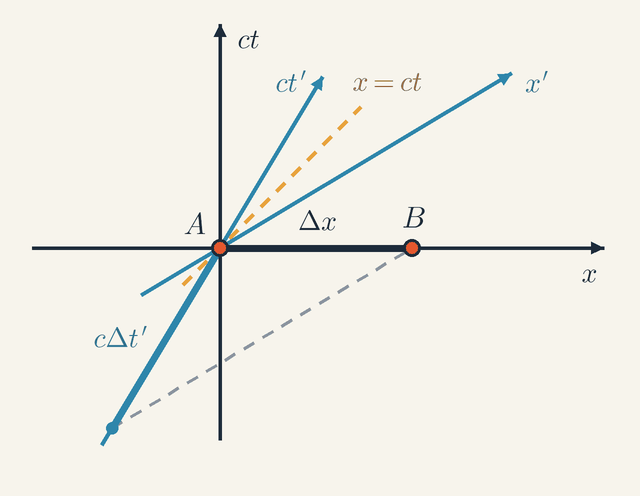
Figure 1. A spacetime diagram of S, with the axes of S′ drawn for v=0.6c and leaning towards the dashed light line. A and B are simultaneous in S, but the dashed line through B (constant t′) meets the ct′ axis below A: in S′ the event B comes first.Legend
x
Position in S: the horizontal axis, the line ct=0.
m
ct
Time in S multiplied by c: the vertical axis, so that time and distance share one unit.
m
x′
Position axis of S′: the line of events with t′=0.
m
ct′
Time axis of S′, time multiplied by c: the worldline of the origin of S′, where x′=0.
m
x=ct
Worldline of a light pulse leaving A; it also obeys x′=ct′.
A
Event at the origin of both frames.
B
Event on the x axis, simultaneous with A in S.
Δx
Distance between A and B in S.
m
cΔt′
Time between A and B in S′, multiplied by c and read along the ct′ axis. It is negative: B comes first.
m
A spacetime diagram draws the Lorentz transformation instead of writing it, and it shows at a glance why two frames disagree about which distant events happen at the same time. Figure 1 is drawn in the frame S, for v=0.6c.
Time is plotted upward as ct, the time multiplied by c, so that both axes of S measure length in the same unit. A light pulse leaving the origin then follows the dashed 45° line x=ct.
The frame S′ brings two axes of its own. Its time axis ct′ is the set of events with x′=0: the worldline x=vt of its origin, which leans to the right of the ct axis. Its position axis x′ is the set of events with t′=0; setting t′=0 in t′=γ(t−vx/c2) gives ct=(v/c)x, a line that leans up from the x axis. Both axes of S′ lean by the same angle, towards the light line from either side, so the light line still lies midway between them. The pulse therefore obeys x′=ct′ as well: the second postulate is built into the picture.
Now look at the events A and B. Both lie on the x axis, so in S they happen at the same time, t=0, a distance Δx apart. In S′ the events with equal t′ lie on lines parallel to the x′ axis, just as events with equal t lie on horizontal lines in S. To read the time of B in S′, follow the dashed line through B, parallel to x′, until it meets the ct′ axis. It meets that axis below A, at cΔt′: by the clocks of S′, the event B happens first.
Putting Δt=0 into the transformation gives the size of the gap: Δt′=−c2γvΔx The minus sign says that B, the event further along the direction of motion, comes first. At the figure's speed γ=1.25, so γv/c=0.75: two lab flashes at the same moment, one light-second apart, are 0.75 s apart for the moving clocks. Whether two distant events are simultaneous depends on the frame.
Time dilation, length contraction, adding speeds
The transformation now delivers the effects met earlier in a few lines each, and it shows that they hold for any clock and any rod, not only for the light clock.
Time dilation. Take a clock at rest at the origin of S′. In S it moves along x=vt, so its reading is t′=γ(t−v2t/c2)=γt(1−v2/c2)=t/γ. While a time Δt passes in S, the moving clock advances only Δt0=Δt/γ; that is, Δt=γΔt0.
Length contraction. A rod of proper length L0 is at rest in S′, so its ends are Δx′=L0 apart. To measure a moving rod, S must mark both ends at the same time, Δt=0, and then the transformation gives Δx′=γΔx. The length in S is therefore L=Δx=L0/γ.
Adding speeds. The inverse transformation is the same rule with −v: x=γ(x′+vt′) and t=γ(t′+vx′/c2). A body moving at u′ along x in S′ covers dx′=u′dt′, so dx=γ(u′+v)dt′ and dt=γ(1+u′v/c2)dt′. Their ratio is its speed in S: u=1+u′v/c2u′+v For u′=c it gives u=c, as the second postulate demands. Two speeds of 0.6c compose not to 1.2c but to 1.2/1.36=15/17≈0.88c.
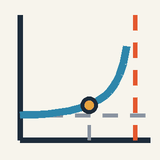
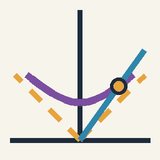
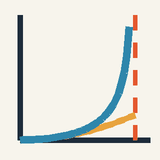
The size of all these effects is set by γ, and the graph in the animation plots it against v/c up to 0.95, where γ=3.20. Near the origin the curve is flat, γ≈1+21v2/c2, only 0.5 % above 1 at 0.1c; this is why relativity escapes everyday notice. At the dot, 0.6c, this parabola gives only 1.18 against the true 1.25, and the slope dγ/d(v/c)=(v/c)γ3 is already 1.17. At the right edge the slope is 31, and the curve climbs towards a vertical asymptote at v=c.
The invariant interval and rapidity
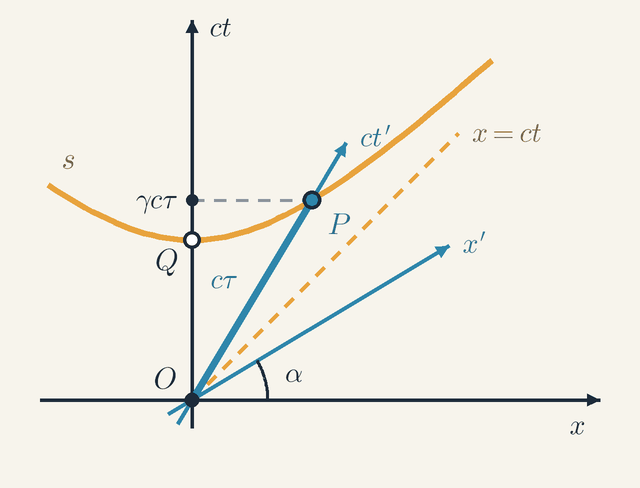
Figure 2. Two identical clocks leave O and tick after the proper time τ: the one at rest at Q, the moving one at P, which S dates at ct=γcτ. Both ticks lie on one hyperbola of equal interval s, so OP only looks longer than OQ.Legend
x
Position in S: the horizontal axis.
m
ct
Time in S multiplied by c: the vertical axis, the worldline of the clock at rest.
m
x′
Position axis of S′.
m
ct′
Time axis of S′, time multiplied by c: the worldline of the moving clock.
m
x=ct
Worldline of light from O: the dashed line the hyperbola approaches.
O
Event where the two clocks meet and start.
Q
Tick of the clock at rest, after the proper time τ.
P
Tick of the moving clock, after the same proper time τ.
cτ
Proper time between O and the tick, multiplied by c: the height of Q and the ct′ coordinate of P.
m
γcτ
Time of P in S, multiplied by c: longer than cτ by the factor γ.
m
s
Interval from O, the same for every point of the hyperbola; here s=cτ.
m
α
Tilt of the axes of S′ from those of S: tanα=v/c.
rad
Times and lengths each change from frame to frame, but one combination of them does not. This invariant, the interval, plays the part in spacetime that distance plays in ordinary space, and Figure 2 shows how to read it on a diagram.
Two identical clocks start together at the event O. One stays at rest in S and climbs the ct axis; the other moves with S′ and climbs the ct′ axis. Each ticks once after the proper time τ, the time it reads itself. The clock at rest ticks at the event Q, at the height cτ. The moving clock ticks at the event P, where its own axis reads ct′=cτ. The dashed line from P across to the ct axis shows when S dates that tick: at ct=γcτ, later than Q. This is time dilation once more.
Notice the puzzle on paper: the segment OP is drawn longer than OQ, yet both stand for the same cτ. The curve s resolves it. Both P and Q lie on this hyperbola, the set of all events at the same interval s=cτ from O. On a spacetime diagram equal intervals are read along such hyperbolas, not with a ruler.
The interval between two events is defined by s2=c2Δt2−Δx2−Δy2−Δz2 Put the transformation into the right-hand side, square and subtract: the cross terms cancel, the factor γ2(1−v2/c2) equals 1, and the same s2 comes out in S′. A rotation in a plane leaves x2+y2 unchanged in just the same way.
The analogy with rotation is exact. Define the rapidity φ by v/c=tanhφ. Then γ=coshφ and γv/c=sinhφ, and the transformation becomes ct′=ctcoshφ−xsinhφ and x′=xcoshφ−ctsinhφ. This is a rotation in the (x,ct) plane by the angle φ, with hyperbolic functions in place of circular ones. Figure 2 shows the same boost with a ruler: the axes of S′ tilt by the angle α, with tanα=v/c=tanhφ. The rapidities of successive boosts along one line simply add, which is the velocity-addition law written in terms of rapidity.
The animation's speed gives a check of these relations. In the animation φ=artanh0.6=ln2, so γ=cosh(ln2)=(2+21)/2=1.25, and two such boosts give tanh(2ln2)=tanh(ln4)=15/17, the speed found above.
The light clock measures an interval. One tick of the moving clock spans Δt=1.90s and Δx=57 units in S, with light at 50 units per second, so cΔt=95 units and (cΔt)2−Δx2=952−572=762. The interval is the mirror gap, 76 units, the same in every frame; divided by c, it is the proper time of one tick, 1.52 s.
Along a worldline that bends, add up the proper time of each short straight piece: τ=∫dt/γ. Because of the minus signs in s2, motion through space reduces the proper time instead of adding to it. Among all worldlines between two events, the straight, inertial one therefore has the longest proper time, the reverse of Euclid's geometry, where the straight line is the shortest. A twin who travels away and turns back ages less, as the worked problem below shows.
Energy and momentum as one four-vector
Figure 3. The relation E2=(pc)2+(mc2)2 as a right triangle, drawn for v=0.6c, with sides mc2, pc and E in the ratio 4 : 3 : 5. Swinging the leg mc2 onto the hypotenuse along the dashed arc leaves the kinetic energy K=E−mc2.Legend
mc2
Rest energy: one leg of the triangle, copied onto the hypotenuse by the arc.
J
pc
Momentum multiplied by c: the other leg.
J
E
Total energy, γmc2: the hypotenuse.
J
K
Kinetic energy, E−mc2: the part of the hypotenuse beyond the swung leg.
J
θ
Angle between the mc2 leg and the hypotenuse: sinθ=pc/E=v/c.
rad
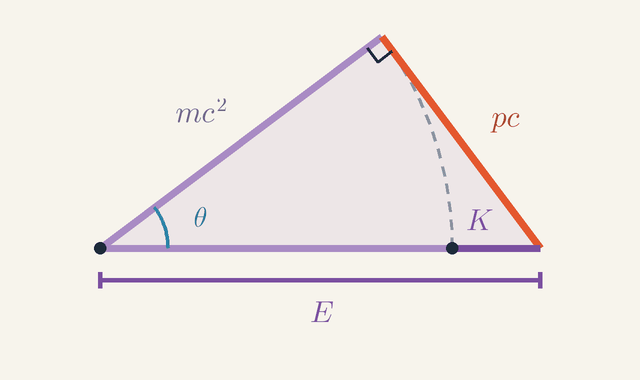
If momentum is to be conserved in every inertial frame, energy and momentum must transform together, just as t and x do. Built into one four-vector, that pair leads to the relation that Figure 3 draws as a right triangle.
First read the triangle. Its legs are the rest energy mc2 and pc, the momentum times c; its hypotenuse is the total energy E, and the right angle sits at the top, so E2=(pc)2+(mc2)2. Swing the leg mc2 about the left vertex down onto the hypotenuse, along the dashed arc: the piece of the hypotenuse left over at the right-hand end is K=E−mc2, the kinetic energy. At the left vertex the angle θ has sinθ=pc/E, which equals v/c, as shown below.
Now the derivation. The step (cdt,dx) between two nearby events on a body's worldline transforms like (ct,x). Dividing it by the proper time dτ=dt/γ, which is the same in all frames, keeps that property; the result is the four-velocity γ(c,v). Multiplying by the mass m gives the four-momentum (E/c,p)=(γmc,γmv) Its space part, p=γmv, is the momentum conserved in collisions. Its time part is E/c, and a boost mixes the two, just as it mixes ct and x: the momentum seen in S′ contains energy from S. So momentum can be conserved in every frame only if energy is conserved too, and the two laws become one.
Like the interval, this four-vector has a length that every frame agrees on: (E/c)2−p2=γ2m2c2(1−v2/c2)=m2c2. Multiplied by c2, it reads E2=(pc)2+(mc2)2 Dividing the space part by the time part gives pc/E=v/c, so v=pc2/E, and this is the sinθ of Figure 3. A massless particle has E=pc and therefore moves at c.
For small speeds, expand γ in powers of v2/c2: E=γmc2≈mc2+21mv2+83mc2v4 Newton's kinetic energy is the first correction, and K=(γ−1)mc2 is the exact form. The rest energy mc2 that remains at v=0 is real: a hot body is heavier by ΔE/c2, and a nucleus is lighter than its separate parts. The mass m is the same in every frame; what grows with speed is γ.
At the animation's speed, 0.6c, the triangle of Figure 3 is a 3-4-5 triangle: pc=γmvc=0.75mc2 and E=1.25mc2, and indeed 0.752+12=1.252. The kinetic energy is K=0.25mc2, while Newton's 21mv2=0.18mc2 is 28 % too low.
Doppler shift, fields and acceleration
Three short applications show how far the transformation reaches: to light from moving sources, to electric and magnetic fields, and to bodies that speed up.
Doppler shift. Light needs no medium, so its Doppler shift can depend only on the relative velocity of source and observer. Let a source recede at v and emit a crest every T in its own frame. In our frame the crests leave every γT, because of time dilation, and between two crests the source moves away by vγT, which adds vγT/c to the travel time of the next crest. The received period is therefore γT(1+v/c)=T1−v/c1+v/c
At 0.6c the factor is exactly 2, which is eφ for the rapidity φ=ln2: a 500 nm spectral line arrives at 1000 nm from a receding source and at 250 nm from an approaching one. For light received at right angles to the motion the distance does not change, so only time dilation remains, lowering the frequency by the factor γ.
Fields. A charge at rest has only an electric field. In a frame where it moves, it is a current and has a magnetic field too, and the magnetic force on a moving charge is an electric force in the charge's own rest frame: a boost mixes electric and magnetic fields as it mixes t and x. Maxwell's equations already obey the Lorentz transformation, so it was mechanics, not electromagnetism, that had to change.
Acceleration. Accelerated bodies need no new theory while spacetime is flat: at each instant, use the inertial frame moving with the body. Suppose a ship keeps a constant proper acceleration a, the one the passengers feel. In each short stretch dτ of ship time it gains the same small rapidity adτ/c, and rapidities add, so φ=aτ/c grows uniformly and v=ctanh(aτ/c) never reaches c. One year of ship time at 9.81m/s2 gives aτ/c≈1.03 and v≈0.77c.
Worked problem: a round trip to a nearby star
Figure 4. The round trip in the Earth frame, t in years and x in light-years. The bent line is the traveller; black numbers are Earth's clock, red numbers hers. The thin lines are Earth's yearly signals, the dots where they reach her: two on the way out, eight on the way back.Legend
t
Time in the Earth frame, drawn in years: the horizontal axis, which is also Earth's own worldline.
s
x
Distance from Earth along the trip, drawn in light-years.
m
L0
Distance to the star in the Earth frame: 3.00 light-years.
m
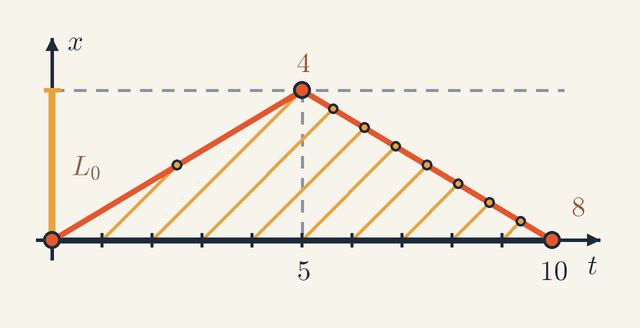
A traveller flies to a star and back and returns younger than her twin on Earth. This is the twin paradox, and this problem applies the whole lesson to it. Figure 4 draws the trip in the Earth frame, with the time t in years across and the distance x in light-years up, so that light runs at 45°. Earth stays on the t axis, and the star, at the distance L0, is the dashed horizontal line. The bent line is the traveller's worldline, climbing to the star and falling back. The numbers are clock readings: when she turns, Earth's clock shows 5 and hers 4; when she lands, 10 and 8.
Send the animation's clock at 0.6c to a star 3.00 light-years away in the Earth frame and straight back, ignoring the brief turnaround. On Earth each leg takes 3.00/0.6=5.00 years, 10 in all. The traveller's clock runs slow by γ=1.25, so it shows 4.00 years per leg, 8 in all.
Her own view agrees. In her frame the distance to the star is contracted to L0/γ=3.00/1.25=2.40 light-years, which she covers at 0.6c in the same 4.00 years. The interval agrees too: in years and light-years, each leg has (cΔt)2−Δx2=52−32=42, a proper time of 4 years. The ratio 10 : 8 is the 5 : 4 of the tick counters in the animation.
Why is the trip not symmetric, when on the outward leg each twin finds the other's clock slow? To see it, let each twin send a light signal every year by her own clock, and count the signals that arrive. The Doppler factor at 0.6c is 2: while the twins move apart, the signals arrive every 2 years; while they approach, every half year.
The thin lines of Figure 4 are Earth's yearly signals, rising at 45° from the t axis until they meet her worldline, and the dots mark where they arrive. On the way out she receives one every 2 years of her time, 2 signals in her 4 years; the signal of year 2 reaches her just as she turns. On the way back she receives one every half year, 8 more; the signal of year 10 arrives as she lands. So the dots crowd together after the turn, and her count of 10 signals says that Earth has aged 10 years.
Earth sees the other side. It receives her signals every 2 years until the light from her turn reaches it. She turned 3 light-years away in year 5, so Earth sees the turn only in year 8, three years after the event: 4 signals in 8 years. In the last 2 years her signals come every half year, 4 more: 8 in all, so she has aged 8 years.
The asymmetry is the change of frame. The signals she receives speed up halfway through her trip, at the turn that she alone feels, while those Earth receives speed up only 2 years before she is back. In the language of the interval, her bent worldline has the shorter proper time.
Limits of validity
Special relativity assumes flat spacetime, with inertial frames that extend everywhere. This section shows where that assumption, and with it the theory, stops.
Gravity breaks it first. A clock lower in a gravitational field runs slow, by a fraction equal to the difference in gravitational potential divided by c2: about 7×10⁻¹⁰ between the Earth's surface and far space. GPS clocks lose about 7 µs a day to their motion and gain about 46 µs a day to their height, so they are tuned to tick slightly slow before launch. Where gravity varies across the region studied, spacetime is curved and general relativity takes over; special relativity still holds in any small, freely falling laboratory.
At everyday speeds the corrections, of order 21v2/c2, are tiny: 5×10⁻¹⁵ for a car at 30 m/s and 3.5×10⁻¹³ for an airliner at 250 m/s. Yet atomic clocks flown around the world in 1971 gained or lost tens to hundreds of nanoseconds, as predicted once gravity was included.
At the other extreme nothing has failed: 6.8 TeV protons in the Large Hadron Collider have γ≈7250 and trail light by less than 3 m/s, and muons circling a storage ring at γ≈29 live 29 times longer than at rest.
Quantum mechanics sets the last limit. Above a collision energy of 2mc2 in the centre-of-mass frame, 1.02 MeV for electrons, a particle and its antiparticle can appear. Only the union of relativity and quantum mechanics can describe this, and that union predicted antimatter before its discovery in 1932.
Where this leads
Gravity as Curved Spacetime keeps the interval but lets spacetime curve, so that free fall follows the straightest worldlines and clocks depend on height. Fission, Fusion and E = mc² turns rest energy into the power of reactors and stars: fusing hydrogen into helium releases 0.7 % of the mass. Photoelectric Effect and Wave–Particle Duality give light the energy E=hf and the momentum p=E/c=h/λ, the massless case of the four-momentum. Particles and Forces: the Standard Model uses the conservation of four-momentum to find particles that leave no track. Looking back, Magnetic Force on Moving Charges and Electromagnetic Waves hold the fields that mix and the speed c that started it all.
Key formulas
Lorentz factor
γ=1−v2/c21
The Lorentz factor comes from Pythagoras applied to the light clock: the slanted light path of a moving clock is longer than the mirror gap by exactly this factor. It is 1 at rest, grows slowly at first, γ≈1+21v2/c2, and then without limit as v approaches c. Every effect of special relativity, from time dilation to the energy of motion, is set by it.
Symbols
γ
Lorentz factor
v
speed of the moving clock, object or frame
m/s
c
speed of light in vacuum
m/s
When it holds: Defined for v<c, which every body with mass satisfies; it has no finite value at v=c. Only the size of the velocity enters, not its direction.
Example: At v=0.6c: γ=1/1−0.36=1/0.8=1.25, the value in the animation.
Time dilation
Δt=γΔt0
Δt0 is the proper time, read on a single clock present at both events, for instance one riding with the moving object. Any frame in which that clock moves measures a longer time between the same events, longer by the factor γ. The effect is real and mutual: each inertial observer finds the other's clocks slow.
Symbols
Δt
time between the two events in a frame in which the clock moves
s
γ
Lorentz factor
Δt0
proper time, on the clock present at both events
s
When it holds: For a clock moving at constant velocity in flat spacetime. If its speed changes, add up the pieces dτ=dt/γ along its path; in a gravitational field, clock rates also depend on height.
Example: One tick of the animation's moving clock: Δt=1.25⋅1.52=1.90s.
Length contraction
L=γL0
A length is measured by locating both ends at the same instant, and a frame in which the object moves finds it shorter. The proper length L0, measured in the object's rest frame, is the longest; any other frame finds L0/γ along the motion and the full size across it. It is the same physics as time dilation: a muon sees the atmosphere contracted where we see its clock slowed.
Symbols
L
length measured in a frame in which the object moves
m
L0
proper length, measured in the object's rest frame
m
γ
Lorentz factor
When it holds: Only lengths along the direction of motion contract. The formula is about measurement at simultaneous instants; a photograph, which collects light that left different points at different times, shows a moving object rotated rather than squashed.
Example: The animation's clock, 30 units wide at rest, is drawn 30/1.25=24 units wide while it moves at 0.6c.
Total energy
E=γmc2
A body's energy grows with speed by the same factor γ that slows its clocks. At rest it does not vanish: E=mc2, the rest energy, which shows that mass is a form of energy. Together with p=γmv, this energy is conserved in every collision, in every inertial frame.
Symbols
E
total energy, rest energy included
J
γ
Lorentz factor
m
mass, the same in every frame
kg
c
speed of light in vacuum
m/s
When it holds: For a free body with mass; for light use E=pc. Potential energy from fields or binding comes on top, and the binding energy of a nucleus shows up as a mass defect.
Example: An electron (mc2=511keV) at 0.6c: E=1.25⋅511≈639keV.
Kinetic energy
K=(γ−1)mc2
The kinetic energy is what motion adds to the rest energy, E−mc2. For small speeds γ−1≈21v2/c2, and Newton's 21mv2 comes back. As v→c it grows without bound, which is why no finite amount of work can bring a body with mass to the speed of light.
Symbols
K
kinetic energy
J
γ
Lorentz factor
m
mass
kg
c
speed of light in vacuum
m/s
When it holds: Exact at any speed below c. The classical 21mv2 is within 1 % of it only below about 0.1c, and it is 28 % too low at 0.6c.
Example: The electron at 0.6c: K=0.25⋅511≈128keV, against 21mv2≈92keV.
Momentum
p=γmv
At high speed Newton's mv is not conserved in every frame, but γmv is. It grows without limit as v→c, so a steady force keeps adding momentum while the speed only creeps toward c. It points along the velocity.
Symbols
p
momentum
kg⋅m/s
γ
Lorentz factor
m
mass
kg
v
velocity
m/s
When it holds: For a body with mass; light has no mass but carries p=E/c. Force is still the rate of change of momentum, F=dp/dt, but no longer ma.
Example: At 0.6c: p=1.25⋅0.6mc=0.75mc, 25 % more than mv.
Energy–momentum relation
E2=(pc)2+(mc2)2
Energy and momentum form one four-vector, (E/c,p), and this relation is its invariant length: E and p change from frame to frame, but E2−(pc)2 does not, and it always equals the square of the rest energy. It links energy and momentum without the speed, which follows as v=pc2/E.
Symbols
E
total energy
J
p
momentum
kg⋅m/s
c
speed of light in vacuum
m/s
m
mass
kg
When it holds: Holds for every free particle, including massless ones: with m=0 it gives E=pc, and then v=c.
Example: At 0.6c: pc=0.75mc2 and E=1.25mc2, and 0.752+12=1.252, a 3-4-5 triangle like the light clock's.
Glossary
Inertial frame of reference
A frame of reference moving at constant velocity, in which a body free of forces keeps moving in a straight line at constant speed. A smoothly cruising train is a good approximation; a braking or turning one is not.
Principle of relativity
The first postulate: the laws of physics take the same form in every inertial frame. No experiment inside a closed laboratory can reveal its uniform motion; only motion relative to something else has a meaning.
Constancy of the speed of light
The second postulate: light in vacuum moves at c≈3.00×10⁸m/s in every inertial frame, whatever the motion of its source or of the observer. Light needs no medium: the Michelson–Morley experiment of 1887 found no sign of one.
Event
Something that happens at one place and one instant, such as a flash or a clock tick, labelled (x,t) in each frame. Different frames give the same event different coordinates.
Proper time
The time between two events read on a single clock present at both, such as a clock riding with a muon from its birth to its decay. Every other inertial frame measures a longer time between the same events.
Time dilation
A clock that moves relative to an observer is measured to run slow by the factor γ, Δt=γΔt0. It affects every process, from atomic clocks to heartbeats, and it is mutual between two inertial observers.
Length contraction
A moving object is measured shorter along its direction of motion, L=L0/γ, but not across it. At 0.6c the animation's 30-unit box is drawn 24 units wide.
Relativity of simultaneity
Two events at different places that are simultaneous in one frame are not simultaneous in a frame moving along the line that joins them. This is why each observer can find the other's clocks slow without contradiction.
Lorentz transformation
The rule that converts the coordinates of an event to a frame moving at v along x: x′=γ(x−vt), t′=γ(t−vx/c2). It replaces the Galilean rule x′=x−vt, t′=t, and reduces to it when v≪c.
Spacetime interval
The combination s2=c2Δt2−Δx2−Δy2−Δz2 for two events, which has the same value in every inertial frame. When s2>0, s/c is the proper time between the events.
Twin paradox
The puzzle that a twin who travels away and back returns younger, although each twin sees the other's clock run slow. Only the traveller changes frame: at 0.6c to a star 3 light-years away and back, 10 years pass on Earth and 8 for her.
Mass–energy equivalence
Mass is a form of energy: a body at rest has the rest energy mc2. One gram corresponds to 9×10¹³J, and nuclear reactions release a small fraction of it.
Quantities
v
Speed of relative motion
m/s
The speed of the moving clock, object or frame relative to the observer: 0.6c in the animation.
c
Speed of light in vacuum
m/s
Exactly 299792458m/s, by the definition of the metre, and the same in every inertial frame. No body with mass can reach it, and no signal can travel faster.
γ
Lorentz factor
1/1−v2/c2: 1 at rest, 1.25 at 0.6c, about 10 at 0.995c, and unbounded as v→c. It sets the size of every relativistic effect.
Δt0
Proper time interval
s
The time between two events on a clock present at both, such as one tick of a clock in its own rest frame: 1.52 s in the animation.
Δt
Dilated time interval
s
The time between the same two events in a frame in which the clock moves, γΔt0: 1.90 s for a tick of the moving clock.
L0
Proper length
m
The length of an object in its own rest frame. A frame in which it moves measures the shorter length L=L0/γ along the motion.
m
Mass
kg
The mass measured at rest, the same in every frame. The growth of energy and momentum with speed is carried by γ, not by m.
E
Total energy
J
γmc2, the rest energy mc2 plus the kinetic energy. Particle physics quotes it in electronvolts: 511 keV for an electron at rest.
K
Kinetic energy
J
The energy of motion, E−mc2=(γ−1)mc2. It is close to 21mv2 only when v≪c.
p
Momentum
kg⋅m/s
γmv, the momentum conserved in collisions at any speed; it grows without limit as v→c. Light has no mass but carries p=E/c.
Quiz
Beginner According to special relativity, what is the same for every observer, however fast they move?
The time between two events
The speed of light in vacuum
The length of a moving train
Whether two distant events are simultaneous
Show answer
Answer: B. The speed of light in vacuum
Einstein's second postulate: light in vacuum moves at c for all inertial observers. Times, lengths and simultaneity all depend on the observer.
Beginner In the light clock, why does the moving clock tick more slowly?
Its mirrors are farther apart
The motion slows its light down
Its light follows a longer, slanted path at the same speed
It loses energy as it moves
Show answer
Answer: C. Its light follows a longer, slanted path at the same speed
Seen from the ground, the light zig-zags along diagonals that are longer than the mirror gap. Its speed is still c, so each tick takes longer.
Beginner An astronaut flies past Earth at a very high, constant speed. What does she notice about her own wristwatch?
It runs slow
It runs fast
It stops
It runs normally
Show answer
Answer: D. It runs normally
In her own frame she is at rest, so her watch, her heartbeat and everything else run normally. Only observers moving relative to her measure her watch running slow.
Intermediate A spaceship moves at v = 0.6·c. What is its Lorentz factor γ?
0.8
1.25
1.6
0.6
Show answer
Answer: B. 1.25
γ = 1/√(1 − 0.6²) = 1/√0.64 = 1/0.8 = 1.25. The value 0.8 is √(1 − v²/c²) itself, not its inverse.
Intermediate A clock on a ship moving at 0.8·c measures 3 s between two events on board (proper time). How long is this interval measured from Earth?
1.8 s
3 s
5 s
2.4 s
Show answer
Answer: C. 5 s
γ = 1/√(1 − 0.64) = 1/0.6 ≈ 1.67, so Δt = γ·Δt₀ = 1.67 × 3 s = 5 s. Multiplying by 0.6 or 0.8 instead shrinks the time, which is the wrong direction.
Intermediate Muons created 10 km up in the atmosphere live only 2.2 µs in their own frame, yet many reach the ground. Why?
In the Earth frame their lifetime is stretched by the factor γ
They travel faster than light
Gravity accelerates them on the way down
Their lifetime grows as the air gets denser
Show answer
Answer: A. In the Earth frame their lifetime is stretched by the factor γ
At v ≈ 0.995·c, γ ≈ 10, so in the Earth frame they live about 22 µs and can travel several kilometres. In the muon's frame the same result appears as a contracted atmosphere.
Advanced An electron's total energy is twice its rest energy (E = 2·m·c² ≈ 1.02 MeV). How fast is it moving?
0.50·c
0.71·c
0.87·c
1.41·c
Show answer
Answer: C. 0.87·c
γ = E/(m·c²) = 2, so v/c = √(1 − 1/γ²) = √0.75 ≈ 0.87. Setting the kinetic energy K = E − m·c² = m·c² equal to the classical ½·m·v² would give v = √2·c ≈ 1.41·c, faster than light: the classical formula fails at these speeds. 0.50·c is 1/γ, and 0.71·c comes from √(1 − 1/γ).
Advanced Which quantity has the same value in all inertial frames?
The time between two events
The distance between two events
Whether two events are simultaneous
The interval c²·Δt² − Δx² − Δy² − Δz²
Show answer
Answer: D. The interval c²·Δt² − Δx² − Δy² − Δz²
The Lorentz transformation mixes space and time but preserves the interval s². Time differences, distances and simultaneity all depend on the frame.
 Physics Tutor