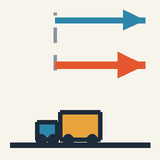
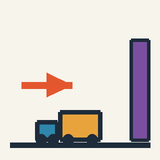
Momentum is mass times velocity: a heavy, slow cart and a light, fast one can carry the same amount.
Changing momentum takes a push lasting some time: a longer, gentler push does the same job, so soft landings hurt less.
In a crash, the momentum one object loses is exactly what the other gains, so the total stays the same.
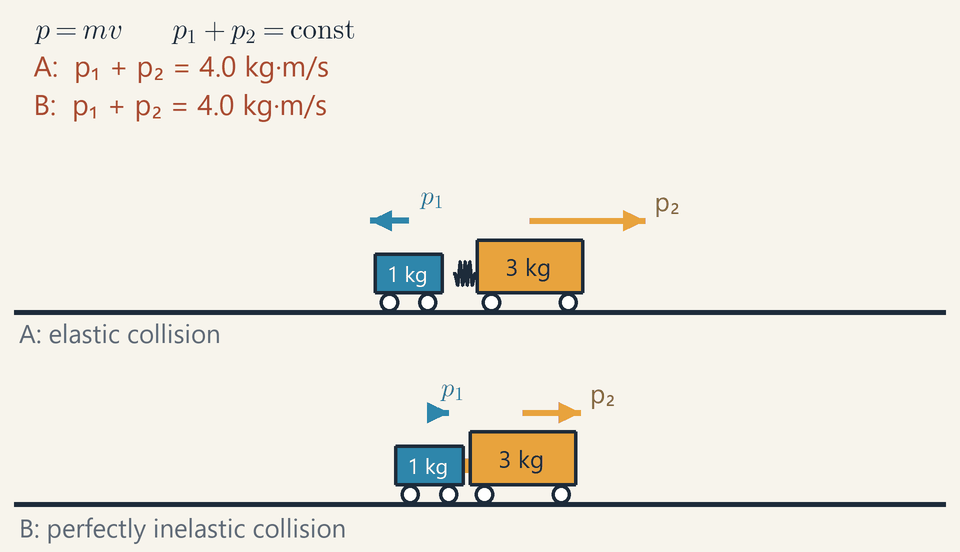
A sticky crash keeps the total momentum but turns some energy of motion into heat, sound and dents.
Why is a slowly rolling shopping trolley full of bottles so hard to stop, while a fast ping-pong ball is easy to catch? Four steps explain it.
Step 1. Multiply an object's mass by its velocity and you get its momentum, measured in kilogram metres per second. Like velocity, momentum has a direction. A heavy, slow object and a light, fast one can carry the same amount: a 4 kg cart at 1 m/s has as much momentum as a 1 kg cart at 4 m/s.
Step 2. To change momentum you must push for some time, and the longer the push lasts, the gentler it can be. That is why you bend your knees when you jump down from a wall: the stop lasts longer, so the force on you is smaller.
Step 3. In a collision the two objects push on each other equally hard, in opposite directions, for exactly the same time. So the momentum one loses is precisely what the other gains, and the total stays the same, as long as nothing outside, such as friction or a wall, joins in. This is the conservation of momentum.
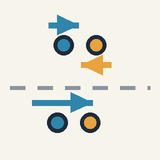
Step 4. The animation shows one crash twice: a light, fast cart hits a heavy cart at rest. With a springy bumper the light cart bounces back and the heavy one rolls away; with a sticky pad they roll on together, more slowly. The total momentum is the same either way. Only the energy of motion differs: the springy bounce keeps it, the sticky crash turns part of it into heat, sound and dents.
Check yourself: a firework shell at rest bursts into two equal halves. One half flies east. What does the other do? Answer: it flies west at the same speed, so the total momentum stays zero.
Intermediate
Key ideas
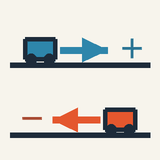
p=mv is a vector: choose a positive direction and give velocities the other way a minus sign.
With no external horizontal force, m1v1+m2v2=m1v1′+m2v2′ in every collision, elastic or not.
Perfectly inelastic: both share v′=(m1v1+m2v2)/(m1+m2); here K drops from 8J to 2J.
Elastic, target at rest: v1′=(m1−m2)v1/(m1+m2), v2′=2m1v1/(m1+m2), and K is unchanged.
Momentum: mass times velocity
The momentum of a body is its mass multiplied by its velocity: p=mv
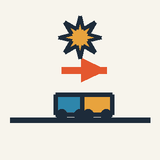
It is measured in kilogram metres per second (kg·m/s). Momentum has a direction: pick a positive direction along the track, and anything moving the other way has negative momentum. Mass and speed can stand in for each other: the 1 kg cart in the animation, arriving at 4 m/s, carries 1⋅4=4kg⋅m/s, as much as both carts together, 4 kg, would carry at 1 m/s.
Momentum is not kinetic energy. K=21mv2 has no direction and grows with the square of the speed: the 1 kg cart at 4 m/s has 8 J, but the same 4 kg·m/s carried by 4 kg at 1 m/s is only 2 J.
Impulse and the force–time graph
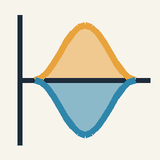
A force changes momentum, and the change depends on how long it acts. For a steady force, Newton's second law F=ma=mΔv/Δt becomes FΔt=Δp. The product FΔt is the impulse J, in newton seconds (1 N·s = 1 kg·m/s); when the force varies, the impulse is the area under the force–time graph.
The same area can be tall and narrow or low and wide. A 70 kg person jumping down from 1 m lands at about 4.4 m/s, so the floor must remove about 310 kg·m/s. Landing stiff-legged stops the body in roughly 0.02 s, which takes an average net force near 15 kN, over 20 times body weight; bending the knees stretches the stop to 0.3 s and cuts the force to about 1 kN.
Why the total momentum is conserved
When two carts collide, each pushes on the other. By Newton's third law the two forces are equal and opposite at every instant, and they act for the same time, the duration of the contact. Their force–time graphs are mirror images, so the impulses are equal and opposite: whatever momentum cart 2 gains, cart 1 loses. The total is the same before and after: m1v1+m2v2=m1v1′+m2v2′
Primes mark velocities after the collision, and every velocity keeps its sign. The law does not care whether the forces between the carts are springy, sticky or explosive. It needs only that no outside force acts along the track, or that outside forces are too weak or brief to matter: a rolling friction of 0.3 N acting during the 0.16 s contact changes the momentum by about 0.05 kg·m/s, about 1 % of the total.
Elastic and inelastic collisions
Momentum conservation is one equation, but a head-on collision has two unknown final velocities; the second condition concerns the kinetic energy. In an elastic collision it is conserved, as with steel balls or spring bumpers. In an inelastic collision part of it becomes heat, sound and deformation. In a perfectly inelastic collision the bodies stick and share one velocity.
For these two cases the final velocities have closed formulas; the elastic pair assumes that body 2 starts at rest.
v′=m1+m2m1v1+m2v2
v1′=m1+m2(m1−m2)v1,v2′=m1+m22m1v1
The first needs only momentum conservation; the second uses both laws, and it implies that elastic bodies separate at the speed at which they approached. Equal masses swap velocities, as in Newton's cradle. A light body hitting a much heavier one bounces back at almost its full speed, like a ball off a wall; a heavy body hitting a light one hardly slows, and the light one flies off at nearly 2v1.
Worked example: the two tracks in the animation
Both tracks start alike: m1=1kg arrives at v1=4m/s and m2=3kg waits at rest. The total momentum is 1⋅4=4kg⋅m/s and the kinetic energy 21⋅1⋅42=8J.
On track B the sticky pad joins the carts, which then share one velocity: v′=1+31⋅4+3⋅0=1m/s Their kinetic energy is now 21⋅4⋅12=2J: 6 J went into heat and squashing the pad. On track A the springy bumper makes the collision elastic: v1′=1+3(1−3)⋅4=−2m/s v2′=1+32⋅1⋅4=2m/s Check: 1⋅(−2)+3⋅2=4kg⋅m/s and 21⋅1⋅22+21⋅3⋅22=8J. The carts approached at 4 m/s and separate at 2−(−2)=4m/s.
Watch the arrows. The blue p1 arrow starts 4 units long, one unit per kg·m/s; on track B it shrinks to 1, while on track A it shrinks through zero and returns pointing left, 2 units long. The gold p2 arrow grows to 3 units on B and to 6 on A. Head to tail they always make 4 units, and both readouts show p1+p2=4.0kg⋅m/s throughout, even during the contact.
The bounce takes twice the impulse: in the same 0.16 s, cart 2 gains 6 kg·m/s on A, an average force of 6/0.16=37.5N, but 3 kg·m/s on B, 18.75 N.
Worked example: a rear-end crash
A 1500 kg car at 20 m/s runs into the back of a 1000 kg car moving the same way at 10 m/s, and they lock together. During the 0.1 s crash road friction is negligible, so momentum is conserved: v′=1500+10001500⋅20+1000⋅10=16m/s
The kinetic energy falls from 21⋅1500⋅202+21⋅1000⋅102=350kJ to 21⋅2500⋅162=320kJ: 30 kJ goes into crumpled metal.
Now let the small car come the other way, at v2=−10m/s. The wreck moves at (1500⋅20−1000⋅10)/2500=8m/s and keeps only 21⋅2500⋅82=80kJ: 270 kJ is lost, nine times as much, because the cars close at 30 m/s instead of 10 m/s. Both feel the same average force of 180 kN, yet the small car's velocity changes by 18 m/s in 0.1 s, a deceleration of about 18 g, and the big car's by only 12 m/s.
Common mistakes
Forgetting the sign. On track A the small cart rebounds at −2m/s; counted as positive, the momenta would add up to 2+6=8kg⋅m/s instead of 4.
Believing that a sticky collision destroys momentum. The joined carts on track B still carry 4 kg·m/s; what disappears is kinetic energy, 6 of the 8 J.
Thinking that the heavier or faster body pushes harder. The forces are equal and opposite, 37.5 N on each cart on track A; the lighter cart just changes its velocity more, by 6 m/s against 2 m/s.
Ignoring an outside force that keeps acting. A 0.5 kg ball falling for 1 s gains about 4.9 kg·m/s because gravity pulls it; only the ball and the Earth together keep a constant total. Keep both colliding bodies in the system.
Using the elastic formulas for every collision. They assume no loss of kinetic energy and a target at rest; on track B they would predict −2 and +2m/s instead of the shared 1 m/s.
Where you meet it
Airbags, helmets and crumple zones lengthen collisions so that the same change of momentum needs a smaller force. Guns recoil: a 4 kg rifle firing a 10 g bullet at 800 m/s kicks back at 0.01⋅800/4=2m/s. Rockets throw exhaust backwards to move forwards, with no air to push against. Next, Work, Energy and Power follows the kinetic energy that collisions keep or lose, and Angular Momentum and Its Conservation applies the same idea to spinning bodies.
Advanced
Key ideas
∫Fdt=Δp; two bodies push on each other equally and oppositely at every instant, so internal forces cannot change ∑p.
Symmetry plus Galilean relativity: equal masses that meet head-on and stick must stop, so seen from a moving car m⋅2v=2m⋅v.
K=21Mvcm2+21μvrel2; a collision scales only the relative part by e2, so sticking (e=0) loses most.
Momentum conservation expresses the homogeneity of space: it holds per component, in relativity (p=γmv) and with field momentum.
The second law in momentum form
This section rewrites Newton's second law in terms of momentum. That is the form that generalises: it handles impacts whose force nobody can measure, systems of many bodies and, later in the lesson, rockets.
The general form of the second law is not F=ma but F=dp/dt, with p=mv: the net force on a body equals the rate at which its momentum changes. For a constant mass the two forms agree, because the mass can be taken outside the derivative: d(mv)/dt=mdv/dt=ma. The momentum form is also the one that survives beyond Newtonian mechanics: in special relativity γmv replaces mv, and in electromagnetism the fields themselves carry momentum.
Multiply both sides by dt and add up over the whole contact, from the instant it begins to the instant it ends. The left side becomes the impulse J and the right side the total change of momentum. This is the impulse–momentum theorem: J=∫Fdt=Δp
Its value lies in what it does not need. The force during an impact rises and falls within a fraction of a second and is rarely known in detail, yet only its integral decides the motion afterwards. A 46 g golf ball leaves the club at 70 m/s after about 0.5 ms of contact. Its momentum changes by 0.046⋅70≈3.2kg⋅m/s, so the average force is 0.046⋅70/0.0005≈6400N, whatever the shape of the pulse. Because the theorem is a vector equation, it holds for each component separately: a horizontal impulse changes only px and leaves py alone.
Internal forces cancel in pairs
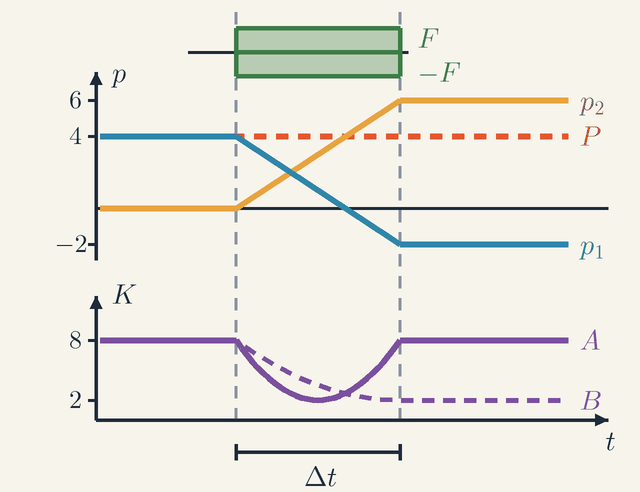
Why does the total momentum of two colliding carts stay the same, however hard they push on each other? Because every push comes with an equal and opposite push back. In the animation a 1 kg cart 1 arrives at 4 m/s and hits a 3 kg cart 2 at rest; on track A they meet through a springy bumper, on track B through a sticky pad. Figure 1 shows track A during the contact; the general proof follows it.
Figure 1. Track A during its contact Δt (time axis zoomed). The forces F and −F are equal and opposite, so p1 and p2 follow mirror ramps and their sum P stays flat; K dips and recovers on track A but stays low on B.Legend
t
Time, the same axis for all three graphs.
s
Δt
Duration of the contact.
s
F
Force of the bumper on cart 2; cart 1 feels −F. Constant here; it is the slope of the p2 ramp.
N
p
Momentum along the track: the vertical axis of the middle graph.
kg⋅m/s
p1
Momentum of cart 1: from 4 down to −2 during the contact.
kg⋅m/s
p2
Momentum of cart 2: from 0 up to 6 during the contact.
kg⋅m/s
P
Total momentum p1+p2 (dashed): flat at 4 throughout.
kg⋅m/s
K
Total kinetic energy of the two carts.
J
A
Track A, springy bumper: K dips to 2 J mid-contact, then returns to 8 J.
B
Track B, sticky pad (dashed): K falls to 2 J and stays there.
Figure 1 follows the contact, which lasts Δt; the time axis t is stretched so that the contact fills the middle of the picture. Read it from top to bottom. The top strip is the force: the bumper pushes cart 2 forward with F and cart 1 backward with −F. By the third law the two are equal and opposite at every instant. In this figure the force is also constant while the contact lasts.
The middle graph shows the momenta. Because dp/dt equals the force, the slope of each momentum graph is the force on that cart, and a constant force draws a straight ramp. p2 climbs with slope F from 0 to 6, and p1 falls with slope −F from 4 to −2kg⋅m/s: cart 1 bounces back. Cart 2 gains 6 kg·m/s in Δt=0.16s, so F=6/0.16=37.5N. Now look at the dashed line P=p1+p2. The two ramps are mirror images, so whatever one cart gains the other loses at the same moment, and P stays at 4 kg·m/s through the whole collision, not only before and after it. The expert layer of the animation plots the same curves.
The flat line does not depend on the force being constant. A real spring pushes harder the more it is squeezed, which bends the ramps into S-shaped curves; they are still mirror images, and their sum is still flat.
The same cancellation works for any number of bodies. The force on body i is the sum of the forces Fij exerted on it by each other body j of the system (internal forces) and of whatever acts from outside (external forces). Add up dpi/dt over all bodies. Every internal pair appears twice in the sum, once as Fij and once as Fji, and the third law makes Fij+Fji=0. Only the external forces survive. With P the total momentum, M the total mass, vcm the velocity of the centre of mass and Fext the sum of all external forces: dtdP=Fext P=∑imivi=Mvcm The second line is the definition of the centre of mass, rcm=∑imiri/M, differentiated once.
So the total momentum changes only through external forces, and the centre of mass moves like a single particle of mass M pushed by their sum. If Fext=0, P is constant, however complicated the internal forces are. If only one component of Fext is zero, for instance the horizontal one when gravity acts vertically, that component of P is still conserved.
Kinetic energy can hide, momentum cannot
The bottom graph of Figure 1 shows the total kinetic energy K of the two carts, and it behaves quite differently from P. On track A, K dips during the contact, down to 2 J at the instant both carts move at 1 m/s, then climbs back to 8 J as the bumper pushes them apart. The missing 6 J was not lost: for a moment it was stored in the squeezed spring of the bumper. On track B, with the sticky pad, K falls to 2 J and stays there (dashed): the 6 J has gone into deforming and warming the pad.
Track B also needs less force. The pair leaves together at 1 m/s, so cart 2 gains only 3⋅1=3kg⋅m/s, and over the same 0.16 s the average force is 3/0.16=18.75N, half that of track A. The two graphs together carry the main message: energy can be parked inside the bodies, as spring energy or as heat, but momentum has nowhere to hide, and it balances at every instant.
Conservation from symmetry
Momentum conservation can also be derived without the third law, from two statements about symmetry. This matters because the third law is not exact (see Limits of validity below), while momentum conservation has never been seen to fail; the symmetry argument shows where the law really comes from.
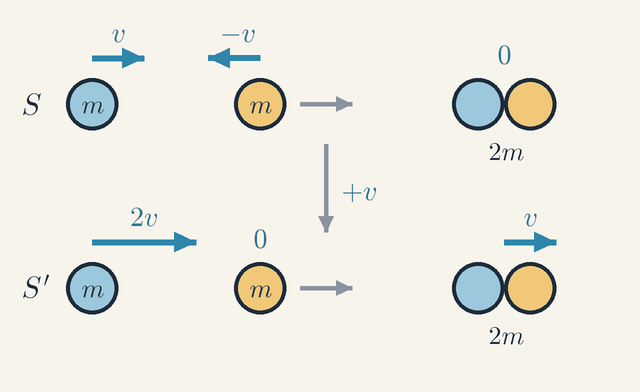
Figure 2. One collision seen from two frames. Top, frame S: equal balls meet at v and −v, stick and, by symmetry, stop. Bottom, frame S′, where every velocity is larger by v: a ball at 2v hits one at rest and the pair leaves at v.Legend
S
Frame of the ground (top row).
S′
Frame of a car moving with the right-hand ball, at −v relative to the ground (bottom row).
m
Mass of each of the two identical balls; stuck together they have 2m.
kg
v
Speed of each ball in S; +v is the shift of every velocity from S to S′. All arrows share one scale, so 2v is twice as long as v.
m/s
Figure 2 shows one collision seen from two frames of reference, before it on the left and after it on the right. The first assumption is mirror symmetry. In the top row, in the frame S of the ground, two identical balls of mass m approach each other at v and −v and stick. Nothing in this situation prefers left to right, so the stuck pair, of mass 2m, cannot move either way: it stays at rest.
The second assumption is Galilean relativity: an observer moving at constant velocity finds the same laws of physics, with every velocity shifted by the same amount. Take as S′ the frame of a car keeping pace with the right-hand ball, which moves at −v relative to the ground. Seen from that car, every velocity is larger by v, as the arrow +v between the rows says. The bottom row follows: the right ball is at rest, the left ball arrives at 2v, and the pair, which stood still in S, leaves at v.
So a mass m at 2v striking an equal mass at rest gives 2m at v, and the bottom row balances: m⋅2v=2m⋅v. Speeds alone do not balance (2v in, v out), and neither does kinetic energy (2mv2 in, mv2 out); the product of mass and velocity does. Building bodies of other masses from equal units and repeating the same change of frame extends the result to any pair of masses, and the quantity that always comes out the same is ∑mv.
The argument also works backwards. Any two-body collision, watched from the frame that moves with the centre of mass, has total momentum zero: the bodies arrive with equal and opposite momenta, like the top row. For the animation's carts that frame moves at 1 m/s. In it cart 1 brings +3 and cart 2 brings −3kg⋅m/s, and on track B the stuck pair simply stops.
The general statement is Noether's theorem (1918): every continuous symmetry of the laws of physics comes with a conserved quantity. If the laws are the same everywhere, so that moving the whole apparatus to another place changes nothing (space is homogeneous), momentum is conserved. Invariance under shifts in time gives conservation of energy, and invariance under rotations conservation of angular momentum. Because it rests on a symmetry rather than on the third law, momentum conservation holds even where the third law fails.
Energy in the centre-of-mass frame
How much kinetic energy can a collision remove, and what are the final velocities? Both questions become simple in the frame that moves with the centre of mass. This section splits the kinetic energy into a part that no collision can touch and a part that it can, and finds the final velocities without solving a quadratic equation.
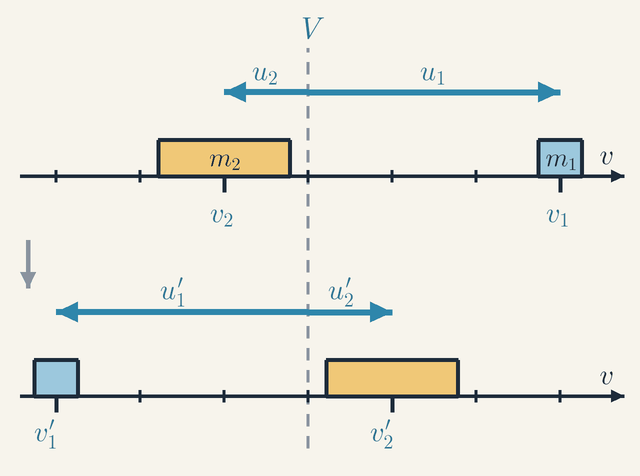
Figure 3. Velocities on one axis. The centre-of-mass velocity V lies nearer the heavier cart, and u1, u2 are measured from it. An elastic collision (e=1) reverses both, so v1′ and v2′ are the mirror images of v1 and v2 in the dashed line.Legend
v
Velocity: positions on the axis are velocities.
m/s
V
Velocity of the centre of mass (dashed line), written vcm in the equations.
m/s
m1
Mass of cart 1 (one block wide).
kg
m2
Mass of cart 2 (three blocks wide).
kg
v1
Velocity of cart 1 before the collision.
m/s
v2
Velocity of cart 2 before the collision.
m/s
u1
Velocity of cart 1 relative to the centre of mass, v1−V.
m/s
u2
Velocity of cart 2 relative to the centre of mass, v2−V.
m/s
v1′
Velocity of cart 1 after the collision.
m/s
v2′
Velocity of cart 2 after the collision.
m/s
u1′
Velocity of cart 1 relative to the centre of mass after the collision: −eu1, here −u1.
m/s
u2′
Velocity of cart 2 relative to the centre of mass after the collision: −eu2, here −u2.
m/s
Figure 3 places the velocities of the animation's carts on one axis v: cart 1, m1=1kg, at v1=4m/s, and cart 2, m2=3kg, at v2=0; the width of each block shows its mass. The dashed line marks the velocity of the centre of mass, called V in the figure and vcm in the equations: vcm=m1+m2m1v1+m2v2=41⋅4+3⋅0=1m/s
Measured from the dashed line, the carts move at u1=v1−vcm=+3m/s and u2=v2−vcm=−1m/s: the two arrows of the top row. In this frame the total momentum is zero, m1u1+m2u2=1⋅3+3⋅(−1)=0, so the arrows are inversely proportional to the masses, and the heavy cart sits three times closer to V than the light one.
A collision cannot move the dashed line, because the internal forces leave the total momentum, and with it vcm, unchanged. It can only change u1 and u2, and afterwards they must still satisfy m1u1′+m2u2′=0. Both therefore change by the same factor. The carts separate instead of passing through each other, so the factor is negative or zero, and we write it as −e: ui′=−eui The number e is the coefficient of restitution. Since u1−u2=v1−v2=vrel, the relative velocity, it can also be read as e=−vrel′/vrel: the fraction of the relative motion that survives the collision, from 1 for an elastic collision to 0 for a sticky one.
The lower row of Figure 3 is the elastic case, e=1: u1′ and u2′ are the old arrows turned around, so the final velocities v1′ and v2′ are the mirror images of v1 and v2 in the dashed line. To return to the frame of the track, add vcm back: vi′=vcm+ui′=vcm−e(vi−vcm) vi′=(1+e)vcm−evi For e=1 this gives v1′=2⋅1−4=−2m/s and v2′=2⋅1−0=+2m/s, the result on track A. A smaller e shortens both arrows by the same factor; at e=0 they vanish, and both carts leave together at V, as on track B.
Now the kinetic energy. Substitute vi=vcm+ui into K=∑i21mivi2 and expand the square: K=21Mvcm2+vcm∑imiui+∑i21miui2 The middle term is zero, because ∑imiui=0. What remains is K=21Mvcm2+Krel with M=m1+m2. The first term is the energy of the centre of mass, and no internal force can change it, because the momentum fixes vcm. The second, Krel, is the energy of motion relative to the centre of mass, and a collision acts only on it. For two bodies it depends only on the relative velocity. From m1u1+m2u2=0 and u1−u2=vrel follow u1=m2vrel/M and u2=−m1vrel/M; then 21m1u12+21m2u22=21m1m2(m2+m1)vrel2/M2, which simplifies to Krel=21μvrel2,μ=m1+m2m1m2 where μ is called the reduced mass.
Since Krel is proportional to vrel2, a collision multiplies it by e2. For the animation M=4kg, vcm=1m/s, μ=0.75kg and vrel=4m/s. The 8 J therefore splits into 21⋅4⋅12=2J that no collision can touch and 21⋅0.75⋅42=6J of relative motion. An elastic bumper gives all 6 J back. Sticking (e=0) removes all 6 J, the largest loss that momentum conservation allows, and the 2 J left is what track B keeps.
Worked problem: a half-elastic bumper
Fit the carts with a bumper of e=0.5: same masses, and cart 1 again arrives at 4 m/s on cart 2 at rest. Find (a) the final velocities, (b) the kinetic energy lost, (c) the average force if the contact still lasts 0.16 s, and (d) the value of e that leaves cart 1 at rest.
(a) The centre of mass still moves at vcm=1m/s, and 1+e=1.5: v1′=(1+e)vcm−ev1=1.5⋅1−0.5⋅4=−0.5m/s v2′=(1+e)vcm−ev2=1.5⋅1−0=1.5m/s Cart 1 bounces back slowly. Momentum checks: 1⋅(−0.5)+3⋅1.5=4kg⋅m/s, as before.
(b) The 2 J of the centre of mass stays, and the 6 J of relative motion is multiplied by e2=0.25: K=2+0.25⋅6=3.5J, so 8−3.5=4.5J is lost. Directly: 21⋅1⋅0.52+21⋅3⋅1.52=0.125+3.375=3.5J.
(c) Cart 2 gains 3⋅1.5=4.5kg⋅m/s. With v2=0 the formula gives v2′=(1+e)vcm, so this is (1+e) times the 3 kg·m/s of the sticky case. Over 0.16 s it takes an average force of 4.5/0.16≈28N, between the 18.75 N of track B (e=0) and the 37.5 N of track A (e=1).
(d) Cart 1 stops when v1′=0, that is when (1+e)vcm=ev1, or 1+e=4e, so e=1/3. Cart 2 then carries all 4 kg·m/s, at 4/3≈1.33m/s, and K=2+6/9≈2.67J. In general, with the target at rest, the striker stops when e=m1/m2. A striker that stops dead is therefore the sign of an elastic collision only between equal masses; here it takes a rather lossy bumper.
Glancing collisions
In two or three dimensions momentum conservation is one equation per component. For two bodies in a plane, momentum gives two equations and energy, if the collision is elastic, a third, but the two final velocities have four components. The missing piece of information is the geometry of the impact, and a collision that is not head-on has to settle directions as well as speeds.
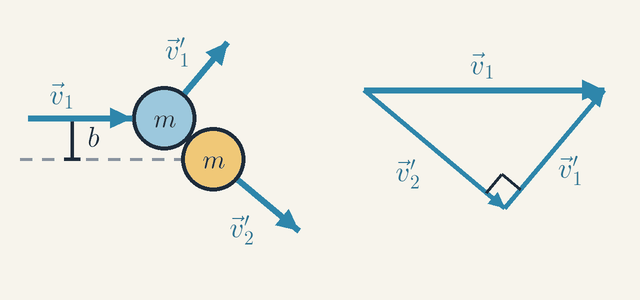
Figure 4. Two identical balls, ball 2 at rest, collide off-centre by the offset b. Ball 2 leaves along the line of centres and ball 1 at right angles to it; the velocities close into a right triangle, v1=v1′+v2′.Legend
m
Mass of each of the two identical balls.
kg
b
Offset: distance between the path of ball 1 and the parallel line through the centre of ball 2.
m
v1
Velocity of ball 1 before the collision; ball 2 is at rest.
m/s
v1′
Velocity of ball 1 after the collision, across the line of centres.
m/s
v2′
Velocity of ball 2 after the collision, along the line of centres.
m/s
Figure 4 shows an off-centre elastic collision of two identical balls of mass m, ball 2 at rest. Ball 1 comes in with velocity v1 along a path that misses the centre of ball 2 by the offset b. At the moment of contact the line joining the two centres is therefore tilted away from the path. For smooth balls without spin, the contact force acts along this line of centres, and nothing acts across it.
Split each velocity into a component along the line of centres and one across it. Across the line there is no force, so those components do not change. Along the line the collision is a head-on elastic collision of equal masses, which swaps the two velocities: ball 1 hands its whole component along the line to ball 2. So ball 2 leaves along the line of centres with v2′, and ball 1 keeps only its component across the line, v1′, which is perpendicular to v2′. If the balls have radius R, the line of centres makes an angle φ with the incoming path, with sinφ=b/(2R), and the speeds afterwards are v2′=v1cosφ and v1′=v1sinφ. A head-on hit (b=0) passes everything to ball 2; a graze (b close to 2R) leaves ball 1 almost undisturbed.
The triangle on the right reaches the right angle without any geometry of the contact. Momentum conservation, with the equal masses cancelled, gives v1=v1′+v2′: the three velocities close into a triangle. Energy conservation gives v12=v1′2+v2′2. Squaring the first equation gives v12=v1′2+v2′2+2v1′⋅v2′, and comparing it with the second leaves v1′⋅v2′=0. The two legs meet at a right angle: after a glancing elastic collision of equal masses, one of them at rest, the balls leave at right angles to each other (in a head-on hit ball 1 simply stops). A snooker ball struck without spin nearly does this, and so do the tracks of slow protons striking protons at rest.
Rockets and variable mass
A rocket changes its own mass as it burns fuel, so F=ma cannot be applied to it directly. The safe route is momentum conservation for the rocket together with the exhaust it throws out.
Take a rocket of mass m moving at v, far from other forces, that ejects exhaust backwards at speed w relative to itself. In a short time dt its mass changes by dm (a negative amount), its velocity by dv, and a mass −dm of exhaust leaves at velocity v−w. Momentum before and after must agree: mv=(m+dm)(v+dv)+(−dm)(v−w) Multiplying out, mv appears on both sides, the two terms vdm cancel, and the product dmdv of two small changes is negligible. What remains is mdv=−wdm. Dividing by m and integrating from the initial mass m0 to the final mass mf gives Δv=wlnmfm0
Only the exhaust speed and the mass ratio matter, and the mass ratio enters only through a logarithm. With w=3km/s and nine tenths of the launch mass as propellant, m0/mf=10 and Δv=3ln10≈6.9km/s. That is short of the 7.8 km/s of a low orbit even before the losses to gravity and air drag. Dropping empty tanks along the way lowers the mass that is left to accelerate, which is why rockets are built in stages.
Limits of validity
Newtonian momentum mv is an approximation, valid for speeds far below the speed of light, c≈3.00×10⁸m/s. The quantity that is really conserved is γmv, with γ=1/1−v2/c2. At 0.6c, γ=1.25, so the true momentum is already 25 % larger than mv, and in particle collisions kinetic energy can even become the mass of new particles. For the carts at 4 m/s the correction is of order v2/c2≈2×10−16.
The third law is not exact either. Two charges moving at right angles to each other exert magnetic forces on each other that are not equal and opposite, so their combined mechanical momentum changes. The total balances only when the momentum stored in the electromagnetic field is counted as well. Light itself carries momentum, p=E/c for light of energy E. Sunlight above the atmosphere delivers 1361 W/m²; on a sheet that absorbs it, this gives a pressure of 1361/(3.00×108)≈4.5×10−6N/m2, about 4.5 µN on each square metre, enough to steer a solar sail.
In quantum mechanics momentum is tied to wavelength, p=h/λ, and its conservation has held in every interaction ever observed. It has even predicted particles. In beta decay the emitted electron seemed to break the conservation of energy, because its energy varied from one decay to the next. In 1930 Pauli proposed that an unseen neutral particle carries off the difference. Later measurements of the recoiling nucleus showed that it carries off momentum too: the electron and the nucleus did not fly apart with equal and opposite momenta. The neutrino was detected in 1956.
Where this leads
Invariance under rotations leads to Angular Momentum and Its Conservation, and the rotational form of the second law to Rotational Dynamics and Torque. The energy side of collisions is in Work, Energy and Power. Gas pressure is the momentum that countless molecular impacts deliver to each square metre of the walls each second, as Kinetic Theory of Gases shows, and γmv, with the conversion of energy into mass, belongs to Special Relativity. In Particles and Forces: the Standard Model, the balance of momentum and energy reveals particles that leave no track.
Key formulas
Momentum
p=mv
Momentum combines how much matter moves with how fast it moves. It is a vector along the velocity, so along a line its sign gives the direction. Doubling either the mass or the speed doubles it, which is why a light, fast body and a heavy, slow one can carry the same amount.
Symbols
p
momentum
kg⋅m/s
m
mass of the body
kg
v
velocity of the body (signed)
m/s
When it holds: Exact in Newtonian mechanics. Near the speed of light it becomes γmv, larger than mv; light, which has no mass, still carries momentum E/c.
Example: The animation's 1 kg cart at 4 m/s: p=1⋅4=4kg⋅m/s. The 3 kg cart would match it at only 1.33 m/s.
Conservation of momentum in a two-body collision
m1v1+m2v2=m1v1′+m2v2′
During the contact the two bodies push on each other with equal and opposite forces for the same time, so their changes of momentum are equal and opposite and the sum stays the same. Unprimed velocities are before the collision, primed ones after, all with their signs. It holds for every kind of collision: elastic, inelastic or explosive.
Symbols
m1
mass of body 1
kg
m2
mass of body 2
kg
v1
velocity of body 1 before the collision
m/s
v2
velocity of body 2 before the collision
m/s
v1′
velocity of body 1 after the collision
m/s
v2′
velocity of body 2 after the collision
m/s
When it holds: Only when the net external force along the line is zero or negligible during the collision. It holds for each component separately, and on its own it does not fix both final velocities: a second condition, such as the energy balance, is needed.
Example: Track A: 1⋅4+3⋅0=1⋅(−2)+3⋅2=4kg⋅m/s.
Common velocity after a perfectly inelastic collision
v′=m1+m2m1v1+m2v2
When the bodies stick, they share one final velocity, so the total momentum is simply divided by the total mass. This is also the velocity of the centre of mass, before and after. The kinetic energy always drops, by 21μvrel2.
Symbols
v′
common velocity of the joined bodies
m/s
m1
mass of body 1
kg
m2
mass of body 2
kg
v1
velocity of body 1 before the collision
m/s
v2
velocity of body 2 before the collision
m/s
When it holds: Requires momentum conservation (no significant external force during the impact) and that the bodies move together afterwards. Velocities in opposite directions enter with opposite signs.
Example: Track B: v′=(1⋅4+3⋅0)/(1+3)=1m/s, and the kinetic energy falls from 8 J to 2 J.
Elastic head-on collision with a target at rest
v1′=m1+m2(m1−m2)v1,v2′=m1+m22m1v1
Solving the conservation of momentum and of kinetic energy together gives these two velocities. The bodies separate at the speed at which they approached, v2′−v1′=v1. If m1<m2 the striker bounces back (v1′<0); equal masses exchange velocities; a very heavy target sends the striker back at almost −v1.
Symbols
v1′
velocity of the striker after the collision
m/s
v2′
velocity of the target after the collision
m/s
m1
mass of the striker
kg
m2
mass of the target, initially at rest
kg
v1
velocity of the striker before the collision
m/s
When it holds: Only for a perfectly elastic, head-on collision with body 2 initially at rest. For a moving target, use vi′=2vcm−vi, or work in the frame where the target is at rest.
Example: Track A: v1′=(1−3)⋅4/4=−2m/s and v2′=2⋅1⋅4/4=2m/s.
Impulse–momentum theorem
J=∫Fdt=Δp
Integrating Newton's second law, F=dp/dt, over time shows that the change of momentum equals the impulse, the area under the force–time graph. Only that area matters: a large force for a short time and a small force for a long time give the same change. It is a vector equation, valid for each component.
Symbols
J
impulse delivered by the force
N⋅s
F
net force on the body, which may vary in time
N
t
time, integrated over the interval during which the force acts
s
Δp
change of momentum, final minus initial
kg⋅m/s
When it holds: Always, for the net force on a body. For a system of bodies the internal forces drop out, and only external impulses change the total momentum.
Example: On track A cart 2 gains 6 kg·m/s in 0.16 s: the average force is 6/0.16=37.5N.
Kinetic energy of relative motion and reduced mass
Krel=21μvrel2,μ=m1+m2m1m2
The kinetic energy of two bodies splits into a centre-of-mass part, 21Mvcm2, which no internal force can change, and this relative part. A collision with coefficient of restitution e multiplies Krel by e2, so Krel is the most energy a collision can turn into heat and deformation. The reduced mass is smaller than either mass and close to the lighter one when the other is much heavier.
Symbols
Krel
kinetic energy of the relative motion
J
μ
reduced mass
kg
vrel
relative velocity, v1−v2
m/s
m1
mass of body 1
kg
m2
mass of body 2
kg
When it holds: Newtonian mechanics, any two bodies, in any number of dimensions (with the size of the relative velocity). For the loss in a collision, use the relative velocity just before impact.
Example: Animation: μ=1⋅3/4=0.75kg and Krel=21⋅0.75⋅42=6J, exactly the energy lost on track B.
Glossary
Momentum
Mass times velocity, p=mv: a vector that points along the velocity. Unlike kinetic energy it has a direction, and it grows only in proportion to the speed, not with its square.
Impulse
The change of momentum that a force produces by acting for some time: FΔt for a steady force, the area under the force–time graph in general. A small force acting for long and a large force acting briefly can give the same impulse.
Conservation of momentum
The total momentum of a system stays constant as long as no net external force acts on it. It holds in every collision and explosion, elastic or not.
Isolated system
A chosen group of bodies on which the net external force is zero, or negligible during the time of interest. The two carts during their 0.16 s contact are a good example.
Internal and external forces
Internal forces act between bodies of the chosen system and cancel in pairs by Newton's third law; external forces come from outside it. Only external forces can change the total momentum.
Elastic collision
A collision in which the total kinetic energy is the same before and after, as with steel balls or spring bumpers. In a head-on elastic collision the bodies separate at the speed at which they approached.
Inelastic collision
A collision in which part of the kinetic energy becomes heat, sound or lasting deformation. The total momentum is still conserved.
Perfectly inelastic collision
A collision in which the bodies stick together and move on with one common velocity. It loses the largest share of kinetic energy that momentum conservation allows: 6 of the 8 J in the animation.
Coefficient of restitution
The speed of separation divided by the speed of approach, e=−vrel′/vrel. It is 1 for an elastic collision and 0 for a perfectly inelastic one.
Centre of mass
The mass-weighted average position of a system. Its velocity, vcm=P/M, is fixed by the total momentum, so no collision between the bodies can change it.
Centre-of-mass frame
The reference frame that moves with the centre of mass, where the total momentum is zero. Every two-body collision looks symmetric there: the bodies approach with equal and opposite momenta.
Recoil
The backward motion of a body that pushes something else forward, such as a gun firing a bullet or a rocket ejecting exhaust. Starting from rest, the two momenta are equal and opposite.
Quantities
p
Momentum
kg⋅m/s
Mass times velocity, with a sign that gives the direction along the chosen axis. The 1 kg cart at 4 m/s carries 4 kg·m/s.
m
Mass
kg
The inertia of a body: for a given change of momentum, a larger mass means a smaller change of velocity.
v
Velocity
m/s
The velocity of a body along the track, with a sign for its direction; unprimed velocities are those before the collision.
v′
Velocity after the collision
m/s
A prime marks a value after the collision. Without a subscript, v′ is the common velocity of bodies that stick together.
J
Impulse
N⋅s
The integral of a force over time, equal to the change of momentum it causes; 1 N·s is the same as 1 kg·m/s.
F
Force
N
A push or pull on a body; the net force equals the rate of change of the body's momentum, F=dp/dt.
vcm
Velocity of the centre of mass
m/s
Total momentum divided by total mass, P/M, and unchanged by any collision: 1 m/s in the animation.
vrel
Relative velocity
m/s
The velocity of body 1 as seen from body 2, v1−v2: 4 m/s before the collision in the animation.
μ
Reduced mass
kg
m1m2/(m1+m2), the mass that goes with the relative motion. It is smaller than either mass: 0.75 kg for the 1 kg and 3 kg carts.
Krel
Kinetic energy of relative motion
J
The part of the kinetic energy that a collision can change, 21μvrel2: 6 J in the animation, all of it lost when the carts stick.
Quiz
Beginner Which has more momentum: a 1000 kg car at 2 m/s or a 50 kg runner at 8 m/s?
The car
The runner
They have the same momentum
Neither: momentum only exists during collisions
Show answer
Answer: A. The car
p = m·v: the car has 1000 × 2 = 2000 kg·m/s, the runner 50 × 8 = 400 kg·m/s. Speed alone does not decide.
Beginner A 40 kg child and an 80 kg adult stand still on the ice, facing each other, and push apart. What happens next?
Both glide away at the same speed
Only the one who pushed harder moves
The child glides away faster than the adult, in the opposite direction
They both move the same way
Show answer
Answer: C. The child glides away faster than the adult, in the opposite direction
The total momentum was zero and stays zero, so the two momenta are equal and opposite: 40 × (child's speed) = 80 × (adult's speed), and the child moves twice as fast. Both feel the same push (Newton's third law), whichever of them does the pushing.
Beginner A small moving cart hits a big cart at rest and they stick together. How do the joined carts move?
Faster than the small cart arrived
Forward, but slower than the small cart arrived
Backward
They stop dead
Show answer
Answer: B. Forward, but slower than the small cart arrived
The total momentum is kept, but it is now shared by more mass, so the common speed is lower and in the original direction.
Intermediate A 2 kg cart at 3 m/s collides with a 1 kg cart at rest and they stick together. What is their common speed?
1 m/s
1.5 m/s
2 m/s
3 m/s
Show answer
Answer: C. 2 m/s
v' = m₁·v₁ / (m₁ + m₂) = 6 ÷ 3 = 2 m/s. Dividing by the moving mass only would give 3 m/s, and averaging the speeds gives 1.5 m/s.
Intermediate A 0.5 kg ball hits a wall at 4 m/s and bounces straight back at 4 m/s. What is the size of its change in momentum?
0 kg·m/s
2 kg·m/s
4 kg·m/s
8 kg·m/s
Show answer
Answer: C. 4 kg·m/s
Δp = m·(v' − v) = 0.5 × (−4 − 4) = −4 kg·m/s. The speed is the same but the direction reversed, so the change is not zero.
Intermediate A 1 kg cart at 4 m/s hits a 3 kg cart at rest. Which outcome is impossible?
Both carts move together at 1 m/s
The 1 kg cart bounces back at 2 m/s and the 3 kg cart moves at 2 m/s
The 1 kg cart stops and the 3 kg cart moves at 1.33 m/s
The 1 kg cart bounces back at 4 m/s and the 3 kg cart moves at 2.67 m/s
Show answer
Answer: D. The 1 kg cart bounces back at 4 m/s and the 3 kg cart moves at 2.67 m/s
All four keep the total momentum at 4 kg·m/s, but the last one ends with ½·1·4² + ½·3·2.67² ≈ 18.7 J of kinetic energy, more than the 8 J available. A collision can keep or lose kinetic energy, but it cannot create it without an energy source such as an explosion.
Advanced A force F(t) acts on a body for a short time. The change in its momentum equals:
∫F·dx
∫F·dt
F·Δx
½·F·Δt²
Show answer
Answer: B. ∫F·dt
From F = dp/dt, integrating over time gives Δp = ∫F·dt, the impulse. ∫F·dx is the work, which changes kinetic energy instead.
Advanced A moving body sticks to an identical body at rest. What fraction of the kinetic energy is lost?
0
1/4
1/2
3/4
Show answer
Answer: C. 1/2
The lost energy is K_rel = ½·μ·v² with μ = m/2, which is half of the initial ½·m·v². The other half remains as centre-of-mass motion.
 Physics Tutor