Arrows with a size and a direction: adding and resolving vectors, the relative-velocity rule v=v′+u, and why a boat aimed straight across a river lands downstream.
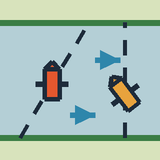
A boat crosses a river: its velocity relative to the bank is its velocity through the water plus the velocity of the water.
A scalar is just a number (mass, time, temperature); a vector also has a direction (velocity, displacement, force).
Add vectors head to tail: 3 m east then 4 m north leaves you 5 m from the start, although you walked 7 m.
Velocities add too: walking along a moving walkway your speeds add; walking against it they cancel.
A boat aimed straight across lands downstream, but the current does not make the crossing take longer.
Some quantities are fully described by one number: a mass of 2 kg, a time of 10 s, a temperature of 20 °C. These are scalars. Others also need a direction: "the station is 2 km away" does not tell you which street to take. Speed (how fast) is a scalar; velocity (how fast and which way) is a vector, like displacement and force. We draw a vector as an arrow: its length shows the size, its tip the direction.
Quick check: is "15 m/s towards the south" a speed or a velocity? Answer: a velocity, because it has a direction.
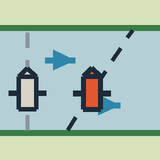
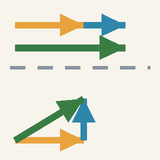
To add two vectors, put the tail of the second arrow at the tip of the first; the sum runs from the very start to the very end. Walk 3 m east, then 4 m north: you end 5 m from the start. You walked 7 m, but your displacement is the 5 m arrow.
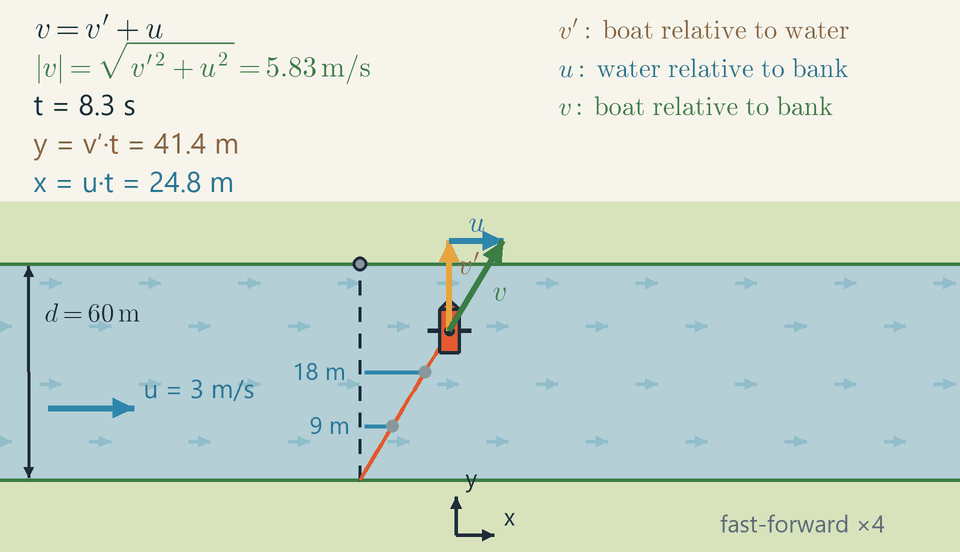
Velocities add the same way. On a moving walkway you stroll at 1 m/s while the belt carries you at 2 m/s, so someone beside it sees you pass at 3 m/s. Walk backwards at 2 m/s and you stay level with them: the velocities cancel.
Quick check: you walk at 1.5 m/s towards the back of a train moving at 20 m/s. How fast do you pass someone on the platform? Answer: 18.5 m/s, in the train's direction.
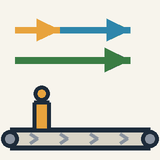
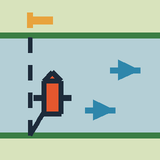
In the animation a boat crosses a river 60 m wide. The rower aims straight at the far bank, but the water carries the boat along a slanted line. The grey dots show it drifting 9 m every 3 seconds, 36 m in all. Yet the trip still takes 12 seconds, as in still water: the current adds a sideways motion, not a delay.
Intermediate
Key ideas
Components: Ax=Acosθ, Ay=Asinθ; magnitude ∣A∣=Ax2+Ay2. Add vectors component by component.
Relative velocity: vboat/bank=vboat/water+vwater/bank; the inner label cancels.
Aimed straight across: t=d/v′, drift x=ut, ground speed v′2+u2; here 12 s, 36 m and 5.83 m/s.
Add magnitudes only for parallel vectors: 5 m/s and 3 m/s at right angles give 5.83 m/s, not 8 m/s.
Scalars, vectors and components
After two walks at right angles, you stand nearer your start than the total distance you walked. A mass of 2 kg or a time of 12 s is complete with one number and a unit. Such quantities are scalars and add like ordinary numbers. Displacement, velocity, acceleration and force also need a direction: they are vectors. A vector is written with an arrow, A; its size, the magnitude, is written ∣A∣ or simply A and is never negative. Speed is the magnitude of the velocity vector.
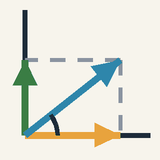
To calculate with a vector, choose two perpendicular axes and project the arrow onto each. If A makes an angle θ with the x axis, measured towards the y axis, its components and its magnitude are related by
Ax=Acosθ,Ay=Asinθ
∣A∣=Ax2+Ay2
Components are signed: Ax is negative when the arrow points towards negative x. The second line is Pythagoras' theorem, and the direction comes back from tanθ=Ay/Ax. In this lesson x points downstream along the river and y straight across it, towards the far bank.
Adding and subtracting vectors
To add two vectors, place the tail of the second at the tip of the first; the sum, or resultant, runs from the first tail to the last tip. In components the rule is plain addition, axis by axis: if C=A+B, then Cx=Ax+Bx and Cy=Ay+By, in any order.
Magnitudes add only for parallel arrows. A 5 m step followed by a 3 m step gives 8 m if both go the same way, 2 m if they are opposite, and 52+32≈5.83m at right angles; any other angle gives something in between. Subtracting means adding the reversed arrow, A−B=A+(−B): drawn from a common starting point, it runs from the tip of B to the tip of A.
Relative velocity: a chain of frames
A velocity is always measured relative to something. Let v′ be the boat's velocity relative to the water, u the water's velocity relative to the bank (the current), and v the boat's velocity relative to the bank. In each second the boat moves v′ through the water while the water carries it u along the bank, and the two displacements add head to tail: v=v′+u
A label rule keeps the order straight: vboat/bank=vboat/water+vwater/bank. The inner labels match and cancel, leaving boat relative to bank. Swapping two labels reverses the arrow: relative to the water, the bank moves upstream at −u.
With x downstream and y across, a boat pointed straight across has v′=(0,v′) and the current is u=(u,0), so v=(u,v′). The components act independently: the across one alone takes the boat over a river of width d, the along one alone carries it downstream. Its ground speed, crossing time and drift are therefore ∣v∣=v′2+u2 t=v′d,x=v′ud
Worked example: the boat in the animation
The rower moves at v′=5m/s through the water, the current flows at u=3m/s, and the river is d=60m wide. The boat points straight across. ∣v∣=52+32=34≈5.83m/s t=560=12s,x=3⋅12=36m
The track makes an angle φ with the line straight across, with tanφ=u/v′=3/5, so φ≈31∘ downstream. Over the ground the boat covers 602+362≈70m, which is also 5.83⋅12. These are the final values of the readouts: y=v′t and x=ut grow steadily and stop at 60 m and 36 m when t reaches 12 s.
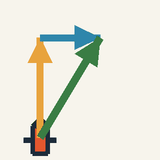
The arrows riding on the boat draw the sum: the gold v′ points straight across, the blue u starts at its tip, and the green v closes the triangle along the dashed track. The grey marks every 3 s show the drift growing by 9 m each time, to 9, 18, 27 and 36 m, while the boat advances 15 m across: the track is straight because neither component changes.
Worked example: an aircraft in a crosswind
A light aircraft flies at 250 km/h relative to the air, towards an airfield 360 km due north, while the wind blows towards the east at 70 km/h. The air plays the part of the water: v′=250km/h, u=70km/h and d=360km.
If the pilot simply points north, the plane needs 360/250=1.44h to go 360 km north, and meanwhile the wind carries it 70⋅1.44≈101km east of the airfield. To fly a straight track due north, she must point partly into the wind, so that the westward component of v′ cancels the wind. The velocity through the air is now the hypotenuse: sinα=v′u,t=v′2−u2d
Here sinα=70/250=0.28, so she heads α≈16.3∘ west of north. The ground speed is 2502−702=240km/h, and the flight takes 360/240=1.5h. The correction costs 3.6 minutes and removes the 101 km error. Pilots call α the wind correction angle.
Reading the velocity triangle
Every relative-velocity problem is a triangle of v′, u and v; first decide which side is the hypotenuse. When the boat points straight across, v′ and u are the legs and the ground velocity is the hypotenuse, longer than either: 5.83 m/s. When the boat must travel straight across, v becomes a leg and v′ the hypotenuse, so the useful speed shrinks to 52−32=4m/s and the crossing takes 15 s. The second boat of the expert view does this.
Along the river the triangle collapses into a line: rowing downstream the boat makes 5+3=8m/s over the ground, rowing upstream only 5−3=2m/s. If the current were faster than the rower, u>v′, no heading could hold the boat on the line straight across.
Common mistakes
Adding speeds as plain numbers. The rower's 5 m/s and the current's 3 m/s give 8 m/s only when both point downstream; at right angles they give 5.83 m/s.
Thinking that the current delays the crossing. It has no component across the river, so the boat aimed straight across still needs 60/5=12s; the current changes where it lands, not when.
Confusing heading and track. The boat points along v′ but moves along v, here 31° further downstream: the bow shows the heading, the dashed trail the track.
Swapping sine and cosine. The cosine goes with the side next to the angle: a rope pulling with 50 N at 20° above the horizontal gives 50cos20∘≈47N horizontally and 50sin20∘≈17N vertically.
Expecting a current to cancel out on a round trip. Rowing 60 m upstream at 2 m/s and back at 8 m/s takes 30+7.5=37.5s, against 24 s in still water: the slow leg lasts longer, so it weighs more.
Where you meet it
Pilots and ferry crews correct for wind and current, and a swimmer caught in a rip current is told to swim parallel to the beach, across the flow. Rain falling vertically at 6 m/s streaks the side windows of a car doing 18 m/s at about 72° from the vertical, because relative to the car the drops also move backwards. Spacecraft dock by matching their velocity to the station's, not to the Earth's.
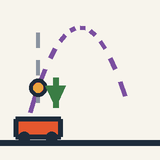
The same toolkit returns throughout mechanics. Projectile Motion splits a throw into independent horizontal and vertical motions, like the boat's across and along motions; Newton's Laws of Motion treats force as a vector; and Circular Motion shows that a velocity can change by turning alone.
Advanced
Key ideas
A vector is defined by how it transforms: its components change with the axes like those of a step in space, so a vector law holds in any orientation.
Galilean change of frame: r=r′+ut gives v=v′+u and a=a′: all inertial frames agree on accelerations.
Galilean addition is the low-speed limit: relativity gives v=(v′+u)/(1+v′u/c2), which never exceeds c.
What makes a quantity a vector
A vector is usually introduced as a quantity with a size and a direction. That is a good start, but the exact test is different: it is how the quantity's components behave when the axes are turned. This test matters, because it is the reason a vector law can be written on any axes we like.
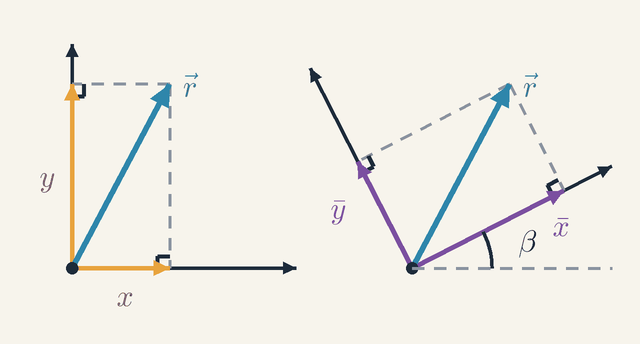
Figure 1. One displacement r drawn twice. On the right the axes are turned through β but the arrow stays put: its components change from x and y to xˉ and yˉ, read at the feet of the dashed perpendiculars.Legend
r
A displacement: the same arrow in both drawings.
m
x
Component of r along the original first axis.
m
y
Component of r along the original second axis.
m
xˉ
Component of r along the turned first axis.
m
yˉ
Component of r along the turned second axis.
m
β
Angle through which the axes are turned, anticlockwise.
rad
Figure 1 draws one displacement r twice. On the left, dashed perpendiculars from the tip of r meet the two axes; the distances from the origin to their feet are the components x and y. On the right the axes have been turned anticlockwise through the angle β, while the arrow r has not moved. The same construction, with perpendiculars to the new axes, gives new components xˉ and yˉ. The arrow exists before any axes are drawn; its components do not.
To find the new components, split r into its two old pieces, x along the old first axis and y along the old second axis, and project each piece onto the new axes. The new first axis makes the angle β with the old first axis and 90∘−β with the old second axis, so the pieces contribute xcosβ and ysinβ. The new second axis makes 90∘+β with the old first axis and β with the old second, so the pieces contribute −xsinβ and ycosβ. Together: xˉ=xcosβ+ysinβ,yˉ=−xsinβ+ycosβ
This rule is the real definition. A vector is any quantity whose components change with the axes exactly as those of a displacement do.
Velocity passes the test. It is a displacement Δr divided by the time Δt, and Δt is a scalar, the same on every set of axes, so dividing by it leaves the rule intact. Acceleration, a change of velocity divided by a time, passes for the same reason, and so does force.
Now take a vector equation such as F=ma or v=v′+u. It states that the components on its two sides are equal. Both sides change by the same linear rule when the axes turn, so if they are equal on one set of axes they are equal on every set. Taking x along the river is a convenience, not physics.
Some combinations of components do not change at all when the axes turn; they are called invariants. The length is one: squaring and adding the two equations above, the cross terms cancel and cos2β+sin2β=1, so xˉ2+yˉ2=x2+y2. More generally, the scalar product of two vectors, A⋅B=AxBx+AyBy=ABcosγ, where γ is the angle between the arrows, is the same on every set of axes.
Take the boat of this lesson, aimed straight across a river 60 m wide. Relative to the water it moves at v′=(0,5)m/s, the current is u=(3,0)m/s, and relative to the bank it moves at v=(3,5)m/s, of magnitude 34≈5.83m/s. Then v′⋅v=0⋅3+5⋅5=25m2/s2, and cosγ=25/(5⋅5.83)≈0.857 gives γ≈31∘. That is the angle between where the boat points and where it actually goes, found from components alone, without a drawing. Turn the axes through β≈59∘, so that xˉ lies along the track, and the ground velocity reads (5.83,0)m/s: other numbers, the same arrow, the same length.
A size and a direction are therefore not quite enough. Turning a book through 90° about some axis has both, an axis and an angle, yet two such turns about different axes do not add like vectors: the book ends up in a different position if the order is swapped, whereas A+B=B+A. Only very small rotations commute, to first order in the angle. That is why angular velocity, a rate of very small rotations, is a vector, while a finite rotation is not.
Changing frames: the Galilean transformation
Figure 1 turned the axes. Relative motion asks what happens when the axes move: how do positions, velocities and accelerations measured from a moving platform compare with those measured from the ground? The answer is the Galilean transformation, and it tells us which quantities every observer agrees on.
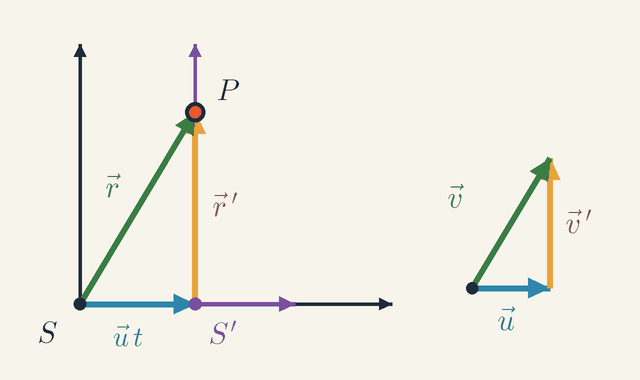
Figure 2. Left: after a time t the water frame S′ has slid ut downstream of the bank frame S, so the boat's positions satisfy r=r′+ut. Right: every arrow divided by t gives v=v′+u.Legend
S
Bank frame: black axes at rest on the ground.
S′
Water frame: purple axes, parallel to those of S, drifting with the current.
ut
How far the origin of S′ has been carried in the time t.
m
P
The boat at the time t.
r′
Position of the boat in the water frame, measured from the origin of S′.
m
r
Position of the boat in the bank frame, measured from the origin of S.
m
u
Velocity of the water frame relative to the bank: the current.
m/s
v′
Velocity of the boat relative to the water.
m/s
v
Velocity of the boat relative to the bank.
m/s
A frame of reference is a set of axes together with a clock. Figure 2 uses two. The bank frame S has black axes fixed to the ground. The water frame S′ has purple axes, parallel to those of S, that drift with the current at the constant velocity u. The two sets of axes coincide at t=0, and both frames read the same clock, so t means the same in both.
The left of Figure 2 is a snapshot at the time t. The origin of S′ has been carried a distance ut along the river: for the 3 m/s current, 36 m downstream after 12 s. The boat, at the point P, left the common origin aimed straight across. In the water frame it is r′ from the origin of S′, 60 m straight up the purple axis. In the bank frame it is r from the origin of S. The three arrows form a triangle: going from the origin of S straight to P is the same as going first to the origin of S′ and then on to P. So a point at r′ in S′ is, in S, at r=r′+ut
Differentiate with respect to t. Because u is constant, d(ut)/dt=u, and the velocities add: v=v′+u For the boat, which moves uniformly from the common origin, each side of the left triangle is t times a velocity, so dividing every side by t gives the velocity triangle on the right of Figure 2. Differentiate once more. The constant u has zero derivative, so it drops out altogether: a=a′
Velocities depend on the observer; accelerations do not. Masses and forces are agreed on as well, so if F=ma holds in S, it holds in S′. A frame in which Newton's laws hold is called inertial. The result says that any frame moving at constant velocity relative to an inertial frame is itself inertial, and no mechanical experiment done entirely inside it can reveal that motion. This is the principle of relativity of mechanics. Galileo made the point with the cabin of a ship sailing smoothly: drops from a bottle fall straight down, just as they do in harbour.
The transformation is also a tool: solve a problem in the frame where it is simplest, then add u. In the water frame the river is a still lake. The boat goes straight across at 5 m/s and needs 60/5=12s, while the bank slides past upstream at 3 m/s. The drift of 36 m is simply the length of bank that slides by during the crossing.
The same velocity triangle tilts starlight. The Earth orbits the Sun at 30 km/s, so light arriving at the speed c appears to come from a direction turned by up to v/c≈10−4rad, about 20 arcseconds. This is the aberration of light, found by James Bradley in the 1720s.
Every heading at once: the velocity diagram
The rower chooses only the heading; the current is given. Which ground velocities can the boat reach, and which heading is best for a given aim? One drawing, the velocity diagram, answers this for every heading at once. Here it is drawn for u<v′, like the lesson's 3 m/s current and 5 m/s rower.
Figure 3. Velocity diagram for u<v′. The tip of v′ can lie anywhere on the dashed circle of radius v′, and v runs from O to it. Notice that O is inside the circle, so v can point in any direction.Legend
x
Axis along the river, pointing downstream.
y
Axis straight across the river, towards the far bank.
O
Starting point of the diagram, where u and v begin.
u
Velocity of the current, drawn from O.
m/s
v′
Velocity of the boat relative to the water: its length is always v′, so its tip stays on the circle.
m/s
v
Velocity of the boat relative to the bank, u+v′.
m/s
θ
Heading: how far v′ points upstream of straight across (the dashed vertical).
rad
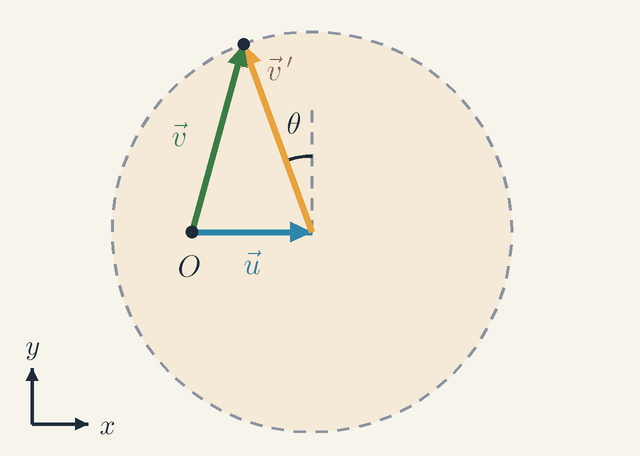
Build Figure 3 in three steps. First draw the current u from a point O. Next attach the boat's velocity through the water, v′, at the tip of u. Its length is fixed at v′, but the rower can point it anywhere, so its tip can lie anywhere on the dashed circle of radius v′ centred on the tip of u. Last, the ground velocity v=u+v′ runs from O to that point on the circle.
The figure shows one heading. The dashed vertical through the tip of u is straight across, and v′ leans to its left, upstream, by the angle θ. Now look at where O sits. Because u<v′, O lies inside the circle, so a line from O in any direction meets the circle: every direction of v is possible, straight across included. The top of the circle gives the largest across component, v′ itself, and hence the fastest crossing.
To turn the picture into numbers, use the axes in the corner of the figure: x downstream and y across, towards the far bank. Leaning upstream means pointing towards negative x, so v′=(−v′sinθ,v′cosθ),v=(u−v′sinθ,v′cosθ) Only the across component v′cosθ carries the boat over the width d, so it fixes the crossing time. During that time the along component carries the boat downstream by the drift x: t(θ)=v′cosθd,x(θ)=v′cosθ(u−v′sinθ)d
The crossing is fastest at θ=0, where cosθ is largest, whatever the current: 60/5=12s, with 3⋅12=36m of drift. The drift vanishes when the upstream part of v′ cancels the current, v′sinθ=u. Call this heading α: sinα=u/v′=0.6, so α≈36.9∘. Then cosα=0.8, the ground velocity is v=(0,4)m/s, a 3–4–5 triangle, and the crossing takes 60/4=15s.
Headings in between trade time for drift. At θ=20∘ the boat crosses in 60/(5cos20∘)≈12.8s and lands (3−5sin20∘)⋅12.8≈16.5m downstream. This is the heading drawn to scale in Figure 3.
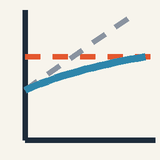
The graph in the animation's Advanced layer shows only the across motion. Each y(t) is a straight line whose slope is that boat's across velocity: 5 m/s for the boat aimed straight across, which reaches the dashed line y=d after 12 s, and 4 m/s for the purple boat heading 36.9° upstream, which arrives after 15 s. The graph cannot show the drift. On the far bank, the first boat lands 36 m downstream and the second exactly opposite its start.
When the current is not uniform
So far the current has been the same everywhere. A real river runs fastest in the middle and almost stops at the banks. Does that change where the boat lands? Surprisingly little, and the reason is worth seeing.
Take the profile u(y)=4um(y/d)(1−y/d). It is zero at both banks, y=0 and y=d, and reaches its largest value um in midstream, y=d/2; take um=4.5m/s. A boat aimed straight across still has the across velocity v′, because the current pushes only along the river. So y=v′t, and it still crosses in 12 s. Along the river its velocity is the local current, dx/dt=u(y). Since y grows steadily, it is easier to follow the boat by y than by t: with dt=dy/v′, each step across adds dx=u(y)dy/v′, and summing the steps over the width gives x=v′1∫0du(y)dy=v′uˉd where uˉ is the current averaged over the width.
For this parabola the average is uˉ=32um=3m/s, so the boat again lands 36 m downstream. Its path, though, is now a curve. At the banks the current is zero, so the boat leaves and arrives moving straight across; in midstream it slants most, at an angle φ from straight across with tanφ=4.5/5, about 42°. Only the current averaged over the width decides the drift.
The same holds for a fixed heading. The boat heading 36.9° upstream moves through the water at 3 m/s upstream and 4 m/s across. Near the banks the current is weaker than 3 m/s and the boat gains ground upstream; in midstream it is stronger and the boat loses it. Because the average is exactly 3 m/s, the boat still lands exactly opposite after 15 s, but on the way it swings 4.3 m upstream near the first bank and 4.3 m downstream near the second.
To hold the straight line all the way, the heading would have to keep turning so that v′sinθ=u(y) at every point. That needs up to 64° in midstream, where sinθ=0.9, and the slower across speed makes the crossing take about 17.9 s.
Worked problem: a river in flood
After heavy rain the current rises to u=6.25m/s, faster than the rower's 5 m/s. Can the boat still land opposite its start? If not, which heading brings it closest, and at what cost in time?
Figure 4. The flood, u>v′: O is now outside the circle, so every v points partly downstream. The least drift is along the tangent from O, which meets v′ at a right angle, so sinθ=v′/u.Legend
x
Axis along the river, pointing downstream.
y
Axis straight across the river, towards the far bank.
O
Starting point of the diagram, where u and v begin.
u
Velocity of the flood current, drawn from O.
m/s
v′
Velocity of the boat relative to the water for the best heading; its tip is where the tangent touches the circle.
m/s
v
Velocity of the boat relative to the bank, along the tangent: the direction with the least drift.
m/s
θ
Best heading: the angle between v′ and straight across (the dashed vertical).
rad
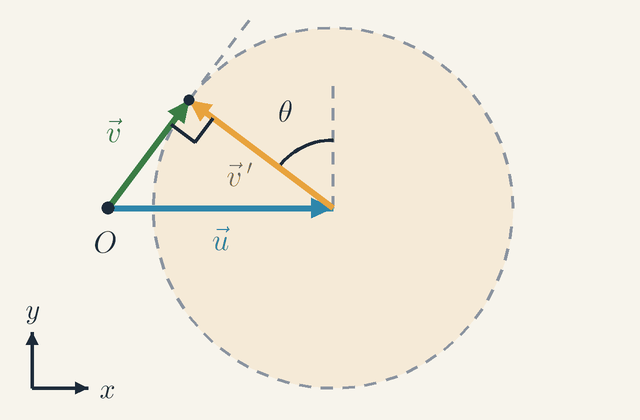
Figure 4 is the velocity diagram of Figure 3, redrawn for the flood. The arrow u is now longer than the radius of the circle, 5 m/s, so O lies outside the circle. Every arrow v from O to the circle therefore points partly downstream: landing opposite is impossible. The formula agrees, since it would need sinθ=u/v′=6.25/5=1.25. Aiming straight across still gives the fastest crossing, 12 s, but with 6.25⋅12=75m of drift.
Which heading gives the least drift? The boat moves along v, and the drift is d times the tangent of the angle between v and straight across. So the best v is the one that leans furthest upstream while still reaching the circle: the tangent from O to the circle, drawn in Figure 4. Calculus confirms it. Differentiating x(θ) with the quotient rule and using sin2θ+cos2θ=1: dθdx=v′cos2θusinθ−v′d=0⇒sinθ=uv′=0.8
So the boat heads θ≈53.1∘ upstream, the angle marked in Figure 4, and cosθ=0.6. Its across speed is 5⋅0.6=3m/s and its downstream speed 6.25−5⋅0.8=2.25m/s. The crossing takes 60/3=20s, and the drift is 2.25⋅20=45m. In general, xmin=du2−v′2/v′.
The right angle marked in Figure 4 is no accident. A tangent to a circle is perpendicular to the radius at the point of contact, and here the radius is v′, so the best v is perpendicular to v′. The scalar product checks it: with v′=(−4,3)m/s and v=(2.25,3)m/s, (−4)(2.25)+3⋅3=0. Compared with aiming straight across, heading upstream saves 30 m of drift and costs 8 s.
The water frame gives an independent check. There the boat moves at 5 m/s along its heading for 20 s, a displacement r′=(−80,60)m, while the water carries everything 6.25⋅20=125m downstream. Then r=r′+ut gives the landing point (45,60)m, as before.
Limits of validity
The rule v=v′+u rests on two assumptions: the moving frame keeps a constant velocity without turning, and all observers share one clock and one ruler. Each fails somewhere, and it is useful to know where.
Suppose the frame S′ accelerates at A relative to S. The transformation gains a term 21At2, and differentiating twice gives a=a′+A: the observers now disagree on accelerations. In a train braking at 2 m/s², a dropped ball has no horizontal acceleration relative to the ground, so relative to the train it veers forward at 2 m/s², as if pushed by a force that nothing exerts. Such apparent forces are called fictitious or inertial forces. A rotating frame adds two more of them, the centrifugal and Coriolis accelerations.
The Earth is such a rotating frame, but it turns slowly, Ω≈7.29×10⁻⁵rad/s. For the boat moving at 5.83 m/s at a latitude of 45°, the sideways Coriolis acceleration 2Ωvsin45∘ is about 6×10⁻⁴m/s2. Over the 12 s crossing that shifts the boat by 21⋅6×10−4⋅122≈4cm. For ocean currents and storms, which last for days and cover thousands of kilometres, it is decisive.
Deeper still, Galilean kinematics assumes one clock for all observers and lengths that all agree on. Light does not obey it: its speed is c≈3.00×10⁸m/s in every inertial frame. Special relativity replaces the sum of velocities along one line by v=1+v′u/c2v′+u which never exceeds c. A probe launched forward at 0.6c from a ship moving at 0.6c travels at 1.2c/1.36≈0.88c, not 1.2c. For the boat the correction is of order v′u/c2≈1.7×10−16, far below anything measurable: Galilean addition is the low-speed limit of the relativistic law.
Where this leads
Projectile Motion splits a throw into a uniform horizontal motion and a uniformly accelerated vertical one, independent of each other like the boat's along and across motions. Newton's Laws of Motion writes F=ma as a vector law that holds in the inertial frames met here. Circular Motion finds the acceleration of a body turning at constant speed by subtracting velocity vectors, and Work, Energy and Power uses the scalar product, W=F⋅Δr. Momentum and Collisions often moves to the centre-of-mass frame by exactly this Galilean shift, and Sound and the Doppler Effect depends on the velocities of source and listener relative to the air.
One question stays open. Magnetic Force on Moving Charges contains a velocity, qv×B: velocity relative to which frame? Special Relativity answers it: once the shared clock is given up, electric and magnetic fields mix from one frame to another.
Key formulas
Components of a vector
Ax=Acosθ,Ay=Asinθ
A vector of magnitude A at an angle θ from the x axis casts a shadow Acosθ on the x axis and Asinθ on the y axis. The cosine goes with the side next to the angle. Components carry signs: between 90° and 270° the x component is negative. Working in components turns arrow geometry into ordinary arithmetic, one axis at a time.
Symbols
Ax
component along the x axis (here a displacement; any vector works, in its own unit)
m
Ay
component along the y axis
m
A
magnitude of the vector
m
θ
angle from the positive x axis, measured towards the y axis
rad
When it holds: Holds for any vector in a plane, with θ measured from the positive x axis towards the positive y axis. If the angle is measured from the y axis instead, sine and cosine swap places.
Example: The boat's track over the ground, 70.0 m at 59.0° from the downstream axis: 70.0cos59.0∘≈36m of drift and 70.0sin59.0∘≈60m across.
Magnitude from components
∣A∣=Ax2+Ay2
The two components are the legs of a right triangle and the vector is its hypotenuse, so Pythagoras' theorem gives its length. The direction follows from tanθ=Ay/Ax, with the signs telling which quadrant it lies in. The magnitude comes out the same whichever pair of perpendicular axes is used.
Symbols
∣A∣
magnitude (length) of the vector
m
Ax
component along the x axis
m
Ay
component along the y axis
m
When it holds: Needs perpendicular axes. In three dimensions add Az2 under the square root.
Example: A drift of 36 m and a width of 60 m: 362+602≈70.0m of track over the ground.
Relative velocity (Galilean addition)
v=v′+u
The boat's velocity relative to the bank is its velocity relative to the water plus the water's velocity relative to the bank. In each second the boat moves v′ through the water while the water carries it u further, and displacements add head to tail. The labels chain: boat/bank = boat/water + water/bank. It is a vector sum: add components, not speeds.
Symbols
v
velocity of the boat relative to the bank
m/s
v′
velocity of the boat relative to the water
m/s
u
velocity of the water relative to the bank (the current)
m/s
When it holds: Holds for frames moving at a constant velocity relative to each other and sharing one clock. In an accelerating or rotating frame, extra terms appear; near the speed of light, the relativistic addition law replaces it.
Example:v′=(0,5)m/s and u=(3,0)m/s give v=(3,5)m/s.
Ground speed when aimed straight across
∣v∣=v′2+u2
When the boat points straight across, its velocity through the water and the current are at right angles, so they are the legs of the velocity triangle and the ground velocity is the hypotenuse. The ground speed is therefore larger than either speed, but smaller than their sum v′+u.
Symbols
∣v∣
speed relative to the bank
m/s
v′
speed relative to the water
m/s
u
speed of the current
m/s
When it holds: Only when v′ is perpendicular to u. For other headings add the components; for a boat that must travel straight across, v′ is the hypotenuse and the speed is v′2−u2.
Example:52+32=34≈5.83m/s, not 8 m/s.
Crossing time and drift when aimed straight across
t=v′d,x=v′ud
Only the across component of the velocity carries the boat over the river, and when the boat points straight across that component is its whole speed through the water, v′. So the crossing takes d/v′, exactly as in still water. During that time the current, which runs along the river, carries the boat ut downstream.
Symbols
t
crossing time
s
d
width of the river
m
v′
speed relative to the water
m/s
x
drift: distance downstream of the point opposite the start
m
u
speed of the current
m/s
When it holds: For a uniform current parallel to straight banks and a boat aimed straight across. If the current varies across the river, u is replaced by its average over the width.
Example:t=60/5=12s and x=3⋅60/5=36m.
Heading to land opposite, and the crossing time
sinα=v′u,t=v′2−u2d
To travel straight across, the upstream component of the velocity through the water, v′sinα, must cancel the current u. The velocity through the water is then the hypotenuse of the triangle, and the speed left for crossing is v′2−u2, which sets the time. Landing opposite always takes longer than aiming straight across.
Symbols
α
heading, measured upstream from straight across
rad
u
speed of the current
m/s
v′
speed relative to the water
m/s
t
crossing time
s
d
width of the river
m
When it holds: Only if u<v′: at u=v′ the boat would have to point straight upstream and would never cross. When the current is faster, no heading cancels it, and the least drift comes from heading upstream with sinθ=v′/u.
Example:sinα=3/5=0.6, so α≈36.9∘, and t=60/52−32=60/4=15s.
Galilean transformation
r=r′+ut,a=a′
A point that is at r′ in a frame moving at constant velocity u is at r′+ut in the original frame, if the two frames coincide at t=0 and share one clock. Differentiating once gives the addition of velocities; differentiating twice gives equal accelerations, because u is constant. That is why Newton's second law has the same form in every inertial frame.
Symbols
r
position in the bank frame
m
r′
position in the water frame
m
u
velocity of the water frame relative to the bank frame (constant)
m/s
t
time, the same in both frames
s
a
acceleration in the bank frame
m/s2
a′
acceleration in the water frame
m/s2
When it holds: For frames in uniform relative motion, without rotation, and for speeds far below c. Special relativity replaces it with the Lorentz transformation, in which time also changes from one frame to the other.
Example: In the water frame the boat goes straight across and is at r′=(0,60)m after 12 s; adding ut=(36,0)m gives the landing point (36,60)m.
Glossary
Scalar
A quantity fully described by one number with its unit, such as mass, time, temperature or energy. Scalars add like ordinary numbers and do not change when the axes are turned. Speed is a scalar; velocity is not.
Vector
A quantity with a magnitude and a direction, drawn as an arrow: displacement, velocity, acceleration, force. Strictly, a quantity whose components change with the axes exactly as those of a displacement do.
Component
The projection of a vector on an axis, such as Ax=Acosθ: a signed number. Components depend on the axes chosen; the vector itself does not.
Resultant
The sum of several vectors, drawn from the tail of the first to the tip of the last when they are placed head to tail. Its magnitude equals the sum of the magnitudes only for parallel vectors: 5 and 3 at right angles give 5.83, not 8.
Velocity triangle
The triangle formed by v′, u and their sum v. Most river and wind problems come down to deciding which side is the hypotenuse: the ground velocity when the craft aims across, its velocity through the water or air when it must travel across.
Reference frame
The body from which motion is measured, with its axes and its clock: here the bank or the water. Positions and velocities depend on the frame; for frames moving steadily relative to each other, accelerations do not.
Relative velocity
The velocity of one body as measured from another, such as the boat relative to the water. Relative velocities chain like their labels, and swapping the labels reverses the arrow: vB/A=−vA/B.
Heading and track
The heading is the direction in which a boat or aircraft points; the track is the direction in which it actually moves over the ground. They differ whenever a current or wind has a component across the heading: in the animation the track is 31° downstream of the heading.
Drift
The sideways displacement caused by a current or wind, measured from the point the craft aimed at. For a boat aimed straight across, x=ud/v′: 36 m in the animation.
Galilean transformation
The rule r=r′+ut that converts positions between two frames in uniform relative motion sharing one clock. It leads to the addition of velocities and to equal accelerations in both frames.
Inertial frame of reference
A frame in which a body with no force on it keeps a constant velocity, so that Newton's laws hold. Any frame moving at constant velocity relative to an inertial frame is inertial too; an accelerating or rotating one is not.
Principle of relativity
No experiment done entirely inside an inertial frame can reveal its uniform motion: the laws of mechanics take the same form in all of them. Seen from a raft drifting with the current, the boat simply crosses a still lake.
Quantities
v′
Velocity relative to the water
m/s
How the boat moves through the water, set by the rower. Its direction is the heading and its magnitude v′ is 5 m/s in the animation.
u
Velocity of the current
m/s
How the water moves relative to the bank, 3 m/s downstream in the animation; it is also the velocity of the water's frame relative to the bank's.
v
Velocity relative to the bank
m/s
The boat's velocity over the ground, v′+u. It points along the track, not along the boat. Its magnitude, the ground speed, is v′2+u2≈5.83m/s for the boat aimed straight across and 4 m/s for the boat that lands opposite.
a
Acceleration
m/s2
The rate of change of the velocity. It is the same in the bank and water frames, a=a′, because u is constant; it is zero for both boats in the animation.
θ
Angle
rad
In the component formulas, the direction of a vector measured from the x axis; in the crossing problems, the heading measured upstream from straight across. It is usually quoted in degrees: 180∘=πrad.
α
Heading to land opposite
rad
The upstream heading at which the current is cancelled, sinα=u/v′: 36.9° in the animation.
d
River width
m
The distance between the banks, measured straight across: 60 m in the animation.
t
Time
s
Time since the boat left the bank, the same in the bank and water frames. The crossing takes 12 s when aimed straight across, 15 s when landing opposite.
x
Drift (downstream position)
m
Position along the river, measured downstream from the starting point; when the boat lands it is the drift, 36 m in the animation.
r
Position vector
m
The arrow from the origin to the body; its components are the coordinates (x,y). It is written r′ when measured in the water frame.
Quiz
Beginner Which of these quantities is a vector?
Mass
Temperature
Velocity
Time
Show answer
Answer: C. Velocity
A vector has a size and a direction. Velocity says how fast and which way; mass, temperature and time are just numbers with units.
Beginner A swimmer aims straight across a flowing river, swimming as hard as she would in a still lake. Compared with the lake, how long does the crossing take?
Longer, because the current fights against her
The same time, but she lands downstream
Less time, because the current helps her along
She can never reach the other bank
Show answer
Answer: B. The same time, but she lands downstream
The current flows along the river, so it adds a sideways drift but nothing to her speed across. She covers the width at her own swimming speed and lands downstream.
Intermediate A boat moves at 4 m/s relative to the water and points straight across a river flowing at 3 m/s. What is its speed relative to the bank?
5 m/s
7 m/s
1 m/s
3.5 m/s
Show answer
Answer: A. 5 m/s
The two velocities are at right angles, so |v| = √(4² + 3²) = 5 m/s. Adding the magnitudes (7 m/s) only works for parallel vectors, and subtracting them (1 m/s) only for opposite ones.
Intermediate A force of 10 N pulls at 30° above the horizontal. What is its horizontal component?
5.0 N
11.5 N
8.7 N
10 N
Show answer
Answer: C. 8.7 N
The horizontal side is adjacent to the angle: 10 × cos 30° ≈ 8.7 N. 5.0 N is the vertical component (10 × sin 30°), and a component can never be larger than the vector itself.
Intermediate A boat moves at 5 m/s relative to the water and points straight across a river 60 m wide that flows at 3 m/s. How far downstream does it land?
60 m
18 m
100 m
36 m
Show answer
Answer: D. 36 m
The crossing takes t = 60 ÷ 5 = 12 s, and during that time the current carries the boat 3 × 12 = 36 m downstream.
Advanced Seen by someone on a raft drifting with the current, how does the boat in the animation (pointing straight across) move?
Diagonally at 5.83 m/s, just as seen from the bank
Straight across at 5 m/s
Straight downstream at 3 m/s
Diagonally upstream at 5.83 m/s
Show answer
Answer: B. Straight across at 5 m/s
In the water's frame, subtract u from every velocity: v′ = v − u = (0, 5) m/s. The raft sees the boat move straight across at its own rowing speed; the drift exists only in the bank's frame.
Advanced A boat moves at v′ relative to the water in a river flowing at u < v′. Which heading reaches the opposite bank in the shortest time?
Upstream, with sin α = u/v′
45° downstream
Slightly downstream, to use the current
Straight across, whatever the current
Show answer
Answer: D. Straight across, whatever the current
The crossing time is t = d/(v′·cos θ), smallest at θ = 0. The current is parallel to the banks, so no heading can borrow speed from it in the across direction.
Advanced The current flows faster than the boat can move through the water (u > v′). What is true?
It cannot land directly opposite; the least drift comes from heading upstream with sin θ = v′/u
It can still land directly opposite by heading upstream with sin α = u/v′
It cannot reach the other bank at all
Its drift is smallest when it points straight across
Show answer
Answer: A. It cannot land directly opposite; the least drift comes from heading upstream with sin θ = v′/u
sin α = u/v′ would exceed 1, so the drift cannot be cancelled. Any heading with an across component still reaches the bank, and minimising the drift x(θ) gives sin θ = v′/u, upstream.
 Physics Tutor