General relativity: mass and energy curve spacetime, so clocks near a mass run slow, τ=t1−rs/r, and light bends by 4GM/(c2b). A mass squeezed inside rs=2GM/c2 becomes a black hole, and accelerated masses send out gravitational waves.
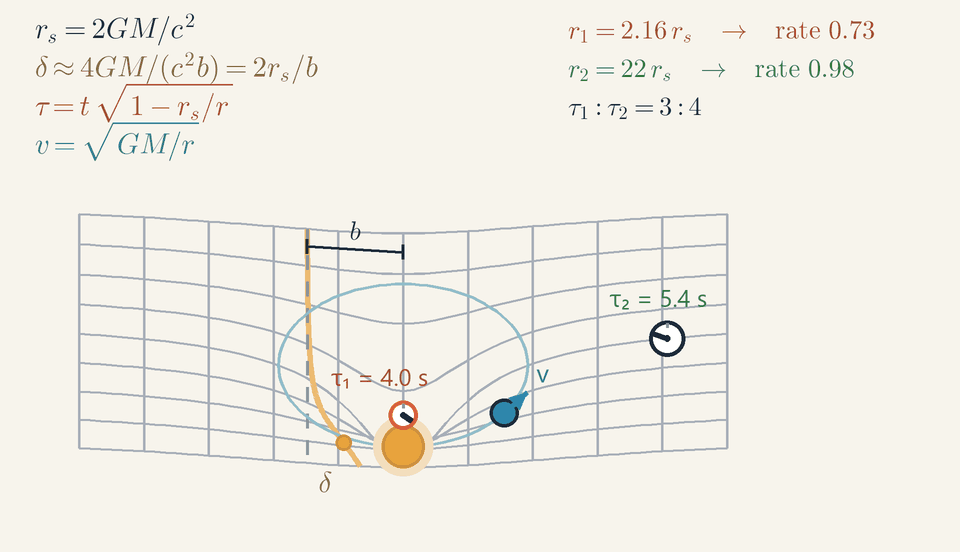
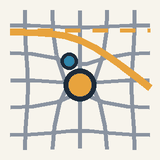
A star dents a grid that stands for spacetime: a ball orbits in the dent, a light ray bends as it passes, and a clock on the star ticks more slowly than a clock far away.
Heavy and light things fall exactly alike, so Einstein saw falling as a property of space and time, not of the objects.
In a closed cabin you cannot tell gravity from steady acceleration, or free fall from empty space: the equivalence principle.
Mass curves space and time: planets follow the curve in their orbits, and light passing a star bends.
Clocks near a mass tick more slowly; GPS must correct for it, or positions would drift by about 10 km a day.
Black holes trap even light; merging black holes send out gravitational waves, first detected in 2015.
Drop a hammer and a feather where there is no air, as an astronaut once did on the Moon, and they land together. Every object falls with the same acceleration, whatever its mass or material. Einstein, in 1915, took it as a clue: if everything falls alike, perhaps falling is not something done to objects but a property of space and time themselves.
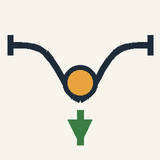
A spacecraft in orbit is not beyond gravity: it falls around the Earth all the time, and the crew and their pencils fall with it, so they float. Now picture a closed cabin. If it falls freely, you float as if gravity had vanished. If it is a rocket speeding up far from any planet, you are pressed to the floor as if by gravity. From inside you cannot tell the difference: this is the equivalence principle.
Einstein's answer is general relativity: mass and energy curve space and time, and a body left alone follows the straightest path it can through that curved spacetime. The rubber sheet in the animation pictures this: the star dents the grid, the blue ball keeps circling the dent, and the gold light ray bends away from the dashed straight line.
Time is curved too. The slow clock on the star turns three times while the fast clock far away turns four. On Earth the effect is tiny, but GPS satellites must correct for it, or positions would drift by about 10 km a day. Pushed to extremes, the theory predicts black holes, which trap light, and gravitational waves, first detected in 2015.
Check yourself: an astronaut floats inside the Space Station. Is there no gravity up there? Answer: there is, almost as much as on the ground. She floats because she falls together with the station.
Intermediate
Key ideas
Schwarzschild radius rs=2GM/c2: 2.95 km for the Sun, 8.9 mm for the Earth; relativistic effects scale as rs/r.
A clock at distance r ticks at τ=t1−rs/r; raising it by h near the ground speeds it up by gh/c2 (1.1×10⁻¹⁶ per metre).
GPS clocks: +45.7 µs/day from weaker gravity, −7.2 µs/day from their speed, net +38.5 µs/day.
Light passing a mass at distance b bends by δ≈4GM/(c2b)=2rs/b: 1.75″ at the Sun's edge, measured in 1919.
The rubber sheet is only an analogy: it needs gravity to work and hides the curving of time, which drives everyday gravity.
What changes, and what we measure
Every body falls with the same acceleration, whatever its mass or material: experiments confirm it to about one part in 1015. Einstein's general relativity (1915) takes this literally: if the motion does not depend on the body, it belongs to space and time. Mass and energy curve spacetime, and a freely falling body, feeling no force, follows the straightest path it can through it. Standing on the ground, you are the exception: the floor pushes you off your free-fall path, and you feel that push as weight.
Two kinds of time appear in the formulas. The proper time τ is what a clock shows at its own place, and every process there keeps step with it. The far-away time t is the reading of a clock at rest far from all masses, a common reference. The distance r from the centre of a mass M is defined by circumference, r=C/2π, because in curved space a ruler laid from the centre gives slightly more. The constants G and c enter through GM/c2, which is a length.
The Schwarzschild radius sets the scale
Twice that length is the Schwarzschild radius, rs=c22GM
It is 2.95 km for the Sun and 8.9 mm for the Earth, growing in proportion to the mass: 29.5 km for a black hole of 10 solar masses. A body squeezed inside its own rs lets nothing out again, not even light, and rs becomes the radius of its event horizon. For the Sun, whose radius is 696,000 km, the 2.95 km is only a scale, not a surface.
The ratio rs/r measures how strong gravity is at a distance r: 1.4×10⁻⁹ at the Earth's surface, 4.2×10⁻⁶ at the Sun's, about 0.34 on a neutron star and 1 at a horizon. Every relativistic correction is of this order, which is why Newton's theory serves so well in the Solar System.
The working formulas
Four formulas answer most practical questions. The first is exact; the other three hold only in weak gravity, and the third only for speeds far below c:
τ=t1−rrs
τΔτ≈c2gh
τΔτ≈−2c2v2
δ=c2b4GM
The first gives the rate of a clock at rest at distance r, compared with far-away time; it falls to zero at the horizon. For small rs/r the square root is close to 1−GM/(rc2), so near a planet a clock at r+h gains on one at r the fraction GMh/(r2c2)=gh/c2, the second formula. A clock 1 m higher runs fast by 1.1×10⁻¹⁶; 1 km higher, it gains 9.4 ns a day.
The third is the slowing of moving clocks from Special Relativity. The fractional rates add with their signs: height makes a clock gain, speed makes it lose. The fourth gives the bending of a ray whose straight-line path would pass the centre at distance b, the impact parameter; with rs it reads δ=2rs/b, in radians. Grazing the Sun that is 1.75″, as measured during the eclipse of 1919. Newton's law, applied to a particle at c, gives half as much; the other half comes from curved space.
Worked example: the animation's clocks and ray
The animation exaggerates: its star's radius is only 1.8rs. The star clock stands at r1=2.16rs and the far clock at r2=22rs, so their rates are 1−1/2.16=0.537≈0.733 1−1/22=0.955≈0.977
The ratio is 0.733/0.977=0.750, exactly 3/4. In one loop the far-away time advances by 12.0/0.977=12.28s, so the far clock shows τ2=12.0s and the star clock τ1=0.733⋅12.28=9.0s: the final values of the red τ1 and green τ2 readouts. Each hand turns once per 3 s of its own time: three turns on the star, four far away.
The gold ray passes at b=8rs. The weak-field formula gives δ≈2/8=0.25rad, or 14.3°, but the exact path drawn bends by 17.8°: this close to the star the formula falls short. The blue ball circles at r=10.4rs. Since GM=rsc2/2, its speed GM/r is c/20.8≈0.22c, Newton's circular-orbit value, exact here when time is counted in far-away seconds.
Worked example: GPS clocks
Navigation satellites orbit 20,200 km above the ground, at r=6371+20200=26571km from the Earth's centre, while the ground clock sits at the Earth's radius R=6371km. For the Earth GM/c2=4.435mm. Comparing the rates at the two radii, the satellite clock gains on a ground clock the fraction c2GM(R1−r1)=4.435mm×(6371km1−26571km1)≈5.29×10⁻¹⁰ which over a day of 86,400 s adds up to +45.7μs.
The satellite also moves at v=GM/r=3.986×1014/(2.657×107)≈3.87km/s, which slows its clock by v2/(2c2)≈8.3×10−11, or −7.2μs a day. The net effect is +45.7−7.2=+38.5μs a day. Positions come from signal travel times, and light covers c⋅38.5μs≈11.5km in that time, so uncorrected fixes would drift by kilometres within a day. The satellite clocks are therefore built to tick slow by about 4.5×10⁻¹⁰.
Reading the rubber-sheet picture
The grid is the orbital plane, and the dent's depth is drawn in proportion to the Newtonian potential Φ=−GM/r (smoothed near the star). The depth also shows how much clocks slow down, since in weak fields dτ/dt≈1+Φ/c2. The dashed grey line is light's path without the star, the black bar marks b, and δ labels the angle between that line and the gold ray. The expert view adds Newton's prediction as a dashed purple path.
Read the sheet as a picture, not as the theory. A ball rolls into a real dent only because the Earth's gravity pulls it down, so the analogy uses gravity to explain gravity. It also shows only curved space, while for slow bodies nearly all of gravity comes from the curving of time; curved space matters mainly for fast bodies such as light.
Common mistakes
Expecting a slow clock to feel slow. Beside the star clock at 2.16rs your watch, heart and atoms all run normally; only a comparison shows that you age 9 years while a far observer ages 12.
Getting the GPS signs wrong. Weaker gravity makes the satellite clock gain 45.7 µs a day and speed makes it lose 7.2 µs, so the net is +38.5 µs, not 52.9 µs.
Using gh/c2 for large heights. For GPS it gives 9.81⋅2.02×107/c2≈2.2×10−9, four times too much, because g weakens with height; use GM/c2(1/R−1/r) instead.
Treating rs as the size of a body, or a black hole as a vacuum cleaner. The Sun's 2.95 km lies deep inside it, and a black hole of the Sun's mass would leave the Earth's orbit unchanged, because outside the mass only M matters.
Where you meet it
Every satnav fix depends on these corrections, and optical atomic clocks now notice a lift of a few centimetres. Gravitational lensing magnifies distant galaxies and maps invisible dark matter. Black-hole shadows have been imaged since 2019, and gravitational waves from merging black holes have been recorded since 2015.
This lesson joins Special Relativity, which supplies proper time and the speed term, to Gravitation and Orbits, its weak-field limit. And because energy has mass, as Fission, Fusion and E = mc² shows, every form of energy curves spacetime, light and pressure included.
Advanced
Key ideas
Curvature is measured from inside: around a mass M a sphere's radius exceeds A/4π by GM/(3c2), about 1.5 mm for the Earth.
Light climbing a height h in a rocket accelerating at g is red-shifted by gh/c2; by equivalence, higher clocks run fast: dτ/dt≈1+Φ/c2.
A free body moves between two events along the worldline of greatest proper time; in a weak field this gives Newton's parabolas.
For light, space curves as much as time: δ=4GM/(c2b), twice Newton's value; orbits precess by 6πGM/(c2a(1−e2)) per lap.
Schwarzschild: horizon at rs, light orbit at 1.5rs, last stable orbit at 3rs; accelerated masses radiate curvature waves at c.
Measuring curvature from inside
How could beings who live inside a space tell that it is curved, without stepping outside it? They can measure. Draw a sphere around some matter and measure its surface area A. In flat space the area fixes the radius: A=4πr2, so the radius must be A/4π. Now measure the radius directly, by laying rulers end to end from the centre out to the sphere. If the rulers read more than A/4π, space is curved, and the difference, called the excess radius, measures by how much.
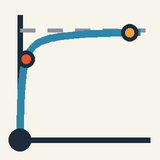
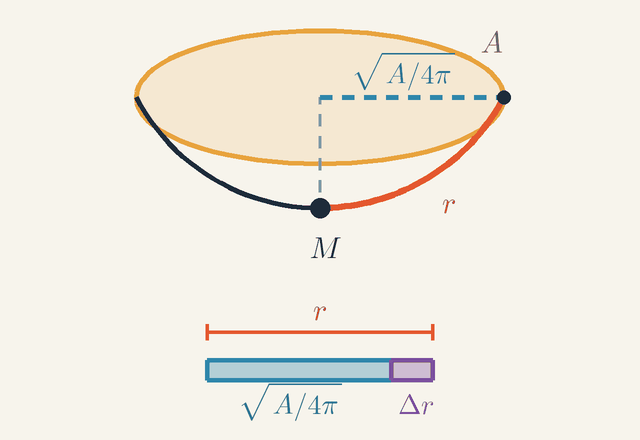
Figure 1. The radius test one dimension lower. The ring stands for a sphere of area A around the mass M; its size alone gives the flat-space radius A/4π (dashed), but a ruler from M must follow the slope and reads the longer r. Not to scale.Legend
M
Mass inside the sphere.
kg
A
Area of the sphere that the ring stands for.
m2
A/4π
Radius that flat space would give for the area A.
m
r
Radius measured with rulers laid from M along the sheet to the ring.
m
Δr
Excess radius, r−A/4π; for matter of roughly uniform density it is GM/(3c2).
m
Figure 1 shows the same test one dimension lower, so that it can be drawn. The curved sheet is the space, the ring stands for the sphere of area A, and the mass M sits at the bottom of the dip. The sheet is drawn as part of a sphere, because that is the shape space takes inside matter of uniform density.
Look first at the dashed line: it is the horizontal distance from the axis to the ring, the radius A/4π that flat space would give for a ring of this size. Now follow the curve marked r: a ruler laid from M to the ring cannot cut across the dip, it has to follow the slope of the sheet, so it reads a longer distance. The bar underneath sets the two lengths side by side, r=A/4π+Δr. The extra piece Δr is the excess radius that beings living in the sheet would measure.
Einstein's law of gravitation, in its simplest form, puts a number on this excess. Take a small sphere around matter of roughly uniform density, with mass M inside it. Then the measured radius exceeds the flat-space value by Δr=r−A/4π=3c2GM
Here G is Newton's gravitational constant and c the speed of light. Because G/c2 is so small, the effect is tiny. For the Earth, treated as uniform, GM/c2=4.435mm, so the excess radius is only about 1.5 mm; for Jupiter it is 0.47 m. No survey could detect these. The power of the rule lies in its generality.
The full law demands the same for every small sphere, around every event (a point in space at one instant) and for every observer, however they move. Writing all of these conditions at once needs three ingredients. The metric is the table that turns steps in the coordinates into the times and lengths that clocks and rulers actually measure. The Einstein tensor Gμν collects the curvature; it is built from second derivatives of the metric, just as the bending of a curve comes from the second derivative of its graph. The stress–energy tensor Tμν collects the density and flow of energy and momentum. The law then reads Gμν=c48πGTμν
Curvature stands on the left, matter on the right. The coupling 8πG/c4≈2.1×10−43N−1 is extremely small, so spacetime is very stiff: enormous energy densities produce only slight curvature. In empty space Tμν=0, so Gμν=0, yet spacetime there is not flat, because Gμν holds only part of the curvature. The part that remains is the tidal field, which stretches a falling cloud of dust along the line towards the mass and squeezes it sideways.
Clock rates from the equivalence principle
Gravity does not only curve space; it also changes the rate of time, so that clocks higher up run faster. This follows from the equivalence principle alone: inside a small closed room, no experiment can tell a uniform gravitational field from a steady acceleration.
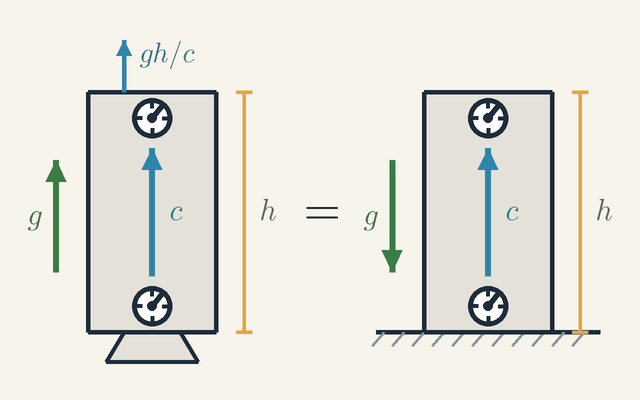
Figure 2. The same cabin twice. Left: a rocket accelerating at g; while the pulse climbs the height h, the ceiling gains the speed gh/c, so the pulse arrives at a lower frequency. Right: the cabin at rest on the ground in a field g. Nothing inside tells them apart. Not to scale.Legend
g
Acceleration of the rocket (left); strength of the gravitational field on the ground, pointing down (right).
m/s2
c
Speed of the light pulse sent from the floor clock to the ceiling clock.
m/s
h
Height of the cabin: the distance between the two clocks.
m
gh/c
Speed the ceiling gains while the pulse climbs; it sets the Doppler shift gh/c2.
m/s
Figure 2 tells the argument twice. Start on the left. Far from any planet, a rocket cabin of height h accelerates upwards at g, with one clock on the floor and one on the ceiling. The floor clock sends a light pulse up at speed c. The pulse needs a time of about h/c to arrive, and during that time the ceiling speeds up by g⋅(h/c). So when it receives the pulse, the ceiling is moving away faster than the floor was when it sent it, by the speed gh/c (the short arrow on top). A receiver moving away sees light Doppler-shifted to a lower frequency, by the fraction (speed)/c, here gh/c2.
Suppose the floor clock sends one pulse per tick. No pulses are lost on the way, yet the ceiling receives them at a rate lower than its own clock ticks, by the fraction gh/c2. Pulses sent down from the ceiling arrive at a higher frequency, because the floor is moving towards them. So everyone aboard agrees: the ceiling clock runs fast and the floor clock slow, by the fraction gh/c2.
On the right the same cabin stands on the ground, in a gravitational field g pointing down. By the equivalence principle nothing inside can tell this room from the rocket, so the result must be the same: in a gravitational field, a clock higher by h runs fast by gh/c2.
Near the ground gh is the rise in the gravitational potential Φ, the potential energy per unit mass. The rule therefore holds for any static potential, taken as zero far away. While a clock far away records a time dt, a clock at rest at potential Φ records its own, proper, time dτ, and dtdτ≈1+c2Φ
Since Φ is negative near a mass, clocks there run slow. Around a mass M, Φ=−GM/r, and the rule is the first-order form of the exact rate found below, 1−rs/r≈1−GM/(rc2), where rs=2GM/c2 is the Schwarzschild radius of the mass.
Energy conservation gives the same answer. Light of energy E has mass E/c2, so in falling through a height h it gains the energy Egh/c2, the fraction gh/c2 of its energy; climbing, it loses that fraction. A photon's energy is proportional to its frequency, so its frequency drops by the same fraction.
Pound and Rebka measured the shift in 1960 over a 22.5 m tower: a fraction of only 2.5×10⁻¹⁵. In 1976 a hydrogen maser clock flown to about 10,000 km confirmed it far more precisely.
The orbiting-clock graph
Satellites carry clocks, and for them both effects matter: height makes a clock run fast, speed makes it run slow. The expert graph applies both to a clock in a circular orbit of radius r, measured from the Earth's centre, compared with a clock on the ground at the Earth's radius R.
Height: the potential rises from −GM/R on the ground to −GM/r in orbit, so by the rule above the orbiting clock gains the fraction GM/c2(1/R−1/r) of every second (green curve). Speed: Special Relativity slows a moving clock by the factor 1−v2/c2≈1−v2/(2c2), and in a circular orbit v2=GM/r, so the clock loses GM/(2rc2) of every second (blue curve). The total (red curve) is c2GM(R1−2r3)
The graph multiplies these fractions by the 86,400 seconds of a day. A grazing orbit, at r=R, gains nothing from height and loses 30.1 µs a day, all of it from speed. With height the green gain rises towards 60.1 µs a day, its value for a clock infinitely far away, while the blue loss shrinks as 1/r. The red curve crosses zero where 1/R=3/(2r), that is at r=1.5R, about 3,190 km up: lower orbits lose time, higher ones gain.
Particular heights can be read off the red curve. The Space Station, 400 km up, loses 24.7 µs a day, so six months aboard leave an astronaut about 4.5 ms younger. GPS clocks, about 20,200 km up, gain 38.5 µs a day, and the right edge of the graph, at 25,000 km, reaches 41.8 µs.
Free fall as the longest proper time
Newton describes falling with forces. General Relativity replaces them with one rule about clocks: between two events, a free body follows the worldline (its path through space and time) along which its own clock records the most time. In flat spacetime that worldline is straight, at constant velocity; this is why the travelling twin of Special Relativity, who turns round, comes home younger.
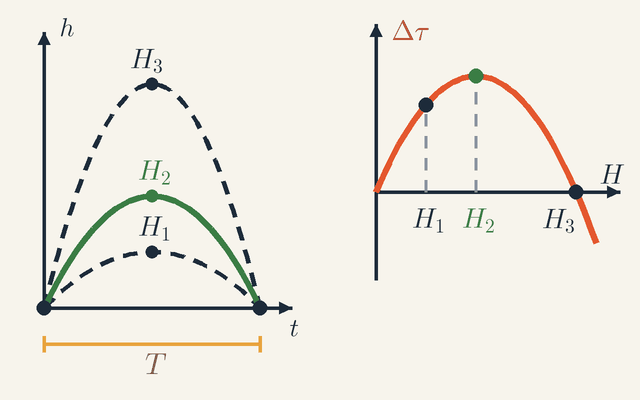
Near the ground two effects compete, as in the last section: height makes a clock run fast by gh/c2, and speed makes it run slow by v2/(2c2). So along a path of height h(t) and speed v(t) the proper time is τ=∫(1+c2gh−2c2v2)dt
Height pays and speed costs. The best path climbs high enough to gain time, but not so fast that its speed eats the gain.
Figure 3. Left: three paths h(t) of a ball thrown up and caught a time T later. Right: the proper time Δτ each path gains on a ground clock, against its peak height H. It is largest for the free-fall path H2 and zero for H3=2H2.Legend
t
Time since the throw.
s
h
Height of the ball above the ground.
m
T
Time from the throw to the catch.
s
H1
Peak height of a low path, H2/2.
m
H2
Peak height of the free-fall path, gT2/8.
m
H3
Peak height of a high path, 2H2=gT2/4.
m
H
Peak height of a path.
m
Δτ
Proper time a clock on the path gains over a clock left on the ground.
s
Figure 3 tests the rule on a ball thrown up and caught a time T later. The left panel shows three paths between the same two events, all arches h=4H(t/T)(1−t/T) that differ only in their peak height H: a low one, H1; the path of free fall, the one the ball actually follows, H2; and a high one, H3. Which gives a clock carried along it the most time?
Compute the time Δτ that the travelling clock gains on a clock left on the ground by averaging the two terms over the flight. The average height of such an arch is two-thirds of its peak, 2H/3. The speed is v=dh/dt=(4H/T)(1−2t/T), and the average of (1−2t/T)2 over the flight is 1/3, so the average of v2/2 is 8H2/(3T2). Multiplying each average by the flight time T and dividing by c2 gives Δτ=c2T(32gH−3T28H2)
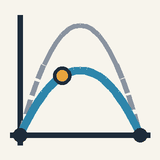
The right panel plots this gain against H: an upside-down parabola. It peaks where its slope, 2g/3−16H/(3T2), is zero, at H2=gT2/8. That is exactly the height of free fall: a ball that rises for T/2 under gravity climbs 21g(T/2)2=gT2/8. For T=3s the peak is 11.0 m and the gain is g2T3/(24c2)≈1.2×10−15s. The low path H1, half as high, gains three-quarters of that. The path H3=gT2/4, twice as high, gains nothing: its extra speed cancels exactly the benefit of height.
The same works for any potential, with gh replaced by Φ. Multiply the integrand by −mc2: the integral becomes ∫(−mc2+21mv2−mΦ)dt. The first term adds the same amount for every path, so making τ as large as possible is the same as making ∫(21mv2−mΦ)dt as small as possible. That is the principle of least action of Newtonian mechanics, whose equation of motion is a=−∇Φ. The mass m cancels from it, so every body falls the same way: the universality of free fall is built into the geometry. Strictly, τ is a maximum only against nearby paths.
The Schwarzschild geometry
The rules so far are weak-field approximations. Outside a spherical, non-rotating mass, such as a star or a black hole, the field equation has an exact solution, found by Karl Schwarzschild in 1916. It is a metric: it gives the proper time dτ between two nearby events from their coordinate separations, c2dτ2=(1−rrs)c2dt2−1−rs/rdr2−r2dΩ2
Here t is the time of a clock far away, r is chosen so that a circle around the centre has circumference 2πr, dΩ is the small angle between the two events as seen from the centre, and rs=2GM/c2. Two readings follow at once. For a clock at rest, dr=dΩ=0, and the metric gives dτ=1−rs/rdt: the exact clock rate. For a ruler laid along the radius, dt=dΩ=0, and the length it measures is dr/1−rs/r, more than dr. This stretching of radial distances is the excess radius of the first section.
Bending light
Light passing a mass is bent, and the size of the bend sets General Relativity apart from Newton's theory: Newtonian reasoning gives only half of what is observed.
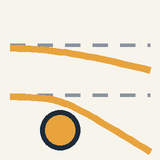
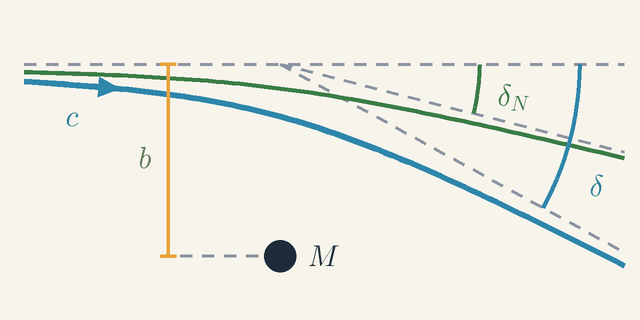
Figure 4. A ray of light passing the mass M at impact parameter b. The time part of the metric alone, as in Newton's theory, would turn it through δN; the space part doubles the turn to δ=2δN. Dashed: the lines the paths approach. Angles exaggerated; not to scale.Legend
M
Mass that bends the ray.
kg
b
Impact parameter: the distance from M to the incoming line of the ray.
m
c
Speed of light, along the ray.
m/s
δ
Deflection in General Relativity, 4GM/(c2b)=2δN.
rad
δN
Deflection from the time part alone, as in Newton's theory: 2GM/(c2b).
rad
Figure 4 follows a ray of light past the mass M. Far to the left the ray travels in a straight line at speed c; the impact parameter b is the distance from M to that incoming line. Far to the right both drawn paths are straight again, along the dashed lines, but turned: one through the angle δN, the other through δ, twice as much. The rest of this section explains the factor of two.
Light moves with dτ=0. Describe its path by u=1/r as a function of the angle φ around the mass, with a prime meaning d/dφ. Setting dτ=0 in the Schwarzschild metric and using the conserved energy and angular momentum gives u′′+u=c23GMu2
Without the right-hand side the solution is a straight line; the small term on the right bends it. This is the equation the animation integrates for its gold ray.
To see the factor of two, look at the metric in a weak field. There the factor in front of c2dt2 is gtt≈1+2Φ/c2, and the factor in front of the squared space step is grr≈−(1−2Φ/c2): both differ from flat space by the same amount, 2Φ/c2.
A slow body covers very little space per unit of time, so only the time part acts on it, and that part alone gives Newton's gravity. Applied to light, the time part alone would give the path bent through δN=2GM/(c2b), the angle Newton's theory gives for a particle moving at c. But light crosses as much space as time, ∣dx∣=cdt, so the space part acts on it as strongly as the time part, and the bending doubles: δ=c2b4GM=2δN
Since 4GM/c2=2rs, this is also δ=2rs/b. In the animation the ray passes at b=8rs: Newton's purple path is bent by 7.2°, this formula gives 0.25rad=14.3°, and the exact gold ray turns through 17.8°, because so close to the mass the weak-field formula falls short. At the Sun's edge, b≈2.4×10⁵rs, the formula gives 1.75″, and radio telescopes confirm it to better than 0.1 %.
Mercury and the strong-field radii
For a planet the same extra term appears in its orbit equation, u′′+u=GM/ℓ2+3GMu2/c2, where ℓ is the angular momentum per unit mass. Without the last term the solutions are Newton's ellipses, which close after one turn. The extra term makes the ellipse turn forward a little on every lap: its closest point to the Sun advances by Δφ=c2a(1−e2)6πGM
where a is the semi-major axis of the ellipse and e its eccentricity. For Mercury, with a=5.79×10¹⁰m and e=0.206, this is 5.0×10⁻⁷rad per orbit, or 43″ in the 415 orbits of a century: exactly the part of Mercury's advance that the pulls of the other planets could not explain.
In strong fields the same equations mark out three radii. At the horizon, rs, the rate 1−rs/r of a clock at rest falls to zero. At the photon sphere, 1.5rs, light can circle the mass, but unstably. At the innermost stable circular orbit, 3rs, stable orbits end; it forms the inner edge of the discs of hot gas around black holes.
Worked problem: a clock riding the ball
How fast, exactly, does a clock in orbit run? Put a clock on the blue ball of the animation, which circles the star at r=10.4rs with angular speed ω. In far-away time, Kepler's law holds exactly for circular orbits in this geometry: ω2=GM/r3. On the orbit r is constant, so dr=0, and the angle advances by dΩ=ωdt. Putting these into the metric and dividing by c2dt2 gives dtdτ=1−rrs−c2r2ω2
With Kepler's law and GM=rsc2/2, the last term is r2ω2/c2=GM/(rc2)=rs/(2r), so dtdτ=1−2r3rs At r=10.4rs this is 1−1.5/10.4=0.856≈0.925.
One loop takes 12.28 s of far-away time, so the ball's clock reads 0.925⋅12.28≈11.4s. Compare the two clocks that stand still in the animation. The far clock, at 22rs, runs at 1−1/22=0.977 and reads 12.0 s; the star clock, at 2.16rs, runs at 0.733 and reads 9.0 s. The ball's clock falls behind the far clock but stays well ahead of the star clock.
The rate splits into one factor for each effect. The gravity factor, 1−1/10.4=0.951, is the rate of a clock at rest at that radius. The motion factor, 1−0.2312=0.973, is the slowing of Special Relativity for the speed 0.231c that a static observer beside the orbit measures. Their product is 0.951⋅0.973≈0.925. That speed exceeds the Newtonian GM/r=0.219c because the static observer's own clock runs slow, so it times the ball over fewer seconds.
Now compare an orbiting clock with one standing still at radius R, whose rate is 1−rs/R. The orbiting clock runs faster when 1−3rs/(2r)>1−rs/R, that is when r>1.5R. This is the zero of the red Earth curve, 3,190 km up, but here the result is exact and holds in strong fields too. For the star clock at 2.16rs the break-even orbit lies at 3.24rs, just outside the last stable orbit at 3rs.
Limits of validity
The weak-field formulas need rs/r≪1 and v≪c. Near the animation's star they fail visibly: for the star clock the weak-field rate 1−rs/(2r) gives 0.769 instead of the exact 0.733, and the deflection formula misses the exact 17.8° by 3.5°. In the Solar System the errors are of order (rs/r)2, about 2×10⁻¹¹ even at the Sun's surface. A neutron star is different: with 1.4 solar masses inside a 12 km radius it has rs/r=0.34, and a clock on its surface runs at 0.81. The Earth graph also leaves out one small effect, the rotation of the ground clock, worth about 0.1 µs a day.
The theory has passed every test so far: light bending and radio delays near the Sun, Mercury's orbit, clocks, the shrinking orbits of binary pulsars and, since 2015, gravitational waves. The first wave detected came from two merging black holes of about 36 and 29 solar masses; it changed the 4 km arms of the LIGO detectors by about 4×10⁻¹⁸m.
The real limit is quantum. The theory predicts singularities, inside black holes and at the start of the expanding universe, where curvature grows without bound. Long before that, near the Planck length, ℏG/c3≈1.6×10−35m, quantum effects of gravity must take over, and no tested theory yet describes them.
Where this leads
Special Relativity is the flat, gravity-free limit, and its twin effect returns here as the rule of longest proper time. Gravitation and Orbits is the weak-field, slow-motion limit. Just as accelerated charges radiate in Electromagnetic Waves, accelerated masses radiate gravitational waves at c, though only through changing quadrupoles, since momentum conservation forbids dipole radiation. Fission, Fusion and E = mc² explains why every form of energy counts in Tμν.
Combined with quantum theory, a black hole should glow like the blackbodies of Blackbody Radiation and the Quantum, at the temperature T=ℏc3/(8πGMkB), about 6×10⁻⁸K for one solar mass. Particles and Forces: the Standard Model describes every known interaction except gravity; joining the two is the great open problem.
Key formulas
Schwarzschild radius
rs=c22GM
The length set by a mass: if the body is squeezed inside it, an event horizon forms and nothing, not even light, can escape. It is also the natural yardstick of gravity's strength, since relativistic effects at distance r are of order rs/r. It happens to equal the radius at which Newton's escape speed 2GM/r would reach c.
Symbols
rs
Schwarzschild radius
m
G
gravitational constant
N⋅m2/kg2
M
mass of the body
kg
c
speed of light
m/s
When it holds: Exact for a spherical, non-rotating, uncharged mass. For a body larger than rs, such as the Sun, it is a scale, not a surface; a rotating black hole has its horizon between rs/2 and rs.
Example: Ten solar masses: rs=10⋅2.95=29.5km; the Earth: 8.9 mm.
Rate of a clock at rest near a mass
τ=t1−rrs
A clock at rest at distance r ticks off the proper time τ while a far-away clock records t. The factor 1−rs/r is below 1 and falls to zero at the horizon; it comes from the Schwarzschild metric with dr=dΩ=0. Every process at that place slows in the same proportion, so it is time itself that runs slow, not the clockwork.
Symbols
τ
proper time of the clock at distance r
s
t
time of a clock at rest far away
s
rs
Schwarzschild radius of the mass
m
r
distance from the centre, defined by circumference
m
When it holds: Exact outside a spherical, non-rotating mass, for a clock at rest; a moving clock needs the speed term as well. Inside the horizon no clock can stay at rest.
Example: The star clock in the animation, at r=2.16rs, runs at 1−1/2.16≈0.733; the far clock at 22rs runs at 0.977, a ratio of 3 : 4.
Clock rate and height near the ground
τΔτ≈c2gh
Of two clocks a height h apart in a field g, the upper one runs fast by the fraction gh/c2. It follows from the equivalence principle, because light climbing a height h in an accelerating rocket arrives redshifted by this fraction, or from expanding 1−rs/r for a small change of r.
Symbols
Δτ
time gained by the upper clock
s
τ
time elapsed on the clocks
s
g
free-fall acceleration
m/s2
h
height difference between the clocks
m
c
speed of light
m/s
When it holds: Weak field and a height small compared with the planet's radius, so that g is the same all the way up; for satellites use GM/c2(1/R−1/r) instead.
Example: A clock 1 km higher gains 9.81⋅1000/(3.00×108)2≈1.1×10−13, about 9.4 ns a day.
Clock rate and speed
τΔτ≈−2c2v2
A clock moving at speed v runs slow by the factor 1−v2/c2 of special relativity; for v≪c that is a loss of the fraction v2/(2c2). The minus sign is the point: speed always makes a clock lose and height makes it gain, and the two fractions add.
Symbols
Δτ
time lost by the moving clock
s
τ
time elapsed
s
v
speed of the clock
m/s
c
speed of light
m/s
When it holds: For speeds far below that of light, with the speed measured in the frame of the reference clock; for satellites, the non-rotating frame of the Earth's centre.
Example: A GPS satellite at 3.87 km/s: v2/(2c2)≈8.3×10−11, a loss of 7.2 µs a day.
Bending of light by a mass
δ=c2b4GM
A ray whose undeflected path would pass the mass at distance b is turned through the angle δ, in radians. Half comes from the curving of time, which alone gives Newton's value 2GM/(c2b) for a particle at speed c; the other half comes from the curving of space. In terms of the Schwarzschild radius, δ=2rs/b.
Symbols
δ
deflection angle
rad
G
gravitational constant
N⋅m2/kg2
M
mass of the deflecting body
kg
c
speed of light
m/s
b
impact parameter, the closest distance of the straight-line path
m
When it holds: Weak field, b≫rs. Closer in the bending grows faster: at b=8rs the exact value is 17.8° against 14.3°, and rays with b below 2.6rs are captured.
Example: Grazing the Sun, b=6.96×10⁸m: δ=4⋅1.327×1020/((3.00×108)2⋅6.96×108)≈8.5×10−6rad, or 1.75″.
Einstein's field equation
Gμν=c48πGTμν
The left side, the Einstein tensor, describes the averaged curvature of spacetime; the right side, the stress–energy tensor, the density and flow of energy and momentum, pressure included. Its simplest reading: a small sphere around matter has a radius longer than A/4π by GM/(3c2). The tiny coupling 8πG/c4≈2.1×10−43N−1 makes spacetime very stiff.
When it holds: A classical law: it must fail where quantum effects of gravity matter, near the Planck length 1.6×10⁻³⁵m. On cosmic scales a cosmological-constant term is added to describe the accelerating expansion.
Example: For the Earth, treated as uniform, the excess radius is GM/(3c2)=4.435/3≈1.5mm.
Schwarzschild metric
c2dτ2=(1−rrs)c2dt2−1−rs/rdr2−r2dΩ2
The exact geometry outside a spherical, non-rotating mass: it gives the proper time dτ between two nearby events. The first term makes static clocks run at 1−rs/r, the second stretches radial distances, and the last is ordinary geometry on spheres of circumference 2πr. Free bodies move along worldlines of greatest τ, light along dτ=0.
Symbols
c
speed of light
m/s
dτ
proper time between the two events
s
rs
Schwarzschild radius
m
r
radial coordinate, defined by circumference
m
dt
far-away time between the events
s
dr
change of the radial coordinate
m
dΩ
angle between the two events, seen from the centre
rad
When it holds: Outside the mass only, for no rotation and no charge. At r=rs these coordinates fail but the geometry stays smooth; the true singularity is at r=0.
Example: A static clock at r=2.16rs: dτ/dt=1−1/2.16≈0.733; a clock in circular orbit at 10.4rs: 1−1.5/10.4≈0.925.
Perihelion advance per orbit
Δφ=c2a(1−e2)6πGM
The relativistic term in the orbit equation makes the ellipse turn forward by Δφ on every revolution, so the orbit never quite closes. The advance is largest for small orbits close to the mass and for elongated ones, through the factor a(1−e2).
Symbols
Δφ
advance of the closest point per orbit
rad
G
gravitational constant
N⋅m2/kg2
M
mass of the central body
kg
c
speed of light
m/s
a
semi-major axis of the orbit
m
e
eccentricity of the orbit
When it holds: Weak field, rs≪a(1−e2). The pulls of other planets add their own advance, about 530″ per century for Mercury.
Example: Mercury, a=5.79×10¹⁰m and e=0.206: Δφ≈5.0×10⁻⁷rad per orbit, 43″ per century.
Glossary
Equivalence principle
In a small, freely falling cabin the laws of physics are those of empty space, and a cabin accelerating at g cannot be told from one resting in a field g. It rests on the fact that all bodies fall alike, tested to about one part in 1015.
Spacetime
Space and time joined into one four-dimensional geometry whose points are events, a place at an instant. Observers in different states of motion split it into space and time differently.
Worldline
The path of a body through spacetime: the sequence of events it passes through. A body at rest still has a worldline, running along the time direction.
Proper time
The time shown by a clock carried along a worldline, which every process on the body keeps step with. It differs from the far-away time t by factors due to gravity and to speed.
Geodesic
The straightest possible worldline in curved spacetime, followed by any freely falling body. For a body it is the worldline of greatest proper time between two events; for light the proper time along it is zero.
Spacetime curvature
The failure of flat geometry in spacetime: clocks at different heights run at different rates, and a sphere around matter has a radius longer than A/4π. Mass and energy produce it, as the field equation states.
Gravitational time dilation
The slower running of clocks deeper in a gravitational field, τ=t1−rs/r; near the ground a clock 1 m higher runs fast by 1.1×10⁻¹⁶. It is separate from the slowing of moving clocks, though the two add.
Gravitational redshift
The lowering of the frequency of light that climbs out of a gravitational field, by gh/c2 over a height h; light falling in is blueshifted. It is the clock effect seen with light, first measured in the laboratory, over 22.5 m, in 1960.
Gravitational lensing
The bending of light by masses, δ=4GM/(c2b), twice Newton's value. Galaxies and clusters bend the light of more distant sources into arcs, rings and multiple images.
Black hole
A body compressed inside its Schwarzschild radius, so that its event horizon traps even light. Outside the horizon its gravity is that of any other body of the same mass.
Perihelion precession
The slow turning of an orbit's ellipse, so that the closest point moves forward on every lap. General relativity adds 6πGM/(c2a(1−e2)) per orbit: 43″ per century for Mercury.
Gravitational waves
Ripples of spacetime curvature travelling at c, sent out by accelerated masses such as merging black holes. A passing wave stretches and squeezes distances by a tiny strain, about 10−21 in the first detection in 2015.
Quantities
rs
Schwarzschild radius
m
2GM/c2, the horizon radius of a black hole of mass M: 2.95 km for the Sun, 8.9 mm for the Earth. The ratio rs/r measures how strong gravity is at distance r.
M
Mass of the attracting body
kg
The mass that curves spacetime around it. With G and c it appears only as the length GM/c2: 4.435 mm for the Earth, 1.48 km for the Sun.
r
Radial coordinate
m
The distance from the centre defined by circumference, r=C/2π. A ruler laid along the radius near a mass measures slightly more.
τ
Proper time
s
The time a clock shows at its own place and speed; in the animation, τ1 on the star and τ2 far away.
t
Far-away time
s
The time of a clock at rest very far from all masses, used to compare clocks at different places; also called coordinate time.
Φ
Gravitational potential
J/kg
Potential energy per kilogram, −GM/r outside a sphere. In weak fields a clock runs at 1+Φ/c2 of the far-away rate.
δ
Deflection angle
rad
The angle between the incoming and outgoing directions of a light ray: 4GM/(c2b) in weak fields, 1.75″ at the Sun's edge.
b
Impact parameter
m
The distance by which the ray would miss the centre of the mass if it went straight on; b=8rs in the animation.
Δφ
Perihelion advance per orbit
rad
The angle by which an orbit's closest point moves forward in one revolution: 5.0×10⁻⁷rad for Mercury.
Gμν
Einstein tensor
m−2
Ten numbers at each event that describe the averaged curvature of spacetime. The field equation makes it proportional to the stress–energy tensor Tμν.
Quiz
Beginner According to general relativity, what is gravity?
A force that travels instantly across empty space
The curving of space and time by mass and energy
A magnetic attraction between all objects
The push of the air pressing down on everything
Show answer
Answer: B. The curving of space and time by mass and energy
Einstein replaced Newton's force with geometry: mass and energy curve spacetime, and freely moving objects follow the straightest possible paths in it. Those paths look like the curved, accelerating motions we blame on a pull.
Beginner You are in a closed lift whose cable has snapped, so it falls freely (ignore air resistance). What do you feel?
Heavier than usual
Your normal weight
Weightless: you float along with everything in the lift
Pressed hard against the ceiling
Show answer
Answer: C. Weightless: you float along with everything in the lift
You, the lift and everything in it fall with the same acceleration, so nothing presses on anything: you feel weightless, as astronauts do in orbit. That falling can switch gravity off locally is the equivalence principle at the heart of general relativity.
Beginner Two identical, very precise clocks are placed at sea level and on a high mountain. After many days, how does the mountain clock compare?
It is slightly ahead, because time runs faster higher up
It is slightly behind, because it is closer to space
It is exactly level: gravity cannot affect time
It is ahead or behind depending on the weather
Show answer
Answer: A. It is slightly ahead, because time runs faster higher up
Farther from the Earth's mass, time runs faster. The effect is tiny, about 10⁻¹³ for a height difference of 1 km (roughly 9 nanoseconds per day), but modern atomic clocks detect it even for a height change of a few centimetres.
Intermediate GPS satellite clocks gain 45.7 µs per day because gravity is weaker up there, and lose 7.2 µs per day because of their speed. What is the net effect compared with clocks on the ground?
They lose 38.5 µs per day
They gain 52.9 µs per day
None: the two effects cancel
They gain 38.5 µs per day
Show answer
Answer: D. They gain 38.5 µs per day
Add the effects with their signs: +45.7 − 7.2 = +38.5 µs per day. Light travels about 11.5 km in 38.5 µs, so without this correction GPS positions would drift by kilometres every day.
Intermediate The Sun's Schwarzschild radius is 2.95 km. What is the Schwarzschild radius of a black hole with 10 times the Sun's mass?
0.295 km
9.3 km
29.5 km
295 km
Show answer
Answer: C. 29.5 km
rₛ = 2GM/c² is proportional to the mass, so 10 × 2.95 km = 29.5 km. Taking √10 would give 9.3 km, and scaling with M² would give 295 km.
Intermediate Why is the rubber-sheet picture of gravity only an analogy?
Because spacetime cannot really be curved
Because the ball rolls into the dent only if something already pulls it down
Because a mass should make the sheet bulge upwards, not sag
Because it describes planets but says nothing at all about light
Show answer
Answer: B. Because the ball rolls into the dent only if something already pulls it down
On a real sheet, Earth's gravity drags the ball into the dent, so the picture assumes the very thing it illustrates. It also shows only curved space, while for slow objects such as planets and falling apples almost all of gravity comes from the curving of time.
Advanced Newtonian gravity applied to a particle moving at speed c predicts that light grazing the Sun bends by 0.87″. Why does general relativity predict 1.75″?
Space is curved as well as time, and the spatial curvature adds an equal second share
Light has a relativistic mass twice its Newtonian mass
The Sun's atmosphere refracts the light by another 0.87″
The Sun's rotation drags the light sideways by another 0.87″
Show answer
Answer: A. Space is curved as well as time, and the spatial curvature adds an equal second share
In the weak field g_tt ≈ 1 + 2Φ/c² and g_rr ≈ −(1 − 2Φ/c²). The time part alone, which the equivalence principle gives, reproduces Newton's 2GM/(c²b); for a particle moving at c the spatial part contributes as much again, so δ = 4GM/(c²b). The 1919 eclipse measurements favoured the doubled value.
Advanced A clock in a circular orbit around the Earth is compared with a clock on the ground. Above roughly which altitude does the orbiting clock run fast?
It always runs slow, at any altitude
Above about 400 km, the Space Station's altitude
Above about 36,000 km, the geostationary altitude
Above about 3,200 km, where r = 1.5·R
Show answer
Answer: D. Above about 3,200 km, where r = 1.5·R
Weaker gravity makes the orbiting clock gain GM/c²·(1/R − 1/r), and its speed makes it lose GM/(2rc²). The two balance when 1/R = 3/(2r), that is r = 1.5·R, about 3,190 km up: the Space Station's clocks run slow, GPS clocks run fast. This is where the red curve in the graph crosses zero.
 Physics Tutor