Light, radio and X-rays are travelling ripples of electric and magnetic fields, E and B, that all cross empty space at c=1/μ0ε0≈3.00×108m/s; they differ only in wavelength, with c=fλ.
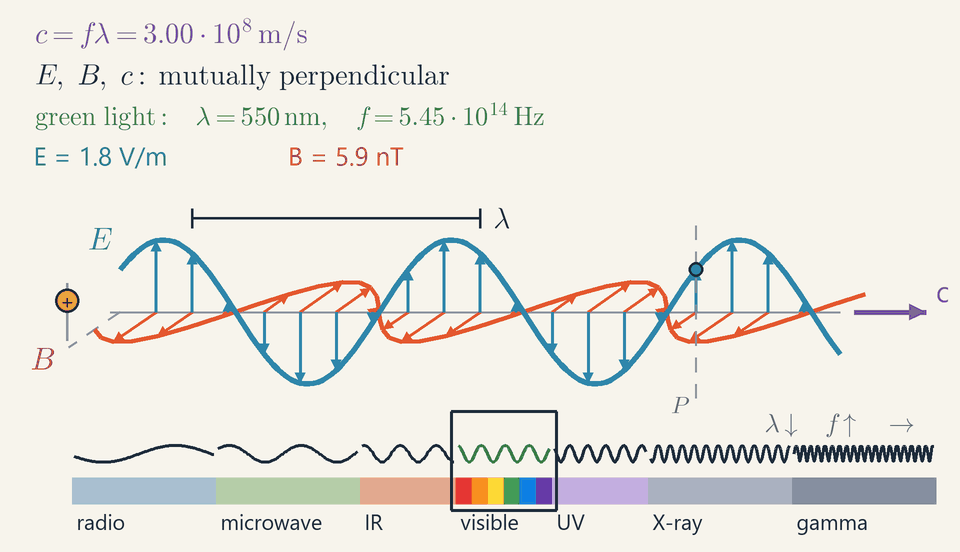
A travelling electromagnetic wave with its electric and magnetic fields in phase and at right angles, above the electromagnetic spectrum.
Charges wiggling up and down an antenna send out ripples of electric and magnetic field: an electromagnetic wave.
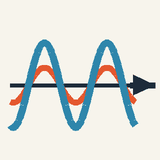
The electric and magnetic ripples rise and fall together, at right angles to each other and to the way the wave travels.
These waves need no air or water: they cross empty space, all at the speed of light, about 300,000 km every second.
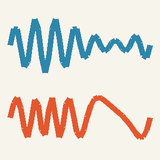
A radio station puts sound on its wave by varying its strength (AM) or its frequency (FM); your aerial picks it up.
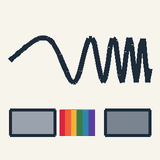
Radio, microwaves, infrared, light, ultraviolet, X-rays and gamma rays differ only in wavelength; our eyes see a narrow band.
Where does a radio wave come from? Picture a metal rod joined to an alternating voltage. Electrons are pushed up the rod, then down, then up again, so its two ends turn positive and negative in turn. Around the rod there is an electric field, and every time the charges swap, the field flips. The old field does not vanish: it moves away from the rod while a new one forms behind it. A ripple of electric field spreads outwards. And while the electrons rush along the rod they form a current, which makes a magnetic field, so a magnetic ripple travels out too. Together they are an electromagnetic wave.
In the animation the wiggling charge on the left plays the antenna. The blue wave and arrows show the electric field, the red wave the magnetic field. They rise and fall together, at right angles to each other and to the direction of travel.
Far away, the electric field shakes the electrons in a car's aerial, and the radio turns that tiny jiggle back into sound. To carry music, a station varies the strength of its wave (AM) or its frequency (FM). These waves need no air: they cross empty space, all at the speed of light, about 300,000 km every second.
Radio is one member of a big family. From long waves to short: radio, microwaves, infrared, visible light, ultraviolet, X-rays and gamma rays. The colour bar shows this spectrum; our eyes see only its narrow rainbow band.
Check yourself: which crosses space faster, radio waves or X-rays? Answer: neither; both travel at the speed of light.
Intermediate
Key ideas
E and B are perpendicular to each other and to the direction of travel (a transverse wave), and they oscillate in phase.
In vacuum every EM wave moves at c=3.00×10⁸m/s and obeys c=fλ, so doubling the frequency halves the wavelength.
Example: FM radio at 100 MHz has λ=c/f=3.0m; green light with λ=550nm has f≈5.45×10¹⁴Hz.
The amplitudes obey E=cB: B looks tiny in teslas, yet the two fields carry equal shares of the energy.
“Radiation” does not mean “radioactive”: only short-wavelength UV, X-rays and gamma rays can ionise atoms.
What is waving
A car aerial picks up a station far away, with no wire between them. An electromagnetic (EM) wave is a travelling pattern of an electric field E, in volts per metre (V/m), and a magnetic field B, in teslas (T). Nothing material moves: at each point the fields grow, shrink and reverse, and the pattern travels. The push of E on the electrons of an aerial or of your eye is how the wave is detected.
Two laws keep it going. As Electromagnetic Induction showed, a changing magnetic field produces an electric field; Maxwell saw that a changing electric field likewise produces a magnetic field. Each change creates the other field a little further on, so the disturbance runs off on its own, with no wires and no medium.
Accelerating charges start it: electrons driven up and down an aerial by an alternating voltage, or the gold charge on the left of the animation. A charge at rest or a steady current makes only steady fields.
Transverse, in phase, at one speed
In vacuum every EM wave has three properties, all visible in the animation:
It is transverse: E (blue, vertical) and B (red, horizontal, drawn in perspective) are perpendicular to each other and to the direction of travel, the arrow c.
The two fields oscillate in phase: they peak and pass through zero at the same places and the same instants.
It travels at c=3.00×10⁸m/s, whatever its frequency.
The wave travels along E×B: turn the fingers of your right hand from E towards B and your thumb gives the direction. With E up the page and B out of it, the wave moves right; half a cycle later both have reversed, and it still does. The direction of E is the polarisation, vertical in the animation.
The speed follows from the two laws: c=1/μ0ε0, where ε0=8.85×10⁻¹²F/m and μ0=1.26×10⁻⁶H/m are the constants of electric forces between charges and of magnetic forces between currents, measured with batteries and coils. They give 3.00×10⁸m/s, the speed of light; in the 1860s this convinced Maxwell that light is an electromagnetic wave.
The working equations
Three relations do most of the work at this level:
c=fλ
E=cB
I=21cε0E02
The first is the rule of Wave Basics: in one period the wave advances by one wavelength. Since c is fixed, doubling the frequency halves the wavelength: along the spectrum bar, to the right, λ falls and f rises.
The second holds at every point and instant. In teslas B looks tiny, 10 nT beside 3.0 V/m, but quantities in different units cannot be compared. Energies can: the densities 21ε0E2 and B2/(2μ0) are exactly equal, so each field carries half of the energy.
The third gives the intensity I, the average power per square metre (W/m²), from the amplitude E0; the 21 is the average of sin2 over a cycle. Double E0 and the power quadruples.
Worked example: the green light in the animation
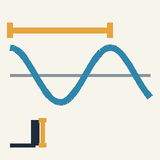
The animation models green light with λ=550nm, the crest-to-crest distance marked by the ruler. In metres, 550nm=5.50×10⁻⁷m, so the frequency and the period are f=λc=5.50×10−73.00×108≈5.45×10¹⁴Hz T=f1≈1.83×10⁻¹⁵s
This is the frequency printed in the panel. A real cycle lasts under two femtoseconds and a drawn one 2 s, so the picture runs about 1015 times slower than the light.
The field amplitude is E0=3.0V/m, so the magnetic amplitude and the intensity are B0=cE0=3.00×1083.0=1.0×10⁻⁸T=10nT I=21⋅3.00×108⋅8.85×10−12⋅3.02≈1.2×10⁻²W/m2
At point P the readouts swing between +3.0 and −3.0V/m and between +10 and −10nT: when E reads 1.5 V/m, B reads 5.0 nT, and both cross zero together. The arrows, one every eighth of a wavelength (69 nm in the real wave), grow and shrink in step. The 12 mW/m² of the advanced view means dim light, some 80 000 times weaker than sunlight.
Worked example: FM radio and a microwave oven
An FM station broadcasts at 100 MHz. Convert first, 100MHz=1.00×10⁸Hz; then λ=fc=1.00×1083.00×108=3.0m
Reading 100 MHz as 107Hz gives 30 m, ten times too long. A quarter-wave car aerial is therefore 75 cm long. About 30 km from a 100 kW transmitter the amplitude is roughly 0.10 V/m, so B0=0.10/(3.00×108)≈3.3×10−10T and I=21⋅3.00×108⋅8.85×10−12⋅0.102≈1.3×10⁻⁵W/m2. The signal took 3.0×10⁴/(3.00×108)=1.0×10−4s to arrive.
A microwave oven at 2.45 GHz uses λ=3.00×10⁸/(2.45×109)≈0.122m. Reflected inside the metal box, the waves form a standing pattern with hot spots half a wavelength, about 6.1 cm, apart. Without the turntable, briefly heat a layer of chocolate and measure the gap between soft spots: 2⋅0.061⋅2.45×109≈3.0×10⁸m/s, the speed of light from a kitchen.
Reading the spectrum bar
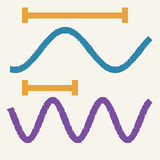
The bar at the bottom orders the family by wavelength, long on the left; each band's wiggle has its own wavelength, but all move at one speed. The limits are conventions:
Radio, longer than about 1 m: AM waves near 300 m, FM waves of 3 m.
Microwaves, 1 mm to 1 m: radar, mobile phones, Wi-Fi and ovens.
Infrared, 700 nm to 1 mm: heat radiation, strongest near 10 µm for your skin.
Visible light, only 400 to 700 nm: the narrow outlined rainbow band.
Ultraviolet, below 400 nm, then X-rays and gamma rays, the shortest far smaller than an atom.
Moving right, the energy of each photon, hf, rises too (h=6.63×10⁻³⁴J⋅s is Planck's constant). That energy, not the intensity, decides what a wave does to a molecule: visible photons of about 2 eV drive vision, and only those above roughly 10 eV (ultraviolet below about 124 nm, X-rays, gamma rays) ionise most atoms.
Common mistakes
EM waves need no medium: sunlight crosses 150 million km of near-vacuum in 8.3 minutes.
Higher frequency is not faster: a radio echo and a laser pulse bounced off the Moon both return after about 2.6 s.
The magnetic field is not negligible: 10 nT beside 3.0 V/m carries equal energy. Its force on an electron at speed v is, however, at most v/c of the electric force, so E defines the polarisation.
Glass changes the speed and the wavelength, not the frequency: with n=1.5, green light slows to 2.0×10⁸m/s and 550 nm shrinks to about 367 nm, while f stays 5.45×10¹⁴Hz.
“Radiation” is not “radioactive”, and power does not make a wave ionising: a 1000 W oven's photons carry 10−5eV, a single X-ray photon tens of keV.
Where you meet it
Radio, television, mobile phones, Wi-Fi, satellite navigation (19 cm), radar and microwave ovens use the long-wavelength end. Remote controls, fibre-optic links (1.55 µm) and thermal cameras use infrared; ultraviolet lamps disinfect water, X-rays image bones and crystals, and gamma rays treat tumours.
This lesson bridges electricity and optics. Polarization of Light follows the direction of E; Interference and Superposition and Diffraction and the Double Slit add the fields of several waves; Reflection and Refraction follows a wave into matter. Blackbody Radiation and the Quantum and Photoelectric Effect show that light is emitted and absorbed in packets of energy hf.
Advanced
Key ideas
Maxwell's term μ0ε0∂E/∂t lets changing E and B sustain each other: a field front moves off at c=1/μ0ε0.
Energy flows along S=E×B/μ0; its cycle average is I=21cε0E02, and an absorber feels a pressure I/c.
Only accelerating charges radiate: the field falls as 1/r, and for v≪c the Larmor power is P=q2a2/(6πε0c3).
Emission and absorption come in quanta hf, so photon energy, not intensity, decides whether radiation can ionise.
Maxwell's equations in empty space
Light, radio waves and X-rays are all waves of electric and magnetic field. To see why such waves exist, and why they all travel at one fixed speed, start from the laws of electromagnetism in a region with no charges and no currents. There they take a strikingly symmetric form: ∇⋅E=0,∇⋅B=0 ∇×E=−∂t∂B,∇×B=μ0ε0∂t∂E
Here E is the electric field, B the magnetic field, and μ0 and ε0 are the magnetic and electric constants of empty space. Read the laws one at a time. The first two are Gauss's laws: with no charges present, no field lines begin or end in the region. The third is Faraday's law: a magnetic field that changes in time produces an electric field that circulates around it. The fourth is Ampère's law with Maxwell's addition, the displacement current ε0∂E/∂t: an electric field that changes in time produces a magnetic field that circulates around it. The last two together let each field keep the other going with no charge nearby, and that is exactly what a wave needs.
Maxwell's term is not a free choice: charge conservation demands it. Where charges are present the fourth law reads ∇×B=μ0J+μ0ε0∂E/∂t, with J the current density. Take the divergence of both sides. The left side is zero, because a curl never has a divergence. On the right, Gauss's law ∇⋅E=ρ/ε0, with ρ the charge density, turns the second term into μ0∂ρ/∂t. What remains is ∇⋅J+∂ρ/∂t=0: charge flowing out of any small volume is exactly the charge lost inside it. Without Maxwell's term the same step would demand ∇⋅J=0, which is false at the plate of a charging capacitor, where current arrives and none leaves.
Why the front moves at the speed of light
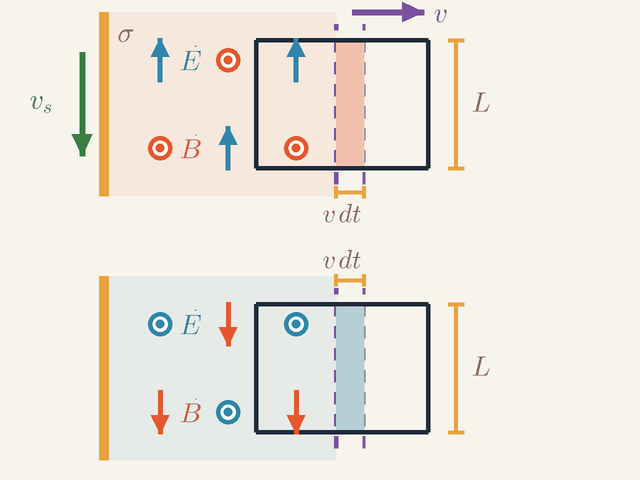
Figure 1. A charged sheet, seen edge on, is jerked down at speed vs; a front moving out at speed v has E and B behind it. Upper view: B crosses the loop of height L. Lower view, from above: E does. In dt the loop gains the shaded strip vdt wide. Not to scale.Legend
σ
Charge per unit area of the moving sheet.
C/m2
vs
Speed of the sheet, down the page in the upper view.
m/s
v
Speed of the front, the edge of the region that has field.
m/s
E
Electric field behind the front: up in the upper view, out of the page in the lower one.
V/m
B
Magnetic field behind the front: out of the page in the upper view, down in the lower one.
T
L
Height of the loop, measured along the front.
m
vdt
How far the front advances in a short time dt: the width of the shaded strip.
m
Before solving any equation, a thought experiment shows how a change in one field creates the other and how the pair moves off together. It uses only the loop forms of Faraday's law and the Ampère–Maxwell law, and it gives the speed of the front directly.
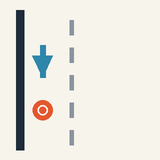
First the source. An infinite flat sheet lies in the yz-plane; Figure 1 shows it edge on, as the orange line at the left. Take x to the right, away from the sheet, y up the page and z out of it. The sheet carries a charge σ per square metre and lies on a fixed sheet with the opposite charge, so at rest there is no field outside.
At t=0 the charged sheet is jerked into motion down the page, along −y, at a constant speed vs. A moving sheet of charge is a current, so a current σvs per metre of width switches on at once. Right next to the sheet, Ampère's law gives the field of a current sheet, B=μ0σvs/2, pointing out of the page, along z.
Farther out the field cannot appear everywhere at the same instant. So suppose it fills a region behind a flat front that moves away from the sheet at some unknown speed v (the dashed line): uniform behind the front, zero ahead of it. The two loop laws will fix both v and the electric field that must come with B.
Figure 1 draws the same front from two directions, each time with a rectangular loop of height L lying across it. In a short time dt the front advances by vdt, and the loop gains the shaded strip of field, of area Lvdt.
The upper view looks along z. The loop lies in the xy-plane, so B (the circled dots, out of the page) passes through it, and the magnetic flux through the loop grows by BLvdt, that is, at the rate BLv. Faraday's law says that a changing flux needs an electric field circulating around the loop. The sides along x contribute nothing, because E along y is perpendicular to them, and the side ahead of the front has no field. Only the side of length L behind the front counts, so EL=BLv.
The lower view looks down along y, from above. Now the loop lies in the xz-plane, E passes through it (out of the page here) and B runs along the loop's side behind the front. The same strip adds electric flux at the rate ELv. No current crosses this loop, so the Ampère–Maxwell law says the circulation of B is μ0ε0 times that rate; again only the side behind the front counts, so BL=μ0ε0ELv. The directions drawn are the ones that give both laws the right signs; only the sizes matter here.
Cancel L, and the two conditions read E=vB,B=μ0ε0vE Put the first into the second: B=μ0ε0v2B. Both can hold only if v2=1/(μ0ε0): c=μ0ε01≈3.00⋅108m/s
Nothing in this depends on σ, on vs or on how suddenly the sheet started: however hard the jerk, the front has this one speed, built from two constants that are measured with charges and currents. Maxwell saw that it equals the measured speed of light and concluded that light is an electromagnetic wave.
Behind the front E=cB=σvs/(2ε0c), since μ0c=1/(ε0c). E points against the sheet's velocity, up the page in Figure 1, and E×B points away from the sheet, the way the front moves.
Notice what the field records: how fast the sheet moves, not where it is. So if the sheet stops after a time τ, a second front of the opposite sign follows the first, and between them a slab of field cτ thick travels on with no charge anywhere near it. Shake the sheet up and down and the outgoing field copies its velocity history, delayed by x/c at a distance x: a plane wave.
The wave equation
The sheet produced a flat front. The differential form of the laws shows that a field pattern of any shape travels at the same speed. Take the curl of Faraday's law. On the left use the identity ∇×(∇×E)=∇(∇⋅E)−∇2E, whose first term vanishes because ∇⋅E=0. On the right, swap the curl with the time derivative and insert the fourth law for ∇×B. The minus signs cancel, leaving ∇2E=μ0ε0∂t2∂2E
This is the wave equation of Wave Basics with 1/(μ0ε0) in place of v2, so every solution travels at c. The same steps, starting from the fourth law, give the same equation for B. The minus sign in Faraday's law is essential: it says that induced fields oppose the change that causes them. With a plus sign the solutions would grow or die away exponentially in time instead of travelling, and there would be no waves.
A plane wave: two fields in phase, at right angles
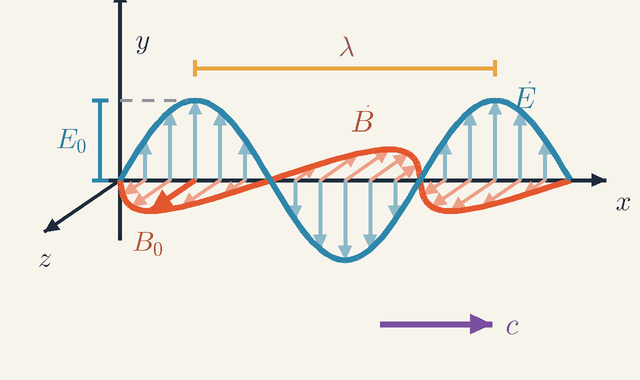
Figure 2. A plane wave travelling along x, frozen at one moment: E (blue) along y and B (red) along z cross zero and peak together, with crests a wavelength λ apart. E0 and B0 have different units, so their lengths cannot be compared.Legend
x
Axis along the direction of travel.
m
y
Axis along which E oscillates.
z
Axis along which B oscillates; it points towards you, drawn down-left.
E
Electric field of the wave.
V/m
B
Magnetic field of the wave, in phase with E.
T
E0
Amplitude of the electric field.
V/m
B0
Amplitude of the magnetic field, equal to E0/c.
T
λ
Wavelength: the distance from one crest to the next.
m
c
Speed of the wave, along the direction of travel.
m/s
The simplest solution, a sinusoidal plane wave, shows how E and B are arranged in all light. Figure 2 freezes one travelling along x at the moment t=0: E=E0sin(kx−ωt),ω=ck Here k=2π/λ is the wave number and ω the angular frequency; ω=ck is what the wave equation requires of this shape.
In the figure the axes are right-handed, with z pointing towards you (drawn down-left on the page). The electric field E (blue) oscillates along y, the magnetic field B (red) along z. Both are sine curves with the same wavelength λ, the distance from one crest to the next, and they cross zero and peak at the same places. Their amplitudes E0 and B0 have different units, so the lengths drawn for them cannot be compared.
Why is E across the direction of travel? In a plane wave the fields depend only on x and t. Gauss's law then reduces to ∇⋅E=∂Ex/∂x=0, and the x-component of the Ampère–Maxwell law gives ∂Ex/∂t=0, because the curl of such a field has no x-component. So Ex is at most a constant, which is no part of the wave: the wave is transverse, and we may take E along y.
Why is B along z, and in step with E? The z-component of Faraday's law gives ∂Bz/∂t=−∂Ey/∂x=−kE0cos(kx−ωt). Integrating in time, the oscillating solution is Bz=(k/ω)E0sin(kx−ωt); the y-component gives ∂By/∂t=0, so there is no oscillating By. Since ω/k=c, E=cB
So B is perpendicular to E and in phase with it, with B0=E0/c, and E×B points along +x, the direction of travel marked c in the figure. For a wave moving towards −x the same steps give Bz=−Ey/c: reversing the direction of travel reverses B relative to E.
The expert graph of the animation shows the same wave in time rather than in space: E at the point P, a sine of amplitude 3.0 V/m whose two cycles each last 1.83 fs, one period of 550 nm green light. P lies two wavelengths along the wave, so kx=4π there and the trace is E=E0sin(4π−ωt)=−E0sinωt: it starts at zero and dips first. This is the snapshot read backwards. The wave moves towards +x, so what reaches P next is the part of the wave just to its left, which at t=0 lies below the axis. The B readout follows the trace, with E/B=c at every instant.
Energy, intensity and momentum
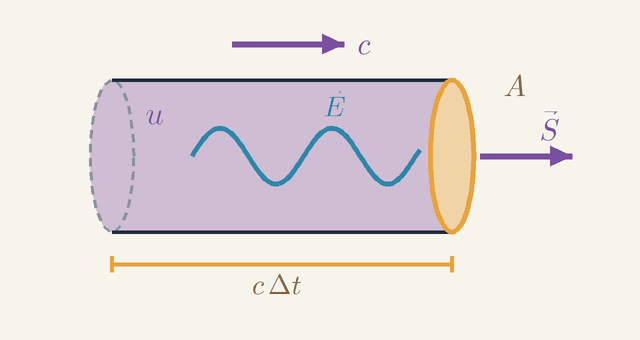
Figure 3. In a time Δt the face A is crossed by all the energy in the tube of length cΔt behind it, uAcΔt. The power per unit area is therefore cu, along S. Not to scale.Legend
cΔt
Length of the tube: how far the wave advances in the time Δt.
m
A
Cross-section of the tube: the patch the energy crosses.
m2
u
Energy per unit volume stored in the field in the tube.
J/m3
E
Electric field of the wave inside the tube.
V/m
S
Power per unit area through the face, along the direction of travel.
W/m2
c
Speed of the wave and of the energy it carries.
m/s
A wave carries energy away from its source; this is how sunlight warms the Earth. To find how much power crosses each square metre, Figure 3 follows the energy through a patch of area A held across the wave's path.
The fields store energy with density u=21ε0E2+B2/(2μ0), joules per cubic metre: the same expressions as for the field in a capacitor and in a coil. The whole pattern moves at c without changing shape, so in a time Δt the face A is crossed by all the energy in the tube of cross-section A and length cΔt behind it, which is uAcΔt. Dividing by A and by Δt, the power per square metre is cu.
Now use the plane-wave link B=E/c together with c2=1/(μ0ε0). The magnetic term becomes B2/(2μ0)=E2/(2μ0c2)=21ε0E2, so the two halves of u are equal, u=ε0E2, and the power per square metre is cε0E2. Poynting's theorem, energy conservation for fields, writes this in general as the vector S of the figure: S=μ0E×B
For the plane wave its size is EB/μ0=E2/(μ0c)=cε0E2, as found above, and it points along the direction of travel.
The field of visible light reverses about 1015 times a second, far too fast for any detector to follow, so what is measured is the average over many cycles. The average of sin2 over a cycle is one half, so the intensity is I=21cε0E02
For the animation's 3.0 V/m this is the 12 mW/m² of the panel, with an average energy density of 4.0×10⁻¹¹J/m3. Sunlight at the ground, about 1.0 kW/m², corresponds to E0≈870V/m and a magnetic amplitude of 2.9 µT.
The fields also carry momentum, S/c2 per cubic metre. Moving at c, that momentum arrives at a surface at the rate S/c per square metre. A black surface absorbs it and so feels a pressure I/c; a mirror sends it back and feels twice that. Sunlight on a black surface at the ground pushes with 3.3 µPa; on a mirror above the atmosphere, where the intensity is 1361 W/m², the force is about 9 N per square kilometre. This tiny, unceasing push drives solar sails and blows comets' dust tails away from the Sun.
Radiation from accelerating charges
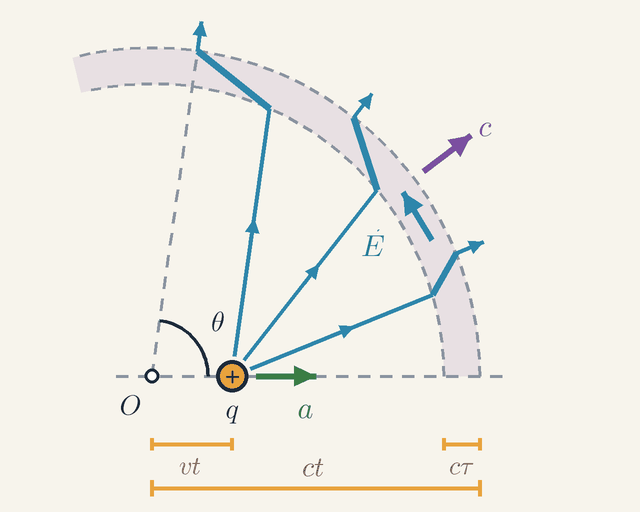
Figure 4. A charge q at rest at O is pushed with acceleration a for a short time τ, then drifts. At time t the lines point away from O outside the sphere of radius ct and away from the charge inside; across the shell cτ thick they kink sideways. Not to scale.Legend
q
The charge that is pushed.
C
O
Where the charge rested before the push.
a
Acceleration of the charge during the push.
m/s2
vt
Distance the charge has moved from O by the time t.
m
ct
Radius of the outer sphere: how far the news of the push has travelled in the time t.
m
cτ
Thickness of the shell: how far the news travels while the push lasts, a time τ.
m
θ
Angle between a field line and the line of the push.
rad
E
Sideways field in the shell, the radiation field: opposite to the sideways part of the acceleration.
V/m
c
Speed at which the shell, and the kink in it, spreads outward.
m/s
So far the waves were simply given. Where do they come from? From charges whose velocity changes. A charge at rest has its Coulomb field. A charge moving at constant velocity carries that field along, since in its own frame it is at rest. Only an acceleration sends out a wave, and Figure 4 shows why.
A charge q rests at O until t=0. It is then pushed along x with acceleration a for a short time τ, and afterwards drifts on at the small speed v=aτ, so a time t later it is a distance vt from O. The figure exaggerates v/c; the argument needs v≪c.
News of the push spreads outward at c, so at the time t the field lines (drawn in cross-section) fall into three zones. Outside the sphere of radius ct about O the news has not arrived yet: the lines still point away from O, where the charge would be had it never moved. Inside the sphere of radius c(t−τ) the charge has been moving steadily all along, as far as the field knows, and its lines point away from where it is now. In the thin shell of thickness cτ between the two spheres each line must join its outer part to its inner part, and since the two parts are offset, the line runs sideways across the shell. This sideways stretch is the kink.
Read its size off the figure. A line leaving at the angle θ to the line of the push is displaced sideways by vtsinθ, the part of the offset vt across the line, and it makes this shift within a shell only cτ thick. Within the shell the field follows the line, so the ratio of its sideways part E⊥ to its radial part Er is the ratio of these two lengths. Using v=aτ, and r=ct for the radius of the shell, ErE⊥=cτvtsinθ=c2arsinθ The radial part is still the Coulomb field, Er=q/(4πε0r2), because by Gauss's law the shell lets through as many field lines as before. Multiplying the two gives the sideways field, the arrow E in the figure.
Look at the powers of r. The radial part falls as 1/r2, but the sideways part falls only as 1/r, because the offset vt grows as the shell spreads while its thickness stays cτ. Far from the charge the kink therefore dominates. It is the radiation field, and it moves outward at c with the shell.
For a push that varies smoothly in time, and for speeds well below c, the same argument gives the field at a distance r and an angle θ from the line of the acceleration: E(r,t)=4πε0c2rqa(t−r/c)sinθ Three things stand out. The field is transverse, opposite to the sideways part of the acceleration for a positive charge. It is set by the acceleration at the earlier time t−r/c, when the news set out. And its intensity, proportional to E2, goes as sin2θ/r2: zero along the line of the acceleration and greatest at right angles to it. That is why a vertical radio mast, whose charges surge up and down, beams its signal out along the ground.
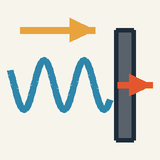
The total power comes from adding the intensity cε0E2 over a sphere of radius r. The sphere's area, proportional to r2, cancels the 1/r2, and sin2θ averages to two thirds over all directions, which gives the Larmor formula: P=6πε0c3q2a2
The 1/r law is what lets energy escape: the power through a sphere, proportional to E2r2, is the same at every radius, whereas a field falling as 1/r2 would carry nothing to great distances. That is why starlight still arrives after many light-years.
In the animation the gold charge oscillates, so its acceleration a=−ω2y is always opposite to its displacement y. The radiated field is opposite to the acceleration, so it follows the displacement: the blue wave beside the charge rises and falls with it, and the point P, two wavelengths away, receives each movement two periods (3.7 fs) later. Synchrotron light and X-ray tubes obey the same rule.
Worked problem: a 1 W green lamp
A small lamp emits P=1.0W of 550 nm green light equally in all directions. At what distance is its field amplitude the animation's 3.0 V/m? What changes at twice that distance? What force acts on a black card of 1.0 cm² held face-on there, and how many photons does it absorb each second?
At a distance r the watt is spread over a sphere of area 4πr2, so I=P/(4πr2). Set this equal to 21cε0E02 and solve for r: r=2πcε0E02P=2π⋅3.00×108⋅8.85×10−12⋅3.021.0≈2.6m
At 5.2 m the same watt crosses a sphere four times larger, so the intensity drops fourfold, to 3.0 mW/m². The amplitude goes as the square root of the intensity, so it only halves, to 1.5 V/m, as the 1/r law requires.
Back at 2.6 m the intensity is 12 mW/m², so the card absorbs 1.2×10−2⋅1.0×10−4=1.2×10⁻⁶W. An absorber feels the pressure I/c, so the force is the absorbed power divided by c: F=1.2×10⁻⁶/(3.00×108)=4.0×10−15N. The pressure, 4.0×10⁻¹¹Pa, equals the beam's average energy density, as it does for any absorber, since both are I/c.
The light's frequency is f=c/λ=5.45×1014Hz, and each photon carries the energy hf, with h Planck's constant: hf=6.63×10−34⋅5.45×1014≈3.6×10⁻¹⁹J, about 2.3 eV. The card therefore absorbs 1.2×10⁻⁶/(3.6×10−19)≈3.3×1012 photons a second. That is far too many for their graininess to show, so the smooth classical wave is an excellent description here.
Limits of validity
The classical theory handles propagation, interference, diffraction and polarisation at every frequency. It fails where matter exchanges energy with the field, because that happens in quanta hf: 2.3 eV for green light, 4×10⁻⁷eV for FM radio, tens of keV for medical X-rays. Most atoms need roughly 10 eV to lose an electron, so only wavelengths below about 124 nm ionise, however weak the beam. When photons are few, the wave gives only the probability of detecting one.
It fails inside atoms too. An electron circling as in a classical hydrogen atom, with a≈9.0×10²²m/s2, would radiate 4.7×10⁻⁸W by Larmor's formula and spiral into the nucleus in about 16 ps. Atoms are stable; explaining why begins in Atomic Models: the Bohr Atom.
In matter the wave slows to c/n, where the refractive index n depends on frequency. Conductors absorb it: seawater cuts a 10 kHz wave by a factor e every 2.5 m or so, which is why submarines use very low frequencies. In vacuum the equations are linear, so beams cross without disturbing each other. Finally, c is exact: since 1983 the metre has been defined so that c=299792458m/s.
Where this leads
Maxwell's equations fix a speed c without saying relative to what; Special Relativity makes it the same for every inertial observer and mixes E and B when the frame changes. Polarization of Light follows the direction of E; Interference and Superposition and Diffraction and the Double Slit add fields; Prisms, Dispersion and Colour traces the slower speed in glass to electrons re-radiating like the sheet above. Blackbody Radiation and the Quantum, Photoelectric Effect and Wave–Particle Duality take up the quanta hf; Particles and Forces: the Standard Model makes the photon the carrier of the electromagnetic force. Gravitational waves (Gravity as Curved Spacetime) also travel at c: in 2017 those of a neutron-star merger arrived within 2 s of its gamma rays.
Key formulas
Speed, frequency and wavelength
c=fλ
During one period, 1/f, the wave moves forward by one wavelength, so its speed is λ divided by 1/f. For electromagnetic waves in vacuum the speed is fixed at c, so frequency and wavelength are inversely proportional: doubling f halves λ.
Symbols
c
speed of light in vacuum
m/s
f
frequency
Hz
λ
wavelength
m
When it holds: Holds for every periodic wave. In a medium of refractive index n the speed is c/n: the frequency stays the same and the wavelength becomes λ/n.
Example: FM radio at 100 MHz: λ=(3.00×10⁸)/(1.00×108)=3.0m; green light at 550 nm has f≈5.45×10¹⁴Hz.
Speed of light from the electric and magnetic constants
c=μ0ε01≈3.00⋅108m/s
Maxwell's equations in empty space combine into a wave equation whose speed is 1/μ0ε0. The constant ε0 comes from forces between charges and μ0 from forces between currents, yet together they give the measured speed of light: the evidence that light is an electromagnetic wave.
Symbols
c
speed of electromagnetic waves in vacuum
m/s
μ0
vacuum permeability
H/m
ε0
vacuum permittivity
F/m
When it holds: In vacuum. In a material the constants become μ and ε, and the speed 1/με=c/n is lower and depends on frequency.
Example:1/(1.257×10−6)(8.854×10−12)≈3.00×108m/s.
Ratio of the electric and magnetic fields
E=cB
Faraday's law applied to a travelling wave ties the two fields together: at every point and instant the electric field is c times the magnetic field. Because c is so large, B looks tiny in teslas, yet the energy densities 21ε0E2 and B2/(2μ0) are exactly equal.
Symbols
E
electric field (value or amplitude)
V/m
c
speed of light
m/s
B
magnetic field at the same point and instant
T
When it holds: For a single travelling wave in vacuum, for instantaneous values and for amplitudes. In a medium E=(c/n)B; in a standing wave or close to an antenna the ratio changes from place to place.
Example: The animation: E0=3.0V/m gives B0=3.0/(3.00×108)=1.0×10−8T=10nT.
Sinusoidal plane wave
E=E0sin(kx−ωt),ω=ck
The field repeats every wavelength in space and every period in time: k=2π/λ is the phase per metre and ω=2πf the phase per second. The pattern keeps its shape while it slides towards +x at ω/k, which the wave equation forces to equal c. The minus sign sets the direction: kx+ωt would travel towards −x.
Symbols
E
electric field at position x and time t
V/m
E0
amplitude of the electric field
V/m
k
wave number
rad/m
x
position along the direction of travel
m
ω
angular frequency
rad/s
t
time
s
c
speed of light
m/s
When it holds: An ideal, infinitely wide wave of a single frequency in vacuum. Real beams are limited in width and duration but are sums of such waves; B has the same form, perpendicular to E, with amplitude E0/c.
Example: Green light: k=2π/(5.50×10−7)≈1.14×107rad/m and ω=ck≈3.43×10¹⁵rad/s.
Poynting vector: the flow of electromagnetic energy
S=μ0E×B
Energy conservation for fields (Poynting's theorem) shows that this vector gives the power crossing a unit area at right angles to it. Its direction, E×B, is the direction of travel. For a wave in vacuum its size is EB/μ0=cε0E2: the energy density ε0E2 times the speed c.
Symbols
S
energy flow per unit area and time
W/m2
E
electric field
V/m
B
magnetic field
T
μ0
vacuum permeability
H/m
When it holds: Gives the instantaneous flow, in vacuum and in non-magnetic materials. Light reverses about 1015 times a second, so detectors register only its average, the intensity.
Example: At a crest of the animation's wave, S=3.0⋅1.0×10−8/(1.26×10−6)≈24mW/m2, twice the average.
Intensity of a sinusoidal wave
I=21cε0E02
The energy density is ε0E2 and it moves at c, so the power per square metre is cε0E2. Averaging sin2 over a cycle gives one half. The intensity goes as the square of the amplitude: double the field and four times the power arrives.
Symbols
I
intensity (average power per unit area)
W/m2
c
speed of light
m/s
ε0
vacuum permittivity
F/m
E0
amplitude of the electric field
V/m
When it holds: For a linearly polarised sinusoidal plane wave in vacuum or air; in a non-magnetic medium of index n, multiply by n. For a field that is not sinusoidal, use the average of cε0E2.
Example: The animation: I=21⋅3.00×108⋅8.85×10−12⋅3.02≈12mW/m2.
Larmor formula: power radiated by an accelerating charge
P=6πε0c3q2a2
An accelerating charge sends out a transverse field proportional to its acceleration that falls off as 1/r, strongest at right angles to the acceleration and zero along it. Squaring that field to get the intensity and adding it over a whole sphere gives this total power, the same at every radius, as energy conservation requires. A charge at rest or in uniform motion has a=0 and does not radiate.
Symbols
P
total radiated power
W
q
charge
C
a
acceleration of the charge
m/s2
ε0
vacuum permittivity
F/m
c
speed of light
m/s
When it holds: For speeds much less than c; at relativistic speeds, as in synchrotrons, the power rises steeply with speed and is beamed forward. It is classical: electrons in the stationary states of atoms do not radiate.
Example: An electron circling as in a classical hydrogen atom, a≈9.0×10²²m/s2, would radiate P≈4.7×10⁻⁸W.
Glossary
Electromagnetic wave
A travelling pattern of electric and magnetic fields that keep each other going: a changing B induces E, and a changing E induces B. It needs no medium and is launched by accelerating charges.
Transverse wave
A wave whose oscillation is across its direction of travel. In vacuum both E and B of an electromagnetic wave are transverse, unlike sound in air, whose molecules oscillate along the direction of travel (a longitudinal wave).
Plane wave
A wave whose fields are the same at every point of each plane perpendicular to the direction of travel, such as E=E0sin(kx−ωt). Far from its source, a small patch of any wave looks like a plane wave.
Polarisation of a wave
The direction along which E oscillates. The animation's wave is linearly polarised: E stays vertical, so B stays horizontal.
Electromagnetic spectrum
The whole family of electromagnetic waves ordered by wavelength or frequency: radio, microwaves, infrared, visible light, ultraviolet, X-rays and gamma rays. Visible light, 400 to 700 nm, covers less than a factor of two in wavelength.
Speed of light
The speed of every electromagnetic wave in vacuum, exactly 299,792,458 m/s (about 3.00×10⁸m/s), the same for every frequency and every inertial observer. Since 1983 the metre has been defined from it.
Maxwell's equations
The four laws of electromagnetism: Gauss's laws for E and B, Faraday's law of induction and the Ampère–Maxwell law. In empty space they predict waves travelling at c=1/μ0ε0.
Displacement current
Maxwell's term ε0∂E/∂t, through which a changing electric field produces a magnetic field just as a current does. It keeps the laws consistent with charge conservation and lets the two fields of a wave regenerate each other.
Antenna
A conductor in which charges are driven to and fro to launch electromagnetic waves, or are set moving by an arriving wave to receive them. A quarter-wave aerial for FM radio at 100 MHz is about 75 cm long.
Radiation pressure
The push of an electromagnetic wave on a surface, because the wave carries momentum: I/c on a perfect absorber and 2I/c on a perfect mirror. Sunlight gives only a few micropascals, enough to steer solar sails.
Photon
The smallest amount of electromagnetic energy at a given frequency, hf. A photon of green light carries about 2.3 eV, one from an FM station less than a millionth of an electronvolt.
Ionising radiation
Radiation whose individual photons or particles carry enough energy, roughly 10 eV or more, to knock electrons out of atoms and molecules: short-wavelength ultraviolet, X-rays and gamma rays. Turning up the intensity of radio waves or ordinary light does not make them ionising.
Quantities
E
Electric field
V/m
The force per unit charge that the wave exerts at a point and instant; 1 V/m is 1 N/C. In the animation it swings between +3.0 and −3.0V/m at P.
B
Magnetic field
T
The magnetic part of the wave, perpendicular to E and in phase with it, with B=E/c: 10 nT in the animation when E=3.0V/m.
E0
Electric field amplitude
V/m
The peak value of E; the intensity grows as E02. The animation's wave has E0=3.0V/m.
c
Speed of light in vacuum
m/s
The speed of every electromagnetic wave in vacuum, 3.00×10⁸m/s. It links frequency and wavelength, c=fλ, and the two field amplitudes, E=cB.
f
Frequency
Hz
The number of field oscillations per second at a fixed point. It is set by the source and does not change when the wave enters a medium: 5.45×10¹⁴Hz for green light. The angular frequency ω=2πf, in rad/s, is the phase gained per second; t is the time, in s.
λ
Wavelength
m
The distance between neighbouring crests, λ=c/f: 3.0 m for FM radio at 100 MHz, 550 nm for green light. The wave number k=2π/λ, in rad/m, is the phase gained per metre along the direction of travel; x is the position along it, in m.
S
Poynting vector
W/m2
The flow of electromagnetic energy: it points along E×B, the direction of travel, and its size is the power crossing a square metre at that instant. A charge q (in C) with acceleration a (in m/s²) radiates a total power P (in W) given by the Larmor formula.
I
Intensity
W/m2
The time average of the Poynting vector's size, the power delivered per square metre: about 12 mW/m² for the animation's wave, about 1 kW/m² for sunlight at noon.
ε0
Vacuum permittivity
F/m
The constant of Coulomb's law and of capacitors, 8.85×10⁻¹²F/m; it sets how much electric field a given charge produces.
μ0
Magnetic constant
H/m
The constant of the magnetic field of currents, 1.26×10⁻⁶H/m (very nearly 4π×10−7H/m). Together with ε0 it fixes c=1/μ0ε0.
Quiz
Beginner Which of these is NOT an electromagnetic wave?
Radio waves
Sound waves
X-rays
Visible light
Show answer
Answer: B. Sound waves
Sound is a vibration of air or another material and cannot cross empty space. Radio, X-rays and light are all electromagnetic waves.
Beginner In empty space, which of these travels fastest?
Radio waves
Visible light
X-rays
They all travel at the same speed
Show answer
Answer: D. They all travel at the same speed
Every electromagnetic wave travels at the speed of light in vacuum, about 300,000 km/s, whatever its wavelength.
Beginner Which of these has the longest wavelength?
Gamma rays
Visible light
Radio waves
Ultraviolet
Show answer
Answer: C. Radio waves
Radio waves sit at the long end of the spectrum, from centimetres to kilometres. Gamma rays are the shortest.
Intermediate An FM radio station broadcasts at 100 MHz. What is the wavelength of its waves?
0.33 m
3.0 m
30 m
3.0·10¹⁶ m
Show answer
Answer: B. 3.0 m
λ = c/f = 3.00·10⁸ ÷ 1.00·10⁸ = 3.0 m. Dividing f by c instead gives 0.33, taking 100 MHz as 10⁷ Hz gives 30 m, and multiplying c by f gives 3·10¹⁶.
Intermediate An EM wave travels in the +x direction. At some point its electric field points along +y. Along which direction does its magnetic field point there?
+z
−y
+x
+y
Show answer
Answer: A. +z
E and B are perpendicular to each other and to the direction of travel, which is along E × B. Since ŷ × ẑ = x̂, B points along +z.
Intermediate You double the frequency of an electromagnetic wave travelling in vacuum. What happens?
Its speed doubles
Its wavelength doubles
Its wavelength halves
Nothing changes
Show answer
Answer: C. Its wavelength halves
The speed is fixed at c, so with c = f·λ doubling f halves λ.
Advanced In a plane electromagnetic wave in vacuum, how does the energy stored in the magnetic field compare with the energy stored in the electric field?
The magnetic energy is c times smaller, since B = E/c
The magnetic energy is c² times smaller
They are equal at every point and instant
The magnetic energy is zero on average
Show answer
Answer: C. They are equal at every point and instant
u_B = B²/(2μ₀) = E²/(2μ₀c²) = ½·ε₀·E² = u_E, using c² = 1/(μ₀ε₀). B is small in teslas, but 1/μ₀ is huge, so the magnetic field carries exactly half of the energy.
Advanced Which charge emits electromagnetic radiation?
A charge at rest
A charge moving at constant velocity
Any charge, as long as it is in a magnetic field
A charge that is accelerating
Show answer
Answer: D. A charge that is accelerating
Only acceleration produces a radiation field that falls off as 1/r and carries energy away, with power given by Larmor's formula P = q²·a² / (6π·ε₀·c³). A charge at rest in a magnetic field feels no force and does not radiate; a moving charge radiates there only because the magnetic force makes it accelerate (synchrotron radiation).
 Physics Tutor