Work W=Fdcosθ, kinetic energy KE=21mv2, potential energy PE=mgh and power P=W/t: how forces transfer energy, and why the total is conserved.
A ball dropped from height h. The blue potential-energy bar shrinks as the gold kinetic-energy bar grows, while the green total-energy bar stays constant.
Work = force × distance moved along the force, in joules: pushing with 10 N for 3 m takes 30 J.
Motion energy grows with the square of the speed: twice as fast means four times the energy.
A falling ball swaps height energy for motion energy, and the total stays the same.
Energy is never destroyed: in a bounce or a skid, part of it turns into heat and sound.
Power is how fast work is done: one watt is one joule every second.
In everyday speech, holding a heavy suitcase for ten minutes is hard work. In physics it is no work at all, because work has a precise meaning: a force does work when it moves something along the direction it pushes or pulls. Work = force × distance, measured in joules (J). Push a trolley with 10 N for 3 m and you do 30 J of work.
Doing work on something gives it energy, the ability to do work. Two kinds matter here. A raised object has height energy (gravitational potential energy): weight × height. Lift a 20 N bag of flour 1.5 m onto a shelf and it stores 30 J. A moving object has motion energy (kinetic energy), 21mv2. Because the speed is squared, a car at twice the speed carries four times the energy.
Energy is never created or destroyed; it only changes form. Let a ball fall: it loses height energy and gains exactly as much motion energy. When it lands, the motion energy squashes the ball and the floor for an instant, and part of it becomes heat and sound, so the ball never bounces back to where it started.
Power tells you how fast work is done, in watts: one watt is one joule per second. Two people carrying the same box up the same stairs do the same work; the faster one develops more power.
Check yourself: you carry a box across a level room at a steady speed. How much work does your upward push do on it? Answer: none, because the box moves sideways, at right angles to your push.
In the animation, the blue "height" bar shrinks and the gold "motion" bar grows as the ball falls, while the green total stays the same.
Intermediate
Key ideas
W=Fdcosθ: only the force component along the motion does work; at 90° it does none.
Work–energy theorem: Wnet=ΔKE, so positive net work speeds an object up.
If only gravity or springs do work, KE+PE stays constant; a dropped object lands at v=2gh, whatever the path.
Friction points against the motion, so its work on a sliding object is negative and slows it down.
Power P=W/t=Fv, in watts (1W=1J/s).
Work: the force along the displacement
Holding a heavy suitcase still is tiring, yet the hand holding it does no work on it. In physics a force does work only if the object moves while the force acts, and only the part of the force along the motion counts. For a constant force F and a straight displacement d at an angle θ to the force, W=Fdcosθ
Work is measured in joules, 1J=1N⋅m, about the work needed to lift a 100 g apple by one metre. It is a scalar: it has no direction, but it has a sign.
The angle between the force and the displacement sets that sign:
Along the motion, θ=0∘ and W=Fd: the force feeds energy into the object.
At right angles, θ=90∘ and the force does no work: the floor under a sliding box, or a string whirling a stone in a circle.
Against the motion, θ=180∘ and W=−Fd: friction and brakes take energy out of the motion.
When several forces act, each does its own work, and the net work is their sum.
Kinetic energy and the work–energy theorem
Push a cart of mass m with a constant net force F over a distance d. With a=F/m, the kinematics relation v2=v02+2ad multiplied by m/2 becomes Fd=21mv2−21mv02. What the work changes is the kinetic energy, KE=21mv2 and the net work done by all the forces equals its change. This is the work–energy theorem: Wnet=ΔKE
Positive net work speeds an object up and negative net work slows it down. Kinetic energy is never negative, ignores the direction of motion and grows with the square of the speed.
Potential energy and the conservation of energy
When a ball of mass m goes from height h1 down to h2, its weight mg does work mg(h1−h2) whatever the path, since only the vertical part of each small step lines up with the weight. Work that depends only on the end points can be stored and given back; this stored energy is the potential energy: PE=mgh
The height h is measured from a level you choose, because only changes of PE matter. Gravity's work is positive going down, where PE falls, and negative going up.
If gravity, or an ideal spring, is the only force doing work, every joule that leaves PE turns up in KE, and the mechanical energy stays the same: KE+PE=constant(no friction or drag)
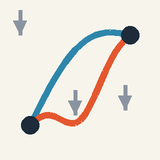
So an object dropped from a height h lands at v=2gh, from mgh=21mv2. The mass cancels, and on a frictionless slide the shape of the track does not matter either: the track pushes at right angles to the motion and does no work.
Worked example: the falling ball in the animation
The 2 kg ball is released from rest at h0=18m. With the ground as h=0, all of its energy is potential at the start: E=mgh0=2⋅9.81⋅18≈353J
Halfway down, at h=9m, half of it has changed form: PE≈177J and KE≈177J, so v=2KE/m≈13.3m/s. Just before landing PE=0 and KE=E: v=2gh0=2⋅9.81⋅18≈18.8m/s
These are the values on the PE, KE and v readouts, and the final frame, the instant just before landing, shows KE=E and PE=0. All the way down, the blue PE bar and the gold KE bar add up to the green E bar, while the velocity arrow v grows.
The fall lasts 2h0/g≈1.92s, yet the halfway height is passed only at 1.35 s. At half the time, 0.96 s, the ball has dropped just 4.5 m, and only a quarter of the energy, 88 J, has changed form. Energy is shared out by height, not by time, and the ball covers more height every second: its faint images, 0.4 s apart, spread ever further apart.
Worked example: pulling a loaded sled
A child pulls a 25 kg sled from rest for 20 m across level snow. The rope is at 30∘ to the ground with a tension of 60 N, and friction on the runners is 30 N. How fast is the sled going at the end?
The rope does 60⋅20⋅cos30∘≈1039J of work, and friction, pointing backwards, does 30⋅20⋅cos180∘=−600J. The weight and the push of the snow are vertical, at right angles to the motion, so they do no work. The net work is 439 J, and from rest the work–energy theorem gives v=m2Wnet=252⋅439≈5.9m/s
Newton's laws agree: the forward part of the pull, 60cos30∘≈52N, leaves a net force of 22 N, so a≈0.88m/s2 and v2=2⋅0.88⋅20≈35m2/s2. The energy route needed neither the acceleration nor the time.
Power, and reading energy graphs
Power is the rate at which work is done, measured in watts, 1W=1J/s: P=tW For a force along the motion at speed v, the work in a short time Δt is FvΔt, so P=Fv. At the end of the pull the rope delivers 52⋅5.93≈308W, but only 154 W on average over the 6.7 s, since the sled started from rest.
On a graph of force against distance, the area under the line is the work: a rectangle Fd for a constant force, a triangle 21kx2 for a spring whose force grows with the stretch, F=kx. On a graph of energy against time, the slope is the power. Gravity's power on the falling ball, mgv, rises from zero to 2⋅9.81⋅18.8≈369W at landing, so the gold bar fills slowly at first and then ever faster.
Common mistakes
Work is not effort. Holding a 20 kg suitcase still for ten minutes does no work on it; your muscles burn chemical energy just to stay tense.
Kinetic energy is not proportional to speed. From 15 m/s to 30 m/s a 1200 kg car's KE goes from 135 kJ to 540 kJ, so with the same braking force it needs four times the braking distance.
Work can be negative. Friction did −600J on the sled: that energy left the motion and reappeared as heat in the runners and the snow.
A single value of PE means nothing without its zero level. The ball has 353 J relative to the ground and 0 J relative to its starting point, yet the fall releases 353 J either way.
Heavier objects do not land faster when only gravity works. A 4 kg ball dropped from 18 m carries 706 J, twice as much, but still lands at 18.8 m/s: the mass cancels.
Where you meet it
Roller-coaster designers start from KE+PE: a car released from rest 40 m above the lowest point can reach at most 2⋅9.81⋅40≈28m/s, about 100 km/h. Hydroelectric plants turn the potential energy of water into electricity, about 0.98 MJ for every tonne that falls 100 m.
Later lessons build on the same energy balance: Simple Machines: Levers, Pulleys and Gears (no machine gives out more work than it takes in), Elasticity: Hooke's Law, Stress and Strain (the energy in a stretched spring), Simple Harmonic Motion, Bernoulli's Principle, Electric Field and Potential, and First Law of Thermodynamics and Heat Engines, which adds heat to the account.
Advanced
Key ideas
W=∫F⋅dr; for a conservative force it is path-independent (zero round any loop), and W=−ΔU.
F=−dU/dx (F=−∇U): the force points downhill on U; minima are stable equilibria, maxima unstable.
d(21mv2)/dt=F⋅v gives Wnet=ΔKE; frictionless constraints do no work.
With friction ΔKE+ΔU=Wnc; the missing energy is the random jiggling of atoms: heat.
mgh is the near-surface limit of U=−GMm/r, and 21mv2 the slow limit of (γ−1)mc2.
Work as a line integral
The rule W=Fdcosθ needs a constant force and a straight path. Real forces change from place to place and real paths bend, so we need a definition of work that copes with both. Everything else in this lesson is built on it.
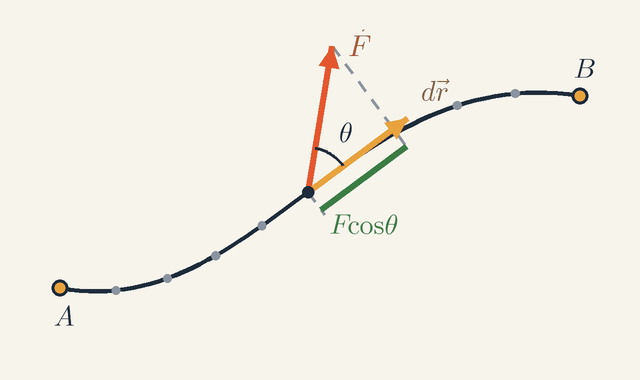
Figure 1. One short step dr of a curved path from A to B, drawn much longer than a real one. Only the part Fcosθ of the force F along the step, found by dropping a perpendicular onto it, does work.Legend
A
Start of the path.
B
End of the path.
dr
One short step along the path, of length dr.
m
F
Force on the particle at the start of the step.
N
θ
Angle between F and the step.
rad
Fcosθ
Component of F along the step: the only part that does work.
N
Figure 1 shows a particle moving along a curved path from A to B while the force on it changes from point to point. The idea is to cut the path into steps so short that each one is practically straight and the force hardly changes along it. Over one such step the simple rule holds again.
Look at the enlarged step dr: an arrow of length dr pointing along the path. Where it starts, the force is F, at the angle θ to the step. The small dots along the curve mark where other steps begin; each has its own force and its own angle.
Only the part of F along the step pushes the particle along it; the part at right angles only pushes it sideways. To find the part along the step, drop the dashed perpendicular from the tip of F onto the line of the step: the green bar it cuts off has the length Fcosθ. The work done in this one step is that component times the length of the step: dW=Fcosθdr=F⋅dr
The dot product appears because it is exactly this: the component of one vector along the other, times the length of the other. The total work from A to B is the sum over all the steps. As the steps get ever shorter, the sum becomes the line integral W=∫ABF⋅dr=∫AB(Fxdx+Fydy+Fzdz) The second form writes the dot product out in components, which is how the integral is usually worked out.
Two results follow at once. For a constant force on a straight path, F comes out of the integral and the steps add up to the displacement, which gives back W=Fdcosθ. And dividing dW by the time dt the step takes, with dr/dt=v, gives the power the force delivers at each instant, P=F⋅v.
Work is not something a body has. It describes a process: an amount of energy passed from whatever exerts the force to the body it acts on.
Deriving the work–energy theorem
The line integral becomes useful once it is tied to motion. Newton's second law makes the link, and the result, the work–energy theorem, says that the net work done on a particle equals the change in its kinetic energy KE=21mv2.
Start with how KE changes in time. The speed squared is the dot product of the velocity with itself, v2=v⋅v, and by the product rule its rate of change is 2v⋅dv/dt. For a particle of constant mass m, therefore, dtd(21mv2)=mv⋅dtdv=Fnet⋅v The last step is Newton's second law, mdv/dt=Fnet: the rate of change of KE is the power of the net force.
Now integrate over time from start to finish. In a time dt the particle takes the step dr=vdt, so the time integral of Fnet⋅v becomes a line integral along the path: ΔKE=∫Fnet⋅dr=Wnet
Nothing in this derivation assumed anything about the force or the path. The theorem therefore holds for the net force on a particle whether or not that force has a potential energy.
Forces that do no work
Some forces act on a body all the time yet never change its speed. Spotting them simplifies energy problems, because they drop out of the balance.
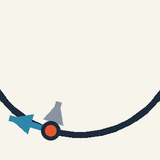
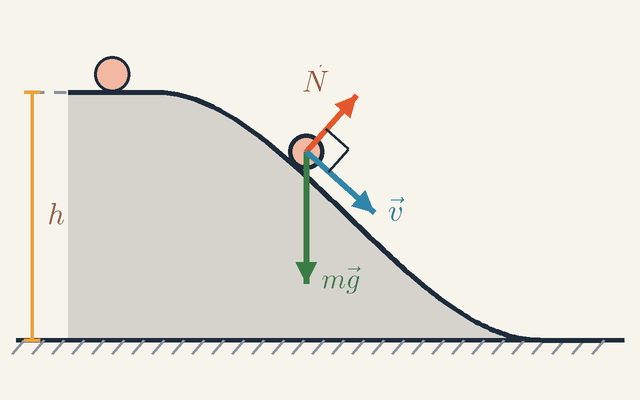
Figure 2. A ball slides from rest down a frictionless slide of any shape, from a height h above the floor. The track's push N stays at right angles to the velocity v, so it does no work and the weight mg alone changes the kinetic energy.Legend
h
Starting height above the floor: how far the ball drops.
m
mg
Weight of the ball, straight down.
N
N
Push of the track on the ball, at right angles to the track.
N
v
Velocity of the ball, along the track.
m/s
Figure 2 shows a ball that slides from rest down a frictionless slide of any shape, starting at the height h above the floor. Two forces act on it: its weight mg, straight down, and the push N of the track. A smooth track can only push at right angles to its own surface. The ball moves along that surface, so its velocity v points along the track. The small square marks the right angle between N and v: at every instant N⋅v=0, so the power of N is zero, and the push does no work however the track bends.
The same holds in general. Split any force into a part along the velocity and a part across it. Only the part along v changes the speed; the part across it only bends the path. The push of a frictionless track, the tension in a pendulum string and the magnetic force on a moving charge are all at right angles to v, so none of them does work. In Figure 2 that leaves the weight alone to change the kinetic energy.
To find the work of the weight, let y be the ball's height above the floor at any moment: y=h at the start and y=0 at the end. The weight points straight down, so only the vertical part of v, which is dy/dt, counts: mg⋅v=−mgdtdy=−dtd(mgy) The minus sign appears because the weight points down while y is measured upwards. Over the whole slide the weight therefore does the work mgh, which depends only on the drop, not on the shape of the track. The theorem then gives 21mv2=mgh: a frictionless slide of any shape delivers the same speed at the bottom, v=2gh.
Read the equation for the power the other way round: the rate at which KE grows is exactly the rate at which mgy falls. With no other force doing work, the sum 21mv2+mgy therefore stays constant along any path. Conservation of energy is not an extra assumption here: it follows from Newton's second law together with the form of the force.
What the energy graph shows
The Advanced view of the animation plots these energies against time for the lesson's falling ball, so the bookkeeping can be watched as it happens.
The ball, of mass m=2kg, is released from rest at the height h0=18m and falls freely. After a time t its height is h=h0−21gt2 and its speed is v=gt. Putting these into KE=21mv2 and PE=mgh gives KE(t)=21mg2t2,PE(t)=mgh0−21mg2t2 The coefficient is 21mg2≈96.2J/s2. The gold KE parabola opens upward and the blue PE parabola is its mirror image. In the sum the t2 terms cancel, so the green total stays flat at mgh0≈353J: dE/dt=0.
The slope of the KE curve is the power that gravity delivers, dKE/dt=mg2t=mgv, which is F⋅v for the weight. It is zero at release, about 184 W half-way through the time of the fall and 2⋅9.81⋅18.8≈369W at landing. The fall lasts 2h0/g≈1.92s, so the average power is 353/1.92≈184W: half the final value, because v grows in proportion to time. The slope of PE(t) is exactly the opposite, which is how the graph says W=−ΔPE.
Plotted against height instead of time, both energies would be straight lines, PE=mgh and KE=mg(h0−h). The curves in time only reflect that the ball covers more height per second as it speeds up.
Conservative forces and potential energy
The work of the weight depended only on where the ball started and where it ended. Forces with this property are special: their work can be stored and recovered, and that store is potential energy.
A force is conservative if its work from a point A to a point B is the same along every path between them. Equivalently, its work around every closed loop is zero: go out along one path and back along another, and the two contributions cancel. Gravity, ideal springs and electrostatic forces are conservative. Because their work depends only on the end points, it can be written as the drop of a function of position, the potential energy U: WA→B=−(UB−UA) Only differences of U appear, so U is defined up to an additive constant: we are free to choose where it is zero.
For gravity there is also an argument, with no dynamics at all, for why weight times height is the right quantity to keep track of. Picture ideal machines (levers, pulleys) that lower one weight to raise another, and call a machine reversible if running it backwards undoes exactly what it did. Suppose some machine could lift a load higher than a reversible one for the same descent of the driving weight. Run it forwards and the reversible one backwards: the driving weight ends up back where it started, but the load ends up higher, for nothing. Repeated, that would be perpetual motion, which is never observed.
So no machine beats a reversible one, and all reversible machines do exactly the same. A balanced lever trades weight for height in exact proportion, so what they all keep unchanged is the total of weight times height.
Reading a potential energy graph
A graph of U against position shows at a glance where a body can go, where it turns back and which way it is pushed, without solving any equation of motion.
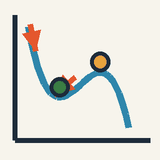
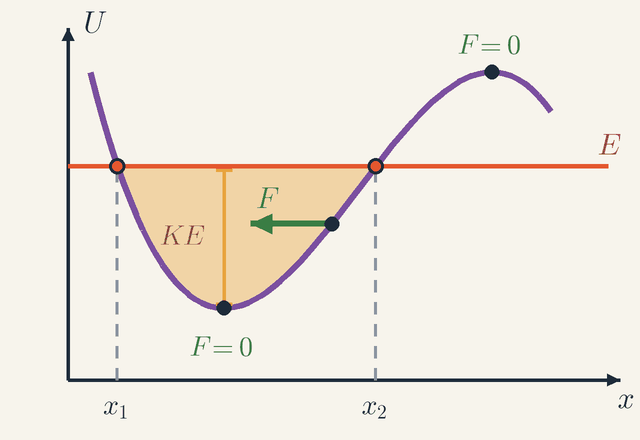
Figure 3. The potential energy U(x) of a body on a line, with its total energy E as a level line; the gold gap is KE=E−U and closes at the turning points x1 and x2. The force F=−dU/dx points downhill and vanishes at the bottom of the well and the top of the hill.Legend
x
Position of the body along the line.
m
U
Potential energy of the body at position x.
J
E
Total energy KE+U: constant, drawn as the level line.
J
KE
Kinetic energy: the gap between the level E and the curve U.
J
F
Force −dU/dx on the body at the marked point: it points downhill and is larger where the slope is steeper. Zero at the two points marked F=0.
N
x1
Left turning point, where U=E.
m
x2
Right turning point, where U=E.
m
Figure 3 plots the potential energy U(x) of a body that moves along a line, where x is its position. The horizontal line is its total energy E=KE+U, which stays constant while only conservative forces do work. Since KE=E−U, the kinetic energy at each x is the height of the gold gap between the level E and the curve below it.
Kinetic energy cannot be negative, so the body can only be where the curve lies on or below E. The gap closes at the turning points x1 and x2, where U=E: there the body stops for an instant and turns back, so it shuttles between them like a marble in a bowl. The hill on the right rises above E, so a body with this energy cannot get over it.
The graph also gives the force. When the body moves by dx, the force does the work Fdx, and for a conservative force that work equals the drop in potential energy, −dU. Setting Fdx=−dU gives F=−dxdU and in three dimensions F=−∇U. Because of the minus sign, on any graph of U(x) the force points downhill. In Figure 3 the arrow F, drawn on the slope between the bottom of the well and x2, points back towards the bottom; where the curve is steeper, the force is larger. Where the slope is zero the force vanishes, at the two points marked F=0.
Those two points are equilibria, but of different kinds. The bottom of the well is a minimum of U: a small displacement either way meets a force back towards it, so the equilibrium is stable. The top of the hill is a maximum: a small displacement meets a force that pushes the body further away, so the equilibrium is unstable. As a check, the spring potential U=21kx2 gives back Hooke's law, F=−kx.
Friction, heat and the full energy balance
Not every force is conservative. Friction is the everyday exception, and including it completes the energy account.
The work of kinetic friction grows with the length of the path, and it is negative whichever way the body slides, because friction always opposes the sliding. A round trip therefore leaves negative work, not zero, so no potential energy can describe it. Split the net work into the part done by conservative forces, which is −ΔU, and the rest, Wnc (non-conservative). The work–energy theorem, ΔKE=−ΔU+Wnc, then becomes ΔKE+ΔU=Wnc Wnc collects friction and drag, which make it negative, and also positive contributions such as the push of an engine or of muscles.
Here is the effect in numbers. A 2 kg block released from the animation's 18 m height slides down a straight ramp at the angle α to the horizontal, with the coefficient of kinetic friction μ=0.2. The normal force is mgcosα, so friction is μmgcosα, and it acts along the whole ramp, of length h0/sinα. Their product is the work of friction: Wnc=−μmgcosα⋅sinαh0=−tanαμmgh0 On a 30∘ ramp this is −122J, which leaves 353−122=231J of kinetic energy and a speed of 15.2 m/s at the bottom. On a 60∘ ramp it is only −41J, and the block arrives at 17.7 m/s. Same drop, different paths, different work: the signature of a non-conservative force.
The energy is not destroyed. The rubbing sets the atoms of both surfaces jiggling, and that random motion is thermal energy. At the level of atoms the forces are conservative; friction only turns ordered motion into disordered motion. A block sliding a distance d on a level floor, pressed on it by the normal force N, produces μNd of thermal energy. Counting it, energy is conserved exactly: this is the first law of thermodynamics seen from mechanics. The heat never gathers back into the block's motion by itself; the second law of thermodynamics describes this one-way change.
Worked problem: a ball landing on a spring
This problem puts gravity and a spring into one energy balance, and shows how large a force it takes to stop a falling body over a short distance.
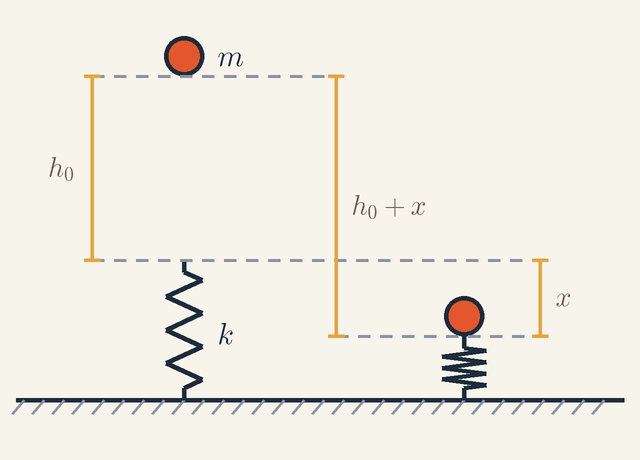
Figure 4. A ball released from rest a height h0 above an upright spring stops when the spring is compressed by x. The weight acts over the whole fall h0+x, and the spring stores 21kx2. Not to scale.Legend
m
Mass of the ball.
kg
k
Stiffness of the spring.
N/m
h0
Height of the release point above the top of the spring.
m
x
Compression of the spring at the lowest point of the fall.
m
h0+x
Total distance fallen from release to the lowest point.
m
Figure 4 sets it up. The animation's ball, of mass m=2kg, is released from rest a height h0=18m above a light spring of stiffness k=5000N/m, which stands upright with its top at ground level. How far, x, is the spring compressed when the ball stops? On the right of the figure, the ball falls h0 to reach the spring and then a further x while it squeezes it, so it falls h0+x in all. The figure is not to scale: the real x is about fifty times smaller than h0.
The ball starts and ends at rest, so ΔKE=0. With no losses, all the work the weight does over the whole fall must end up stored in the spring: the original 353 J plus the extra mgx released as the ball sinks below ground level. So mg(h0+x)=21kx2 With the numbers this is a quadratic in x, and its positive root is the answer: 2500x2−19.62x−353.16=0,x≈0.380m
The extra term changes the answer by only 1 %: without it, x=2⋅353/5000≈0.376m. The peak force on the ball, kx≈1900N, is about 97 times its weight. Crash mats and crumple zones work the other way: they absorb the energy over a longer distance, and twice the distance means half the average force.
The same problem can be read on a potential energy graph. Write the potential energy as a function of the compression x at any moment while the ball touches the spring (the answer above is the largest value of x), with U=0 at the top of the spring: U(x)=21kx2−mgx The spring term grows as the spring is squeezed; the gravity term falls as the ball sinks.
The minimum of U, where dU/dx=kx−mg=0, lies at x=mg/k≈3.9mm: there the spring force balances the weight, and the ball could rest on the spring. The lowest point of the fall is not this minimum but the turning point where U=E, as in Figure 3. Without losses the ball would bounce, leave the spring at 18.8 m/s and climb back to 18 m.
Limits of validity
Both energy formulas of this lesson are approximations, and the theorem itself is about particles. Here is where each one stops working.
mgh is the near-surface form of the gravitational potential energy U=−GMm/r, where M is the Earth's mass and r the distance from its centre. Exactly, raising a mass from the surface, at the radius R≈6371km, by a height h takes mghR/(R+h). So mgh is too high by a fraction of about h/R: 3×10⁻⁶ for the 18 m drop, but 6 % for a lift to the 400 km height of the space station. Letting h grow without limit gives the energy needed to escape from the Earth altogether, mgR, about 62.5 MJ per kilogram, which corresponds to an escape speed of 11.2 km/s.
21mv2 is the low-speed form of the relativistic kinetic energy (γ−1)mc2, where c is the speed of light and γ=1/1−v2/c2. The first correction adds a fraction 43v2/c2 to the energy: about 3×10⁻¹⁵ for the ball at 18.8 m/s, while at half the speed of light the classical formula falls 19 % short. Energy also has mass: the ball's 353 J corresponds to 353/c2≈4×10−15kg.
The theorem is a statement about a particle. For a body that spins, deforms or has its own energy stores, the integral ∫Fnet⋅drcm, taken along the path of the centre of mass, gives only the change in the kinetic energy of the centre-of-mass motion. When you jump, the floor pushes you up, but the point where it pushes does not move, so the floor does no work: your kinetic energy comes from chemical energy in your muscles. A solid ball rolling without slipping from 18 m puts two-sevenths of its kinetic energy into spin and arrives at 15.9 m/s instead of 18.8 m/s.
At the scale of atoms quantum mechanics takes over: energy is still conserved, but bound energies come in discrete levels, and a particle can even be found where U>E, which classical mechanics forbids.
Where this leads
Emmy Noether showed in 1918 that energy conservation follows from a symmetry: the laws of physics are the same today as tomorrow. Within mechanics, the same energy balance appears in other lessons: Momentum and Collisions sorts collisions by whether kinetic energy survives, Rotational Dynamics and Torque adds the energy of spin, and Gravitation and Orbits uses U=−GMm/r for orbits and escape speeds. Elasticity: Hooke's Law, Stress and Strain and Simple Harmonic Motion build on U=21kx2.
Beyond mechanics, Electric Field and Potential turns U into energy per unit charge, Bernoulli's Principle applies the energy balance to a flowing fluid, and First Law of Thermodynamics and Heat Engines makes heat a full member of the account. Special Relativity replaces 21mv2 with (γ−1)mc2, Fission, Fusion and E = mc² weighs the energy stored in nuclei, and Schrödinger's Equation and Tunnelling shows what happens where classical motion would need a negative kinetic energy.
Key formulas
Work done by a constant force
W=Fdcosθ
Only the component of the force along the displacement, Fcosθ, does work; the component at right angles neither speeds the object up nor slows it down. The work is positive below 90∘, zero at 90∘ and negative above it. One joule is the work of one newton over one metre.
Symbols
W
work done by the force
J
F
size of the force
N
d
length of the displacement
m
θ
angle between the force and the displacement
rad
When it holds: For a constant force and a straight displacement. For a changing force or a curved path, add up small pieces: W=∫F⋅dr.
Example: A 60 N pull at 30∘ to the ground over 20 m: W=60⋅20⋅cos30∘≈1039J.
Kinetic energy
KE=21mv2
The energy a body has because it moves: the work needed to bring it from rest to speed v, and the work it can do while being stopped. It grows with the square of the speed, so doubling the speed makes it four times larger, and it does not depend on the direction of motion.
Symbols
KE
kinetic energy
J
m
mass
kg
v
speed
m/s
When it holds: For speeds far below the speed of light; in general KE=(γ−1)mc2. A spinning body also has rotational kinetic energy.
Example: The animation's 2 kg ball at 18.8 m/s: KE=21⋅2⋅18.82≈353J.
Gravitational potential energy
PE=mgh
Lifting a mass m by a height h at steady speed takes work mgh against its weight, and gravity gives that work back when the mass comes down. The height is measured from a level you choose; only changes of PE matter, and they depend only on the change in height, not on the path.
Symbols
PE
gravitational potential energy
J
m
mass
kg
g
gravitational field strength
m/s2
h
height above the chosen zero level
m
When it holds: Near the Earth's surface, for heights much smaller than its radius of 6371 km, where g is constant. Far from the Earth, use U=−GMm/r.
Example: The animation's ball at the start: PE=2⋅9.81⋅18≈353J.
Work–energy theorem
Wnet=ΔKE
The net work of all the forces on a body equals the change in its kinetic energy. It follows from Newton's second law: F=ma together with v2=v02+2ad gives Fd=21mv2−21mv02. Positive net work speeds the body up, negative net work slows it down.
Symbols
Wnet
net work done by all the forces
J
ΔKE
change in kinetic energy, final minus initial
J
When it holds: Always holds for a particle. For a body that spins or deforms, the work of the net force gives only the kinetic energy of its centre of mass.
Example: The sled: 1039−600=439J of net work takes 25 kg from rest to 2⋅439/25≈5.9m/s.
Conservation of mechanical energy
KE+PE=constant(no friction or drag)
When only gravity or ideal springs do work, every joule of kinetic energy gained comes out of potential energy, so the sum stays fixed. Forces at right angles to the motion, such as the push of a frictionless track, do no work and do not change this. It gives speeds from heights without knowing the path or the time.
Symbols
KE
kinetic energy
J
PE
potential energy
J
When it holds: Only when no friction, drag, motor or muscle does work; otherwise use ΔKE+ΔU=Wnc.
Example: The animation's ball keeps KE+PE≈353J throughout, so it lands at 2⋅9.81⋅18≈18.8m/s.
Power
P=tW
Power is how fast work is done or energy is transferred, in watts (1W=1J/s). The same work done in half the time takes twice the power. For a force acting along the motion at speed v, P=Fv.
Symbols
P
average power
W
W
work done
J
t
time taken
s
When it holds: Gives the average power over the time t; the power at an instant is dW/dt=F⋅v.
Example: Gravity does 353 J of work on the falling ball in 1.92 s: on average P=353/1.92≈184W.
Energy balance with non-conservative forces
ΔKE+ΔU=Wnc
Split the forces into conservative ones, whose work is −ΔU, and the rest. The work–energy theorem then says that the mechanical energy changes by exactly the work Wnc of friction, drag, motors or muscles. Friction makes Wnc negative, and the mechanical energy it removes becomes heat.
Symbols
ΔKE
change in kinetic energy
J
ΔU
change in potential energy
J
Wnc
work of the non-conservative forces
J
When it holds: Always holds for a particle. Unlike ΔU, Wnc depends on the path taken.
Example: A 2 kg block sliding down 18 m of height on a 30∘ ramp with μ=0.2: Wnc≈−122J, so it arrives with 231 J of kinetic energy instead of 353 J.
Force from potential energy
F=−dxdU
A conservative force is minus the slope of its potential energy: it pushes the body downhill on the U(x) curve, towards lower potential energy. Where the slope is zero the force is zero, and the body can rest in equilibrium: stable at a minimum of U, unstable at a maximum.
Symbols
F
component of the force along x
N
U
potential energy
J
x
position
m
When it holds: Only for conservative forces, which have a potential energy. In three dimensions, F=−∇U.
Example: A spring with U=21kx2 gives F=−kx: with k=5000N/m, a compression of 0.38 m pushes back with about 1900 N.
Glossary
Energy
The capacity to do work, measured in joules. It takes many forms (kinetic, potential, thermal, chemical, electrical) that turn into one another while the total stays fixed.
Work
Energy passed to or from an object by a force acting along its displacement, W=Fdcosθ for a constant force. It is positive when the force helps the motion, negative when it opposes it, and zero when the force is at right angles to the motion or the object does not move.
Kinetic energy
The energy of motion, KE=21mv2. It is never negative and does not depend on the direction of motion; doubling the speed makes it four times larger.
Potential energy
Energy stored in the position or arrangement of bodies, defined for a conservative force by W=−ΔU. Near the ground PE=mgh, and a stretched spring stores 21kx2. Only differences matter, so the zero level can be chosen freely.
Mechanical energy
The sum of kinetic and potential energy, KE+PE. It stays constant while only conservative forces do work; friction and drag lower it.
Conservation of energy
The total energy of an isolated system never changes: energy only changes form or moves from one body to another. Once heat is counted, it holds exactly, friction included.
Work–energy theorem
The net work done by all the forces on a body equals the change in its kinetic energy, Wnet=ΔKE. It follows from Newton's second law.
Conservative force
A force whose work between two points does not depend on the path taken, so its work around any closed loop is zero. Gravity, ideal springs and electrostatic forces are conservative; only such forces have a potential energy.
Non-conservative force
A force whose work depends on the path, so no potential energy can describe it. Friction and drag usually do negative work (kinetic friction on a body sliding over a fixed surface always does) and turn mechanical energy into heat, while a motor or muscles can do positive work.
Thermal energy
The energy of the random jiggling of atoms and molecules. Friction converts mechanical energy into it: a block sliding a distance d on a level floor produces μNd, shared between the two surfaces.
Power
The rate of doing work or transferring energy, P=W/t, in watts; for a force along the motion, P=Fv. Two lifts of the same load to the same height take the same work, but the faster one needs more power.
Stable and unstable equilibrium
A position where the force is zero, dU/dx=0. At a minimum of U a small nudge produces a force back towards it (stable); at a maximum the body runs away (unstable).
Quantities
W
Work
J
The energy a force passes to an object, 1J=1N⋅m; negative when the force opposes the motion. Not to be confused with the watt, the unit W of power.
F
Force
N
The size of the force in W=Fdcosθ; in F=−dU/dx, its component along x, with a sign.
d
Displacement
m
How far the point where the force acts moves in a straight line while the force acts.
θ
Angle between force and displacement
rad
It decides the sign of the work: positive below 90∘, zero at 90∘, negative above it. Usually quoted in degrees.
m
Mass
kg
How much matter the body has and how strongly it resists a change of speed: 2 kg for the ball in the animation, 25 kg for the sled.
v
Speed
m/s
How fast the body moves, the size of its velocity. KE grows with v2, so doubling the speed makes it four times larger; the ball reaches about 18.8m/s just before landing.
KE
Kinetic energy
J
Energy of motion, 21mv2: 0 J at release and about 353 J just before landing in the animation. With PE it makes up the mechanical energy E=KE+PE, a constant 353 J during the fall.
PE
Gravitational potential energy
J
Energy stored in height, mgh above a chosen zero level: about 353 J at the start of the animation and 0 J at the ground.
h
Height
m
Height above a reference level you choose; only changes of height affect the energy.
g
Free-fall acceleration
m/s2
About 9.81m/s2, or 9.81N/kg, near the Earth's surface: the weight of a mass m is mg, and lifting it by 1 m takes mg joules.
Wnet
Net work
J
The sum of the works of all the forces on a body, equal to ΔKE: 439 J for the sled, which leaves it moving at 5.9 m/s.
U
Potential energy
J
The general symbol for the energy of a conservative force, defined by W=−ΔU up to a constant: mgh near the ground, 21kx2 for a spring, −GMm/r far from a planet.
Wnc
Work of non-conservative forces
J
The work of friction, drag, motors or muscles, equal to the change of mechanical energy ΔKE+ΔU; negative when friction turns energy into heat.
P
Power
W
Work done or energy transferred per second, 1W=1J/s; one kilowatt-hour is 3.6 MJ.
t
Time
s
The time over which the work is done or the energy transferred: 6.7 s for the pull of the sled, 1.92 s for the fall of the ball.
x
Position
m
The coordinate along a line, as in F=−dU/dx; for a spring, the stretch from its natural length, with U=21kx2.
Quiz
Beginner A 2 kg ball moves at 3 m/s. What is its kinetic energy?
9 J
18 J
6 J
3 J
Show answer
Answer: A. 9 J
KE = ½mv² = ½ × 2 × 3² = 9 J. Forgetting the ½ gives 18 J; forgetting to square the speed gives 3 J.
Beginner You carry a box across a room at constant height and constant speed. How much work does the upward force of your arms do on the box?
Zero
Its weight times the distance walked
A negative amount, because gravity pulls down
A positive amount, because carrying it is tiring
Show answer
Answer: A. Zero
Your arms push straight up while the box moves horizontally. The force is perpendicular to the displacement (cos 90° = 0), so it does no work in the physics sense, even though your muscles get tired.
Beginner A 1 kg book is lifted 2 m onto a shelf. How much gravitational potential energy does it gain? (g = 9.81 m/s²)
19.62 J
2 J
9.81 J
4.905 J
Show answer
Answer: A. 19.62 J
PE = mgh = 1 × 9.81 × 2 = 19.62 J.
Intermediate A ball is dropped from a height of 5 m. Ignoring air resistance, how fast is it moving just before it hits the ground?
About 9.9 m/s
About 49 m/s
About 98 m/s
It depends on the ball's mass
Show answer
Answer: A. About 9.9 m/s
mgh = ½mv², so v = √(2gh) = √(2 × 9.81 × 5) ≈ 9.9 m/s. The mass cancels out.
Intermediate A box slides across a rough floor and slows down. What work does friction do on the box?
Negative work
Positive work
Zero work, because the floor does not move
Positive or negative, depending on which way the box slides
Show answer
Answer: A. Negative work
Friction points opposite to the displacement (θ = 180°, cos θ = −1), so its work is negative. That is exactly why the box loses kinetic energy. Kinetic friction always opposes the sliding, whichever way the box moves, so its work on the box is always negative.
Intermediate A motor lifts a 50 kg load by 10 m in 20 s at constant speed. What is its power output? (g = 9.81 m/s²)
245.25 W
4905 W
25 W
98100 W
Show answer
Answer: A. 245.25 W
Work = mgh = 50 × 9.81 × 10 = 4905 J. Power = work ÷ time = 4905 ÷ 20 = 245.25 W. 4905 is the energy in joules, not the power.
Advanced A 2 kg block starts from rest at the top of a rough ramp 5 m high and reaches the bottom at 8 m/s. How much work did friction do on it? (g = 9.81 m/s²)
+34.1 J
−98.1 J
−34.1 J
−64 J
Show answer
Answer: C. −34.1 J
ΔKE + ΔU = W_nc: ΔKE = ½ × 2 × 8² = 64 J and ΔU = −2 × 9.81 × 5 = −98.1 J, so W_nc = 64 − 98.1 = −34.1 J. Friction turned 34.1 J of mechanical energy into heat; its work is negative because it opposes the motion.
Advanced A particle has potential energy U(x) = 3x² (U in joules, x in metres). What force acts on it at x = 2 m?
−12 N
12 N
−6 N
0 N
Show answer
Answer: A. −12 N
F = −dU/dx = −6x, so at x = 2 m the force is −12 N. It points back towards x = 0, the minimum of U.
 Physics Tutor