Why falling bodies stop speeding up: drag grows with speed, as Fd=21ρCdAv2, until it balances the weight mg at the terminal velocity vt. Viscosity η, parachutes and streamlining complete the picture.
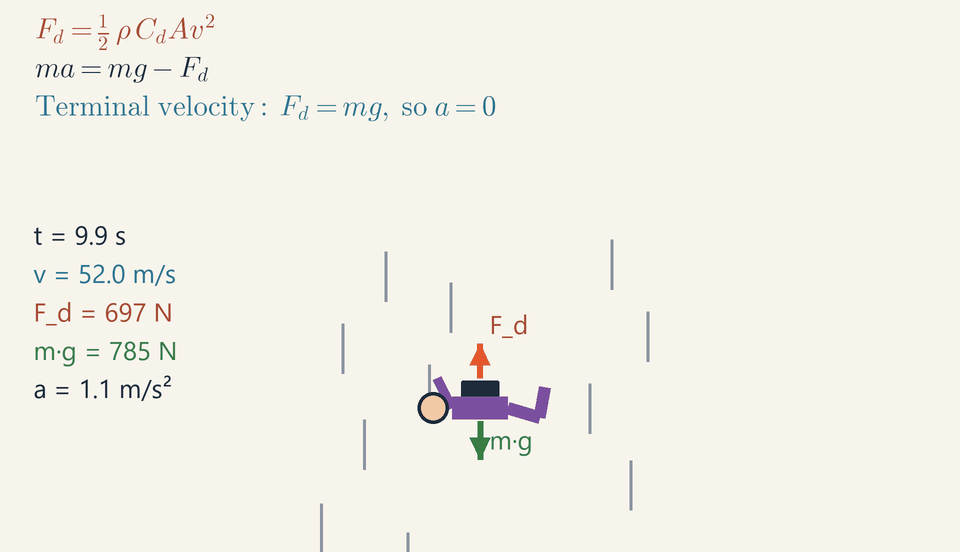
A skydiver falls belly-down until air resistance balances the weight at terminal velocity, then opens a parachute and slows to a much lower terminal velocity (shown at double speed).
Air and water push back on anything moving through them; this drag grows quickly with speed and with the area facing the flow.
A falling skydiver speeds up until air resistance equals the weight; then the speed stays constant: the terminal velocity.
An open parachute's huge area makes the drag bigger than the weight, so the jumper slows to a gentle, safe terminal speed.
Streamlined shapes slip through fluids with little drag; thick, sticky liquids such as honey have a high viscosity.
Gravity keeps pulling, yet a falling skydiver stops speeding up. Let's see why, one step at a time.
Step 1: fluids push back. Hold your hand out of a moving car's window and the air shoves it backwards. Air, water and every other fluid push against anything moving through them. This push is called drag, or air resistance. It grows quickly with speed (twice as fast means about four times the push) and with the area facing the flow.
Step 2: a falling body stops speeding up. Watch the skydiver. Just after the jump the speed is low, so the air resistance (red arrow, up) is small and the weight (green arrow, down) wins: the skydiver speeds up and the blue speed bar climbs. But more speed means more air resistance. After about ten seconds the red arrow is as long as the green one. The forces cancel, so the speed stops changing: the skydiver falls steadily at about 200 km/h, the terminal velocity.
Step 3: the parachute. The open canopy has a huge area, so the air resistance suddenly becomes much bigger than the weight and the skydiver slows down. As the speed drops, so does the push, until it balances the weight again at a gentle 18 km/h.
Step 4: shape and stickiness. A smooth, pointed shape lets the fluid close in behind it, so it feels little drag: think of fish and racing cyclists. Thick liquids such as honey resist even slow motion; this inner stickiness is called viscosity.
Check yourself: a raindrop falls at a steady speed. Is the air resistance on it smaller than, equal to or bigger than its weight? (Answer: equal. A steady speed means the forces balance.)
Intermediate
Key ideas
Quadratic drag: Fd=21ρCdAv2, so doubling the speed quadruples the drag.
Small, slow spheres in a viscous fluid obey Stokes' law, Fd=6πηrv, with the viscosity η in Pa·s.
Falling body: ma=mg−Fd; at terminal velocity Fd=mg, so vt=2mg/(ρCdA).
An 80 kg skydiver with CdA=0.43m2 reaches vt≈55m/s; a parachute (CdA≈52m2) cuts it to about 5 m/s.
Balanced forces mean constant velocity, not rest; just after the canopy opens the jumper still falls, but decelerates.
What drag is and what it depends on
A falling skydiver stops speeding up, although the weight stays the same. Drag is the force a fluid exerts on a body moving through it. It points against the body's velocity relative to the fluid: a cyclist riding at 10 m/s into a 5 m/s headwind meets the air at 15 m/s.
For balls, cars and skydivers the drag follows the quadratic law Fd=21ρCdAv2 Here ρ is the density of the fluid (1.2 kg/m³ for air near the ground), A the frontal area facing the flow and v the speed. The drag coefficient Cd is a pure number set by the shape: about 0.05 for a teardrop, 0.3 for a modern car, 0.47 for a sphere and 1.5 for a round parachute.
Why the square? Each second the body shoves aside a fluid mass of about ρAv and gives it a speed comparable to v. The momentum handed over per second, which is the force, is then about ρAv2: twice the speed, four times the drag.
Viscosity and the world of the small and slow
Viscosity, η, is a fluid's internal friction, the resistance of its layers to sliding past one another, measured in pascal seconds (Pa·s). At 20 °C air has 1.8×10⁻⁵Pa⋅s, water 1.0×10⁻³Pa⋅s, olive oil about 0.08 Pa·s and glycerol 1.4 Pa·s; warm liquids are runnier.
Tiny or slow objects, such as dust, fog droplets or a bead sinking in honey, feel a drag proportional to v instead. For a sphere of radius r this is Stokes' law, Fd=6πηrv(Stokes, Re≪1) The density does not appear: the fluid is not flung aside but sheared, layer against layer.
Which law applies is decided by the Reynolds number, built from the fluid's density and viscosity, the speed and the size L of the body: Re=ηρvL It compares the fluid's inertia with its viscosity. Below about 1, Stokes' law holds; above about 1000, the quadratic law holds, with a Cd set mainly by the shape. A fog droplet has Re≈0.02; the skydiver, with L≈0.5m, about 2 million.
Falling with drag: terminal velocity
Take down as positive. A falling body feels its weight mg downward and the drag upward, so Newton's second law reads ma=mg−Fd At the start v=0, there is no drag and a=g. As the body speeds up, the drag grows and the acceleration shrinks, until the drag equals the weight. From then on a=0 and the body falls at a constant speed, the terminal velocity. Setting 21ρCdAvt2=mg gives vt=ρCdA2mg
For a small sphere in the Stokes regime, the weight minus the buoyant force (see Buoyancy and Archimedes' Principle) is balanced by 6πηrv, which gives vt=9η2r2(ρs−ρf)g(Stokes sphere) where ρs and ρf are the densities of the sphere and of the fluid. In air, buoyancy is only about 0.1 % of a skydiver's weight, and we ignore it. A body of the same shape and material but twice as large falls 2≈1.41 times faster with quadratic drag (m∝r3, A∝r2), which helps small animals survive falls, but four times faster in the Stokes regime (vt∝r2).
Worked example: the skydiver in the animation
The jumper has m=80kg and, belly-down, CdA=0.43m2, in air with ρ=1.2kg/m3. The weight is mg=80⋅9.81=785N, the green line among the readouts, and the terminal velocity is vt=1.2⋅0.432⋅785≈3040≈55.2m/s about 199 km/h.
Since mg=21ρCdAvt2, the drag at any speed is Fd=mg(v/vt)2. When the v readout shows 30 m/s, at t≈3.4s, Fd=21⋅1.2⋅0.43⋅302≈232N and a=(785−232)/80≈6.9m/s2. The approach is slow: at 13 s, when the canopy opens, the readouts show v≈54.1m/s, Fd≈755N and a≈0.4m/s2. The t readout counts real seconds; the animation runs at double speed.
The canopy has CdA=52.5m2, 122 times more, so vt falls by a factor 122≈11, to 55.2/11.05≈5.0m/s (18 km/h), as the parachute line under the formulas says. While the canopy inflates, the drag peaks near 3340 N, 4.3 times the weight, at t≈14s, and the a readout dips to about −32m/s2, a deceleration of 3.3 g. By about 19 s the readouts settle at v=5.0m/s, Fd=785N and a=0.
Worked example: fog droplets and raindrops
Why do clouds float while rain falls? A fog droplet of radius r=10μm falls through air (η=1.8×10⁻⁵Pa⋅s), with ρs=1000kg/m3 and ρf=1.2kg/m3. The Stokes formula gives vt=9⋅1.8×10−52⋅(10−5)2⋅998.8⋅9.81≈0.012m/s just 1.2 cm/s. Check the regime: Re=1.2⋅0.012⋅2×10−5/(1.8×10−5)≈0.016, far below 1, so Stokes' law was the right choice. An updraft of a few centimetres per second keeps such droplets aloft.
A raindrop of radius 1 mm is 100 times larger. Stokes' law would give 104 times more, 121 m/s, at a Reynolds number of about 16 000, far outside its range. With the quadratic law instead, Cd≈0.5, m=ρs⋅34πr3=4.19×10⁻⁶kg and A=πr2=3.14×10⁻⁶m2: vt=1.2⋅0.5⋅3.14×10−62⋅4.19×10−6⋅9.81≈6.6m/s close to the 6.5 m/s measured for drops 2 mm across, at Re≈900. Find the regime first, then choose the law.
Reading the force arrows
The two arrows share one scale in pixels per newton. The green mg arrow never changes; the red Fd arrow goes through four phases.
Speeding up: red shorter than green, so the net force points down and a shrinks from g towards zero.
Terminal velocity: both arrows equally long, zero net force, a steady speed near 55 m/s.
Opening: red about 4.3 times longer than green, so the net force points up and a turns negative while the jumper still falls.
Balanced again: red back to the length of green, at 5.0 m/s, with the grey air streaks barely creeping past.
Common mistakes
Balanced forces do not mean rest: at terminal velocity the net force is zero, yet the jumper still falls at 55 m/s.
An opening parachute does not pull the jumper up, whatever videos from a still-falling camera flyer suggest: the velocity stays downward, dropping from 54 to 5 m/s, while the acceleration points up, about −32m/s2 at its peak.
Everyday drag is not proportional to speed: at half the terminal speed, 27.6 m/s, the drag on the jumper is a quarter of the weight, 196 N, not half.
Heavier bodies do fall faster in air, but only as m: 40 kg of extra gear with the same CdA raises vt by a factor 1.5≈1.22, to 67.5 m/s.
Viscosity is not density: olive oil floats on water, yet it is about 80 times more viscous.
Where you meet it
Drag sets the energy bill of every vehicle. Moving steadily through still air takes the power P=Fdv=21ρCdAv3 For a car with CdA=0.66m2 at 90 km/h (25 m/s) this is 21⋅1.2⋅0.66⋅253≈6.2kW; at 130 km/h it is 18.6 kW, three times as much, and each kilometre costs about twice the energy.
Cyclists crouch to cut CdA, golf-ball dimples reduce drag and parachutes exploit it, while centrifuges speed up the slow Stokes settling of blood cells. Bernoulli's Principle explains the pressure 21ρv2 behind the drag law, Damping and Resonance treats drag that slows an oscillation, and Work, Energy and Power follows where the energy goes.
Advanced
Key ideas
Viscosity from shear: F/A=ηv0/d; a real fluid does not slip at a solid wall, and η measures momentum flow between layers.
mdv/dt=mg−kv2 gives v=vttanh(gt/vt): initial slope g, and 96 % of vt after 2vt/g.
Flows with the same Re=ρvL/η look alike, so a small model in a wind tunnel predicts the full-size flow.
Cd depends only on Re: 24/Re for Stokes flow, about 0.47 higher up, then a sharp drop near Re≈3×10⁵.
Zero viscosity is a singular limit: as η→0 a thin boundary layer and a wake remain, so real bodies always feel drag.
Viscosity: momentum flowing between layers
Viscosity is a fluid's resistance to having its layers slide over one another. Every drag force in this lesson comes from it, directly or indirectly, so we begin with the simplest flow that measures it.
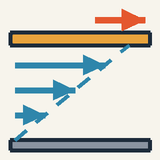
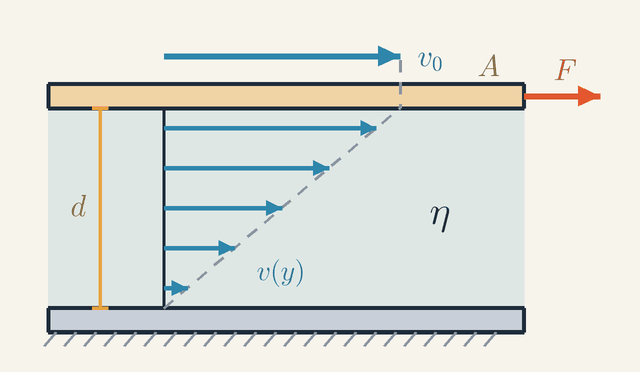
Figure 1. Shear flow between two plates a distance d apart: the upper plate, of area A, is pulled by a force F at speed v0, and the lower one is held still. Notice that the fluid's speed v(y) grows in a straight line, from zero at the bottom to v0 at the top.Legend
d
Width of the gap between the two plates.
m
A
Area of the upper plate.
m2
F
Force that pulls the upper plate along at a steady speed.
N
v0
Speed of the upper plate; the lower plate is at rest.
m/s
v(y)
Speed of the fluid at height y above the lower plate: zero at the bottom, v0 at the top.
m/s
η
Viscosity of the fluid: the stress needed per unit velocity gradient.
Pas
Figure 1 shows that flow. A fluid fills the gap of width d between two large parallel plates. The lower plate is held still. The upper plate, of area A, is pulled by a force F and slides at the steady speed v0. Each blue arrow gives the fluid's speed v(y) at the height y above the lower plate.
Two facts fix the lengths of the arrows. First, fluid in contact with a solid surface moves with that surface. This is the no-slip condition, and it holds for every ordinary fluid. So the arrow at the bottom has length zero and the one at the top has length v0. Second, neighbouring layers pull on each other with a force per unit area proportional to how quickly the speed changes with height, ηdv/dy. This is what defines the viscosity η. In steady flow no layer speeds up, so the pull from the faster layer above it must balance the drag from the slower layer below: the stress, and with it dv/dy, is the same at every height.
That is why the arrows grow in equal steps and the dashed line through their tips is straight. The speed rises by v0 across the gap d, so dv/dy=v0/d everywhere, and the force needed per unit area of the plate is AF=ηdv0 Doubling the plate's speed, or halving the gap, doubles the force. Since F/A is a stress, η is measured in Pa·s.
The same law reads more deeply as a flow of momentum. Each layer pulls the slower layer below it forward and is held back by it in return. Momentum along the flow therefore passes from fast fluid to slow, at a rate set by η. In Figure 1 it enters at the moving plate, crosses every layer downwards and leaves through the still plate; F is the rate, in momentum per second, at which the upper plate feeds it in.
This picture explains how viscosity depends on the state of the fluid. In a gas the momentum is carried by molecules hopping between layers: a molecule arriving from a faster layer brings extra forward momentum into a slower one. Kinetic theory gives η≈31ρvˉλ. Here ρ is the gas density, vˉ the mean molecular speed and λ the mean free path, the average distance a molecule travels between collisions. Because λ∝1/ρ, the product ρλ stays the same when the gas is compressed, so gas viscosity is independent of pressure. It rises with temperature, because vˉ does.
Liquids behave the opposite way: their molecules are held by their neighbours, heat helps them break free, and the viscosity falls steeply on heating. Water has 1.79 mPa·s at 0 °C but only 0.28 mPa·s at 100 °C.
The viscous force also completes the equation of motion of a fluid. For an ideal fluid, Newton's second law per unit volume is Euler's equation: density times acceleration equals the pressure force −∇p plus the weight ρg, where p is the pressure. In an incompressible fluid the net viscous force per unit volume is η∇2v. The Laplacian ∇2 measures how far the velocity at a point differs from the average of its surroundings, so this force pulls each parcel towards the motion of its neighbours. Adding it gives the Navier–Stokes equation: ρ(∂t∂v+(v⋅∇)v)=−∇p+ρg+η∇2v The bracket is the acceleration of a fluid parcel: the change of velocity at a fixed point plus the change that comes from moving to a place where the flow is different. The equation is solved with the no-slip condition of Figure 1: at every solid surface the fluid moves with the surface, so v=0 on a body at rest.
Dimensional analysis and the Reynolds number
The flow around a real body is far too complicated to calculate from the Navier–Stokes equation. Dimensional analysis shows how much can be said without solving it, and it produces the one number that classifies every flow.
For a body of a given shape, the drag F can depend only on the body's size L, its speed v through the fluid and the fluid's density ρ and viscosity η. These five quantities are built from three units, the kilogram, the metre and the second, so they can be combined into only 5−3=2 independent dimensionless numbers. A convenient pair is F/(ρv2L2) and the Reynolds number Re=ηρvL A physical law cannot depend on the choice of units, so it must be a relation between these two numbers: the first is a function of the second. Replacing L2 by the body's frontal area A and adding the conventional factor 21 gives the drag law Fd=21ρv2ACd(Re) The drag coefficient Cd is a pure number. All the hard physics now hides in one function of one variable, which has to be measured only once for each shape.
Physically, Re compares inertia with viscosity. The velocity changes by about v over distances of about L, so the inertial term ρ(v⋅∇)v is about ρv2/L and the viscous term η∇2v is about ηv/L2. Their ratio is Re. At large Re inertia dominates; at small Re viscosity does.
It follows that flows past geometrically similar bodies at equal Re are scaled copies of each other, which is what makes model tests work. With the kinematic viscosity ν=η/ρ, the Reynolds number is Re=vL/ν; ν is 1.0×10⁻⁶m2/s for water and 1.5×10⁻⁵m2/s for air. A 1 : 10 model of a car has one tenth of the length, so in water it matches the real car in air when its speed is 10νwater/νair≈0.67 of the car's speed.
The range of Re in nature is enormous: about 10−4 for a swimming bacterium, 0.016 for a fog droplet, 900 for a raindrop and 2×10⁶ for the skydiver.
Stokes flow and the drag curve
The function Cd(Re) has been measured for many shapes. The sphere is the standard example, and its curve shows the two very different regimes of drag.
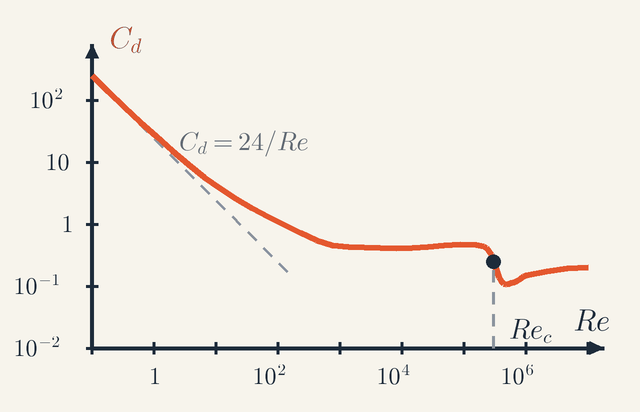
Figure 2. Drag coefficient Cd of a smooth sphere against the Reynolds number Re, both on logarithmic axes. Notice the three stages: the dashed Stokes line Cd=24/Re at small Re, a flat plateau, and the sudden drop at Rec.Legend
Cd
Drag coefficient, defined by Fd=21ρv2ACd.
Re
Reynolds number of the flow, ρvL/η, with L the sphere's diameter.
Rec
Reynolds number of the drag crisis, about 3×10⁵.
Figure 2 plots the drag coefficient Cd of a smooth sphere against the Reynolds number Re, based on the sphere's diameter. Both axes are logarithmic: each factor of 10 takes the same distance, so a power law Cd∝Ren appears as a straight line of slope n. The dashed line is Cd=24/Re, of slope −1.
Follow the measured curve from left to right. For Re≪1 it runs along the dashed line. Near Re≈1 it bends above it, and between Re≈103 and 2×10⁵ it flattens into a plateau at 0.4 to 0.5. At Rec≈3×10⁵ it plunges to about 0.1: this is the drag crisis. Beyond it the curve recovers part of the way, to roughly 0.2 at Re≈107. The plateau and the plunge come from the shape of the wake, the subject of the next section.
The straight part is Stokes flow. At Re≪1 the inertial term is negligible, so the density ρ drops out of the problem. The drag on a sphere of radius r can then depend only on η, v and r, and the only product of these with the unit of force is ηrv. Solving the slow-flow equations fixes the numerical factor: Fd=6πηrv Dividing by 21ρv2πr2 gives Cd=12η/(ρvr)=24η/(ρv⋅2r)=24/Re, which is the dashed line.
A small sphere sinking through a liquid reaches its terminal velocity when this drag balances its weight minus the buoyancy, 34πr3(ρs−ρf)g, where ρs is the density of the sphere and ρf that of the fluid. Setting the two equal gives vt=9η2r2(ρs−ρf)g proportional to r2: a sphere twice as wide sinks four times as fast. Timing a sinking ball and solving for η is a standard way to measure the viscosity of oils.
Separation, the wake and the drag crisis
Why does Cd stop falling and level off, and why does it suddenly drop near Rec? The answer lies in a thin layer of fluid next to the body's surface.
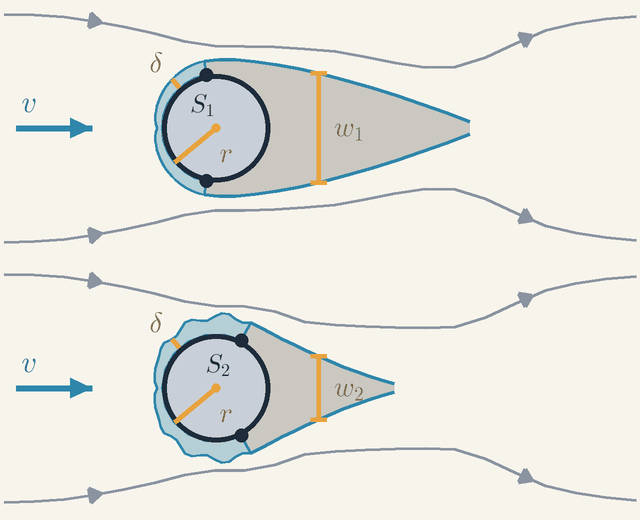
Figure 3. Flow past a sphere of radius r in a stream of speed v. A laminar boundary layer (top) separates early, at S1, and leaves a wide wake w1; a turbulent one (bottom) separates later, at S2, and the wake w2 is narrower. Not to scale.Legend
v
Speed of the stream far upstream.
m/s
r
Radius of the sphere.
m
δ
Thickness of the boundary layer, across which the speed rises from zero at the surface to that of the stream. Drawn far too thick.
m
S1
Point where the laminar boundary layer separates, about 80° from the front.
S2
Point where the turbulent boundary layer separates, farther back, about 120° from the front.
w1
Width of the wake behind the sphere with a laminar boundary layer.
m
w2
Width of the wake with a turbulent boundary layer.
m
Figure 3 shows the flow past a sphere of radius r in a stream of speed v. At the surface the fluid is at rest (no slip). The thin layer in which its speed climbs to that of the stream is the boundary layer, of thickness δ; it is drawn far thicker than it really is. Over the front half of the sphere the pressure falls, which pushes the layer along. Behind the widest point the pressure rises again, and the slow fluid near the wall does not have the momentum to move against it.
In the upper picture the boundary layer is laminar, meaning smooth and orderly. It runs out of momentum early and separates at S1, about 80° round from the front: it leaves the surface along the tangent as a free shear layer. Behind it lies a broad wake of slow, swirling, low-pressure fluid, of width w1. In the lower picture the boundary layer is turbulent. Its eddies keep stirring fast fluid from outside down towards the wall, so it clings to the surface longer and separates farther back, at S2, about 120° from the front. The wake, of width w2, is much narrower.
Now connect this to Figure 2. Above Re≈103 the flow is of the upper kind: it cannot follow the rear of the body. The front feels nearly the full stagnation pressure 21ρv2 while the wide wake behind sits at low pressure. This difference, the pressure drag, does not depend on η, so Cd levels off: that is the plateau. Near Rec the boundary layer becomes turbulent before it can separate. The flow switches to the lower kind, the wake narrows, the pressure behind recovers partly, and Cd drops to about 0.1: that is the drag crisis.
Golf-ball dimples make the boundary layer turbulent much earlier, triggering the crisis near Re≈5×10⁴. A drive covers Re≈105 to 2×10⁵, so over the whole flight the dimples roughly halve the drag. Bodies with sharp edges, such as a flat plate, a spread-eagled jumper or a canopy, behave differently: the flow separates at their edges at any high Re, so their Cd stays nearly constant. That is why the animation can use one value of CdA for each phase of the jump. The v2 law summarises a complicated flow over a limited range of Re; it is not a law of nature like F=ma.
The boundary layer also resolves an old puzzle. An ideal fluid, with η=0, flowing steadily past a body closes up perfectly behind it and exerts no drag at all: d'Alembert's paradox of 1752. One might expect real flows to approach this as η→0, but they do not.
In the Navier–Stokes equation η multiplies the term with the highest derivatives. Dropping that term lowers the order of the equation, and the remaining equation cannot satisfy the no-slip condition. However small η is, the change of velocity therefore crowds into a boundary layer, the δ of Figure 3, where the gradients are steep enough for viscosity to matter. Its thickness shrinks only as L/Re; for the skydiver it is a fraction of a millimetre. The layer still separates, the wake survives and the drag stays finite. Zero viscosity is a singular limit, as Prandtl's boundary-layer theory of 1904 showed.
Integrating the fall: the hyperbolic tangent
The skydiver of the animation (mass 80 kg, belly-down) falls at Reynolds numbers near 2×10⁶, where Cd is constant and the drag grows as v2. This section solves the motion exactly.
Write k=21ρCdA, so that the drag is kv2, and take down as positive. The weight mg acts down and the drag acts up, so Newton's second law reads mdv/dt=mg−kv2. The jumper stops accelerating when the two forces balance, at the terminal velocity vt with vt2=mg/k. Dividing by m and using this definition gives dv/dt=g(1−v2/vt2). The speed and the time can now be put on opposite sides and integrated from the jump, when t=0 and v=0: ∫0v1−u2/vt2du=vtartanh(v/vt)=gt Solving for v gives v(t)=vttanh(vtgt) Since the integral of tanh is lncosh, one more integration gives the distance fallen, x(t)=(vt2/g)lncosh(gt/vt).
The natural time scale is τ=vt/g, the time free fall would need to reach vt. For the animation's jumper, with vt=55.2m/s, it is τ=5.6s. For t≪τ, tanhs≈s, so v≈gt: the first seconds are almost free fall. For t≫τ, tanhs≈1−2e−2s and lncoshs≈s−ln2, so v≈vt(1−2e−2t/τ),x≈vtt−(vt2/g)ln2 The jumper ends up a fixed 215 m behind an imaginary companion who had fallen at vt from the start.
Compare linear drag, mdv/dt=mg−bv, which gives v=vt(1−e−t/τ) with again τ=vt/g, here equal to m/b. The start is the same, with slope g, but the final approach is slower: the gap to vt shrinks at the rate 1/τ instead of 2/τ. At terminal velocity nothing speeds up, yet gravity is still doing work at the rate mgvt=785⋅55.2≈43kW. All of it goes into stirring the air, whose eddies finally turn it into heat.
Reading the graphs: approach and opening shock
The formulas become concrete on the animation's graphs. Slopes and areas on them show how fast the jumper speeds up and slows down, how far the jumper falls and how hard the canopy pulls.
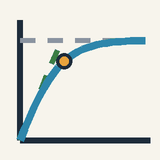
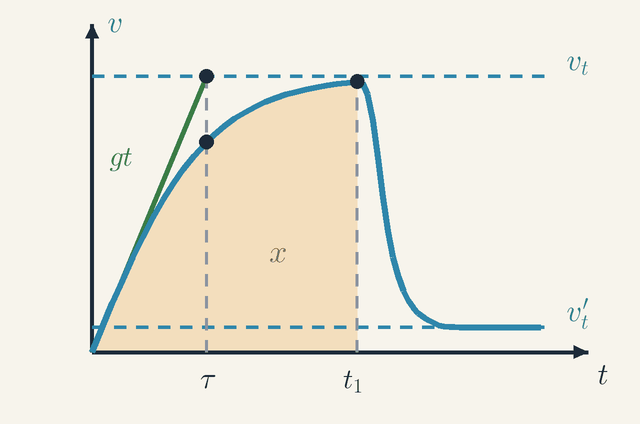
Figure 4. The skydiver's speed v(t) in the animation's model. Notice the tangent gt meeting the line vt at τ, and the sharp fall to vt′ once the canopy starts to open at t1. The shaded area under the curve up to t1 is the distance fallen, x.Legend
v
Speed of the jumper.
m/s
t
Time since the jump.
s
vt
Terminal speed of the belly-down jumper, 55.2 m/s.
m/s
vt′
Terminal speed under the open canopy, 5.0 m/s.
m/s
gt
Speed that free fall would reach: the tangent to v(t) at t=0, of slope g.
m/s
τ
Time scale vt/g=5.6s: the tangent gt meets the line vt at t=τ.
s
t1
Moment the canopy starts to open, 13 s after the jump.
s
x
Distance fallen before t1: the shaded area under v(t).
m
Figure 4 is the speed graph of the animation's expert view, drawn from the same model. The blue curve is the jumper's speed v(t). It leaves the origin along the green tangent gt, of slope g, which meets the upper dashed line vt at t=τ=5.6s, the first dashed vertical. Look at the lower dot there: the curve has reached only tanh1≈0.76 of vt, 42 m/s, because drag has been growing all the way. It reaches 96 % of vt after 2τ, and 54.1 m/s by t1=13s, the second dashed vertical, when the canopy starts to open.
The animation also draws a second graph, not shown here: the drag Fd(t)=mgtanh2(gt/vt) in red. It starts flat, because drag grows as v2, and creeps up towards the dashed mg line.
At t1 the canopy's diameter starts to grow steadily, for 4 s. Its area grows as the square of the diameter, so the extra CdA grows as the square of the time since opening. At first CdA rises faster than v2 falls, so the drag shoots up, to a peak of about 3340 N, or 4.3mg, at t≈14.0s and v≈37m/s. This is the opening shock. In Figure 4, after t1 the blue curve turns steeply down onto the lower dashed line, vt′=5.0m/s, and reaches it by about 18 s. The approach is quick because the new time scale is only vt′/g=0.51s.
The areas carry meaning too. The area under v(t) is the height lost: 505 m before the opening (the shaded area x in Figure 4), 92 m during the inflation and 25 m more at the final speed until 22 s, 622 m in all. On the drag graph, Newton's second law mdv/dt=mg−Fd shows that the net area between Fd(t) and the mg line after the opening is the momentum removed: mΔv=80⋅(54.1−5.0)≈3930N⋅s.
Worked problem: a canopy that opens at once
Why must a canopy open gradually? Suppose the full canopy, with CdA=52.5m2, appeared instantly at 13 s, when the speed is v0=54.1m/s. With this CdA the terminal speed is vt′=4.99m/s, which means the drag equals mg at vt′. Drag grows as v2, so at v0 it would jump to Fd=mg(vt′v0)2=785⋅(4.9954.1)2≈9.2×10⁴N This is 117 times the weight. Subtracting the weight leaves a net force of 116 times the weight, a deceleration of about 116 g.
How quickly would the speed drop? Now v>vt′, so the drag exceeds the weight and the same equation as before, dv/dt=−g(v2/(vt′)2−1), makes the speed fall. Above the terminal speed its solution uses coth in place of tanh. With t counted from the opening, v(t)=vt′coth(vt′gt+u0),cothu0=vt′v0 Here cothu0=10.8, so u0=0.093. The speed is down to 2vt′≈10m/s when the bracket reaches arcoth2=0.549. With vt′/g=0.509s that takes (0.549−0.093)⋅0.509≈0.23s. The integral of coth is lnsinh, so the distance covered is ((vt′)2/g)ln(sinh0.549/sinh0.093)≈2.54⋅1.83≈4.6m.
An energy balance gives the average force. Between 54.1 and 10 m/s the jumper loses 21⋅80⋅(54.12−102)≈113kJ of kinetic energy. The drag must absorb this, plus the 3.6 kJ of potential energy released on the way, within 4.6 m: an average force of 32 times the weight. The animation's canopy spreads the opening over 4 s and 92 m. There the drag absorbs the 116 kJ of kinetic energy lost plus 72 kJ of potential energy, an average of 2.6mg with a peak of 4.3mg. Real parachutes use sliders or reefing lines to slow the opening for exactly this reason.
Limits of validity
The model keeps CdA fixed in each phase and the air density ρ fixed throughout. Both are approximations. Head-down, a jumper roughly halves CdA, and since vt∝1/CdA, the terminal speed rises by a factor 2, to about 78 m/s. Since vt∝1/ρ as well, it also changes with height: at 4000 m, where the air density is about 0.82 kg/m³ instead of 1.2 kg/m³, the belly-down jumper falls at 55.2⋅1.2/0.82≈67m/s. Terminal velocity therefore depends on posture and on height.
Air behaves as incompressible only while the Mach number, the ratio of v to the speed of sound, stays below about 0.3; the skydiver is at 0.16. At 39 km the air is some 250 times thinner, so vt is about 16 times higher on paper. Record jumps from there have passed the speed of sound, where shock waves raise Cd.
Stokes' law needs Re well below 1: its first correction, a factor 1+3Re/16, already adds about 10 % at Re=0.5. At the other end of the size scale, particles smaller than about 0.1 μm are comparable with the 68 nm mean free path of air molecules. The air then no longer acts as a continuous fluid: it slips at their surface, and Brownian motion moves them more than settling does. Finally, the model ignores unsteady flow, so the animation's smooth growth of CdA only approximates the violent real opening shock.
Where this leads
Bernoulli's Principle describes the ideal flow outside the boundary layer and explains why drag is measured in units of 21ρv2. In Damping and Resonance a linear drag −bv becomes the damping term of an oscillator. Kinetic Theory of Gases derives a gas's viscosity from molecular collisions. Electric Current and Resistance has the same structure as Stokes settling: electrons drift at a terminal velocity at which collisions balance the electric force, so the current is proportional to the field. Conduction, Convection and Radiation uses boundary layers to explain how wind carries heat away, and the paths of Projectile Motion become shorter and lopsided once drag is added.
Key formulas
Quadratic drag law
Fd=21ρCdAv2
Every second the body pushes aside a fluid mass of about ρAv and gives it a speed comparable to v, so the momentum handed to the fluid each second, the drag, grows as ρAv2. The factor 21ρv2 is the dynamic pressure of the oncoming flow, and the drag coefficient Cd collects everything about the shape. The force points against the velocity relative to the fluid.
Symbols
Fd
drag force
N
ρ
density of the fluid
kg/m3
Cd
drag coefficient, set by the shape
A
frontal area facing the flow
m2
v
speed relative to the fluid
m/s
When it holds: For Reynolds numbers above about 1000 (balls, vehicles, people, parachutes), where the drag coefficient is nearly constant. It fails for tiny or slow bodies (use Stokes' law), near the drag crisis of smooth round bodies and near the speed of sound.
Example: The skydiver at 30 m/s with CdA=0.43m2: Fd=21⋅1.2⋅0.43⋅302≈232N.
Stokes' law for a sphere
Fd=6πηrv(Stokes, Re≪1)
In very slow or very small-scale flow the fluid's inertia is negligible: the fluid is sheared rather than flung aside, so the drag depends on the viscosity but not on the density, and it is proportional to the speed. Solving the slow-flow equations for a sphere gives the factor 6π; two thirds of the force come from shear on the surface and one third from the pressure difference between front and back.
Symbols
Fd
drag force
N
η
viscosity of the fluid
Pa⋅s
r
radius of the sphere
m
v
speed relative to the fluid
m/s
Re
Reynolds number of the flow, based on the diameter
When it holds: Only for Re≪1: the error is about 10 % at Re=0.5. The sphere must also be much larger than the mean free path of the fluid's molecules, 68 nm in air.
Example: A fog droplet of radius 10 μm falling at 0.012 m/s in air: Fd=6π⋅1.8×10−5⋅10−5⋅0.012≈4.1×10⁻¹¹N, equal to its weight.
Newton's second law for a falling body
ma=mg−Fd
With down as positive, the weight mg pulls down and the drag pushes up, so the net force is their difference. The acceleration starts at g when v=0 and shrinks as the drag grows. It reaches zero at terminal velocity and becomes negative, pointing up, when the drag exceeds the weight, as just after a parachute opens.
Symbols
m
mass of the body
kg
a
acceleration, positive downward
m/s2
g
free-fall acceleration
m/s2
Fd
drag force, pointing up
N
When it holds: For vertical motion with down as positive and buoyancy neglected, which is about 0.1 % of the weight in air. In a liquid, subtract the buoyant force as well.
Example: The skydiver at 30 m/s: a=(785−232)/80≈6.9m/s2; at the peak of the opening shock, a=(785−3340)/80≈−32m/s2.
Terminal velocity with quadratic drag
vt=ρCdA2mg
At terminal velocity the drag equals the weight, 21ρCdAvt2=mg, and solving for the speed gives this formula. A heavier body, a smaller frontal area, a more streamlined shape or thinner air means a faster fall. For bodies of the same shape and material m∝L3 and A∝L2, so vt∝L.
Symbols
vt
terminal velocity
m/s
m
mass of the body
kg
g
free-fall acceleration
m/s2
ρ
density of the fluid
kg/m3
Cd
drag coefficient
A
frontal area
m2
When it holds: For quadratic drag with negligible buoyancy and constant CdA and ρ. In air that thickens on the way down the speed never quite settles: at 4000 m the same jumper's vt is about 67 m/s.
Example: Belly-down, vt=2⋅785/(1.2⋅0.43)≈55.2m/s; under the canopy, with CdA=52.5m2, vt≈5.0m/s.
Speed of a body falling from rest with quadratic drag
v(t)=vttanh(vtgt)
Separating the variables in dv/dt=g(1−v2/vt2) and integrating from rest gives this law. It starts like free fall, v≈gt, and approaches vt on the time scale vt/g: the speed is tanh1≈0.76 of vt after vt/g and 0.96 of vt after 2vt/g.
Symbols
v
speed at time t
m/s
vt
terminal velocity
m/s
g
free-fall acceleration
m/s2
t
time since the release from rest
s
When it holds: From rest, with quadratic drag and constant CdA, ρ and g. A body that starts faster than vt slows down along v=vtcoth(gt/vt+u0) instead, with cothu0=v0/vt.
Example: The skydiver, with vt/g=5.6s: after 11.2 s, v=55.2tanh2≈53.2m/s.
Terminal velocity of a small sphere (Stokes)
vt=9η2r2(ρs−ρf)g(Stokes sphere)
At terminal velocity the weight of the sphere minus the buoyant force, 34πr3(ρs−ρf)g, equals the Stokes drag 6πηrvt. The weight grows as r3 but the drag only as r, so vt∝r2: a particle ten times smaller settles a hundred times more slowly. If ρs<ρf, vt comes out negative and the sphere rises instead.
Symbols
vt
terminal velocity
m/s
r
radius of the sphere
m
ρs
density of the sphere
kg/m3
ρf
density of the fluid
kg/m3
g
free-fall acceleration
m/s2
η
viscosity of the fluid
Pa⋅s
When it holds: Only while Re≪1, so check ρfvt⋅2r/η after computing. For a raindrop of radius 1 mm the formula gives 121 m/s at a Reynolds number of about 16 000, far outside its range.
Example: A fog droplet of radius 10 μm in air: vt=2⋅(10−5)2⋅998.8⋅9.81/(9⋅1.8×10−5)≈0.012m/s.
Reynolds number
Re=ηρvL
The ratio of the fluid's inertial force per unit volume, about ρv2/L, to the viscous one, about ηv/L2. Dimensional analysis shows that the drag coefficient of a given shape depends on nothing else, so flows with equal Re are scaled copies of each other. Small Re means smooth, syrupy flow; large Re means separation, wakes and turbulence.
Symbols
Re
Reynolds number
ρ
density of the fluid
kg/m3
v
speed of the body relative to the fluid
m/s
L
size of the body (for a sphere, its diameter)
m
η
viscosity of the fluid
Pa⋅s
When it holds: Defined for any flow, but the choice of L is a convention, so compare values only for the same convention. Similarity also needs the same shape and, at high speed, the same Mach number.
Example: The skydiver at 55 m/s with L≈0.5m: Re=1.2⋅55⋅0.5/(1.8×10−5)≈1.8×106.
Power needed against drag
P=Fdv=21ρCdAv3
Power is force times speed. To keep moving steadily against drag, an engine, a cyclist or gravity must supply Fdv, and with quadratic drag that grows as v3. The energy per kilometre is the drag force times the distance, so it grows only as v2.
Symbols
P
power needed against drag
W
Fd
drag force
N
v
speed
m/s
ρ
density of the fluid
kg/m3
Cd
drag coefficient
A
frontal area
m2
When it holds: For steady motion through still air with quadratic drag. With wind, Fd depends on the speed relative to the air while P=Fdv uses the speed over the ground; rolling resistance and drivetrain losses need power on top.
Example: A car with CdA=0.66m2 at 25 m/s (90 km/h): P=21⋅1.2⋅0.66⋅253≈6.2kW; at 130 km/h, about 18.6 kW.
Glossary
Drag
The force a fluid exerts on a body moving through it, directed against the body's velocity relative to the fluid. Air resistance is drag in air; a headwind increases it because the relative speed is larger.
Viscosity
A fluid's internal friction, its resistance to layers sliding over one another, measured by η. It describes how readily momentum passes from fast layers to slow ones, and it is not density: olive oil is less dense than water but about 80 times more viscous.
No-slip condition
The experimental fact that the fluid touching a solid surface moves with that surface. It holds for all ordinary fluids, so every moving body carries a thin layer of fluid along with it.
Quadratic drag
Drag proportional to the square of the speed, Fd=21ρCdAv2, found at high Reynolds numbers for balls, vehicles and people. Doubling the speed quadruples the drag and multiplies the power needed by eight.
Stokes' law
The drag on a small sphere in slow, viscous flow, Fd=6πηrv: proportional to the speed and independent of the fluid's density. It holds for Re≪1, as for dust, fog droplets, cells or a bead in honey.
Terminal velocity
The steady speed at which drag, together with any buoyancy, balances the weight, so the acceleration is zero. A belly-down skydiver reaches about 55 m/s, a jumper under a round canopy about 5 m/s.
Reynolds number
The dimensionless ratio Re=ρvL/η of inertial to viscous effects in a flow. It decides which drag law applies: Stokes' law below about 1, quadratic drag above about 1000.
Dynamic similarity
The rule that flows around bodies of the same shape are scaled copies of each other when their Reynolds numbers are equal. It is why wind-tunnel and water-tank models predict full-size flows.
Boundary layer
The thin layer next to a surface in which the flow speed rises from zero at the wall to that of the outer stream. Its thickness shrinks as L/Re but never vanishes, so friction never disappears.
Wake
The region of slow, swirling fluid behind a body once the flow has separated from its surface. Its low pressure, against the high pressure on the front, causes the pressure drag that dominates for blunt bodies.
Drag crisis
The sudden fall of a sphere's drag coefficient, from about 0.47 to about 0.1, near Re≈3×10⁵, when the boundary layer turns turbulent and the wake narrows. Golf-ball dimples bring it on at lower speeds.
Streamlining
Shaping a body so that the flow closes smoothly behind it and leaves only a thin wake. A teardrop has Cd≈0.05, about 25 times less than a flat plate of the same frontal area.
Quantities
Fd
Drag force
N
The force of the fluid on the body, opposite to its velocity relative to the fluid; 785 N for the skydiver at terminal velocity.
v
Speed relative to the fluid
m/s
How fast the body moves through the fluid, which is what drag depends on; with wind it differs from the speed over the ground.
ρ
Density of the fluid
kg/m3
Mass per unit volume of the fluid: about 1.2 kg/m³ for air near the ground and 1000 kg/m³ for water. In the Stokes formula the fluid's density is written ρf and the sphere's ρs.
A
Frontal area
m2
The area of the body's silhouette as seen by the oncoming flow, the area to which Cd refers.
Cd
Drag coefficient
A pure number set by the shape and by Re: about 0.05 for a teardrop, 0.47 for a sphere and 1.5 for a round parachute.
η
Viscosity
Pa⋅s
Shear stress divided by the velocity gradient, (F/A)/(v0/d): about 1.8×10⁻⁵Pa⋅s for air and 1.0×10⁻³Pa⋅s for water.
r
Radius of the sphere
m
The size in Stokes' law: the drag grows as r while the weight grows as r3, so vt∝r2.
vt
Terminal velocity
m/s
The speed at which drag balances the weight: 55.2 m/s for the belly-down jumper of the animation, 5.0 m/s under the canopy.
Re
Reynolds number
The ratio of inertial to viscous forces, ρvL/η: about 0.016 for a fog droplet and 2×10⁶ for the skydiver. Here L is the size of the body, in metres: the diameter for a sphere.
P
Power against drag
W
The rate at which work must be done to keep moving against drag, Fdv; with quadratic drag it grows as v3.
Quiz
Beginner A skydiver has reached terminal velocity. Which statement is true?
The skydiver has stopped moving
Air resistance on the skydiver equals the weight
The skydiver's weight has dropped to zero
Air resistance is now bigger than the weight
Show answer
Answer: B. Air resistance on the skydiver equals the weight
At terminal velocity the upward air resistance exactly balances the downward weight, so the speed stops changing. The skydiver still falls fast, at about 200 km/h, and the weight is unchanged.
Beginner Why does opening a parachute slow a skydiver down?
It makes the skydiver lighter
It switches off gravity for a moment
Its large area makes air resistance much bigger than the weight
It pushes the skydiver upwards like a rocket
Show answer
Answer: C. Its large area makes air resistance much bigger than the weight
The weight does not change. The canopy's large area makes air resistance far bigger than the weight at the same speed, so the skydiver slows down until the two forces balance again at a low speed.
Intermediate A cyclist doubles her speed from 15 km/h to 30 km/h. With quadratic drag, by what factor does the air drag on her increase?
4
2
8
√2
Show answer
Answer: A. 4
F_d ∝ v², so doubling v multiplies the drag by 2² = 4. The power needed to overcome it, F_d·v ∝ v³, grows eightfold.
Intermediate An 80 kg skydiver has C_d·A = 0.43 m² in air of density 1.2 kg/m³. What is the terminal velocity? (g = 9.81 m/s²)
Intermediate Just after the parachute opens, the skydiver is still falling but slowing down. Which way do the net force and the acceleration point?
Downwards, because the skydiver is still moving down
Upwards, because the drag is now larger than the weight
Nowhere: there is no net force while the skydiver keeps falling
Downwards, because the weight is always the larger force
Show answer
Answer: B. Upwards, because the drag is now larger than the weight
The drag exceeds the weight, so the net force and the acceleration point up while the velocity still points down: the skydiver decelerates. Velocity and acceleration need not point the same way.
Advanced A body falls from rest with quadratic drag, so v = v_t·tanh(g·t/v_t). After what time does its speed reach about 96 % of v_t?
v_t/g
v_t/(2g)
2·v_t/g
10·v_t/g
Show answer
Answer: C. 2·v_t/g
tanh 2 ≈ 0.964, so v ≈ 0.96·v_t when g·t/v_t = 2, that is t = 2·v_t/g (about 11 s for the skydiver). At t = v_t/g the speed is only tanh 1 ≈ 76 % of v_t.
Advanced Two solid spheres of the same material fall through air at terminal velocity with quadratic drag; one has twice the radius of the other. How much faster does the larger one fall?
Not at all: they fall at the same speed
2 times faster
4 times faster
About 1.41 times faster
Show answer
Answer: D. About 1.41 times faster
m ∝ r³ and A ∝ r², so v_t = √(2·m·g/(ρ·C_d·A)) ∝ √r. Doubling r multiplies v_t by √2 ≈ 1.41.
Advanced In the Stokes regime (Re ≪ 1), how does the terminal velocity of a small sphere sinking in a liquid depend on its radius r?
v_t ∝ r²
v_t ∝ √r
v_t ∝ r
v_t ∝ 1/r
Show answer
Answer: A. v_t ∝ r²
Weight minus buoyancy scales as r³ while Stokes drag 6π·η·r·v scales as r·v, so v_t = 2·r²·(ρ_s − ρ_f)·g/(9η) ∝ r². That is why fine sediment takes hours to settle.
 Physics Tutor