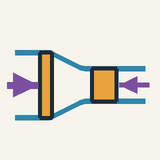
Where a pipe gets narrower, the water must move faster: the same amount passes every point each second.
Where the water moves faster, its pressure is lower; where it slows down again, the pressure rises.
Speeding up needs a push: the higher pressure behind the water drives it into the narrow part.
The height of water in a thin tube on the pipe shows the pressure there.
Let's build Bernoulli's idea one small step at a time.
Step 1: what goes in must come out. Water cannot pile up inside a full pipe, so every second the same amount of water must pass every point. Where the pipe gets narrower, the water has to hurry. That is why water spurts faster when you squeeze the end of a garden hose.
Step 2: pressure is a push. Pressure tells you how hard the water pushes on each bit of surface it touches. A thin glass tube standing on the pipe shows it: the harder the push, the higher the water climbs in the tube.
Step 3: speeding up needs a push from behind. A bit of water entering the narrow part speeds up, so something must push it forward. That push comes from the water behind it, so the pressure behind (in the wide part) must be higher than the pressure ahead (in the narrow part). Fast water, low pressure; slow water, high pressure. You can also see it as a trade: the water gains energy of motion and pays for it with pressure.
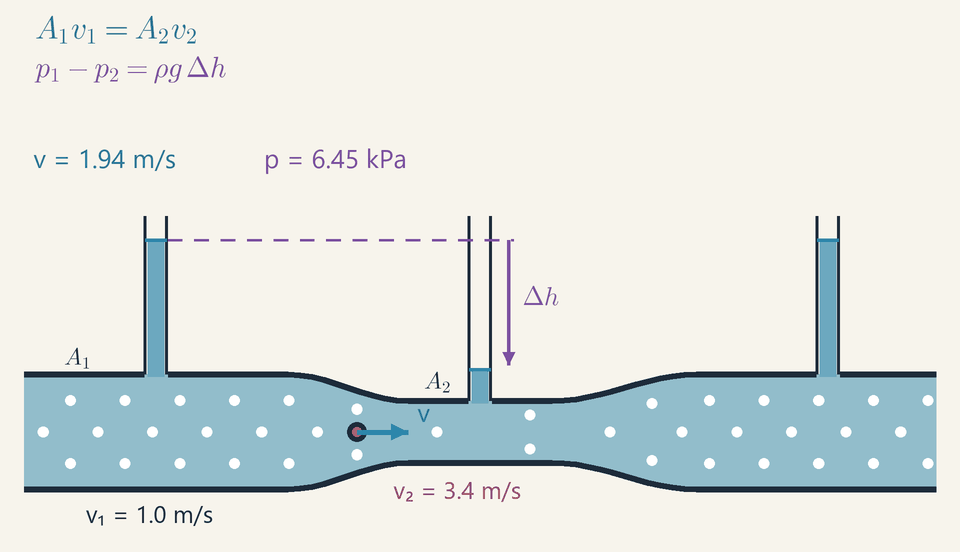
In the animation, the white dots are small bits of water. Follow the red one: it pulls away from its neighbours, races through the narrow waist, then slows down again. The water column above the waist stands lowest.
Check yourself: two boats moving fast side by side, close together, tend to drift towards each other. Why? (Answer: the water squeezed between them flows faster than the water outside, so its pressure is lower, and the higher pressure on the outer sides pushes the boats together.)
Intermediate
Key ideas
Continuity: A1v1=A2v2; halving a round pipe's diameter makes the water four times faster.
Bernoulli for a horizontal pipe: p1−p2=21ρ(v22−v12), so pressure is traded for speed.
Example: from 1.0 to 3.41 m/s the pressure drops by 5.3 kPa, so the throat column stands Δh≈0.54m lower.
A Venturi meter reads Δh and uses both equations to find the speed and the flow rate.
What flows, and what we measure
Two boats moving fast side by side, close together, tend to drift towards each other. This lesson follows a steady flow of a liquid or a gas: the velocity at each fixed point never changes, although the fluid keeps moving through it, and each parcel travels along a fixed line called a streamline. Water is treated as an ideal fluid, incompressible, with a constant density ρ=1000kg/m3, and frictionless, which is a good model for a short, smooth pipe.
Four quantities describe a pipe flow: the flow speed v (m/s), averaged over a cross-section; the cross-sectional area A (m²), with A=πd2/4 for a round pipe of diameter d; the volume flow rate Q (m³/s), the volume that passes a section each second; and the pressure p, the push of the water on each square metre of the wall, in pascals (1Pa=1N/m2).
A thin vertical tube on the pipe, a standpipe, shows the pressure as a height: the water climbs until the weight of its column balances the pressure below, p=ρgh. All pressures here are gauge pressures, measured above the atmosphere's 101 kPa, which cancels in every difference.
Continuity: what goes in must come out
In a time Δt the water crossing a section moves forward by vΔt and fills a cylinder of volume AvΔt. Dividing by the time gives the flow rate: Q=Av
Water cannot pile up inside a full pipe or vanish from it, so the same Q must pass every section, wide or narrow: A1v1=A2v2
The speed is therefore inversely proportional to the area. Because the area of a round pipe grows with the square of its diameter, halving the diameter divides the area by 4 and makes the water four times faster, not twice as fast.
Bernoulli's equation: trading pressure for speed
A parcel entering a narrowing speeds up, so a net force must push it forward. Along a horizontal pipe that force can only come from the pressure of the surrounding water, so the pressure behind the parcel must be higher than the pressure ahead of it: fast flow goes with low pressure.
Energy makes this exact: the work that the pressure forces do on a parcel moving from high to low pressure becomes kinetic energy, or potential energy if the parcel climbs. Per unit volume these energies are p, 21ρv2 and ρgh, all in pascals (1Pa=1J/m3), and along a streamline their sum stays the same: p+21ρv2+ρgh=const
In a horizontal pipe the height terms cancel, so the pressure drop equals the gain in kinetic energy per unit volume. Two standpipes show it as a difference of heights: p1−p2=21ρ(v22−v12) Δh=ρgp1−p2
Height counts too. In a uniform pipe that climbs 10 m the speed cannot change, so the pressure falls by ρgh=1000⋅9.81⋅10≈98kPa, almost one atmosphere, which is why tall buildings need pumps.
Worked example: the Venturi tube in the animation
On the animation's scale, which is the same for the pipe and the columns, the pipe's radius is 24 cm at the inlet and 13 cm in the throat, and the water enters at v1=1.0m/s with a gauge pressure of 7.85 kPa, which holds the first column 0.80 m above the axis.
Continuity, Bernoulli's equation and the standpipe rule give: v2=v1A2A1=1.0⋅(1324)2≈3.41m/s p1−p2=21⋅1000⋅(3.412−1.02)≈5.31kPa Δh=1000⋅9.815310≈0.541m
The throat pressure is 7.85−5.31=2.54kPa, so its column stands only 0.26 m above the axis. These are the animation's numbers: the labels v1=1.0m/s and v2=3.4m/s, the purple Δh arrow below the dashed inlet level, and the readouts, where v climbs from 1.00 to 3.41 m/s while p falls from 7.85 to 2.54 kPa as the red parcel enters the throat and its blue velocity arrow grows 3.41 times.
Past the throat everything runs backwards, and in this ideal fluid the last column climbs back to 0.80 m. The flow rate, Q=π⋅0.242⋅1.0≈0.181m3/s or 181 litres a second, is the same in the throat: π⋅0.132⋅3.41≈0.181m3/s.
Worked example: reading a Venturi meter
A Venturi meter is such a tube built into a pipeline to measure its flow. Suppose a water main 12 cm in diameter narrows to a throat of 6 cm, and the columns over the two sections differ by 30 cm. How fast does the water flow, and how much passes each second?
The pressure drop is ρgΔh=1000⋅9.81⋅0.30≈2.94kPa. Halving the diameter quarters the area, so v2=4v1, and Bernoulli's equation becomes ρgΔh=21ρ(16−1)v12. The density cancels, and in general v1=(A1/A2)2−12gΔh=152⋅9.81⋅0.30≈0.63m/s
Then v2=4⋅0.63≈2.5m/s and Q=π⋅0.062⋅0.63≈7.1×10⁻³m3/s, about 7 litres per second. Fed with the animation's 0.541 m and area ratio 3.41, the same formula returns its 1.0 m/s. Note that Δh grows with the square of the flow: twice the flow would give 1.20 m, so each meter suits a limited range.
Reading the columns and the dots
Each column top stands p/(ρg) above the axis, a height called the pressure head. Add the velocity head v2/(2g), 0.05 m at the inlet and 0.59 m in the throat, and every section reaches the same total head, 0.85 m: this is Bernoulli's equation divided by ρg. Along real pipelines friction makes this level slope down.
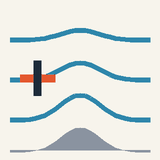
The white dots enter at a steady rate, so the gap between neighbours in a row is the speed times a fixed time: in the throat the gaps open up 3.41 times, and the three rows close in, because streamlines crowd where the flow is fast.
Common mistakes
The low pressure in the throat does not suck the water in. The water is pushed from behind, by 7.85 kPa at the inlet against 2.54 kPa in the throat.
Square the speeds before subtracting them: for the animation, 21ρ(v2−v1)2 gives 2.90 kPa instead of the correct 5.31 kPa.
A narrowing does not raise the pressure inside it. A thumb on a hose raises the pressure behind it by holding back the flow, but for a given flow through a horizontal pipe the narrowest section has the lowest pressure.
The pressure is not used up in the throat. In an ideal fluid it recovers fully, so the last column is back at 0.80 m; in a real pipe friction leaves it several centimetres lower.
Where you meet it
Venturi meters measure flows of water, fuel and gas. Carburettors and perfume atomisers use the low pressure of a fast air stream to draw liquid up a tube, and a laboratory water-jet pump sucks air out of a flask the same way. A Pitot tube on an aircraft compares the pressure of air brought to rest with the static pressure to find the airspeed, and two ships sailing close side by side are pushed together by the faster water between them.
The lesson rests on Fluid Pressure and Pascal's Principle, for the columns, and on Work, Energy and Power, for the conservation of energy. The friction it leaves out, viscosity, is the subject of Drag and Terminal Velocity.
Advanced
Key ideas
p+21ρv2+ρgh=const: the work done by pressure on a stream tube equals the energy the fluid gains.
Even in steady flow a parcel accelerates as it moves, through (v⋅∇)v; the force comes from −∇p.
The sum is constant along a streamline (steady, inviscid, incompressible); if ∇×v=0, one constant holds everywhere.
Viscosity makes the head fall along a real pipe; gases need the compressible form above Mach 0.3; low pressure can cause cavitation.
A tank drains at Torricelli's v=2gh, the speed of a free fall from the surface: potential energy becomes kinetic.
Streamlines, stream tubes and the moving parcel
This section sets up the language of fluid flow and uses it to answer a first question: why does water speed up in a narrowing pipe, and how large is its acceleration? The running example is the animation's Venturi tube. Water of density ρ=1000kg/m3 enters a wide pipe of radius 24 cm at 1.0 m/s, with a gauge pressure (pressure above atmospheric) of 7.85 kPa, enough to hold up a water column 0.80 m high. It then passes a throat of radius 13 cm and widens again.
A flow is described by its velocity field v(r,t): the velocity of whatever fluid is at the point r at the time t. The flow is steady when this field does not change with time at any fixed point, ∂v/∂t=0. A streamline is a line that is tangent to v at each of its points. In a steady flow the streamlines stay fixed, and each small parcel of fluid travels along one of them.
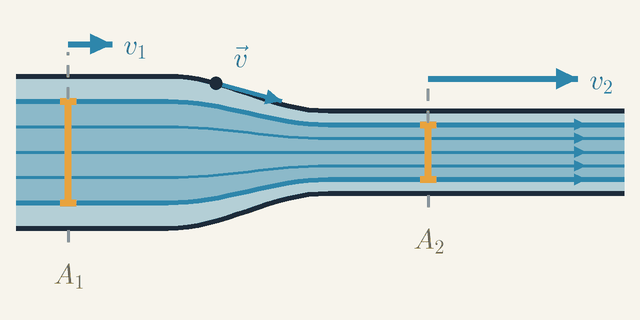
Figure 1. Streamlines through a narrowing pipe. The two heavier ones bound a stream tube that no fluid crosses, so the same volume per second passes A1 and A2 and the lines crowd together where the fluid is faster; the velocity v at the wall, itself a streamline, lies along it.Legend
A1
Cross-section of the stream tube at section 1, where it is wide.
m2
A2
Cross-section of the same tube at section 2, where it is narrow.
m2
v1
Speed of the fluid through section 1.
m/s
v2
Speed through section 2: larger, since A2v2=A1v1.
m/s
v
Velocity at a point of the wall, which is itself a streamline: tangent to the wall there.
m/s
Figure 1 shows a pipe that narrows. The thin blue lines are streamlines, and the velocity at any point is tangent to the streamline through it. The wall is a streamline as well, because no fluid crosses it: the arrow v at the dot on the wall lies along the wall. The two heavier lines bound a stream tube, a bundle of neighbouring streamlines. Since no fluid crosses a streamline, none crosses the side of the tube either: whatever enters it through section 1, of area A1, must leave through section 2, of area A2.
For a liquid the density is constant, so the volume that enters per second must equal the volume that leaves per second. This volume flow rate is Q=Av, with v the average speed across the section, so A1v1=A2v2 Because A2 is smaller than A1, the speed v2 is larger than v1, by the factor A1/A2.
Look at the streamlines in Figure 1: they crowd together where the tube is narrow. Equal volumes flow between neighbouring lines, so their spacing is a picture of the speed: close lines, fast fluid. The two arrows v1 and v2 are drawn in the ratio A1/A2. In the animation A1/A2=(24/13)2≈3.41, so the water reaches 3.41 m/s in the throat. The local form of this law is ∇⋅v=0: a fluid of constant density can neither pile up nor thin out anywhere.
Steady does not mean unaccelerated. The animation's field never changes, yet the red parcel speeds up from 1.0 to 3.41 m/s, because it moves into a region where the field is faster. The rate of change of the parcel's own velocity is the material derivative: DtDv=∂t∂v+(v⋅∇)v The first term is the change of the field at a fixed point; it is zero in a steady flow. The second, the convective term, is the change the parcel meets because it moves: in the time dt it travels vdt to a place where the field is different.
On the pipe's axis the velocity points along the axis, call it x, so the convective term is simply vdv/dx. In the animation it reaches about 25 m/s², some 2.5g, near the end of the narrowing, and the widening section brakes the parcel at up to 21 m/s².
Energy balance on a stream tube
Why should faster fluid be at lower pressure? To speed up, a parcel needs a net forward force, and in a horizontal pipe only the pressure can provide it: the pressure behind the parcel must exceed the pressure ahead. An exact energy balance turns that idea into Bernoulli's equation.
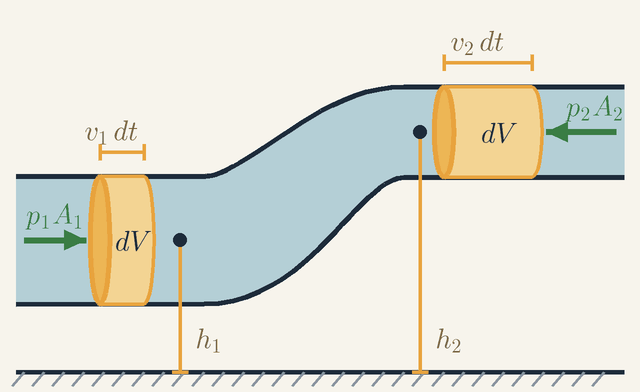
Figure 2. A stream tube that narrows and rises, followed for a short time dt: a slab of volume dV enters at section 1 and an equal slab, longer because the tube is thinner, leaves at section 2. The forces p1A1 and p2A2 do the net work (p1−p2)dV. Not to scale.Legend
p1A1
Force with which the fluid behind pushes the entering slab forward: pressure times area.
N
p2A2
Force with which the fluid ahead pushes back on the leaving slab.
N
v1dt
Length of the entering slab: the distance the fluid moves in dt at section 1.
m
v2dt
Length of the leaving slab, longer since v2>v1.
m
dV
Volume of each slab, the same at both sections.
m3
h1
Height of the tube's axis at section 1 above a reference level.
m
h2
Height of the tube's axis at section 2 above the same level.
m
Figure 2 shows a stream tube that narrows and rises, from section 1 at the height h1 to section 2 at the height h2, both measured to the tube's axis. Follow the fluid in the tube for a short time dt. At section 1 a slab of length v1dt enters, with the mass dM=ρA1v1dt and the volume dV=dM/ρ. At section 2 a slab of length v2dt leaves. By continuity it has the same mass and the same volume, so it is the longer of the two, because the tube is thinner there.
Between the two slabs nothing has changed: the flow is steady, so every point still holds fluid moving with the same velocity as before. The net effect of the interval dt is therefore that the slab dV has been taken from section 1 and put at section 2, with the speed and the height of section 2. Its energy has grown by dM(21v22−21v12)+dMg(h2−h1)
What paid for this gain? Not the pressure on the side of the tube: it acts perpendicular to the flow and does no work. The work is done at the two ends. The fluid behind pushes the entering slab with the force p1A1 through the distance v1dt, which is the work p1A1v1dt=p1dV. At section 2 the fluid ahead pushes back with the force p2A2 while the leaving slab moves v2dt forward against it, which is the work −p2dV. Without friction, the work–energy theorem sets the net work equal to the gain in energy: (p1−p2)dV=dM(21v22−21v12+gh2−gh1)
Divide by dV, use dM/dV=ρ, and collect the terms of each section on its own side: p1+21ρv12+ρgh1=p2+21ρv22+ρgh2. Sections 1 and 2 were any two sections, so along the tube p+21ρv2+ρgh=const
Every term is an energy per unit volume, measured in pascals (1 Pa = 1 J/m³). 21ρv2 is kinetic energy and ρgh potential energy. The pressure term p is the work needed to push a unit volume of fluid into a region that is already full, called flow work. In the horizontal Venturi tube h is the same everywhere, and raising the speed from 1.0 to 3.41 m/s costs 21ρ(v22−v12)≈5.31kPa of pressure.
In a gas the internal energy per unit mass, u, joins the balance, and the sum conserved per unit mass becomes u+p/ρ+21v2+gh. Its first two terms together form the specific enthalpy. Without heat exchange or shaft work, this is the steady-flow energy equation of a nozzle. In a frictionless liquid u stays constant and drops out.
Euler's equation: along and across the flow
The energy argument treats a whole stream tube at once. Newton's second law, applied to each small volume of fluid, gives the same result in local form, shows where the constant holds, and adds a second rule for the pressure across the streamlines.
Consider a small cube of fluid. The pressure pushes inwards on each face, and the forces on opposite faces cancel except for the difference in pressure between them. Per unit volume the net pressure force is therefore −∇p, pointing from high towards low pressure. Adding gravity, ρg per unit volume, and setting the total equal to the density times the material derivative gives Euler's equation: ρ(∂t∂v+(v⋅∇)v)=−∇p+ρg
Three steps turn it into Bernoulli's equation. First, in a steady flow ∂v/∂t=0. Second, a vector identity splits the convective term: (v⋅∇)v=∇(21v2)−v×Ω, where Ω=∇×v is the vorticity, twice the local angular velocity with which the fluid spins. Third, gravity points down while h is measured up, so for a constant density ρg=−∇(ρgh). Moving all the gradients to the left, ∇(p+21ρv2+ρgh)=ρv×Ω
The right-hand side is a cross product with v, so it is perpendicular to v. The gradient of the sum therefore has no component along the flow: the sum is constant along each streamline, as found with Figure 2, but different streamlines may carry different constants. If the flow is irrotational, Ω=0, the whole gradient vanishes and one constant holds everywhere. An ideal fluid that starts from rest, or from a uniform stream like the water entering the Venturi tube, stays irrotational, so in practice a single constant usually serves.
Across the flow, Euler's equation says something different. Where the streamlines curve with radius R, each parcel needs the centripetal acceleration v2/R towards the centre of curvature, and, gravity aside, only a pressure difference across the streamlines can supply it: ∂n∂p=Rρv2 Here n is the distance across the streamlines, measured away from the centre of curvature. The pressure therefore rises away from the centre of a bend, so air curving over a wing has a lower pressure next to it than farther out. Where the streamlines are straight and parallel, R is infinite and the pressure does not change across them, apart from the hydrostatic change with height. That is why a tap in the wall of a straight section reads the pressure on the axis.
Reading the pressure graph
The animation's graph shows Bernoulli's equation at work along the whole tube. Its slopes show Euler's equation as well, and explain why real Venturi tubes are shaped the way they are.
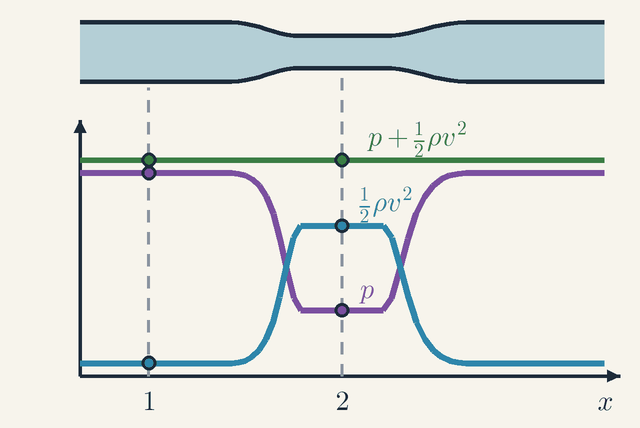
Figure 3. The pressures along the Venturi tube, drawn to one scale under a sketch of the tube. Where the tube narrows, p falls by exactly as much as 21ρv2 rises, so their sum stays flat; the dots mark the values at sections 1 and 2.Legend
x
Position along the tube, in the direction of flow.
m
p
Static pressure (gauge) on the tube's axis.
Pa
21ρv2
Dynamic pressure: kinetic energy per unit volume.
Pa
p+21ρv2
Their sum, the same all along the tube.
Pa
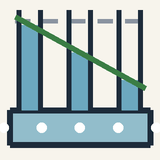
Figure 3 redraws the animation's pressure graph under a sketch of the tube, with the position x along the pipe running to the right. Section 1 is the wide inlet and section 2 the middle of the throat, and the graph follows the red parcel along the pipe. The static pressure p (purple) falls from 7.85 to 2.54 kPa through the narrowing, stays flat along the throat and recovers in the widening section. The dynamic pressure 21ρv2 (blue) does the opposite: it rises from 0.50 to 5.81 kPa and falls back. Their sum (green) stays flat at 8.35 kPa. The three curves share one scale, so whatever height the blue curve gains, the purple one loses. Expressed as the height of the water column it could hold up, (p+21ρv2)/(ρg), the sum is 0.851 m, called the total head.
Now look at the slopes. On the axis Euler's equation reads −dp/dx=ρvdv/dx=ρa, with a the parcel's acceleration. So the downward slope of the purple curve is the net force per unit volume on the parcel, and it equals the upward slope of the blue curve. It is steepest, about 25 kPa per metre, where the parcel accelerates most, on the steep flanks of the curves in Figure 3. It is zero along the throat, where the speed is constant.
In the widening section the pressure rises along the flow: the purple curve climbs on the right. Such a rise is called an adverse pressure gradient, because it pushes against the motion. The ideal fluid simply slows down. In a real fluid the layer next to the wall has already been slowed by friction and may lack the kinetic energy to climb the pressure rise; it stops, and the flow breaks away from the wall. That is why Venturi tubes widen more gently than they narrow: here over 60 cm, against 50 cm for the narrowing.
Tanks, jets and Pitot tubes
Bernoulli's equation also links points at different heights, and points where the fluid is brought to rest. Each case gives a simple and useful result.
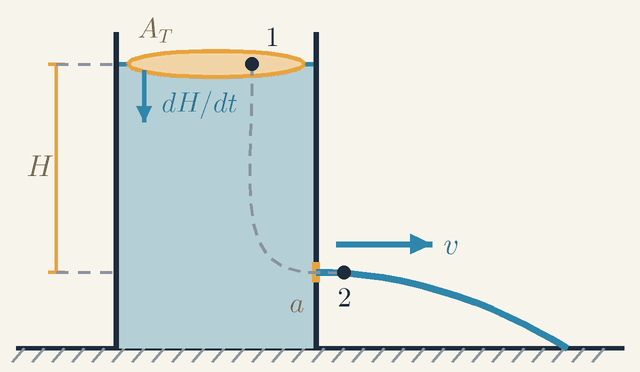
Figure 4. A wide tank draining through a small hole. The dashed streamline runs from the still free surface (1) to the jet (2), a depth H lower, so v=2gH; meanwhile the level sinks at the rate dH/dt, with ATdH/dt=−av. Not to scale.Legend
H
Depth of the free surface above the hole.
m
AT
Area of the tank's free surface.
m2
a
Area of the hole.
m2
v
Speed of the jet just outside the hole.
m/s
dH/dt
Rate of change of the level: negative, since the level sinks.
m/s
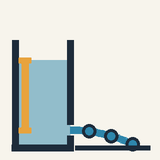
Figure 4 shows a wide tank draining through a small hole. Follow the dashed streamline from point 1, on the free surface, to point 2, in the jet just outside the hole, a depth H lower. At both ends the pressure is atmospheric: at 1 the surface is open to the air, and at 2 the streamlines of the jet are straight and parallel, so the pressure inside it equals that of the air around it. The surface is almost still, because it is much wider than the hole. So the pressure terms cancel, the kinetic term at 1 is negligible, and the potential energy ρgH lost per unit volume all becomes the kinetic energy 21ρv2 of the jet: v=2gH(Torricelli)
The jet leaves as fast as a stone dropped from the height H. This is the v=2gh of the formula list, with the depth written H because it changes as the tank drains.
How long does the tank take to empty? If the level sinks slowly, the flow is almost steady at every moment (quasi-steady), and Torricelli's result holds at the current depth. Continuity then links the two ends of the streamline: the free surface, of area AT, sinks at the rate dH/dt, which is negative, while the jet leaves the hole, of area a, at the speed v: ATdtdH=−av=−a2gH Since AT/a is large, the surface crawls while the jet shoots out, which is why Figure 4 cannot be to scale. Separate the variables, dH/H=−(a/AT)2gdt, and integrate from the initial depth H0 down to 0. The left side gives −2H0, so 2H0=(a/AT)2gt, and the tank empties in t=aATg2H0
A barrel of 0.25 m² filled 0.80 m deep, draining through a 1 cm² hole, has AT/a=2500 and empties in 2500⋅1.6/9.81≈1.0×103s, about 17 minutes. The level drops fast at first and slowly at the end, since the jet speed goes as H.
A Pitot tube measures speed with a stagnation point. Its open end faces the flow, and the fluid arriving there is brought to rest, v=0; at the same height the pressure at the mouth is therefore p+21ρv2, the stagnation pressure. Small holes in the side of the tube, which the flow runs past in parallel, read the static p. The difference is 21ρv2, from which v follows.
On the animation's axis the open end would read the green 8.35 kPa everywhere, while the wall taps read the purple curve. An aircraft at 60 m/s in air of density 1.2 kg/m³ sees a difference of 21⋅1.2⋅602=2.16kPa.
Worked problem: when the throat sucks and boils
Keep the animation's tube and its inlet gauge pressure of 7.85 kPa, but turn up the flow. At what inlet speed does the throat reach atmospheric pressure, and at what speed does the water boil there? Take 101.3 kPa for the atmosphere and 2.34 kPa for the vapour pressure of water at 20 °C.
The tube is horizontal, so Bernoulli's equation between the inlet and the throat is p1+21ρv12=p2+21ρv22. Continuity gives v2=(A1/A2)v1, with A1/A2=3.41. Substituting v2 gives the throat gauge pressure p2=p1−21ρv12[(A2A1)2−1]=7.85−5.31v12 with p2 in kPa and v1 in m/s; the 5.31 is 21ρ(3.412−1) in these units.
The throat gauge pressure is zero, so the throat is at atmospheric pressure, when v1=7.85/5.31≈1.22m/s. At higher speeds the throat is below atmospheric pressure, so a tube opened there draws air or liquid in instead of holding up a column. This is how a water-jet pump and a carburettor work.
Cavitation, boiling at room temperature, begins when the absolute throat pressure falls to the vapour pressure. Absolute pressure is gauge pressure plus atmospheric, so this happens at the gauge pressure 2.34−101.3≈−99.0kPa. Setting 7.85−5.31v12=−99.0 gives v1=5.317.85+99.0≈4.49m/s,v2=3.41⋅4.49≈15.3m/s
The pipe then carries π⋅0.242⋅4.49≈0.81m3/s, four and a half times the animation's flow. In practice bubbles form a little earlier, around tiny pockets of gas and in turbulent eddies. Swept into the widening section, where the pressure recovers, they collapse violently, and these repeated collapses are what pit pump impellers and ship propellers.
Limits of validity
Bernoulli's equation rests on three idealisations: no friction, constant density and steady flow. Each fails somewhere, and the paragraphs below take them in turn and show where.
Viscosity, the fluid's internal friction, is the first to fail. The Reynolds number ρvd/η compares the fluid's inertia with its viscous forces; here d is the pipe's diameter and η the viscosity of water, about 1.0×10⁻³Pa⋅s. For the animation it is 1000⋅1.0⋅0.48/(1.0×10−3)≈5×105, far above the few thousand at which pipe flow turns turbulent, so the real flow would be turbulent.
Yet friction hardly matters in a short, smooth narrowing, and Venturi meters agree with the ideal formula to within a few per cent. Across the whole tube, though, a real Venturi permanently loses 5 to 20 % of its pressure drop, so the column after the widening would stand some 3 to 11 cm below the first.
Incompressibility is excellent for liquids. The animation's 5.3 kPa drop changes the density of water by the fraction Δp/K≈2.4×10−6, where K≈2.2GPa is its bulk modulus, the pressure needed per unit fractional change of volume. Gases qualify while the flow is well below the speed of sound. At Mach 0.3, three tenths of the speed of sound or about 100 m/s in air, the density changes by about 4.5 %, and the incompressible formula predicts a Pitot reading about 2 % too small.
Steadiness fails when a valve shuts quickly. The term ∂v/∂t then dominates, and a pressure wave, called water hammer, runs along the pipe. Stopping the animation's 1.0 m/s flow abruptly would raise the pressure by about ρcΔv≈1000⋅1400⋅1.0≈1.4MPa, where c is the speed of the wave in the water-filled pipe and Δv the sudden change of speed.
Where this leads
Bernoulli's equation is the work–energy theorem of Work, Energy and Power, written per unit volume. Torricelli's jet leaves with the speed of Free Fall and traces the parabola of Projectile Motion, and ∂p/∂n=ρv2/R is the centripetal force of Circular Motion applied to a fluid. For gases the enthalpy form leads to the First Law of Thermodynamics and Heat Engines, and the speed of sound that bounds the incompressible model returns in Sound and the Doppler Effect.
Lift is often misexplained. A popular claim says that the air over a wing must rejoin the air beneath it at the trailing edge, and so must move faster along the longer upper path. This is false: the upper air arrives first. Moreover, a steady ideal flow without circulation exerts no net force on a body at all.
What a wing does is set up a circulation Γ=∮v⋅dl, the integral of the velocity around a loop that encloses the wing: a net swirl added to the oncoming stream. Its value is fixed by the sharp trailing edge, which the flow must leave smoothly. In a stream of speed U the lift per unit span is then ρUΓ, and Bernoulli's equation turns the faster flow above the wing and the slower flow below into the pressure difference that carries it. The viscosity that selects that circulation, and causes drag, is the subject of Drag and Terminal Velocity.
Key formulas
Volume flow rate
Q=Av
In a time Δt the fluid crossing a section moves forward by vΔt and fills a cylinder of volume AvΔt; dividing by the time gives the volume per second. Multiplied by the density it becomes the mass flow rate, ρAv in kg/s.
Symbols
Q
volume flow rate through the section
m3/s
A
cross-sectional area, at right angles to the flow
m2
v
flow speed, averaged over the section
m/s
When it holds: Holds for any fluid, provided v is the speed averaged over the section and A is measured at right angles to the flow.
Example: The animation's inlet: Q=π⋅0.242⋅1.0≈0.181m3/s, 181 litres every second.
Equation of continuity
A1v1=A2v2
Water cannot pile up inside a full pipe or vanish from it, so the volume that enters each second must leave through every other section: Q is the same everywhere. The speed is therefore inversely proportional to the area. For a round pipe A∝d2, so halving the diameter makes the water four times faster.
Symbols
A1
cross-sectional area at the wide section
m2
v1
flow speed at the wide section
m/s
A2
cross-sectional area at the narrow section
m2
v2
flow speed at the narrow section
m/s
When it holds: Steady flow of an incompressible fluid (a liquid, or a gas far below the speed of sound) with no leaks or branches. For a compressible gas the mass flow ρAv is what stays the same.
Example: In the animation the throat area is 3.41 times smaller, so v2=3.41⋅1.0=3.41m/s.
Bernoulli's equation
p+21ρv2+ρgh=const
Each term is an energy per unit volume, in pascals (1Pa=1J/m3): p is the work the pressure can do, 21ρv2 the kinetic energy and ρgh the potential energy. Pressure forces do work on a parcel moving from high to low pressure, and that work becomes kinetic or potential energy, so the sum does not change along a streamline. Faster at the same height therefore means lower pressure.
Symbols
p
static pressure
Pa
ρ
density of the fluid
kg/m3
v
flow speed
m/s
g
free-fall acceleration
m/s2
h
height above a chosen reference level
m
When it holds: Steady, inviscid, incompressible flow, along one streamline; the same constant holds across streamlines only if the flow is irrotational. In a real pipe friction makes the sum fall along the flow.
Example: In the animation the sum is 7.85+0.50=8.35kPa at the inlet and 2.54+5.81=8.35kPa in the throat.
Pressure drop in a horizontal pipe
p1−p2=21ρ(v22−v12)
With no change of height the ρgh terms cancel, and the pressure falls by exactly the gain in kinetic energy per unit volume. The pressure difference is the cause of the acceleration, not its result: the fluid speeds up because the pressure behind it is higher than the pressure ahead. Square the speeds before subtracting them.
Symbols
p1
pressure at the wide section
Pa
p2
pressure at the narrow section
Pa
ρ
density of the fluid
kg/m3
v1
flow speed at the wide section
m/s
v2
flow speed at the narrow section
m/s
When it holds: A horizontal pipe and ideal steady flow. If the pipe rises from h1 to h2, add ρg(h2−h1) to the right-hand side.
Example: From 1.0 to 3.41 m/s in water: p1−p2=500⋅(3.412−1)≈5.31kPa.
Pressure difference read as a column height
Δh=ρgp1−p2
A thin vertical tube on the pipe fills until the weight of its column balances the pressure below it, p=ρgh, the hydrostatic rule of Fluid Pressure and Pascal's Principle. Two such tubes therefore turn a pressure difference into a height difference: every 9.81 kPa of pressure is one metre of water.
Symbols
Δh
difference between the two column heights
m
p1
pressure under the first column
Pa
p2
pressure under the second column
Pa
ρ
density of the liquid in the columns
kg/m3
g
free-fall acceleration
m/s2
When it holds: The columns hold the pipe's own liquid, at rest, with their taps flush with the wall where the streamlines are straight. A U-tube of a heavier liquid, such as mercury under water, needs the difference of the two densities in place of ρ.
Example: The animation: Δh=5310/(1000⋅9.81)≈0.541m, the marked Δh.
Torricelli's law
v=2gh(Torricelli)
Follow a streamline from the free surface of a wide tank, where the water is almost at rest, to the jet just outside a hole a depth h lower. Both points are at atmospheric pressure, so the pressure terms cancel and the potential energy ρgh becomes the kinetic energy 21ρv2. The jet leaves with the speed of a body that has fallen freely through h.
Symbols
v
speed of the jet leaving the hole
m/s
g
free-fall acceleration
m/s2
h
depth of the hole below the free surface
m
When it holds: Tank much wider than the hole (otherwise the motion of the surface counts) and losses neglected. A real jet is a little slower, and just outside a sharp-edged hole it narrows, so the flow rate is less than the jet speed times the area of the hole.
Example: A hole 0.80 m below the surface: v=2⋅9.81⋅0.80≈3.96m/s.
Glossary
Steady flow
A flow in which the velocity at every fixed point stays the same over time, although each parcel may speed up or slow down as it moves. The flow in the animation is steady: the pattern never changes, yet every parcel accelerates into the throat.
Streamline
A line that is everywhere tangent to the velocity of the flow. In steady flow it is also the path a parcel follows; streamlines never cross, and they crowd together where the flow is fast.
Stream tube
A bundle of neighbouring streamlines forming a tube. No fluid crosses its walls, so the same mass passes every cross-section each second; a pipe is a stream tube with solid walls.
Ideal fluid
A model fluid that is incompressible (constant density) and inviscid (without internal friction). Bernoulli's equation in its simple form is exact only for such a fluid; water in a short, smooth pipe comes close.
Irrotational flow
A flow whose vorticity ∇×v is zero everywhere, so that small bits of fluid move without spinning. The Bernoulli sum then has the same value on every streamline, not only along each one.
Cross-sectional area
The area A of a cut through the pipe at right angles to the flow, in m². For a round pipe of diameter d it is A=πd2/4, so halving the diameter divides the area by 4.
Equation of continuity
The conservation of mass in a flow. For an incompressible fluid the volume flow rate Q=Av is the same through every cross-section, so the fluid moves fastest where the pipe is narrowest.
Bernoulli's principle
Along a streamline of a steady ideal flow, p+21ρv2+ρgh stays constant, so where a fluid speeds up at the same height its pressure falls. It is the conservation of energy applied to a moving fluid.
Venturi effect
The drop in pressure in the narrow part, or throat, of a pipe, where the fluid moves fastest. A Venturi meter reads this drop as a difference of column heights and turns it into a flow rate.
Gauge pressure
Pressure measured above the atmospheric pressure, about 101 kPa, rather than above vacuum. The animation's readouts are gauge pressures: the throat's 2.54 kPa is about 104 kPa absolute.
Head
A pressure or an energy per unit volume expressed as a height of the liquid: p/(ρg) is the pressure head and v2/(2g) the velocity head. In ideal flow their sum plus the height of the point is the same all along a streamline; friction makes this total head fall along a real pipe, which is called head loss.
Cavitation
The local boiling of a liquid where its pressure falls below the vapour pressure, about 2.3 kPa absolute for water at 20 °C. The vapour bubbles collapse violently when they reach higher pressure and can erode pump impellers and ship propellers.
Quantities
p
Static pressure
Pa
The force per unit area that the moving fluid exerts on the pipe wall, read by a standpipe or a wall tap; 1Pa=1N/m2=1J/m3.
21ρv2
Dynamic pressure
Pa
The kinetic energy per unit volume of the flow, and the pressure rise where the flow is brought to rest: 0.50 kPa at the animation's inlet, 5.81 kPa in its throat.
v
Flow speed
m/s
How fast the fluid moves, averaged over the cross-section in a pipe calculation: 1.0 m/s at the animation's inlet and 3.41 m/s in the throat.
ρ
Density
kg/m3
Mass per unit volume: 1000 kg/m³ for water and about 1.2 kg/m³ for air at room conditions. It stays constant in an incompressible flow.
Q
Volume flow rate
m3/s
The volume passing a cross-section each second, Q=Av: 0.181 m³/s, or 181 litres per second, in the animation.
h
Height
m
The height of a point above a chosen reference level, which enters as the potential energy per unit volume ρgh. In Torricelli's law it is the depth of the hole below the free surface.
g
Free-fall acceleration
m/s2
About 9.81m/s2 near the Earth's surface. It turns a height of liquid into a pressure, p=ρgh.
Δh
Difference of column heights
m
How much lower the liquid stands in the standpipe over the throat than over the inlet. It measures the pressure drop, p1−p2=ρgΔh: 0.541 m in the animation.
Quiz
Beginner Water flows through a pipe that gets narrower. In the narrow part, the water…
moves more slowly
moves faster
stops
keeps the same speed
Show answer
Answer: B. moves faster
The same amount of water must pass every point each second, so it has to move faster where the pipe is narrow.
Beginner In a horizontal pipe, where the water flows fastest, its pressure is…
highest
the same as everywhere else
lowest
exactly zero
Show answer
Answer: C. lowest
Speeding up needs a push from higher pressure behind, so the pressure is lowest where the water is fastest.
Beginner Why does the water shoot farther when you put your thumb over the end of a hose?
The thumb adds energy to the water
The thumb makes the water heavier
Gravity is weaker at the nozzle
Pressure builds up behind the thumb and pushes the water out faster
Show answer
Answer: D. Pressure builds up behind the thumb and pushes the water out faster
With the end wide open, the water leaves easily and the pressure at the end of the hose stays low. Your thumb narrows the exit, so pressure builds up behind it and pushes the water through the small gap much faster, just as the higher pressure in the wide part speeds the water up in the narrow part of the animated pipe. Less water comes out each second than before, but it leaves much faster and flies farther. The thumb adds no energy: it only narrows the exit.
Intermediate A pipe narrows from a diameter of 10 cm to 5 cm. Water enters at 2 m/s. How fast does it flow in the narrow part?
4 m/s
8 m/s
1 m/s
2 m/s
Show answer
Answer: B. 8 m/s
A ∝ d², so halving the diameter divides the area by 4. From A₁·v₁ = A₂·v₂, v₂ = 4 × 2 = 8 m/s. Using the diameter ratio alone gives the wrong 4 m/s.
Intermediate In a horizontal Venturi tube, water speeds up from 1 m/s to 3 m/s (ρ = 1000 kg/m³). By how much does the pressure drop?
4 kPa
2 kPa
1 kPa
9 kPa
Show answer
Answer: A. 4 kPa
p₁ − p₂ = ½·ρ·(v₂² − v₁²) = 500 × (9 − 1) = 4000 Pa = 4 kPa. Forgetting to square the speeds gives 1 kPa.
Intermediate Two sheets of paper hang parallel, a few centimetres apart. You blow hard between them. They…
move apart
stay still
move toward each other
fall down
Show answer
Answer: C. move toward each other
The fast air between the sheets has a lower pressure than the still air outside, so the outside air pushes the sheets together.
Advanced Which condition is NOT required to apply p + ½·ρ·v² + ρ·g·h = const along a single streamline?
Steady flow
Negligible viscosity
Incompressible fluid
Irrotational flow
Show answer
Answer: D. Irrotational flow
Along one streamline, steady, inviscid and incompressible flow is enough. Irrotational flow is needed only to use the same constant across different streamlines.
Advanced A wide open tank has a small hole 1.8 m below the water surface. Ignoring losses, how fast does the water leave the hole? (g = 9.81 m/s²)
about 3.5 m/s
about 5.9 m/s
about 17.7 m/s
about 1.3 m/s
Show answer
Answer: B. about 5.9 m/s
Bernoulli between the still surface and the jet (both at atmospheric pressure) gives Torricelli's law: v = √(2·g·h) = √(2 × 9.81 × 1.8) ≈ 5.9 m/s.
 Physics Tutor