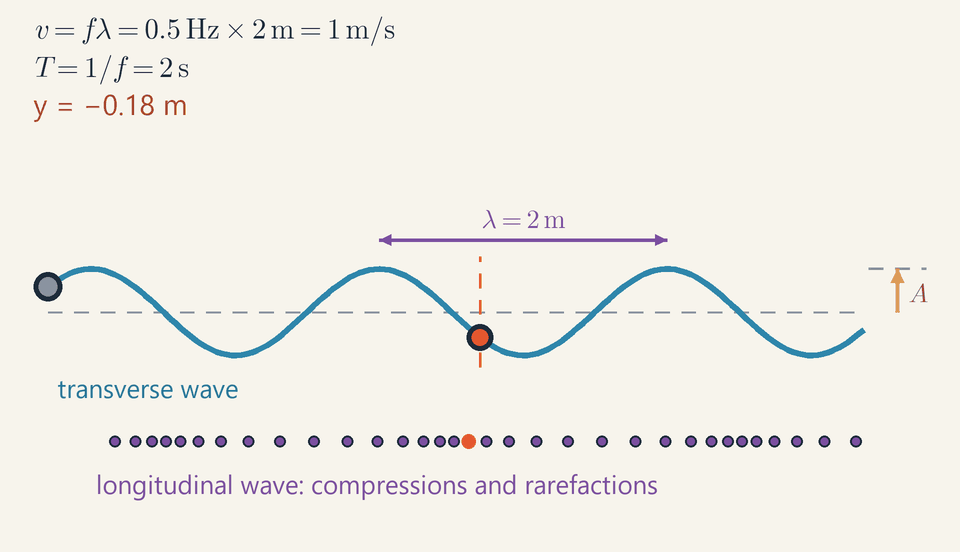
A wave carries energy from place to place; the rope or the water only moves back and forth around where it was.
Transverse wave: the material moves across the direction of travel (rope). Longitudinal: it moves along it (slinky, sound).
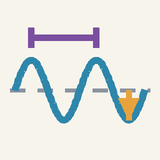
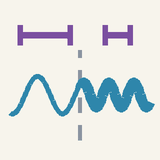
Wavelength is the distance from crest to crest; amplitude is how high a crest rises above the rest line.
Frequency is how many crests pass a point each second; speed = frequency × wavelength.
Shaking faster does not make the wave faster: the crests just get closer together.
Picture a stadium wave: each fan only stands up and sits down again, yet a bulge of raised arms races all the way round the stands. That is what a wave is: a disturbance that travels from place to place and carries energy, while the material itself stays put. A boat on a lake rises and falls as ripples pass, but they do not carry it to the shore.
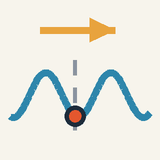
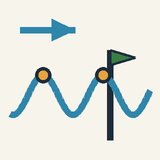
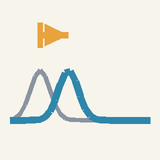
In the animation a hand shakes the end of a rope. The gold dots ride the crests, the high points, steadily to the right, while the red bead only bobs up and down on its dashed line.
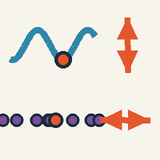
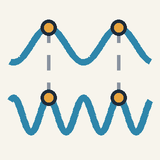
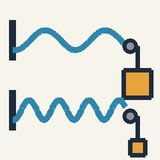
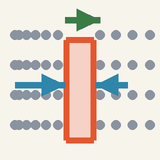
There are two kinds of wave. On the rope each bit moves across the direction of travel: a transverse wave. In the slinky at the bottom the coils move back and forth along that direction, crowding together and spreading apart: a longitudinal wave. Sound in air is of this kind.
Four words describe a regular wave. The wavelength is the distance from one crest to the next; the amplitude is how high a crest rises above the rest line; the frequency is how many crests pass a point each second, in hertz (Hz); the speed is how far a crest travels in one second. If 2 crests pass you every second and they are 3 metres apart, the wave covers 2×3=6 metres each second: speed = frequency × wavelength.
The speed is fixed by the medium, not by the hand. Shake faster and more crests leave each second, so they have to sit closer together.
Check yourself: you shake the rope three times as often. What happens to the wavelength? (It becomes three times shorter; the speed does not change.)
Intermediate
Key ideas
v=fλ: in one period T the pattern moves forward exactly one wavelength.
f=1/T in hertz; the amplitude A is the largest displacement from the rest line.
The medium sets the speed (string: v=F/μ); the source sets the frequency.
When a wave enters a new medium, f stays the same while v and λ change together.
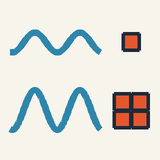
The energy carried grows as A2: double the amplitude, four times the energy.
What moves, and what we measure
It is tempting to think that a shaken rope travels along with its crests. It does not. A wave is a disturbance that travels through a medium and carries energy, while each part of the medium only oscillates about its resting place. On a shaken rope each bit copies its neighbour a moment later: the motion is handed on, the rope stays. In the animation the crests run to the right, yet the red bead only bobs along its dashed line.
On the rope each piece moves at right angles to the direction of travel: a transverse wave. In the slinky below, the coils move back and forth along that direction, crowding into compressions and spreading into rarefactions: a longitudinal wave. Sound in air is longitudinal, because a gas resists squeezing but not sideways shearing. Light is transverse too, with electric and magnetic fields oscillating instead of matter.
The displacement y is how far a point is from its rest position (the dashed line), in metres; the amplitude A is the largest displacement, from the rest line to a crest. The wavelength λ is the length of one cycle in space, crest to crest. The period T is the time of one full oscillation of a point, and the frequency f the number of oscillations per second, in hertz (Hz).
One wavelength per period
Watch a single crest. While the point under it makes one full oscillation, the next crest arrives where the first one was: in one period T the pattern moves forward by exactly one wavelength, so its speed is λ/T. Since the frequency is the number of periods per second, the two key relations of this lesson are:
f=T1
v=fλ
They hold for every repeating wave, on a rope, in air or for light, and any two of v, f and λ give the third. The relation does not say which quantity is fixed, though: that is the job of the medium and of the source.
The medium sets the speed
How fast a disturbance is handed on depends on the medium alone: on how strongly it pulls back and how much mass must be set moving. For a string or rope with tension F, in newtons, and mass per metre μ, in kilograms per metre, v=μF
Pull harder and the wave runs faster; a heavier rope makes it slower, and four times the tension doubles the speed. Sound travels at about 343 m/s in air at 20 °C, 1480 m/s in water and 6000 m/s in steel, light at 3.00×10⁸m/s in a vacuum.
The source sets the frequency: the hand or the loudspeaker decides how many cycles leave each second, and the wavelength follows, λ=v/f. In a new medium each point is driven by the old one at the same rate, so f stays the same while v and λ change together. The energy carried grows with the square of the amplitude: doubling A carries four times as much energy each second.
Worked example: the rope in the animation
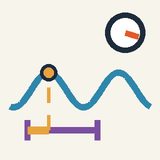
The red bead makes one oscillation every 2 s, and the purple double arrow spans one wavelength, 2 m. So f=1/T=1/2=0.5Hz v=fλ=0.5⋅2=1m/s These are the values at the top of the animation. The purple arrow rides 2 m forward with the crests in each period, then jumps back to where the picture looks the same.
The bead sits 3 m from the hand, so the hand's motion reaches it 3/1=3s later, one and a half periods: the bead is half a cycle out of step. Whenever the hand is at its lowest, −0.3m, the bead is at its highest, +0.3m; the red readout swings between these two values, the amplitude marked by the gold arrow A.
Compare how far the bead and a crest travel in one period. In each period the bead travels 4A=1.2m up and down, an average of 0.6 m/s across the rope, while each crest moves 2 m along it. The slinky's compressions, too, are 2 m apart.
Worked example: two ropes tied together
A light rope of 0.040 kg per metre is tied to a heavy one of 0.160 kg per metre, each 6 m long, under a tension of 36 N. You shake the light rope 5 times per second. On each rope, v1=36/0.040=900=30m/s,λ1=30/5=6m v2=36/0.160=225=15m/s,λ2=15/5=3m The frequency is 5 Hz on both, because the joint shakes the heavy rope as often as it is shaken itself. Four times the mass per metre halves the speed, and with it the wavelength.
A pulse crosses the light rope in 6/30=0.2s and the heavy one in 6/15=0.4s, 0.6 s in all. Part of each wave also bounces back from the joint: that is where reflection begins.
Snapshots and histories
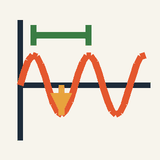
A snapshot plots y against the position x at one instant, like the rope itself, and shows the wavelength and the amplitude. A history plots y against the time t for one point, like the red bead's graph in the advanced view, and shows the period. Both are sines of the same height, one repeating every 2 m and the other every 2 s; their ratio is the 1 m/s.
A longitudinal wave is drawn the same way, with the displacement along the slinky plotted upward, so the curve looks transverse. Read it with care: a compression is not where the displacement is largest, but at a coil sitting exactly at its rest position with both neighbours pushed towards it. Half a wavelength on, they are pulled away: a rarefaction.
Common mistakes
Shaking faster does not make the wave faster: on the 36 N light rope, 10 shakes per second still travel at 30 m/s; only the wavelength shrinks, from 6 m to 3 m.
The wave speed is not the speed of the medium: the red bead averages 0.6 m/s, and more if the amplitude grows, while the crests travel at a steady 1 m/s.
The amplitude is measured from the rest line: the rope spans 0.6 m from its lowest to its highest point, but A=0.3m.
From crest to trough is half a wavelength, and from top to bottom half a period: a point that takes 0.25 s to go from top to bottom has T=0.5s and f=2Hz.
Where you meet it
Sound needs about 3 s per kilometre, so the delay between lightning and thunder gives the distance of a storm. Audible sound, 20 Hz to 20 kHz, has wavelengths from 17 m down to 1.7 cm; medical ultrasound at 5 MHz, at about 1540 m/s in tissue, has 0.3 mm waves, fine enough to show a beating heart. Earthquakes send both kinds of wave through the ground, and the transverse ones cannot cross the Earth's outer core, which is how we know that it is liquid.
Next come Sound and the Doppler Effect, Standing Waves, Interference and Superposition, Reflection and Refraction, and Electromagnetic Waves.
Advanced
Key ideas
y=f(x−vt) is any shape sliding at speed v; for a sine, y=Asin(kx−ωt) and v=ω/k=fλ.
Newton's law for a string element or a gas slab gives ∂2y/∂t2=v2∂2y/∂x2, with v2=F/μ or dP/dρ.
Sound is adiabatic: c=γP/ρ=γkBT/m, set by temperature alone and close to molecular speeds.
The wave equation is linear, so waves superpose: two pulses pass through each other unchanged.
Valid while λ is much longer than the mean free path, amplitudes stay small and v does not depend on f; else shocks or dispersion.
A shape that slides
A wave is a disturbance that travels while the medium stays where it is: each point of the rope only moves up and down, yet a shape runs along it. To work with waves we need one function that gives the displacement of every point at every instant, and we need to know what form that function takes when a shape moves without changing.
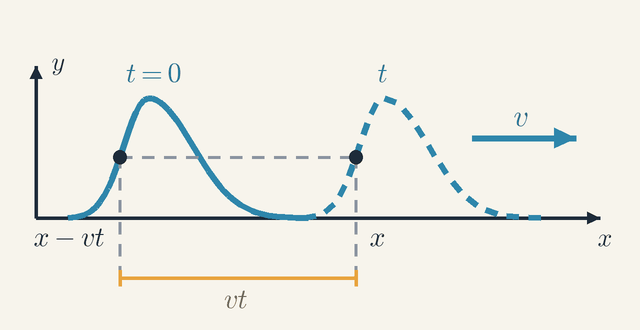
Figure 1. A lopsided pulse at t=0 (solid) and a time t later (dashed), moved on by vt. Notice the two dots: the height now found at x is the height the pulse had at x−vt.Legend
y
Displacement of the rope from its rest line.
m
x
Position along the rope; the dot on the dashed pulse is at x.
m
t
Time: the solid pulse is the rope at t=0, the dashed one a time t later.
s
v
Speed of the wave, towards +x.
m/s
vt
Distance the shape has moved in the time t.
m
x−vt
Position of the dot on the solid pulse, whose height is now found at x.
m
Write y(x,t) for the sideways displacement of the rope at position x and time t. Figure 1 follows a lopsided pulse, steeper on its left side than on its right, so that you can see the whole shape being carried along unchanged. The solid curve is the rope at t=0; call its shape y=f(x), where for now f names a shape, not a frequency. The dashed curve is the same rope a time t later. In that time the shape has moved towards +x at speed v, so it has shifted by the distance vt marked under the axis.
Now look at the two dots. The right one is on the dashed curve at position x. The left one is on the solid curve a distance vt further back, at x−vt. The dashed horizontal line joining them shows that they are at the same height: the moving shape has simply carried that height forward by vt. The same is true for every point, so the height found at x at time t is the height that was at x−vt at time zero: y(x,t)=f(x−vt)
Everything depends on the single combination x−vt. Holding it fixed, x−vt=x1, picks out one feature of the shape, a peak say, and that feature is at x=x1+vt: it moves forward at speed v, as it should. By the same argument a shape moving towards −x has the form g(x+vt).
The most important shape is a sine. Give it a wavelength λ, the distance between neighbouring crests, and a period T, the time one point takes to go through a full cycle. The argument of the sine, called the phase, must then grow by 2π when x increases by λ, and also when t increases by T. Both requirements are met by y(x,t)=Asin(kx−ωt) k=λ2π ω=T2π=2πf where A is the amplitude and f=1/T is now the frequency. The wave number k counts radians of phase per metre of rope, and the angular frequency ω counts radians of phase per second. To find the speed, take k out of the phase: kx−ωt=k(x−(ω/k)t). The sine therefore depends on x and t only through x−vt, with v=kω=fλ
In the animation k=πrad/m and ω=πrad/s, so the wavelength is 2 m, the period 2 s and the speed 1 m/s. With x measured from the hand, the rope is y=0.3sin(πx−πt), in metres and seconds. Adding a phase constant, Asin(kx−ωt+φ), only shifts the point of its cycle at which the wave starts.
Newton's law for a piece of string
So far we have only described a travelling shape. Now we ask why a disturbance on a string travels at all, and what sets its speed. The answer comes from Newton's second law applied to one tiny piece of string.
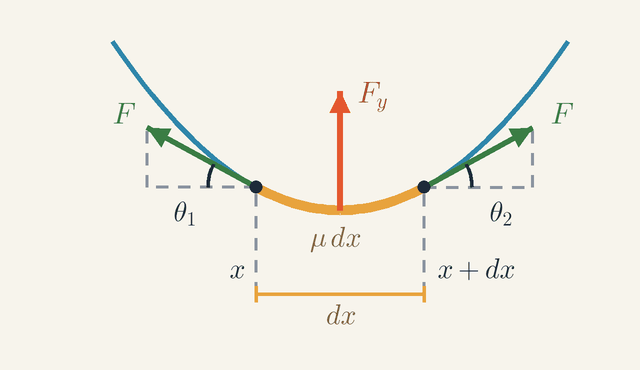
Figure 2. A short piece of string in a bend, pulled along the string at both ends by the tension F. The horizontal parts of the pulls cancel; the sideways parts add up to Fy, towards the inside of the bend. Not to scale: the angles are drawn large.Legend
x
Position of the left end of the piece.
m
x+dx
Position of the right end of the piece.
m
dx
Length of the piece along x.
m
μdx
Mass of the piece, with μ the mass per unit length.
kg
F
Tension: the pull of the rest of the string on the piece, along the string, at each end.
N
θ1
Angle between the pull at the left end and the horizontal.
rad
θ2
Angle between the pull at the right end and the horizontal.
rad
Fy
Net sideways force on the piece: the sum of the sideways parts of the two pulls.
N
Figure 2 shows a short piece of string between x and x+dx, at a place where the string is bent. If μ is the mass per unit length, the piece has mass μdx. The rest of the string pulls on it at both ends with the tension F, always along the string, at the angles θ1 and θ2 to the horizontal.
Split each pull into a horizontal part and a sideways part; the dashed lines at each end show the split. When the angles are small, both horizontal parts are very nearly F and they point in opposite directions, so they cancel. The sideways part of each pull is Fsinθ. For a small angle sinθ≈tanθ, and tanθ is just the slope of the string, ∂y/∂x. So the sideways part at each end is F times the slope of the string at that end.
In the figure the slope is negative at the left end and positive at the right end, so both sideways parts point up and add. In general the left end is pulled towards −x and the right end towards +x, so their sideways parts enter with opposite signs: the net sideways force is F times the slope at x+dx minus F times the slope at x. That difference of slopes across a length dx is (∂2y/∂x2)dx, so Fy=F∂x2∂2ydx
A straight piece therefore feels no net force, and a curved piece is pulled towards the inside of its curve, as the arrow Fy shows. Newton's second law for the piece reads μdx∂2y/∂t2=Fy, and dividing by μdx gives ∂t2∂2y=μF∂x2∂2y
This is the wave equation. In words: each bit of string accelerates in proportion to how sharply the string is curved there. Does the sliding shape of the first section, y=f(x−vt) with f again naming a shape, obey it? Each derivative with respect to t brings out a factor −v by the chain rule, and each derivative with respect to x a factor 1, so ∂2y/∂t2=v2f′′ and ∂2y/∂x2=f′′, where f′′ is the second derivative of the shape. The equation then reads v2f′′=(F/μ)f′′. It holds for every shape, provided that v=μF
The tension supplies the restoring force and the mass per unit length the inertia, just as the stiffness and the mass do for an oscillator on a spring: a tighter string carries waves faster, a heavier one slower. Two approximations are hidden in the derivation. The horizontal parts of the pulls, Fcosθ≈F, were taken to cancel, so the piece moves only sideways; and the tension was taken to be the same everywhere. Both need small slopes, ∣∂y/∂x∣≪1.
Sound: the same law in a gas
Sound is mechanics too. In air the restoring force comes from pressure instead of tension, and the gas moves along the direction of travel instead of across it. This section derives the wave equation for a gas, and from it the speed of sound.
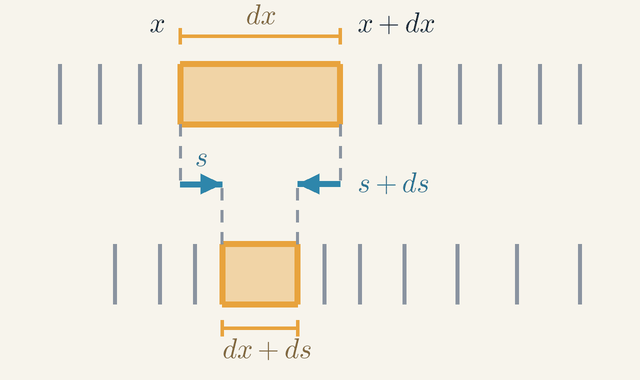
Figure 3. One layer of gas between x and x+dx, at rest (top) and displaced by a sound wave (bottom). Its faces move by different amounts, s and s+ds, so it is now dx+ds thick: here it is squeezed. Not to scale.Legend
x
Rest position of the left face of the layer.
m
x+dx
Rest position of the right face of the layer.
m
dx
Thickness of the layer at rest.
m
s
Displacement of the left face from its rest position, along x.
m
s+ds
Displacement of the right face; ds is how much more it moved than the left face.
m
dx+ds
Thickness of the layer once displaced.
m
In a sound wave each thin layer of gas moves back and forth along x, like the coils of the slinky in the animation. Let s(x,t) be the displacement along x of the layer that rests at x. Figure 3 follows one layer, between x and x+dx while the gas is at rest (top row). In the bottom row a sound wave has displaced the gas. The left face of the layer has moved by s and the right face by s+ds, a different amount, so the layer is now dx+ds thick. In the figure ds is negative: the right face has moved back, the layer is squeezed and the gas in it is denser.
Three links lead from this picture to a wave equation.
First, mass is conserved. The two faces have moved by amounts that differ by ds=(∂s/∂x)dx, so the same mass now fills a thickness (1+∂s/∂x)dx. The density is inversely proportional to the thickness, so for a small ∂s/∂x it changes by δρ≈−ρ0∂s/∂x, where ρ0 is the density at rest.
Second, the pressure depends on the density. For a small change, δP=(dP/dρ)0δρ, where the subscript 0 means that the derivative is taken in the gas at rest.
Third, Newton's law for the layer. Per unit area it has mass ρ0dx. The pressure on its left face pushes it towards +x and the pressure on its right face towards −x, so the net force per unit area is the drop in pressure across it, −(∂δP/∂x)dx. Dividing by dx, ρ0∂2s/∂t2=−∂δP/∂x: the layer is pushed away from the side of higher pressure.
Chaining the three, put δρ into δP and δP into Newton's law, then divide by ρ0: ∂t2∂2s=c2∂x2∂2s,c2=(dρdP)0
This is the same wave equation as for the string, and c is the speed of sound. Which derivative dP/dρ is the right one depends on what the temperature does while the gas is squeezed. Newton assumed it stays constant, so that P∝ρ; that gives c=P0/ρ0≈290m/s for air at 20 °C, some 15 % below the measured 343 m/s.
Laplace found the flaw: heat has no time to flow from the compressions, which warm up, to the rarefactions, which cool down. At 1 kHz heat diffuses about 0.1 mm in half a period, while a compression and the next rarefaction are 17 cm apart. Each layer is therefore squeezed without exchanging heat, an adiabatic process, in which P∝ργ with γ=1.40 for air. Then dP/dρ=γP/ρ, and c=ρ0γP0=mγkBT
The second form uses the ideal gas law, P0=ρ0kBT/m. Here T is the absolute temperature, not the period, m the mass of one molecule and kB Boltzmann's constant. The pressure drops out, because at a fixed temperature a higher pressure means a proportionally higher density. The speed of sound depends only on the gas and its temperature: 331 m/s at 0 °C and 343 m/s at 20 °C. Compare the molecules themselves: their root-mean-square speed, 3kBT/m (see Kinetic Theory of Gases), is 502 m/s at 20 °C, so c is γ/3≈0.68 of it. A pressure signal, passed on from molecule to molecule by collisions, travels a little slower than the molecules that carry it.
Snapshot, history and the graph
A wave depends on two variables, so it can be graphed in two ways: the whole rope at one instant, or one point of the rope over time. This section shows that for a travelling wave the two graphs are the same curve, and what that says about how each point moves.
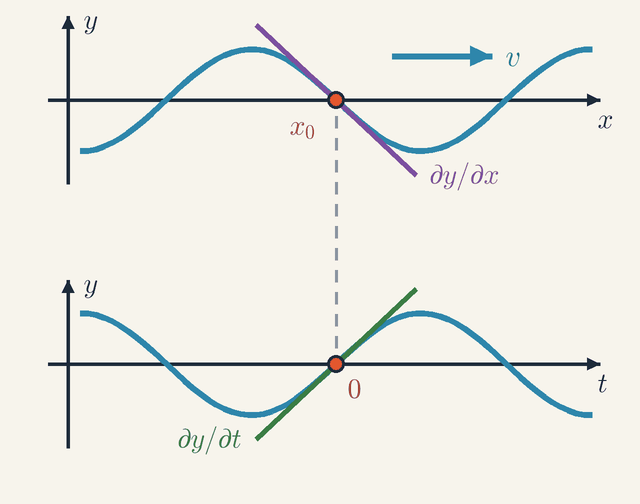
Figure 4. Two slices of one wave through the red bead at x0=3m: the rope at t=0 (above) and the bead's displacement over time (below). Notice the tangents: the snapshot slopes down where the history slopes up, because the lower curve is the upper one read backwards.Legend
y
Displacement of the rope from its rest line.
m
x
Position along the rope, measured from the hand.
m
t
Time.
s
x0
Position of the red bead.
m
v
Speed of the wave, towards +x.
m/s
∂y/∂x
Slope of the rope at the bead in the snapshot: the upper tangent line.
∂y/∂t
Velocity of the bead: the slope of its history, the lower tangent line.
m/s
Think of y(x,t) as a surface over the (x,t) plane; Figure 4 cuts it in two ways. The upper curve is a snapshot, a slice at one instant: the rope at t=0, y=0.3sin(πx). The lower curve is a history, a slice at one place: the red bead at x0=3m, the graph of the advanced view. Since sin(3π−a)=sina, the bead moves as y=0.3sin(3π−πt)=0.3sin(πt): a sine of period 2 s that starts at zero and rises. The hand at x=0 moves as −0.3sin(πt), the same curve upside down. The dashed line joins the two appearances of the bead at t=0.
Why are the two slices related? Because y depends on x and t only through x−vt, the chain rule gives ∂y/∂x=f′ and ∂y/∂t=−vf′. Hence ∂t∂y=−v∂x∂y
A point of the rope moves at minus the wave speed times the local slope. This makes sense: where the rope slopes down towards +x, the higher part behind is arriving, so the point rises. In Figure 4 the x and t axes have equal scales and v=1m/s, so the lower curve is the upper one flipped left to right, a mirror image about the dashed line. Look at the two tangent lines at the bead: the snapshot slopes down, ∂y/∂x=−kA, and the history slopes up, ∂y/∂t=+ωA.
Where the rope crosses its rest line, as at the bead, its slope is largest in size, kA, and so is the speed of the point, vkA=ωA; at a crest both are zero. In the animation kA=0.3π≈0.94, so the bead peaks at 0.94 m/s, almost the wave speed, and its graph starts with that slope.
Applying the rule twice gives back the wave equation, ∂2y/∂t2=v2∂2y/∂x2: the acceleration of a point is v2 times the curvature of the rope there. A crest, the most curved place, accelerates downward the hardest, at ω2A=0.3π2≈2.96m/s2. For a sine ∂2y/∂x2=−k2y, so every point obeys ∂2y/∂t2=−ω2y. The wave is a row of harmonic oscillators like those of Simple Harmonic Motion, each a little behind its neighbour.
Superposition: adding waves
The wave equation is linear: y and its derivatives appear only to the first power. So if two functions satisfy it, their sum does too. Two pulses running towards each other add where they overlap and leave with their shapes intact, and the general solution on a long string is f(x−vt)+g(x+vt), with f and g any two shapes, as d'Alembert showed in 1747. Interference, beats and standing waves are all superpositions.
Linearity also works the other way round: any shape can be built as a sum of sines. Each sine travels at its own ω/k; on the ideal string that is the same v for all of them, so the sum, and with it the shape, travels unchanged. Light obeys the same equation, derived from Maxwell's equations instead of Newton's law.
Energy carried by a wave
Energy travels with the shape. Per metre, a piece of string has kinetic energy 21μ(∂y/∂t)2. It also has potential energy 21F(∂y/∂x)2, because a slanted piece is longer than dx by about 21(∂y/∂x)2dx and the tension did work stretching it. For a travelling wave, ∂y/∂t=−v∂y/∂x and F=μv2 make the two equal at every point.
For a sine the kinetic energy per metre is 21μω2A2cos2(kx−ωt), which averages to 41μω2A2 over a cycle. Doubling it for the equal potential energy, the total is 21μω2A2 per metre. This energy moves along at v, so the mean power passing any point is Pˉ=21μω2A2v
It grows as A2 and as ω2. Where two ropes meet, a jump in the product μv sends part of the wave back. For the ropes of the intermediate example μv doubles, from 1.2 to 2.4 kg/s; the reflected amplitude is (1.2−2.4)/(1.2+2.4)=−1/3 of the incoming one, so a third of the amplitude returns upside down, and since power goes as amplitude squared, a ninth of the power is reflected.
Worked problem: powering the rope
Suppose the rope of the animation, with A=0.3m, ω=πrad/s and v=1m/s, has μ=0.2kg/m and lies on a smooth floor, shaken sideways so that gravity plays no part. What tension does it need, what power must the hand supply, and what changes if the hand shakes twice as often?
The tension follows from v=F/μ, and the power from the formula above: F=μv2=0.2⋅12=0.2N Pˉ=21μω2A2v=21⋅0.2⋅π2⋅0.32⋅1≈0.089W
Check the power by counting energy. The rope holds 21μω2A2≈0.089J per metre, so one wavelength, 2 m of rope, holds about 0.18 J. In each 2 s period the hand delivers 0.089⋅2≈0.18J, exactly that amount: every period, the hand fills one more wavelength of rope with energy.
Now shake at 1 Hz with the same amplitude. The speed is set by F and μ alone, so it is still 1 m/s, and the wavelength becomes λ=v/f=1m. The power grows with ω2, four times, to about 0.36 W. To keep 89 mW, ωA must stay the same, so the amplitude must halve to 0.15 m. The largest slope kA then stays at 0.94, and so does the bead's top speed ωA. In a given medium the power is set by the peak speed of the moving points, ωA, not by the amplitude alone.
Limits of validity
Three assumptions were made along the way: small slopes, a smooth continuous medium and a speed that is the same for all frequencies.
Small slopes. Every step used sinθ≈tanθ and cosθ≈1. At a slope of 0.1 the neglected terms are about half a per cent; at the animation's 0.94, drawn large to be visible, they would be tens of per cent. A real guitar string with a 1 mm amplitude and a 1.3 m wavelength has kA≈0.005. For sound, the same condition is δP≪P0: even a painful 120 dB sound has a pressure amplitude of only about 28 Pa, 3×10⁻⁴ of atmospheric pressure. In a blast the condition fails: the compressed, heated parts of the wave travel faster and outrun the parts ahead of them, and the front steepens into a shock wave.
A continuous medium. Treating the gas as smooth needs wavelengths far longer than the mean free path, the average distance a molecule travels between collisions, about 70 nm in air. Audible sound, with wavelengths from 1.7 cm to 17 m, is safe, but ultrasound near 1 GHz, with λ≈0.34μm, is absorbed within a short distance.
One speed for all frequencies. A shape keeps only if v does not depend on frequency. Deep-water waves have v=gλ/(2π), 1.8 m/s at a wavelength of 2 m and 3.5 m/s at 8 m, and light in glass is slower for blue than for red. Such waves are called dispersive: a pulse spreads out as it goes, and its energy moves at the group velocity dω/dk, half the crest speed for deep water.
Where this leads
Sound and the Doppler Effect follows moving sources and observers; Loudness, Intensity and Decibels turns Pˉ∝A2 into decibels; Standing Waves and Interference and Superposition apply linearity; Reflection and Refraction, and Prisms, Dispersion and Colour, deal with speeds that change between media or with frequency. Electromagnetic Waves derives the speed of light from the same equation. In Wave–Particle Duality the frequency becomes proportional to energy and the wave number to momentum, and Schrödinger's Equation and Tunnelling describes waves that are dispersive by nature.
Key formulas
Wave speed, frequency and wavelength
v=fλ
In one period every point of the medium completes one oscillation, and in the same time the pattern moves forward by exactly one wavelength. The speed is therefore λ/T, which is fλ. The relation links the three quantities but does not say which one is fixed: the medium sets v, the source sets f, and λ follows.
Symbols
v
wave speed
m/s
f
frequency
Hz
λ
wavelength
m
When it holds: Holds for every periodic wave. In a dispersive medium v is the speed of the crests, which can differ from the speed at which the energy travels.
Example: The rope in the animation: v=0.5⋅2=1m/s. A 5 Hz wave on a rope where v=30m/s has λ=6m.
Frequency and period
f=T1
The frequency counts the complete oscillations a point makes each second, and the period is the time one oscillation takes, so each is the inverse of the other. One hertz is one cycle per second. The source sets f, and every point of the medium oscillates at that frequency.
Symbols
f
frequency
Hz
T
period, the time of one oscillation
s
When it holds: Holds for any repeating motion. A single pulse that does not repeat has no period and no single frequency.
Example: The red bead repeats its motion every 2 s, so f=1/2=0.5Hz.
Wave number
k=λ2π
The phase of a sine wave changes by 2π radians over one wavelength, so the wave number is the phase gained per metre. It does for space what the angular frequency does for time. A large k means short waves.
Symbols
k
wave number
rad/m
λ
wavelength
m
When it holds: Defined for sinusoidal waves. Any other shape is a sum of sines with many values of k.
Example: For λ=2m: k=2π/2=π≈3.14rad/m.
Angular frequency
ω=2πf
Each point of a sine wave goes through 2π radians of phase per oscillation, so in one second it covers 2πf radians. It is the same ω as in simple harmonic motion, because every point of the medium is a harmonic oscillator. Together with k it gives the speed, v=ω/k.
Symbols
ω
angular frequency
rad/s
f
frequency
Hz
When it holds: Defined for any periodic oscillation; it is the frequency measured in radians instead of cycles.
Example:f=0.5Hz gives ω=π≈3.14rad/s; with k=πrad/m, v=ω/k=1m/s.
Sinusoidal wave travelling towards +x
y(x,t)=Asin(kx−ωt)
The displacement depends on position and time only through the phase kx−ωt. A crest is a point of fixed phase, so it moves as x=x1+(ω/k)t, towards +x at v=ω/k. At a fixed x the point oscillates with period T; at a fixed t the rope is a sine of wavelength λ. With +ωt instead of −ωt the wave moves towards −x.
Symbols
y
displacement of the point at x, at time t
m
x
position along the direction of travel
m
t
time
s
A
amplitude
m
k
wave number
rad/m
ω
angular frequency
rad/s
When it holds: An ideal wave of one frequency that goes on for ever, in a medium without losses or dispersion. A phase constant φ inside the sine sets where the cycle starts.
Example: The animation, with x measured from the hand: y=0.3sin(πx−πt). At the bead, x=3m, this becomes y=0.3sin(πt).
Wave speed on a stretched string
v=μF
Newton's second law for a short piece of string: the tension pulls it back towards the straight line with a force proportional to its curvature, and its mass resists. The result is the wave equation with v2=F/μ. More tension gives faster waves, a heavier string slower ones; neither the frequency nor the amplitude enters.
Symbols
v
wave speed
m/s
F
tension in the string
N
μ
mass per unit length
kg/m
When it holds: Small slopes, a perfectly flexible string and a uniform μ. Stiff strings, such as thick piano wires, carry high frequencies slightly faster.
Example: 36 N on a rope of 0.040 kg/m: v=36/0.040=30m/s; on a rope four times heavier, 15 m/s.
Glossary
Wave
A disturbance that travels from place to place and carries energy and momentum, while the medium it passes through only oscillates about its resting position. A ripple crosses a pond; the water stays.
Medium
The material a mechanical wave travels through: a rope, air, water, rock. Its stiffness and its inertia set the wave speed. Light needs no medium: its fields oscillate even in empty space.
Transverse wave
A wave in which the medium moves at right angles to the direction of travel, like the rope in the animation; light is transverse too. Gases and liquids cannot carry such waves through their bulk, because they do not resist shear.
Longitudinal wave
A wave in which the medium moves back and forth along the direction of travel, like the slinky or sound in air. It is a train of alternating compressions and rarefactions.
Crest and trough
The highest and the lowest points of a transverse wave, at +A and −A from the rest line. Neighbouring crests are one wavelength apart; a crest and the next trough, half a wavelength.
Compression and rarefaction
The places in a longitudinal wave where the medium is squeezed together or spread apart. In a sound wave they have slightly higher and slightly lower pressure, and they are half a wavelength apart.
Sinusoidal wave
A wave whose shape is a sine curve, y=Asin(kx−ωt), so that every point of the medium moves in simple harmonic motion. Any other shape can be built by adding such waves.
Phase of a wave
The argument kx−ωt of the sine, which says where in its cycle a point is. Points a whole number of wavelengths apart move in step; points an odd number of half-wavelengths apart, like the hand and the red bead 3 m away, move in antiphase.
Wave equation
The equation ∂2y/∂t2=v2∂2y/∂x2, which follows from Newton's second law for a string or for a gas. Every shape that slides at speed v, in either direction, solves it.
Superposition principle
Where two waves overlap their displacements add, y=y1+y2, and each wave goes on afterwards as if the other had not been there. It holds because the wave equation is linear, which needs small amplitudes.
Dispersion
The dependence of the wave speed on frequency, as for deep-water waves or light in glass. A pulse made of many frequencies then spreads out, and its energy travels at the group velocity dω/dk rather than at the speed of the crests.
Shock wave
A very steep front that forms when the compressed, hotter parts of a strong wave travel faster than the parts ahead of them and catch up. Explosions and supersonic aircraft make them; the linear theory of this lesson no longer applies.
Quantities
y
Displacement
m
How far a point of the medium is from its rest position at a given instant, positive on one side and negative on the other. The red readout of the animation shows it for the bead.
x
Position
m
Where along the direction of travel the displacement is read, measured here from the hand: the red bead sits at x=3m.
t
Time
s
The instant at which the displacement is read; at a fixed x the displacement repeats every period T.
A
Amplitude
m
The largest displacement, from the rest line to a crest: 0.3 m in the animation. The energy carried grows as A2.
λ
Wavelength
m
The length of one complete cycle in space, for example from crest to crest: 2 m in the animation.
T
Period
s
The time one point takes for a complete oscillation, which is also the time the wave takes to advance by one wavelength: 2 s in the animation.
f
Frequency
Hz
The number of oscillations per second, f=1/T. The source sets it, and it does not change when the wave enters a new medium.
v
Wave speed
m/s
How fast the pattern travels, v=fλ, set by the medium. It is not the speed of the medium's own particles.
k
Wave number
rad/m
The phase per metre, k=2π/λ: πrad/m in the animation. A large k means short waves.
ω
Angular frequency
rad/s
The phase per second, ω=2πf: πrad/s in the animation. With the wave number it gives the speed, v=ω/k.
F
Tension
N
The force that stretches a string or rope. It supplies the restoring force, so more tension means faster waves.
μ
Linear mass density
kg/m
The mass of one metre of string or rope. It supplies the inertia, so a heavier rope carries slower waves.
Quiz
Beginner A duck floats on a pond while ripples pass under it. What does the duck do?
It is carried along with the ripples to the shore
It bobs up and down and stays roughly in place
It is pushed away from the source at the speed of the ripples
It stays perfectly still
Show answer
Answer: B. It bobs up and down and stays roughly in place
A wave carries energy, not water. The water under the duck, and the duck with it, only moves up and down (and a little back and forth) as each ripple passes.
Beginner In a sound wave in air, how do the air molecules move?
Back and forth along the direction the sound travels
Up and down, at right angles to the direction of travel
All the way from the source to your ear
They do not move at all
Show answer
Answer: A. Back and forth along the direction the sound travels
Sound is a longitudinal wave: the molecules oscillate back and forth along the direction of travel, creating compressions and rarefactions, without travelling to your ear.
Beginner You shake the end of a rope faster, without changing how tightly it is stretched. What happens to the waves?
The waves travel faster
The crests get farther apart
The crests get closer together
The waves become taller automatically
Show answer
Answer: C. The crests get closer together
The speed depends only on the rope and its tension. A higher frequency at the same speed means a shorter wavelength, so the crests are closer together.
Intermediate Neighbouring crests on a rope are 0.8 m apart, and a point on the rope takes 0.2 s to go from its highest to its lowest position. How fast does the wave travel?
4 m/s
1 m/s
0.16 m/s
2 m/s
Show answer
Answer: D. 2 m/s
Highest to lowest is half an oscillation, so T = 2 × 0.2 s = 0.4 s and v = λ/T = 0.8 m ÷ 0.4 s = 2 m/s. Taking 0.2 s as the full period gives 4 m/s, taking it as a quarter period gives 1 m/s, and 0.16 comes from multiplying λ by the time.
Intermediate Sound travels at 340 m/s. What is the wavelength of a 170 Hz note?
2 m
0.5 m
57 800 m
170 m
Show answer
Answer: A. 2 m
λ = v/f = 340 ÷ 170 = 2 m. Multiplying v by f, or inverting the ratio (0.5 m), are common slips.
Intermediate A wave on a light rope continues into a heavier rope, where it travels more slowly. Which quantity stays the same?
The wavelength
The speed
The frequency
None: all three change
Show answer
Answer: C. The frequency
Each point of the second rope is driven by the first at the same rate, so f is unchanged. Since v decreases, λ = v/f decreases too.
Advanced A wave on a string is y = 0.02·sin(4x − 20t), in SI units. What is its speed?
80 m/s
5 m/s
0.2 m/s
20 m/s
Show answer
Answer: B. 5 m/s
Here k = 4 rad/m and ω = 20 rad/s, so v = ω/k = 5 m/s, travelling towards +x. 80 comes from multiplying k by ω, and 20 confuses ω with v.
Advanced Which expression describes a pulse of fixed shape travelling towards −x at speed v?
y = g(x − v·t)
y = g(x)·e^(−v·t)
y = g(x·v·t)
y = g(x + v·t)
Show answer
Answer: D. y = g(x + v·t)
For y = g(x + vt), a fixed value of the argument means x = const − vt, which moves towards −x. g(x − vt) moves towards +x; the other two change shape and do not satisfy the wave equation.
 Physics Tutor