Why things float or sink: a fluid pushes up on a body with the weight of the fluid it displaces, Fb=ρfluidVsubg.
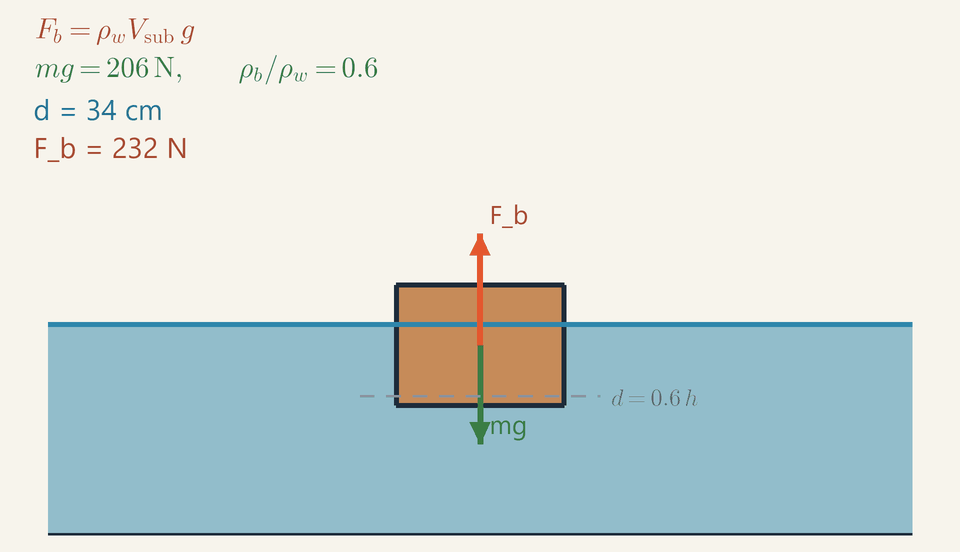
A wooden block (ρ = 600 kg/m³) is dropped into water. It bobs up and down, then settles with 60% of its height submerged, where the buoyant force F_b balances its weight mg.
Water presses harder the deeper you go, so it pushes up on an object's bottom more than down on its top: that net upward push is the buoyant force.
Archimedes' principle: the push equals the weight of the fluid the object pushes aside, about 9.8 N for every litre of water.
Under water, things feel lighter: you only have to lift their weight minus the buoyant force.
Heavier than the water it can push aside, an object sinks; lighter, it floats, sinking in until the water pushed aside weighs as much as it does.
Air is a fluid too: a hot-air or helium balloon rises because it weighs less than the air it pushes aside.
Dive to the bottom of a swimming pool and you feel the water pressing on your ears. Water presses on everything in it, from every side, and the deeper you go the harder it presses, because the water below holds up all the water above.
Now picture a block under water. Its bottom is deeper than its top, so the water pushes up on the bottom harder than it pushes down on the top. The difference is an upward push: the buoyant force.
How strong is it? Imagine a thin plastic bag full of water, hanging still in the pool. It neither sinks nor rises, so the surrounding water must be holding up exactly its weight. Swap the bag for a stone of the same shape: the water cannot tell the difference and pushes up just as hard. This is Archimedes' principle: the buoyant force equals the weight of the fluid the object pushes aside. Each litre pushed aside gives about 9.8 N of lift, so under water you only lift an object's weight minus this push.
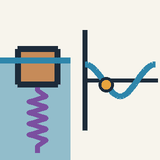
An object that weighs more than the water it can push aside sinks. One that weighs less floats, settling just deep enough that the water it pushes aside weighs as much as it does. In the animation the wooden block bobs, then rests with 60 % of its height under water, once the “water pushes up” arrow is as long as the “weight” arrow. Air is a fluid too: a hot-air balloon rises because it weighs less than the air it pushes aside.
Check yourself: a 3-litre rock lies on the bottom of a lake. How much lighter does it feel while you lift it under water? Answer: by the weight of 3 litres of water, about 29 N.
Intermediate
Key ideas
Fb=ρfluidVsubg: use the density of the fluid and only the submerged volume.
Buoyancy comes from pressure rising with depth, p=p0+ρgh: the bottom is pushed harder than the top.
Fully submerged, it sinks if ρobject>ρfluid, rises if ρobject<ρfluid, and hovers if they are equal.
A floating body has Vsub/V=ρobject/ρfluid: ice in fresh water is 92% submerged.
What density and pressure measure
A steel ball bearing sinks in water; steel ships float. Whether something floats is decided by density, the mass per unit volume: ρ=Vm
It is measured in kg/m³. Fresh water has 1000 kg/m³, so a litre has a mass of 1 kg; ice has 920 kg/m³ and steel about 7850 kg/m³. For a hollow or mixed object, ρ is the average density: the total mass over the whole volume inside its outer surface.
Pressure is force per unit area, in pascals (1Pa=1N/m2). A fluid at rest pushes at right angles on every surface, harder with depth, because each layer carries the fluid above it: p=p0+ρgh
Here p0 is the pressure at the surface, about 101 kPa, and h the depth; water adds about 9.8 kPa per metre, as Fluid Pressure and Pascal's Principle shows.
Where the buoyant force comes from
Take a box of height H with a horizontal top and bottom of area A, completely under water. Its bottom is deeper by H, so the pressure there is higher by ρgH, and the upward push on the bottom beats the downward push on the top: Fup−Fdown=ρgHA=ρgV
The side pushes cancel in pairs, and p0 and the depth of the box drop out: the net push is upward, equals the weight of the water the box replaces, and is the same at every depth.
For any other shape, imagine the object's place filled with water. That parcel stays at rest, so the surrounding water holds it up with exactly its weight, without knowing what is inside the surface. This is Archimedes' principle: a body in a fluid is pushed up by a buoyant force equal to the weight of the fluid it displaces, Fb=ρfluidVsubg
Use the density of the fluid, not of the object, and only the volume Vsub below the surface.
Sink, float or hover
Fully submerged, Vsub=V: the weight ρobjectVg faces a push ρfluidVg, so only the two densities matter.
If ρobject>ρfluid, the weight wins at every depth and the object sinks, however large it is.
If ρobject<ρfluid, the push wins and the object rises until part of it sticks out.
If the two densities are equal, the object hovers at any depth, like a fish or a well-trimmed submarine.
A floating object sinks in only until the fluid it displaces weighs as much as it does, ρfluidVsubg=ρobjectVg, so the fraction below the surface is the ratio of the densities: VVsub=ρfluidρobject
Ice floats in fresh water 92 % submerged. In sea water, about 1025 kg/m³, an iceberg has 920/1025≈0.90 of its volume below the surface: only a tenth shows.
Worked example: the block in the animation
In the labels h is not a depth but the block's height, 0.5 m. The cross-section is A=0.7m×0.1m=0.07m2, so V=0.035m3, and ρb=600kg/m3 is the density of the wood (ρw is that of water). The mass and the weight are m=ρbV=600⋅0.035=21kg,mg=21⋅9.81≈206N which is the green mg arrow. Fully under water the block would be pushed up with 1000⋅0.035⋅9.81≈343N, more than its weight, so it floats.
At rest Fb=mg, so Vsub=206/(1000⋅9.81)=0.021m3 and the submerged depth is d=Vsub/A=0.30m=0.6h: the ratio 600/1000 of the floating rule, at the level of the dashed line. Pressure agrees: the bottom face, 0.30 m down, feels 1000⋅9.81⋅0.30≈2943Pa more than the top, and 2943⋅0.07≈206N.
The readouts follow Fb=ρwgAd: 6.9 N more for each centimetre of depth. Released 5 cm above the water, the block hits it at about 1 m/s and overshoots, staying completely under for about a quarter of a second: d stops at 50 cm and Fb at its maximum, 343 N, which throws the block back up. After a few shrinking swings the readouts end at d≈30cm and an Fb within a few newtons of 206 N.
Worked example: weighing a stone in water
A stone on a spring balance reads 24.5 N in air and 14.7 N completely under water. What are its volume and density?
Under water the balance shows the apparent weight, the true weight minus the buoyant force, so Fb=24.5−14.7=9.8N, the weight of the displaced water: V=ρfluidgFb=1000⋅9.819.8≈1.0×10⁻³m3 or one litre. The mass is 24.5/9.81≈2.5kg, so ρ=m/V≈2500kg/m3, typical of rock. Quicker still: the weight divided by the loss in water, 24.5/9.8=2.5, is the density relative to water.
Legend says Archimedes tested a king's crown by the water it displaced. Pure gold (19 300 kg/m³) of the same weight loses only 1.3 N in water, so gold mixed with lighter silver gives itself away by losing more.
Reading the arrows and the dashed line
The green mg arrow keeps its length, while the red Fb arrow grows in proportion to the submerged depth. With the block's bottom above the dashed line, the red arrow is shorter and the net force points down; below it, the net force points up. Each centimetre from the line gives 6.9 N back towards it, as a spring of stiffness 687 N/m would. The block overshoots because it is still moving at the line, and water drag shrinks each swing.
On a graph of pressure against depth, a straight line climbs from p0 by ρg per metre. The gap between the two faces of a submerged body, ρgH, is the same wherever it is.
Common mistakes
Using the object's density in Fb: for the block it gives 600⋅0.021⋅9.81≈124N instead of the correct 206 N.
Using the whole volume of a floating object: the block's 0.035 m³ would give 343 N, but only the 0.021 m³ below the waterline counts.
Expecting a bigger push deeper down: a submerged 2-litre stone feels 1000⋅0.002⋅9.81=19.62N at 1 m and at 10 m alike, because its top and bottom gain the same pressure.
Thinking that heavy things sink: a 1 g steel ball bearing sinks, while a steel ship of 50 000 tonnes floats, because its air-filled hull is less dense on average than water.
Forgetting to convert litres: two litres are 0.002 m³, and putting in 2 gives 19 620 N.
Where you meet it
Ships ride about 2.5 % deeper by volume in fresh water than at sea, so hulls carry separate load lines for both. Submarines flood or empty ballast tanks to sink, hover or surface, and a hydrometer floats deeper in a less dense liquid, so its stem reads the density of milk or wine. Heated to 100 °C, air has about 0.95 kg/m³, against 1.20 kg/m³ outside at 20 °C, so each cubic metre of a hot-air balloon lifts only about 0.25 kg.
Buoyancy drives convection, the rise of warm fluid, in Conduction, Convection and Radiation, and sets the settling speed of grains in Drag and Terminal Velocity. The bobbing block is an oscillator like those of Simple Harmonic Motion, and when the fluid flows, pressure no longer depends on depth alone: that is Bernoulli's Principle.
Advanced
Key ideas
Replace the body by fluid of the same shape: that fluid stays at rest, so the pressure on the surface pushes up with exactly its weight, ρfgV.
Energy view: raising the body by δz lowers fluid of volume V by δz, so δU=(m−ρfV)gδz: weight minus buoyancy.
A floating body bobs like a mass on a spring: k=ρwgA, so ω0=g/d, with d its floating depth.
A heeling ship rights itself if the metacentre M, where the vertical through the shifted centre of buoyancy B′ meets the centreline, is above G.
Limits: in a compressible fluid ρf falls with height, so a balloon stops where densities match; in free fall (geff=0) buoyancy vanishes.
Pressure in a fluid at rest
Buoyancy is pressure and nothing else: the upward force on a submerged body is the sum of all the pushes the surrounding fluid exerts on its surface. So we start with how pressure behaves in a fluid at rest. Notation: ρf is the density of the fluid, whatever it is; when the fluid is water we write ρw, and, as in the animation, ρb is the density of the block. g≈9.81m/s2 is the acceleration due to gravity, and p0 is the pressure of the air at the water's surface.
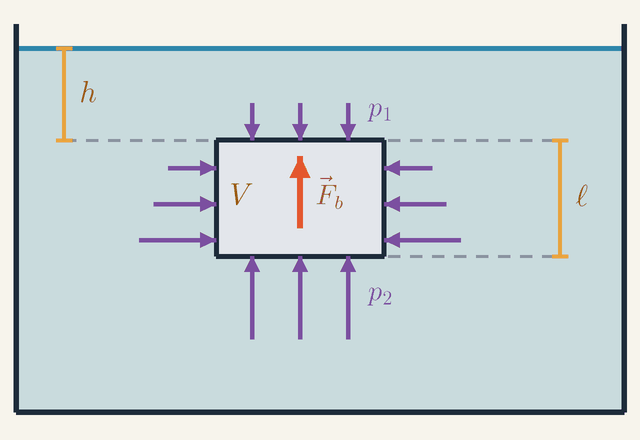
Figure 1. A box of height ℓ wholly under water, its top face at depth h. Pressure pushes at right angles to every face, harder with depth (only that part is drawn; p0 adds equally everywhere): the sides cancel in pairs and the bottom beats the top, leaving Fb upward.Legend
p1
Pressure on the top face, at depth h.
Pa
p2
Pressure on the bottom face, at depth h+ℓ; larger than p1.
Pa
h
Depth of the top face below the surface.
m
ℓ
Height of the box.
m
V
Volume of the box, ℓA, where A is the area of its top or bottom face.
m3
Fb
Net pressure force on the box, upward: (p2−p1)A=ρfgV.
N
Figure 1 shows a box of height ℓ and volume V, with a top and a bottom face of area A each (so V=ℓA), held wholly under water with its top face at depth h. Look first at the directions of the arrows: on every face they meet the face at right angles. A fluid at rest cannot resist a shear stress, a force along a surface that would make its layers slide over one another, so it can only push straight on a surface.
Now look at their lengths. The arrows grow with depth, because each layer of water carries the weight of all the water above it. Only this depth-dependent part is drawn: the air adds the same pressure p0 to every face, and a uniform pressure gives no net force on a closed box, as we prove below.
The two sides lie at the same depths, so their arrows match in pairs and cancel. That leaves the top face, pushed down by p1A, and the bottom face, pushed up by p2A. The bottom is deeper by ℓ, so p2 exceeds p1 by the weight of a column of water ℓ tall standing on unit area, ρf(ℓA)g/A: p2−p1=ρfgℓ The net push on the box is therefore upward: Fb=(p2−p1)A=ρfgℓA=ρfgV This is the weight of the water that would fill the box. The depth h has dropped out: as long as water does not compress, the buoyant force is the same at every depth.
Pressure as a field
The box argument used two facts without proof: that pressure at a point pushes equally in every direction, and that it grows steadily with depth. Both follow from Newton's second law applied to tiny pieces of fluid at rest, and the general form is what later lets us treat bodies of any shape and even accelerating containers.
First, direction. Write the force of the fluid on a small surface element of area dA as −pn^dA, where n^ is the unit vector normal to the element, pointing out of the body; the minus sign says the fluid pushes inward.
Is p the same whatever way the element faces? Consider a small triangular wedge of fluid. The forces on its faces scale with the square of its size, its weight with the cube. As the wedge shrinks the weight becomes negligible, so the face forces alone must balance, and for a triangle that is possible only if the pressure is the same on every face. So p does not depend on direction: pressure is a scalar field p(r), a single number at each point.
Second, how it varies. Take a small cube of sides dx, dy, dz. The fluid on its left face pushes it in the +x direction with p(x)dydz; the fluid on its right face pushes it back with p(x+dx)dydz. The net force along x is the difference, −(∂p/∂x)dxdydz. The same holds along y and z, so the net pressure force per unit volume is −∇p: pressure differences push fluid from high pressure towards low.
For fluid at rest this force must balance gravity, which pulls on each unit volume with ρfg. With z measured upward, so that g points along −z, ∇p=ρfg,dzdp=−ρfg For constant density, integrating down from the surface gives p=p0+ρfgh at depth h; the p1 and p2 of Figure 1 are this at depths h and h+ℓ. Because ∇p points along g, pressure changes only vertically: surfaces of equal pressure, the free surface among them, are perpendicular to g, that is, horizontal.
Three routes to Archimedes' principle
Archimedes' principle states that a body in a fluid at rest feels an upward force equal to the weight of the fluid it displaces. The box proved it for one shape. Three arguments prove it for any shape, and each adds something: the first is a one-line calculation, the second also says where the force acts, and the third shows why only the average density matters.
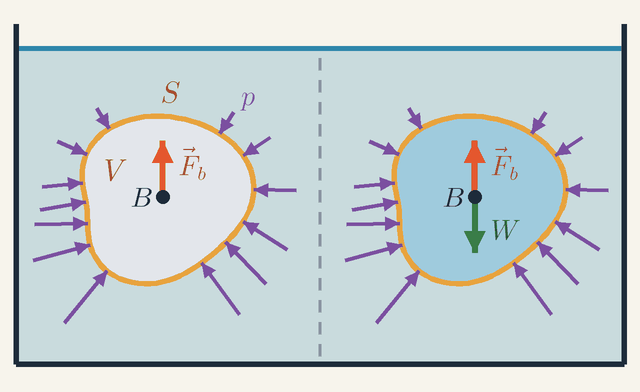
Figure 2. Left: a body in water at rest, its surface S and the pressure p on it. Right: the same S filled with water. The pressure on S is the same in both; that water is at rest, so Fb equals its weight W and acts through B. Not to scale.Legend
S
Surface of the body; on the right the same surface encloses water.
V
Volume enclosed by S.
m3
p
Pressure on S: at right angles to it, larger where S is deeper.
Pa
B
Centroid of the volume inside S: the centre of buoyancy.
Fb
Pressure force on S, upward through B; the same in both panels.
N
W
Weight of the water that fills S, ρfVg, downward through B.
N
Figure 2 holds the key idea. On the left, a body of any shape sits in water at rest; S is its surface, V the volume inside it, and the arrows are the pressure p on S, at right angles to S and longer where S is deeper. On the right the body has been taken away and the same surface S encloses water instead. Compare the arrows: they are identical. The pressure at each point of S is set by that point's depth in the surrounding water, which has not changed, so it cannot depend on what is inside S. Whatever fills S, the total pressure force on it, Fb, is the same.
Route 1, by calculus. The buoyant force is the sum of the pressure forces over the closed surface S. The hydrostatic pressure is just a function of height, so it can be continued into the volume V the body occupies. The gradient theorem, a close relative of the divergence theorem, then turns the surface integral of pn^ into the volume integral of ∇p, and the hydrostatic equation supplies ∇p: Fb=−∮Spn^dA=−∫V∇pdV=−ρfgV The force points against g, upward, with magnitude ρfgV: the weight of a volume V of fluid. The surface pressure p0 has dropped out because its gradient is zero; this is the proof that a uniform pressure exerts no net force on a closed surface.
For a floating body only part of the surface is wet. Work with the pressure in excess of p0: the air's p0 acts on the whole closed surface and cancels. That excess is zero on the plane of the waterline, so closing the wetted surface with the patch of that plane inside the body adds nothing, and the same theorem gives ρwgVsub, where Vsub is the submerged volume.
Route 2, by equilibrium, with no calculus; it uses the right-hand picture. The water inside S is at rest under two forces: its weight W=ρfVg, acting downward through its centre of mass, and the pressure force Fb of the water around it. Since it does not accelerate, the forces cancel, so Fb=W and points up. Since it does not start to turn, the two forces have no net torque, so Fb acts along the same vertical line as W. For uniform water the centre of mass is the centroid, the geometric centre, of the volume inside S, labelled B.
Now go back to the left-hand picture. The pressure on S is the same, so the body feels the same force along the same line. Buoyancy equals the weight of the fluid displaced and acts through B, the centroid of the displaced volume, called the centre of buoyancy. This argument does not even need constant density: in a fluid whose density changes with depth, the force is still the weight of the fluid displaced, g∫VρfdV, now acting through that fluid's centre of mass.
Route 3, by energy. Raise the body by a small height δz. Its own potential energy grows by mgδz. Fluid flows into the space it leaves below, and the net effect on the fluid is that a volume V of it, of mass ρfV, has moved down by δz, losing ρfVgδz. In total δU=(m−ρfV)gδz A force is minus the slope of the potential energy, so the upward net force is −δU/δz=ρfVg−mg: buoyancy minus weight. Only the body's mass and volume enter, that is, its average density m/V. This is why a steel hull floats even though steel is nearly eight times denser than water: it encloses enough air to bring its average density below water's.
The water as a spring
A floating body pushed down and let go bobs up and down. Near its floating position, the water acts on it as a linear spring, and that spring gives the period of the bobbing.
Take the animation's block. It is wall-sided, with vertical sides, so the area of its horizontal cross-section, A=0.70m⋅0.10m=0.07m2, is the same at every height. From here on h is the block's height, h=0.50m, not a depth as in Figure 1. Its density is ρb=0.6ρw, so its mass is m=ρbAh=21kg and its weight 206 N. Floating, buoyancy equals weight, ρwgAd=ρbgAh, so the floating depth (the draught) is d=(ρb/ρw)h=0.30m.
Now push the block a further distance x below its floating depth. It displaces an extra volume Ax, so the buoyant force grows by ρwgAx while the weight stays the same. The net force is a restoring force −kx with stiffness k=ρwgA, about 687 N/m for the block. That is Hooke's law, so the motion is simple harmonic. Using m=ρbAh and then d=(ρb/ρw)h, its angular frequency is ω0=mk=ρbhρwg=dg
The area has cancelled, and the result is simple: a wall-sided floating body bobs with the period of a simple pendulum as long as its floating depth. For d=0.30m, ω0≈5.7rad/s and T0=2πd/g≈1.10s, whatever the area; a wall-sided ship with a 9 m draught would heave, that is bob, about once every 6 s.
The spring is linear only while the block is partly under water. Once it is wholly submerged its displaced volume cannot grow any more, and neither can the buoyant force. The graph of the motion shows both regimes.
Reading the y(t) graph
The animation's block is driven by this spring together with a water drag. Its graph tests the spring model: where it holds, where it fails, and how fast the motion dies away.
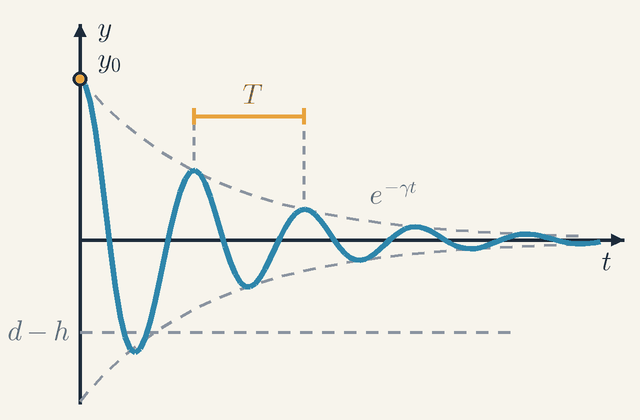
Figure 3. The block's height y above its floating level after release from y0. Dashed: the envelope ±y0e−γt that the later peaks follow, and the level d−h below which the block is wholly under water. T is the time between successive peaks.Legend
y
Height of the block above its floating level.
m
t
Time since the release.
s
y0
Starting height, at the release.
m
d−h
Height at which the block's top is level with the water (d is the floating depth, h the block's height); below it the whole block is under water.
m
T
Time between two successive upper turning points.
s
e−γt
Factor by which the swings shrink with time; γ is the damping rate.
Figure 3 plots the height y of the block above its floating level against the time t; the horizontal t axis, y=0, is the floating level itself. The block is released at y0=35cm, which puts its bottom 5 cm above the water, since it floats 30 cm deep.
Follow the first swing: it is not harmonic. The block falls through the air, then plunges right under, past the dashed level d−h=−20cm, where its top is flush with the water, down to −24.5cm at 0.55 s. Below d−h the spring saturates: Fb cannot exceed the buoyancy of the whole block, ρwgV=343N. After this swing the submerged depth stays between about 15 and 40 cm, inside the block's height, where the force is linear.
Now read the upper turning points after the first: +15.2, +6.7, +2.9, +1.3 and +0.55 cm. They come about 1.11 s apart, the spacing T marked in the figure, and each is about 0.44 times the one before. A constant ratio per swing means exponential decay, so the peaks lie on the dashed envelope ±y0e−γt of the damped oscillation y≈y0e−γtcos(ωt) that labels the graph in the animation; here ω is the damped angular frequency ωd. One period multiplies the amplitude by e−γT≈0.44, so γ≈ln(1/0.44)/1.11≈0.74s−1 close to the γ=0.75s−1 built into the model's water drag.
Damping hardly slows the swinging: ωd=ω02−γ2≈5.67rad/s is only about 1 % below ω0, which is why T is so close to T0. The quality factor Q=ω0/(2γ)≈3.8 says the damping is light: the block makes a handful of visible swings before it settles.
Stability and the metacentre
Floating is not enough: a ship must also stay upright. When does a small tilt, a heel, produce a torque that turns the body back? One length, the metacentric height GM, answers it.
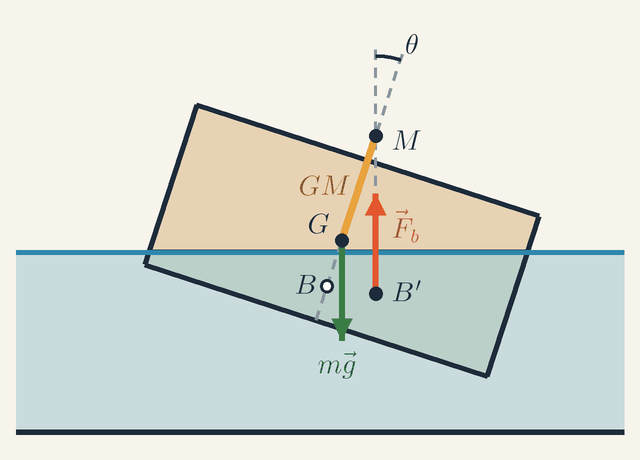
Figure 4. A box-shaped hull heeled by θ (angle drawn large). The weight mg acts at G. The immersed wedge has moved the centre of buoyancy from B to B′, where Fb acts; the vertical through B′ meets the centreline at M, above G, so the hull rights itself.Legend
θ
Heel angle: how far the hull is turned from upright.
rad
G
Centre of gravity of the hull, on its centreline; the weight acts here.
B
Centre of buoyancy when the hull was upright, a point fixed in the hull.
B′
Centre of buoyancy now: the centroid of the submerged part, moved towards the low side.
M
Metacentre: where the vertical through B′ meets the centreline.
GM
Metacentric height: the distance from G up to M; the righting couple is mgGMsinθ.
m
mg
Weight of the hull, downward through G.
N
Fb
Buoyant force, upward through B′; equal in size to the weight.
N
Figure 4 shows a box-shaped hull heeled by an angle θ, drawn far larger than a real heel to make the geometry plain. Two forces act on it. The weight mg acts downward through the centre of gravity G, a point fixed in the hull. The buoyant force Fb acts upward through the centre of buoyancy, the centroid of the submerged part. When the hull was upright that centroid was at B, on the centreline, the hull's line of symmetry through G. In a ship B is often below G, as here, and that alone is not dangerous.
Now look at the waterline. Heeling lifts a wedge of hull out of the water on the high side and pushes a wedge in on the low side. The submerged volume stays the same, but its shape moves towards the low side, and so does its centroid: the centre of buoyancy moves from B to B′, and Fb now acts along the vertical through B′. Follow that vertical up: it crosses the centreline at the metacentre M.
How high is M? Let I be the second moment of area of the waterplane, the area cut out of the hull by the water surface, about the heel axis, the line it tilts about. A strip of waterplane at distance y from that axis gains or loses an immersed height yθ, so the wedges carry a volume moment Iθ from one side to the other, and B moves sideways by Iθ/Vsub. For a small angle that shift equals BMθ, so M sits at a fixed height BM=VsubI above B.
In Figure 4, M lies above G, at the distance GM. The weight through G and the buoyancy through B′ are equal and opposite but not in line, so they form a couple. Its lever arm is GMsinθ, and its moment, mgGMsinθ, turns the hull back upright. If M lay below G, the same two forces would tip it further. So a floating body is stable against a small heel when M is above G, that is, when GM>0.
For a box-shaped hull of width b, length L and floating depth d, I=Lb3/12 and Vsub=Lbd, so BM=12db2 Width helps as its square. Anything that raises G works against stability: cargo stowed high, and water sloshing freely across a deck, which runs to the low side and acts like a raised G, a classic cause of capsizes.
Worked problem: would the block stay upright?
Apply this to the animation's block: height h=0.50m, floating depth d=0.30m, 0.70 m wide and 0.10 m thick. Measure heights from its bottom. The block is uniform, so G is at mid-height, 0.25 m, and B is at the middle of the submerged part, half the floating depth, 0.15 m.
Heeling in the plane of the screen, the waterplane is 0.70 m wide: BM=12db2=12⋅0.300.702≈0.136m So M is 0.15+0.136≈0.286m above the bottom, 3.6 cm above G: the block is stable this way. At a heel of 5°, where sinθ≈0.087, the righting moment is 206⋅0.036⋅0.087≈0.65N⋅m.
Heeling across the 0.10 m thickness, the waterplane is only 0.10 m wide, and BM=0.102/(12⋅0.30)≈0.003m. Now M lies 9.7 cm below G, so GM<0 and the block is unstable. A real block of these proportions would roll over and float on its broad face, 6 cm deep (0.6 of its 0.10 m thickness). Only the two-dimensional animation, which lets the block move up and down but not roll, keeps it upright.
The same reasoning gives a general rule. For a uniform block of relative density s=ρb/ρw, height h and width b in the plane of the heel, G is at h/2, B at d/2=sh/2, and BM=b2/(12sh). Asking for M above G, sh/2+b2/(12sh)>h/2, and rearranging gives the condition to float upright: hb>6s(1−s) For s=0.6 this demands b/h>1.2: the width gives 1.4, which passes, the thickness only 0.2, which fails. A square beam, b=h, fails the test for any s between about 0.21 and 0.79, which is why square timbers of ordinary wood float tilted rather than flat side up.
Accelerating and compressible fluids
So far the container was at rest and the fluid incompressible. Dropping either assumption changes buoyancy in instructive ways.
In a container accelerating at a, fluid at rest relative to it must accelerate with it. Newton's second law per unit volume then reads −∇p+ρfg=ρfa, that is, ∇p=ρf(g−a). This is the hydrostatic equation with g replaced by the effective gravity g−a, so everything above carries over: buoyancy points against g−a.
Three consequences follow. In a lift accelerating upward at 2 m/s², the effective weight m(g+a) and the buoyancy both grow by the factor 11.81/9.81, so a floating block keeps its depth. In a car that speeds up, effective gravity tilts backward, so a helium balloon on a string leans forward while the passengers are pressed back. In free fall g−a=0: no pressure gradient, no buoyancy, and on an orbiting station bubbles do not rise in a drink.
In a compressible fluid ρf changes with height. An isothermal atmosphere has ρ=ρ0e−z/H, where the scale height H≈8.4km at 15 °C is the rise over which the density falls by a factor e. A sealed, rigid balloon whose average density is half that of ground-level air rises until the air around it is just as dense, where e−z/H=1/2, near Hln2≈5.8km. It levels off there stably: pushed higher, it meets thinner air, its buoyancy falls below its weight and it sinks back; pushed lower, the reverse.
A compressible body in a liquid behaves the other way. A diver in a foam-rubber suit who drifts deeper is squeezed by the extra pressure, displaces less water and so sinks faster. Neutral buoyancy is therefore unstable for anything that compresses more easily than water, which is why divers, fish and submarines must keep adjusting it.
Limits of validity
Everything above rests on idealisations. Here is when each one fails, and by how much.
Water is slightly compressible, with a bulk modulus of about 2.2 GPa: at 4000 m, under some 40 MPa, sea water is roughly 2 % denser than at the surface, and the buoyancy of a rigid body grows by as much.
Hydrostatics also assumes fluid all round the body. A body pressed flat on the bottom, with no fluid underneath, gets no push from below and is held down by the pressure on its top.
Surface tension σ adds a force proportional to the length of the line where the water surface meets the body, while weight and buoyancy grow with volume. The two are comparable for objects about the size of the capillary length, σ/(ρg)≈2.7mm for water, which is why insects and a dry steel needle can rest on the surface.
An accelerating body must also accelerate some of the fluid around it. For a sphere this added mass is 21ρfV, so a bubble released from rest, whose own mass is negligible, starts upward at about ρfVg/(21ρfV)=2g, not at the enormous acceleration its tiny mass suggests. Added mass and the waves a real block sends out make it bob more slowly, and settle sooner, than the spring model predicts.
Finally, buoyancy is a continuum effect, and for very small particles thermal motion competes with it. Grains 10 nm across and twice as dense as water are spread by thermal motion over about 0.8 m of height, the height at which lifting one grain against its weight minus buoyancy costs the typical thermal energy kBT; so they hardly settle.
Where this leads
Buoyancy returns wherever densities differ. In Drag and Terminal Velocity, a small sphere settling through a liquid reaches a terminal speed proportional to the density difference ρs−ρf, because buoyancy is subtracted from the weight. Warm fluid rising and cool fluid sinking is convection, in Conduction, Convection and Radiation. Flowing fluids, in which pressure is no longer set by depth alone, are the subject of Bernoulli's Principle. The bobbing block, with Q≈3.8, is a case of Damping and Resonance, and the balloon leaning forward in an accelerating car shows that gravity and acceleration cannot be told apart, the starting point of Gravity as Curved Spacetime.
Key formulas
Archimedes' principle
Fb=ρfluidVsubg
The fluid pushes up on a body with a force equal to the weight of the fluid that would fill its submerged part. The force comes from pressure rising with depth: the lower surfaces of the body are pushed harder than the upper ones, and the sideways pushes cancel. The density in it is the fluid's, never the object's.
Symbols
Fb
buoyant force, pointing up
N
ρfluid
density of the fluid
kg/m3
Vsub
volume of the body below the surface (the displaced volume)
m3
g
gravitational acceleration
m/s2
When it holds: Holds for any shape in a fluid at rest, provided the fluid reaches the underside. It fails for a body sealed flat against the bottom, it is joined by drag and lift in a moving fluid, and it vanishes in free fall.
Example: The floating block of the animation displaces 0.021 m³: Fb=1000⋅0.021⋅9.81≈206N, equal to its weight.
Pressure at a depth
p=p0+ρgh
Each layer of fluid carries the weight of the fluid above it, so the pressure grows in proportion to the depth, starting from the pressure p0 at the surface. Only the depth matters, not the shape of the container. The difference ρgH between the bottom and the top of a body of height H is what produces the buoyant force.
Symbols
p
pressure at depth h
Pa
p0
pressure at the surface, usually atmospheric
Pa
ρ
density of the fluid
kg/m3
g
gravitational acceleration
m/s2
h
depth below the surface
m
When it holds: For a fluid at rest with a constant density, which liquids nearly have. In the atmosphere the density falls with height, and the pressure falls roughly exponentially instead.
Example: At the bottom of the floating block, 0.30 m down: p−p0=1000⋅9.81⋅0.30≈2.9kPa.
Density
ρ=Vm
Density is mass per unit volume, a property of the material rather than of the amount of it. For an object with hollows or made of several materials, the total mass divided by the total enclosed volume gives its average density, the number that decides whether it floats.
Symbols
ρ
density (average density for a mixed or hollow body)
kg/m3
m
mass
kg
V
volume
m3
When it holds: Always true as a definition. For a hollow or mixed body it gives an average that can be far from the density of its material: a steel hull full of air averages less than water.
Example: The block in the animation: ρ=21/0.035=600kg/m3.
Fraction of a floating body below the surface
VVsub=ρfluidρobject
A floating body sinks until the fluid it displaces weighs as much as it does, ρfluidVsubg=ρobjectVg. Dividing both sides by ρfluidVg leaves the ratio of the densities: g and the size of the body cancel.
Symbols
Vsub
volume below the surface
m3
V
whole volume of the body
m3
ρobject
average density of the body
kg/m3
ρfluid
density of the fluid
kg/m3
When it holds: Only for a body that floats, ρobject<ρfluid; a ratio above 1 means it sinks. It neglects the buoyancy of air on the dry part (a correction below 0.1 % for wood or ice but a few per cent for light foams) and surface tension, which matters only for objects of a few millimetres.
Example: An iceberg in sea water: 920/1025≈0.90, so 90 % of it is below the surface.
Glossary
Fluid
A substance that flows, a liquid or a gas, because at rest it cannot resist a shearing force. At rest it can only push, at right angles to any surface it touches.
Hydrostatic pressure
The pressure in a fluid at rest. It grows with depth because each layer carries the weight of the fluid above it, p=p0+ρgh: in water by about 9.8 kPa per metre.
Buoyant force
The net upward force a fluid exerts on a body in it, the sum of the pressure pushes over its whole surface. It exists because the pressure under the body is greater than the pressure above it.
Archimedes' principle
Any body wholly or partly immersed in a fluid receives an upward push as large as the weight of the fluid it displaces, Fb=ρfluidVsubg. It holds for any shape and any material.
Displaced fluid
The fluid that would fill the submerged part of the body if the body were taken away. Its volume is Vsub and its weight is the buoyant force; for a ship, its mass is called the ship's displacement.
Average density
The total mass of an object divided by the whole volume inside its outer surface, air spaces included. This, not the density of the material, decides floating: a steel ship floats because its air-filled hull averages less than 1000 kg/m³.
Relative density
The density of a substance divided by that of water, a pure number also called specific gravity: 0.6 for the wood in the animation, 0.92 for ice, 2.5 for a typical stone. For a body floating in water it equals the fraction of its volume below the surface.
Apparent weight
What a balance shows while the body hangs in a fluid: its true weight minus the buoyant force. A one-litre stone weighing 24.5 N reads 14.7 N under water.
Floating equilibrium
The state of a floating body at rest, in which the buoyant force on its submerged part equals its weight. The body settles at the depth where the displaced fluid weighs as much as it does.
Neutral buoyancy
The state of a submerged body whose average density equals that of the fluid, so that weight and buoyancy balance at any depth. Fish adjust it with a swim bladder and submarines with ballast tanks.
Centre of buoyancy
The point B through which the buoyant force acts: the centroid of the displaced volume. It moves when a floating body tilts, and that shift is what can turn the body upright again.
Metacentre
For a slightly tilted floating body, the point M where the vertical through the shifted centre of buoyancy meets the body's centreline. The body is stable if M lies above its centre of gravity G.
Quantities
Fb
Buoyant force
N
The net upward push of the fluid, equal to the weight of the fluid displaced; 206 N on the floating block of the animation.
ρ
Density
kg/m3
Mass per unit volume, m/V: 1000 kg/m³ for fresh water and about 1.2 kg/m³ for air near the ground.
ρfluid
Density of the fluid
kg/m3
The density of the surrounding liquid or gas, the one that sets the buoyant force; about 1025 kg/m³ for sea water.
ρobject
Density of the object
kg/m3
The average density of the body, its total mass over its total volume. Compared with ρfluid, it decides whether the body sinks, floats or hovers.
m
Mass
kg
The mass of the body, whose weight is mg; 21 kg for the block in the animation.
V
Volume of the object
m3
The whole volume enclosed by the body's outer surface; one litre is 0.001 m³.
Vsub
Submerged volume
m3
The part of the body's volume below the surface of the fluid, equal to the volume of fluid displaced. It equals V once the body is fully under.
p
Pressure
Pa
Force per unit area, pushing at right angles on any surface in the fluid; 1Pa=1N/m2.
p0
Surface pressure
Pa
The pressure at the fluid's free surface, usually that of the atmosphere, about 101 kPa. It acts on every side of a body and cancels out of the buoyant force.
h
Depth
m
How far below the surface the pressure is taken. In the animation's labels, h is instead the height of the block.
g
Free-fall acceleration
m/s2
The acceleration of free fall, about 9.81 m/s² at the Earth's surface. It multiplies both the weight and the buoyant force, so it cancels from the floating fraction; in free fall, where the effective g is zero, buoyancy vanishes too.
Quiz
Beginner A solid object that is denser than water is placed in water. What happens?
It sinks
It floats with most of it above the surface
It floats if it is big enough
It hovers halfway down
Show answer
Answer: A. It sinks
If the object is denser than water, its weight is larger than the biggest push the water can give, even when it is completely under water. Making it bigger does not help: its weight and the push grow together.
Beginner According to Archimedes' principle, the buoyant force equals what?
The weight of the fluid displaced
The weight of the object
The volume of the object
The mass of the fluid displaced
Show answer
Answer: A. The weight of the fluid displaced
The upward force equals the weight of the displaced fluid. It equals the object's own weight only when the object floats: a sinking stone is pushed up by less than its weight. It is a force in newtons, so it is a weight, not a mass or a volume.
Beginner A 2-litre stone is fully submerged in water. What buoyant force acts on it? (g = 9.81 m/s²)
19.62 N
19620 N
2 N
9.81 N
Show answer
Answer: A. 19.62 N
2 L = 0.002 m³, so F_b = 1000 × 0.002 × 9.81 = 19.62 N. Forgetting to convert litres to m³ gives 19620 N.
Intermediate Why does a fluid push upward on a submerged object?
The pressure at its bottom is greater than at its top
Water molecules are attracted to the object
Objects lose part of their mass in water
The pressure at its top is greater than at its bottom
Show answer
Answer: A. The pressure at its bottom is greater than at its top
Pressure grows with depth, p = p₀ + ρgh. The bottom is deeper, so the upward push on it beats the downward push on the top.
Intermediate Ice has a density of 920 kg/m³. What percentage of an ice cube floating in fresh water is below the surface?
92%
8%
50%
100%
Show answer
Answer: A. 92%
Submerged fraction = ρ_ice/ρ_water = 920/1000 = 0.92, so 92% is below the surface and only 8% shows.
Intermediate A stone hanging from a string is fully submerged in a lake and then lowered deeper. What happens to the buoyant force?
It stays the same
It increases, because the pressure is higher deeper down
It decreases, because there is more water above it
It drops to zero
Show answer
Answer: A. It stays the same
The pressures on the top and bottom both increase by the same amount, so their difference, and hence F_b = ρgV, does not change. Water is nearly incompressible.
Advanced Why does a steel ship float, although steel is about 8 times denser than water?
Its hull encloses air, so its average density is less than that of water
Steel becomes less dense in water
Its engines keep pushing it upward
Sea water is denser than steel
Show answer
Answer: A. Its hull encloses air, so its average density is less than that of water
What matters is the total mass divided by the total enclosed volume. The air-filled hull displaces enough water to equal the ship's weight.
Advanced A box of height H with horizontal faces of area A is fully submerged in a fluid of density ρ. What is the net force from the fluid pressure?
ρ·g·H·A, upward
ρ·g·H·A, downward
p₀·A, upward
Zero, because the pressures cancel
Show answer
Answer: A. ρ·g·H·A, upward
The bottom face is deeper by H, so its pressure exceeds the top's by ρgH. The net force is ρgH·A = ρgV upward; p₀ and the side forces cancel.
 Physics Tutor