Motion under gravity alone: every body gains the same 9.81 m/s of downward velocity each second (g≈9.81m/s2), so from rest v=gt and h=21gt2, and a heavy ball and a light ball land together.
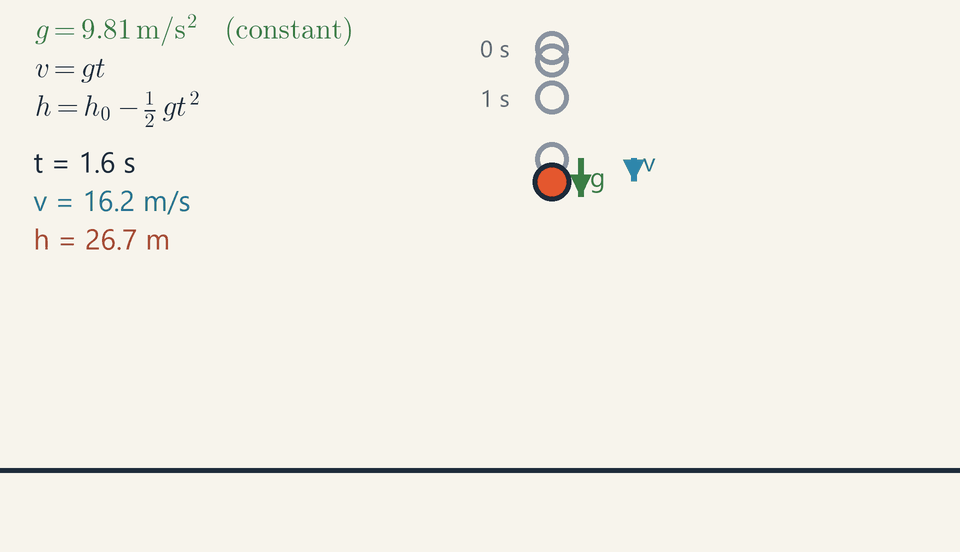
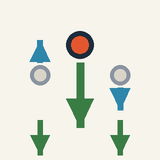
A ball dropped from rest. Strobe circles every 0.5 s, labelled at whole seconds, show the spacing growing as it falls; the blue arrow is its velocity and the green arrow is the constant acceleration g.
A falling object gains about 9.81 m/s of speed every second; this steady gain is called g.
The distance grows faster than the speed: about 4.9 m in the first second, 19.6 m after two.
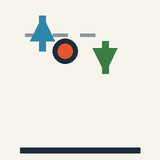
Without air, heavy and light things fall together: a bigger pull, but also more mass to speed up.
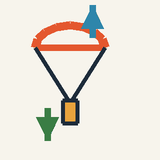
Air pushes back harder the faster something falls, so a feather or a parachute soon stops speeding up.
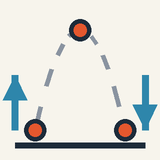
Gravity never switches off: a ball thrown up slows down, stops for an instant at the top, then falls back.
Drop a ball and it falls faster and faster. An object is in free fall when gravity is the only force that matters. Near the Earth's surface it gains about 9.81 m/s of downward speed every second, whatever it is made of. This steady gain is called g, the acceleration due to gravity.
Let a stone go from a high bridge. After 1 s it falls at about 10 m/s, after 2 s at about 20 m/s, after 3 s at about 29 m/s: the speed climbs by the same step each second.
Quick check: roughly how fast is it after 5 s? (About 49 m/s.)
The distance grows faster than the speed, because the stone starts from rest. In the first second its average speed is only about 4.9 m/s, so it drops about 4.9 m; after two seconds it has fallen 19.6 m, four times as far. In the animation the faint circles, one every half second, spread further and further apart.
Why do heavy and light things fall together? Gravity pulls a heavier object harder, but a heavier object is also harder to speed up, in exactly the same proportion, so the two effects cancel. In a tube with the air pumped out, a feather and a coin fall side by side. In everyday life air pushes back on a falling object, more and more as it speeds up, so a feather or a parachute soon stops gaining speed.
Gravity does not switch off on the way up. A ball thrown upward loses about 9.81 m/s every second, stops for an instant at the top and falls back.
Quick check: a ball leaves your hand straight up at about 20 m/s. When does it stop rising? Answer: after about 2 s.
Intermediate
Key ideas
From rest (down positive, h = distance fallen): v=gt, h=21gt2, v=2gh.
Distances fallen in successive equal time intervals are in the ratio 1 : 3 : 5 : 7.
Thrown up at v0: it stops at the top after v0/g and returns after 2v0/g at the same speed.
At the top v=0, but the acceleration is still g downward.
Free fall and the choice of sign
Timing a dropped stone is one way to find the depth of a well. An object is in free fall when gravity is the only force acting on it, with air resistance neglected. A ball thrown upward is in free fall too, from the moment it leaves your hand. Near the Earth's surface every freely falling body has the same downward acceleration, g≈9.81m/s2, whatever its mass.
The motion is along a vertical line, so choose which way is positive. For a drop, take down as positive and start the clock at the release: the velocity v, the acceleration g and the distance fallen h are then all positive. For a throw, take up as positive: the acceleration is then −g, and a negative velocity means the object is coming down. Never mix the two in one problem. In the formulas below h is the distance fallen; the animation's h readout shows the height above the ground.
One acceleration for every body
In free fall the velocity changes by the same amount every second, g=Δv/Δt: 9.81 m/s of downward velocity per second, for a coin or a person alike. Gravity pulls with the weight W=mg, proportional to the mass, but the mass also resists any change of velocity, and Newton's second law gives a=W/m=g. A body ten times heavier is pulled ten times harder and is ten times harder to speed up.
Galileo reached the same conclusion by reasoning. If heavy bodies fell faster, a light stone tied to a heavy one should hold it back, yet the pair is heavier than either and should fall faster still; the contradiction disappears only if all bodies fall alike. In 1971 an Apollo 15 astronaut dropped a hammer and a falcon feather on the airless Moon, where g≈1.62m/s2, and they landed together.
The free-fall equations
Since g is constant, the constant-acceleration equations of Motion in a Straight Line apply with v0=0 and a=g, down being positive:
v=gt
h=21gt2(distance fallen from rest)
v=2gh
The speed grows in proportion to the time, the distance with its square: in twice the time an object falls four times as far, because it is also moving faster. The third equation, from v2=2gh, links speed and height without the time. Handy checks: a fall of about 5 m takes 1 s, one of about 20 m takes 2 s.
For a throw, keep the initial velocity v0. With up as positive and y the height above the launch point, v=v0−gt(up positive) y=v0t−21gt2 A ball thrown up at v0 stops at the top after v0/g, at a height v02/(2g), and is back at the launch point after 2v0/g, moving down at the speed v0: the way down mirrors the way up. A throw downward simply has a negative v0.
Worked example: the ball in the animation
How long does the fall take, and how fast does the ball land? The ball is released from rest h0=40m above the ground and lands when it has fallen 40 m: t=g2h0=9.812⋅40≈2.86s v=gt=9.81⋅2.856≈28.0m/s The third equation agrees, without the time: 2⋅9.81⋅40=784.8≈28.0m/s, about 100 km/h.
These are the readouts at the landing: t stops at 2.9 s (they show one decimal) and v at 28.0 m/s, while the h readout, the height h0−21gt2, runs down from 40 m to 0. The blue v arrow grows by the same step every second, and the green g arrow keeps its length throughout.
Halfway through the time, at 1.43 s, the ball has fallen only 10.0 m, a quarter of the drop, and moves at 14.0 m/s; the h readout shows 30.0 m. It passes the halfway height, 20 m, only after 2.02 s, at 19.8 m/s: it crosses the lower half in less than a third of the time. Its average speed, 40/2.856≈14.0m/s, is half the final speed.
Worked example: a ball thrown straight up
You throw a ball straight up at 12 m/s from a hand 1.5 m above the ground, then step aside. How high does it rise, when is it back at hand height, and how fast does it land? Take up as positive and the origin at the hand: v0=+12m/s, acceleration −9.81m/s2.
At the top v=0, so 0=12−9.81t gives t≈1.22s, and the height gained is v02/(2g)=144/19.62≈7.34m: the top is 8.84 m above the ground. The ball is back at hand height after 2v0/g≈2.45s, moving down at 12 m/s. At t=2s, v=12−9.81⋅2=−7.6m/s: the minus sign means it is already falling.
On reaching the ground its displacement is Δy=−1.5m, and the time is not needed, so use v2=v02−2gΔy: v2=122−2⋅9.81⋅(−1.5)=144+29.4=173.4m2/s2 It lands at 13.2 m/s downward, v=−13.2m/s, after t=(12+13.2)/9.81≈2.57s, faster than it was thrown because it ends 1.5 m lower.
Reading the strobe picture and the graphs
The faint circles show the ball every 0.5 s; at the circles labelled 1 s and 2 s it has fallen 4.9 m and 19.6 m. The gaps between successive circles are 1.23, 3.68, 6.13, 8.58 and 11.04 m, in the ratio 1 : 3 : 5 : 7 : 9. This is Galileo's odd-number rule: the distance goes as t2 (1, 4, 9, 16, 25), and successive squares differ by odd numbers. Each gap is g(Δt)2=9.81⋅0.52≈2.45m longer than the one before.
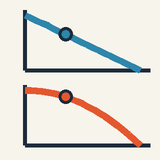
On a velocity–time graph the fall is a straight line through the origin with slope g, and the distance fallen is the area under it: for the animation, a triangle 2.86 s wide and 28.0 m/s tall, of area 21⋅2.856⋅28.0≈40m. The height–time graph, drawn in the expert layer, is a parabola that starts flat and steepens, its slope being the velocity.
Common mistakes
The acceleration is not zero at the top: only the velocity is, for an instant, while the acceleration stays 9.81 m/s² downward and turns the ball back. Thrown up at 19.62 m/s, a ball stops after 2.0 s and returns after 4.0 s.
Heavier objects do not fall faster: without air, a 5 kg shot and a 5 g marble both gain 9.81 m/s every second.
Keep the factor 2 and the square root in v=2gh: a drop of 20 m gives 392.4≈19.8m/s, not 392 or 196 m/s.
Do not confuse the distance fallen with the height above the ground: after 1 s the animation's ball has fallen 4.9 m and is 35.1 m up.
Where you meet it
Drop a ruler between a friend's fingers: if it falls 20 cm before they catch it, their reaction time is 2⋅0.20/9.81≈0.20s. A diver from a 10 m platform reaches the water after about 1.4 s at about 14 m/s, and timing a dropped stone gives the depth of a well. Free fall is also the vertical half of every throw: Projectile Motion adds a steady horizontal motion, Newton's Laws of Motion explains the acceleration, Work, Energy and Power reads v2=2gh as energy conservation, and Drag and Terminal Velocity adds the air.
Advanced
Key ideas
Weight is proportional to inertial mass, so y¨=−g for every body: inside a falling box everything floats (equivalence principle).
Integrating y¨=−g: vy=v0−gt is a line of slope −g, y=h0+v0t−21gt2 a parabola.
g=GM/R2 is the law that holds the Moon: 60 Earth radii away, it falls 1/602 as far per second as an apple.
Quadratic drag: v(t)=vttanh(gt/vt) with vt=2mg/(ρCdA); the ideal model needs v≪vt.
Inertia, weight and the equivalence principle
Everything in this lesson rests on one experimental fact: in a vacuum, all bodies near the ground fall with the same acceleration, whatever their mass or material. This section shows why that fact is surprising and where it led.
Take up as the positive y direction. Newton's second law for a falling body then reads miy¨=−mgg Two different masses appear here. On the left, the inertial mass mi measures how hard the body is to accelerate. On the right, the gravitational mass mg measures how strongly gravity pulls on it, just as an electric charge measures how strongly an electric field pulls; g is the strength of the Earth's gravity near the ground, about 9.81 m/s². Nothing in Newton's mechanics says that the two masses must be equal.
Experiment says they are. Torsion balances find the ratio mg/mi the same for different materials to about one part in 1013, and in 2022 a satellite comparing test masses of platinum and titanium alloys reached about one part in 1015. With mi=mg the mass cancels from both sides, leaving y¨=−g for every body: the acceleration of free fall does not depend on what is falling.
Einstein turned this equality into a principle, the equivalence principle. Picture a small closed box falling freely. Every object inside has the same acceleration as the box, so relative to the box nothing accelerates: loose objects float, and no experiment done inside can tell the fall from floating far out in empty space. The box must be small, so that g has the same size and direction throughout it. The equivalence principle is the starting point of general relativity, the theory in which gravity becomes the geometry of spacetime.
This is why astronauts float. At a space station's altitude of about 400 km, g is still about 8.7 m/s², nearly 90 % of its value at the ground. Gravity has not switched off: the crew and the station are falling together, so neither presses on the other.
Integrating the equation of motion
With the mass gone, the whole motion follows from ay=−g. Two integrations give the velocity and the position, and one more step gives the energy.
Take up as positive and start the clock at the release, t=0, when the body is at the height h0 with the vertical velocity v0. Because ay=dvy/dt=−g is constant, one integration gives the velocity; because vy=dy/dt, a second gives the position: vy(t)=v0+∫0t(−g)dt′=v0−gt y(t)=h0+∫0tvy(t′)dt′=h0+v0t−21gt2 Each integration brings one constant, fixed by the starting state: v0 in the first, h0 in the second. Gravity itself supplies only the term −21gt2, which bends the graph of y(t) into a parabola, and it bends every fall in the same way.
In the animation the ball is dropped from rest, v0=0, at h0=40m. It reaches the ground, y=0, when 21gT2=h0, that is at T=g2h0=9.812⋅40≈2.86s Its velocity is then vy=−gT≈−28.0m/s, the minus sign meaning downwards.
Often the time does not matter, only how the speed depends on the height. The chain rule removes t: ay=dvy/dt=(dvy/dy)(dy/dt)=vydvy/dy. So vydvy=−gdy, and integrating from the release gives vy2=v02−2g(y−h0) Multiply by m/2 and rearrange: 21mvy2+mgy=21mv02+mgh0. The left side, kinetic plus potential energy, keeps its starting value: energy is conserved. Each kilogram of the animation's ball starts with gh0=9.81⋅40=392.4J/kg of potential energy and lands with 21vy2=21⋅784.8=392.4J/kg of kinetic energy.
Reading the velocity and height graphs
The two formulas are easiest to understand as graphs. Reading slopes and areas on them is the quickest check of any motion with constant acceleration.
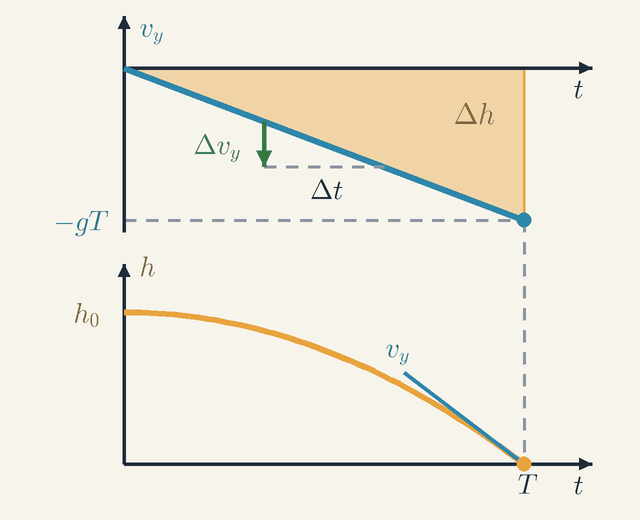
Figure 1. The animation's drop on a common time axis. Upper graph: vy=−gt is a straight line of slope −g, and the shaded area between it and the t axis is the change of height Δh. Lower graph: the slope of h(t) at each instant is vy, steepest at the impact T.Legend
t
Time since the release.
s
T
Time of the impact, where the fall ends.
s
vy
Vertical velocity, up positive: the height of the upper line, and the slope of the tangent to h(t).
m/s
gT
Speed gained in the whole fall; the upper line ends at vy=−gT.
m/s
Δt
Any time interval: the horizontal leg of the slope triangle.
s
Δvy
Change of vy over Δt: the vertical leg. The slope is Δvy/Δt=−g.
m/s
Δh
Change of height in the whole fall: the signed area between the vy line and the t axis.
m
h
Height above the ground.
m
h0
Release height, at t=0.
m
Figure 1 shows the animation's drop as two graphs, one above the other, on the same time axis t. The vertical dashed line at the impact time T≈2.86s joins them.
Look first at the upper graph, vy(t)=−gt: a straight line from zero down to −gT≈−28.0m/s. Its slope is the acceleration. The small triangle shows that over any interval Δt the velocity changes by Δvy=−gΔt, and the slope of the whole line, −28.01/2.856≈−9.81m/s2, is ay=−g. Because the slope is the same everywhere, so is the acceleration: on a graph, constant acceleration means a straight velocity line.
Now look at the shaded triangle between the line and the time axis. Its area is the change of height Δh, because each thin vertical strip of it has the width dt and the height vy, and vydt is the distance moved in that time. The triangle lies below the axis, so its area counts as negative: Δh=21⋅2.856⋅(−28.0)≈−40m, the whole drop.
The lower graph is the height h(t), which during the fall is y(t)=h0−21gt2: a parabola opening downwards. Its slope at each instant is the current vy, read off the upper graph. At the release vy=0, so the curve leaves the level h0=40m horizontally. At the impact vy=−28.0m/s, so the curve is steepest there; the tangent drawn at T, labelled vy, has the slope −gT, the value at which the upper line ends. The rate at which the slope changes, the bending of the curve, is the second derivative, −g all the way down.
The parabola also shows how unevenly the drop spends its time. At half time, T/2=1.43s, the ball has fallen only 21⋅9.81⋅1.4282=10.0m and is still at 30 m, three quarters of the way up; the remaining 30 m take the second half. At T both graphs stop: the ground pushes back, and the free fall is over.
Where g comes from
So far g has been a given number. Newton's law of universal gravitation explains its value, and shows why it is only approximately constant.
A spherical Earth of mass M and radius R attracts a body of mass m at its surface with the force GMm/R2, as if all its mass sat at the centre. Dividing by m gives the acceleration g=R2GM With G=6.674×10⁻¹¹Nm2/kg2, M=5.97×1024kg and R=6371km it comes to 9.82 m/s². The measured value differs slightly from place to place, because the Earth spins, is flattened at the poles and is not uniform inside.
At a height h above the surface the distance from the centre is R+h, so g becomes GM/(R+h)2≈(GM/R2)(1−2h/R) when h≪R: smaller by a fraction of about 2h/R. For the animation's 40 m that fraction is 80/(6.371×106)≈1.3×10−5, about 13 parts per million. This is why g looks constant: everyday heights are tiny compared with R.
An orbit is a fall that keeps missing the ground
The same g that brings a dropped ball down also keeps a satellite up. Figure 2 shows how, by comparing two small distances.
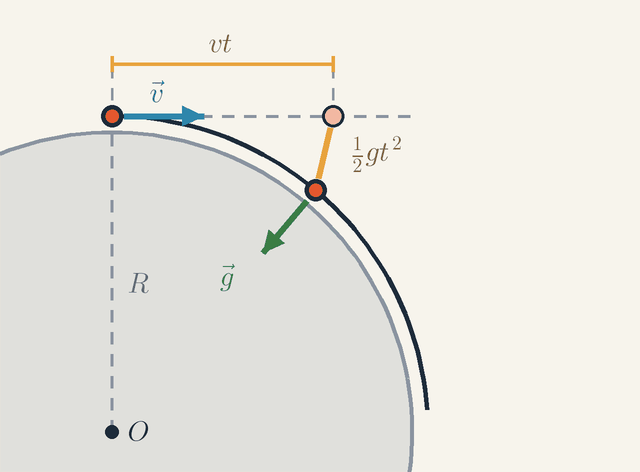
Figure 2. A ball thrown sideways from just above the ground. In a short time t it would move vt along the dashed tangent, but gravity pulls it about 21gt2 towards O. If the ground curves away by the same amount, the ball never lands. Not to scale.Legend
O
Centre of the Earth.
R
Radius of the Earth.
m
v
Velocity at the start, horizontal, along the tangent.
m/s
vt
Distance along the straight line in the time t, without gravity.
m
g
Acceleration of gravity, pointing at the centre O.
m/s2
21gt2
Distance gravity pulls the ball below the straight line in the time t.
m
In Figure 2 a ball is thrown sideways from just above the ground with the velocity v. Without gravity it would move along the dashed straight line, a tangent to the Earth, and after a short time t it would be at the pale ball, a distance vt from its start. Gravity adds a displacement of about 21gt2 towards the centre O, the gold segment. So after the time t the ball is not at the pale ball but at the solid ball just below it, on the curved path; there the arrow g points at O.
The ground also falls away from the dashed line, because the Earth is round. The tangent is at right angles to the radius R, so by Pythagoras a point a distance x along it is R2+x2 from O, and its height above the surface is R2+x2−R≈2Rx2 for x≪R. With x=vt, the ground lies (vt)2/(2R) below the line.
Now compare the two drops. If the ball falls less than the ground, it climbs away from the ground; if more, it lands; if exactly as much, it stays at the same height above the ground. Since the same holds at every point of its path, it then circles forever. The condition is 21gt2=2R(vt)2 The time cancels, leaving v2/R=g: gravity supplies exactly the centripetal acceleration v2/R that a circle of radius R needs. Near the surface this takes v=gR=9.81⋅6.371×106≈7.9km/s. An orbit is free fall with enough sideways speed for the ground to keep curving away underneath.
The same reasoning passed Newton's decisive test, the Moon. If gravity weakens as 1/r2 with the distance r from the centre, then at the Moon's distance of about 60 Earth radii it should give an acceleration of g/602≈2.7×10−3m/s2. The Moon actually circles at 384,000 km once every 27.3 days, which requires a centripetal acceleration of 2.72×10⁻³m/s2: the two agree.
The same agreement can be pictured as a distance fallen. In one second the Moon falls 21⋅2.72×10−3⋅12≈1.4×10⁻³m, about 1.4 mm, below the straight line it would otherwise follow. That is the 21gt2 of Figure 2 with the Moon's much smaller g; an apple near the ground falls 4.9 m in the same second.
Falling through air
In air, the rule that all bodies fall alike breaks down, and it breaks down in a predictable way. Figure 3 shows the effect before the equations explain it.
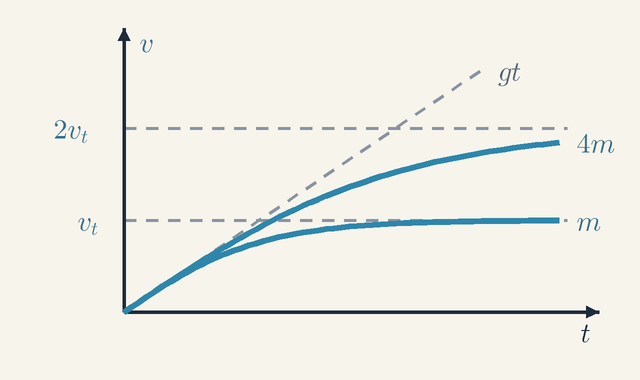
Figure 3. Speed against time with air drag for two balls of equal size and shape, of masses m and 4m. Both start along the no-air line v=gt, then level off at their terminal speeds, vt and 2vt; the heavier ball follows the line for longer.Legend
t
Time since the release.
s
v
Speed of the ball, measured downwards.
m/s
gt
Speed after a time t with no air: the dashed straight line.
m/s
vt
Terminal speed of the lighter ball. The heavier ball's is 2vt, since vt∝m.
m/s
m
Mass of the lighter ball; the heavier one has 4m.
kg
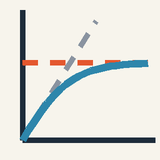
Figure 3 plots the speed v against the time t for two balls of the same size and shape, one of mass m and one of mass 4m. The dashed straight line is v=gt, the fall without air. Both curves leave the origin along it, because at low speed the drag is negligible. Then they bend away and level off at their own terminal speeds, marked by the horizontal dashed lines: vt for the lighter ball and 2vt for the heavier one. The heavier ball follows the straight line for longer and ends up twice as fast. The rest of this section derives the curves and the factor 2.
Drag is the force the air exerts on a body moving through it, directed against the motion and growing with the speed. For everyday sizes and speeds it is close to Fd=21ρCdAv2 where ρ is the density of the air, A the cross-sectional area facing the flow, and Cd the drag coefficient, a pure number set by the shape, about 0.5 for a sphere. For dust and fog droplets, which are tiny and slow, the drag is proportional to v instead.
Take down as positive. Newton's second law, with the weight pulling down and the drag pushing up, reads mdtdv=mg−21ρCdAv2 At the start v=0, the drag is zero and the acceleration is g. As the speed grows the drag catches up with the weight and the acceleration fades. The speed approaches the value at which the two forces balance and dv/dt=0, the terminal velocity: vt=ρCdA2mg
Written with vt, the equation of motion becomes dv/dt=g(1−v2/vt2). Its solution starting from rest is v(t)=vttanh(vtgt) You can check it by differentiating: since d(tanhx)/dx=1−tanh2x, the derivative is g(1−v2/vt2). For small t, tanhx≈x and v≈gt, the no-air line; for t≫vt/g, tanh→1 and v→vt. So vt/g is the time scale on which the curve levels off.
To get the speed after a fall through a distance s, use the chain rule again: dv/dt=vdv/ds=21d(v2)/ds. The equation for v2 is then dsd(v2)=2g(1−vt2v2) so v2 approaches vt2 exponentially, over a distance scale vt2/(2g): v2=vt2(1−e−2gs/vt2) For a short fall, s≪vt2/(2g), the exponential is close to 1−2gs/vt2, and the result reduces to the no-air v2=2gs.
Now the factor 2. At fixed size and shape, ρ, Cd and A are the same for both balls, so vt∝m: four times the mass gives twice the terminal speed. It also doubles the time scale vt/g, so the heavier ball stays close to v=gt for twice as long. That is the second curve of Figure 3.
Drop a tennis ball, the lighter ball of Figure 3, from the animation's 40 m. Take m=57g, a diameter of 6.7 cm (so A=π⋅0.03352≈3.53×10⁻³m2), Cd≈0.55 and ρ=1.2kg/m3. Its terminal velocity is vt=1.2⋅0.55⋅3.53×10−32⋅0.057⋅9.81≈22m/s and it lands at 19.7 m/s after 3.26 s, instead of 28.0 m/s after 2.86 s without air. A ball of the same size four times as heavy has twice the terminal velocity, about 44 m/s, and lands at 25.4 m/s after 2.95 s. So air does separate heavy from light, through vt∝m at fixed size and shape.
For comparison, a skydiver falling belly-down levels off near 55 m/s (about 200 km/h), and a raindrop 1 mm across at about 4 m/s. At terminal velocity the acceleration is zero, not g: the body falls at constant speed, with the drag balancing the weight.
Worked problem: meeting the falling ball
At the instant the ball of the animation is released from 40 m, a second ball is thrown straight up from the ground directly below it at 28.0 m/s, the speed at which the first one lands. When and where do they meet?
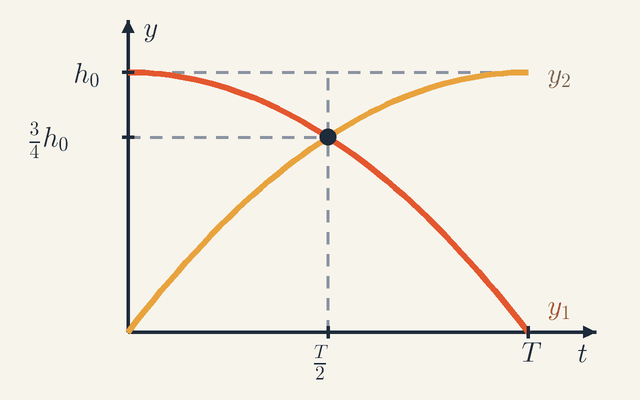
Figure 4. Heights of the two balls of the worked problem: y1 dropped from h0, y2 thrown up from the ground. The curves are mirror images about the dashed line at T/2, where they cross at the height 43h0.Legend
t
Time since the release of the first ball.
s
T
Time at which the first ball lands and the second reaches its highest point.
s
2T
Time at which the balls meet.
s
y
Height above the ground, up positive.
m
h0
Release height of the first ball, and the top of the second ball's flight.
m
43h0
Height at which the balls meet.
m
y1
Height of the dropped ball.
m
y2
Height of the ball thrown up from the ground.
m
Figure 4 plots both heights against time, with up as positive and the origin on the ground. The first ball is dropped from h0; the second is thrown up with v0=28.0m/s: y1=h0−21gt2,y2=v0t−21gt2 Follow y1: it leaves h0 horizontally and reaches the ground at T. Follow y2: it starts on the ground, and since v0=gT, its velocity v0−gt falls to zero exactly at T. So the second ball reaches the top of its flight at T, at the height v0T−21gT2=21gT2=h0, where the first ball started.
The two curves are mirror images of each other about the dashed line at T/2: y2(t)=y1(T−t). To check, use h0=21gT2: then y1(T−t)=h0−21g(T−t)2=gTt−21gt2, which is y2(t). The balls meet where the curves cross, and by the symmetry that crossing lies on the dashed line.
The algebra is even shorter. The 21gt2 terms are identical, so they cancel from the gap between the balls: y1−y2=h0−v0t. The gap closes at a constant 28.0 m/s, as if there were no gravity, and vanishes at t=h0/v0=40/28.01≈1.43s, exactly T/2.
At that moment both balls are at y=40−21⋅9.81⋅1.4282=30.0m, the level 43h0 marked in Figure 4. The first ball moves down at gT/2=14.0m/s and the second up at 28.0−14.0=14.0m/s. The equal speeds are no coincidence: the second ball's flight is the first one's played backwards, which is what the mirror symmetry of Figure 4 says.
A slower throw meets later and lower. The meeting time h0/v0 cannot exceed the 2.86 s the first ball takes to land, so the throw needs at least v0=h0/T=14.0m/s, the average speed of the fall; at exactly that speed both balls reach the ground together.
Seen from the first ball, gravity has disappeared: both balls have the same acceleration −g, so in the first ball's freely falling frame the second ball approaches in a straight line at the constant speed v0. This is the equivalence principle of the first section at work. The same reasoning explains why, in Projectile Motion, a dart aimed straight at a target that drops at the moment of firing hits it whatever its launch speed, provided it arrives before the target lands.
Limits of validity
The ideal model of free fall makes three assumptions: g is uniform, there is no air, and the Earth does not rotate. The numbers above show how far each one holds.
A uniform g is excellent over a 40 m drop, where g changes by 13 parts per million. A fall from orbital heights, however, needs g=GM/r2 at each distance r from the centre. Neglecting the air is fine only while v≪vt: from 40 m, the heavier ball of the previous section lands 9 % short of the ideal 28.0 m/s, and the tennis ball 30 % short.
The Earth's rotation makes the ground a slightly non-inertial frame, one that is itself accelerating. Part of gravity goes into keeping the ground on its daily circle, which reduces the effective g by up to 0.034 m/s² at the equator. Together with the Earth's flattening, this makes g range from 9.78 m/s² at the equator to 9.83 m/s² at the poles.
Rotation also deflects a fall eastward: the top of a tower moves east slightly faster than its foot, and a ball dropped from it keeps that extra speed. The animation's ball, dropped at a latitude of 45°, would land about 4 mm east of the point directly below its release.
Relativity adds only tiny corrections at these speeds: at 28 m/s, v2/c2≈9×10−15. Gravity also affects time itself: a clock 40 m up runs faster than one on the ground by the fraction gh/c2≈4.4×10−15. This shift was first measured around 1960 with gamma rays sent up a 22.5 m tower, and optical clocks now detect it over height differences of less than a metre.
Where this leads
Free fall connects to most of mechanics. Projectile Motion combines it with a uniform horizontal motion; Newton's Laws of Motion explains the acceleration as weight divided by mass; Work, Energy and Power turns v2=2gh, the speed after a drop of height h from rest, into mgh=21mv2. Gravitation and Orbits extends g=GM/r2 to planets and satellites, Drag and Terminal Velocity treats the air properly, and Simple Harmonic Motion shows how the period of a pendulum depends on g, which is how g was measured for centuries. Gravity as Curved Spacetime builds a whole theory on the fact that all bodies fall alike.
Key formulas
Speed of a body falling from rest
v=gt
Free fall has a constant acceleration g, so a body released from rest gains the same 9.81 m/s of downward speed every second, and after a time t it has gained gt. On a velocity–time graph this is a straight line through the origin with slope g. The mass does not appear: every body gains speed at the same rate.
Symbols
v
downward speed at time t
m/s
g
free-fall acceleration
m/s2
t
time since the release
s
When it holds: For a release from rest, with down as positive and air resistance negligible (v≪vt). For a throw, use v=v0−gt instead.
Example: After 2 s, v=9.81⋅2=19.62m/s; the animation's ball lands after 2.86 s at about 28.0 m/s.
Distance fallen from rest
h=21gt2(distance fallen from rest)
The distance fallen is the area under the velocity–time line, a triangle of base t and height gt, hence 21gt2. Put differently, the average speed from rest is half the final speed, 21gt, multiplied by the time. Because the distance grows as t2, twice the time means four times the distance, and the gaps between equally timed snapshots grow as 1 : 3 : 5 : 7.
Symbols
h
distance fallen since the release
m
g
free-fall acceleration
m/s2
t
time since the release
s
When it holds: From rest, with a uniform g and no air resistance. Here h is measured down from the release point; the height above the ground is h0−21gt2, as on the animation's readout.
Example: After 1 s a body has fallen 4.9 m, after 2 s 19.6 m; the animation's 40 m takes 2⋅40/9.81≈2.86s.
Speed after falling a height h
v=2gh
Eliminating the time between v=gt and h=21gt2 gives v2=2gh. It is also energy conservation: the potential energy lost, mgh, becomes kinetic energy 21mv2, and the mass cancels. The speed grows only as the square root of the height: four times the height gives twice the speed.
Symbols
v
speed after falling the height h
m/s
g
free-fall acceleration
m/s2
h
height fallen from rest
m
When it holds: From rest and without air resistance. A body launched up or down at speed v0 reaches v02+2gh at a depth h below the launch point. With drag the real speed is lower, and a body dropped from rest never exceeds vt.
Example: From the animation's 40 m: v=2⋅9.81⋅40≈28.0m/s; from 20 m, 19.8 m/s.
Velocity of a body thrown vertically
v=v0−gt(up positive)
With up as positive, gravity changes the velocity by −g every second, whichever way the body moves. A ball thrown up at v0 slows down, has v=0 at the top after v0/g, and then v becomes negative as it falls back. The acceleration is −g throughout, at the top as well.
Symbols
v
vertical velocity at time t, positive upward
m/s
v0
initial vertical velocity, positive for a throw upward
m/s
g
free-fall acceleration
m/s2
t
time since the launch
s
When it holds: While the body is in flight and air resistance is negligible: on the way up, at the top and on the way down. A throw downward has v0<0.
Example: Thrown up at 19.62 m/s: v=0 after 19.62/9.81=2.0s, and v=−19.62m/s when it is back at the launch point after 4.0 s.
Terminal velocity with quadratic drag
vt=ρCdA2mg
Drag grows as 21ρCdAv2 while the weight mg stays fixed, so a falling body speeds up until the two are equal. Setting 21ρCdAvt2=mg gives this speed, at which the net force and the acceleration are zero. Since vt∝m at fixed size and shape, a ball four times as heavy has twice the terminal velocity.
Symbols
vt
terminal velocity
m/s
m
mass of the falling body
kg
g
free-fall acceleration
m/s2
ρ
density of the air
kg/m3
Cd
drag coefficient (shape factor)
A
cross-sectional area facing the air
m2
When it holds: For drag proportional to v2, which holds for objects of everyday size at everyday speeds. For dust and fog droplets the drag is proportional to v and this formula fails.
Example: A tennis ball (57 g, 6.7 cm across, Cd≈0.55) in air of 1.2kg/m3: vt≈22m/s.
Glossary
Free fall
Motion under gravity alone, with air resistance neglected. A thrown ball is in free fall on the way up, at the top and on the way down, not only while it drops.
Free-fall acceleration
The acceleration g shared by every freely falling body at a given place: about 9.81 m/s² near the Earth's surface, pointing vertically down. It ranges from about 9.78 m/s² at the equator to 9.83 m/s² at the poles.
Weight
The gravitational force on a body, W=mg, measured in newtons. It is a force, not a mass: a 2 kg bag weighs about 19.6 N on the Earth and 3.2 N on the Moon.
Inertial and gravitational mass
Inertial mass measures how hard a body is to accelerate; gravitational mass measures how strongly gravity pulls on it. Experiments find them equal to about one part in 1015, which is why all bodies fall alike.
Equivalence principle
The statement that inside a small freely falling box no experiment can tell the fall from floating in empty space, because everything in it shares the same acceleration. It is the starting point of general relativity.
Weightlessness
The state of a body in free fall, which nothing supports and which therefore feels no weight. Gravity has not vanished: aboard a station orbiting at 400 km, g is still about 8.7 m/s².
Sign convention
The choice of which vertical direction counts as positive. Down positive suits drops from rest (v=gt), up positive suits throws (v=v0−gt); either works if it is kept throughout a problem.
Odd-number rule
From rest, the distances fallen in successive equal time intervals are in the ratio 1 : 3 : 5 : 7, because the total distance grows as t2. Galileo found it with balls rolling down a ramp.
Top of a vertical throw
The instant at which a ball thrown straight up has zero velocity, reached after v0/g at a height v02/(2g). The acceleration there is still g downward, which is why the ball turns back.
Air resistance (drag)
The force of the air opposing a body's motion through it. It grows with speed, roughly as v2 for everyday objects and as v for tiny droplets, and it is why a feather falls more slowly than a stone.
Terminal velocity
The steady speed at which drag balances weight, so the acceleration is zero. It grows as m/(CdA): about 22 m/s for a tennis ball, 55 m/s for a belly-down skydiver.
Universal gravitation
Newton's law that any two masses attract each other with a force GMm/r2. At the Earth's surface it gives g=GM/R2, and the same law holds the Moon in its orbit.
Quantities
g
Free-fall acceleration
m/s2
The velocity gained each second in free fall, the same for every body: about 9.81m/s2 near the ground, directed downward.
h
Distance fallen
m
In the formulas, the distance fallen since a release from rest. The animation's h readout shows the height above the ground instead: h0 (40 m in the animation) minus the distance fallen.
v
Velocity
m/s
In the drop formulas, the downward speed at time t; in v=v0−gt, the vertical velocity with up as positive, negative on the way down.
v0
Initial velocity
m/s
The vertical velocity at the release: zero for a drop, positive for a throw upward when up is positive.
t
Time
s
The time since the release (or the launch), the clock being started at that instant: the animation's ball lands at t≈2.86s.
m
Mass
kg
The body's mass. It cancels out of free fall without air, but it sets the terminal velocity: vt∝m at fixed size and shape.
vt
Terminal velocity
m/s
The speed at which drag balances weight and the body stops speeding up.
ρ
Air density
kg/m3
The mass of air per unit volume, about 1.2kg/m3 at sea level; thinner air higher up gives a larger terminal velocity.
Cd
Drag coefficient
A pure number describing how the shape meets the air: about 0.5 for a sphere, around 1 for a person falling belly-down.
A
Frontal area
m2
The area the body presents to the oncoming air, measured across the motion: πd2/4 for a ball of diameter d.
Quiz
Beginner An astronaut on the Moon, where there is no air, drops a hammer and a feather at the same moment. Which lands first?
They land at the same time
The hammer
The feather
Neither falls, because there is no air
Show answer
Answer: A. They land at the same time
Without air resistance, gravity gives every object the same acceleration whatever its mass, so they land together.
Beginner A stone is dropped from rest. Ignoring air resistance, what is its speed after 2 s? (g = 9.81 m/s²)
19.62 m/s
9.81 m/s
39.24 m/s
2 m/s
Show answer
Answer: A. 19.62 m/s
The speed grows by 9.81 m/s each second: v = g·t = 9.81 × 2 = 19.62 m/s.
Beginner A ball is thrown straight up. At the very top of its path it stops for an instant. What is gravity doing at that instant?
Nothing, because the ball is not moving
Still pulling it down exactly as hard as before
Pulling it down more weakly than before
Pushing it upward
Show answer
Answer: B. Still pulling it down exactly as hard as before
Gravity does not depend on how the ball moves: it pulls with the same strength the whole time, so the acceleration at the top is still 9.81 m/s² downward. That is why the ball immediately starts coming back down; if nothing pulled at the top, it would hover there.
Intermediate A ball is dropped from a height of 20 m. With what speed does it hit the ground, ignoring air resistance?
19.8 m/s
392 m/s
196 m/s
14.0 m/s
Show answer
Answer: A. 19.8 m/s
v = √(2gh) = √(2 × 9.81 × 20) = √392.4 ≈ 19.8 m/s. Don't forget the square root or the factor 2.
Intermediate An object falls from rest. In what ratio are the distances it covers during the 1st, 2nd, 3rd and 4th seconds?
1 : 3 : 5 : 7
1 : 2 : 3 : 4
1 : 4 : 9 : 16
1 : 1 : 1 : 1
Show answer
Answer: A. 1 : 3 : 5 : 7
The total distance grows as t² (1, 4, 9, 16), so the distance covered in each separate second is the difference: 1, 3, 5, 7.
Intermediate A ball is thrown straight up at 19.62 m/s. Ignoring air resistance, how long until it comes back to the launch point?
4.0 s
2.0 s
8.0 s
1.0 s
Show answer
Answer: A. 4.0 s
It takes v₀/g = 19.62 ÷ 9.81 = 2.0 s to reach the top and the same time to come down, so 4.0 s in total. 2.0 s is only the way up.
Advanced A skydiver has reached terminal velocity. What is her acceleration?
Zero
9.81 m/s² downward
9.81 m/s² upward
Slightly more than 9.81 m/s² downward
Show answer
Answer: A. Zero
At terminal velocity, drag balances weight, so the net force and therefore the acceleration are zero. The speed is constant.
Advanced Two balls have the same size and shape, but one is four times as heavy. With quadratic drag, how do their terminal velocities compare?
The heavy one's is twice as large
They are equal
The heavy one's is four times as large
The heavy one's is sixteen times as large
Show answer
Answer: A. The heavy one's is twice as large
v_t = √(2mg/(ρC_dA)) grows as √m, so four times the mass gives twice the terminal velocity.
 Physics Tutor