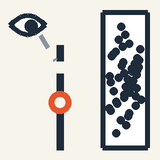
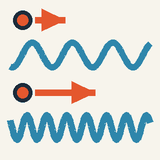
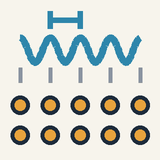
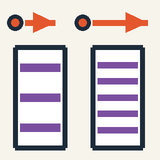
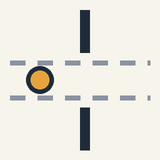
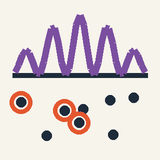
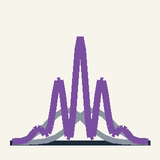
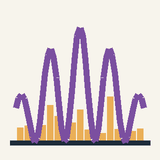
Electrons and photons travel like waves but are detected like particles: sent one at a time through two slits, they land as single dots that build up fringes set by the de Broglie wavelength λ=h/p.
Electrons pass one at a time through a double slit; each lands as a single dot, yet the dots build up a striped interference pattern.
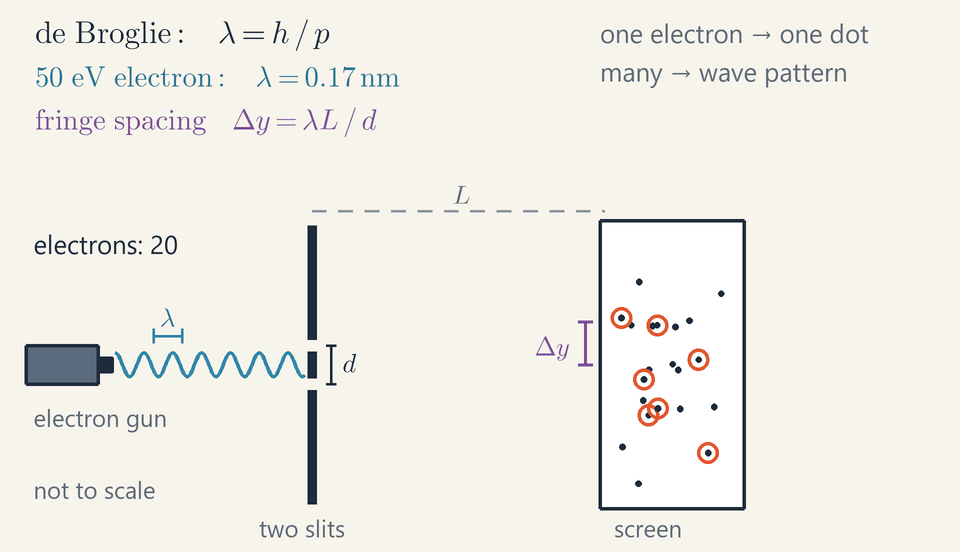
After two slits, light makes bright and dark stripes, something only waves can do.
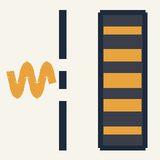
Light also delivers energy in packets called photons, each worth E=hf; these packets knock electrons out of a metal.
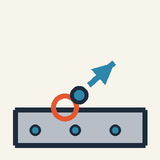
Fired one at a time, each electron lands on the screen as a single dot, like a tiny ball.
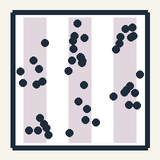
Hundreds of dots build up stripes, so each lone electron's wave must pass through both slits.
Watching which slit each electron takes makes the stripes vanish, leaving one smooth patch.
For centuries scientists argued about light. Sent through two narrow slits, it paints bright and dark stripes, something only waves can do. Yet when light frees electrons from a metal (the photoelectric effect), it behaves like a hail of tiny energy packets called photons. Each packet carries the energy E=hf, where f is the frequency, which sets the colour, and h is a tiny fixed number, Planck's constant; so a violet photon carries more energy than a red one. Light is neither just a wave nor just a stream of particles.
Electrons, which we picture as tiny balls, share this double nature. Follow the animation step by step.
Step 1. The gun fires electrons one by one, so slowly that only one is ever on its way. Each hits the screen at one spot and leaves one dot, like a marble striking a target. So far: particles.
Step 2. Where the next dot lands is pure chance. But after a few hundred dots a pattern shows up: bright stripes separated by almost empty gaps. That is the mark of waves from the two slits adding in some places and cancelling in others, like ripples on a pond.
Step 3. The electrons travel alone, so none has a partner to interfere with. Each electron's own wave must pass through both slits at once.
Step 4. Put a detector by the slits to see which one each electron uses: the stripes vanish and the dots pile up into one smooth patch.
Check yourself: the experiment is stopped after just five electrons. Do you see stripes? Answer: no, only five scattered dots. Stripes need many dots.
Remember: quantum objects travel like waves and arrive like particles.
Intermediate
Key ideas
Every moving particle has a de Broglie wavelength λ=h/p, with h=6.626×10⁻³⁴J⋅s.
A 50 eV electron has λ≈0.17nm, about the spacing of atoms in a crystal.
Electron fringes obey the light formula Δy=λL/d: faster electrons give narrower fringes.
A thrown ball has λ≈10−34m, far too small for it ever to diffract visibly.
The wave sets the probability of where each electron lands; each detection is a single point.
One electron, one dot
In the animation an electron gun fires electrons at a wall with two narrow slits, and a screen behind it records each arrival. Only one electron is on its way at a time: the first six are drawn in flight, then the animation speeds up while the counter climbs. Every arrival is a single dot, the whole electron with all its charge detected at one point. Yet after a few hundred arrivals the dots crowd into bright stripes separated by nearly empty gaps, the interference pattern that light makes behind two slits.
The electron has a momentum p=mv and a kinetic energy E, quoted in electronvolts: 1eV=1.602×10⁻¹⁹J is the energy an electron gains across 1 V. The slits are a distance d apart, the screen is a distance L beyond them, and the fringe spacing Δy separates neighbouring bright stripes.
The de Broglie wavelength
Light is a wave, but the lesson Photoelectric Effect showed that it also arrives in packets, photons of energy E=hf, each carrying a momentum p=h/λ. In 1924 Louis de Broglie turned the idea around and proposed that every particle with momentum p has a wavelength λ=ph
Here h=6.626×10⁻³⁴J⋅s is the Planck constant. Because h is so tiny, a wavelength is noticeable only for particles of very small mass at modest speeds: electrons, neutrons, atoms. The blue wave before the slits stands for this matter wave: not a ripple of electron substance but a wave of probability.
A slow particle has kinetic energy E=21mv2, and since p=mv this is E=p2/(2m), so p=2mE
An electron accelerated from rest through a voltage V gains E=eV, where e=1.602×10⁻¹⁹C is the size of its charge. Four times the energy gives twice the momentum and half the wavelength.
From energy to fringe spacing
Beyond the slits the two parts of the matter wave overlap and interfere as light does in Diffraction and the Double Slit: where the paths differ by a whole number of wavelengths many electrons land, and where they differ by an odd number of half wavelengths almost none do. For small angles this gives a chain of three equations that solves most problems:
λ=ph
p=2mE
Δy=dλL
Energy gives momentum, momentum gives wavelength, and wavelength gives the fringe spacing. Faster electrons have a shorter wavelength and narrower fringes; closer slits or a more distant screen spread the fringes out. The last equation is the double-slit formula for light, with the de Broglie wavelength.
Worked example: the electrons in the animation
The electrons in the animation have E=50eV. Convert the energy to joules, find the momentum with m=9.11×10⁻³¹kg, then the wavelength: E=50⋅1.602×10−19=8.01×10⁻¹⁸J p=2⋅9.11×10−31⋅8.01×10−18=3.82×10⁻²⁴kg⋅m/s λ=3.82×10−246.626×10−34=1.73×10⁻¹⁰m=0.173nm
This is the 0.17 nm on the blue readout, about the spacing of atoms in a crystal. The speed, v=p/m=4.2×106m/s, is only 1.4 % of the speed of light, so ignoring relativity in p=2mE is safe.
The drawing is labelled not to scale. Suppose the real slits are d=0.50μm apart and the screen is L=2.0m away. Then Δy=0.50×10−61.73×10−10⋅2.0=6.9×10⁻⁴m=0.69mm
The purple Δy mark beside the screen stands for this spacing. Seen from the slits, neighbouring stripes are only λ/d=3.5×10−4rad, or 0.02°, apart, which is why electron interference needs slits finer than a micrometre, a long flight path or electron lenses that magnify the pattern.
Worked example: one wavelength, three particles
To see how atoms are arranged in a crystal you need a wavelength close to their spacing. What energy must a photon, an electron and a neutron have for λ=0.173nm, the value in the animation?
All three need the same momentum, p=h/λ=3.82×10−24kg⋅m/s, but momentum and energy are related differently. For the photon, E=pc: E=λhc=1.73×10−106.626×10−34⋅3.00×108=1.15×10⁻¹⁵J=7.2keV which is an X-ray photon. The electron needs 50 eV, as above. For the neutron, with m=1.675×10⁻²⁷kg, E=2mp2=2⋅1.675×10−27(3.82×10⁻²⁴)2=4.36×10⁻²¹J=0.027eV
The same wavelength costs 7.2 keV, 50 eV or 0.027 eV, a factor of 260,000 in energy, because the wavelength is fixed by momentum and a heavier particle reaches a given momentum with far less kinetic energy. The neutron, at only p/m=2280m/s, has about the thermal energy of room temperature, which is why neutrons slowed in a reactor suit crystal studies. X-rays, electrons and neutrons are used this way.
Reading the pattern on the screen
No rule says where the next dot will land: the wave fixes only the probability of each place. With 10 or 20 dots the screen looks random; around 200 the stripes are clear, and after all 560 the dark gaps are almost empty, with the stripe centres one Δy apart.
In a dark gap the waves from the two slits arrive half a wavelength out of step and cancel, as in Interference and Superposition, so fewer electrons land there with both slits open than with one: a second route makes arriving less likely, which no stream of ordinary particles could do.
The stripes fade towards the edges because each slit, a quarter of d wide, spreads its wave through only a limited angle. That fading envelope takes the values 1, 0.81, 0.41 and 0.09 at the bright stripes, and the next would sit on a zero of it, just beyond the screen's edge.
Common mistakes
The electrons do not interfere with one another: only one is in flight at a time, yet 560 electrons sent singly build the fringes. Each electron's own wave passes through both slits.
An electron is never split at the slits: every detection is one whole electron, with the full charge 1.602×10⁻¹⁹C, at a single point.
The wavelength is set by momentum, not by energy: a 50 eV electron and a 0.027 eV neutron share the same 0.17 nm. And p=2mE does not apply to photons, for which p=E/c.
Large objects have a wavelength too, just an unobservable one: a 0.15 kg ball at 30 m/s has p=4.5kg⋅m/s and λ=1.5×10⁻³⁴m, some 1019 times smaller than a proton.
Faster electrons give narrower fringes, not wider ones: doubling the speed halves both λ and Δy, from 0.69 mm to 0.35 mm.
Where you meet it
The first proof came in 1927, when Davisson and Germer scattered 54 eV electrons off a nickel crystal and found a strong beam at 50°, just where waves of λ=h/p=0.167nm reflected from rows of atoms 0.215 nm apart reinforce, since 0.215sin50∘=0.165nm. Electron microscopes run at tens of kilovolts, giving wavelengths of a few picometres, some 105 times shorter than visible light, and can image single atoms. Molecules of 60 carbon atoms have produced fringes too.
Atomic Models: the Bohr Atom introduced its allowed orbits as a rule; here the rule gets a reason, because each orbit holds a whole number of electron wavelengths. Schrödinger's Equation and Tunnelling gives the matter wave its own equation of motion and lets it leak through barriers, and the expert level explains why watching the electrons destroys the fringes.
Advanced
Key ideas
Amplitudes add, then square: ∣ψ1+ψ2∣2 has the cross term 2Re(ψˉ1ψ2), so P12=P1+P2.
Detections are discrete: the histogram of single arrivals converges to ∣ψ∣2, with scatter of order 1/n.
If any device can tell which slit was used, probabilities add instead, P=P1+P2, and the fringes vanish.
A photon able to resolve the slits kicks the electron by at least about h/d, a whole fringe: uncertainty keeps the theory consistent.
For large objects λ=h/p is tiny: fringes too fine for any detector, plus decoherence, leave the classical curve.
Lumps that arrive like a wave
This section sets up the puzzle that the rest of the lesson resolves. Electrons are fired one at a time at a plate with two slits, and a screen behind it records where each lands. Pick a small stretch of the screen and call P1 the probability that an electron lands there with only slit 1 open, P2 the same with only slit 2 open, and P12 the probability with both open.
If electrons were pellets, each would pass through one slit or the other. With both slits open, the pellets through slit 1 would land just as they did with slit 2 closed, and likewise for slit 2, so the counts would simply add: P12=P1+P2. A classical wave behaves differently. It delivers its energy continuously, not in lumps, and what adds is the height of the wave, not its energy. Because the intensity goes as the square of the height, the intensity with both slits open is not the sum of the two single-slit intensities, and fringes appear.
Electrons do what neither picture allows. The detector clicks with one whole electron at a time, never a fraction, as for pellets. Yet the clicks build up a fringe pattern, as for a wave, and P12=P1+P2: at a dark fringe, opening the second slit makes arrivals rarer. The pellet argument shows why this matters. Any account in which each electron goes through one definite slit, and behaves there as it would with the other slit closed, leads straight to P12=P1+P2. The experiment therefore rules out every such account, however detailed. The next section gives the rule that replaces it.
Amplitudes add, probabilities do not
Quantum mechanics keeps the arithmetic of waves but applies it to probabilities. Every way an event can happen (here, the electron reaching the chosen point through slit 1, or through slit 2) is given a complex number, its probability amplitude: ψ1 for the first way, ψ2 for the second. The rule has two cases.
When nothing in the world distinguishes the ways, their amplitudes add, and the probability is the squared magnitude of the total: ψ=ψ1+ψ2 ∣ψ∣2=∣ψ1∣2+∣ψ2∣2+2Re(ψ1∗ψ2) The first two terms are the single-slit probabilities. The last one, the cross term (or interference term), can be positive or negative, and it is the whole difference from classical counting. When some record shows which way was taken, the probabilities of the separate ways add instead, and the cross term is absent.
To use the rule we need the amplitudes themselves. A free particle of momentum p has the de Broglie wavelength λ=h/p. Along a path of length r the phase of its amplitude advances by kr, where k=p/ℏ=2π/λ is the wave number and ℏ=h/(2π). For two equal slits the amplitudes are ψj=Aeikrj, where r1 and r2 are the lengths of the two routes to the chosen point. They have the same size A and differ only in phase, by δ=k(r2−r1) Everything that follows comes from adding two such numbers.
Two arrows and their sum
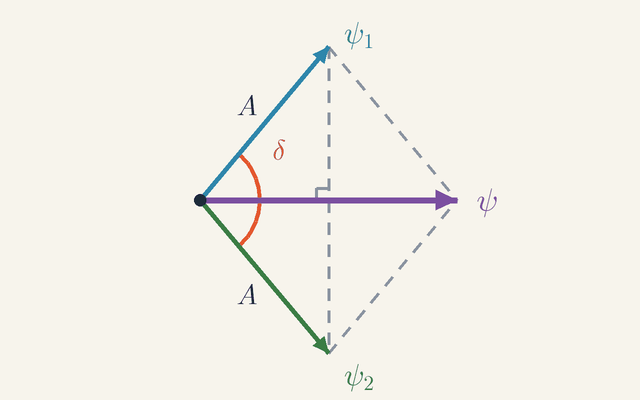
Figure 1. The amplitudes ψ1 and ψ2 as arrows of equal length A, an angle δ apart. Their sum ψ is a diagonal of the dashed rhombus; the right angle where the diagonals cross gives ∣ψ∣=2Acos(δ/2).Legend
ψ1
Amplitude for arriving through slit 1: an arrow of length A whose direction is its phase.
ψ2
Amplitude for arriving through slit 2: also of length A, turned from ψ1 by δ.
ψ
Total amplitude with both slits open: the diagonal ψ1+ψ2.
A
Length of each of the two arrows (equal slits).
δ
Phase difference of the two amplitudes: the angle between the arrows.
rad
Adding two complex numbers is adding two arrows, and Figure 1 uses this to make the cross term visible. Each amplitude is drawn as an arrow in the complex plane: its length is its magnitude A and its direction is its phase. Only the angle δ between ψ1 and ψ2 matters, because turning both arrows together by the same angle changes no length, and so no probability.
The sum ψ is a diagonal of the rhombus built on the two arrows (a rhombus, because both sides have the same length A). Now look at the other diagonal, dashed. The diagonals of a rhombus cut each other in half at a right angle, marked in the figure. So half of ψ is one leg of a right triangle whose hypotenuse is ψ1, of length A, and whose angle at the origin is δ/2. That leg is Acos(δ/2), and doubling it gives ∣ψ∣=2Acos2δ for δ between 0 and π; for larger angles take the magnitude of the cosine.
Squaring, and using 2cos2x=1+cos2x, splits the result into the two parts of the rule: ∣ψ∣2=4A2cos22δ=2A2+2A2cosδ The first term, 2A2, is the which-path sum ∣ψ1∣2+∣ψ2∣2; the second, 2A2cosδ, is the cross term. Two cases fix the picture. When δ=0 the arrows line up, so ∣ψ∣=2A and ∣ψ∣2=4A2, twice the which-path value. When δ=π they point in opposite directions and cancel, so ∣ψ∣2=0: no electron ever arrives there, although either slit alone would send some.
Why must the amplitudes be complex numbers rather than real waves? Each amplitude also carries a time factor e−iEt/ℏ, where E is the electron's energy. Energy is conserved along both routes, so the factor is the same for both: it turns both arrows of Figure 1 together and drops out of ∣ψ∣2. A steady beam therefore gives a steady count rate. A real wave such as cos(kr−ωt) would instead make the probability itself oscillate in time, which is never seen.
From path difference to fringes
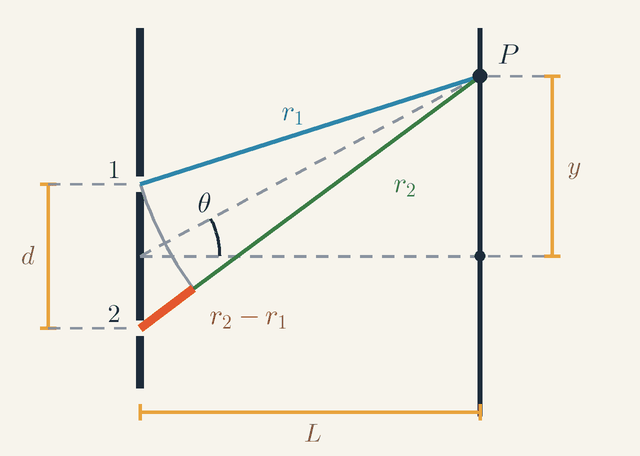
Figure 2. Two routes from slits d apart to a point P on a screen at distance L. The arc centred on P through slit 1 marks off r1 along route 2 and leaves the extra length r2−r1≈dsinθ. Not to scale: P is drawn far too close.Legend
d
Distance between the two slits.
m
L
Distance from the slit plate to the screen.
m
y
Height of P above the axis through the middle of the slits.
m
P
Point of the screen where the two amplitudes are added.
θ
Angle between the axis and the line from the middle of the slits to P.
rad
r1
Length of the route from slit 1 to P.
m
r2
Length of the route from slit 2 to P.
m
r2−r1
Extra length of route 2, left over once the arc has marked off r1; about dsinθ for a distant screen.
m
The phase difference δ depends on where the electron lands. Figure 2 gives the geometry that turns a position on the screen into a path difference, and so into a phase.
Two slits, labelled 1 and 2, are a distance d apart, and the screen stands a distance L behind the plate. A point P of the screen lies at height y above the axis through the middle of the slits; seen from that middle point, P is at an angle θ from the axis. Two routes reach P: one of length r1 from slit 1 and one of length r2 from slit 2. Because P is above the axis, route 2 is the longer one.
To find how much longer, follow the arc centred on P through slit 1. Every point of the arc is a distance r1 from P; it is a piece of a wavefront converging on P, whose points all arrive in step. Where the arc meets route 2 it has therefore marked off a length r1, measured back from P. What is left of route 2 at the slit end, the thick segment, is the extra length r2−r1.
The real screen is millions of times farther away than d, so the two routes are almost parallel and the short arc is almost a straight line square to both. The arc, the thick segment and the plate between the slits then form a small right triangle with hypotenuse d. Its angle at slit 1 is θ, because the arc is square to the routes and the plate is square to the axis. The side opposite that angle is the extra length: r2−r1≈dsinθ and the phase difference of Figure 1 is δ=k(r2−r1)=λ2πdsinθ
Bright fringes are where the arrows of Figure 1 line up, δ=2πm with m a whole number, that is dsinθ=mλ: the extra length is a whole number of wavelengths. The angles are tiny, so sinθ≈y/L, and the bright fringes sit at ym=mλL/d. They are equally spaced, by Δy=dλL and the dark fringes lie halfway between them, where δ is an odd multiple of π.
Reading the histogram
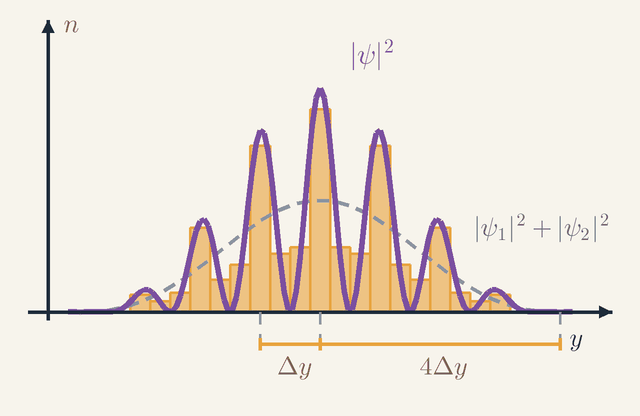
Figure 3. The 560 electrons of the animation in bins a third of a fringe wide (gold bars), with ∣ψ∣2 (solid) and the which-path sum (dashed), both in counts per bin. The curves enclose nearly the same area; the slit width takes both to zero at 4Δy.Legend
n
Number of electrons that landed in a bin of width Δy/3.
y
Position along the screen, measured from the centre of the pattern.
m
∣ψ∣2
Probability density with both slits open (solid curve), scaled to counts per bin.
∣ψ1∣2+∣ψ2∣2
Which-path sum: the pattern when every electron's slit is recorded (dashed curve), with nearly the same area.
Δy
Distance between neighbouring bright fringes, λL/d; the single-slit factor first vanishes at 4Δy.
m
Figure 3 puts the theory against counted electrons. It is what the expert layer of the animation builds up: 560 electrons, sorted by where they landed along the screen coordinate y into bins a third of a fringe wide. The height n of each gold bar is the number of electrons in its bin. Two curves are drawn over the bars, both scaled to counts per bin: the solid curve is the quantum prediction ∣ψ∣2, and the dashed curve is the which-path sum ∣ψ1∣2+∣ψ2∣2, the pattern expected if every electron's slit were recorded.
First compare the two curves. For equal slits ∣ψ∣2=4A2cos2(δ/2), which is twice the dashed value 2A2 at each bright fringe and zero at each dark one. The cross term 2A2cosδ is positive over half of each fringe and negative over the other half, so it averages to zero across a fringe. The two curves therefore enclose nearly the same area: interference moves arrivals from the dark bands into the bright ones, but creates and destroys none.
Next, the slow fall-off of both curves away from the centre. This is the single-slit factor. Each slit has a width of its own, here a=d/4, and waves from different parts of one slit also interfere with each other. As a result A is not constant but depends on y through the envelope sinβ/β, with β=πay/(λL). The envelope first vanishes at β=π, that is at y=λL/a=4Δy, the right-hand mark under the axis. At the bright fringes of orders 0 to 3 the intensity envelope (sinβ/β)2 is 1, 0.81, 0.41 and 0.09 of its central value, and order 4 is missing because it falls exactly on the zero. The screen ends at about 3.2Δy, where the bars stop.
Finally, the bars against the solid curve. In the animation the central bin ends with 94 of the 560 electrons and each first-order bin with 77. The curve peaks near 104 per bin, yet even a perfect run would leave the central bar a little short of it. A bar counts everything across its bin, so it averages the curve over a third of a fringe, and the mean of cos2 over that width, centred on a peak, is 0.91.
In a real run each count also fluctuates: a bin expecting n electrons receives about n±n. For the central bin that is a relative scatter of 10 %, and the scatter falls to 1 % only at 10,000 counts per bin. This is why the first few dozen dots look like noise. The wave predicts the distribution of many arrivals; it never says where the next single electron will land.
Watching the electrons
Why not simply look at which slit each electron uses? Light up the region just behind the slits, so that each passing electron scatters a photon and a flash shows where it went. Then every electron is seen at one slit, never at both. Sort the electrons by their flash: those seen at slit 1 land with the pattern ∣ψ1∣2, those seen at slit 2 with ∣ψ2∣2. Together they make the dashed curve of Figure 3. Once the path is recorded, probabilities add, as the rule says, and the fringes are gone.
Could the light be made gentle enough not to disturb the electrons? Dimmer light does not help, because light comes in photons: dimmer means rarer photons, not weaker ones. An electron either scatters a whole photon, is located and joins the smooth pattern, or scatters none and joins the fringes.
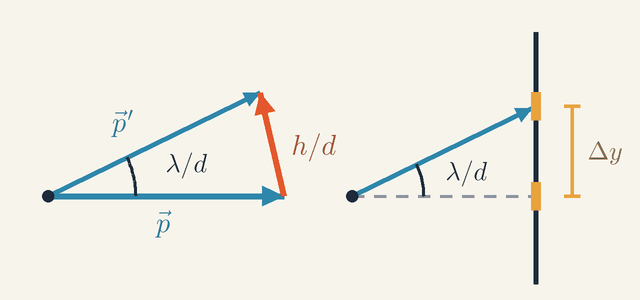
The other option is softer photons. A photon of wavelength λγ carries momentum h/λγ, so a longer wavelength gives a gentler kick. But a flash can be located only to within about its own wavelength. Telling apart slits a distance d apart therefore needs λγ below about d, and so a photon momentum of at least about h/d. The next section shows that a kick of this size is just enough to wash out the fringes.
A kick the size of a fringe
Figure 4. Left: a photon that locates the electron at a slit kicks it sideways by up to about h/d, turning its momentum from p to p′ through about λ/d. Right: that is the angle between neighbouring bright fringes, Δy apart. Not to scale.Legend
p
Momentum of the electron before the photon scatters.
kg⋅m/s
p′
Momentum after the kick: the same length, turned through a small angle.
kg⋅m/s
h/d
Largest sideways kick from a photon short enough in wavelength to tell the slits apart.
kg⋅m/s
λ/d
Largest angle through which the kick turns the electron's path; also the angle between neighbouring bright fringes.
rad
Δy
Distance on the screen from the centre of the pattern to the next bright fringe, λL/d.
m
Figure 4 compares the kick from one such photon with the spacing of the fringes. On the left, the electron arrives with momentum p. The photon scatters off it in an unknown direction and hands it a sideways momentum of up to about h/d: the arrow from the tip of p to the tip of the new momentum p′. The kick is small and sideways, so p′ keeps the length of p but is turned through an angle of up to about (h/d)/p. With p=h/λ that angle is λ/d.
On the right, the same angle appears in the apparatus. Seen from the slits, the middle of the pattern and the next bright fringe, a distance Δy away on a screen at distance L, are an angle Δy/L apart, and Δy/L=λ/d because Δy=λL/d. So a kick strong enough to find the slit turns the electron by up to the angle between neighbouring fringes, in a random direction. Each landing point is shifted at random by up to about a whole fringe, and the bright and dark bands smear into each other.
In numbers, for the 50 eV electrons of the worked problem below and slits 0.50 µm apart, a 0.50 µm photon carries only 1/2900 of the electron's momentum, yet on a screen 2.0 m away it can shift the landing point by up to 0.69 mm, a whole fringe. Once λγ exceeds d the fringes begin to return, because the flash no longer shows which slit was used.
This trade-off is not a weakness of using light. It is the uncertainty principle, which limits the spreads Δx and Δp of a position and a momentum along the same direction: ΔxΔp≥2ℏ Locating the electron at one slit pins its sideways position to better than about d, so its sideways momentum must spread by at least the order of ℏ/d, whatever does the locating. The estimate above is good to factors of order 1; the worked problem below does the exact sum for a different detector.
The limit has to hold for every apparatus. An electron that was located and yet undisturbed would have to make fringes, because nothing disturbed it, and make none, because its path is known and probabilities add: the theory would contradict itself. The limit belongs to nature, not to clumsy instruments.
Partial which-path information
Real detectors can lie anywhere between recording nothing and recording the path perfectly, and the fringes fade by just the right amount in between. To see how, treat the detector itself as a quantum system. If the electron passes slit 1, the detector ends in the state written ∣D1⟩; if it passes slit 2, in ∣D2⟩. Their overlap ⟨D1∣D2⟩ is a complex number, of size between 0 and 1, that measures how alike the two states are. Electron and detector end together in the state ψ1∣D1⟩+ψ2∣D2⟩, and when only the electron's landing point is observed, the squared magnitude of this sum carries the overlap into the cross term: ∣ψ∣2=∣ψ1∣2+∣ψ2∣2+2Re(ψ1∗ψ2⟨D1∣D2⟩)
Identical states (overlap 1) record nothing and leave full fringes; orthogonal states (overlap 0) record the path perfectly and leave none. In between, two numbers describe the result. The fringes are measured by their visibility V=Pmax+PminPmax−Pmin where Pmax and Pmin are the probabilities at a bright fringe and at the neighbouring dark one, so that V=1 for perfect fringes and V=0 for none. For equal amplitudes V=∣⟨D1∣D2⟩∣. The path information is measured by the distinguishability D, defined so that the best possible guess of the slit, made from the detector, is right with probability (1+D)/2: D=0 is a coin toss and D=1 is certainty. Then V2+D2≤1 with equality when the detector starts in a definite quantum state. Partial knowledge of the path buys partial fringes; full knowledge and full fringes never come together.
Nobody has to read the record; it only has to exist. A gas molecule that bounces off the electron is such a detector, and so, for a large molecule sent through the slits, is a photon of heat radiation that the warm molecule emits in flight. Each such event multiplies the overlap by another factor smaller than 1, and after many of them the cross term is gone. This loss of interference to the surroundings is called decoherence, and it is why matter-wave experiments need a high vacuum.
Worked problem: a recoiling slit plate
In the late-1920s debates between Einstein and Bohr, one proposal was to read the electron's path from the recoil of the slit plate. Take the animation's 50 eV electrons at the real scale of the intermediate example (λ=0.173nm, d=0.50μm, L=2.0m, so Δy=0.69mm), with a plate free to slide sideways. How well must the plate's momentum be known, and what happens to the fringes?
Step 1, the two recoils. An electron that reaches the centre of the screen through slit 1, a distance d/2 above the axis, is deflected towards the axis through an angle d/(2L); through slit 2 it is deflected the other way by the same angle. Its sideways momentum changes by pd/(2L) one way or the other, and by conservation of momentum the plate takes the opposite kick. The two possible kicks of the plate differ by δp=Lpd=Δyh=6.94×10−46.626×10−34=9.5×10⁻³¹kg⋅m/s where the middle step uses p=h/λ and Δy=λL/d. (Here δp is a momentum difference, not the phase δ.)
Step 2, the plate's position. To tell the two kicks apart reliably, the spread of the plate's momentum must be well below δp; take a standard deviation σp=δp/4=2.4×10−31kg⋅m/s. Standard deviations are the spreads of the uncertainty principle, so the plate's position must then be spread by at least σx=2σpℏ=2⋅2.4×10−311.055×10−34=2.2×10⁻⁴m
Step 3, the fringes. That is Δy/π, about a third of a fringe. The pattern is fixed to the slits, so it is as uncertain in position as the plate. Averaging the cos2 fringes over a Gaussian spread σx multiplies their contrast by e−2π2σx2/Δy2=e−2=0.14. The detector rule of the previous section gives the same answer from the other side. The plate's two possible final states are spreads of width σp whose centres differ by δp, and they overlap by e−δp2/(8σp2)=e−2. So V=0.14 and D=1−e−4=0.99: the path is known almost for certain, and the fringes are nearly gone.
Step 4, a looser plate. If its momentum is known only to σp=δp, the fringes keep 88 % visibility, but the path is revealed only with D=0.47. Both cases give V2+D2=1: a plate in a definite quantum state sits on the boundary, and no plate does better.
Limits of validity
The relation p=2mE, with E the kinetic energy, ignores relativity. That is harmless at 50 eV, a ten-thousandth of the electron's rest energy mc2=511keV. In a 100 kV electron microscope, though, the exact momentum, from pc=E2+2Emc2, gives λ=3.70pm, while the simple formula gives 3.88 pm, about 5 % too long. The relation λ=h/p itself stays exact; only the link between p and E changes.
The fringe formula needs small angles and a screen in the far field, L≫d2/λ, which is 1.4 mm in the example against L=2m. Fringes also need a coherent beam: a small source, so that both slits receive the same wave, and nearly a single energy, so that all the electrons share one wavelength and one fringe spacing.
For large objects the wave is real but invisible, for two reasons. The first is the wavelength. A 0.15 kg ball at 30 m/s has λ=1.5×10⁻³⁴m: behind slits 10 cm apart, a screen 10 m away would carry fringes 1.5×10⁻³²m apart, and a detector the size of a proton would average some 1017 of them into a smooth curve. The second is decoherence: in air the ball is struck by about 5×1025 molecules a second, each one a which-path record.
Yet no sharp boundary between quantum and classical objects is known. Molecules of 60 carbon atoms, with λ=2.5pm at 220 m/s, have made fringes behind a grating of 100 nm period, and so, later, have molecules of about 2000 atoms.
Where this leads
Schrödinger's Equation and Tunnelling turns the amplitude into a wave function obeying its own equation, with E=ℏω and p=ℏk, and lets it leak through barriers that a classical particle could never cross. The orbits of Atomic Models: the Bohr Atom are those that fit a whole number of wavelengths, 2πr=nλ, which is equivalent to an angular momentum nℏ. In Semiconductors, Diodes and LEDs, electron waves in a periodic crystal form energy bands. Particles and Forces: the Standard Model treats every particle as a quantum of a field and computes each process by adding the amplitudes of its alternative histories, drawn as interaction diagrams: the rule of this lesson in its most general form.
Key formulas
de Broglie wavelength
λ=ph
Every particle with momentum p has a wave whose wavelength is the Planck constant divided by the momentum. It is the relation that holds for a photon, whose momentum is h/λ, extended to matter in 1924 and confirmed by electron diffraction in 1927. The wavelength depends on the momentum alone, not on the energy or the mass separately.
Symbols
λ
de Broglie wavelength
m
h
Planck constant, 6.626×10⁻³⁴J⋅s
J⋅s
p
momentum of the particle
kg⋅m/s
When it holds: Holds for every particle, at relativistic speeds too if p is the relativistic momentum. It gives the wavelength of the probability amplitude; nothing material oscillates.
Example: The 50 eV electrons of the animation: λ=6.626×10⁻³⁴/(3.82×10−24)=1.73×10−10m=0.17nm.
Momentum from kinetic energy
p=2mE
With E=21mv2 and p=mv, eliminating v gives E=p2/(2m), so the momentum is the square root of twice the mass times the kinetic energy. An electron accelerated from rest through a voltage V has E=eV.
Symbols
p
momentum
kg⋅m/s
m
mass of the particle
kg
E
kinetic energy
J
When it holds: Only for speeds well below that of light, E≪mc2 (511 keV for an electron); at 100 keV it underestimates p by about 5 %. It does not apply to photons, for which p=E/c.
Example: For E=50eV=8.01×10⁻¹⁸J: p=2⋅9.11×10−31⋅8.01×10−18=3.82×10⁻²⁴kg⋅m/s.
Fringe spacing
Δy=dλL
Bright fringes lie where the path difference from the two slits, dsinθ, is a whole number of wavelengths. For small angles sinθ≈y/L, so the bright fringes sit at ym=mλL/d, a distance λL/d apart. It is the formula for light; for particles λ is the de Broglie wavelength, so the spacing shrinks as the momentum grows.
Symbols
Δy
distance between neighbouring bright fringes
m
λ
wavelength (de Broglie wavelength for particles)
m
L
distance from the slits to the screen
m
d
distance between the centres of the slits
m
When it holds: For small angles and a screen in the far field, L≫d2/λ. The width of each slit changes the brightness of the fringes, through the single-slit envelope, but not their spacing.
Example: Electrons of 50 eV (λ=0.173nm), slits 0.50μm apart, screen at 2.0 m: Δy=0.69mm.
Superposition of amplitudes
ψ=ψ1+ψ2
When an electron can reach a point of the screen in two ways that leave no trace, the amplitude for arriving there is the sum of the amplitudes for the two ways. Amplitudes are complex numbers: the magnitude sets the probability, and the phase advances by 2π for each wavelength travelled, so paths of different length arrive with different phases.
Symbols
ψ
amplitude for arriving at the point with both slits open
ψ1
amplitude for arriving there through slit 1
ψ2
amplitude for arriving there through slit 2
When it holds: Only for alternatives that nothing distinguishes, even in principle. If any record shows which slit was used, the probabilities add instead: ∣ψ1∣2+∣ψ2∣2.
Example: At the centre of the screen both paths are equally long, so ψ1=ψ2 and ψ=2ψ1: the probability is four times that with one slit open, twice the sum of the two single-slit probabilities.
Probability with interference
∣ψ∣2=∣ψ1∣2+∣ψ2∣2+2Re(ψ1∗ψ2)
The probability is the squared magnitude of the total amplitude. Expanding ∣ψ1+ψ2∣2 gives the two single-slit probabilities plus a cross term, which for equal magnitudes is 2∣ψ1∣2cosδ, with δ the phase difference between the paths. The cross term is positive at bright fringes, negative at dark ones and averages to zero, so interference moves arrivals around without changing their total.
Symbols
∣ψ∣2
probability of arrival with both slits open
∣ψ1∣2
probability of arrival through slit 1 alone, with slit 2 closed
∣ψ2∣2
probability of arrival through slit 2 alone, with slit 1 closed
ψ1∗
complex conjugate of the amplitude ψ1
ψ2
amplitude through slit 2
Re
real part of a complex number
When it holds: While nothing records the path. A detector whose final states are ∣D1⟩ and ∣D2⟩ multiplies the cross term by their overlap ⟨D1∣D2⟩; with full which-path information the cross term vanishes.
Example: For equal amplitudes, ∣ψ∣2 swings between 4∣ψ1∣2 at a bright fringe and 0 at a dark one: in the expert graph the solid curve peaks at twice the dashed curve.
Uncertainty principle
ΔxΔp≥2ℏ
The spreads of position and momentum along the same direction cannot both be small: their product is at least ℏ/2. It follows from the wave description, since a wave confined to a length Δx must mix wavelengths and therefore momenta. In the double slit it means that a probe sharp enough to find the electron at one slit kicks it sideways by about a fringe's worth of angle, which washes out the pattern.
Symbols
Δx
spread (standard deviation) of the position
m
Δp
spread (standard deviation) of the momentum in the same direction
kg⋅m/s
ℏ
reduced Planck constant, h/(2π)=1.055×10−34J⋅s
J⋅s
When it holds: For a position and the momentum along the same axis, x and px; it sets no limit on x together with py. The equality holds only for a Gaussian wave packet.
Example: An electron confined within Δx=0.10nm, the size of an atom, has Δp≥1.055×10⁻³⁴/(2⋅1.0×10−10)=5.3×10−25kg⋅m/s, a velocity spread of at least 580 km/s.
Glossary
Wave–particle duality
Quantum objects such as electrons and photons travel as waves, which diffract and interfere, yet are always detected as whole particles at single points. It is one theory, not two pictures: the wave gives the probability of each detection.
Photon
The quantum of light, a packet of energy E=hf and momentum p=h/λ. Light of any brightness is emitted and absorbed one photon at a time; dimmer light means fewer photons, not weaker ones.
Matter wave
The wave of a moving particle, also called the de Broglie wave, with wavelength λ=h/p: 0.17 nm for a 50 eV electron. It is a wave of probability amplitude, not a ripple of the particle's substance.
Electron diffraction
The spreading and interference of electron waves at crystals, slits or edges. First seen in 1927, when electrons scattered by a nickel crystal emerged in the directions that λ=h/p predicts.
Interference fringes
Alternating bands of many and few arrivals where waves from two openings overlap, bright where they arrive in step and dark where they cancel. Behind two slits neighbouring bright fringes are Δy=λL/d apart.
Probability amplitude
The complex number assigned to each way an event can happen; the probability is the squared magnitude of the total amplitude. Its phase advances by 2π for every wavelength travelled.
Superposition
The adding of amplitudes for alternatives that leave no record, ψ=ψ1+ψ2. Probabilities are then not additive: the cross term can make an outcome more likely or rule it out.
Born rule
The probability of detecting the particle at a place is proportional to ∣ψ∣2 there. Single arrivals are random, but their histogram approaches ∣ψ∣2, with a scatter of about n in a bin of n counts.
Which-path information
Any record, read or not, of which slit the particle passed. Full information removes the cross term and the fringes, leaving ∣ψ1∣2+∣ψ2∣2; partial information only weakens them.
Fringe visibility
The contrast of a pattern, V=(Pmax−Pmin)/(Pmax+Pmin): 1 when the dark fringes are empty, 0 when there are no fringes. With a which-path distinguishability D, V2+D2≤1.
Uncertainty principle
Position and momentum along one direction cannot both be sharp: ΔxΔp≥ℏ/2, with Δx in metres and Δp in kg·m/s. It is a property of waves, not a flaw of instruments, and it stops any device from finding the slit without washing out the fringes.
Decoherence
The loss of interference when a system leaves which-path traces in its surroundings, such as colliding gas molecules or emitted heat radiation. It is one reason why large, warm objects never show fringes.
Quantities
λ
de Broglie wavelength
m
The wavelength of a particle's matter wave, h/p; 0.17 nm for the 50 eV electrons of the animation.
p
Momentum
kg⋅m/s
Mass times velocity, mv, for a slow particle, and E/c for a photon. It alone fixes the de Broglie wavelength.
m
Mass
kg
The particle's mass: 9.11×10⁻³¹kg for an electron, 1.675×10⁻²⁷kg for a neutron.
E
Kinetic energy
J
The energy of motion, 21mv2=p2/(2m), often given in electronvolts: 1eV=1.602×10⁻¹⁹J, gained by an electron across 1 V.
h
Planck constant
J⋅s
The constant that sets the scale of quantum effects, exactly 6.62607015×10⁻³⁴J⋅s by the definition of the SI.
ℏ
Reduced Planck constant
J⋅s
h/(2π)≈1.055×10−34J⋅s, the natural form when phases are measured in radians: p=ℏk with k=2π/λ.
d
Slit separation
m
The distance between the centres of the two slits; for electrons, usually below a micrometre.
L
Slit-to-screen distance
m
The distance from the wall with the slits to the screen that records the arrivals.
Δy
Fringe spacing
m
The distance between neighbouring bright fringes on the screen, λL/d.
ψ
Probability amplitude
The complex amplitude for an arrival at a point; ∣ψ∣2 is the probability of a click in a given small detector there, so here it is a pure number. ψ1 and ψ2 are its parts through each slit.
Quiz
Beginner Electrons are sent one at a time through two slits. What does a single electron produce on the screen?
A faint striped pattern
One dot at a single point
Two dots, one behind each slit
Nothing until many electrons have arrived
Show answer
Answer: B. One dot at a single point
Each electron is detected at one place, like a particle. The stripes only appear once many such dots have accumulated.
Beginner After thousands of electrons have arrived one by one, what pattern do the dots form?
Two bright bands, one behind each slit
A uniform spread of dots
Bright and dark stripes, like interfering waves
A single dot in the middle
Show answer
Answer: C. Bright and dark stripes, like interfering waves
The dots pile up in bright stripes separated by almost empty gaps: an interference pattern, the signature of a wave passing through both slits.
Beginner A detector is added that shows which slit each electron goes through. What happens to the stripes?
They become sharper
They shift sideways
Nothing changes
They disappear, leaving one smooth blurry patch
Show answer
Answer: D. They disappear, leaving one smooth blurry patch
Finding out the path destroys the interference: the electrons then behave as if each went through one slit only. The dots then simply add up the patterns from each slit alone, which overlap into one smooth patch.
Intermediate Electrons are sent through a double slit so slowly that only one is ever in the apparatus. The fringes still build up. What does this show?
Each electron's wave passes through both slits and interferes with itself
The electrons interfere with one another on the screen
The slits become charged and steer the electrons into stripes
Each electron splits into two halves, one through each slit
Show answer
Answer: A. Each electron's wave passes through both slits and interferes with itself
No two electrons are ever in flight together, so they cannot interfere with each other. Each electron's own wave goes through both slits and its interference sets where that electron is likely to land, yet it is always detected whole, at a single point.
Intermediate In an electron double-slit experiment, the electrons are made faster. What happens to the fringe spacing?
It increases
It decreases
It stays the same
The fringes vanish
Show answer
Answer: B. It decreases
A faster electron has more momentum, so λ = h/p is shorter, and Δy = λ·L/d becomes smaller.
Intermediate Why do we never observe a thrown tennis ball diffracting through a doorway?
Large objects have no wavelength
It moves too slowly to have a wave
Its de Broglie wavelength is far too tiny compared with the opening
Gravity destroys the interference
Show answer
Answer: C. Its de Broglie wavelength is far too tiny compared with the opening
Every moving object has λ = h/p, but for a ball p is huge on the quantum scale, so λ ≈ 10⁻³⁴ m: no opening is anywhere near that small.
Advanced In the double slit, |ψ|² = |ψ₁|² + |ψ₂|² + 2·Re(ψ₁*·ψ₂). Which term produces the fringes?
|ψ₁|²
|ψ₂|²
|ψ₁|² + |ψ₂|²
2·Re(ψ₁*·ψ₂)
Show answer
Answer: D. 2·Re(ψ₁*·ψ₂)
The cross term oscillates with the phase difference between the two paths. Without it (which-path known) only the smooth sum |ψ₁|² + |ψ₂|² remains.
Advanced A which-path detector is added whose two final states have a real overlap ⟨D₁|D₂⟩ = 0.6, with equal amplitudes through both slits. What is the fringe visibility V?
0.6
0.36
0.4
0, because any detector destroys the fringes
Show answer
Answer: A. 0.6
With the detector, |ψ|² = |ψ₁|² + |ψ₂|² + 2·Re(ψ₁*·ψ₂·⟨D₁|D₂⟩), so for equal amplitudes the cross term, and with it V, is scaled by 0.6. The path distinguishability is D = √(1 − 0.6²) = 0.8, and V² + D² = 1: partial which-path information only partly erases the fringes.
 Physics Tutor