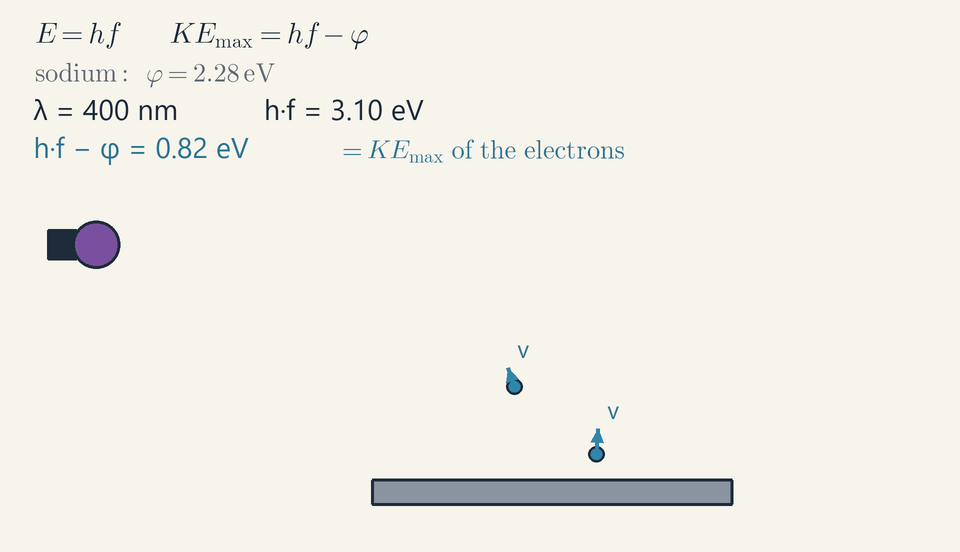
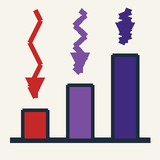
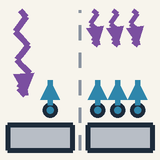
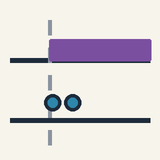
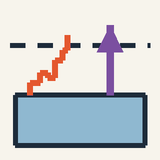
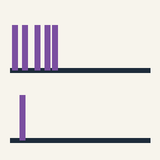
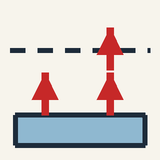
Light knocks electrons out of a metal one photon at a time, each photon carrying E=hf: the colour decides whether it works (hf>φ), the brightness only how many electrons leave.
A lamp sends photons at a sodium plate: bright red light ejects nothing, while dim violet and ultraviolet light knock electrons out, faster for ultraviolet.
Light arrives in tiny energy packets called photons; an electron takes the energy of one photon at a time, all or nothing.
To leave the metal an electron must pay a fixed “exit fee”; if one photon cannot pay it, no electron escapes, however bright the light.
Colour sets the energy of each photon: red photons carry little, violet ones more, ultraviolet ones more still.
Brighter light of a suitable colour ejects more electrons, but not faster ones.
Electrons leave the instant the light arrives, even in very dim light: nothing has to build up first.
Shine light on a clean metal plate inside a vacuum tube and, with the right light, electrons jump out of its surface; a meter in the circuit then shows a current. This is the photoelectric effect. Let us collect what experiments show, one observation at a time.
Observation 1: colour decides. In the animation a bright red lamp floods the sodium plate and nothing happens, however long we wait. Dim violet light works at once. Observation 2: no waiting. Even very faint violet light frees electrons the instant it arrives. Observation 3: brightness decides how many. Brighter violet light ejects more electrons, but none of them faster. Observation 4: bluer means faster. Ultraviolet light makes electrons leap out with more speed than violet.
A light wave spreading smoothly over the plate explains only the third observation. Einstein's answer, in 1905: light arrives in tiny packets of energy called photons, and the colour sets the energy of each packet. Red photons carry little, violet ones more, ultraviolet ones more still. An electron takes one photon at a time, all or nothing. To get out it must pay a fixed “exit fee”. A red photon cannot pay it, and more red photons do not help, just as a crowd in which each person holds one coin cannot buy a five-coin ticket. Whatever is left after the fee becomes the electron's speed.
Photomultiplier tubes use this effect to count single photons, and camera sensors and solar panels rely on a closely related effect. The photoelectric effect itself earned Einstein his Nobel Prize.
Check yourself: ultraviolet light frees electrons from a metal, and you make it twice as bright. Do the electrons come out faster, or do more of them come out? Answer: more of them, with the same top speed.
Intermediate
Key ideas
Photon energy E=hf=hc/λ; with hc≈1240eV⋅nm, E[eV]≈1240/λ[nm].
KEmax=hf−φ: electrons leave only if hf>φ, giving a threshold f0=φ/h and a longest wavelength λ0=hc/φ.
Sodium (φ≈2.28eV): λ0≈544nm, so 400 nm light gives KEmax=0.82eV while 700 nm light ejects nothing.
Intensity sets how many electrons leave per second (the photocurrent), never KEmax.
What the experiment measures
Two metal electrodes sit in an evacuated glass tube: a plate that the light falls on, here sodium, and a collector joined to it through a battery and an ammeter. In the dark the meter reads zero, because nothing carries charge across the vacuum. Light of a suitable colour makes a current flow at once: electrons, called photoelectrons, leave the lit plate and reach the collector.
The experimenter varies two properties of the light: its frequency f, seen as colour, and its intensity, the power it delivers per square metre. Two things are measured: the photocurrent I, which counts the electrons arriving each second, and the energy of the fastest electrons. Contrary to the wave picture, whether electrons come out, and how fast the fastest ones move, depends only on the frequency; the intensity sets nothing but the current.
Light in packets: the photon
In 1905 Einstein proposed that light is absorbed, and travels, in packets of energy now called photons. A photon of frequency f, or wavelength λ=c/f, carries the energy E=hf=λhc where h=6.626×10⁻³⁴J⋅s is Planck's constant and c the speed of light. Brighter light of one colour means more photons per second, not bigger ones.
Atomic physics measures such energies in electronvolts, the energy an electron gains across 1 V: 1eV=1.602×10⁻¹⁹J. With the product hc≈1240eV⋅nm a photon's energy in electronvolts is 1240 divided by its wavelength in nanometres: 3.10 eV for violet light at 400 nm.
The energy balance: Einstein's equation
Conduction electrons move freely inside a metal, but freeing even the most loosely held one costs a definite energy. That energy is the work function φ: about 2.1 eV for caesium, 2.28 eV for sodium, 4.3 eV for zinc and 5.1 eV for gold. An electron absorbs a whole photon or nothing. If hf exceeds φ, the electron pays its way out and keeps the rest as kinetic energy: KEmax=hf−φ
The word “maximum” matters: only an electron that starts from the highest occupied energy and loses nothing on its way out leaves with all of hf−φ. Electrons from lower levels, or from deeper inside, emerge with less, anything from zero up to KEmax.
If hf is smaller than φ, no single photon can free an electron, and an electron cannot save up several photons: it passes its small gain to the metal as heat long before another photon arrives. The boundary case hf=φ defines the threshold frequency and the threshold wavelength:
f0=hφ
λ0=φhc
The threshold is a minimum frequency but a maximum wavelength: light of longer wavelength than λ0 frees nothing, however intense it is.
Worked example: the sodium plate in the animation
The plate in the animation is sodium, φ=2.28eV, so λ0=1240/2.28≈544nm, in the green, and f0≈5.51×10¹⁴Hz. The bright red lamp at 700 nm gives hf=1240/700=1.77eV and hf−φ=1.77−2.28=−0.51eV. None of its 14 photons frees an electron, and a red tag reads no emission.
Violet light at 400 nm gives hf=3.10eV and KEmax=3.10−2.28=0.82eV; ultraviolet at 250 nm gives hf=4.96eV and KEmax=2.68eV. These are the values on the λ, hf and hf−φ readouts. Since 0.82eV=1.31×10⁻¹⁹J, the fastest violet electrons move at v=2KEmax/m≈5.4×105m/s; the fastest ultraviolet ones reach 9.7×10⁵m/s.
The blue velocity arrows show this. One electron in three leaves with KEmax; the others lost energy inside the metal and keep 45 % or 75 % of it, so their arrows are shorter. The fastest ultraviolet arrow is 2.68/0.82≈1.8 times as long as the fastest violet one. When the violet light turns bright, nine photons free nine electrons instead of three, yet the readout stays at 0.82 eV.
Worked example: a zinc plate under ultraviolet
A clean zinc plate, φ=4.3eV, is lit by the ultraviolet line of a mercury lamp at 254 nm. Does visible light work on it, how fast are the fastest electrons, and how large is the current?
Zinc's threshold is λ0=1240/4.3≈288nm, already in the ultraviolet, so the violet light that works on sodium frees nothing here. At 254 nm, hf=1240/254=4.88eV and KEmax=4.88−4.3=0.58eV: the fastest electrons move at about 4.5×10⁵m/s.
Suppose 1.0 mW of this light reaches the plate. At 4.88eV=7.82×10⁻¹⁹J per photon, about 1.3×10¹⁵ photons arrive each second. A bare metal converts them poorly: if one in a thousand frees an electron, 1.3×10¹² electrons leave each second and the current is I≈1.3×1012⋅1.602×10−19≈2×10⁻⁷A, or 0.2 µA. Doubling the lamp's power doubles the current but leaves the 0.58 eV unchanged.
Reading the energy diagram and the graphs
An energy diagram draws an electron's energy as height. The electrons fill the metal up to a top level, and an electron at rest just outside lies φ higher. A photon lifts one electron by exactly hf. For violet light, the 3.10 eV splits into 2.28 eV to climb out and 0.82 eV of motion; the red 1.77 eV falls 0.51 eV short, and the electron's gain ends up as heat.
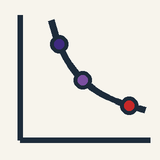
For one colour above the threshold, the photocurrent against intensity is a straight line through the origin, while KEmax against intensity is flat. KEmax against frequency is zero up to f0 and then a straight line of slope h: the same slope for every metal, starting from each metal's own f0=φ/h. The advanced view of the animation draws this graph.
Common mistakes
Brighter light does not make faster electrons: tripling the violet light in the animation frees three times as many electrons, each still with at most 0.82 eV.
Waiting does not help below the threshold: the red lamp could shine on sodium for hours, and each 1.77 eV photon would still fall short of 2.28 eV.
The work function is subtracted, not added: violet photons on sodium give 3.10−2.28=0.82eV, not 5.38 eV.
The threshold belongs to the metal, not to the light: 400 nm light frees electrons from sodium but not from zinc, whose threshold is 288 nm.
Convert electronvolts into joules before using KE=21mv2: 0.82 eV is 1.31×10⁻¹⁹J and gives 540 km/s, while putting in 0.82 directly gives 1.3×10¹⁵m/s, faster than light.
Where you meet it
Photomultiplier tubes count single photons in medical scanners, particle detectors and telescopes, multiplying each photoelectron about a million times. Night-vision intensifiers work the same way, and spacecraft in sunlight charge to a few volts positive as ultraviolet light frees electrons from their skin. Solar cells and camera sensors use the internal photoelectric effect, in which the photon lifts an electron inside a semiconductor rather than out of it.
Quanta of hf run through the rest of modern physics. In Atomic Models: the Bohr Atom, atoms emit and absorb photons that match the gap between two energy levels; Semiconductors, Diodes and LEDs turns the effect around; Wave–Particle Duality gives electrons a wavelength too.
Advanced
Key ideas
Stopping potential: eV0=hf−φ, a straight line of slope h/e for every metal; only the intercept −φ/e changes.
The work function is the binding of electrons in the metal: heat pays it statistically (e−φ/kT), a photon pays it in one go.
Light is lumpy: a detector clicks one photon at a time, each with E=hf and p=h/λ; dimmer light means fewer clicks, not weaker ones.
Intense lasers allow multiphoton emission below the threshold: KEmax=nhf−φ.
Measuring the energy: the stopping potential
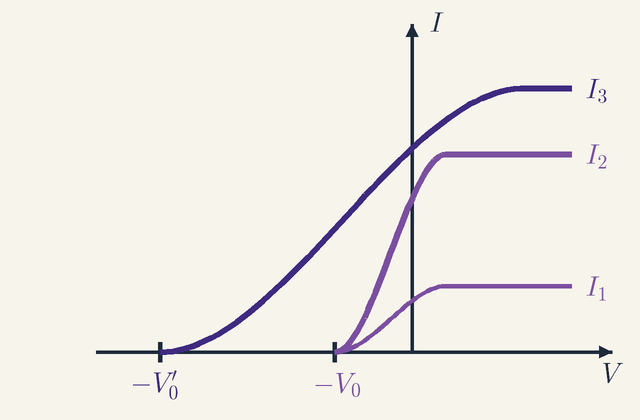
The photoelectric effect is settled by two measurements: how many electrons leave a lit metal each second, and how much kinetic energy the fastest of them carry. The first is simply a current. The second needs a trick, the stopping potential, and Figure 1 shows how it works.
Figure 1. Photocurrent I against collector voltage V in three runs on sodium. Brighter violet light (I2 against I1) raises the plateau but leaves the stopping potential V0 unchanged; ultraviolet light (I3) moves the zero to −V0′. Not to scale.Legend
I
Photocurrent: the charge per second carried by the electrons that reach the collector.
A
V
Voltage of the collector relative to the lit plate; negative values push the electrons back.
V
V0
Stopping potential for the violet light: the current vanishes at V=−V0.
V
V0′
Stopping potential for the ultraviolet light; larger than V0 because each ultraviolet photon carries more energy.
V
I1
Photocurrent in dim violet light; its plateau is the saturation current.
A
I2
Photocurrent in bright violet light, with three times as many photons per second as for I1.
A
I3
Photocurrent in ultraviolet light, drawn with the most photons per second.
A
The apparatus is a vacuum tube with two electrodes: a sodium plate that the light falls on, and a collector facing it. A voltage V is applied to the collector, measured relative to the lit plate, and a meter records the photocurrent I, the charge per second carried by the electrons that reach the collector. Figure 1 shows three runs: dim violet light (I1), brighter light of the same violet colour (I2) and ultraviolet light (I3).
Start on the right of Figure 1, where V is positive. The collector attracts the electrons, every electron that leaves the plate is collected, and each curve levels off at a plateau, the saturation current. A plateau counts electrons per second, so for light of one colour it is proportional to the number of photons arriving per second: I2, with three times as many photons as I1, has a plateau three times as high. The ultraviolet run is drawn with the most photons per second, so its plateau is the highest. A plateau tells you how many electrons leave, never how fast they go.
Now move left, where V is negative. The collector now repels the electrons, and to arrive an electron must climb a potential-energy hill of height e∣V∣, where e=1.602×10⁻¹⁹C is the elementary charge. Only an electron that leaves the plate with more kinetic energy than this gets over. The electrons leave with a spread of energies and directions (Figure 2 shows where the spread comes from), so as V is made more negative the slowest are turned back first and the current falls gradually. It reaches zero at V=−V0, where even the fastest electrons, those with the largest kinetic energy KEmax, are just turned back: eV0=KEmax
The voltage V0 is the stopping potential. It turns an energy measurement into a voltage reading: an electron stopped by exactly 1 V had 1 eV of kinetic energy, where the electronvolt, the energy an electron gains across 1 V, is 1.602×10⁻¹⁹J. For sodium, V0=0.82V under violet light of 400 nm and 2.68V under ultraviolet light of 250 nm, the values on the animation's V0 readout. The fastest electrons therefore carry 0.82 eV and 2.68 eV.
Now compare where the curves in Figure 1 reach zero. The two violet curves differ in height by a factor of three, yet both reach zero at the same −V0. The ultraviolet curve I3 reaches zero at −V0′, further to the left, because its electrons are faster. The same holds for any set of runs: every intensity of one colour stops at the same voltage, and each colour at its own. Intensity sets the current; frequency sets the energy. That is the whole puzzle in one figure, and the rest of this explanation shows why.
Energy conservation for one photon
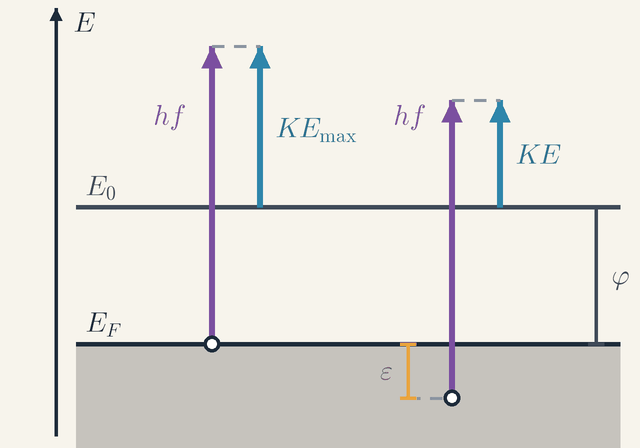
Why should the energy depend on the colour alone? Einstein's answer, in 1905, was that light is absorbed in whole quanta, photons, each carrying the energy hf, where f is the frequency of the light and h=6.626×10⁻³⁴J⋅s is Planck's constant. Figure 2 follows the energy of one photon from its absorption until its electron is outside the metal.
Figure 2. Energy levels for one absorbed photon, to scale for ultraviolet light on sodium. Both electrons gain the same hf; the one starting on the Fermi level EF ends KEmax above the vacuum level E0, the one starting ε lower ends with less, KE.Legend
E
Energy of an electron.
J
EF
Fermi level: the highest occupied electron state in the metal.
J
E0
Vacuum level: the energy of an electron at rest just outside the metal.
J
φ
Work function: the gap from EF up to E0, the least energy that frees an electron.
J
hf
Energy of the absorbed photon, the same for both electrons.
J
ε
How far below the Fermi level the second electron starts: the extra energy it must spend to get out.
J
KEmax
Kinetic energy, once outside, of the electron that starts on the Fermi level: hf−φ.
J
KE
Kinetic energy, once outside, of the electron that starts ε lower: hf−φ−ε.
J
The vertical axis of Figure 2 is the energy E of an electron. Inside a metal the conduction electrons fill the available states from the bottom up to a highest occupied level, the Fermi level EF; the shaded band is the filled states. An electron at rest just outside the surface has the energy of the vacuum level E0. The gap between the two, φ=E0−EF, is the work function: the least energy that takes an electron out of the metal. For sodium it is 2.28 eV.
Absorbing a photon raises an electron by exactly hf: the purple arrows, equal for both electrons. Follow the electron on the left first. It starts on the Fermi level, so it needs only φ to reach the vacuum level. If it loses nothing on the way out, it keeps the remainder as kinetic energy, the blue arrow above E0. No electron can do better, so this is the maximum: KEmax=hf−φ
Now follow the electron on the right. It starts an energy ε below the Fermi level, so it must spend ε more to get out, and the same photon leaves it with only KE=hf−φ−ε Its blue arrow is shorter by ε. Electrons from deeper states, and electrons that lose energy in collisions before they reach the surface, come out slower still: that is the spread of energies that made the curves of Figure 1 fall gradually. Setting ε=0 gives back KEmax=hf−φ. Einstein's equation is energy conservation for one photon and one electron, nothing more; the new physics is entirely in the claim that light arrives in quanta of size hf.
The arrows are drawn to scale for ultraviolet light on sodium: hf=4.96eV and φ=2.28eV give KEmax=2.68eV, exactly the eV0 measured in Figure 1, and the electron that starts ε=0.9eV lower leaves with 1.78eV.
One detail of this energy balance is easy to miss: a free electron cannot absorb a photon. To see why, let an electron of mass m start at rest and take in a photon of energy E, which also carries momentum E/c. The electron would then have energy mc2+E and momentum p=E/c. But relativity fixes a particle's energy by its momentum: the square of the energy must be (mc2)2+(pc)2=(mc2)2+E2. The square of mc2+E is larger than that by 2mc2E, so energy and momentum cannot both be conserved. Something else must take up the momentum, the crystal lattice or the surface, so the effect belongs to electrons bound in a metal, not to isolated electrons.
Nor is the work function a constant special to light. The same barrier controls thermionic emission, in which heat frees the electrons: random thermal motion gives a few of them enough energy to climb over it, and the current is governed by the factor e−φ/kT, where k is Boltzmann's constant and T the absolute temperature. At room temperature kT≈0.025eV, and for sodium the factor is below 10−38: no emission at all. A tungsten filament (φ≈4.5eV) at 2500 K has kT≈0.22eV, and the factor reaches about 10−9, enough for a useful current. Heat pays the exit fee by chance, a few electrons at a time; a photon pays it in one go.
The straight line and its slope
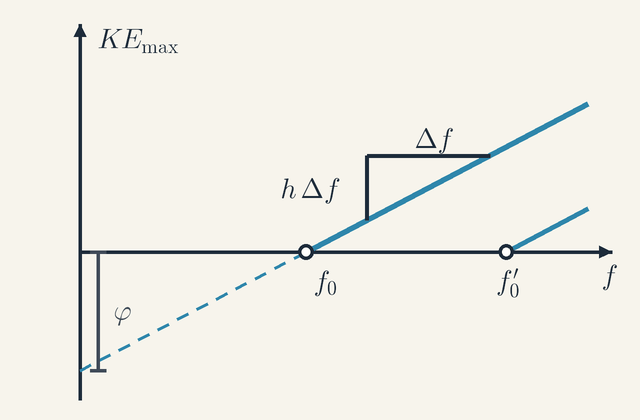
Einstein's equation makes a sharp, testable prediction: plotted against frequency, KEmax is a straight line whose slope is the same for every metal. Figure 3 draws that prediction, which is also how h was first measured with light.
Figure 3.KEmax against f for sodium (thick line) and zinc, which has a larger work function (thin line). Both have slope h, so they are parallel: a step Δf raises KEmax by hΔf. The dashed continuation reaches −φ.Legend
KEmax
Largest kinetic energy of the photoelectrons, hf−φ.
J
f
Frequency of the light.
Hz
f0
Threshold frequency of sodium, φ/h: where its line meets the f axis.
Hz
f0′
Threshold frequency of zinc, larger because its work function is larger.
Hz
φ
Work function of sodium: the dashed continuation cuts the energy axis at −φ.
J
Δf
A step along the frequency axis, taken anywhere on the line.
Hz
hΔf
Rise of the line over that step, the same everywhere: the slope of the line is h.
J
Figure 3 plots KEmax=hf−φ against the frequency f of the light; the thick line is sodium. Look first at the small triangle on it: a step Δf to the right raises the line by hΔf, and it does so wherever on the line the step is taken. That is what a slope of h means.
Next, look where the line meets the axes. It cuts the frequency axis at the threshold frequency f0=φ/h, where a photon has just enough energy to free an electron, with nothing to spare. Below f0 no electrons are emitted, however bright the light, so there is nothing to measure. Continued below f0 (dashed), the line is an extrapolation, not a measurement; it cuts the energy axis at −φ, a depth φ below the frequency axis, and reading off that intercept is one way to find the work function.
The thin line belongs to a metal with a larger work function, zinc, with φ≈4.3eV. It has the same slope h, so it runs parallel to the sodium line, but it starts at the larger threshold f0′=4.3eV/h≈1.04×1015Hz, already in the ultraviolet.
The advanced view of the animation draws the sodium line with three points on it. The red point, at 4.28×10¹⁴Hz, lies below the threshold f0=5.51×10¹⁴Hz and sits at zero: no electrons. The violet point, at 7.49×10¹⁴Hz, lies at 0.82 eV, and the ultraviolet one, at 1.20×10¹⁵Hz, at 2.68 eV: the two stopping potentials of Figure 1. The dim and bright violet runs share a single point, because intensity does not appear on this graph at all.
In the laboratory one measures V0 rather than KEmax. Dividing Einstein's equation by e gives V0=ehf−eφ a straight line of slope h/e=4.14×10−15V⋅s: the stopping potential rises by about 0.41 V for every 1014Hz. The slope is universal and only the intercept depends on the metal, so the lines for caesium, sodium and zinc are parallel, as in Figure 3. Millikan, who doubted Einstein's light quanta, measured such lines between 1914 and 1916 and found h within about 1 % of today's value. Einstein's Nobel Prize for 1921 cited this law, not relativity.
Why a classical wave cannot do it
Light as a classical wave explains interference and diffraction perfectly, so why was a new idea needed at all? Because the wave picture gets all three observations of Figure 1 wrong.
The first is timing. A wave delivers energy continuously, spread over its whole front, and an electron can collect it only from roughly the area of its own atom, about 10−20m2. In dim light of 0.01 W/m² that area receives 0.01⋅10−20=10−22W, so gathering sodium's work function, 2.28eV=3.65×10⁻¹⁹J, would take t=10−22W3.65×10−19J≈3650s about an hour. Experiments find no delay at all, down to the few nanoseconds they can resolve.
The second is energy. Brighter light has a stronger electric field, which should shake the electrons harder and send them out faster; Figure 1 shows that brighter light gives more electrons, not faster ones. The third is the threshold. Given enough time, a wave of any frequency should deliver enough energy, yet below f0 nothing comes out, however long one waits. All three predictions fail.
With photons all three facts follow at once. Absorption is all or nothing, so emission starts as soon as the first photon arrives. Each photon's energy hf is fixed by the colour, so brighter light means more photons, not bigger ones. And a photon with less energy than φ frees nothing, however many of them arrive. A photon counter makes the graininess audible: dim the light and it does not click more quietly; its equal clicks just come less often.
A photon also carries momentum, p=h/λ=E/c, so E2−(pc)2=0: it is a particle of zero mass, as relativity requires of anything moving at c. Compton's scattering of X-rays off electrons confirmed this momentum in 1923. Where a particular photon will land can be predicted only as a probability, and that probability follows the intensity of the classical wave, which is why the wave picture still gets interference right.
A caution: a semiclassical model, in which the electrons obey quantum mechanics but the light stays a classical wave, also produces the threshold, the current proportional to intensity and the prompt emission. The photoelectric effect therefore points to photons without proving them. The proof came from experiments with single photons: antibunching in 1977, where light from a single atom was found never to deliver two photons at the same instant, and in 1986 the finding that one photon sent into a beam splitter never registers on both sides at once.
Beyond the single-photon threshold
The simple law assumes one photon per electron, a cold metal and an electron that must leave the material. Relaxing each assumption, or running the law backwards, gives four important extensions.
Intense laser pulses deliver photons so densely that an electron can absorb n of them at once: KEmax=nhf−φ. The rate grows as the n-th power of the intensity, so this needs very strong light. Two photons of the animation's red light, 2⋅1.77=3.54eV, would free electrons from sodium with up to 1.26 eV, more than single violet photons give.
At any temperature above absolute zero a few electrons sit slightly above the Fermi level, so the threshold is not perfectly sharp but blurred over a few kT. Careful measurements of φ fit the shape of this thermal tail.
Photoemission spectroscopy runs the equation backwards. With a known hf, usually ultraviolet or X-rays, the measured kinetic energy gives each electron's binding energy Eb, its depth below the Fermi level (the ε of Figure 2), through KE=hf−Eb−φ.
In a semiconductor a photon need not free the electron from the material, only lift it across the band gap, the energy gap between the filled states and the empty states in which an electron can carry current: 1.12 eV in silicon. The electron stays inside and adds to a current there. Silicon solar cells and camera sensors therefore respond to all wavelengths shorter than about 1100 nm.
Worked problem: measuring Planck's constant
The straight line of Figure 3 turns two stopping-potential readings into a measurement of h. Pretend you know neither h nor φ, only the animation's readouts: 0.82 V at 400 nm and 2.68 V at 250 nm.
First the frequencies. From f=c/λ they are 7.495×10¹⁴Hz and 1.1992×10¹⁵Hz, so Δf=4.497×10¹⁴Hz, while ΔV0=2.68−0.82=1.86V.
Next write eV0=hf−φ for each wavelength and subtract. The work function is the same in both equations, so it cancels, leaving eΔV0=hΔf: h=ΔfeΔV0=4.497×10141.602×10−19⋅1.86≈6.63×10⁻³⁴J⋅s
With h known, either reading gives φ. At 400 nm the photon energy is hc/λ=1240/400=3.10eV, using hc≈1240eV⋅nm, so φ=hf−eV0=3.10−0.82=2.28eV. The line now predicts the stopping potential at any other wavelength, for instance V0=1240/300−2.28=1.85V at 300 nm.
Now remove the collector and shine the ultraviolet light on an isolated sodium ball of radius R=1.0cm. Every electron that escapes leaves the ball more positive, so each later electron must climb out of the ball's growing potential V, losing eV on the way. Emission stops when eV reaches KEmax, that is at V=2.68V: the ball charges itself up to the stopping potential. A sphere's potential is V=Q/(4πε0R), where ε0 is the permittivity of free space and 4πε0=1.11×10⁻¹⁰F/m, so the final charge is Q=4πε0RV=1.11×10−10⋅0.010⋅2.68≈3.0×10⁻¹²C or Q/e≈1.9×107 missing electrons. Brighter light charges it faster, never higher.
Limits of validity
The clean law of Figure 3 rests on idealisations. Three matter in practice: the surface, the tube and the range of photon energies.
The work function belongs to a surface, not just to a metal: it changes with the crystal face exposed and even with a single layer of adsorbed atoms. Published values for sodium range from about 2.3 to 2.75 eV, and a caesium film can bring a surface below 1.5 eV. The yield is idealised too: the animation frees one electron for every photon above the threshold, whereas bare metals yield well under one electron per hundred photons, and the best photomultiplier cathodes about one per four.
A real tube usually has two different metals, the plate and the collector, and between two different metals joined in a circuit there is a contact potential, equal to the difference of their work functions divided by e. It shifts the measured cut-off: in an ideal tube, eV0 actually equals hf minus the collector's work function, not the plate's. The shift is the same at every frequency, so the slope h/e is untouched, which makes the slope the robust result.
The energies here are tiny next to the electron's rest energy of 511 keV: the fastest ultraviolet electrons, with 2.68 eV, move at 9.7×10⁵m/s, 0.3 % of c, so 21mv2 is accurate. X-rays of tens of keV eject inner-shell electrons fast enough to need relativity. At higher energies other processes take over: above about 30 keV, Compton scattering overtakes photoabsorption in water and soft tissue, and above 1.022 MeV, twice the electron's rest energy, a photon can create an electron–positron pair.
Where this leads
Blackbody Radiation and the Quantum is where h first appeared, in the spectrum of hot bodies; here it became a property of light itself. Atomic Models: the Bohr Atom applies hf=E2−E1 to spectral lines, Semiconductors, Diodes and LEDs runs the internal effect in reverse, with photons of energy close to the band gap, and Wave–Particle Duality follows single photons through a double slit and gives electrons the wavelength h/p. A photon's momentum ties the subject to Special Relativity and to Momentum and Collisions, and Particles and Forces: the Standard Model presents the photon as the carrier of the electromagnetic force.
Key formulas
Photon energy
E=hf=λhc
Light is absorbed and emitted in whole quanta, photons, each carrying an energy proportional to its frequency. Since f=c/λ, the same energy is hc/λ: the shorter the wavelength, the more energy per photon. Making light brighter changes the number of photons, never the energy of each.
Symbols
E
energy of one photon
J
h
Planck's constant
J⋅s
f
frequency of the light
Hz
c
speed of light in vacuum
m/s
λ
wavelength in vacuum
m
When it holds: Exact for every photon, from radio waves to gamma rays. In glass or water the frequency and the energy stay the same while the wavelength shortens, so use the vacuum wavelength.
Example: Violet light of 400 nm: E=1240/400=3.10eV, that is 4.97×10⁻¹⁹J.
Einstein's photoelectric equation
KEmax=hf−φ
Energy conservation for one electron that absorbs one photon: of the hf it receives, at least φ is spent leaving the metal, and the rest is kinetic energy. Only electrons from the top of the occupied levels that lose nothing on the way out reach the maximum; most leave with less. A negative result means that no electron leaves, not that electrons leave with negative energy.
Symbols
KEmax
kinetic energy of the fastest photoelectrons
J
h
Planck's constant
J⋅s
f
frequency of the light
Hz
φ
work function of the metal
J
When it holds: For one photon per electron, the rule at ordinary intensities, and only when hf>φ. Intense laser pulses allow n photons at once, nhf−φ.
Example: Sodium under 250 nm ultraviolet: KEmax=4.96−2.28=2.68eV.
Threshold frequency
f0=hφ
Setting KEmax=0 gives the lowest frequency whose photons can just free an electron. It is a property of the metal, through φ, not of the lamp: below it, no intensity and no waiting time produce emission.
Symbols
f0
threshold frequency
Hz
φ
work function of the metal
J
h
Planck's constant
J⋅s
When it holds: A sharp edge for single-photon emission from a cold metal. Heat blurs it over a few kT, about 0.025 eV at room temperature, and multiphoton absorption can free electrons below it.
The same threshold written as a wavelength, λ0=c/f0. Because a photon's energy falls as its wavelength grows, λ0 is a maximum: light of any longer wavelength frees nothing.
Symbols
λ0
threshold wavelength
m
h
Planck's constant
J⋅s
c
speed of light in vacuum
m/s
φ
work function of the metal
J
When it holds: As for the threshold frequency; the wavelength is the one in vacuum.
Example: Sodium: λ0=1240/2.28≈544nm, green light; zinc, with φ=4.3eV: 1240/4.3≈288nm, in the ultraviolet.
Stopping potential
eV0=KEmax
Make the collector negative relative to the plate: an electron that crosses a retarding potential difference V0 loses kinetic energy eV0. The photocurrent stops when even the fastest electrons are turned back, so measuring that voltage measures KEmax. In electronvolts the two numbers are equal: a stopping potential of 0.82 V means KEmax=0.82eV.
Symbols
e
elementary charge
C
V0
stopping potential
V
KEmax
kinetic energy of the fastest photoelectrons
J
When it holds: For electrons crossing a vacuum without collisions. In a real tube the contact potential between plate and collector shifts the measured voltage by a constant, which leaves the slope h/e of V0 against f unchanged.
Example: Sodium: V0=0.82V under 400 nm light and 2.68 V under 250 nm light, as on the animation's readout.
The shortcut for photon energies
hc≈1240eV⋅nm
Planck's constant times the speed of light, in units suited to atoms: 4.136×10⁻¹⁵eV⋅s times 3.00×10¹⁷nm/s gives about 1240 eV·nm. Dividing it by a wavelength in nanometres gives the photon energy in electronvolts directly, with no powers of ten.
Symbols
h
Planck's constant
J⋅s
c
speed of light in vacuum
m/s
When it holds: A numerical shortcut accurate to about 0.01 % (the value is 1239.84 eV·nm). It works only with energies in electronvolts and wavelengths in nanometres.
Example: Red light of 700 nm: 1240/700=1.77eV, too little for sodium's 2.28 eV.
Glossary
Photoelectric effect
The release of electrons from a material when light falls on it. In a metal it needs light above a threshold frequency, and it starts at once, even in very dim light.
Photon
A quantum of light: an indivisible packet with energy hf and momentum h/λ, and no mass. For one colour, a brighter beam carries more photons per second, not more energetic ones.
Electron-volt
The energy an electron gains or loses when it crosses a potential difference of 1 V: 1eV=1.602×10⁻¹⁹J. Photons of visible light carry about 1.8 to 3.1 eV.
Work function
The exit fee for an electron: the least energy that takes it out of a metal. It depends on the metal and on the state of its surface, and the same barrier limits thermionic emission.
Photoelectric threshold
The boundary hf=φ. Light of lower frequency, that is, of longer wavelength, frees no electrons however bright it is or however long it shines; the threshold is set by the metal, not by the lamp.
Photoelectron
An electron set free by light. Apart from its origin it is an ordinary electron, with charge −e and mass 9.11×10⁻³¹kg.
Maximum kinetic energy
The kinetic energy of the fastest photoelectrons, KEmax=hf−φ, measured in joules or electronvolts and set by the frequency alone. Most electrons leave with less, because they start lower in the metal or lose energy on the way out.
Light intensity
The power that light delivers per square metre, in W/m². For one colour it is proportional to the number of photons arriving each second, so it controls how many electrons leave, not their energy.
Saturation current
The largest photocurrent, reached when the collector is positive enough to gather every emitted electron. It is proportional to the light intensity, while the stopping potential does not depend on it.
Quantum efficiency
The number of electrons emitted per incident photon. It is well under 1 % for bare metals and about 25 % for the best photomultiplier cathodes; the animation assumes 100 %.
Thermionic emission
The release of electrons from a hot metal: heat lifts a few of them over the work function at random, and the current grows as e−φ/kT. Hot cathodes in vacuum tubes and X-ray tubes work this way.
Multiphoton emission
Emission in which one electron absorbs several photons at once, so that KEmax=nhf−φ. It needs very intense light, such as focused laser pulses, and can free electrons below the single-photon threshold.
Quantities
f
Frequency
Hz
Oscillations of the light per second, 1Hz=1s−1, seen by the eye as colour. Visible light spans about 4.3 to 7.5×10¹⁴Hz, from red to violet.
λ
Wavelength
m
The distance between successive crests, λ=c/f, where c=3.00×10⁸m/s is the speed of light in vacuum; it is usually given in nanometres (1nm=10−9m): about 700 nm for red light and 400 nm for violet.
E
Photon energy
J
The energy of one photon, hf, usually quoted in electronvolts: 1.77 eV at 700 nm, 4.96 eV at 250 nm.
h
Planck constant
J⋅s
6.626×10⁻³⁴J⋅s, or 4.136×10⁻¹⁵eV⋅s: the energy of a photon divided by its frequency, and the slope of KEmax against f.
φ
Work function
J
The least energy that takes an electron from the metal to rest just outside it, usually quoted in electronvolts: about 2.28 eV for sodium, 4.3 eV for zinc.
f0
Threshold frequency
Hz
The lowest frequency that frees electrons from a given metal, φ/h: 5.51×10¹⁴Hz for sodium.
λ0
Threshold wavelength
m
The longest wavelength that still frees electrons, hc/φ: 544 nm for sodium, so yellow and red light fail.
I
Photocurrent
A
The current carried by the photoelectrons: e times the number reaching the collector each second. Above the threshold it is proportional to the light intensity.
V0
Stopping potential
V
The retarding voltage on the collector that just stops the fastest electrons, V0=KEmax/e: 0.82 V for sodium under 400 nm light.
e
Elementary charge
C
The size of the electron's charge, 1.602×10⁻¹⁹C. It also converts units: 1eV=1.602×10⁻¹⁹J.
Quiz
Beginner Bright red light shines on a metal, but no electrons are ejected. What will make electrons come out?
Making the red light even brighter
Using light of higher frequency, such as violet or ultraviolet
Shining the red light for longer
Moving the lamp farther away
Show answer
Answer: B. Using light of higher frequency, such as violet or ultraviolet
Each photon must, on its own, carry enough energy to pay the metal's “exit fee” (physicists call it the work function). Red photons cannot, however many there are; violet or ultraviolet photons (higher frequency) carry more energy each.
Beginner In the photon picture, what does a brighter lamp of the same colour change?
The energy of each photon
The colour of the light
The number of photons per second
The speed of the light
Show answer
Answer: C. The number of photons per second
Brightness is the number of photons arriving each second. The energy per photon depends only on the colour (frequency).
Intermediate What is the energy of a photon with wavelength 620 nm? (h·c ≈ 1240 eV·nm)
0.5 eV
2.0 eV
3.1 eV
7.7 eV
Show answer
Answer: B. 2.0 eV
E = h·c/λ = 1240 eV·nm ÷ 620 nm = 2.0 eV. Dividing the other way round gives 0.5, which is not an energy in eV.
Intermediate Photons of energy 4.0 eV fall on a metal whose work function is 2.5 eV. What is the maximum kinetic energy of the ejected electrons?
1.5 eV
6.5 eV
4.0 eV
2.5 eV
Show answer
Answer: A. 1.5 eV
KE_max = h·f − φ = 4.0 eV − 2.5 eV = 1.5 eV. The work function is spent freeing the electron, so it is subtracted, not added.
Intermediate Light above the threshold frequency shines on a metal. What happens if its intensity is doubled?
KE_max doubles
KE_max halves
Twice as many electrons leave each second, with the same KE_max
Nothing changes at all
Show answer
Answer: C. Twice as many electrons leave each second, with the same KE_max
Twice the intensity means twice as many photons, hence twice as many electrons, but each photon still carries h·f, so KE_max = h·f − φ is unchanged.
Advanced Graphs of KE_max against frequency are drawn for several different metals. What do all the lines have in common?
The intercept on the frequency axis
Their slope, equal to Planck's constant h
The intercept on the energy axis
The highest frequency they reach
Show answer
Answer: B. Their slope, equal to Planck's constant h
KE_max = h·f − φ: the slope is h for every metal, while the intercepts f₀ = φ/h and −φ depend on the work function.
Advanced The photocurrent stops when the collector is at a stopping potential of −1.5 V relative to the plate. What is KE_max?
1.5 J
0.75 eV
1.5 eV
3.0 eV
Show answer
Answer: C. 1.5 eV
e·V₀ = KE_max, and an electron crossing 1.5 V gains or loses 1.5 eV, so KE_max = 1.5 eV (2.4 × 10⁻¹⁹ J, not 1.5 J).
Advanced Which observation could the classical wave theory of light NOT explain?
Electrons leave at once, even in very dim light above the threshold
More intense light ejects more electrons
Light carries energy
Metals contain free electrons
Show answer
Answer: A. Electrons leave at once, even in very dim light above the threshold
A classical wave spreads its energy over the whole surface, so in dim light an electron would need a long time to gather φ. Quanta deliver it in one go, so emission is immediate.
 Physics Tutor