The wavefunction ψ(x) gives the odds of finding a particle through ∣ψ∣2, and the Schrödinger equation shapes it: in a box only the energies En∝n2 are allowed, and a barrier higher than the particle's energy can still be crossed, with a probability that falls as e−2κa with the width a.
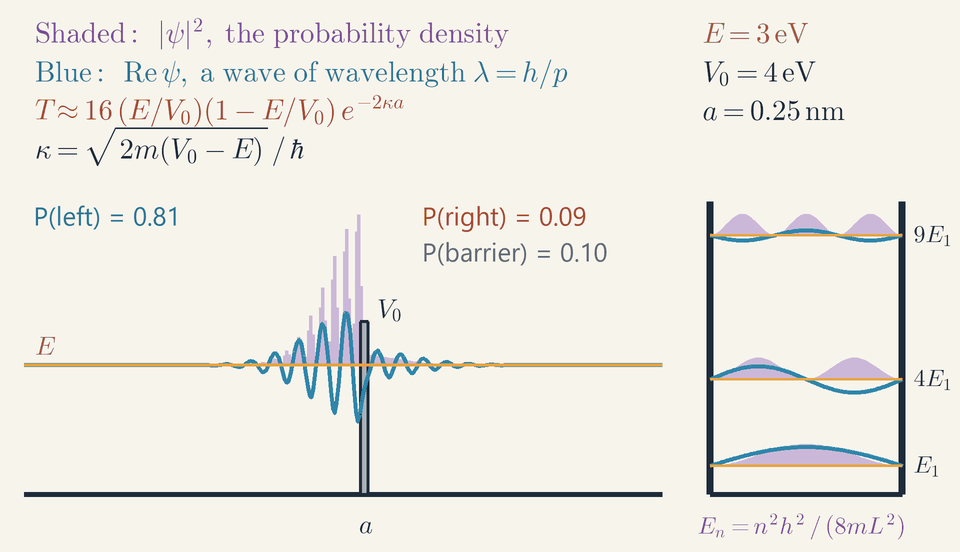
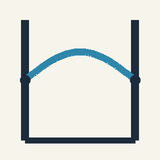
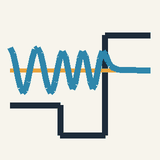
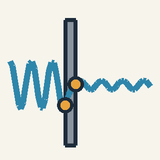
An electron wave packet hits a thin energy barrier: most of it is reflected and part tunnels through, while an electron trapped in a box shows its three lowest standing waves.
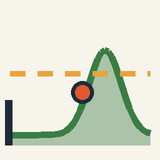
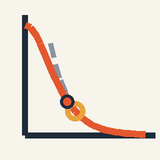
A ball with too little energy to reach the top of a hill always rolls back: its energy limits how high it can go.
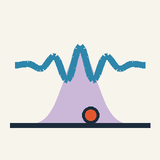
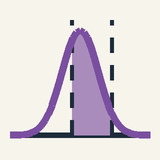
An electron is described by a wave: where the wave is big, the electron is likely to be found.
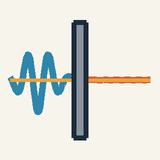
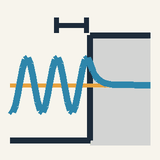
An electron's wave can leak through a thin wall it cannot climb: most of it bounces back, a little gets through.
Each electron is found whole on one side or the other; a thinner or lower wall lets many more through.
In a box only whole half-waves fit, so a trapped electron can only have certain energies.
Step 1: energy sets a limit. A ball rolling up a hill trades speed for height. With too little energy to reach the top, it stops partway and rolls back, every time: energy cannot appear from nowhere.
Step 2: tiny things behave like waves. Light acts sometimes as a wave, sometimes as particles (photons), and so do electrons. An electron is described by a wave, written ψ (the Greek letter psi). Where the wave is big, the electron is likely to be found; where it is flat, almost never. In the animation the blue line is the electron's wave and the shaded hump shows where it probably is.
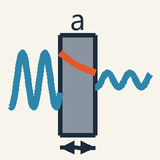
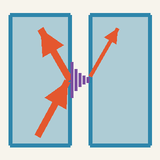
Step 3: a wave can leak through a thin wall. The gold line is the electron's energy and the grey wall is higher, so a ball would always come back. Watch: most of the wave bounces back, but a smaller wave appears beyond the wall and moves on. Each electron is still found whole on one side or the other; here about one in five gets through. This is quantum tunnelling. Light does it too: light trapped in glass by total internal reflection can cross a very thin air gap into a second block.
Check yourself: the wall is made twice as thick. Do more or fewer electrons get through? Answer: far fewer, because the wave dies away quickly inside the wall. A lower wall, though, lets more through.
Step 4: trapped waves have set energies. In the box on the right the wave must fit between the walls like a guitar string, so only whole half-waves are allowed, each with its own energy. Electrons in atoms are trapped too, which is why atoms have energy levels.
Tunnelling lets nuclei fuse inside the Sun and stores photos in flash memory.
Intermediate
Key ideas
∣ψ∣2 is the probability density: its area over a region is the chance of finding the particle there.
Where E>V, ψ oscillates with λ=h/p; where E<V, it decays as e−κx, with κ=2m(V0−E)/ℏ.
For a wide barrier T≈16(E/V0)(1−E/V0)e−2κa: the width a sits in an exponent.
A 3 eV electron and a 4 eV, 0.25 nm barrier give κ=5.12nm−1 and T≈0.22; doubling a cuts T more than tenfold.
A box of width L allows only L=nλ/2, so En=n2h2/(8mL2): levels in the ratio 1 : 4 : 9.
The wavefunction and its probabilities
A detector behind a wall higher than the electrons' energy still finds some of them. In quantum mechanics an electron has no definite path. Its state is a wavefunction ψ(x), a wave that is never seen directly: a detector finds the whole electron at one place, and the wavefunction only says how likely each place is.
By the Born rule, ∣ψ∣2 is a probability per metre, and the probability of finding the particle between two points is the area under it: P=∫∣ψ∣2dx
In the animation ∣ψ∣2 is the purple shading and the blue line is the real part of the wave, Reψ. The readouts P(left), P(barrier) and P(right) are the areas of the shading in three regions, and over the whole line they add up to 1.
The Schrödinger equation on an energy diagram
For a particle of definite energy E the wavefunction obeys the time-independent Schrödinger equation: −2mℏ2dx2d2ψ+V(x)ψ=Eψ Here m is the mass, V(x) the potential energy and ℏ=h/2π the reduced Planck constant. Read it as an energy balance: kinetic plus potential energy equals E, and the kinetic part is set by how sharply ψ curves.
The animation is an energy diagram: position runs across, energy runs up. The grey barrier is V(x), zero on both sides and V0 inside, and the gold line is E, with the wave drawn about it. Where E>V the wave oscillates with the de Broglie wavelength λ=ph,p=2m(E−V) as the blue wave does on both sides of the barrier.
Where E<V a classical particle could never be, since its kinetic energy would be negative. The equation still has solutions there, but they are exponentials, not waves, and the decaying one dies away gradually inside the wall.
Inside the barrier: decay and transmission
Inside a thick barrier of height V0 the wave decays as e−κx, with the decay constant κ=ℏ2m(V0−E) Over the decay length 1/κ the amplitude falls by a factor e≈2.72. A larger deficit V0−E or a heavier particle makes κ larger and the decay faster.
A thin barrier leaves some wave on the far side, with the same wavelength but a smaller amplitude. The fraction of electrons that get through is the transmission probability T, the fraction that come back is R, and R+T=1. For a barrier of width a much larger than 1/κ, T≈16(V0E)(1−V0E)e−2κa The amplitude is multiplied by e−κa and the probability by its square; the prefactor, never above 4, depends only on E/V0.
The width sits in an exponent, so tunnelling is extremely sensitive to it: every extra 1/(2κ) of thickness divides T by e. For barriers a few electronvolts high, only layers at most a few nanometres thick let many electrons through.
Worked example: the barrier in the animation
The electron has E=3eV and meets a barrier V0=4eV high and a=0.25nm wide, the values written in the scene. The top of the barrier is 1 eV, 1.60×10⁻¹⁹J, above the energy, so κ=1.055×10−342⋅9.11×10−31⋅1.60×10−19≈5.12×10⁹m−1=5.12nm−1 and the decay length 1/κ=0.195nm is a little shorter than the barrier.
Then 2κa=2⋅5.12⋅0.25=2.56 and e−2.56≈0.077. The prefactor is 16⋅0.75⋅0.25=3, so T≈3⋅0.077≈0.23 The exact formula of the advanced level gives 0.214, and the moving packet, which holds a small spread of energies, 0.218. That is where the readouts settle: P(right)=0.22 and P(left)=0.78.
Outside the barrier λ=h/2mE=0.708nm, and the transmitted wave has the same wavelength but only about 0.22≈0.47 of the incoming amplitude. In front of the barrier the incoming and reflected waves overlap in tall fringes λ/2=0.354nm apart. About 4 s in, the readouts show 0.80 on the left, 0.10 in the barrier and 0.10 on the right: for a moment a tenth of the probability sits inside the wall.
Worked example: a scanning tunnelling microscope
A sharp metal tip is held a fraction of a nanometre above a conducting surface. For electrons near the top of the filled levels the gap is a barrier whose top lies about one work function above them, here V0−E=4.5eV, and the current is proportional to the transmission, I∝e−2κd, with d the width of the gap. By what factor does it change when the tip moves 0.1 nm closer?
Since κ grows as the square root of the deficit, κ=5.12⋅4.5≈10.9nm−1, and the prefactor cancels in a ratio: I2/I1=e2κΔd=e2⋅10.9⋅0.1=e2.17≈8.8. With the rounder κ≈10nm−1 it is e2≈7: a shift of less than half an atom's diameter multiplies the current several times.
A bump only 0.01 nm high changes the current by e0.217≈1.24, a 24 % rise, while an atomic step 0.2 nm high changes it about 77 times. A feedback loop moves the tip to keep the current constant as it scans, and the tip's height then traces the surface atom by atom.
Trapped waves: energy levels in a box
Now trap the electron in a box of width L with V=0 inside and walls it cannot pass. The wavefunction must vanish at both walls, like a guitar string fixed at both ends, so only whole numbers of half-wavelengths fit, L=nλ/2. Then p=h/λ=nh/(2L), and the kinetic energy p2/2m gives the allowed energies En=8mL2n2h2 with n=1,2,3,… counting the half-waves; n=0 would mean no wave at all, so the lowest energy is never zero.
The levels grow as n2, in the ratio 1 : 4 : 9, as in the box of the animation, labelled E1, 4E1 and 9E1. Each standing wave keeps a fixed shading ∣ψn∣2: a state of definite energy is stationary. For L=1nm, E1=(6.626×10⁻³⁴)2/(8⋅9.11×10−31⋅10−18)≈6.0×10−20J=0.38eV, so E2=1.50eV and E3=3.38eV. A jump from n=3 to n=2 releases 5E1=1.88eV, a red photon of about 660 nm. A smaller box spaces the levels further apart, as 1/L2.
Common mistakes
The electron does not lose energy in the barrier. Beyond it the wavelength is still 0.708 nm, so a 3 eV electron comes out with 3 eV; only the amplitude is smaller.
The electron does not split. P(right)=0.22 means that about 22 of every 100 electrons are found beyond the barrier, each one whole.
Transmission is not inversely proportional to width: from 0.25 nm to 0.5 nm, T falls from 0.214 to 0.018, about twelve times, because doubling the width squares the exponential factor.
Mass matters as much as energy. A proton with the same 3 eV at the same barrier has a κ larger by 1836≈43, so 2κa≈110 and T≈6×10−48.
Where you meet it
Flash memory stores each bit as charge on an isolated gate, written and erased by driving electrons through an insulating layer a few nanometres thick. Tunnel diodes, scanning tunnelling microscopes and the escape of alpha particles from nuclei follow the rule of this lesson, and in the Sun's core protons fuse only thanks to tunnelling.
The same wave rules govern light in Reflection and Refraction, where a totally reflected beam can cross a thin gap. Nuclei tunnel in Radioactivity and Half-Life and in Fission, Fusion and E = mc²; Semiconductors, Diodes and LEDs builds energy bands from electron waves; and Atomic Models: the Bohr Atom has relatives of the box levels.
Advanced
Key ideas
In a static potential ω=E/ℏ is the same everywhere; p2/2m=E−V sets the local wavelength, and where V>E the wave decays as e−κx.
Matching ψ and ψ′ at both edges gives T=[1+V02sinh2(κa)/(4E(V0−E))]−1, with ∣r∣2+∣t∣2=1.
For κa≫1, T≈16(E/V0)(1−E/V0)e−2κa: the exponential fall traced by the T(a) graph.
Frustrated total internal reflection is the optical twin: light crosses a gap about a wavelength wide on its decaying field.
WKB, T≈exp(−2∫κdx), explains why alpha energies of 4–9 MeV give half-lives from microseconds to billions of years.
One frequency, many wavelengths
Tunnelling is a wave effect, so start with the wave of a particle that has a definite energy and ask how it changes as the potential energy changes along its path. Two rules settle almost everything that follows: the frequency is the same everywhere, and the wavelength adjusts to the local kinetic energy. Where the kinetic energy would be negative, the wave does not stop dead; it fades.
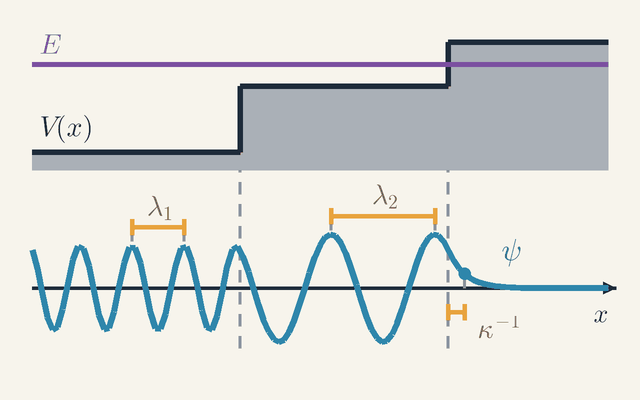
Figure 1. One state of energy E crossing three levels of V(x) (grey). Where E−V is smaller the wave is longer (V=43E gives λ2=2λ1); where V>E it stops oscillating and dies out over the length κ−1.Legend
E
Energy of the state: one value for the whole wave.
J
V(x)
Potential energy at position x, drawn in grey: 0, 43E and 45E.
J
ψ
Wave function: its real part at one instant.
m−1/2
x
Position along the line of motion.
m
λ1
Wavelength on the lowest level, where E−V is largest.
m
λ2
Wavelength on the middle level, where E−V is a quarter as large: λ2=2λ1.
m
κ−1
Decay length where V>E: over it ψ falls to 1/e of its value at the edge.
m
Figure 1 shows one state of energy E (the purple line) crossing three flat levels of the potential energy V(x) (grey). Underneath, the blue curve is the wave function ψ at one instant. On the lowest level V=0, and the wave oscillates with wavelength λ1. On the middle level V=43E, so the kinetic energy E−V is only a quarter of what it was: the wave stretches to λ2=2λ1, and its crests grow taller. On the highest level V=45E lies above E. There the wave stops oscillating and dies away, falling to 1/e of its value at the edge over the short length κ−1 marked at the right. Look also at the two steps: the curve is continuous there and has no kink.
Why the frequency is shared. When V does not depend on time, a state of definite energy has the form ψ(x)e−iωt: a fixed shape in space times a single oscillating factor, with the same angular frequency ω=E/ℏ at every x. Nothing in the potential changes in time, so nothing can drive one part of the wave faster than another. Light entering glass behaves in the same way: it keeps its frequency and changes only its wavelength. One frequency for the whole wave means one energy for the whole motion. This is energy conservation, in the language of waves.
Why the wavelength changes. The fixed energy is shared differently between kinetic and potential energy from place to place. Writing ℏω=p2/2m+V(x) and solving for the momentum gives the local momentum p(x)=2m(E−V(x)), and with it the local wavelength h/p(x). Where V dips, p is larger and the waves crowd together; where V rises, they stretch. On the middle level of Figure 1 the kinetic energy is a quarter as large, so p is halved and the wavelength doubles from λ1 to λ2. The crests are taller there because a slower particle spends more time on each stretch of its path, so it is more likely to be found there.
What happens where V>E. A classical particle can never be there, since its kinetic energy E−V would be negative: this is the classically forbidden region. In the formula, the square root of a negative number is imaginary, p=iℏκ, with the real decay constant κ=ℏ2m(V−E) Put into the plane wave eipx/ℏ, this turns it into the real exponential e−κx. The equation also allows the growing solution e+κx, but in a forbidden region that goes on without end it would make ψ grow without limit, so it is ruled out. The amplitude therefore does enter the forbidden region, but it decays there, by a factor e over every length 1/κ.
Comparing the top and middle levels shows how short this decay length is. In Figure 1, V−E on the top level equals E−V on the middle level, so κ equals the middle level's wavenumber 2π/λ2 and the decay length is κ−1=λ2/2π: the wave is gone within about a sixth of a wavelength.
Light fades in the same way, and the effect can be seen on a laboratory bench. A ray travels in glass of refractive index n, at an angle θ to the normal of a surface with air beyond it. The wave pattern along the surface must match on both sides, so the component of the wavevector along the surface, ky=nωsinθ/c, is the same in the air. In air, however, the whole wavevector is only ω/c long. Beyond the critical angle, where nsinθ>1, the component along the surface is already longer than that on its own, so the square of the component across the gap is negative: kx2=(ω/c)2−ky2=(ω/c)2(1−n2sin2θ) Then kx=iκ is imaginary, and the field in the air decays as e−κx. For n=1.5 at 60°, κλ0=2πn2sin2θ−1≈5.2, where λ0 is the vacuum wavelength. Green light of 550 nm therefore decays over about 0.1 µm. Bring a second glass block that close, and part of the light crosses the gap into it. This is frustrated total internal reflection: barrier penetration for photons.
Matching at the edges: the exact transmission
Now make the forbidden region finite: a barrier with allowed ground on both sides. The decaying wave reaches the far side with a reduced but non-zero amplitude, and there it starts a travelling wave again. To find how much gets through, solve the wave equation in each region and join the pieces at the edges.
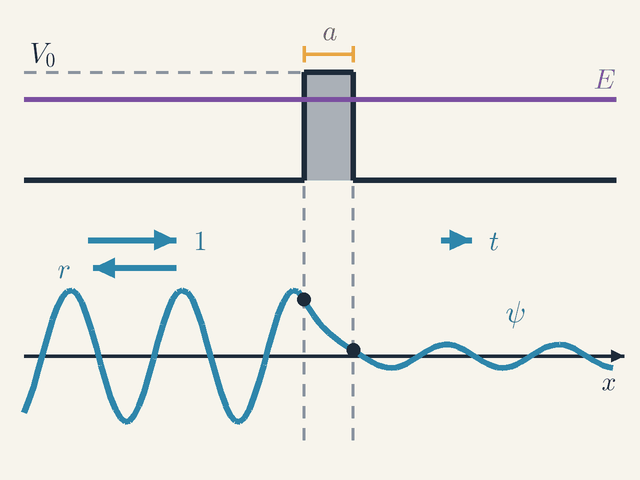
Figure 2. A wave of unit amplitude meets a barrier of height V0 and width a (E=43V0, κa=1.6). The arrow lengths are the incident (1), reflected (r) and transmitted (t) amplitudes; at the two dots ψ and its slope match.Legend
V0
Height of the barrier.
J
E
Energy of the wave, below the top of the barrier.
J
a
Width of the barrier.
m
ψ
Wave function: its real part at one instant.
m−1/2
x
Position along the line of motion.
m
r
Amplitude of the reflected wave, for an incident wave of amplitude 1.
t
Amplitude of the transmitted wave behind the barrier, on the same scale.
Figure 2 shows a wave of unit amplitude arriving from the left at a barrier of height V0 and width a. It is drawn for E=43V0 and κa=1.6, a barrier just under half a wavelength thick. In front of the barrier the incident wave (arrow 1) and the reflected wave (arrow r) overlap and form a nearly standing wave. Inside, the curve bends away from the axis and sinks. Behind the barrier a single wave of amplitude t runs on to the right, and nothing comes back from there. The arrow lengths are the amplitudes: here ∣r∣=0.94 and ∣t∣=0.34. The two dots mark the edges, where ψ and its slope ψ′ must have the same values on both sides.
Why must they agree? Rearrange the Schrödinger equation into a statement about curvature: dx2d2ψ=ℏ22m(V−E)ψ Where V<E, the curvature has the opposite sign to ψ, so the curve always bends back towards the axis and oscillates. Where V>E, it has the same sign, so the curve bends away from the axis, like e±κx. At an edge V jumps by a finite amount, so the curvature jumps too, but it stays finite. A finite curvature acting over a vanishing distance cannot change the slope, so ψ′ is continuous; and a curve whose slope is finite cannot jump, so ψ is continuous as well. That is why the curve in Figure 2 passes through the dots without a kink.
Now the calculation. Put the barrier on 0<x<a, with V=0 outside it. Outside, the wavenumber is k=2mE/ℏ; inside, the decay constant is κ=2m(V0−E)/ℏ. On the left, ψ=eikx+re−ikx: the incident wave of unit amplitude plus the reflected wave. Inside, ψ=Ceκx+De−κx; the growing term is allowed this time, because the barrier ends before it can grow without limit. On the right, ψ=teikx alone, because nothing comes in from that side.
That makes four unknowns, r, C, D and t, and the edges supply four conditions: ψ and ψ′ continuous at x=0 and at x=a. These are four linear equations, and eliminating C and D leaves t=coshκa+i2kκκ2−k2sinhκae−ika The transmission probability is its squared size, one over the squared size of the denominator: ∣t∣2=[cosh2κa+(2kκκ2−k2)2sinh2κa]−1 Replace cosh2 by 1+sinh2. The two sinh2 terms then combine, with the coefficient 1+(κ2−k2)2/(2kκ)2=(κ2+k2)2/(2kκ)2. Since κ2+k2=2mV0/ℏ2, this coefficient is V02/(4E(V0−E)), and T=[1+4E(V0−E)V02sinh2(κa)]−1
Why is ∣t∣2 the fraction that gets through? The probability current j=(ℏ/m)Im(ψ∗ψ′) measures how much probability flows past a point per second. In a stationary state probability piles up nowhere, so j is the same at every x. On the left it is (ℏk/m)(1−∣r∣2), the incident flow minus the reflected flow; on the right it is (ℏk/m)∣t∣2. Setting them equal gives ∣r∣2+∣t∣2=1: every particle is either reflected or transmitted. The speed ℏk/m is the same on both sides, so T=∣t∣2 is the transmitted fraction.
The arrows and the formula both give a numerical check of this result. In Figure 2 the arrows give ∣r∣2=0.88 and ∣t∣2=0.12, which add up to 1, and the 12 % that gets through is T. The formula agrees: with E=43V0 the factor V02/(4E(V0−E)) is 4/3, sinh1.6=2.38, and T=1/(1+34⋅5.65)=0.12.
For a thick barrier, κa≫1, two simplifications apply. First, sinhκa=21(eκa−e−κa)≈21eκa, because the second exponential is tiny. Second, the sinh2 term is then huge, so the 1 in the bracket is negligible and the bracket can be inverted directly: T≈16(V0E)(1−V0E)e−2κa The prefactor is never more than 4, its value at E=21V0, so the exponential decides: each extra decay length 1/κ of width divides T by e2≈7.4.
How transmission falls with width
The exact formula is hard to read at a glance. A graph of T against the width shows its two regimes: a gentle start for thin barriers and a pure exponential for thick ones.
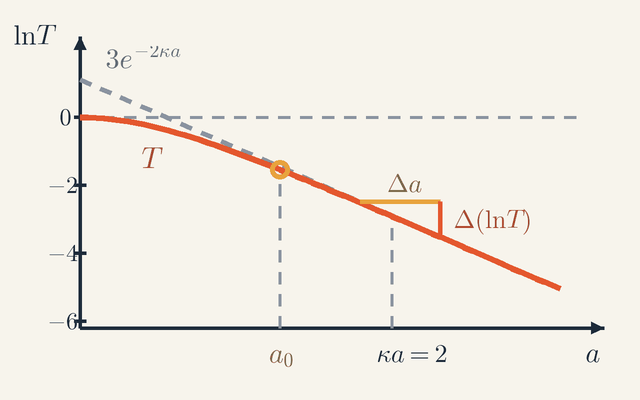
Figure 3.lnT against the barrier width a for E=3eV, V0=4eV. The exact curve starts flat, then follows the dashed thick-barrier line of slope −2κ. The ring marks the animation's barrier a0.Legend
lnT
Natural logarithm of the transmission probability; 0 means T=1.
a
Width of the barrier.
m
T
Exact transmission probability for a barrier of width a.
e−2κa
Thick-barrier law, here T≈3e−2κa: the dashed straight line.
κa
Width in decay lengths 1/κ; the dashed marker at κa=2 is where the straight line takes over.
a0
Width of the animation's barrier, 0.25 nm.
m
Δa
A step in the barrier width.
m
Δ(lnT)
Change of lnT over that step, −2κΔa: T is multiplied by e−2κΔa.
Figure 3 plots the exact T(a) for E=3eV and V0=4eV, up to a=0.6nm; the Advanced layer of the animation shows the same curve. Here it is drawn on a logarithmic scale, as lnT against a, because on that scale an exponential is a straight line. For an electron with V0−E=1eV, κ=5.12nm−1, so one decay length is about 0.2 nm.
Follow the solid curve T from the left. It starts at T=1, that is lnT=0, since no barrier means no reflection. It leaves that level gently: for small a, sinhκa≈κa, so T≈[1+1.33(κa)2]−1, where 1.33=V02/(4E(V0−E)). The exact values are still 0.92 at 0.05 nm and 0.72 at 0.1 nm. Beyond the dashed marker at κa=2 the curve is practically a straight line. The triangle reads off its slope: a step Δa lowers lnT by Δ(lnT)=−2κΔa, so each further 0.1 nm multiplies T by e−1.02≈0.36. The ring marks the animation's barrier, a0=0.25nm, where T=0.214.
The dashed line is the thick-barrier law. For these energies 16(E/V0)(1−E/V0)=16⋅43⋅41=3, so T≈3e−2κa: a straight line that starts at ln3≈1.1, and that the exact curve joins. For thin barriers the law is poor. At a=0 it gives 3, more than any probability can be, and at 0.25 nm it gives 0.232, 8 % too high. From 0.4 nm on it agrees within 2 %.
The animation sends a wave packet, not a wave of a single energy: its energies are spread by 0.34 eV around 3 eV. Because T rises steeply with E (a higher energy means a smaller κ), the faster components get through more easily. The packet's transmission, 0.218, is therefore slightly above the 0.214 of a 3 eV wave, and the transmitted electrons average 3.08 eV against 2.99 eV for the reflected ones.
What if the energy is above the barrier, E>V0? Classically every particle would pass. In the formula V0−E is now negative, so κ becomes imaginary: κ=iq, where q=2m(E−V0)/ℏ is the real wavenumber over the barrier. Then sinhκa becomes isinqa, and both sinh2κa and V0−E change sign, so T=[1+4E(E−V0)V02sin2(qa)]−1 Now T oscillates with the width instead of falling. It reaches 1 only at the resonances qa=nπ, where the barrier holds a whole number of half-wavelengths and the waves reflected at its two edges cancel. At every other width some of the wave is reflected, even though the particle has energy to spare. For a 3 eV electron over a barrier 2 eV high, q=5.12nm−1: as the width grows, T dips to 0.75 and returns to 1 at a=0.61nm, 1.23 nm and so on.
Smooth barriers and alpha decay
Real barriers are rarely rectangular: their height changes gradually along the path. The thick-barrier law extends to them slice by slice, and its best-known use explains why some nuclei live for billions of years and others for less than a microsecond.
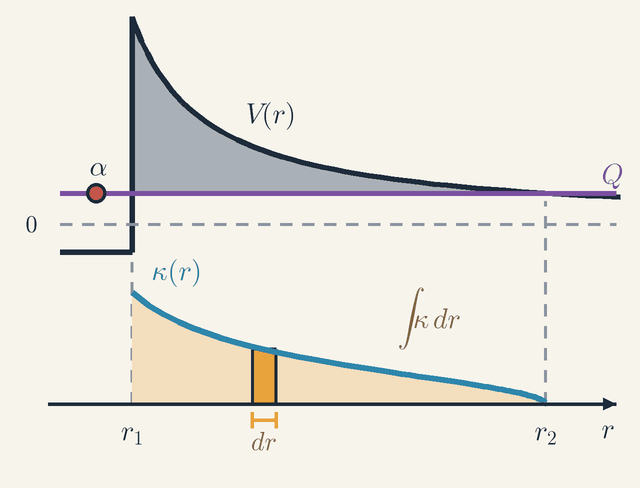
Figure 4. Top: the barrier holding an alpha particle in uranium-238, to scale outside the nucleus (the well inside is a sketch). Bottom: κ(r) from r1 to r2; the shaded area is ∫κdr, made of slices like the gold one of width dr.Legend
V(r)
Potential energy of the alpha particle at distance r from the centre: a well inside the nucleus, electric repulsion outside.
J
Q
Energy released in the decay: the alpha particle's energy, the E of the formulas.
J
α
The alpha particle, trapped in the well.
r
Distance from the centre of the nucleus.
m
r1
Nuclear surface, where the barrier begins.
m
r2
Outer turning point, where V=Q again and the barrier ends.
m
κ(r)
Decay constant 2m(V−Q)/ℏ at distance r; it falls to zero at r2.
m−1
dr
Width of one thin slice of the barrier; the slice multiplies the amplitude by e−κdr.
m
∫κdr
Area under κ(r) from r1 to r2: the exponent in T≈e−2∫κdr.
Figure 4 shows the barrier that holds an alpha particle inside a uranium-238 nucleus. The coordinate along the motion is now the distance r from the centre, in the role of x. The upper panel shows the potential energy V(r) and the energy Q released in the decay, which plays the part of E. Inside the nuclear surface r1 the strong force makes a deep well (only sketched), and the alpha particle α is trapped in it. Just outside r1 the electric repulsion puts V far above Q. It falls off as 1/r and meets Q again at the outer turning point r2, where the barrier ends. The lower panel plots the decay constant κ(r)=2m(V(r)−Q)/ℏ over the same range: it is largest at r1 and falls to zero at r2.
To handle a barrier whose height varies, cut it into thin slices of width dr, like the gold strip. If κ changes little over one decay length, that is ∣dκ/dr∣≪κ2, each slice behaves like a thin piece of uniform barrier and multiplies the amplitude by e−κdr. Multiplying the factors of all the slices adds their exponents, so the amplitude falls by e−∫κdr, where ∫κdr is the shaded area under the curve. The probability is the square of the amplitude, which doubles the exponent: T≈exp(−2∫r1r2κ(r)dr) This is the WKB estimate, named after Wentzel, Kramers and Brillouin. It drops a prefactor of order 1, like the 3 of the rectangular barrier, because the exponent decides. For a rectangular barrier the area is simply κa, and the estimate gives back e−2κa.
George Gamow used this in 1928 to explain alpha decay. Beyond the reach of the strong force, the daughter nucleus, of charge Ze, repels the alpha particle, of charge 2e, with V=4πε0r2Ze2 the curve of Figure 4. For uranium-238 the daughter is thorium, Z=90. The barrier peaks near 28 MeV at the nuclear surface, about 9 fm from the centre, while the energy released is only Q=4.27MeV. The alpha particle must therefore tunnel out to where V has fallen to Q, about 61 fm from the centre. The integral gives 2∫κdr≈88, so T≈e−88≈6×10−39.
Turning this into a lifetime uses the same idea as the worked problem below. Inside the nucleus the alpha particle strikes the wall roughly 1021 times per second, with the chance T of escaping at each strike. The escape rate is about 1021⋅6×10−39=6×10⁻¹⁸ per second, so it escapes after some 1017 s: a few billion years. That is the right order for the measured half-life of 4.5 billion years, a real success for an estimate whose exponent is 88.
The exponent depends steeply on energy. Polonium-212 releases 8.95 MeV. Its outer turning point moves in to 26 fm, the barrier becomes thinner and lower, the exponent falls to about 33, and the half-life is only 0.3 µs. A drop of 55 in the exponent is a factor e55≈1024: roughly doubling the energy, from 4.3 to 9 MeV, shortens the half-life about 1024 times. This steep trend had already been measured, as the empirical Geiger–Nuttall rule; tunnelling explains it.
Bound states and zero-point energy
The same matching conditions do more than count transmitted particles. Applied to a particle trapped between walls, they produce its energy levels.
Start with a box whose walls are infinitely high. Then κ is infinite in the walls, the wave cannot enter them at all, and ψ must vanish at x=0 and x=L. Inside, where V=0, the solutions are sinkx and coskx. The condition at x=0 keeps only sinkx, and the condition at x=L requires kL=nπ, with n a positive whole number: a whole number of half-wavelengths must fit in the box. This leaves ψn=2/Lsin(nπx/L) where the factor 2/L makes the total probability 1. The energy is the kinetic energy ℏ2kn2/2m with kn=nπ/L: En=8mL2n2h2
In a well of finite depth the walls are not perfectly hard. Inside, the solution oscillates; outside, it must decay on both sides; and at each wall the two must join with the same value and slope. For most energies the inside wave reaches a wall with the wrong slope, and the outside piece would have to grow without limit. Only special energies let both joins work at once: quantisation is a boundary condition, not an extra postulate. The tails also let the wave spread a little beyond the walls, as if the box were slightly wider, so the wavelength is longer and the energy lower. For a well 1 nm wide and 4 eV deep the lowest level is 0.26 eV, not the 0.38 eV of the infinite box.
The lowest level is never zero. Taking n=0 would give ψ=0 everywhere, which is no particle at all. The uncertainty principle says the same. In the ground state the position spread is Δx=0.18L, and the momentum, of size πℏ/L in either direction, has the spread Δp=πℏ/L. Their product is ΔxΔp≈0.57ℏ, just above the minimum ℏ/2 that the principle allows. Confining a particle to a region of size L therefore costs kinetic energy of order ℏ2/(mL2), the zero-point energy. It keeps atoms from collapsing: pulling an electron closer to the nucleus lowers its potential energy but raises this kinetic cost.
Worked problem: a leaky trap
Place two of the animation's barriers, each 4 eV high and 0.25 nm thick, a distance L=2nm apart, with an electron of about 3 eV between them. How long does the electron stay trapped, and how does that depend on the thickness of the walls?
Treat the electron as a particle bouncing to and fro at the speed v=2E/m=1.03×106m/s, which is 1.03 nm per femtosecond, with a chance T of escaping each time it hits a wall. Between hits it crosses the gap once, so it hits a wall every L/v=1.95fs. The chance of escape per unit time, the escape rate, is therefore Γ=Tv/L. A constant chance per unit time means that the number still inside decays as e−Γt, with mean lifetime 1/Γ: τ=vTL=T1.95fs With the animation's 0.25 nm walls, T=0.214 and τ≈9fs. With walls 1 nm thick, T=1.06×10⁻⁴ and τ≈18ps. With 2 nm walls, T=3.8×10⁻⁹ and τ≈0.5μs.
Notice the pattern. By the thick-barrier law, each extra nanometre of wall divides T, and so multiplies the lifetime, by e2κ⋅1nm=e10.25, about 28,000: exactly the step from 18 ps to 0.5 µs.
A proton in the same trap would stay trapped far longer. Its mass is 1836 times larger, so at the same energy it moves 43 times more slowly and faces a κ 43 times larger, since both scale with m. Even with 0.25 nm walls, T falls to about 6×10−48 and τ grows to some 1034 s, far longer than the age of the Universe. The bouncing picture is crude for T=0.214, where the electron is gone within a few bounces, and accurate when T is small, as for alpha decay.
Limits of validity
Everything here is non-relativistic. A 3 eV electron moves at 0.34 % of the speed of light, and its energy is 6×10⁻⁶ of its rest energy, 511 keV, so the Schrödinger equation describes it excellently. The rectangular barrier and the infinite box are idealisations. In a tunnel junction, for instance, the electron induces charge in the nearby metal and is attracted to it, and this attraction rounds and lowers the barrier. That raises T but keeps the exponential dependence on the width.
The model is also one-dimensional. In three dimensions only the motion across the barrier counts, so an electron arriving at an angle, with less of its energy in that direction, tunnels less. Inside a solid the electron responds to forces as if it had a different mass, its effective mass, which replaces m. In gallium arsenide it is 0.067 of the free mass, which cuts κ about fourfold and lets electrons tunnel through layers a few nanometres thick in resonant-tunnelling diodes. Finally, the potential was taken as fixed and the electron as alone. In very small junctions one electron's charge changes the potential enough to block the next one.
Where this leads
Wave–Particle Duality introduced the amplitude and its probabilities; this lesson gave it an equation. Radioactivity and Half-Life shows the exponential decay law that a leaky trap produces, and Fission, Fusion and E = mc² the tunnelling that lets nuclei fuse in stars. Semiconductors, Diodes and LEDs applies the same matching conditions to a periodic potential, where they give energy bands.
Reflection and Refraction treats total internal reflection, whose frustrated form is the optical twin of tunnelling. The orbits of Atomic Models: the Bohr Atom give way to the three-dimensional Schrödinger equation, whose solution for hydrogen yields the same −13.6eV/n2 levels and the shapes of the orbitals, and Particles and Forces: the Standard Model makes the same wave mechanics relativistic.
Key formulas
Time-independent Schrödinger equation
−2mℏ2dx2d2ψ+V(x)ψ=Eψ
For a particle of definite energy, the equation says that kinetic plus potential energy equals the total energy E at every point. The kinetic part is set by the curvature of ψ: where E>V the curve bends back towards the axis and oscillates, and where E<V it bends away and grows or decays exponentially. Schrödinger proposed it in 1926 as the wave equation of matter.
Symbols
ℏ
reduced Planck constant
J⋅s
m
mass of the particle
kg
dx2d2ψ
curvature (second derivative) of the wavefunction
m−5/2
ψ
wavefunction
m−1/2
x
position along the line
m
V(x)
potential energy at position x
J
E
total energy of the particle
J
When it holds: For non-relativistic particles, with energies far below mc2, in a potential that does not change in time. A changing potential needs the time-dependent equation, and relativistic energies need the Dirac equation.
Example: Outside the animation's barrier V=0 and E=3eV, and the solution is a wave of wavelength h/2mE=0.708nm.
Probability from the wavefunction (Born rule)
P=∫∣ψ∣2dx
∣ψ∣2 is a probability per unit length, so the probability of finding the particle in a region is the area under ∣ψ∣2 over that region. Over the whole line the area is 1. Each measurement finds the particle whole, at one place; P predicts the fraction of runs in which it turns up in the region.
Symbols
P
probability of finding the particle in the region
∣ψ∣2
probability density
m−1
ψ
wavefunction
m−1/2
dx
width of a small slice of the line
m
When it holds: Holds for any normalised wavefunction, with the integral taken over the region of interest. In three dimensions ∣ψ∣2 is a probability per unit volume and the integral runs over a volume.
Example: After the collision in the animation, the area under ∣ψ∣2 to the right of the barrier is P(right)=0.22, and to the left 0.78.
Energy levels of a particle in a box
En=8mL2n2h2
The wavefunction must vanish at both walls, so a whole number n of half-wavelengths fits in the box: λ=2L/n. The momentum h/λ=nh/(2L) then gives the kinetic energy p2/2m. The levels grow as n2 and as 1/L2, so a smaller box spaces them further apart, and the lowest is never zero.
Symbols
En
energy of level n
J
n
quantum number, the number of half-waves: 1,2,3,…
h
Planck constant
J⋅s
m
mass of the particle
kg
L
width of the box
m
When it holds: Exact only for infinitely high walls. Real walls let the wave leak into them, so the box is effectively wider and the levels lie lower: 0.26 eV instead of 0.38 eV for the ground state of a well 1 nm wide and 4 eV deep.
Example: An electron in a box 1 nm wide: E1=0.38eV, E2=1.50eV and E3=3.38eV.
Decay constant inside a barrier
κ=ℏ2m(V0−E)
Where V0>E, the Schrödinger equation has exponential solutions e±κx instead of waves. It is the de Broglie relation with an imaginary momentum, p=iℏκ. The larger the energy deficit V0−E and the heavier the particle, the faster the decay: the amplitude falls by a factor e over the decay length 1/κ.
Symbols
κ
decay constant of the amplitude
m−1
m
mass of the particle
kg
V0
height of the barrier
J
E
energy of the particle
J
ℏ
reduced Planck constant
J⋅s
When it holds: Only for E<V0. For E>V0 the square root is imaginary, and the wave oscillates inside the barrier with wavenumber 2m(E−V0)/ℏ.
Example: For an electron, κ=5.12nm−1 times the square root of V0−E in eV: 5.12 nm⁻¹ in the animation, 10.9 nm⁻¹ for the 4.5 eV gap of a tunnelling microscope.
Transmission through a thick barrier
T≈16(V0E)(1−V0E)e−2κa
Across the barrier the amplitude is multiplied by e−κa, so the probability is multiplied by e−2κa. The prefactor, at most 4, comes from matching the waves at the two edges and depends only on E/V0. Because the width sits in the exponent, doubling it squares the exponential factor.
Symbols
T
transmission probability
E
energy of the particle
J
V0
height of the barrier
J
κ
decay constant inside the barrier
m−1
a
width of the barrier
m
When it holds: For thick barriers, κa≫1; within about 2 % of the exact result once κa>2. For thin barriers it overestimates, and as a→0 it even exceeds 1, so use the exact formula there.
Example: The animation: 3e−2.56≈0.23, against the exact 0.214; for a=0.5nm, 3e−5.12≈0.018.
Exact transmission through a rectangular barrier
T=[1+4E(V0−E)V02sinh2(κa)]−1
Matching ψ and ψ′ at both edges gives four equations for the reflected, inner and transmitted amplitudes, and T is the squared size of the transmitted one. It falls from 1 at a=0, smoothly at first and then exponentially. Conservation of the probability current makes the reflection probability R=1−T.
Symbols
T
transmission probability
V0
height of the barrier
J
κ
decay constant inside the barrier
m−1
a
width of the barrier
m
E
energy of the particle
J
When it holds: For a rectangular barrier in one dimension and a single energy E<V0. Above the barrier it becomes T=[1+V02sin2(qa)/(4E(E−V0))]−1, with q=2m(E−V0)/ℏ, and T=1 only at the resonances qa=nπ.
Example:E=3eV, V0=4eV, a=0.25nm: κa=1.28 and sinh2(κa)=2.76, so T=1/(1+1.33⋅2.76)=0.214, the circled point of the graph.
Glossary
Wavefunction
The wave ψ(x) that describes the state of a quantum particle. It is in general complex and is never observed directly; its squared size gives the probabilities of where the particle will be found.
Born rule
The rule that ∣ψ∣2 is a probability density: the chance of finding the particle in a region is the area under ∣ψ∣2 there. Each detection finds a whole particle; the rule describes how the detections of many runs are spread.
Schrödinger equation
The wave equation of non-relativistic quantum mechanics. For a state of definite energy it says that kinetic plus potential energy equals E, with the kinetic energy set by the curvature of ψ.
Stationary state
A state of definite energy E. Its wavefunction only turns its phase in time, at the frequency ω=E/ℏ, so ∣ψ∣2 does not change; the standing waves in a box are examples.
Classically forbidden region
A region where the potential energy exceeds the particle's energy, V>E, so the classical kinetic energy would be negative. The wavefunction is not zero there: it decays exponentially, over a length 1/κ.
Evanescent wave
A wave that does not travel but decays exponentially away from a boundary, like the wavefunction inside a barrier or light just beyond a totally reflecting surface. A second boundary within its reach turns it into transmission.
Quantum tunnelling
The passage of a particle through a barrier higher than its energy, which classical physics forbids. The particle keeps its energy, and the chance falls exponentially with the barrier's width: about 22 % for the electron in the animation.
Transmission and reflection probabilities
T and R, the fractions of particles that pass a barrier and that bounce back. They add up to 1, and even a particle with E>V0 is in general partly reflected.
Particle in a box
A particle confined between two impenetrable walls a distance L apart. Only whole numbers of half-waves fit, so its energies are En=n2h2/(8mL2), in the ratio 1 : 4 : 9.
Zero-point energy
The lowest energy a confined particle can have, which is never zero: E1=0.38eV for an electron in a 1 nm box. It follows from the uncertainty principle and keeps helium liquid down to absolute zero at ordinary pressure.
Frustrated total internal reflection
The optical twin of tunnelling: light totally reflected inside glass crosses a gap up to about a wavelength wide into a second block, carried across by the decaying field beyond the surface.
Scanning tunnelling microscope
An instrument that holds a sharp tip a fraction of a nanometre above a conducting surface and measures the tunnelling current between them. The current changes nearly tenfold per 0.1 nm of gap, so it maps surfaces atom by atom.
Quantities
ψ
Wavefunction
m−1/2
The amplitude of the particle's wave at each point. In one dimension ∣ψ∣2 is a probability per metre, so ψ itself has the unit m−1/2. Unlike the pure number ψ of Wave–Particle Duality, it carries a unit.
P
Probability
The chance of finding the particle in a given region, the area under ∣ψ∣2 there; it lies between 0 and 1.
E
Energy
J
The particle's total energy, kinetic plus potential, the same everywhere in a stationary state. Usually quoted in electronvolts: 3 eV for the electron in the animation.
V0
Barrier height
J
The potential energy inside the barrier, measured from the level on both sides: 4 eV in the animation. In general the potential energy is a function of position, V(x).
m
Mass
kg
The particle's mass, 9.11×10⁻³¹kg for an electron. A heavier particle has a larger κ and tunnels far less.
ℏ
Reduced Planck constant
J⋅s
ℏ=h/2π=1.055×10−34J⋅s. It links energy to frequency, E=ℏω, and momentum to wavenumber, p=ℏk.
h
Planck constant
J⋅s
h=6.626×10⁻³⁴J⋅s; it sets the de Broglie wavelength λ=h/p.
κ
Spatial decay constant
m−1
How fast the amplitude falls inside a barrier; 1/κ is the decay length. For an electron 1 eV below the top of the barrier, κ=5.12nm−1.
a
Barrier width
m
The thickness of the barrier, 0.25 nm in the animation. It enters the transmission through the exponent −2κa.
L
Box width
m
The distance between the walls of the box; the levels scale as 1/L2: 0.38 eV for L=1nm.
T
Transmission probability
The fraction of particles that get through the barrier: 0.214 for the animation's barrier at 3 eV, and 0.018 if it were twice as wide.
En
Energy of level n
J
An allowed energy of a particle in a box of width L, n2h2/(8mL2): 0.38, 1.50 and 3.38 eV for an electron in a 1 nm box.
Quiz
Beginner In quantum physics, what does the size of an electron's wave at a place tell you?
How fast the electron is moving there
How likely you are to find the electron there
How heavy the electron is there
How much energy the electron has there
Show answer
Answer: B. How likely you are to find the electron there
The wave sets the odds: where it is large, a detector is likely to find the electron; where it is flat, almost never. The electron itself is always found whole, in one place.
Beginner An electron reaches a thin wall that it does not have enough energy to climb over. What can happen?
It always bounces back, like a ball rolling up a hill
It always gets through, because it is a wave
It usually bounces back, but sometimes turns up on the other side
It stays stuck inside the wall
Show answer
Answer: C. It usually bounces back, but sometimes turns up on the other side
Most of its wave is reflected, but a small part leaks through a thin wall. So each electron has a chance, often small, of being found on the far side: this is tunnelling.
Beginner Which of these depends on quantum tunnelling?
A bicycle dynamo lighting a lamp
A magnifying glass focusing sunlight
A pressure cooker cooking food faster
The flash memory that keeps photos in a phone
Show answer
Answer: D. The flash memory that keeps photos in a phone
Flash memory is written and erased by making electrons tunnel through an insulating layer only a few nanometres thick. The other three are explained by classical physics.
Intermediate Using the estimate T ≈ e^(−2κa), what happens to the tunnelling probability when the barrier is made twice as wide?
It is squared: 0.1 becomes about 0.01
It halves: 0.1 becomes 0.05
It doubles: 0.1 becomes 0.2
It does not change, because only the height matters
Show answer
Answer: A. It is squared: 0.1 becomes about 0.01
Doubling a doubles the exponent, and e^(−4κa) = (e^(−2κa))², so 0.1 becomes about 0.01. This exponential sensitivity is why, for electrons and barriers a few eV high, tunnelling only matters when the barrier is at most a few nanometres thick.
Intermediate An electron is trapped in a box. Its lowest allowed energy is E₁. What is the energy of the third level, n = 3?
3·E₁
6·E₁
9·E₁
E₁/9
Show answer
Answer: C. 9·E₁
E_n = n²·h²/(8mL²), so E₃ = 3² × E₁ = 9·E₁. Three half-waves fit in the box, so the wavelength is a third as long, the momentum three times larger, and the energy grows as its square.
Intermediate An electron with an energy of 3 eV tunnels through a barrier 4 eV high. What is its energy on the other side?
Less than 3 eV, because it lost energy pushing through
More than 3 eV, because the barrier gave it energy
4 eV, the height of the barrier
Still 3 eV: the wave beyond the barrier has the same wavelength
Show answer
Answer: D. Still 3 eV: the wave beyond the barrier has the same wavelength
Tunnelling through a fixed barrier conserves energy. Beyond the barrier V = 0 again, so the wave has the same wavelength λ = h/√(2mE) as before; only its amplitude, and so the probability, is smaller.
Advanced An electron whose energy E is greater than V₀ meets a rectangular barrier. What does quantum mechanics predict?
It always passes, T = 1, just like a ball
It is partly reflected in general; T = 1 only at resonances, when qa = nπ
It is always fully reflected
T = E/V₀, whatever the width
Show answer
Answer: B. It is partly reflected in general; T = 1 only at resonances, when qa = nπ
Above the barrier κ becomes imaginary and sinh(κa) turns into a sine: T = [1 + V₀²·sin²(qa)/(4E(E − V₀))]⁻¹, with q = √(2m(E − V₀))/ħ. T is below 1 except when qa = nπ, where the reflections from the two edges cancel.
Advanced In a scanning tunnelling microscope the gap acts as a barrier with κ ≈ 10 nm⁻¹. The tip moves 0.1 nm closer to the surface. Roughly how does the tunnelling current change?
It grows about 7 times
It grows by about 10 %
It doubles
It falls about 7 times
Show answer
Answer: A. It grows about 7 times
The current is proportional to e^(−2κd), so a gap 0.1 nm smaller multiplies it by e^(2 × 10 × 0.1) = e² ≈ 7.4. This steep dependence lets an STM sense height changes far smaller than an atom.
 Physics Tutor