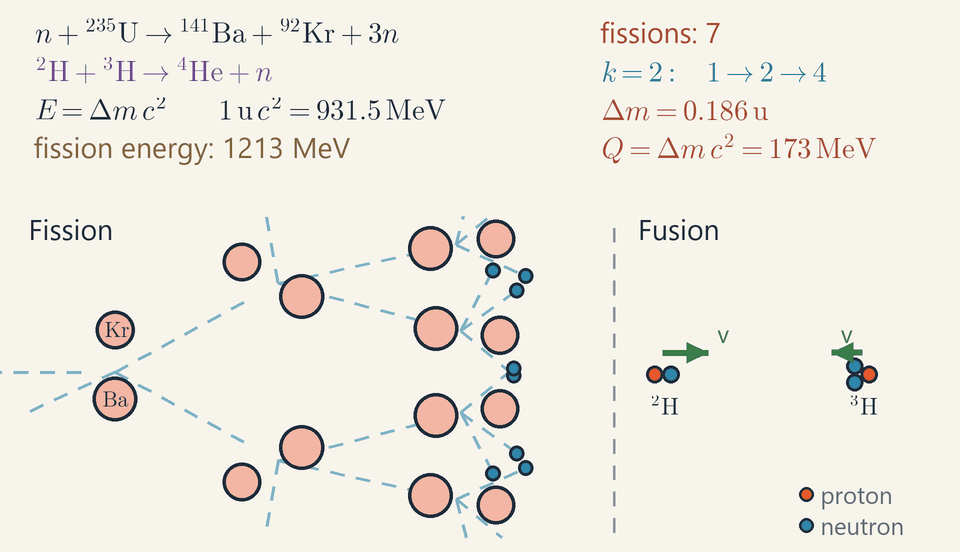
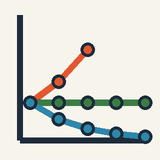
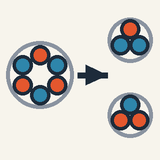
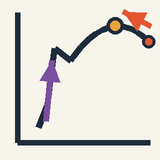
Splitting heavy nuclei and fusing light ones both release energy, because the products are more tightly bound and slightly lighter: the lost mass Δm leaves as the energy Q=Δmc2.
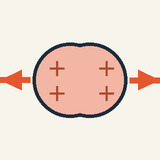
A neutron splits a uranium nucleus and starts a chain reaction (left), while two hydrogen nuclei fuse into helium (right); in both, the products weigh less and the mass difference is released as energy.
A nucleus is a tight cluster of protons and neutrons; the number of protons decides the element, and only a nuclear reaction can change it.
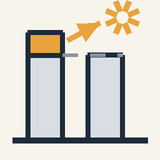
Fission: a neutron splits a heavy uranium nucleus into two smaller ones that fly apart, with a flash of energy and 2 or 3 new neutrons.
Those neutrons split more nuclei, which free more neutrons: a chain reaction that grows 1, 2, 4, …
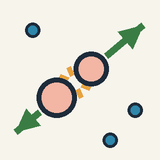
Fusion: two light nuclei collide at enormous speed and merge into helium; that is how the Sun shines.
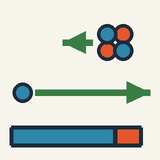
Energy is never made from nothing: the pieces weigh slightly less afterwards, and the missing mass has become energy, E=mc2.
Step 1. At the centre of every atom sits a tiny nucleus, a tight cluster of protons and neutrons. The number of protons tells you the element: 92 means uranium, 1 means hydrogen. Chemical reactions only shuffle the electrons outside; changing a nucleus takes a nuclear reaction.
Step 2. Fission means splitting. In the animation a blue neutron flies into a gold uranium-235 nucleus. The nucleus swallows it, wobbles and breaks into two smaller nuclei, with a flash of energy and two or three new neutrons. The two pieces shoot off in opposite directions.
Step 3. Each new neutron can split another uranium nucleus: a chain reaction. Follow the dashed paths as they branch, 1, 2, 4… In a power station, control rods soak up the spare neutrons so that each split causes just one more.
Step 4. Fusion means joining. On the right, two heavy-hydrogen nuclei rush at each other. Both are positive, so they repel and slow down; only a collision at enormous speed, at millions of degrees, lets them merge into helium and a fast neutron. The Sun shines by fusion too: it joins ordinary hydrogen into helium.
Step 5. Energy is never made from nothing; it only changes form. So where does it come from? Weigh everything very precisely: after either reaction the pieces are slightly lighter. The missing mass has turned into energy, E=mc2. Because the speed of light c is huge, a speck of mass gives a lot: one kilogram of uranium-235, fully split, gives as much heat as about 2,700 tonnes of coal.
Check yourself: do the helium nucleus and the neutron weigh more or less than the two heavy-hydrogen nuclei they came from? Answer: less. The difference has left as energy.
Intermediate
Key ideas
Q=Δmc2 with 1u⋅c2=931.5MeV, where Δm is the mass of the reactants minus the mass of the products.
n+235U→141Ba+92Kr+3n: Δm=0.186u, Q≈173MeV, carried off mostly by the two fragments, the lighter one faster.
2H+3H→4He+n: Q=17.6MeV; with equal momenta, K=p2/(2m) gives the 4× lighter neutron 4/5 of it.
Multiplication factor k: Ng=N0kg, so k<1 dies out, k=1 is a steady reactor and k>1 grows every generation.
No nucleon is destroyed: A balances on both sides. The mass drops because the products are more tightly bound.
What we measure: nuclei, masses and energies
In a fission no proton or neutron is lost, yet the pieces come out slightly lighter than what went in. A nucleus is described by two whole numbers: the proton number Z, which fixes the element, and the neutron number N. Their sum A=Z+N, the mass number, counts the nucleons. Uranium-235, 235U, has Z=92 protons and N=143 neutrons. Isotopes share Z but differ in N: deuterium, 2H, and tritium, 3H, are hydrogen with one and two neutrons.
Nuclear masses are given in atomic mass units, 1u=1.6605×10⁻²⁷kg, one twelfth of a carbon-12 atom. Nuclear energies are given in mega-electronvolts, 1MeV=1.602×10⁻¹³J, a million electronvolts, against the few electronvolts of a chemical bond. Tabulated masses are those of neutral atoms; in these reactions the electrons cancel.
Mass defect: where the energy comes from
Where does a reaction's energy come from? Special relativity answers: a body at rest holds the rest energy E=mc2 so a system that gives energy away becomes lighter by that energy divided by c2. Since c2=8.99×10¹⁶J/kg, a tiny loss of mass carries a huge energy.
The mass defect Δm is the total mass of the reactants minus that of the products, and the energy released, the Q value, is Q=Δmc2,1u⋅c2=931.5MeV A negative Q means that the reaction needs energy to happen.
Nothing is destroyed: nucleons and charge are conserved (1+235=141+92+3 and 92=56+36 in the fission), but the nucleons end up more tightly held. The energy needed to pull a nucleus apart into free protons and neutrons is its binding energy; per nucleon it climbs from 1.1 MeV in deuterium to about 8.8 MeV near iron-56, then sinks to 7.6 MeV in uranium. Fission and fusion both move nucleons towards that peak, and the extra binding leaves as energy.
The working equations
Besides Q=Δmc2, four relations do most of the work: the two reactions of the animation, the growth of a chain reaction, and the kinetic energy of a body of mass m and momentum p:
n+235U→141Ba+92Kr+3n+173MeV
2H+3H→4He+n+17.6MeV
Ng=N0kg
K=2mp2
To find a reaction's energy, balance it (the same mass numbers and charges on both sides), subtract the summed masses and multiply by 931.5 MeV per u. To find who carries it, use momentum: reactants almost at rest give products with equal and opposite momenta, and since K=p2/(2m) the lighter product gets more.
Worked example: the reactions in the animation
Start with the fission. With the atomic masses 235.0439 u for uranium-235, 140.9144 u for barium-141, 91.9262 u for krypton-92 and 1.0087 u for the neutron: mbefore=235.0439+1.0087=236.0526u mafter=140.9144+91.9262+3⋅1.0087=235.8667u Δm=236.0526−235.8667≈0.186u,Q≈0.186⋅931.5≈173MeV
These are the Δm and Q labels at the first split. The fissions counter then climbs to 3 and 7 (passing 5 briefly) and the energy readout to 520 and 1213 MeV: one Q per fission. The 173 MeV is forty million times the 4 eV that burning a carbon atom gives.
About 160 MeV becomes kinetic energy of the two fragments. The other 13 MeV goes to the three neutrons (about 6 MeV) and prompt gamma rays (about 7 MeV). The uranium was practically at rest, so the fragments leave with equal and opposite momenta and the lighter krypton takes the larger share: 160⋅141/233≈97MeV against 63 MeV for barium. Their speeds, 0.048c and 0.031c, differ by the factor 141/92≈1.5 that the two green v arrows show. The fuel soon stops the fragments, and their energy becomes heat.
The fusion works the same way, with a mass defect ten times smaller, so more decimals are needed: 2.014102 u for deuterium, 3.016049 u for tritium, 4.002603 u for helium-4 and 1.008665 u for the neutron. Δm=5.030151−5.011268=0.018883u,Q=0.018883⋅931.5≈17.6MeV
Again the momenta are equal and opposite. The neutron, four times lighter than the helium nucleus, moves four times faster and takes four fifths of the energy, 54⋅17.6≈14.1MeV, against 3.5 MeV for the helium: the two energy labels beside the products.
Worked example: a year in a power station
A large reactor produces 3000 MW of heat, which its turbines turn into about 1000 MW of electricity. How much uranium-235 does it split in a year, and how much mass disappears? With 3.156×10⁷s in a year, E=Pt=3.0×109W⋅3.156×107s=9.47×10¹⁶J Counting about 200 MeV, or 3.20×10⁻¹¹J, per fission (the later decays of the fragments included), the number of fissions is Nfis=3.20×10⁻¹¹J9.47×1016J=2.96×1027
That is 2.96×1027/(6.02×1023mol−1)=4.91×103mol of uranium-235, or 4.91×103mol⋅0.235kg/mol≈1150kg. The mass that disappears is far smaller, Δm=E/c2≈1.05kg, about a thousandth of the uranium split.
A coal station giving the same heat, at 30 MJ per kilogram, would burn over three million tonnes, yet lose the same 1.05 kg of mass.
Reading the arrows and the counters
Every green arrow is a velocity. With almost no total momentum to start with, two products move in opposite directions with speeds in the inverse ratio of their masses: 141 to 92 for krypton and barium, 4 to 1 for the neutron and the helium nucleus. On the fusion side the incoming arrows are in the ratio 3 : 2, because the lighter deuterium nucleus must move faster to match the momentum of the tritium nucleus. Both shrink as the repulsion between the positive nuclei slows them.
The dashed lines are neutron paths. Each early fission frees three neutrons, two of which split new nuclei, so each fission causes k=2 new ones. Generation g then holds Ng=N0kg=2g fissions, starting from N0=1: 1, 2 and 4. A bomb is a chain with k>1 in dense metal, its generations about ten nanoseconds apart. A power reactor is held at k=1: control rods of boron or cadmium absorb spare neutrons, and a moderator such as water slows the rest, since slow neutrons split uranium-235 much more readily.
Common mistakes
Nucleons are not destroyed. The mass number balances, 1+235=141+92+3; the mass drops because the fragments are more tightly bound, by about 0.8 MeV per nucleon.
E=mc2 is not special to nuclei. Burning coal also loses mass, about 3×10⁻¹⁰ of it; fission loses about a thousandth and D–T fusion four thousandths.
Fission and fusion do not cancel. Both move nucleons towards the binding peak near iron; splitting iron, or fusing beyond it, would cost energy.
Count every particle. Leaving the three outgoing neutrons out of the fission equation gives Δm=3.21u and almost 3000 MeV, seventeen times too much.
Watch the units. Multiply a mass in u by 931.5 MeV, or convert to kilograms first: 0.0189⋅1.66×10−27kg⋅8.99×1016m2/s2=2.82×10−12J, which is again 17.6 MeV.
Where you meet it
About a tenth of the world's electricity comes from fission reactors. The Sun fuses hydrogen into helium and turns about 4.3 million tonnes of mass into light every second; fusion experiments aim to do the same on Earth with D–T fuel. Fission fragments are radioactive, which links back to Radioactivity and Half-Life, and the rest energy mc2 comes from Special Relativity. Ahead, Schrödinger's Equation and Tunnelling explains how nuclei slip through the Coulomb barrier, and Particles and Forces: the Standard Model shows what holds protons and neutrons together.
Advanced
Key ideas
Mass measures total energy, so a bound nucleus weighs less than its free nucleons: B=(Zmp+Nmn−M)c2.
Z and N are conserved, so Q=∑B(after)−∑B(before): moving towards the B/A peak near iron releases energy from either side.
Liquid drop: volume ∝A minus surface ∝A2/3 and Coulomb ∝Z2/A1/3; the Coulomb repulsion pushes heavy nuclei to split.
A heavy drop has a fission barrier (≈ 6 MeV for uranium); slow-neutron capture lifts 236U∗ to 6.5 MeV, over the top.
D–T nuclei at ~10 keV tunnel through a ≈ 0.4 MeV Coulomb barrier; a reactor needs nTτ above about 3×10²¹keV⋅s/m3.
Mass as stored energy
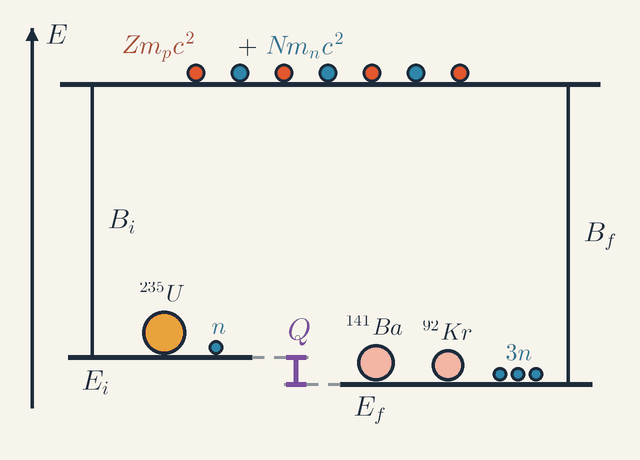
Figure 1. Energy levels of the fission n+235U→141Ba+92Kr+3n, to scale. The reactants lie Bi and the products Bf below the loose nucleons; the short step between them is the energy Q released, about a tenth of either depth.Legend
E
Energy; the axis points towards higher energy.
J
Zmpc2
Rest energy of the Z protons of the reaction, far apart and at rest.
J
Nmnc2
Rest energy of the N neutrons of the reaction, far apart and at rest.
J
Ei
Rest energy of the reactants: the nucleus 235U and a neutron.
J
Ef
Rest energy of the products: 141Ba, 92Kr and three neutrons.
J
Bi
Binding energy of the reactants, ∑B(before): how far their level lies below the loose nucleons.
J
Bf
Binding energy of the products, ∑B(after): how far their level lies below the loose nucleons.
J
Q
Energy released by the reaction: Q=Ei−Ef=Bf−Bi.
J
235U
Uranium-235 nucleus, with 92 protons and 143 neutrons.
141Ba
Barium-141 nucleus, a fission fragment.
92Kr
Krypton-92 nucleus, the other fragment.
n
Neutron (blue); 3n is three free neutrons.
Fission and fusion both release energy by rearranging nucleons, and how much they release can be read off from masses alone. Figure 1 shows why. It is the energy ledger of the fission in the animation, n+235U→141Ba+92Kr+3n, drawn to scale.
Start at the top line. Take all Z=92 protons and N=144 neutrons that take part in the reaction (the 143 of the uranium plus the incoming one) and imagine them far apart and at rest. Their energy is then just their rest energy, Zmpc2+Nmnc2, where mp and mn are the proton and neutron masses.
Now let the nucleons come together into nuclei. The strong nuclear force pulls them in, so the energy drops. The size of that drop is the binding energy B: the energy you would have to supply to pull the nucleons apart again. On the left, the reactants, the 235U nucleus and the neutron n, sit at the level Ei, a depth Bi below the top line. On the right, the products, 141Ba, 92Kr and three free neutrons, sit at the level Ef, a depth Bf below it. The short step between the two lower levels is the energy handed to the surroundings: Q=Ei−Ef=Bf−Bi Notice how small it is: about a tenth of either depth. The nucleons are bound almost as tightly before the split as after it; fission only tightens them a little.
Why should this energy show up as a change of mass? Picture a sealed box with perfectly insulating walls, holding a uranium-235 nucleus and a slow neutron, standing on a scale. Let the fission happen inside. The fragments fly apart and their kinetic energy becomes heat in the walls, but nothing leaves the box, so its total energy is unchanged, and so is its mass. Now open a window and let the heat out: the box becomes lighter by exactly Q/c2. The missing mass, the mass defect, has not been destroyed; it is the mass carried away by the released energy.
The general rule is that the mass of any composite body is its total internal energy divided by c2: the rest energies of its parts plus their kinetic and potential energies. Inside a nucleus the strong force makes the potential energy large and negative, so a nucleus weighs less than its free nucleons. That shortfall, times c2, is the binding energy, the depth of a level below the top line of Figure 1: B=(Zmp+Nmn−M)c2 Here M is the mass of the nucleus. Tables list the masses of neutral atoms, electrons included; with those, use the mass of a hydrogen atom mH in place of mp, so that the electron masses cancel.
Now the energy balance of a whole reaction. Rearrange the definition as Mc2=Zmpc2+Nmnc2−B for every nucleus, and add these up before and after the reaction. Fission, and the fusion of deuterium with tritium (D–T fusion, 2H+3H→4He+n), keep the total number of protons and the total number of neutrons separately. So the nucleon rest energies are the same on both sides and cancel; a free neutron simply counts as a nucleus with B=0. Only the binding energies remain: Q=∑B(after)−∑B(before) In the symbols of Figure 1, Bi=∑B(before) and Bf=∑B(after), so this is the same Q=Bf−Bi. A reaction releases energy when its products are more tightly bound than its reactants, and a table of masses is enough to say how much, whatever the details of the forces or of the way the nucleus breaks.
Reading the binding-energy curve
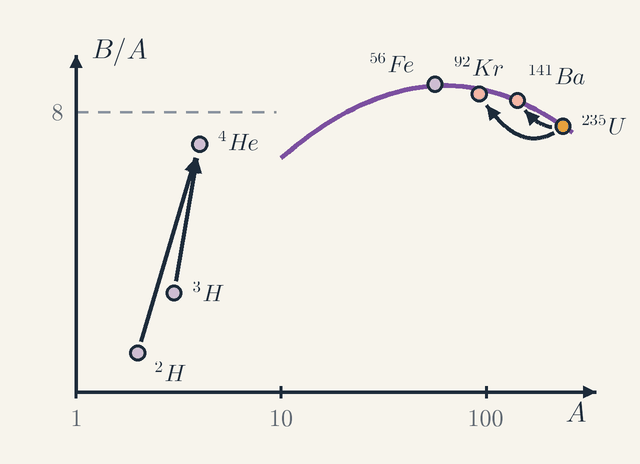
Figure 2. Binding energy per nucleon B/A against A on a logarithmic axis: the liquid-drop curve and measured nuclei. Fusion climbs the steep side to 4He; 235U splits into 92Kr and 141Ba, higher on the gentle side. The peak is near 56Fe.Legend
A
Mass number: the number of nucleons in the nucleus.
B/A
Binding energy per nucleon: the total binding energy B divided by A, the average binding of one nucleon. The dashed line marks 8MeV.
J
2H
Deuterium, with B/A=1.112MeV.
3H
Tritium, with B/A=2.827MeV.
4He
Helium-4, with B/A=7.074MeV: the product of D–T fusion.
56Fe
Iron-56, with B/A=8.790MeV, near the top of the curve.
92Kr
Krypton-92, with B/A=8.513MeV: a fission fragment.
141Ba
Barium-141, with B/A=8.326MeV: the other fragment.
235U
Uranium-235, with B/A=7.591MeV: the fissioning nucleus.
The binding-energy curve tells you how tightly bound every nucleus is, and therefore which reactions can release energy at all. Figure 2 plots the binding energy per nucleon, B/A, against the mass number A, the number of nucleons, on a logarithmic axis so that light and heavy nuclei both fit. The dots are measured nuclei. The purple curve is the liquid-drop formula of the next section, drawn from A=10 (the expert graph of the animation shows the same plot, with the curve in gold).
Read it from left to right. It climbs steeply through the lightest nuclei: 1.112 MeV per nucleon for deuterium, 2H, 2.827 MeV for tritium, 3H, and 7.074 MeV for helium-4. It peaks at 8.790 MeV near iron-56, 56Fe, then sinks slowly to 7.591 MeV for uranium-235. Any reaction that moves nucleons up the curve releases energy. On the steep left side that means joining light nuclei: fusion. On the gentle right side it means splitting heavy ones: fission.
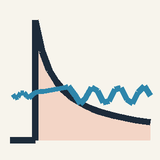
The arrows in Figure 2 are the two reactions of the animation, whose markers climb the curve in the same way. The fusion arrows run from 2H and 3H up to 4He. The fission arrows run from 235U to its two fragments, krypton-92 at 8.513 MeV and barium-141 at 8.326 MeV, both higher than uranium. Since B/A times A is the binding energy B of a nucleus, the rule Q=∑B(after)−∑B(before) gives both energies without a single mass, free neutrons counting zero: Qfus=4⋅7.074−2⋅1.112−3⋅2.827=17.59MeV Qfis=141⋅8.326+92⋅8.513−235⋅7.591=173.3MeV
Per nucleon the two processes are very different. D–T fusion releases about 3.5 MeV for each of its five nucleons, in one steep climb. Fission gains much less per nucleon. Of the 235 nucleons of uranium, 233 stay bound in the fragments, each about 0.81 MeV more tightly than before (the fragments' average B/A of 8.400 MeV, minus 7.591 MeV). The other two leave as free neutrons and give up their 7.591 MeV of binding each. The balance, 233⋅0.809−2⋅7.591≈173MeV, is the same Q: fission's large total comes from the large number of nucleons, not from a large gain for each.
Iron sets the limit for both. Fusing nuclei beyond the peak, or splitting nuclei below it, moves nucleons down the slope, to less tight binding, so the reaction costs energy instead of releasing it.
Why the curve peaks: the liquid drop
The shape of the curve comes from a contest between two forces: the nuclear force, which binds each nucleon to its neighbours, and the electric repulsion between protons. A simple model that treats the nucleus as a drop of charged liquid captures both and gives the curve of Figure 2.
Start with the nuclear force. It is strong but short-ranged, acting only over about 10−15m, and it saturates: each nucleon binds only its nearest neighbours, however many others there are. Two things follow. First, nucleons pack the same way in every nucleus, so all nuclei have about the same density; the volume grows in proportion to A, and the radius is R=r0A1/3 with r0≈1.2×10⁻¹⁵m.
Second, the binding behaves like that of a liquid. Every inside nucleon contributes the same amount, so the binding grows with the volume, as aVA. Nucleons at the surface have fewer neighbours, so a term proportional to the surface area, aSA2/3, is subtracted. In light nuclei a large share of the nucleons sit at the surface: that is why the curve rises so steeply on the left.
Next, the repulsion. A sphere of radius R with charge Ze spread evenly through it stores the electric energy 53Z2e2/(4πε0R). Putting in R=r0A1/3 gives a term aCZ2/A1/3, with the coefficient aC=534πε0r0e2≈0.72MeV
Last, the Pauli exclusion principle: no two neutrons, and no two protons, can occupy the same state, so each kind fills its own ladder of energy levels. A nucleus with more neutrons than protons must put its surplus neutrons on higher rungs, which costs energy. This asymmetry term vanishes when N=Z. Together the four terms give B=aVA−aSA2/3−A1/3aCZ2−AaA(N−Z)2 with aV=15.75, aS=17.8, aC=0.711 and aA=23.7MeV, fitted to measured masses; these are the values behind the curve of Figure 2. The fitted aC agrees well with the estimate above.
Now the peak. On its own, the volume term gives every nucleon the same binding and would make B/A flat. The surface term pulls B/A down most in light nuclei. The Coulomb term pulls it down most in heavy ones: with Z roughly proportional to A, it grows about as A5/3, faster than the volume term. In uranium-235 it costs 975 MeV out of a total binding of 1784 MeV. Between these two losses lies the maximum near iron. Two smaller nuclei hold the same 92 protons with less electric energy in total, because each proton is now repelled only by the protons of its own fragment; the surface energy rises a little, but the Coulomb saving is larger, and fission releases the difference.
The same contest explains why heavy nuclei carry extra neutrons. The Coulomb term favours fewer protons, the asymmetry term favours N=Z, and as nuclei grow the balance shifts towards neutrons: uranium-235 has 143 neutrons for 92 protons. The fragments inherit this surplus. Barium-141 has 85 neutrons, while the heaviest stable barium, barium-138, has only 82; with too many neutrons for their size, the fragments are radioactive.
The fission barrier
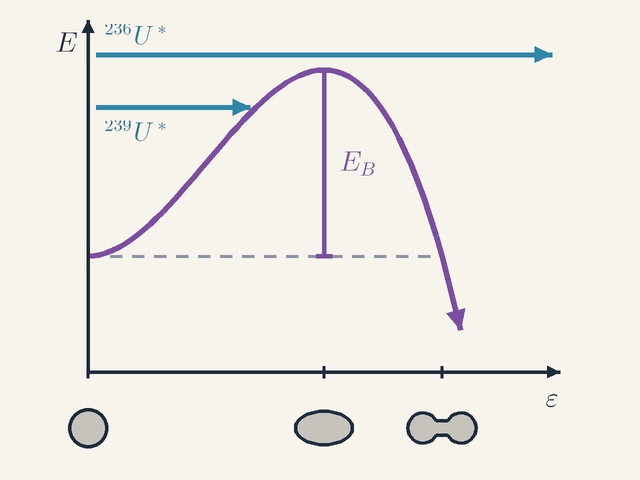
Figure 3. Energy E of a uranium nucleus against its elongation ε (shapes under the axis). The arrow of 236U∗ clears the barrier EB; that of 239U∗ stops at its wall. Curve schematic, not to scale; the levels are in proportion.Legend
ε
Elongation: how far the drop is stretched from a sphere into an elongated shape of the same volume.
E
Energy of the nucleus at that shape, measured from that of the sphere.
J
EB
Height of the fission barrier above the sphere: about 6 MeV for uranium.
J
236U∗
Excitation energy of 236U∗, formed by 235U and a slow neutron: 6.5 MeV, above the barrier.
J
239U∗
Excitation energy of 239U∗, formed by 238U and a slow neutron: 4.8 MeV, below the barrier.
J
The curve says uranium would release energy by splitting, so why does a uranium nucleus not split by itself? Figure 3 answers this. It plots the energy E of the nucleus, measured from that of the sphere, against its elongation ε: a small number that says how far the drop has been stretched from a sphere into an elongated shape of the same volume. The shapes under the axis show the sphere, the stretched drop and the drop about to break.
Two terms of the liquid drop change as it stretches. The surface grows, so the surface energy ES rises, by 52ε2ES. The protons move farther apart on average, so the Coulomb energy EC falls, by 51ε2EC. The net change, (52ES−51EC)ε2, is positive as long as EC<2ES: then the curve starts upward from the sphere, and a small stretch is pulled back. From the liquid drop, EC/ES=(aC/aS)Z2/A, so the condition reads Z2/A<2aS/aC≈50.
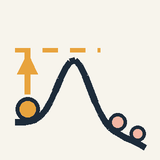
Uranium, with Z2/A≈36, passes this test: it sits in the hollow on the left of Figure 3. To split, it must first be stretched over the hump, the fission barrier, whose height EB is about 6 MeV. Beyond the top the Coulomb energy wins, and the energy falls steadily as the nucleus forms a neck and breaks in two: the arrow running down on the right.
Where does the energy to cross the barrier come from? A captured neutron brings its binding energy into the nucleus as excitation energy, and the two blue arrows of Figure 3 show how much. Uranium-235 and a slow neutron form 236U∗ (the star marks an excited nucleus) with 6.5 MeV of excitation, more than the barrier: its arrow clears the hump, and the nucleus splits. This is the brief quiver of the nucleus in the animation. Uranium-238 and a slow neutron form 239U∗ with only 4.8 MeV: its arrow runs into the wall of the hump and stops.
The difference is pairing. Nucleons bind more strongly in pairs, and the neutron added to uranium-235 completes a pair, while the one added to uranium-238 is left on its own. To split uranium-238, the incoming neutron must bring the missing energy as kinetic energy, about 1 MeV.
That is why reactors run on the rare isotope, uranium-235, only 0.7 % of natural uranium: it splits with neutrons of any energy. Slow neutrons are captured by it far more readily than fast ones, so reactors slow their neutrons down.
Chain reactions and delayed neutrons
Each fission sets free two or three neutrons, three in the animation's reaction, and these can split further nuclei. The multiplication factor k is the average number of neutrons from one fission that go on to cause another fission. After g generations, N0 neutrons have become Ng=N0kg. With k<1 the chain dies out, with k=1 it holds steady, and with k>1 it grows. A reactor runs at k=1.
How fast the chain grows depends on the time between generations. If every neutron were emitted at the moment of fission (a prompt neutron), a generation would last about 10−4s, which makes 104 generations per second. Then even k=1.001 would multiply the power by 1.001104≈2×10⁴ in one second, far too fast for any mechanical control.
Control rests on delayed neutrons. About 0.65 % of the fission neutrons are not emitted at the split but seconds later, by fragments as they decay. Waiting for them stretches the average generation to about 0.1 s, so the same k=1.001 raises the power by only about 1 % per second, slow enough to move control rods. This works only while the chain needs the delayed neutrons. Above k≈1.0065 the prompt neutrons alone keep the chain growing and the fast multiplication returns, so a reactor must always stay below that value.
Fusion: the Coulomb barrier and tunnelling
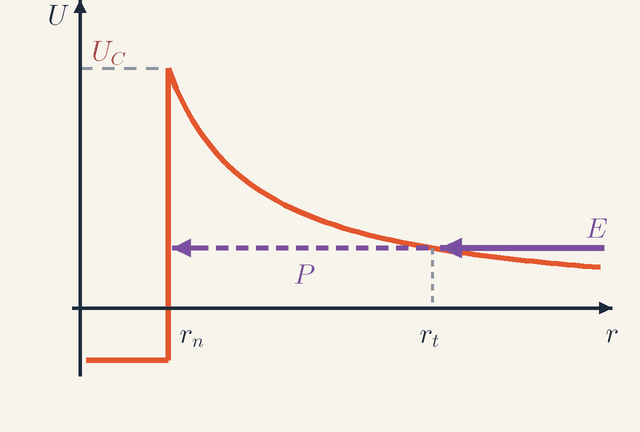
Figure 4. Potential energy U of a deuterium–tritium pair against separation r. A pair with energy E turns back at rt and can reach the contact distance rn only by tunnelling, with probability P. Not to scale: UC is 40 times E, not 4.Legend
r
Distance between the centres of the two nuclei.
m
U
Potential energy of the pair: electric repulsion outside rn, nuclear attraction inside.
J
UC
Height of the Coulomb hill at contact: about 0.4 MeV.
J
E
Collision energy of the pair: 10 keV in the example of the text.
J
rn
Contact distance, where the nuclear force grips: about 3.5 fm.
m
rt
Turning point, where U=E: about 144 fm for 10 keV.
m
P
Probability that a pair tunnels through the barrier from rt to rn.
Fusion faces the opposite problem. The nuclei to be joined are both positive, so they repel each other, and the nuclear force grips only once they touch. Figure 4 shows the obstacle. It plots the potential energy U of a deuterium–tritium pair against the distance r between their centres. Far apart, U is their electric repulsion, e2/(4πε0r): the red curve, rising towards the left. At the contact distance rn, about 3.5 fm, the nuclear force takes over and the pair drops into the deep nuclear well at the bottom left. The top of the red hill, at rn, is the Coulomb barrier UC. With e2/(4πε0)=1.44MeVfm, UC=4πε0rne2=3.5fm1.44MeVfm≈0.4MeV
Now follow a pair that comes in from the right with collision energy E, the purple arrow. Classically it climbs the hill until all its kinetic energy has become potential energy, where U=E; that is the turning point rt, where it stops and turns back. In a plasma at 1.2×10⁸K the thermal energy is kBT=10keV. A head-on pair with 10 keV turns back at rt=1.44MeVfm/0.010MeV=144fm, about 40 times farther out than rn. Classically it never fuses.
Quantum mechanics changes this. A nucleus also behaves as a wave, and a wave can leak through a region that a particle cannot classically enter. This is tunnelling: the dashed arrow of Figure 4 from rt to rn, crossed with probability P. In the animation it is the step labelled tunnelling, where the slowed nuclei jump the last stretch. For D–T at collision energy E, P≈e−EG/E where the Gamow energy EG≈1.2MeV is a constant fixed by the charges and masses of the pair. P is tiny but rises steeply with energy: 2×10⁻⁵ at 10 keV, 2×10⁻³ at 30 keV.
Two effects therefore compete. In a plasma, fast nuclei are rare, and their number falls off quickly with energy; slow nuclei are common but hardly ever tunnel. The product of the two peaks well above the thermal energy, so in a plasma at 10 keV most fusions come from the few pairs with energies near 30 keV.
A fusion plasma gives out more energy than it loses only when it is dense enough, hot enough and held together long enough. The condition is on the product of the density n, the temperature T and the confinement time τ: nTτ must reach about 3×10²¹keV⋅s/m3, for instance 1020 ions per cubic metre at 10 keV, held for 3 s.
Worked problem: what drives the fragments apart
Problem: in the animation's fission the two fragments carry away about 160 MeV of kinetic energy, most of the 173 MeV; the neutrons and gamma rays take the rest. Which force supplies it, how far apart are the fragments when they separate, and how do they share the energy?
The force must act over distances much larger than the range of the nuclear force, so it is the electric repulsion between the 56 protons of barium and the 36 of krypton. Model the fragments as two charges that start at rest with their centres a distance d apart. As they fly apart, their electric potential energy turns entirely into kinetic energy: Ktot=4πε0dZ1Z2e2=d56⋅36⋅1.44MeVfm=d2903MeVfm
Step 1, the separation. If the fragments were touching spheres, of radii r0A1/3=6.2 and 5.4fm, then d=11.7fm, and the formula would give about 250 MeV, more than the whole Q. The actual 160 MeV needs a larger starting distance, d=2903/160=18.1fm. So when they separate, the fragments are not spheres but elongated shapes joined by a thin neck, their centres about 6 fm farther apart than touching spheres. Their deformation energy is not lost: it heats the fragments, which cool by boiling off neutrons.
Step 2, the sharing. The fissioning nucleus is almost at rest, so the fragments fly off with equal and opposite momenta. With K=p2/(2m) and the same p, kinetic energy is inversely proportional to mass, so the lighter fragment takes the larger share: KKr=160⋅141/233=97MeV and KBa=63MeV. Both have the same momentum, p=2mK≈4070MeV/c.
Step 3, how quickly. At separation r the kinetic energy equals the potential energy lost so far, K(r)=Ktot(1−d/r). The fragments therefore have 90 % of their energy by r=10d≈180fm, still deep inside the electron cloud of the atom, which is about 105fm across. The energy of fission is delivered by electric repulsion, almost entirely within a tiny region around the nucleus.
Limits of validity
The liquid drop is a fit, not a theory. It matches heavy nuclei to about 0.5 % (1786 MeV for uranium-235, against 1784 MeV measured), but it ignores shell structure: like electrons in atoms, nucleons fill shells, and nuclei with 2, 8, 20, 28, 50, 82 or 126 protons or neutrons, the magic numbers, are extra stable. So the drop gives 4He only 16 MeV of binding instead of the measured 28.3 MeV, predicts 162 MeV instead of 173 MeV for the animation's fission, and would split uranium into two equal halves, whereas shell effects make it split unequally, mostly into fragments near A=95 and A=140.
Two parts of the energy calculation are approximations too. Sharing energy by K=p2/(2m) is non-relativistic. In D–T fusion the neutron takes four fifths of the 17.59 MeV, that is 14.07 MeV, and moves at 0.17c; the exact relativistic two-body calculation with the true masses gives 14.03 MeV, 0.3 % less.
The second approximation is in writing Q as a difference of binding energies, which needs Z and N to be conserved separately. Where the weak force turns protons into neutrons, as in the Sun's net reaction 41H→4He+2e++2ν, the mass difference between a neutron and a hydrogen atom, 0.78 MeV, enters for each converted proton: the energy released is 28.3−2⋅0.78=26.7MeV, 0.7 % of the mass. What stays exact at these energies is the conservation of energy, momentum, charge and nucleon number.
Where this leads
Schrödinger's Equation and Tunnelling turns the factor e−EG/E into a calculation. Particles and Forces: the Standard Model shows where the nuclear force comes from, as a leftover of the strong interaction that binds quarks with gluons, and describes the weak force that lets the Sun turn protons into neutrons. Looking back, Special Relativity supplies E=mc2, Radioactivity and Half-Life describes the decaying fragments that provide the delayed neutrons, Coulomb's Law gives the barrier, and Momentum and Collisions shares the energy among the products.
Key formulas
Mass–energy equivalence
E=mc2
A body at rest holds an energy proportional to its mass, with the square of the speed of light as the factor. Read the other way, the mass of any system is its total internal energy divided by c2: heat it and it becomes heavier, let energy out and it becomes lighter. In a reaction, the energy released is the loss of mass times c2.
Symbols
E
rest energy of the body
J
m
mass of the body
kg
c
speed of light in vacuum
m/s
When it holds: Exact for a body at rest; a moving body has the total energy γmc2. The change of mass is practically measurable only for nuclear energies: about 10−3 of the mass in fission, 3×10⁻¹⁰ when coal burns.
Example: One kilogram of mass corresponds to 8.99×10¹⁶J: a reactor producing 3000 MW of heat turns about 1.05 kg into energy in a year.
Energy released from the mass defect
Q=Δmc2,1u⋅c2=931.5MeV
The products of a reaction are lighter than the reactants by Δm, and that mass has left as energy, mostly as the kinetic energy of the products. The conversion factor is the rest energy of one atomic mass unit, 1.6605×10⁻²⁷kg times c2, which is 1.492×10⁻¹⁰J or 931.5 MeV. A negative Q means that the reaction needs energy to happen.
Symbols
Q
energy released by one reaction
J
Δm
mass of the reactants minus mass of the products
kg
c
speed of light in vacuum
m/s
u
atomic mass unit, 1.6605×10⁻²⁷kg
kg
MeV
mega-electronvolt, 1.602×10⁻¹³J
J
When it holds: Holds for any reaction, nuclear or chemical. Use nuclear masses throughout, or atomic masses when the electrons balance on both sides, as they do in the reactions of this lesson.
Example: D–T fusion: Δm=0.018883u, so Q=0.018883⋅931.5≈17.6MeV.
Binding energy of a nucleus
B=(Zmp+Nmn−M)c2
A nucleus weighs less than its separate protons and neutrons, because the strong force released energy when it pulled them together. That deficit times the square of the speed of light is the binding energy, the energy you would have to supply to take the nucleus apart. Divided by the mass number, it measures how tightly each nucleon is held.
Symbols
B
binding energy of the nucleus
J
Z
number of protons
mp
mass of a free proton
kg
N
number of neutrons
mn
mass of a free neutron
kg
M
mass of the nucleus
kg
c
speed of light in vacuum
m/s
When it holds:M is the mass of the bare nucleus. With atomic masses, use the hydrogen-atom mass mH instead of mp so that the electrons cancel; their own small binding energy is neglected.
Example: Helium-4: (2⋅1.007825+2⋅1.008665−4.002603)⋅931.5=28.3MeV, or 7.07 MeV per nucleon.
Energy released from binding energies
Q=∑B(after)−∑B(before)
Write every nuclear mass as the masses of its free nucleons minus its binding energy. When a reaction keeps the number of protons and the number of neutrons separately, the free-nucleon masses are the same on both sides and cancel, so the energy released is the gain in total binding. Free neutrons count with B=0. On the B/A curve, any move towards the peak near iron releases energy.
Symbols
Q
energy released by the reaction
J
B
binding energy of one nucleus
J
∑
sum over all the nuclei on one side of the reaction
When it holds: Only when the numbers of protons and of neutrons are each conserved, as in fission and D–T fusion. When the weak force turns protons into neutrons, as in the Sun, the mass difference between a neutron and a hydrogen atom must be taken into account.
Example: The fission in the animation: 141⋅8.326+92⋅8.513−235⋅7.591=173.3MeV.
Fission of uranium-235 into barium and krypton
n+235U→141Ba+92Kr+3n+173MeV
A slow neutron is absorbed by uranium-235, and the excited uranium-236 splits into barium-141 and krypton-92 and frees three neutrons. The mass numbers balance, 1+235=141+92+3, and so do the charges, 92=56+36. The 173 MeV is the mass defect of 0.186 u times c2; this is only one of many ways in which the same nucleus can split.
Symbols
n
neutron
235U
uranium-235 nucleus (92 protons, 143 neutrons)
141Ba
barium-141 nucleus (56 protons, 85 neutrons)
92Kr
krypton-92 nucleus (36 protons, 56 neutrons)
When it holds: The fragments vary from one fission to the next, mostly near mass numbers 95 and 140, with 2.4 neutrons on average. Including the later decays of the radioactive fragments, a fission releases about 200 MeV in all.
Example: Of the 173 MeV, the fragments take about 160 MeV: 97 MeV for krypton and 63 MeV for barium, in the inverse ratio of their masses. The rest goes to the three neutrons and the prompt gamma rays.
Deuterium–tritium fusion
2H+3H→4He+n+17.6MeV
A deuterium nucleus (one proton, one neutron) and a tritium nucleus (one proton, two neutrons) fuse into helium-4 and a free neutron. The products are 0.0189 u lighter, which gives 17.6 MeV. Since the products fly apart with equal and opposite momenta, the neutron, four times lighter, takes four fifths of the energy.
Symbols
2H
deuterium nucleus
3H
tritium nucleus
4He
helium-4 nucleus (alpha particle)
n
neutron
When it holds: The nuclei must tunnel through a Coulomb barrier of about 0.4 MeV, so the reaction runs only in a plasma at around 108K. It is the easiest fusion reaction to ignite, which is why fusion reactors are designed for it.
Each fission leads on average to k new fissions, so every generation multiplies the number of fissions by k. After g generations, N0 fissions have become N0kg: exponential growth for k>1, a steady rate for k=1 and a dying chain for k<1.
Symbols
Ng
number of fissions in generation g
N0
number of fissions in the first generation
k
multiplication factor: new fissions per fission
g
generation number, counted from 0
When it holds: Assumes the same k in every generation. In a real reactor k changes with temperature, control rods and fuel burn-up, and delayed neutrons stretch the time between generations to about 0.1 s.
Example: The animation: N0=1 and k=2 give 1, 2 and 4 fissions in generations 0, 1 and 2, 7 in all, as the counter shows.
Liquid-drop (semi-empirical) binding energy
B=aVA−aSA2/3−A1/3aCZ2−AaA(N−Z)2
The nucleus is treated as a charged drop. The volume term counts the binding of each nucleon by its neighbours; the surface term removes part of it for the nucleons at the surface; the Coulomb term is the electric energy of Z protons in a sphere of radius r0A1/3; the asymmetry term is the Pauli cost of having more neutrons than protons. Their balance makes B/A peak near iron.
Symbols
B
binding energy of the nucleus
J
A
mass number
Z
number of protons
N
number of neutrons
aV
volume coefficient, about 15.75 MeV
J
aS
surface coefficient, about 17.8 MeV
J
aC
Coulomb coefficient, about 0.711 MeV
J
aA
asymmetry coefficient, about 23.7 MeV
J
When it holds: A fit to measured masses: good to about 0.5 % for heavy nuclei, but it leaves out shell effects and pairing, so it fails for the lightest nuclei (16 MeV instead of 28.3 MeV for helium-4).
Example: Uranium-235 (Z=92, N=143): 3701−678−975−262=1786MeV, against 1784 MeV measured.
Glossary
Nucleon
A proton or a neutron, the two particles that make up a nucleus. Their number is the mass number A=Z+N; nuclear reactions rearrange nucleons but neither create nor destroy them.
Isotope
Nuclei with the same number of protons, and so the same element, but different numbers of neutrons. Uranium-235 and uranium-238 are isotopes of uranium; deuterium 2H and tritium 3H are heavy isotopes of hydrogen.
Mass–energy equivalence
Every body at rest holds the rest energy E=mc2, so a system that gives energy away becomes lighter by E/c2. It holds for chemical and nuclear reactions alike; only the size of the energy differs.
Mass defect
The total mass before a reaction minus the total mass after it, Δm; the reaction releases Q=Δmc2. For a single nucleus it is the mass of its free nucleons minus its own mass. Nothing has been destroyed: the missing mass has left as energy.
Binding energy
The energy needed to pull a nucleus apart into free protons and neutrons, equal to its mass defect times c2. Per nucleon, B/A, it peaks at about 8.8 MeV near iron-56; the larger it is, the more tightly bound the nucleus.
Nuclear fission
The splitting of a heavy nucleus, usually after it absorbs a neutron, into two medium-sized fragments and a few neutrons. A uranium-235 fission releases about 200 MeV in all, most of it as kinetic energy of the fragments.
Nuclear fusion
The joining of two light nuclei into a heavier, more tightly bound one. Deuterium–tritium fusion releases 17.6 MeV per reaction; in the Sun, hydrogen fuses into helium.
Chain reaction
A sequence in which the neutrons from each fission cause further fissions. With a multiplication factor k the chain dies out (k<1, subcritical), runs steadily (k=1, critical) or grows (k>1, supercritical).
Strong nuclear force
The attraction between nucleons that holds a nucleus together against the repulsion of its protons. It is much stronger than the electric force but acts only over about 10−15m, so each nucleon binds only its neighbours.
Liquid-drop model
A picture of the nucleus as a charged drop of nuclear liquid, with volume, surface, Coulomb and asymmetry energies. It gives the binding energies of heavy nuclei to better than 1 % and explains why they can split.
Fission barrier
The energy hump a heavy nucleus must climb while stretching before the electric repulsion takes over and pulls it apart; about 6 MeV for uranium. A slow neutron captured by uranium-235 supplies 6.5 MeV, more than enough.
Coulomb barrier
The electric repulsion that two nuclei must overcome to come close enough to fuse, about 0.4 MeV for deuterium and tritium. At fusion temperatures, near 10 keV, nuclei pass it by quantum tunnelling rather than over the top.
Quantities
E
Rest energy
J
The energy a body holds by virtue of its mass, mc2; one gram corresponds to 9.0×10¹³J.
m
Mass
kg
The mass of a body or a system, which measures its total internal energy. Atomic and nuclear masses are usually given in atomic mass units, 1u=1.6605×10⁻²⁷kg, with rest energy 931.5 MeV.
c
Speed of light in vacuum
m/s
2.998×10⁸m/s; its square, 8.99×10¹⁶J/kg, converts mass into energy.
Δm
Mass defect
kg
Mass of the reactants minus mass of the products, usually quoted in u: 0.186 u for the fission in the animation, 0.0189 u for D–T fusion.
Q
Energy released (Q value)
J
The energy released by one reaction, Δmc2, usually given in MeV, with 1MeV=1.602×10⁻¹³J; positive when energy is released.
B
Binding energy
J
The energy needed to separate a nucleus into its free nucleons: 28.3 MeV for helium-4, 1784 MeV for uranium-235.
Z
Atomic number
The number of protons in a nucleus; it fixes the element and the nuclear charge Ze.
N
Neutron number
The number of neutrons in a nucleus; uranium-235 has 143, uranium-238 has 146.
A
Mass number
The number of nucleons, A=Z+N; the mass of a nucleus in u is close to A.
k
Multiplication factor
The average number of new fissions caused by the neutrons of one fission: k=2 in the animation, k=1 in a reactor running steadily.
Quiz
Beginner In nuclear fission, what happens to a heavy nucleus such as uranium-235?
It splits into two smaller nuclei and frees a few neutrons
It joins another nucleus to form a heavier one
It loses its electrons and becomes an ion
It burns with oxygen, like coal
Show answer
Answer: A. It splits into two smaller nuclei and frees a few neutrons
Fission means splitting: after absorbing a neutron, a uranium-235 nucleus breaks into two medium-sized nuclei and 2 or 3 neutrons, releasing energy. Joining nuclei is fusion, and losing electrons or burning are chemical processes.
Beginner Why can a single neutron set off a chain reaction in uranium-235?
The same neutron bounces from nucleus to nucleus forever
Each split frees 2 or 3 new neutrons that can split more nuclei
Every uranium nucleus splits by itself at the same moment
The flash of energy turns nearby atoms into new uranium
Show answer
Answer: B. Each split frees 2 or 3 new neutrons that can split more nuclei
Every fission releases 2 or 3 fresh neutrons. If at least one of them splits another nucleus, the process keeps itself going; if two do, it grows from 1 to 2 to 4 splits and beyond, as in the animation.
Beginner What makes the Sun shine?
Hydrogen gas burning with oxygen
Fission of uranium in its core
Fusion of hydrogen nuclei into helium
Heat left over from its birth, slowly leaking out
Show answer
Answer: C. Fusion of hydrogen nuclei into helium
In the Sun's core, at about 15 million degrees, hydrogen nuclei fuse into helium. The helium weighs slightly less than the hydrogen it came from, and the missing mass is released as energy. Ordinary burning would have used up the Sun within a few thousand years.
Intermediate In a nuclear reaction the products are 0.0189 u lighter than the reactants. How much energy is released? (1 u·c² = 931.5 MeV)
1.76 MeV
176 MeV
0.0189 MeV
17.6 MeV
Show answer
Answer: D. 17.6 MeV
Q = Δm·c² = 0.0189 × 931.5 MeV ≈ 17.6 MeV, the energy of D–T fusion. 1.76 MeV and 176 MeV slip a power of ten, and 0.0189 MeV forgets to convert the mass into energy.
Intermediate A nuclear reactor runs steadily at constant power. What is its multiplication factor k?
k = 2, as in a growing chain
k = 3, one for each neutron released
k = 1, on average
k slightly below 1, so that it can never run away
Show answer
Answer: C. k = 1, on average
At constant power each fission must trigger, on average, exactly one more: k = 1 (critical). With k > 1 the number of fissions grows every generation; with k < 1 it dies out. Control rods tune k by absorbing neutrons.
Intermediate D–T fusion, ²H + ³H → ⁴He + n, releases 17.6 MeV. Why does the neutron get about 14.1 MeV, far more than the helium nucleus?
It is 4 times lighter: at equal momenta, K = p²/(2m) is 4 times larger
It is created first and leaves before the helium nucleus forms
Neutrons always take 80 % of the energy of any nuclear reaction
The helium nucleus loses most of its energy to its electric charge
Show answer
Answer: A. It is 4 times lighter: at equal momenta, K = p²/(2m) is 4 times larger
The reactants are almost at rest, so the products fly apart with equal and opposite momenta p. Then K = p²/(2m) is inversely proportional to the mass: the neutron (A = 1) gets about 4/5 of 17.6 MeV ≈ 14.1 MeV and the ⁴He nucleus (A = 4) the remaining 3.5 MeV.
Advanced Why do both the fusion of light nuclei and the fission of heavy nuclei release energy?
Some protons and neutrons are destroyed and turned into energy
B/A peaks near iron, so both make more tightly bound nuclei
Light and heavy nuclei have negative binding energy
Both reactions free electrons that carry the energy away
Show answer
Answer: B. B/A peaks near iron, so both make more tightly bound nuclei
B/A rises from 1.1 MeV for ²H to about 8.8 MeV near ⁵⁶Fe, then falls to 7.6 MeV for ²³⁵U. Moving towards the peak from either side increases the total binding energy, so Q = ΣB(after) − ΣB(before) > 0. The number of nucleons is unchanged; only how tightly they are bound changes.
Advanced Why does ²³⁵U split with slow (thermal) neutrons, while ²³⁸U needs fast neutrons?
²³⁸U nuclei are too small a target for slow neutrons
Only ²³⁵U is radioactive; ²³⁸U is completely stable
Slow neutrons are repelled by the extra neutrons of ²³⁸U
Capture lifts ²³⁶U* above its fission barrier, but not ²³⁹U*
Show answer
Answer: D. Capture lifts ²³⁶U* above its fission barrier, but not ²³⁹U*
The compound nucleus must be excited above its fission barrier. ²³⁶U, with even numbers of protons and neutrons, gains extra pairing energy when it forms, so a slow neutron is enough. ²³⁹U ends up with an odd neutron and gains about 1.7 MeV less, so the neutron must bring about 1 MeV of kinetic energy. (²³⁸U is itself radioactive, with a half-life of 4.5 billion years.)
 Physics Tutor