Pressure and temperature explained by countless molecules flying, colliding and bouncing off the walls: their impacts explain pV=NkT, and the temperature measures their mean kinetic energy, ⟨21mv2⟩=23kT.
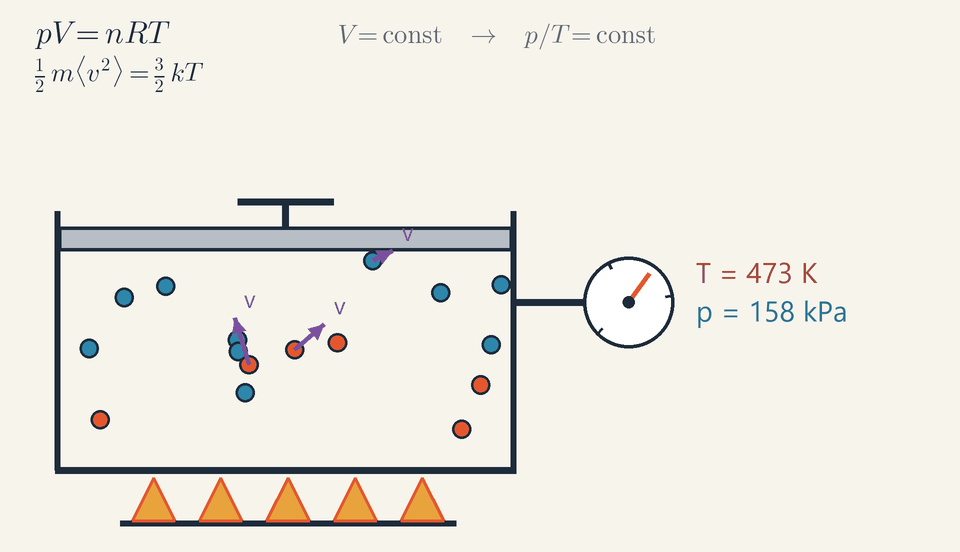
Molecules bouncing in a closed box: their hits on the walls make the pressure, and heating them makes it rise.
A gas is a swarm of tiny molecules, far apart, flying in straight lines and bouncing off each other and the walls.
Each hit on a wall is a tiny push; countless hits every second blend into a steady push: the gas pressure.
Put more gas into the same space and more molecules hit each bit of wall, so the pressure goes up.
Temperature measures how fast the molecules move: heat a gas and they hit harder and more often, so the pressure rises.
At absolute zero (0 K, −273 °C) the molecules would move as little as possible: nothing can be colder.
A balloon looks still, yet the air inside it is a swarm of molecules racing about.
Step 1: what a gas is. In a gas they are far apart, with mostly empty space between them, and nothing holds them together. Each one flies in a straight line until it hits another molecule or a wall, bounces, and flies on. The empty space is why you can squeeze air in a bicycle pump but hardly squeeze water at all, and why the smell of toast reaches every room of a house within minutes.
Step 2: where pressure comes from. Every molecule that hits a wall gives it a tiny shove. Think of rain on a tin roof: a few drops make separate taps, but a downpour blends into one steady roar. Molecules are so numerous that their hits blend into a steady push on every bit of wall: the gas pressure.
Step 3: more gas, more pressure. Pump more air into a tyre and more molecules strike each patch of wall every second, so the pressure rises.
Step 4: temperature is motion. The temperature of a gas measures how fast its molecules move on average. Heat it and they speed up, so they hit the walls harder and more often: two reasons for the pressure to rise. At absolute zero, 0 K or −273 °C, the motion would be the smallest possible.
Check yourself: a sealed can of air warms in the sun. Does the number of molecules inside change? Does the pressure? Answer: the number does not change; the pressure rises, because the same molecules move faster.
In the animation, yellow flashes mark hits on the walls. When the flame comes on, molecules that touch the hot floor turn orange and speed up, and the pressure needle climbs.
Intermediate
Key ideas
Ideal gas law: pV=nRT=NkT, with T in kelvins, R=8.314J/(mol⋅K) and k=1.38×10⁻²³J/K.
Mean translational kinetic energy per molecule: ⟨21mv2⟩=23kT, the same for every gas at a given temperature.
At fixed V and n, p/T is constant: doubling the kelvin temperature doubles the pressure.
vrms=3RT/M with M in kg/mol: at the same T lighter molecules move faster (N₂ at 300 K: about 517 m/s).
The ideal gas and what we measure
A gas presses steadily on its walls, yet its molecules touch them only in separate hits. Kinetic theory pictures a gas as an enormous number N of molecules, tiny compared with the gaps between them, flying straight in random directions. They bounce elastically off the walls and off each other and exert no forces between collisions. This model is the ideal gas; air at room conditions follows it to within about 0.1 %.
Four quantities describe the gas as a whole. The pressure p is the force per unit area on the walls, in pascals (1Pa=1N/m2); the air around you is at about 101 kPa. The volume V is in cubic metres (1 L = 0.001 m³). The temperature T must be in kelvins: add 273.15 to the Celsius reading, so 27 °C is 300 K. The amount is the number of molecules N or of moles n=N/NA, with the Avogadro constant NA=6.022×10²³mol−1.
The ideal gas law
Experiments on many gases and the molecular model lead to the same equation of state, together with the link between its two constants:
pV=nRT=NkT
R=NAk
Here R=8.314J/(mol⋅K) is the gas constant for a mole and k=1.38×10⁻²³J/K is the Boltzmann constant, the same constant for a single molecule. The law does not care which gas it is: at 300 K and 100 kPa a mole of helium or of nitrogen fills V=RT/p=24.9L.
Hold two variables fixed and the older gas laws appear: at fixed V and n, p/T is constant; at fixed T, pV is constant (Boyle's law); at fixed p, V/T is constant (Charles's law), so a balloon taken out into the frost shrinks. A shortcut: with V in litres, nRT/V comes out in J/L, which is kPa; two moles at 300 K in a rigid 10 L tank are at 2⋅8.314⋅300/10≈499kPa.
Pressure and temperature, molecule by molecule
Pressure is the combined effect of impacts. A molecule of mass m that hits a wall with velocity component vx comes back with −vx, handing the wall a momentum 2mvx. A faster molecule pushes harder at each hit and returns sooner, so its share grows as vx2. Adding up all the molecules, with random motion sharing v2 equally among three directions, gives p=31VNm⟨v2⟩ where ⟨v2⟩ is the mean of the squared speeds.
Now compare this with pV=NkT. Since 31m⟨v2⟩=32⟨21mv2⟩, the two agree only if ⟨21mv2⟩=23kT Temperature measures the mean kinetic energy of the molecules' motion from place to place, and nothing else. At 300 K the molecules of every gas carry on average 23⋅1.38×10−23⋅300=6.2×10⁻²¹J.
Solving for the speed gives the root-mean-square speed, the square root of ⟨v2⟩: vrms=m3kT=M3RT with M the molar mass in kg/mol. For nitrogen, M=0.028kg/mol and vrms=517m/s at 300 K, faster than sound; helium, with M=0.004kg/mol, reaches 1370 m/s at the same temperature. Equal energies mean that lighter molecules move faster, as 1/m, and heating raises every speed as T.
Worked example: heating the gas in the animation
The box holds nitrogen at 27 °C (T1=300K) and p1=100kPa, and the clamped piston keeps V and n fixed. Once the flame is on, a molecule bouncing off the hot floor for the first time leaves with its kinetic energy doubled and its speed multiplied by 2. When all have done so, the mean kinetic energy, and with it the kelvin temperature, has doubled: T2=2T1=600K,p2=p1T1T2=100⋅300600=200kPa vrms=517⋅2≈731m/s The mean kinetic energy per molecule rises from 6.2×10⁻²¹ to 1.24×10⁻²⁰J.
Follow the readouts: the orange T and the blue p climb together, their ratio fixed at 31kPa/K. Each molecule turns orange when it first touches the floor, and the purple arrow v of a heated molecule grows by about 41 %. The run ends before every molecule has reached the floor: two of the sixteen are still blue, so the readouts stop at about 586 K and 195 kPa, with the gauge needle just below its 200 kPa mark.
Worked example: a tyre warming up
On a cold morning at 7 °C a tyre gauge reads 230 kPa; after an hour's driving the air inside is at 42 °C. If the volume hardly changes, what does the gauge read now, and how much air does the 25 L tyre hold?
A tyre gauge shows the excess over the atmosphere, so convert to absolute pressure and kelvins: p1=230+101=331kPa, T1=280K, T2=315K. At fixed volume p2=p1T1T2=331⋅280315≈372kPa so the gauge reads 372−101=271kPa. The temperature rose by 12.5 % but the gauge reading by 18 %, because the atmosphere's share stays the same; that is why tyre pressures are specified cold.
For the amount, kilopascals times litres give joules: n=pV/(RT)=331⋅25/(8.314⋅280)≈3.55mol, about 2.1×1024 molecules. With a molar mass of 0.029 kg/mol for air, that is roughly 100 g of air carrying a quarter of the car's weight.
Reading the pressure–temperature line
Plot the pressure in a sealed, rigid container against temperature and you get a straight line. Against kelvins it passes through the origin with slope nR/V: for the animation's gas, from 100 kPa at 300 K to 200 kPa at 600 K, a slope of 31kPa/K. Against degrees Celsius it reaches zero pressure at −273 °C, and the lines for different amounts of gas, with different slopes, all point to that one temperature. Such extrapolations gave the first estimates of absolute zero, though real gases liquefy before reaching it.
At fixed temperature the pressure–volume graph is a hyperbola instead, p=nRT/V, lying higher for a hotter gas: halve the volume and the pressure doubles.
Common mistakes
Using degrees Celsius. Heating from 27 °C to 327 °C at fixed volume doubles the pressure to 200 kPa, because 300 K becomes 600 K; the ratio 327/27 would give an absurd 1211 kPa.
Using the gauge reading as the pressure. The tyre showing 230 kPa is really at 331 kPa; with the gauge value the amount of air comes out about 30 % too small.
Putting the molar mass in grams per mole. With M=28 instead of 0.028, 3RT/M gives 16 m/s for nitrogen instead of 517 m/s.
Thinking that equal temperatures mean equal speeds. Helium and nitrogen at 300 K share the same mean kinetic energy, but their rms speeds are about 1370 m/s and 517 m/s.
Picturing pressure as molecules at rest pushing apart. It comes from impacts, and an elastic bounce still gives the wall 2mvx: elastic means that no kinetic energy is lost, not that nothing is exchanged.
Where you meet it
Tyres, bicycle pumps and weather balloons swelling as they rise into thinner air all follow pV=nRT. A hot-air balloon floats because air at 100 °C holds about 20 % fewer molecules per cubic metre than air at 27 °C at the same pressure, since N/V=p/(kT). First Law of Thermodynamics and Heat Engines builds on this molecular energy, and The Second Law of Thermodynamics and Entropy explains why heat flows from hot to cold.
Advanced
Key ideas
Bounces on a piston give p=32(N/V)⟨21mv2⟩; with pV=NkT the mean kinetic energy is 23kT, 21kT per degree of freedom.
A slowly pushed piston speeds up the molecules it hits: compression heats the gas, pVγ=const with γ=5/3 for atoms.
Boltzmann factor e−E/kT: the air thins as e−mgh/kT with height, and speeds follow f(v)∝v2e−mv2/(2kT).
vp<⟨v⟩<vrms, all ∝T/m: heating moves the peak of f(v) right and makes it lower and broader.
Frozen vibrations leave CV of N₂ near 25R, not the classical 27R: an early clue to quantum mechanics.
Pressure as a flow of momentum
A gas pushes on its container because its molecules keep striking the walls. Each strike hands the wall a little momentum, and pressure is nothing more than the rate at which momentum arrives per unit area. Following that flow step by step links a quantity we can measure, the pressure p, to one we cannot see, the speeds of the molecules.
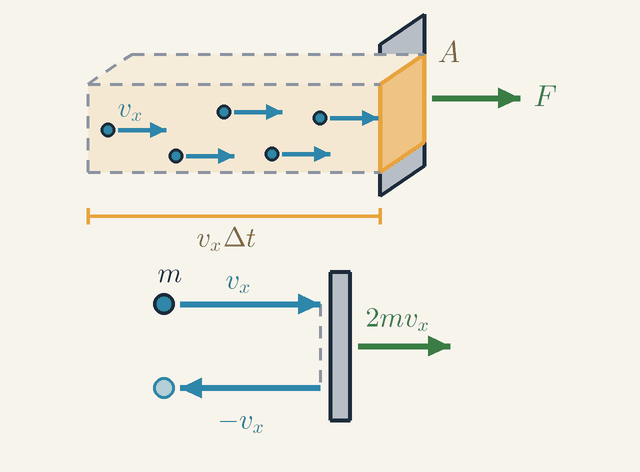
Figure 1. Molecules with velocity component vx that reach the patch A within Δt start inside a slab of length vxΔt. Below, one hit enlarged: vx becomes −vx, so the wall receives 2mvx. All hits together make the force F. Not to scale.Legend
A
Area of the patch of wall, drawn in perspective.
m2
vx
Velocity component of a molecule perpendicular to the wall, towards it.
m/s
Δt
A short time interval.
s
vxΔt
Distance such a molecule covers in Δt: the length of the slab, whose volume is AvxΔt.
m
m
Mass of one molecule.
kg
mvx
Momentum of the molecule before the hit; afterwards it is −mvx, so the wall receives 2mvx.
kg⋅m/s
F
Force of all the hits on the patch: the momentum handed over per unit time.
N
Figure 1 looks at a patch of wall of area A, perpendicular to the x axis. For the push only the velocity component vx matters, the part of a molecule's velocity aimed straight at the wall; motion along the wall hands it no momentum. So sort the molecules into groups by their vx, and follow one group with a given vx>0, heading for the wall. Say it has ΔN of the N molecules in the volume V, so ΔN/V of them in each unit of volume.
Which molecules of this group reach the patch during a short time Δt? Each covers vxΔt towards the wall in that time, so it arrives only if it starts within that distance of the patch. These are the molecules inside the shaded slab of Figure 1, of length vxΔt and volume AvxΔt. Molecules farther back arrive later, and those moving away never arrive. The slab therefore holds (ΔN/V)AvxΔt molecules of the group, and all of them hit the patch.
The enlarged hit below the slab shows what each arrival does. The bounce is elastic, so the velocity component turns from vx into −vx and the momentum from mvx into −mvx, where m is the mass of one molecule. Momentum is conserved, so the wall receives the difference, 2mvx.
Now multiply the number of hits by the momentum per hit: in Δt the group delivers (ΔN/V)AvxΔt⋅2mvx. Notice that vx appears twice. A faster molecule arrives more often and also strikes harder, so the push grows as vx2. The force F is momentum per unit time, so divide by Δt; the pressure is force per unit area, p=F/A, so divide by A. The group's share of the pressure is 2m(ΔN/V)vx2.
Adding the shares of all the groups heading for the wall gives p=V2m∑vx>0ΔNvx2 The motion is random, so for every group with +vx there is an equally large group with −vx. The sum over the half moving towards the wall is therefore half the sum over all N molecules, that is 21N⟨vx2⟩, where angle brackets mean the average over all the molecules. This half cancels the factor 2 of the bounce: p=VNm⟨vx2⟩ Last, the squared speed is v2=vx2+vy2+vz2, and random directions favour no axis, so each component carries a third of it: ⟨vx2⟩=⟨vy2⟩=⟨vz2⟩=⟨v2⟩/3. Hence p=31VNm⟨v2⟩ which is the formula the expert layer of the animation writes.
Three features of this result are easy to overlook. First, it needs only the mean of v2, not any particular distribution of speeds. Second, collisions between molecules do not change it: a collision only passes momentum from one molecule to another, and the momentum still reaches the wall in the end. Third, in a mixture each kind of molecule adds its own term, so the partial pressures of the components add up to the total (Dalton's law).
To put in numbers, use the measured gas law pV=NkT, where k=1.38×10⁻²³J/K is the Boltzmann constant. Nitrogen at 300 K and 100 kPa holds N/V=p/(kT)=2.4×1025 molecules per cubic metre. Each square centimetre of wall takes about 3×10²³ hits per second (the rate is 41(N/V)⟨v⟩, with the mean speed ⟨v⟩ found below). With so many separate impacts, the push feels perfectly steady.
Temperature and equipartition
The pressure formula becomes far more than a formula once it meets experiment, because it tells us what temperature is. Multiply it by V and write m⟨v2⟩ as twice the mean kinetic energy: pV=32N⟨21mv2⟩ Experiment says pV=NkT. Comparing the two, ⟨21mv2⟩=23kT Temperature measures the mean kinetic energy of the molecules' motion from place to place: at 300 K it is 6.2×10⁻²¹J, or 0.039 eV, per molecule. Since the three directions share ⟨v2⟩ equally, each direction holds on average 21kT.
This is the simplest case of equipartition: in classical equilibrium every term of a molecule's energy that is quadratic in a velocity or a coordinate, such as 21mvx2, averages 21kT. A diatomic molecule such as nitrogen can also rotate about the two axes perpendicular to its bond, which adds two more quadratic terms, so its mean energy is 25kT. (Spinning about the bond itself does not count: nearly all the mass lies on that axis, so its moment of inertia is tiny and, like the vibration discussed under the limits below, this motion is frozen out.)
Per mole, multiply by the Avogadro number NA; with the gas constant R=NAk=8.314J/(mol⋅K) the internal energy of nitrogen is 25RT. Raising the temperature by 1 K at constant volume therefore takes the molar heat capacity CV=25R=20.8J/(mol⋅K), against 23R=12.5J/(mol⋅K) for helium or argon, whose atoms only move from place to place.
Why heavy and light molecules share the energy
Equipartition makes a bold claim: in a mixture, a heavy molecule and a light one carry the same mean kinetic energy, so the heavy one must move more slowly. The mechanism is the collisions between them, and one collision drawn the right way shows how it works.
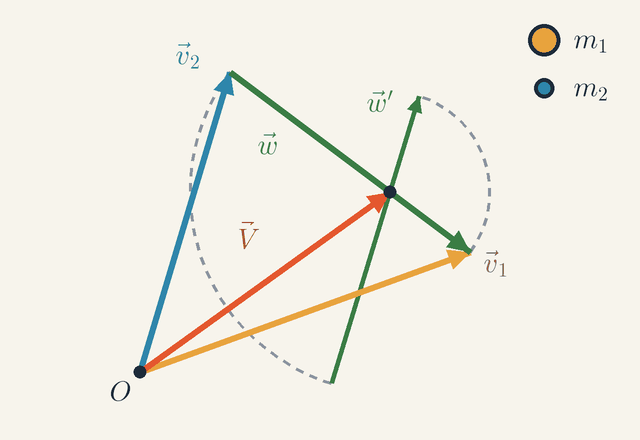
Figure 2. One elastic collision in velocity space, for m1=2m2. The centre-of-mass velocity V and the length of w stay the same; only the direction changes, from w to w′, so the two tips swing about the end of V along the dashed arcs.Legend
O
Origin of velocity space: every velocity arrow starts here.
m1
Mass of the heavy molecule, drawn in gold.
kg
m2
Mass of the light molecule, drawn in blue; here m1=2m2.
kg
v1
Velocity of the heavy molecule before the collision.
m/s
v2
Velocity of the light molecule before the collision.
m/s
w
Relative velocity v1−v2: the arrow from the tip of v2 to the tip of v1.
m/s
V
Centre-of-mass velocity (m1v1+m2v2)/(m1+m2): it ends on w, nearer the heavy tip, at distances from the tips in the inverse ratio of the masses.
m/s
w′
Relative velocity after the collision: the same length as w, in a new direction.
m/s
Figure 2 is drawn in velocity space: every velocity is an arrow from one common origin O, so the motion of a molecule is fully given by where its arrow ends. The heavy molecule, of mass m1=2m2, has the gold velocity v1; the light one, of mass m2, has the blue v2. The green arrow from the tip of v2 to the tip of v1 is their relative velocity, w=v1−v2.
The orange arrow is the centre-of-mass velocity V=(m1v1+m2v2)/M, with M=m1+m2. It is an average of v1 and v2 weighted by mass, so its tip lies on w, nearer the heavier tip: the distances to the two tips are in the inverse ratio of the masses, (m2/M)∣w∣ to the heavy tip and (m1/M)∣w∣ to the light one. With m1=2m2 it ends one third of the way along w from the heavy tip. Reading the figure from the end of V, v1=V+Mm2w,v2=V−Mm1w
What can a collision change? The total momentum MV is conserved, so V stays put. Substituting the two velocities above, the kinetic energy splits into 21MV2+21(m1m2/M)w2, so an elastic collision, which conserves it, also keeps the length of w. Only the direction of w can change: it turns into w′. In Figure 2 the two tips therefore swing about the end of V along the dashed arcs, the heavy tip on the small one, of radius (m2/M)∣w∣, and the light tip on the large one, of radius (m1/M)∣w∣.
Now the step to equilibrium. Each molecule collides billions of times a second with partners arriving from all sides, so after a few collisions the direction of w has forgotten where it started and bears no relation to V. The two are uncorrelated, and the average of their dot product vanishes: ⟨V⋅w⟩=0. Multiplying out the product gives MV⋅w=m1v12−m2v22+(m2−m1)v1⋅v2 The velocities of two molecules about to meet are independent and point in random directions, so ⟨v1⋅v2⟩=0 as well. Averaging leaves m1⟨v12⟩=m2⟨v22⟩: the same mean kinetic energy. The heavier molecule is slower by exactly the factor that keeps its energy equal; with m1=2m2 its root-mean-square speed is lower by 2.
Squeezing a gas: the moving piston
Push a piston into a gas without letting heat flow and the gas gets hotter. Kinetic theory shows exactly where the piston's work goes: into faster molecules, one bounce at a time.
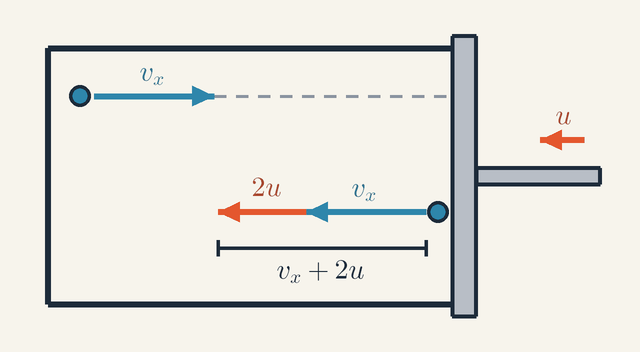
Figure 3. A molecule bouncing off a piston that moves in at speed u. It arrives with vx and, seen from the box, leaves with vx+2u: its old speed plus an extra 2u from the moving wall. Not to scale (u≪vx).Legend
u
Speed at which the piston moves into the gas; each hit adds 2u to the molecule's speed.
m/s
vx
Speed of the molecule towards the piston before the hit, measured in the box.
m/s
vx+2u
Speed with which the molecule leaves the piston, measured in the box.
m/s
In Figure 3 the piston moves inwards at a speed u much smaller than the molecular speeds, and one molecule approaches it with the speed vx (upper arrow). The bounce is easiest to see from the piston's own frame, where the wall is at rest. There the molecule approaches at vx+u, because the piston is coming towards it, and a bounce off a resting wall reverses the velocity without changing its size, so it leaves at vx+u. Back in the box's frame we add the piston's own speed u in the direction of the rebound, so the molecule leaves with vx+2u instead of vx. In the lower arrow of Figure 3 the blue part is the old vx and the orange part is the extra 2u that the moving wall adds.
Each hit therefore raises the molecule's energy by 21m(vx+2u)2−21mvx2=2mvxu+2mu2≈2mvxu where the last term is dropped because u≪vx.
Count the hits as in Figure 1: a group strikes the piston face, of area A, (ΔN/V)Avx times per second, and each strike adds 2mvxu. Summed over the groups this is uA times the very sum that gave the pressure, so the gas gains energy at the rate pAu. Meanwhile the piston sweeps out the volume Au each second, so the volume changes at the rate −Au. In other words dU=−pdV: the piston's work appears, in full, as faster molecules.
With no heat flowing in, and U=23NkT for point molecules that only move from place to place, put p=NkT/V into dU=−pdV: 23NkdT=−VNkTdV Dividing by NkT gives 23dT/T=−dV/V, and integrating gives 23lnT+lnV=const. Since T is proportional to pV, this is TV2/3=const,pV5/3=const
The same steps work for any molecule. With f quadratic energy terms, U=2fNkT and pVγ=const with γ=1+2/f: 5/3 for atoms (f=3) and 7/5 for nitrogen and oxygen (f=5). A diesel engine squeezes air about eighteen-fold; starting from 300 K this heats it to 300⋅180.4, some 950 K, hot enough to ignite the fuel without a spark.
Light in a box with mirrored walls obeys the same counting of hits and momentum. A photon carries momentum E/c instead of mv and moves at c, so where the derivation multiplied momentum by speed, mv2 becomes the photon energy E. The pressure is then a third of the energy per unit volume ε, p=ε/3. With U=εV=3pV, the rule dU=−pdV gives pV4/3=const: an adiabatic exponent of 4/3.
The Boltzmann factor
So far only averages have appeared. To find how the speeds themselves are spread, we need a broader rule of statistical mechanics: in equilibrium at temperature T, a state of energy E has a probability proportional to the Boltzmann factor e−E/kT. States with energy much larger than kT are rare.
Applied to potential energy, a molecule at height h has the extra energy mgh, so the number of molecules per unit volume falls with height as e−mgh/kT. It drops by a factor e every kT/(mg) of height, which is 9.1 km for nitrogen at 300 K. The real atmosphere is colder higher up, which makes the fall steeper; on top of Mount Everest the pressure is about a third of its sea-level value.
Applied to kinetic energy, 21m(vx2+vy2+vz2), the exponential of a sum is a product of exponentials. Each velocity component is therefore independent of the others and follows its own Gaussian weight, e−mvx2/(2kT), centred on zero: for any single component, values near zero are the most likely.
The speed distribution
Each velocity component is most likely near zero, and yet hardly any molecule is nearly at rest. Turning the weight of each velocity into a distribution of speeds resolves this, and gives the three characteristic speeds of a gas.
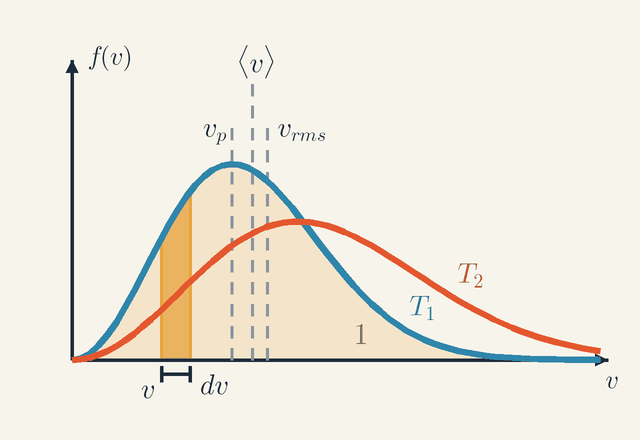
Figure 4. The speed distribution at two temperatures, T2=2T1. The strip of width dv holds the fraction f(v)dv of the molecules, and each curve encloses an area of 1. Dashed lines mark vp<⟨v⟩<vrms at T1, in true proportion.Legend
v
Speed of a molecule.
m/s
f(v)
Distribution of speeds: the fraction of molecules per unit speed, so a strip of width dv holds f(v)dv.
s/m
dv
Width of the strip: a small range of speeds.
m/s
vp
Most probable speed, at the peak of f(v).
m/s
⟨v⟩
Mean speed: the average of v over all the molecules.
m/s
vrms
Root-mean-square speed, ⟨v2⟩: the speed of a molecule with the mean kinetic energy.
m/s
T1
Temperature of the blue curve.
K
T2
Higher temperature of the orange curve, here 2T1: the curve is lower and wider but encloses the same area.
K
Figure 4 plots the speed distribution f(v). Its meaning is set by the thin strip: f(v)dv is the fraction of molecules with speeds between v and v+dv, which is the area of the strip of width dv under the curve. Every molecule has some speed, so the whole area under each curve is 1.
To build f(v), collect every velocity whose length lies between v and v+dv. In velocity space these arrows end in a thin spherical shell of radius v and thickness dv, whose volume is 4πv2dv. Each of them has the Gaussian weight e−mv2/(2kT). Multiplying the two and fixing the constant so that the area is 1 gives the Maxwell–Boltzmann distribution f(v)=4π(2πkTm)3/2v2e−mv2/(2kT) The two factors pull in opposite directions. The factor v2 empties the region near zero speed, because there are few velocities of small length, even though each component on its own is most likely near zero. The exponential cuts off the fast tail. The peak lies between the two.
Three speeds summarise the curve. The most probable speed vp is at the peak, where the slope of v2e−mv2/(2kT) is zero: 2v−(m/kT)v3=0, so vp2=2kT/m. The root-mean-square speed vrms=⟨v2⟩ follows at once from ⟨21mv2⟩=23kT. The mean speed ⟨v⟩ is the average of v weighted by f(v), an integral that gives vp=m2kT<⟨v⟩=πm8kT<vrms=m3kT All three are proportional to T/m, in the fixed ratio 1 : 1.128 : 1.225, and the dashed lines of Figure 4 mark them in this true proportion. For nitrogen at 300 K they are 422, 476 and 517 m/s.
The orange curve is the same gas at the higher temperature T2=2T1. All three speeds lie farther right by the factor 2, so the curve is stretched sideways by 2. Its area must stay equal to 1, so its peak is lower by the same factor.
Reading the histogram
The expert layer of the animation draws f(v) as eight bars, each 200 m/s wide, from 0 to 1600 m/s. Their heights come from the formula at the temperature on the readout, not from counting the sixteen molecules on the screen, which would be far too few. At 300 K the tallest bar, from 400 to 600 m/s, holds 36 % of the molecules, and the dashed vrms marker stands at 517 m/s. At 586 K the peak has moved to vp=590m/s, the 400–600 and 600–800 m/s bars are almost equal at 26 % each, and the marker and the vrms readout show 723 m/s, larger by 586/300=1.40.
Because the area under f(v) stays equal to 1, a widening curve must drop, as the orange curve of Figure 4 does: the height of the peak falls as 1/T. The fast tail changes most. The fraction of molecules faster than 1000 m/s grows from 1.1 % at 300 K to 12.5 % at 586 K, more than tenfold for less than a doubling of T. Evaporation and chemical reactions need a minimum energy, which only the molecules in this tail have, so their rates also climb steeply with temperature.
Worked problem: heating the gas two ways
Take one mole of the animation's nitrogen at 300 K and 100 kPa, so its volume is V1=RT1/p1=24.9L. (a) How much heat must the flame supply to bring it to 600 K with the piston clamped? (b) What compression, with no heat exchanged, reaches the same 600 K, and at what final pressure and cost in work?
(a) With the piston clamped the volume does not change, so the gas does no work and all the heat goes into internal energy. Real nitrogen stores 25kT per molecule, or 25RT per mole, so Q=25RΔT=2.5⋅8.314⋅300≈6.24kJ Only 3.74 kJ of it, the 23RΔT of motion from place to place, shows up in the speeds and in the pressure, which doubles to 200 kPa because the temperature doubles at fixed volume. The other 2.49 kJ sets the molecules spinning, a motion the animation's point molecules cannot show.
(b) With no heat exchanged, TVγ−1 stays constant, with γ=7/5 for nitrogen. Solving for the volume ratio, V1V2=(T2T1)1/(γ−1)=2−5/2≈0.177 and the gas law pV=nRT then gives the final pressure: p2=p1T1T2V2V1=100⋅27/2≈1131kPa The gas must be squeezed from 24.9 L to 4.4 L, and it ends at more than five times the pressure reached in (a). No heat flows, so the piston's work equals the rise in internal energy, again 6.24 kJ, because the final temperature is the same. A monatomic gas, with γ=5/3, would need only V2/V1=2−3/2≈0.354, ending at 566 kPa after 3.74 kJ of work.
Limits of validity
The ideal gas assumes molecules that are small and far apart. That holds well for nitrogen at 300 K and 100 kPa: the mean spacing (V/N)1/3 is 3.5 nm, about nine molecular diameters, and the molecules themselves fill only 0.06 % of the volume.
The van der Waals equation (p+an2/V2)(V−nb)=nRT, for n moles, corrects for both effects: the constant a for the attraction between molecules, which lowers the pressure, and b for their own volume, which raises it. Under these conditions each correction is about 0.2 % and the two nearly cancel. At high density or near the boiling point, 77 K, they grow and no longer cancel; below the critical temperature the equation even describes condensation into a liquid.
Equipartition is a classical result, and its failures were early signs of quantum mechanics. A vibrating bond would add another kT per molecule (one quadratic term for its motion, one for its stretch) and raise CV of nitrogen to 27R, yet at room temperature it is 25R. The reason: vibrational energy comes in quanta of 0.29 eV, eleven times kT=0.026eV, so the Boltzmann factor leaves hardly any molecule excited and the vibration is frozen. Hydrogen below a few tens of kelvins loses even its rotations.
The classical picture fails completely once the thermal de Broglie wavelength h/2πmkT, the quantum size of a molecule at temperature T, approaches the spacing between molecules. For nitrogen at 300 K it is 0.019 nm, far below 3.5 nm, but not so in liquid helium near 2 K or for the electrons in a metal.
Collisions between molecules, left out of the animation, do not alter an ideal gas's pressure but set its other properties. With a molecular diameter d≈0.37nm, a nitrogen molecule at room conditions travels on average a mean free path λ=kT/(2πd2p)≈68nm between collisions; at its mean speed of 476 m/s that is about 7×10⁹ collisions a second. These collisions bring any starting distribution to the Maxwell–Boltzmann form within nanoseconds, and they govern diffusion, viscosity and heat conduction; the animation's bars show the equilibrium they would establish. Relativity plays no part: vrms/c≈2×10−6.
Where this leads
The energy U=2fnRT, the work −pdV and the adiabat are the working parts of First Law of Thermodynamics and Heat Engines. In The Second Law of Thermodynamics and Entropy, counting the ways of sharing energy among molecules, the idea behind the Boltzmann factor, becomes entropy. Blackbody Radiation and the Quantum shows equipartition failing again, for the modes of light in a cavity, and Semiconductors, Diodes and LEDs uses e−E/kT to count conducting electrons. The speed of sound, γRT/M=353m/s for nitrogen at 300 K, with M here the molar mass, links back to Sound and the Doppler Effect, and the mean free path explains why the viscosity of a gas, behind the drag in Drag and Terminal Velocity, hardly depends on its pressure.
Key formulas
Ideal gas law
pV=nRT=NkT
The state of a dilute gas is fixed by its pressure, volume, temperature and amount, and one equation links all four. Written per mole it uses R, written per molecule it uses k; the two forms agree because nR=Nk. Kinetic theory explains it: the pressure of the impacts, 31(N/V)m⟨v2⟩, equals NkT/V because the mean kinetic energy is 23kT.
Symbols
p
absolute pressure of the gas
Pa
V
volume of the gas
m3
n
amount of gas in moles
mol
R
molar gas constant, 8.314J/(mol⋅K)
J/(mol⋅K)
T
absolute temperature
K
N
number of molecules
k
Boltzmann constant, 1.38×10⁻²³J/K
J/K
When it holds: For dilute gases far from condensation, with the temperature in kelvins and the absolute pressure. At high density or near liquefaction, the van der Waals equation does better.
Example: One mole at 300 K and 100 kPa fills V=8.314⋅300/105≈0.0249m3, that is 24.9 L, whatever the gas.
Pressure from molecular impacts
p=31VNm⟨v2⟩
Each molecule that bounces off a wall hands it a momentum 2mvx, and faster molecules also come back more often, so the force per unit area is the number density times m⟨vx2⟩. Random motion spreads ⟨v2⟩ equally over three directions, which gives the factor 31. Only the mean of v2 matters, not the shape of the speed distribution.
Symbols
p
pressure on the walls
Pa
N
number of molecules
V
volume of the gas
m3
m
mass of one molecule
kg
⟨v2⟩
mean of the squared molecular speeds
m2/s2
When it holds: For an ideal gas whose molecules move equally in all directions; collisions between molecules do not change it. Attractions between molecules in a dense gas add corrections.
Example: Nitrogen at 300 K: N/V=2.4×1025m−3, m=4.65×10⁻²⁶kg and ⟨v2⟩=5172m2/s2 give p≈100kPa.
Mean translational kinetic energy
⟨21mv2⟩=23kT
Comparing the impact formula for the pressure with pV=NkT shows that temperature measures the mean kinetic energy of the molecules' motion from place to place: 21kT for each of the three directions. The mass does not appear, so at a given temperature every gas has the same mean kinetic energy per molecule, and lighter molecules move faster.
Symbols
⟨21mv2⟩
mean translational kinetic energy of one molecule
J
m
mass of one molecule
kg
v
speed of a molecule
m/s
k
Boltzmann constant
J/K
T
absolute temperature
K
When it holds: Holds for the motion of molecules from place to place in any classical system in thermal equilibrium, gas or liquid. It fails where quantum effects dominate, as for electrons in a metal or helium near absolute zero. Rotations and vibrations carry energy in addition to this.
Example: At 300 K: 23⋅1.38×10−23⋅300≈6.2×10⁻²¹J per molecule, for helium and nitrogen alike; at 600 K, in the heated animation, it doubles to 1.24×10⁻²⁰J.
Root-mean-square speed
vrms=m3kT=M3RT
Solving 21m⟨v2⟩=23kT for the speed gives the square root of the mean squared speed. Per mole, k/m becomes R/M, which is handier because molar masses are tabulated. The speed grows as T and falls as 1/m.
Symbols
vrms
root-mean-square speed of the molecules
m/s
k
Boltzmann constant
J/K
T
absolute temperature
K
m
mass of one molecule
kg
R
molar gas constant
J/(mol⋅K)
M
molar mass, in kilograms per mole
kg/mol
When it holds: For a classical gas in thermal equilibrium, with M in kg/mol. It is slightly larger than the average speed: ⟨v⟩≈0.92vrms.
Example: Nitrogen at 300 K: 3⋅8.314⋅300/0.028≈517m/s; heated to 600 K in the animation, 517⋅2≈731m/s.
Maxwell–Boltzmann speed distribution
f(v)=4π(2πkTm)3/2v2e−mv2/(2kT)
Each velocity component follows a Gaussian set by the Boltzmann factor e−mvx2/(2kT). Collecting all the directions with the same speed multiplies it by the area 4πv2 of a sphere in velocity space, so f(v) starts at zero, peaks at vp=2kT/m and then falls off exponentially. The prefactor makes the total area 1, so f(v)dv is the fraction of molecules with speeds between v and v+dv.
Symbols
f(v)
fraction of molecules per unit interval of speed
s/m
v
molecular speed
m/s
m
mass of one molecule
kg
k
Boltzmann constant
J/K
T
absolute temperature
K
When it holds: For a classical ideal gas in thermal equilibrium; collisions establish it within a few collision times. Gases out of equilibrium, such as a molecular beam, and quantum gases at very low temperature follow other distributions.
Example: Nitrogen at 300 K peaks at 422 m/s, and only 1.1 % of its molecules are faster than 1000 m/s; at 586 K that fraction is 12.5 %.
Gas constant and Boltzmann constant
R=NAk
R is the gas constant for a mole of molecules and k the same constant for one molecule, so they differ by a factor equal to the number of molecules in a mole. This is what makes nRT and NkT equal, since N=nNA. The constant k turns a temperature into a typical energy per molecule.
Symbols
R
molar gas constant
J/(mol⋅K)
NA
Avogadro constant, molecules per mole
mol−1
k
Boltzmann constant
J/K
When it holds: Exact: since 2019 the SI fixes k=1.380649×10⁻²³J/K and NA=6.02214076×10²³mol−1.
Example:6.022×1023⋅1.3806×10−23≈8.314J/(mol⋅K).
Glossary
Kinetic theory
The explanation of a gas's bulk properties (pressure, temperature, heat capacity, viscosity) by applying Newton's laws to its molecules and averaging over enormous numbers of them. Pressure becomes momentum delivered by impacts, and temperature becomes mean kinetic energy.
Ideal gas
A model gas of point-like molecules that exert no forces on each other except in brief elastic collisions. It obeys pV=nRT exactly; real gases come close when they are dilute and far from condensing, air at room conditions to about 0.1 %.
Gas pressure
The steady push of a gas on a surface, made of countless molecular impacts, each of which hands the wall a momentum 2mvx. It acts equally in all directions and grows with the number of molecules per unit volume and with ⟨v2⟩.
Elastic collision
A collision in which no kinetic energy is lost. A molecule bouncing elastically off a wall keeps its speed but reverses vx, so it still transfers a momentum 2mvx: elastic does not mean that nothing is exchanged.
Absolute zero
The lowest possible temperature, 0 K or −273.15 °C, where the classical motion of the molecules would stop and an ideal gas would exert no pressure; quantum mechanics leaves a small zero-point motion. Gas-law temperatures are counted from it, in kelvins.
Gas laws
Boyle's law (pV constant at fixed T), Charles's law (V/T constant at fixed p) and the pressure law (p/T constant at fixed V). All three are special cases of the ideal gas law, with T in kelvins.
Root-mean-square speed
The square root of the mean squared speed, ⟨v2⟩, the speed that fixes the mean kinetic energy. It is about 9 % larger than the ordinary average speed: 517 against 476 m/s for nitrogen at 300 K.
Equipartition of energy
In classical thermal equilibrium every quadratic term in a molecule's energy, such as 21mvx2, averages 21kT. It fails for motions whose energy quanta are much larger than kT, like the vibration of nitrogen at room temperature, which is frozen.
Boltzmann factor
The factor e−E/kT that gives the relative probability of a state of energy E in equilibrium at temperature T. It makes the air thin out with height and makes very fast molecules rare.
Maxwell–Boltzmann distribution
The distribution of molecular speeds in a gas in equilibrium, f(v)∝v2e−mv2/(2kT). It starts at zero, peaks at vp=2kT/m and has a long fast tail; heating moves the peak to the right and makes it lower and broader.
Adiabatic compression
Compression with no heat exchanged. The molecules rebound faster from the advancing piston, so the work done heats the gas and pVγ stays constant, with γ=5/3 for atoms and 7/5 for air.
Mean free path
The average distance a molecule travels between collisions with other molecules, about 68 nm in air at room conditions. These collisions do not change the pressure of an ideal gas, but they control diffusion, viscosity and heat conduction.
Quantities
p
Pressure
Pa
Force per unit area exerted by the gas on any surface, 1Pa=1N/m2. Sea-level air is at about 101 kPa; the gas law needs the absolute value, not a gauge reading.
V
Volume
m3
The space the gas fills, that is, the volume of its container; 1L=10−3m3.
T
Absolute temperature
K
Temperature counted from absolute zero: the Celsius value plus 273.15. It is proportional to the mean translational kinetic energy of the molecules.
n
Amount of substance
mol
The number of moles, n=N/NA, where the Avogadro constant NA=6.022×10²³mol−1 is the number of molecules in a mole.
N
Number of molecules
How many molecules the gas contains: about 2.4×1025 in each cubic metre of air at room conditions.
k
Boltzmann constant
J/K
k=1.38×10⁻²³J/K converts a temperature into an energy per molecule: kT≈4.1×10⁻²¹J at 300 K. It is written kB in lessons where k already means something else.
R
Molar gas constant
J/(mol⋅K)
R=8.314J/(mol⋅K), the Boltzmann constant for a whole mole of molecules, R=NAk.
m
Molecular mass
kg
The mass of one molecule: 4.65×10⁻²⁶kg for nitrogen, whose molecule has a mass of 28 u.
M
Molar mass
kg/mol
The mass of one mole, M=NAm. In the formulas it must be in kg/mol: 0.028 for nitrogen, not 28.
vrms
Root-mean-square speed
m/s
⟨v2⟩, the typical molecular speed: 517 m/s for nitrogen at 300 K, growing as T.
Quiz
Beginner What causes the pressure of a gas on the walls of its container?
The weight of the gas pressing down
Molecules at rest repelling each other
Molecules hitting the walls and bouncing off
The walls pulling the gas towards them
Show answer
Answer: C. Molecules hitting the walls and bouncing off
Each bounce gives the wall a tiny push; the combined effect of countless hits per second is a steady force per unit area, the pressure.
Beginner A sealed can of gas is heated. What happens to its molecules?
They move faster on average
They get bigger
There are more of them
They slow down and spread out
Show answer
Answer: A. They move faster on average
Temperature measures the molecules' kinetic energy. Heating speeds them up, so they hit the walls harder and more often and the pressure rises.
Intermediate A rigid container holds gas at 27 °C and 100 kPa. It is heated to 327 °C. What is the new pressure?
1211 kPa
200 kPa
100 kPa
400 kPa
Show answer
Answer: B. 200 kPa
At constant volume p/T is constant, with T in kelvins: 300 K → 600 K doubles the pressure to 200 kPa. Using degrees Celsius (327/27) gives the absurd 1211 kPa.
Intermediate Helium and nitrogen are at the same temperature. Which statement is correct?
Nitrogen molecules move faster because they are heavier
Both kinds of molecule have the same average speed
Helium molecules have more kinetic energy because they are lighter
Their molecules have the same average kinetic energy, but helium molecules move faster
Show answer
Answer: D. Their molecules have the same average kinetic energy, but helium molecules move faster
⟨½·m·v²⟩ = (3/2)·k·T depends only on T. With equal kinetic energy, the lighter helium atoms must move faster.
Intermediate What is the average translational kinetic energy of a gas molecule at 300 K? (k = 1.38 × 10⁻²³ J/K)
6.2 × 10⁻²¹ J
4.1 × 10⁻²¹ J
2.1 × 10⁻²¹ J
1.2 × 10⁻²⁰ J
Show answer
Answer: A. 6.2 × 10⁻²¹ J
(3/2)·k·T = 1.5 × 1.38 × 10⁻²³ × 300 ≈ 6.2 × 10⁻²¹ J. The value k·T alone is 4.1 × 10⁻²¹ J.
Advanced A molecule of mass m with velocity component vₓ bounces elastically off a wall perpendicular to x. How much momentum does it transfer to the wall?
m·vₓ
Zero, because the collision is elastic
2m·vₓ
½·m·vₓ²
Show answer
Answer: C. 2m·vₓ
Its x-momentum goes from +m·vₓ to −m·vₓ, a change of 2m·vₓ, which the wall receives. Elastic means kinetic energy is conserved, not that no momentum is exchanged.
Advanced Each velocity component of a gas molecule, such as vₓ, is most likely to be near zero, yet the Maxwell–Boltzmann speed distribution f(v) falls to zero as v → 0. Why?
Collisions with the walls and with other molecules keep speeding slow molecules up, so none stay near rest
The spherical shell of velocity vectors with speeds between v and v + dv has volume 4π·v²·dv, which shrinks to zero as v → 0
The Boltzmann factor e^(−m·v²/(2kT)) is zero at v = 0, so no molecule can be found at rest
By equipartition every molecule carries at least (3/2)·k·T, so its kinetic energy can never be zero
Show answer
Answer: B. The spherical shell of velocity vectors with speeds between v and v + dv has volume 4π·v²·dv, which shrinks to zero as v → 0
The Boltzmann factor is largest at v = 0 (it equals 1 there), and equipartition fixes only the average energy, not a minimum. But the velocity vectors with speeds between v and v + dv fill a spherical shell of volume 4π·v²·dv, which vanishes as v → 0, so f(v) ∝ v²·e^(−m·v²/(2kT)) starts at zero and peaks at v_p = √(2kT/m).
Advanced As a gas is heated, how does its Maxwell–Boltzmann speed distribution change?
The peak moves to higher speeds and becomes taller
All molecules end up with the same, higher speed
Its shape is unchanged; only the number of molecules grows
The peak moves to higher speeds and becomes lower and broader
Show answer
Answer: D. The peak moves to higher speeds and becomes lower and broader
The most probable speed √(2kT/m) increases, and since the area under f(v) stays equal to 1, the wider curve must also be lower.
 Physics Tutor