Energy is conserved, ΔU=Q−W, and a heat engine turns part of the heat flowing from hot to cold into work, but never all of it: at best the share ηC=1−Tc/Th.
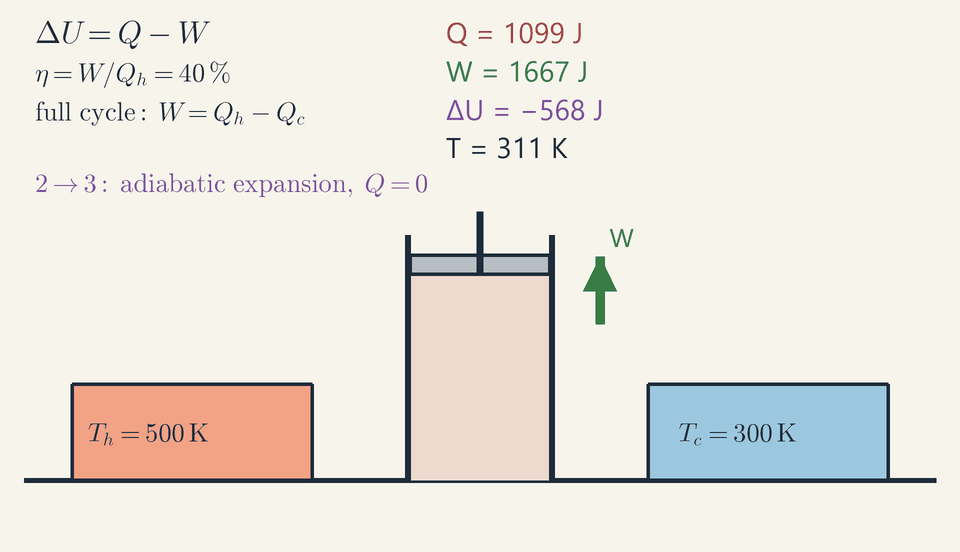
A Carnot engine: a gas takes heat from a hot reservoir, does work on a piston and rejects waste heat to a cold reservoir.
Temperature tells how fast molecules jiggle; thermal energy is their total energy; heat is energy flowing from hot to cold.
Energy is never created or destroyed: heat put into a gas warms it, lets it push a piston, or both.
Work can become heat too: rubbing your hands or pumping a tyre warms things up.
A heat engine lets heat flow from hot to cold and catches part of it as work; the rest must leave as waste heat.
The bigger the gap between the hot side and the cold side, the bigger the share of heat that can become work.
Rub your hands together and they warm up; pump up a bicycle tyre and the pump gets hot. In both cases work has turned into heat.
Step 1: three words. Temperature tells you how fast, on average, the molecules of something jiggle. Thermal energy is the total energy of all those molecules. Heat is energy on the move, flowing from a hotter object to a colder one because their temperatures differ.
Step 2: the first law. Energy is never created or destroyed, only moved or changed in form. Heat a gas in a cylinder and the energy you put in does one of two things, or a bit of both: it warms the gas, or it lets the gas push a piston, which is work.
Step 3: heat engines. A car engine or a power station lets heat flow from a hot place to a cold place and catches part of it as work. Some heat must always flow on to the cold side as waste: that is why cars have radiators and power stations have cooling towers.
Step 4: the bigger the gap between the hot side and the cold side, the larger the share of the heat that can become work.
Check yourself: you give a gas 100 J of heat and it does 30 J of work pushing a piston. Where are the other 70 J? (In the gas, which is now warmer.)
In the animation, a gas in a cylinder repeats four steps: heated, it pushes the piston up and cools as it keeps expanding; then it is squeezed back while it hands waste heat to the cold side. Squeezing the cooled gas costs less work than the hot gas gave out: the difference is the useful work.
Intermediate
Key ideas
First law: ΔU=Q−W, with Q the heat added to the gas and W the work done by the gas.
Ideal gas: isothermal means ΔU=0, so Q=W; adiabatic means Q=0, so W=−ΔU and an expanding gas cools.
Over a full cycle ΔU=0, so the net work is W=Qh−Qc.
Efficiency η=W/Qh=1−Qc/Qh; the animated Carnot engine reaches 40 % between 500 K and 300 K.
Q and W depend on the path taken; U is a state function.
Heat, work and internal energy
A gas can take in heat and grow no warmer, if it spends that energy pushing a piston. Thermodynamics follows energy into and out of a system, here the gas in the cylinder, with three quantities measured in joules. The internal energy U is the energy stored in the gas; for an ideal gas it is the kinetic energy of its molecules. Heat Q crosses the boundary because of a temperature difference, and work W crosses it when a force moves something, as when the gas pushes a piston.
Q is positive when heat flows into the gas. W is the work done by the gas: positive when it expands, negative when the piston squeezes it. At constant pressure W=pΔV, so a gas at 100 kPa that expands by 2 L does 100kPa⋅2L=200J of work, since a kilopascal times a litre is a joule.
The first law: where the energy goes
Heat is energy on the move, so the energy that enters as heat either stays in the gas or leaves as work: ΔU=Q−W
This is the first law of thermodynamics. In the 1840s Joule warmed water with paddles driven by falling weights and found that about 4.2 J of work does what one calorie of heat does.
For an ideal monatomic gas U=23nRT, so ΔU=23nRΔT. The animation's gas has nR=2J/K (about 0.24 mol), so its internal energy changes by 3 J per kelvin. Four simple processes share it out differently:
Isothermal, at constant T: ΔU=0, so Q=W. In the animation's first stroke the gas absorbs 1099 J and does 1099 J of work.
Adiabatic, with no heat exchanged: Q=0, so W=−ΔU. In the second stroke the gas does 600 J of work and cools from 500 K to 300 K; compressed, a gas heats up, as in a bicycle pump.
Constant volume: the piston cannot move, so W=0 and all the heat raises the temperature, Q=ΔU.
Constant pressure: W=pΔV=nRΔT. Heating 1 mol of a monatomic gas by 10 K takes ΔU=125J plus W=83J, so Q=208J.
Heat engines and efficiency
A heat engine repeats a cycle, bringing the gas back to its starting state, so over each cycle ΔU=0. It takes heat Qh from a hot reservoir and gives heat Qc to a cold one, both counted as positive amounts. Its net work, and its efficiency (the fraction of the heat taken in that becomes work), are
W=Qh−Qc
η=QhW=1−QhQc
A reservoir is a body too large for its temperature to change, such as a furnace or a river. Between reservoirs at absolute temperatures Th and Tc, no engine can beat the Carnot efficiency (the expert level shows why): ηC=1−ThTc Some heat must always be rejected; the bigger the temperature gap, the larger the share that can become work.
Worked example: the engine in the animation
The animated engine runs a Carnot cycle between Th=500K and Tc=300K. In stroke 1 the gas expands isothermally from 1 L to 3 L on the hot reservoir. An ideal gas at constant temperature does work nRTln(Vf/Vi) (derived at the expert level), all of it supplied as heat: Qh=2⋅500⋅ln3=1098.6J
In stroke 2 the insulated gas expands on to 6.46 L, doing W=−ΔU=3⋅200=600J of work as it cools to 300 K. In stroke 3 it is squeezed on the cold reservoir from 6.46 L to 2.15 L, again by a factor of 3, and rejects Qc=2⋅300⋅ln3=659.2J. Stroke 4, adiabatic, costs 600 J and restores 1 L and 500 K. Then W=Qh−Qc=1098.6−659.2=439.4J,η=1098.6439.4=40%
That is exactly 1−300/500: a Carnot engine reaches the limit. The two adiabatic strokes cancel, +600 and −600J, because each spans the same 200 K.
Reading the cycle: readouts and p–V diagram
The readouts are running totals since the cycle began, rounded to the joule; ΔU=Q−W holds at every instant. In stroke 1 the red Qh arrow is on, T stays at 500 K, and Q and W climb together to 1099 J. In stroke 2, Q is frozen while W climbs to 1699 J and ΔU falls to −600J.
The last two strokes compress the gas. In stroke 3 the blue Qc arrow appears, and Q and W fall together, to 439 J and 1039 J. In stroke 4, Q stays at 439 J while W falls to 439 J and ΔU returns to zero: the net heat absorbed has all become work. The green W arrow points up while the gas pushes the piston and down while the piston pushes the gas.
On a pressure–volume diagram the work of a stroke is the area under its curve. Going out along the top of the loop the gas does 1698.6 J; coming back along the bottom the piston does 1259.2 J on it, so the loop encloses the net 439.4 J.
Worked example: a power station
A power station raises steam at 527 °C (800 K), condenses it with river water at 27 °C (300 K), and turns 40 % of its heat into 600 MW of electric power. The cycle equations hold per second too, in megawatts.
The Carnot limit is 1−300/800=62.5%, so 40 % is allowed. The fuel must supply Qh=W/η=600/0.40=1500MW, and Qc=1500−600=900MW leaves as waste heat, more than the electricity. Water has a specific heat of 4186 J/(kg·K), so warming the river by only 10 K takes 900×106/(4186⋅10)≈21500kg of water every second. A perfect Carnot engine would still need 600/0.625=960MW of heat and reject 360 MW.
Common mistakes
Heat is not stored in a body; it is energy in transit, so Q and W depend on the path. From 1 L at 1000 kPa to 3 L at 333 kPa the gas does 2000 J of work if it first expands at constant pressure, only 667 J if it first cools at constant volume, with ΔU=0 both times.
Keep one sign convention. Chemists often count the work done on the gas and write ΔU=Q+W; either way, 250 J of heat in and 90 J of work out give ΔU=160J.
Adiabatic does not mean isothermal: with no heat exchanged, the gas of stroke 2 cools by 200 K. Nor does isothermal mean no heat: in stroke 1 the gas absorbs 1099 J.
Put temperatures in kelvins. Between 100 °C and 20 °C the limit is 1−293/373=21%, not 1−20/100=80%.
Waste heat is not a design flaw: even a frictionless engine between 500 K and 300 K must reject at least 60 % of its heat.
Where you meet it
Car engines turn roughly a quarter to a third of their fuel's energy into work; steam power stations reach about 40 %, and combined-cycle gas plants about 60 % by starting from much hotter gas. Refrigerators and heat pumps are heat engines run backwards. Fuel cells and batteries make electrical work without passing through heat, so the Carnot limit does not bind them. The next lesson, The Second Law of Thermodynamics and Entropy, explains why every engine must reject heat and turns the ratio Q/T into entropy.
Advanced
Key ideas
dU=δQ−δW: U is a state function (∮dU=0), Q and W are not, so a cycle turns net heat into work W=∮pdV.
Kelvin's statement: no cycle turns heat taken at a single temperature into work with no other change.
Hence no engine beats a reversible one, and all reversible engines between Th and Tc share one efficiency, ηC=1−Tc/Th.
Qh/Th=Qc/Tc: a reversible engine passes on entropy unchanged; real engines create entropy and fall below ηC.
Run backwards it is a refrigerator: COP=Qc/W≤Tc/(Th−Tc), which can exceed 1.
Heat and work depend on the path
An engine turns heat into work by taking a gas round a closed loop of states again and again. Before asking how efficient that can be, we need to see why a loop can deliver any work at all. The reason is that heat and work, unlike energy, depend on the route the gas takes from one state to another.
The gas throughout is the animation's: a monatomic ideal gas, about 0.24 mol of it, so that nR=2.00J/K, where n is the amount of gas and R the gas constant. Its state is fixed by its pressure p and volume V, and then its temperature follows from pV=nRT. Its internal energy U, the total kinetic energy of its atoms, is U=23nRT. Write Q for heat flowing into the gas and W for work done by the gas.
A change is quasi-static when it is slow enough for the gas to stay uniform, so that p and T have definite values at every moment. For one small quasi-static step the first law, conservation of energy, reads dU=δQ−δW,δW=pdV The second formula is force times distance: the gas pushes a piston of area A with force pA, and if the piston moves out by dx the gas does work pAdx=pdV. It is positive when the gas expands and negative when it is compressed.
The internal energy is a function of the state: once p and V are known, so is U (for an ideal gas, T alone fixes it). Its change dU is therefore an exact differential, and round any closed loop ∮dU=0. Heat and work are different. The symbol δ marks a small amount whose total depends on the path, so a phrase such as "the heat in the gas" has no meaning. Figure 1 shows this directly.
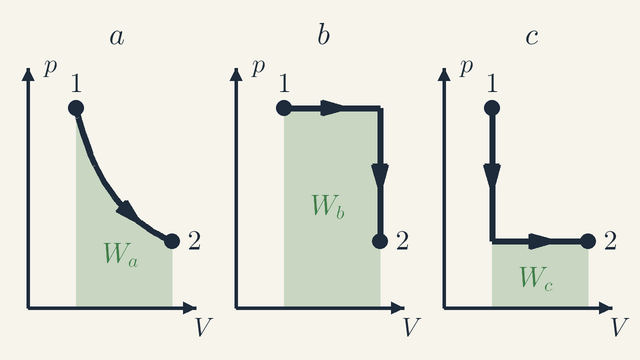
Figure 1. Three routes from state 1 to state 2, both on the same isotherm. The work done by the gas is the shaded area under each route, and the three areas differ, Wb>Wa>Wc, although the end states are the same.Legend
p
Pressure of the gas.
Pa
V
Volume of the gas.
m3
a
Route along the 500 K isotherm, at constant temperature.
b
Route that first expands at constant pressure, then cools at constant volume.
c
Route that first cools at constant volume, then expands at constant pressure.
Wa
Work done by the gas along route a: the area under it.
J
Wb
Work done by the gas along route b: the area under it.
J
Wc
Work done by the gas along route c: the area under it.
J
Figure 1 draws three routes the gas can take from state 1 (1 L, 1000 kPa) to state 2 (3 L, 333 kPa). In each panel p runs up and V across. Look at the shaded area under each route. Every small step adds pdV to the work, a thin strip of height p and width dV, so the work of a route is the area under it. A kilopascal times a litre is 103Pa⋅10−3m3=1J, so areas in these units read directly in joules.
Route a follows the isotherm pV=nRT=2.00⋅500=1000J, the curve of constant temperature 500 K through both states. Its area, worked out in the third section, is Wa=1098.6J. Route b first expands at 1000 kPa and then cools at constant volume; the cooling step is vertical and adds no area, so the area under route b is a rectangle of height 1000 kPa and width 2 L: Wb=2000J. Route c first cools at constant volume and then expands at 333 kPa, which leaves a rectangle of height 333 kPa: Wc=667J.
Both states lie on the 500 K isotherm, so ΔU=0 by every route, and the first law gives Q=W: the gas takes in 1098.6 J, 2000 J or 667 J of heat depending on the route. The end states are the same in all three panels, yet the work and the heat differ. They belong to the route, not to the states.
A cycle exploits this freedom. After a full loop the gas is back where it started, so ∮dU=0 and ∮δQ=∮δW. Because the work depends on the path, going out by one route and back by another leaves a net work, the area enclosed by the loop: W=∮pdV That net work is paid for by a net intake of heat. This is how every heat engine works.
The Carnot loop on the p–V diagram
The Carnot cycle is the loop that exchanges heat at only two fixed temperatures. It sets the upper limit for every engine, so it is worth reading closely. Its heat comes from two reservoirs, bodies so large that their temperatures do not change when they give or take heat: a hot one at Th=500K and a cold one at Tc=300K. The loop is made of two kinds of stroke. On an isotherm the gas touches a reservoir and keeps its temperature. On an adiabat the gas is insulated, so no heat flows at all.
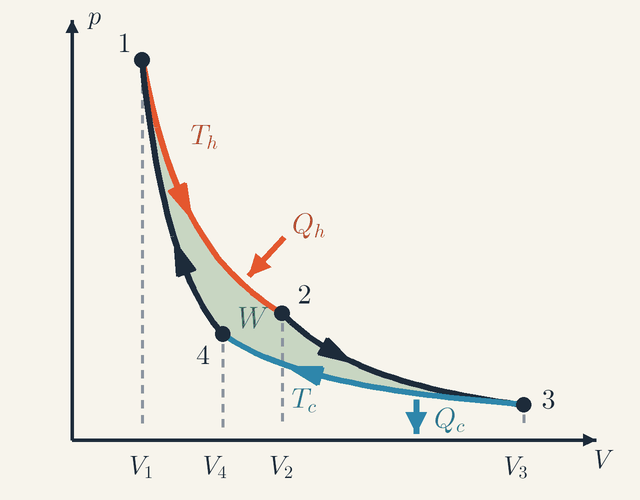
Figure 2. The animation's Carnot loop to scale, run clockwise from corner 1. The coloured curves are the two isotherms, the black ones the steeper adiabats; the shaded area inside the loop is the net work W.Legend
p
Pressure of the gas.
Pa
V
Volume of the gas.
m3
V1
Volume at corner 1, where the hot isotherm starts.
m3
V2
Volume at corner 2, where the hot isotherm ends.
m3
V3
Volume at corner 3, where the cold isotherm starts.
m3
V4
Volume at corner 4, where the cold isotherm ends.
m3
Th
Temperature of the hot isotherm and of the hot reservoir.
K
Tc
Temperature of the cold isotherm and of the cold reservoir.
K
Qh
Heat the gas takes in from the hot reservoir along the hot isotherm.
J
Qc
Heat the gas gives to the cold reservoir along the cold isotherm.
J
W
Net work done by the gas in one cycle: the area inside the loop.
J
Figure 2 shows the animation's Carnot loop to scale. Follow it clockwise from corner 1. From 1 to 2 the gas expands along the hot isotherm, at Th, and takes in the heat Qh from the hot reservoir. From 2 to 3 it keeps expanding along an adiabat; with no heat coming in it does this work out of its own internal energy, so it cools until it reaches Tc. From 3 to 4 it is compressed along the cold isotherm, at Tc, and gives up the heat Qc to the cold reservoir. From 4 to 1 a second adiabat compresses it with no heat flow, and the work done on it warms it back to Th.
The corners are at V1=1L and 1000 kPa, V2=3L and 333 kPa, V3=6.46L and 93 kPa, and V4=2.15L and 279 kPa; the next section shows where V3 and V4 come from. The two isotherms are the hyperbolas pV=1000J and pV=nRTc=600J.
Now compare the curves at a corner. An adiabat obeys pVγ=const (derived in the next section), where γ, the ratio of the heat capacities at constant pressure and at constant volume, is 5/3 for a monatomic gas. Differentiating, its slope is dp/dV=−γp/V, against −p/V for an isotherm through the same point. So where the two cross, the adiabat falls 5/3 times as steeply. That is why each adiabat in Figure 2 cuts down from the hot isotherm to the cold one, closing the loop.
Read the work off the areas. Under the two expansion strokes, 1 to 2 and 2 to 3, the area is 1098.6+600=1698.6J; under the two compressions, 3 to 4 and 4 to 1, it is 659.2+600=1259.2J. The shaded loop between them is the net work, W=1698.6−1259.2=439.4J.
The two adiabatic areas are equal, 600 J each, because on an adiabat Q=0, so the work equals the change of U, and both adiabats change U by 23nR(Th−Tc)=1.5⋅2.00⋅200=600J. The loop runs clockwise, so the gas does more work while expanding at high pressure than is done on it while being compressed at low pressure. Run anticlockwise, the same loop is a refrigerator.
Deriving the Carnot efficiency for an ideal gas
The efficiency of an engine is the fraction of the heat it takes in that comes out as work, η=W/Qh. Over one cycle ΔU=0, so W=Qh−Qc and η=1−Qc/Qh. Everything therefore hangs on the ratio Qc/Qh, and the strokes of Figure 2 give it in three steps.
First, the isotherms. For an ideal gas U depends on T only, so along an isotherm dU=0 and δQ=δW=pdV. With p=nRT/V and T fixed, Q=∫ViVfVnRTdV=nRTlnViVf The hot isotherm, from V1 to V2 in Figure 2, takes in Qh=nRThln(V2/V1)=1000ln3=1098.6J. The cold one runs as a compression from V3 to V4, so the gas gives out heat; counted as a positive amount, Qc=nRTcln(V3/V4).
Second, the adiabats. Along an adiabat δQ=0, so dU=−pdV. Substitute dU=23nRdT and p=nRT/V, then divide by nRT: 23TdT=−VdV Integrating gives 23lnT+lnV=const, that is TV2/3=const. For any ideal gas the same steps give TVγ−1=const, and replacing T by pV/nR turns this into pVγ=const, with γ=5/3 here.
Third, the volumes. The adiabat from 2 to 3 starts at Th and volume V2 and ends at Tc and volume V3, so ThV22/3=TcV32/3, which gives V3/V2=(Th/Tc)3/2. The adiabat from 4 to 1 joins the same two temperatures, so V4/V1 is the same factor. Dividing one ratio by the other, V4V3=V1V2 In the animation the factor is (5/3)3/2=2.15: it takes 3 L to 6.46 L and 1 L to 2.15 L, the volume steps of the two adiabats in Figure 2.
The two logarithms are therefore equal, ln(V3/V4)=ln(V2/V1)=ln3, so Qc=600ln3=659.2J, and dividing Qh by Qc leaves only the temperatures: ThQh=TcQc(Carnot) ηC=1−ThTc Both ratios equal nRln3=2.197J/K in the animation, and the efficiency is 1−300/500=40%, whatever the volumes or the amount of gas. The exponent γ has also dropped out: a diatomic gas would need other volumes but would reach the same efficiency. That is a first hint that the result belongs to no particular substance, and the next two sections prove it.
Reversible engines and the second law
A process is reversible if an arbitrarily small change of conditions can run it backwards, through the same states, with every flow of heat and work reversed. That needs two things: no friction, and heat that crosses only vanishing temperature differences. Every Carnot stroke qualifies. On the isotherms the gas is at the reservoir's own temperature, and on the adiabats no heat flows at all. So the engine can run in reverse, using 439.4 J of work to take 659.2 J from the cold reservoir and deliver 1098.6 J to the hot one.
The second law needs one more ingredient, a statement of what nature forbids. In the form Kelvin gave it, later sharpened by Planck: no cycle can take heat from a single reservoir and turn it into work with no other change. It sounds modest, but the next section shows that it alone fixes the best efficiency any engine can have.
Why no engine beats a reversible one
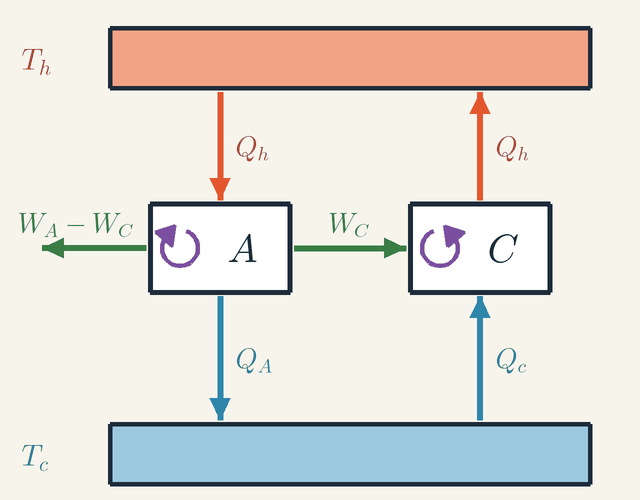
The argument is a thought experiment. Suppose someone builds an engine A that does better than a Carnot engine between the same two reservoirs. Couple it to a Carnot engine C running backwards and add up what happens.
Figure 3. An engine A claimed to beat the Carnot efficiency drives a Carnot engine C backwards between the same reservoirs. The hot reservoir ends unchanged, yet work WA−WC is left over, drawn from the cold reservoir alone. Not to scale.Legend
Th
Temperature of the hot reservoir.
K
Tc
Temperature of the cold reservoir.
K
A
Engine claimed to be more efficient than a reversible one.
C
Carnot engine, run backwards as a refrigerator.
Qh
Heat that A takes from the hot reservoir and that C gives back to it: the same amount.
J
QA
Heat that A rejects to the cold reservoir.
J
Qc
Heat that C takes from the cold reservoir, more than QA.
J
WA
Work that A delivers per cycle.
J
WC
The part of WA passed on to drive C.
J
WA−WC
Work left over: the heat the cold reservoir loses, Qc−QA, turned into work.
J
In Figure 3 the hot reservoir at Th=500K is at the top and the cold one at Tc=300K at the bottom. Vertical arrows carry heat, horizontal arrows carry work. Engine A takes the same Qh=1098.6J from the hot reservoir as the Carnot engine would, but is supposed to deliver more work, WA=500J, an efficiency of 45.5 %. By the first law it then rejects only QA=1098.6−500=598.6J to the cold reservoir. Now pass WC=439.4J of that work to C, run as a refrigerator: it takes Qc=659.2J from the cold reservoir and delivers Qh=1098.6J to the hot one.
Follow the arrows and keep the accounts. The hot reservoir gives Qh to A and gets the same Qh back from C, so it is left exactly as it was. The cold reservoir receives QA and gives up Qc, a net loss of Qc−QA=659.2−598.6=60.6J. Meanwhile WA−WC=500−439.4=60.6J of work is left over. Taken together, the two machines turn heat from the cold reservoir alone into work, with no other change. The second law forbids exactly this, so engine A cannot exist: no engine beats a reversible one.
Now let A be reversible too. If it were less efficient than C, the same argument with the roles swapped, C driving A backwards, would again give work from one reservoir. So all reversible engines between the same two temperatures share one efficiency, whatever their working substance, and the ideal-gas calculation has already found its value: ηC=1−Tc/Th.
That universality defines an absolute temperature with no thermometer substance at all: set Th/Tc=Qh/Qc for any reversible engine running between two bodies. The ideal-gas calculation shows that this scale is proportional to the ideal-gas scale, so the two agree once the same unit is chosen. The zeroth law (two bodies each in equilibrium with a third are in equilibrium with each other) is what makes "the temperature of a reservoir" a meaningful label in the first place.
Finally, read Qh/Th=Qc/Tc as a balance. The engine takes the quantity Q/T out of the hot reservoir and passes the same amount to the cold one, unchanged. That quantity is the change of entropy, the subject of the lesson on the second law and entropy. The line ΔStot=Qc/Tc−Qh/Th=0 in the animation's Advanced layer records 2.197 J/K leaving the hot side and reaching the cold side, with nothing created.
Worked problem: a cycle without adiabats
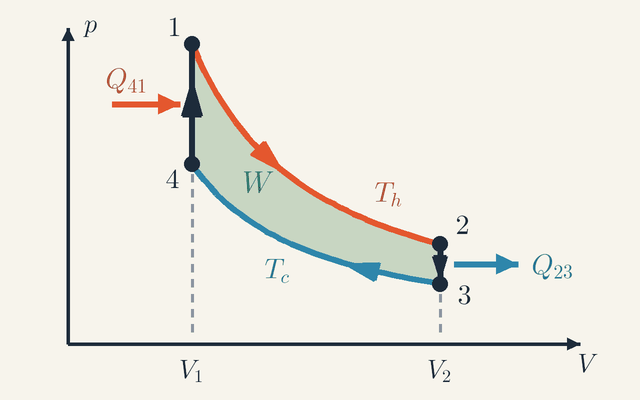
What does it cost to break one of Carnot's rules? Keep the animation's gas, reservoirs and isotherms between V1=1L and V2=3L, but replace the adiabats by constant-volume steps: lock the piston and move the cylinder to the other reservoir. Find the work, the efficiency and where the shortfall goes.
Figure 4. The worked cycle to scale: the isotherms of Figure 2 joined by constant-volume steps instead of adiabats. The shaded loop is the net work W; at each vertical step heat crosses a temperature gap of up to 200 K.Legend
p
Pressure of the gas.
Pa
V
Volume of the gas.
m3
V1
The smaller volume, 1 L, where the left-hand step is made.
m3
V2
The larger volume, 3 L, where the right-hand step is made.
m3
Th
Temperature of the hot isotherm and of the hot reservoir.
K
Tc
Temperature of the cold isotherm and of the cold reservoir.
K
W
Net work done by the gas in one cycle: the area inside the loop.
J
Q41
Heat taken from the hot reservoir while the gas warms at constant volume, from corner 4 to corner 1.
J
Q23
Heat given to the cold reservoir while the gas cools at constant volume, from corner 2 to corner 3.
J
Figure 4 shows the new loop to scale. From 1 to 2 the gas expands along the hot isotherm (Th) and from 3 to 4 it is compressed along the cold one (Tc), exactly as before, so the isotherms still give 1098.6 J in at 500 K and 659.2 J out at 300 K. The two vertical steps are new. At constant volume the gas does no work, so the heat it exchanges equals its change of internal energy.
From 2 to 3, at 3 L, the gas cools from 500 K to 300 K and its pressure falls from 333 kPa to 200 kPa; it hands the cold reservoir Q23=23nR⋅200=600J. From 4 to 1, at 1 L, it must take Q41=600J from the hot reservoir to warm up again, its pressure rising from 600 kPa to 1000 kPa. The vertical steps add no area, so the net work is the same as Carnot's, but the hot reservoir now supplies 1098.6+600=1698.6J: W=1098.6−659.2=439.4J,η=1098.6+600439.4=25.9%
The loss comes from heat crossing a finite temperature gap, and entropy measures it. On the isotherms the entropy flows cancel exactly as in the Carnot cycle. On the vertical steps they do not. While warming at 1 L the gas gains entropy ∫23nRdT/T=23nRln(5/3)=1.53J/K, but the hot reservoir, giving its 600 J at a steady 500 K, loses only 600/500=1.20J/K. While cooling at 3 L the gas loses 1.53 J/K, but the cold reservoir gains 600/300=2.00J/K. The gas returns to its starting state, so its own changes cancel, and each cycle creates 2.00−1.20=0.80J/K of entropy in the reservoirs.
The work lost is Tc times the entropy created, 300⋅0.80=240J. Check it: a Carnot engine given the same 1698.6 J would deliver 0.40⋅1698.6=679.4J, and 679.4−439.4=240J exactly. The cure is a regenerator, a porous heat store that takes up the 600 J layer by layer as the gas cools and returns it the same way as the gas warms. Each layer meets gas at nearly its own temperature, so no entropy is created, the hot reservoir supplies only the 1098.6 J of the isotherm, and the efficiency is back to 40 %. This is the idea behind the Stirling engine.
Refrigerators and heat pumps
Run backwards, the Carnot engine pumps heat uphill, from cold to hot. A refrigerator is judged by its coefficient of performance COP, the heat removed from the cold side per joule of work, Qc/W. With W=Qh−Qc and the Carnot ratio Qh/Qc=Th/Tc, the best possible value is COP=WQc≤Th−TcTc In the animation 659.2/439.4=1.5=300/200. Used as a heat pump, the same machine delivers Qh to the warm side: 1098.6/439.4=2.5 joules of heat per joule of work, the limit Th/(Th−Tc)=500/200. Values above 1 break no law: the work does not have to create the heat it moves, only lift it.
Why real engines fall short
Real engines lose for reasons beyond friction. Most take in heat over a range of temperatures instead of all at the hottest one. The ideal petrol-engine (Otto) cycle is two adiabats joined by heating and cooling at constant volume. Its efficiency is η=1−r1−γ, where the compression ratio r is the largest volume divided by the smallest: 60 % for r=10 with air (γ=1.4). That is well below the Carnot value of nearly 90 % between its peak gas temperature, around 2500 K, and the 300 K intake air. Real petrol engines, with friction and heat leaks as well, peak near 35–40 %.
Speed matters too. A reversible engine must exchange heat across vanishing temperature differences, so it runs infinitely slowly and delivers no power. An engine limited by how fast heat flows in and out gives its greatest power near η=1−Tc/Th, which is 39 % between 800 K and 300 K, close to what real steam power stations achieve.
Limits of validity
The stroke formulas assume quasi-static changes. Pressure evens out at about the speed of sound, crossing a 10 cm cylinder in about 0.2 ms, well within the 10 ms of one stroke in a car engine at 3000 rpm. Heat diffuses far more slowly, so fast strokes are nearly adiabatic and truly isothermal ones are impractical; real cycles add heat at roughly constant volume or constant pressure instead.
The values U=23nRT and γ=5/3 hold for a dilute monatomic gas. Air near room temperature has γ=1.4, and in a dense gas U depends on the volume too, yet ηC is unaffected, as the argument of Figure 3 guarantees. The first law has no known exception, but in relativity energy includes rest energy. Burning 1 kg of petrol releases about 46 MJ, so the products are lighter than the petrol and oxygen by 46×106/(3.00×108)2≈5×10−10kg, far too little to weigh.
The laws also describe averages. For a handful of molecules Q and W fluctuate from cycle to cycle, and a single cycle can even beat Carnot. The relative fluctuations scale as 1/N for N molecules, about 3×10⁻¹² for the 1.4×10²³ atoms of the animation's gas, so for anything visible the laws hold exactly. The third law makes absolute zero unreachable, so Tc is never zero and ηC always stays below 1.
Where this leads
The Second Law of Thermodynamics and Entropy turns Q/T into entropy, proves the Clausius inequality and explains, by counting molecular arrangements, why heat flows only downhill. Kinetic Theory of Gases gives the molecular reasons for U=23nRT and for adiabatic heating. Steam engines rely on Phase Changes and Latent Heat: boiling and condensing happen at a fixed temperature, so their heat exchange is naturally isothermal. Conduction, Convection and Radiation sets how fast heat reaches an engine, and so its power; Electric Power and Energy at Home follows the energy from the power station to the socket; and Work, Energy and Power is where the conservation of energy began.
Key formulas
First law of thermodynamics
ΔU=Q−W
The energy that enters a system as heat either stays inside, raising its internal energy, or leaves as work. It is the conservation of energy, once heat is recognised as energy in transit. With W the work done by the system, heat flowing in and expansion count as positive; texts that use the work done on the system write ΔU=Q+W.
Symbols
ΔU
change in internal energy of the system
J
Q
heat received by the system
J
W
work done by the system on its surroundings
J
When it holds: Always, for any system and any process, fast or slow, as long as the signs are used consistently. Over a complete cycle ΔU=0.
Example: In the animation's second stroke Q=0 and the gas does 600 J of work: ΔU=0−600=−600J, and its temperature falls by 200 K.
Net work of a cycle
W=Qh−Qc
After a full cycle the working substance is back in its starting state, so ΔU=0 and the first law says that the net work equals the net heat taken in. With both heats counted as positive amounts, that is the heat taken from the hot side minus the heat rejected to the cold side.
Symbols
W
net work done per cycle
J
Qh
heat taken from the hot reservoir per cycle
J
Qc
heat rejected to the cold reservoir per cycle
J
When it holds: For any engine, reversible or not, over a whole number of cycles. Within a cycle the internal energy changes, so heat and work do not balance stroke by stroke.
Example: The animated engine: W=1098.6−659.2=439.4J per cycle.
Efficiency of a heat engine
η=QhW=1−QhQc
Efficiency compares what you get, the work, with what you pay for, the heat drawn from the hot reservoir. The second form follows from W=Qh−Qc: the efficiency falls short of 1 by exactly the fraction of the heat that is rejected, so η=1 would need Qc=0.
Symbols
η
efficiency (a fraction, often quoted in per cent)
W
net work done per cycle
J
Qh
heat taken from the hot reservoir per cycle
J
Qc
heat rejected to the cold reservoir per cycle
J
When it holds: For any cyclic engine; it can be applied per cycle or per second. Divide by the heat taken in, not by the heat rejected. Refrigerators and heat pumps are rated by a coefficient of performance instead.
Example: The power station of the worked example: η=600/1500=40%, with 900 MW rejected.
Carnot efficiency
ηC=1−ThTc
The highest efficiency any engine can reach between reservoirs at absolute temperatures Th and Tc, attained only by a reversible engine. It follows from Qh/Th=Qc/Tc for reversible engines and depends on the two temperatures alone, not on the design or the working substance.
Symbols
ηC
Carnot (maximum possible) efficiency
Tc
absolute temperature of the cold reservoir
K
Th
absolute temperature of the hot reservoir
K
When it holds: An upper limit, approached only by infinitely slow, frictionless engines that exchange heat across vanishing temperature differences. Temperatures must be in kelvins.
Example: The animation: 1−300/500=40%. Steam at 800 K and river water at 300 K: 1−300/800=62.5%.
Work as the area of the loop
W=∮pdV
Each small expansion dV against the pressure p does work pdV, so the work in one stroke is the area under its curve on a p–V diagram. Round a closed cycle, the areas under expansion and compression subtract and leave the area enclosed by the loop: positive for a clockwise loop (an engine), negative for an anticlockwise one (a refrigerator).
Symbols
W
net work done by the gas per cycle
J
p
pressure of the gas
Pa
V
volume of the gas
m3
When it holds: Only for quasi-static changes, where the gas has one well-defined pressure; a gas rushing into a vacuum does no work although its volume grows.
Example: With pressure in kPa and volume in litres, areas read directly in joules: the animation's loop encloses 1698.6−1259.2=439.4J.
Heat ratio of a reversible engine
ThQh=TcQc(Carnot)
For any reversible engine, the heats exchanged with the two reservoirs are in the ratio of their absolute temperatures; this ratio defines the thermodynamic temperature scale without any thermometer substance. Read as a balance, the engine takes Q/T from the hot reservoir and hands exactly as much to the cold one: entropy is passed on, not created.
Symbols
Qh
heat taken from the hot reservoir per cycle
J
Th
absolute temperature of the hot reservoir
K
Qc
heat rejected to the cold reservoir per cycle
J
Tc
absolute temperature of the cold reservoir
K
When it holds: Reversible engines only. A real engine rejects more heat, Qc/Tc>Qh/Th, and so creates entropy.
Example: The animation: 1098.6/500=659.2/300=2.197J/K.
Coefficient of performance of a refrigerator
COP=WQc≤Th−TcTc
A refrigerator uses work W to pull heat Qc out of the cold side and dumps Qc+W on the hot side. Its coefficient of performance is the heat removed per joule of work, and the reversible limit follows from Qh/Th=Qc/Tc. It can be well above 1, because the work only lifts the heat from cold to hot instead of creating it.
Symbols
COP
coefficient of performance (heat removed per unit of work)
Qc
heat removed from the cold side per cycle
J
W
work supplied per cycle
J
Tc
absolute temperature of the cold side
K
Th
absolute temperature of the hot side
K
When it holds: The bound holds for every refrigerator and is reached only by a reversible one. It grows without limit as Tc approaches Th and falls towards zero near absolute zero. A heat pump, rated by the heat it delivers, is limited to Th/(Th−Tc).
Example: The animated engine run backwards: 659.2/439.4=1.5=300/(500−300). A freezer at 255 K in a kitchen at 298 K: at most 255/43=5.9.
Glossary
First law of thermodynamics
Conservation of energy with heat included. The change in a system's internal energy equals the heat it receives minus the work it does, ΔU=Q−W, so no engine can deliver work from nothing.
Internal energy
The energy stored inside a system, in the motion and interactions of its molecules. For an ideal monatomic gas it is 23nRT and depends on temperature alone.
Heat
Energy transferred because of a temperature difference; on its own it always flows from hotter to colder. A body does not contain heat: it contains internal energy, which heat can raise or lower.
Work done by a gas
Energy transferred when a gas moves a piston: pΔV at constant pressure, and in general the area under the curve on a p–V diagram. Positive when the gas expands, negative when it is compressed.
State function
A quantity fixed by the present state alone, such as U, p, V or T, so it returns to its starting value after any cycle. Heat and work are not state functions: they depend on the path taken.
Isothermal process
A change at constant temperature, kept so by slow contact with a reservoir. For an ideal gas ΔU=0, so the heat taken in equals the work done: 1099 J each in the animation's first stroke.
Adiabatic process
A change with no heat exchanged, Q=0, because the system is insulated or the change is too fast for heat to flow. The work comes out of the internal energy, so an expanding gas cools and a compressed one heats up.
Heat reservoir
A body so large that giving or taking heat does not change its temperature, such as a furnace, a river or the atmosphere.
Heat engine
A device that runs in a cycle, takes heat from a hot reservoir, turns part of it into work and rejects the rest to a cold reservoir. Car engines, steam turbines and jet engines are heat engines.
Reversible process
An idealised, infinitely slow process with no friction and no heat flow across a finite temperature gap, which an arbitrarily small change could run backwards. No engine is more efficient than a reversible one.
Carnot cycle
The reversible cycle of two isotherms and two adiabats: heat enters only at Th and leaves only at Tc. Its efficiency, 1−Tc/Th, is the upper limit for any engine working between those temperatures.
Refrigerator and heat pump
A heat engine run backwards: work moves heat from a cold place to a hot one. A refrigerator is rated by the heat it removes per joule of work, a heat pump by the heat it delivers; both ratios can exceed 1.
Quantities
ΔU
Change in internal energy
J
Final minus initial internal energy of the system. It is zero over any complete cycle and, for an ideal gas, whenever the temperature ends where it started.
Q
Heat
J
Heat received by the system; negative when the system gives heat away.
W
Work done by the system
J
Work done by the system on its surroundings, such as a gas pushing a piston; negative when the surroundings do work on it. For an engine, the net work per cycle. On a p–V diagram it is ∮pdV, with p the gas pressure in pascals and V its volume in cubic metres (1 kPa times 1 L is 1 J).
Qh
Heat from the hot reservoir
J
Heat taken in per cycle at the high temperature, counted as a positive amount: 1098.6 J in the animation.
Qc
Heat to the cold reservoir
J
Heat rejected per cycle at the low temperature, counted as a positive amount: 659.2 J in the animation.
Th
Temperature of the hot reservoir
K
Absolute temperature at which the engine takes in heat: 500 K in the animation.
Tc
Temperature of the cold reservoir
K
Absolute temperature at which the engine rejects heat: 300 K in the animation. Degrees Celsius never go into the efficiency formulas.
η
Efficiency
The fraction of the heat taken in that comes out as work, W/Qh, often given in per cent.
ηC
Carnot efficiency
The highest efficiency possible between Th and Tc, reached only by a reversible engine: 40 % between 500 K and 300 K.
COP
Coefficient of performance
For a refrigerator, the heat removed from the cold side per unit of work, Qc/W. Unlike an efficiency, it can be larger than 1.
Quiz
Beginner What does the first law of thermodynamics express?
Energy is conserved: it is neither created nor destroyed
Heat always flows from cold to hot
A frictionless engine is 100 % efficient
Nothing can be colder than 0 °C
Show answer
Answer: A. Energy is conserved: it is neither created nor destroyed
The first law, ΔU = Q − W, is energy conservation applied to heat and work.
Beginner Why does every car engine have to get rid of waste heat?
Only because of friction between moving parts
Because petrol holds more energy than the engine can store
To stop the fuel from freezing
Because no heat engine can turn all of its heat into work
Show answer
Answer: D. Because no heat engine can turn all of its heat into work
The second law requires every heat engine to reject some heat to a colder place. Friction adds losses, but even a perfect engine needs the radiator.
Beginner Which change would let a heat engine turn a larger share of its heat into work?
Using a bigger cylinder at the same temperatures
Making the hot side hotter or the cold side colder
Running the engine faster
Painting the engine black
Show answer
Answer: B. Making the hot side hotter or the cold side colder
The maximum efficiency depends only on the two temperatures, 1 − T_c/T_h: the bigger the gap, the more work per unit of heat.
Advanced 1000 J of heat leaks directly from a reservoir at 500 K to one at 250 K, with no engine in between. What is the entropy change of the universe?
0 J/K, because energy is conserved
−2 J/K
+2 J/K
+6 J/K
Show answer
Answer: C. +2 J/K
The hot reservoir loses 1000/500 = 2 J/K and the cold one gains 1000/250 = 4 J/K, so ΔS_universe = +2 J/K > 0: heat flowing across a temperature gap is irreversible. Energy is conserved, entropy is not; adding the magnitudes gives the wrong 6 J/K.
Intermediate An engine takes in 2000 J of heat per cycle and rejects 1400 J. What is its efficiency?
30 %
70 %
43 %
143 %
Show answer
Answer: A. 30 %
W = 2000 − 1400 = 600 J, and η = W/Q_h = 600/2000 = 30 %. Dividing by the rejected heat (600/1400) gives the wrong 43 %.
Intermediate What happens when an ideal gas expands adiabatically while pushing a piston?
Its temperature stays constant
The gas does work and its temperature falls
Heat flows in to keep its energy constant
Its internal energy rises
Show answer
Answer: B. The gas does work and its temperature falls
With Q = 0, the first law gives ΔU = −W. The work done by the expanding gas comes from its internal energy, so it cools.
Advanced What is the maximum possible efficiency of an engine running between 327 °C and 27 °C?
92 %
100 %
67 %
50 %
Show answer
Answer: D. 50 %
Use kelvins: η_C = 1 − 300/600 = 50 %. Using Celsius (1 − 27/327) gives the wrong 92 %.
Advanced In a p–V diagram of an engine cycle, what does the area enclosed by the loop represent?
The heat absorbed from the hot reservoir
The change in internal energy over one cycle
The net work done per cycle
The entropy produced per cycle
Show answer
Answer: C. The net work done per cycle
W = ∮p·dV is the area of the loop. Over a cycle ΔU = 0, so this area also equals Q_h − Q_c, not Q_h itself.
 Physics Tutor