Temperature T, heat Q and specific heat capacity c: why a hot body cools and a cold one warms until they match, and how much energy that takes, Q=mcΔT.
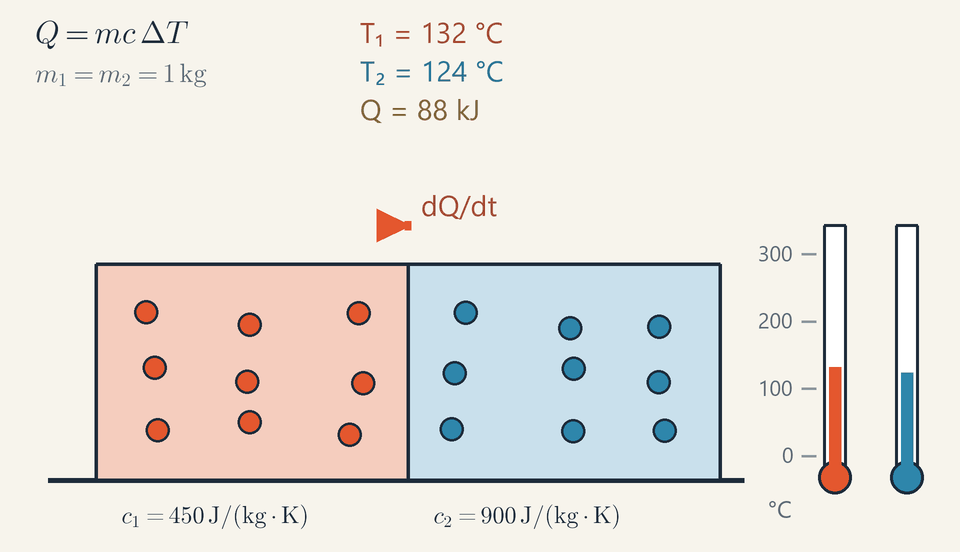
A hot block and a cold block in contact: heat flows from hot to cold until both reach the same temperature.
Beginner
Key ideas
Temperature tells how hard, on average, an object's tiny particles jiggle; a thermometer reads it in °C or in kelvins.
Temperature is not the amount of energy: a warm bathtub holds far more energy than a teaspoon of the same water.
Heat is energy on the move: it flows by itself only from hotter to colder, until both reach the same temperature.
Some materials are much harder to warm: kilogram for kilogram, water needs about nine times more energy than iron.
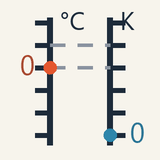
Step 1. How hot is something? A thermometer answers with a number: its temperature. On the Celsius scale, water freezes at 0 °C and boils at 100 °C. Scientists also use the kelvin scale, which starts at absolute zero (about −273 °C), the coldest temperature possible; one kelvin is the same step as one degree Celsius.
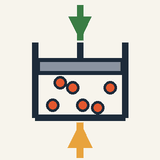
Step 2. What does the thermometer really measure? Everything is made of tiny particles that never stop jiggling. Temperature tells you how hard, on average, each particle jiggles: the hotter the object, the faster its particles move.
Step 3. Temperature is not the same as the amount of energy. A bathtub of warm water and a teaspoon of the same water have the same temperature, but the bathtub holds thousands of times more jiggling energy, because it contains thousands of times more particles.
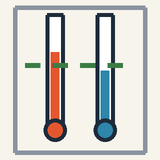
Step 4. Heat is energy on the move. When a hot object touches a cold one, its fast particles bump into the slower ones and share some of their motion. Energy flows by itself from hot to cold, never the other way, until both reach the same temperature: thermal equilibrium. In the animation, the hot block's particles jiggle harder at first; the heat arrow shrinks as the thermometers draw level and disappears when both blocks are equally warm.
Step 5. Some materials are much harder to warm than others. A kilogram of water needs about 4200 joules to warm by one degree; a kilogram of iron needs only about 450. That is why sand can burn your feet while the sea stays cool.
Check yourself: a sparkler's sparks are hotter than 1000 °C, yet they barely hurt when they land on your hand. Why? Answer: each spark is tiny, so although it is very hot, it carries very little energy.
Intermediate
Key ideas
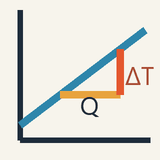
Q=mcΔT gives the heat in joules needed to change the temperature of a mass m, as long as nothing melts or boils.
A change of 1 °C equals a change of 1 K; T(K)=T(∘C)+273.15.
In an insulated system, heat lost by the hot body = heat gained by the cold body; this fixes the final temperature.
Equal heat does not give equal temperature change: the body with the larger mc changes less.
Temperature, heat and their units
Temperature is what a thermometer reads. On the Celsius scale water freezes at 0 °C and boils at 100 °C. The kelvin scale (unit K) has steps of the same size but starts at absolute zero, −273.15 °C, the lowest temperature possible: T(K)=T(∘C)+273.15
A temperature change ΔT therefore has the same value on both scales: from 20 °C to 30 °C is a change of 10 K. Only the kelvin scale starts from a true zero, so use kelvins whenever temperatures are multiplied, divided or raised to a power.
Heat Q is energy, in joules (J), that passes from one body to another because their temperatures differ. A body does not contain heat: it contains internal energy U, the energy of the random motion of its particles and of the forces between them. Heat, like work, is energy in transit, positive when it flows into a body and negative when it flows out.
Specific heat capacity
As long as nothing melts, boils or reacts, the heat needed to change a body's temperature, and the heat capacity of the body, are
Q=mcΔT
C=mc
Here m is the mass, ΔT the final temperature minus the initial one, and c the specific heat capacity: the energy that warms 1 kg of the material by 1 K, in J/(kg·K). The heat capacity C=mc of the whole body is in J/K. When a body cools, ΔT and Q are both negative.
Typical values, in J/(kg·K), are 4180 for water, 2100 for ice, 900 for aluminium, about 800 for dry sand, 450 for iron, 385 for copper and 130 for lead. Kilogram for kilogram, water needs about nine times as much energy as iron for the same warming. That is why the sea warms and cools slowly.
Heat balance and the final temperature
When a hot body and a cold body touch inside good insulation, heat flows until both reach a common temperature T, and the heat lost by the hot body equals the heat gained by the cold one: m1c1(T1−T)=m2c2(T−T2) Solving for T, the equilibrium temperature, gives Teq=m1c1+m2c2m1c1T1+m2c2T2
This is an average of the starting temperatures, weighted by heat capacity: it lies between them, closer to the body with the larger mc. A weighted average does not depend on where the zero of the scale lies, so the formula works in °C as well as in kelvins. A body with twice the heat capacity changes its temperature half as much.
Worked example: the blocks in the animation
A 1 kg block of iron (c1=450J/(kg⋅K), so C1=450J/K) at 327 °C touches a 1 kg block of aluminium (c2=900J/(kg⋅K), C2=900J/K) at 27 °C. With no losses, heat lost equals heat gained: 450(327−T)=900(T−27) 1350T=147150+24300=171450,T=127∘C
The iron cools by 200 K, while the aluminium warms by only 100 K because its heat capacity is twice as large. The heat that crossed the contact is Q=450⋅200=900⋅100=90000J=90kJ. These are the final values on the readouts: T1 and T2 meet at 127 °C while Q climbs to 90 kJ.
The readouts also show the exchange slowing down: after 1 s the iron reads about 217 °C, the aluminium reads about 82 °C, and the heat that has crossed is about 50 kJ, so more than half of the heat crosses in the first second. The orange-red arrow labelled dQ/dt, the rate of heat flow in watts, has a length proportional to T1−T2. It is half as long when the readouts reach about 227 °C and 77 °C, and it fades as the thermometers draw level, the iron's column always falling twice as fast as the aluminium's rises.
Worked example: running a bath
You want an 80 kg bath at 38 °C, mixing hot water at 60 °C with cold water at 12 °C. How much hot water do you need, and how much energy did the boiler spend heating it? Ignore losses.
Both are water, so c cancels: mh(60−38)=mc(38−12). With mh+mc=80kg, this gives mh=80⋅26/48≈43.3kg of hot water and 36.7 kg of cold, more hot than cold because 38 °C is nearer to 60 °C. The boiler warmed the hot water from 12 °C to 60 °C: Q=mcΔT=43.3⋅4180⋅48≈8.7×10⁶J
That is 8.7 MJ, about 2.4 kWh (1 kWh is 3.6 MJ), or nearly 50 minutes of a 3 kW heater.
How fast heat flows: the shrinking arrow
The heat balance gives the end point, not the time it takes. In the animation heat crosses the contact at dQ/dt=k(T1−T2), with a thermal conductance k=240W/K: 72 kW at first, then less and less as the gap closes. Because the flow is proportional to the gap, the gap shrinks by the same fraction in equal times, halving about every 0.87 s, and never quite reaches zero.
A body cooling in a large room at temperature Tenv follows the same rule, Newton's law of cooling: dtdT=−τT−Tenv The left side is the rate of change of temperature, and the time constant τ grows with the body's heat capacity. The excess decays as T−Tenv=(T0−Tenv)e−t/τ: tea at 80 °C in a 20 °C room whose excess halves every 12 minutes reads 50 °C after 12 minutes, 35 °C after 24 minutes and 27.5 °C after 36 minutes.
Common mistakes
Heat is not stored in a body, and cold does not flow: the 90 kJ in the animation is energy that passed from the iron to the aluminium.
Use the temperature change, not the final temperature. Warming a 0.5 kg aluminium pan from 20 °C to 120 °C takes 0.5⋅900⋅100=45kJ, not 54 kJ.
Equal heat does not mean an equal change of temperature. The same 90 kJ cools the iron by 200 K but warms the aluminium by only 100 K.
Celsius temperatures cannot be compared as ratios: 54 °C is not twice as hot as 27 °C, since 327 K is only 9 % more than 300 K.
A metal handle feels colder than a wooden one at the same 20 °C only because metal, which conducts heat hundreds of times better, draws heat from your skin much faster: skin senses heat loss, not temperature.
Where you meet it
Water's large specific heat gives coastal towns milder winters and cooler summers, and the oceans have absorbed about nine tenths of the extra energy trapped by greenhouse gases. Engines are cooled with water, storage heaters keep warmth in dense bricks, and food energy is measured by burning food in a calorimeter; a food Calorie is 4.18 kJ.
Heat that melts or boils instead of warming is the subject of Phase Changes and Latent Heat, and how heat travels that of Conduction, Convection and Radiation. Thermal Expansion shows what warming does to size, Kinetic Theory of Gases explains temperature as molecular motion, and First Law of Thermodynamics and Heat Engines joins heat and work in one energy balance.
Advanced
Key ideas
Equal temperature is what bodies share once nothing changes; collisions equalize the mean energy, 21kBT per quadratic degree of freedom.
First law: ΔU=Q−W; heat is energy carried by microscopic collisions or radiation, driven by a temperature difference.
Second law: heat flows by itself only from hot to cold, raising the entropy by δQ(1/T2−1/T1)>0.
Temperature as a condition of equilibrium
Before temperature can be measured it has to be defined, and the definition comes from an experiment. Put two bodies in thermal contact, so that they can exchange energy but not matter, and wait. For a while their properties change: lengths, pressures and electrical resistances drift. Then the changes stop. The bodies are now in thermal equilibrium, and we say, by definition, that they have the same temperature.
The zeroth law of thermodynamics adds one fact: two bodies that are each in equilibrium with a third are in equilibrium with each other. This is what makes a thermometer trustworthy. The thermometer is the third body: if it gives the same reading in contact with A and in contact with B, then A and B would not change if they touched. For this to work, its heat capacity must be small enough not to disturb the temperature it measures.
This definition says when two temperatures are equal, but not how to number them. Mercury, resistance and thermocouple thermometers agree at their calibration points but differ slightly in between, because each relies on a property of its own material. A dilute gas removes this dependence: at constant volume its pressure is proportional to a temperature that is the same for every gas at low enough density. That temperature is the kelvin scale. Since 2019 the kelvin has been fixed by giving the Boltzmann constant an exact value, which ties every temperature T to an energy kBT: kB=1.380649×10⁻²³J/K
What collisions share out
Equal temperature also has a meaning at the scale of molecules: it is the condition under which collisions stop moving energy, on average, from one body to another. A thought experiment shows why.
Take two different gases in a box, separated by a piston that slides freely. The piston soon settles where the pressures on its two faces balance, but it never stands quite still: it trembles under the individual molecular impacts. Through this trembling, the side whose molecules strike harder on average passes energy to the other side. The trade stops only when the mean kinetic energy per molecule is the same on both sides. In a mixture, collisions do the same job directly, molecule to molecule. So in equilibrium heavy molecules move more slowly than light ones, yet all have the same average 21mv2.
Classical statistical mechanics turns this into the equipartition theorem. In equilibrium, every term of a particle's energy that is quadratic in one velocity component or one coordinate, such as 21mvx2, has the same average, 21kBT. A molecule of a monatomic gas has three such terms, one kinetic term per direction, so its mean kinetic energy is 23kBT. An atom in a solid has three kinetic terms and also three potential ones, because its bonds pull it back towards its rest position along each direction; its mean energy is therefore 3kBT.
For one mole of a simple solid, with NA atoms and R=NAkB, the energy is 3RT, so the molar heat capacity is the same for every element: Cm=3R≈25J/(mol⋅K) This is the Dulong–Petit law, found by experiment in 1819. Divided by the molar masses of iron and aluminium, 0.0558 and 0.0270 kg/mol, 3R gives specific heat capacities of about 447 and 924 J/(kg·K), close to the 450 and 900 used in the animation. Aluminium's value is about twice iron's because its atoms are about half as heavy: a kilogram of aluminium holds about twice as many atoms, and each stores the same energy.
How far an atom jiggles
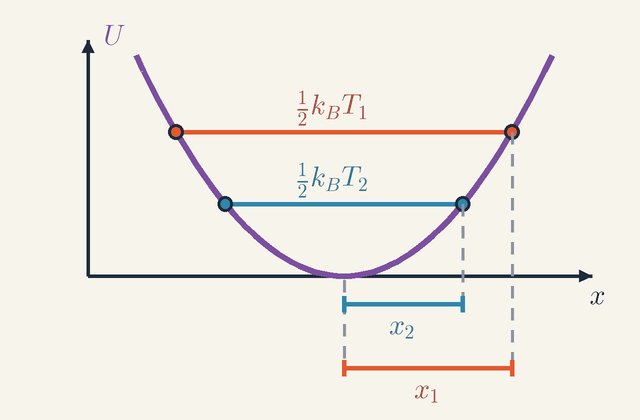
Equipartition says how much energy an atom's vibration holds. Figure 1 turns that energy into a distance, the size of the atom's jiggle, and shows how it grows with temperature.
Figure 1. One atom's elastic energy U=21ksx2 against its displacement x. The level of the mean energy 21kBT meets the well at the root-mean-square displacement kBT/ks, so doubling T widens the jiggle only by 2. Drawn for T1=2T2.Legend
U
Elastic energy of one atom in its bonds, 21ksx2, where ks is the stiffness of the bonds.
J
x
Displacement of the atom from its rest position, along one direction.
m
21kBT1
Mean elastic energy along one direction at the higher temperature T1, drawn as a level.
J
21kBT2
Mean elastic energy along one direction at the lower temperature T2, drawn as a level.
J
x1
Where the level 21kBT1 meets the well: the root-mean-square displacement, the typical size of the jiggle, at T1.
m
x2
The same at T2; smaller than x1 by a factor 2 when T1=2T2.
m
Figure 1 follows one atom of a solid moving along one direction, with displacement x from its rest position. For small displacements its bonds act like a spring of stiffness ks, so its elastic energy is U=21ksx2: the parabolic well in the figure. (Here U is the energy of this one atom in its bonds, not the internal energy of the block.) By equipartition the average of U is 21kBT. Each horizontal line is drawn at that average for one temperature: the upper line at 21kBT1 for the hotter body, the lower one at 21kBT2 for the colder body, with T1=2T2 as in the animation.
Now look at where each line meets the well. There 21ksx2=21kBT, so the line crosses the well at x=±kBT/ks, one point on each side of the centre. The brackets under the axis measure the crossing from the centre: x1 for T1 and x2 for T2. These distances have a physical meaning. Since the mean of 21ksx2 is 21kBT, the mean of x2 is kBT/ks, so each crossing is exactly the root-mean-square displacement: the typical size of the jiggle at that temperature.
The shape of the well decides how that size grows. Because U rises as x2, raising the line to twice the height pushes the crossing out by only a factor 2: in the figure x1=2x2. The jiggle grows as T, not as T. The animation draws its particles by this rule: the iron's, at 600 K, jiggle 2≈1.4 times as widely as the aluminium's, at 300 K.
Heat, work and the first law
Temperature says which way energy will flow; heat is the name of that flow. Heat was once pictured as a fluid, caloric, stored in bodies. In the 1840s James Joule showed that falling weights turning a paddle wheel in water warm it just as heating does, at a fixed rate of about 4.2 J of work for every calorie. Heat is therefore not a substance but energy in transfer, and energy conservation that includes it is the first law of thermodynamics: ΔU=Q−W
Here U is the internal energy of the system, Q the heat it receives and W the work it does on its surroundings, the sign convention of the lesson First Law of Thermodynamics and Heat Engines. If W counts the work done on the system instead, the law reads ΔU=Q+W.
The two kinds of transfer differ in how they happen. Work is energy passed on by a macroscopic force acting through a distance, like a piston pushing on a gas. Heat is energy passed on by microscopic collisions or by radiation, driven by a temperature difference. Only U is a property of the state of a body. A warm block could have been warmed by a flame, which is heat, or by rubbing, which is work, and nothing in the block records which; so "the heat contained in a body" means nothing.
For solids and liquids, the work done against the atmosphere as they expand is negligible, so the heat they receive, Q=CΔT, is in effect their change of internal energy ΔU. Gases differ: an ideal gas heated at constant pressure also does work as it expands, so its molar heat capacity at constant pressure exceeds the one at constant volume by exactly R.
Two blocks in contact: an exponential approach
The first law fixes where the exchange ends; to follow it in time we need a model of how fast heat crosses the contact. Treat each block as uniform, with one temperature throughout: the hot block has heat capacity C1 and temperature T1(t), the cold one C2 and T2(t). Let the contact carry a heat flow proportional to the temperature difference, k(T1−T2), where k is the thermal conductance of the contact, in W/K. Each block's energy changes only through this flow, so C1dtdT1=−k(T1−T2),C2dtdT2=k(T1−T2)
Two results follow. First, adding the equations gives d(C1T1+C2T2)/dt=0: what one block loses, the other gains, so C1T1+C2T2 stays at its starting value. At the end both temperatures are equal, and this fixes the final temperature: Teq=C1+C2C1T1(0)+C2T2(0)
Second, dividing each equation by its heat capacity and subtracting the second from the first gives an equation for the gap ΔT=T1−T2 alone: dtdΔT=−k(C11+C21)ΔT The gap shrinks at a rate proportional to its own size, which is the mark of exponential decay. Starting from ΔT0, ΔT=ΔT0e−t/τ,τ=k(C1+C2)C1C2 The time constant τ is long when the bodies are large or the contact is poor. The combination C1C2/(C1+C2) is always smaller than either heat capacity, so the smaller body sets the pace.
The animation uses 1 kg of iron at 600 K (327 °C), so C1=450J/K, and 1 kg of aluminium at 300 K (27 °C), so C2=900J/K. Then Teq=(450⋅600+900⋅300)/1350=400K, or 127 °C, and the iron passes 450⋅200=90kJ to the aluminium. With C1C2/(C1+C2)=300J/K and k=240W/K, the time constant is τ=300/240=1.25s (1/τ=0.8s−1). The flow starts at kΔT0=240⋅300=72kW, the gap halves every τln2≈0.87s, and it is down to 1 K after τln300≈7.1s.
Reading the two curves
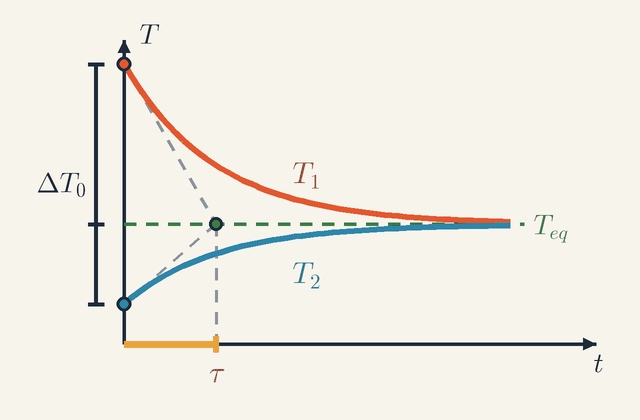
The solution is easiest to grasp as a picture. Figure 2 shows where the two temperatures end, how fast they start, and what τ means on the graph.
Figure 2. The temperatures of the two blocks against time, with the animation's numbers. Both curves approach Teq, which divides the starting gap ΔT0 in the ratio 2 : 1; the tangents at t=0 (dashed grey) both reach it at t=τ.Legend
T
Temperature of a block.
K
t
Time since the blocks were put in contact.
s
T1
Temperature of the hot block, the iron; it falls from its starting value.
K
T2
Temperature of the cold block, the aluminium; it rises from its starting value.
K
Teq
Common final temperature, the level both curves approach.
K
ΔT0
Starting temperature difference T1−T2; the gap then shrinks as e−t/τ.
K
τ
Time constant: the time at which both starting tangents reach Teq.
s
Figure 2 draws the two curves of the animation's expert graph with its numbers. The orange-red curve T1 starts at the iron's 327 °C and falls; the blue curve T2 starts at the aluminium's 27 °C and rises. The bracket on the left spans the starting gap ΔT0, 300 K.
First, see where the curves go. Both bend onto the green dashed line Teq, at 127 °C. This line cuts the bracket in the ratio 2 : 1, and it keeps cutting the shrinking gap in the same ratio: because C1T1+C2T2 always equals (C1+C2)Teq, we have C1(T1−Teq)=C2(Teq−T2), so the iron, with half the heat capacity, is always twice as far from Teq. At every moment T1−Teq=32ΔT and Teq−T2=31ΔT: the iron's curve is the aluminium's mirrored in the dashed line and stretched to twice the height.
Next, see how they start. The two grey dashed lines are the tangents at t=0, and their slopes are the starting rates: −kΔT0/C1=−160K/s for the iron and +kΔT0/C2=+80K/s for the aluminium. Both tangents reach the line Teq at the same instant, t=τ, marked on the time axis: the iron would fall its 200 K, and the aluminium rise its 100 K, in 1.25 s.
This is what τ means: the time a temperature would need to reach Teq if it kept its starting rate. In fact the rate falls in proportion to the remaining gap, so after τ about 37 % of the gap is left, and after 4τ only about 2 %.
If the second body is huge (C2→∞, a room or a lake), its temperature hardly moves from Tenv, τ becomes C1/k, and the first equation becomes Newton's law of cooling: dtdT=−τT−Tenv
Why heat runs from hot to cold
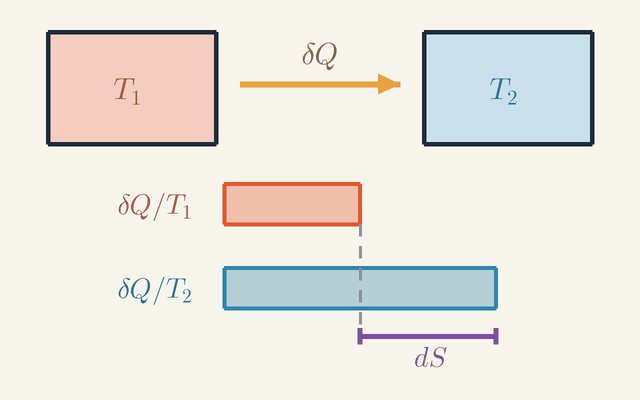
Nothing in the first law sets the direction of the flow: energy would be conserved just as well if the 90 kJ went back from the aluminium into the iron. The direction comes from the second law of thermodynamics: the total entropy of an isolated system cannot decrease. A body at a uniform temperature T that receives a small heat δQ gains entropy δQ/T. Figure 3 applies this rule to one small transfer between the blocks.
Figure 3. One small transfer of heat δQ from the hot block to the cold one. Divided by the lower temperature T2, the same δQ gives a longer bar than δQ/T1; the overhang dS is the entropy created. Bars to scale for T1=2T2.Legend
T1
Temperature of the hot block.
K
T2
Temperature of the cold block.
K
δQ
A small amount of heat passing from the hot block to the cold one.
J
δQ/T1
Entropy lost by the hot block.
J/K
δQ/T2
Entropy gained by the cold block.
J/K
dS
Entropy created by the transfer: the overhang of the lower bar, δQ(1/T2−1/T1).
J/K
Figure 3 follows one small amount of heat δQ from the hot block, at T1, to the cold one, at T2; it is small enough that neither temperature changes during the transfer. The hot block loses the entropy δQ/T1, the upper bar; the cold block gains δQ/T2, the lower bar. The heat is the same on both sides, but on the cold side it is divided by a smaller temperature, so that bar is longer: twice as long here, where T1=2T2. The part of the lower bar that overhangs the upper one, dS, is the entropy that the transfer creates: dS=δQ(T21−T11)
For δQ>0 this is positive exactly when T1>T2. Heat flowing from hot to cold therefore raises the total entropy, and the reverse flow would lower it, which the second law forbids. At the molecular level the reverse flow breaks no law of motion; for bodies of everyday size it is just overwhelmingly improbable.
For the whole exchange in the animation, add up such steps. Each block's entropy changes by dS=CdT/T, with T in kelvins, and integrating from the starting temperatures to Teq=400K gives ΔS=C1lnT1(0)Teq+C2lnT2(0)Teq=450ln600400+900ln300400≈76J/K The iron loses 182 J/K, but the aluminium gains 259 J/K: it receives the same 90 kJ, but at lower temperatures, so each joule brings it more entropy.
The second law also gives temperature its deepest definition. Take a reversible engine that takes heat Qh from a reservoir at Th and rejects heat Qc to a reservoir at Tc. Whatever its working substance, Qh/Qc=Th/Tc, so this ratio defines a temperature scale that depends on no material, and it coincides with the ideal-gas kelvin scale. In statistical physics the same idea reads 1/T=∂S/∂U at fixed volume: the inverse temperature is the entropy a body gains per joule it receives. That is why heat flows towards the colder body: there each joule brings more entropy.
Worked problem: an engine between the blocks
Direct contact delivers no work, although the temperature difference between the blocks could yield some. Suppose that, instead of touching, the two blocks drive a reversible engine that takes heat from the iron, rejects heat to the aluminium and delivers work, until both reach a common temperature Tf. The iron starts at T1=600K and the aluminium at T2=300K. What is Tf, and how much work is delivered?
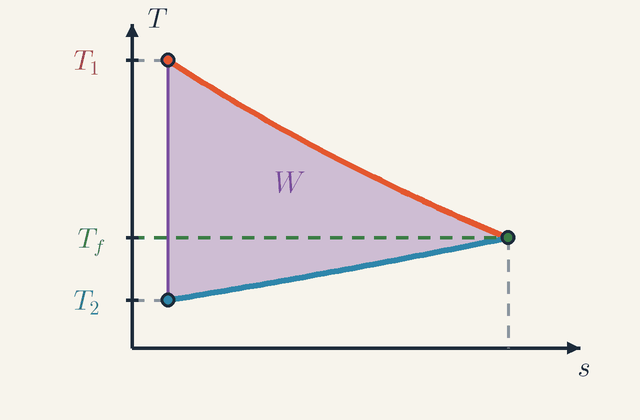
Figure 4. A reversible engine between the iron and the aluminium on a temperature–entropy diagram. The iron gives up and the aluminium takes in the same entropy s until their temperatures meet at Tf; the shaded area between the curves is the work W.Legend
T
Temperature of a block.
K
s
Entropy that has left the iron so far; the same amount has entered the aluminium.
J/K
T1
Starting temperature of the iron, 600 K; the iron cools along the orange-red curve.
K
T2
Starting temperature of the aluminium, 300 K; it warms along the blue curve.
K
Tf
Common final temperature, where the two curves meet.
K
W
Work delivered by the engine: the area between the curves.
J
Figure 4 follows the engine on a temperature–entropy diagram. Let s be the entropy that has left the iron so far; it runs along the horizontal axis. A reversible engine creates no entropy, so the same s has entered the aluminium. Since dS=CdT/T for each block, the iron, losing s, cools along T1e−s/C1, the orange-red curve, while the aluminium, gaining s, warms along T2es/C2, the blue one. The curves meet at the dashed level Tf; there no temperature difference is left and the engine stops.
Now read off the work. In a small step ds the iron gives up a heat equal to its own temperature times ds, and the aluminium takes in its own, lower temperature times ds. The engine turns the difference into work, which on the diagram is a thin vertical strip between the curves. Adding the strips, the work W is the shaded area between the curves, which narrows to a point as the temperatures approach each other.
The curves meet when the entropy changes of the two blocks cancel, since the total entropy does not change: C1ln(Tf/T1)+C2ln(Tf/T2)=0. Solving for lnTf gives Tf=T1C1/(C1+C2)T2C2/(C1+C2)=6001/3⋅3002/3=300⋅21/3≈378K or about 105 °C. By then s=C1ln(T1/Tf)≈208J/K has passed from one block to the other. No heat leaves the pair except through the engine, so the work is the internal energy the blocks lose together: W=C1(T1−Tf)−C2(Tf−T2)≈99.9−70.2=29.7kJ
The engine takes 99.9 kJ from the iron, more than the 90 kJ of direct contact, and turns about 30 % of it into work; its momentary efficiency, 1−T2/T1 for the current temperatures, falls from 50 % at the start to zero at the end. The blocks finish 22 K below the 400 K of direct contact, because the reversible end point is the weighted geometric mean of the starting temperatures, while contact gives the weighted arithmetic mean, which is always higher. Any temperature difference can yield work; letting heat leak straight across wastes it and creates the 76 J/K found above.
Real blocks and the limits of the model
The two-block model assumes that each block stays uniform, which needs heat to spread inside a block faster than it crosses the contact. Inside a body, heat flows down the temperature gradient, following Fourier's law of conduction: q=−κ∇T Here q is the heat flux in W/m² and κ the thermal conductivity, about 80 W/(m·K) for iron. Combined with energy conservation, it gives the diffusion equation ∂T/∂t=α∇2T, with the thermal diffusivity α=κ/(ρc)≈2.3×10−5m2/s for iron, where ρ is the density.
That diffusivity tests the assumption of uniform blocks. Heat needs a time of order L2/α to spread across a distance L: about 110 s across a 1 kg iron cube of side L≈5cm. That is far longer than the animation's τ of 1.25 s, so real blocks would not stay uniform and would take minutes to settle; the animation idealises them.
Hot bodies also radiate. A surface of area A and emissivity ε emits the power P=εσAT4 with σ=5.67×10⁻⁸W/(m2⋅K4), and absorbs in return from its surroundings at T0, so its net loss is εσA(T4−T04). The iron's free faces, 0.013 m² with ε≈0.6, lose a net 50 W or so at 600 K to surroundings at 300 K, so the insulation is only approximate. For small differences T4−T04≈4T03ΔT, and radiation behaves like Newton's law of cooling; but between 600 K and 300 K the flux is nearly four times this linear estimate.
Heat capacities are not constant either: iron's c rises by more than a quarter between 300 K and 600 K. At low temperatures equipartition fails. Vibration energies are quantised, and once kBT is small compared with the spacing of their levels the vibrations freeze out; their heat capacity then falls as T3 near absolute zero. Stiff diamond shows this even at room temperature, with about 510 J/(kg·K) instead of the Dulong–Petit 2080. Finally, temperature itself needs many particles near equilibrium: a single molecule has an energy, not a temperature.
Where this leads
Kinetic Theory of Gases turns 23kBT into pressure and molecular speeds. First Law of Thermodynamics and Heat Engines builds engines on the energy balance, and The Second Law of Thermodynamics and Entropy generalises the 76 J/K found here. Conduction, Convection and Radiation develops Fourier's law and radiation, Phase Changes and Latent Heat treats heat that changes the state rather than the temperature, and Thermal Expansion shows what warming does to size. The failure of equipartition opened the quantum era, as Blackbody Radiation and the Quantum explains.
Key formulas
Heat and temperature change
Q=mcΔT
The heat needed to change a body's temperature is proportional to its mass, to the temperature change and to a property of the material, the specific heat capacity c. Water's 4180 J/(kg·K) is one of the largest values, which is why water heats and cools slowly. Because ΔT is final minus initial, Q comes out negative when the body cools and gives heat away.
Symbols
Q
heat received by the body (negative if it gives heat away)
J
m
mass of the body
kg
c
specific heat capacity of the material
J/(kg⋅K)
ΔT
temperature change, final minus initial
K
When it holds: Only while nothing melts, boils or reacts, and over a range where c stays nearly constant. At a phase change heat flows with ΔT=0, and over wide ranges c itself varies with temperature.
Example: Cooling the animation's iron block from 327 °C to 127 °C: Q=1⋅450⋅(−200)=−90kJ, the 90 kJ that the aluminium receives.
Heat capacity of a body
C=mc
The heat capacity C is the heat that warms a whole body by 1 K, so that Q=CΔT. It combines how much material there is with what the material is: a large mass with a small c can match a small mass with a large c. For an object made of several parts, the heat capacities of the parts add up.
Symbols
C
heat capacity of the whole body
J/K
m
mass of the body
kg
c
specific heat capacity of the material
J/(kg⋅K)
When it holds: For a body of one material; for a composite object, add mc over its parts. Like c, it changes somewhat with temperature.
Example: 1 kg of aluminium has C=900J/K, twice the 450 J/K of 1 kg of iron, so the same heat changes its temperature half as much.
Kelvin and Celsius temperatures
T(K)=T(∘C)+273.15
The kelvin and the degree Celsius are steps of the same size, but the kelvin scale starts at absolute zero, −273.15 °C, instead of at the freezing point of water. Converting a temperature therefore adds 273.15, while a temperature difference has the same value on both scales.
Symbols
T(K)
temperature in kelvins
K
T(∘C)
the same temperature in degrees Celsius
∘C
When it holds: Exact, by definition. Use kelvins for ratios, powers and the gas laws: 600 K is twice 300 K, but 327 °C is not twelve times as hot as 27 °C.
Example: The iron block at 600 K is at 600−273.15=326.85∘C, about 327 °C.
Final temperature of two bodies in contact
Teq=m1c1+m2c2m1c1T1+m2c2T2
Setting the heat lost by the hot body equal to the heat gained by the cold one and solving for the common final temperature gives an average of the starting temperatures, weighted by the heat capacities mc. It lies between them, closer to the body with the larger heat capacity. Because it is a weighted average, it can be used in °C as well as in kelvins.
Symbols
Teq
common final (equilibrium) temperature
K
m1
mass of body 1
kg
c1
specific heat capacity of body 1
J/(kg⋅K)
T1
starting temperature of body 1
K
m2
mass of body 2
kg
c2
specific heat capacity of body 2
J/(kg⋅K)
T2
starting temperature of body 2
K
When it holds: Only if the bodies exchange heat with nothing else and neither melts, boils nor reacts. For several bodies, sum mcT and mc over all of them.
Example: Iron (C=450J/K) at 327 °C and aluminium (C=900J/K) at 27 °C: Teq=(450⋅327+900⋅27)/1350=127∘C.
Newton's law of cooling
dtdT=−τT−Tenv
A body exchanges heat with its surroundings at a rate proportional to its excess temperature, so its temperature changes at a rate proportional to T−Tenv. The solution is an exponential, T=Tenv+(T0−Tenv)e−t/τ: the excess falls by the same factor in equal times. The minus sign makes a hot body cool and a cold one warm.
Symbols
T
temperature of the body at time t
K
t
time
s
Tenv
temperature of the surroundings, assumed constant
K
τ
time constant: heat capacity of the body divided by its thermal conductance to the surroundings
s
When it holds: Good when heat leaves mainly by conduction or forced convection and the excess is modest, with the body nearly uniform inside. Radiation (∝T4) and natural convection make the rate grow faster than the difference.
Example: Tea at 80 °C in a 20 °C room with τ=20min: after 20 min the 60 K excess has fallen to 60/e≈22K, so the tea is at about 42 °C.
Fourier's law of heat conduction
q=−κ∇T
Heat flows down the temperature gradient, from hot to cold, with a flux proportional to how steeply the temperature changes with position. The vector q gives the heat crossing a unit area per second, and the minus sign makes it point towards lower temperature. For a flat layer of thickness d it reduces to q=κΔT/d.
Symbols
q
heat flux density: heat per unit area per unit time
W/m2
κ
thermal conductivity of the material
W/(m⋅K)
∇T
temperature gradient, pointing towards higher temperature
K/m
When it holds: For conduction in solids and still fluids, with each small region close to equilibrium. It does not describe convection or radiation, and κ itself varies with temperature.
Example: A 2 cm wooden board (κ≈0.15W/(m⋅K)) with faces 20 K apart passes q=0.15⋅20/0.02=150W/m2.
Stefan–Boltzmann law of thermal radiation
P=εσAT4
Every surface radiates electromagnetic energy at a rate that grows as the fourth power of its absolute temperature. A perfect emitter, a black body, has ε=1; real surfaces have 0<ε<1. A body also absorbs radiation from its surroundings at T0, so its net loss is εσA(T4−T04).
Symbols
P
power radiated by the surface
W
ε
emissivity of the surface, between 0 and 1
σ
Stefan–Boltzmann constant, 5.67×10⁻⁸
W/(m2⋅K4)
A
area of the radiating surface
m2
T
absolute temperature of the surface
K
When it holds:T must be in kelvins. The formula gives the total emission; ε may depend on wavelength and temperature, and the net exchange also depends on the temperature and shape of the surroundings.
Example: A black surface at 600 K emits σT4=5.67×10−8⋅6004≈7.3kW/m2, sixteen times as much as at 300 K.
Glossary
Temperature
The quantity that is equal for bodies in thermal equilibrium, read by a thermometer in °C or in kelvins. At the particle level it measures the average energy of random motion (23kBT of translational kinetic energy per gas molecule), not the total energy a body holds.
Absolute zero
The lowest possible temperature, 0 K or −273.15 °C, where the particles' random motion has the least energy that quantum mechanics allows. The kelvin scale starts there, which is why only kelvin temperatures can be compared as ratios.
Thermal equilibrium
The state reached by bodies in thermal contact once nothing changes any more: their temperatures are equal and no net heat flows. The zeroth law states that two bodies each in equilibrium with a third are in equilibrium with each other, which is what makes thermometers work.
Heat
Energy transferred from one body to another because of a temperature difference, by particle collisions or by radiation, measured in joules. It is energy in transit, not something a body contains, and it flows by itself only from hotter to colder.
Internal energy
The total energy of the random motion of a body's particles and of the forces between them, U. Heat and work both change it; two bodies at the same temperature can hold very different internal energies.
Heat balance (calorimetry)
In an insulated system, the heat lost by the hot bodies equals the heat gained by the cold ones. It fixes the final temperature: 1 kg of iron at 327 °C and 1 kg of aluminium at 27 °C end at 127 °C.
Equipartition of energy
In classical thermal equilibrium, each quadratic term in a particle's energy carries on average 21kBT. It gives about 25 J/(mol·K) for simple solids, and it fails at low temperatures, where quantum effects freeze the motion out.
First law of thermodynamics
Energy conservation with heat included: ΔU=Q−W, where Q is the heat received and W the work done by the system. Some texts count the work done on the system instead and write ΔU=Q+W.
Second law of thermodynamics
Heat never flows by itself from a colder body to a hotter one; equivalently, the total entropy of an isolated system never decreases. A transfer δQ from T1 to a colder T2 raises the entropy by δQ(1/T2−1/T1).
Newton's law of cooling
The rate at which a body's temperature approaches that of its surroundings is proportional to the difference, so the excess decays exponentially with a time constant τ. It holds exactly for a contact of fixed conductance and, with a measured coefficient h, approximately for a surface cooled by air or water, provided the temperature differences stay modest.
Conduction
Transfer of heat through a material by collisions between neighbouring particles, without the material itself moving. Fourier's law gives the flux, q=−κ∇T: metals conduct well, while wood, foam and still air conduct poorly.
Thermal radiation
Electromagnetic waves that every body emits because of its temperature; they carry heat even through a vacuum. The emitted power grows as T4 (the Stefan–Boltzmann law), so doubling the absolute temperature multiplies it by 16.
Quantities
T
Absolute temperature
K
Absolute temperature, counted from absolute zero: T(K)=T(∘C)+273.15. Use kelvins whenever temperatures are multiplied, divided or raised to a power.
ΔT
Temperature change
K
Final minus initial temperature; it has the same value in kelvins and in degrees Celsius, and it is negative when a body cools.
Q
Heat
J
Energy transferred because of a temperature difference, positive when it flows into the body. 1 kJ warms about 0.24 kg of water by 1 K.
U
Internal energy
J
The energy of the random motion and interactions of a body's particles: a property of its state, changed by heat and by work.
c
Specific heat capacity
J/(kg⋅K)
Heat needed to warm 1 kg of a material by 1 K: 4180 for water, 900 for aluminium, 450 for iron.
C
Heat capacity
J/K
Heat needed to warm a whole body by 1 K, C=mc: 450 J/K for the iron block in the animation, 900 J/K for the aluminium one. Here m is the mass of the body, in kg.
Teq
Equilibrium temperature
K
The common final temperature of bodies that exchange heat only with each other: the average of their starting temperatures weighted by heat capacity.
k
Thermal conductance
W/K
Heat flow through a contact per kelvin of temperature difference, dQ/dt=k(T1−T2); 240 W/K in the animation. Not to be confused with the thermal conductivity of a material, written κ here and k in Conduction, Convection and Radiation, nor with the Boltzmann constant kB.
τ
Time constant
s
The time in which a temperature difference falls by a factor e≈2.72 during an exponential approach; 1.25 s in the animation. In Newton's law of cooling, τ=C/k for a body losing heat to surroundings at the constant temperature Tenv; t is the time elapsed.
κ
Thermal conductivity
W/(m⋅K)
Heat flux per unit temperature gradient in a material: about 400 for copper, 80 for iron, 0.15 for wood and 0.025 for still air. It sets the heat flux density q, in W/m², through Fourier's law q=−κ∇T.
P
Radiated power
W
Power that a surface of area A (in m²) and emissivity ε (between 0 and 1) radiates at absolute temperature T: P=εσAT4, with σ=5.67×10⁻⁸W/(m2⋅K4).
Quiz
Beginner You put a cold metal spoon into a cup of hot tea. What happens?
Cold flows from the spoon into the tea
Heat flows from the tea into the spoon until both reach the same temperature
Heat flows from the spoon into the tea
Nothing, because metal does not take in heat
Show answer
Answer: B. Heat flows from the tea into the spoon until both reach the same temperature
Energy flows spontaneously from the hotter body to the colder one. There is no such thing as a flow of "cold"; the tea simply loses energy to the spoon until their temperatures are equal.
Beginner At the level of particles, what does temperature measure?
How many particles there are
The total amount of heat stored in the object
How vigorously the particles jiggle
How big the particles are
Show answer
Answer: C. How vigorously the particles jiggle
Temperature measures the average energy of the particles' random motion. The total stored energy also depends on how much material there is.
Beginner On a hot sunny day, why does the sea stay cool while the sand on the beach gets very hot?
Water needs much more energy than sand to warm up by the same amount
Sand starts the day with more heat in it
Water cannot absorb sunlight
Salt in the water blocks the heat
Show answer
Answer: A. Water needs much more energy than sand to warm up by the same amount
Water has a very large specific heat capacity, so the same sunshine raises its temperature much less than that of sand. Waves also spread the warmth through metres of water, while only a thin top layer of sand is heated.
Intermediate How much heat is needed to warm 2 kg of water (c = 4200 J/(kg·K)) from 20 °C to 30 °C?
8.4 kJ
840 kJ
252 kJ
84 kJ
Show answer
Answer: D. 84 kJ
Q = m·c·ΔT = 2 × 4200 × 10 = 84 000 J = 84 kJ. Using the final temperature (30) instead of the change ΔT = 10 K gives 252 kJ.
Intermediate In an insulated flask, 1 kg of water at 80 °C is mixed with 1 kg of water at 20 °C. What is the final temperature?
100 °C
50 °C
60 °C
80 °C
Show answer
Answer: B. 50 °C
Heat lost by the hot water equals heat gained by the cold water: 1 × c × (80 − T) = 1 × c × (T − 20), so T = 50 °C. Temperatures do not add up.
Advanced Two bodies with heat capacities C₁ and C₂ exchange heat at a rate k·(T₁ − T₂). How does their temperature difference evolve?
It decays exponentially with 1/τ = k·(1/C₁ + 1/C₂)
It falls linearly and reaches zero after a finite time
It decays exponentially with τ = C₁/k, whatever C₂ is
It oscillates around zero before settling
Show answer
Answer: A. It decays exponentially with 1/τ = k·(1/C₁ + 1/C₂)
Subtracting the two energy-balance equations gives dΔT/dt = −k·(1/C₁ + 1/C₂)·ΔT, a first-order linear equation whose solution is an exponential decay.
Advanced A coffee cools from 90 °C to 55 °C in 10 minutes in a 20 °C room. If it follows Newton's law of cooling, what is its temperature after another 10 minutes?
20 °C
45 °C
27.5 °C
37.5 °C
Show answer
Answer: D. 37.5 °C
The excess over room temperature decays by the same factor in equal times: 70 K → 35 K is a factor of 2, so 35 K → 17.5 K, giving 37.5 °C. Assuming a constant drop of 35 °C would wrongly give 20 °C.
Intermediate In a room at 20 °C, a metal handle feels much colder to your hand than a wooden one. Why?
The metal is at a lower temperature than the wood
Wood produces a little heat of its own
Metal conducts heat away from your skin much faster than wood
Cold flows out of the metal into your hand
Show answer
Answer: C. Metal conducts heat away from your skin much faster than wood
After hours in the room both are at 20 °C. Your skin senses how fast it loses heat, not the object's temperature: metal, a good conductor, drains heat from your warm hand much faster than wood.
 Physics Tutor