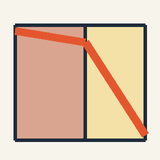
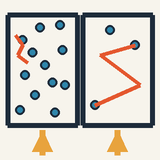
The three ways heat travels: conduction through matter, Q/t=kAΔT/d; convection with moving liquids and gases; and radiation, mostly infrared, which crosses even empty space, P=εσAT4.
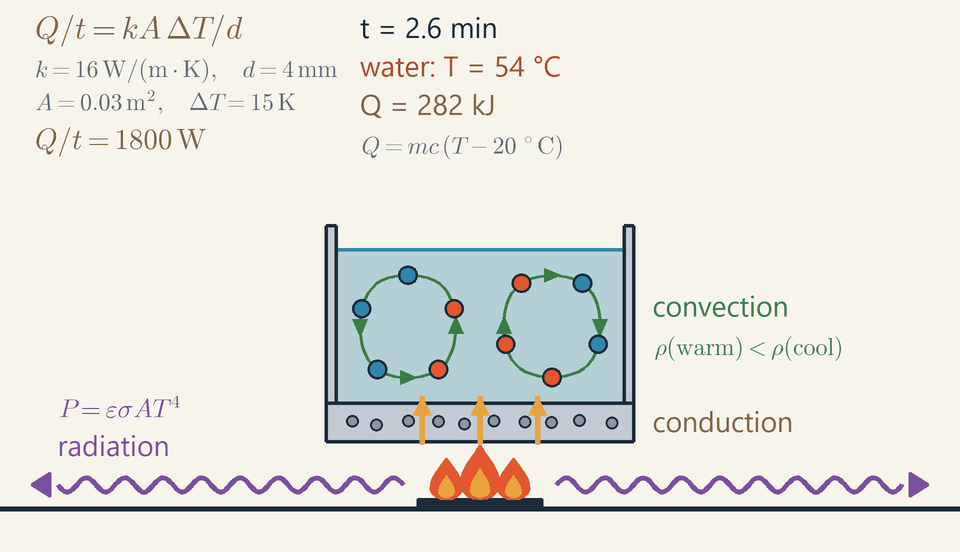
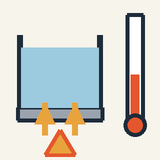
A pot of water on a gas flame: heat crosses the metal base by conduction, circulates through the water by convection and leaves the flame as radiation.
Heat travels in three ways: conduction through materials, convection with moving liquids and gases, and radiation.
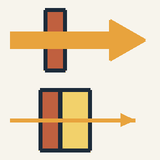
Metals conduct heat well; wood, plastic, wool and trapped air are insulators that slow it down.
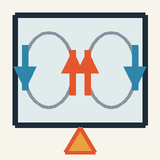
Warm water or air is lighter, so it rises while cooler fluid sinks: a convection loop.
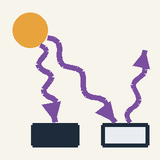
Radiation needs no material: dark surfaces absorb and give it off well, shiny ones reflect it.
Step 1. Heat always moves from warmer places to cooler ones, and it can travel in three ways. A pot of water on a gas flame shows all three at once.
Step 2. Conduction: heat passing through a material by contact. The particles in the hot underside of the pot jiggle hard and knock into their neighbours, which start jiggling harder too, and so on up through the metal. Nothing travels except the jiggling. Metals pass heat on quickly; wood, plastic, wool and still air pass it slowly and are called insulators. A fluffy coat keeps you warm because it traps air.
Step 3. Convection: heat carried by a moving liquid or gas. Water near the hot bottom warms, expands a little and becomes lighter than the cooler water above, so it rises; cooler water sinks to take its place, and a loop forms. People say that heat rises, but it is really the warm fluid that rises.
Step 4. Radiation: heat carried by invisible infrared light, which needs no material at all. That is how sunshine warms your face across empty space. Dark, dull surfaces absorb and give off this radiation well; shiny ones reflect it, which is why emergency blankets are silvery.
In the animation, gold arrows show heat crossing the metal base, where the particles jiggle. The water turns in two loops: red blobs (warm) rise in the middle and blue blobs (cool) sink along the sides. Purple waves carry radiation away from the flame.
Check yourself: why does a saucepan have a metal body but often a plastic or wooden handle? Answer: metal passes heat quickly to the food; the handle must be a poor conductor so that you can hold it.
Intermediate
Key ideas
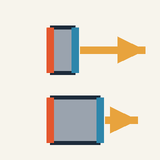
Fourier's law: Q/t=kAΔT/d, so doubling the thickness halves the heat flow.
Pot base: 16×0.03×15/0.004=1800W, enough to warm 2 kg of water by 60 K in about 4.6 minutes.
U-value: Q/t=UAΔT, and a low U means good insulation; convection is often modelled as Q/t=hAΔT.
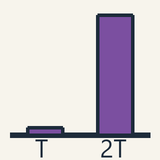
Stefan–Boltzmann: P=εσAT4 with T in kelvins, so doubling T multiplies P by 16.
Heat flow and what drives it
At room temperature, steel and wood are equally warm, yet the steel feels colder. Heat is energy that moves because of a temperature difference, on its own always from warmer to cooler. The amount, Q, is measured in joules, the rate Q/t in watts, and the rate per square metre, the heat flux q, in W/m². A difference ΔT has the same value in kelvins and in degrees Celsius; only radiation depends on the temperatures themselves, which must then be in kelvins.
Heat travels in three ways: by conduction, from particle to particle through a material that stays put; by convection, carried by a moving liquid or gas; and by radiation, electromagnetic waves, mostly infrared, that need no material. The pot in the animation shows all three at once.
Conduction: Fourier's law
Through a flat layer of area A and thickness d whose faces differ by ΔT, once the temperatures inside have settled, the heat flow is tQ=dkAΔT
Twice the area offers twice as many paths, twice the difference pushes twice as hard, and twice the thickness halves the flow. The material enters through its thermal conductivity k, in W/(m·K): about 400 for copper, 16 for stainless steel, 0.7 for brick, 0.15 for wood, 0.04 for mineral wool and 0.025 for still air. Metals lead thanks to their free electrons; wool, foam and feathers insulate by trapping air in pockets too small for it to circulate.
Layers in series combine like resistors. Each square metre of a layer has a thermal resistance R=d/k, in m²·K/W, and builders sum them into a U-value: tQ=UAΔT,U=∑(d/k)1 A low U means good insulation. For one layer U=k/d, so doubling the thickness halves the loss.
Worked example: the pot in the animation
The steel base has k=16W/(m⋅K), A=0.03m2 and d=4mm=0.004m, and the flame keeps its underside 15 K hotter than its top, so tQ=0.00416⋅0.03⋅15=1800W
Warming 2 kg of water, with c=4180J/(kg⋅K), from 20 °C to 80 °C needs Q=mcΔT=2⋅4180⋅60=501600J≈502kJ so, with no losses, it takes t=501600/1800≈279s, about 4.6 minutes.
These are the final values on the readouts: t reaches 4.6 min, the water 80 °C and Q 502 kJ, time-lapsed into eight seconds. The gold arrows mark the steady flow up through the base, drawn far thicker than 4 mm so that its jiggling atoms show. Steel is a mediocre conductor, but 4 mm is so thin that 15 K drives 1800 W through it. A wooden base, with k=0.15W/(m⋅K), would pass about a hundred times less.
Convection: the loops in the pot
Water touching the hot base expands slightly and becomes less dense than the cooler water around it, as the density label in the scene states, so buoyancy lifts it and denser water sinks to take its place. The dashed green streamlines close into two loops that rise together above the flame and sink along the walls; each parcel turns red on its way up and blue on its way down. This is natural convection; with a fan or a pump it becomes forced convection.
No simple formula covers a whole flow, so engineers write the heat exchanged between a surface and a fluid as tQ=hAΔT with ΔT between the surface and the distant fluid, and a measured coefficient h: about 10 W/(m²·K) for still air, around 100 for air from a fan and tens of thousands for boiling water. This is Newton's law of cooling; wind chill is the same law, with the wind raising h.
Radiation: the fourth power of temperature
Every surface radiates, near room temperature mostly infrared around 10 µm. The Stefan–Boltzmann law gives the power from an area A at absolute temperature T: P=εσAT4 with σ=5.67×10⁻⁸W/(m2⋅K4) and an emissivity ε from 0 (a perfect mirror) to 1 (a black body). Heating a plate from 27 °C to 327 °C (300 K to 600 K) doubles T and multiplies P by 24=16.
A body also absorbs radiation from its surroundings, and a good emitter is an equally good absorber. With surroundings at T0 the net loss is Pnet=εσA(T4−T04) Bare skin at 306 K (33 °C), with ε≈0.97 and about 1.5 m² radiating, in a room with walls at 293 K loses 0.97⋅5.67×10−8⋅1.5⋅(3064−2934)≈115W, more than the 100 W or so a resting body produces. The purple waves carry energy sideways from the flame, where conduction and convection send almost none.
Worked example: a single-glazed window
A 1.5 m² window has one pane of glass 4 mm thick, with k=1.0W/(m⋅K), between a room at 20 °C and the outside at 0 °C. For the glass alone, Fourier's law gives 1.0⋅1.5⋅20/0.004=7500W, the output of several heaters. Real windows lose far less: a film of slow air clings to each face and adds a resistance 1/h, with h≈8W/(m2⋅K) indoors (half convection, half radiation) and h≈25W/(m2⋅K) outdoors in a light wind.
Per square metre, the three resistances add up: R=81+1.00.004+251=0.125+0.004+0.040=0.169m2⋅K/W tQ=RAΔT=0.1691.5⋅20≈178W,U=R1≈5.9W/(m2⋅K)
The glass supplies only about 2 % of the resistance; the air films do the insulating. The flux is 20/0.169≈118W/m2, so the indoor film takes 118⋅0.125≈15K and the inner face of the glass sits near 5 °C, below the dew point of room air at 50 % humidity, about 9 °C: single panes run with condensation. Double glazing with U≈1.2W/(m2⋅K) would lose about 36 W here, and the brick-and-wool wall of the expert view only about 11 W.
Common mistakes
"Heat rises" is half true: warm fluid rises, but heat itself spreads in every direction by conduction and radiation, so a ceiling heater warms people 2 m below it.
Insulation does not stop heat; it slows it. Even 10 cm of mineral wool, with U=0.04/0.1=0.4W/(m2⋅K), passes 8 W per square metre across 20 K.
Metal and wood at room temperature are equally warm. Steel feels colder because it conducts about a hundred times better (16 against 0.15 W/(m·K)), so it draws heat from your hand faster.
Never put degrees Celsius into T4. From 27 °C to 327 °C the radiated power rises 16 times (300 K to 600 K), not 12 times, let alone 21 000.
The difference T4−T04 is not (T−T0)4. For 306 K and 293 K the first gives about 79 W per square metre of black surface, the second less than 0.002 W.
Where you meet it
Every heating bill is a sum of UAΔT terms over walls, roof and windows. A vacuum flask defeats all three mechanisms: the vacuum stops conduction and convection, and silvering stops most radiation. Weather is convection on a grand scale, and the Earth's temperature balances absorbed sunlight against infrared radiated to space. Next, Kinetic Theory of Gases shows conduction molecule by molecule, Blackbody Radiation and the Quantum explains where σT4 comes from, and The Second Law of Thermodynamics and Entropy explains why heat flows on its own only from hot to cold.
Advanced
Key ideas
q=−k∇T plus energy conservation gives ∂T/∂t=α∇2T, α=k/(ρc); a layer settles in a time of order d2/α.
Steady heat flow obeys ∇2T=0, like electrostatics: a point source gives q=W/(4πr2); layers add resistances d/k.
In a brick + wool wall most of ΔT falls across the wool, whose d/k is about nine times larger; U=1/∑R.
Gas conductivity, k≈31nvˉℓc1, does not depend on density, because the mean free path ℓ∝1/n.
Heat flux and the temperature gradient
The slab law Q/t=kAΔT/d covers only a flat layer whose temperatures have settled. To treat bodies of any shape, and temperatures that change in time, we need a law that holds at every point. This section sets it up.
At each point we use two vectors. The heat flux density q points the way energy flows; its size is the energy crossing unit area, set square to the flow, per unit time, in W/m². The temperature gradient ∇T points the way temperature rises fastest; its size is that rise per metre, in K/m. Fourier's law in local form says that heat flows straight down the gradient, at a rate set by the conductivity k: q=−k∇T The minus sign makes heat run from hot to cold, against the gradient.
For a flat layer the gradient is simply ΔT/d, and the local law gives back the slab law. In the animation's pot the steel base is 4 mm thick, with k=16W/(m⋅K), and its underside is 15 K hotter than its top. So ∣∇T∣=15/0.004=3750K/m and q=16⋅3750=60000W/m2; over the base's 0.03 m² that is the 1800 W of the slab law.
The law has the form of Ohm's law written at a point, J=−σel∇V: temperature plays the potential, q the current density and k the electrical conductivity σel. Like Ohm's law, it is a material law that holds for gentle gradients, not a fundamental principle. In fibrous or layered materials k depends on direction: wood conducts heat about twice as well along the grain as across it, so there q need not point exactly down the gradient.
Deriving the heat equation
Fourier's law gives the flow at one instant. To predict how a temperature profile changes in time, we combine it with conservation of energy. The result, the heat equation, governs every problem in the rest of this lesson.
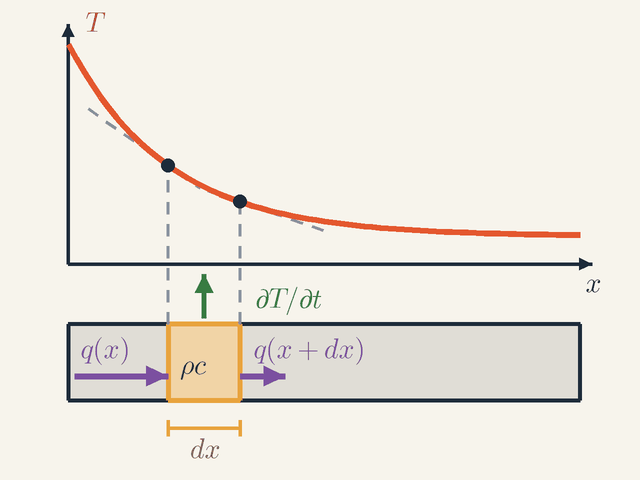
Figure 1. A thin slice of a rod, of thickness dx. The profile T(x) is convex: its slope, and so the flux q=−k∂T/∂x, is larger at the left face than at the right, so more heat enters than leaves and the slice warms. Not to scale.Legend
x
Position along the rod.
m
T
Temperature profile along the rod at one moment; its tangents are dashed.
K
dx
Thickness of the thin slice.
m
q(x)
Heat flux density entering the slice through its left face.
W/m2
q(x+dx)
Heat flux density leaving through its right face; smaller than q(x).
W/m2
ρc
Heat capacity per unit volume: density times specific heat capacity.
J/(m3⋅K)
∂T/∂t
Rate at which the slice warms.
K/s
Figure 1 shows a rod in which heat flows along x only, and a thin slice of it, of thickness dx. Above the rod is the temperature profile T(x) at one moment, with dashed tangents at the two faces of the slice. Look at the tangents: the left one is steeper than the right one, because the profile is convex (it curves upwards). The flux at each face is set by the local slope, q=−k∂T/∂x, so the arrow q(x) entering on the left is longer than the arrow q(x+dx) leaving on the right. More heat enters than leaves, and the surplus warms the slice at the rate ∂T/∂t of the green arrow.
Now count the energy, per unit area of the rod's cross-section. Each second the slice gains q(x)−q(x+dx). For a thin slice this difference is the rate of change of q along the rod times the thickness, −(∂q/∂x)dx. The slice has volume dx per unit area, and ρc is the heat capacity per unit volume (density times specific heat capacity), so warming it at the rate ∂T/∂t takes ρcdx∂T/∂t. Setting gain equal to storage and cancelling dx: ρc∂t∂T=−∂x∂q
Now substitute Fourier's law, q=−k∂T/∂x. With k constant, ∂q/∂x=−k∂2T/∂x2, and dividing by ρc gives the heat equation: ∂t∂T=α∂x2∂2T,α=ρck
The same count works for a small box in three dimensions. The net heat flowing out of it per unit volume is the divergence ∇⋅q, so ρc∂T/∂t=−∇⋅q, and ∂2T/∂x2 becomes the Laplacian ∇2T. The constant α is the thermal diffusivity, in m²/s. It grows with k, which moves heat faster, and falls with ρc, which demands more heat for each kelvin.
The equation has a simple reading. The second derivative ∂2T/∂x2 is the curvature of the profile: the change of slope between the two faces of the slice in Figure 1. Where the profile curves upwards, a point is colder than the average of its neighbours, and it warms; where it curves downwards, the point is warmer than its neighbours, and it cools. So every bump in a temperature profile flattens out in time.
How far and how fast heat spreads
Before solving anything, the heat equation already tells us the time scales of a problem. This is often all an engineer needs.
The equation contains a single constant, α, in m²/s. The only length that can be built from α and a time t is αt, so after a time t a disturbance has spread a distance of order αt. Turned round, a layer of thickness d settles to its steady state in a time of order d2/α. The time grows with the square of the thickness: twice as thick, four times as slow.
Three examples. The pot's steel base, with density 7900 kg/m³ and specific heat capacity 500 J/(kg·K), has α=16/(7900⋅500)≈4.1×10−6m2/s and settles in about 0.0042/(4.1×10−6)≈4s. That is tiny next to the 279 s warm-up, so using the steady slab law for the pot was justified. Twenty centimetres of brick, with α≈4.6×10⁻⁷m2/s, take about 24 h. The 6.7 cm of water in the pot would need some 9 hours to warm through by conduction alone; convection does it in minutes.
The wall in the graph
The Advanced view of the animation shows a wall warming up. Following it shows the heat equation at work: heat creeping in, energy being stored, and a final steady state.
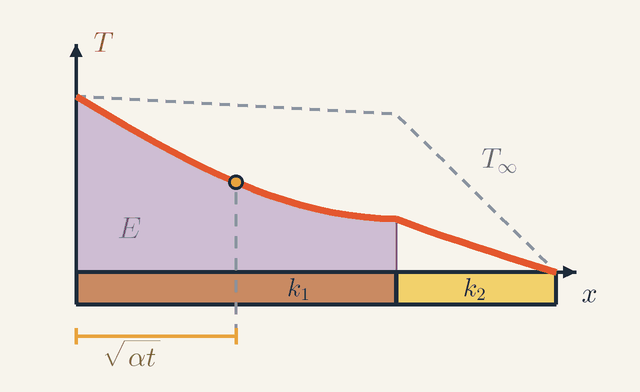
Figure 2. The brick and mineral-wool wall six hours after its inner face is heated. The warming has crept about αt into the brick; the shaded area, times ρc, is the heat E stored there, and the dashed line T∞ is the final steady state.Legend
x
Distance from the inner (room-side) face.
m
T
Temperature in the wall six hours after the start.
K
k1
Thermal conductivity of the brick, the inner layer.
W/(m⋅K)
k2
Thermal conductivity of the mineral wool, the outer layer.
W/(m⋅K)
αt
How far the warming has crept into the brick after time t; there the profile stands near half its surface value.
m
E
Energy stored in the brick per unit area of wall: ρc times the shaded area.
J/m2
T∞
Steady-state profile that the wall approaches, straight within each layer.
K
Figure 2 shows the wall six hours after the start. It is 20 cm of brick (k1=0.7W/(m⋅K)) on the room side and 10 cm of mineral wool (k2=0.04W/(m⋅K)) outside, drawn as bars under the axis x, to the same scale. Everything was at 0 °C until the inner face, at x=0, was held at 20 °C; the outer face stays at 0 °C.
Read the red profile T(x) from left to right. It falls steeply near the inner face and has barely reached the wool: the warming has crept only about αt into the brick, the distance marked under the axis. After t=6h=21600s this is 4.6×10−7⋅21600≈0.10m. At that depth, marked by the dot, the profile stands at about 10 °C, near half its value at the face.
The shaded area between the profile and the initial 0 °C line measures stored energy: multiplied by ρc, it is the heat E taken up by the brick per square metre of wall. The wool's share is tiny, because its ρc is 60 times smaller than the brick's. All this energy came in through the inner face and has not left through the outer one, so E is, very nearly, the time integral of q(0)−q(d): the flux in at the inner face minus the flux out at the outer face, where x=d.
The animation's readouts show these two fluxes. The inner flux q(0) starts huge and falls roughly as 1/t, like the flux into a very thick block of brick, ΔTkρc/(πt), which is about 190 W/m² after one hour. The outer flux q(d) stays at zero until the warming reaches it. At the six hours of Figure 2 they are about 76 and 2.3 W/m²: most of what enters is still charging the brick. Both approach 7.2 W/m², and they are within 10 % of each other after 48 hours and within 1 % after 72.
The dashed grey line T∞ is the steady state the wall ends up in. There ∂T/∂t=0, so the heat equation says ∂2T/∂x2=0: the profile is straight within each layer. In the steady state no energy piles up anywhere, so the same flux q crosses both layers. Each layer's slope is therefore q/k, so the slopes are in the inverse ratio of the conductivities, and the line through the wool is k1/k2=17.5 times steeper.
The size of that common flux follows from adding the two layers' resistances d/k per square metre, with d1=0.20m of brick and d2=0.10m of wool: q=d1/k1+d2/k2ΔT=0.286+2.520≈7.2W/m2,U≈0.36W/(m2⋅K) The drop across each layer is q times its resistance. The wool's resistance is about nine times the brick's, so it takes 17.9 K of the 20 K and the brick only 2.1 K.
Modes of decay
How quickly does the wall forget its start and settle on T∞? The answer comes from splitting the profile into simple shapes that each fade at their own rate.
The heat equation is linear: the sum of two solutions is again a solution. So any departure from the steady state can be written as a sum of sine-shaped modes, and each one decays on its own, keeping its shape. Put a mode sin(2πx/λ) of wavelength λ into the heat equation: two x-derivatives multiply it by −(2π/λ)2, so its amplitude must fall as e−t/τ, with τ=4π2αλ2 Because the decay time goes as λ2, fine wiggles vanish almost at once and only the broadest mode lingers. Joseph Fourier developed his series, sums of sines, for exactly this problem, in his theory of heat of 1822.
In the wall, the slowest mode has to fit the brick's two faces. At the inner face the temperature is held, so the departure from the steady state is zero there. At the outer face the wool nearly stops the flow, so the slope of the departure is nearly zero. The broadest sine with a zero at one end and a flat top at the other is a quarter wave, λ=4d, which gives τ=4d2/(π2α)≈9.7h. The wool does leak a little, so the real decay is slightly quicker: the gap between the two readouts shrinks by a factor e about every 9 hours, from under 10 % at 48 h to under 1 % at 72 h.
Temperature waves
When the surface temperature rises and falls every day, or every year, the heat equation turns the swing into a wave that fades as it travels inward. This is why thick walls and deep cellars stay at nearly constant temperature.
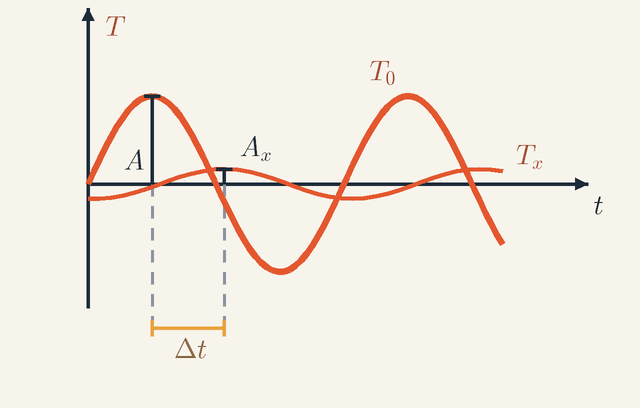
Figure 3. A daily temperature swing at the surface, T0 with swing A, and 20 cm deep in brick, Tx. At depth the swing shrinks to Ax=Ae−x/δ, and its peak comes Δt later.Legend
t
Time.
s
T
Temperature, measured from its mean.
K
T0
Surface temperature, swinging with angular frequency ω.
K
Tx
Temperature at depth x below the surface (here 20 cm).
K
A
Swing of the surface temperature about its mean.
K
Ax
Swing at depth x: Ae−x/δ, with δ=2α/ω.
K
Δt
How much later the peak arrives at depth x than at the surface: x/(δω).
s
Figure 3 plots two temperatures against time t, each measured from its mean. The large curve T0 is the surface, swinging with angular frequency ω and amplitude A. The small curve Tx is the temperature at a depth x inside. Notice two things: Tx swings much less, by only Ax, and its peaks come later, by Δt.
Both effects come from one solution of the heat equation, a damped wave travelling inward: T(x,t)−Tmean=Ae−x/δcos(ωt−x/δ),δ=2α/ω To see why δ has this value, write the wave as the real part of Aeiωte−(1+i)x/δ. A time derivative multiplies it by iω; two space derivatives multiply it by (1+i)2/δ2=2i/δ2. The heat equation then demands iω=2iα/δ2, which is δ=2α/ω.
Read the solution term by term. The amplitude falls by a factor e every distance δ, so at depth x the swing is Ax=Ae−x/δ. The phase x/δ subtracted from ωt means that each peak arrives later than at the surface by Δt=x/(δω). Slow cycles reach deeper, because δ grows as 1/ω.
For brick and the daily cycle, ω=2π/(24h), the depth δ is about 11 cm. The figure is drawn for x=20cm, where x/δ≈1.8: 20 cm into thick brickwork the swing is cut to about a sixth, e−1.8≈0.17, and arrives some 7 hours late. In soil, with α≈5×10⁻⁷m2/s, the yearly wave has δ≈2.2m: a cellar 3 m down sees a quarter of the surface swing, about two and a half months late.
Steady states and Laplace's equation
Once nothing changes in time, heat flow becomes the same mathematical problem as electrostatics, so every solution found there can be reused.
In a steady state ∂T/∂t=0, and the heat equation reduces to ∇2T=0. This is Laplace's equation, which the electrostatic potential obeys in empty space. Every electrostatic solution therefore describes a heat flow too, with temperature in place of the potential and the flux q in place of the field.
Take a small source of power W deep in a large block. In the steady state all of W crosses every sphere of radius r around it, so q=W/(4πr2), just like the field of a point charge. With q=−kdT/dr, integrating inward from far away, where the block is undisturbed, gives a temperature rise of W/(4πkr). For 10 W released deep in soil with k=1W/(m⋅K), the soil 0.5 m away is warmer by 10/(4π⋅1⋅0.5)≈1.6K.
Worked problem: insulation inside or outside?
Does it matter which side of a wall the insulation goes on? The steady heat loss says no; the stored heat and the warm-up time say yes, very much.
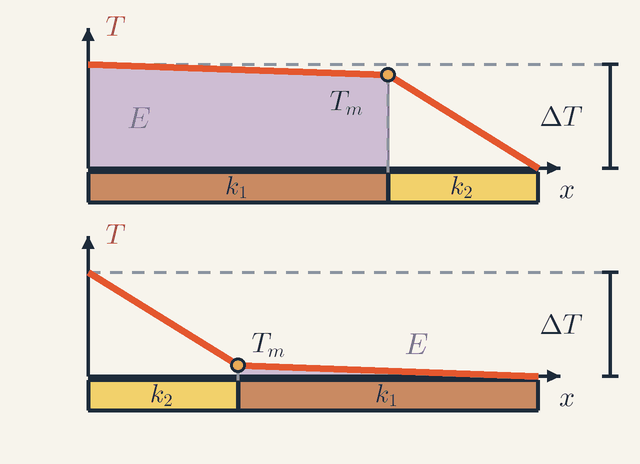
Figure 4. The same wall in the steady state with the wool outside (upper graph) and on the room side (lower graph). The drop across each layer is qd/k, so the interface temperature Tm moves; the shaded area, times ρc, is the heat E the brick stores.Legend
x
Distance from the room-side face.
m
T
Temperature in the wall in the steady state.
K
k1
Thermal conductivity of the brick.
W/(m⋅K)
k2
Thermal conductivity of the mineral wool.
W/(m⋅K)
Tm
Temperature at the interface between the two layers.
K
ΔT
Total temperature difference across the wall; the same in both graphs.
K
E
Energy stored in the brick per unit area of wall: ρc times the shaded area.
J/m2
Figure 4 compares the two arrangements in the steady state, with the room on the left at x=0 and the same total difference ΔT=20K across the wall. The upper graph is the animation's wall: brick (k1) on the room side, wool (k2) outside. The lower graph swaps the layers: wool on the room side, brick outside. Compare where the interface temperature Tm sits, and how large the shaded area under the brick's profile is.
Step 1, the steady loss. Series resistances add in any order, so the total is still 0.286+2.5=2.786m2⋅K/W and the loss stays q=7.2W/m2.
Step 2, the profile. The drop across each layer is qd/k, so it travels with the layer. With the wool outside (upper graph), the brick runs from 20 °C down to Tm≈17.9∘C. With the wool inside (lower graph), the wool takes its 17.9 K first, so Tm=20−7.18⋅2.5≈2.1∘C, and the brick spans only 2.1 °C to 0 °C.
Step 3, the stored heat. Per square metre the brick stores ρcd times its mean temperature rise above 0 °C, with ρc=1.51×10⁶J/(m3⋅K); this is the energy E, ρc times the shaded area in Figure 4. With the wool outside the brick averages 19.0 °C and holds 1.51×106⋅0.20⋅19.0≈5.7MJ; with the wool inside it averages about 1 °C and holds only 0.31 MJ. Adding the wool's few hundredths of a megajoule, the totals are 5.8 and 0.34 MJ per square metre, a factor of 17. With the wool outside, the room must supply those 5.8 MJ while the wall warms, on top of what leaves through the outer face: as much as 9 days of the steady loss.
Step 4, the timing. With the wool inside, the layer facing the room is light, with α≈1.6×10⁻⁶m2/s, and settles in about d2/α=0.102/(1.6×10−6)≈1.75h. After two hours the room side loses 7.8 W/m², within 10 % of its final value. With the wool outside, q(0) needs two days to come that close.
The verdict. Inside insulation suits rooms heated now and then, which then warm up within hours. Outside insulation turns the brick into a warm store that smooths out daily swings. It also keeps the brick warm: behind inside insulation the brick sits near 0 to 2 °C, where moisture from the room can condense in the wall unless a vapour barrier stops it.
Where the coefficients come from
So far the conductivity k, the convective coefficient and the radiative exchange have been taken as given. Simple models explain their sizes.
Gases. Kinetic theory gives k≈31nvˉℓc1: there are n molecules per unit volume, moving at a mean speed vˉ, and each carries a heat capacity c1 over one mean free path ℓ before it collides. Since ℓ∝1/n, the density cancels: a gas conducts as well at half the pressure. This holds until ℓ becomes comparable with the container. In air at 1 atm ℓ≈70nm, so a vacuum flask needs a pressure below about 1 Pa before ℓ exceeds its gap of a few millimetres and conduction collapses.
Metals. Free electrons carry the heat as well as the charge, which is why good electrical conductors also conduct heat well.
Convection. A fluid layer of depth d heated from below starts to circulate when its Rayleigh number, gβΔTd3/(να), exceeds a critical value: about 1700 between two solid plates, and about 1100 when the top is a free surface, as in the pot. Here g is the gravitational acceleration, β the fluid's expansion coefficient and ν its kinematic viscosity. The number compares buoyancy, which drives the flow, with viscosity and conduction, which damp it. For the 6.7 cm of water in the pot, less than a thousandth of a kelvin across the layer is enough.
Radiation. For small differences T4−T04≈4T03ΔT, so radiation also behaves like a coefficient: a nearly black surface near room temperature exchanges about 4σT03≈6W/(m2⋅K), as much as natural convection in air.
Limits of validity
Fourier's law assumes that the carriers of heat (molecules, lattice vibrations or electrons) collide many times over the distances and times of interest. It fails in structures comparable with their mean free path, which is a few hundred nanometres for lattice vibrations in silicon at room temperature. In transistors tens of nanometres across, heat flows partly ballistically, without collisions, and the effective k falls well below the bulk value. The heat equation also lets a sudden heating be felt at once everywhere, however faintly; this fails on time scales of picoseconds, before the carriers have collided.
Conductivity varies with temperature, which makes the equation non-linear over wide ranges. The Stefan–Boltzmann law assumes grey surfaces much larger than the thermal wavelength, about 10 µm at room temperature. Across much narrower gaps, near-field radiation can exceed the black-body limit many times over.
Where this leads
Molecular diffusion obeys the same equation as heat, Electric Current and Resistance is the electrical twin of conduction, and steady heat flow repeats Electric Field and Potential. Kinetic Theory of Gases supplies the mean free path behind k, and Blackbody Radiation and the Quantum derives σ from Planck's law. The Second Law of Thermodynamics and Entropy shows that heat flowing down a temperature difference produces entropy, about 7.2(1/273−1/293)≈1.8×10−3W/(m2⋅K) in the wall, and Schrödinger's Equation and Tunnelling meets a diffusion equation with an imaginary coefficient.
Key formulas
Fourier's law for a flat layer
tQ=dkAΔT
Heat conducted through a layer grows with its area and with the temperature difference between its faces, and falls with its thickness, because the same difference is spread over a longer path. The conductivity k carries all the properties of the material. The law describes a steady flow, reached once the profile inside has settled, after a time of order d2/α.
Symbols
Q
heat conducted through the layer
J
t
time taken
s
k
thermal conductivity of the material
W/(m⋅K)
A
area of the layer
m2
ΔT
temperature difference between the two faces
K
d
thickness of the layer
m
When it holds: A steady state in a uniform layer, with heat flowing straight through; for other shapes use q=−k∇T. The thickness must be in metres.
Example: The pot's steel base: 16⋅0.03⋅15/0.004=1800W.
U-value of a layered wall
tQ=UAΔT,U=∑(d/k)1
In a wall of several layers the same heat flow crosses each one, so the temperature drops add up and each layer acts as a resistance d/k in series. The total resistance per square metre is ∑(d/k), and its inverse, the U-value, gives the flow per square metre and per kelvin. Surface air films can be included as extra resistances 1/h.
Symbols
Q
heat lost through the wall
J
t
time taken
s
U
U-value of the whole wall
W/(m2⋅K)
A
area of the wall
m2
ΔT
temperature difference across the whole wall
K
d
thickness of each layer
m
k
thermal conductivity of each layer
W/(m⋅K)
When it holds: A steady state with layers parallel to the surface. Parallel paths such as studs or steel ties (thermal bridges) must be combined as resistances in parallel.
Example: 20 cm of brick and 10 cm of wool: U=1/(0.286+2.5)≈0.36W/(m2⋅K), so 10 m² with 20 K across lose about 72 W.
Convective heat transfer (Newton's law of cooling)
tQ=hAΔT
The heat exchanged between a surface and a fluid flowing past it is taken to be proportional to their temperature difference. Everything about the flow, natural or forced, slow or fast, smooth or turbulent, is packed into the measured coefficient h. Applied to a small object, it makes the temperature difference decay exponentially.
Symbols
Q
heat exchanged with the fluid
J
t
time taken
s
h
heat-transfer coefficient
W/(m2⋅K)
A
area of the surface in contact with the fluid
m2
ΔT
temperature of the surface minus that of the fluid far away
K
When it holds: An empirical rule: h depends on the kind and speed of the flow and on the shape, and in natural convection it changes with ΔT itself, so a value holds only for conditions like those in which it was measured.
Example: The inside of a 1.5 m² window, 15 K colder than the room, with h≈8W/(m2⋅K): 8⋅1.5⋅15=180W.
Stefan–Boltzmann law
P=εσAT4
Every surface emits thermal radiation, and the total power grows as the fourth power of its absolute temperature. A black body (ε=1) emits the most possible; a real surface emits the fraction ε of it. The constant σ follows from Planck's law of black-body radiation.
Symbols
P
power radiated
W
ε
emissivity of the surface
σ
Stefan–Boltzmann constant, 5.67×10⁻⁸
W/(m2⋅K4)
A
area of the radiating surface
m2
T
absolute temperature of the surface
K
When it holds: Temperatures in kelvins. It assumes a grey surface, with the same emissivity at all wavelengths, much larger than the wavelengths emitted, and it gives the emission only, not what the body absorbs from its surroundings.
Example: From 300 K to 600 K, P grows by 24=16; a black square metre at 300 K emits about 460 W.
Net radiative exchange with the surroundings
Pnet=εσA(T4−T04)
A body at T enclosed by surroundings at T0 emits εσAT4 and absorbs εσAT04, because a good emitter is an equally good absorber. The difference is the net loss; it vanishes when T=T0, as equilibrium requires. For small differences it is close to 4εσT03AΔT.
Symbols
Pnet
net power lost by radiation
W
ε
emissivity of the body
σ
Stefan–Boltzmann constant
W/(m2⋅K4)
A
radiating area of the body
m2
T
absolute temperature of the body
K
T0
absolute temperature of the surroundings
K
When it holds: Surroundings that enclose a much smaller body, and grey surfaces. Mind the algebra: T4−T04 is not (T−T0)4.
Example: Skin at 306 K, ε=0.97, 1.5 m², walls at 293 K: Pnet≈115W.
Fourier's law in local form
q=−k∇T
At every point the heat flux runs straight down the temperature gradient, with a size proportional to its steepness. The minus sign sends heat from hot to cold. The law has the same form as Ohm's law, with temperature as the potential and the heat flux as the current density.
Symbols
q
heat flux density
W/m2
k
thermal conductivity
W/(m⋅K)
∇T
temperature gradient, pointing toward the steepest rise
K/m
When it holds: Gentle gradients over distances much longer than the mean free path of the heat carriers and times much longer than their collision time. In wood or graphite k depends on direction.
Example: In the pot's base, ∣∇T∣=15/0.004=3750K/m, so q=16⋅3750=60kW/m2.
Heat equation
∂t∂T=α∂x2∂2T,α=ρck
Energy conservation, ρc∂T/∂t=−∇⋅q, combined with Fourier's law gives this equation. A point warms when the profile around it is concave up, that is, when it is colder than the average of its neighbours, and cools when the profile is concave down. Changes spread a distance of about αt, so a layer of thickness d settles in a time of order d2/α.
Symbols
T
temperature at position x and time t
K
t
time
s
x
position across the layer
m
α
thermal diffusivity
m2/s
k
thermal conductivity
W/(m⋅K)
ρ
density
kg/m3
c
specific heat capacity
J/(kg⋅K)
When it holds: Constant k, ρ and c, no heat sources and conduction only (a moving fluid adds convection terms). In three dimensions ∂2T/∂x2 becomes ∇2T.
Example: Brick: α=0.7/(1.512×106)≈4.63×10−7m2/s, so 20 cm settles in about 0.22/α≈86400s, a day.
Glossary
Heat
Energy transferred because of a temperature difference, on its own always from warmer to cooler. A body does not contain heat: it has internal energy, and heat is energy in transit.
Conduction
Heat transfer through a material from particle to particle, with no overall motion of the material. It is fast in metals, where free electrons carry the energy, and slow in wood, plastic and trapped air.
Convection (heat transfer)
Heat carried by a moving liquid or gas. In natural convection buoyancy drives the motion, because warm fluid is less dense; in forced convection a fan, a pump or the wind drives it and removes heat much faster.
Thermal radiation
Electromagnetic radiation that every body emits because of its temperature, mostly infrared near room temperature (around 10 µm). It needs no material and crosses empty space, which is how sunlight reaches the Earth.
Thermal insulator
A material that conducts heat poorly, such as wood, foam or mineral wool, with a conductivity below about 0.2 W/(m·K). Most good insulators are air trapped in small pockets, where it cannot circulate.
Fourier's law
Conducted heat flows down the temperature gradient, at a rate proportional to it: q=−k∇T. For a flat layer it becomes Q/t=kAΔT/d, so twice the thickness gives half the flow.
Thermal resistance
The opposition of a layer to heat flow, R=d/k for each square metre, in m²·K/W. The resistances of layers in series add like electrical resistors, and the U-value is 1/∑R.
Newton's law of cooling
The rule that the heat exchanged between a surface and a fluid is proportional to their temperature difference, Q/t=hAΔT. The coefficient h is measured, not derived, and depends on the whole flow, not only on the materials.
Blackbody
An ideal surface that absorbs all the radiation falling on it (ε=1) and therefore emits the most possible at its temperature. At each wavelength a good absorber is an equally good emitter; a perfect mirror is neither.
Stefan–Boltzmann law
The power radiated by a surface grows as the fourth power of its absolute temperature, P=εσAT4. Doubling T in kelvins multiplies P by 16.
Steady state (heat flow)
A condition in which temperatures no longer change although heat keeps flowing, as through a wall between a warm room and the cold outside. It differs from thermal equilibrium, where the temperatures are equal and no net heat flows.
Heat equation
The equation ∂T/∂t=α∂2T/∂x2, which follows from Fourier's law and energy conservation. A temperature change spreads a distance of about αt, so a layer twice as thick takes four times as long to settle.
Quantities
tQ
Heat flow rate
W
Heat transferred per unit time, in joules per second. The pot's base passes 1800W.
q
Heat flux density
W/m2
Heat flow per unit area, a vector pointing the way the energy goes; 7.2W/m2 crosses the wall of the expert graph in steady state.
k
Thermal conductivity
W/(m⋅K)
How well a material conducts heat: the flux through a 1 m layer per kelvin of difference. About 400 for copper, 16 for steel, 0.7 for brick and 0.04 for mineral wool; written κ in Temperature and Heat, and also λ in some texts.
P
Radiated power
W
Power a surface emits as thermal radiation, P=εσAT4; with surroundings at T0 the net loss is εσA(T4−T04), about 115 W for 1.5 m² of bare skin in a room at 20 °C.
U
U-value (thermal transmittance)
W/(m2⋅K)
Heat flow through one square metre of a wall or window per kelvin of difference, U=1/∑(d/k); the lower it is, the better the insulation.
h
Heat-transfer coefficient
W/(m2⋅K)
Heat exchanged per square metre and per kelvin between a surface and a fluid: about 10 for still air, tens of thousands for boiling water.
T
Absolute temperature
K
Temperature measured from absolute zero, T(K)=T(∘C)+273.15. Radiation formulas need it, never degrees Celsius; a difference ΔT has the same value in kelvins and in degrees Celsius.
ε
Emissivity
The fraction of a black body's radiation that a surface emits at the same temperature, from 0 for a perfect mirror to 1 for a black body; about 0.97 for skin and 0.1 for polished steel.
σ
Stefan–Boltzmann constant
W/(m2⋅K4)
5.67×10⁻⁸W/(m2⋅K4). A black body at 300 K emits σT4≈460W per square metre.
α
Thermal diffusivity
m2/s
k/(ρc): how fast temperature changes spread through a material, about 4.1×10⁻⁶m2/s for steel and 4.6×10⁻⁷m2/s for brick.
Quiz
Beginner Why is the handle of a frying pan often made of wood or plastic?
To make the pan lighter
Wood and plastic conduct heat poorly, so the handle stays cool
Wood and plastic reflect the heat back into the pan
A metal handle would melt on the stove
Show answer
Answer: B. Wood and plastic conduct heat poorly, so the handle stays cool
Wood and plastic are insulators: heat creeps through them by conduction far more slowly than through metal, so the end you hold stays cool.
Beginner How does heat from the Sun reach the Earth?
By conduction through space
By convection currents in space
By radiation, which can cross empty space
By hot air rising from the Sun
Show answer
Answer: C. By radiation, which can cross empty space
Space is almost empty, so there is nothing to conduct heat or to carry it by convection. Radiation is light, visible and infrared, and it travels through a vacuum.
Beginner In a pot heated from below, why does the water just above the flame rise?
It warms, expands and becomes less dense than the cooler water around it
Heat always moves upwards
The flame pushes the water up through the base
Steam bubbles lift all of the water
Show answer
Answer: A. It warms, expands and becomes less dense than the cooler water around it
Warm water takes up a little more space, so it is lighter than the same volume of cool water. Buoyancy pushes it up and cooler water sinks to replace it: a convection loop.
Intermediate A brick wall 0.20 m thick (k = 0.7 W/(m·K)) has an area of 10 m². Its inner surface is at 18 °C and its outer surface at 2 °C. How much heat flows through it each second?
56 W
22.4 W
700 W
560 W
Show answer
Answer: D. 560 W
Q/t = k·A·ΔT/d = 0.7 × 10 × 16 ÷ 0.20 = 560 W. Forgetting the area gives 56 W, multiplying by d instead of dividing gives 22.4 W, and adding the temperatures instead of subtracting them gives 700 W.
Intermediate A wall is a single layer of insulating material. If you double its thickness and nothing else changes, what happens to the heat flowing through it?
It halves
It doubles
It falls to a quarter
It stays the same, because the temperatures are the same
Show answer
Answer: A. It halves
Q/t = k·A·ΔT/d is inversely proportional to d: twice the thickness gives half the heat flow, and U = k/d halves too.
Intermediate A metal plate is heated from 27 °C to 327 °C and its emissivity does not change. By what factor does the power it radiates increase?
About 12
2
16
About 21 000
Show answer
Answer: C. 16
Use kelvins: 300 K → 600 K doubles T, and P ∝ T⁴ gives 2⁴ = 16. Taking the Celsius ratio 327/27 ≈ 12, or its fourth power (about 21 000), is a classic mistake.
Advanced A wall consists of 20 cm of brick (k = 0.7 W/(m·K)) and 10 cm of mineral wool (k = 0.04 W/(m·K)). In steady state, where does most of the temperature drop occur?
Across the brick, because it is twice as thick
Across the wool, because its thermal resistance d/k is about nine times larger
Equally across both layers, because the same heat flows through each
At the boundary between the two layers
Show answer
Answer: B. Across the wool, because its thermal resistance d/k is about nine times larger
The same flux q crosses both layers, so each drop is q·d/k. For the brick d/k ≈ 0.29 m²·K/W, for the wool 2.5 m²·K/W: the wool takes about 90 % of the total ΔT.
Advanced One face of a slab is suddenly heated. If the slab were twice as thick (same material), roughly how would the time needed to reach a steady temperature profile change?
It would stay the same
It would double
It would halve
It would become about four times longer
Show answer
Answer: D. It would become about four times longer
The heat equation ∂T/∂t = α·∂²T/∂x² has the diffusion time scale d²/α, so doubling d multiplies the time by about four.
 Physics Tutor