Why hot things glow, why their colour shifts from red to white as the peak wavelength λmax=b/T shortens and the radiated power grows as T4, and how explaining that glow forced Planck to invent energy quanta, E=hf.
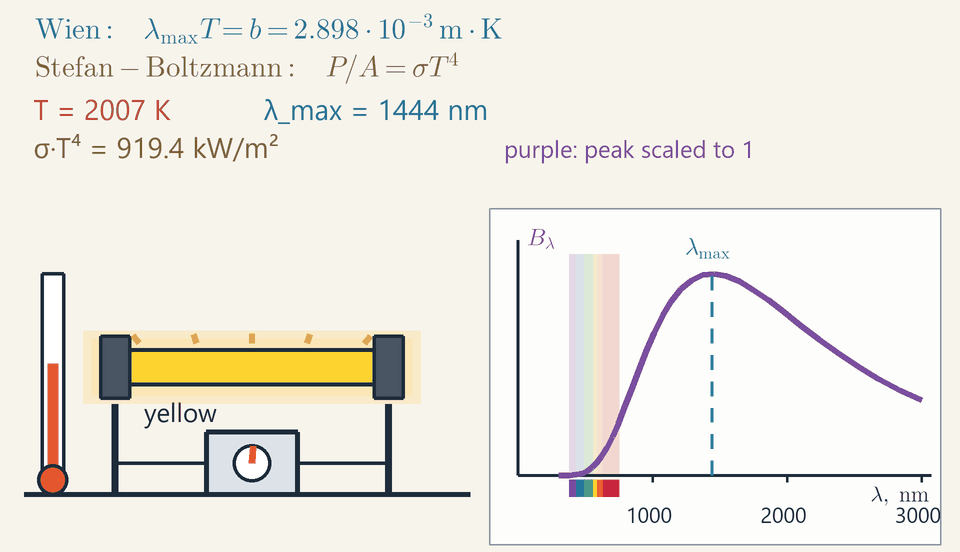
A metal bar heated from room temperature to 3500 K glows dull red, then orange, yellow and white, while its spectrum slides towards shorter wavelengths and its radiated power soars.
Everything gives off thermal radiation; at everyday temperatures it is invisible infrared.
As things heat up they glow dull red, then orange, yellow and finally white.
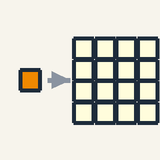
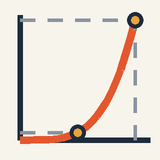
Hotter means far brighter: doubling the temperature in kelvin gives 16 times as much radiated energy.
Colour tells temperature: red stars are the coolest, blue-white stars the hottest.
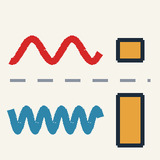
Light leaves in small packets of energy, and a blue packet carries more than a red one: this is why the glow fades out on the blue side.
Look into a campfire after the flames die down: the embers glow orange, and a coal fanned by the wind brightens to yellow. A potter judges the heat of a kiln by the colour inside it. Hot things glow, and their colour tells how hot they are.
Step 1. Everything gives off this thermal radiation, even you and a cup of tea. At everyday temperatures it is all infrared, invisible to our eyes; thermal cameras turn it into pictures. Only above about 800 K (roughly 500 °C) does a faint red glow appear.
Step 2. As an object heats up, two things change. It gives off far more energy: double its temperature in kelvin and it radiates 16 times as much. And its colour shifts: dull red, orange, yellow, then white. The hottest stars look blue-white, the coolest red.
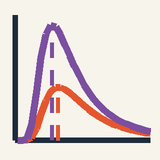
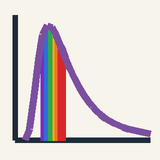
Step 3. The glow is a mixture of many wavelengths. In the animation the purple curve shows how the light is shared among them. As the knob turns up, the hump slides towards the rainbow band of visible light and the gold rays grow fast. Even white hot, most of the curve stays in the infrared, which is why filament bulbs wasted so much energy as heat.
Step 4. Around 1900 the best theory of light predicted the wrong curve: it said hot objects should pour out endless violet and ultraviolet light. Max Planck fixed it with a bold idea: light is given off in small packets of energy, and a packet of blue light carries more energy than a packet of red. A warm object can rarely spare enough for the big blue packets, so its glow fades out on the blue side.
Check yourself: one star looks orange, another blue-white. Which is hotter? Answer: the blue-white one.
Intermediate
Key ideas
A blackbody absorbs all radiation; its glow depends only on its temperature T in kelvin.
Wien's law: λmaxT=b=2.898×10⁻³m⋅K, so a hotter body peaks at a shorter wavelength.
Stefan–Boltzmann law: P=εσAT4, with σ=5.67×10⁻⁸W/(m2⋅K4) and emissivity 0<ε≤1.
Net radiated power is Pnet=εσA(T4−Tenv4): cold objects radiate too.
The colour we see comes from the whole visible part of the spectrum, not from the peak alone.
What a blackbody is
It is tempting to think that only glowing objects radiate. In fact everything radiates simply because it is warm: its charged particles jostle with thermal motion, and accelerated charges emit electromagnetic waves. Near room temperature this thermal radiation is almost all infrared, around 10 µm; only above about 800 K does enough of it reach the visible band to show a dull red glow.
A blackbody absorbs all the radiation falling on it, at every wavelength, so the light it gives off depends only on its temperature T, not on its material or shape. The best laboratory version is a small hole in a closed oven: light entering it is absorbed after bouncing around inside, so the hole looks black when cold and glows with the pure thermal spectrum when hot. Stars and glowing coals come close, and the animation treats its bar as one.
Emissivity, ε, is the fraction of a blackbody's radiation that a real surface emits at the same temperature. By Kirchhoff's law this equals the fraction of incoming radiation the surface absorbs: good absorbers are good emitters. Soot has ε≈0.95, polished silver about 0.02.
Two laws: the peak and the total power
Wien's displacement law gives the wavelength at which the spectrum peaks: λmaxT=b=2.898×10⁻³m⋅K Double T and λmax halves. With b=2.898×10⁶nm⋅K, a person at 310 K peaks near 9300 nm, deep in the infrared, while the Sun, whose spectrum peaks near 500 nm, must be about 5800 K at its surface: Wien's law is a thermometer that works at any distance.
The Stefan–Boltzmann law gives the total power radiated, over all wavelengths, by a surface of area A: P=εσAT4 σ=5.67×10⁻⁸W/(m2⋅K4) A blackbody, with ε=1, radiates σT4 per square metre. Doubling T multiplies this by 24=16, and the bar in the animation, heated from 300 K to 3500 K, ends up radiating (3500/300)4≈18500 times more.
A body also absorbs radiation from its surroundings; if they are at Tenv, the net power it loses is Pnet=εσA(T4−Tenv4) When the two temperatures are equal, both sides keep radiating but the net flow is zero: thermal equilibrium.
Planck's quanta: why the blue side fades
Around 1900 the accepted theory predicted radiation growing without limit towards short wavelengths: any warm object would pour out ultraviolet light. Max Planck explained the measured curve by assuming that matter exchanges energy with radiation of frequency f only in whole quanta: E=hf=λhc where h=6.626×10⁻³⁴J⋅s is Planck's constant. With hc≈1240eV⋅nm, a red photon at 620 nm carries 2.0 eV and a violet one at 413 nm 3.0 eV.
Each vibration of the hot material has a thermal energy of order kT, where k=1.381×10⁻²³J/K is Boltzmann's constant: 0.30 eV at 3500 K. A quantum much bigger than kT is rarely emitted, its chance falling roughly as e−hf/kT. So the long-wavelength side follows the old theory, while on the short side the quanta become too costly and the curve plunges; the peak sits where hf≈5kT.
Worked example: the bar in the animation
At the end of the animation the bar is at T=3500K. The two laws give λmax=Tb=35002.898×10−3=8.28×10⁻⁷m=828nm σT4=5.67×10−8⋅35004≈8.51×10⁶W/m2
These are the final values on the λmax and σT4 readouts, 828 nm and 8509 kW/m²: each square centimetre radiates about 850 W. The peak lies just beyond the red end of the visible band, which is at 750 nm, so the dashed blue line ends just right of the rainbow strip, and only about 18 % of the power is visible light.
At 1750 K, half that temperature, the peak was twice as far out, at 1656 nm, and the power 16 times smaller. At the start, 300 K, the peak was at 9659 nm, far off the axis. The gold rays, whose length grows as T4, appear only at 2000 K, when the power is still 11 % of its final value. The room at 300 K sends back only σ⋅3004≈0.46kW/m2, negligible for the glowing bar.
Worked example: the Sun and the Earth
How hot is the Sun's surface, judged from its power alone? Above the atmosphere, sunlight delivers 1361 W/m². That power left the Sun's surface, of radius R=6.96×10⁸m, and has spread over a sphere of radius d=1.496×10¹¹m, so at the surface the flux was (d/R)2≈46200 times larger: σT4=1361⋅46200≈6.29×10⁷W/m2 T=(5.67×10−86.29×107)1/4≈5770K close to the 5800 K that Wien's law gave from the 500 nm peak: the total power and the shape of the spectrum agree.
The Earth intercepts sunlight on its cross-section πRE2 and reflects about 30 % of it, but it radiates from its whole surface, 4πRE2. In balance, σTE4=40.70⋅1361≈238W/m2⇒TE≈255K that is −18 °C, with a peak near b/TE≈11μm. The measured average is about 288 K: the 33 K difference is the greenhouse effect, as water vapour and carbon dioxide absorb part of that infrared and send it back down.
Reading the spectrum and the colours
The purple curve plots Bλ, the power radiated per unit wavelength, against λ; the area under it is the total power. Here its peak is always drawn at the same height (“peak scaled to 1”), so the curve shows where the light lies and the σT4 readout says how much. It is lopsided, falling steeply on the short-wavelength side and trailing a long infrared tail: at every temperature only a quarter of the power lies below λmax.
The colour comes from the whole visible slice, 380 to 750 nm. At 1000 K only the far red tail reaches it: dull red. Orange and yellow join in as T rises, and at 5000 to 6000 K the slice is nearly flat and looks white; hotter stars look bluish white. No blackbody looks green: when the peak sits in the green, the curve is so broad that the mix is white.
Common mistakes
“Red hot” is the coolest visible glow, not the hottest: red stars are near 3000 K, the Sun 5800 K, blue-white stars 10 000 K or more.
The peak is not the colour: the bar at 3500 K peaks in the infrared, at 828 nm, yet glows white hot.
Cold objects radiate too: a wall at 300 K emits about 460 W per square metre, but absorbs about as much from its surroundings.
A hotter body is brighter at every wavelength, red included: at 3500 K the bar emits 4600 times more at 650 nm than at 1500 K, and 195 000 times more at 450 nm.
Use kelvins: warming a hotplate from 20 °C to 40 °C multiplies its radiation by (313/293)4≈1.30, a rise of 30 %, not 16 times.
Where you meet it
Thermal cameras and ear thermometers read infrared, and astronomers read star temperatures from their colours. Filament lamps at 2700 to 3000 K put only about 7 to 11 % of their power into visible light, which is why LEDs replaced them. Planck's quanta lead next to the Photoelectric Effect and to Atomic Models: the Bohr Atom.
Advanced
Key ideas
Classically every cavity mode gets kT and modes crowd as 8π/λ4: Rayleigh–Jeans 2ckT/λ4 diverges as λ→0.
Planck: an oscillator holds only 0,hf,2hf,…; its mean energy hf/(ehf/kT−1) freezes out modes with hf≫kT.
Einstein's balance of absorption, spontaneous and stimulated emission (A and B coefficients) reproduces Planck's law: the laser's principle.
Every body glows, and the colour of the glow depends on its temperature. To find the spectrum from first principles, take the simplest glowing object: a closed cavity whose walls are held at the temperature T. The radiation inside comes into equilibrium with the walls, and its spectrum cannot depend on what the walls are made of. If it did, two cavities at the same temperature, joined through a filter that passes only one colour, would trade energy at that colour, and heat would flow between bodies at equal temperature, which the second law forbids.
So the radiation is universal, and we may study the easiest cavity of all: a cube of side L with reflecting walls. Classically the field inside is a sum of standing waves, and the first job is to count them.
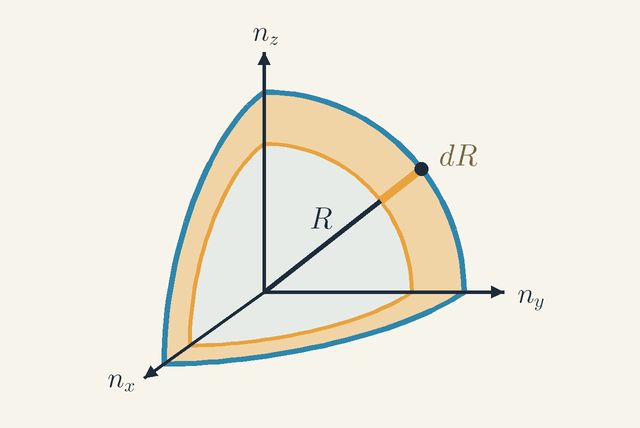
Figure 1. Each standing wave of a cube is a point (nx,ny,nz) with whole-number coordinates. Waves longer than λ fill the octant of radius R=2L/λ; the gold shell of thickness dR holds those between λ and λ+dλ. Shell not to scale.Legend
nx
Whole number of half-wavelengths of a standing wave along x.
ny
Whole number of half-wavelengths along y.
nz
Whole number of half-wavelengths along z.
R
Distance of a mode's point from the origin, nx2+ny2+nz2; modes longer than λ have R<2L/λ.
dR
Thickness of the shell holding the modes between λ and λ+dλ: dR=2Ldλ/λ2.
Figure 1 is the counting device. A standing wave must fit the cube along each axis: along x exactly nx half-wavelengths fit into L, and likewise ny along y and nz along z, each a positive whole number. So every mode is one triple (nx,ny,nz), that is one point of a lattice with spacing 1 in the space spanned by the axes nx, ny, nz. Each lattice point owns a unit cube of this space, so counting modes amounts to measuring volume.
The wavelength of a mode is set by the distance of its point from the origin. Measured along the x axis, the wave repeats every 2L/nx, and likewise along y and z. The reciprocals of these three axis wavelengths add like the components of a vector, which gives λ21=4L2nx2+ny2+nz2⇒λ=R2L where R=nx2+ny2+nz2 is that distance. Points far from the origin are short waves.
Now count. The modes with wavelengths longer than λ are the points closer to the origin than R=2L/λ. Because all three numbers are positive, these points fill one eighth of a ball, the octant outlined in blue in Figure 1. Its volume is 81⋅34πR3, and every point stands for two modes, because light is a transverse wave whose electric field can oscillate in two independent directions (two polarisations). The number of modes longer than λ is therefore N=2⋅81⋅34πR3=3λ38πL3
The spectrum needs the number of modes in a narrow band of wavelengths. Lengthening the wavelength from λ to λ+dλ shrinks R=2L/λ by dR=2Ldλ/λ2, so these modes lie in the gold shell of thickness dR just inside the blue surface. The shell's volume is 814πR2dR; with two polarisations it holds 8πL3dλ/λ4 modes. Dividing by the volume L3 of the cube and by dλ gives the number of modes per unit volume and unit wavelength: n(λ)=λ48π The size of the box has dropped out, as it must. The steep 1/λ4 drives everything that follows: short waves fit into a given space in far greater numbers than long ones.
Equipartition and the ultraviolet catastrophe
Classical physics also says how much energy each mode holds. The field of one standing wave swings back and forth in time exactly like a mass on a spring, its energy passing between the electric and the magnetic field. Equipartition of energy gives such an oscillator, in equilibrium at the temperature T, the mean energy kT, where k is Boltzmann's constant: 21kT for each of its two quadratic energy terms. The energy per unit volume and unit wavelength is then uλ=n(λ)kT=8πkT/λ4.
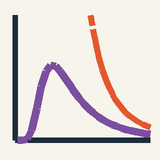
What a detector or an eye receives is the radiance Bλ: the power leaving a surface per unit area, per unit solid angle and per unit wavelength. Radiation of energy density uλ travels at the speed of light c, spread evenly over all 4π steradians of direction, so Bλ=cuλ/(4π), and BλRJ=λ42ckT This is the Rayleigh–Jeans law. It matches measurements at long wavelengths, but it grows without limit as λ→0, so the total energy ∫0∞uλdλ is infinite. Every cavity would hold an infinite energy, piled up in the shortest waves: the ultraviolet catastrophe.
The dashed curve in this level's animation is this law at 3500 K. At the right edge of the graph, 3000 nm, it is already 2.1 times Planck's curve; at the 828 nm peak it is 29 times too high; it comes within 11 % only beyond about 20 µm. The failure is not a detail of the model. The mode count is sound geometry; what fails is equipartition itself. The same failure shows up in the specific heats of gases, where molecular vibrations that equipartition says should share the heat stay frozen at low temperature.
Planck's quantised oscillators
In 1900 Planck found the way out. He kept the mode count and changed a single assumption: an oscillator cannot hold any energy it likes, only whole multiples of a fixed step.
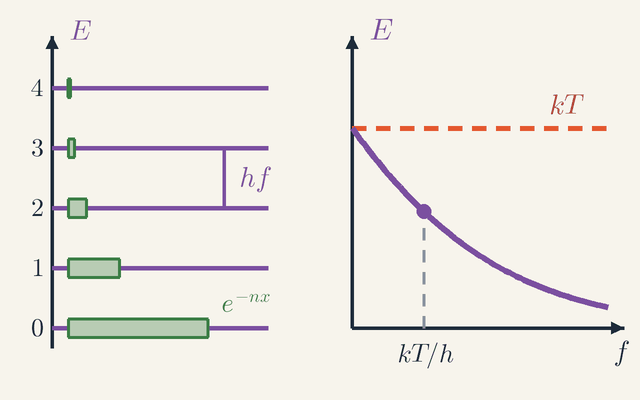
Figure 2. Left: an oscillator of frequency f may hold only the energies nhf; the bars are the Boltzmann weights e−nx of the levels, drawn for hf=kT. Right: its mean energy Eˉ equals the classical kT at low f and dies away for f≫kT/h.Legend
E
Energy of the oscillator.
J
hf
Spacing of the energy levels: one quantum of an oscillator of frequency f.
J
e−nx
Boltzmann weight of level n, with x=hf/kT: each level weighs e−x times as much as the one below.
f
Frequency of the oscillator, that is of the mode.
Hz
kT
Mean energy of an oscillator according to classical equipartition; the dashed line.
J
kT/h
The frequency at which one step hf equals kT.
Hz
Eˉ
Mean energy of the quantised oscillator, hf/(ehf/kT−1).
J
The left half of Figure 2 draws this rule as a ladder. An oscillator of frequency f may hold only the energies En=nhf, with n=0,1,2,…; the rungs are a step hf apart, where h is a new constant of nature, Planck's constant. At the temperature T, statistical physics weights rung n by its Boltzmann factor e−En/kT=e−nx, with the shorthand x=hf/kT: the size of one step measured in units of kT. The green bars show these weights for hf=kT, that is x=1. Each bar is e−1≈0.37 times the one below it, so most oscillators sit on the lowest rungs.
The mean energy is the weighted average of the rungs. The weights form a geometric series with ratio e−x, ∑n=0∞e−nx=1−e−x1 and the energy-weighted sum is hf times minus the derivative of this series with respect to x: ∑n=0∞nhfe−nx=(1−e−x)2hfe−x Dividing the second sum by the first gives the mean energy: Eˉ=1−e−xhfe−x=ehf/kT−1hf
The purple curve on the right of Figure 2 is this Eˉ, plotted against the frequency f; the dashed line is the classical kT. Follow the curve from left to right. When the step is small, hf≪kT, the approximation ex≈1+x gives Eˉ≈kT, so the curve starts on the classical line: low frequencies, that is long wavelengths, still obey equipartition. At the marked point f=kT/h one step costs exactly kT, and the curve has already fallen to kT/(e−1)≈0.58kT.
When hf≫kT, Eˉ≈hfe−hf/kT is exponentially small. Even the first rung is then too expensive, nearly every oscillator stays on rung 0, and the short-wavelength modes are frozen out. Their huge number no longer matters, and the catastrophe is gone.
Replacing kT by Eˉ, with f=c/λ, turns the Rayleigh–Jeans law into Planck's law: Bλ=λ52hc2ehc/λkT−11 Planck fitted it to the precise measurements made in Berlin in 1900 and obtained values of h and k within a few per cent of today's, h=6.626×10⁻³⁴J⋅s and k=1.381×10⁻²³J/K.
Photons and Einstein's coefficients
Planck quantised the oscillators that emit the light. In 1905 Einstein went further and proposed that light itself comes in quanta of energy hf, later called photons. In 1917 he derived Planck's law once more, from nothing but atoms trading photons with radiation, and in doing so found a process nobody had suspected.
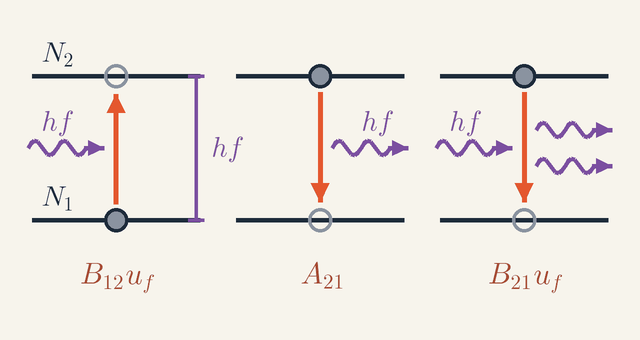
Figure 3. Two-level atoms, levels hf apart, and photons of energy hf (wavy arrows). Left to right: absorption, at the rate B12uf; spontaneous emission, at A21; stimulated emission, where a passing photon triggers a second, identical one, at B21uf.Legend
N1
Number of atoms in the lower level.
N2
Number of atoms in the upper level.
hf
Gap between the levels, equal to the energy of each photon drawn.
J
B12uf
Rate at which one atom in the lower level absorbs a photon; uf is the energy density of the radiation per unit frequency.
s−1
A21
Rate at which one excited atom emits a photon spontaneously.
s−1
B21uf
Rate at which one excited atom is stimulated to emit by the radiation.
s−1
Figure 3 shows atoms with two energy levels a gap hf apart, bathed in radiation whose spectral energy density, the energy per unit volume and unit frequency, is uf. There are N1 atoms in the lower level and N2 in the upper one. Each panel is one process: the filled dot marks where the atom starts, the open circle where it ends, the straight arrow is its jump, and the wavy arrows are photons of energy hf.
On the left is absorption: a photon disappears and the atom jumps up. An atom in the lower level does this at the rate B12uf, proportional to the amount of radiation present. In the middle is spontaneous emission: an excited atom drops on its own, at the rate A21, and sends out a photon in a random direction. On the right is stimulated emission: a passing photon makes an excited atom drop, at the rate B21uf. One photon goes in and two come out.
In equilibrium the number of upward jumps per second equals the number of downward ones, and the populations follow Boltzmann's law, N2/N1=e−hf/kT. Dividing the balance by N2 and collecting the terms in uf gives N1B12uf=N2(A21+B21uf)⇒uf=B12ehf/kT−B21A21
Compare this with Planck's law written per unit frequency, uf=(8πhf3/c3)/(ehf/kT−1). As T→∞, ehf/kT→1 and Planck's uf grows without limit, so the denominator above must vanish there: B12=B21. What remains then matches only if A21/B21=8πhf3/c3. Absorption and stimulated emission are equally strong, and they fix the rate of spontaneous emission.
Stimulated emission is essential. Without it the balance would give uf=A21/(B12ehf/kT), Wien's exponential form, which fails at long wavelengths. The stimulated photon is an exact copy of the one that triggered it, with the same frequency, direction and phase: that is the principle of the laser.
Why, then, is a laser hard to make? The ratio of stimulated to spontaneous emission, B21uf/A21, works out to 1/(ehf/kT−1), the mean number of photons per mode. For the glowing bar of the animation, at 3500 K and at its 828 nm peak, it is only 0.007: almost all the light of a hot body is spontaneous. A laser therefore needs a population inversion, N2>N1, which no body in thermal equilibrium can provide. In 1924 Bose derived the whole law by counting photons as indistinguishable particles, the start of Bose–Einstein statistics.
Wien's and Stefan's laws from Planck's law
Two rules of thermal radiation were known before Planck: the peak wavelength falls as 1/T, and the total power rises as T4. Both now follow from Planck's formula, with their constants built from h, c and k.
First the peak. Use the dimensionless variable x=hc/λkT, the photon energy hc/λ in units of kT. Substituting λ=hc/(xkT) gives Bλ=h4c32k5T5ex−1x5 so at a fixed T the peak lies where x5/(ex−1) is largest. Setting its derivative to zero gives 5x4(ex−1)=x5ex, that is x=5(1−e−x). Start from the guess x=5 and put it into the right-hand side: it returns 4.966, and one more round settles on the root x=4.965. Hence
λmaxT=4.965khc=2.898×10⁻³m⋅K
Wien's constant is not a new constant of nature but a combination of h, c and k.
Next the total power. The power leaving unit area of the surface, M, is π times the integral of Bλ over all wavelengths. The factor is π rather than 2π because the radiance is added over all directions of the hemisphere, each weighted by the cosine of its angle from the normal: a surface seen at a slant looks smaller. Changing the variable to x, with dλ=−hcdx/(x2kT), turns the integral into a pure number times T4, and ∫0∞x3/(ex−1)dx=π4/15: M=π∫0∞Bλdλ=h3c22πk4T4∫0∞ex−1x3dx M=σT4,σ=15h3c22π5k4 which gives the Stefan–Boltzmann constant σ=5.670×10⁻⁸W/(m2⋅K4).
The fourth power has a simple reading. Modes with hf up to a few kT are active and the rest are frozen out, so the active modes reach up to a frequency proportional to T. Their number per unit volume grows as the cube of that frequency, so as T3, and each holds an energy of order kT: the energy density, and with it the power emitted, grows as T4.
Both laws were found before Planck. Stefan read the fourth power from measurements in 1879; Boltzmann derived it in 1884 from thermodynamics and the radiation pressure u/3, where u is the energy density; and in 1893 Wien showed that thermodynamics forces the form Bλ=T5g(λT), with some function g of the single variable λT. Thermodynamics could not find g; that took the quantum.
Reading the family of Planck curves
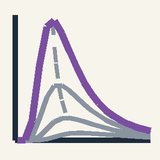
The scaling Bλ=T5g(λT) is what this level's animation shows as the bar heats up. Every curve has the same shape, squeezed horizontally by the factor 1/T and stretched vertically by T5. From 2000 K to 3500 K, a factor 1.75 in temperature, the peak moves from 1449 nm to 828 nm and rises 1.755≈16.4 times, while the area under the curve, the total power, grows only 1.754≈9.4 times, from 907 to 8509 kW/m². The height outgrows the area because the curve also gets narrower.
As the bar heats, the purple curve rises past the grey curves it leaves behind and lies above each of them at every wavelength, because 1/(ehc/λkT−1) increases with T at every λ: a hotter body is brighter in every colour. The small graph is the quartic σT4. It reaches half its final value only at 3500/21/4≈2943K, after more than four fifths of the temperature rise.
A caution about peaks. Bλ is a density per unit wavelength. Plotted per unit frequency, the same radiation peaks where x=3(1−e−x), at x=2.821, which at 3500 K corresponds to 1457 nm, not 828 nm. The peaks differ because equal steps in wavelength are not equal steps in frequency: ∣df∣=cdλ/λ2, so converting one density into the other multiplies it by a factor that depends on λ, and the maximum moves.
For the Sun the two peaks lie at 502 nm and 883 nm. The power in any band is the same in both plots; only the position of the maximum of a density depends on the variable chosen. “The Sun peaks in the green” describes a graph, not the light.
Worked problem: a glowing rod cools
Planck's law also tells us how fast a hot body cools when radiation alone carries its heat away. Switch off the current when the bar is at T0=3500K. Model it as a tungsten rod of diameter d=1.0mm in a vacuum, as inside a lamp bulb, so that radiation is the only way out for heat. Take the density ρ=19300kg/m3, a mean specific heat cp=170J/(kg⋅K) and a mean emissivity ε=0.30, the fraction of the blackbody power σT4 that the real surface emits. How long does the rod take to reach 1750 K, where it radiates 24=16 times less?
Set up an energy balance for a piece of length ℓ away from the ends. Its heat content changes at the rate mcpdT/dt, with the mass m=ρπd2ℓ/4, and it loses εσT4 through each square metre of its surface πdℓ. Dividing both by the surface gives, per unit area, 4ρdcpdtdT=−εσT4 The length has dropped out; only the ratio of volume to surface, d/4, matters. Separate the variables, −dT/T4=4εσdt/(ρdcp), and integrate from T0 at t=0. Since the integral of −T−4 is 31T−3, T31−T031=ρdcp12εσt⇒T=(1+t/τ)1/3T0 with the time constant τ=ρdcp/(12εσT03)≈0.375s.
The cooling curve
The solution has a shape worth remembering: a fast start and a very long tail.
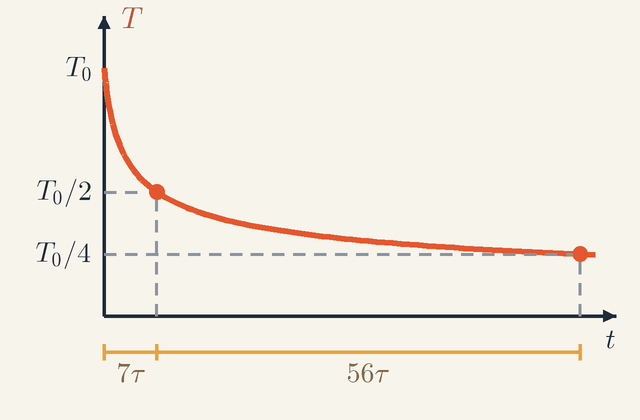
Figure 4. Temperature of a rod cooling by radiation alone, T=T0/(1+t/τ)1/3. Notice the long tail: the first halving takes 7τ, the second 56τ, eight times as long.Legend
T
Temperature of the rod.
K
t
Time since the current was switched off.
s
T0
Starting temperature.
K
T0/2
Half the starting temperature.
K
T0/4
A quarter of the starting temperature.
K
τ
Time constant of the rod, τ=ρdcp/(12εσT03).
s
Figure 4 plots this solution, the temperature T against the time t. The curve leaves T0 almost vertically and then flattens into a long tail. The dots mark the two halvings of the temperature. T=T0/2 when (1+t/τ)1/3=2, so 1+t/τ=8 and t=7τ; T=T0/4 when 1+t/τ=64, at t=63τ. The gold bars under the time axis show the two intervals: 7τ for the first halving and 63τ−7τ=56τ for the second, eight times as long.
Now the numbers. Differentiating T at t=0 gives the initial cooling rate T0/(3τ)≈3100K/s, the steep start of the curve. The first halving, 7τ≈2.6s, takes the bar from white heat to a yellow-orange glow at 1750 K. The next halving, to 875 K, where the dull red is almost gone, takes eight times as long, about 21 s. The reason: at each stage of the second halving the bar is at half the temperature of the matching stage of the first, so it radiates 24=16 times more slowly, while it has only half as much heat to lose, 875 K of cooling instead of 1750 K; and 16/2=8. The radiation the bar receives from a room at 300 K is (300/875)4≈1.4% of what it emits even at 875 K, so ignoring it is fair.
In reality the emissivity of tungsten falls to about 0.1 near 1000 K, so the red stage lasts longer still. A lamp filament a few hundredths of a millimetre thick has a τ dozens of times shorter, since τ is proportional to d, and fades in a fraction of a second.
Limits of validity
Planck's law describes radiation in thermal equilibrium with matter at a single temperature. Real surfaces emit less, ε(λ)Bλ, with an emissivity between 0 and 1 that depends on wavelength. Tungsten's is higher in the visible than in the infrared, so its light looks a little hotter than the metal really is. A thin gas emits and absorbs only narrow spectral lines, and the Sun's spectrum is a near-blackbody crossed by dark absorption lines. Lasers, LEDs and sodium lamps are not thermal sources at all.
The classical laws survive as limits: Wien's exponential for hf≫kT, and Rayleigh–Jeans for hf≪kT. Radio astronomy lives in the second: a 1 GHz signal has hf/kT≈0.016 even at 3 K. The law also assumes bodies and gaps much larger than the thermal wavelength, the wavelength near the emission peak, about 10 µm at room temperature. A dust grain much smaller than that radiates less than σT4 per unit area, while two surfaces a fraction of a micrometre apart can exchange heat many times faster than two blackbodies, through evanescent waves that tunnel across the gap.
Within its domain the law is extraordinarily exact. The cosmic microwave background, the afterglow of the hot early universe, follows a Planck curve at 2.725 K, peaking near 1.06 mm, to within about 50 parts per million of its peak.
Where this leads
Planck treated quantisation as a property of the emitters; Einstein's light quanta took it literally, and the Photoelectric Effect is where you meet them next. Discrete energy levels and their spectral lines are the subject of Atomic Models: the Bohr Atom, and the double nature of the photon returns in Wave–Particle Duality. Light made without heat, across a band gap, appears in Semiconductors, Diodes and LEDs. The failure of equipartition links back to Kinetic Theory of Gases, and the entropy of radiation, which guided Planck in 1900, to The Second Law of Thermodynamics and Entropy.
Key formulas
Wien's displacement law
λmaxT=b=2.898×10⁻³m⋅K
The wavelength at which a blackbody's spectrum peaks is inversely proportional to its absolute temperature: double T and the peak moves to half the wavelength. The law follows from Planck's law, whose peak sits where hc/λkT=4.965, so that b=hc/(4.965k). In nanometres, b=2.898×10⁶nm⋅K.
Symbols
λmax
wavelength at which the spectrum Bλ is highest
m
T
absolute temperature of the body
K
b
Wien's displacement constant
m⋅K
When it holds: For a blackbody, or a surface whose emissivity does not vary with wavelength, with T in kelvins. It locates the peak per unit wavelength; per unit frequency the peak lies at c/fmax≈1.76λmax.
Example: The bar at the end of the animation: λmax=2.898×10⁻³/3500=828nm, just beyond the red end of the visible band.
Stefan–Boltzmann law
P=εσAT4
Every surface radiates, and the total power, summed over all wavelengths, grows as the fourth power of its absolute temperature. A blackbody emits σT4 per square metre, the area under its Planck curve; a real surface emits the fraction ε of that. The power is always positive: this is emission only, not the net exchange.
Symbols
P
power radiated by the surface
W
ε
emissivity of the surface, between 0 and 1
σ
Stefan–Boltzmann constant
W/(m2⋅K4)
A
area of the radiating surface
m2
T
absolute temperature of the surface
K
When it holds: Temperatures in kelvins. It assumes a grey surface, with the same emissivity at all wavelengths, much larger than the wavelengths it emits; the radiation absorbed from the surroundings must be subtracted separately.
Example: One square centimetre of a blackbody at 3500 K: P=5.67×10−8⋅10−4⋅35004≈851W.
Stefan–Boltzmann constant
σ=5.67×10⁻⁸W/(m2⋅K4)
The power radiated per square metre by a blackbody at 1 K. It is tiny, but the fourth power makes up for it: at 1000 K a blackbody emits 56.7 kW per square metre. It is not an independent constant: Planck's law gives it in terms of h, c and k.
Symbols
σ
Stefan–Boltzmann constant
W/(m2⋅K4)
When it holds: The same for every blackbody, whatever its material, size or shape. Since 2019 the SI fixes h, c and k exactly, so σ is exactly known too.
Example: A blackbody at 300 K emits σT4≈459W per square metre; at 3500 K, 8.51×10⁶W/m2.
Net radiated power
Pnet=εσA(T4−Tenv4)
A body emits εσAT4 and, by Kirchhoff's law, absorbs the same fraction ε of the radiation σATenv4 that its surroundings send it. The difference is the net loss. When T=Tenv both flows continue but cancel; when the surroundings are hotter, Pnet is negative and the body gains energy.
Symbols
Pnet
net power lost by radiation
W
ε
emissivity of the body
σ
Stefan–Boltzmann constant
W/(m2⋅K4)
A
radiating area of the body
m2
T
absolute temperature of the body
K
Tenv
absolute temperature of the surroundings
K
When it holds: For a grey body enclosed by surroundings that behave as a blackbody at a single temperature, with both temperatures in kelvins. For a small difference ΔT it is close to 4εσAT3ΔT, proportional to the difference.
Example: One face of a black radiator panel, 1 m² at 350 K, in a room with walls at 293 K: Pnet=5.67×10−8⋅(3504−2934)≈433W.
Energy of a photon
E=hf=λhc
Radiation of frequency f exchanges energy with matter only in quanta of hf. Since f=c/λ, shorter wavelengths carry bigger quanta: a violet photon has nearly twice the energy of a red one. Planck introduced the quantum for the emitting oscillators in 1900; Einstein made it a property of light itself in 1905.
Symbols
E
energy of one photon
J
h
Planck constant
J⋅s
f
frequency of the radiation
Hz
c
speed of light in vacuum
m/s
λ
wavelength in vacuum
m
When it holds: Exact for every photon. In a material the frequency stays the same while the wavelength shrinks, so use the frequency or the vacuum wavelength.
Example: At the 828 nm peak of the bar at 3500 K: E=1240/828≈1.50eV, about five times kT=0.30eV.
Planck's law
Bλ=λ52hc2ehc/λkT−11
The radiance of a blackbody per unit wavelength: the power leaving unit area, per unit solid angle and per unit wavelength. It is the number of modes per unit volume and unit wavelength, 8π/λ4, times the mean energy of a mode, hf/(ehf/kT−1), times c/(4π). At long wavelengths it tends to the classical 2ckT/λ4; at short ones the exponential cuts it off, which removes the ultraviolet catastrophe.
Symbols
Bλ
spectral radiance
W/(m2⋅sr⋅m)
h
Planck constant
J⋅s
c
speed of light in vacuum
m/s
λ
wavelength
m
k
Boltzmann constant
J/K
T
absolute temperature
K
When it holds: Radiation in thermal equilibrium with matter at one temperature: inside a closed cavity, or from an opaque blackbody surface. A real surface emits ε(λ)Bλ; lasers, LEDs and gas-discharge lamps are not thermal and do not follow it.
Example: At 3500 K the peak, at 828 nm, reaches Bλ≈2.15×10¹²W/(m2⋅sr⋅m), 16.4 times the peak at 2000 K.
Stefan–Boltzmann constant from Planck's law
σ=15h3c22π5k4
Integrating Planck's law over all wavelengths, and over all directions of a hemisphere, gives the power per unit area σT4; the integral ∫0∞x3/(ex−1)dx=π4/15 supplies the numbers. The T4 arises because the number of modes that are not frozen out grows as T3 and each carries an energy of order kT. In 1900 Planck turned this around, using the measured σ and b to obtain the first values of h and k.
Symbols
σ
Stefan–Boltzmann constant
W/(m2⋅K4)
k
Boltzmann constant
J/K
h
Planck constant
J⋅s
c
speed of light in vacuum
m/s
When it holds: Wherever Planck's law holds; it gives the same constant for every blackbody, whatever its material.
Example: With k=1.3806×10⁻²³J/K, h=6.6261×10⁻³⁴J⋅s and c=2.9979×10⁸m/s, the formula gives 5.670×10⁻⁸W/(m2⋅K4).
Glossary
Thermal radiation
Electromagnetic radiation that every body gives off because of its temperature, spread over a broad range of wavelengths. Near room temperature it is almost all infrared; above about 800 K enough of it is visible for the body to glow.
Blackbody
An ideal body that absorbs all the radiation falling on it, at every wavelength, so that its own emission depends only on its temperature. A small hole in the wall of a closed oven is the closest real example; stars and glowing coals come near.
Kirchhoff's law of thermal radiation
At each wavelength a surface emits the same fraction of blackbody radiation as it absorbs of the radiation falling on it: emissivity equals absorptance. Good absorbers are good emitters, and a perfect mirror is neither.
Wien's displacement law
The peak wavelength of a blackbody's spectrum is inversely proportional to its absolute temperature, λmaxT=b. Hotter bodies peak at shorter wavelengths: 828 nm at 3500 K, 9.7 µm at 300 K.
Stefan–Boltzmann law
The total power radiated per unit area grows as the fourth power of the absolute temperature, σT4 for a blackbody and εσT4 for a real surface. Doubling T multiplies it by 16.
Draper point
The temperature, about 800 K (around 525 °C), at which a hot object first gives off a faint visible glow, dull red in the dark. Below it, its thermal radiation is all infrared.
Colour temperature
The temperature of the blackbody whose glow has the same colour as a given light source. A candle flame is about 1900 K, a filament lamp 2700 K, daylight about 6500 K; LEDs are labelled this way although their light is not thermal.
Rayleigh–Jeans law
The classical prediction Bλ=2ckT/λ4, obtained by giving every mode of the radiation the energy kT. It matches experiment at long wavelengths, where hf≪kT, but fails badly at short ones.
Ultraviolet catastrophe
The absurd consequence of the Rayleigh–Jeans law that a body at any temperature would radiate ever more at shorter wavelengths, with an infinite total power. Planck's energy quanta removed it in 1900.
Equipartition of energy
The classical rule that in thermal equilibrium each independent oscillator holds a mean energy kT. It fails for modes with hf≫kT, which are frozen out; this failure caused both the ultraviolet catastrophe and the puzzle of the specific heats of gases.
Energy quantum
The smallest amount of energy, E=hf, that radiation of frequency f can exchange with matter. Planck introduced it for the emitting oscillators in 1900; a quantum of light itself is called a photon.
Stimulated emission
Emission of a photon by an excited atom, triggered by an incoming photon of the same frequency and identical to it in direction and phase. Einstein showed in 1917 that blackbody radiation requires it; lasers are built on it.
Quantities
T
Absolute temperature
K
Temperature counted from absolute zero, T(K)=T(∘C)+273.15. Every radiation formula needs it in kelvins.
λmax
Peak wavelength
m
The wavelength at which the spectrum Bλ is highest, usually quoted in nanometres (1nm=10−9m) or micrometres.
b
Wien's displacement constant
m⋅K
The product λmaxT, the same for every blackbody: 2.898×10⁻³m⋅K, or 2.898×10⁶nm⋅K. It equals hc/(4.965k).
P
Radiated power
W
The energy a surface sends out as radiation each second, summed over all wavelengths and directions. For a surface of area A (in m²) at absolute temperature T it is εσAT4; the net power Pnet also subtracts what surroundings at Tenv send back.
ε
Emissivity
The fraction of a blackbody's radiation that a real surface emits at the same temperature, from 0 to 1; by Kirchhoff's law it equals the fraction the surface absorbs. About 0.95 for soot, 0.3 for white-hot tungsten, 0.02 for polished silver.
σ
Stefan–Boltzmann constant
W/(m2⋅K4)
5.67×10⁻⁸W/(m2⋅K4): the power per square metre radiated by a blackbody at 1 K. It is built from h, c and k.
E
Photon energy
J
The energy of one quantum of light, E=hf=hc/λ, with f the frequency (Hz), λ the wavelength in vacuum (m) and c the speed of light (m/s); it is often given in electronvolts, 1eV=1.602×10⁻¹⁹J. A photon at 828 nm carries 1.50 eV.
h
Planck constant
J⋅s
6.626×10⁻³⁴J⋅s, the ratio of a quantum's energy to its frequency. Its smallness is why quanta go unnoticed in everyday life.
k
Boltzmann constant
J/K
1.381×10⁻²³J/K. The product kT is the typical thermal energy per oscillator: 0.026 eV at 300 K, 0.30 eV at 3500 K.
Bλ
Spectral radiance
W/(m2⋅sr⋅m)
The power emitted per unit area of surface, per unit solid angle and per unit wavelength: the height of the Planck curve. Its peak grows as T5.
Quiz
Beginner A steel poker is pushed into a very hot fire. As it gets hotter and hotter, how does its glow change?
White first, then yellow, then red
Blue first, then green, then red
Dull red first, then orange, then yellow-white
It keeps the same colour and only gets brighter
Show answer
Answer: C. Dull red first, then orange, then yellow-white
As the temperature rises, the emitted light shifts towards shorter wavelengths: first only a little deep red is visible, then orange and yellow join in, and finally the mix of all visible colours looks white.
Beginner Which of these stars has the hottest surface?
A blue-white star
A red star
An orange star
A yellow star like the Sun
Show answer
Answer: A. A blue-white star
The hotter a body, the more its glow shifts towards blue. Red stars are the coolest (around 3000 K), the Sun is about 5800 K, and blue-white stars reach 10 000 K or more.
Beginner Does your own body give off thermal radiation?
No, only objects hot enough to glow do
Only when you have a fever
Yes, but only as faint visible light
Yes, mostly as invisible infrared, which thermal cameras can see
Show answer
Answer: D. Yes, mostly as invisible infrared, which thermal cameras can see
Everything above absolute zero radiates. At about 310 K your body's glow peaks near 9 µm, deep in the infrared: invisible to the eye but clear to a thermal camera.
Intermediate The Sun's spectrum peaks at about 500 nm. Using Wien's law (b = 2.898 × 10⁻³ m·K), what is the temperature of its surface?
About 580 K
About 5800 K
About 58 000 K
About 1450 K
Show answer
Answer: B. About 5800 K
T = b / λ_max = 2.898 × 10⁻³ m·K ÷ 5.00 × 10⁻⁷ m ≈ 5800 K. Forgetting that 1 nm = 10⁻⁹ m is the usual source of a wrong power of ten.
Intermediate Two stars have the same radius. The spectrum of star B peaks at half the wavelength of star A's. How does the total power radiated by B compare with that of A?
2 times as large
4 times as large
16 times as large
Half as large
Show answer
Answer: C. 16 times as large
Wien: halving λ_max means doubling T. Stefan–Boltzmann: at the same surface area P ∝ T⁴, so B radiates 2⁴ = 16 times as much. ‘2 times’ forgets the fourth power; ‘half as large’ confuses a shorter wavelength with less energy.
Intermediate A lamp filament at 3000 K has its emission peak at about 970 nm, in the infrared. Why does the lamp still give useful visible light?
The spectrum is broad, so part of it still lies between 380 and 750 nm
970 nm is yellow light
The glass bulb converts the infrared into visible light
The filament emits only at its peak wavelength
Show answer
Answer: A. The spectrum is broad, so part of it still lies between 380 and 750 nm
A blackbody spectrum spreads over a wide range of wavelengths. At 3000 K only its short-wavelength side, about a tenth of the power, falls in the visible band; the rest leaves as infrared heat.
Advanced According to Planck's law, how does the height of the peak of B_λ grow with the absolute temperature T?
In proportion to T
In proportion to T²
In proportion to T⁴, like the total power
In proportion to T⁵
Show answer
Answer: D. In proportion to T⁵
B_λ can be written as T⁵·g(λT). The peak always sits at the same λT = b, so its height grows as T⁵. The area grows only as T⁴ because the curve also narrows, as 1/T.
Advanced What was the “ultraviolet catastrophe”?
Ultraviolet light from hot stars damaging early telescopes
The classical prediction that a blackbody radiates infinite power at short wavelengths
Planck's law predicting far more ultraviolet light than experiments found
The discovery that hot objects emit no ultraviolet light at all
Show answer
Answer: B. The classical prediction that a blackbody radiates infinite power at short wavelengths
With kT per mode (equipartition) and a number of modes growing as 1/λ⁴, the Rayleigh–Jeans law diverges as λ → 0. Planck's quanta E = h·f freeze out the short-wavelength modes and remove the divergence.
 Physics Tutor