Pressure p=F/A grows with depth as p=p0+ρgh, and a liquid passes any added push undiminished to every point, so a small force on a narrow piston can lift a car.
Water squirts from a tank at three depths, and a hydraulic press lifts a car when its thin piston is pushed down.
Pressure is how hard a fluid pushes on each piece of a surface: its moving molecules keep bumping into everything they touch.
In a still liquid, pressure grows with depth because more liquid presses down from above; a denser liquid presses harder.
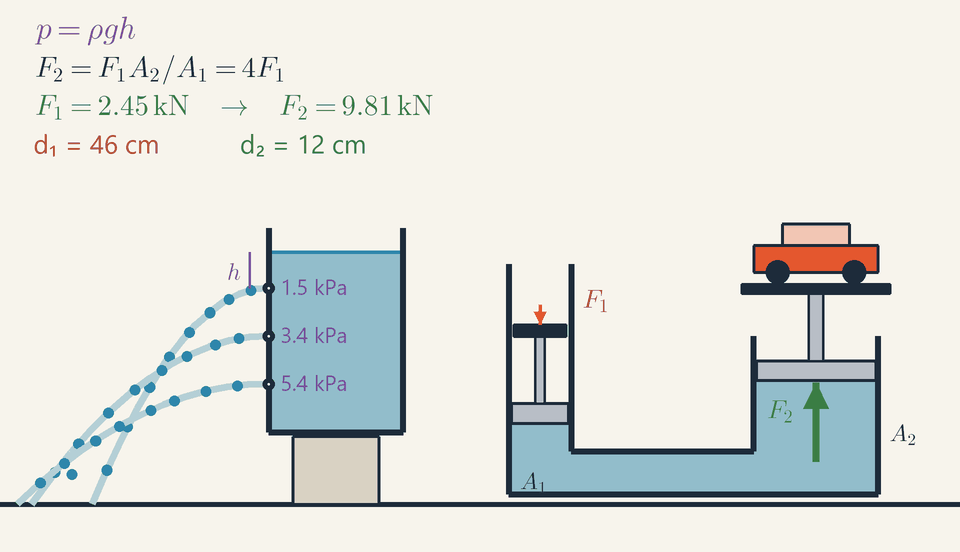
Only depth counts: a thin tube and a wide lake have the same pressure at the same depth.
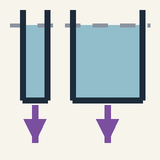
Push on a trapped liquid and the extra pressure reaches every point, so a small piston can lift a car on a wide one.
Nothing is free: the small piston must travel much farther than the car rises.
Pressure tells you how hard a fluid pushes on each piece of a surface. Water and air are made of countless tiny molecules that never stop moving. They bump into everything they touch: the sides of a glass, your skin, your eardrums. Each bump is a tiny push, and all of them together, spread over an area, make the pressure. That is also why a fluid pushes on a surface whichever way the surface faces.
Step 1: pressure grows with depth. The deeper you go in a still liquid, the more liquid sits above you, and its weight presses on everything below. That is why your ears ache at the bottom of a pool, and why a dam is built much thicker at its base than at its top. A denser liquid, such as seawater, presses a little harder at the same depth.
Step 2: only the depth counts. A thin tube and a wide lake, filled to the same level, have the same pressure at the same depth; the amount of water makes no difference.
Check yourself: in the animation, which of the three holes squirts fastest, and why? Answer: the lowest one, because the water there is deepest and presses hardest.
Step 3: a trapped liquid passes a push along. Press on it in one place and the extra pressure reaches every point of the liquid equally (Pascal's principle). In the animation a push on the thin piston lifts a car standing on the wide piston. The wide piston has four times the area, so it receives four times the force.
Step 4: nothing comes for free. To raise the car, the thin piston must travel four times as far as the car rises.
Intermediate
Key ideas
Pressure is force per unit area: p=F/A, in pascals (1Pa=1N/m2); the air at sea level gives about 101 kPa.
A liquid at rest adds p=ρgh with depth, whatever the container's shape: about 98 kPa per 10 m of water.
In a press F1/A1=F2/A2, so F2=F1A2/A1; doubling the piston diameter quadruples the force.
Equal volumes, A1d1=A2d2: the press multiplies force but divides distance, so F1d1=F2d2 and no energy is created.
What pressure measures
The air around us presses on every square metre with the weight of some 10 tonnes, yet our bodies are not crushed. Pressure is the force that a fluid exerts on each square metre of a surface it touches: p=AF Its unit is the pascal, 1Pa=1N/m2. The air presses with about 101 kPa, and the fluids inside our bodies push back just as hard.
Pressure is not a force and has no direction of its own. At a point in a fluid at rest it has the same value whichever way a small surface faces, and the force it produces, F=pA, is always perpendicular to that surface. The absolute pressure is counted from vacuum, the gauge pressure from the atmosphere's 101 kPa: a tyre gauge reading 220 kPa means about 321 kPa absolute.
Why pressure grows with depth
Inside a liquid of density ρ at rest, picture the vertical column of liquid above a small area A at depth h. Its weight is ρAhg, and since the pressure on its sides is horizontal, only the liquid below can carry it; dividing by the area gives the gauge pressure at depth h: p=ρgh Adding the pressure p0 on the free surface, usually the atmosphere's, gives the absolute pressure: p=p0+ρgh
In water the pressure rises by 9.81 kPa per metre, so 10 m add about 98 kPa, almost one atmosphere: a diver at 10 m bears twice the surface pressure. Mercury is 13.6 times denser, so in a barometer a column of only 101325/(13600⋅9.81)≈0.76m balances the atmosphere; a water column would need 10.3 m, the limit for any suction pump.
Only the depth counts, not the shape of the vessel or the amount of liquid: a thin pipe and a wide lake filled to the same level have the same pressure at the same depth. This is the hydrostatic paradox. All points at one level of a connected, still liquid thus share one pressure, and connected vessels fill to the same height.
Pascal's principle and the hydraulic press
Pascal's principle states that a change of pressure applied to an enclosed liquid is transmitted undiminished to every point of the liquid and to the walls. The liquid's weight fixes only the differences of pressure, through ρgh, so a push on the boundary must raise every pressure by the same amount.
A hydraulic press is built on this principle. With its two pistons, of areas A1 and A2, at about the same height, the pressures under them are equal, F1/A1=F2/A2, so F2=A1F1A2 For round pistons the area goes as the square of the diameter: doubling the diameter quadruples the force.
The price is distance. A liquid hardly compresses, so the volume pushed out of the narrow cylinder must enter the wide one: A1d1=A2d2 Combined with the ratio of the forces, this gives F1d1=F2d2 The work put in equals the work taken out: like a lever, the press multiplies force but divides distance, never creating energy.
Worked example: the tank and press in the animation
The tank is kept full, with holes 15, 35 and 55 cm below the surface. The purple labels give ρgh at each hole; for the lowest one p=1000⋅9.81⋅0.55≈5400Pa=5.4kPa and likewise 1.5 and 3.4 kPa for the upper two. Only this gauge part drives the jets, because the atmosphere also presses on the outside of each hole. The push becomes speed, v=2gh (see Bernoulli's Principle): about 1.7, 2.6 and 3.3 m/s, so the lowest jet is the fastest.
On the right, the wide piston is twice as wide as the thin one, so A2=4A1. To hold up the 1000 kg car it must push with F2=1000⋅9.81=9810N, so the hand needs only F1=A2F2A1=49810≈2450N These are the 2.45 kN and 9.81 kN of the label, and the green arrow under the wide piston is four times as long as the red one above the handle.
As the handle goes down, the readouts show d1 reaching 48 cm while d2 reaches only 12 cm, a quarter as much. The works agree: F1d1=2452.5⋅0.48≈1177J and F2d2=9810⋅0.12≈1177J, the energy that raises the car 12 cm.
Worked example: the front glass of an aquarium
An aquarium is filled 60 cm deep, and its front pane is 1.5 m wide. The gauge pressure on the glass grows from zero at the surface to 1000⋅9.81⋅0.60≈5890Pa at the bottom, so its average pˉ over the pane is the value halfway down, about 2940 Pa. With a wetted area of 1.5⋅0.60=0.90m2, F=pˉA≈2943⋅0.90≈2650N the weight of a 270 kg mass. The atmosphere presses on both faces of the glass and cancels.
The push does not depend on how far the tank extends behind the glass: a tank only 5 cm from front to back pushes just as hard. Doubling the depth to 1.20 m doubles both the average pressure and the area, so the force grows fourfold, to about 10.6 kN. Since most of it acts low down, tanks and dams are built strongest at the bottom.
Reading a pressure–depth diagram
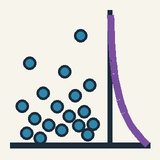
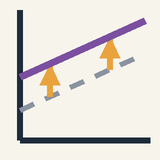
Plotted against depth, the pressure is a straight line of slope ρg: 9.81 kPa per metre in water but only 12 Pa per metre in air. The gauge-pressure line starts at zero; the absolute-pressure line is the same line lifted by p0≈101kPa.
Arrows drawn on a wall, one per depth and as long as the pressure there, outline a triangle whose area times the width of the wall is the total force: hence the aquarium's average of half the bottom value. Around a submerged object the arrows are longer underneath than on top, and their sum is the upward buoyant force.
Common mistakes
More water does not mean more pressure: a narrow pipe and a lake, both 10 m deep, give the same 98 kPa at the bottom.
Pressure is not a force: the 5.4 kPa at the lowest hole pushes with 0.54 N on a 1 cm² plug but with 5.4 N on a 10 cm² one.
Keep gauge and absolute pressure apart: 20 m down in a lake the water adds 196 kPa, but the absolute pressure is 297 kPa.
Use the ratio of areas, not of diameters: pistons 3 cm and 12 cm across multiply a force by (12/3)2=16, not 4.
Where you meet it
Car lifts, jacks, hydraulic brakes and excavators run on Pascal's principle, usually with oil at several megapascals. Water towers stand high because each metre of height adds 9.81 kPa at the taps below, and when you stand, the blood pressure in your feet is about 100 mmHg (13 kPa) higher than at your heart. Next, Buoyancy and Archimedes' Principle turns the extra push from below into the force that floats ships, and Bernoulli's Principle follows pressure into moving fluids.
Advanced
Key ideas
A fluid at rest carries no shear, so its stress is normal to every surface and the same in all directions: pressure is a scalar p.
Only pressure differences push: the force per unit volume is −∇p, and balancing gravity gives ∇p=ρg, so p=p0+ρgh.
From ∇p=−ρ∇ϕ, isobars are horizontal equipotentials; a density that varies along a level has no static state and convects.
Gas pressure is molecular drumming, p=nkT; an isothermal atmosphere thins as p=p0e−z/H, H≈8.4km.
Only ∇p matters, so a uniform Δp shifts p everywhere (Pascal); an ideal press conserves work, W1=ΔpV=W2.
Why pressure has no direction
A fluid is a material that cannot resist a shear: push sideways on a layer of water, however gently, and it flows. A viscous fluid such as honey resists the rate of shearing, but once it is at rest it carries no shear stress at all. So inside a fluid at rest the force across any small surface is at right angles to that surface, and the force per unit area is called the pressure. This section shows that the pressure at a point is a single number, the same whichever way the surface faces; everything later in the lesson rests on that fact.
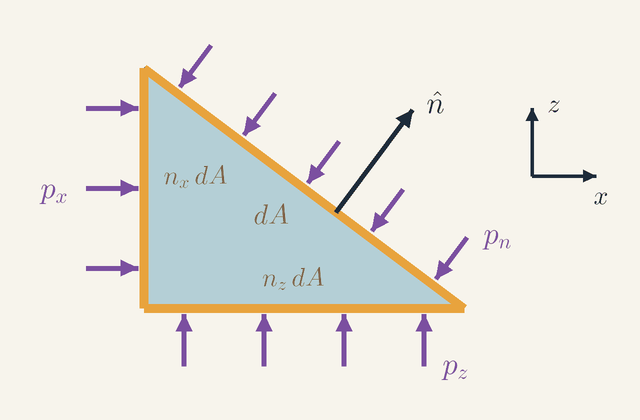
Figure 1. A small wedge of fluid seen from the side: a face normal to x, a face normal to z and a slanted face of area dA with outward unit normal n^. The face areas are in the ratio nx:nz:1, here 3:4:5, and equal arrows mean equal pressure. Not to scale.Legend
n^
Unit vector at right angles to the slanted face, pointing out of the wedge.
px
Pressure on the face normal to x.
Pa
pz
Pressure on the face normal to z.
Pa
pn
Pressure on the slanted face.
Pa
dA
Area of the slanted face.
m2
nxdA
Area of the face normal to x: the slanted face projected onto it, with nx the x-component of n^.
m2
nzdA
Area of the face normal to z: the slanted face projected onto it, with nz the z-component of n^.
m2
x
Horizontal coordinate axis.
m
z
Vertical coordinate axis, pointing up.
m
Figure 1 shows a small wedge of fluid seen from the side. Look at its three faces. The left face is vertical, so its normal points along x; the bottom face is horizontal, so its normal points along z; the slanted face has area dA and an outward unit normal n^ with components nx and nz. The left and bottom faces are the slanted face projected onto planes at right angles to x and to z, so their areas are nxdA and nzdA. In the drawing nx=0.6 and nz=0.8, so the three faces have areas in the ratio 0.6:0.8:1 and carry 3, 4 and 5 equal arrows. The two triangular ends of the wedge, parallel to the page, push only along y, so they play no part in the balance along x or z.
Call the pressures on the three faces px, pz and pn, without assuming that they are equal. The fluid outside pushes each face inward. Along x, the left face is pushed toward +x with the force pxnxdA. The slanted face is pushed along −n^ with the force pndA, and the x-part of that push is pnnxdA, toward −x. The bottom face pushes only along z. The wedge is at rest, so the forces along x cancel: pxnxdA=pnnxdA and therefore px=pn.
Along z the same count gives pznzdA up and pnnzdA down, but the wedge's weight also enters. The weight is proportional to the wedge's volume, which shrinks as the cube of its size, while the surface forces shrink only as the square. Divide the balance by dA and let the wedge shrink to a point: the weight term goes to zero, and pz=pn.
So px=pz=pn, and since the slant of the face was arbitrary, the pressure at a point is the same on every surface through it. Pressure is a scalar field p(r): one number at each point, with no direction of its own. The direction of a pressure force comes from the surface. On a surface element of area dA with outward unit normal n^, the fluid pushes with dF=−pn^dA, the minus sign meaning inward.
The equation of hydrostatics
Pressure changes from point to point, and that change is what holds a fluid up against its own weight. This section turns the idea into one equation that gives the pressure everywhere in a fluid at rest.
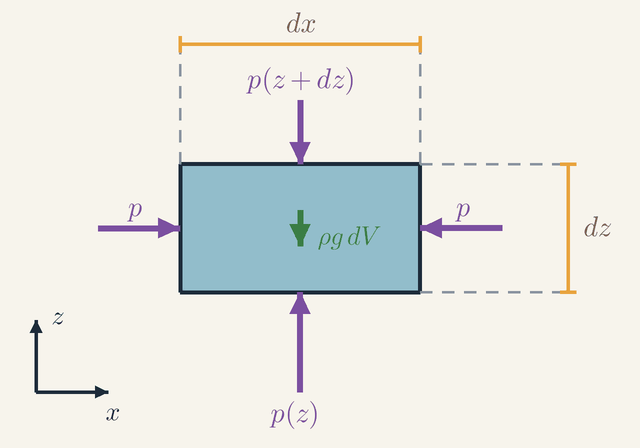
Figure 2. A small block of fluid at rest, dx wide, dz high and dy deep into the page; arrow lengths show the pressure. The side pushes cancel, and the push from below exceeds the push from above by exactly the weight ρgdV. Not to scale: the pressure difference is exaggerated.Legend
dx
Width of the block along x.
m
dz
Height of the block.
m
p(z)
Pressure on the bottom face, at height z; it pushes up.
Pa
p(z+dz)
Pressure on the top face, at height z+dz; it pushes down and is the smaller of the two.
Pa
p
Pressure on each side face; the same on both, since they are at the same height.
Pa
ρgdV
Weight of the block: the density ρ times g times its volume dV=dxdydz.
N
x
Horizontal coordinate axis.
m
z
Height, measured upward.
m
Figure 2 shows a small block of fluid at rest, dx wide, dz high and dy deep into the page, so its volume is dV=dxdydz. Compare the arrows in opposite pairs. A uniform pressure squeezes the block equally from opposite sides and gives no net force; only a difference between opposite faces can push it.
Start with the sides. The two side faces are at the same height and carry the same pressure p, so their pushes are equal and opposite, and they cancel.
Now the top and the bottom. The bottom face, at height z, is pushed up with p(z)dxdy; the top face, at height z+dz, is pushed down with p(z+dz)dxdy. Over the small height dz the pressure changes by p(z+dz)−p(z)=(∂p/∂z)dz, so the net upward push is [p(z)−p(z+dz)]dxdy=−∂z∂pdV The pressure is larger below, so the arrow p(z) is longer than the arrow p(z+dz) and the net push is upward. The green arrow ρgdV is the block's weight, with ρ the density and g the gravitational acceleration. At rest the net push and the weight must be equal, and the figure draws the weight exactly as long as the difference between the two pressure arrows.
The same count works for every pair of faces. The faces normal to x leave a net push −(∂p/∂x)dV along x, which is zero for the two equal side arrows of the figure, and the faces normal to y leave −(∂p/∂y)dV. The three pairs together give a pressure force per unit volume of −∇p. In equilibrium it cancels the weight per unit volume, ρg, so ∇p=ρg This is the equation of hydrostatics. With the gravitational potential energy per unit mass ϕ=gz, for which g=−∇ϕ, it reads ∇p=−ρ∇ϕ. With z measured upward, g has only a z-component, equal to −g, so the vertical part of the equation is dzdp=−ρg and the horizontal parts, ∂p/∂x=∂p/∂y=0, say that the pressure is the same all along a level.
For a liquid the density is nearly constant, and the equation integrates at once to p+ρgz=const. The boundary fixes the constant: at the free surface, a height h above the point considered, the pressure is the atmospheric pressure p0, so p=p0+ρgh Here h is the depth, measured down from the surface. The pressure grows with h even though dp/dz is negative; the two statements agree, because z points up and h points down.
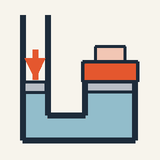
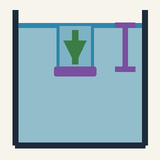
In the animation's expert layer a sinking probe draws this law. It plots the gauge pressure p−p0, the pressure above atmospheric, against the depth h: a straight line through the origin with slope ρg≈9.81kPa/m, reaching about 7.0 kPa at the probe's deepest point, 71 cm down. The absolute pressure p would give the same line lifted by p0≈101kPa. Both lines have the same slope, and only the slope, the gradient of p, exerts a net force on the fluid.
Isobars, levels and convection
The hydrostatic equation says more than how pressure grows with depth. It fixes the shape of the surfaces of equal pressure, and it tells when a fluid cannot stay at rest at all.
Since ∇p=−ρ∇ϕ, the gradient of p is parallel to the gradient of ϕ at every point. A gradient is perpendicular to the surfaces on which its quantity is constant, so the surfaces of equal pressure, the isobars, are also surfaces of constant ϕ: the equipotentials of gravity. In a laboratory these are horizontal planes; on the scale of the planet they follow the curved shape of a calm sea. That is why connected vessels fill to one level: the free surface in each of them is part of the same isobar, p=p0.
The same equation shows when no state of rest is possible. The curl of a gradient is always zero, so the curl of ∇p vanishes, and so must the curl of ρ∇ϕ: ∇×(ρ∇ϕ)=∇ρ×∇ϕ=0 A cross product vanishes only when its two vectors are parallel, so the density gradient must be vertical: ρ must be the same all along each level. Warm one side of a room, or one side of a pan of water, and the density changes along a level. No pressure field can then balance gravity, and the fluid has to move. That motion is convection; it drives sea breezes and spreads the heat of a radiator round a room.
Pascal's principle and the work of the press
A hydraulic press lifts a car with the push of a hand. Two short arguments explain how: one from the pressure field, one from energy.
First the field. The equation ∇p=ρg involves only the gradient of p, so it fixes the pressure only up to an added constant, which the boundary sets. Raise the pressure at the boundary of an incompressible liquid by Δp and the whole field rises by Δp, while its gradient stays ρg. Every point of the liquid feels the same increase: that is Pascal's principle. In a real liquid the increase does not arrive everywhere at once. It spreads as a pressure wave at the speed of sound, about 1480 m/s in water, so it crosses the 1.5 m wide press of the animation in about a millisecond.
Now energy, which gives the force ratio without mentioning pressure at all. Push the small piston, of area A1, down by a small distance δd1. The liquid does not compress, so the volume A1δd1 that leaves the small cylinder fills the large one, of area A2, whose piston rises by δd2=(A1/A2)δd1. In an ideal press, with no friction, the work put in equals the work taken out, F1δd1=F2δd2, and so F2=F1A1A2 This is the result Pascal's principle gives, with F1=ΔpA1 and F2=ΔpA2. The argument is the principle of virtual work, the same one that explains a lever: the press trades distance for force.
Over a whole stroke each piston sweeps the same volume, V=A1d1=A2d2, so both works equal ΔpV. In the animation the small piston is 26 cm across and is pushed with 2452.5 N, so the pressure under it is Δp=2452.5/(π⋅0.132)≈46.2kPa. Its area is 0.0531m2 and its stroke 0.48 m, so it sweeps V≈0.0531⋅0.48≈0.0255m3, and W1=W2=ΔpV≈1177J. That is the largest value both work readouts reach, at the bottom of the stroke.
Gases and the exponential atmosphere
In a liquid the density hardly changes with pressure; in a gas it is nearly proportional to it. To see what that does to the hydrostatic equation, we first need the pressure of a gas in terms of its molecules.
Gas pressure is the momentum that molecules deliver to a wall per unit time and per unit area. Take a wall at right angles to x. A molecule of mass m that hits it with velocity component vx bounces back with −vx, so it hands over the momentum 2mvx. The molecules with a given vx that strike an area dA in a time dt are those within a distance vxdt of it, a number proportional to vx, so each group contributes in proportion to vx2. Only the half of the molecules moving toward the wall arrive, which cancels the factor 2, and averaging over all the molecules gives p=nmvx2 where n is the number of molecules per unit volume and vx2 is the mean of vx2. In thermal equilibrium each molecule has on average the kinetic energy 21kT for its motion along x, with k Boltzmann's constant and T the absolute temperature. So mvx2=kT, and p=nkT For air at 101 kPa and 288 K this gives n≈2.55×1025m−3.
Now the atmosphere, with m the mean mass of an air molecule. The density is ρ=nm, so at a uniform temperature ρ=mp/(kT): proportional to the pressure. The hydrostatic equation becomes dzdp=−kTmgp The pressure falls at a rate proportional to itself, so it falls exponentially with height. With p0 now the pressure at sea level, z=0: p=p0e−z/H,H=mgkT≈8.4km for air at 288 K. H is the scale height, the climb over which the pressure falls by a factor e. The factor e−mgz/(kT) is the Boltzmann factor, which compares the potential energy mgz of a molecule with the thermal energy kT; here it appears from the mechanical side.
The law agrees well with measurement. On the summit of Everest, 8.85 km up, it predicts about 35 kPa, close to the 34 kPa measured there; the real air is colder than 288 K, which lowers the pressure a little further. In 1648 a mercury barometer carried up the Puy de Dôme at Pascal's request showed the column falling by about 8 cm, because less air was pressing down from above.
Accelerating fluids and buoyancy
The hydrostatic equation also holds in a container that accelerates, provided we work in the container's own frame. It then explains why the surface of a sloshing tank tilts, and, with one more step, where buoyancy comes from.
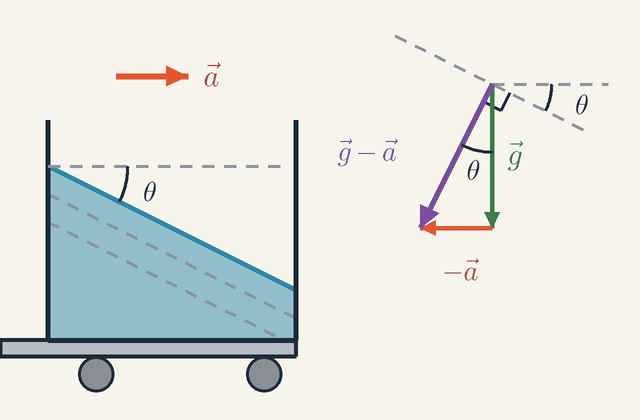
Figure 3. A tank on a lorry accelerating with a. In the tank's frame the pressure grows along g−a, so the free surface and every isobar (dashed) are perpendicular to it, tilted by the angle θ between g and g−a. Not to scale.Legend
a
Acceleration of the lorry and its tank; also drawn reversed, as −a, to build g−a.
m/s2
g
Gravitational acceleration, pointing down.
m/s2
g−a
Effective gravity in the tank's frame; the pressure grows along it.
m/s2
θ
Tilt of the free surface from the horizontal, equal to the angle between g and g−a; tanθ=a/g.
rad
In a frame that accelerates with a, every bit of fluid feels an inertial force −ρa per unit volume besides its weight, so the equation becomes ∇p=ρ(g−a) The fluid behaves as if gravity were g−a, the effective gravity. Figure 3 shows a tank on a lorry that accelerates to the right with a. On the right of the figure, g−a is built by adding g, straight down, and −a, pointing backwards: the result points down and backwards. The pressure grows along g−a, so the isobars, drawn dashed, are perpendicular to it. The free surface is one of these isobars, p=p0, so it tilts with them, and the water piles up at the back of the tank.
To find the tilt, look at the angle θ between the surface and the horizontal. The surface is perpendicular to g−a and the horizontal is perpendicular to g, so θ is also the angle between g and g−a. In the vector triangle on the right, the side opposite θ is a and the side next to it is g, so tanθ=a/g The figure uses a=g/2 to make the tilt easy to see. Water in a tank on a lorry accelerating at 3 m/s² slopes at an angle θ with tanθ=3/9.81≈0.31, about 17°.
Buoyancy comes from the same field. The total pressure force on a body under the surface is the sum of −pn^dA over its closed surface. A theorem of vector calculus turns this surface integral into the volume integral of ∇p over the space the body occupies, so for a fluid at rest −∮pn^dA=−∫∇pdV=−ρgV with V the body's volume. This force points up and equals the weight of the fluid the body displaces: Archimedes' principle. The pressure on the surface does not depend on what fills it, so the result holds for any body. In the accelerating tank the same integral gives −ρ(g−a)V, which has a forward part; that is why a helium balloon in a car leans forward as the car speeds up.
Worked problem: the weight of the liquid in the press
The analysis of the press above ignored the weight of the liquid itself. This problem puts it back, to show how large the correction is and where the energy goes.
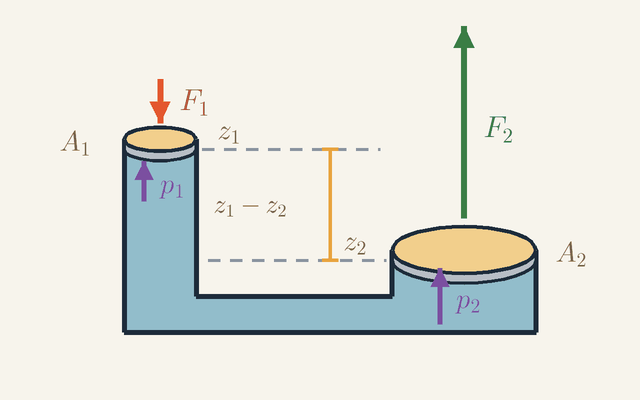
Figure 4. The press of the worked problem at the start of the stroke. The small piston sits higher by z1−z2, so the pressure under it is lower: p1=p2−ρg(z1−z2). Not to scale: the pressure arrows exaggerate the difference.Legend
A1
Area of the small piston.
m2
A2
Area of the large piston, four times A1.
m2
F1
Force the hand exerts on the small piston.
N
F2
Force of the liquid on the large piston, equal to the car's weight.
N
p1
Pressure of the liquid under the small piston.
Pa
p2
Pressure of the liquid under the large piston, F2/A2.
Pa
z1
Height of the bottom of the small piston.
m
z2
Height of the bottom of the large piston.
m
z1−z2
How much higher the small piston's bottom is; the pressure under it is lower by ρg(z1−z2).
m
Figure 4 shows the animation's press filled with water, at the start of the stroke. Look first at the two piston bottoms. The small piston's, at height z1, is 40 cm above the large piston's, at height z2. During the stroke the small piston moves 48 cm down and the large one 12 cm up, so at the end the small piston's bottom is 20 cm below the other's.
The large piston carries the car, so the liquid must push it up with the car's weight, F2. Over the area A2 this needs the pressure p2=F2/A2≈46.19kPa, all through the stroke. The pressure falls with height, as the hydrostatic equation says, so under the small piston, higher by z1−z2, it is lower: p1=p2−ρg(z1−z2) That is the shorter arrow p1 in the figure. The hand must then push with F1=p1A1.
At the start ρg(z1−z2)=9810⋅0.40≈3.92kPa; at the end the height difference is −0.20m and the term is −1.96kPa. With A1=0.0531m2 the hand must push with F1=(46.19−3.92)kPa⋅0.0531m2≈2.24kN at the start and F1=(46.19+1.96)kPa⋅0.0531m2≈2.56kN at the end, instead of the steady 2.45 kN found without the liquid's weight.
The height difference changes linearly along the stroke, from 0.40 to −0.20m, and so does the pressure under the small piston. The work of the hand is therefore the swept volume times the average pressure. The average height difference is 0.10 m, so the hand does W1=V(p2−ρg⋅0.10m)=0.02548m3⋅45.21kPa≈1152J
That is 25 J less than the 1177 J the car gains, and the difference comes from the water itself. The 25.5 kg of water pushed across leaves a column at the top of the small cylinder, centred 24 cm below the small piston's starting level, and ends as a layer under the large piston, centred 6 cm above that piston's starting level, which was 40 cm lower. Its centre of mass therefore drops by 0.40−0.24−0.06=0.10m and releases 25.5⋅9.81⋅0.10≈25J: energy is conserved once the liquid is counted. Here the correction reaches 8.5 % of the force; real jacks work at megapascals, where a few kilopascals of ρgΔz are negligible.
Limits of validity
Every result above rests on a few assumptions, and each of them fails somewhere.
The first is the absence of shear, which holds only for a fluid at rest or moving as a rigid body, like the water in the lorry. In a flowing fluid the pressure also depends on the speed, and viscosity brings shear stresses back.
The second is constant density. It suits liquids very well: water compresses by about 0.005 % per atmosphere, and even at the bottom of the deepest ocean trench, nearly 11 km down under some 110 MPa, it is only a few per cent denser. For a gas it holds only over heights small compared with the scale height H: across a 10 m room the air pressure changes by 0.12 %, but across a mountain range the exponential law is needed.
The third is that surfaces are flat. Where a liquid surface is curved, surface tension adds a jump in pressure across it. In a water-filled glass tube of radius r=0.5mm, the surface tension γ≈0.072N/m lowers the pressure just under the curved surface by 2γ/r, about 0.3 kPa, enough to pull the water some 3 cm up the tube.
The last is the continuum itself. A smooth field p(r) needs fluid elements small compared with the apparatus yet holding many molecules. An air molecule at sea level travels about 70 nm between collisions, so that is easy there; above about 120 km it travels more than a metre, and the continuum picture fails.
Where this leads
Pressure in a fluid at rest is the starting point of several other lessons. Integrating it over a submerged body is the subject of Buoyancy and Archimedes' Principle. Bernoulli's Principle extends p+ρgz=const to moving fluids by adding 21ρv2, which is where the jet speed 2gh comes from, and Drag and Terminal Velocity brings back the shear that a fluid at rest lacks. The molecular origin of p=nkT is worked out in Kinetic Theory of Gases, convection returns in Conduction, Convection and Radiation, and the press's trade of force for distance is the one met in Simple Machines: Levers, Pulleys and Gears. Sound, finally, is a small and rapid ripple of pressure, the subject of Sound and the Doppler Effect.
Key formulas
Definition of pressure
p=AF
Pressure is the normal force per unit area. It is a scalar: at a point it has the same value whatever the orientation of the surface, and the force it exerts, F=pA, always pushes perpendicular to the surface. The same force on a smaller area gives a larger pressure, which is why a knife cuts and snowshoes keep you on top of the snow.
Symbols
p
pressure on the surface
Pa
F
force perpendicular to the surface
N
A
area of the surface
m2
When it holds: Gives the average pressure over the area. When the pressure varies over the surface, as on a dam, add up pdA instead; only the force component perpendicular to the surface counts.
Example: The 1000 kg car on the 52 cm wide piston of the animation: p=9810/0.212≈46kPa.
Hydrostatic pressure at depth
p=ρgh
A column of liquid of height h standing on an area A weighs ρAhg; spread over A, that weight is the extra pressure ρgh at depth h. It depends on the depth alone, not on the shape or size of the vessel. It is the gauge pressure, counted above the pressure on the surface.
Symbols
p
gauge pressure at depth h
Pa
ρ
density of the liquid
kg/m3
g
free-fall acceleration
m/s2
h
depth below the free surface
m
When it holds: For a fluid of constant density at rest, which suits liquids very well. In a gas over large heights the density changes, and the pressure falls exponentially instead.
Example: The lowest hole in the animation, 55 cm down: p=1000⋅9.81⋅0.55≈5.4kPa.
Absolute pressure at depth
p=p0+ρgh
The pressure at depth h is the pressure p0 on the surface, usually the atmosphere's, plus the weight of the liquid above per unit area. It is the integral of dp/dz=−ρg from the surface down, with p0 as the constant of integration. Plotted against depth it is a straight line of slope ρg starting at p0.
Symbols
p
absolute pressure at depth h
Pa
p0
pressure on the free surface
Pa
ρ
density of the liquid
kg/m3
g
free-fall acceleration
m/s2
h
depth below the free surface
m
When it holds: Constant density, fluid at rest, and one connected body of fluid between the surface and the point. If the surface is closed off, p0 is the pressure of whatever presses on it.
Example: 20 m down in a lake: p=101+196=297kPa, almost three atmospheres.
Force multiplication in a hydraulic press
F2=A1F1A2
By Pascal's principle the pressure under both pistons is the same, F1/A1=F2/A2, so the output force is the input force multiplied by the ratio of the areas. For round pistons the area ratio is the square of the diameter ratio, so a piston twice as wide gives four times the force.
Symbols
F2
force exerted by the large piston
N
F1
force applied to the small piston
N
A2
area of the large piston
m2
A1
area of the small piston
m2
When it holds: For an ideal press: pistons at the same height (otherwise the pressures differ by ρgΔh), no friction, no leaks and slow motion.
Example: In the animation A2=4A1, so 2.45 kN on the small piston holds up the car's 9.81 kN.
Equal volumes swept by the pistons
A1d1=A2d2
A liquid hardly changes its volume under pressure, so the volume pushed out of the narrow cylinder, A1d1, must reappear under the wide piston as A2d2. The large piston therefore moves only the fraction A1/A2 of the small piston's travel.
Symbols
A1
area of the small piston
m2
d1
distance moved by the small piston
m
A2
area of the large piston
m2
d2
distance moved by the large piston
m
When it holds: For an incompressible liquid, rigid walls and no leaks. Trapped air bubbles compress and spoil it, which is why hydraulic brakes must be bled.
Example: In the animation d1=48cm and A2=4A1 give d2=12cm.
Work balance of an ideal press
F1d1=F2d2
Combining the force ratio with the equal volumes, the work done on the small piston equals the work done by the large one. The press multiplies force and divides distance in the same proportion, so it never creates energy; each work is the pressure times the swept volume, W=ΔpV.
Symbols
F1
force applied to the small piston
N
d1
distance moved by the small piston
m
F2
force exerted by the large piston
N
d2
distance moved by the large piston
m
When it holds: Only for an ideal press. Friction makes the input work larger than the output, and the weight of the liquid adds a small correction when the pistons are at different heights.
Example: In the animation 2452.5⋅0.48≈9810⋅0.12≈1177J, the values the W1 and W2 readouts reach at the bottom of the stroke.
Hydrostatic equation
dzdp=−ρg
A thin horizontal slab of fluid of thickness dz is held up by the difference between the pressures on its lower and upper faces, which must equal its weight per unit area, ρgdz. With z measured upward, the pressure therefore falls with height. It is the vertical component of ∇p=ρg, and unlike p=p0+ρgh it holds also when the density changes with height.
Symbols
p
pressure at height z
Pa
z
height, measured upward
m
ρ
local density of the fluid
kg/m3
g
free-fall acceleration
m/s2
When it holds: Any fluid at rest under gravity, including a gas whose density varies; integrate it with ρ(z), or with ρ written as a function of p. In an accelerating container g−a replaces g.
Example: Air at sea level, ρ≈1.2kg/m3: the pressure falls by about 12 Pa per metre, 1.2 kPa over a 100 m tower.
Glossary
Fluid
A substance that flows and cannot resist a shear while at rest: liquids and gases. A liquid keeps its volume and has a free surface; a gas fills its container and compresses easily.
Pressure
The normal force per unit area that a fluid exerts on a surface, p=F/A. It is a scalar: at a point in a fluid at rest it is the same in all directions, and only the force it produces has a direction, perpendicular to the surface.
Atmospheric pressure
The pressure of the air at the Earth's surface, about 101 kPa at sea level: the weight of some 10 tonnes of air above each square metre. It falls with height, by a factor e about every 8.4 km in air at a uniform 288 K.
Gauge pressure
Pressure measured above the atmosphere's, p−p0: what a tyre gauge or the animation's graph shows. Absolute pressure counts from vacuum instead; 20 m under a lake the gauge pressure is 196 kPa and the absolute pressure 297 kPa.
Hydrostatic pressure
The pressure in a fluid at rest due to the weight of the fluid above, ρgh at depth h. In water it grows by 9.81 kPa per metre, so 10 m of water add roughly one atmosphere.
Hydrostatic paradox
The pressure at the bottom of a vessel depends only on the depth of the liquid, not on its amount or on the vessel's shape. A narrow tube and a wide tank filled to the same height press equally hard on equal areas of their bottoms.
Communicating vessels
Containers connected below the liquid's surface. A still liquid stands at the same level in all of them, whatever their shapes, because points at one level of a connected liquid have equal pressure.
Pascal's principle
A change of pressure applied to an enclosed liquid at rest is transmitted undiminished to every point of the liquid and to the walls of its container. It holds because the liquid's weight fixes only the differences of pressure, not their common level.
Hydraulic press
Two connected cylinders of different areas closed by pistons. Equal pressure under both gives F2=F1A2/A1, while the large piston moves only A1/A2 as far as the small one, so the work put in equals the work taken out.
Incompressible fluid
A fluid whose density does not change with pressure. Liquids come close: water shrinks by only about 0.005 % per extra atmosphere, so a hydraulic line passes on a push with almost no give.
Isobar
A surface on which the pressure has the same value everywhere. In a fluid at rest the isobars are surfaces of equal gravitational potential, hence horizontal, and a free surface is one of them.
Convection
Motion of a fluid driven by differences of density, such as warm air rising above a radiator. It starts whenever the density varies along a horizontal level, because then no pressure field can balance gravity and the fluid cannot stay at rest.
Quantities
p
Pressure
Pa
Normal force F per unit area A at a point in the fluid, 1Pa=1N/m2. Depending on the context it is absolute (counted from vacuum) or gauge (counted from the atmosphere).
p0
Surface pressure
Pa
The pressure acting on the free surface of the liquid, usually the atmosphere's, about 101 kPa: where the line of pressure against depth starts.
ρ
Density
kg/m3
Mass per unit volume of the fluid: 1000 kg/m³ for fresh water, about 1025 kg/m³ for seawater, 13 600 kg/m³ for mercury and 1.2 kg/m³ for air at sea level.
g
Free-fall acceleration
m/s2
About 9.81m/s2 near the Earth's surface. It is also the weight per unit mass, 9.81 N/kg, which is how it enters ρgh.
h
Depth
m
Vertical distance below the free surface, measured downward. Only this distance, not the vessel's shape, sets the hydrostatic pressure.
z
Height
m
Vertical coordinate measured upward from a chosen level. Below a surface at height zs the depth is h=zs−z, which is why dp/dz is negative.
F1
Input force
N
The force pushed onto the small piston of a press, of area A1: 2.45 kN in the animation.
F2
Output force
N
The force exerted by the large piston, of area A2, A2/A1 times the input force: 9.81 kN in the animation, the weight of the 1000 kg car.
d1
Travel of the small piston
m
How far the small piston is pushed: 48 cm in the animation.
d2
Travel of the large piston
m
How far the large piston and its load rise, d1A1/A2: 12 cm in the animation.
Quiz
Beginner Where is the water pressure greatest in a swimming pool?
At the surface
Halfway down
At the bottom
It is the same everywhere
Show answer
Answer: C. At the bottom
Pressure grows with depth because more water presses from above, so it is greatest at the bottom.
Beginner Three holes are made at different heights in the side of a full water tank. Water squirts out fastest from…
the highest hole
the middle hole
all three equally
the lowest hole
Show answer
Answer: D. the lowest hole
The lowest hole is deepest, where the water is pressed hardest, so the water leaves it fastest.
Beginner In a hydraulic jack, the large piston has 10 times the area of the small one. A push on the small piston makes the large piston push with…
the same force
10 times less force
10 times more force
100 times more force
Show answer
Answer: C. 10 times more force
The pressure is the same under both pistons, so the force grows in proportion to the area: 10 times the area, 10 times the force.
Intermediate What is the gauge pressure 20 m below the surface of a lake? (ρ = 1000 kg/m³, g = 9.81 m/s²)
20 kPa
101 kPa
297 kPa
196 kPa
Show answer
Answer: D. 196 kPa
p = ρ·g·h = 1000 × 9.81 × 20 = 196 200 Pa ≈ 196 kPa. Adding the atmosphere's 101 kPa would give the absolute pressure, 297 kPa.
Intermediate A narrow tube and a wide tank are filled with water to the same height. The pressure at the bottom is…
greater in the wide tank
greater in the narrow tube
the same in both
zero in the narrow tube
Show answer
Answer: C. the same in both
Hydrostatic pressure depends only on depth: p = ρ·g·h. The amount of water and the shape of the container do not matter.
Intermediate A press has round pistons with diameters of 2 cm and 10 cm. A force of 100 N on the small piston produces on the large one…
500 N
2500 N
1000 N
100 N
Show answer
Answer: B. 2500 N
The area ratio is the square of the diameter ratio: (10 ÷ 2)² = 25, so F₂ = 25 × 100 N = 2500 N. Using the diameter ratio alone gives the wrong 500 N.
Advanced In a hydraulic press with A₂ = 4·A₁, the small piston is pushed 40 cm down. How far does the large piston rise, and how do the works compare?
10 cm, and W₂ = W₁
40 cm, and W₂ = 4·W₁
10 cm, and W₂ = 4·W₁
160 cm, and W₂ = W₁
Show answer
Answer: A. 10 cm, and W₂ = W₁
The liquid is incompressible, so A₁·d₁ = A₂·d₂ gives d₂ = 10 cm. Then F₂·d₂ = 4·F₁ × d₁/4 = F₁·d₁: the press conserves work.
Advanced On a graph of absolute pressure p against depth h in a lake, the line…
passes through the origin with slope ρ·g
has slope ρ·g and intercept p₀ ≈ 101 kPa
has slope g/ρ and intercept p₀
curves and flattens out with depth
Show answer
Answer: B. has slope ρ·g and intercept p₀ ≈ 101 kPa
Integrating dp/dz = −ρ·g for incompressible water gives p = p₀ + ρ·g·h: a straight line of slope ρ·g starting at atmospheric pressure. Only gauge pressure passes through the origin.
 Physics Tutor