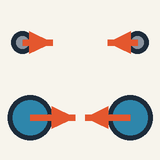
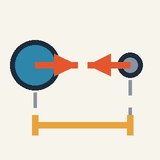
Every object with mass pulls on every other object; the bigger the masses, the stronger the pull.
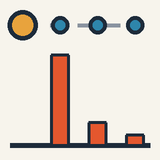
The pull weakens fast with distance: twice as far gives a quarter of the pull, three times as far a ninth.
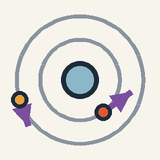
An orbit is an endless fall: moving sideways fast enough, an object keeps falling but never reaches the ground.
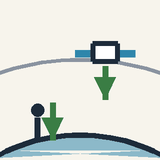
Astronauts float not because gravity has vanished, but because they and their spacecraft fall together.
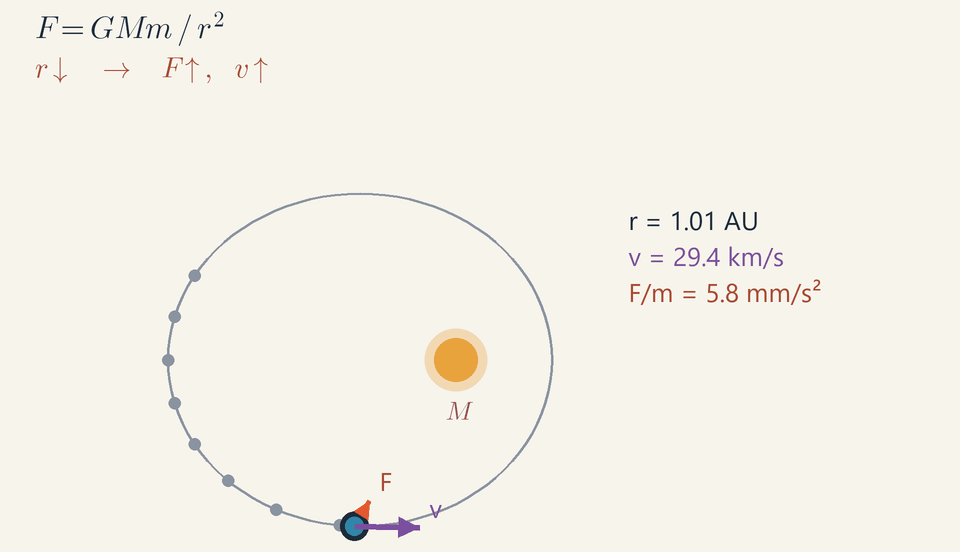
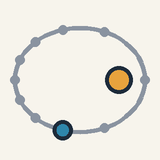
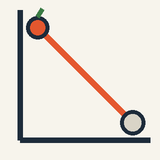
A planet speeds up as it falls toward the star and slows as it moves away, so it is fastest at the closest point.
Drop a pencil and it falls; look up and the Moon hangs in the sky. Newton's great idea was that one and the same pull explains both.
Step 1. Every object with mass attracts every other object, more strongly when the masses are bigger: you feel the Earth's pull, but not the tiny pull of the person sitting next to you.
Step 2. The pull weakens with distance, and fast. Distance is measured from centre to centre: twice as far, the pull drops to a quarter; three times as far, to a ninth. Quick check: if two objects are moved ten times farther apart, what happens to their pull? (Answer: it becomes a hundred times weaker.)
Step 3. Why doesn't the Moon fall onto the Earth? It does fall, all the time. Without the pull it would carry straight on; gravity bends its path toward the Earth. Picture a cannon on a very high mountain firing sideways. A slow ball lands nearby, a faster one farther away. Fired fast enough, the ball drops just as quickly as the curved ground falls away beneath it, so it never lands: it is in orbit. Astronauts float for the same reason: they and their spacecraft fall together, even though gravity up there is almost as strong as on the ground.
Step 4. Most orbits are slightly stretched circles, called ellipses, with the star off-centre. A planet speeds up as it falls in toward the star and slows down as it climbs away.
In the animation, the red arrow is the star's pull: always aimed at the star, longer when the planet is close. The blue dashed line shows where the planet would go if gravity switched off. The grey dots, left at equal time steps, bunch up far from the star and spread out near it.
Intermediate
Key ideas
F=Gm1m2/r2 with G=6.674×10⁻¹¹N⋅m2/kg2; r is measured between the centres and the two pulls are equal and opposite.
Field strength g=GM/r2: 9.8 m/s² at the Earth's surface, a quarter of that (about 2.5 m/s²) twice as far from the centre.
Circular orbit: GMm/r2=mv2/r gives v=GM/r; the ISS (r=6771km) moves at 7.67 km/s, one orbit in about 92 min.
Higher circular orbits are slower: v∝1/r and T∝r3/2, whatever the satellite's mass.
At 400 km g is still about 8.7 m/s²; astronauts are weightless because they and the station fall together.
The law of gravitation and the field strength
The pull that makes a pencil fall also bends the Moon's path. Every body with mass attracts every other body. For masses m1 and m2 whose centres are a distance r apart, Newton's law of universal gravitation gives the size of the pull: F=r2Gm1m2
Here G=6.674×10⁻¹¹N⋅m2/kg2 is the gravitational constant, so small that two 70 kg people 1 m apart attract each other with only 3.3×10⁻⁷N. The force acts along the line joining the centres, and by Newton's third law each body pulls the other equally hard: you pull the Earth up with the same 690 N with which it pulls you down. For a planet or a star, r is measured from its centre.
Dividing the force on a small mass m by m gives the field strength of a body of mass M, the pull per kilogram: g=r2GM
Its unit, the newton per kilogram, is the same as m/s²: g is the free-fall acceleration at that place. At the Earth's surface (M=5.97×1024kg, R=6371km) it is 9.8 m/s². At r=2R, one Earth radius up, it is a quarter of that, about 2.45 m/s², and 400 km up it is still about 8.7 m/s².
Circular orbits
As in Circular Motion, a body moving at speed v on a circle of radius r needs a net force mv2/r toward the centre. For a satellite, gravity alone supplies it: r2GMm=rmv2 v=rGM(circular orbit)
The satellite's own mass m cancels: a space station and a spanner dropped by its crew share the same orbit. One lap of length 2πr takes T=2πr/v, so T2=4π2r3/(GM). Higher orbits are slower, v∝1/r, and their laps much longer, T∝r3/2: a satellite skimming the ground would circle in about 84 minutes, while the Moon, 60 Earth radii away, takes 27.3 days.
Ellipses and Kepler's three laws
A satellite launched sideways a little faster or slower than GM/r follows an ellipse instead. Johannes Kepler found three laws of planetary motion between 1609 and 1619, and Newton's law explains all three.
Every planet moves on an ellipse with the Sun at one focus, not at the centre.
The line from the Sun to the planet sweeps equal areas in equal times, so the planet is fastest at perihelion, its closest point, and slowest at aphelion, its farthest.
The square of the period is proportional to the cube of the orbit's size.
The size is the semi-major axis a, half the longest diameter and the average of the closest and farthest distances. The eccentricity e says how stretched the ellipse is: the closest distance is a(1−e), the farthest a(1+e), and a circle has e=0. In Newton's form the third law is T2=GM4π2a3 the circular result with r replaced by a, whatever the eccentricity. Around the Sun, with T in years and a in astronomical units (1AU=1.496×10¹¹m), it reads simply T2=a3.
Energy in a gravitational field
Pulling two masses apart takes work, so their potential energy grows with distance. Taking it as zero at infinite separation gives U=−rGMm
The minus sign means that a body sits in a well: lifting it from rest at r to infinity takes GMm/r of work. In orbit the total energy E=21mv2−GMm/r stays constant, so the body speeds up as it falls inward. With E≥0 the body escapes; from the Earth's surface that takes 2GM/R≈11.2km/s.
On an ellipse the energy depends only on its size, E=−GMm/(2a). Equating the two expressions gives the speed at any distance, the vis-viva relation: v2=GM(r2−a1) For a circle, r=a and it reduces to v2=GM/r.
Worked example: the planet in the animation
The star has the Sun's mass, GM=1.327×10²⁰m3/s2, and the ellipse has a=1AU and e=0.5, so the planet swings between 0.5 AU and 1.5 AU and, with the Earth's a, takes one year per lap. How strong is the pull per kilogram at the two ends? At perihelion, 7.48×10¹⁰m from the star, g=(7.48×10¹⁰)21.327×10²⁰≈0.0237m/s2=23.7mm/s2 and three times farther out it is nine times smaller, 2.6 mm/s². These are the extremes of the F/m readout, and the red F arrow shrinks by the same factor.
For the speeds, the circular speed at 1 AU is GM/a≈29.8km/s, the Earth's speed. With distances in AU, the vis-viva relation gives v=29.82/0.5−1=29.83≈51.6km/s v=29.82/1.5−1=29.8/3≈17.2km/s at perihelion and aphelion, the two ends of the v readout.
The speed ratio, 3, is the inverse of the distance ratio, as equal areas demand: at both ends of the long axis the velocity is perpendicular to the radius, a short time Δt sweeps a thin triangle of area 21rvΔt, and 0.5⋅51.6=1.5⋅17.2. The energy per kilogram, 21v2−GM/r, comes out as −4.4×10⁸J/kg at both points, which is −GM/(2a).
Watch the angle between the arrows. On the way in, the purple v arrow is less than 90° from the red F arrow, so the pull has a component along the motion and speeds the planet up; on the way out the angle exceeds 90° and the pull brakes it. At perihelion and aphelion the arrows are perpendicular and the speed is momentarily steady.
Worked example: two Earth satellites
The International Space Station flies about 400 km up, so r=6371+400=6771km from the Earth's centre. With GM=3.986×10¹⁴m3/s2 for the Earth, v=6.771×1063.986×1014≈7672m/s≈7.67km/s T=v2πr=76722π⋅6.771×106≈5545s about 92 minutes. Up there g=GM/r2≈8.7m/s2, 89 % of its value on the ground.
A geostationary satellite must circle once per turn of the Earth relative to the stars, T=86164s (23 h 56 min), to hang above one point of the equator. The third law gives r=(4π2GMT2)1/3≈4.216×107m about 35 800 km above the equator, at 2πr/T≈3.07km/s. As a check, the radius is 42164/6771≈6.23 times the station's, so the period should be 6.233/2≈15.5 times longer, and indeed 1436/92.4≈15.5.
Common mistakes
Believing there is no gravity in orbit. At 400 km g is still 8.7 m/s²; astronauts float because they and the station fall together.
Measuring r from the surface. With 400 km instead of 6771 km, the station's speed would come out as 31.6 km/s, not 7.67 km/s.
Thinking that heavier satellites or higher orbits need more speed. The formula v=GM/r contains no satellite mass, and the geostationary satellite is slower than the station.
Putting the farthest distance into the third law. Halley's comet ranges from 0.59 AU to 35.1 AU, so a=17.8AU and T=17.83/2≈75 years, not 208 years.
Assuming the planet speeds up because the pull is strong. At perihelion the pull peaks, at 23.7 mm/s² in the animation, yet it is perpendicular to the velocity, so the speed has just stopped rising.
Where you meet it
Navigation satellites 20 200 km up with 12-hour periods, geostationary weather and television satellites, the tides, and the masses of planets and stars, read off from the orbits around them with the third law: all rest on this lesson.
The equal-area law is angular momentum conservation (Angular Momentum and Its Conservation); U=−GMm/r generalises the mgh of Work, Energy and Power; the same inverse square governs charges in Coulomb's Law; and Gravity as Curved Spacetime starts from the fact that every body falls with the same acceleration.
Advanced
Key ideas
Moon test: at 60 Earth radii a=4π2r/T2≈g/602, so the apple and the Moon obey the same inverse-square law.
Gravity is central, so L is conserved and dA/dt=L/(2m) is constant: equal areas in equal times, for any central force.
With 1/r2, orbits are conics r=p/(1+ecosθ): E<0 ellipse, E=0 parabola, E>0 hyperbola.
T2=4π2a3/(GM) depends only on the semi-major axis, not on how stretched the ellipse is.
All bodies fall alike (gravitational mass = inertial mass); general relativity builds on this and adds Mercury's 43″ per century.
From the apple to the Moon
This section sets out the force law and the first evidence that one law rules both the ground and the sky. Two masses M and m a distance r apart attract each other with a force of size GMm/r2, where G is the gravitational constant. In vector form, with M at the origin and m at the position r, F=−r2GMmr^ where r^ is the unit vector pointing from M towards m. The minus sign turns the force back towards M: gravity attracts.
Newton's first test compared the Moon with a falling apple. If the pull weakens as 1/r2, then 60 Earth radii away it should be 602=3600 times weaker than at the surface. The Moon is r=3.844×10⁸m away, about 60 Earth radii, and goes round the Earth once in 27.32 days (T=2.36×10⁶s). To stay on its circle it needs the centripetal acceleration ac=T24π2r≈2.72×10⁻³m/s2 and the inverse-square law predicts g/602=9.81/3600≈2.72×10−3m/s2. The two agree: the apple and the Moon obey the same law.
Why may the distance be measured from the Earth's centre? Because of the shell theorem: a uniform spherical shell attracts a mass outside it exactly as if all the shell's mass sat at its centre, and exerts no net force at all on a mass inside it. A planet is a nest of such shells, so from outside it acts as a point mass. Inside a uniform planet only the shells nearer the centre pull. Their mass grows as r3 while their pull per unit mass falls as 1/r2, so g falls in proportion to r, down to zero at the centre.
Once G is known, the same law weighs the Earth. Cavendish measured G with a torsion balance in 1798. At the surface g=GM/R2, with R the Earth's radius, so M=gR2/G≈5.97×1024kg. That is a mean density of 5.5 g/cm³, twice that of surface rocks, so the deep interior, above all the core, must be far denser.
Equal areas from angular momentum
Kepler found that the line from the star to a planet sweeps out equal areas in equal times, so the planet moves fast near the star and slowly far from it. His rule is the conservation of angular momentum in another form, as the steps below show.
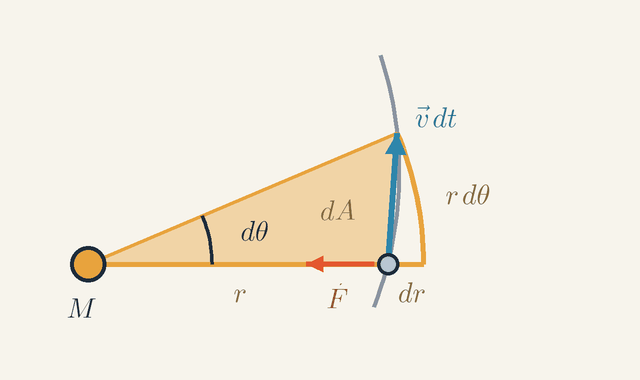
Figure 1. One short step of a planet around its star M, drawn enlarged. The step vdt splits into dr along the radius and rdθ across it; only the second sweeps the gold triangle dA. The pull F lies along the radius. Not to scale.Legend
M
The star, of mass M.
kg
r
Distance from the star to the planet.
m
F
Pull of the star on the planet, along the radius towards M.
N
vdt
The planet's step in the short time dt: velocity times time.
m
dr
Part of the step along the radius: the change in r.
m
rdθ
Part of the step across the radius: an arc of radius r.
m
dθ
Angle the radius vector turns through during the step.
rad
dA
Area of the thin triangle swept by the radius vector during the step.
m2
Figure 1 enlarges one short step of a planet at the distance r from its star M. The direction of the radius vector is given by the angle θ. In a short time dt the planet moves by vdt, the blue arrow. Split this step into two parts. The part dr along the radius only changes the distance; it sweeps no area, because it slides the planet along the line it already lies on. The part across the radius is the short arc rdθ, traced as the radius vector turns through the small angle dθ. Only this part sweeps new area: the gold triangle, of base r and height rdθ, so dA=21r⋅rdθ.
Dividing by dt gives the areal speed, the area swept per unit time: dA/dt=21r2θ˙, where θ˙=dθ/dt is the rate at which the radius vector turns. The planet's speed across the radius is rθ˙, so its angular momentum about the star has the size L=mr⋅rθ˙=mr2θ˙. Hence dtdA=2mL
Now look at the pull F in Figure 1: it points along the radius, towards M. The torque r×F is therefore zero, because the cross product of two parallel vectors vanishes, and without a torque the angular momentum L cannot change. Its size L fixes the areal speed, which is Kepler's second law. Its direction, perpendicular to both r and v, never changes either, so the orbit stays in one plane.
Nothing here used the 1/r2. Equal areas hold for every central force, that is, every force that points along the line to a fixed centre. Kepler's second law therefore tests the direction of the force, not how its strength depends on distance.
The animation's planet makes this concrete. It orbits a star of one solar mass on an ellipse with semi-major axis a=1AU and eccentricity e=0.5. The semi-major axis is half the longest diameter. The eccentricity is a measure of how flattened the ellipse is: 0 for a circle, close to 1 for a long, thin one. The ellipse's semi-minor axis, half the shortest diameter, is b=a1−e2≈0.866AU, and the planet's period, as the third law below shows, is one year.
In the expert view each gold sector is swept in an eighth of the period, about 45.7 days, so both have one eighth of the ellipse's area, πab/8≈0.34AU2. The sector at perihelion, the point nearest the star, is short and wide; the one at aphelion, the farthest point, is long and narrow.
At the two ends of the major axis the velocity is perpendicular to the radius, so there L/m=rv exactly. With the speeds found from the vis-viva relation below, 51.6 km/s at 0.5 AU and 17.2 km/s at 1.5 AU, this gives 0.5⋅51.6=1.5⋅17.2≈25.8AU⋅km/s at both ends, as it must.
Energy and the radial motion
Angular momentum alone does not say how close to the star the planet comes or how far it strays. Energy does, and it reduces the orbit to a one-dimensional problem in the distance r.
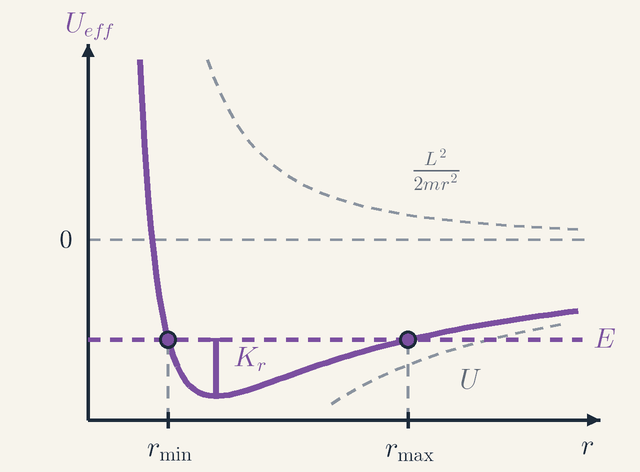
Figure 2. The effective potential energy Ueff (purple) is the sum of the dashed curves L2/(2mr2) and U. The planet stays where Ueff lies below the level E, between the turning points rmin and rmax; the gap is the radial kinetic energy Kr.Legend
Ueff
Effective potential energy of the radial motion: L2/(2mr2)−GMm/r.
J
E
Total energy: constant along the orbit, negative for a bound orbit; drawn as a horizontal level.
J
r
Distance from the star.
m
rmin
Perihelion distance a(1−e): the inner turning point, where r˙=0.
m
rmax
Aphelion distance a(1+e): the outer turning point, where r˙=0.
m
Kr
Radial kinetic energy 21mr˙2: the gap between E and Ueff.
J
2mr2L2
Centrifugal term: the kinetic energy of the sideways motion at distance r.
J
U
Gravitational potential energy, −GMm/r.
J
Start with the potential energy. Choose U=0 when the two bodies are infinitely far apart. Then U at the distance r is the work gravity does on m as it moves from r out to infinity, ∫r∞(−GMm/r′2)dr′, which gives U=−rGMm It is negative everywhere and rises towards zero far away: the lower dashed curve, U, in Figure 2.
Next the kinetic energy. Split the velocity into a radial part r˙, the rate at which the distance changes, and a sideways part rθ˙. From L=mr2θ˙ the sideways part equals L/(mr), so its kinetic energy is L2/(2mr2). The conserved total energy is then E=21mr˙2+2mr2L2−rGMm
Because L is constant, the last two terms depend on r alone, so they can be treated together as a single potential energy for the radial motion: the effective potential energy Ueff, the purple curve of Figure 2. It is the sum of the two dashed curves. The upper one, the centrifugal term L2/(2mr2), climbs steeply as r shrinks; it acts as a centrifugal barrier that keeps the planet from falling into the star. The lower one is U. Close in the barrier wins, far out gravity wins, and in between the sum forms a well.
Now read the figure like a ball rolling in a valley. The energy E is the horizontal dashed level, the same at every r. The gap between that level and the purple curve is the radial kinetic energy Kr=21mr˙2. It cannot be negative, so the planet can only be where the curve lies below the level.
For E<0, as drawn, the level cuts the curve at two turning points, rmin and rmax. There Kr=0, so r˙=0: the distance stops shrinking or growing and turns round. The distance therefore oscillates between rmin, the perihelion, and rmax, the aphelion. If the level just touches the bottom of the well, the two turning points merge and the orbit is a circle. For E≥0 the level meets the curve only once, at the barrier, and the planet escapes to infinity.
The shape of the orbit
Figure 2 gives the range of distances but not the curve the planet traces. To find the curve, rewrite the radial equation of motion in terms of the angle θ instead of the time.
Along the radius, Newton's second law reads m(r¨−rθ˙2)=−GMm/r2; the term −rθ˙2 is the centripetal acceleration that comes from the turning of the radius vector. Two changes make the equation solvable. First, use u=1/r as the variable. Second, trade time for angle with θ˙=L/(mr2)=(L/m)u2. Then r˙=−(L/m)du/dθ and r¨=−(L/m)2u2d2u/dθ2, and after dividing by −m(L/m)2u2 the law becomes linear: dθ2d2u+u=L2GMm2
This is the equation of a harmonic oscillator pushed by a constant force, so its solution is that constant plus a cosine: u=(1+ecosθ)/p, with p=L2/(GMm2) and θ measured from perihelion. In terms of r, r=1+ecosθp which is a conic section with the star at a focus: an ellipse for e<1 (E<0), a parabola for e=1 (E=0) and a hyperbola for e>1 (E>0).
For the ellipse, perihelion at θ=0 and aphelion at θ=π give rmin=p/(1+e) and rmax=p/(1−e). Their sum is the major axis 2a, so p=a(1−e2)=b2/a, rmin=a(1−e) and rmax=a(1+e).
The inverse square is special. By Bertrand's theorem only two forces give bound orbits that always close: the inverse square and the linear spring force. Under any other power law a bound orbit does not close, and its perihelion drifts round a little on every lap.
The energy fixes the size of the ellipse. At either turning point r˙=0, so E=L2/(2mr2)−GMm/r. Multiplied by r2 this is a quadratic, Er2+GMmr−L2/(2m)=0, whose two roots are rmin and rmax. The roots of a quadratic add up to minus the middle coefficient over the first one, so rmin+rmax=−GMm/E. That sum is 2a, hence E=−2aGMm The energy sets the size a; for a given a, the angular momentum sets p and with it the shape e.
Setting this equal to the energy at any point of the orbit, 21mv2−GMm/r, and dividing by m/2 gives the vis-viva relation, which the animation uses for its speed readout: v2=GM(r2−a1) On a circle, r=a and v2=GM/r; at 1 AU from the Sun this is 29.8 km/s, the Earth's orbital speed. For the animation's planet, with a=1AU, the speed is 29.82/r−1km/s with r in AU: 51.6 km/s at perihelion and 17.2 km/s at aphelion.
Kepler's third law
The third law links the period to the size of the orbit and, read backwards, weighs the central body.
Over one period the radius vector sweeps the whole ellipse, of area πab, at the constant rate L/(2m), so T=2πabm/L. Squaring gives T2=4π2a2b2m2/L2. From the orbit equation L2=GMm2p, and p=b2/a, so L2=GMm2b2/a. Substituting, b2 and m2 cancel: T2=GM4π2a3 The period depends on a alone, not on the shape: a circle of radius 1 AU and the animation's ellipse with a=1AU and e=0.5 both take one year.
Read backwards, the law weighs the Sun. The Earth's orbit, a=1.496×10¹¹m and T=3.156×10⁷s, gives GM=4π2a3/T2≈1.327×1020m3/s2, and so a solar mass of 1.99×1030kg.
Time along the orbit: Kepler's equation
The laws so far give the shape and the period, but not where the planet is at a given moment. That needs one more angle, the eccentric anomaly, and one equation for it.
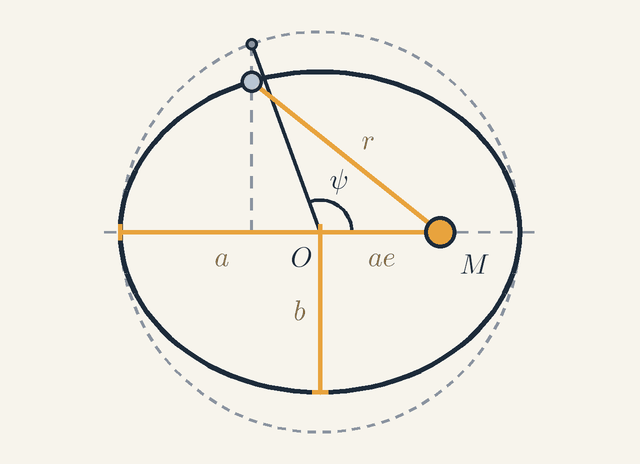
Figure 3. The ellipse and the dashed circle of radius a share the centre O. The point of the circle straight above the planet defines the eccentric anomaly ψ, the angle at O from the axis. The star M is ae from O, and the planet is r=a(1−ecosψ) from the star.Legend
O
Centre of the ellipse and of the dashed circle.
M
The star, at one focus of the ellipse; its mass is M.
kg
a
Semi-major axis: from the centre to the end of the long axis; also the radius of the dashed circle.
m
b
Semi-minor axis: from the centre to the end of the short axis.
m
ae
Distance from the centre to the star: the eccentricity e times a.
m
r
Distance from the star to the planet.
m
ψ
Eccentric anomaly: the angle at O, from the axis towards perihelion to the point of the circle straight above the planet.
rad
Figure 3 shows the ellipse with its centre O, semi-major axis a and semi-minor axis b. The star M sits at a focus, a distance ae from O; perihelion is the end of the long axis on the star's side. Around O draw the dashed circle of radius a, which touches the ellipse at both ends of the long axis. From the planet draw a line perpendicular to the long axis, the thin dashed line, until it meets the circle. The line from O to that point of the circle makes the angle ψ with the axis towards perihelion: this angle is the eccentric anomaly.
Squeezing the circle towards the axis by the factor b/a turns it into the ellipse, so measured from O the planet is at (acosψ,bsinψ), while the star is at (ae,0). Pythagoras gives the distance between them, and with b2=a2(1−e2) the terms collect into a perfect square: r2=a2(cosψ−e)2+b2sin2ψ=a2(1−ecosψ)2 that is, r=a(1−ecosψ): smallest, a(1−e), at ψ=0 and largest, a(1+e), at ψ=π.
Now the time. By the law of areas, the time t since perihelion is proportional to the area swept since then, and t/T is that area divided by the whole ellipse, πab. The area is easiest to find on the circle and then squeeze.
On the circle, the region swept from perihelion to the point at ψ, as seen from the star, is the sector at O with angle ψ, of area 21a2ψ, minus the triangle with corners O, the star and that point. This triangle has base ae and height asinψ, so its area is 21a2esinψ. Squeezing by b/a shrinks every area by the same factor, so the area swept on the ellipse is 21ab(ψ−esinψ). Dividing by πab and multiplying by 2π gives Kepler's equation: T2πt=ψ−esinψ
Given ψ, the time follows at once; given the time, there is no closed-form solution for ψ. The animation finds ψ by Newton's iteration at each of its time steps, then the position. The r(t) graph of the expert view shows the result: a broad, flat crest at 1.5 AU and a narrow, sharp trough at 0.5 AU. The planet crosses the minor axis at ψ=π/2 and ψ=3π/2; putting these into Kepler's equation shows that it spends a fraction 21+e/π≈0.66 of its year on the far side of the minor axis, about 241 days, against 124 days on the near side.
Worked problem: a transfer orbit
Kepler orbits are also how spacecraft travel. The cheapest two-burn route between two circular orbits around the same star is a Hohmann transfer: half of an ellipse that touches both circles.
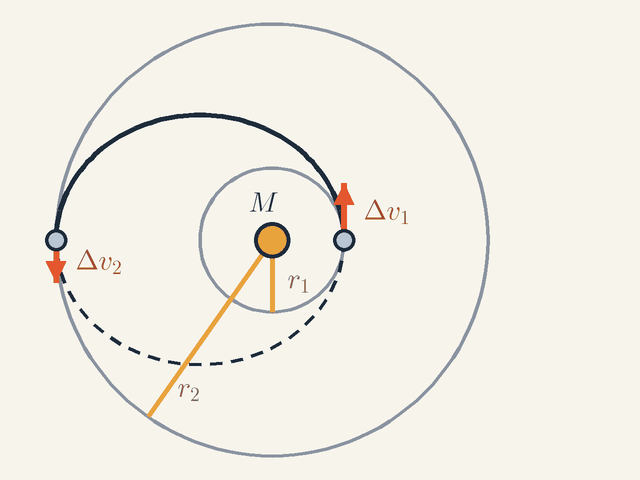
Figure 4. A Hohmann transfer between circular orbits of radii r1 and r2=3r1, orbits to scale (arrows not). A forward burn Δv1 puts the craft on the ellipse; after the solid half-orbit, a second forward burn Δv2 makes the orbit circular.Legend
M
The star, at the centre of both circles; its mass is M.
kg
r1
Radius of the inner circular orbit, where the craft starts.
m
r2
Radius of the outer circular orbit, the destination.
m
Δv1
First burn, forward at the inner circle: from the circular speed up to the perihelion speed of the ellipse.
m/s
Δv2
Second burn, forward at aphelion, the far end of the ellipse: from the aphelion speed up to the circular speed.
m/s
Figure 4 draws it to scale for r1=0.5AU and r2=1.5AU, so that the transfer ellipse is the animation's ellipse. The craft starts on the inner circle. A forward burn Δv1 puts it on the ellipse whose perihelion touches the inner circle and whose aphelion touches the outer one. Its major axis is therefore r1+r2, so a=(r1+r2)/2=1AU. Only the solid half of the ellipse is flown; at its far end a second forward burn Δv2 makes the orbit circular.
The first burn. On a circle the vis-viva relation gives v=GM/r, so the circular speed at r1 is 29.82≈42.1km/s. The transfer ellipse needs the perihelion speed of 51.6 km/s, so Δv1=9.5km/s.
The second burn. Half an orbit later, after T/2≈183 days, the craft reaches aphelion at 17.2 km/s. That is short of the circular speed there, 29.8/1.5≈24.3km/s, so Δv2=7.1km/s.
Both burns pushed forward, 16.6 km/s in all, yet the craft ends 17.8 km/s slower than it started. Energy resolves the paradox. Per kilogram, a circular orbit has the total energy E=−GM/(2r), the kinetic energy GM/(2r)=−E and the potential energy −GM/r=2E. From r1 to r2 the total rises from −8.87×10⁸ to −2.96×10⁸J/kg, so the engine supplies 5.91×10⁸J/kg. The potential energy rises by twice that, 1.18×10⁹J/kg, and the kinetic energy falls by 5.91×10⁸J/kg to make up the difference. Higher orbits are slower, but they hold more energy.
The same route from the Earth to Mars, from 1 AU to 1.52 AU, has a≈1.26AU. With T in years and a in AU the third law reads T=a3/2, so the trip takes 21⋅1.263/2≈0.707 years, about 258 days.
Beyond two point masses
Real systems differ from one point mass circling a fixed one in three ways: both bodies move, bodies have size, and there are usually more than two.
Two bodies orbit their common centre of mass, and their relative orbit obeys the same laws with M replaced by M+m: T2=4π2a3/(G(M+m)). The Earth–Moon centre of mass lies 4670 km from the Earth's centre, inside the Earth; the Sun–Jupiter one lies 1.07 solar radii from the Sun's centre, just above its surface. The small wobble of a star around such a point reveals planets around other stars.
A body of finite size also feels how the field changes across it. The field GM/d2 of a body of mass M at the distance d changes over the Earth's radius R by about R times its rate of change with distance, 2GMR/d3. For the Moon this is 1.1×10⁻⁶m/s2: the tidal acceleration, which stretches the oceans into two bulges, one facing the Moon and one on the far side. The Sun's field at the Earth is about 180 times the Moon's, yet its tidal effect is only about half the Moon's, because the difference falls as 1/d3 and the Sun is about 390 times farther away.
Other planets perturb every orbit; they advance Mercury's perihelion by about 530″ per century. The Earth's equatorial bulge turns the planes of satellite orbits, by about 1° a day for the near-polar orbits chosen to keep pace with the Sun. For three or more bodies there is no general formula, and planetary tables come from numerical integration.
Limits of validity
The inverse-square law has been confirmed from separations below a tenth of a millimetre up to planetary distances, and the equality of gravitational and inertial mass to about one part in 1015. Newtonian gravity is the weak-field, slow-motion limit of general relativity. The size of the corrections is set by the pure number GM/(rc2), with c the speed of light: about 7×10⁻¹⁰ at the Earth's surface and 1×10⁻⁸ at 1 AU from the Sun.
Small as they are, the corrections are measured. Mercury's perihelion advances by an extra 43″ per century; the animation's planet, with a=1AU and e=0.5, would turn by about 5″ per century. Navigation-satellite clocks 20 200 km up gain about 46 microseconds a day on ground clocks because gravity is weaker there; their orbital speed takes back about 7, leaving a net gain of about 38. Near a neutron star, where GM/(rc2)≈0.2, and at a black-hole horizon, where it reaches 0.5, Newton's law fails outright.
Gravity is also extremely weak: two electrons repel each other electrically about 4×1042 times more strongly than they attract each other gravitationally. It rules the sky only because mass comes in one sign, so it always adds up, while the positive and negative charges of large bodies cancel. At the Planck length, about 1.6×10⁻³⁵m, gravity and quantum mechanics would both matter, and no tested theory covers that regime.
Where this leads
The equal-area law is the conservation of angular momentum met in Angular Momentum and Its Conservation, and U=−GMm/r is the general form of the mgh of Work, Energy and Power. The same inverse square governs charges in Coulomb's Law, its field picture continues in Electric Field and Potential, and the electron moves on a Kepler orbit with quantised angular momentum in Atomic Models: the Bohr Atom.
Inside a uniform Earth g∝r, a restoring pull that grows with distance from the centre, which is the condition for Simple Harmonic Motion: a train in a frictionless tunnel through the centre would cross in about 42 minutes, half the 84-minute period of an orbit grazing the surface. Finally, the equality of gravitational and inertial mass is the starting point of Gravity as Curved Spacetime, where orbits become the straightest paths through curved spacetime.
Key formulas
Newton's law of universal gravitation
F=r2Gm1m2
Every pair of masses attracts with a force proportional to each mass that falls off as the inverse square of the centre-to-centre distance. The force lies along the line joining the centres, and the two bodies pull on each other equally hard (Newton's third law), even when one is far heavier. Spherical bodies act as if all their mass sat at their centres.
Symbols
F
size of the attractive force on each body
N
G
gravitational constant
N⋅m2/kg2
m1
mass of the first body
kg
m2
mass of the second body
kg
r
distance between the centres
m
When it holds: Exact for point masses and for spherical bodies outside each other; for other shapes, add up the pulls of the small pieces. It fails only in very strong fields or for speeds near that of light, where general relativity takes over.
Example: Two people of 70 kg, 1 m apart: F=6.674×10−11⋅70⋅70/12≈3.3×10−7N.
Gravitational field strength
g=r2GM
The force on a small mass divided by that mass: the pull per kilogram created by a body of mass M. Because the small mass cancels, g is also the free-fall acceleration, the same for every body at that place. It falls as the inverse square of the distance from the centre.
Symbols
g
gravitational field strength (free-fall acceleration)
N/kg
G
gravitational constant
N⋅m2/kg2
M
mass of the attracting body
kg
r
distance from its centre
m
When it holds: Outside a spherical body, with r measured from its centre. Inside a uniform sphere g grows instead in proportion to r, from zero at the centre; at the equator the Earth's spin lowers the measured value by about 0.3 %.
Example: At the Earth's surface g=3.986×10¹⁴/(6.371×106)2≈9.8N/kg; at r=2R it is about 2.45 N/kg.
Speed in a circular orbit
v=rGM(circular orbit)
Gravity supplies exactly the centripetal force that a circle needs, GMm/r2=mv2/r, and this fixes the speed at each radius. The orbiting mass cancels, so all satellites at the same height move at the same speed. Higher orbits are slower: v∝1/r.
Symbols
v
orbital speed
m/s
G
gravitational constant
N⋅m2/kg2
M
mass of the central body
kg
r
radius of the orbit, measured from the centre of the central body
m
When it holds: Only for a circular orbit around a much heavier body; on an ellipse the speed varies and the vis-viva relation applies instead.
Example: The space station at r=6771km: v=3.986×10¹⁴/(6.771×106)≈7.67km/s.
Kepler's third law
T2=GM4π2a3
The square of the period grows as the cube of the semi-major axis, with the same constant for all bodies orbiting the same mass. For a circle it follows from T=2πr/v with v=GM/r; for an ellipse, from the constant areal speed. The eccentricity does not enter: a circle and a stretched ellipse with the same a take the same time.
Symbols
T
orbital period
s
a
semi-major axis (the radius, for a circle)
m
G
gravitational constant
N⋅m2/kg2
M
mass of the central body
kg
When it holds: For two bodies with m≪M; otherwise replace M by M+m. The pulls of other bodies cause small deviations.
Example: The planet in the animation, with a=1AU around one solar mass, takes 1 year; Halley's comet, with a=17.8AU, takes about 75 years.
Vis-viva relation (speed anywhere on an orbit)
v2=GM(r2−a1)
Energy conservation written for an orbit: the total energy per kilogram, 21v2−GM/r, equals −GM/(2a) everywhere on an ellipse. So the speed at any point depends only on the distance from the central body and on the size of the orbit. For a circle r=a and v2=GM/r; letting a→∞ gives the escape speed, v2=2GM/r.
Symbols
v
speed at distance r
m/s
G
gravitational constant
N⋅m2/kg2
M
mass of the central body
kg
r
present distance from the centre of the central body
m
a
semi-major axis of the orbit
m
When it holds: Any orbit of two bodies with m≪M and no other forces; for a hyperbola a is taken as negative.
Example: The planet in the animation (a=1AU): at 0.5 AU, v=29.83≈51.6km/s; at 1.5 AU, 17.2 km/s.
Gravitational potential energy
U=−rGMm
The energy stored in a pair of masses, chosen to be zero when they are infinitely far apart. Gravity pulls them together, so separating them takes work and U rises toward zero: it is negative at every finite distance. A body whose total energy 21mv2+U is negative is bound.
Symbols
U
gravitational potential energy of the pair
J
G
gravitational constant
N⋅m2/kg2
M
mass of the central body
kg
m
mass of the smaller body
kg
r
distance between the centres
m
When it holds: Outside spherical bodies. Only differences of U matter: near the surface, for a height h≪R, the change is mgh.
Example: A 1 kg mass on the Earth's surface has U=−(3.986×10¹⁴)/(6.371×106)≈−6.26×107J; launching it at the escape speed of 11.2 km/s supplies exactly these 62.6 MJ.
Kepler's second law (equal areas in equal times)
dtdA=2mL=const
In a short time the line from the star to the planet sweeps a thin triangle of area 21r2dθ, and mr2θ˙ is the angular momentum L. Gravity points at the star, so it exerts no torque about it and L stays constant: equal areas in equal times. The planet must therefore move fast where r is small and slowly where it is large.
Symbols
A
area swept by the line from the star to the planet
m2
t
time
s
L
angular momentum of the planet about the star
kg⋅m2/s
m
mass of the planet
kg
When it holds: Any central force, whatever its dependence on distance. It fails when a torque acts, for instance from drag or from a rocket engine.
Example: In the animation rv is the same at both ends of the major axis: 0.5⋅51.6=1.5⋅17.2≈25.8AU⋅km/s.
Glossary
Universal gravitation
The attraction between every pair of masses, F=Gm1m2/r2: one law for apples, moons and galaxies. It is always attractive and acts along the line joining the centres.
Inverse-square law
A law in which an effect falls as 1/r2: twice as far gives a quarter, ten times as far a hundredth. Gravity and the electric force between point charges both follow it.
Gravitational field
The pull per kilogram that a mass creates around it, g=GM/r2, pointing toward the mass. It equals the free-fall acceleration at that point.
Shell theorem
A uniform spherical shell attracts an outside mass as if all its mass sat at its centre, and exerts no net force on a mass inside it. It is why distances are measured from a planet's centre.
Orbit
The path of a body moving under gravity around another, such as a planet around a star or a satellite around the Earth. It is a never-ending free fall in which the sideways motion keeps carrying the body past the central mass.
Weightlessness
The feeling of having no weight when you and your surroundings fall freely together, so that nothing presses on you. Gravity has not vanished: on the space station it is still about 8.7 m/s².
Ellipse
A closed oval curve: the points whose distances to two fixed points, the foci, add up to the same length 2a. Its eccentricity e, from 0 for a circle to almost 1, says how stretched it is.
Perihelion and aphelion
The closest point, at a(1−e), and the farthest point, at a(1+e), of an orbit around the Sun or another star (perigee and apogee around the Earth). The planet is fastest at perihelion and slowest at aphelion.
Kepler's laws
Three rules for planetary orbits: ellipses with the Sun at one focus; equal areas swept in equal times; T2∝a3. Newton's law of gravitation explains all three.
Central force
A force that always points toward or away from one fixed centre, as gravity points at the star. It exerts no torque about that centre, so angular momentum is conserved and equal areas are swept in equal times.
Escape speed
The smallest launch speed that lets a body leave for good, reaching infinity with zero total energy: 2GM/r, which is 2 times the circular speed at the same distance. From the Earth's surface it is about 11.2 km/s.
Equivalence principle
The equality of gravitational and inertial mass, so that all bodies fall with the same acceleration whatever their mass or material. Tested to about one part in a million billion, it is the starting point of general relativity.
Quantities
F
Gravitational force
N
The size of the mutual pull between two masses; each body feels the same force, in opposite directions.
G
Gravitational constant
N⋅m2/kg2
A universal constant, 6.674×10⁻¹¹N⋅m2/kg2: the force between two 1 kg masses 1 m apart, in newtons. It is the least precisely known fundamental constant.
M
Mass of the central body
kg
The mass of the planet or star at the centre of the orbit. Orbits reveal only the product GM, which is known far more precisely than M itself. The orbiting body's own mass is written m (m1 and m2 in the general law); it cancels from the motion itself.
r
Distance between centres
m
Measured from centre to centre, never from the surface: for the space station r=6771km, not 400 km.
g
Gravitational field strength
N/kg
The force per kilogram, GM/r2, which is also the free-fall acceleration (1N/kg=1m/s2): 9.8 N/kg at the Earth's surface.
v
Orbital speed
m/s
The speed along the orbit: GM/r on a circle, 7.67 km/s for the space station. On an ellipse it varies and is highest at the closest point.
T
Orbital period
s
The time for one complete orbit: 92 min for the space station, one year for the Earth and for the planet in the animation.
a
Semi-major axis
m
Half the longest diameter of the ellipse, the average of the closest and farthest distances; often given in astronomical units, 1AU=1.496×10¹¹m. It alone fixes the period and the energy.
U
Gravitational potential energy
J
The energy of a pair of masses, −GMm/r: zero at infinite separation and negative closer in. Its rise with distance is the work needed to pull the bodies apart.
L
Angular momentum
kg⋅m2/s
The orbital counterpart of momentum, mr2θ˙. Gravity exerts no torque about the star, so L stays constant: Kepler's second law.
Quiz
Beginner The distance between two asteroids doubles. What happens to the gravitational pull between them?
It halves
It becomes four times weaker
It stays the same
It doubles
Show answer
Answer: B. It becomes four times weaker
Twice as far, the pull drops to ½ × ½ = ¼ of its value: four times weaker, not just half as strong. Gravity weakens faster than the distance grows.
Beginner Why doesn't the Moon crash into the Earth?
There is no gravity that far from the Earth
The Sun pulls it away exactly as hard
It moves sideways fast enough to keep falling around the Earth
It is too light to be attracted
Show answer
Answer: C. It moves sideways fast enough to keep falling around the Earth
Gravity does act on the Moon; it bends the Moon's path. The Moon's sideways speed means that as it falls, the Earth's surface keeps curving away beneath it.
Beginner Where on its elliptical orbit does a planet move fastest?
Closest to the star
Farthest from the star
At the same speed everywhere
Halfway between the nearest and farthest points
Show answer
Answer: A. Closest to the star
As the planet falls inward, gravity speeds it up, so it is fastest at the closest point (perihelion) and slowest at the farthest (aphelion).
Intermediate What is the gravitational field strength at a height above the Earth's surface equal to one Earth radius?
9.8 m/s²
4.9 m/s²
2.45 m/s²
0 m/s²
Show answer
Answer: C. 2.45 m/s²
The distance from the Earth's centre doubles, so g = G·M / r² falls to a quarter: 9.8 ÷ 4 ≈ 2.45 m/s². 4.9 m/s² would wrongly assume g ∝ 1/r.
Intermediate A satellite is moved from a low circular orbit to a higher circular orbit. Its orbital speed…
increases
stays the same
becomes zero
decreases
Show answer
Answer: D. decreases
From G·M·m / r² = m·v² / r, v = √(G·M / r): a larger radius means a lower speed, even though the higher orbit took energy to reach.
Intermediate Astronauts on the International Space Station, 400 km up, float inside it because…
there is no gravity at 400 km
gravity there is only about 1 % of its surface value
they and the station are in free fall together
the Earth's rotation cancels gravity
Show answer
Answer: C. they and the station are in free fall together
At 400 km, g is still about 8.7 m/s². The station and everyone in it fall around the Earth with the same acceleration, so nothing presses them against the floor.
Advanced Kepler's second law, equal areas in equal times, is a direct consequence of…
conservation of energy
conservation of angular momentum, because gravity is a central force
the 1/r² form of the force only
conservation of linear momentum
Show answer
Answer: B. conservation of angular momentum, because gravity is a central force
dA/dt = L / (2m). A central force exerts no torque about the star, so L and therefore the areal speed are constant, whatever the force law.
Advanced A comet orbits the Sun. Its closest point is 0.5 AU from the Sun and its farthest point is 7.5 AU. What is its period?
About 20.5 years
64 years
About 0.35 years
8 years
Show answer
Answer: D. 8 years
Kepler's third law uses the semi-major axis, half the longest diameter of the ellipse: a = (0.5 + 7.5) / 2 = 4 AU, so T = a^1.5 = 4^1.5 = 8 years (T in years, a in AU, around the Sun). Using the farthest distance gives 7.5^1.5 ≈ 20.5 years and the closest 0.5^1.5 ≈ 0.35 years; 64 is a³ without the square root.
 Physics Tutor