Why things start, stop and turn: force F, mass m and the three laws that connect them, with ∑F=ma at their centre.
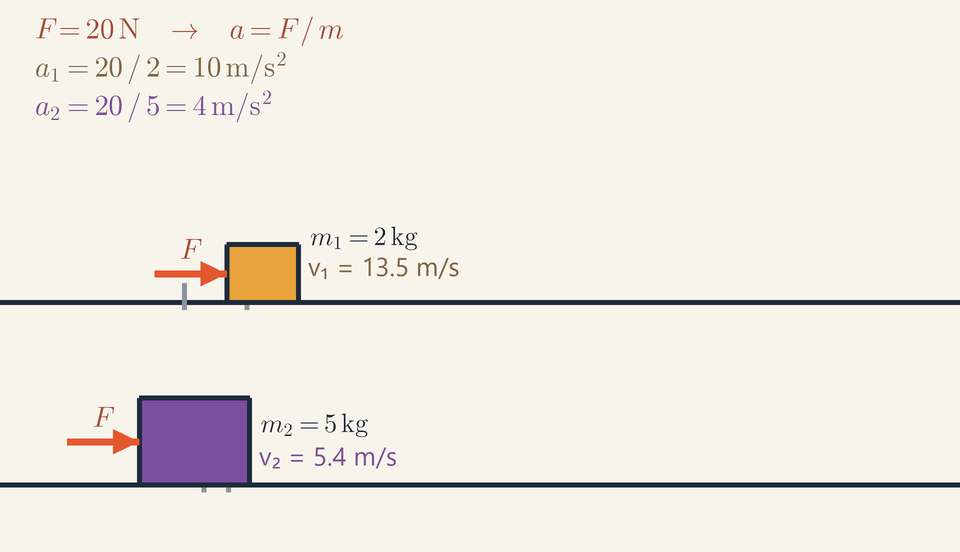
The same force F pushes a light block (m) and a block 2.5 times heavier (2.5m). The light block accelerates 2.5 times as much, so it pulls further and further ahead.
A force is a push or a pull, measured in newtons (N); forces add like arrows into one net force.
With no net force, a still object stays still and a moving one keeps going straight at the same speed.
The same push speeds up a light object more than a heavy one: acceleration = force ÷ mass.
Mass (kg) is the same everywhere; weight is the pull of gravity, about six times smaller on the Moon.
Forces come in pairs acting on different objects: push a wall and it pushes back on you just as hard.
A force is a push or a pull. Some forces need contact, like a foot kicking a ball or a rope pulling a sledge; others act across empty space, like gravity or a magnet. Forces are measured in newtons (N).
Forces have directions, so they combine like arrows. Push a box to the right with 30 N while a friend pushes it to the left with 20 N, and the net force is 10 N to the right.
Quick check: what if your friend also pushes with 30 N? (The net force is zero.)
First law: with zero net force, an object at rest stays at rest, and a moving object keeps going in a straight line at the same speed. A pushed sofa stops when you let go only because of friction, a force from the floor. On smooth ice a puck glides on and on.
Second law: a net force changes the motion, and acceleration = net force ÷ mass. Double the force and the acceleration doubles; double the mass and it halves. In the animation the same push (red arrows) acts on a 2 kg and a 5 kg block on a frictionless floor, so the light block gains speed 2.5 times faster.
Quick check: a 6 kg trolley feels a net force of 18 N. What is its acceleration? (3 m/s².)
Mass is not weight. Mass, in kilograms, says how hard an object is to speed up and is the same everywhere; weight is the pull of gravity, in newtons, about six times smaller on the Moon.
Third law: forces come in pairs. Push a wall and it pushes back on you just as hard; jump, and you push the Earth down while it pushes you up. The two forces act on different objects, so they never cancel each other.
Intermediate
Key ideas
Use the net force, the vector sum of every force on one body: ∑F=ma.
∑F=0 means zero acceleration: the body is at rest or moves at constant velocity. Motion itself needs no force.
Mass (kg) measures inertia. Weight W=mg (N) is a force that depends on local gravity.
Free-body diagram: one object, every force on it, then ∑F=ma along each axis.
Third-law pairs act on different bodies, so they never appear on the same free-body diagram and never cancel.
Force, mass and the net force
A force is a push or a pull that one body exerts on another, such as the Earth's pull on a falling apple. It is a vector, F, with a size in newtons (N) and a direction. Along a straight line, choose a positive direction and give each force a sign: with right as positive, 10 N to the left is −10N.
What changes the motion is the net force ∑F, the vector sum of all the forces on that one body. Push a 4 kg box with 30 N to the right while a friend pushes it with 10 N to the left, and the net force is 30−10=20N to the right. The mass m, in kilograms, measures inertia, how strongly the body resists a change of velocity; it is the same on the Earth, on the Moon and in deep space.
The first and second laws
With zero net force the velocity does not change: a body at rest stays at rest, and a moving body keeps the same speed in the same direction. ∑F=0⇔v=const Motion itself needs no force; only a change of motion does. A car cruising at a steady 20 m/s against 600 N of drag and rolling resistance needs a driving force of exactly 600 N: the forces balance, and the car is in equilibrium.
When the forces do not balance, the body accelerates in the direction of the net force: ∑F=ma Double the net force and the acceleration doubles; double the mass and it halves. The box above gets a=20/4=5m/s2. The law also defines the newton: 1 N gives a 1 kg mass an acceleration of 1 m/s², so 1N=1kg⋅m/s2.
Weight and free-body diagrams
Weight is the gravitational force on a body. Near the Earth's surface W=mg with g=9.81m/s2, so weight is a force in newtons, not a mass in kilograms. A 70 kg astronaut weighs 70⋅9.81≈687N on the Earth and 70⋅1.62≈113N on the Moon, about a sixth as much, yet her mass is still 70 kg. A surface pushes back with a normal force N, perpendicular to it, and a taut rope pulls with a tension T.
To use the laws, draw a free-body diagram in four steps.
Isolate one body and draw it alone, as a box or a dot.
Draw every force acting on that body: weight, normal force, tension, friction, pushes.
Leave out the forces this body exerts on others; they belong on other diagrams.
Choose axes, ideally one along the acceleration, and apply the second law along each axis.
As a vector equation, the law splits into one equation per axis: ∑Fx=max∑Fy=may For a block on a level floor with no vertical acceleration, the second one gives N−mg=0, so N=mg; on a slope or in an accelerating lift the normal force differs from the weight.
The third law: forces come in pairs
Forces are interactions, so they come in pairs. If body A pushes on body B, then B pushes on A with a force of the same size in the opposite direction: FAB=−FBA where FAB is the force that A exerts on B. The two forces are of the same kind and act at the same moment, but on different bodies, so they never cancel and never appear on the same free-body diagram.
A book on a table feels its weight and the table's normal force. These balance, but they are not a third-law pair: both act on the book, and they are equal only because the book does not accelerate. The partner of the weight is the book's gravitational pull on the Earth. In a crash, a 1000 kg car and a 6000 kg truck feel the same force, say 30 kN, which gives the car 30 m/s² but the truck only 5 m/s².
Worked example: the blocks in the animation
The animation pushes a light block, m1=2kg, and a heavy one, m2=5kg, with the same horizontal force F=20N: the red arrows have equal lengths. The floors are frictionless and each weight is balanced by the normal force (19.62 N and 49.05 N), so the push is the net force: a1=m1F=220=10m/s2,a2=m2F=520=4m/s2
Both blocks start from rest, so after t=3s v1=a1t=10⋅3=30m/s,v2=a2t=4⋅3=12m/s These are the final values on the v1 and v2 readouts, which grow by 10 and 4 m/s every second.
The distances follow from x=21at2: the blocks cover 45 m and 18 m. The grey marks show the front edges after 0, 1 and 2 s: the light block has moved 5 m and then 20 m, and the heavy one has moved 2 m and then 8 m. At every instant the light block's speed and distance are 2.5 times the heavy block's, the inverse of the mass ratio.
Worked example: a scale in a lift
You stand on a bathroom scale in a lift. Your mass is 70 kg, and the lift starts upwards with an acceleration of 1.0 m/s². Two forces act on you: your weight, mg=686.7N, downwards, and the scale's normal force N, upwards. With upwards positive, the second law gives N−mg=ma⇒N=m(g+a)=70⋅(9.81+1.0)≈757N
By the third law you push down on the scale with the same 757 N, and that is what it measures; a scale marked in kilograms divides by 9.81 and shows 77.1 kg. At constant speed it shows your true 70 kg. While the lift slows near the top, a=−1.0m/s2 and the reading drops to 70⋅8.81≈617N, or 62.9 kg. In free fall it would read zero: weightlessness means no support force, not no gravity.
Common mistakes
Motion needs no net force: the car at a steady 20 m/s against 600 N of resistance is driven by exactly 600 N, and more would speed it up.
Mass is not weight: the 70 kg astronaut weighs 687 N on the Earth and 113 N on the Moon, yet is just as hard to set moving in both places.
The normal force is not always mg: in the accelerating lift it is 757 N, while your weight is 687 N.
Use the net force, not one force: the box pushed with 30 N one way and 10 N the other gets a=20/4=5m/s2, not 30/4=7.5m/s2.
Where you meet it
Crumple zones and seat belts use a=F/m in reverse: spreading a crash over a longer time lowers the acceleration, and so the force, on the passengers. Rockets, swimmers and walkers push something backwards and are pushed forwards by its third-law partner. Next come Friction and Inclined Planes, Circular Motion, where the net force turns the velocity, and Gravitation and Orbits; Momentum and Collisions and Work, Energy and Power follow from the second law added up over time and over distance.
Advanced
Key ideas
General form F=dp/dt; for constant mass F=ma: three equations, one per axis.
F=ma is not a mere definition: forces have material sources and laws of their own, such as GMm/r2 or −kx.
Third law: d(pA+pB)/dt=0. Momentum conservation is the sturdier law: fields carry momentum too.
Only inertial frames will do; an accelerating frame needs pseudo-forces such as −maframe, with no material source.
Near c, p=γmv: a constant force gives ever less acceleration and v never reaches c.
Force as the rate of change of momentum
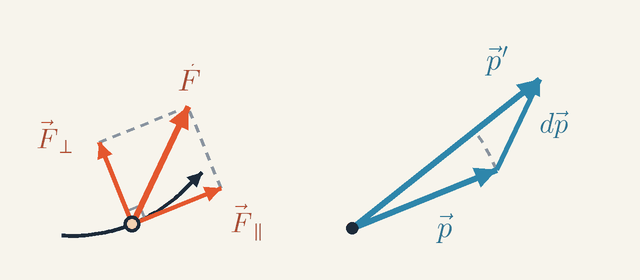
Newton's second law is usually met as F=ma. Its general form uses the momentum p=mv, and reading it as a statement about vectors explains at once how a force can speed a body up, slow it down or turn it.
Figure 1. A body going round a bend. Left: the net force F splits into F∥ along the motion, which changes the speed, and F⊥ across it, which turns the path. Right: in a short time p becomes p′=p+dp, with dp along F. Not to scale.Legend
F
Net force on the body at the dot.
N
F∥
Part of F along the motion: it changes the speed.
N
F⊥
Part of F across the motion, towards the inside of the bend: it turns the path.
N
p
Momentum mv of the body, along its motion.
kg⋅m/s
dp
Change of momentum in a short time dt: dp=Fdt, so it points the way F points.
kg⋅m/s
p′
Momentum a short time later: p+dp, longer than p and turned.
kg⋅m/s
Figure 1 follows one body round a bend: the black curve is its path, and the arrowhead shows which way it moves. On the left, look at the dot. The net force F on the body is split into two perpendicular parts. The part F∥ lies along the motion; it changes the speed and leaves the direction alone. The part F⊥ points across the motion, towards the inside of the bend; it changes the direction and leaves the speed alone. Circular motion at steady speed is the case in which only F⊥ is present.
On the right the same moment is drawn with momenta. In a short time dt the momentum p changes by dp=Fdt, so dp is parallel to F, not to p. Placing it at the tip of p gives the new momentum p′=p+dp. Now compare p′ with the dashed arc, whose radius is ∣p∣: the tip of p′ lies beyond the arc, so the momentum has grown, and p′ also points in a new direction. The parallel part of the force caused the growth, the perpendicular part the turn.
Written as an equation, this is the second law in its general form: the net force on a body equals the rate at which its momentum changes, F=dtdp If the mass is constant, dp/dt=mdv/dt=ma, which is the familiar form. A vector equation is three equations at once, one for each axis; with dots for time derivatives (x¨=d2x/dt2), mx¨=Fx,my¨=Fy,mz¨=Fz
Each of these is a second-order differential equation: it contains the second derivative of the position. Solving it therefore needs two starting values per axis, the initial position and the initial velocity. Given those and the force, the motion is fixed for all later times. Note what the law links: the net force sets the acceleration, whatever the velocity happens to be. A body can move fast with no force on it, and a ball at the top of its throw is momentarily at rest while still accelerating at g.
Inertial frames: what the first law adds
The first law is more than the special case ∑F=0 of the second. It claims that there are frames of reference in which a body free of forces moves in a straight line at constant speed. These are called inertial frames, and only in them does ∑F=ma hold as written. Any frame moving at constant velocity relative to an inertial frame is inertial too, because adding the same constant velocity to every body changes no acceleration. Frames that accelerate need a correction, described further on.
Impulse and work: areas under the force
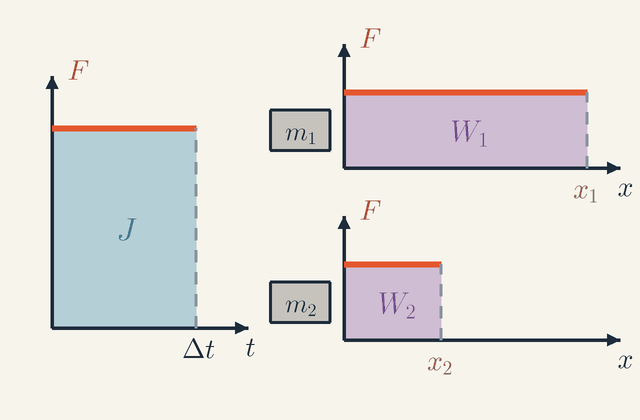
Adding up a force over time gives the change of momentum; adding it up over distance gives the change of kinetic energy. These two theorems lead from Newton's laws to the conservation laws, and Figure 2 shows both for the push of the animation.
Figure 2. One constant force F pushes each block of the animation for the same time Δt. Left: the area under F(t) is the impulse J, the same for both. Right: the area under F(x) is the work; the light block m1 is pushed further, through x1, so W1 is larger than W2.Legend
F
Constant force that pushes each block.
N
t
Time since the push began.
s
Δt
Duration of the push.
s
J
Impulse of the force: the area under F(t), J=FΔt. It equals the momentum gained.
N⋅s
x
Position of a block along the floor, measured from where the push began.
m
m1
The light block.
kg
m2
The heavy block.
kg
x1
Distance the light block moves during Δt.
m
x2
Distance the heavy block moves during Δt.
m
W1
Work done on the light block: the area under F(x) up to x1.
J
W2
Work done on the heavy block: the area under F(x) up to x2.
J
In Figure 2 the same constant force F=20N acts for Δt=3s on the light block m1=2kg and on the heavy block m2=5kg. The left graph plots the force against the time t. It is a flat line, and the shaded area under it, FΔt, is the impulse J. This graph is the same for both blocks, because both feel the same force for the same time. The two graphs on the right plot the force against the position x of each block. Their heights are equal, but their widths are not: the light block is pushed through the longer distance x1, the heavy one only through x2. So the shaded areas, the works W1 and W2, are unequal.
First the motion itself. Under the 20 N push the acceleration a=F/m is a constant 10 m/s² for the light block and 4 m/s² for the heavy one, so in the lesson's graphs a(t) is a flat line and v(t) a straight line whose slope is that acceleration. The area under a(t) over the 3 s is the velocity gained, 10⋅3=30m/s and 4⋅3=12m/s. Starting from rest, each block covers 21a(Δt)2, that is x1=21⋅10⋅32=45m and x2=21⋅4⋅32=18m.
Over time: integrate F=dp/dt from 0 to t. The left side becomes the impulse of the force, the right side the change of momentum: ∫0tFdt′=p(t)−p(0) Both blocks start at rest and receive the impulse J=FΔt=20⋅3=60N⋅s, so both end with the same momentum, 2⋅30=5⋅12=60kg⋅m/s.
Over distance: by the chain rule the acceleration can be written a=dv/dt=(dv/dx)(dx/dt)=vdv/dx. Then F=ma becomes Fdx=mvdv, and integrating both sides from the start of the push to its end gives the work–energy theorem: ∫x0xFdx′=21mv2−21mv02 For the light block the work is W1=Fx1=20⋅45=900J, and indeed 21⋅2⋅302=900J. For the heavy block W2=20⋅18=360J, which equals 21⋅5⋅122.
The result: equal momenta, but kinetic energies in the ratio 2.5. The reason is Ek=p2/(2m): for the same momentum, the lighter body carries more energy. It moves faster, so it travels further while the force acts, and the force does more work on it.
What gives the second law its content
If F=ma merely defined force, it would predict nothing: any observed acceleration could be blamed on a force invented for the purpose. The law has content because forces can be known independently of the motions they cause. Three facts make this possible. Every force has a source, another body nearby or a field that some body produces, so a body far from everything feels no force. Forces add as vectors. And forces obey laws of their own: gravity GMm/r2, the spring force −kx, the electric force between charges, and friction, roughly proportional to the normal force.
Mass, too, can be measured without going in a circle. Let two bodies push each other apart, for instance with a compressed spring between them. By the third law the two forces are equal and opposite, so the accelerations are in the inverse ratio of the masses, a1/a2=m2/m1. The animation's equal pushes give the same ratio, 10/4=5/2. Once one body is chosen as the unit of mass, this measures every other.
With masses and force laws known, the second law becomes a machine for prediction. The present position and velocity give the force; the force gives the acceleration; the acceleration gives the position and velocity a moment later; and the step repeats. With a spring force −kx the result is an oscillation; with gravity's GMm/r2 it is an elliptical orbit.
The third law and conservation of momentum
The third law says that when two bodies A and B interact, the force FAB that A exerts on B and the force FBA that B exerts on A are equal and opposite. Combined with the general second law, it gives the most useful conservation law of mechanics.
Take two bodies that interact only with each other. The momentum of each changes at the rate set by the force on it: dpB/dt=FAB and dpA/dt=FBA. Adding the two and using the third law, dtd(pA+pB)=FAB+FBA=0 so the total momentum never changes. For example, a spring pushes apart carts of 2 kg and 5 kg that start at rest. Their total momentum stays zero, so they move off in opposite directions with speeds in the ratio 5 to 2, say 2.5 m/s and 1.0 m/s, however the push varied during the release.
For many bodies the same argument works pair by pair. The internal forces cancel, and what is left is dP/dt=∑Fext, where P is the total momentum and ∑Fext the sum of the forces from outside. Since P equals the total mass times the velocity of the centre of mass, the centre of mass moves like a single point carrying the whole mass. That is why each block of the animation may be treated as a point.
Momentum conservation is sturdier than the third law itself. Forces between separated bodies cannot respond instantly, because no influence travels faster than light, and the magnetic forces between two moving charges are in general not equal and opposite. Yet the total momentum is still conserved once the momentum carried by the electromagnetic field is counted.
Accelerating frames and pseudo-forces
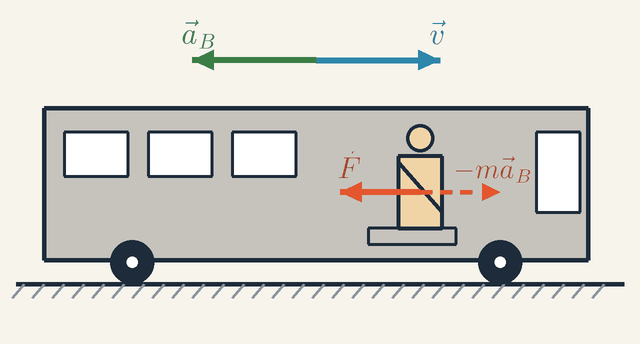
Newton's laws hold only in inertial frames, yet we often describe motion from a car, a lift or the turning Earth. In such a frame the laws can be rescued by adding pseudo-forces. Figure 3 shows how, for a bus that is braking.
Figure 3. A bus that is braking. It moves forwards with v, but its acceleration aB points backwards. The seat belt pulls the passenger back with the real force F; in a frame fixed to the bus, where the passenger stays at rest, F is balanced by the dashed pseudo-force −maB.Legend
v
Velocity of the bus relative to the road.
m/s
aB
Acceleration of the bus, the frame B, relative to the road; it points backwards because the bus brakes.
m/s2
F
Force of the seat belt on the passenger: a real force, exerted by a body.
N
maB
Passenger's mass m times aB. The dashed arrow is the pseudo-force −maB, pointing forwards; no body exerts it.
N
Relative to the road, which we take as inertial, the bus in Figure 3 moves forwards with velocity v, but its acceleration aB points backwards because it is braking. Now describe the motion from a frame B fixed to the bus and not rotating. A body's position relative to the road is the position of the bus plus the body's position relative to the bus. Differentiating twice, the accelerations add in the same way, a=aB+a′, where a′ is the acceleration seen from the bus. So a′=a−aB, and multiplying by m and using ma=∑F gives ma′=∑F−maB
The extra term −maB acts like a force proportional to the mass; it is the dashed arrow in the figure. But no body exerts it, and it has no third-law partner. That is how to recognise a pseudo-force.
Now look at the passenger, with a mass of 60 kg, while the bus brakes at 4 m/s². Seen from inside the bus, the passenger seems pushed forwards with maB=60⋅4=240N. Seen from the road, nothing pushes the passenger forwards: the passenger simply keeps going until the seat belt supplies the real backward force F of 240 N. That force alone gives the passenger the same acceleration aB as the bus. Seen from inside the bus, the passenger stays at rest, a′=0, because F and the pseudo-force −maB balance, as the two horizontal arrows on the passenger show.
Other accelerating frames work the same way. In a lift accelerating upwards at 1.0 m/s², the pseudo-force points down and adds to gravity, so everything inside behaves as if g were 9.81+1.0=10.81m/s2. A rotating frame needs two pseudo-forces: the centrifugal force, and the Coriolis force, which acts only on bodies moving relative to the rotating frame. The Earth's surface is such a frame. With the Earth's rate of rotation ω and radius R, the ground at the equator has the centripetal acceleration ω2R≈0.034m/s2, only about 0.35 % of g; yet the Coriolis force decides which way cyclones spin.
One property links pseudo-forces to gravity. Like gravity, pseudo-forces are proportional to mass, so no experiment inside a closed laboratory can tell its own acceleration from gravity. That clue led to general relativity.
Worked problem: a hanging block does the pulling
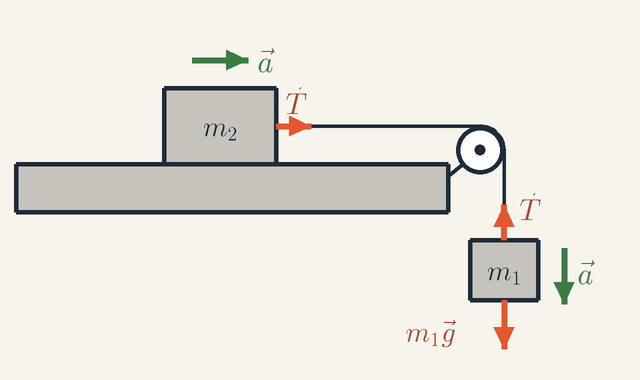
Here gravity takes the place of the animation's hand. The standard method for connected bodies applies: one free-body diagram per body (a sketch of that body alone with every force acting on it), plus a condition that links their motions.
Figure 4. The hanging block m1 pulls the block m2 across a frictionless table by a light string over a light pulley. Both have the acceleration a; the string pulls each with T, weaker than the weight m1g. The weight and normal force on m2 cancel and are not drawn.Legend
m1
The hanging block.
kg
m2
The block on the table.
kg
T
Force of the string on a block; its size T is the tension, the same at both ends of the string.
N
a
Acceleration, the same size for both blocks.
m/s2
m1g
Weight of the hanging block.
N
In Figure 4 the block m2=5kg lies on a frictionless table. A light string runs from it over a light, frictionless pulley to the hanging block m1=2kg. The weight of the hanging block is m1g=2⋅9.81=19.62N, almost the animation's 20 N push. Find the acceleration a and the string tension T.
Two facts link the blocks. The string keeps its length, so both blocks move through the same distance in the same time and share the acceleration a: to the right for m2, downwards for m1, as the two arrows labelled a show. And because the string and pulley are light and frictionless, the string pulls with the same force at both ends, the two arrows labelled T. Now take the direction of motion along the string as positive for each block. The sliding block has only T along its motion; its weight and the normal force cancel, so the figure leaves them out. The hanging block has its weight m1g downwards, along its motion, and T upwards, against it. The second law for each block reads m2a=T,m1a=m1g−T In numbers, 5a=T and 2a=19.62−T. Adding the two equations removes the unknown tension and leaves 7a=19.62, so a=m1+m2m1g=719.62≈2.80m/s2,T=m2a≈14.0N
Now read the result. Pushed by a hand with 20 N, the 5 kg block gained 4 m/s²; pulled by a 19.62 N weight, it gains only 2.80 m/s². The pulling force is almost the same, but it must now accelerate 7 kg, because the hanging block has to be accelerated too. The tension, 14.0 N, is less than the hanging weight, which is why the arrow T on the hanging block is shorter than m1g. The difference, m1g−T=m1a≈5.6N, is the net force that accelerates the hanging block; if tension and weight were equal, it could not accelerate at all. Three seconds after starting from rest, the blocks move at 2.80⋅3≈8.4m/s and have travelled 21⋅2.80⋅32≈12.6m.
Two checks. Substituting a into T=m2a gives T=m1m2g/(m1+m2), which is symmetric in the two masses. So if the blocks are swapped, with the 5 kg one hanging, the acceleration becomes a=49.05/7≈7.01m/s2, but the tension stays at about 14.0 N. And the limits make sense: when the hanging mass is much the larger, a→g and it almost falls freely; when it is tiny, a→0 and the tension approaches the hanging block's own weight, as if it simply hung at rest.
Limits of validity
Newton's laws, as stated here, describe point bodies, or the centres of mass of extended ones, in inertial frames, at speeds far below the speed of light and on scales far above atoms. Each condition marks a boundary.
The rotation of an extended body needs a law of its own, with torque in place of force and moment of inertia in place of mass. Contact forces such as tension and the normal force are themselves the averaged effect of countless electric forces between atoms; Newton's laws take them as given rather than explain them.
At high speed F=dp/dt survives, but the momentum becomes p=γmv, with the Lorentz factor γ=1/1−v2/c2 and c the speed of light. A constant force acting from rest still gives p=Ft; solving γmv=Ft for v gives v=1+(Ft/(mc))2Ft/m which approaches c but never reaches it. Keep pushing the 2 kg block with 20 N. The Newtonian answer v=Ft/m would reach c≈3.00×10⁸m/s after about 347 days; at that moment Ft/(mc)=1, so the true speed is only c/2≈0.71c. At the animation's 30 m/s the relativistic correction is of order v2/c2≈10−14, far below anything measurable.
On atomic scales a particle has no sharp trajectory, and quantum mechanics replaces F=ma. Newton's law returns as the law for the average motion of large bodies.
Where this leads
Most of classical mechanics is the second law plus a force law. Friction and Inclined Planes adds the forces of rough surfaces; Circular Motion studies the net force that only turns the velocity; Gravitation and Orbits brings the law of gravity that explains the planets. Added up over time and over distance, the laws become Momentum and Collisions and Work, Energy and Power. Applied to turning bodies they give Rotational Dynamics and Torque; with a spring force, Simple Harmonic Motion; with a force that grows with speed, Drag and Terminal Velocity. At high speeds they give way to Special Relativity, and the equality of inertial and gravitational mass opens Gravity as Curved Spacetime.
Key formulas
First law (law of inertia)
∑F=0⇔v=const
If the forces on a body balance, its velocity stays constant in size and direction; being at rest is the case v=0. The converse also holds: a body moving at constant velocity has zero net force on it, not necessarily no forces at all. The law also picks out the inertial frames, the frames in which it is true.
Symbols
∑F
net force, the vector sum of all forces on the body
N
v
velocity of the body
m/s
When it holds: Only in inertial frames, and for a point body or the centre of mass of an extended one. In an accelerating frame a free body seems to accelerate.
Example: A car cruising at a steady 20 m/s against 600 N of drag and rolling resistance has a driving force of exactly 600 N: the net force is zero.
Second law
∑F=ma
The net force on a body gives it an acceleration in the same direction, inversely proportional to its mass. It is a vector equation, so it holds separately along each axis: ∑Fx=max, ∑Fy=may. It also defines the newton: 1N=1kg⋅m/s2.
Symbols
∑F
net force on the body
N
m
mass of the body
kg
a
acceleration of the body
m/s2
When it holds: In inertial frames, for a body of constant mass at speeds far below the speed of light. Otherwise use F=dp/dt, with relativistic momentum at high speed.
Example: The animation's 20 N push gives the 2 kg block a=20/2=10m/s2 and the 5 kg block a=20/5=4m/s2.
Third law (action and reaction)
FAB=−FBA
Forces come from interactions, so they come in pairs: whatever A exerts on B is matched by a force of B on A, equal in size, opposite in direction and of the same kind. They act on different bodies and never cancel each other. Combined with the second law, the pair makes the total momentum of the two bodies constant.
Symbols
FAB
force exerted by body A on body B
N
FBA
force exerted by body B on body A
N
When it holds: Holds for contact forces, and for gravitational and electric forces between bodies at rest or moving slowly. It can fail for magnetic forces between moving charges, where the field carries momentum; momentum conservation still holds.
Example: In a crash, a 1000 kg car and a 6000 kg truck feel the same 30 kN, so the car accelerates at 30 m/s² and the truck at only 5 m/s².
Weight
W=mg
Weight is the gravitational force on a body: its mass times the local gravitational field strength g. It is a force in newtons that points downwards, and it changes from place to place while the mass stays the same. A scale actually measures the normal force, which equals the weight only when the scale does not accelerate vertically.
Symbols
W
weight, the gravitational force on the body
N
m
mass of the body
kg
g
gravitational field strength, 9.81m/s2 at the Earth's surface
m/s2
When it holds: Near the surface of a planet or moon, where g is nearly constant; far away use the law of gravitation, in which g falls off as 1/r2.
Example: A 70 kg astronaut: W=70⋅9.81≈687N on the Earth and 70⋅1.62≈113N on the Moon.
Force as the rate of change of momentum
F=dtdp
This is the general form of the second law: the net force equals how fast the momentum p=mv changes. For constant mass it reduces to F=ma. Integrated over time it says that the impulse of the force equals the change of momentum.
Symbols
F
net force on the body
N
p
momentum of the body, mv
kg⋅m/s
t
time
s
When it holds: In inertial frames; it stays true in special relativity with p=γmv. For a body that gains or loses mass, such as a rocket, apply it to a closed system that includes the mass that enters or leaves.
Example: 20 N acting for 3 s gives both of the animation's blocks the same momentum, 2⋅30=5⋅12=60kg⋅m/s.
Glossary
Force
A push or a pull that one body exerts on another, by contact or at a distance. It is a vector measured in newtons, 1N=1kg⋅m/s2.
Net force
The vector sum ∑F of all the forces acting on one body. Only the net force sets the acceleration: 30 N one way and 10 N the other give a net force of 20 N.
Inertia
The tendency of a body to keep its velocity, at rest or in motion, unless a net force acts on it. Mass measures it: the more massive the body, the smaller the acceleration a given force produces.
Inertial frame of reference
A frame in which a body with no net force on it moves at constant velocity, so that Newton's laws hold as written. A frame moving at constant velocity relative to an inertial one is inertial too; an accelerating or rotating frame is not.
Equilibrium
The state of a body on which the net force is zero, ∑F=0: it is at rest or moves at constant velocity. A car cruising at a steady 20 m/s is in equilibrium just as much as a parked one.
Weight
The gravitational force on a body, W=mg, directed downwards and measured in newtons. It changes from place to place (about six times smaller on the Moon), while the mass does not.
Normal force
The push of a surface on a body resting against it, perpendicular to the surface. It adjusts to what is needed: equal to mg for a body at rest on a level floor, larger in a lift accelerating upwards.
Tension
The pull of a stretched rope, string or cable, directed along it and away from the body it is attached to. A light string passes the same tension along its whole length.
Free-body diagram
A sketch of one body on its own with every force that acts on it, and only those. It is the starting point for writing ∑F=ma along each axis.
Third-law pair
The two forces of one interaction, A on B and B on A: equal in size, opposite in direction and of the same kind. They act on different bodies, so they never cancel each other.
Momentum
Mass times velocity, p=mv. The net force is its rate of change, and the total momentum of bodies that interact only with each other stays constant.
Pseudo-force
An apparent force, also called a fictitious force, −maframe, that must be added for Newton's laws to work in an accelerating frame. Nothing exerts it and it has no third-law partner; the centrifugal force is an example.
Quantities
F
Force
N
A push or pull on a body, with a size in newtons and a direction.
∑F
Net force
N
The vector sum of all the forces on one body. When it is zero the velocity is constant; otherwise it equals ma.
m
Mass
kg
The body's inertia, how hard it is to change its velocity. It is the same everywhere.
a
Acceleration
m/s2
The rate of change of velocity. It points along the net force and its size is the net force divided by the mass.
v
Velocity
m/s
The rate of change of position, with its direction. It stays constant whenever the net force is zero.
g
Free-fall acceleration
m/s2
The weight per kilogram, equal to the free-fall acceleration: about 9.81m/s2 (N/kg) at the Earth's surface and 1.62m/s2 on the Moon.
N
Normal force
N
The perpendicular push of a surface on a body. On a level surface it equals mg only if no other vertical force acts and the body does not accelerate vertically.
FAB
Force exerted by A on B
N
One force of an interaction; its third-law partner is the force of B on A, FBA=−FAB.
p
Momentum
kg⋅m/s
Mass times velocity, mv. The net force equals its rate of change.
aframe
Acceleration of the frame
m/s2
The acceleration of a non-inertial frame relative to an inertial one. Seen from that frame, every body seems to feel the extra force −maframe.
Quiz
Beginner A net (total) force of 12 N acts on a 3 kg ball. What is its acceleration?
4 m/s²
36 m/s²
0.25 m/s²
15 m/s²
Show answer
Answer: A. 4 m/s²
Newton's second law: a = F ÷ m = 12 ÷ 3 = 4 m/s².
Beginner A puck slides on ice with no friction and no other horizontal force. What happens to it?
It keeps moving at a constant velocity
It gradually slows down and stops
It gradually speeds up
It stops at once
Show answer
Answer: A. It keeps moving at a constant velocity
With zero net force there is no acceleration (first law), so the velocity stays the same.
Beginner A small car and a big truck collide head-on. Which one feels the larger force?
Both feel forces of exactly the same size
The truck, because it is bigger
The car, because it is lighter
Whichever one was moving faster
Show answer
Answer: A. Both feel forces of exactly the same size
Third law: the car pushes on the truck exactly as hard as the truck pushes on the car. The car is damaged more because the same force gives its smaller mass a much bigger acceleration (a = F ÷ m).
Intermediate An astronaut with a mass of 70 kg travels to the Moon. What changes?
Her weight decreases, her mass stays 70 kg
Her mass and weight both decrease
Her mass decreases, her weight stays the same
Nothing changes
Show answer
Answer: A. Her weight decreases, her mass stays 70 kg
Mass measures inertia and is the same everywhere. Weight W = m·g depends on the local gravity, which is weaker on the Moon.
Intermediate A car moves at a constant 20 m/s on a straight, level road. Air drag and rolling resistance on it total 600 N. How large is the forward driving force?
Exactly 600 N
More than 600 N, or the car would slow down
0 N, because the car is not accelerating
It depends on the car's mass
Show answer
Answer: A. Exactly 600 N
Constant velocity means zero acceleration, so the net force is zero (first law): the driving force exactly balances the 600 N of resistance. A larger force would speed the car up. Steady motion needs no net force.
Intermediate A book rests on a table. Which force is the third-law partner of the book's weight?
The book's gravitational pull on the Earth
The table's normal force on the book
The book's push on the table
None, because the book is at rest
Show answer
Answer: A. The book's gravitational pull on the Earth
The weight is the Earth pulling the book, so its partner is the book pulling the Earth. The normal force balances the weight, but both act on the book, so they are not a pair.
Advanced A horse pulls a cart, and the cart pulls back on the horse with an equal force. Why can they still accelerate?
The two forces act on different bodies, so they don't cancel
The horse pulls slightly harder than the cart pulls back
Action–reaction pairs only cancel when objects are at rest
The reaction appears a moment after the action
Show answer
Answer: A. The two forces act on different bodies, so they don't cancel
Forces cancel only on the same body. Each body accelerates according to the net force on it: the cart because the pull beats friction, the horse because the ground's push beats the cart's pull.
Advanced In a car braking hard, a passenger seems to be thrown forward. In the car's frame, how is this described?
By a fictitious force, because the car's frame is not inertial
By a real forward force from the seat
By the third-law reaction to the brakes
By an increase in the passenger's mass
Show answer
Answer: A. By a fictitious force, because the car's frame is not inertial
The braking car is an accelerating frame, so a fictitious force −m·a_frame appears. In the ground frame, the passenger simply keeps moving while the car slows.
 Physics Tutor