Springs and pendulums: a restoring force proportional to the displacement, F=−kx, gives a steady oscillation x=Acos(ωt+φ) whose period does not depend on the amplitude.
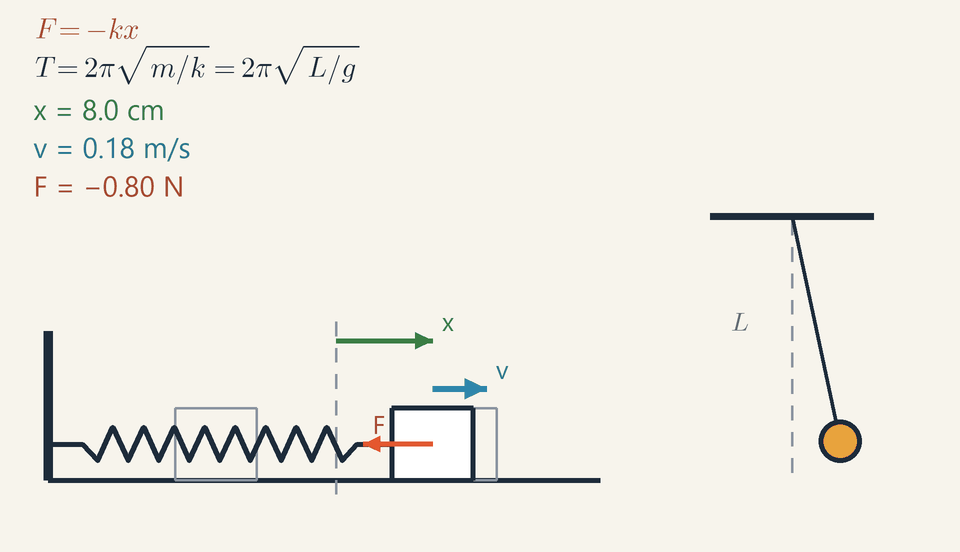
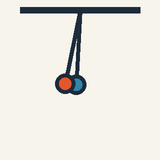
A mass on a spring and a pendulum with the same period oscillate in step. The velocity arrow is longest as each passes the centre and shrinks to zero at the turning points.
Pull an object away from its resting spot and a restoring push or pull drives it back, so it moves to and fro.
It moves fastest as it passes the middle and stops for an instant at each end before turning back.
The period is the time for one full back-and-forth; the frequency is the number of swings per second.
A heavier mass or a softer spring swings more slowly; for a pendulum only the length matters: longer means slower.
Pulling it farther does not change the period, as long as a pendulum's swings stay small.
A child on a swing, a weight bobbing on a spring, a plucked guitar string: each moves to and fro around a resting position.
Step 1. Pull and let go. Move the object away from its resting spot and something pulls it back: the spring, or gravity for a swing. It overshoots the middle, stops and returns. When the pull back grows in step with the distance (twice as far, twice the pull), the motion is called simple harmonic motion.
Step 2. Fast in the middle, stopped at the ends. The object is fastest as it passes the centre and stops for an instant at each end before turning back. Its energy keeps changing form: all motion energy in the middle, all stored energy (in the stretched spring, or as height for a swing) at the ends.
Step 3. Period and frequency. The time for one full back-and-forth is the period. A grandfather clock's pendulum has a period of about 2 seconds. The frequency is the number of swings per second, so frequency = 1 ÷ period: here half a swing per second.
Step 4. What sets the rhythm? A heavier mass on a spring swings more slowly; a stiffer spring makes it faster. For a pendulum only the length matters (and gravity): a longer pendulum ticks more slowly, and four times the length gives twice the period. The weight of the bob makes no difference.
Check yourself: you release a pendulum from a little farther out, but the swing is still small. Does its period change? (No: it has farther to go, but it moves faster.)
In the animation, a spring and a pendulum keep exactly the same rhythm. Watch the blue speed arrow: longest as the object passes the centre ("fastest"), shrinking to nothing at each end ("turns back").
Intermediate
Key ideas
SHM needs a linear restoring force F=−kx; then x(t)=Acos(ωt+φ) with ω=k/m.
T=2πm/k for a spring and T=2πL/g for a small-angle pendulum; f=1/T.
T does not depend on the amplitude: a bigger swing means a bigger force and higher speeds.
Force and acceleration are largest at the turning points, where v=0, and zero at the centre, where v is largest.
Energy 21kA2 is all potential at the ends and all kinetic at the centre, where vmax=Aω.
What oscillates, and how we measure it
A block pulled farther from its resting place has farther to travel, yet it takes no longer to come back. Every oscillator has an equilibrium position, where it could rest with no net force on it: the dashed line for the block in the animation, the vertical for the pendulum. The displacement x is measured from there, with a sign: x=+10cm on one side, x=−10cm on the other. Its largest value is the amplitude A. At the turning points, x=±A, the body stops for an instant and comes back.
One full cycle, out, across and back, takes the period T, in seconds. The frequency f=1/T counts cycles per second, in hertz (Hz). The equations use the angular frequency ω=2πf=2π/T, in radians per second, which counts a cycle as one turn of 2π radians.
A restoring force gives a cosine
Pull a block on a spring aside and the spring pulls it back with a force proportional to the displacement: F=−kx The spring constant k, in newtons per metre, measures the stiffness; the minus sign says that the force points back towards equilibrium. Newton's second law gives a=−(k/m)x, an acceleration proportional to the displacement and opposite to it. This is simple harmonic motion, and its position follows a cosine: x(t)=Acos(ωt+φ)
The phase constant φ says where in the cycle the clock was started; a release from rest at x=+A, as in the animation, has φ=0. A cosine motion has the acceleration −ω2x, so it fits the spring only if ω2=k/m. The spring and the mass alone set the rhythm:
ω=mk
T=2πkm
f=T1
The amplitude appears nowhere here. Double it, and at each stage of the trip the block is twice as far out, feels twice the force and moves twice as fast: twice the path at twice the speed takes the same time. This is isochronism, which made pendulum clocks possible. The amplitude does set the top speed, vmax=Aω at the centre, and the largest acceleration, amax=ω2A at the turning points.
The pendulum: gravity plays the spring
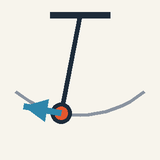
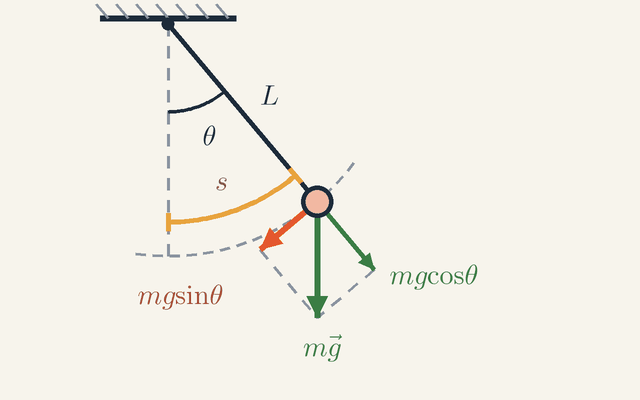
A simple pendulum is a small bob on a light string of length L. Its restoring force is the part of gravity along the arc, mgsinθ, where θ is the angle from the vertical. For small angles sinθ≈θ (in radians) and the arc length is s=Lθ, so the force is −(mg/L)s: a spring with k=mg/L. In the spring formula the mass cancels: T=2πgL
A heavier bob is pulled harder in exact proportion to its greater inertia, so only L and g matter: four times the length gives twice the period, and on the Moon, where g is about six times smaller, its period is 6≈2.45 times longer. At the animation's 15° the true period is only 0.4 % longer.
A spring hung vertically keeps the period of a horizontal one: gravity only lowers the equilibrium by the static stretch d=mg/k. Since m/k=d/g, the period is also 2πd/g: a hanging mass bounces like a pendulum as long as the spring's static stretch.
Reading the arrows, and where the energy is
The intermediate view adds three arrows. The green x arrow runs from the dashed centre line to the block. The red F arrow always points the opposite way, longest at the turning points and absent at the centre. The blue v arrow is a quarter of a cycle out of step: zero at the turning points, longest at the centre, reversing twice per cycle.
Energy explains the pattern. At a turning point all of it is stored in the spring, 21kA2; at the centre all of it is kinetic. In between, the shares change but their sum does not: 21mv2+21kx2=21kA2 Setting x=0 gives the top speed, vmax=Ak/m=Aω.
Because the stored energy grows as x2, the shares are uneven: halfway out, at x=A/2, the spring holds only a quarter of the energy, and the block still has 3/2, about 87 %, of its top speed. From a turning point it needs a sixth of a period to cover the first half of the way in, and a twelfth for the second.
Worked example: the oscillators in the animation
The block has m=1kg, the spring has k=10N/m, and the block is released from rest at A=10cm. Then ω=k/m=10≈3.16rad/s T=2π/ω≈1.99s,f=1/T≈0.50Hz vmax=Aω=0.10⋅3.16≈0.32m/s,Fmax=kA=10⋅0.10=1.0N
These are the extremes of the readouts: x swings between +10 and −10cm, v between +0.32 and −0.32m/s, and F between −1.00 and +1.00N, with F=−1.00N exactly when x reads +10cm. The largest acceleration is 1.0N/1kg=1.0m/s2, and the energy is 21⋅10⋅0.102=0.05J, the same as 21⋅1⋅0.3162 at the centre.
The pendulum beside it has L=g/ω2=9.81/10≈0.98m, so 2πL/g is the same 1.99 s and the two stay in step. The length is no accident: g/ω2=mg/k is also the static stretch this spring would get from the 1 kg block hanging on it. Released at 15° (0.262 rad), the bob swings Lθ0≈0.26m along its arc to either side and passes the bottom at about ωLθ0≈0.81m/s.
Worked example: a car on its springs
A 1200 kg car body sinks 1.0 cm on its springs when an 80 kg passenger gets in. At what rhythm does the loaded car bounce after a bump?
Treat the four springs as one. The passenger's weight, 80⋅9.81=784.8N, compresses it by 0.010 m, so k=784.8/0.010=78480N/m. With 1280 kg on board: T=2πkm=2π784801280≈0.80s that is, about 1.25 bounces per second.
The static-stretch rule checks it: the full 1280 kg compresses the springs by d=mg/k=0.16m, and 2π0.16/9.81≈0.80s again. Suspensions are typically tuned to 1 to 1.5 Hz, which passengers find comfortable; shock absorbers then stop the bounce from going on after every bump.
Common mistakes
Where the block stops, the force is not zero: at a turning point the force and acceleration are largest, 1.0 N and 1.0 m/s² for the animation's block, and at the centre they vanish.
A bigger swing does not take longer: doubling the animation's amplitude to 20 cm leaves the period at 1.99 s, while the top speed doubles to 0.63 m/s.
Keep the 2π, and do not mix hertz with radians per second: for 0.2 kg on an 80 N/m spring, m/k=0.05s, but T≈0.31s, f≈3.2Hz and ω=20rad/s.
A pendulum's period depends neither on the bob's mass nor, for small swings, on the amplitude; released from 60°, though, it takes about 7 % longer than the formula says.
Measure x from the equilibrium position, not from the end of the relaxed spring; for a hanging spring that position is mg/k lower, and then gravity drops out.
Where you meet it
Pendulum clocks rely on isochronism: a seconds pendulum, 1 s per swing and 2 s per cycle, is g/π2≈0.994m long, almost the animation's pendulum. A quartz watch counts the 32 768 vibrations per second of a tiny quartz tuning fork; car suspensions, swaying towers and the atoms of a solid oscillate in a nearly simple harmonic way. Damping and Resonance adds friction and periodic pushes, and Wave Basics shows how coupled oscillators carry a wave.
Advanced
Key ideas
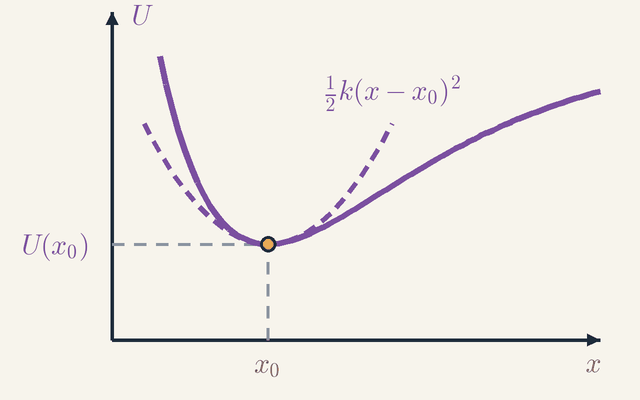
x¨=−ω2x: the acceleration is always the mirror image of the displacement; near any minimum of U, k=U′′(x0).
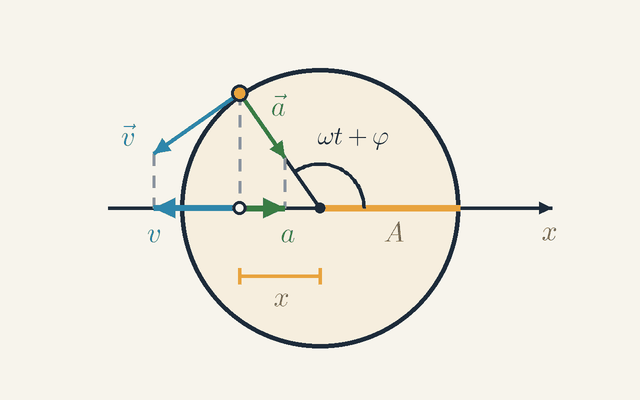
SHM is uniform circular motion seen edge-on: x=Acosωt is the shadow of a point circling at angular speed ω.
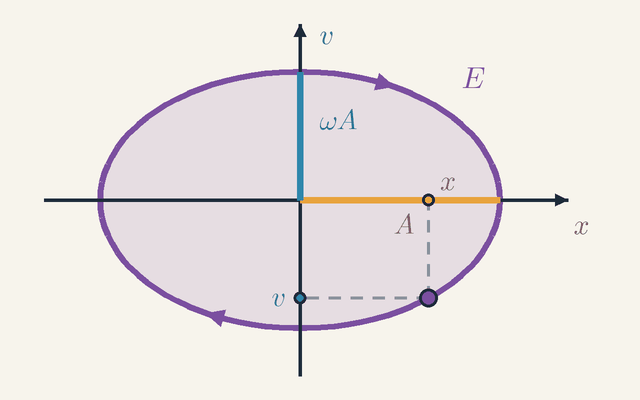
Phase portrait: x2/A2+v2/(Aω)2=1, an ellipse traced once per period, whatever the amplitude.
The pendulum equation θ¨=−(g/L)sinθ is SHM only for small θ; T is about 7 % longer at 60°.
Damping −bx˙ makes the amplitude decay; driving near ω0 gives resonance, sharper for weaker damping.
One equation behind many oscillators
This lesson is about a single equation and the reason it turns up all over physics. Start with the simplest case: a block of mass m on a frictionless floor, fixed to a spring of stiffness k. Let x be the block's displacement from the point where the spring is relaxed, and write x¨ for its acceleration, the second derivative of x with respect to time.
The spring pulls back with the force −kx (Hooke's law): it always points towards the centre and grows in proportion to the displacement. Newton's second law then reads mx¨=−kx. Dividing by m and naming the ratio k/m gives x¨=−ω2x,ω2=mk In words: the acceleration is the displacement reversed and scaled by ω2. The constant ω has the unit of an inverse time; it will turn out to be the angular frequency of the motion, in radians per second.
What earns this equation a whole lesson is not the spring but its form. It is linear: x and its derivatives appear only to the first power, never squared or multiplied together. It is of second order: the highest derivative is the second. And its coefficients are constant. Any system whose equation has this form moves in the same way, whatever it is made of: the charge on a capacitor discharging through a coil, the quartz crystal of a watch, the stretching vibration of a molecule, a ship rolling in calm water and the atoms of a crystal through which sound passes. The next section shows why so many systems end up with it.
Why small oscillations are harmonic
Real restoring forces are rarely exactly proportional to the displacement. This section shows why that does not matter for small oscillations: near any stable equilibrium, every smooth force law looks like Hooke's law, so the system obeys the equation above. That is what "harmonic" means here: a motion governed by x¨=−ω2x.
Figure 1. A sketch of a potential energy U with a stable minimum at x0. Close to the minimum the dashed parabola, which rises above U(x0) by 21k(x−x0)2 with k=U′′(x0), follows U closely; farther out the two part ways.Legend
x
Position of the system along its line of motion.
m
U
Potential energy of the system.
J
x0
Position of the stable equilibrium, where U is lowest.
m
U(x0)
Value of U at the minimum.
J
21k(x−x0)2
Height of the dashed parabola above U(x0): the harmonic approximation of U, with k=U′′(x0).
J
Figure 1 sketches the potential energy U of some system against its position x. The bottom of the well, at x0, is a stable equilibrium: move the system either way and U rises, so the force, which always points downhill on this curve, pushes it back. Look first at the dot, where the solid curve U and the dashed parabola touch. Close to it the two are hard to tell apart. Farther out they part ways: on the left the real curve climbs more steeply than the parabola, and on the right it flattens out below it.
The parabola fits because of the Taylor expansion of U about x0. Its first term is the constant U(x0). Its linear term, U′(x0)(x−x0), vanishes, because the slope of the curve is zero at a minimum. So the first term that changes with x is the quadratic one: U(x)≈U(x0)+21U′′(x0)(x−x0)2 This is the dashed parabola, with k=U′′(x0); the label 21k(x−x0)2 in Figure 1 is how far it rises above U(x0). The force is minus the slope of U, so near the minimum it is −dU/dx=−U′′(x0)(x−x0): Hooke's law, with the equilibrium x0 in place of the relaxed spring. At a minimum U′′(x0)>0, so k is positive and the force really does pull back.
The pendulum shows the recipe at work. A bob of mass m on a string of length L, swung out by the angle θ, rises by L(1−cosθ), so its potential energy is mgL(1−cosθ), where g is the acceleration of free fall. For small angles cosθ≈1−21θ2, so U≈21mgLθ2: a parabola in θ, with the angular stiffness mgL in place of k. What resists turning is the moment of inertia mL2, in place of m, so ω2=mgL/(mL2)=g/L. The conclusion is general: small oscillations about any minimum with U′′(x0)>0 are harmonic, and only their frequency depends on the system.
The general solution and its two constants
Now solve the equation. The aim is a formula for x(t) that covers every possible start, and a clear count of what the start can change.
Which functions come back as themselves, times a negative constant, when differentiated twice? The cosine and the sine: d2(cosωt)/dt2=−ω2cosωt, and the same holds for sinωt. Because the equation is linear, a sum of solutions, each multiplied by any constant, is again a solution. A second-order equation leaves exactly two constants free: one for the starting position and one for the starting velocity. Write x0 and v0 for the position and velocity at t=0 (from here on, x0 is a starting position, and the equilibrium is at x=0). Then x(t)=x0cosωt+ωv0sinωt=Acos(ωt+φ) The first form is easy to check: at t=0 it gives x0, and its derivative there gives v0. The second form merges the two terms into one cosine with the amplitude A, the largest displacement, and the phase constant φ, which says where in the cycle the clock was started. Expanding Acos(ωt+φ)=Acosφcosωt−Asinφsinωt and matching terms gives Acosφ=x0 and −Asinφ=v0/ω, so A=x02+(v0/ω)2,tanφ=−v0/(ωx0) The division of labour is clean: the equation fixes ω; the start fixes A and φ.
The animation's block makes this concrete. It has m=1kg and k=10N/m, so ω=10≈3.16rad/s and the period is T=2π/ω≈1.99s. It is released from rest at x0=A=0.10m, so v0=0, φ=0 and x=Acosωt. Differentiating once gives the velocity, v=−Aωsinωt, which is the same as Aωcos(ωt+π/2): the velocity is the displacement curve shifted a quarter period earlier, so it leads the displacement by a quarter period. Differentiating again gives the acceleration a=−ω2x, half a period away from the displacement, in antiphase: largest where x is largest, but pointing the other way.
Linearity also proves isochronism, the fact that the period does not depend on the amplitude, in one line. If x(t) is a solution, so is λx(t) for any constant λ, because multiplying both sides of x¨=−ω2x by λ changes nothing. The stretched copy swings λ times as far with exactly the same timing, so a large swing and a small one take the same time.
A compact way to carry both constants is a complex number. Write x as the real part of Ceiωt, with the complex amplitude C=Aeiφ; the real part of Aei(ωt+φ) is indeed Acos(ωt+φ). The gain is that each time derivative of eiωt simply multiplies it by iω. The equation becomes (iω)2C=−ω2C, which holds for every C: the differential equation has turned into algebra. This shortcut is what makes damped and driven oscillators manageable.
The reference circle
Simple harmonic motion has a geometric twin: uniform motion round a circle. The twin explains why the phase is an angle and why ω is measured in radians per second, and it gives the velocity and the acceleration without any calculus.
Figure 2. A point turns counter-clockwise on a circle of radius A at angular speed ω. Its shadow on the horizontal diameter, at x, moves like the block: its v and a are the horizontal parts of v and a, and a=−ω2x. Arrow lengths are not to scale.Legend
A
Radius of the circle: the amplitude of the shadow's motion.
m
ωt+φ
Phase: the angle the radius has turned from the positive x direction.
rad
x
Position of the shadow, measured from the centre (negative here).
m
v
Velocity of the point: tangent to the circle, of size ωA.
m/s
a
Acceleration of the point: towards the centre, of size ω2A.
m/s2
v
Velocity of the shadow: the horizontal part of v.
m/s
a
Acceleration of the shadow: the horizontal part of a, equal to −ω2x.
m/s2
Figure 2 draws the reference circle. A point travels round a circle of radius A, counter-clockwise, at the constant angular speed ω. After a time t its radius has turned through the angle ωt+φ, measured from the positive x direction; in the figure this is a little more than a quarter turn, so the point is at the upper left. Drop the dashed line from the point straight down onto the horizontal diameter. Its foot, the point's shadow (the open circle), is at x=Acos(ωt+φ) from the centre: exactly the position of the block.
Now the velocity. The point's velocity v is tangent to the circle and has size ωA, because the point covers an arc of length A for every radian it turns. The shadow moves only along the diameter, so its velocity v is the horizontal part of v: v=−ωAsin(ωt+φ). In the figure v points down and to the left, so v points left.
Then the acceleration. The point moves at constant speed on a circle, so its acceleration a is centripetal: it points to the centre and has size ω2A. Its horizontal part is the shadow's acceleration: a=−ω2Acos(ωt+φ)=−ω2x In the figure x is negative, so a points right, towards the centre, while the shadow still moves left: it is slowing down as it nears its turning point at −A.
The shadow therefore obeys the equation of this lesson and moves exactly like the block. Simple harmonic motion is uniform circular motion seen edge-on. That is why the phase ωt+φ is an angle and why ω, the angular speed of the point, is measured in radians per second. It is also the picture behind the complex number of the last section: Ceiωt is the turning point drawn in the complex plane, and x is its shadow on the real axis.
The phase ellipse
The reference circle follows the motion in space. A second picture follows the state of the oscillator: its position and velocity together, which are all that is needed to predict the rest of the motion. In this picture energy conservation becomes a shape.
Figure 3. The phase portrait: the point (x,v) runs clockwise round an ellipse with semi-axes A and ωA, one lap per period. Every point of the ellipse has the same energy E. The dot is one instant; the dashed lines read off its x and v. Axis scales are arbitrary.Legend
x
Position, on the horizontal axis.
m
v
Velocity, on the vertical axis.
m/s
A
Amplitude, the largest x: the semi-axis along x.
m
ωA
Largest speed: the semi-axis along v.
m/s
E
Total energy 21mv2+21kx2, the same all along the ellipse.
J
Figure 3 plots the velocity v upwards against the position x across. Each instant of the motion is one point (x,v); as time passes the point moves and traces a closed curve, the phase portrait. Since x=Acosωt and v=−ωAsinωt, that curve is an ellipse. Energy conservation gives its equation directly: 21mv2+21kx2=E, and dividing both sides by E=21kA2=21mω2A2 gives A2x2+(Aω)2v2=1
The semi-axes are A along x and ωA along v. The first is the largest displacement, where all the energy is in the spring; the second is the largest speed, where all of it is in the block. For the animation's block they are 0.10 m and 0.32 m/s. Every point of the ellipse has the same energy E, which is why the figure labels the curve itself E; a larger energy would give a larger ellipse of the same shape.
Now follow the motion round. The point starts at the right-hand end of the ellipse, (A,0), and runs clockwise, one lap per period. The direction is forced: in the upper half v>0, so x grows and the point moves right; in the lower half v<0, so it moves left. The dot in Figure 3 is one instant, at the lower right: the block is still on the positive side but already moving back. The dashed lines read its x and v off the axes. Plot v/ω upwards instead of v and both semi-axes become A: the ellipse turns back into the reference circle.
The expert layer of the animation shows this ellipse beside the graph of x(t), a cosine between ±10cm. The slope of that graph is v, and its curvature follows a=−ω2x, so the curve always bends towards the time axis: most sharply at the peaks and troughs, where ∣x∣ is largest, and not at all where it crosses zero.
Two deeper facts follow from the ellipse. First, over a cycle sin2 and cos2 both average to 21, so the mean kinetic and mean potential energies are equal, each E/2. For the block E=21⋅10⋅0.102=0.050J, so each averages 0.025J.
Second, draw the ellipse with the momentum p=mv upwards instead of v. Its semi-axes are then A and mAω, and its area is πA⋅mAω=2πE/ω, about 0.099Js here. This area is an adiabatic invariant, a quantity that stays fixed when the system is changed slowly: when k or L changes slowly compared with the period, the area, and so E/ω, stays constant. Shorten a pendulum's string gradually and its energy rises in proportion to its frequency.
In the early quantum theory this area was set equal to a whole number of Planck constants h; the full theory gives the energy levels E=(n+21)ℏω, with ℏ=h/2π and n a whole number from 0 upwards.
Beyond the ideal oscillator
Real oscillators are only approximately ideal. The pendulum is the clearest case, because its exact equation can be written down and compared with the harmonic one.
Figure 4. A pendulum of length L pulled aside by θ. Its weight splits into mgcosθ along the string and mgsinθ along the path, towards the lowest point; only the second restores. The bob is the arc length s=Lθ from the lowest point. Arrow lengths are not to scale.Legend
L
Length of the string, from the pivot to the bob.
m
θ
Angle between the string and the vertical.
rad
s
Length of the path from the lowest point to the bob: s=Lθ.
m
mg
Weight of the bob, pulling straight down.
N
mgsinθ
Part of the weight along the path, towards the lowest point: the restoring force.
N
mgcosθ
Part of the weight along the string, away from the pivot; it cannot change the speed.
N
Figure 4 shows the pendulum mid-swing. The bob hangs on a string of length L and has been pulled aside by the angle θ from the vertical, so it is a path length s=Lθ along the arc from the lowest point. Its weight mg, straight down, splits into two parts at right angles. The part mgcosθ points along the string, away from the pivot. It has no component along the path, so it cannot speed the bob up or slow it down; the tension in the string acts along the same line. The part mgsinθ points along the path, towards the lowest point. Only this part restores.
The exact equation comes from turning about the pivot. The restoring force mgsinθ acts at the lever arm L, so its torque is −mgLsinθ. The bob's moment of inertia about the pivot is mL2, and torque equals moment of inertia times angular acceleration. Dividing by mL2: θ¨=−Lgsinθ For small angles sinθ≈θ (in radians), and the restoring force mgsinθ is close to mgθ=(mg/L)s. That is Hooke's law once more, for the displacement s along the arc, with k=mg/L and ω2=k/m=g/L, as found from the energy in the second section.
The pendulum is harmonic only approximately. Since sinθ<θ for every positive angle, the true restoring torque falls short of the linear one: the bob is pulled back more weakly than the harmonic law says and takes longer to return. The period therefore grows with the amplitude θ0, roughly as 2πL/g(1+θ02/16) for moderate swings. The excess over 2πL/g is 0.19 % at 10°, 0.43 % at the animation's 15°, 7.3 % at 60° and 18 % at 90°, and it grows without limit as the release point approaches the upside-down position at 180°. The last two values come from the exact period; the short formula already falls below them.
This growth of the period with the amplitude is why clockmakers keep the swing small. Christiaan Huygens published an exact cure in 1673: a bob guided along a cycloid instead of a circular arc has a period that does not depend on the amplitude at all.
Other departures from the ideal are just as concrete. A spring's own mass ms moves too: its coils near the block move almost as fast as the block, those near the fixed end hardly at all, and on balance they add about ms/3 to the oscillating mass. A rigid body swinging about a pivot at a distance d from its centre of mass is a physical pendulum, with T=2πI/(mgd), where I is its moment of inertia about the pivot; for a point bob, I=mL2 and d=L, and the formula returns 2πL/g.
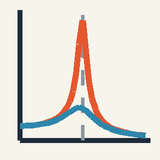
A friction force proportional to the velocity, −bx˙ with x˙ the velocity and b a constant, makes the amplitude decay as e−bt/(2m). And a periodic push at a frequency close to ω builds up a large response, resonance, which is sharper the weaker the damping.
Worked problem: putty lands on the block
This problem tests the division of labour found above: the equation fixes ω, and the state at the start fixes the amplitude. A sudden event changes both the mass and the starting state, and the outcome depends on when it happens.
As the animation's block (m=1kg, k=10N/m, A=0.10m) passes the centre at its top speed, Aω≈0.32m/s, a 1 kg lump of putty is dropped onto it from just above and sticks. What are the new period and amplitude? And what changes if the lump lands at a turning point instead?
First, the collision. The floor and gravity act vertically, so during the brief impact no horizontal force acts and the horizontal momentum is conserved. The putty brings none, so 1⋅0.316=2v′, which gives v′=0.158m/s. The impact is so short that the block has not moved: it is still at x0=0.
Second, the new frequency. The spring is unchanged but the mass has doubled, so ω′=10/2≈2.24rad/s and T′=2π/ω′≈2.81s, longer by a factor 2.
Third, the new amplitude. The motion restarts from x0=0 with the speed v′, so the formula for the amplitude gives A′=x02+(ω′v′)2=2.240.158≈0.071m The block now swings only 7.1 cm out, A/2, and the energy has dropped from 0.050 J to 21⋅10⋅0.0712=0.025J. Half of it was lost in the collision, as always when a moving body sticks to an equal one at rest: the pair moves at half the speed with twice the mass, so it has half the kinetic energy.
If the lump lands at a turning point, the block is momentarily at rest, so there is no velocity to share and no energy is lost. The block restarts from rest at x0=0.10m: the amplitude stays 10 cm and the energy 0.05 J. The period is again 2.81 s, because it depends only on k and the new mass, but the top speed falls to Aω′≈0.22m/s. The same impact either shrinks the amplitude or leaves it alone, depending on the phase at which it happens, while the period responds only to the mass.
Limits of validity
Every model has a range where it works. The harmonic oscillator has two limits: one at large displacements, where Hooke's law fails, and one at very small energy steps, where quantum mechanics takes over.
Hooke's law is only the first term of the Taylor expansion of U, so it holds only for small displacements. Steel wire stays linear only up to a strain, its fractional stretch, of a fraction of a percent. A coil spring made from that wire can still stretch much further, because its wire mostly twists rather than stretches, and each short piece twists only a little. Beyond the linear range the higher terms of U come in. They make the period depend on the amplitude, as for the pendulum, and they add harmonics: components of the motion at whole multiples of ω. For the pendulum the measure of "small" is the angle: keeping the period within 1 % of 2πL/g requires θ0 below about 23°.
Quantum mechanics sets the other limit: an oscillator's energy can change only in steps of ℏω, where ℏ≈1.05×10⁻³⁴Js is the reduced Planck constant. For the animation's block, ℏω≈3.3×10⁻³⁴J against an energy of 0.05 J, a quantum number of about 1.5×1032, so the steps are far too small to see.
A molecule is different. Hydrogen chloride vibrates at ω≈5.4×10¹⁴rad/s, so ℏω≈0.36eV, about fourteen times the typical thermal energy kBT≈0.026eV at room temperature (here kB is the Boltzmann constant and T the absolute temperature). Collisions in the gas rarely carry enough energy to lift the molecule to its next level, so it stays in its ground state, with the zero-point energy 21ℏω, and its vibration adds almost nothing to the heat capacity of the gas.
Where this leads
The equation of this lesson is the starting point for much of the rest of the course. Add friction and a periodic drive and it becomes the one studied in Damping and Resonance, where the quality factor sets how long an oscillator rings and how sharp its resonance is. Couple many oscillators in a row and their motion travels as a wave, the subject of Wave Basics; in Standing Waves, each normal mode of a string is a simple harmonic motion with its own ω. The stiffness k comes from Elasticity: Hooke's Law, Stress and Strain, the reference circle from Circular Motion, and the same mathematics returns in Electromagnetic Waves and in the quantised oscillators of Blackbody Radiation and the Quantum.
Key formulas
Linear restoring force (Hooke's law)
F=−kx
A spring stretched or compressed by x pulls or pushes back with a force proportional to x; for a hanging spring, measuring x from the loaded equilibrium gives the same law for the net force. The minus sign is the whole point: the force always points towards equilibrium, so it brings the body back and makes it overshoot, which is oscillation. Any force of this form, not only a spring's, produces simple harmonic motion.
Symbols
F
restoring force on the body
N
k
spring constant (stiffness)
N/m
x
displacement from the equilibrium position
m
When it holds: For an ideal spring within its elastic limit, and for any system displaced only slightly from a stable equilibrium. Large stretches, or a pendulum's large angles, add non-linear terms.
Example: The animation's spring, k=10N/m, stretched by 10 cm: F=−10⋅0.10=−1.0N, pointing back towards the centre.
Position in simple harmonic motion
x(t)=Acos(ωt+φ)
The cosine solves a=−ω2x: twice differentiated, it returns itself times −ω2. The amplitude A sets the size of the swing, ω the rhythm and φ the starting point in the cycle; A and φ come from the initial position and velocity. Geometrically, x(t) is the shadow of a point moving round a circle of radius A at angular speed ω.
Symbols
x
displacement from equilibrium at time t
m
A
amplitude
m
ω
angular frequency
rad/s
t
time
s
φ
phase constant, the phase at t=0
rad
When it holds: For an undamped oscillator with a linear restoring force. With friction the amplitude decays; with a non-linear force the motion can still repeat, but it is no longer a pure cosine.
Example: The animation's block: x=0.10cos(3.16t) in metres, so at t=T/6≈0.33s it is at 5 cm, halfway in.
Angular frequency of a mass on a spring
ω=mk
Putting the cosine into Newton's law, ma=−kx, gives mω2=k. A stiffer spring pulls harder, so the mass speeds up and turns back sooner; a larger mass has more inertia and responds more slowly. The amplitude does not appear, which is why big and small swings keep the same rhythm.
Symbols
ω
angular frequency
rad/s
k
spring constant
N/m
m
oscillating mass
kg
When it holds: For a mass on an ideal, light spring; a spring of mass ms behaves roughly as if ms/3 were added to m. Hanging the spring vertically does not change ω.
Example:k=10N/m and m=1kg: ω=10≈3.16rad/s.
Period of a mass on a spring
T=2πkm
One cycle is one full turn of the phase, 2π radians, so T=2π/ω. Four times the mass doubles the period; four times the stiffness halves it. Since m/k equals the static stretch d divided by g, a hanging mass bounces with the period of a pendulum of length d.
Symbols
T
period of one full cycle
s
m
oscillating mass
kg
k
spring constant
N/m
When it holds: For a linear spring and weak damping. The period stays independent of the amplitude only while the spring stays linear.
Example: The animation's block: T=2π1/10≈1.99s; the loaded car of the worked example: 2π1280/78480≈0.80s.
Period of a simple pendulum (small swings)
T=2πgL
For small angles the part of gravity along the arc acts like a spring with k=mg/L, and in 2πm/k the mass cancels. It drops out because gravity's pull and the bob's inertia grow together. Four times the length gives twice the period.
Symbols
T
period of one full cycle
s
L
length from the pivot to the centre of the bob
m
g
free-fall acceleration
m/s2
When it holds: For a small bob on a light string and small swings: the true period is 0.4 % longer at 15° and about 7 % longer at 60°. A swinging rigid body needs the physical-pendulum formula 2πI/(mgd).
Example: The animation's pendulum, L=0.981m: T=2π0.981/9.81=2π0.1≈1.99s, in step with the block.
Frequency and period
f=T1
If one cycle takes T seconds, there are 1/T cycles every second. Frequency is measured in hertz, cycles per second; the angular frequency counts radians instead, ω=2πf.
Symbols
f
frequency
Hz
T
period
s
When it holds: Holds for any repeating motion, harmonic or not.
Example: The animation's period of 1.99 s gives f≈0.50Hz, about the same as a grandfather clock's pendulum with its 2 s cycle.
Glossary
Simple harmonic motion
Oscillation in which the acceleration is proportional to the displacement from equilibrium and opposite to it, a=−ω2x. The position then follows a cosine, and a system that moves this way is called a harmonic oscillator.
Equilibrium position
The position where the net force is zero, so the body could stay at rest. If the equilibrium is stable, a small displacement produces a force back towards it, and that is what makes oscillation possible.
Restoring force
A force that always points back towards equilibrium. When it is proportional to the displacement, F=−kx, as for an ideal spring (Hooke's law), the oscillation is simple harmonic.
Turning point
An end of the swing, x=±A, where the body stops for an instant and reverses. The speed is zero there, but the force and the acceleration are at their largest.
Frequency
The number of complete cycles per second, f=1/T, measured in hertz (1Hz=1s−1). Do not confuse it with the angular frequency ω=2πf: the animation's 0.50 Hz is 3.16 rad/s.
Phase of an oscillation
The angle ωt+φ inside the cosine, which says where in its cycle the oscillator is; it grows by 2π every period. Two oscillators are in phase when they reach the same turning point together, and in antiphase when they reach opposite turning points together.
Isochronism
The independence of the period from the amplitude. It is exact for simple harmonic motion and nearly true for a pendulum's small swings, which is why a free pendulum keeps almost the same rhythm while its swing slowly dies away.
Simple pendulum
A small bob on a light string of length L, swinging under gravity. For small angles its motion is simple harmonic, with T=2πL/g whatever the mass of the bob.
Small-angle approximation
Replacing sinθ by θ, with θ in radians, which turns the pendulum's equation into that of simple harmonic motion. The period it gives is 0.4 % too short at 15° and about 7 % too short at 60°.
Phase portrait
A graph of velocity against position, on which the whole history of an undamped oscillator is one closed curve; with damping it spirals in towards the origin. For simple harmonic motion it is the ellipse x2/A2+v2/(Aω)2=1, traced once per period.
Damping
The loss of an oscillator's energy to friction or air resistance, which makes the amplitude shrink. Light damping barely changes the period; a car's shock absorbers damp its bounce so strongly that it dies out within a cycle or two.
Resonance
The large response of an oscillator pushed by a periodic force at a frequency close to its own. The weaker the damping, the taller and narrower the peak: small pushes timed to a swing's rhythm build up a big swing.
Quantities
x
Displacement
m
Position measured from the equilibrium position, with a sign; for the block in the animation it swings between +10 and −10 cm.
A
Amplitude
m
The largest displacement, always positive. It is set by how the motion is started, not by the spring: the animation's block has A=10cm.
F
Restoring force
N
The force pulling the body back towards equilibrium, F=−kx; for the animation's block its size peaks at 1.0 N at the turning points.
k
Spring constant (stiffness)
N/m
The stiffness: the force needed per metre of stretch. A stiffer spring, with a larger k, gives a faster oscillation.
m
Mass
kg
The oscillating mass, a measure of inertia: a larger mass responds more slowly, so the period grows as m.
ω
Angular frequency
rad/s
The rate at which the phase ωt+φ advances with the time t (in seconds): ω=2πf=k/m; 3.16 rad/s for the animation's block.
φ
Phase constant
rad
The phase at t=0, fixed by where and how the motion starts; φ=0 for a release from rest at x=+A.
T
Period
s
The time for one full cycle, T=2π/ω; about 1.99 s in the animation.
L
Pendulum length
m
The distance from the pivot to the centre of the bob; the animation's pendulum has L≈0.98m.
g
Free-fall acceleration
m/s2
The acceleration of free fall, about 9.81 m/s² at the Earth's surface; for a pendulum, g/L plays the role of k/m.
Quiz
Beginner Where is a mass on a spring moving fastest?
At the equilibrium position
At the turning points
Halfway between the centre and a turning point
Its speed is the same everywhere
Show answer
Answer: A. At the equilibrium position
At the centre all the energy is kinetic, so the speed is greatest. At the turning points the mass stops for an instant.
Beginner A pendulum takes 2 s to swing from one side to the other and back again. What is its frequency?
2 Hz
1 Hz
0.5 Hz
4 Hz
Show answer
Answer: C. 0.5 Hz
One full cycle takes T = 2 s, so f = 1/T = 0.5 Hz.
Beginner A spring with k = 200 N/m is stretched by 0.1 m. How strong is the restoring force?
20 N
2000 N
10 N
0.0005 N
Show answer
Answer: A. 20 N
Hooke's law: |F| = kx = 200 × 0.1 = 20 N, pulling back towards equilibrium.
Intermediate You double the amplitude of a mass oscillating on a spring. What happens to the period?
It doubles
It stays the same
It halves
It increases by a factor of √2
Show answer
Answer: B. It stays the same
T = 2π√(m/k) contains no amplitude. A larger amplitude means a larger force and higher speeds, which exactly compensate for the longer path.
Intermediate A 0.5 kg mass hangs on a spring with k = 50 N/m. What is the period?
About 0.63 s
About 0.1 s
About 62.8 s
About 1.59 s
Show answer
Answer: A. About 0.63 s
T = 2π√(m/k) = 2π√(0.5/50) = 2π × 0.1 ≈ 0.63 s. 0.1 s forgets the 2π; 1.59 is the frequency in hertz, not the period.
Intermediate A pendulum clock is taken to the Moon, where g is about 6 times smaller. What happens to its period?
It becomes 6 times longer
It stays the same
It becomes about 2.45 times shorter
It becomes about 2.45 times longer
Show answer
Answer: D. It becomes about 2.45 times longer
T = 2π√(L/g). Dividing g by 6 multiplies T by √6 ≈ 2.45.
Advanced Which differential equation describes simple harmonic motion?
ẍ = −ω²x
ẍ = ω²x
ẋ = −ωx
ẍ = −ω²
Show answer
Answer: A. ẍ = −ω²x
Only ẍ = −ω²x has oscillating solutions x = A·cos(ωt + φ). ẍ = ω²x gives exponential growth, ẋ = −ωx exponential decay, and ẍ = −ω² constant acceleration.
Advanced A pendulum is released from 60° instead of 5°. How does its period compare with 2π√(L/g)?
It is exactly equal
It is noticeably shorter
It is noticeably longer
It is twelve times longer, since the amplitude is twelve times larger
Show answer
Answer: C. It is noticeably longer
The formula assumes sinθ ≈ θ. At 60°, sinθ is clearly smaller than θ, so the restoring torque is weaker than the linear model predicts and the period is about 7% longer.
 Physics Tutor