Why a passing siren drops in pitch: motion squeezes or stretches the waves that reach you, so a source approaching at vs is heard at f′=fv/(v−vs), where v is the speed of sound.
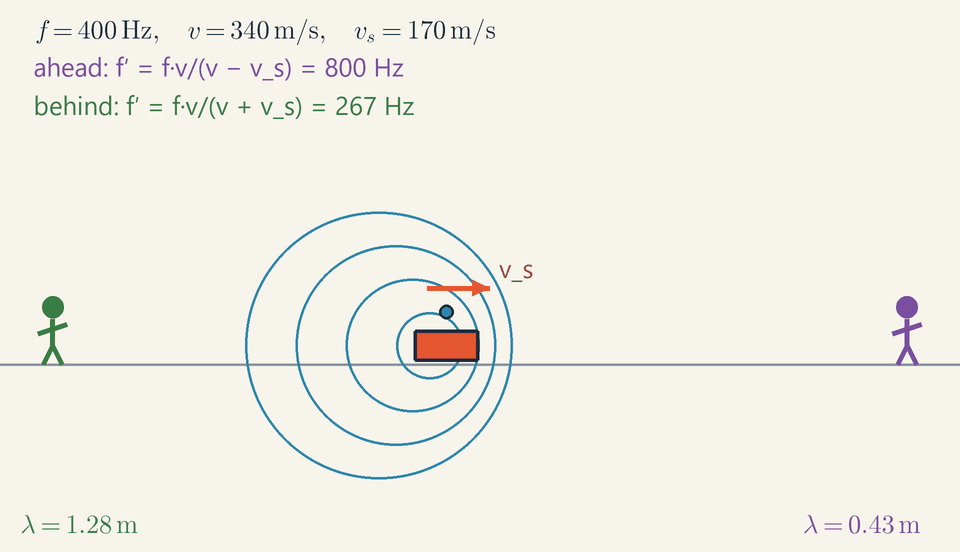
A siren moving at half the speed of sound emits circular wavefronts that bunch up in front of it and spread out behind it.
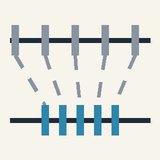
A moving siren squeezes its sound waves together in front and spreads them out behind.
Crests that arrive more often sound higher; crests that arrive less often sound lower.
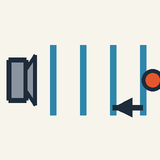
Moving towards a still source also raises the pitch: you meet its crests more often.
The pitch stays high while the siren approaches and low while it leaves; getting closer only makes it louder.
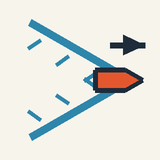
A source faster than its own waves leaves them piled up in a V behind it: a boat's bow wave, or a sonic boom in air.
Watch a duck paddle across a still pond. It makes new ripples all the time, but each one spreads from the spot where the duck was when it made it. Ahead of the duck the ripples crowd together; behind it they lie far apart. Sound from a moving siren does exactly the same in air, and that is what the blue rings in the animation show.
Your ear hears pitch as how often crests arrive. The listener in front gets crests close together, arriving often, so the siren sounds higher. The listener behind gets them spread out and arriving rarely, so it sounds lower. The siren itself never changes its note: the driver hears it normally all the time. This change of pitch caused by motion is the Doppler effect.
It works the other way round too. Run towards a still bell and you meet its crests sooner than if you stood still, so the note sounds slightly higher; run away and it drops.
Two mistakes are common. The pitch does not keep rising as the ambulance comes nearer: it stays high the whole time it approaches, stays low the whole time it leaves, and drops as it passes. Coming nearer only makes it louder, which is a different effect.
What if the source is faster than its own waves? Then it leaves all its crests behind, and they pile up along a V, like the wake of a speedboat. For sound in air this pile-up is a sonic boom, heard all the time a plane flies faster than sound, not only at the moment it reaches that speed.
Check yourself: a car sounds its horn as it drives away from you. Is the note you hear higher or lower than the one the driver hears? Answer: lower.
Intermediate
Key ideas
Source approaching: f′=fv/(v−vs); receding: f′=fv/(v+vs), with v≈343m/s in air at 20 °C.
A moving source changes the wavelength: λ′=(v−vs)/f in front and (v+vs)/f behind.
A moving observer leaves λ unchanged but meets the crests faster: f′=f(v+vo)/v.
All speeds are measured relative to the air, so source and observer motion are not symmetric.
What we measure, and from where
A siren rushing past drops in pitch, yet the siren itself never changes its note. Sound in air is a travelling pattern of compressions and rarefactions. A source that vibrates f times per second, its frequency in hertz (Hz), sends out one crest every period T=1/f. The crests travel at the speed of sound v, set by the air, not by the source: about 343 m/s at 20 °C. Neighbouring crests are one wavelength λ=v/f apart, 0.85 m for a 400 Hz note in air at 340 m/s.
A listener counts something else: the crests that reach the ear each second. This heard frequency f′ is what the ear perceives as pitch, and when nothing moves, f′=f. The Doppler effect is the difference caused by motion. Every speed is measured relative to the air: vs for the source and vo for the observer, the listener, both moving along the line that joins them.
A moving source changes the wavelength
Once a crest has left the source, it spreads at v from the point of emission, whatever the source does next. Let the source move towards a listener at vs. During one period the last crest runs vT ahead while the source follows it by vsT, so in front of the source the crests are packed closer: λ′=fv−vs(in front of the source)
Behind the source the spacing is (v+vs)/f. The crests still travel at v, so a still listener in front receives v/λ′=fv/(v−vs) crests per second, more than f, and a listener behind receives fv/(v+vs), fewer.
A moving listener changes the pitch in another way. A source at rest keeps the ordinary spacing λ=v/f, and a listener walking towards it at vo meets its crests at the relative speed v+vo, so f′=f(v+vo)/v. Source motion changes the wavelength in the air; listener motion changes only how often the crests are met.
The Doppler formulas
For motion along the line that joins source and listener, with every speed measured relative to the air, the three basic cases are these:
f′=v−vsfv(source approaching)
f′=v+vsfv(source receding)
f′=vf(v+vo)(observer approaching)
When both move, the effects multiply: f′=f(v+vo)/(v−vs) for approach, and a speed directed away changes its sign. Check every answer: approach raises the frequency, retreat lowers it, and if nothing moves relative to the air, f′=f. A car driving just ahead of an ambulance at its speed u hears f(v−u)/(v−u)=f, like the ambulance driver.
Worked example: the siren in the animation
The animation exaggerates the motion so that the bunching is easy to see. The siren emits f=400Hz and moves at vs=170m/s, half of v=340m/s. At rest its crests would be λ=340/400=0.85m apart. In front of it and behind it, λ′=400340−170=0.425m,f′=0.425340=800Hz fv+vs=400340+170=1.275m,f′=1.275340≈267Hz
These are the numbers on the screen. The purple readout gives 800 Hz for the purple listener ahead, the green readout 267 Hz for the green listener behind, and the labels in the bottom corners show the wavelengths, rounded to 0.43 m and 1.28 m. The blue rings are half the still-air gap apart in front and one and a half times it behind, and the orange-red vs arrow shows the siren's velocity.
Each side checks itself: f′λ′=800⋅0.425=340m/s; the crests keep their speed and only their spacing changes. A listener whom this siren passes hears its note fall by the factor (v+vs)/(v−vs)=3, an octave and a fifth.
Worked example: an ambulance passing by
An ambulance with a 700 Hz siren drives at 25 m/s (90 km/h) on a day when v=343m/s. Standing close to the road, you hear f′=343−25700⋅343≈755Hz,f′=343+25700⋅343≈652Hz before and after it passes: a drop of about 103 Hz, a ratio of 368/318≈1.16, more than a whole tone (1.12).
Now drive towards the ambulance yourself at 20 m/s. Before you meet, both of you approach; afterwards both recede: f′=343−25700⋅(343+20)≈799Hz,f′=343+25700⋅(343−20)≈614Hz The drop grows to about 185 Hz, because both motions now contribute.
Finally, swap the roles. Driving at 25 m/s towards a still 700 Hz alarm, you hear 700⋅368/343≈751Hz, about 4 Hz less than the moving ambulance gave: small at road speeds, but real, because only the source's motion changes the wavelength in the air.
Reading the wavefront picture
Each blue ring in the animation is one crest, centred on the point where the siren was when it emitted it, not where the siren is now. The centres lie in a row along the road, the youngest and smallest ring closest to the siren. The spacing is smallest straight ahead, largest straight behind, and changes smoothly in between.
A listener beside the road hears this pattern sweep past. While the siren is far up the road, the crests reaching her are almost as squeezed as those straight ahead; once it is far down the road, almost as stretched as those behind. In between the pitch slides down, the more suddenly the closer she stands to the road. The rings show pitch, not loudness: the sound also grows louder as the siren approaches, because its power is spread over smaller spheres.
Common mistakes
The pitch does not rise as the source comes nearer. A siren driving straight at you at a steady 25 m/s stays at 755 Hz; only the loudness grows, by about 6 dB each time the distance halves.
Source and observer motion are not interchangeable. In air at 340 m/s, a 500 Hz siren approaching at 30 m/s is heard at 548 Hz; a listener approaching a still siren at 30 m/s hears 544 Hz.
Speeds are measured relative to the air. A 10 m/s wind changes the speed of sound along it to 353 or 333 m/s, but if source and listener are at rest, every crest takes the same time to arrive and the pitch stays at f.
Motion does not change the source: the ambulance driver, moving with the siren, hears its true note, 400 Hz in the animation and 700 Hz in the ambulance.
Do not add the speed to the frequency: a 500 Hz source approaching at 30 m/s gives 548 Hz, not 530 Hz. Approach must land above f and retreat below it, here at 459 Hz.
Where you meet it
Speed guns measure the Doppler shift of a microwave echo, Doppler ultrasound shows blood flowing in an artery, weather radar maps the winds inside storms, and bats track insects by the pitch of their echoes. Astronomers read the motion of stars from the shifts of their spectral lines, red for receding and blue for approaching, and find planets around other stars from the wobble they cause.
The next lesson, Loudness, Intensity and Decibels, deals with the other change you hear as a siren approaches, its growing loudness. Interference and Superposition explains the beats that instruments use to measure small shifts, and Special Relativity shows how the Doppler effect works for light, which has no air to measure speeds against.
Advanced
Key ideas
Moving source: each crest starts closer to you, so arrivals bunch up: f′=f/(1−(vs/v)cosθ), θ taken at emission.
Moving observer: you sweep through extra phase, ω′=ω+kvo, so f′=f(1+vo/v), less than a source gives.
Sound has a preferred frame, the air; light has none, and with time dilation both views give f′=f(1+β)/(1−β).
Faster than its own waves, any object drags a Mach cone, sinα=v/vs: bow waves, sonic booms, Cherenkov light.
Reflection off a moving target shifts the frequency twice, Δf≈2fu/v: radar guns and Doppler ultrasound.
Counting crests: a moving source
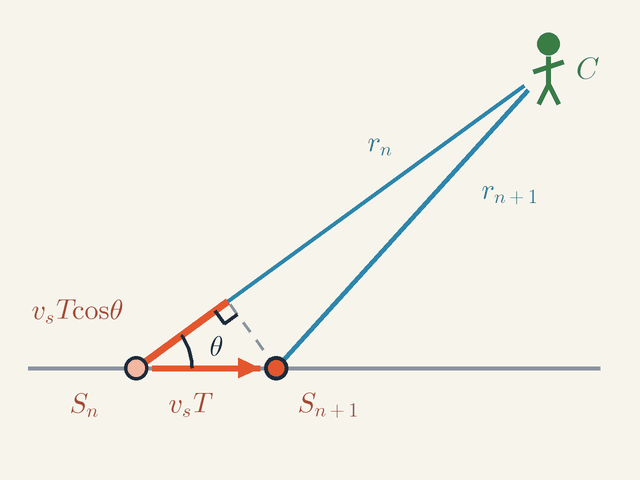
A siren of frequency f drives at speed vs through still air, in which sound travels at speed v, and a listener C stands still. Why does C hear a pitch f′ different from f? The cleanest answer comes from counting crests. A pitch is the number of pressure crests that arrive per second, so all we need is the time between the arrivals of two neighbouring crests. Figure 1 sets up that count.
Figure 1. Two successive crests of a moving siren on their way to a listener C. Between sending them the siren moves vsT; because the two paths are nearly parallel, the second is shorter by vsTcosθ. Not to scale.Legend
C
Listener at rest in still air.
Sn
Where the siren is when it sends crest n.
Sn+1
Where it is when it sends crest n+1, one period later.
T
Period of the siren, T=1/f.
s
vsT
Distance the siren moves in one period, along its velocity.
m
rn
Length of the path of crest n, from Sn to C.
m
rn+1
Length of the path of crest n+1, from Sn+1 to C.
m
θ
Angle between the siren's velocity and the line to C, at the moment of emission.
rad
vsTcosθ
Component of the step vsT along the line to C: how much shorter the second path is.
m
Think of the siren as a clock that sends out one crest every period T=1/f. Crest number n leaves from the point Sn at time nT. Crest n+1 leaves one period later from Sn+1, because in that period the siren has moved a distance vsT along the road: the arrow from Sn to Sn+1 in Figure 1.
Once a crest has left, the siren no longer matters to it: it runs through the air at speed v, in a straight line to C. Crest n covers the path rn and crest n+1 the path rn+1, so they arrive at tn=nT+rn/v,tn+1=(n+1)T+rn+1/v The time between these arrivals is the period the listener hears: T′=tn+1−tn=T+vrn+1−rn
So everything hangs on how much the second path differs from the first. Look at the dashed line in Figure 1, dropped from Sn+1 at right angles onto the first path. The step vsT is tiny compared with the distance to C (one period lasts a few milliseconds), so the two paths are almost parallel. The second path is then shorter than the first by the stretch of the first path between Sn and the foot of that dashed line. That stretch is the component of the step along the line to C, namely vsTcosθ, where θ is the angle at Sn between the siren's velocity and the line to C. Hence rn+1−rn=−vsTcosθ
Putting this into T′ gives T′=T(1−(vs/v)cosθ). Frequency is one over the period, so f′=1−(vs/v)cosθf
Three directions show what the formula says. Straight ahead, θ=0, it gives fv/(v−vs): the crests are squeezed together and the pitch rises. This case is exact at any distance, because both paths then lie on the same line. Straight behind, θ=180∘, it gives fv/(v+vs): the crests are stretched apart and the pitch falls. Side-on, θ=90∘, there is no shift, because a step at right angles to the line of sight does not change the distance to C to first order.
Two points are easy to miss. First, only the radial component vscosθ, the part of the velocity along the line to the listener, counts; motion across that line does nothing. Second, θ is the angle at the moment of emission, not at the moment of hearing. The crest you hear now set off a travel time r/v ago, at the so-called retarded time, when the siren was somewhere else. The roadside example below shows that this delay is easy to hear.
Counting phase: a moving observer
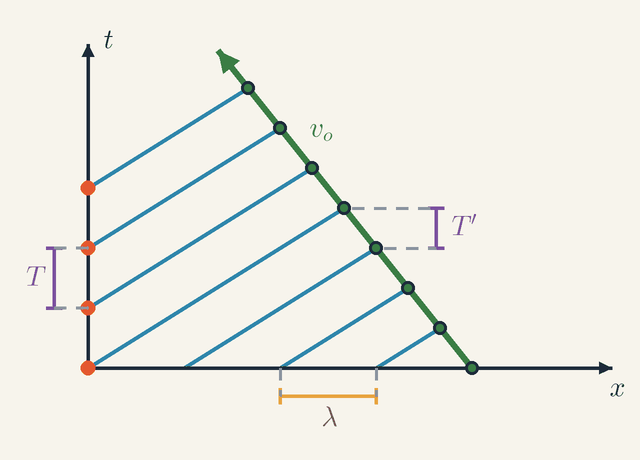
Now swap the roles: the siren stands still and the listener moves. The air then carries the same evenly spaced crests as for a listener at rest; nothing about the wave changes. What changes is how often the moving listener runs into the crests. A space-time picture, Figure 2, makes this count visible.
Figure 2. Space-time picture of a siren at rest at x=0: each sloping line is a crest, rising T for every λ it travels. A listener walking towards the siren at vo=v/2 meets a crest every T′=2T/3; one at rest, every T.Legend
x
Position along the line from the source to the listener; the source is at x=0.
m
t
Time.
s
T
Time between two crests sent by the source: the period.
s
T′
Time between two crests met by the walking listener, here 2T/3.
s
λ
Wavelength: distance between neighbouring crests, λ=vT.
m
vo
Speed of the listener walking towards the source, here v/2.
m/s
In Figure 2 position x runs to the right and time t upwards, and the source sits at x=0, on the vertical axis. It sends out a crest every period T. Each crest moves to the right at speed v, so in the picture it is a straight sloping line, advancing one wavelength λ=vT per period. That is why the crest lines are parallel and rise by T for every λ they cover.
A listener at rest is a vertical line in this picture, and she crosses one crest line every T. The listener of Figure 2 walks towards the source at vo=v/2, so her track leans towards the axis, into the crest lines, and she cuts through them more often. She and the crests close in on each other at v+vo, and the crests are λ apart, so the time between crests becomes T′=λ/(v+vo)=T/(1+vo/v)=2T/3, marked T′ in the figure. In the time 4T in which a resting listener meets four crests, she meets six.
The same count in symbols uses the phase of the wave. Write the wave as a function of ωt−kx, with angular frequency ω=2πf and wavenumber k=ω/v=2π/λ. The phase grows by 2π from one crest to the next, so counting radians of phase is counting crests. A listener who starts at x0 and walks towards the source is at x=x0−vot, so the phase she experiences is ωt−k(x0−vot)=(ω+kvo)t−kx0 It grows at the rate ω+kvo, hence ω′=ω+kvo,f′=f(1+vvo) The extra kvot radians in a time t are the extra crests she walks into: the lean of her track in Figure 2. Walking away, vo changes sign and the pitch drops.
Source or observer: not the same shift
The two results look alike, but they are not the same. Give both cases one speed u and write β=u/v. A source moving towards you at u multiplies the frequency by 1−β1=1+β+β2+… while you moving towards the source at u multiply it by 1+β. The two agree to first order in β and differ by β2/(1−β), so the difference only matters when u is a sizeable fraction of v.
At road speeds it is small but measurable. At 30 m/s, with sound at 340 m/s, β≈0.088 and the difference is 0.85 % of f: a 500 Hz siren is heard at 548.4 Hz when it moves and at 544.1 Hz when the listener moves, 4.3 Hz apart. At the animation's Mach 0.5, u=v/2, the difference is dramatic: a listener racing at 170 m/s towards a 400 Hz siren at rest hears 600 Hz, while a siren racing at 170 m/s towards a listener at rest is heard at 800 Hz.
Why the air picks out a frame
This asymmetry is no paradox. The air is a real, physical medium, and the frame in which it is at rest is special: "moving" in these formulas always means moving relative to the air.
To see how a frequency changes between frames, describe the same wave from a frame moving at velocity u along x. Its position coordinate is x′, with x=x′+ut, and it keeps the same clock. The phase becomes ωt−kx=(ω−ku)t−kx′ The wavenumber is still k, so the wavelength is the same for every observer; only the frequency changes, to ω−ku. A listener walking towards the source has u=−vo, which gives back ω+kvo.
A moving source fits the same rule. In the source's own frame the air streams backwards past it at vs, like a wind, so its sound runs forward relative to it at only v−vs. Since it sends f crests per second, they are spaced by λ=(v−vs)/f, and that wavelength is shared by all frames. In the air the crests travel at v, so a listener at rest in the air hears v/λ=fv/(v−vs), exactly as the crest count found.
When both move, at any angles, the two factors multiply: f′=fv−vscosθv+vocosφ Here θ is the angle at emission between the source's velocity and the line to the observer, as in Figure 1, and φ is the angle between the observer's velocity and the direction to the source.
The pitch curve heard beside the road
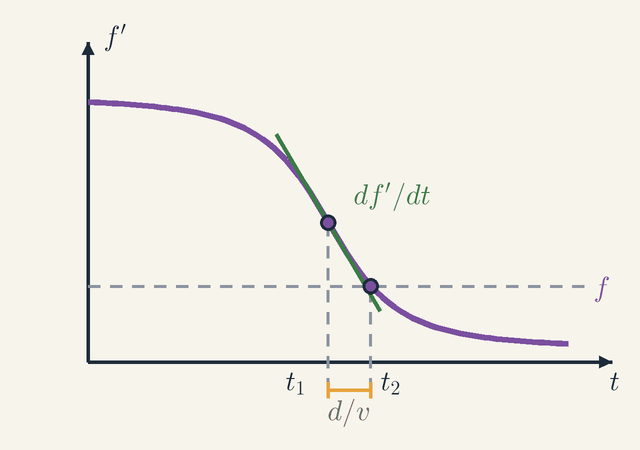
A siren that drives past does not jump from high to low: its pitch slides down a smooth curve. Working out that curve uses both points of the first section, the emission angle and the travel delay. Figure 3 shows the result.
Figure 3. The pitch f′ heard by C beside the road, against time. The siren is level with C at t1, but f′ falls through the siren's own f only at t2=t1+d/v. The tangent at t1 is the steepest slope; the f′ axis starts above zero.Legend
t
Time.
s
f′
Frequency heard by C.
Hz
f
Frequency of the siren (dashed line).
Hz
t1
Moment when the siren is level with C.
s
t2
Moment when f′ equals f: the crest sent side-on at t1 arrives.
s
d/v
Time sound needs to cross the gap d from the road to C.
s
df′/dt
Slope of the curve at t1: how fast the heard pitch falls.
Hz/s
Figure 3 plots the pitch f′ that the listener C hears against time t. The numbers are the animation's, scaled down to a small picture: C stands d=50 length units from the road, sound covers 70 units per second and the siren 35, so vs/v=0.5, as for the animation's 170 and 340 m/s. The siren's own frequency is f=400Hz, the dashed line, and the siren is level with C at t1=4s.
Each point of the curve takes two steps. For a time of hearing t, first find the emission time te of the crest arriving then: the one for which the siren's distance to C at te equals the distance the crest has run since, v(t−te). Then evaluate f/(1−(vs/v)cosθ) with the angle θ at te. The curve starts at 788 Hz at t=0, a little below the head-on 800 Hz, because that crest left when the line to C was already 10° off the road. It falls to 279 Hz by t=8s.
Now look at the middle of the curve. The siren is level with C at t1, yet the curve crosses the dashed line f′=f only later, at t2. The heard pitch equals f for the crest sent side-on, at θ=90∘; that crest left at t1 and still had to cross the gap d to the listener. Hence t2=t1+d/v=4+50/70≈4.71s which is the bracket d/v in Figure 3. You hear the siren pass a moment after it has passed.
How fast does the pitch fall? The heard pitch depends on t only through the emission time, so by the chain rule df′/dt=(df′/dte)/(dt/dte), and both factors are simple.
For the arrival time, t=te+r/v, where r is the siren's distance to C at emission. That distance shrinks at the radial speed, dr/dte=−vscosθ, so dt/dte=1−(vs/v)cosθ.
For the angle, let X=vs(t1−te) be the distance the siren still has to go to be level with C. Then cosθ=X/X2+d2, whose derivative with respect to X is d2/(X2+d2)3/2=sin3θ/d. Since dX/dte=−vs, it follows that d(cosθ)/dte=−(vs/d)sin3θ.
Differentiating f′=f/(1−(vs/v)cosθ) gives df′/dte=f(vs/v)(dcosθ/dte)/(1−(vs/v)cosθ)2. Dividing by dt/dte adds one more power of the denominator: dtdf′=−fvvsdvs(1−(vs/v)cosθ)3sin3θ
At the crossing t2, where θ=90∘, this is −f(vs/v)(vs/d)=−400⋅0.5⋅35/50=−140Hz/s. The tangent drawn at t1, labelled df′/dt, is steeper still: it is the steepest slope of the whole curve, as the worked problem below shows. The formula also says how the slide scales with distance. The slope goes as 1/d, so twice as far from the road the same drop takes twice as long; on the road itself, d→0, the slide becomes a sudden step from 800 to 267 Hz.
Worked problem: the moment the siren passes
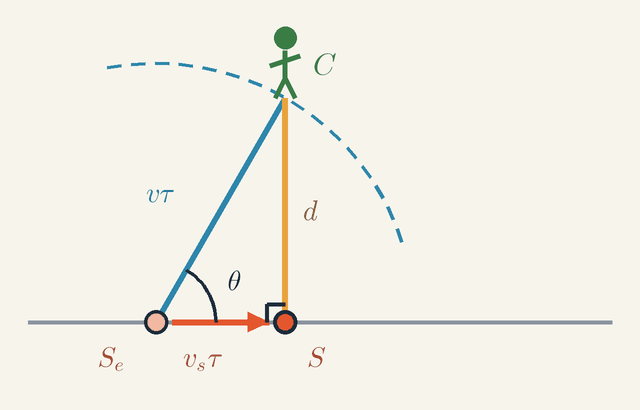
The most striking moment is when the siren is level with you. What pitch do you hear at that instant, and is the pitch falling fastest then? Figure 4 draws the geometry of that instant.
Figure 4. The crest (dashed arc) that reaches C at the instant the siren is level with C. It left Se a time τ earlier and travelled vτ, while the siren moved vsτ to S; so cosθ=vs/v.Legend
C
Listener beside the road.
Se
Where the siren was when it sent the crest that now reaches C.
S
Where the siren is now, level with C.
d
Distance from the road to C.
m
τ
Time the crest has been travelling since it left Se.
s
vτ
Distance the crest has travelled, from Se to C.
m
vsτ
Distance the siren has moved in that time, from Se to S.
m
θ
Emission angle: between the siren's velocity and the line from Se to C.
rad
At t1=4s the siren is at S, level with C. The crest reaching C at that instant, the dashed arc, left from Se a time τ earlier. In that time the crest travelled vτ from Se to C, the hypotenuse of the triangle, while the siren moved vsτ along the road from Se to S. The third side is the gap d from the road to C, at right angles to the road, and the angle at Se is the emission angle θ.
Step 1, the pitch. In this right triangle the cosine of θ is the side along the road over the hypotenuse: cosθ=vτvsτ=vvs The time τ cancels, so this holds whatever C's distance from the road. The Doppler formula then gives f′=1−vs2/v2f which for vs/v=0.5 is 400/0.75≈533Hz, the value marked at t1 in Figure 3, from a crest emitted at θ=60∘. Pythagoras says how long ago it left: (vτ)2=(vsτ)2+d2, so τ=d/v2−vs2=50/702−352≈0.82s.
Step 2, the steepest slope. In the slope formula only the angle varies, and it enters as the cube of the ratio sinθ/(1−(vs/v)cosθ), so the slope is steepest where that ratio is largest. The derivative of the ratio with respect to θ is (1−(vs/v)cosθ)2cosθ−vs/v which vanishes at cosθ=vs/v, the very angle of Step 1. So the pitch falls fastest at the instant the siren is level with you. There sinθ=1−vs2/v2 and the ratio equals 1/0.75, against 1 at θ=90∘, so the slope is 140/0.753/2≈216Hz/s: the tangent in Figure 3.
Step 3, a real ambulance. For the ambulance of the intermediate level (700 Hz, 25 m/s, v=343m/s), vs/v≈0.073. As it passes you hear 700/(1−0.0732)≈703.7Hz, barely above its own pitch. Its pitch falls from about 755 Hz on approach to about 652 Hz as it leaves, a drop of 103 Hz. Standing 10 m from its path, the steepest slope is about 700⋅0.073⋅25/10≈128Hz/s (the factor (1−0.0732)3/2 differs from 1 by less than 1 %), so the drop takes roughly 0.8 s. That is of the order of 2d/vs, the time the ambulance takes to cover twice your distance from its path, during which the line to you swings through most of its angles.
Faster than its own waves: the Mach cone
What happens when the source catches up with its own sound? As vs→v, the crests sent ahead pile up into a single front. Once vs>v, the source outruns every crest it sends.
Picture the crests at one instant. A crest emitted a time τ ago is a sphere of radius vτ, centred where the source was then, a distance vsτ behind its present position. Older crests are larger spheres centred further back, and all of them touch one cone whose tip is on the source. A line from the tip that just touches one sphere is at right angles to the radius at the touching point, which makes a right triangle with hypotenuse vsτ and side vτ opposite the tip. The half-angle α of the cone therefore obeys sinα=vτ/(vsτ): sinα=vsv(Mach cone)
The ratio vs/v is the Mach number: at Mach 2, α=30∘; at Mach 1.5, about 42°. The faster the source, the narrower the cone.
The cone is hidden in the Doppler formula too. Its denominator 1−(vs/v)cosθ vanishes when cosθ=v/vs=sinα, the direction at right angles to the cone's surface: all the crests sent that way arrive at the same moment. That pile-up is the shock wave, and it sweeps across the ground as a sonic boom for as long as the aircraft stays supersonic, not only at the moment it reaches the speed of sound. For directions closer to straight ahead the denominator turns negative, which means crests sent later arrive earlier. So after the cone has passed, a listener hears two streams of sound at once, one of them backwards.
Any object faster than the waves of its medium drags such a cone, whether it makes a sound of its own or not: a bullet; a boat on shallow water, where long waves all travel at gh for a depth h; or a charged particle in water moving faster than light does there, c/n≈0.75c, whose Cherenkov radiation makes the water of reactor pools glow blue.
Light, echoes and radar
Light needs no medium, so there is no air to pick out a frame: only the relative velocity of source and observer can matter, and the two ways of counting must give the same answer. They do, once time dilation is included: a clock moving at speed βc ticks slowly by the factor 1−β2, as seen from the frame it moves through.
First count in the observer's frame, with the source approaching at β=u/c. Its slowed clock emits at f1−β2, and the moving-source factor 1/(1−β) comes on top: f1−β2/(1−β). Now count in the source's frame, where the observer approaches. She meets crests at f(1+β) per second of source time, but her own clock runs slow, so per second of her time she counts f(1+β)/1−β2. Since 1−β2=(1−β)(1+β), both reduce to f′=f1−β1+β
Behind this agreement lies the rule found for sound. The phase ωt−kx counts crests, and all observers agree on a count, so ω and k change between frames together, just as t and x do: for sound by the Galilean change of frame, for light by the Lorentz transformation. Time dilation alone also causes a shift with no counterpart for sound, the transverse Doppler effect: light emitted when the source is level with you arrives at f1−β2, below f. For a source receding at β=0.1, f′/f=0.9/1.1≈0.905, so its red hydrogen line at 656.3 nm is seen at 725.6 nm.
An echo from a moving target is shifted twice. First the target acts as a moving observer and receives f(v+u)/v; then it sends that sound back as a moving source, which multiplies by v/(v−u). For a target approaching at u, f′′=fv−uv+u≈f(1+v2u) where the approximation holds for u much smaller than v. The same double shift applies when the source itself drives at a fixed wall: had the animation's siren car driven at 170 m/s straight at a wall, its driver would hear the echo at 400⋅510/170=1200Hz.
Radar and medical ultrasound use the approximation. They mix the echo with the outgoing signal and measure the beat between them, Δf=f′′−f≈2fu/v, which gives the target's speed. A 24.125 GHz traffic radar sees a car at 30 m/s with Δf=2fu/c≈4.8kHz, and a 5 MHz ultrasound probe sees blood moving at 0.5 m/s (sound travels at 1540 m/s in tissue) with about 3.2 kHz.
Limits of validity
The formulas assume a uniform, still medium with a single wave speed. In air v rises with temperature and shifts with the wind, and gradients of either bend sound away from the straight line of sight. They also assume that the source's velocity and direction change little during one period, 2.5 ms for a 400 Hz siren.
They are linear, too: they treat sound as small pressure swings, about 0.02 Pa on top of 100 000 Pa of atmospheric pressure for speech, which add up without changing the speed of sound. Near vs=v this fails. The piled-up crests form a strong compression that travels faster than ordinary sound, and the infinite f′ of the formula becomes a shock front, curved near the nose and straightening into the Mach cone farther out. A sonic boom carries tens of pascals, usually heard as a double bang from the nose and the tail.
Dispersion, a wave speed that depends on wavelength, changes the cone as well: on deep water, where long waves outrun short ones, a ship's wake keeps a half-angle of about 19.5° over a wide range of speeds.
For sound, relativistic corrections are of order (vs/c)2, about 3×10⁻¹³ even at 170 m/s, so the Galilean formulas are exact in practice, while the source–observer asymmetry, of order (vs/v)2, is real. For light, the first-order Δf/f≈2u/c is ample for radar, where β≈10−7, but at β=0.5 the exact one-way factor is 3≈1.73, neither the source formula's 2 nor the observer formula's 1.5.
Where this leads
Special Relativity turns the source–observer puzzle into the Lorentz transformation of frequency and wavelength, and Electromagnetic Waves covers the radio waves and light that radar and astronomy use. Beats between echo and signal belong to Interference and Superposition, the loudness of an approaching siren to Loudness, Intensity and Decibels. The thermal motion of atoms broadens spectral lines by a few parts per million, linking Kinetic Theory of Gases with Atomic Models: the Bohr Atom, while Gravity as Curved Spacetime describes a different shift, of clocks in a gravitational field, not to be confused with the Doppler effect.
Key formulas
Moving source approaching a still listener
f′=v−vsfv(source approaching)
The source moves vsT towards the listener between two crests, so the crests in front are packed (v−vs)/f apart instead of v/f. They still travel at v, so the listener receives v divided by that spacing each second. The frequency grows without limit as vs approaches v.
Symbols
f′
frequency heard by the listener
Hz
f
frequency emitted by the source
Hz
v
speed of sound relative to the air
m/s
vs
speed of the source towards the listener, relative to the air
m/s
When it holds: For a source moving straight at a listener at rest, through still air and slower than sound. At an angle use f′=f/(1−(vs/v)cosθ); as vs reaches v a shock forms instead.
Example: The animation's 400 Hz siren at 170 m/s in air at 340 m/s: f′=400⋅340/170=800Hz.
Moving source receding from a still listener
f′=v+vsfv(source receding)
Behind the source each new crest starts vsT farther away than the last, so the crests are spread (v+vs)/f apart and arrive less often. Unlike the approaching case, the shift stays moderate at any speed: at Mach 1 the note is exactly halved.
Symbols
f′
frequency heard by the listener
Hz
f
frequency emitted by the source
Hz
v
speed of sound relative to the air
m/s
vs
speed of the source away from the listener, relative to the air
m/s
When it holds: For a listener at rest straight behind a source moving through still air; it then holds at any source speed.
Example: The animation's siren heard from behind: f′=400⋅340/510≈267Hz.
Moving observer approaching a still source
f′=vf(v+vo)(observer approaching)
The source is at rest, so its crests keep their ordinary spacing λ=v/f; the observer simply runs into them at the relative speed v+vo. Unlike source motion, observer motion leaves the wave in the air unchanged, which is why the two formulas differ at the same speed. Moving away, replace vo by −vo.
Symbols
f′
frequency heard by the moving observer
Hz
f
frequency emitted by the source
Hz
v
speed of sound relative to the air
m/s
vo
speed of the observer towards the source, relative to the air
m/s
When it holds: For an observer moving straight towards a source at rest in still air. At an angle only the component of the observer's velocity along the line to the source counts.
Example: Driving at 25 m/s towards a still 700 Hz alarm, with v=343m/s: f′=700⋅368/343≈751Hz.
Wavelength in front of a moving source
λ′=fv−vs(in front of the source)
Between two crests the previous crest runs vT ahead while the source follows it by vsT, so the gap is (v−vs)T=(v−vs)/f. This is a change of the wave itself in the air, which every observer, moving or not, finds the same. Behind the source the gap is (v+vs)/f.
Symbols
λ′
wavelength in the air in front of the source
m
v
speed of sound relative to the air
m/s
vs
speed of the source relative to the air
m/s
f
frequency emitted by the source
Hz
When it holds: Straight ahead of a source moving steadily through still air below the speed of sound; at vs=v the spacing shrinks to zero and the crests merge into one front.
Example: In the animation, λ′=(340−170)/400=0.425m (shown as 0.43 m), against 0.85 m for a siren at rest.
Moving source at any angle
f′=1−(vs/v)cosθf
Each crest starts closer to the listener than the one before by the radial part of the source's step, vsTcosθ, so the crests arrive spaced by T(1−(vs/v)cosθ). The angle is taken at the moment of emission: the crest you hear now left when the source was elsewhere. Ahead (θ=0) and behind (θ=180∘) this reduces to the first two formulas; at θ=90∘ there is no shift.
Symbols
f′
frequency heard by the listener
Hz
f
frequency emitted by the source
Hz
vs
speed of the source relative to the air
m/s
v
speed of sound relative to the air
m/s
θ
angle between the source's velocity and the direction to the listener, at emission
rad
When it holds: For a listener at rest in still air, far enough away that the source moves only a small fraction of the distance in one period. For a source faster than sound the denominator can vanish or turn negative: the crests then arrive together, on the Mach cone, or in reverse order.
Example: Listener C in the animation hears about 533 Hz at the instant the siren passes him, from a crest emitted at θ=60∘: 400/(1−0.5⋅0.5)≈533Hz.
Half-angle of the Mach cone
sinα=vsv(Mach cone)
A crest emitted a time τ ago is a sphere of radius vτ whose centre lies vsτ behind a source faster than sound. All these spheres touch one cone with its tip on the source, and the right triangle formed by the source, a centre and the point of contact gives sinα=vτ/(vsτ). The faster the source, the narrower the cone.
Symbols
α
half-angle of the cone
rad
v
speed of the waves in the medium
m/s
vs
speed of the source
m/s
When it holds: Only for vs>v, and for waves whose speed does not depend on their wavelength: sound in air, long waves on shallow water; light in glass or water is slightly dispersive, so each colour has a slightly different cone. Near the nose a strong shock moves faster than v and bends the cone; on deep water a ship's wake keeps about 19.5° instead.
Example: A jet at Mach 2: sinα=1/2, so α=30∘.
Glossary
Doppler effect
The change in the frequency received from a wave source caused by motion of the source, the observer or both. An approaching siren sounds higher and a receding one lower, while the siren itself never changes its note.
Doppler shift
The size of that change, Δf=f′−f: positive for approach, negative for retreat. For light it is called a blueshift or a redshift, because spectral lines move towards the blue or the red end of the spectrum.
Pitch
How high or low a sound seems, set by the frequency that reaches the ear. It is not loudness: an approaching siren becomes both louder and higher, for different reasons.
Speed of sound
The speed at which sound crests travel through a medium, set by the medium's stiffness and density, not by the source. In air it is about 343 m/s at 20 °C and rises by about 0.6 m/s per degree; in water it is about 1480 m/s.
Wavefront
A surface on which the wave has the same phase, for example a crest. From a small source in still air the wavefronts are spheres (circles in the animation), each centred where the source was when it emitted it.
Rest frame of the medium
The frame in which the air (or water) is at rest. Only in this frame does sound travel at the same speed v in every direction, so the Doppler formulas measure every speed relative to it; light has no such frame.
Radial velocity
The component of a velocity along the line between source and observer, vscosθ for a source. It sets the first-order Doppler shift; motion straight across the line of sight gives no shift for sound.
Retarded time
The earlier moment at which the crest heard now was emitted, one travel time r/v before it arrives. The angle θ in the Doppler formula is taken at that moment, which is why a passing siren is heard at exactly f only after it has passed.
Mach number
The ratio of a body's speed to the speed of sound, vs/v. The siren in the animation moves at Mach 0.5; above Mach 1 a body outruns its own waves.
Mach cone
The cone that all the wavefronts of a source faster than its waves touch, with half-angle α given by sinα=v/vs. The pressure jump on it is a shock wave, heard on the ground as a sonic boom as the cone sweeps past.
Cherenkov radiation
Light given off by a charged particle that moves through a material faster than light travels in it, such as an electron faster than 0.75 c in water. It forms a cone, the optical counterpart of a sonic boom, and causes the blue glow of reactor pools.
Doppler radar and ultrasound
Instruments that send out a wave and measure the frequency of the echo from a moving target. The echo is shifted twice, Δf≈2fu/v, and mixing it with the outgoing signal gives a beat at Δf.
Quantities
f
Source frequency
Hz
The number of crests the source emits per second, as measured by someone moving with it: 400 Hz for the siren in the animation.
f′
Heard frequency
Hz
The number of crests that reach the observer each second, heard as pitch: 800 Hz ahead of the animation's siren and about 267 Hz behind it.
v
Speed of sound
m/s
The speed of the waves relative to the medium: about 343 m/s in air at 20 °C, rounded to 340 m/s in the animation.
vs
Source speed
m/s
The speed of the source relative to the air: 170 m/s, half the speed of sound, in the animation.
vo
Observer speed
m/s
The speed of the listener relative to the air, counted positive towards the source in f′=f(v+vo)/v.
λ
Wavelength
m
The distance between neighbouring crests, λ=v/f for a source at rest: 0.85 m for 400 Hz in air at 340 m/s.
λ′
Shifted wavelength
m
The crest spacing in the air in front of a moving source, (v−vs)/f, or behind it, (v+vs)/f: 0.425 m and 1.275 m in the animation.
θ
Emission angle
rad
The angle between the source's velocity and the direction from the source to the listener, taken when the crest was emitted: 0 straight ahead, π (180°) straight behind.
α
Half-angle of the Mach cone
rad
Half the opening angle of the cone dragged by a source faster than its waves, sinα=v/vs: 30∘ at Mach 2.
Δf
Doppler shift
Hz
The heard minus the emitted frequency, f′−f; for an echo from a target moving at u, about 2fu/v.
Quiz
Beginner An ambulance with its siren on drives towards you, passes you and drives away. What do you hear?
A pitch that rises steadily as it gets closer
The same pitch the whole time, just louder and then quieter
A higher pitch while it approaches, then a lower pitch once it has passed
A lower pitch while it approaches, then a higher pitch as it leaves
Show answer
Answer: C. A higher pitch while it approaches, then a lower pitch once it has passed
While the ambulance approaches, the crests reach you squeezed together, so the pitch is higher. Once it is moving away, they are stretched apart and the pitch drops.
Beginner Why does a siren sound higher in front of a moving ambulance?
The wave crests are squeezed together, so they reach you more often
The siren really plays a higher note when the ambulance moves
Sound travels much faster in front of a moving vehicle
The sound is louder in front, and louder sounds are higher
Show answer
Answer: A. The wave crests are squeezed together, so they reach you more often
Each crest is emitted a little further forward than the last, so in front they bunch up and arrive more often. The siren's own note does not change.
Beginner What pitch does the ambulance driver hear from the siren on the roof?
A higher pitch
The siren's normal pitch
A lower pitch
A pitch that keeps going up and down
Show answer
Answer: B. The siren's normal pitch
The driver moves with the siren, so there is no motion between them and no Doppler shift.
Intermediate A 500 Hz siren approaches you at 30 m/s. The speed of sound is 340 m/s. What frequency do you hear?
About 459 Hz
About 544 Hz
530 Hz
About 548 Hz
Show answer
Answer: D. About 548 Hz
f′ = f·v/(v − v_s) = 500 × 340 ÷ 310 ≈ 548 Hz. 459 Hz is the receding value, 544 Hz uses the moving-observer formula, and 530 Hz wrongly adds the speed to the frequency.
Intermediate A 400 Hz source moves at 40 m/s through air where sound travels at 340 m/s. What is the wavelength just in front of it?
0.85 m
0.75 m
0.95 m
0.80 m
Show answer
Answer: B. 0.75 m
λ′ = (v − v_s)/f = 300 ÷ 400 = 0.75 m. 0.85 m is the wavelength when the source is at rest, and 0.95 m is the value behind it.
Intermediate Compare a source moving at 30 m/s towards a still listener with a listener moving at 30 m/s towards a still source. Which statement is true?
The moving source gives a slightly larger shift
They give exactly the same shift, since only the relative speed matters
Only the moving source produces a shift
Only the moving listener produces a shift
Show answer
Answer: A. The moving source gives a slightly larger shift
f·v/(v − u) is slightly larger than f·(v + u)/v. Sound travels in air, so it matters who moves relative to the air: only the source's motion changes the wavelength.
Advanced A car drives along a straight road past a listener standing beside it. The crest emitted when the car is level with the listener is heard with which frequency?
f·v/(v − v_s)
f·v/(v + v_s)
Exactly f
Zero
Show answer
Answer: C. Exactly f
f′ = f/(1 − (v_s/v)·cos θ), with θ measured at the moment of emission. For the crest emitted when the car is level with the listener, θ = 90°, so cos θ = 0 and f′ = f exactly. The listener hears that crest a little later, after it has crossed the gap from the road.
Advanced A jet flies at Mach 2. What is the half-angle of its Mach cone?
60°
45°
27°
30°
Show answer
Answer: D. 30°
sin α = v/v_s = 1/2, so α = 30°. 60° confuses the angle with its complement, and 27° comes from using tan instead of sin.
 Physics Tutor