Why bridges have gaps, thermostats click and lakes freeze from the top: most materials grow when they are heated, by ΔL=αL0ΔT.
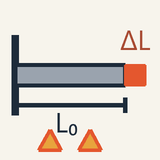
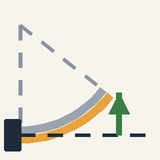
An aluminium bar and a brass–steel strip are heated from 20 °C to 220 °C and then cooled: the bar lengthens and the strip curls up, and both return to their original shape.
Most things expand when heated and shrink back when cooled: their jiggling particles push slightly further apart.
The growth is proportional to the length and to the temperature rise: a rod twice as long grows twice as much.
The change is small but the force is huge, so bridges, pavements and railways need gaps or joints.
Different materials expand differently: a brass–steel strip curls when heated, which is how many thermostats switch.
Step 1. Almost everything grows a little when it warms up and shrinks again when it cools, which is why concrete pavement slabs are laid with thin gaps between them. This is thermal expansion.
Step 2. Why? An object is made of tiny particles that are always jiggling. Heat it and they jiggle harder, nudging one another slightly further apart, so the whole object becomes a little longer, wider and thicker.
Step 3. How much? The growth is small but very regular: warm a rod twice as much and it grows twice as much; take a rod twice as long and it also grows twice as much. A 1 m aluminium bar heated by 200 degrees grows by less than 5 mm, yet a long steel bridge changes length by tens of centimetres between winter and summer. The pushing force is enormous, so bridges get toothed expansion joints.
Step 4. Different materials grow by different amounts. Bond a strip of brass to a strip of steel and heat them: the brass grows more, so the pair has to curl, with the brass on the outside of the bend. Such bimetallic strips switch thermostats and kettles on and off.
In the animation, flames heat a metal bar and a brass–steel strip. The bar's end moves past the dashed line (its growth is drawn 25 times bigger) while the strip curls upwards; when the flames go out, both return to their original shape.
Check yourself: a metal lid is stuck on a glass jar. Should you run hot water over the lid or over the glass? (Over the lid: metal expands more than glass, so the lid loosens.)
Water is a strange exception: between 0 °C and 4 °C it shrinks as it warms.
Intermediate
Key ideas
ΔL=αL0ΔT: the growth is proportional to the original length and to the temperature change; α is in K⁻¹.
Typical α: steel 12, brass 19, aluminium 23 (×10⁻⁶ K⁻¹); a 1 m aluminium bar heated by 200 K grows 4.6 mm.
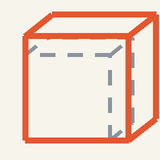
Areas grow by ΔA≈2αAΔT and volumes by ΔV≈3αVΔT; liquids are described by a volume coefficient β.
A hole in a heated plate grows too: every length scales up, as in a photographic enlargement.
What expands, and why
Power lines sag lower on hot days, because a warm wire is slightly longer than a cold one. In a solid, atoms sit at almost fixed distances from their neighbours, held by bonds that act like stiff springs. They vibrate about those positions, and heating makes them vibrate harder. The bonds resist squeezing more than stretching, so an atom that shakes harder spends more time slightly further out, and the average spacing grows. Every length of the object grows with that spacing.
Three quantities describe the effect: the original length L0, the change in length ΔL=L−L0 (negative on cooling) and the temperature change ΔT. A step of 1 °C is the same size as a step of 1 K, so ΔT has the same value on both scales: warming from 20 °C to 220 °C is ΔT=200K.
The law of linear expansion
Measurements give a simple rule: the change in length is proportional to the original length and to the temperature change, ΔL=αL0ΔT
Each metre of a rod grows on its own, so a rod twice as long grows twice as much. The coefficient of linear expansion α belongs to the material. Its unit is K⁻¹ because it is the fractional growth ΔL/L0 per kelvin: α=23×10−6K−1 means that each metre of aluminium gains 23 micrometres per kelvin.
Typical values, in units of 10−6K−1, are: invar (an iron–nickel alloy) 1.2, glass 9, steel and concrete about 12, copper 17, brass 19, aluminium 23. Since αΔT stays well under 1 % in everyday heating, the change is easy to overlook but hard to stop.
Areas, volumes and liquids
Heating multiplies every length of a uniform plate by (1+αΔT), so its area is multiplied by (1+αΔT)2≈1+2αΔT; the dropped term (αΔT)2 is negligible. A block's volume is multiplied by the cube. To first order, area and volume therefore grow by ΔA≈2αA0ΔT ΔV=βV0ΔT,β≈3α
Here β is the coefficient of volume expansion. Holes scale too: the opening of a ring grows exactly as a disc of the same material would, like a photographic enlargement.
Liquids, having no shape of their own, are described by β alone. In units of 10−6K−1 it is about 210 for water at 20 °C, 180 for mercury and 950 for petrol, against 27 for glass. A liquid-in-glass thermometer reads this difference: the liquid outgrows its bulb and climbs the narrow tube. It is also why a tank filled to the brim with cool petrol overflows in the sun.
Worked example: the bar and the strip in the animation
The aluminium bar has L0=1m=1000mm and is heated from 20 °C to 220 °C, so ΔT=200K and ΔL=23×10−6K−1⋅1000mm⋅200K=4.6mm
This is the blue ΔL readout at 220 °C: the bar is now 1.0046 m long. The growth and its arrow are drawn 25 times larger, since at true scale they would be invisible.
The strip is 10 cm of brass (α=19×10−6K−1) bonded to 10 cm of steel (α=12×10−6K−1). Free, the brass would grow by 19×10−6⋅100mm⋅200=0.38mm and the steel by 0.24 mm, a mismatch of only 0.14 mm. Bonded, the layers cannot slide, so the strip must curve, with the longer brass on the outside of the bend. Here the brass is underneath, so the strip curls upwards.
It bends into an arc of radius R≈25cm, derived at the expert level. An arc of length L rises above its starting line by about L2/(2R), so the tip of the 100 mm strip lifts by d≈1002/(2⋅246)≈20mm: the green d arrow and readout. A 0.14 mm mismatch has become a 20 mm movement: that is what makes the strip a good switch.
Worked example: a bridge and its expansion joint
A steel bridge deck 120 m long is fixed at one end and rests on sliding bearings at the other. Built at 15 °C, it reaches −20 °C on winter nights and +45 °C in summer sun. How much movement must the joint at the free end allow?
With α=12×10−6K−1 and L0=120000mm, each kelvin changes the length by αL0=1.44mm. In summer, with ΔT=+30K, the deck grows by 1.44⋅30≈43mm; in winter, with ΔT=−35K, it shrinks by 1.44⋅35≈50mm. The joint must cover about 94 mm, hence its long interlocking steel teeth.
Without a joint, the abutments would have to squeeze the summer growth back out, a strain of αΔT=3.6×10⁻⁴. With Young's modulus E=200GPa that takes a stress σ=EαΔT=72MPa, roughly a quarter of the stress at which structural steel begins to yield, whatever the length of the deck.
Reading the animation
The dashed lines mark the cold shapes. The bar is fixed to the wall and rests on a roller, like a bridge deck on its bearings, so all its growth appears at the free end; the strip is clamped at one end only, so it is free to bend.
ΔL and d are both proportional to the rise above 20 °C: halfway, at 120 °C, they read 2.30 mm and about 10 mm. Each kelvin adds 0.023 mm to the bar and about 0.1 mm to the strip's deflection. On cooling, the readouts run back through the same values to zero: thermal expansion is reversible, unless something has been stressed beyond its elastic limit.
Common mistakes
A hole in a heated plate grows like every other length: a 20.00 mm hole in steel warmed by 100 K becomes 20.02 mm, which is how rings are shrink-fitted onto shafts.
The atoms do not swell; their average spacing grows, by 0.46 % in the animation's bar.
Use the change of temperature, not the temperature: 20 °C to 30 °C gives the same growth as 80 °C to 90 °C, and a change of 200 °C is 200 K, with no 273 added.
Areas grow with 2α and volumes with 3α: an aluminium block heated by 200 K gains 1.38 % in volume, three times the 0.46 % of each edge.
Not everything expands when heated: water contracts as it warms from 0 °C to 4 °C, and a stretched rubber band shortens.
Where you meet it
Long structures get room to move: joints and roller bearings on bridges, gaps between concrete slabs, loops in pipelines, and power lines that sag lower on hot days. Materials that must stay joined, such as glass sealed around the wires of a lamp or a filling in a tooth, are chosen with matching coefficients, while bimetallic strips use a mismatch on purpose to switch kettles, irons and thermostats.
This lesson builds on Temperature and Heat. Water's odd behaviour returns in Phase Changes and Latent Heat: it expands by 9 % on freezing. Blocked expansion obeys the stress–strain law of Elasticity: Hooke's Law, Stress and Strain, and gases, which expand far more than solids, are explained in Kinetic Theory of Gases.
Advanced
Key ideas
α=(1/L)dL/dT; for αΔT≪1, L≈L0(1+αΔT): a straight line of slope αL0, retraced on cooling.
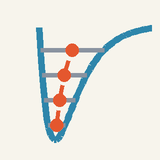
Expansion measures bond anharmonicity: in a parabolic potential the mean spacing would not grow, however hard the atoms vibrate.
Blocked expansion gives σ=EαΔT; a bimetal bends with 1/R=3ΔαΔT/(2h) and its tip rises d≈L2/(2R).
Water's density peaks at 3.98 °C as ice-like order collapses, so a lake settles at 4 °C at the bottom and freezes from the top.
The coefficient as a rate of change
Everything in this lesson rests on one number per material, the expansion coefficient α. The familiar rule ΔL=αL0ΔT is only an approximation, so it is worth seeing exactly what it approximates. The precise definition is the fractional growth in length per kelvin, taken at a single temperature: α=L1dTdL
The right-hand side is the derivative of lnL with respect to T. Integrating it from the starting temperature T0 to T therefore gives the length exactly: L=L0exp(∫T0TαdT′)
If α does not depend on temperature, the integral is simply αΔT, and expanding the exponential gives L=L0eαΔT=L0(1+αΔT+21α2ΔT2+…). The linear law keeps only the first correction, αΔT, and drops the rest. For solids that costs almost nothing: in the animation αΔT=4.6×10⁻³, and the exponential gives 4.611 mm of growth instead of 4.600 mm.
The real weakness of the linear law is elsewhere: α itself changes with temperature. For real aluminium it rises by more than a tenth between 20 °C and 220 °C, so a real 1 m bar would grow by nearly 5 mm, an error far larger than the 0.011 mm lost by dropping the square term. Over wide temperature ranges, α must be integrated.
The animation's graph of ΔL against T shows the linear law: a straight line from 0 at 20 °C to 4.6 mm at 220 °C, with slope dL/dT=αL0=0.023mm/K. On cooling, the dot slides back down the same line. No loop opens, because the length depends only on the present temperature, not on the history of heating and cooling. With the temperature-dependent α of real aluminium, the line would curve gently upwards.
The same definition applies to volume: β=(1/V)dV/dT. An isotropic solid, one that expands equally in every direction, keeps its shape, so V∝L3. Then lnV is 3lnL plus a constant, and differentiating gives β=3α exactly. The familiar ΔV≈3αV0ΔT is approximate only because it drops terms in (αΔT)2.
Why hot atoms need more room
Why should a solid expand at all? The answer lies in the shape of the bond between neighbouring atoms. Suppose the force between two neighbours were exactly −kx, where x is the change in their separation from its resting value and k is the stiffness of the bond. The potential energy would then be a parabola, every vibration would be symmetric about x=0, and the mean spacing would never change, however hard the atoms vibrated. A crystal with such perfectly spring-like (harmonic) bonds would not expand.
Real bonds are lopsided. Pushing two atoms together meets a steep repulsion as their electron clouds overlap, while pulling them apart meets an attraction that weakens with distance.
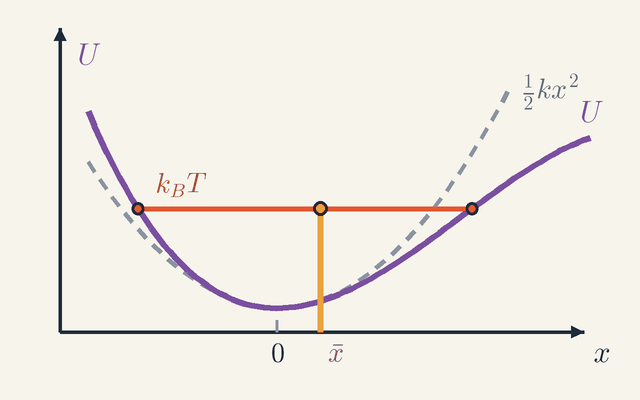
Figure 1. The energy U of a bond as its spacing changes by x: solid for a real bond, dashed for an ideal spring 21kx2. At the thermal energy kBT an atom swings between the two dots, so its mean displacement xˉ lies to the right of 0. Not to scale: the lopsidedness is exaggerated.Legend
x
Change in the spacing of two neighbouring atoms, measured from the bottom of the well.
m
U
Potential energy of the bond.
J
21kx2
Energy of an ideal spring of stiffness k: the symmetric parabola that the real curve follows near its bottom.
J
kBT
Thermal energy, Boltzmann's constant times the temperature: the height of the level at which the atoms vibrate.
J
xˉ
Mean change of spacing: the average position of the vibrating atom, pushed to positive x by the lopsided bond.
m
Figure 1 plots the energy U of one bond against the change x in its spacing. Look first at the two curves. The dashed parabola 21kx2 is the ideal, symmetric spring. The solid curve is the real, lopsided bond: near the bottom of the well the two agree, but on the squeezed side (left) the real curve rises above the parabola, and on the stretched side (right) it falls below it.
Now look at the horizontal level drawn at the height kBT, the typical thermal energy of a vibrating atom (kB is Boltzmann's constant). An atom with this energy swings back and forth between the two dots where the level meets the solid curve: these are its turning points. On the left the wall is steep, so the turning point lies close to x=0. On the right the wall is gentle, so the turning point lies further out. The atom therefore reaches further out than in, and its average position xˉ, the gold line, lies at positive x, to the right of the bottom of the well. A hotter atom rides a higher level, on a more lopsided stretch of the curve, and xˉ moves further out. This outward drift of the average spacing, repeated in every bond of the crystal, is thermal expansion.
To make this quantitative, the simplest lopsided bond adds a cubic term to the spring, with a constant b that measures the asymmetry. This is the solid curve of Figure 1, with its lopsidedness exaggerated: U(x)=21kx2−31bx3 The minus sign puts the energy below the parabola for x>0 and above it for x<0, as in the figure. The force on the atom is −dU/dx=−kx+bx2.
Now average over the motion. A vibrating atom stays in place on average, so the time average of the force on it must vanish: kxˉ=bx2, where x2 is the mean square displacement. Because b is small, it is enough to take x2 from the harmonic spring. For a vibration of energy Evib, half of it is potential energy on average, so 21kx2=21Evib and xˉ=bEvib/k2. A classical oscillator in thermal equilibrium has Evib=kBT on average, which gives xˉ=k2bkBT Averaging x with the Boltzmann factor e−U/kBT, to first order in b, gives the same result. So Figure 1, which follows one vibration at the energy kBT, marks the same xˉ that the thermal average gives.
The mean displacement grows in proportion to the temperature. Dividing by the resting spacing r0 gives the fractional growth per kelvin, α≈bkB/(k2r0): constant at ordinary temperatures, and proportional to b. The expansion coefficient is a direct measure of how asymmetric the bonds are.
What sets the size of the coefficient
The same picture explains a striking regularity. Melting and expansion both depend on how far up the potential well the thermal energy reaches: a solid melts when its vibrations become a sizeable fraction of the atomic spacing, and it expands as the atoms ride higher up the lopsided well. A deep, stiff well therefore gives both a high melting temperature and a small α, and for many metals their product is roughly the same, about 0.02. For aluminium, 23×10−6⋅933≈0.021; for tungsten, 4.5×10−6⋅3695≈0.017.
Invar, an iron–nickel alloy, breaks the rule: a magnetic contraction nearly cancels its normal expansion, a discovery that earned Charles-Édouard Guillaume the Nobel Prize in 1920 and makes Invar valuable in precision instruments.
At low temperatures the classical picture fails. The vibrations freeze into their quantum ground state, which hardly gains energy as the temperature rises. Expansion follows the vibrational energy, so α falls to zero together with the heat capacity, as the third law of thermodynamics requires. Their ratio stays nearly constant (Grüneisen's rule).
Thermal stress in a blocked rod
What happens when expansion is prevented? Take a rod held between rigid walls. It cannot change its length, so the walls must squeeze it by exactly as much as it would have expanded: they impose an elastic strain −αΔT that cancels the free expansion. By Hooke's law, stress is Young's modulus E times strain, so this takes a stress of size σ=EαΔT The stress is compressive on heating and tensile on cooling. Notice that the length has cancelled, because only the fractional strain matters: a 1 m rod and a 1 km rail of steel both gain 2.4 MPa of stress per kelvin.
The bending strip
A strip of two metals bonded together, such as brass on steel, is only partly blocked. Each layer tries to expand by its own amount, but the bond forces them to share one shape, and the compromise is a bend. This is how a thermostat turns a change of temperature into a movement. To find the bend, we need to know how the strain varies through the thickness of the strip.
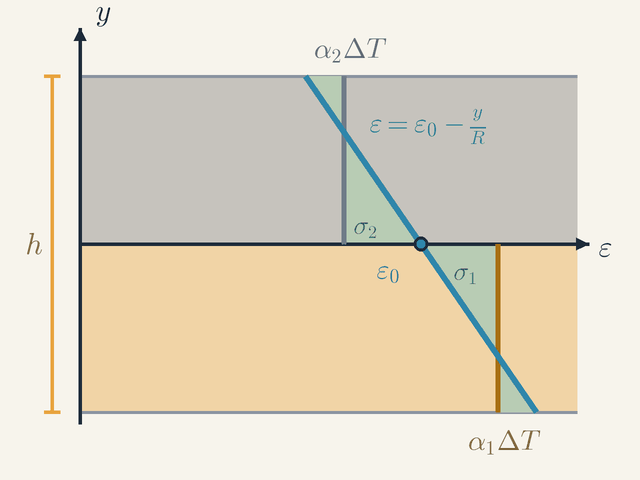
Figure 2. Strain through the thickness of a heated brass–steel strip. The vertical lines are the free strains of the brass (gold, below) and the steel (grey, above); the blue line is the strain of the bent strip. Each green gap, times E, is the stress in that layer.Legend
y
Position across the strip, measured from the interface towards the centre of curvature (the steel side is positive).
m
h
Thickness of the strip, both layers together.
m
ε
Strain along the strip: the fractional change of length.
ε0
Strain at the interface, y=0: the mean of the two free strains for equal layers.
R
Radius of curvature of the bent strip; the blue line falls by 1/R per unit of y.
m
α1ΔT
Strain the brass would have if it were free: its coefficient α1 times the temperature rise.
α2ΔT
Strain the steel would have if it were free: its coefficient α2 times the temperature rise.
σ1
Stress in the brass: E times the gap between the blue line and the brass's own free strain.
Pa
σ2
Stress in the steel: E times the gap between the blue line and the steel's own free strain.
Pa
Figure 2 is a cut through the thickness h of the strip. The vertical axis is the position y across the strip, measured from the interface towards the centre of curvature, so the steel (grey) fills 0<y<h/2 and the brass (gold) fills −h/2<y<0. The horizontal axis is the strain ε along the strip.
Start with the two vertical lines. They are the strains each layer would have if it were free: α1ΔT for the brass and α2ΔT for the steel. Brass expands more, α1>α2, so its line lies further to the right.
Now the blue line. Bonded together, the layers must bend as one, to a radius R. In a bend, each thin slice along the strip is stretched or shortened in proportion to its distance from the centre of curvature, so the strain varies linearly across the strip: ε(y)=ε0−Ry Here ε0 is the strain at the interface. The line falls towards the centre of curvature, so the brass, on the outside of the bend, is stretched most.
A layer is stressed only by the part of its strain that is not free expansion, so the stress is E(ε−αiΔT), with α1 in the brass and α2 in the steel. In the figure this is E times the horizontal gap between the blue line and the layer's own vertical line: the green wedges, σ1 in the brass and σ2 in the steel. Next to the interface the blue line lies left of the brass line and right of the steel line, so the brass is squeezed and the steel stretched. Near the outer faces the blue line has crossed the vertical lines, and the signs are reversed.
The blue line has two unknowns, its position ε0 and its slope 1/R. No external load acts on the strip, so the stresses must give zero net force along it and zero net bending moment. These two conditions fix the two unknowns.
Take equal thicknesses and equal moduli. The term −y/R contributes equal and opposite forces in the two halves, so the net force vanishes only if ε0 is the average of the two free strains, ε0=21(α1+α2)ΔT: the blue line crosses the interface half way between the two vertical lines. Relative to this, the brass is squeezed and the steel stretched by the same mismatch strain 21ΔαΔT, where Δα=α1−α2. Per unit width, these two equal and opposite forces, each 41EΔαΔTh, act h/2 apart and form a couple of moment 81EΔαΔTh2. The bending stress −Ey/R supplies the opposite moment Eh3/(12R). Setting the two moments equal gives R1=2h3ΔαΔT(equal thicknesses and moduli) With this slope the blue line crosses each vertical line two thirds of the way from the interface to the outer face, as drawn.
For the animation, Δα=7×10⁻⁶K−1, ΔT=200K and h=0.5mm give 1/R=4.2m−1. The animation uses Stephen Timoshenko's general formula of 1925 with the real moduli (brass 100 GPa, steel 200 GPa) and gets 4.07m−1, a radius of 24.6 cm.
How far does the tip move? For small angles a circle hugs a parabola, so an arc of radius R falls away from its starting tangent, after a length L, by d≈2RL2 The 10 cm strip therefore lifts its tip by about 20.4 mm. The exact arc, which turns the tip through 23°, gives the 20.1 mm of the green readout. Combining the two formulas gives d=3ΔαΔTL2/(4h): halving the thickness doubles the movement, and doubling the length quadruples it. That is why thermostats use long, thin or coiled strips.
The water curve
Most liquids expand steadily when warmed. Water between 0 °C and about 4 °C does the opposite, and this small anomaly decides how lakes freeze.
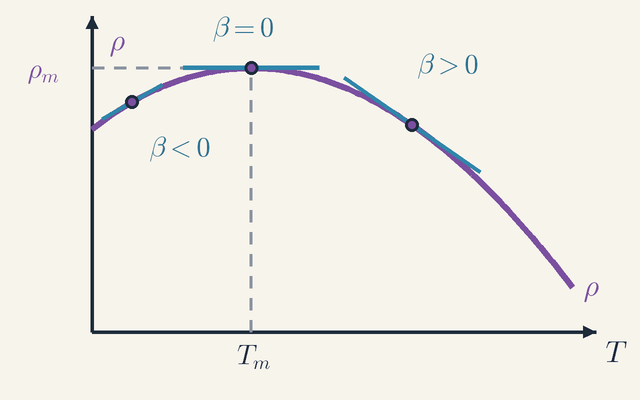
Figure 3. The density ρ of water from 0 to 12 °C, with its tangent at three temperatures. The slope is −βρ: positive where β<0, zero at the maximum at Tm, negative where β>0. The vertical scale is greatly stretched.Legend
T
Temperature, here in degrees Celsius.
∘C
ρ
Density of liquid water.
kg/m3
Tm
Temperature of the density maximum, 3.98 °C.
∘C
ρm
Greatest density of liquid water, 999.97 kg/m³, reached at Tm.
kg/m3
β
Coefficient of volume expansion at the point of tangency: negative where the density rises with T, zero at the maximum, positive where it falls.
K−1
Figure 3 shows the density ρ of water from 0 to 12 °C, the right panel of the animation, with its tangent drawn at three temperatures. To read the expansion coefficient off this curve, note that for a fixed mass the density is inversely proportional to the volume, so β=−(1/ρ)dρ/dT. The slope of the curve is therefore −βρ, and its sign is always opposite to that of β.
Now follow the tangents from left to right. On the left the curve climbs, so the slope is positive and β<0: about −68×10−6K−1 at 0 °C, which means that warming the water there makes it shrink. At the peak the tangent is level and β=0. This is the temperature Tm=3.98 °C of the greatest density, ρm=999.97kg/m3. Beyond it the curve falls and β>0, as for any other liquid. The vertical axis is greatly stretched: from 4 °C to 12 °C the density falls by less than 0.05 %.
This anomaly governs lakes. In autumn, cooled surface water is denser than the water below it, so it sinks, until the whole lake is at about 4 °C. Further cooling makes the surface water lighter, not heavier, so it stays on top, where it freezes, while the bottom stays near 4 °C under floating ice.
When heating makes things shrink
Water's anomaly is structural. Ice is an open, hydrogen-bonded lattice full of empty space. Melting partly collapses it, and ice-like clusters that survive in the cold liquid keep breaking up as it warms, letting the molecules pack closer. This shrinking competes with the ordinary expansion of the bonds, and it wins up to 3.98 °C.
A rubber band carrying a weight shortens when heated, for a different reason. Its tension comes mainly from long chain molecules: a straightened chain has far fewer possible arrangements than a crumpled one, so it has lower entropy, and heat drives the chains back towards shorter, disordered shapes.
Thermodynamics links this to a heat effect without any molecular model. Let f be the tension and L the length of the band. The free energy F=U−TS then changes by dF=−SdT+fdL. Since F is a function of T and L, its mixed second derivatives are equal, and that gives a Maxwell relation: (∂L∂S)T=−(∂T∂f)L
Rubber's tension at fixed length rises with temperature, so the right-hand side is negative: stretching rubber lowers its entropy, and the band must give out heat. Stretched quickly, before that heat can escape, the band warms. A steel wire held at fixed length behaves the other way: heating it relieves its stretch, so it loses tension, by EAα per kelvin for a cross-section A. The sign reverses, and a quick stretch cools the steel, by about 0.1 K at 100 MPa.
Worked problem: the bar between two walls
Thermal stress can be enormous, but a slender bar has a way out. This problem puts numbers to both.
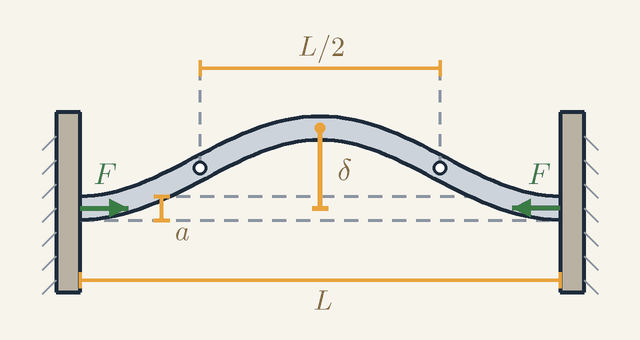
Figure 4. A bar of length L clamped between two walls and pushed by the force F, shown after it has bowed sideways by δ; the dashed outline is the straight bar. The dots are the inflection points, L/2 apart. Not to scale.Legend
L
Length of the bar between the walls.
m
a
Side of the square cross-section of the bar.
m
F
Compressive force between each wall and the bar; before buckling, F=σa2.
N
δ
Sideways displacement of the middle of the bowed bar, exaggerated here.
m
L/2
Length of the stretch between the two inflection points: half the bar.
m
Figure 4 shows the animation's 1 m aluminium bar with the roller replaced by a second rigid wall, so that it is clamped at both ends. Its length is L, and its square cross-section has the side a=10mm, so its area is a2=10−4m2; take E=70GPa. Each wall pushes on the bar with the force F.
First, suppose the bar stays straight through the full 200 K. It would need the stress σ=EαΔT=70×109⋅23×10−6⋅200≈3.2×10⁸Pa that is 322 MPa, or F=σa2=32kN on each wall. Even a strong structural aluminium alloy yields at about 280 MPa, so the bar would be crushed plastically, permanently shortened.
In fact a slender bar fails much earlier, by buckling. The figure shows it after it has bowed sideways, with its middle displaced by δ; the dashed outline is the straight bar, and the bowing is exaggerated. Because the clamped ends cannot turn, the bar takes the shape of one full wave, with inflection points (the dots) a quarter and three quarters of the way along.
At an inflection point the curvature of the bar passes through zero, and because the bending moment is proportional to the curvature, the moment there is zero, just as at an end that is free to turn. The stretch between the dots, of length L/2, therefore behaves like a bar with ends free to turn, and such a bar buckles at the force π2EI/(L/2)2. Here I is the second moment of area of the section, I=a4/12 for a square. So a strut with clamped ends bows sideways once the compressive force reaches 4π2EI/L2, and dividing by the area a2 gives the critical stress σc=a2L24π2EI=3L2π2Ea2≈23MPa
The bar buckles when the thermal stress reaches this value. Setting EαΔTc=σc, the modulus cancels: ΔTc=3αL2π2a2=3⋅23×10−6⋅12π2⋅0.012≈14K
After only 14 K, when a free bar would have grown just 0.33 mm, the clamped one bows sideways. Rails would buckle the same way on hot days if sleepers and ballast did not hold them sideways.
Limits of validity
The linear law makes two assumptions. The first, αΔT≪1, always holds for solids: 1000 K changes steel by only about 1.2 %. The second, a constant α, is the real limit: over wide ranges α must be integrated. Near absolute zero expansion dies out: copper's α at 50 K is only about a quarter of its room value of 17×10−6K−1. At a phase change the law fails abruptly: water expands by 9 % on freezing, and steel shrinks slightly as its crystal structure changes near 900 °C.
The formulas also assume a uniform temperature. Pour boiling water into a thick, cold glass, and the inner surface heats by some 50 K while the outside stays cool. The hot layer is blocked by the cold one, as in the rod between walls, and the stresses are of order EαΔT≈70×109⋅9×10−6⋅50≈30MPa, comparable to the practical strength of ordinary glass. Borosilicate glass, with α≈3.3×10⁻⁶K−1, gets about a third of that, which is why it is used for ovenware and laboratory glass.
Gases follow none of this. At constant pressure an ideal gas has β=1/T, about 3.4×10⁻³K−1 at 20 °C, sixteen times the value for water.
Where this leads
Temperature and Heat supplies the kelvin; Elasticity: Hooke's Law, Stress and Strain supplies σ=Eε, behind thermal stress and buckling. Kinetic Theory of Gases explains why a gas expands by 1/T per kelvin, and First Law of Thermodynamics and Heat Engines puts that expansion to work. The 4 °C anomaly shapes the convection of Conduction, Convection and Radiation, ice returns in Phase Changes and Latent Heat, and the entropy of a rubber band anticipates The Second Law of Thermodynamics and Entropy.
Expansion even reaches geometry. Picture a plate that is cold at its centre and hot at its rim, measured by inhabitants with rulers made of the plate's own material. Near the rim their rulers lengthen, so they count fewer ruler lengths around a circle than across it: circles around the centre measure less than 2π times their radius, and triangles have angles adding up to more than 180∘, as on a sphere. In Gravity as Curved Spacetime, mass does to rulers and clocks what heat does here.
Key formulas
Linear expansion
ΔL=αL0ΔT
Every part of a rod grows by the same fraction αΔT, so the change in length is that fraction of the original length. It doubles if the rod is twice as long or the warming twice as large. A negative ΔT (cooling) gives a negative ΔL.
Symbols
ΔL
change in length
m
α
coefficient of linear expansion of the material
K−1
L0
original length, at the starting temperature
m
ΔT
temperature change (the same in K and °C)
K
When it holds: For a body free to expand, heated evenly, with αΔT≪1 and α nearly constant over the range; not across a phase change such as melting or freezing.
Example: The aluminium bar in the animation: 23×10−6⋅1000mm⋅200=4.6mm.
Area expansion
ΔA≈2αA0ΔT
Both sides of a surface grow by the factor (1+αΔT), so the area is multiplied by its square, 1+2αΔT plus a negligible (αΔT)2. Holes in the surface grow in the same proportion as the material around them.
Symbols
ΔA
change in area
m2
α
coefficient of linear expansion
K−1
A0
original area
m2
ΔT
temperature change
K
When it holds: For an isotropic material heated evenly, with the same conditions as linear expansion. The dropped term (αΔT)2 is only about 2×10⁻⁵ of the area even for aluminium heated by 200 K.
Example: A 1 m² aluminium plate heated by 200 K gains 2⋅23×10−6⋅1⋅200=0.0092m2, that is 92 cm².
Volume expansion
ΔV=βV0ΔT,β≈3α
The volume grows by the fraction βΔT. For an isotropic solid every length is multiplied by (1+αΔT), so the volume is multiplied by its cube and β≈3α. Liquids and gases have no shape of their own and are described by β directly.
Symbols
ΔV
change in volume
m3
β
coefficient of volume expansion
K−1
V0
original volume
m3
ΔT
temperature change
K
α
coefficient of linear expansion of the solid
K−1
When it holds:β≈3α holds only for isotropic solids. For water β changes sign at 3.98 °C, and for an ideal gas at constant pressure β=1/T.
Example: 40 L of petrol (β=950×10−6K−1) warmed by 15 K grows by 950×10−6⋅40000mL⋅15=570mL.
Definition of the expansion coefficient
α=L1dTdL
The coefficient is the fractional rate of growth of a length with temperature at one temperature, the derivative of lnL. Integrating it gives L=L0exp(∫αdT), which reduces to L0(1+αΔT) when α is constant and αΔT is small.
Symbols
α
coefficient of linear expansion at temperature T
K−1
L
length at temperature T
m
dTdL
rate of change of length with temperature, the slope of the length–temperature graph
m/K
T
temperature
K
When it holds: Always valid as a definition. α itself depends on temperature and tends to zero near absolute zero.
Example: The bar in the animation grows 4.6 mm over 200 K, a slope of 0.023mm/K; divided by 1000 mm this gives α=23×10−6K−1.
Thermal stress in a blocked rod
σ=EαΔT
If walls keep a rod at its original length, they must compress it by the strain αΔT that free expansion would have produced. By Hooke's law, σ=Eε, that takes the stress EαΔT, compressive on heating and tensile on cooling. The length of the rod does not appear.
Symbols
σ
stress in the rod (size)
Pa
E
Young's modulus of the material
Pa
α
coefficient of linear expansion
K−1
ΔT
temperature change since the rod was fixed
K
When it holds: For perfectly rigid supports and stresses below the elastic limit; a slender rod buckles sideways at a much lower stress.
Example: A steel deck (E=200GPa) blocked and warmed by 30 K: σ=200×109⋅12×10−6⋅30=72MPa.
Curvature of a bimetallic strip
R1=2h3ΔαΔT(equal thicknesses and moduli)
The two bonded layers try to expand by different amounts, and the strip settles in the shape where the internal stresses give no net force and no net bending moment: an arc whose curvature 1/R grows with the mismatch ΔαΔT. A thinner strip bends more, because the same mismatch of strain is taken up across a smaller thickness. The layer with the larger α lies on the outside of the curve.
Symbols
R
radius of curvature of the strip
m
Δα
difference between the two expansion coefficients
K−1
ΔT
temperature change since the strip was straight
K
h
total thickness of the strip
m
When it holds: For two layers of equal thickness and equal Young's modulus, bonded without slipping and heated evenly; unequal moduli change the factor (by about 3 % for brass on steel).
Example: Brass on steel, Δα=7×10⁻⁶K−1, h=0.5mm, heated by 200 K: 1/R=4.2m−1, a radius of 23.8 cm.
Tip deflection of a bent strip
d≈2RL2
A circular arc of radius R bends away from its starting tangent, and after a length L the gap has grown to about L2/(2R), the same geometry as the drop of the Earth's surface below a horizontal line of sight. Because 1/R grows with ΔT, the tip moves in proportion to the temperature change.
Symbols
d
sideways movement of the free end
m
L
length of the strip
m
R
radius of curvature
m
When it holds: For small bends, L≪R; the exact arc gives R(1−cos(L/R)), slightly less.
Example: The 10 cm strip in the animation with R=24.6cm: d≈1002/(2⋅246)≈20mm.
Glossary
Thermal expansion
The growth of a body's lengths, areas and volume when its temperature rises, and their shrinking when it falls. It is reversible: brought back to its starting temperature, the body returns to its original size.
Linear, area and volume expansion
The growth of one length, of a surface and of a volume. For an isotropic solid they are linked: in fractional terms an area grows twice and a volume three times as much as a length, β≈3α.
Isotropic material
A material that behaves the same in every direction, so a single coefficient describes all its lengths. Many crystals are anisotropic and expand by different amounts along different axes.
Anharmonicity
The lopsidedness of the force between atoms: squeezing them together costs more energy than pulling them apart by the same distance. Without it atoms would vibrate symmetrically and solids would not expand.
Bimetallic strip
Two metals with different expansion coefficients bonded face to face. Heated, it bends with the more strongly expanding metal on the outside of the curve; it is the moving part of many thermostats and switches.
Thermal stress
The stress that builds up when expansion or contraction is prevented, σ=EαΔT for a fully blocked rod. It does not depend on the length: steel gains about 2.4 MPa per kelvin.
Expansion joint
A gap left in a bridge, road, pipeline or railway so that its parts can lengthen and shorten freely. On bridges it is often spanned by interlocking steel teeth.
Buckling
The sudden sideways bowing of a slender rod, rail or plate under compression. A 1 m aluminium bar 10 mm thick, clamped between walls, buckles after only about 14 K of warming, long before the stress could crush it.
Anomalous expansion of water
Water contracts as it warms from 0 °C to 3.98 °C, where its density peaks at 999.97 kg/m³, and expands above that. This is why a lake freezes from the top while its bottom stays near 4 °C.
Negative thermal expansion
Contraction on heating, the opposite of the usual behaviour. Water below 4 °C, a stretched rubber band and zirconium tungstate all shrink as they warm.
Invar
An iron–nickel alloy with a very small expansion coefficient, about 1.2×10⁻⁶K−1, because a magnetic contraction almost cancels its normal expansion. It is used for precision instruments and measuring tapes.
Thermoelastic effect
The small temperature change of a solid that is loaded quickly. A steel wire cools slightly when stretched while rubber warms, and the sign follows from the sign of the material's expansion.
Quantities
L0
Original length
m
The length at the starting temperature: 1 m for the bar in the animation.
ΔL
Change in length
m
New length minus original length, L−L0: positive on heating, negative on cooling. 4.6 mm for the bar heated by 200 K.
ΔT
Temperature change
K
Final minus initial temperature. It has the same value in kelvins and in degrees Celsius: 20 °C to 220 °C is 200 K.
α
Coefficient of linear expansion
K−1
The fractional growth of a length per kelvin, (1/L)dL/dT, a property of the material: steel 12, brass 19, aluminium 23, in units of 10−6K−1.
β
Coefficient of volume expansion
K−1
The fractional growth of a volume per kelvin; 3α for an isotropic solid, and the only coefficient used for liquids: about 210×10−6K−1 for water at 20 °C.
σ
Thermal stress
Pa
Force per unit cross-sectional area inside a body whose expansion is blocked; compressive when it is heated, tensile when it is cooled.
E
Young's modulus
Pa
The stiffness of the material, stress divided by strain: about 200 GPa for steel, 100 GPa for brass and 70 GPa for aluminium.
h
Strip thickness
m
The total thickness of a bimetallic strip, both layers together: 0.5 mm in the animation.
R
Radius of curvature
m
The radius of the circle into which a heated bimetallic strip bends; 1/R is its curvature. About 25 cm for the strip in the animation at 220 °C.
d
Tip deflection
m
How far the free end of a bent strip moves away from its straight position: 20 mm for the 10 cm strip in the animation.
Quiz
Beginner Why do long bridges have expansion joints (gaps bridged by interlocking metal teeth)?
To let rainwater drain off the road
To give the deck room to lengthen and shorten as its temperature changes
To make the bridge lighter
To stop the bridge from swaying in the wind
Show answer
Answer: B. To give the deck room to lengthen and shorten as its temperature changes
A steel or concrete deck grows on hot days and shrinks on cold ones, by tens of centimetres on a long bridge. Without joints it would push on its supports hard enough to crack or buckle.
Beginner A metal lid is stuck on a glass jar. Why does running hot water over the lid help to open it?
Hot water makes the lid slippery
The glass expands more than the metal and pushes the lid off
Heat makes the metal soft, like rubber
The metal lid expands more than the glass, so it loosens
Show answer
Answer: D. The metal lid expands more than the glass, so it loosens
Metals expand more than glass for the same warming (and the thin lid heats up first), so the lid grows away from the glass rim and the grip loosens.
Beginner A strip of brass is bonded to a strip of steel and heated. Brass expands more than steel. What happens?
The strip bends, with the brass on the outside of the curve
The strip bends, with the brass on the inside of the curve
The strip stays straight and simply gets longer
The strip gets shorter, because the steel pulls the brass back
Show answer
Answer: A. The strip bends, with the brass on the outside of the curve
The brass layer wants to become longer than the steel layer, but they are joined. The only way for one side to be longer is to curve, with the longer brass on the outer side of the bend.
Intermediate A steel rail (α = 12×10⁻⁶ K⁻¹) is 25 m long. By how much does it lengthen when it warms by 30 K?
0.9 mm
90 mm
9 mm
0.3 mm
Show answer
Answer: C. 9 mm
ΔL = α·L₀·ΔT = 12×10⁻⁶ K⁻¹ × 25 m × 30 K = 9×10⁻³ m = 9 mm. Forgetting ΔT gives 0.3 mm; a power-of-ten slip gives 0.9 mm or 90 mm.
Intermediate A steel plate with a round hole in it is heated evenly. What happens to the hole?
It shrinks, because the metal expands into the hole
It keeps exactly the same size
It becomes oval
It grows by the same fraction as every other length in the plate
Show answer
Answer: D. It grows by the same fraction as every other length in the plate
Uniform expansion scales every length by (1 + α·ΔT), like a photographic enlargement, including the circumference of the hole. The hole therefore grows, by the same fraction as the plate.
Advanced For a bimetallic strip, 1/R = 3·Δα·ΔT/(2h). If the strip is made half as thick (same length, materials and ΔT), what happens to the deflection of its tip?
It halves
It doubles
It stays the same
It quadruples
Show answer
Answer: B. It doubles
d ≈ L²/(2R) and 1/R ∝ 1/h, so halving h doubles the curvature and the deflection. A fourfold change would come from doubling the length, since d ∝ L².
Advanced A steel rod (E = 200 GPa, α = 12×10⁻⁶ K⁻¹) is held between two rigid walls and warmed by 50 K. What stress builds up in it?
120 MPa, compressive
120 MPa, tensile
Zero, because its length does not change
2.4 MPa, compressive
Show answer
Answer: A. 120 MPa, compressive
The walls must squeeze the rod back by the free expansion α·ΔT, a strain of 6×10⁻⁴, so σ = E·α·ΔT = 200×10⁹ Pa × 12×10⁻⁶ K⁻¹ × 50 K = 1.2×10⁸ Pa = 120 MPa, in compression. 2.4 MPa is E·α alone, without ΔT.
Advanced In winter, ice forms on the surface of a deep lake while the water at the bottom stays at about 4 °C. Why?
Ice is denser than water, so it forms at the top and sinks later
Heat from the Earth's core keeps the bottom at exactly 4 °C
Water is densest at about 4 °C, so once the lake reaches 4 °C, colder water stays on top and freezes there
The high pressure at the bottom raises the freezing point
Show answer
Answer: C. Water is densest at about 4 °C, so once the lake reaches 4 °C, colder water stays on top and freezes there
Above 4 °C, cooled surface water is denser and sinks, mixing the lake. Below 4 °C the anomaly reverses this: colder water is lighter, stays at the surface and freezes, while the densest water, at about 4 °C, fills the bottom. (Pressure actually lowers the freezing point slightly.)
 Physics Tutor