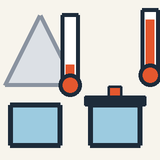
Why melting ice and boiling water soak up heat without getting any warmer, and how much heat each change of state takes: Q=mL, with Lf=334kJ/kg and Lv=2260kJ/kg for water.
1 kg of ice is heated from −20 °C into steam at 120 °C: the temperature climbs, halts at 0 °C while the crystal melts, climbs again, and halts at 100 °C while the water boils away.
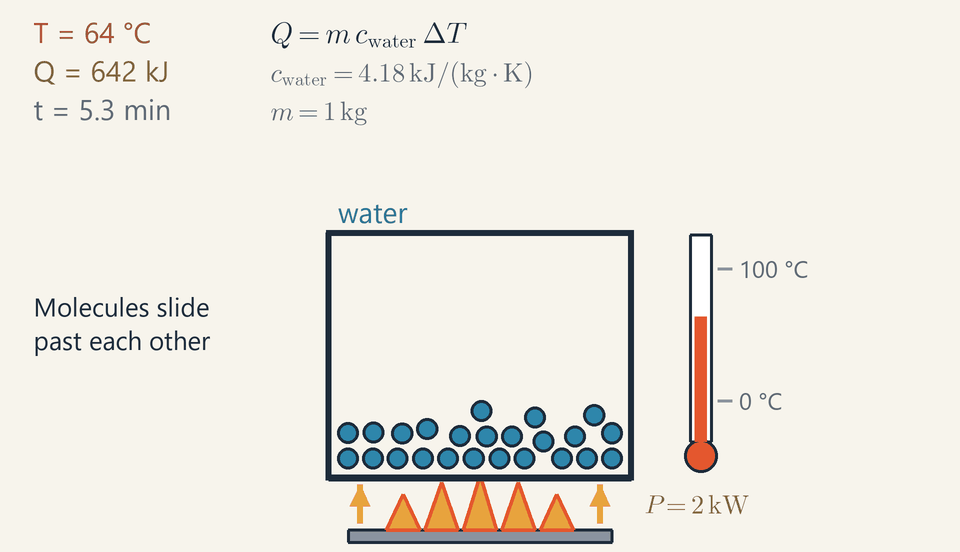
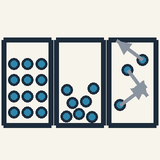
In a solid, molecules hold fixed places; in a liquid they slide past each other; in a gas they are far apart and fly freely.
While ice melts or water boils, the temperature stays the same even though heat keeps flowing in.
This hidden (latent) heat breaks the links between molecules; boiling needs about seven times more than melting.
Freezing and condensing give the heat back, and evaporation cools: that is how sweating keeps you cool.
Step 1. Ice melts, and water boils. Matter comes in three everyday states. In a solid such as ice, the molecules hold fixed places in a regular pattern and can only jiggle on the spot. In a liquid they stay close but slide past one another. In a gas such as steam they are far apart and fly about freely.
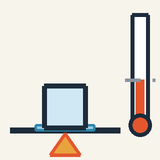
Step 2. Warm some ice and the thermometer climbs, but only to 0 °C. Surprisingly, the flame keeps supplying heat, yet the thermometer stays at 0 °C until the last bit of ice has melted. The heat is busy breaking the links that hold the molecules in their pattern, not making them move faster. Because it seems to vanish, it is called latent (hidden) heat.
Step 3. The same happens at 100 °C: the water boils, bubbles of steam form inside it, and the temperature stays put until all the water has turned to steam. Boiling needs about seven times more heat than melting, because each molecule must tear itself completely away from its neighbours.
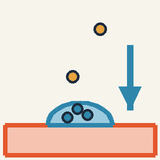
Step 4. Run the film backwards and the heat comes back: freezing water and condensing steam give it out. Water also evaporates below boiling: the fastest molecules escape from the surface and carry energy away, which is how sweat cools your skin.
Butter is a mixture of fats and glass has no regular pattern, so they soften gradually instead of melting at one temperature.
In the animation, watch the thermometer stop at 0 °C while the links of the crystal break, then at 100 °C while molecules escape one by one. The boiling stage is shown four times faster.
Check yourself: why does a drink with ice cubes stay near 0 °C until the ice is gone? Answer: the heat coming in from the warm room melts the ice instead of warming the drink.
Intermediate
Key ideas
Q=mcΔT changes the temperature; Q=mL changes the state at constant temperature (ΔT=0).
Water: Lf=334kJ/kg, Lv=2260kJ/kg; boiling 1 kg takes over five times the heat of warming it from 0 to 100 °C.
From ice at −20 °C to steam at 120 °C, 1 kg needs about 3094 kJ, and 73 % of it goes into boiling.
The boiling point depends on pressure: about 71 °C on Everest, about 120 °C in a pressure cooker.
Two kinds of heat
It is tempting to think that heating a substance must make it hotter. In fact the energy can do two things. It can make the molecules move faster, which a thermometer shows as a rising temperature: this is sensible heat, Q=mcΔT, met in Temperature and Heat. Or it can pull the molecules apart without speeding them up, and the substance changes state at constant temperature: this is latent, or hidden, heat.
The specific heat capacity c belongs to a phase, not the substance. For water it is about 2100 J/(kg·K) in ice, 4180 J/(kg·K) in the liquid and 2010 J/(kg·K) in steam, so the same heat warms ice about twice as much as liquid water.
Latent heat changes the state
While a substance changes state, the heat is proportional to the mass that changes: Q=mL Here L is the specific latent heat in J/kg: Lf (fusion) for melting, Lv (vaporisation) for boiling, with ΔT=0.
For water at atmospheric pressure, Lf=334kJ/kg at 0 °C and Lv=2260kJ/kg at 100 °C. Boiling a kilogram takes 6.8 times the heat that melts it and 5.4 times the heat that warms it from 0 to 100 °C, because melting only loosens the bonds, while boiling tears each molecule away from its neighbours.
The change runs both ways at the same temperature: freezing a kilogram of water releases 334 kJ, condensing a kilogram of steam 2260 kJ. Heat given out counts as negative: Q=−mLf for freezing.
Heat balance with a change of state
Three relations, applied stage by stage, solve nearly every problem here:
Q=mcΔT
Q=mL
Lf=334kJ/kg,Lv=2260kJ/kg(water)
Split the process into stages, each changing either the temperature of one phase, with its c, or the state at a fixed temperature, with mL; no single mcΔT may cross 0 °C or 100 °C. In an insulated container all heats add up to zero, latent ones included. Before solving for a final temperature, check that there is enough heat for the change of state to finish; if not, the mixture ends at the transition temperature with both phases present.
Worked example: the ice in the animation
A kilogram of ice at −20 °C is heated at 1 atm into steam at 120 °C. In kilojoules, with c in kJ/(kg·K) as on the screen:
Ice from −20 to 0 °C: Q1=mciceΔT=1⋅2.1⋅20=42kJ
Melting at 0 °C: Q2=mLf=1⋅334=334kJ
Water from 0 to 100 °C: Q3=mcwaterΔT=1⋅4.18⋅100=418kJ
Boiling at 100 °C: Q4=mLv=1⋅2260=2260kJ
Steam from 100 to 120 °C: Q5=mcsteamΔT=1⋅2.01⋅20=40.2kJ
The total, 42+334+418+2260+40.2≈3094kJ, is the final value on the Q readout, and the T readout ends at 120 °C. Boiling alone takes 73 % of the heat.
The ideal burner supplies P=2kW, so each stage lasts t=Q/P: melting 334000/2000=167s, boiling 2260000/2000=1130s, almost 19 minutes, and the whole journey 1547 s, the final 25.8 min on the clock readout. The film is not to scale: boiling runs four times faster and the short warmings four times slower, as the purple labels say.
On the sloped stages the formula line reads Q=mcΔT with the current phase's c; on the flat ones it switches to Q=mL with ΔT=0, and the T readout stops while Q keeps climbing. The gold arrows beside the flame never change: heat flows in steadily. In the box the grey bonds of the crystal break one by one at 0 °C, and at 100 °C the molecules escape one at a time, each of the 24 taking 2260/24≈94kJ.
Worked example: ice in a jug of lemonade
You add 100 g of ice at −10 °C to 300 g of lemonade at 24 °C in an insulated jug. Treating the lemonade as water, what is the final temperature?
First compare what the ice needs with what the lemonade can give. Warming the ice to 0 °C takes 0.10⋅2100⋅10=2100J and melting it all 0.10⋅334000=33400J, 35 500 J in total, but the lemonade, cooling to 0 °C, can give at most 0.30⋅4180⋅24≈30100J. So the drink ends at exactly 0 °C: the remaining 28 000 J melts 28000/334000≈0.084kg, and 16 g of ice still floats.
With only 50 g of ice, warming and melting need 1050+16700=17750J, so all of it melts, and the energy balance reads 0.30⋅4180⋅(24−T)=17750+0.05⋅4180⋅T This gives about 8.4 °C, whereas 50 g of water at 0 °C would leave the drink at 20.6 °C: most of the cooling comes from the melting.
Reading the heating curve
Plot the T readout against the Q readout for the heating curve, made of straight pieces. A rising piece has slope 1/(mc), so the water piece is half as steep as the ice and steam pieces. A flat piece is mL long: 334 kJ for melting, 2260 kJ for boiling. With a steady burner the graph against time looks the same, since t=Q/P.
Read backwards, it is a cooling curve: a freezing liquid levels off because the latent heat it releases makes up for the heat it loses, which is how melting points are measured. Butter and wax, being mixtures, and glass, which has no regular crystal, show no flat piece; they soften gradually.
Common mistakes
Turning up the flame does not heat boiling water above 100 °C at 1 atm; it only boils it away faster: a 4 kW burner boils away the animation's kilogram in 9.4 minutes, not 19.
Heat is not temperature: while the ice melts, 334 kJ flow in and the thermometer stays at 0 °C. The energy rearranges the molecules instead of speeding them up.
Watch the units of L: 334 kJ/kg equals 334 J/g, so melting 20 g of ice takes 20⋅334=6680J. Mixing grams with joules per kilogram gives errors by a factor of 1000.
The values 0 °C and 100 °C hold only at 1 atm. On Everest, at about a third of an atmosphere, water boils near 71 °C; in a pressure cooker at about 2 atm, near 120 °C.
Evaporation is not boiling: it happens at the surface at any temperature, while boiling needs bubbles of vapour inside the liquid.
Where you meet it
Steam scalds because each gram condensing on the skin releases 2260 J, while a gram of water at 100 °C gives about 260 J as it cools to body temperature. Sweat cools you by evaporating: with Lv≈2420kJ/kg at skin temperature, a litre an hour carries away about 670 W. On frosty nights growers spray fruit trees, because freezing water releases 334 kJ per kilogram and holds the buds near 0 °C. A refrigerator evaporates a fluid inside, taking latent heat from the food, and condenses it at the back, releasing the heat into the kitchen.
In clouds, condensing vapour releases the latent heat that powers storms. The ideas return in later lessons: Conduction, Convection and Radiation; Kinetic Theory of Gases; and First Law of Thermodynamics and Heat Engines.
Advanced
Key ideas
L is an enthalpy jump, L=Δu+pΔv: at 1 atm about 7.5 % of Lv pushes back the atmosphere.
Coexisting phases have equal g=h−Ts, which fixes T at a given p; the entropy jumps by Δs=L/T.
A Carnot cycle across the boiling plateau gives Clausius–Clapeyron: dp/dT=L/(TΔv); for ice Δv<0.
The vapour density goes as e−W/kBT, W being the energy to free one molecule, so vapour pressure climbs steeply with T.
The molecular picture of a plateau
A plateau on a heating curve is a stretch where heat keeps flowing in but the temperature does not rise. To see where that energy goes, look at the molecules.
In ice each water molecule is held by hydrogen bonds to four neighbours, in an open hexagonal lattice, and vibrates about its fixed site. Temperature measures the mean kinetic energy of this jiggling. Below 0 °C, added heat makes the vibrations larger, and the thermometer rises. At the melting point the added energy goes into breaking bonds instead: it becomes potential energy as the lattice comes apart, the mean kinetic energy stays the same, and so the temperature stays put until the crystal is gone.
The animation draws this as a cartoon. The crystal's molecules vibrate with an amplitude that grows as T, because the mean square displacement of a vibration is proportional to the temperature. On the plateau the bonds break one by one, and the liquid packs more closely than the open crystal, because water is denser than ice.
Two latent heats measure the two jobs. The specific latent heat of fusion, Lf=334kJ/kg, melts ice at 0 °C; the specific latent heat of vaporisation, Lv=2260kJ/kg, boils water at 100 °C. Melting only loosens the hydrogen-bond network, so Lf is just 12 % of the 2834 kJ/kg that takes ice straight to vapour. Boiling must free every molecule from all of its neighbours, so Lv≈6.8Lf.
The energy per molecule is LvM/NA, where M=0.018kg/mol is the molar mass and NA is Avogadro's number: LvM/NA≈6.8×10−20J≈0.42eV. That is about 13 times kBT at 100 °C, the typical thermal energy, with kB Boltzmann's constant. A molecule escapes only when it happens to gather far more than its average share of energy. Escape is therefore a rare event whose rate depends steeply on temperature, and this returns below as the steep vapour-pressure curve.
Latent heat as a jump in enthalpy
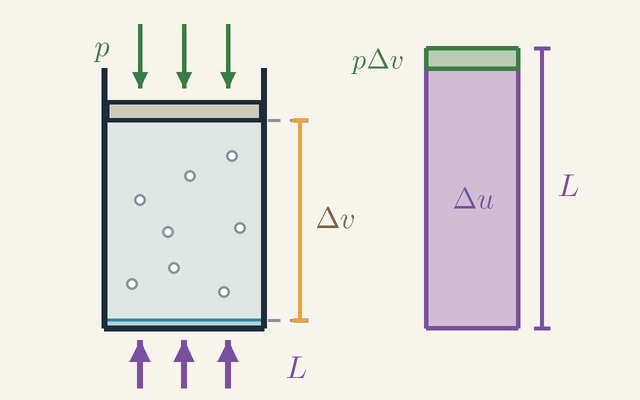
Figure 1. One kilogram boiling at constant pressure p: the heat L flows in, the vapour gains the volume Δv and lifts the piston. The bar shows how L splits into Δu and pΔv for water at 1 atm. The cylinder is not to scale.Legend
p
Constant pressure of the surroundings, pushing down on the piston.
Pa
L
Heat that turns one kilogram of liquid into vapour: the latent heat.
J/kg
Δv
Volume gained per kilogram: vapour minus liquid.
m3/kg
Δu
Rise in internal energy per kilogram: the energy that pulls the molecules apart.
J/kg
pΔv
Work per kilogram done on the surroundings as the vapour pushes the piston up.
J/kg
Where exactly does the latent heat go? Part of it separates the molecules, and part of it pays for the room the vapour takes up. Splitting the two shows that latent heat is a change in enthalpy, the quantity used for every phase change in the rest of this lesson.
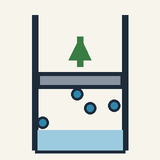
Figure 1 shows one kilogram of liquid boiling in a cylinder closed by a piston that slides freely. The arrows on the piston stand for the pressure p of the surroundings, which stays constant. The arrows at the bottom are the heat L flowing in. As liquid turns into vapour the volume grows by Δv, the bracket beside the cylinder, so the piston rises against p. Lifting it takes the work pΔv, energy that leaves the substance and goes to the surroundings. The rest, Δu, stays inside as a rise in internal energy: the energy of pulling the molecules apart. The bar on the right stacks the two parts, and together they make up L.
To write this as an equation, use lower-case letters for quantities per kilogram: u for internal energy, v for volume and h=u+pv for enthalpy. The first law says that the heat taken in equals the rise in internal energy plus the work done, L=Δu+pΔv. Because p is constant, pΔv is the same as Δ(pv), so the heat is exactly the jump in enthalpy:
L=Δh=Δu+pΔv
For water boiling at 1 atm (101 325 Pa), each kilogram grows from 0.00104 m³ of liquid to 1.673 m³ of vapour, so pΔv=101325⋅1.672≈169kJ/kg. Only 7.5 % of Lv goes into pushing back the atmosphere; the other 2091 kJ/kg separates the molecules. The bar in Figure 1 is drawn in these proportions.
Melting is different. Ice shrinks by about 8 % as it melts, so Δv is small and negative and pΔv≈−9J/kg: the atmosphere does a tiny amount of work on the ice, and Lf is almost entirely internal energy.
Why the temperature stalls
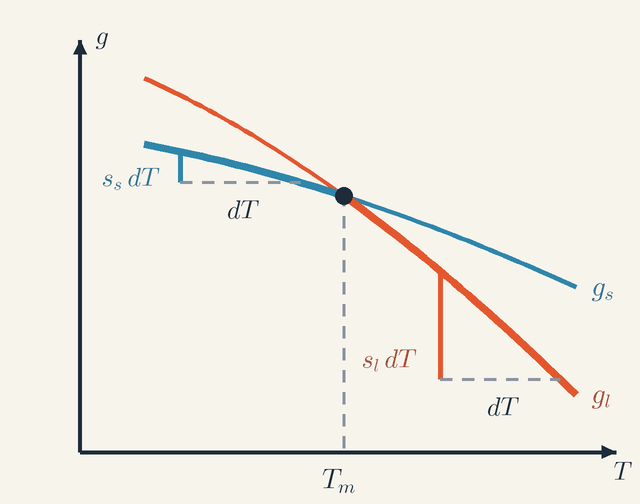
Figure 2. Specific Gibbs energies of the solid, gs, and of the liquid, gl, at one pressure. Each falls with slope −s, the liquid's faster. The lower curve, drawn thick, is the stable phase, and the two cross at the melting point Tm. Not to scale.Legend
g
Specific Gibbs energy, h−Ts; at fixed T and p the phase with the lower g is stable.
J/kg
T
Temperature.
K
gs
Specific Gibbs energy of the solid.
J/kg
gl
Specific Gibbs energy of the liquid.
J/kg
Tm
Temperature where the curves cross: the melting point at this pressure.
K
dT
A small step in temperature.
K
ssdT
How far gs falls over the step dT: the solid's entropy times the step.
J/kg
sldT
How far gl falls over the same step: more, because the liquid's entropy sl is larger.
J/kg
The molecular picture says what the heat does on a plateau. Thermodynamics says why the substance must stay at one temperature while it changes phase. The tool is the specific Gibbs energy g=h−Ts, where s is the specific entropy. At fixed temperature and pressure a system settles in the state of lowest Gibbs energy, just as a mechanical system settles at its lowest potential energy.
Figure 2 plots g against T at one fixed pressure, for the solid, gs, and for the liquid, gl. At each temperature the phase whose curve lies lower is the stable one, and that part of its curve is drawn thick: the solid's to the left of Tm, the liquid's to the right.
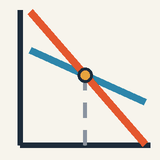
Why do the curves cross? At fixed pressure a small change of g is dg=−sdT, so each curve slopes down with gradient −s. Look at the two small triangles: over the same step dT the solid's curve drops by ssdT and the liquid's by sldT. The liquid is the more disordered phase, so sl>ss and its curve falls faster. At low temperature the liquid's curve lies higher, so the steeper curve must cut the shallower one, and it does so once, at the melting point Tm: below it the solid has the lower g and is stable, above it the liquid. Both curves also bend downwards, because each phase's entropy grows as it warms.
Now put ice and water in contact. They share the same T and p and exchange molecules freely. Moving a kilogram from solid to liquid changes the Gibbs energy by gl−gs, so molecules drift towards the phase with the lower curve until the other phase is used up. The two can stay together only where neither direction gains anything, gs=gl: at the crossing, at Tm and nowhere else.
That is why the temperature stalls. While both phases are present it is pinned at Tm, and added heat can only change the proportions: after a heat Q on the melting plateau, a fraction Q/(mLf) of the mass m has melted.
The crossing also fixes the jump in entropy. Writing gs=gl as hs−Tss=hl−Tsl gives Δh=TΔs, and since Δh=L,
Δs=TL
For water this is 1.22 kJ/(kg·K) on melting and 6.06 kJ/(kg·K) on boiling. Per mole the boiling value is 109 J/(mol·K). Trouton's rule, an observation rather than a law, says that many simple liquids gain roughly 87 J/(mol·K) on boiling. Water gains more because its hydrogen bonds make the liquid unusually ordered, so turning it into vapour adds more disorder.
The heating curve
The expert graph of the animation plots the temperature T against the heat supplied Q while 1 kg of ice at −20 °C becomes steam at 120 °C. It has two kinds of stretch. Within one phase, heat raises the temperature and the line is straight, with slope
dQdT=mc1
where c is the specific heat capacity. With m=1kg and c equal to 2.1, 4.18 and 2.01 kJ/(kg·K), the slopes are 0.48 K/kJ for ice, 0.24 K/kJ for water and 0.50 K/kJ for steam: liquid water is the hardest to warm. On a plateau the temperature is fixed and only the width matters: mLf=334kJ for melting and mLv=2260kJ for boiling. The whole axis spans 3094 kJ, and the boiling plateau alone fills 73 % of it.
The phase diagram
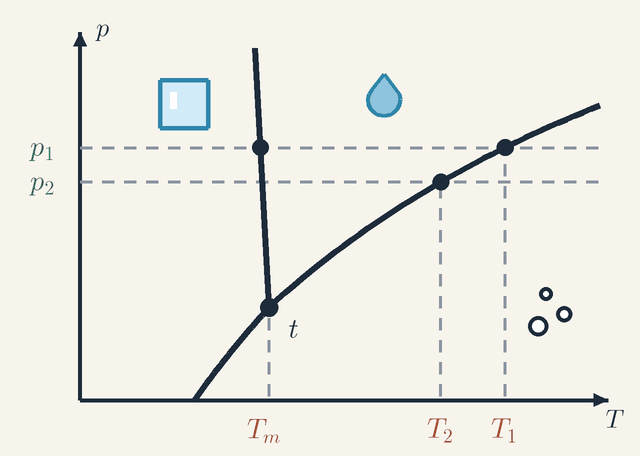
Figure 3. The p–T phase diagram of water, pressure on a logarithmic axis; the three coexistence lines meet at the triple point t. Heating at p1 (sea level) or p2 (a mountain) is a horizontal path that boils at T1 or T2. Not to scale.Legend
p
Pressure, on a logarithmic axis.
Pa
T
Temperature.
K
t
The triple point, the only point where solid, liquid and vapour coexist.
p1
Sea-level pressure, 1 atm.
Pa
p2
Pressure on a high mountain, a third of p1.
Pa
Tm
Melting point of ice, almost the same at every pressure shown.
K
T1
Boiling point at p1.
K
T2
Boiling point at p2, lower than T1.
K
A heating curve is one experiment at one pressure. The phase diagram shows, for every pressure and temperature at once, which phase is stable and where two phases can coexist.
Figure 3 is the p–T diagram of water, with pressure on a logarithmic axis so that very low pressures and atmospheric pressure both fit. Each phase owns a region: the cube marks the solid, the drop the liquid and the bubbles the vapour. Along the lines between the regions two phases coexist, and the three lines meet at the triple point t, 0.01 °C and 612 Pa, the only point where all three phases coexist.
A heating experiment at constant pressure is a horizontal path from left to right. The animation's dot runs along the dashed line p1, 1 atm. It stops where the path meets the nearly vertical melting line, at Tm, 0 °C, and again where it meets the vaporisation curve, at T1, 100 °C: these two crossings are the two plateaus.
On a high mountain the pressure is lower, the dashed line p2, a third of an atmosphere. That path meets the rising vaporisation curve sooner, so the boiling point T2 is lower. The melting line is drawn leaning back far more than it really does; its true slope is worked out later in the lesson.
Below the triple-point pressure a horizontal path never enters the liquid region. It crosses the sublimation curve instead, where ice turns straight into vapour. Snow does this on a cold, dry, sunny day, when the water vapour in the air has a pressure well below 612 Pa. At the triple point the sublimation curve is steeper than the vaporisation curve, because its latent heat is larger, and the next section shows that the slope grows with the latent heat. That latent heat is about 2834 kJ/kg: Lf plus Lv measured at 0 °C, which is 2501 kJ/kg, not the 2260 kJ/kg of 100 °C.
Derivation: the Clausius–Clapeyron equation
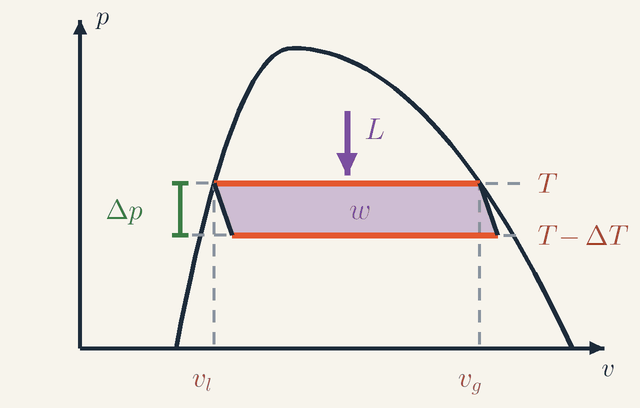
Figure 4. A thin Carnot cycle inside the dome where liquid and vapour coexist. On the isotherm T one kilogram evaporates from vl to vg, absorbing L; the shaded strip is the work w. Not to scale: Δp and ΔT are exaggerated.Legend
p
Pressure.
Pa
v
Volume per kilogram.
m3/kg
vl
Volume of one kilogram of liquid.
m3/kg
vg
Volume of one kilogram of vapour, in reality far larger than vl.
m3/kg
Δp
Drop in vapour pressure from T to T−ΔT.
Pa
T
Temperature of the evaporation: the upper isotherm.
K
T−ΔT
Slightly lower temperature of the condensation: the lower isotherm.
K
L
Heat absorbed while one kilogram evaporates.
J/kg
w
Net work of one cycle per kilogram, the area of the strip: Δp(vg−vl).
J/kg
The lines of Figure 3 are not arbitrary. Their slope dp/dT follows from the latent heat and the change in volume alone, and the argument needs nothing beyond the second law. The idea is to run a tiny Carnot engine that uses boiling as its working stroke.
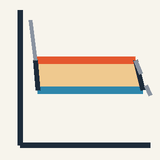
Figure 4 is a p–v diagram. Inside the dome, liquid and vapour coexist; there the pressure at a given temperature is fixed at the vapour pressure, so each isotherm is a horizontal line. Follow one kilogram round the cycle. Along the top edge, at temperature T and vapour pressure p, the liquid evaporates completely: its volume grows from vl to vg while it absorbs the heat L. Down the slanted right side the wet vapour expands adiabatically, with no heat exchanged, and cools to T−ΔT, so its pressure falls by Δp. Along the bottom edge, at T−ΔT and the lower pressure p−Δp, it condenses and gives out heat. Up the slanted left side an adiabatic compression brings it back to the start.
Now find the work of one cycle in two ways. Geometrically, the net work is the area enclosed: a thin strip of base vg−vl and height Δp, the shaded strip, so w=Δp(vg−vl). Thermodynamically, any reversible engine working between T and T−ΔT has the Carnot efficiency ΔT/T, so it turns that fraction of the absorbed heat into work: w=LΔT/T. Setting the two equal and letting ΔT shrink to zero gives the Clausius–Clapeyron equation, with Δv=vg−vl:
dTdp=TΔvL
The Gibbs energy gives the same result. Along a coexistence line the two phases keep gl=gg, so their changes match, dgl=dgg. In general dg=vdp−sdT, so vldp−sldT=vgdp−sgdT, which gives dp/dT=Δs/Δv; with Δs=L/T this is the same equation.
Boiling points and vapour pressures
The equation becomes easy to use with two approximations, both good far from the critical point. The vapour takes up far more room than the liquid, vg≫vl, so Δv≈vg. And the vapour is nearly an ideal gas, vg≈RT/(Mp), with R the gas constant. Substituting both gives
dTd(lnp)=RT2LM
and, if L is treated as constant, integrating between two points (T1,p1) and (T2,p2) of the curve gives
ln(p1p2)=−(RLM)(T21−T11)
For water LM/R≈4900K. Start from sea level, where p1 is 1 atm and the boiling point is T1=373K (Figure 3). On the mountain p2=p1/3, so ln(p2/p1)=−ln3 and the formula gives 1/T2=1/373+ln3/4900 (in K−1): T2=344K, about 71 °C. At 2 atm the same formula gives about 121 °C, roughly the temperature inside a pressure cooker.
The curve can be read in two ways: as the vapour pressure of the liquid at each temperature, or as its boiling point at each outside pressure. These are one curve because a liquid boils when bubbles of its own vapour can grow inside it, and that happens once its vapour pressure reaches the pressure around it.
For melting, the same equation explains the near-vertical line. With Δv=−9.07×10⁻⁵m3/kg at 273 K it gives dp/dT≈−13.5MPa/K. The slope is huge and negative: it takes 133 atmospheres to lower the melting point by 1 K, and the line leans slightly back, towards lower temperature at higher pressure. Water is unusual here; for most substances the solid is denser than the liquid, Δv>0, and the melting line leans forwards.
Kinetic theory explains why the boiling curve rises so steeply. A molecule needs an energy W≈LM/NA to escape from the liquid, and the share of molecules with that much energy goes roughly as the Boltzmann factor e−W/kBT. Since W/kBT=LM/(RT), this is the same exponential that the integrated formula gives, p∝e−LM/(RT). As a result the vapour pressure of water rises by 3.5 % per kelvin at 100 °C and by about 6 % per kelvin at 20 °C. And because the molecules that escape are the fastest ones, those left behind are slower on average: an evaporating liquid cools.
Worked problem: the same ice on a mountain
Take the animation's kilogram of ice at −20 °C and its ideal 2 kW burner to the summit of Everest, where the pressure is about a third of an atmosphere: the dashed line p2 in Figure 3. How much heat, and how much time, does it take to turn all the ice into vapour? At sea level it takes 3054 kJ, the Q readout when the last water boils away, and 1527 s: 42 kJ to warm the ice, 334 kJ to melt it, 418 kJ to warm the water and 2260 kJ to boil it.
Warming and melting the ice. The melting point barely moves, as the nearly vertical melting line of Figure 3 suggests. The pressure drops by 68 kPa, which raises the melting point by only 68000/(13.5×106)≈0.005K, so the first two stages still need 42 kJ and 334 kJ.
Warming the water. The water now boils at about 71 °C, the point T2 of Figure 3, so warming it from 0 °C takes 4.18⋅71≈297kJ instead of 418 kJ.
Boiling it. The latent heat at 71 °C is not the 2260 kJ/kg of 100 °C. To find it, use the fact that enthalpy is a function of state: any route between the same two end states gives the same change. So instead of boiling at 71 °C, take a detour: warm the liquid to 100 °C, boil it there, and cool the vapour back to 71 °C. The vapour behaves almost as an ideal gas, whose enthalpy hardly depends on pressure, so the different pressures along the detour do not matter:
Lv(71∘C)≈4.18⋅29+2260−2.01⋅29≈2323kJ/kg
This is close to the measured 2331 kJ/kg. In general Lv grows at the rate cwater−csteam≈2.2kJ/(kg⋅K) as the boiling point is lowered, that is by about 2.2 kJ/kg for every kelvin: at a lower temperature both the liquid and the vapour hold less enthalpy, but the liquid loses more, so the gap between them, Lv, widens.
In total 42+334+297+2323≈2996kJ, which the burner supplies in 1498 s. On the heating curve the water-warming stretch shrinks by 121 kJ, while the boiling plateau, now at 71 °C, grows by 63 kJ, so the whole job is only 2 % cheaper. That is why cooking at altitude is slow: the energy hardly changes, but the pot never gets hotter than 71 °C while it holds water, and the speed of the chemistry of cooking is set by temperature, not by energy.
Limits of validity
Everything above treats the latent heat as a constant and the vapour as an ideal gas. Both are approximations, and a phase change need not even happen where the diagram says.
The latent heat depends on temperature: Lv is 2501 kJ/kg at 0 °C and 2260 kJ/kg at 100 °C. Integrated down from 100 °C with a constant 2260 kJ/kg, the vapour-pressure formula therefore gives 2.8 kPa at 20 °C instead of the measured 2.34 kPa. The animation's diagram uses a mean value of 2.40 MJ/kg, chosen so that its curve passes both through the triple point and through 100 °C at 1 atm. At the critical point, 374 °C and 22.06 MPa, liquid and vapour become identical: Δv and Lv vanish, the dome of Figure 4 closes at its top, and the boiling plateau disappears.
A new phase needs a seed, such as a dust grain or a crystal already present. Without one, tiny droplets of water stay liquid far below 0 °C, as in clouds at −20 °C; such water is called supercooled. When supercooled water at −10 °C finally freezes, the latent heat it releases warms it back to 0 °C. The heat from freezing a fraction of the water must warm all of it by 10 K, so only cΔT/Lf=4.18⋅10/334≈1/8 freezes at once, and the rest stays liquid at 0 °C. In the same way, water heated in a smooth cup in a microwave can rise above 100 °C without boiling, becoming superheated, and then boil violently.
Pressure melting is weak. A 70 kg skater on a blade contact of 3 mm by 10 cm presses on the ice with about 2.3 MPa, which lowers the melting point by only 0.17 K. Friction and a thin, disordered surface layer on the ice explain skating far better.
Not every transition has a sharp plateau. Sea water starts to freeze at about −1.9 °C and goes on freezing over a range of temperatures, because the brine left behind grows saltier. Glass softens gradually, with no latent heat at all. And iron, which loses its magnetism at 770 °C, shows a peak in its specific heat there rather than a plateau.
Where this leads
The first law and the Carnot argument are the subject of First Law of Thermodynamics and Heat Engines, and every steam power station works by boiling and condensing water. The entropy jump Δs=L/T belongs to The Second Law of Thermodynamics and Entropy, and the Boltzmann factor and the Maxwell speeds of the escaping molecules to Kinetic Theory of Gases. Water's 9 % expansion on freezing, which tilts the melting line back, was met earlier in Thermal Expansion. Clausius–Clapeyron also shapes the weather: air can hold about 6–7 % more vapour for each kelvin of warming, so a warmer atmosphere carries more latent heat upwards by convection, treated in Conduction, Convection and Radiation, and releases it in heavier downpours.
Key formulas
Sensible heat
Q=mcΔT
The heat needed to change the temperature of one phase is proportional to the mass and to the temperature change; the factor c is a property of that phase. It applies only between transitions: the specific heat of ice is about half that of liquid water.
Symbols
Q
heat absorbed (negative if released)
J
m
mass
kg
c
specific heat capacity of the phase
J/(kg⋅K)
ΔT
temperature change
K
When it holds: Within one phase and while c stays roughly constant. Never across a melting or boiling point: split the process into stages there.
Example: The animation's ice from −20 to 0 °C: Q=1⋅2100⋅20=42000J.
Latent heat of a change of state
Q=mL
While a substance melts or boils, the heat breaks the bonds between molecules instead of speeding them up, so the temperature stays constant and the heat is simply proportional to the mass that changes. The reverse change, freezing or condensing, releases the same heat, Q=−mL.
Symbols
Q
heat absorbed during the change
J
m
mass that changes phase
kg
L
specific latent heat of that change
J/kg
When it holds: At the transition temperature for the given pressure, with ΔT=0. L itself depends on the temperature at which the change happens.
Example: Melting 2 kg of ice at 0 °C: Q=2⋅334=668kJ.
Latent heats of water
Lf=334kJ/kg,Lv=2260kJ/kg(water)
Melting only loosens the hydrogen-bond network, while boiling frees each molecule completely, so Lv is about 6.8 times Lf. Both are large compared with most substances: ethanol boils with about 850 kJ/kg.
Symbols
Lf
specific latent heat of fusion (melting)
J/kg
Lv
specific latent heat of vaporisation (boiling)
J/kg
When it holds:Lf at 0 °C and Lv at 100 °C, both at 1 atm. Lv grows as the temperature falls: 2420 kJ/kg at skin temperature, 2501 kJ/kg at 0 °C.
Example: With a 2 kW burner, melting 1 kg of ice takes 334000/2000=167s and boiling 1 kg of water 1130 s.
Slope of the heating curve
dQdT=mc1
On a graph of temperature against heat supplied, a single phase rises in a straight line, because each joule raises T by 1/(mc). A larger heat capacity mc gives a gentler slope; on a plateau the slope is zero.
Symbols
T
temperature of the sample
K
Q
heat supplied so far
J
m
mass
kg
c
specific heat capacity of the phase present
J/(kg⋅K)
When it holds: Within one phase, with uniform temperature and no heat lost; it is zero on a melting or boiling plateau.
Example: For the animation's 1 kg: 0.48 K/kJ for ice, 0.24 K/kJ for water, 0.50 K/kJ for steam.
Entropy jump at a phase change
Δs=TL
The phase change absorbs the heat L reversibly at the constant temperature T, so the entropy grows by L/T. It follows from equal Gibbs energies g=h−Ts of the two phases: Δh=TΔs.
Symbols
Δs
change of specific entropy
J/(kg⋅K)
L
specific latent heat
J/kg
T
transition temperature, in kelvins
K
When it holds: For a transition at constant temperature and pressure; T must be in kelvins.
It gives the slope of a coexistence line on the p–T diagram. It follows from a small Carnot cycle across the plateau, whose work ΔpΔv must equal LΔT/T, or from keeping the Gibbs energies of the two phases equal. A negative Δv, as for ice, makes the slope negative.
Symbols
p
coexistence (vapour) pressure
Pa
T
transition temperature
K
L
specific latent heat
J/kg
Δv
specific volume after the change minus before
m3/kg
When it holds: Exact for any first-order transition of a pure substance, with all quantities taken on the coexistence line.
For a vapour far from the critical point, the liquid's volume is negligible and the vapour is nearly ideal, vg≈RT/(Mp). With L treated as constant the equation integrates to this form: the logarithm of the pressure falls linearly with 1/T.
Symbols
p1
vapour pressure at T1
Pa
p2
vapour pressure at T2
Pa
T1
first temperature
K
T2
second temperature
K
L
specific latent heat of vaporisation
J/kg
M
molar mass
kg/mol
R
gas constant, 8.314
J/(mol⋅K)
When it holds: Well below the critical point and over a range where L changes little (a few tens of kelvins for water).
Example: Water with LM/R≈4900K: at a third of an atmosphere it boils at about 344 K, 71 °C.
Glossary
Phase of matter
A form of matter with uniform properties throughout: solid, liquid or gas. Ice, liquid water and steam are three phases of one substance, with the same molecules arranged differently.
Phase change
A change from one phase to another: melting and freezing, vaporisation and condensation, sublimation (solid to gas) and deposition (gas to solid). At a given pressure a pure substance changes phase at one fixed temperature.
Sensible heat
Heat that changes a body's temperature, Q=mcΔT. A thermometer senses it, unlike latent heat.
Latent heat
Heat absorbed or released while a substance changes phase at constant temperature, Q=mL. It goes into the potential energy of the molecules, not into their motion, and comes back out in the reverse change.
Melting point
The temperature at which solid and liquid coexist: 0 °C for water at 1 atm. A liquid freezes at the same temperature, unless it is supercooled.
Boiling point
The temperature at which the vapour pressure of a liquid equals the pressure around it, so bubbles of vapour can form inside: 100 °C for water at 1 atm, about 71 °C at a third of an atmosphere.
Evaporation
The escape of molecules from the surface of a liquid, at any temperature below the boiling point. The fastest molecules leave, so the liquid left behind cools: this is how sweat cools the skin.
Vapour pressure
The pressure of a vapour in equilibrium with its liquid (or solid) at a given temperature. For water it is 2.34 kPa at 20 °C and 101.3 kPa at 100 °C, rising steeply with temperature.
Heating curve
A graph of temperature against heat supplied (or against time at constant power). Its sloped parts have slope 1/(mc), and its flat parts, the plateaus, are mL long.
Phase diagram
A map of pressure against temperature showing where each phase is stable. Its lines mark two-phase coexistence and meet at the triple point, where all three coexist: 0.01 °C and 612 Pa for water.
Critical point
The end of the liquid–vapour line, where the two phases become identical and the latent heat of vaporisation drops to zero: 374 °C and 22.06 MPa for water.
Supercooling
Keeping a liquid below its freezing point without it freezing, because the solid needs a seed to start growing. Superheating is the same delay for boiling above the boiling point.
Quantities
Q
Heat
J
Energy transferred because of a temperature difference; positive when the substance absorbs it, negative when it gives it out.
m
Mass
kg
The mass that is heated or, in Q=mL, the mass that changes phase: 1 kg in the animation.
c
Specific heat capacity
J/(kg⋅K)
The heat that warms 1 kg of one phase by 1 K. For water it differs by phase: 2100 in ice, 4180 in the liquid, 2010 in steam.
ΔT
Temperature change
K
Final minus initial temperature; 1 K equals 1 °C of change. On a plateau ΔT=0.
L
Specific latent heat
J/kg
The heat that changes the phase of 1 kg at constant temperature; the same amount is released in the reverse change.
Lf
Specific latent heat of fusion
J/kg
The heat that melts 1 kg of solid at its melting point: 334kJ/kg for ice at 0 °C.
Lv
Specific latent heat of vaporisation
J/kg
The heat that turns 1 kg of liquid into vapour: 2260kJ/kg for water at 100 °C, more at lower temperatures.
T
Absolute temperature
K
Temperature in kelvins, the Celsius value plus 273.15; it must be used in Δs=L/T and in the Clausius–Clapeyron equation.
Δs
Specific entropy change
J/(kg⋅K)
The jump in entropy per kilogram during a phase change, L/T: 1.22kJ/(kg⋅K) for melting ice, 6.06kJ/(kg⋅K) for boiling water.
p
Pressure
Pa
The pressure at which the phases coexist; 1 atm is 101 325 Pa. It fixes the melting and boiling temperatures.
Δv
Change in specific volume
m3/kg
Volume per kilogram after the change minus before it: about +1.67m3/kg for boiling water at 1 atm, −9.07×10⁻⁵m3/kg for melting ice.
M
Molar mass
kg/mol
The mass of one mole, 0.018 kg/mol for water; LM is the latent heat per mole.
R
Molar gas constant
J/(mol⋅K)
8.314 J/(mol·K); for water LM/R≈4900K.
Quiz
Beginner Ice at 0 °C is melting in a pan on a low flame. What does a thermometer in the ice–water mixture show while the ice melts?
A temperature that rises steadily
0 °C, until all the ice has melted
A temperature below 0 °C
100 °C, because heat is flowing in
Show answer
Answer: B. 0 °C, until all the ice has melted
While it melts, the heat breaks the ice crystal apart instead of speeding up the molecules, so the temperature stays at 0 °C until no ice is left.
Beginner A pot of water is boiling hard. What happens if you turn the flame up?
The water gets much hotter than 100 °C
The water stops boiling
The water cools down
It boils away faster, but stays at about 100 °C
Show answer
Answer: D. It boils away faster, but stays at about 100 °C
At a given pressure, boiling water stays at its boiling point. The extra heat turns more water into steam each second; it does not raise the temperature.
Beginner Why do you feel cold when you climb out of a pool on a windy day, even in the sun?
Evaporating water takes heat from your skin
Pool water is always colder than the air
The wind blows cold into your skin
Wet skin lets the sunlight pass through
Show answer
Answer: A. Evaporating water takes heat from your skin
To evaporate, water needs latent heat, and it takes it from your skin. The wind carries the vapour away, so evaporation, and the cooling, go faster.
Intermediate How much heat is needed to melt 2 kg of ice that is already at 0 °C? (L_f = 334 kJ/kg)
167 kJ
334 kJ
668 kJ
4520 kJ
Show answer
Answer: C. 668 kJ
Q = m·L_f = 2 kg × 334 kJ/kg = 668 kJ. Dividing instead of multiplying gives 167 kJ, forgetting the mass gives 334 kJ, and using L_v = 2260 kJ/kg gives 4520 kJ.
Intermediate Why does a scald from steam at 100 °C usually hurt more than one from water at 100 °C?
Steam is always hotter than 100 °C, even at sea level
Condensing steam releases 2260 J of latent heat per gram on the skin
Steam has a larger specific heat than liquid water
Steam molecules move faster, so they hit the skin harder
Show answer
Answer: B. Condensing steam releases 2260 J of latent heat per gram on the skin
Each gram of steam that condenses on the skin gives it 2260 J before it even starts to cool. A gram of 100 °C water cooling to skin temperature gives only about 260 J.
Intermediate Why does 20 g of ice at 0 °C cool a drink much more than 20 g of water at 0 °C?
The ice is at a lower temperature than the water
Ice has a larger specific heat than water
Ice floats, so it touches more of the drink
Each gram of ice absorbs 334 J while melting, before it starts to warm
Show answer
Answer: D. Each gram of ice absorbs 334 J while melting, before it starts to warm
Both start at 0 °C. The ice must first melt, taking 20 × 334 = 6680 J from the drink, and only then warms like the water. Ice's specific heat is in fact about half that of water.
Advanced At the summit of Everest the air pressure is about one third of its sea-level value. According to the Clausius–Clapeyron equation, at about what temperature does water boil there?
71 °C
100 °C
33 °C
120 °C
Show answer
Answer: A. 71 °C
ln(p₂/p₁) = −(L·M/R)·(1/T₂ − 1/T₁) with L·M/R ≈ 4900 K and ln(1/3) ≈ −1.10 gives 1/T₂ ≈ 1/373 K + 1.10/4900 K, so T₂ ≈ 344 K ≈ 71 °C. The boiling point does not drop in proportion to the pressure.
Advanced Heat keeps flowing into melting ice at constant pressure, yet its temperature does not change. What fixes the temperature?
The thermometer is too slow to follow the rising temperature
Heat leaks out to the surroundings exactly as fast as it flows in
Ice and water coexist only at the T where their specific Gibbs energies are equal
The internal energy of the ice stays constant, so its temperature must too
Show answer
Answer: C. Ice and water coexist only at the T where their specific Gibbs energies are equal
In equilibrium the two phases share T, p and the Gibbs energy per kilogram, g = h − T·s. At a given p that leaves a single T, so the heat absorbed, L per kilogram, turns solid into liquid without changing T. The internal energy does rise, by about L.
 Physics Tutor