Why a spring stretches in equal steps, F=kx, where that rule stops, and how stress σ, strain ε and Young's modulus E=σ/ε describe any elastic material.
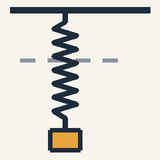
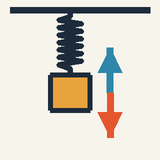
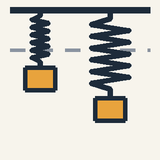
Equal weights are hung one by one on a spring: each adds the same stretch on the ruler, and the spring returns to its original length when they are lifted off.
Elastic objects return to their original shape when the force is removed; clay and dough do not.
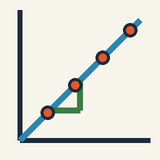
Equal weights stretch a spring by equal steps: twice the weight, twice the stretch.
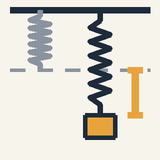
The stiffness k says how hard a spring is to stretch: the same weight stretches a stiff spring less.
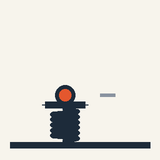
A stretched spring stores energy and gives it back when released, as in a slingshot or a trampoline.
Past its elastic limit, a spring stays stretched for good.
Squeeze a sponge, stretch a rubber band or bend a plastic ruler, then let go: each one springs back.
Step 1. Elastic or not? A material is elastic if it returns to its original shape once the force is removed. By this test, steel is more elastic than rubber: it is much harder to deform, but it springs back almost perfectly. Modelling clay and dough are the opposite: they keep whatever shape you press into them.
Step 2. Hooke's rule. Hang a weight on a spring and it stretches a little. Hang a second, identical weight and it stretches by the same amount again: twice the weight, twice the stretch. Robert Hooke (1678) wrote it as F=kx: the pull F equals a number k times the stretch x.
Step 3. Stiffness. The number k tells how stiff the spring is. A toy spiral spring is very soft (small k); a car's suspension spring is very stiff (large k), so the same load stretches it far less.
Step 4. Energy and limits. A stretched spring stores energy and gives it back when released: that is how a slingshot or a trampoline works. But pull too hard and the spring passes its elastic limit: it stays longer for good and never returns to its original length.
Check yourself: a spring stretches 2 cm under a 5 N weight. How far does it stretch under 15 N, below its elastic limit? Answer: 6 cm, three times the force, three times the stretch.
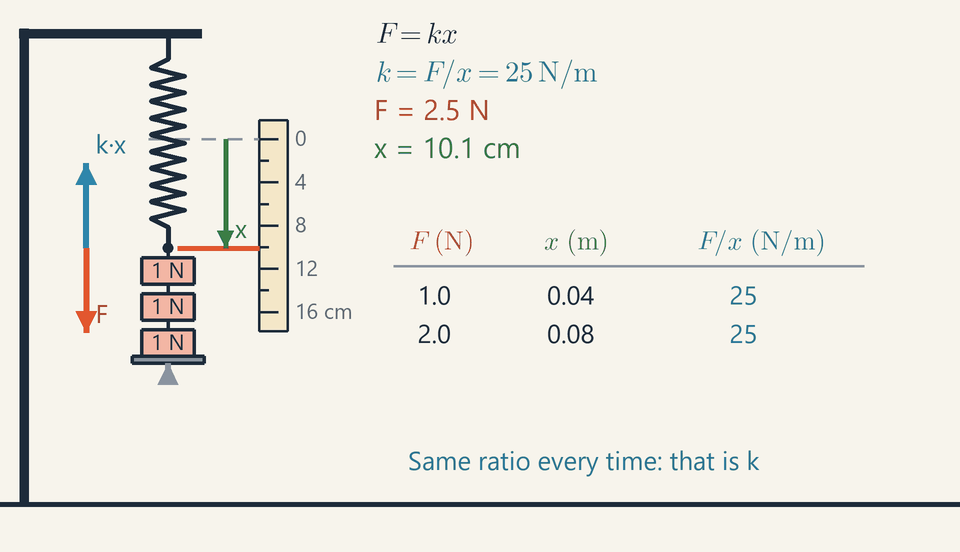
In the animation, equal weights are hung one at a time. Each one moves the red pointer down the ruler by the same step (the green marks), and the green bars grow in equal steps. When the weights are lifted off, the spring returns exactly to the dashed line where it started.
Intermediate
Key ideas
Hooke's law: F=kx, where x is the change in length, not the length itself.
k=F/x in N/m; the animation's spring has k=1.0N/0.040m=25N/m.
A hanging mass is at rest when the spring's pull equals its weight: kx=mg.
Stress σ=F/A and strain ε=ΔL/L0 describe the material; Young's modulus is E=σ/ε.
Load, extension and the spring constant
Hang a load on a spring and it gets longer. What matters is the change in length, the extension x=L−L0, where L0 is the natural length and L the length under load; in the animation it is measured from the dashed line. A squeezed spring has a negative x.
Robert Hooke published in 1678 that, up to a limit, the extension is proportional to the force that causes it: double the load and the extension doubles. F=kx
The constant k is the spring constant, or stiffness, in newtons per metre (N/m): the force per metre of extension, found by dividing a load by the extension it produces: k=xF A toy spiral spring has about 1 N/m, the spring in the animation 25 N/m and a car's suspension spring some 30 000 N/m.
The spring pulls back with a restoring force of the same size, directed against the extension: F=−kx when the sign matters. A mass hanging at rest is in equilibrium, so kx=mg, which is how a spring balance weighs things. In the animation the blue kx arrow and the red F arrow always have the same length; while a weight is being lowered, the grey tray arrow carries the rest of its weight.
Energy and the force–extension graph
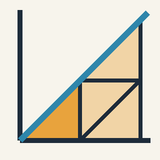
Plotted against the extension, the load gives a straight line through the origin whose slope is k: steep for a stiff spring, shallow for a soft one. Points stay on the line only up to the elastic limit. Below it the spring returns exactly to its natural length when unloaded; beyond it the line bends over and the spring stays longer for good, a plastic deformation.
The area under the line is the work done in stretching, stored as elastic potential energy. The force grows steadily from 0 to kx, so its average is half the final value and the area is a triangle: U=21kx2=21Fx Twice the stretch stores four times the energy, and a bow or a slingshot gives it back when released.
Springs in series and in parallel
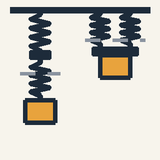
Hook two springs one below the other, in series, and each carries the whole load, so the extensions add: x=F/k1+F/k2. Dividing by F gives series:k1=k11+k21
Hang the load from two springs side by side, in parallel, joined by a bar that keeps their stretches equal, and they share the load, so their forces add: parallel:k=k1+k2
Two springs like the one in the animation give 12.5 N/m in series and 50 N/m in parallel: a series pair is softer than either spring, a parallel pair stiffer. A spring is also two halves in series, so each half of the animation's spring would have 50 N/m.
Worked example: the spring in the animation
Each weight in the animation weighs 1.0 N (a mass of 1.0/9.81≈0.102kg) and moves the pointer 4.0 cm down the ruler. From the first row of the table, k=xF=0.040m1.0N=25N/m
The other rows, from 2.0 N for 0.08 m to 4.0 N for 0.16 m, give the same ratio in the last column: that constant ratio is Hooke's law. With all four weights, x=F/k=4.0/25=0.16m. These are the F and x readouts once all four weights hang, 4.0 N and 16 cm, and the green x arrow spans 16 cm of the ruler.
The stored energy is then U=21⋅25⋅0.162=0.32J, also 21⋅4.0⋅0.16. After one, two and three weights it was 0.02, 0.08 and 0.18 J: each weight adds the same 4 cm, but the fourth adds 0.14 J, seven times as much as the first, because the spring already pulls with 3.0 N.
When the weights are lifted off, x returns to zero and the energy comes back, since 4.0 N is below the elastic limit of 5.5 N (22 cm). A fifth weight would still be safe; a sixth would not.
Stress, strain and Young's modulus
The spring constant belongs to one object, not to its metal. A wire twice as long stretches twice as far under the same load, and a wire with twice the cross-sectional area needs twice the force for the same stretch. To describe the material, divide the force by the area and the stretch by the original length: σ=AF,ε=L0ΔL
The stress σ is in pascals (1Pa=1N/m2, and 1MPa=1N/mm2); the strain ε is a pure number, often given in percent. In the linear region they are proportional, and their ratio is Young's modulus: E=εσ
It is about 200 GPa for steel, 70 GPa for aluminium and glass, 10 GPa for wood along the grain and only 0.01–0.1 GPa for rubber. Together the three relations give the stretch of any wire or rod: ΔL=AEFL0 A uniform wire is therefore a spring with k=AE/L0: longer is softer, thicker is stiffer.
Worked example: a steel wire under load
A steel wire 2.0 m long and 1.0 mm in diameter holds a 10 kg mass. How far does it stretch? The load is the weight, F=mg=10⋅9.81=98.1N, and the cross-section is a circle: A=4πd2=4π⋅(1.0×10−3)2=7.85×10⁻⁷m2
The stress is σ=98.1/(7.85×10−7)=1.25×108Pa, that is 125 MPa. Dividing by E=200GPa gives the strain, ε=1.25×10⁸/(2.0×1011)=6.25×10−4, about 0.06 %. The stretch is ΔL=εL0=6.25×10−4⋅2.0=1.25×10⁻³m or 1.25 mm.
As a spring the wire has k=AE/L0≈7.9×104N/m, some 3000 times stiffer than the animation's spring. Its stress of 125 MPa is about half the yield stress of even ordinary structural steel, roughly 250 MPa, so it springs back fully when unloaded. A wire twice as thick, with four times the area, would stretch only about 0.31 mm.
Common mistakes
Using the length instead of the extension: a 20 cm spring stretched to 24 cm has x=4cm, not 24 cm.
Mixing centimetres and metres: 1.0 N over 4.0 cm gives 1.0/0.040=25N/m, not 1.0/4.0=0.25.
Using the mass as the force: a 0.20 kg mass pulls with its weight, 0.20⋅9.81=1.96N, not with 0.20 N.
Forgetting the one half: at 16 cm the animation's spring stores 21Fx=0.32J, not Fx=0.64J, because the force was smaller earlier in the stretch.
Thinking that springs in series are stiffer: two 25 N/m springs one below the other give 12.5 N/m, because each one carries the whole load.
Where you meet it
Spring balances, car suspensions, mattresses, watch hairsprings and the spring in a ballpoint pen all rely on F=kx. Electronic scales use strain gauges, metal foils whose resistance changes as they stretch, sensitive to strains of a few millionths. Bridges, cranes and aircraft are designed to keep every stress well inside the linear region.
A mass pulled down on a spring and released oscillates, the subject of Simple Harmonic Motion and then of Damping and Resonance. The speed of sound in a solid is set by its Young's modulus (Wave Basics), and a rail that cannot expand as it warms comes under stress (Thermal Expansion).
Advanced
Key ideas
Stored energy U=∫0xkx′dx′=21kx2, the area under the F–x line: double x and U grows four times.
Near any stable minimum U≈U0+21U′′(x0)(x−x0)2: Hooke's law is that first term, with k=U′′(x0).
Blocks end to end stretch twice as far; side by side they need twice the force. Hence F/A=EΔL/L.
Unloading from beyond the yield point follows a line parallel to the elastic slope and leaves a permanent strain.
A coil spring works in torsion: k=Gd4/(8D3n), so k depends on geometry as well as on the material.
Why small deformations are linear
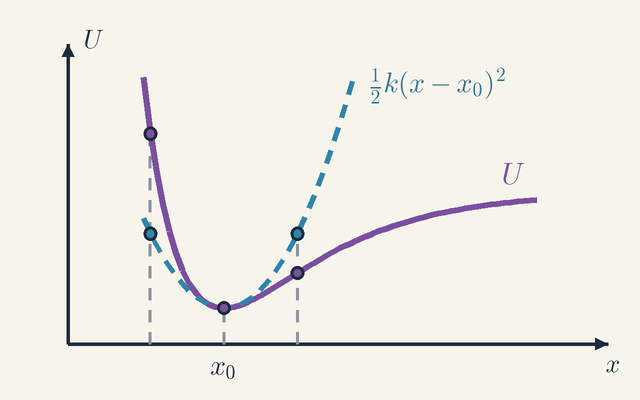
Figure 1. The energy U of two neighbouring atoms against their spacing x (solid), and the parabola of an ideal spring with the same bottom (dashed). Near x0 they agree; at equal distances either side, the real curve lies above the parabola when squeezed and below it when stretched. Not to scale.Legend
U
Potential energy of the pair of atoms: the solid curve, measured from an arbitrary zero.
J
x
Spacing between the two atoms.
m
x0
Equilibrium spacing, at the bottom of the well.
m
21k(x−x0)2
Energy of an ideal spring with the same bottom and curvature: the dashed parabola.
J
k
Stiffness of that spring, equal to the curvature U′′(x0) of the well at its bottom.
N/m
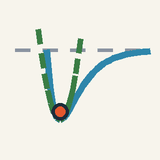
Hooke's law says that the force needed to deform a body is proportional to the deformation. It is not a fundamental principle like the conservation of energy. It is what almost any smooth force looks like when the displacement is small, and Figure 1 shows why.
The solid curve U is the potential energy of two neighbouring atoms in a solid, plotted against their spacing x. The atoms attract each other at long range and repel each other steeply at short range; both effects are electrical. Together they make a well whose lowest point is the equilibrium spacing x0. On the left, where the atoms are pushed together, the curve climbs steeply. On the right, where they are pulled apart, it flattens out, and far enough out the bond lets go.
The dashed parabola 21k(x−x0)2 is the energy of an ideal spring with the same bottom and the same curvature. Look first near x0: there the two curves are hard to tell apart. Then look at the two dashed verticals, at equal distances either side of x0. The dots on them show where the curves separate: on the squeezed side (left) the real curve lies above the parabola, on the stretched side (right) below it.
To make this precise, expand U as a Taylor series about the minimum: U(x)=U(x0)+U′(x0)(x−x0)+21U′′(x0)(x−x0)2+61U′′′(x0)(x−x0)3+⋯
Each term carries a higher power of the displacement x−x0, so for small displacements each is much smaller than the one before. The first term is a constant and exerts no force. The second is zero, because the slope of U vanishes at a minimum: U′(x0)=0. Differentiating what is left gives the force F=−dU/dx: F=−k(x−x0)−21U′′′(x0)(x−x0)2,k=U′′(x0)
The first term is Hooke's law. For small enough displacements it beats the second, whatever the shape of the well, which is why one law covers a molecular bond, a steel cable and a bridge. The stiffness k is the curvature of the well at its bottom, and k>0 is exactly the condition for a stable equilibrium: displaced either way, the atoms are pushed back.
The second term measures how lopsided the well is: it is the gap between the two curves of Figure 1. A real bond is harder to squeeze than to stretch, so U′′′(x0)<0, and the extra force −21U′′′(x0)(x−x0)2 is positive on both sides. When the bond is stretched (x>x0) it works against the restoring pull, so the bond softens; when the bond is squeezed (x<x0) it adds to the restoring push, so the bond stiffens. The correction is small: steel stays elastic only up to strains (fractional changes of length) of about 0.1 %, and there it is a fraction of a percent. Yet the same asymmetry is what makes solids expand when heated.
From one spring to a material
The constant k belongs to one particular spring or bar. To describe a material we need a constant that does not depend on the size of the sample, and two thought experiments show what to divide by.
Put two identical blocks end to end and pull. Each block carries the same force F, so each stretches by the same amount, and the pair stretches twice as far as one block: this is the series rule. The extension grows in proportion to the length, so the measure of deformation that does not depend on length is the strain, the extension per unit original length, ε=ΔL/L0.
Now put the two blocks side by side. To give them the same stretch takes twice the force: this is the parallel rule. The force grows in proportion to the cross-sectional area A, so the measure of load that does not depend on area is the stress, the force per unit area, σ=F/A.
For a uniform bar, stress is proportional to strain, and the constant of proportionality E, Young's modulus, belongs to the material alone. Rearranged, the same law gives the stiffness of the bar: AF=EL0ΔL,k=L0AE
A short, thick bar is stiff and a long, thin one is soft, yet one value of E describes both if they are made of the same steel.
From atomic bonds to Young's modulus
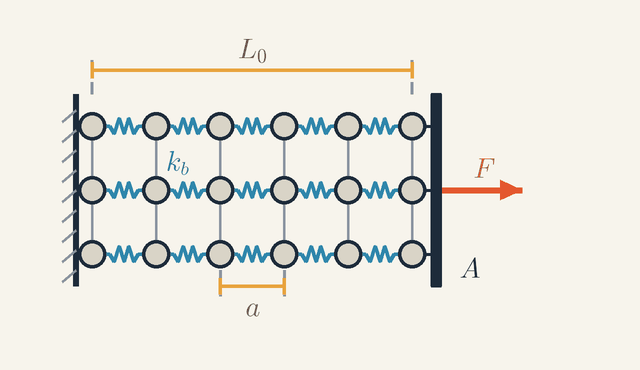
Figure 2. A bar as a crystal: atoms a distance a apart, every bond a spring of stiffness kb. The load F pulls on A/a2 chains side by side, each a series of L0/a bonds (three and five in this sketch); the plate is the end face, seen edge-on. Not to scale.Legend
a
Spacing between neighbouring atoms.
m
kb
Stiffness of one bond, drawn as a spring.
N/m
L0
Length of the bar.
m
A
Area of the end face the load acts on (the plate, seen edge-on): the cross-section of the bar.
m2
F
Load pulling on the end face of the bar.
N
Young's modulus can be estimated from the atoms themselves, by applying the same series and parallel counting. Figure 2 models a crystal as a cubic stack of atoms a distance a apart, every bond a spring of stiffness kb. The bar, of length L0, is held by the wall on the left and pulled by the force F on the right. The dark plate is its end face, of area A, seen edge-on.
First count across the bar. Each atom takes up a square of side a of the end face, so A/a2 chains of atoms run side by side along the bar (three in the sketch). Then count along one chain: it is a series of L0/a bonds (five in the sketch).
Now combine the two counts. In series, L0/a equal springs share the extension, so a chain is softer than one bond by that factor: its stiffness is kb/(L0/a)=kba/L0. In parallel, the chains share the load, so their stiffnesses add: k=a2A⋅L0kba=L0A⋅akb
Comparing this with k=AE/L0 gives E=kb/a: the modulus is the stiffness of one bond divided by the spacing of the atoms.
For steel, E=200GPa and a≈0.25nm give kb=Ea≈50N/m, just twice the 25 N/m of the animation's spring. A single bond is not especially stiff. The modulus is huge only because so many chains pull together: 1/a2, some 1.6×10¹⁹ of them, cross each square metre.
Stored energy as the area under the line
Back to a single spring, with x now standing for its extension from the natural length. Stretching it from 0 to x against its own pull kx′ takes the work U=∫0xkx′dx′=21kx2
On the animation's F–x graph this is the hatched triangle under the line, with base x and height kx. As the red dot climbs, the U readout passes 0.02 J at 1 N, 0.08 J at 2 N, 0.18 J at 3 N and 0.32 J at 4 N.
Look at the increments rather than the totals: 0.02, 0.06, 0.10 and 0.14 J, in the ratio 1 : 3 : 5 : 7. Each newton of load adds 4 cm of extension, and each 4 cm strip of the triangle is a trapezium whose average height is 0.5, 1.5, 2.5 and 3.5 N. Later strips cost more because the spring is already pulling when they start. For the same reason, stretching from x1 to x2 costs 21k(x22−x12), not 21k(x2−x1)2.
For a bar the same triangle gives U=21FΔL=21(σA)(εL0). Dividing by the volume AL0, and using ε=σ/E, gives the energy per unit volume, which is the area under the stress–strain line: u=21σε=2Eσ2
Steel at its yield stress of about 250 MPa, the highest stress it takes elastically, holds u=(2.5×10⁸)2/(2⋅2.0×1011)≈1.6×105J/m3. With a density of about 7800 kg/m³, that is about 20 J per kilogram, enough to lift that kilogram by only 2 m. Springs store energy conveniently, not densely.
Sideways shrinkage, shear and coil springs
A stretched bar also gets thinner. Its width shrinks by the fraction νε, where ν, Poisson's ratio, is about 0.3 for metals and close to 0.5 for rubber.
Because the laws are linear, the effects of separate loads simply add. Squeeze a cube with a pressure p on all six faces: that is three compressions at once, one along each axis. Each one shortens the cube along its own axis by the strain p/E and, through Poisson's ratio, lengthens it along the other two axes by νp/E. Along any one axis the net strain is therefore −(p/E)(1−2ν). The fractional change of volume is the sum of the three strains, −3(p/E)(1−2ν), and the bulk modulus, the pressure divided by the fractional loss of volume, is K=3(1−2ν)E
A positive K requires ν<1/2. At ν=1/2 a stretch leaves the volume unchanged, which is why rubber is so hard to compress.
A third modulus describes shear, a change of shape at constant volume, as when the top of a block is pushed sideways over its base. For an isotropic material, one with the same properties in every direction, it is not independent: two constants describe every small deformation. Given E and ν, the shear modulus is G=2(1+ν)E about 80 GPa for steel.
Shear is what matters in a coil spring. Pulling on a coil spring hardly lengthens its wire; it twists it. For wire diameter d, coil diameter D and n turns, the twisting of the wire gives k=8D3nGd4
A steel wire 0.5 mm thick, wound into 25 turns of 10 mm diameter, gives k=8.0×1010⋅(5×10−4)4/(8⋅0.013⋅25)=25N/m: the animation's spring. Note the strong dependence on D: coils 1.4 times wider would make the spring 1.43≈2.7 times softer. So k describes one spring, while E, ν and G describe the steel it is made of.
Beyond the elastic limit
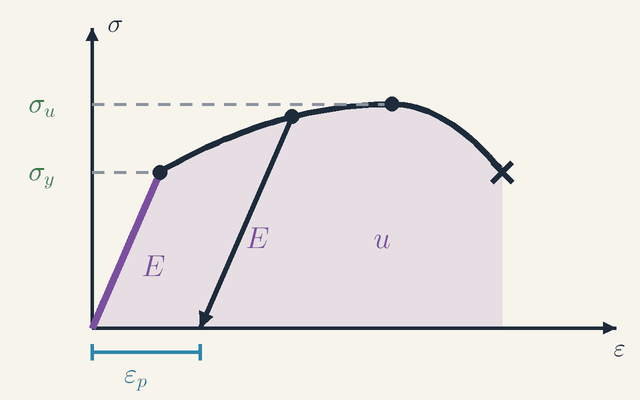
Figure 3. Stress against strain for a metal wire. The straight start has slope E and ends at the yield stress σy; the curve then rises to its top σu and falls to the break (×). Unloaded along the arrow, the wire follows a line parallel to the first and keeps the strain εp. Not to scale.Legend
σ
Stress: the force divided by the original cross-section of the wire.
Pa
ε
Strain: extension per unit original length.
E
Young's modulus: the slope of the straight start, and of the unloading line.
Pa
σy
Yield stress, where the straight line ends and the wire starts to flow.
Pa
σu
Ultimate tensile strength: the highest stress on the curve.
Pa
εp
Permanent strain left after unloading.
u
Energy absorbed per unit volume up to the break: the shaded area under the curve.
J/m3
Everything so far assumed small strains. Figure 3 shows what happens when a metal wire is pulled further: its stress σ against its strain ε, all the way to fracture. Here σ is the force divided by the original cross-section of the wire.
Start at the origin. The stress rises along a straight line of slope E: this is the region of Hooke's law. The line ends at the dot level with σy, the yield stress (the purple dot of the animation's wire graph). Beyond it the wire flows. Dislocations, line defects in the crystal, start to glide, so planes of atoms slip past each other one row at a time instead of all at once. That is why real metals yield so early: a perfect crystal would hold out to several gigapascals, while real steels yield at 0.25–2 GPa.
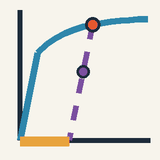
The animation's F–x graph for the spring has the same shape: its straight line ends at the elastic limit, the purple dot at 5.5 N and 22 cm, where the dashed curve bends over.
Now follow the curve past σy. It keeps rising, but more gently, because the dislocations tangle and block one another; this is called work hardening. The top of the curve is the ultimate tensile strength σu. Past it a neck forms: one short stretch of the wire thins faster than the rest. The force, and with it the plotted stress, falls, even though the true stress in the shrinking neck still rises, and the wire breaks at the cross (×).
Next, stop loading part way up the curve, at the dot on its rising part, and unload. The wire comes down along the arrow, a line parallel to the elastic one, with the same slope E, because only the elastic part of the strain is recovered. At zero stress it keeps the permanent strain εp. Loaded again, it climbs the same line and rejoins the curve: it is now elastic up to a higher stress than before.
The shaded area under the whole curve, u=∫σdε, is the energy absorbed per unit volume before fracture; in the straight part it is the triangle 21σε met earlier. A large area means a tough material. Ductile metals absorb a great deal of energy by flowing before they break, while glass or cast iron break near the end of the straight part. The animation's spring stops at 4.0 N, 73 % of its 5.5 N limit, so on unloading it retraces the line and all 0.32 J comes back.
Worked problem: letting the load drop
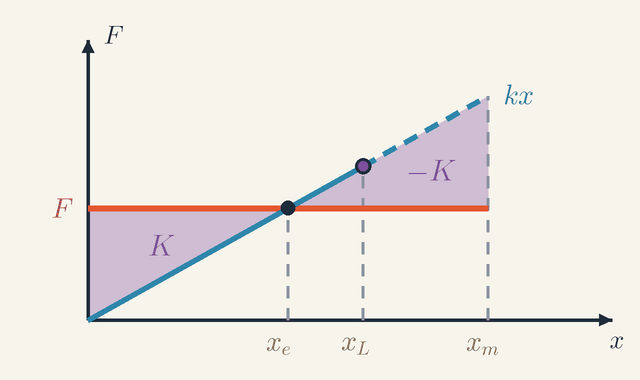
Figure 4. Force against extension for the dropped load. The load F and the pull kx meet at xe. The left triangle is the kinetic energy K gained up to there; the right one, of equal area, takes it back, so the weights stop at xm=2xe, past the elastic limit xL.Legend
F
Force; also the load itself, the horizontal line: the weight of the four masses hung on together.
N
x
Extension of the spring from its natural length.
m
kx
Pull of the spring at the extension x: the sloped line.
N
xe
Extension where the pull equals the load, F/k: the equilibrium of gentle loading.
m
xL
Extension at the elastic limit (the purple dot); beyond it the spring's line is dashed.
m
xm
Extension at the lowest point, where the weights stop: 2F/k.
m
K
Kinetic energy of the weights: the left triangle is the energy gained up to xe; the right triangle, −K, is the same amount taken back.
J
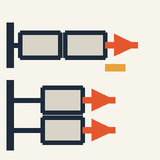
The tray in the animation lowers each weight gently, so the spring is in equilibrium at every instant. Suppose instead that all four weights, 4.0 N in all, were hooked on together at the natural length and let go. Figure 4 follows the fall on a graph of force against extension x.
Two forces act on the weights. The load F, their weight, is the same at every extension: the horizontal line. The pull kx of the spring grows with the extension: the sloped line. The two lines cross at xe=F/k=4.0/25=0.16m, the 16 cm of gentle loading.
Left of xe the load is the larger force, so the weights speed up. The net force is the gap between the lines, and the work it does, the area of the left triangle, becomes their kinetic energy K. It is largest at xe, where it equals 21Fxe.
Right of xe the spring pulls harder than the load, so the weights slow down and the spring takes the energy back: the right triangle, marked −K. Its area equals that of the left one, because the pull climbs from F to 2F over the same distance xe it took to climb from 0 to F. So the kinetic energy is zero again at xm=2xe, where the weights stop for an instant.
Energy gives the same result directly. Neglecting the spring's mass and air resistance, at the lowest point the weights are momentarily at rest, so all the energy gravity has released, Fxm, is stored in the spring: Fxm=21kxm2,xm=k2F=252⋅4.0=0.32m
That is twice the 16 cm of gentle loading and far past the 22 cm elastic limit xL, the purple dot of Figure 4: the spring would be stretched for good. A sudden load doubles the peak deformation, so the largest load this spring survives when dropped from its natural length is half its static limit, 25⋅0.22/2=2.75N.
An ideal spring would oscillate between 0 and 32 cm about 16 cm. The mass is m=4.0/9.81=0.408kg, so ω=k/m=25/0.408≈7.83rad/s and the period is 2π/ω≈0.80s. The speed at the centre follows from energy. At 16 cm gravity has released 4.0⋅0.16=0.64J and the spring holds 0.32 J, so the other 0.32 J is kinetic energy: v=2⋅0.32/0.408≈1.25m/s, equal to ω⋅0.16m, as simple harmonic motion requires.
Gentle loading avoids all this because the tray absorbs the surplus: 0.32 J if all four weights were lowered at once. Loading in four steps, as the animation does, wastes less. In each step the tray's push starts at 1.0 N, the weight just added, and falls to zero over 4 cm, so the tray absorbs only 21⋅1.0⋅0.04=0.02J per step. Over the four steps gravity releases 0.40 J (the weights fall 16, 12, 8 and 4 cm), the spring keeps 0.32 J and the tray takes 0.08 J. With ever smaller steps the loss vanishes.
Limits of validity
Hooke's law is a small-strain law. Mild steel stays linear only up to a strain of 250MPa/200GPa=1.25×10−3, about 0.13 %, and window glass breaks near 0.1 %.
Rubber stretches to several times its length, but past a few percent of strain its stress–strain curve is S-shaped, and its tension has a different origin. Rubber is a tangle of long chain molecules. Stretching it straightens them, and their thermal jiggling pulls them back towards tangled shapes, of which there are far more. This is an entropy effect, and it has a surprising consequence: a stretched rubber band pulls harder when heated.
Materials also depend on time. Polymers, concrete and hot metals creep: under a constant load they keep slowly deforming. Many materials also unload along a different curve from the one they loaded on. The loop between the two curves is called hysteresis, and its area is energy turned into heat in each cycle, which is why a rubber ball never bounces back to its starting height.
The spring model has limits of its own. A real spring of mass ms oscillates as if about ms/3 were added to the load. Many tension springs are wound with an initial tension F0: they do not stretch at all until the load exceeds F0, and then follow F=F0+kx. The animation's spring has no initial tension, so its line passes through the origin.
Where this leads
A mass on a spring obeys mx¨=−kx, the equation of Simple Harmonic Motion: the animation's 0.41 kg load would oscillate with a period of 0.80 s, and Damping and Resonance adds the internal losses. In a rod, each slice is a mass between springs, and longitudinal waves travel along it at E/ρ, with ρ the density: about 5000 m/s in steel, nearly 15 times the speed of sound in air (Wave Basics).
The lopsided bond of Figure 1 leads to Thermal Expansion. A steel rail clamped at both ends and warmed by 30 K cannot lengthen, so it comes under the stress that would squeeze it back by its free expansion: σ=EαΔT=2.0×1011⋅1.2×10−5⋅30≈7.2×10⁷Pa, or 72 MPa, with α the expansion coefficient of steel. Finally, water's bulk modulus of about 2.2 GPa means that squeezing it by 1 % takes 22 MPa, some 220 atmospheres, which is why Fluid Pressure and Pascal's Principle can treat it as incompressible.
Key formulas
Hooke's law for a spring
F=kx
The force needed to stretch a spring is proportional to its extension, so equal loads add equal stretches and the force–extension graph is a straight line through the origin with slope k. The spring pulls back with an equal and opposite restoring force, written F=−kx when the sign matters. Here x is the change in length, not the length.
Symbols
F
load stretching the spring
N
k
spring constant (stiffness)
N/m
x
extension from the natural length
m
When it holds: Up to the elastic limit, for a spring wound without initial tension; beyond the limit the line bends and the spring stays permanently longer.
Example: The animation's spring, k=25N/m, with four 1.0 N weights: x=4.0/25=0.16m.
Spring constant from a measurement
k=xF
Dividing the load by the extension it produces gives the stiffness, in newtons per metre. If the spring obeys Hooke's law, every pair of measured values gives the same ratio, and that constancy is the test of the law. A stiff spring has a large k and stretches little.
Symbols
k
spring constant (stiffness)
N/m
F
load
N
x
extension produced by that load
m
When it holds: Only in the linear region, with x in metres and measured from the natural length. For a spring with initial tension, use the slope ΔF/Δx between two loads instead.
Example: 1.0 N stretches the animation's spring by 4.0 cm: k=1.0/0.040=25N/m.
Energy stored in a stretched spring
U=21kx2=21Fx
The work done in stretching is the area under the force–extension line, a triangle of base x and height F=kx. The force grows from zero, so its average is 21F, which is where the one half comes from. Because U goes as x2, doubling the stretch stores four times the energy.
Symbols
U
elastic potential energy
J
k
spring constant
N/m
x
extension from the natural length
m
F
force at the extension x
N
When it holds: For a linear spring stretched from its natural length within the elastic limit. Stretching further, from x1 to x2, costs 21k(x22−x12).
Example: At 16 cm the animation's spring stores 21⋅25⋅0.162=0.32J.
Springs in series
series:k1=k11+k21
Springs hooked one below the other each carry the whole load, so their extensions add: x=F/k1+F/k2. Dividing by F shows that the reciprocals of the stiffnesses add. The pair is always softer than its softer spring.
Symbols
k
stiffness of the combination
N/m
k1
stiffness of the first spring
N/m
k2
stiffness of the second spring
N/m
When it holds: For light springs that obey Hooke's law; with more springs, add one term per spring.
Example: Two 25 N/m springs in series: 1/k=1/25+1/25, so k=12.5N/m, and 4.0 N stretches the pair by 32 cm.
Springs in parallel
parallel:k=k1+k2
Springs side by side, joined so that they stretch by the same amount, share the load, and their forces add: F=k1x+k2x. The stiffnesses therefore add, and the pair is stiffer than either spring.
Symbols
k
stiffness of the combination
N/m
k1
stiffness of the first spring
N/m
k2
stiffness of the second spring
N/m
When it holds: Only if the springs really stretch by the same amount, which needs the load to hang at the right point of the bar joining them (the middle, for identical springs).
Example: Two 25 N/m springs in parallel give k=50N/m: four 1.0 N weights stretch them by only 8 cm.
Stress and strain
σ=AF,ε=L0ΔL
Stress is the force per unit cross-sectional area and strain the stretch per unit length. Dividing out the size of the sample this way gives quantities that describe the material: a wire with twice the cross-section carries twice the force at the same stress, and a wire twice as long stretches twice as far at the same strain. Strain is a pure number, often quoted in percent.
Symbols
σ
stress
Pa
F
force along the wire or rod
N
A
cross-sectional area
m2
ε
strain
ΔL
change in length
m
L0
original length
m
When it holds: Here A is the original cross-section (engineering stress). Once a wire thins noticeably, as in necking, the true stress, the force divided by the actual area, is larger.
Example: 98.1 N on a steel wire of cross-section 7.85×10⁻⁷m2: σ=1.25×10⁸Pa=125MPa.
Young's modulus
E=εσ
In the linear region stress and strain are proportional, and their ratio is a constant of the material, independent of the shape and size of the sample. It is Hooke's law written for the material instead of the object; on a stress–strain graph it is the slope of the straight part. A large E means a stiff material.
Symbols
E
Young's modulus
Pa
σ
stress
Pa
ε
strain
When it holds: Only for small strains, below the limit of proportionality (about 0.1 % for steel). Rubber has no single value, because its curve is not straight.
Example: Steel, E=200GPa, under 125 MPa: ε=1.25×10⁸/(2.0×1011)=6.25×10−4.
Stretch of a wire or rod
ΔL=AEFL0
Combining σ=F/A, ε=ΔL/L0 and E=σ/ε gives the stretch directly. It grows with the load and the length and falls with the cross-section and the modulus. Read as F=(AE/L0)ΔL, it is Hooke's law with a spring constant k=AE/L0.
Symbols
ΔL
change in length
m
F
force along the wire or rod
N
L0
original length
m
A
cross-sectional area
m2
E
Young's modulus of the material
Pa
When it holds: For a uniform bar in tension or compression within the linear region; a slender bar in compression may buckle first.
Example: A 2.0 m steel wire 1.0 mm in diameter holding 10 kg: ΔL=98.1⋅2.0/(7.85×10−7⋅2.0×1011)≈1.25×10−3m.
Glossary
Elasticity
The ability of a body to return to its original size and shape when the forces deforming it are removed. Elastic is not the same as stretchy: steel deforms far less than rubber but springs back just as completely, while clay does not spring back at all.
Hooke's law
For small deformations the deformation is proportional to the force that causes it: F=kx for a spring, σ=Eε for a material. Robert Hooke published it in 1678; it holds only up to a limit that depends on the material.
Extension
The change in length from the natural, unloaded length, x=L−L0; a negative value is a compression. A 20 cm spring stretched to 24 cm has an extension of 4 cm, not 24 cm.
Restoring force
The force a deformed body exerts back on whatever deforms it, directed so as to undo the deformation: −kx for a spring. For a mass hanging at rest it balances the weight, kx=mg.
Elastic potential energy
The energy stored in a deformed body, equal to the work done in deforming it: 21kx2 for a spring, the area under its force–extension line. An elastic body returns all of it when released.
Springs in series and in parallel
In series (one after another) each spring carries the whole load and the extensions add, so 1/k=1/k1+1/k2 and the pair is softer. In parallel (side by side, stretched equally) the forces add, so k=k1+k2 and the pair is stiffer.
Quasi-static loading
Applying a load so slowly that the body is in equilibrium at every instant, with x=F/k all along, as the tray does in the animation. A load released suddenly overshoots to twice the static extension.
Elastic limit
The largest load or deformation after which a body still returns fully to its original shape; the spring in the animation reaches it at 5.5 N and 22 cm. The end of the straight part of the graph, the limit of proportionality, usually lies close to it.
Yield point
The stress at which a metal starts to flow plastically, because dislocations in its crystals begin to glide. Mild steel yields at about 250 MPa, a strain of only about 0.13 %.
Plastic deformation
Deformation that remains after the load is removed, also called permanent set. A metal unloaded from beyond its yield point comes back along a line parallel to its elastic line and stays longer than before.
Necking and fracture
Past the ultimate tensile strength, the highest point of the stress–strain curve, a ductile wire thins in one place (a neck), the force it can carry falls, and it breaks there.
Ductile and brittle materials
A ductile material such as copper or mild steel stretches plastically a long way before breaking and absorbs much energy. A brittle one such as glass, cast iron or chalk breaks near the end of its elastic region, with almost no plastic flow.
Quantities
F
Load
N
The force stretching the spring or wire; at equilibrium it equals the spring's restoring force kx. In the animation each weight adds 1.0 N.
x
Extension
m
The change in length from the natural length, positive when stretched; each 1.0 N weight in the animation adds 0.040 m.
k
Spring constant (stiffness)
N/m
The force needed per metre of extension, F/x, and the slope of the force–extension line. It belongs to one spring and depends on its shape as well as its material: 25 N/m in the animation.
U
Elastic potential energy
J
The energy stored by the stretch, 21kx2: 0.32 J for the animation's spring at 16 cm.
σ
Stress
Pa
Force per unit cross-sectional area, F/A, where A is the area of the section across the wire or bar, in square metres (7.85×10⁻⁷m2 for a wire 1.0 mm in diameter), and 1MPa=1N/mm2. It says how hard the material is loaded, whatever the size of the sample.
ε
Strain
Fractional change in length, ΔL/L0: the change in length ΔL divided by the original length L0, both in metres. It is often given in percent, and steel stays elastic only up to about 0.1 %.
E
Young's modulus
Pa
Stress divided by strain in the linear region, a property of the material alone: about 200 GPa for steel, 70 GPa for aluminium, 0.01–0.1 GPa for rubber.
ν
Poisson's ratio
How much a stretched bar narrows: its sideways strain is −νε. About 0.3 for metals and close to 0.5 for rubber, whose volume barely changes.
G
Shear modulus
Pa
Resistance to a change of shape at constant volume, G=E/(2(1+ν)), about 80 GPa for steel. It sets the stiffness of a coil spring, whose wire is twisted.
Quiz
Beginner A spring stretches 3 cm when one weight hangs from it. How far does it stretch with three identical weights, staying below its elastic limit?
3 cm
6 cm
9 cm
27 cm
Show answer
Answer: C. 9 cm
The stretch is proportional to the force: three times the weight gives three times the stretch, 3 × 3 cm = 9 cm.
Beginner What does it mean when a spring has gone past its elastic limit?
It no longer returns to its original length when the load is removed
It snaps as soon as the limit is reached
It becomes stiffer and harder to stretch
It stops stretching, however much weight is added
Show answer
Answer: A. It no longer returns to its original length when the load is removed
Beyond the elastic limit part of the deformation is permanent, so the spring stays longer than before. It does not necessarily break, and it usually stretches more easily, not less.
Intermediate A 0.50 kg mass hangs at rest from a spring and stretches it by 10 cm. What is the spring constant? (g = 9.81 m/s²)
0.49 N/m
5.0 N/m
4.9 N/m
49 N/m
Show answer
Answer: D. 49 N/m
At rest k·x = m·g, so k = 0.50 × 9.81 ÷ 0.10 = 49 N/m. Using 10 instead of 0.10 m gives 0.49 N/m, and forgetting g gives 5.0 N/m.
Intermediate Two identical springs, each with k = 200 N/m, are hooked one below the other. What is the stiffness of the pair?
400 N/m
100 N/m
200 N/m
40 000 N/m
Show answer
Answer: B. 100 N/m
In series each spring carries the full load, so the extensions add: 1/k = 1/200 + 1/200, giving k = 100 N/m. Side by side (in parallel) they would give 400 N/m.
Intermediate In Hooke's law F = k·x, what is x?
The total length of the stretched spring
The length of the spring before it is stretched
The change in length from the natural length
The distance from the support to the hanging weight
Show answer
Answer: C. The change in length from the natural length
x is the extension: stretched length minus natural length. A 20 cm spring stretched to 24 cm has x = 4 cm, not 24 cm.
Advanced A spring with k = 500 N/m is already stretched by 0.10 m. How much extra work is needed to stretch it to 0.20 m?
2.5 J
10 J
5.0 J
7.5 J
Show answer
Answer: D. 7.5 J
W = ∫ k·x dx from 0.10 to 0.20 m = ½·k·(x₂² − x₁²) = ½ × 500 × (0.040 − 0.010) = 7.5 J. ½·k·(Δx)² = 2.5 J ignores that the spring already pulled with 50 N at the start; 10 J is the total stored at 0.20 m; 5.0 J = k·x₁·Δx uses only the initial force.
Advanced A metal wire is loaded beyond its yield point and then the load is removed. How does it unload on the stress–strain graph?
Along a straight line parallel to the initial elastic line, leaving a permanent strain
Back along the same curve, returning to zero strain
Straight down to zero stress at constant strain
Along a horizontal line at constant stress
Show answer
Answer: A. Along a straight line parallel to the initial elastic line, leaving a permanent strain
Unloading is elastic: the stress falls along a line of slope E, parallel to the first straight part. The plastic strain remains when the stress reaches zero (the permanent set).
Advanced Why does Hooke's law describe so many systems, from molecules to bridges?
Because all materials are made of tiny springs
Near a stable equilibrium any smooth potential energy is nearly parabolic, so the restoring force is linear
Because Newton's third law requires forces proportional to displacement
Because all materials have the same elastic limit
Show answer
Answer: B. Near a stable equilibrium any smooth potential energy is nearly parabolic, so the restoring force is linear
Expanding U(x) about a minimum gives U ≈ U₀ + ½·U″(x₀)·(x − x₀)², so F = −dU/dx ≈ −k·(x − x₀) with k = U″(x₀). Larger displacements bring in higher-order terms and the law breaks down.
 Physics Tutor