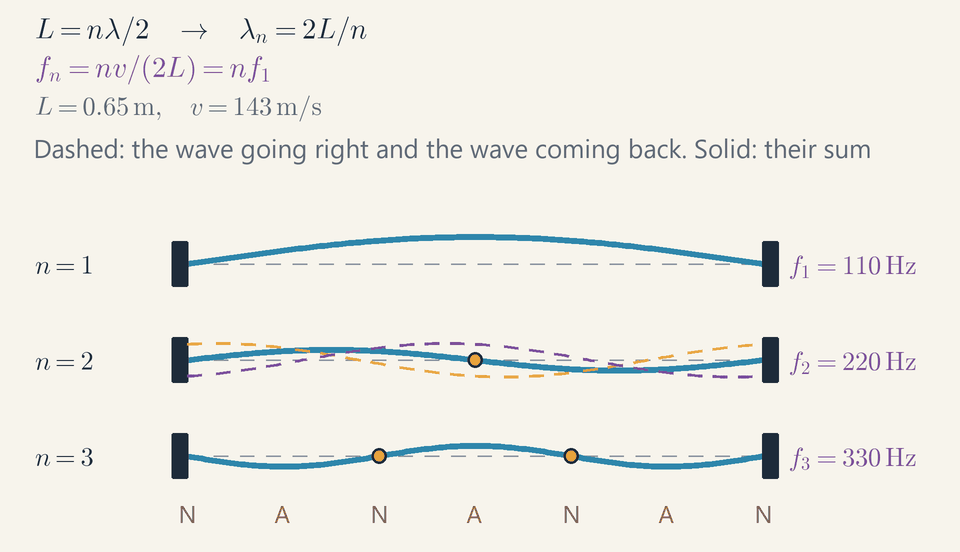
Why a guitar string sings only certain notes: waves trapped between two fixed ends must fit a whole number of half-wavelengths, L=nλ/2, so only the frequencies fn=nv/(2L) survive.
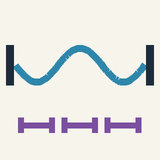
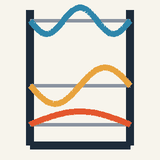
Three strings fixed at both ends vibrate in their first three harmonics, with still nodes and swinging antinodes.
A standing wave forms when waves bouncing back from the fixed ends overlap with the waves going out.
Nodes are points that never move; antinodes, halfway between them, swing the most.
Only a whole number of loops fits between the fixed ends; one loop, the fundamental, gives the lowest note.
More loops means faster vibration and a higher note: two loops vibrate twice as fast as one.
A shorter, tighter or thinner string plays a higher note.
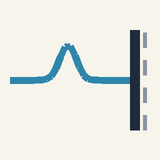
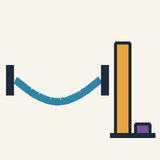
Two friends turning a long skipping rope make it swing as one big loop: the middle flies highest while the ends stay in their hands. Shake one end faster and the rope can settle into two loops with a still point in the middle. Neither shape travels along the rope: this is a standing wave.
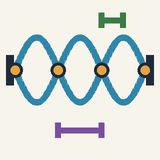
Where does it come from? Waves run along the string, bounce off the fixed ends and come back. The outgoing and returning waves overlap, and together they make a pattern that stays in place. On the middle string of the animation the dashed waves run in opposite directions, and the solid string is what they add up to.
Some points never move at all. They are the nodes, marked by gold dots; the fixed ends are nodes too. Halfway between two nodes the string swings the most: that is an antinode.
Because both ends must stay still, only a whole number of loops fits: one, two, three and so on. The one-loop pattern is the fundamental and gives the lowest note. Two loops vibrate twice as fast as one and three loops three times as fast, giving higher notes called harmonics. A real string vibrates in several of these patterns at once, and that mix is why a guitar and a violin playing the same note still sound different.
Pressing a string against a fret shortens the vibrating part, so every loop is shorter and the note is higher. Tightening a string, or using a thinner one, also raises the note. Flutes and organ pipes do the same with standing sound waves in a tube: longer pipes, lower notes.
Check yourself: a string vibrates in three loops. How many nodes does it have, counting both ends? Answer: four.
Intermediate
Key ideas
A string fixed at both ends holds a whole number of half-wavelengths: L=nλ/2, so λn=2L/n.
The allowed frequencies are fn=nv/(2L)=nf1; the lowest is the fundamental, f1=v/(2L).
Wave speed on a string is v=F/μ, so four times the tension doubles every frequency.
Neighbouring nodes are λ/2 apart, and each antinode is λ/4 from the nearest node.
A pipe closed at one end has only odd harmonics: fn=nv/(4L), n=1,3,5,…
Two travelling waves make a standing wave
At a given length and tension, a guitar string held fixed at both ends vibrates only at certain frequencies. Waves on a string clamped at both ends bounce off the ends and run through each other. When two waves with the same amplitude A, wavelength λ and frequency f travel in opposite directions, their sum does not travel at all: it is a standing wave. On the middle string of the animation, the dashed curves are the two waves and the solid string is their sum.
Where the two waves always arrive with opposite displacements, they cancel: these nodes, marked by gold dots, never move. Halfway between two nodes the waves always agree, and the string swings with amplitude 2A: these are the antinodes. Every other point oscillates at the same frequency with a smaller amplitude, and neighbouring loops move in opposite directions.
Besides λ, f in hertz and the wave speed v=fλ from Wave Basics, a string has its length L between the clamps, its tension F in newtons and its linear density μ, the mass of one metre of string, in kg/m. The harmonic number n counts the loops.
Fitting half-wavelengths between the ends
Neighbouring nodes are half a wavelength apart, and each antinode lies a quarter-wavelength from the nearest node. A clamped end cannot move, so it must be a node, and the string holds a whole number n of loops, each λ/2 long: L=2nλ so the only wavelengths it allows are λn=n2L with n=1,2,3,… The longest is twice the length of the string.
A wave that does not fit returns from each round trip out of step with the wave still arriving, and its reflections largely cancel. Only the fitting wavelengths reinforce themselves, so every confined wave has a definite set of natural frequencies.
The harmonic series and the wave speed
All waves on one string travel at the same speed v, so each allowed wavelength has its own frequency, fn=v/λn: fn=2Lnv=nf1 The lowest, f1=v/(2L), is the fundamental; the others, 2f1, 3f1 and so on, are its harmonics, equally spaced by f1. The second harmonic sounds an octave above the fundamental.
The wave speed depends on the tension and the linear density: v=μF A tight string pulls a displaced piece back hard, so waves run fast; a heavy string has more inertia, so they run slowly.
There are therefore three ways to raise the pitch: shorten the vibrating part (a fret), tighten the string (the peg) or use a lighter one. The frequency is inversely proportional to L but grows only as F: halving the length doubles it, while doing the same with tension alone takes four times the force.
Worked example: the guitar string in the animation
The animation's strings are 0.65 m long, like a classical guitar's, and their waves travel at 143 m/s. Which notes do they play? In the fundamental the string holds half a wavelength: λ1=2L=2⋅0.65=1.30m f1=λ1v=1.30143=110Hz Then f2=220Hz and f3=330Hz, the purple labels beside the strings; 110 Hz is the A of a guitar's fifth string. A real period of 1/110s≈9.1ms is far too short to watch, so the animation stretches it to 2 s, 220 times slower.
On the third string λ3=2L/3≈0.433m, so the nodes are λ3/2≈0.217m apart and each antinode lies λ3/4≈0.108m from its neighbours: the spacing of the letters N A N A N A N under the string, four nodes counting both ends and three antinodes.
To raise the fundamental an octave, to 220 Hz, at the same length, v must double to 286 m/s; since v grows as F, the tension must be multiplied by four, not two.
Worked example: tuning a violin string
A violin's A string vibrates over 0.325 m and has a linear density of 0.60 g/m, that is 6.0×10⁻⁴kg/m. What tension tunes it to 440 Hz? Find the wave speed first: v=2Lf1=2⋅0.325⋅440=286m/s F=μv2=6.0×10−4⋅2862≈49N That is about the weight of a 5 kg mass; leaving μ in g/m would give a tension a thousand times too large.
If the string slackens and sounds 436 Hz, the tension must grow by the factor (440/436)2≈1.018, less than 2 % or about 0.9 N, because f1 is proportional to F. To play the B at 494 Hz the violinist shortens the string instead, to L′=v/(2f)=286/988≈0.289m: the finger goes down about 3.5 cm from the nut.
Reading the pattern: loops, phases and pipes
To read a standing-wave picture, count the loops: there are n of them, each λ/2 long, and n+1 nodes including the ends. Points within one loop move in step; neighbouring loops are half a cycle apart. Twice per cycle the whole string passes through its straight position, moving fastest, and at the extremes it stops for an instant.
In a pipe the air moves back and forth along the pipe. A closed end stops it and is a displacement node; an open end is close to a displacement antinode. Open at both ends, a pipe has the same series as a string, fn=nv/(2L). Closed at one end, it holds an odd number of quarter-wavelengths, so fn=nv/(4L) with odd n only. With sound at 343 m/s, a 0.65 m pipe sounds 132, 396 and 660 Hz when closed at one end, and 264, 528 and 792 Hz when open at both.
Common mistakes
A standing wave is not frozen: every point except the nodes keeps oscillating, all at one frequency, 330 Hz on the bottom string of the animation.
The wavelength is not the length of the string: in the fundamental the string holds half a wavelength, so the 0.65 m string has λ1=1.30m.
Nodes are half a wavelength apart, not a whole one: with λ=0.8m they are 0.4 m apart, and a node lies 0.2 m from the nearest antinode.
Doubling the tension does not double the pitch: since f grows as F, the 110 Hz string would rise only to about 156 Hz.
Harmonics are not louder copies of one note but different frequencies, here 110, 220 and 330 Hz; the mix that a pluck excites gives each instrument its timbre.
Where you meet it
Every string instrument is a set of standing waves: frets change L, pegs change F, and the bass strings are wound with wire to add mass. A violinist who touches a string lightly at its midpoint forces a node there; the fundamental and the odd harmonics, which need motion at the centre, die out, and the note jumps an octave. Flutes, clarinets and organ pipes hold standing sound waves. In a microwave oven the hot spots lie half a wavelength, about 6 cm, apart.
Driving a system at a natural frequency builds up a large motion, the resonance of Damping and Resonance. Standing waves are a special case of Interference and Superposition, pipes use the speed of sound from Sound and the Doppler Effect, and fitting whole wavelengths around an orbit returns for electrons in Atomic Models: the Bohr Atom.
Advanced
Key ideas
Asin(kx−ωt)+Asin(kx+ωt)=2Asinkxcosωt: a fixed shape times one common oscillation.
A clamped end returns a pulse upside down, as from an inverted twin behind the wall; two ends allow only kn=nπ/L.
Any motion is a superposition of modes, ∑bnsin(nπx/L)cos(ωnt+φn); a centre pluck has no even modes.
A standing wave carries no net energy: it sloshes between kinetic (antinodes) and elastic (nodes); driving at an fn gives resonance.
Confined waves have discrete modes everywhere; in quantum mechanics frequency becomes energy, giving energy levels.
Two travelling waves on a string
Why does a string held at both ends vibrate only at certain frequencies? The starting point is the simplest question: how does a single wave move along a stretched string?
Let y(x,t) be the sideways displacement of the point of the string at position x, at time t. For small slopes, a string with tension F and mass per metre μ obeys the wave equation ∂t2∂2y=v2∂x2∂2y where v2=F/μ and v is the wave speed. Its general solution is any shape running right plus any shape running left: y(x,t)=u(x−vt)+q(x+vt) The value of u stays the same wherever x−vt stays the same, so the shape u slides towards larger x at speed v without changing; q slides the other way. An end of the string ties these two waves together, and that is where standing waves come from.
Reflection at a clamped end
What happens when a pulse reaches a point that cannot move? The answer, an upside-down echo, is the first half of every standing wave.
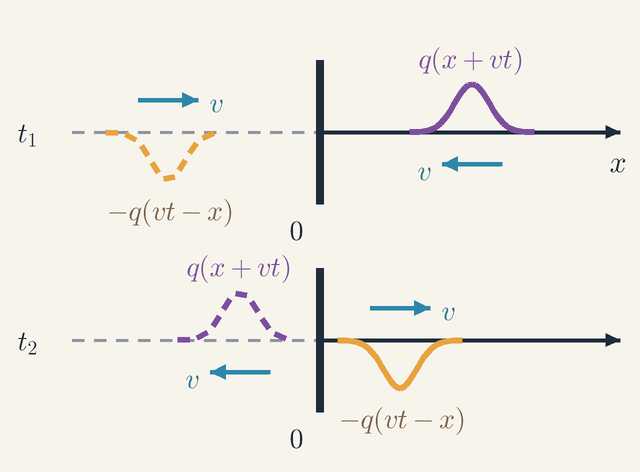
Figure 1. A clamped end at x=0, with the string on the right. At t1 the pulse q(x+vt) is on the string and its upside-down twin −q(vt−x) waits at the mirror position behind the wall; at t2 they have passed through each other and the twin is the pulse on the string.Legend
q(x+vt)
The incoming pulse, running towards the wall. Where it is behind the wall, off the string, it is dashed.
m
q(vt−x)
Its twin −q(vt−x): the pulse mirrored in the wall and turned upside down. It runs away from the wall and is dashed while behind it.
m
v
Speed of the pulse and its twin.
m/s
x
Position along the string, measured from the wall.
m
t1
An instant before the pulse reaches the wall (upper picture).
s
t2
A later instant, after the pulse and its twin have passed through each other (lower picture).
s
Figure 1 clamps the string at x=0; the real string is the part to the right of the wall, x>0. A pulse q(x+vt) arrives from the right, running left. The clamp means y(0,t)=0 at every instant. Putting x=0 into the general solution gives u(−vt)+q(vt)=0 for every t. Writing s=−vt, this says u(s)=−q(−s) for every s: the returning wave is fixed completely by the incoming one, and y(x,t)=q(x+vt)−q(vt−x)
Read the second term as a picture. Replacing x by −x in q(x+vt) gives q(vt−x), the incoming pulse mirrored in the clamp; the minus sign turns it upside down. In the upper picture of Figure 1, at the instant t1, look at the two shapes. The purple pulse q(x+vt) is on the real string and runs left. Its gold, dashed twin −q(vt−x) hangs downwards at the mirror position behind the wall and runs right. Both move at speed v, so they reach the wall at the same moment, and at x=0 they cancel at every instant: the clamp never moves.
In the lower picture, at the later instant t2, the two have passed through each other. The solid gold twin is now the only shape on the real string, upside down and running away from the wall, while the purple original carries on, dashed, behind the wall, where there is no string. The result: at a clamped end a pulse comes back inverted, with its shape and speed unchanged.
A free end, such as a ring sliding on a smooth rod, behaves differently. The ring can move but feels no sideways force from the rod, so the string must meet the rod at right angles: ∂y/∂x=0 at x=0. The same steps then give u(s)=+q(−s), and the pulse returns upright.
From two travelling waves to a standing wave
Now send in a sine wave instead of a single pulse. The incoming wave and its reflection overlap all along the string, and their sum is a standing wave.
Take the incoming wave Asin(kx+ωt), with amplitude A, wavenumber k=2π/λ for wavelength λ, and angular frequency ω=vk; it is a wave of the form q(x+vt). Its inverted mirror image −q(vt−x) is −Asin(ωt−kx)=Asin(kx−ωt). Adding the two with sina+sinb=2sin21(a+b)cos21(a−b) gives y(x,t)=2Asin(kx)cos(ωt)
Space and time have separated: a fixed shape sinkx multiplied by one oscillation cosωt shared by every point. The point at x moves up and down sinusoidally with amplitude 2A∣sinkx∣. Where sinkx=0, that is where kx=mπ with whole m, the string never moves: these points are the nodes, and they are λ/2 apart because k=2π/λ. Halfway between nodes, where ∣sinkx∣=1, lie the antinodes, which swing with the full amplitude 2A.
Because sinkx changes sign at each node, neighbouring loops are always on opposite sides of the line: they swing in antiphase. A motion in which every point oscillates at one frequency with a fixed shape is called a normal mode.
The animation shows this on a string in its second mode, n=2. The dashed gold wave Asin(kx−ωt) runs right, the dashed purple one runs left, and the solid string is their sum. The graph follows the red antinode at x=L/4, where sinkx=1: its motion is a pure cosine, 2Acosωt, which starts on the dashed +2A line.
Two clamped ends: only certain wavenumbers
A second clamp turns a continuum of possible waves into a set of notes. This is the step that gives a string its pitch.
The standing wave above already has a node at x=0. A second clamp at x=L also demands y(L,t)=0 at all times, so sinkL=0, and kL must be a whole multiple of π: kn=Lnπ with n=1,2,3,… counting the loops. In words, a whole number of half-wavelengths must fit between the clamps, L=nλn/2. Because ω=vk for every wave on the string, the allowed angular frequencies are ωn=nπv/L, and the frequencies are fn=2Lnv They are whole multiples of the lowest one, the fundamental f1=v/(2L): this is the harmonic series.
For the animation's string, L=0.65m and v=143m/s, so f1=143/(2⋅0.65)=110Hz, with k1=π/0.65≈4.83rad/m and ω1=2π⋅110≈691rad/s. A string with only one clamp accepts every k: it is the second boundary that makes the spectrum discrete.
The round trip and the harmonic series
The same frequencies follow without a single sine, by tracking one pulse as it bounces between the clamps. This view shows why the harmonics are exact multiples.
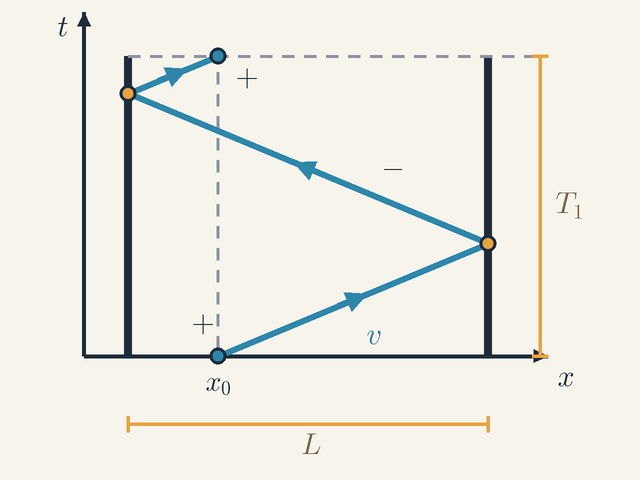
Figure 2. A space–time diagram of one pulse between two clamps: position x across, time t up. The signs + and − say whether the pulse is upright or inverted. After T1=2L/v it is back at x0, upright and moving the same way.Legend
x
Position along the string.
m
t
Time, increasing upwards.
s
L
Distance between the two clamps.
m
x0
Where the pulse starts, and where it is back after one round trip.
m
v
Speed of the pulse; the slope of each leg.
m/s
T1
Time of one round trip, 2L/v.
s
Figure 2 is a space–time diagram: position x runs across, time t runs upwards, and the two thick vertical lines are the clamps at x=0 and x=L, which stay put. A pulse moving at constant speed is a straight sloping line, and each bounce is a corner. Follow the blue path from the bottom. The pulse leaves x0 at t=0, running right at speed v; the sign + says it is upright. At x=L it reflects and turns upside down (−), runs left across the whole string, then reflects at x=0 and turns upright again (+). Two reflections mean two inversions, so it reaches x0 at the top dot upright and moving right, exactly as it started.
The length of the path does not depend on where the pulse started: (L−x0)+L+x0=2L. So the round trip takes T1=v2L=1431.30≈9.09ms which is exactly 1/f1 for 110 Hz. A disturbance of any shape is made of parts that each make this same round trip, so after T1 the whole string is back in its starting state and the motion repeats with period T1. A motion with period T1 can contain only frequencies that fit a whole number of cycles into T1: the multiples of 1/T1=110Hz. The harmonic series is the round-trip time written as a spectrum.
Any motion is a sum of modes
A real string is never set going in one pure mode, yet every motion is still a mixture of modes, and there is a way to find the mixture.
The wave equation is linear: if two motions are solutions, so is their sum. Every mode is a solution, and together the modes are enough to build any motion of the string: y(x,t)=∑nbnsinLnπxcos(ωnt+φn) Mode n enters with its own amplitude bn and phase φn. Both are set by the string's initial shape and velocity, and finding them is called Fourier analysis.
The tool that does the finding is orthogonality: multiply the shapes of two different modes and integrate along the string, and the result is zero. For a string released from rest with the shape y0(x), every phase φn is zero, because each mode must start at rest. Multiply y0(x) by the shape of mode n and integrate from 0 to L. Orthogonality removes every term except mode n's own, which gives bn times ∫0Lsin2(nπx/L)dx=L/2. Therefore bn=L2∫0Ly0(x)sinLnπxdx
Symmetry settles one case without any integral. A pluck at the centre gives a shape symmetric about x=L/2, while every even mode is antisymmetric about that point: one half goes up while the other goes down. A symmetric shape times an antisymmetric one integrates to zero, so the even coefficients vanish, and a string plucked at its centre sounds only odd harmonics. Going the other way, a few modes already make rich motions: the first two alone, a quarter-cycle out of step, add up to a bump that runs back and forth between the ends, and many modes together build the sharp corner of a real pluck.
Orthogonality also splits the energy. The total energy of the string is the sum of the mode energies, with no cross terms between modes: En=41μLωn2bn2 This is the kinetic energy of mode n at the instant it passes through straight: 21μωn2bn2sin2(nπx/L) per metre, and the sin2 averages to one half along the string. In this sense any linear vibrating system, from a bridge to a molecule, is a collection of independent oscillators, one per mode.
Where the energy sits
A standing wave carries no energy along the string, yet energy keeps moving inside it. Figure 3 shows where it is stored.
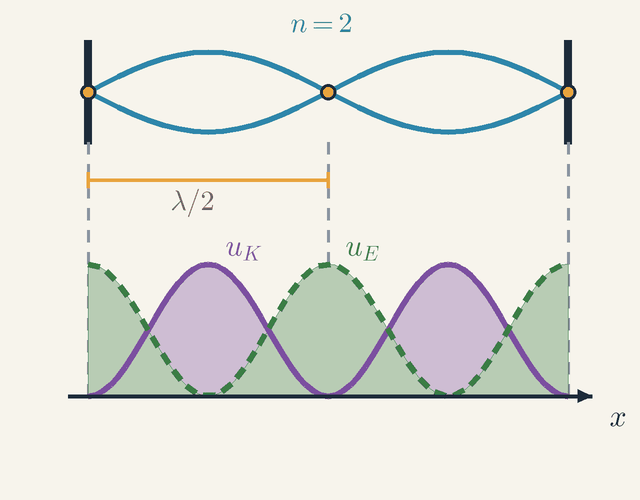
Figure 3. An n=2 standing wave and, below it, the largest energy per metre reached at each point during a cycle: the kinetic part uK peaks at the antinodes, the elastic part uE at the nodes, and both peaks are equally high.Legend
n
Mode number. The string is in its second mode, n=2, drawn at its two extreme shapes.
λ/2
Distance between neighbouring nodes (gold dots): half a wavelength.
m
x
Position along the string.
m
uK
Kinetic energy per metre: the largest value it reaches at each point during a cycle.
J/m
uE
Elastic (stretching) energy per metre: the largest value it reaches at each point during a cycle.
J/m
Figure 3 shows the n=2 string at its two extreme shapes, with its nodes as gold dots, λ/2 apart. Below it, two curves show how the energy per metre is spread along x. Each curve is the largest value that energy reaches at each point during a cycle; the two largest values occur at different instants.
The kinetic energy per metre is uK=21μ(∂y/∂t)2. With ∂y/∂t=−2Aωsinkxsinωt, it varies as sin2kxsin2ωt. Its largest value, the solid purple curve, peaks at the antinodes, where the string moves fastest, and vanishes at the nodes, which never move. It is reached at the instants when the string passes through straight.
The elastic energy per metre, stored by stretching the string, is uE=21F(∂y/∂x)2. With ∂y/∂x=2Akcoskxcosωt, it varies as cos2kxcos2ωt. Its largest value, the dashed green curve, peaks at the nodes, where the string is most tilted, and is reached at the instants of maximum displacement. The two curves reach the same height, 2μA2ω2, because Fk2=μω2 (from v2=F/μ and ω=vk). So during each cycle the energy sloshes from elastic energy near the nodes to kinetic energy near the antinodes and back.
Why does none of it travel along the string? Each travelling component carries a mean power 21μω2A2v, but in a standing wave the two carry it in opposite directions, so the net flow is zero. Instant by instant, the power passing a point is the sideways force from the string on the left, −F∂y/∂x, times the velocity of that point, ∂y/∂t: P=−F∂x∂y∂t∂y=FkωA2sin2kxsin2ωt The factor sin2kx is zero at every node and every antinode, at all times. Energy never crosses those points: it swings back and forth within each quarter-wavelength, at twice the frequency of the motion. On the animation's graph, the antinode passes through zero at its top speed, 2Aω; at that instant all the energy of its region is kinetic.
Drive the string at one of its fn and the energy fed in during each cycle adds up, so the amplitude grows until the losses balance the drive. This is resonance, and the height of its peak is set by the quality factor Q met in Damping and Resonance.
Beyond the ideal string
The rule that whole numbers of waves must fit carries over to other ends, stiffer strings and surfaces, with changes you can hear.
A string clamped at x=0 but free at x=L needs zero slope at the free end, coskL=0, so kL=(m−21)π with whole m≥1. An odd number of quarter-wavelengths fits, and f=(2m−1)v/(4L): only odd multiples of the lowest frequency v/(4L). This is the pipe closed at one end. Its closed end is a displacement node, like the clamp, and its open end is a pressure node, like the free end. The air just outside an open end also takes part, adding about 0.6 of the pipe's radius to the effective length.
A real string also resists bending. This extra restoring force grows faster with curvature than tension does, so short waves run faster and the overtones go sharp: fn≈nf11+Bn2 where the stiffness constant B grows with the fourth power of the wire's diameter. For a piano string near middle C, B is of order 4×10⁻⁴, so for the tenth mode 1+0.04≈1.02: it lies about 2 % above ten times the fundamental, and tuners stretch their octaves slightly to match.
In two dimensions the waves must fit both ways at once. A rectangular membrane with sides Lx and Ly has modes fmn=(v/2)(m/Lx)2+(n/Ly)2. A round drumhead has modes at about 1.59, 2.14 and 2.30 times its lowest frequency, not whole multiples, which is why a drum's pitch is less definite than a string's.
Worked problem: plucking the animation's string
This problem puts the pieces together: the Fourier coefficients of a real pluck, the harmonics it leaves out, and the share of energy each harmonic gets.
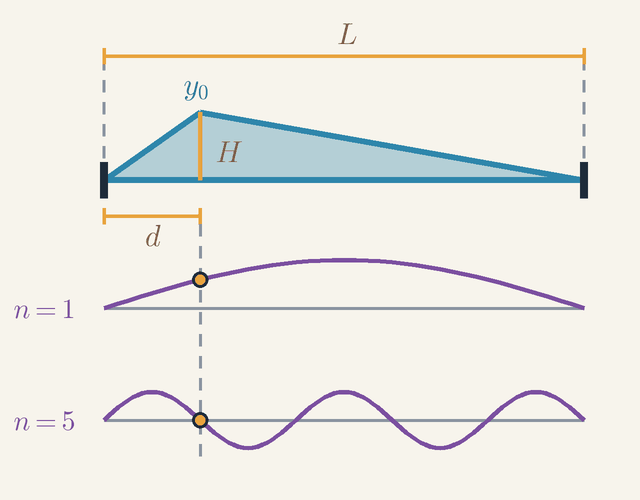
Figure 4. A string plucked at d=L/5, and the shapes of modes 1 and 5. Mode 1 is well above zero at the pluck point; mode 5 has a node there, so the pluck cannot excite it. Not to scale: H is drawn far too large.Legend
y0
Shape of the string at the moment of release: a triangle.
m
H
How far the string is pulled aside at the pluck point.
m
d
Distance from the left end to the pluck point.
m
L
Length of the string.
m
n
Mode number: mode n has n loops. Shown: sin(nπx/L) for n=1 and n=5.
Figure 4 draws the string at the moment of release. It is the animation's string, L=0.65m and v=143m/s, pulled aside by H=3mm at d=0.13m from the left end, a fifth of its length, and let go from rest. The height H is drawn far larger than it is. Which harmonics sound, and how is the energy shared between them?
The initial shape y0(x) is the blue triangle: two straight lines from the clamps up to the height H at x=d. Putting it into the formula for bn and integrating each straight piece gives bn=π2n2d(L−d)2HL2sinLnπd=2π2n225Hsin5nπ where the second form uses d=L/5, so that d(L−d)=4L2/25. This gives b1≈2.23mm, b2≈0.90mm and b3≈0.40mm, at 110, 220 and 330 Hz.
The two lower pictures show why some harmonics are missing. Look along the dashed vertical line through the pluck point x=d. The shape of mode 1, sin(πx/L), is well above zero there, so pulling at d feeds mode 1 strongly. The shape of mode 5, sin(5πx/L), crosses zero exactly there, because d=L/5. The pluck point is a node of mode 5, a place where that mode never moves, so no pull applied there can start it. The same holds for every mode with a node at d: sin(nπ/5)=0 for n=5,10,…, so 550 Hz and 1100 Hz are absent.
For the energy, En∝ωn2bn2, with ωn∝n and bn∝sin(nπd/L)/n2, so En∝sin2(nπd/L)/n2. Dividing each term by the sum over all modes, the fundamental gets 44 % of the energy, the second harmonic 29 % and the third 13 %. Plucked at the centre, the same string would put 81 % into the fundamental, 9 % into the third harmonic and nothing into the even ones. Plucking nearer the end feeds the upper harmonics, which is why a guitar sounds bright and thin near the bridge and round over the soundhole.
Limits of validity
The ideal string is a model. Knowing where it stops being right tells you when the results above can be trusted.
The model assumes small slopes, so that the string hardly stretches and its tension stays equal to F. Here the steepest slope is H/d=3/130≈0.023, well within that. A hard pluck does stretch the string, so the note starts slightly sharp and settles as it fades.
Nor are the ends perfectly rigid, and they must not be: a string alone pushes very little air, and an instrument sounds because the bridge moves and passes the vibration to the body. That leak, together with air drag and internal friction, damps the modes, the high ones fastest. If the fundamental's amplitude falls by a factor e in τ≈3s, its quality factor is Q=πf1τ=π⋅110⋅3≈1000.
A string is made of atoms about 0.3 nm apart, so the continuous wave equation holds only for wavelengths much longer than that spacing. A chain of N atoms has exactly N modes, the shortest wavelength being two spacings. In a crystal these modes reach about 1013Hz, and their quanta, called phonons, carry sound and heat.
Where this leads
The idea that only waves which fit can survive reaches far beyond strings.
Light between two mirrors forms standing waves spaced in frequency by c/(2L), where c is the speed of light: about 500 MHz for a 30 cm laser cavity (Electromagnetic Waves). Adding waves in general leads on to the next lesson, Interference and Superposition.
The deepest echo is in quantum mechanics, where an electron is a wave and its frequency is an energy, E=hf, with h the Planck constant. An electron confined to a box of length L must also fit whole half-wavelengths, λn=2L/n. Its momentum is p=h/λ and its energy is p2/(2me), with me the electron mass, so En=8meL2n2h2 which is about 0.38 eV for n=1 in a 1 nm box. The levels grow as n2, not as n, because for matter waves the frequency goes as k2, while on a string it goes as k. Fitting whole wavelengths around an orbit is the idea behind Atomic Models: the Bohr Atom; the box is solved properly in Schrödinger's Equation and Tunnelling, and Wave–Particle Duality explains why electrons are waves at all.
Key formulas
Whole number of half-wavelengths
L=2nλ
Each loop of a standing wave spans half a wavelength, from one node to the next, and a clamped end must be a node. A string fixed at both ends can therefore hold only a whole number of loops, and that fixes the possible wavelengths. Count the loops in a picture and you have n.
Symbols
L
length of the string between the fixed ends
m
n
harmonic number: the number of loops
λ
wavelength of the standing wave
m
When it holds: For a string with both ends fixed, or a pipe open at both ends. A pipe closed at one end holds an odd number of quarter-wavelengths instead, L=nλ/4 with odd n.
Example: A 1.0 m string vibrating with λ=0.5m holds n=2L/λ=4 loops.
Allowed wavelengths on a fixed string
λn=n2L
Solving the fitting condition for λ gives every wavelength a string fixed at both ends can hold: the longest is twice the string's length, and the others are its halves, thirds, quarters and so on. It is the wavelength of the two travelling waves that make up the pattern, twice the length of one loop.
Symbols
λn
wavelength of mode n
m
L
length of the string
m
n
harmonic number
When it holds: For both ends fixed (or both free). It is the wavelength on the string: the sound sent into the air has the same frequency but a different wavelength, because sound travels at another speed.
Example: The animation's 0.65 m string: λ1=1.30m, λ2=0.65m and λ3≈0.433m.
Harmonic series of a string
fn=2Lnv=nf1
All modes of one string share the same wave speed, so f=v/λ turns the allowed wavelengths into allowed frequencies. They form a harmonic series: exact multiples of the fundamental f1=v/(2L), equally spaced by f1. The time 2L/v is a round trip to the far end and back, which is why it is the period of the fundamental.
Symbols
fn
frequency of mode n
Hz
n
harmonic number
v
wave speed on the string
m/s
L
length of the string
m
f1
fundamental frequency, n=1
Hz
When it holds: For an ideal, flexible string with rigid ends, whose wave speed does not depend on frequency. Stiff strings such as piano wires have overtones slightly above nf1.
Example:L=0.65m and v=143m/s: f1=143/1.30=110Hz, then 220 and 330 Hz.
Wave speed on a string
v=μF
Tension pulls a displaced piece of string back towards the line, and its inertia per metre resists; their ratio sets how fast a disturbance spreads. It follows from Newton's second law applied to a short piece of string. A tighter string carries faster waves, a heavier one slower waves.
Symbols
v
wave speed
m/s
F
tension in the string
N
μ
linear density: mass per metre of string
kg/m
When it holds: For a perfectly flexible string and small slopes, so that the tension is the same everywhere. Bending stiffness makes short waves run slightly faster.
Example: Violin A string with F=49N and μ=6.0×10⁻⁴kg/m: v=49/(6.0×10−4)≈286m/s.
Standing wave as a product of shape and oscillation
y(x,t)=2Asin(kx)cos(ωt)
Two equal sine waves running in opposite directions, Asin(kx−ωt) and Asin(kx+ωt), add up to a fixed shape sinkx multiplied by a common oscillation cosωt. Each point moves sinusoidally with amplitude 2A∣sinkx∣, and the nodes, where sinkx=0, are λ/2 apart. Points on opposite sides of a node move in opposite directions.
Symbols
y
displacement of the string from its rest line
m
x
position along the string, measured from a fixed end
m
t
time
s
A
amplitude of each travelling wave
m
k
wavenumber, 2π/λ
rad/m
ω
angular frequency, 2πf
rad/s
When it holds: For two components of equal amplitude and frequency, with the origin at a node. If the amplitudes differ, part of the wave keeps travelling and the nodes are no longer completely still.
Example: Mode n=2 of the animation's string: k=2π/0.65≈9.67rad/m, so the nodes are π/k=0.325m apart and the red antinode sits at x=L/4≈0.16m.
Allowed wavenumbers between two fixed ends
kn=Lnπ
The product form vanishes at x=0 for any k; a second clamp at x=L also demands sinkL=0, so kL must be a whole multiple of π. Multiplying by the wave speed gives the natural angular frequencies ωn=vkn=nπv/L. It is the condition L=nλ/2 written with k=2π/λ.
Symbols
kn
wavenumber of mode n
rad/m
n
harmonic number
L
distance between the fixed ends
m
When it holds: For both ends fixed. With one end fixed and one free, coskL=0 instead, giving k=(m−21)π/L with whole m: odd quarter-wave modes. For an electron in a box the same rule fixes the allowed momenta.
Example: The animation's string: k1=π/0.65≈4.83rad/m, so ω1=vk1≈691rad/s, which is 2πf1 with f1=110Hz.
Glossary
Standing wave
A wave pattern that stays in place: its points oscillate, but its crests do not travel. It is the sum of two equal waves running in opposite directions, y=2Asin(kx)cos(ωt), and on average it carries no energy along the medium.
Node
A point of a standing wave that never moves, because the two component waves always cancel there. Neighbouring nodes are λ/2 apart, and a clamped end is always a node.
Antinode
A point midway between two nodes, where the oscillation is largest, 2A for two components of amplitude A. It lies λ/4 from the nearest node; it is a place, not a crest, and its displacement passes through zero twice per cycle.
Reflection at a fixed end
A pulse that reaches a clamped end comes back upside down, as if an inverted mirror image had arrived through the wall from the far side. At a free end it returns upright.
Superposition principle
In a linear medium, overlapping waves simply add their displacements, and each carries on as if the other were not there. It lets two travelling waves form a standing wave, and any motion be split into modes.
Normal mode
A pattern of motion in which every point oscillates sinusoidally at one common frequency, with a fixed shape. A string fixed at both ends has the modes sin(nπx/L), one for each whole number n.
Fundamental
The lowest mode of a confined wave, n=1: one loop, λ1=2L and f1=v/(2L). It usually sets the pitch we hear; for the animation's string it is 110 Hz.
Harmonic
A mode whose frequency is a whole multiple of the fundamental, fn=nf1. The numbering of overtones differs by one: the second harmonic is the first overtone, the third harmonic the second overtone.
Timbre
The quality that tells two instruments apart when they play the same note. It comes from the mix of harmonic amplitudes, which depends on the instrument and on where and how the string is plucked, bowed or struck.
Fourier analysis
Writing a shape or a signal as a sum of sines with suitable amplitudes and phases. For a string it turns the initial shape into the coefficients bn of its modes.
Resonance
The large response of a system driven at one of its natural frequencies, when the energy fed in during each cycle keeps adding up. Damping limits how high it grows.
Pipe closed at one end
An air column with a displacement node at the closed end and a displacement antinode at the open end. It holds an odd number of quarter-wavelengths, so only odd harmonics occur, fn=nv/(4L) with n=1,3,5,…
Quantities
L
String length
m
The vibrating length between the two fixed ends, from nut to bridge on a guitar; 0.65 m in the animation.
n
Harmonic number
A whole number that labels the mode and counts its loops; the pattern has n+1 nodes, including the ends.
λ
Wavelength
m
The length of one full cycle of either travelling component, twice the length of a loop. A string fixed at both ends allows only λn=2L/n.
fn
Frequency of harmonic n
Hz
The number of oscillations per second of every point in mode n, fn=nv/(2L); n=1 gives the fundamental f1.
v
Wave speed
m/s
How fast each travelling component runs along the string. It is the same for every harmonic: 143 m/s in the animation.
F
Tension
N
The force that stretches the string. Four times the tension doubles the wave speed and every frequency.
μ
Linear mass density
kg/m
The mass of one metre of string: 0.60 g/m is 6.0×10⁻⁴kg/m. A heavier string carries slower waves and plays lower notes.
A
Amplitude of each travelling wave
m
The amplitude of each of the two counter-running components; the antinodes swing with twice this, 2A.
y
Displacement of the string
m
How far the point of the string at position x is from its rest line at time t; in a standing wave y=2Asin(kx)cos(ωt), which stays zero at the nodes.
k
Wave number
rad/m
The phase change per metre along the wave, k=2π/λ. Two fixed ends allow only kn=nπ/L.
ω
Angular frequency
rad/s
The rate at which the phase of each point's oscillation advances, ω=2πf; for every mode ω=vk.
Quiz
Beginner On a vibrating string with a standing wave, which points never move?
The antinodes
All of them: a standing wave does not move
None: every point moves
The nodes
Show answer
Answer: D. The nodes
Nodes are the still points where the two overlapping waves always cancel. Every other point moves, and the antinodes, in the middle of each loop, swing the most: “standing” means the pattern does not travel, not that the string is frozen.
Beginner A guitarist presses a string against a fret, shortening the part that vibrates. What happens to the note?
It gets lower
It gets higher
It stays the same
The string stops vibrating
Show answer
Answer: B. It gets higher
A shorter string fits shorter loops, which vibrate faster, so the note is higher.
Beginner A string vibrates with three loops instead of one. Compared with one loop, how fast does it vibrate?
Three times as fast
Three times as slowly
Just as fast
Nine times as fast
Show answer
Answer: A. Three times as fast
The frequency of the harmonic with n loops is n times the fundamental, so three loops vibrate three times as fast and give a higher note.
Intermediate A string 0.8 m long is fixed at both ends, and waves travel along it at 240 m/s. What is its fundamental frequency?
300 Hz
75 Hz
150 Hz
192 Hz
Show answer
Answer: C. 150 Hz
f₁ = v/(2L) = 240 ÷ 1.6 = 150 Hz. Forgetting the 2 gives 300 Hz, using 4L gives 75 Hz, and 192 comes from multiplying v by L.
Intermediate In a standing wave of wavelength 0.6 m, how far apart are two neighbouring nodes?
0.6 m
0.3 m
0.15 m
1.2 m
Show answer
Answer: B. 0.3 m
Nodes are half a wavelength apart: 0.6 ÷ 2 = 0.3 m. 0.15 m is the node-to-antinode distance, λ/4.
Intermediate The tension of a string is multiplied by four, everything else unchanged. What happens to its fundamental frequency?
It quadruples
It is unchanged
It halves
It doubles
Show answer
Answer: D. It doubles
v = √(F/μ), so four times the tension doubles v, and f₁ = v/(2L) doubles too.
Advanced A standing wave is y = 2A·sin(kx)·cos(ωt) with k = 5π rad/m. How far apart are neighbouring nodes?
0.2 m
0.4 m
0.1 m
0.8 m
Show answer
Answer: A. 0.2 m
Nodes are where sin(kx) = 0, that is kx = mπ, so they are π/k = 1/5 = 0.2 m apart. 0.4 m is the wavelength 2π/k.
Advanced An ideal string fixed at both ends is plucked exactly in its middle. Which harmonics are absent from its sound?
All odd harmonics (n = 1, 3, 5, …)
All harmonics except the fundamental
All even harmonics (n = 2, 4, 6, …)
None: all harmonics are present equally
Show answer
Answer: C. All even harmonics (n = 2, 4, 6, …)
The initial shape is symmetric about x = L/2, while every even mode sin(nπx/L) is antisymmetric about that point, with a node there. Their Fourier coefficients vanish.
 Physics Tutor