When waves overlap, their displacements simply add, y=y1+y2: depending on the path difference Δ they reinforce each other or cancel out, and at slightly different frequencies they beat.
Waves on strings adding up point by point: in step they reinforce each other, half a wave out of step they cancel.
Where two waves meet, their heights simply add; afterwards each goes on unchanged.
Crest on crest makes a wave twice as tall: the waves help each other.
Crest on trough makes them cancel: that is how noise-cancelling headphones work.
Two notes of almost the same pitch drift in and out of step: you hear beats, as many per second as the difference in frequency.
Quiet spots always come with loud spots nearby: energy is moved around, not destroyed.
When two waves meet, they do not bounce off each other like balls. They simply add up: at each point the height is what the first wave would make plus what the second would make. Afterwards each goes on its way unchanged, just as two conversations cross a room without spoiling each other. This adding-up is called superposition.
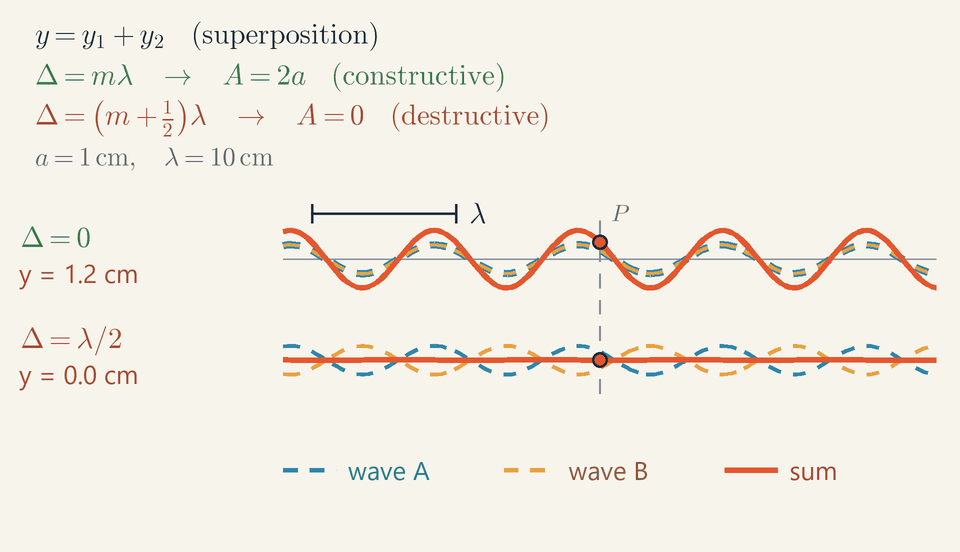
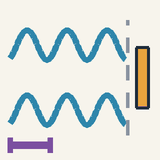
The animation shows two waves (dashed) on the same string and their sum (solid). On the top string the waves are in step: crest meets crest and trough meets trough, so the string swings twice as high. This is constructive interference.
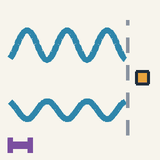
On the lower string one wave is shifted by half a wavelength, so every crest meets a trough. One wave pushes up exactly as much as the other pulls down, and the string barely moves: destructive interference. Noise-cancelling headphones use this trick, playing an upside-down copy of the noise into your ear.
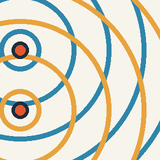
Where does the energy go at a quiet spot? It is not destroyed. With two loudspeakers playing the same steady note, you can walk across a room and find quiet places right next to loud ones: the energy is only moved around. Perfect silence is rare, because walls reflect sound too.
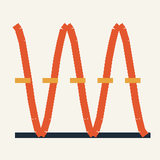
When two notes are almost, but not quite, the same, the waves drift slowly in and out of step, and the sound swells and fades: wah, wah, wah. These are beats, and there are as many per second as the difference between the two frequencies. A guitarist tunes two strings by turning a peg until the beats slow down and stop.
Check yourself: tuning forks of 440 Hz and 443 Hz sound together. How many beats per second do you hear? Answer: three.
Intermediate
Key ideas
Superposition: y=y1+y2 at every point and every instant in a linear medium.
Δ=(m+21)λ gives destructive interference, amplitude ∣A1−A2∣, zero only if A1=A2.
Twice the amplitude means four times the intensity, because I∝A2.
A steady pattern needs coherent sources with a fixed phase difference.
Waves add, point by point
Noise-cancelling headphones and soap-bubble colours rest on one rule. Where two waves pass through the same place, each point of the medium moves by the sum of the displacements that each wave alone would give it: y=y1+y2
This is the principle of superposition. Displacements carry signs, so a crest of 1 cm meeting a trough of 1 cm gives zero. It holds in a linear medium, one whose restoring force is proportional to the displacement: strings, air and water at small amplitudes, and light in vacuum.
Each wave carries on as if the other were not there: two pulses running towards each other along a rope add while they overlap, then separate unchanged. Note what adds: displacements, not intensities.
Phase difference and path difference
Whether two waves of the same frequency help or cancel each other depends on their phase difference φ, how far one is ahead of the other in its cycle (2π for a whole cycle). For sources that vibrate in step, it comes from the path difference Δ=r2−r1, the extra distance one wave travels to the point; each wavelength of extra path is one cycle of delay: φ=λ2πΔ
So Δ=0,λ,2λ,… brings the waves in step, and Δ=λ/2,3λ/2,… brings crest onto trough. Only Δ in wavelengths matters: 3.2 wavelengths acts like 0.2.
A steady pattern needs coherent sources, whose phase difference stays fixed, like two loudspeakers fed by one signal. If the frequencies differ slightly, the phase difference drifts, and the loudness swells and fades as many times per second as the frequencies differ: fbeat=∣f1−f2∣ Strings at 196 Hz and 198 Hz give two beats per second; the animation's expert layer shows them on a third string.
The conditions for loud and quiet
For sources in step and waves of amplitudes A1 and A2 at the point, the two extreme cases are
Δ=mλ→A=A1+A2(constructive)
Δ=(m+21)λ→A=∣A1−A2∣(destructive)
Here m=0,1,2,…, and A is the amplitude of the combined oscillation. Complete silence needs equal amplitudes.
For two equal amplitudes a, any path difference in between gives A=2acosλπΔ which falls smoothly from 2a at Δ=0 to zero at Δ=λ/2.
What we hear or see is the intensity I, the power through each square metre, which grows as the square of the amplitude. Two equal sources that each give I0 alone therefore produce I=4I0cos2(λπΔ) Bright places get 4I0, dark places nothing, and the average is 2I0, as without interference: energy is moved from quiet places to loud ones, not destroyed.
Worked example: the strings in the animation
Each dashed wave has amplitude a=1cm, wavelength λ=10cm (the ruler above the top string) and frequency 0.5 Hz, so each point repeats its motion every 2 s and the waves move at v=fλ=5cm/s.
On the top string the gold wave B lies exactly on the blue wave A, so Δ=0 and the amplitudes add: A=A1+A2=1+1=2cm The readout at P swings between −2.0 and +2.0cm, and the red sum is twice as tall as either dashed wave, with 22=4 times the intensity of one.
On the second string wave B is shifted by half a wavelength, Δ=λ/2=5cm, so every crest of A meets a trough of B: A=∣A1−A2∣=∣1−1∣=0 The red sum lies flat, and the readout stays at 0.0 cm.
In between, a quarter-wavelength shift of 2.5 cm would give A=2cos(π/4)≈1.41cm and exactly 2I0; a shift of λ/3 gives A=2cos(π/3)=1cm, no more than one wave alone.
Worked example: two loudspeakers
Two small loudspeakers are driven in phase by the same 686 Hz signal. With the speed of sound at 343 m/s, the wavelength is λ=v/f=343/686=0.50m. You stand 3.00 m from one speaker and 3.75 m from the other, so Δ=3.75−3.00=0.75m=1.5λ That is (m+21)λ with m=1: you are at a quiet spot.
How quiet? The amplitude of a small source falls as 1/r, so the far speaker's amplitude is 3.00/3.75=0.80 of the near one's. What is left is 1−0.80=0.20, an intensity of 0.202=0.04 of the near speaker alone, while a nearby loud spot gets 1.802=3.24: 81 times more, about 19 dB.
The spot also depends on the note: 0.75 m is an odd number of half wavelengths at 229, 686 and 1143 Hz, which are quiet there, but a whole number of wavelengths at 457 and 915 Hz, which are loud. So music is never silenced at one place.
Adding waves by eye
To sketch a superposition, add the signed heights of the two waves at a few points and join the results: where one wave is at zero the sum equals the other, and where the two are equal and opposite it vanishes. In the animation the dashed blue and gold curves are the waves, the solid red one their sum, and the dashed line through P marks where the readouts measure y.
Two waves of the same frequency travelling the same way add up to a wave of that frequency and speed: the red crests on the top string keep pace with the dashed ones at 5 cm/s. The flat second string, with no wave and no energy left, is best read as what arrives at one point by two paths; with separate sources, cancellation in one place always comes with reinforcement elsewhere.
Common mistakes
Adding intensities instead of amplitudes: two equal waves in step give 22=4 times the intensity of one, not 2; only the average over the pattern is twice one source.
Believing that destructive interference destroys energy: the quiet spot's 0.04 comes with loud spots at 3.24, whose average, 1.64, is exactly 1+0.802, the sum of the two speakers' separate intensities.
Expecting silence whenever waves are out of step: that needs equal amplitudes, and waves of 4 cm and 1 cm still leave 3 cm.
Thinking that the distance itself decides: only the difference counts, so 3.00 m and 3.75 m, or 10.00 m and 10.75 m, both give quiet spots at 686 Hz.
Expecting a pattern from any two sources: two lamps, or two violinists on one note, have wandering phases, so only the summed intensity, 2I0, remains.
Where you meet it
Noise-cancelling headphones play an inverted copy of incoming noise and work best on steady low hums, such as an aircraft cabin's. Soap bubbles get their colours from light reflected by the two surfaces of a thin film, and the anti-reflection coating of a camera lens is about 100 nm thick so that two reflections of green light cancel.
Wi-Fi at 2.4 GHz (wavelength 12.5 cm) reaches a laptop by several paths, so moving it a few centimetres can turn a weak spot into a strong one, and gravitational-wave detectors use interference to sense length changes far smaller than a proton. Standing Waves adds waves running in opposite directions, and Diffraction and the Double Slit applies these conditions to light.
Advanced
Key ideas
Add equal-frequency oscillations as rotating arrows (phasors): AR2=A12+A22+2A1A2cos(φ1−φ2).
Equal amplitudes: I=4I0cos2(πΔ/λ), averaging 2I0: interference redistributes energy, never creates it.
Changing one source's phase moves the bright directions: two antennas steer a beam, as phased arrays do.
Different frequencies: the phase difference grows, I∝A12+A22+2A1A2cos((ω1−ω2)t): beats at ∣f1−f2∣.
A steady pattern needs a fixed phase difference; for independent sources the cross term averages out and only I1+I2 remains.
Why waves simply add
Everything in this lesson rests on one fact: where two waves overlap, their displacements add. This section shows why that is so, and the next sections draw the consequences.
Superposition is not an extra law of nature. It is a property of the equation the wave obeys. Take a stretched string and let y(x,t) be the small sideways displacement, at time t, of the piece of string at position x. Newton's second law applied to each short piece gives, for small displacements, the wave equation, in which v is the speed of waves on the string: ∂t2∂2y=v2∂x2∂2y
This equation is linear: each term contains y once and only to the first power, with no y2 and no product of y with its own derivatives. Suppose y1 and y2 are both solutions, and try y=c1y1+c2y2 with any constants c1 and c2. The derivative of a sum is the sum of the derivatives, and constants come out in front, so each side of the equation splits into a y1 part and a y2 part. Each part balances on its own, so the combination is a solution too. That is the principle of superposition: two waves pass through each other, and at every point the displacement is simply y1+y2.
The general solution of the wave equation, y=F(x−vt)+G(x+vt), shows it at work: F is a pulse of any shape moving right, G one moving left, and the two cross with their shapes intact. Small pressure changes in air, light in vacuum, whose field equations are exactly linear, and the wavefunction of quantum mechanics all obey linear equations of this kind, so everything below applies to them as well.
Adding two oscillations with phasors
At any one point, each wave makes the medium oscillate. To find the combined motion we must add two oscillations of the same frequency but with different amplitudes and phases. Adding cosines directly is clumsy; drawing each oscillation as a turning arrow turns the sum into simple geometry.
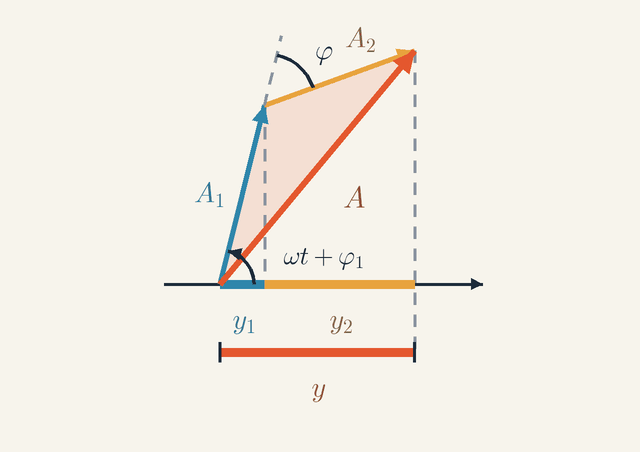
Figure 1. Two oscillations of the same frequency drawn as turning arrows (phasors), laid head to tail. A1 and A2 turn together, so the triangle with their sum A keeps its shape, and the projections y1 and y2 on the axis add up to y.Legend
A1
Amplitude of the first oscillation: the length of the blue arrow.
m
A2
Amplitude of the second oscillation: the length of the gold arrow.
m
A
Amplitude of the sum: the red arrow, which closes the triangle.
m
ωt+φ1
Phase of the first oscillation: the angle of the blue arrow from the axis, growing at the rate ω.
rad
φ
Phase difference φ1−φ2: the angle between the two arrows, fixed while both turn.
rad
y1
Displacement due to the first oscillation: the projection of the blue arrow on the axis.
m
y2
Displacement due to the second oscillation: the projection of the gold arrow on the axis.
m
y
Displacement of the sum, y1+y2: the projection of the red arrow.
m
The two oscillations are y1=A1cos(ωt+φ1) and y2=A2cos(ωt+φ2), with the same angular frequency ω. Figure 1 draws each one as an arrow, called a phasor. The length of the arrow is the amplitude: A1 for the blue arrow, A2 for the gold one. Its angle from the horizontal axis is the phase: ωt+φ1 for the blue arrow, marked at its foot, and ωt+φ2 for the gold one. The oscillation itself is the projection of the arrow on the axis, its shadow: an arrow of length A1 at the angle ωt+φ1 has the projection A1cos(ωt+φ1), which is exactly y1. As time passes the arrow turns anticlockwise at the rate ω, and its shadow moves back and forth.
Now look at three things in the figure. First, the gold arrow starts at the tip of the blue one, head to tail, and the red arrow A runs from the foot of the blue arrow to the tip of the gold one: A is the vector sum of the two. Second, both arrows turn at the same rate ω, so the angle between them, φ=φ1−φ2, marked between the gold arrow and the dashed extension of the blue one, never changes. The shaded triangle therefore keeps its shape and turns as one rigid piece, and A turns at the rate ω too. Third, along the axis the shadows y1 and y2 lie one after the other and together span y, the shadow of A, because the projection of a sum of vectors is the sum of their projections. So y=y1+y2 is itself an oscillation at the same angular frequency ω, and its amplitude is the length A.
The length A follows from the triangle. The angle inside the triangle where the two arrows meet is π−φ, because φ is measured from the extension of the blue arrow. The law of cosines, together with cos(π−φ)=−cosφ, gives A2=A12+A22+2A1A2cosφ The amplitude is largest, A1+A2, when φ=0 and the arrows point the same way, and smallest, ∣A1−A2∣, when φ=π and they point opposite ways.
In complex numbers the same sum reads as follows. Each oscillation is the real part of Ajei(ωt+φj), the common factor eiωt comes out, and A2=∣A1eiφ1+A2eiφ2∣2; the argument of that complex sum is the phase of the resultant. Multiplying out the squared modulus gives the law of cosines again.
Where does φ come from? Take two sources of the same angular frequency ω, with their own phases α1 and α2, and a point at distances r1 and r2 from them. A wave travelling at speed v needs the time rj/v to arrive, so what reaches the point at time t left source j at the time t−rj/v. Its phase is therefore ω(t−rj/v)+αj=ωt+αj−krj, where k=ω/v=2π/λ is the wavenumber and λ the wavelength. So φj=αj−krj, and in the difference the common ωt drops out: φ=φ1−φ2=λ2πΔ+(α1−α2),Δ=r2−r1 Here Δ is the path difference, the extra distance travelled by the wave from the second source. Each wavelength of extra path adds 2π to the phase difference.
For two equal amplitudes a from sources in step (α1=α2), the law of cosines becomes A2=2a2(1+cosφ). The identity 1+cosφ=2cos2(φ/2) turns this into A2=4a2cos2(φ/2), and since φ/2=πΔ/λ, A=2acosλπΔ Special cases can be read straight off the triangle. At Δ=λ/3 the phase difference is 2π/3, or 120°, so the angle inside the triangle is 60°; two equal sides around a 60° angle make an equilateral triangle, and A=a. At Δ=λ/4 the arrows are perpendicular, A is the hypotenuse of a right isosceles triangle, and A=2a.
Intensity and where the energy goes
An ear or an eye does not register the amplitude but the intensity I, the power carried through each square metre, which is proportional to the square of the amplitude. Turning the amplitude law into an intensity law also shows that interference only moves energy around.
Multiply the law of cosines by the constant that turns A2 into intensity. The terms A12 and A22 become I1 and I2, the intensities each source gives alone, and A1A2 becomes I1I2: I=I1+I2+2I1I2cosφ For two equal sources in step that each give I0 alone, φ=2πΔ/λ and I=4I0cos2(λπΔ) The last term of the general law, 2I1I2cosφ, is called the cross term, and it is the whole of interference: without it the intensities would simply add. Across a screen or a room, φ runs through many whole cycles, and the average of cosφ over a whole cycle is zero. What remains on average is I1+I2=2I0: the bright fringes, at 4I0, gain exactly what the dark ones lose.
That energy balance assumes the sources are many wavelengths apart. Close together they are coupled: each source pushes on a medium that the wave of the other is also moving. If that wave arrives in step with the push, the source works against a higher pressure, or field, and radiates more; if it arrives out of step, the source radiates less. Two small sources a distance d apart, driven with equal strength and a phase difference α, radiate in total P=2P0(1+cosαkdsinkd) where P0 is the power one source radiates alone. Two checks: when kd is large, sinkd/(kd) is small and P≈2P0, the sum of the separate powers; when d→0 the factor tends to 1, so two sources in step act as one source of double strength, P=4P0, while two in opposite phase cancel.
For example, two loudspeakers 1.5 m apart playing 50 Hz (wavelength 6.86 m in air, so kd=1.37) radiate 3.43P0 in step, but only 0.57P0 with one wired backwards, which reverses its phase. That is a factor of 6, almost 8 dB of bass lost. Energy is still conserved: the air loads each speaker differently, so the amplifier simply delivers a different power.
Path difference far away, and steering a beam
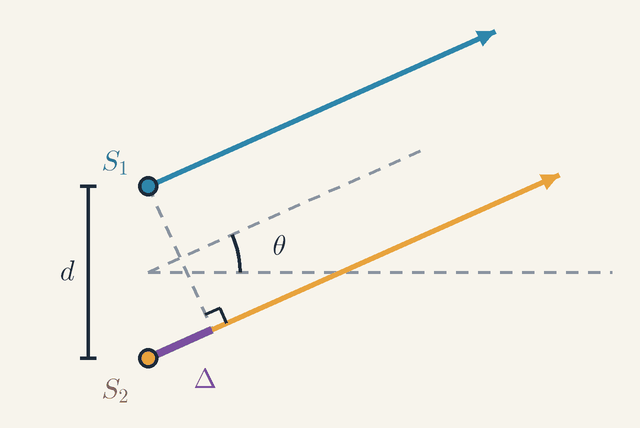
Antennas, loudspeakers and slits are usually observed from far away, at many times their separation. Then the path difference depends only on the direction, and the interference pattern becomes a pattern of directions. Figure 2 finds that path difference.
Figure 2. Two sources S1 and S2 a distance d apart, seen from far away: the rays to the distant point are parallel, at the angle θ from the perpendicular bisector. The path from S2 is longer by the purple piece, Δ=dsinθ. Not to scale.Legend
S1
First source.
S2
Second source.
d
Distance between the two sources.
m
θ
Direction of the distant point, measured from the perpendicular bisector of S1S2.
rad
Δ
Path difference: how much farther the wave from S2 travels than the wave from S1.
m
In Figure 2 the sources S1 and S2 are a distance d apart, and we look towards a distant point in the direction at the angle θ from their perpendicular bisector, the horizontal dashed line. Because the point is so far away, the two rays to it, blue from S1 and gold from S2, are practically parallel. The dashed line from S1 to the gold ray meets that ray at a right angle. Beyond this line both paths are equally long, so the only extra length of the path from S2 is the purple piece between S2 and the foot of the dashed line. That piece is Δ.
The purple piece is one side of a right triangle whose hypotenuse is S1S2, of length d. The angle of that triangle at S1 equals θ: the line S1S2 is at right angles to the bisector, the dashed line is at right angles to the rays, and turning two lines by the same right angle leaves the angle between them unchanged. The purple side lies opposite that angle, so Δ=dsinθ For sources in step, the waves therefore arrive in step, and form a strong beam, in every direction where dsinθ is a whole number of wavelengths.
The phases of the sources can also be set on purpose. Let S1 lag behind S2 by the phase α, so that α1−α2=−α. Then φ=2πdsinθ/λ−α, and the strongest direction, where φ=0, moves to sinθ=2πdαλ The beam swings towards the side of the delayed source, S1: its shorter path makes up exactly for its late start. A 10 GHz radar (λ=3.0cm) with elements 1.5 cm apart, each a quarter cycle (90°) behind its neighbour, aims where sinθ=0.5, at 30°. Changing the phases electronically steers the beam with no moving parts: this is how phased-array antennas work.
Beats: interference in time
So far both waves had the same frequency, so the phase difference at a point stayed fixed. If the frequencies differ slightly, the phase difference grows steadily with time, and the combined loudness at one place rises and falls. These swells are beats, which musicians use to tune their instruments.
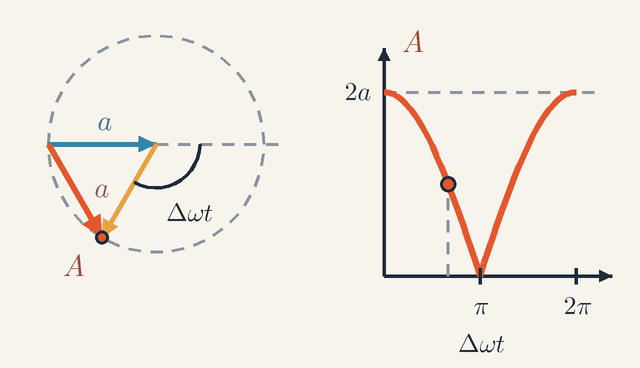
Figure 3. Beats with two equal arrows. Seen from the blue arrow, the slower gold one drops back by Δωt, so the sum A shrinks from 2a to 0 and grows back (graph, right): one beat for every 2π of Δωt.Legend
a
Amplitude of each oscillation: the length of the blue arrow and of the gold arrow.
m
A
Amplitude of the sum: the length of the red arrow, plotted as the red curve.
m
2a
Largest value of A, reached when the two arrows point the same way.
m
Δωt
Angle by which the gold arrow has dropped back from the blue one; it grows in proportion to the time t.
rad
π
Half a turn: the arrows point opposite ways and A=0.
rad
2π
A whole turn: the arrows line up again, and one beat is complete.
rad
Figure 3 shows beats with the same arrows. Both oscillations have the amplitude a, and their angular frequencies ω1 and ω2 differ by a small amount Δω=ω1−ω2. Look at the arrows from the blue one, as if you turned with it at ω1, so that it stays still along the axis. The gold arrow, turning at the slower ω2, falls steadily behind: after a time t it has dropped back by the angle Δωt. Its foot stays at the tip of the blue arrow, so its own tip runs round the dashed circle of radius a centred there. The red sum A therefore stretches and shrinks: it is 2a when the two arrows line up and 0 when they point opposite ways, at Δωt=π.
The two equal arrows and their sum form an isosceles triangle, which gives the length of the sum at any moment, A=2a∣cos(Δωt/2)∣. The graph on the right plots it against Δωt, and its dot marks the moment drawn on the left. The curve repeats every 2π of Δωt, that is, every 2π/Δω in time. That is one beat: the time the faster arrow needs to gain a whole turn on the slower one.
Algebra gives the same result. At a fixed point take y=asinω1t+asinω2t. The identity sinp+sinq=2cos2p−qsin2p+q turns this into y=2acos(2Δωt)sin(ωˉt) where ωˉ=(ω1+ω2)/2 is the mean angular frequency. The second factor is a fast oscillation at the mean frequency; the first is a slow envelope that sets its size.
The third string of the animation, shown at this level, adds two waves of amplitude a=1cm with the frequencies f1=1.5Hz and f2=1.25Hz (in hertz, f=ω/(2π)). The fast oscillation runs at their mean, 1.375 Hz, and the envelope's cosine at half their difference, 0.125 Hz: one period of the cosine per 8 s loop. Loudness follows the size of the envelope, not its sign, and that size peaks twice in each period of the cosine, once where the cosine is +1 and once where it is −1. So the beats come at the full difference, fbeat=∣f1−f2∣ here 0.25 Hz, one beat every 4 s.
On the graph of y(t) at the point P, the purple trace swells to almost 2 cm near t=0.4s and 4.4s and pinches to zero near 2.4 s and 6.4 s, always inside the dashed envelope ±2a.
Each beat holds 1.375⋅4=5.5 fast oscillations, because in 4 s wave 1 makes 6 cycles and wave 2 makes 5. The extra half cycle means that the fast motion restarts upside down after every pinch, which is why the envelope's cosine needs two beats to repeat. In Figure 3 this is the faster arrow overtaking the slower one once per beat. With unequal amplitudes A1 and A2, the law of cosines with φ=Δωt gives the intensity I∝A12+A22+2A1A2cos(Δωt) which swings between (A1+A2)2 and (A1−A2)2. The beats are still there, but the sound never falls silent.
Modulation: beats read backwards
Beats show that two close frequencies added together look like one frequency with a slowly changing amplitude. Read the other way round, a wave whose amplitude is made to change contains extra frequencies. This is how AM radio carries sound.
Let a carrier of angular frequency ωc have its amplitude follow a tone of angular frequency ωm, with the modulation depth b: the signal is (1+bcosωmt)cosωct. The product rule cospcosq=21[cos(p+q)+cos(p−q)] splits it into the carrier itself plus two side bands of amplitude b/2, at ωc+ωm and ωc−ωm. An AM station at 1.2 MHz carrying sound up to 4.5 kHz therefore fills the band from 1195.5 to 1204.5 kHz, 9 kHz wide, which is why AM channels in Europe are spaced 9 kHz apart.
Many sources: a polygon of arrows
Gratings and antenna arrays combine many sources, not two. The phasor picture handles any number of them: the arrows are simply laid head to tail in a longer chain.
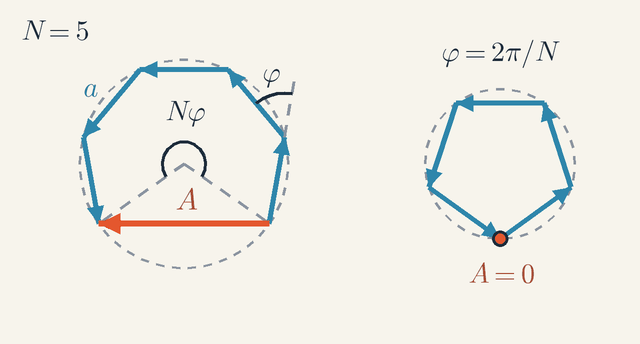
Figure 4.N=5 equal arrows, each turned by φ from the one before, bend round a regular polygon, and their sum A closes the chain (left). At φ=2π/N the polygon closes on itself and A=0 (right).Legend
N
Number of equal sources, here 5.
a
Amplitude of one source: the length of each blue arrow.
m
A
Amplitude of the sum: the red arrow from the start of the chain to its end.
m
φ
Phase step between neighbouring sources: the angle each arrow is turned from the one before.
rad
Nφ
Angle that the whole chain, from the first arrow to the last, spans at the centre of the dashed circle.
rad
Figure 4 takes N equal sources in a row, each a phase φ ahead of the one before; on the left N=5. All N arrows have the same length a, and each is turned by the same angle φ from the one before it. A chain with equal sides and the same turn at every corner is part of a regular polygon, so its corners lie on one circle, the dashed one; let R be its radius. Seen from the centre, each side spans the angle φ, and the whole chain, from the foot of the first arrow to the tip of the last, spans Nφ. The sum A, the red arrow, closes the chain.
A chord that spans the angle β at the centre of a circle of radius R has the length 2Rsin(β/2): the line from the centre to its midpoint cuts the isosceles triangle into two right triangles. So one side is a=2Rsin(φ/2), and the closing chord is A=2R∣sin(Nφ/2)∣. Dividing the second by the first removes the unknown radius R: A=asin(φ/2)sin(Nφ/2) For N=2, the identity sinφ=2sin(φ/2)cos(φ/2) brings back A=2a∣cos(φ/2)∣.
Two cases stand out. When φ is a multiple of 2π, all the arrows point the same way, so A=Na and the intensity is I=N2I0, where I0 is the intensity of one source alone. As φ grows from zero the chain curls up, and the first zero comes at φ=2π/N: the N turns of φ then add up to a whole turn and the polygon closes on itself, as on the right of Figure 4.
With ten sources the peaks are 100 times as intense as one source, and their first zeros lie at φ=2π/10 instead of π for two sources, so the peaks are five times narrower. The average intensity is still 10I0, because the cross terms average to zero: the energy is gathered into narrow, bright peaks. This is the principle of diffraction gratings and radio-telescope arrays.
Standing waves and wave packets
Superposition also explains two patterns met in later lessons: waves that stand still, and waves confined to a short packet.
Two equal waves running in opposite directions add, by the identity used for beats, to asin(kx−ωt)+asin(kx+ωt)=2asinkxcosωt Every point oscillates in step with every other, with an amplitude 2a∣sinkx∣ fixed by its position. Where sinkx=0, every λ/2, there are nodes that never move: this is a standing wave.
Adding many neighbouring frequencies, spread over a band of width Δf, makes a single wave packet. The components agree in phase at one moment and drift out of step within a time of about 1/Δf, so the shorter the packet, the wider the band it needs: roughly ΔfΔt≈1.
The packet's envelope moves at the group velocity dω/dk; for two waves this is the speed Δω/Δk of the beat pattern. On the animation's string every frequency travels at the same 5 cm/s, so ω=vk and the group velocity equals the wave speed: the beat envelope, which repeats every v/Δf=20cm along the string, keeps pace with the waves. In deep water, where long waves run faster than short ones, it would not: there the envelope moves at only half the speed of the crests.
Worked problem: a detuned loudspeaker
This problem brings together the amplitude law, the contrast of a pattern and beats.
Take the two loudspeakers of the intermediate level, in step at 686 Hz, so that λ=0.50m in air at 343 m/s. A listener sits 3.00 m from one and 3.75 m from the other. The amplitude of each speaker falls off as 1/r, so at the listener the far one is weaker by the ratio 3.00/3.75=0.80. Find the contrast of the pattern, then let the far speaker drift to 686.25 Hz.
Before the drift, the path difference is Δ=0.75m=1.5λ, so φ=2π⋅1.5=3π and cosφ=−1: the listener sits at a quiet spot. Measure intensities in units of the near speaker alone, so that A1=1 and A2=0.8. The quietest and loudest values the pattern can take, at cosφ=−1 and cosφ=+1, are Imin=(1−0.8)2=0.04,Imax=(1+0.8)2=3.24 The visibility, or contrast, of the pattern compares the two. Since Imax−Imin=4A1A2 and Imax+Imin=2(A12+A22), V=Imax+IminImax−Imin=A12+A222A1A2=1.641.6=0.98 A 20 % mismatch in amplitude still leaves a dip of 10log10(3.24/0.04)≈19dB below the loudest value: interference is forgiving.
Now detune the far speaker by 0.25 Hz. Its phase gains a whole cycle on the other every 4 s, so φ runs through all values, and the listener hears beats at 0.25 Hz, the rhythm of the animation's third string: 0.04 at t=0, 3.24 two seconds later, 0.04 again at 4 s.
The same drift moves the pattern in space. On the line between the speakers, a step δ towards one speaker shortens one path by δ and lengthens the other by δ, so it changes Δ by 2δ; the quiet spots, one wavelength of Δ apart, are therefore λ/2=0.25m apart. As the phase drifts, the whole pattern slides by one spacing per beat, 0.25 m in 4 s or about 6 cm/s, towards the speaker with the lower frequency. Beats in time and fringes in space are one phenomenon: a pattern sweeping past a fixed ear.
Averaged over a beat, the cross term vanishes and leaves 1+0.82=1.64, the sum of the two separate intensities. If the detuning wandered randomly by a few hertz, every seat would receive that same 1.64 on average: independent sources add intensities, not amplitudes.
Limits of validity
Superposition is exact only while the medium responds linearly, that is, while doubling the disturbance doubles the response. Strong waves break this rule, and coherence sets a second limit.
A sound wave cannot have a pressure amplitude larger than atmospheric pressure, because the pressure in a rarefaction cannot fall below zero; for a pure tone that limit is about 191 dB. Long before it is reached, the compressions of a loud wave travel faster than its rarefactions, and the wave steepens into a shock. A string swung too far stretches, so its tension and its pitch rise, and a water wave breaks when its height reaches about a seventh of its wavelength.
Light in vacuum obeys linear equations: the scattering of light by light that quantum theory predicts has been seen only in particle colliders. In some crystals, though, intense light drives the electrons beyond their linear response and creates new frequencies: a green laser pointer turns 1064 nm infrared light into 532 nm green light, at twice the frequency.
Steady fringes also need coherence: the two waves must keep a fixed phase difference. A real wave train with a spread of frequencies Δf keeps a steady phase only over its coherence length, Lc≈c/Δf, where c is the speed of light. For sunlight, which spans the whole visible band, that is about 1 µm, which is why soap films show colours only while they are no thicker than about a micrometre. For a laser with Δf≈1MHz it is some 300 m. Detectors average too: eyes and photodiodes record only the mean intensity, and the ear follows beats only up to some 15 per second.
Where this leads
Two equal waves running in opposite directions give the fixed nodes of Standing Waves. Many coherent sources along a slit or a grating make the fringes of Diffraction and the Double Slit, where again Δ=dsinθ. Light is a travelling pattern of electric and magnetic fields, as Electromagnetic Waves explains, and two equal perpendicular components a quarter cycle apart give the circular states of Polarization of Light.
Incoherent sources add intensities, which is how decibels combine in Loudness, Intensity and Decibels; two coherent sources in step add 6 dB at a bright spot instead of 3 dB, because the intensity there is four times, not twice, that of one source. Electrons and single photons build up fringes dot by dot: amplitudes add, and probabilities are their squares. That idea, the heart of Wave–Particle Duality and of Schrödinger's Equation and Tunnelling, is superposition at its deepest.
Key formulas
Superposition principle
y=y1+y2
Where two waves overlap, each point moves by the sum of the displacements the waves would give it separately. Signs matter: a crest of +1cm and a trough of −1cm add to zero. The rule follows from the linearity of the wave equation, since a sum of solutions is again a solution, so each wave carries on as if the other were absent.
Symbols
y
total displacement at a point and instant
m
y1
displacement the first wave alone would cause
m
y2
displacement the second wave alone would cause
m
When it holds: Holds in linear media: strings, sound and water waves of small amplitude, and light in vacuum. It fails at very large amplitudes (shock waves, breaking waves) and for very intense light in some crystals.
Example: On the top string of the animation, when each wave lifts P by 1 cm, y=1+1=2cm; on the second string, y=1+(−1)=0.
Constructive interference
Δ=mλ→A=A1+A2(constructive)
If the path difference is a whole number of wavelengths, the two waves arrive in step, crest with crest, and their amplitudes add. One wavelength of extra path is a delay of exactly one cycle, which leaves no trace. For equal waves the amplitude doubles and the intensity becomes four times larger.
Symbols
Δ
path difference, r2−r1
m
m
order: 0,1,2,…
λ
wavelength
m
A
amplitude of the combined oscillation
m
A1
amplitude of the first wave at the point
m
A2
amplitude of the second wave at the point
m
When it holds: Coherent sources of the same wavelength that vibrate in step. If one source is inverted, the constructive and destructive conditions swap.
Example: Two loudspeakers at 686 Hz (λ=0.50m) are loud wherever Δ=0.50m, the case m=1.
Destructive interference
Δ=(m+21)λ→A=∣A1−A2∣(destructive)
If the path difference is an odd number of half wavelengths, one wave arrives half a cycle late: its crests meet the other's troughs and the amplitudes subtract. The result vanishes only for equal amplitudes; otherwise the smaller wave just weakens the larger one. The energy missing here appears at the loud places nearby.
Symbols
Δ
path difference, r2−r1
m
m
order: 0,1,2,…
λ
wavelength
m
A
amplitude of the combined oscillation
m
A1
amplitude of the first wave at the point
m
A2
amplitude of the second wave at the point
m
When it holds: Coherent sources of the same wavelength that vibrate in step. True silence also needs equal amplitudes at the point, which different distances to the sources and reflections usually spoil.
Example: Amplitudes in the ratio 1 to 0.8 meeting at Δ=1.5λ leave A=0.2: an intensity of 0.04, against 3.24 at a loud spot.
Resultant amplitude of two equal waves
A=2acosλπΔ
Two equal waves from sources in step have the phase difference φ=2πΔ/λ at the point, and adding them gives the amplitude 2a∣cos(φ/2)∣. It falls smoothly from 2a at Δ=0 to zero at Δ=λ/2, and the pattern repeats with every wavelength of path difference.
Symbols
A
amplitude of the sum
m
a
amplitude of each wave
m
Δ
path difference
m
λ
wavelength
m
When it holds: Equal amplitudes, the same frequency and sources in step. For unequal amplitudes use A2=A12+A22+2A1A2cosφ.
Example: With the animation's a=1cm and λ=10cm, a path difference of 2.5 cm gives A=2cos(π/4)≈1.41cm.
Adding two oscillations of the same frequency
A2=A12+A22+2A1A2cosφ
Draw each oscillation as a rotating arrow (phasor) whose length is its amplitude. Arrows of the same frequency turn together, so they form a rigid triangle with their sum, and the law of cosines gives the length of that sum. The last term, the cross term, is the interference: positive when the waves are nearly in step, negative when they are nearly opposite.
Symbols
A
amplitude of the sum
m
A1
amplitude of the first oscillation
m
A2
amplitude of the second oscillation
m
φ
phase difference between the two oscillations
rad
When it holds: Any two sinusoidal oscillations of exactly the same frequency, whatever their amplitudes and phases. If the frequencies differ, φ changes with time and the formula describes beats.
Example: Amplitudes of 4 cm and 3 cm at φ=π/2: A=16+9=5cm, more than either but less than their sum.
Intensity pattern of two equal sources
I=4I0cos2(λπΔ)
Intensity is proportional to the square of the amplitude, so squaring A=2a∣cos(πΔ/λ)∣ gives this pattern. It peaks at 4I0, four times one source, and falls to zero half a wavelength of path difference away. Its average over many fringes is 2I0, the sum of the two sources: interference moves energy, it does not create it.
Symbols
I
intensity at the point
W/m2
I0
intensity of one source alone
W/m2
Δ
path difference
m
λ
wavelength
m
When it holds: Two equal coherent sources in step, far enough apart that each emits as if it were alone. For incoherent sources the cross term averages out and I=2I0 everywhere.
Example: At Δ=λ/4, cos2(π/4)=1/2 and I=2I0: exactly the sum of the two intensities.
Sum of two close frequencies
y=2acos(2Δωt)sin(ωˉt)
Adding asinω1t and asinω2t with the identity for a sum of sines gives a fast oscillation at the mean angular frequency inside a slow envelope, 2acos(Δωt/2). The envelope's cosine changes sign every half period, and the loudness, which follows its size, peaks twice in each of its periods.
Symbols
y
displacement at the point
m
a
amplitude of each wave
m
Δω
difference of the angular frequencies, ω1−ω2
rad/s
t
time
s
ωˉ
mean angular frequency, (ω1+ω2)/2
rad/s
When it holds: Equal amplitudes; with unequal ones the envelope never reaches zero. The picture of a fast oscillation inside a slow envelope is useful only when the frequencies are close, ∣Δω∣≪ωˉ.
Example: For the animation's 1.5 Hz and 1.25 Hz waves the fast oscillation is at 1.375 Hz, and the envelope's cosine has the frequency 0.125 Hz, a period of 8 s, the length of the loop.
Beat frequency
fbeat=∣f1−f2∣
The phase difference between the two waves grows by a whole cycle every 1/∣f1−f2∣ seconds, and each time they come back in step the sound is loud. The pitch you hear is the mean frequency; only the loudness pulses at the difference.
Symbols
fbeat
number of beats per second
Hz
f1
frequency of the first wave
Hz
f2
frequency of the second wave
Hz
When it holds: Heard as beats only while the difference is small, up to about 15 per second; larger differences sound rough, and then like two separate notes.
Example: The animation's 1.5 Hz and 1.25 Hz waves give fbeat=0.25Hz, one beat every 4 s; strings at 196 Hz and 198 Hz beat twice a second.
Glossary
Superposition principle
Where waves overlap, the total displacement at each point and instant is the sum of the displacements each wave would cause alone, y=y1+y2. Afterwards each wave carries on unchanged.
Linear medium
A medium whose restoring force is proportional to the displacement, so that the wave equation contains y only to the first power and its solutions can be added. Strings, air and water are linear at small amplitudes; very loud sound and very intense light are not.
Interference
The pattern of reinforcement and cancellation that appears where coherent waves overlap. It moves energy from some places to others without creating or destroying any.
Constructive interference
Waves arriving in step, crest on crest, at a path difference Δ=mλ. The amplitudes add, A=A1+A2, and two equal waves give four times the intensity of one.
Destructive interference
Waves arriving half a cycle apart, crest on trough, at a path difference Δ=(m+21)λ. The amplitudes subtract, A=∣A1−A2∣, which is zero only if they are equal.
Path difference
How much farther one wave travels than the other to reach a point, Δ=r2−r1. Only its size in wavelengths matters: 1.5 wavelengths acts like half a wavelength, and 2 like none.
Phase difference
How far one oscillation is ahead of another in its cycle, in radians, 2π being a whole cycle. A path difference gives φ=2πΔ/λ, plus any difference between the sources themselves.
Coherent sources
Sources whose phase difference stays fixed, such as two loudspeakers fed by one signal or a laser beam split in two. Independent sources have wandering phases, so their pattern averages out and only their intensities add.
Interference fringes
The fixed bands of loud and quiet sound, or of bright and dark light, produced by coherent sources. From one bright fringe to the next the path difference changes by one wavelength.
Phasor
A rotating arrow whose length is the amplitude of an oscillation and whose angle is its phase; the oscillation is the arrow's projection. Oscillations of one frequency add like vectors, which gives A2=A12+A22+2A1A2cosφ.
Beats
The slow rise and fall of loudness when two waves of slightly different frequencies overlap, because their phase difference drifts steadily. There are ∣f1−f2∣ beats per second: 196 Hz and 198 Hz give 2.
Envelope
The slowly varying curve that bounds a fast oscillation, such as ±2acos(Δωt/2) for beats. The ear hears the size of the envelope as loudness.
Quantities
y
Displacement
m
The signed distance of a point of the medium from its rest position at a given instant: positive at a crest, negative at a trough. It is the quantity that adds in superposition.
A
Resultant amplitude
m
The amplitude of the combined oscillation at a point, between ∣A1−A2∣ and A1+A2, where A1 and A2 are the amplitudes of the separate waves there.
a
Amplitude of each wave
m
The common amplitude of two equal waves; 1 cm in the animation, so their sum reaches 2a=2cm.
λ
Wavelength
m
The distance from one crest to the next, 10 cm on the ruler in the animation. Path differences are measured in units of it.
Δ
Path difference
m
The extra distance one wave travels to reach the point, r2−r1. Whole wavelengths give loud places, odd numbers of half wavelengths quiet ones.
m
Order of interference
A whole number, 0,1,2,…, counting the whole wavelengths contained in the path difference.
φ
Phase difference
rad
How far one oscillation leads the other in its cycle; 2πrad is a whole cycle, and φ=2πΔ/λ for sources in step.
I
Intensity
W/m2
The average power carried through each square metre. It is proportional to the square of the amplitude, so doubling A makes it four times larger.
I0
Intensity of one source
W/m2
The intensity that one of two equal sources gives on its own. Two in step give 4I0 at a bright spot, and 2I0 on average over the pattern.
fbeat
Beat frequency
Hz
The number of loud moments per second when two close frequencies overlap, ∣f1−f2∣: 0.25 Hz, one beat every 4 s, for the 1.5 Hz and 1.25 Hz waves of the animation.
ωˉ
Mean angular frequency
rad/s
The average (ω1+ω2)/2 of the two angular frequencies, each ω=2πf: the rate of the fast oscillation inside the beat envelope, whose cosine turns at Δω/2 with Δω=ω1−ω2. In the animation ωˉ=2π⋅1.375≈8.6rad/s.
Quiz
Beginner Two waves of the same height meet so that a crest lands exactly on a crest. What does the water do there?
It stays flat
It forms a crest about twice as high
It forms a crest of the same height
It forms a deep trough
Show answer
Answer: B. It forms a crest about twice as high
The heights simply add: crest plus crest gives a crest twice as high. This is constructive interference.
Beginner Noise-cancelling headphones make a sound of their own. What kind of sound do they play?
The same noise, louder, to mask it
A soft, steady hum
An upside-down copy of the noise, so its crests line up with the noise's troughs
A very high-pitched tone
Show answer
Answer: C. An upside-down copy of the noise, so its crests line up with the noise's troughs
Flipping the noise upside down turns every crest into a trough, so the copy cancels the noise at your ear for all pitches at once: destructive interference.
Beginner Two pulses travel towards each other along a rope, overlap, and then move apart. What do they look like afterwards?
Exactly as before, as if they had never met
Both smaller, because they lost energy
Merged into one bigger pulse
Bounced back the way they came
Show answer
Answer: A. Exactly as before, as if they had never met
Waves pass through each other: they add only while they overlap, and each one carries on unchanged.
Intermediate Two loudspeakers emit the same note in phase. At a point where the path difference is 1.5·λ, what do you hear?
A loud sound (constructive)
A quiet spot (destructive)
A sound one octave higher
The same as with one speaker
Show answer
Answer: B. A quiet spot (destructive)
1.5·λ has the form (m + ½)·λ with m = 1, so crests arrive with troughs and the waves cancel.
Intermediate Two coherent waves of amplitudes 5 cm and 3 cm meet exactly half a wavelength out of phase. What is the amplitude of the result?
8 cm
0 cm
2 cm
4 cm
Show answer
Answer: C. 2 cm
Out of phase, the amplitudes subtract: |5 − 3| = 2 cm. Complete cancellation needs equal amplitudes.
Intermediate At a point of constructive interference of two equal coherent sources, how does the intensity compare with one source alone?
4 times larger
2 times larger
The same
Half as large
Show answer
Answer: A. 4 times larger
The amplitude doubles and intensity goes as amplitude squared, so it is 2² = 4 times larger. Elsewhere there are dark spots, so the average is only twice one source.
Advanced Two tuning forks of 256 Hz and 260 Hz sound together. How many beats per second do you hear?
2
258
516
4
Show answer
Answer: D. 4
f_beat = |f₁ − f₂| = 260 − 256 = 4 Hz. The tone you hear is near the mean, 258 Hz.
Advanced In y = 2a·cos(Δω·t/2)·sin(ω̄·t), the envelope's cosine has frequency |f₁ − f₂|/2. Why is the beat frequency |f₁ − f₂|?
Because the sine term doubles it
Because loudness follows |cos|, which peaks twice per cosine cycle
Because of a measurement convention only
Because the ear hears each beat twice
Show answer
Answer: B. Because loudness follows |cos|, which peaks twice per cosine cycle
The ear responds to the size of the envelope, |cos(Δω·t/2)|, which reaches a maximum twice in each period of the cosine, so loud moments repeat at |f₁ − f₂|.
 Physics Tutor