Why sounds fade with distance, I=P/(4πr2), and how the decibel scale β=10log10(I/I0) squeezes a vast range of intensities into everyday numbers.
A loudspeaker sends out spherical sound waves. The power crossing one square at distance r covers four squares at 2r, so the intensity falls as 1/r² and the level drops by 6 dB per doubling of distance.
Sound spreads out in every direction, so the same energy covers a bigger area the farther it travels.
Twice as far from a source, the sound is spread over 4 times the area, so you receive only a quarter of it.
Sound levels are measured in decibels (dB): every extra 10 dB means ten times more sound intensity.
Pitch (high or low) and loudness (strong or weak) are different properties of a sound.
Hours of sound above about 85 dB can damage your hearing for good.
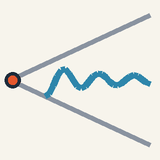
Hold a can of spray paint close to a wall and you get a small, thick patch. Step back to twice the distance and the same paint covers a patch twice as wide and twice as tall, four times the area, so the layer is four times thinner. Sound from a loudspeaker spreads in the same way, in all directions, like a growing bubble. The blue rings in the animation are that bubble, and they fade as they grow.
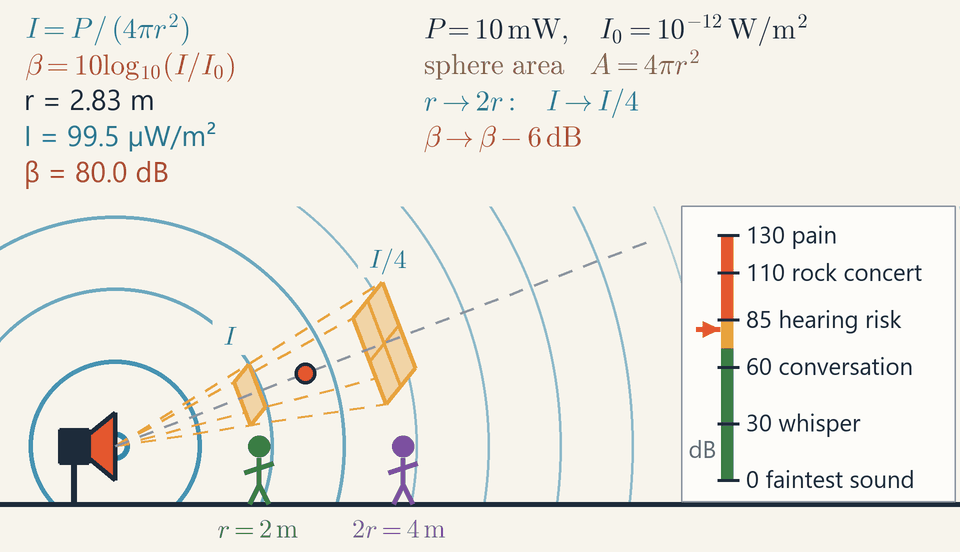
The speaker sends out the same sound energy every second. The intensity is how much of it arrives on each square metre every second, measured in watts per square metre. Look at the gold squares: the sound passing through one square near the speaker is shared by four equal squares twice as far away, so each of them gets only a quarter.
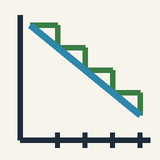
Our ears cope with an enormous range, from the faintest sound they can detect to noise a million million times more intense. To keep the numbers friendly we use decibels (dB), shown on the chart: every step of 10 dB means ten times the intensity. So 60 dB is a hundred times as intense as 40 dB. Moving twice as far away costs about 6 dB.
Our sense of loudness is more modest than the numbers: a sound needs roughly ten times the intensity, 10 dB more, to seem twice as loud. And loudness is not pitch: high or low depends on frequency, so a soft whistle can be high and a loud drum low.
Look after your hearing: hours of sound above about 85 dB can damage it for good.
Check yourself: a radio plays at 70 dB and another sound reaches 90 dB. How many times more intense is it? Answer: 100 times, two steps of 10 dB.
Intermediate
Key ideas
Intensity is power per area: I=P/(4πr2) in W/m² for a source radiating evenly in all directions.
Inverse-square law: doubling r divides I by 4; tripling r divides it by 9.
β=10log10(I/I0) with I0=10−12W/m2: ×10 in I is +10 dB, ×2 is +3 dB, ÷4 is −6 dB.
Decibels do not add: two equal independent 80 dB sources give 83 dB, not 160 dB.
Intensity: power through each square metre
The acoustic power P of a source is the sound energy it sends out each second, in watts. Sound carries little energy: a typical loudspeaker turns 1 % or less of its electrical power into sound, and the one in the animation radiates just P=10mW.
Your ear collects only the share of that power that falls on its own small area. The intensity is the power crossing each square metre of a surface facing the sound: I=AP
It is measured in W/m² and describes the sound at one place, not the source. Intensity is not loudness, which is how strong the sound seems to a listener. Nor is it pitch, high or low, which is set mainly by the frequency.
The inverse-square law
Picture a small source sending sound out evenly in every direction. At a distance r the energy it emits each second is spread over a sphere of area 4πr2, so the intensity of a point source is I=4πr2P
Doubling the distance makes the sphere four times larger, so the intensity drops to a quarter; tripling it divides the intensity by 9. When you compare two distances, P and 4π cancel: I1I2=(r2r1)2
The gold pyramid in the animation shows the geometry. Rays through the corners of one square at r=2m enclose, at 4 m, a square twice as wide and twice as tall: four equal squares, labelled I/4. The energy that crossed one square is shared among four: none is lost, it is only spread thinner.
The decibel scale
The ear handles an enormous range, from about 10−12W/m2, the faintest 1 kHz tone a young listener can hear, to about 10 W/m², where sound becomes painful. Instead of numbers spread over thirteen powers of ten, we count the powers of ten. The sound intensity level is β=10log10I0I,I0=10−12W/m2 in decibels (dB). A factor of 10 in intensity adds 10 dB and a factor of 100 adds 20 dB; since log102=0.301, doubling adds 3.0 dB and quadrupling 6.0 dB.
Two working rules follow. Because I2/I1=(r1/r2)2, the logarithm turns the square into a factor 2, and 10⋅2=20: the level falls by 20 dB per tenfold distance and by 6 dB per doubling. Because independent sources add their intensities, N equal sources raise the level by 10log10N:
β2=β1−20log10(r1r2)
βN=β1+10log10N(N equal incoherent sources)
Worked example: the meter in the animation
The speaker radiates P=10mW=0.010W. For the near listener, at r=2m: A=4πr2=4π⋅22=50.3m2 I=50.3m20.010W=1.99×10⁻⁴W/m2 so I/I0=1.99×108 and β=10log10(1.99×10⁸)=10⋅8.30=83.0dB
The far listener, at 4 m, receives a quarter of that intensity, 4.97×10⁻⁵W/m2, at a level of 83.0−20log102=77.0dB. These are the I and β readouts as the red meter reaches the listeners' distances: at the near listener about 199 µW/m² and 83.0 dB, and at the far listener 49.7 µW/m² and 77.0 dB.
The meter starts at 1 m (795.8 µW/m², 89.0 dB) and ends at 8 m (12.4 µW/m², 70.9 dB). Its distance doubles every 2 s, so each step divides the intensity by 4 and lowers the level by the same 6.0 dB, and the pointer slides down the chart in equal steps. Over the whole walk the intensity shrinks 64 times, yet the level falls by only 18 dB.
Worked example: a safe distance from a drill
A meter 2 m from a pneumatic drill reads 100 dB. How far away must you be for the level to fall to 85 dB, the hearing-risk mark on the chart? At 2 m, I=I0⋅10100/10=0.01W/m2; if the drill radiated evenly in all directions, its acoustic power would be P=4π⋅22⋅0.01≈0.50W. The level must drop by 15 dB, so 20log10(2mr)=15 r=2m⋅1015/20=2m⋅100.75=11.2m
A second, identical drill raises the level at 2 m to 100+10log102=103.0dB, and the 85 dB distance grows to 2⋅1018/20=15.9m: 2 times farther, not twice as far. Hard ground adds roughly the same 3 dB at every distance: it halves the power estimate but leaves these distances unchanged.
A common occupational guideline allows 8 hours a day at 85 dB and halves the time for every 3 dB more. A worker 2 m from one drill is 15 dB above that, five halvings, so the limit is 8h/25=15min.
Reading the decibel chart
The chart beside the speaker is a ruler in decibels, so equal distances on it are equal factors of intensity: from a 30 dB whisper to a 60 dB conversation is a factor of 1000, and from 0 dB to the threshold of pain at 130 dB a factor of 1013. Its coloured bar is green up to 70 dB, gold up to 85 dB and red above, where long exposure harms hearing. The pointer starts in the red at 89.0 dB, crosses 85 dB when the meter is about 1.6 m from the speaker, and ends at 70.9 dB, just above the green.
Loudness grows far more gently than intensity. A sound must gain about 10 dB, ten times the intensity, to seem twice as loud. So a 110 dB rock concert, 50 dB above a conversation, carries 105 times the intensity but sounds only about 25=32 times as loud.
Common mistakes
Decibels do not add. Two identical, independent 80 dB machines give 83 dB, not 160 dB: the intensities add, and doubling the intensity adds 3 dB. Reaching 86 dB takes four machines.
Doubling the distance does not halve the intensity but quarters it, a drop of 6 dB; only a long line of sources, such as a busy road, loses just 3 dB per doubling.
0 dB is not silence but the reference intensity I0, about the faintest sound a young ear can detect; fainter sounds have negative levels, and 10−13W/m2 is −10 dB.
Four times the intensity does not sound four times as loud: the 6 dB gained by halving your distance sounds only about 1.5 times as loud, since loudness doubles roughly every 10 dB.
Small slips cost whole factors: dividing by r2 instead of 4πr2 makes an intensity 12.6 times too large, and dropping I0 or the factor 10 turns 70 dB, the level of 10−5W/m2, into −50 dB or 7 dB.
Where you meet it
Noise limits at work and near airports, the ratings of ear defenders (good earmuffs cut 20 to 30 dB, a factor of 100 to 1000 in intensity) and the noise maps of cities all rest on these rules. The decibel serves wherever ratios span many powers of ten: amplifier gains, the light lost in optical fibres, the strength of phone signals.
The inverse-square law is not special to sound: light, gravity and the electric field of a point charge also spread over spheres, as Gravitation and Orbits, Coulomb's Law and Electromagnetic Waves show. Coherent sources, which add amplitudes rather than intensities, lead to Interference and Superposition, and sound trapped between walls leads to Standing Waves.
Advanced
Key ideas
Amplitude falls as 1/r and energy goes as amplitude squared, so I∝1/r2: every cone from the source carries the same power at any distance.
I=p02/(2ρc); meters read Lp=20log10(prms/20μPa), with 20 because I∝p2; in free air Lp≈β.
β(r)=β1−20log10(r/r1): a straight line against logr, −20 dB per decade, −6.02 dB per doubling.
The 1/r2 law fails in the near field, in rooms and with air absorption; a line source spreads over cylinders: −3 dB per doubling.
What intensity measures
Intensity tells us how much sound energy flows through a surface: the power crossing each square metre held square-on to the flow, in watts per square metre. It is what a microphone or an eardrum responds to, and energy conservation alone fixes how it changes with distance.
Where does the flow come from? In a sound wave the air pressure rises and falls by a small excess pressure p about its usual value, while the air itself moves to and fro with velocity u. The pressure pushes on the moving air in front of it, so it does work at the rate pu per square metre: force per area times velocity, the acoustic form of force times velocity. This product swings with the wave, so the intensity I is defined as its average over one cycle. It is a vector that points the way the energy flows.
Now surround a source by any closed surface and cut the surface into small patches. Write each patch as a vector dA whose length is the patch's area and which points outward. Only the part of the flow that crosses a patch carries energy through it, so the power leaving through one patch is I⋅dA. If the source runs steadily and nothing absorbs sound, energy cannot pile up inside, so the whole power P of the source must leave through the surface (the circled integral sign means a sum over the entire closed surface): ∮I⋅dA=P
Spreading through a cone: the inverse-square law
The easiest way to see what that equation says about distance is to follow one narrow bundle of the flow.
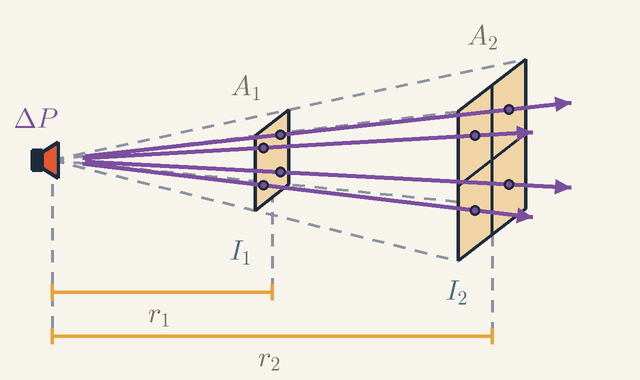
Figure 1. A narrow cone from the loudspeaker, crossed by a patch A1 at distance r1 and a patch A2 at r2=2r1. The same four rays cross both, but A2=4A1 has one ray in each of its four cells, so I2=I1/4.Legend
ΔP
Power carried by the cone: the share of the source's output that crosses each patch.
W
r1
Distance from the source to the first patch.
m
r2
Distance from the source to the second patch, twice r1.
m
A1
Area of the first patch, facing the source.
m2
A2
Area of the second patch: four times A1, one ray in each of its four cells.
m2
I1
Intensity at the first patch: the power per square metre there, ΔP/A1.
W/m2
I2
Intensity at the second patch, ΔP/A2.
W/m2
Figure 1 follows the energy inside one narrow cone with its tip at the source. Its four rays stand for the power ΔP that the cone carries. They cross a square patch of area A1 at distance r1 and then a second patch of area A2 at r2=2r1; both patches face the source. The sides of the cone are straight lines from its tip, so every side of the square grows in proportion to the distance: at twice the distance the patch is twice as wide and twice as high, and A2=4A1. The cross lines on A2 divide it into four cells, each the size of A1.
Now look at the dots where the rays cross. On A1 all four rays pass through one cell's worth of area; on A2 there is one ray in each cell. The same power is spread over four times the area, so the power per square metre has fallen to a quarter, I2=I1/4. In symbols: nothing is lost between the patches, so I1A1=I2A2=ΔP. Along a cone the cross-section grows as r2, so the intensity falls as 1/r2, and the cone carries the same power at every distance.
Fill all directions with such cones. For a source that radiates evenly, on a sphere of radius r centred on it, I points straight outward and has the same size I everywhere. Each patch then passes IdA, and the patches add up to the area of the sphere, 4πr2. The closed-surface equation becomes 4πr2I=P, which is the inverse-square law: I=4πr2P The live check above the first expert graph shows it for the animation's 10 mW loudspeaker: from 1 m to 8 m, I plunges from 796 to 12.4 µW/m², yet 4πr2I stays at 10.0 mW.
Why the amplitude falls as one over r
The inverse-square law is about energy. What happens to the wave itself, the swing of pressure a microphone records? It must shrink too; the question is how fast.
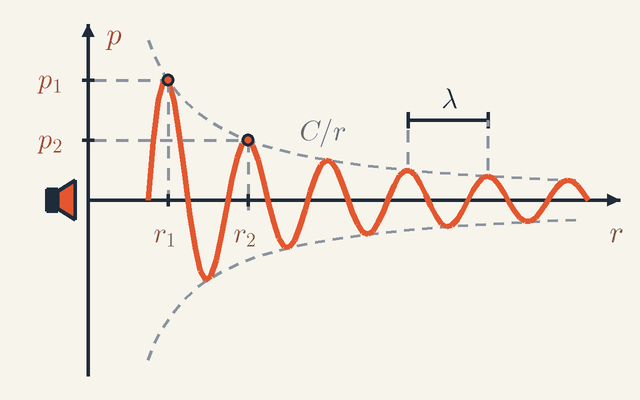
Figure 2. The pressure p along one ray from a loudspeaker at r=0, at one instant. The crests stay λ apart, while crests and troughs shrink along the dashed envelope ±C/r: the crest at r2=2r1 is half as high as the one at r1.Legend
p
Excess pressure of the sound wave at the instant shown.
Pa
r
Distance from the source along the ray.
m
p1
Height of the crest at r1: the pressure amplitude there.
Pa
p2
Height of the crest at r2: half of p1.
Pa
r1
Distance from the source to the first marked crest.
m
r2
Distance to the second marked crest, twice r1.
m
λ
Wavelength: the distance between neighbouring crests, the same at every r.
m
C/r
Envelope of the wave, with C a constant set by the source: crests touch +C/r, troughs −C/r.
Pa
Figure 2 is a snapshot of the excess pressure p along one ray leaving a loudspeaker at r=0. Look first at the spacing: neighbouring crests are always one wavelength λ apart, so distance does not change the pitch. Then look at the heights. The crest at r1 reaches p1; the crest at r2=2r1 reaches only p2=p1/2. Every crest touches the dashed curve +C/r and every trough the curve −C/r, where C is a constant set by the strength of the source. Twice the distance, half the amplitude: the pressure amplitude goes as 1/r.
The wave equation confirms this. Let c be the speed of sound. When a point source sends sound evenly in all directions, p depends only on the distance r and the time t. In that case the three-dimensional wave equation can be rewritten, exactly, as a one-dimensional wave equation for the product rp: ∂r2∂2(rp)=c21∂t2∂2(rp) This is the equation of a wave on a string, whose solutions are shapes that travel at speed c without changing. The outgoing one is rp=f(t−r/c) for any function f: whatever the source does at a given moment is repeated at distance r a time r/c later. Dividing by r, p(r,t)=rf(t−r/c)
Read this against Figure 2: the function f draws the wiggles and the divisor r draws their envelope ±C/r. It is also why the animation draws its wavefronts thinner and paler as they grow.
Why does an amplitude falling as 1/r mean an intensity falling as 1/r2? Think of what receives the sound, an eardrum or the membrane of a microphone. Such a receiver is linear: driven at a given frequency, it moves with a velocity proportional to the force on it. The power it absorbs is force times velocity, so it goes as the square of the amplitude. Amplitude as 1/r and power as amplitude squared give intensity as 1/r2. Energy conservation and the wave equation agree, and the same two facts hold for the electric field of light.
Pressure and intensity in a plane wave
To turn a pressure reading into an intensity we need the air velocity u that goes with a given p. Far from the source a small patch of the spherical wave is practically flat: a plane wave travelling along x. Newton's second law for a thin slab of air of density ρ says that its mass per unit volume times its acceleration equals the net push, which comes from the pressure being higher on one face than on the other: ρ∂t∂u=−∂x∂p For a wave travelling towards +x, p=F(t−x/c) for some function F, so the right-hand side is F′/c. Integrating over time then gives u=ρcp The air moves exactly in step with the pressure: where the pressure is high, the air surges forward. The power per square metre pu is then p2/(ρc). For a sine wave of amplitude p0 the average of p2 over a cycle is p02/2, so I=2ρcp02 The product ρc is the acoustic impedance of the medium: it says how much pressure it takes to make the air move at a given speed. For air at 20 °C, ρc≈413kg/(m2s).
How big are these quantities? At the animation's near listener, 2 m from the source, I=1.99×10⁻⁴W/m2. Then p0=2⋅413⋅1.99×10−4≈0.41Pa, and the velocity amplitude of the air, p0/(ρc), is about 1 mm/s. Dividing a velocity amplitude by 2π times the frequency gives the displacement: at 1 kHz the air moves only 0.16 µm back and forth, and at the threshold of hearing about 10−11m, a tenth of an atom's diameter.
Two decibel scales
Hearing spans about thirteen powers of ten in intensity, so levels are given on a logarithmic scale. The sound intensity level is β=10log10(I/I0), with I0=10−12W/m2, roughly the faintest 1 kHz sound a young ear can hear. Each factor of ten in intensity adds 10 dB: the near listener's 1.99×10⁻⁴W/m2 is 83.0 dB.
A meter, however, senses pressure, not intensity. It reports the sound pressure level Lp=20log10(prms/pref), where prms=p0/2 is the root-mean-square pressure and pref=20μPa. The factor is 20, not 10, because intensity goes as pressure squared, and 20log10 of a ratio equals 10log10 of its square. Since I=prms2/(ρc), the two scales differ only by a constant, Lp−β=10log10(ρcI0/pref2)≈0.14dB in air, so in practice they are interchangeable: the near listener's 83.0 dB reads 83.1 dB on a meter.
The pressures involved are tiny. A 60 dB conversation has prms=0.02Pa, two ten-millionths of an atmosphere, and a painful 120 dB is only 20 Pa. That smallness is what makes the wave equation linear to excellent accuracy, and linearity is what lets the waves of several sources simply add, as a later section uses.
Straight lines on logarithmic axes
Logarithms do more than compress a huge range: they turn power laws into straight lines. Between two distances from a point source I2/I1=(r1/r2)2, and taking 10log10 of both sides gives β2=β1−20log10(r1r2) Against logr the level therefore falls along a straight line: 20 dB for every factor of ten in distance (a decade), and 20log102=6.02 dB for every doubling.
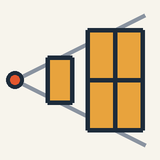
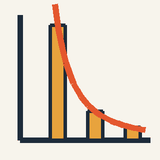
The two expert graphs show both views. On the first, I(r) drops from 796 µW/m² at 1 m to 199 at 2 m and then creeps towards 12.4 µW/m² at 8 m, a curve on which equal ratios are hard to see. On the second, plotted against logr, the distances 1, 2, 4 and 8 m are equally spaced and the level runs down a straight line through 89.0, 83.0, 77.0 and 70.9 dB. The meter, whose distance doubles every 2 s, moves along that line at a steady pace.
The slope measures the exponent. Any power law I∝r−n gives a straight line of slope −10n dB per decade on these axes: −20 for a point source, −10 for a long line source (the worked problem below), 0 for a plane wave or for sound guided along a tube. Anechoic rooms, whose walls absorb almost all sound, are tested this way: wherever the measured level strays from the −20 dB-per-decade line, reflections are adding to it.
Adding sources: phase decides
When two sources sound together, the levels in decibels do not add: two 80 dB machines do not make 160 dB. Because the waves are small, they superpose, and at each instant their pressures add, p=p1+p2. The intensity follows the mean square of the pressure; with a bar for the average over time, p2=p12+p22+2p1p2 The first two terms are the two sources' own contributions. The last one, the cross term, depends on how the two waves keep in step, and it decides the result.
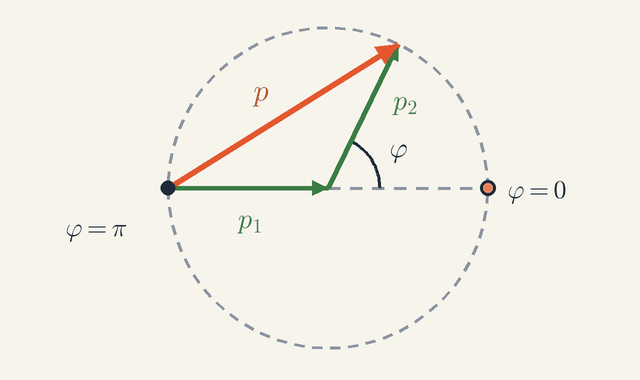
Figure 3. Pressure amplitudes of two equal waves at one listener, drawn as arrows: p2 starts at the tip of p1, turned through the phase difference φ, and the sum p closes the triangle. As φ changes, the tip of p runs round the dashed circle.Legend
p1
Pressure amplitude of the first wave at the listener: the length of its arrow.
Pa
p2
Pressure amplitude of the second wave, here equal to p1; its direction shows its phase relative to the first.
Pa
p
Amplitude of the combined wave: the arrow sum p1+p2.
Pa
φ
Phase difference: the angle through which p2 is turned from the direction of p1; 0 in step, π half a cycle apart.
rad
Figure 3 works out the sum at one listener for two sine waves of the same frequency. From here on p1, p2 and p denote amplitudes. Each wave is drawn as an arrow whose length is its pressure amplitude and whose direction is its phase, the point it has reached in its cycle. The arrow p1 lies along the horizontal axis. The arrow p2 starts at its tip and is turned through the phase difference φ, the angle by which the second wave runs ahead of the first. The combined wave is the arrow p from the start of p1 to the tip of p2, which closes the triangle. The angle of the triangle opposite p is π−φ, so the law of cosines gives p2=p12+p22+2p1p2cosφ and the last term is the cross term of the mean square, now written through the phase. In the figure the two sources are equal, p1=p2, so as φ changes the tip of p runs round the dashed circle centred on the tip of p1.
Independent sources, such as two machines or two voices, have no fixed phase relation. Their phase difference drifts at random, the tip of p wanders all round the circle, and cosφ averages to zero. The cross term disappears and the intensities simply add, so N equal sources give N times the intensity of one: βN=β1+10log10N(N equal incoherent sources)
Two sources add 3.0 dB, ten add 10 dB. Unequal sources are dominated by the louder: 80 dB and 70 dB are 108 and 107 times I0, so together they give 10log10(108+107)=80.4dB. Run backwards, the rule removes background noise from a measurement: subtract intensities, never decibels.
Coherent sources, such as two loudspeakers fed the same tone, keep a fixed phase difference, so the cross term survives. Its value depends on where the listener stands, because φ depends on the difference between the two path lengths. Where the waves arrive in step, φ=0 and the tip of p sits at the right-hand point of the circle: the arrows line up, p=2p1, and the intensity is four times that of one source, +6.0 dB. Where they arrive half a cycle apart, φ=π and the tip of p sits at the left-hand point, back at the start of p1: the waves cancel. Averaged over the whole pattern the intensity is still twice that of one source. Interference moves energy around; it does not create it.
Worked problem: the noise of a straight road
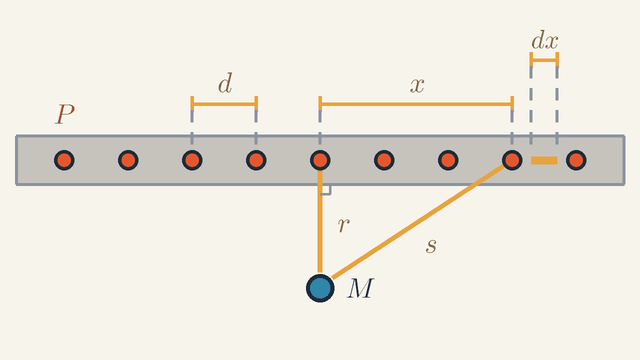
Everyday noise often comes from many sources in a row. Model a long straight road as a row of independent sources, each like the animation's loudspeaker, P=10mW, one every d=20m. What does a meter read at r=40m from the road, and how fast does the level fall as you walk away?
Figure 4. The road from above, drawn with r=2d: sources of power P spaced d apart and a meter M at distance r. A source at position x is s=r2+x2 from M, and a slice dx of road holds dx/d sources.Legend
P
Acoustic power of each source.
W
d
Spacing between neighbouring sources.
m
M
The sound-level meter.
r
Distance from the meter to the road, which is also its distance to the nearest source.
m
x
Position of one source along the road, measured from the foot of the perpendicular from M.
m
s
Distance from that source to the meter, r2+x2.
m
dx
Length of a thin slice of road; it holds dx/d sources.
m
Figure 4 shows the road from above, drawn with r=2d as in the numbers. The meter M stands a distance r from the road, level with the nearest source. Another source sits a distance x along the road, measured from the foot of the perpendicular from M. By Pythagoras it is s=r2+x2 from the meter, so on its own it gives P/(4πs2) there.
The sources are independent, so by the previous section the meter adds their intensities. Rather than add them one by one, spread them evenly along the road: a slice of length dx holds dx/d sources. Summing the slices along the whole road turns the sum into an integral. Its middle step uses ∫−∞∞r2+x2dx=rπ and the result is I=∫−∞∞4π(r2+x2)Pddx=4πdP⋅rπ=4drP
At 40 m, I=0.010/(4⋅20⋅40)=3.1×10−6W/m2, so β=64.9dB, where the nearest source alone would give 57.0 dB. At 80 m the level is 61.9 dB and at 160 m 58.9 dB: 3.0 dB per doubling, half the fall of a point source, because now I∝1/r. The reason is visible in the integral: half of the sound comes from the stretch of road within r of the nearest point on either side. Doubling r quarters each source's share but doubles the number of sources in that stretch, so the intensity only halves.
Two checks on the model. The integral matches the exact sum over separate sources to 0.4 % once r≥d; closer in, the nearest source dominates and the road no longer looks continuous. And a road of finite length L looks like a point source again from well beyond L, where the level returns to 6 dB per doubling.
A subtler point: is 64.9 dB the energy actually flowing past the meter? Draw a cylinder of radius r around the road. Waves from distant sources cross it at a slant, and only the part of their flow that points straight out leaves the cylinder. Counting only that part gives P/(2πdr) per square metre; times the cylinder's area per metre of road, 2πr, it returns the P/d that each metre of road radiates. This is 2/π of the meter's value, about 2 dB lower, because the meter adds the intensities of all the waves whatever their direction. So p02/(2ρc) equals the energy flow only for a wave travelling one way.
Limits of validity
The inverse-square law rests on four assumptions: a small source, open space, still air that absorbs nothing, and small amplitudes. Each one fails somewhere.
Close to the source: within about a wavelength of a real source (3.4 m at 100 Hz), or within a few times its size, pressure and air velocity are not yet in step as they are in a plane wave, and the pressure of an extended source does not yet fall as 1/r. Real sources also beam: a loudspeaker sends wavelengths shorter than its cone mostly forward. A directivity factor Q in I=QP/(4πr2) describes this; a source on hard ground radiates into half the space only, so Q=2 (+3 dB). Such factors do not depend on distance, so the 6 dB per doubling survives.
Indoors, sound reflects from the walls. Beyond the critical distance, where the reflected sound becomes as strong as the direct sound (often about a metre in a living room), reflections dominate and moving away barely lowers the level.
Outdoors, air absorbs a fixed number of decibels per kilometre on top of the spreading, and the loss rises steeply with frequency: at 20 °C and 70 % humidity, about 0.3 dB per kilometre at 125 Hz, 5 dB at 1 kHz and nearly 80 dB at 8 kHz, against the 60 dB that spreading costs from 1 m to 1 km. High pitches die away first, hence the low rumble of distant thunder.
Linearity fails at high amplitude. At 150 dB, near a jet engine, prms≈630Pa is only 0.6 % of an atmosphere, yet crests travel slightly faster than troughs, and a 1 kHz plane wave would steepen into a shock within about 7 m. No undistorted sine wave exceeds about 191 dB at sea level, where its amplitude would equal the atmospheric pressure and its troughs would reach vacuum.
Finally, β measures physics, not loudness: the ear is far less sensitive at low frequencies, so meters usually apply an A-weighting, a filter that turns down the frequencies the ear hears poorly, and quote the result in dB(A).
Where this leads
Flux through closed surfaces also makes gravity and the field of a point charge fall as 1/r2, in Gravitation and Orbits and Coulomb's Law; it is the idea behind Gauss's law. Light follows the same arithmetic: in Electromagnetic Waves its intensity is E02/(2Z0), with the impedance of free space Z0≈377Ω taking the role of ρc. Coherent sources and their cross term lead to Interference and Superposition, sound confined between walls to Standing Waves, and the eardrum as a driven receiver to Damping and Resonance. Absorption at a fixed number of decibels per kilometre is the same exponential decay as in Radioactivity and Half-Life.
Key formulas
Intensity as power per area
I=AP
Intensity is the share of a sound's power that crosses each square metre of a surface facing the sound. It is what your ear or a microphone responds to, since each collects the energy falling on its own small area. The same power spread over a larger area means a weaker sound at every point of it.
Symbols
I
sound intensity
W/m2
P
sound power crossing the surface
W
A
area of the surface, at right angles to the sound
m2
When it holds: Gives the average over the surface; if the sound is not spread evenly, apply it to a small patch. A surface tilted away from the sound catches less of it.
Example: 10 mW spread over the 50.3 m² sphere at 2 m: I=0.010/50.3=1.99×10−4W/m2.
Intensity of a point source
I=4πr2P
A small source radiating evenly in all directions spreads its power over a sphere of area 4πr2. With no energy lost on the way, the same P crosses every such sphere, so the intensity falls as 1/r2.
Symbols
I
sound intensity at distance r
W/m2
P
acoustic power of the source
W
r
distance from the source
m
When it holds: In open air, away from reflecting surfaces, farther than about a wavelength and several source sizes, and close enough for air absorption to be negligible. Directional sources and line sources need other forms.
Example: The animation's 10 mW speaker gives 796 µW/m² at 1 m, 199 µW/m² at 2 m and 12.4 µW/m² at 8 m.
Inverse-square ratio
I1I2=(r2r1)2
Dividing the point-source law at two distances cancels P and 4π and leaves only the ratio of the distances, squared. Mind the inversion: I2 is on top on the left but r1 on the right, because the farther point receives less.
Symbols
I1
intensity at distance r1
W/m2
I2
intensity at distance r2
W/m2
r1
first distance from the source
m
r2
second distance from the source
m
When it holds: Same conditions as the point-source law, for the same source and the same direction from it.
Example: From 2 m to 4 m: I2/I1=(2/4)2=1/4, so 199 µW/m² becomes 49.7 µW/m².
Sound intensity level in decibels
β=10log10I0I,I0=10−12W/m2
The level counts how many powers of ten the intensity lies above the reference I0, times 10 so that the steps are decibels. A factor of 10 adds 10 dB and a factor of 2 adds 3 dB, so the ear's range of 1013 fits between 0 and 130 dB. To go back, use I=I0⋅10β/10.
Symbols
β
sound intensity level
dB
I
sound intensity
W/m2
I0
reference intensity, about the threshold of hearing at 1 kHz
W/m2
When it holds: Holds for any intensity; sounds fainter than I0 have negative levels. It is a physical measure: perceived loudness also depends on frequency, which is why meters often apply an A-weighting, written dB(A).
Example: 2 m from the animation's speaker: β=10log10(1.99×10⁸)=83.0dB.
Change of level with distance
β2=β1−20log10(r1r2)
Taking the logarithm of the inverse-square ratio turns the factor (r1/r2)2 into a subtraction. The 20 is 10⋅2, from the square: every doubling of the distance costs 20log102=6.0dB, and every factor of ten costs 20 dB.
Symbols
β2
level at distance r2
dB
β1
level at distance r1
dB
r2
new distance from the source
m
r1
distance where the level is known
m
When it holds: For a point source in open air; a constant extra, such as the 3 dB from hard ground, cancels out. For a line source the 20 becomes 10, and air absorption adds a loss proportional to the distance.
Example: A drill at 100 dB at 2 m falls to 85 dB at 2⋅1015/20=11.2m.
Level of N equal independent sources
βN=β1+10log10N(N equal incoherent sources)
Independent sources have unrelated phases, so their pressure waves sometimes reinforce and sometimes cancel, and on average their intensities simply add. N equal sources give N times the intensity of one, which the logarithm turns into 10log10N decibels.
Symbols
βN
level with all N sources sounding
dB
β1
level of one source alone
dB
N
number of equal sources
When it holds: Only for incoherent sources that each give the same level at the listening point. Coherent sources, such as two speakers playing the same tone, interfere: from +6 dB where they reinforce to silence where they cancel.
Example: Two 80 dB machines: 80+10log102=83dB; ten of them give 90 dB.
Intensity from the pressure amplitude
I=2ρcp02
In a travelling wave the air velocity is in step with the excess pressure, u=p/(ρc), so the power per square metre, pressure times velocity, is p2/(ρc); averaging over a cycle gives one half. Intensity therefore goes as the square of the amplitude, which is why pressure levels use 20log10 where intensity levels use 10log10.
Symbols
I
sound intensity
W/m2
p0
pressure amplitude (peak excess pressure)
Pa
ρ
density of the medium
kg/m3
c
speed of sound in the medium
m/s
When it holds: For a single travelling wave, plane or far from its source. It fails in the near field and in standing or diffuse fields, where waves cross from several directions and pressure and air velocity are not in step.
Example: 2 m from the animation's speaker: p0=2⋅413⋅1.99×10−4≈0.41Pa.
Glossary
Sound intensity
The sound power crossing each square metre of a surface that faces the sound, in W/m². It belongs to the sound at one place, not to the source: the same speaker gives 199 µW/m² at 2 m and a quarter of that at 4 m.
Acoustic power
The total sound energy a source sends out each second, in watts. Unlike the intensity it does not depend on where you listen; the speaker in the animation radiates 10 mW.
Point source
A source much smaller than the distance to the listener that radiates equally in all directions. Its sound spreads over spheres, so the inverse-square law applies.
Inverse-square law
The intensity of a point source falls as 1/r2, because the same power spreads over a sphere of area 4πr2. Doubling the distance quarters the intensity (−6 dB); tripling it divides the intensity by 9.
Decibel
A logarithmic unit for the ratio of two powers or intensities, 10log10 of the ratio. +10 dB means ten times the intensity and +3 dB about twice; since it measures a ratio, a level always needs a reference.
Sound intensity level
The intensity expressed in decibels above the reference I0=10−12W/m2, β=10log10(I/I0). A conversation at 60 dB is a million times I0.
Sound pressure level
What a sound level meter reports, Lp=20log10(prms/20μPa), computed from the pressure instead of the intensity. The factor is 20 because intensity goes as pressure squared; in open air Lp and β differ by only about 0.1 dB.
Threshold of hearing
The faintest sound a healthy young ear can detect, about 10−12W/m2, or 0 dB, at 1 kHz. The ear is less sensitive at low and at very high frequencies, so the threshold is higher there.
Threshold of pain
The level at which sound starts to hurt, around 120 to 130 dB, that is 1 to 10 W/m². Hearing damage begins far below it, with long exposure above about 85 dB.
Loudness
How strong a sound seems to a listener, as opposed to its measured intensity. It grows much more slowly: about 10 dB more, ten times the intensity, sounds roughly twice as loud. It is also distinct from pitch, which is set mainly by frequency.
Incoherent sources
Sources with unrelated phases, such as two machines or two voices. Their intensities add, so N equal ones raise the level by 10log10N; coherent sources, fed the same signal, add pressure amplitudes instead and interfere.
Line source
A long row of sources, such as the traffic on a straight road. Its sound spreads over cylinders rather than spheres, so the intensity falls as 1/r and the level by only 3 dB per doubling of distance.
Quantities
P
Acoustic power
W
The sound energy the source emits per second, in all directions together; 10 mW for the speaker in the animation.
A
Area
m2
The area over which the power is spread, at right angles to the sound; for a point source, the sphere 4πr2.
r
Distance from the source
m
The distance from the source to the listening point; r1 and r2 are two such distances.
I
Sound intensity
W/m2
The power per area at the listening point; I1 and I2 are its values at r1 and r2.
I0
Reference intensity
W/m2
10−12W/m2, roughly the threshold of hearing at 1 kHz: the zero of the decibel scale.
β
Sound intensity level
dB
10log10(I/I0), a ratio expressed in decibels; β1, β2 and βN are the levels at given distances or from N sources.
N
Number of sources
How many equal, independent sources sound together.
p0
Pressure amplitude
Pa
The largest excess of the air pressure over its mean value as the wave passes; p0/2 is the rms pressure that a meter measures.
ρ
Air density
kg/m3
The mass of a cubic metre of the medium, about 1.20kg/m3 for air at 20 °C and sea-level pressure.
c
Speed of sound
m/s
About 343 m/s in air at 20 °C; the product ρc≈413kg/(m2s) is the acoustic impedance of air. It is written v in Sound and the Doppler Effect.
Quiz
Beginner You walk from 1 m to 2 m away from a small loudspeaker in an open field. What happens to the sound intensity at your ears?
It halves
It drops to a quarter
It stays the same
It drops to an eighth
Show answer
Answer: B. It drops to a quarter
At twice the distance, the same sound energy is spread over a sphere with 4 times the area, so each square metre, and each ear, receives a quarter as much.
Beginner Which property of a sound mainly decides its pitch, that is how high or low it sounds?
Its intensity
Its speed
Its frequency
Your distance from the source
Show answer
Answer: C. Its frequency
Pitch depends on frequency, the number of vibrations per second. Intensity sets how loud a sound is, not how high, and all sounds travel at the same speed in air.
Beginner The sound level rises from 50 dB to 70 dB. How many times more intense has the sound become?
100 times
20 times
2 times
1.4 times
Show answer
Answer: A. 100 times
Every 10 dB step multiplies the intensity by 10, so 20 dB more means 10 × 10 = 100 times the intensity.
Intermediate A siren radiates 2 W of sound power evenly in all directions. What is the sound intensity 10 m away?
1.6 × 10⁻² W/m²
2.0 × 10⁻² W/m²
5.0 × 10⁻³ W/m²
1.6 × 10⁻³ W/m²
Show answer
Answer: D. 1.6 × 10⁻³ W/m²
I = P/(4π·r²) = 2 ÷ (4π × 10²) ≈ 1.6 × 10⁻³ W/m². Forgetting to square r gives 1.6 × 10⁻² W/m², dividing by r² alone gives 2.0 × 10⁻² W/m², and dropping the π gives 5.0 × 10⁻³ W/m².
Intermediate Two identical machines each produce 80 dB at your position. What is the level when both run together?
160 dB
83 dB
86 dB
80 dB
Show answer
Answer: B. 83 dB
The two machines are independent (incoherent) sources, so their intensities add, not their decibels. Doubling the intensity adds 10·log₁₀ 2 ≈ 3 dB, so the level is 83 dB. Reaching 86 dB would take four machines; two coherent sources, such as two speakers playing the same tone, give +6 dB only at spots of constructive interference.
Intermediate What is the sound intensity level of a sound of intensity 10⁻⁵ W/m²? (I₀ = 10⁻¹² W/m²)
70 dB
50 dB
7 dB
−50 dB
Show answer
Answer: A. 70 dB
β = 10·log₁₀(10⁻⁵ / 10⁻¹²) = 10·log₁₀(10⁷) = 70 dB. Forgetting the factor 10 gives 7 dB, and taking 10·log₁₀ I without dividing by I₀ gives −50 dB.
Advanced In open air, a sound level meter reads 94 dB at 1 m from a small source. What does it read 10 m away?
84 dB
88 dB
74 dB
9.4 dB
Show answer
Answer: C. 74 dB
The level drops by 20·log₁₀(r₂/r₁) = 20·log₁₀ 10 = 20 dB, giving 74 dB. 84 dB would follow from I ∝ 1/r, and 88 dB is the level after a single doubling of distance.
Advanced Next to a long, busy motorway, the noise level falls by only about 3 dB each time you double your distance, instead of 6 dB. Why?
Traffic noise is mostly low-pitched
Air absorbs less sound close to the ground
The ground reflects extra sound towards you
The road is a line of sources, not a point
Show answer
Answer: D. The road is a line of sources, not a point
Cars spread along the road radiate through a cylinder of area 2π·r·L. Doubling r only doubles that area, so I halves and the level drops by 3 dB, whereas a point source spreads over a sphere and loses 6 dB. Ground reflection adds about the same 3 dB at every distance, so it cannot change the drop per doubling.
 Physics Tutor