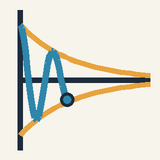
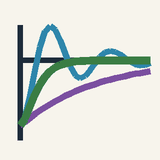
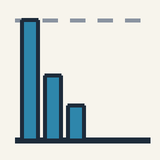
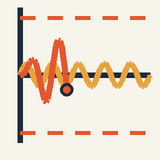
Why real oscillations die away as A=A0e−βt, how damping ranges from light through critical, bc=2km, to heavy, and how small pushes in rhythm build up a resonance of amplitude QF0/k.
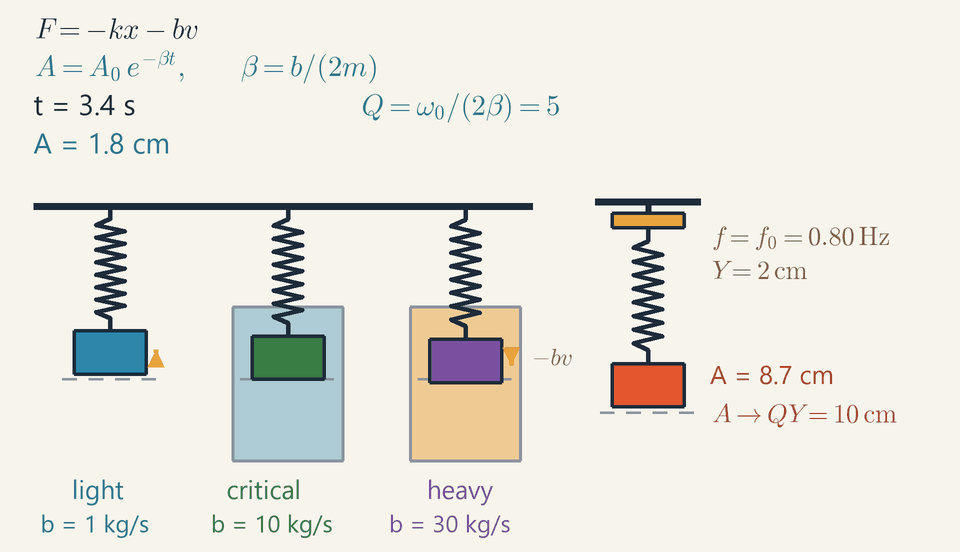
Three identical spring–block systems with light, critical and heavy damping are pulled down and released, while a fourth spring is shaken gently at its natural frequency and its bounces build up.
Everything that swings or bounces has a natural frequency, its own rhythm; a shorter pendulum or a stiffer spring swings faster.
Friction and air resistance take a little energy on every swing and turn it into heat, so the swings shrink: this is damping.
Light damping gives many shrinking bounces; heavy damping gives no bounce at all, only a slow creep back.
Critical damping is just enough to stop the bouncing, so the object returns to rest fastest, like a door with a good closer.
Gentle pushes in step with the natural rhythm add up to a big motion: this is resonance.
A short pendulum swings faster than a long one, and a block on a stiff spring bounces faster than on a soft one. Everything that can swing or bounce has a natural frequency: its own rhythm, the number of back-and-forth trips it makes each second when it is left alone.
Step 1: damping. Start a swing and walk away: each trip is a little smaller than the one before. Air resistance and friction take some energy on every trip and turn it into heat, and they push back harder the faster the object moves. This gradual fading is called damping.
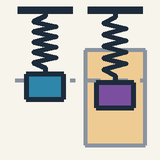
Step 2: how much damping? In the animation, three identical blocks hang on identical springs, and all three are pulled down and let go together. The left one moves in air (light damping) and bounces many times, each bounce smaller. The right one sits in thick syrup (heavy damping): it never overshoots, but it creeps back very slowly. The middle one, in a thinner liquid, has just enough damping to stop the bouncing. This is critical damping, and its “at rest” label appears first. Car shock absorbers and door closers are set close to it.
Step 3: resonance. Small pushes given in step with the natural rhythm all add energy at the right moment, so the motion grows. On the right, the top of a spring is shaken gently in the block's own rhythm, and soon the block bounces far more than the shaking. Damping is what stops the growth.
Check yourself: a washing machine often shakes hard for a few seconds while its drum speeds up, then calms down at full speed. Why? Answer: on the way up, the drum's spin rate passes through the machine's natural frequency, so for a moment it is shaken in rhythm: resonance.
Intermediate
Key ideas
The damping force F=−bv opposes the motion; with light damping the amplitude decays as A=A0e−βt, with β=b/(2m).
Critical damping at bc=2km: below it the system oscillates, above it it creeps back without oscillating.
Q=ω0/(2β)=mω0/b: after about Q cycles, a freely ringing oscillator is down to about 4% of its amplitude.
Driven at f0, the steady amplitude is A=F0/(bω0)=QF0/k: weak damping turns small pushes into big motion.
Two forces: the spring and the damper
More damping does not always bring a block to rest sooner. A block on a spring that is pulled and released feels two forces: the spring's restoring force −kx, pointing back towards equilibrium, and a damping force that opposes the motion, such as the drag of a liquid or of a shock absorber's oil. For slow motion in a liquid the damping force is nearly proportional to the velocity, so the net force is F=−kx−bv
The damping constant b is in kilograms per second (kg/s, the same as N·s/m). The two forces peak at different moments: the spring force at the turning points, where the block stops for an instant, and the damping force when the block moves fastest, which for light damping is close to equilibrium.
In the animation the gold arrows show −bv; they flip every time a block turns round. The right-hand block, in thick syrup with b=30kg/s, has the longest arrow although it moves the slowest: at its top speed, 0.077 m/s, the damping force 30⋅0.077≈2.3N exactly balances the spring's pull.
Light damping: an exponential fade
With light damping the block keeps almost its natural rhythm, but each swing is smaller than the last by the same fraction, because a damping force that grows with the speed takes a fixed fraction of the remaining energy in every cycle. That is an exponential decay, A=A0e−βt, with β=2mb,ω0=mk The damping rate β is in s⁻¹: after a time 1/β the amplitude is down to 1/e, about 37%, and it halves every ln2/β. Here ω0 is the natural angular frequency. The full motion is a cosine inside the shrinking envelope: x=A0e−βtcos(ωdt+φ),ωd=ω02−β2
The damper holds the block back a little, so the damped angular frequency ωd is just below ω0. The quality factor measures how light the damping is: Q=2βω0=bmω0 Each cycle multiplies the amplitude by about e−π/Q, so after Q cycles only e−π, about 4%, is left. A tuning fork, with a Q in the thousands, rings for seconds after a single tap.
Light, critical and heavy damping
As b grows the decay speeds up, until at a critical value the block no longer overshoots: bc=2km=2mω0 There β=ω0 and ωd drops to zero. Comparing b with bc gives three kinds of motion:
b<bc, light damping: the block overshoots again and again, with swings that die away exponentially.
b=bc, critical damping: the quickest possible return to equilibrium without any overshoot.
b>bc, heavy damping: no overshoot either, but the damper resists so strongly that the block creeps back.
Too much damping is slow for the same reason a spoon is slow in honey: the damping force soon matches the spring's pull, which limits the speed to about kx/b. Triple b and the block crawls back three times as slowly.
Worked example: the three blocks in the animation
All three blocks have m=1kg and k=25N/m, and each is pulled down 10 cm and released from rest: ω0=25/1=5rad/s,bc=225⋅1=10kg/s so f0≈0.80Hz, one cycle every 1.26 s. The middle block is exactly critical; the right-hand one has three times bc, the left-hand one a tenth of it. For the left block, β=2⋅11=0.5s−1,Q=2⋅0.55=5
After 3 s its amplitude is 10cm⋅e−0.5⋅3≈2.2cm, the value on the blue A readout when the t readout, which starts at the release, shows 3 s. The amplitude halves every ln2/0.5≈1.4s, each cycle multiplies it by e−π/5≈0.53, and after 5 cycles, about 6.3 s, only 4% is left. The critical block stays within 4 mm of its dashed equilibrium line after about 1.0 s, the heavy one after about 3.8 s and the light one after about 6.4 s.
Resonance: pushes in step with the motion
Now drive the oscillator with a periodic force F0cosωt. After the start-up it oscillates steadily at the driving frequency, with the amplitude A(ω)=(ω02−ω2)2+(2βω)2F0/m Far from ω0 the response is small; near it the amplitude rises steeply: this is resonance. At ω0 the spring force and the inertia cancel, and the drive only has to make up for the damping: A(ω0)=bω0F0=kQF0 A steady force would stretch the spring by F0/k; applied in rhythm, it moves the block Q times as far. At resonance the block lags a quarter cycle behind the push, so it moves fastest when the push is strongest, and every push does positive work.
On the right of the animation, the top of an identical, lightly damped spring is shaken by Y=2cm at exactly f0=0.80Hz. Moving the top of a spring by y changes its pull by ky, so the shaking acts like a force F0=kY=25⋅0.02=0.5N, and A=bω0F0=1⋅50.5=0.10m which is QY=10cm. The driven block's A readout climbs there slowly, roughly as QY(1−e−βt): about 6 cm after 2 s of shaking, 9 cm after 4.6 s and 9.9 cm at the end of the loop.
Worked example: a car with a worn shock absorber
One corner of a car puts about 400 kg on a suspension spring with k=40000N/m: ω0=40000/400=10rad/s,bc=240000⋅400=8000kg/s so the body bounces at about 1.6 Hz. A healthy absorber, set somewhat below bc, lets the body overshoot once after a bump. A worn one with b=800kg/s gives β=800/(2⋅400)=1.0s−1 and Q=10/(2⋅1.0)=5, like the left block in the animation. A 4 cm bounce then halves every 0.7 s and is still 4⋅e−2≈0.5cm after 2 s, three bounces later.
The road can drive the car too. Ripples spaced d=10m apart shake the wheel v/d times per second, which matches the natural 1.59 Hz at v≈16m/s, about 57 km/h. At that speed the worn car heaves about Q=5 times as high as the ripples and seems to float.
Common mistakes
More damping is not always faster: the right-hand block, at three times bc, needs about 3.8 s to settle, the critical one only 1.0 s.
Light damping changes the amplitude, not the rhythm: with Q=5 the period grows only from 1.257 s to 1.263 s.
The time 1/β is not a half-life: with β=0.5s−1 the amplitude falls to 37% in 2 s and halves in 1.4 s; the energy, which goes as A2, halves in 0.7 s.
Resonance is not infinite: damping caps the amplitude at QF0/k, 10 cm for the shaken spring, where the drive's 0.125 W equals the damper's losses.
The critical value is 2km, not km: forgetting the 2 gives 5 kg/s instead of 10 kg/s for the blocks.
Where you meet it
Near-critical damping is built into door closers, instrument needles and car suspensions; near the top of the Taipei 101 tower, a steel pendulum of about 660 tonnes swings against the building's sway. Resonance is put to work in quartz watches, whose crystal rings at 32 768 Hz, in musical instruments and in radio tuning. It must be avoided in structures: London's Millennium Bridge swayed sideways on its opening days in 2000, as walkers fell into step with it. The same equation governs circuits made of the parts in Capacitors and Electromagnetic Induction, and each mode in Standing Waves.
Advanced
Key ideas
Write x=Re(x^eiωt): each d/dt becomes a factor iω, a quarter turn, so the linear equation becomes algebra.
Free motion: s=−β±β2−ω02; complex roots (ζ<1) ring, a double root (ζ=1) is critical, real roots creep.
Q = stored energy ÷ energy lost per radian: dE/dt=−ω0E/Q, so E∝e−2βt and the amplitude decays half as fast.
A=∣x^∣ peaks at ω0 with QF0/k, lagging the force by 90°; the half-power width is Δω≈ω0/Q.
Same equation elsewhere: an RLC circuit (L, R, 1/C for m, b, k; Q=ω0L/R), atmospheric tides, ions absorbing infrared.
The equation of free motion
Damping is any force that drains the energy of a vibration: air, oil, a magnet braking a metal plate. This section finds every possible free motion of a damped spring and block. It matters twice over: these motions are how a disturbed system settles, and they are also the transient that every driven oscillator has to shed before it reaches its steady state.
Take a block of mass m on a spring of stiffness k, with a damper that pushes against the velocity with the force −bx˙. Here x is the displacement from equilibrium and b is the damping coefficient. Newton's second law gives mx¨=−kx−bx˙. Divide by m and name two ratios, the damping rate β=b/(2m) and the natural angular frequency ω0=k/m. The equation takes its standard form x¨+2βx˙+ω02x=0 The factor 2 is a convention that keeps the roots below free of halves.
The equation is linear, and its coefficients do not change with time. An exponential is the one function whose derivative is a multiple of itself, so try x=est with a constant s, which may be complex. Each time derivative then just multiplies by s. Every term carries the same factor est, and dividing it out leaves the characteristic equation s2+2βs+ω02=0. The quadratic formula gives its two roots: s1=−β+β2−ω02,s2=−β−β2−ω02 Because the equation is linear, any sum c1es1t+c2es2t is also a solution, and the two constants are fixed by the initial position and velocity. So everything about the free motion is decided by where the two roots lie.
The animation uses m=1kg and k=25N/m, so ω0=5rad/s (0.80 Hz), with three dampers, b=1, 10 and 30kg/s, that is β=0.5, 5 and 15s−1.
Three kinds of free motion
Whether a released block swings to and fro or just creeps home depends only on the sign of β2−ω02 under the square root. A map of the roots shows the three cases at once, and also which damping brings the block back fastest.
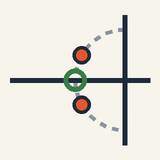
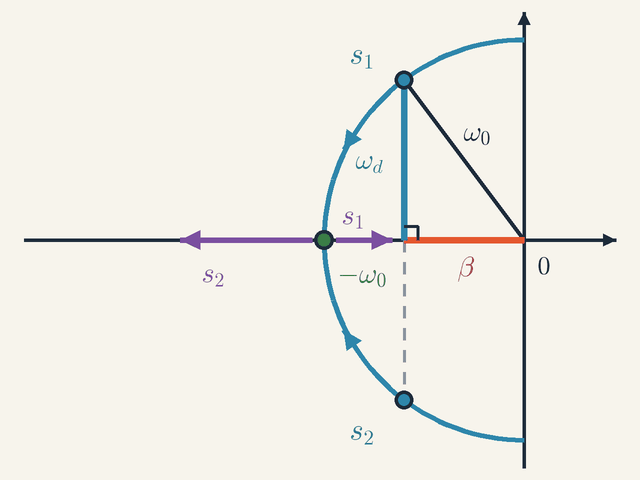
Figure 1. The complex plane of the roots s: real part across, imaginary part up. As damping grows, the light-damping pair −β±iωd moves along the blue arc of radius ω0, meets at −ω0 at critical damping, then splits along the real axis.Legend
s1
Root with the plus sign: the upper blue dot, then on the real axis, moving back towards 0.
s−1
s2
Root with the minus sign: the lower blue dot, then on the real axis, moving away from 0.
s−1
β
Damping rate b/(2m): minus the real part of the pair, its distance left of the vertical axis.
s−1
ωd
Damped angular frequency ω02−β2: the imaginary part of s1, the height of the upper dot.
rad/s
ω0
Natural angular frequency k/m: the radius of the arc, and −ω0 is where the two roots meet.
rad/s
Figure 1 is the complex plane of s: real part along the horizontal axis, imaginary part up the vertical one. One number sorts the cases, the damping ratio ζ=β/ω0. It equals b/bc, where bc=2km is the critical damping coefficient, the value of b that makes β=ω0. In the animation bc=10kg/s, so the three blocks have ζ=0.1, 1 and 3.
Light damping, ζ<1. The number under the square root is negative, so the roots are the complex pair −β±iωd, the two blue dots, with the damped angular frequency ωd=ω02−β2. Since e(−β±iωd)t=e−βte±iωdt, the real part −β sets the decay and the imaginary part ±ωd sets the oscillation. Combining the two exponentials so that x is real gives x=Ce−βtcos(ωdt+φ) an oscillation inside an envelope that shrinks as e−βt; the constants C and φ come from the initial position and velocity.
Now look at the right triangle, drawn for ζ=0.6. Its horizontal leg is β, its vertical leg is ωd, and its hypotenuse is β2+ωd2=ω0. So a complex root always lies at the distance ω0 from the origin. As b grows, the pair moves along the blue arc of radius ω0, the upper root down and the lower one up, towards the real axis.
Critical damping, ζ=1. The two roots meet at −ω0. A double root supplies only one exponential, e−ω0t; the second independent solution is te−ω0t, as substituting it into the equation confirms.
Heavy damping, ζ>1. The square root is now real and smaller than β, so both roots are real and negative. As b grows, s1 turns back towards 0 and s2 runs off to the left. Nothing oscillates: the block creeps back.
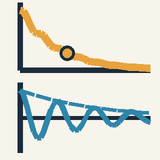
The expert x(t) graph of the animation uses the blue, green and purple of Figure 1 and shows the three blocks released from rest at −10cm; call this release distance A0=10cm. Blue (ζ=0.1, s=−0.5±4.97is−1) overshoots to +7.3cm half a period after the release, at 0.63 s. Green (ζ=1) follows x=−A0(1+ω0t)e−ω0t and is within 4 mm of zero after about 1.0 s. Purple (ζ=3) has the roots −0.86 and −29.1s−1. Its fast term, e−29.1t, is gone within a tenth of a second. The slow root, close to −ω02/(2β) when the damping is strong, leaves a creep with a time constant of 1.2 s.
Which damping brings the block home fastest? A sum of exponentials dies only as fast as its slowest term, the one whose root lies nearest the vertical axis in Figure 1. Below critical damping that distance is β, which grows with b as the pair moves left along the arc. Above critical damping it is ∣s1∣, which shrinks as b grows, because s1 drifts back towards 0. The two trends meet at ζ=1: there the nearest root is as far left as it can get, and the decay rate reaches its largest value, ω0. If a small overshoot is acceptable, slightly less damping is quicker still. At ζ=0.75 the block stays within 4 mm of zero after 0.64 s, which is why instrument needles are often tuned a little below critical.
Energy and the meaning of Q
The roots say how fast the motion decays; the energy says why. It also gives the one number engineers quote for any oscillator, the quality factor Q.
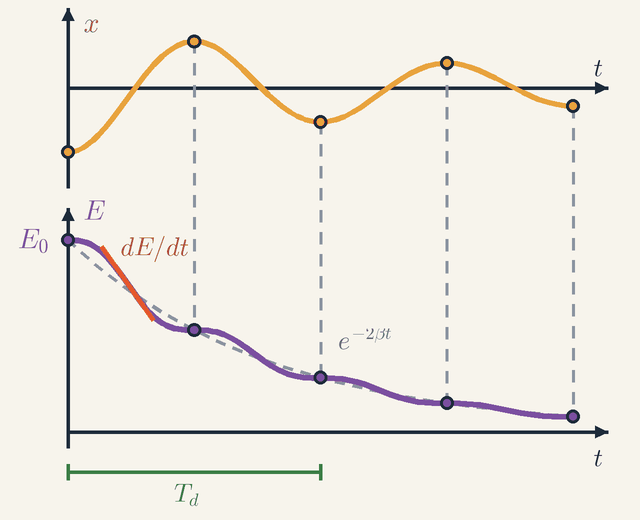
Figure 2. A lightly damped block released from rest at −A0: its position x above, its energy E below. E falls at the rate bx˙2, so it is flat at each turning point, where it touches the smooth decay E0e−2βt, and steepest where the block moves fastest.Legend
x
Displacement of the block from equilibrium.
m
t
Time since the release.
s
E
Stored energy, kinetic plus spring: 21mx˙2+21kx2.
J
E0
Energy at the release, all in the spring: 21kA02.
J
e−2βt
Decay factor of the dashed curve E0e−2βt, which the energy touches at every turning point.
dE/dt
Rate of change of the energy, −bx˙2: largest in size where the block moves fastest, zero at a turning point.
W
Td
Damped period 2π/ωd: one full cycle, the green span.
s
Figure 2 follows the light block of the animation (ζ=0.1), released from rest at x=−A0: its position x(t) on top and its stored energy E below, on one time axis.
To read the lower panel, first find how fast E changes. Multiply the equation of motion, mx¨+bx˙+kx=0, by x˙. The product mx¨x˙ is the time derivative of 21mx˙2, and kxx˙ is that of 21kx2. So the inertia and spring terms together make the derivative of E=21mx˙2+21kx2, and what is left reads dtdE=−bx˙2 The damper removes energy at the rate bx˙2. That rate is never negative, and it is zero whenever the block stops for an instant.
Now look at the lower panel. Energy drains only while the block moves, so E falls in steps. Each dot marks a turning point, where x˙=0 and all the energy sits in the spring; there the slope of E is zero and the curve is flat. The tangent marked dE/dt touches the steepest part of the first fall, where the block moves fastest, just before it passes equilibrium. At a turning point ∣x∣=A0e−βt, so the energy there is 21kA02e−2βt. The flat parts therefore sit exactly on the dashed curve E0e−2βt, with E0=21kA02=21⋅25⋅0.102=0.125J. Between turning points E wanders about 10% above and below that curve. From one turning point to the next, half a damped period Td/2, the energy is multiplied by e−βTd≈0.53.
Smoothing out the steps gives a simple law. Over one cycle of light damping the motion is nearly Acosω0t with a slowly shrinking amplitude A. The average of x˙2 over the cycle is then 21ω02A2, while E=21mω02A2. So the average of bx˙2 is (b/m)E=2βE, and dtdE=−2βE The energy decays as e−2βt. Energy goes as the square of the amplitude, so the amplitude decays half as fast, as e−βt, just as the roots said.
The quality factor is defined as Q=ω0/(2β). With it the law reads dE/dt=−ω0E/Q. The block moves through one radian of phase in the time 1/ω0, so in that time it loses the fraction 1/Q of its energy: Q is the stored energy divided by the energy lost per radian. A high-Q oscillator rings for many cycles; the light block has only Q=5.
A familiar rule says the fraction lost per cycle is 2π/Q. Here that would be 126%, which is impossible: the rule is only the first term of the exact 1−e−2π/Q, good for large Q alone. The exponential law itself holds exactly from one cycle to the next. Over one damped period Td=2π/ωd=1.263s, the green span in Figure 2, the energy keeps the fraction e−2βTd≈0.28, so 72% goes in the first cycle.
The driven oscillator
Now push the block with a periodic force F0cosωt. This is the situation of a loudspeaker cone, a bridge in gusty wind or an electron in a light wave, and the questions are how large the response is and how far it lags. The equation of motion gains a right-hand side: x¨+2βx˙+ω02x=(F0/m)cosωt Because the equation is linear, its general solution is any one particular solution plus the free motion found above. The free part dies away, as e−βt for light damping; it is called the transient. What remains is the steady state, which oscillates at the drive frequency ω, not at ω0.
Complex numbers find the steady state quickly. Write the force as the real part of F0eiωt and look for x as the real part of x^eiωt, where the complex amplitude x^ is a constant still to be found. Taking the real part commutes with adding, with differentiating and with multiplying by real numbers, so one can solve the complex equation and take the real part at the end. Each d/dt acting on eiωt becomes a factor iω. Multiplying by i is a quarter turn in the complex plane, so the velocity leads the displacement by 90°. The differential equation becomes algebra: (ω02−ω2+2iβω)x^=F0/m
The trick needs linearity: a term in x2 would mix the real and imaginary parts, and the real part of the complex answer would no longer solve the real equation. Linearity also gives superposition, so a force made of many frequencies produces the sum of the separate responses.
The phasor triangle: amplitude and lag
The complex equation says that two arrows add up to a third. Drawing them turns the amplitude and the phase lag into plain geometry.
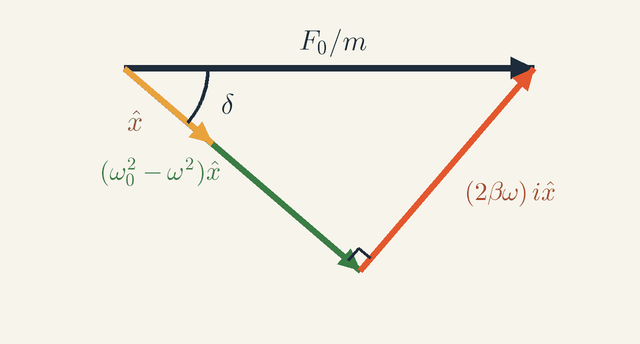
Figure 3. The equation (ω02−ω2+2iβω)x^=F0/m as arrows in the complex plane, below resonance. The green and orange terms meet at a right angle and add up to the drive F0/m, the hypotenuse; δ is the lag of x^ behind the drive.Legend
F0/m
The drive, force per unit mass, along the real axis.
m/s2
x^
Complex amplitude of the displacement, at the angle −δ from the drive; drawn at its own scale.
m
(ω02−ω2)x^
Spring and inertia terms together: a real multiple of x^, so it points along x^.
m/s2
(2βω)ix^
Damping term: x^ turned a quarter turn ahead by the factor i and scaled by 2βω.
m/s2
δ
Lag of the displacement behind the drive: the angle between x^ and F0/m.
rad
Figure 3 draws the equation in the complex plane, for ω=0.75ω0 and β=0.25ω0. The drive F0/m lies along the real axis. The gold arrow is x^, drawn at its own scale. The spring term ω02x^ and the inertia term −ω2x^ are both real multiples of x^, so together they make the green arrow (ω02−ω2)x^, which points along x^. The damping term 2βωix^ carries the extra factor i, so the orange arrow stands at a right angle to the green one. Green plus orange must equal the drive. The drive is therefore the hypotenuse of a right triangle, and x^, lying along the green leg, lags behind the drive by the angle δ between that leg and the hypotenuse.
Solving the equation for x^ gives x^=ω02−ω2+2iβωF0/m Its modulus is the amplitude A, and its argument is −δ, where δ is the lag of the displacement behind the force. The triangle gives both without further algebra. Its legs measure (ω02−ω2)A and 2βωA and its hypotenuse is F0/m, so Pythagoras gives the amplitude and the ratio of the legs gives the lag: A(ω)=(ω02−ω2)2+(2βω)2F0/m tanδ=ω02−ω22βω As ω rises through ω0, δ rises from 0 to 180∘. Figure 3 is drawn below resonance, where the green leg is positive and δ is under 90∘. Above ω0 the factor ω02−ω2 turns negative, the green arrow points against x^, and δ passes 90∘.
Reading the resonance curve
The two formulas above contain the whole steady response. Plotting them against the drive frequency shows where the oscillator responds strongly, how sharp that response is, and what the phase does on the way through.
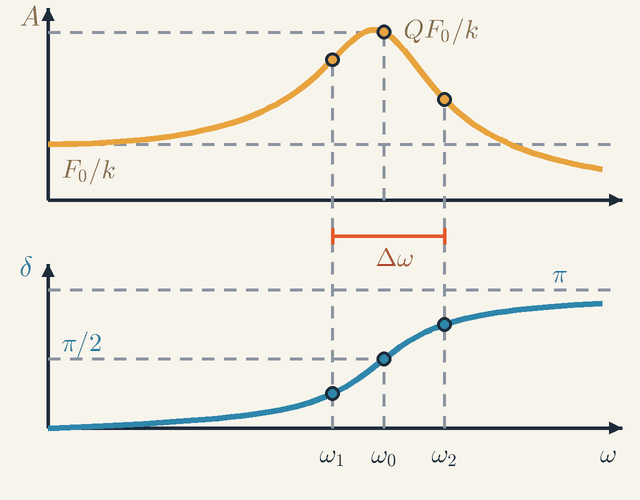
Figure 4. The steady response of a block with Q=3 to a drive of angular frequency ω: amplitude A above, lag δ below. At ω0, just right of the peak, A=QF0/k and δ=π/2; the width between the half-power frequencies ω1 and ω2 is ω0/Q.Legend
A
Steady amplitude of the displacement.
m
δ
Lag of the displacement behind the drive.
rad
ω
Angular frequency of the drive.
rad/s
ω0
Natural angular frequency: just right of the amplitude peak, where δ=π/2.
rad/s
ω1
Lower half-power frequency, where δ=π/4.
rad/s
ω2
Upper half-power frequency, where δ=3π/4.
rad/s
Δω
Full width at half power: ω2−ω1=2β=ω0/Q.
rad/s
F0/k
Static stretch: the amplitude for a drive that changes very slowly.
m
QF0/k
Amplitude at ω0: Q times the static stretch.
m
π/2
A quarter turn: the lag at ω0.
rad
π
A half turn: the lag far above ω0, where the block moves against the drive.
rad
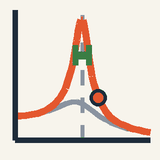
Figure 4 sketches the steady response of a block with Q=3: the amplitude A(ω) on top and the lag δ(ω) below, on the same frequency axis. The resonance panel of the animation plots A(ω) for the shaken spring, with Q=5 and Q=1. There the top of the spring is moved by Y=2cm, which acts on the block like a force with F0/m=ω02Y, so F0/k=Y.
Read the curves from left to right. Far below ω0 the spring term dominates: A≈F0/k, the static stretch (2 cm in the animation), δ≈0, and the block follows the shaker. Far above ω0 inertia dominates: A≈F0/(mω2) shrinks below the dashed F0/k level, δ approaches π, and the block moves against the drive. At ω0, just right of the peak, spring and inertia cancel and only damping balances the drive: A=QF0/k and δ=π/2. The velocity is then in phase with the force, so the drive does positive work all through the cycle. In the animation the tall Q=5 curve reaches 10 cm, while the low grey Q=1 curve gives only 2 cm at ω0.
The width of the peak is measured with power. In the steady state the mean power taken from the drive equals the mean power the damper dissipates, P=21bω2A2, which is 0.125 W at resonance for Q=5. Writing ω2A2=(F0/m)2/[(ω02−ω2)2/ω2+4β2] shows that P peaks exactly at ω0 and falls to half where ∣ω02−ω2∣=2βω. These are the frequencies ω1 and ω2 of the figure; for Q=5 they are 4.52 and 5.52 rad/s (0.72 and 0.88 Hz). There the two legs of the triangle in Figure 3 are equal, so tanδ=±1: the lag curve passes π/4 at ω1 and 3π/4 at ω2. The full width is Δω=ω2−ω1=2β=Qω0 so Q also measures the sharpness of the peak, ω0/Δω. The amplitude peak itself sits slightly below ω0, at ω02−2β2≈4.95rad/s, where it reaches 10.05 cm rather than 10 cm.
The dot on the animation's curve shows the start-up. The shaker starts from its centre and moves as Ysinω0t, while the block starts from rest. The steady displacement lags the drive by a quarter turn, which makes it −QYcosω0t, and at first the transient cancels it, so x≈−QY(1−e−βt)cosω0t. The amplitude climbs on the time scale 1/β=2s and reaches 90% of the peak only after ln10/β≈4.6s. A narrow peak and a long ring-down are one fact seen twice: the width 2β times the decay time 1/β is always 2, so a sharply tuned oscillator is slow to respond.
Worked problem: shaking at the wrong rhythm
Shake the same spring (F0/m=0.5m/s2, β=0.5s−1, ω02=25s−2, b=1kg/s) at 0.50 Hz and at 1.00 Hz, either side of its natural 0.80 Hz. Find the steady amplitude, the lag and the mean power in each case.
Below resonance, at 0.50 Hz: ω=2πf=π≈3.14rad/s, so ω02−ω2=25−9.87=15.13s−2 and 2βω=3.14s−2. Then A=15.132+3.1420.5=0.032m,tanδ=15.133.14,δ≈12∘ Above resonance, at 1.00 Hz: ω=2π≈6.28rad/s, so ω02−ω2=25−39.48=−14.48s−2 and 2βω=6.28s−2. The negative denominator puts δ between 90∘ and 180∘: A=14.482+6.2820.5=0.032m,tanδ=−14.486.28,δ≈157∘
Both amplitudes are about 3.2 cm, a third of the resonant 10 cm. The difference is in the phase: at 0.50 Hz the block rides along with the shaker, while at 1.00 Hz it moves almost against it. The mean power 21bω2A2 differs too: about 5 mW at 0.50 Hz and 20 mW at 1.00 Hz, against 125 mW at resonance. The amplitudes are equal but the frequency has doubled, so the velocity amplitude ωA at 1.00 Hz is twice as large and the power four times as large.
The start-up matters as well. Started from rest, the free ringing at ωd=4.97rad/s adds to the steady motion and beats against it with the period 2π/∣ω−ωd∣, 3.4 s and 4.8 s here. With the shaker starting from its centre, as in the animation, the early swings therefore reach 4.1 and 4.5 cm, more than the steady 3.2 cm. After 3/β=6s the transient is down to e−3, about 5%.
Beyond linear damping
Everything so far assumed a damping force proportional to the velocity. Real friction often is not, and the shape of the decay tells which law is at work.
Dry friction is a constant force μN against the motion, with μ the friction coefficient and N the normal force. It keeps the period at 2π/ω0 but cuts the amplitude by the same 2μN/k every half-swing. The reason: over a half-swing from A1 to A2, the spring energy lost, 21k(A12−A22), equals the work μN(A1+A2) done against friction. The envelope is a straight line, and the block stops dead after a finite time, once the spring force can no longer beat friction. With 0.1 N of friction the animation's block would lose 8 mm per half-swing and stop after 12 of them, about 7.5 s.
Drag growing as v2 kills large swings fast and lets small ones linger, so the amplitude falls roughly as 1/(1+t/t1), with a time t1 set by the starting amplitude. A practical test: plot the logarithm of the amplitude against time. Only linear damping gives a straight line.
The spring can be nonlinear too. A stiffening spring rings faster at large amplitude, so its resonance curve leans towards high frequencies, and as the drive frequency is swept the amplitude can jump between two steady values.
Energy can also enter without a periodic force. Pumping a swing by standing and squatting twice per cycle changes a property of the oscillator, its effective length, instead of pushing it: this is parametric resonance. A bowed string or a clock escapement feeds energy in step with the motion itself. That acts as negative damping, which grows the swing until nonlinearity limits it. The Tacoma Narrows Bridge, destroyed in 1940, failed by such a self-excited flutter in a steady wind, not by simple resonance with a periodic force.
Limits of validity
The linear damper is exact for an electrical resistor, nearly so for an eddy-current brake, and good for slow motion through a viscous liquid (Drag and Terminal Velocity). A real spring is linear only for small stretches (Elasticity: Hooke's Law, Stress and Strain). The resonant amplitude also takes time to build: the drive must last many times 1/β=2Q/ω0, which is 1.4 s for a tuning fork with Q≈2000 at 440 Hz.
Damping never comes alone. The molecular collisions that drain the energy also kick the block at random, so an oscillator in equilibrium at temperature T keeps an average energy kBT, where kB is Boltzmann's constant. Half of that sits in the spring, so the mean of 21kx2 is 21kBT, and the block jitters by kBT/k (root mean square). For the 25 N/m spring at 300 K that is 1.3×10⁻¹¹m, far below anything visible. For an atomic-force-microscope cantilever with k=0.1N/m it is 0.2 nm, a floor on what the instrument can sense. This link between dissipation and random force is the fluctuation–dissipation theorem. Quantum effects come in steps of ℏω0≈5×10⁻³⁴J; against the block's 0.125 J they are utterly negligible, and they matter only for molecules, atoms and very cold micro-resonators.
Where this leads
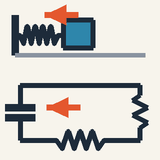
With the charge q in place of x, the same equation describes a series circuit, Lq¨+Rq˙+q/C=V0cosωt. The inductance L, the resistance R and 1/C play the parts of m, b and k, so ω0=1/LC and Q=ω0L/R. A radio that separates medium-wave stations 10 kHz apart near 1 MHz needs a width ω0/Q no larger than the spacing, so a Q of order 100; see Capacitors, Electromagnetic Induction and Electromagnetic Waves.
Light drives the electrons bound in atoms in the same way. Below their ultraviolet resonances the response grows with frequency, which is why glass bends violet more than red (Prisms, Dispersion and Colour); at a resonance, energy is absorbed, as by the ions of a salt crystal in the infrared. The same curve, each time with its own ω0 and Q, fits atmospheric tides, the modes in Standing Waves and the nuclei in an MRI scanner. In quantum physics, width times decay time returns as the link between the width of a spectral line and the lifetime of the state that emits it.
Key formulas
Net force on a damped oscillator
F=−kx−bv
The spring pulls the block back towards equilibrium with −kx, and the damper resists its motion with −bv. The two forces peak at different moments: the spring force at the turning points, the damping force when the block moves fastest, which for light damping is close to equilibrium. Both are linear in the motion, which is what makes the equation solvable exactly.
Symbols
F
net force on the block
N
k
spring constant
N/m
x
displacement from equilibrium
m
b
damping constant
kg/s
v
velocity of the block
m/s
When it holds: Needs Hooke's law for the spring and a damping force proportional to the velocity, which is good for slow motion in a liquid, oil dampers and eddy-current brakes. Dry friction (constant in size) and fast air drag (about v2) do not fit this form.
Example: At its fastest, 0.077 m/s, the heavy block (b=30kg/s) feels a damping force of 30⋅0.077≈2.3N, which exactly balances the spring's pull while it is still 9.2 cm from equilibrium.
Damping rate and natural angular frequency
β=2mb,ω0=mk
These two rates contain all the physics of the free motion. ω0 says how fast the undamped oscillator would swing, stiffness against inertia; β says how fast the damper drains it, damping against inertia. Their ratio ζ=β/ω0 decides whether the system oscillates at all.
Symbols
β
damping rate
s−1
b
damping constant
kg/s
m
mass of the block
kg
ω0
natural angular frequency
rad/s
k
spring constant
N/m
When it holds: For any linear spring and damper. ω0 is the actual oscillation frequency only without damping; a damped system rings at ω02−β2.
Example: The blocks in the animation: ω0=25/1=5rad/s, and β is 0.5, 5 and 15 s⁻¹ for damping constants of 1, 10 and 30 kg/s.
Lightly damped free oscillation
x=A0e−βtcos(ωdt+φ),ωd=ω02−β2
Below critical damping the block still oscillates, but inside an envelope A0e−βt that shrinks by the same fraction every cycle. The oscillation runs at ωd, slightly slower than ω0, because the damper holds the block back. The constants A0 and φ are fixed by the starting position and velocity.
Symbols
x
displacement from equilibrium at time t
m
A0
amplitude of the envelope at t=0
m
β
damping rate
s−1
t
time since the release
s
ωd
damped angular frequency
rad/s
φ
phase constant
rad
ω0
natural angular frequency
rad/s
When it holds: Only for light damping, β<ω0. At β=ω0 the frequency ωd falls to zero and the motion becomes a return without oscillation.
Example: The light block: ωd=25−0.25≈4.97rad/s, and after 3 s the envelope is 10cm⋅e−1.5≈2.2cm.
Critical damping constant
bc=2km=2mω0
Critical damping is reached when the damping rate b/(2m) equals the natural angular frequency k/m, so that the damped frequency falls to zero. Solving for b gives 2km. At this value a displaced system returns to equilibrium as fast as it can without overshooting.
Symbols
bc
critical damping constant
kg/s
k
spring constant
N/m
m
mass
kg
ω0
natural angular frequency
rad/s
When it holds: For a linear spring and a linear damper. Below bc the system oscillates, above it creeps back; if a small overshoot is acceptable, somewhat less damping (a damping ratio near 0.75) settles to within a few per cent even sooner.
Example:m=1kg and k=25N/m: bc=225⋅1=10kg/s, the middle block's damping constant.
Quality factor
Q=2βω0=bmω0
Q compares the natural rate ω0 with the energy decay rate 2β: it is the stored energy divided by the energy lost per radian of motion. A high Q means weak damping, a long ring after a tap and a tall, narrow resonance peak. A freely ringing oscillator keeps about e−π/Q of its amplitude from one cycle to the next.
Symbols
Q
quality factor
ω0
natural angular frequency
rad/s
β
damping rate
s−1
m
mass
kg
b
damping constant
kg/s
When it holds: Useful for light damping. Rules of thumb such as a fraction 2π/Q of the energy lost per cycle need Q to be large; critical damping corresponds to Q=1/2.
Example: The light block: Q=5/(2⋅0.5)=5, so after 5 cycles only e−π, about 4%, of the amplitude is left.
Steady amplitude of a driven oscillator
A(ω)=(ω02−ω2)2+(2βω)2F0/m
Once the transient has died away, a damped oscillator driven by F0cosωt moves at the drive's frequency with this amplitude. The term ω02−ω2 is the mismatch between spring and inertia, and 2βω is the damping. Far below ω0 the amplitude tends to the static stretch F0/k, far above it falls as 1/ω2, and near ω0 only the damping term limits it.
Symbols
A(ω)
steady amplitude at the driving frequency ω
m
ω
driving angular frequency
rad/s
F0
amplitude of the driving force
N
m
mass
kg
ω0
natural angular frequency
rad/s
β
damping rate
s−1
When it holds: Only in the steady state, a few times 1/β after the drive starts, and only for a linear spring and damper driven by a sinusoidal force.
Example: The shaken spring (F0/m=0.5m/s2) driven at 1.00 Hz: A=0.5/14.482+6.282≈0.032m, a third of the 10 cm at resonance.
Amplitude at resonance
A(ω0)=bω0F0=kQF0
At ω=ω0 the spring force and the inertia cancel each other, so the drive only has to balance the damping force: F0=bω0A. The amplitude is then Q times the static stretch F0/k. Weak damping turns a small force into a large motion, and the displacement lags the force by exactly a quarter cycle.
Symbols
A(ω0)
steady amplitude when driven at ω0
m
F0
amplitude of the driving force
N
b
damping constant
kg/s
ω0
natural angular frequency
rad/s
Q
quality factor
k
spring constant
N/m
When it holds: For the steady state of a linear oscillator. Strictly, the amplitude peaks slightly below ω0, at ω02−2β2, but the difference is negligible unless Q is small; very large amplitudes make real springs nonlinear.
Example: The shaken spring in the animation: F0=kY=0.5N, so A=0.5/(1⋅5)=0.10m, which is QY=10cm.
Glossary
Natural frequency
The frequency at which a system oscillates when it is disturbed and left alone, without damping: ω0=k/m for a block on a spring, or f0=ω0/(2π) in hertz. For the blocks in the animation it is 5 rad/s, or 0.80 Hz.
Damping
The gradual loss of an oscillation's energy, usually to heat, through friction, drag or electrical resistance. Light damping shrinks the amplitude while leaving the rhythm almost unchanged.
Viscous damping
Damping by a force proportional and opposite to the velocity, F=−bv, as in slow motion through a liquid or in a car's shock absorber. It gives an exponential decay; dry friction, a force of constant size, gives a linear one instead.
Light damping
Damping below the critical value, b<bc, also called underdamping. The system overshoots equilibrium again and again, and its swings shrink by the same fraction every cycle.
Critical damping
The damping bc=2km that is just enough to prevent any overshoot. A displaced system then returns to equilibrium in the shortest time possible without crossing it, which is what door closers aim for.
Heavy damping
Damping above the critical value, b>bc, also called overdamping. There is no oscillation, only a slow creep back to equilibrium, and the larger b, the slower the creep.
Driven oscillation
The motion of an oscillator pushed by a periodic external force such as F0cosωt, also called a forced oscillation. Once the start-up has died away, it moves at the driving frequency ω, not at its own.
Transient
The part of a driven oscillator's motion that comes from its own free ringing. It decays as e−βt and has gone after a few times 1/β, leaving the steady state.
Steady state
The lasting motion of a driven oscillator once the transient has died out: an oscillation at the driving frequency, with a constant amplitude A(ω) and a constant lag behind the force.
Resonance
The large response of an oscillator driven close to its natural frequency, where every push adds energy. With a damping force −bv the steady amplitude at resonance is QF0/k, Q times the stretch the same force would cause if it were steady.
Resonance curve
The graph of the steady amplitude, or of the absorbed power, against the driving frequency. It peaks near ω0, with a height proportional to Q and a full width at half power of ω0/Q.
Phase lag
How far the displacement trails the driving force, given as an angle δ, with a whole cycle counted as 360∘. It is near 0 far below resonance, exactly 90∘ at ω0 and close to 180∘ far above.
Quantities
b
Damping constant
kg/s
The damping force per unit speed; 1 kg/s is the same as 1 N·s/m. The three blocks in the animation have 1, 10 and 30 kg/s.
β
Damping rate
s−1
Half the damping constant per unit mass, b/(2m): in a time 1/β the amplitude falls by the factor e. For the light block, 0.5s−1.
ω0
Natural angular frequency
rad/s
k/m, the angular frequency of the undamped oscillator: 2π times the natural frequency f0 in hertz.
ωd
Damped angular frequency
rad/s
The angular frequency of a lightly damped free oscillation, ω02−β2, slightly below ω0: 4.97 instead of 5 rad/s for the light block.
bc
Critical damping constant
kg/s
The damping constant at which β=ω0, equal to 2km: the boundary between oscillating and creeping back. It is 10 kg/s for the blocks in the animation.
ζ
Damping ratio
β/ω0=b/bc: below 1 the system oscillates, at 1 it is critically damped, above 1 it creeps back. The animation's blocks have 0.1, 1 and 3.
Q
Quality factor
ω0/(2β), the stored energy divided by the energy lost per radian. A free oscillation rings for about Q cycles, and the resonance peak is Q times the static response.
ω
Driving angular frequency
rad/s
The angular frequency of the periodic force, 2π times the number of pushes per second. In the steady state the oscillator moves at this frequency.
F0
Driving-force amplitude
N
The largest value of the periodic force F0cosωt. Shaking the top of a spring by Y is equivalent to F0=kY, which is 0.5 N in the animation.
A
Amplitude
m
The largest displacement in a cycle. In free decay it shrinks from its starting value A0 as A0e−βt; under a drive it settles at the steady value A(ω).
Quiz
Beginner Three identical blocks on identical springs are pulled down and let go together: one lightly damped, one critically damped, one heavily damped. Which comes to rest first?
The lightly damped one
The critically damped one
The heavily damped one
All three at the same moment
Show answer
Answer: B. The critically damped one
Critical damping is just enough to stop the overshoot. With less damping the block keeps bouncing; with more, the damper slows the return so much that the block creeps back.
Beginner A swing that is pushed once and then left alone gradually stops. Why?
Gravity eventually stops pulling on it
Its energy is destroyed a little on every swing
Friction and air resistance turn its energy into heat
Its natural rhythm slows down until it stops
Show answer
Answer: C. Friction and air resistance turn its energy into heat
Energy is never destroyed: friction at the pivot and air resistance convert the swing's energy into heat, a little on every swing. That loss is damping. The rhythm stays almost the same while the swings get smaller.
Beginner You want to make a swing go higher using only small pushes. How should you push?
Once per swing, in time with its rhythm, as it moves away from you
As often and as fast as you can
At random moments, so the pushes average out
Only as it passes the lowest point, moving towards you
Show answer
Answer: A. Once per swing, in time with its rhythm, as it moves away from you
A push given once per swing, each time as the swing moves away from you, adds energy every time, so small pushes build up a big swing: that is resonance. The same push given while it moves towards you takes energy away.
Intermediate A 1 kg block hangs on a spring with k = 25 N/m. Which damping constant b makes it critically damped?
5 kg/s
25 kg/s
10 kg/s
50 kg/s
Show answer
Answer: C. 10 kg/s
b_c = 2√(k·m) = 2 × √(25 × 1) = 10 kg/s. Forgetting the factor 2 gives 5 kg/s; dropping the square root gives 2 × 25 = 50 kg/s, and dropping both gives 25 kg/s.
Intermediate A lightly damped oscillator has β = b/(2m) = 0.5 s⁻¹ and an amplitude of 10 cm at t = 0. What is its amplitude at t = 2 s?
6.1 cm
1.4 cm
5.0 cm
3.7 cm
Show answer
Answer: D. 3.7 cm
A = A₀·e^(−βt) = 10 cm × e^(−1) ≈ 3.7 cm. 1/β = 2 s is the time to fall to 1/e ≈ 37%, not to half, so treating it as a half-life gives 5 cm. The energy, proportional to A², decays as e^(−2βt): using that exponent gives 1.4 cm, and using e^(−βt/2) gives 6.1 cm.
Intermediate A swing with some friction is pushed exactly at its natural frequency, with the same small push every time. What happens to its amplitude?
It grows without limit
It grows, then levels off when the energy lost per swing equals the energy fed in
It stays equal to that of the first swing
It grows, then shrinks back to zero
Show answer
Answer: B. It grows, then levels off when the energy lost per swing equals the energy fed in
Damping losses grow with the amplitude, so the swing grows only until the losses balance the input. For a damping force −b·v the steady amplitude is A = F₀/(b·ω₀) = Q·F₀/k: large, but finite.
Advanced A lightly damped oscillator is driven exactly at its natural angular frequency ω₀. In the steady state, how does its displacement compare with the driving force?
In phase with the force
Half a cycle behind (180°)
A quarter cycle ahead (90°)
A quarter cycle behind (90°)
Show answer
Answer: D. A quarter cycle behind (90°)
tan δ = 2βω/(ω₀² − ω²) becomes infinite at ω₀, so δ = 90°: the displacement lags by a quarter cycle and the velocity is in phase with the force, so the drive does positive work throughout the cycle.
Advanced Two oscillators with the same mass and the same spring differ only in their damping: one has Q = 50, the other Q = 5. Driven by the same force, how does the resonance peak of the Q = 50 oscillator compare?
About 10 times taller and 10 times narrower
About 10 times taller and just as wide
Just as tall but 10 times narrower
About 100 times taller and 10 times narrower
Show answer
Answer: A. About 10 times taller and 10 times narrower
At resonance A = Q·F₀/k, so the height grows in proportion to Q, while the width Δω ≈ ω₀/Q shrinks in proportion to 1/Q.
 Physics Tutor