Light leaves a mirror at the angle at which it arrives, θr=θ1, and bends at a boundary by Snell's law, n1sinθ1=n2sinθ2, because its speed v=c/n changes; inside glass or water, beyond the critical angle θc, it is trapped by total internal reflection.
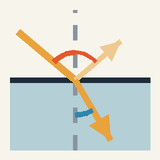
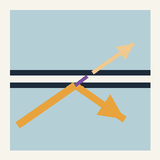
A light ray enters glass, slows down and bends towards the normal while a faint ray reflects; then, inside the glass beyond the critical angle, it is totally reflected.
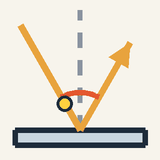
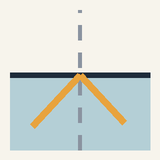
Angles are measured from the normal, a line standing straight out of the surface; a mirror sends light off at the same angle it arrived.
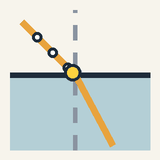
Light is slower in glass and water, so a ray entering at a slant swings towards the normal: that bending is refraction.
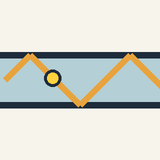
Light inside glass that meets the surface too slantwise cannot get out and is all reflected; optical fibres trap light this way.
Refraction fools the eye: a straw standing in water looks broken at the surface.
Step 1, the normal. Wherever a ray of light lands on a surface, imagine a line standing straight out of the surface at that point. It is called the normal, and every angle in optics is measured from it, not from the surface.
Step 2, reflection. A ray bouncing off a smooth surface leaves at the same angle from the normal as it arrived, like a snooker ball rebounding from the cushion. A mirror is smooth, so all the rays bounce together and you see a clear picture. Paper is rough on a tiny scale: light leaves it in every direction, so you can see the page from anywhere in the room, but never your face in it.
Step 3, refraction. When light passes into water or glass at a slant, it changes direction at the surface. The reason is speed: light is slower in glass. Think of a shopping trolley rolling at an angle from smooth floor onto carpet: the wheel that reaches the carpet first is slowed first, and the trolley swings round. The rule: on the slower side, the ray is closer to the normal.
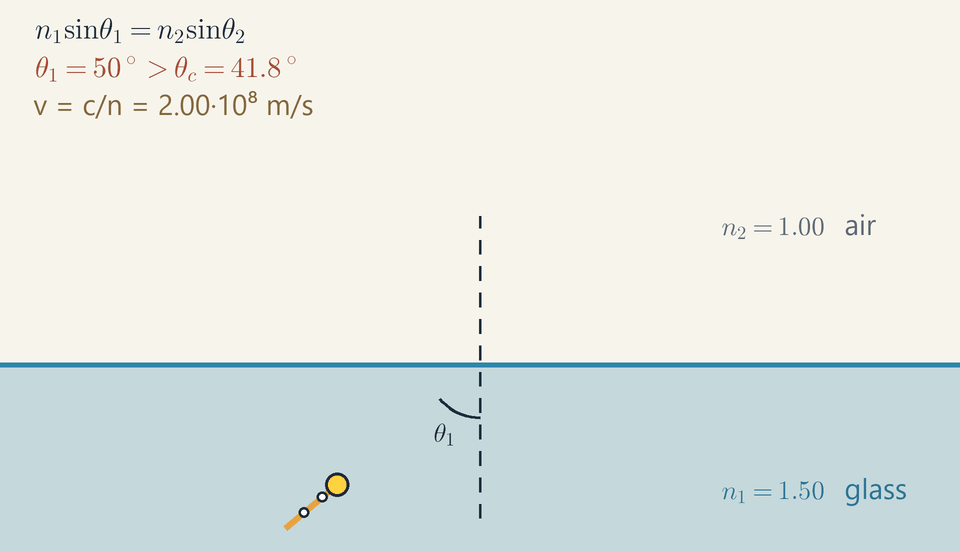
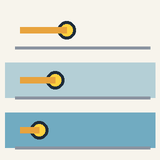
In the animation the yellow dot leaves a white mark every quarter of a second. Inside the glass the marks crowd together: slower light, shorter steps. Notice the faint ray that bounces back too.
Step 4, trapped light. Leaving glass, a ray bends away from the normal. Tilt it far enough and it cannot get out at all: all of it reflects back inside. This total internal reflection guides light along optical fibres.
Check yourself: a ray goes from water into air. Does it end up closer to the normal or farther from it? (Farther: light is faster in air.)
Intermediate
Key ideas
Refractive index n=c/v: water 1.33, glass about 1.5, diamond 2.42; in the same time, light covers less ground in a denser medium.
From the normal: reflection θr=θ1; refraction n1sinθ1=n2sinθ2 (air → glass at 50∘ gives 30.7∘).
From higher to lower n: sinθc=n2/n1; beyond θc (41.8∘ for glass → air) all the light is reflected.
The frequency never changes at a boundary; speed and wavelength are both divided by n: v=c/n, λ=λ0/n.
Rays, the normal and the refractive index
A lake mirrors the far shore, yet you see the stones at your feet: how much light a surface reflects depends on the angle at which the light arrives. A narrow beam of light can be drawn as a ray. A ray is a line along the direction in which the light's energy travels. Where a ray meets a surface, draw the normal, the line perpendicular to the surface there. Every angle in optics is measured from the normal, never from the surface: the angle of incidence θ1, the angle of reflection θr and the angle of refraction θ2. The reflected and refracted rays stay in the plane of incidence, which holds the incident ray and the normal.
The refractive index compares the speed of light in vacuum, c≈3.00×10⁸m/s, with its speed v in the material: n=vc
Air has n=1.0003, rounded to 1.00; water has 1.33, ordinary glass about 1.5 (the animation uses 1.50) and diamond 2.42. Of two media, the one with the larger n is called optically denser.
The laws of reflection and refraction
At a smooth boundary, part of the light is reflected and part enters the second medium. Their directions obey two laws:
θr=θ1(reflection)
n1sinθ1=n2sinθ2
The reflected ray leaves on the other side of the normal at the angle at which the light arrived. The second law is Snell's law of refraction, described by Ibn Sahl in Baghdad around 984, found again by Willebrord Snell in 1621 and published by Descartes in 1637.
In Snell's law the product nsinθ is the same on both sides. Entering a medium of larger n, sinθ must shrink, so the ray bends towards the normal; entering one of smaller n, it bends away. A ray arriving along the normal goes straight on, though it still slows down, and every light path can be travelled backwards.
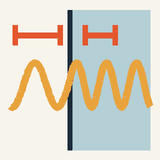
The frequency f, set by the source, never changes at the boundary. Since v=fλ, the wavelength shrinks in proportion to the speed: λ=nλ0 where λ0 is the wavelength in vacuum. Green light of 550 nm has a wavelength of about 367 nm in the animation's glass, and it is still green: colour goes with the frequency.
Why slower light bends
Picture a straight wavefront arriving at the surface; it makes the same angle θ1 with the surface as the ray makes with the normal. One end touches the surface at A. While the other end covers its last stretch, v1Δt in air, to reach the surface at B, the light that entered at A advances only v2Δt into the glass. The new front starts at B and just touches the circle of radius v2Δt around A: the wave has turned.
The two right-angled triangles share their longest side, the stretch AB of length L along the surface, so sinθ1=Lv1Δt,sinθ2=Lv2Δt Dividing gives sinθ1/sinθ2=v1/v2=n2/n1, which is Snell's law: the beginner's shopping-trolley picture made exact.
Worked example: the ray in the animation
In the first part of the animation, light goes from air, n1=1.00, into glass, n2=1.50, at θ1=50∘. Snell's law gives sinθ2=n2n1sinθ1=1.501.00⋅0.766=0.511,θ2=30.7∘ This is the line 1.00sin50∘=1.50sin30.7∘ on the screen. The ray turns through 50∘−30.7∘=19.3∘ towards the dashed normal, while the faint reflected ray leaves at 50∘ on the other side of it.
The readout drops from 3.00×10⁸ to v=c/n=2.00×108m/s as the dot enters the glass, so the white marks it leaves every quarter of a second are only two thirds as far apart there: the same time, less distance.
How bright is the faint ray? For light arriving along the normal, the fraction of the power reflected is R=(n1+n2n1−n2)2(normal incidence) For air and glass, R=(0.50/2.50)2=0.04, or 4 %. At 50∘ it is about 6 %, and it climbs towards 100 % at grazing incidence: a lake mirrors the far shore, yet you see the stones at your feet.
Total internal reflection
In the second part of the animation the light travels inside the glass, now n1=1.50, towards air, n2=1.00. Snell's law reads sinθ2=1.50sinθ1: the ray leaves farther from the normal than it arrived, and it grazes the surface, θ2=90∘, at the critical angle sinθc=n1n2(n1>n2) For glass and air, sinθc=1/1.50=0.667, so θc=41.8∘.
Beyond θc, Snell's law would need sinθ2>1: there is no refracted ray, and all the light is reflected. The animation's ray meets the surface at 50∘, where 1.50sin50∘=1.15; the screen shows θ1=50∘>θc=41.8∘, and the whole beam returns into the glass. This total internal reflection loses nothing, and it can happen only on the side with the higher index.
Worked example: a lamp in a swimming pool
A small lamp lies on the floor of a pool 2.0 m deep. How much of the surface does it light, what does a swimmer see looking up, and how deep does the pool look from straight above?
For water to air, sinθc=1.00/1.33=0.752, so θc=48.8∘. Only rays inside a cone of that half-angle escape, so the lit patch is a circle of radius r=dtanθc=2.0⋅1.14=2.28m, where d is the depth; beyond it, the surface is a perfect mirror seen from below. Run the rays backwards: a swimmer looking up sees the whole sky squeezed into a window 2θc=97.5∘ across, ringed by a reflection of the pool floor.
Looking straight down, you receive rays close to the normal, where sinθ≈θ. A ray leaving the water is tilted n times more than inside, so traced back it seems to come from a point only 1/n as deep. The pool looks 2.0/1.33=1.50m deep, a quarter less than it is.
Common mistakes
Angles are measured from the normal, not from the surface. A ray at 40∘ to the glass surface has θ1=50∘; using 40° in Snell's law gives 25.4° instead of 30.7°.
Snell's law relates sines, not angles. Dividing 30° by 1.5 gives 20° instead of 19.5°; at 50° the shortcut gives 33.3° instead of 30.7°.
Light keeps its colour in water or glass. Orange light of 600 nm has a wavelength of 400 nm in glass of index 1.50, but its frequency, 5.0×10¹⁴Hz, is unchanged.
Total internal reflection needs light going from a higher index to a lower one. Entering glass from air, even at 89°, the ray gets in at 41.8°.
Optically denser does not mean heavier. Olive oil floats on water, yet with n≈1.47 against 1.33 it bends light more.
Where you meet it
Optical fibres carry internet traffic as light trapped by total internal reflection. The prisms in binoculars meet the light at 45∘, beyond the 41.8∘ critical angle, so they reflect better than silvered mirrors. Diamond, with n=2.42 and θc=24.4∘, traps light and sends much of it back out through the top, which is why it sparkles. Mirages over hot roads come from light bending gradually in air of varying index.
Because n depends slightly on colour, a prism splits white light, the subject of Prisms, Dispersion and Colour. Curved boundaries that form images follow in Lenses and Mirrors and The Eye, Cameras and Telescopes, and the polarisation of reflected light in Polarization of Light.
Advanced
Key ideas
Fermat: light takes a path of stationary time T=∫nds/c; dT/dx=0 at the crossing point gives n1sinθ1=n2sinθ2.
Phasors of paths near the stationary one line up and add; distant paths curl up and cancel, so rays need apertures much wider than λ.
Fronts must match along the surface: ksinθ is conserved, so fronts spaced λ0 in air kink to λ0/n in glass.
Beyond θc an evanescent wave decays within about λ; a second block that close lets light tunnel across (frustrated total reflection).
Fermat's principle of stationary time
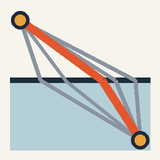
Reflection and refraction look like two separate rules, one for mirrors and one for glass. Both follow from a single statement about travel time, and seeing why is the most direct way into ray optics.
Start with the time itself. Light moves at c/n in a medium of refractive index n, so covering a short length ds takes nds/c. Adding these pieces along a whole path gives its travel time. The integral ∫nds is called the optical path length, and the time is that length divided by c: T=c1∫nds
Fermat's principle says that light follows a path for which T is stationary. Stationary means that a small deformation of the path changes the time only to second order in the size of the deformation, never to first order, just as a smooth function is flat at the bottom of a valley or the top of a hill.
Stationary is not always least. Inside a mirror shaped as an ellipse, every path from one focus to the mirror and on to the other focus takes the same time, so all of them are stationary. In a mirror curved more tightly than that ellipse, the real path is the longest of its neighbours, not the shortest.
Why should light care about time at all? Because light is a wave. Take every conceivable path from the source to the detector and give each one a small arrow, a phasor, turned through the phase ωT that the wave accumulates along it, where ω is the angular frequency. The light that arrives is the sum of all these arrows. Label the paths by a parameter x, and let x0 be the stationary one, with time T0. Near it the time changes only quadratically, with T′′ the second derivative of T at x0: T≈T0+21T′′(x−x0)2
Close to x0 the times hardly differ, so neighbouring arrows point almost the same way and add up. Farther out the phase changes ever faster from one path to the next, and the arrows curl into tight spirals that cancel. What arrives therefore comes from a band of paths around the stationary one whose times differ by less than about half a period. That band is what we call a ray. In quantum theory the same arrows are a photon's probability amplitudes.
Snell's law from the travel time
The most useful consequence of Fermat's principle is the law of refraction. To derive it, write the travel time as a function of one number, the point where the light crosses the surface, and ask where that time is stationary.
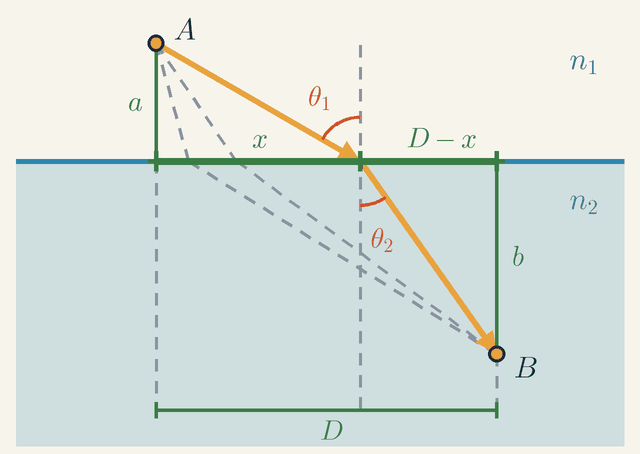
Figure 1. Light goes from A to B, crossing the surface a distance x from the foot of A. Each leg is the hypotenuse of a right triangle (sides a and x; b and D−x). The solid route takes the least time and obeys Snell's law; the dashed routes take longer.Legend
A
Start of the route, a height a above the surface.
B
End of the route, a depth b below the surface.
a
Height of A above the surface.
m
b
Depth of B below the surface.
m
D
Horizontal distance from A to B.
m
x
Distance along the surface from the foot of A to the crossing point.
m
D−x
The rest of the horizontal distance: from the crossing point to the foot of B.
m
θ1
Angle between the first leg and the normal to the surface (the dashed vertical line).
rad
θ2
Angle between the second leg and the normal.
rad
n1
Refractive index of the upper medium.
n2
Refractive index of the lower medium.
Figure 1 sets up the problem. The point A is a height a above a flat surface, in a medium of index n1. The point B is a depth b below it, in a medium of index n2, a horizontal distance D further on.
Within one medium the quickest route is a straight line, so any candidate route is straight above the surface and straight below it. It is then fixed by one number: the distance x along the surface from the foot of A to the crossing point. Each leg is the hypotenuse of a right triangle, with sides a and x above the surface and b and D−x below it. The solid gold route is the quickest; the dashed routes cross the surface elsewhere, and each takes longer.
By Pythagoras the legs are a2+x2 and b2+(D−x)2 long. Light covers them at c/n1 and c/n2, so the route that crosses at x takes T(x)=cn1a2+x2+n2b2+(D−x)2 The quickest route is where this function is stationary, so its derivative must vanish. Moving the crossing point to the right lengthens the upper leg and shortens the lower one, which is where the minus sign comes from: dxdT=c1(a2+x2n1x−b2+(D−x)2n2(D−x))=0
Now read the two fractions off the figure. At the crossing point the upper leg makes the angle θ1 with the normal, the dashed vertical line. The side a is parallel to that normal, so the angle at A between the leg and a is also θ1. The side opposite this angle is x, and the first fraction, opposite over hypotenuse, is x/a2+x2=sinθ1. In the lower triangle the side b is vertical too, the angle at B is θ2, the opposite side is D−x, and the second fraction is (D−x)/b2+(D−x)2=sinθ2. The condition dT/dx=0 is therefore Snell's law: n1sinθ1=n2sinθ2
Is this time a minimum? Differentiating once more gives a sum of two positive terms, dx2d2T=c1((a2+x2)3/2n1a2+(b2+(D−x)2)3/2n2b2)>0 so at a flat surface the stationary time is a true minimum.
Reflection follows from the same steps. Put B above the surface, in the same medium as A, so that both legs have the index n1. The condition then becomes sinθr=sinθ1, where θr is the angle between the reflected leg and the normal: the angle of reflection equals the angle of incidence.
The principle also predicts something the angles alone cannot. Light must be slower, by the factor n2/n1, in the medium where it bends towards the normal. Newton's particle model explained the same bending by a pull of the glass on the light, which would make it faster inside. The two pictures predict opposite speeds, and in 1850 Foucault measured light to be slower in water than in air, as Fermat's principle requires.
Wavefronts and phase matching
Fermat's principle speaks of paths. The same law can be seen in the wave itself, as the condition that the waves on the two sides of the surface fit together. This view is the one that generalises: it explains mirages and links refraction to conservation laws.
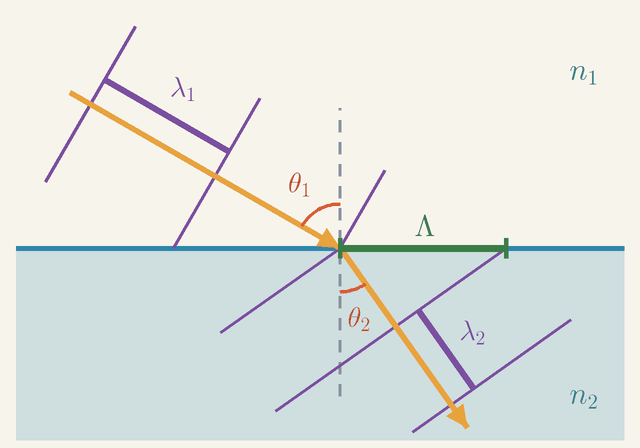
Figure 2. Wavefronts (purple) crossing a surface, drawn for n2/n1=1.5. They are λ1 apart above and λ2 apart below, yet meet the surface at the same points, Λ apart on both sides. To fit, the fronts tilt, and the ray turns towards the normal.Legend
λ1
Wavelength in the upper medium: the distance between neighbouring wavefronts there.
m
λ2
Wavelength in the lower medium: λ2=λ1n1/n2, shorter because light is slower there.
m
Λ
Distance along the surface between the points where neighbouring fronts meet it, the same on both sides.
m
θ1
Angle between the incident ray and the normal; also the angle between a front and the surface.
rad
θ2
Angle between the refracted ray and the normal.
rad
n1
Refractive index of the upper medium.
n2
Refractive index of the lower, optically denser medium (shaded).
Figure 2 draws a beam crossing the surface into a medium where light is 1.5 times slower, n2/n1=1.5. The purple lines are wavefronts, lines of equal phase. They are also lines of equal travel time from the source, so they are Fermat's principle in wave form, and each front is perpendicular to its ray. Neighbouring fronts are one wavelength apart: λ1 in the upper medium and λ2=λ1n1/n2 in the lower one, because the frequency is the same on both sides while the speed is lower below.
The expert layer of the animation shows the law as this matching condition: its fronts are λ0 apart in air, where λ0 is the wavelength in vacuum, and λ0/n, 1.5 times closer, in glass.
Now look along the surface. The wave is continuous across it, so the fronts above and below must join without a break: each front reaches the surface at the same point from both sides. Neighbouring fronts therefore meet the surface the same distance Λ apart on both sides, the green bar.
Relate Λ to each wavelength. A front is perpendicular to its ray and the surface is perpendicular to the normal, so the angle between a front and the surface equals the angle between the ray and the normal, θ1 above the surface. Two neighbouring fronts and the stretch Λ of surface between their meeting points form a right triangle: Λ is its hypotenuse, and the gap between the fronts, λ1, is the side opposite θ1. Hence λ1=Λsinθ1. Below the surface the same triangle gives λ2=Λsinθ2. Eliminating Λ, sinθ1λ1=Λ=sinθ2λ2 For the animation's angles, 50∘ in air and 30.7∘ in glass, both sides give Λ=1.31λ0. Writing λ=λ0/n on each side turns the equation into n1sinθ1=n2sinθ2: Snell's law once more.
The tilt of the fronts also shows why the ray turns towards the normal in the slower medium. One end of an oblique front reaches the surface first and is slowed first, while the other end still moves fast in the upper medium. The front pivots about its slowed end, and the ray, perpendicular to the front, turns towards the normal.
The matching condition has a compact form. The wave vector points along the ray and has the size k=nω/c=2π/λ. Its component along the surface is ksinθ=2π/Λ, so phase matching says that this tangential component is the same on both sides. This mirrors two conservation laws of mechanics. A boundary that does not change in time conserves the frequency ω, as time symmetry conserves energy. A surface that looks the same all along its length conserves the tangential wave vector, as translation symmetry conserves momentum.
The rule holds for any stack of parallel layers: crossing one boundary after another, n(z)sinθ(z) stays the same at every height z. Where n grows, sinθ shrinks and the ray turns towards the normal. In air whose index varies smoothly with height, a ray therefore curves towards higher n. Over a hot road the air near the ground is warmer and its index lower, so light from the sky curves upwards into the eye and the road seems to shine like water: a mirage.
Refraction angle against incidence angle
Snell's law is not linear in the angles. A graph of one angle against the other shows at a glance where the small-angle rule of lens formulas holds, where it fails, and where total internal reflection begins.
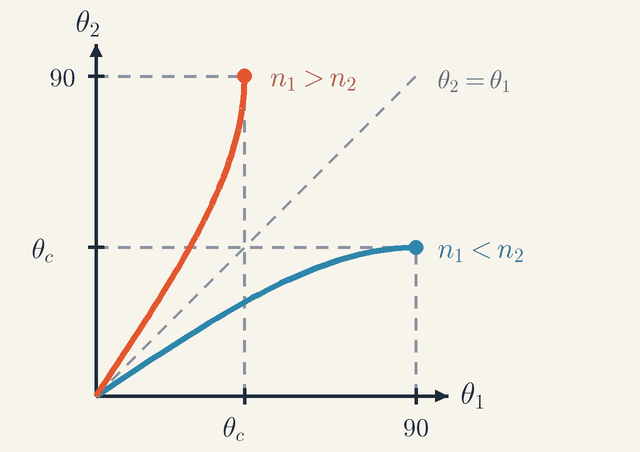
Figure 3. Refraction angle θ2 against incidence angle θ1, both from 0 to 90∘, for glass of index 1.5. Air into glass (blue) ends at height θc; glass into air (red) stops at θ1=θc, where θ2 reaches 90∘. The curves are mirror images in the diagonal.Legend
θ1
Angle of incidence, measured from the normal.
rad
θ2
Angle of refraction, measured from the normal.
rad
θc
Critical angle for glass into air, sinθc=1/1.5; also the angle at which the air-into-glass curve ends.
rad
n1
Refractive index of the medium the light comes from.
n2
Refractive index of the medium it enters.
Figure 3 plots the refraction angle θ2 against the incidence angle θ1, from 0 to 90∘, for glass of index 1.5 crossed in both directions. As in Snell's law, n1 is the index of the medium the light comes from and n2 that of the medium it enters.
Follow the blue curve first: air into glass, n1<n2. Near the origin it is a straight line of slope n1/n2=0.667, because for small angles sinθ≈θ and Snell's law becomes θ2≈(n1/n2)θ1, the rule behind lens formulas. The curve then bends over and ends, at grazing incidence θ1=90∘, at θ2=41.8∘: the height of the horizontal dashed line marked θc. Light from air never travels inside the glass at more than this angle from the normal.
Now the red curve: glass into air, n1>n2. It starts with slope 1.5, climbs ever faster, and reaches θ2=90∘ at θ1=θc=41.8∘, where it stops at the vertical dashed line. This is the critical angle, sinθc=n2/n1. Beyond it there is no refracted ray at all, and all the light is reflected: total internal reflection.
The two curves are mirror images of each other in the dashed diagonal θ2=θ1. The reason is that every light path can be travelled backwards: if light from air at θ1 enters the glass at θ2, light inside the glass at θ2 leaves into air at θ1, which swaps the axes. That is why the same angle θc ends both curves.
Why does the red curve shoot up so steeply near its end? Differentiating Snell's law gives n1cosθ1dθ1=n2cosθ2dθ2, so dθ1dθ2=n2cosθ2n1cosθ1 As θ2→90∘ the cosine in the denominator goes to zero and the slope diverges. Near θc a tiny tilt of the incoming ray swings the emerging ray through a wide angle.
Why light is slower in matter
So far the index n has simply been given. This section explains where it comes from, and why it depends on colour.
The slowing is not light pausing at each atom. The wave drives the electrons of the material, which oscillate at the wave's frequency and radiate waves of their own. A thin layer of these electrons adds a weak wave that lags a quarter of a cycle behind the incoming one. Adding a small wave a quarter of a cycle behind shifts the phase of the total slightly back, as if the wave had arrived a little late. Layer after layer, these small delays add up, and the total wave travels at c/n.
The electrons respond more strongly as the frequency approaches their natural frequencies, which for glass lie in the ultraviolet. The index therefore rises with frequency: about 1.514 for red light and 1.522 for blue in a common crown glass. This dependence of n on frequency is called dispersion, and it is what lets a prism split white light into colours. For X-rays, whose frequency lies above the resonances, n is slightly below 1. The crests then move faster than c, which breaks no law: the crests of a steady wave carry no signal.
Amplitudes, Brewster's angle and the evanescent wave
Snell's law fixes the directions of the reflected and refracted rays, but not how much light goes each way. That depends on light being an electromagnetic wave, and it explains why a window reflects a little, why reflected glare is polarised, and what happens just beyond a totally reflecting surface.
Maxwell's equations require the components of the electric and magnetic fields along the surface to be continuous across it. Applying this to the incident, reflected and refracted waves gives the Fresnel equations, which give the fractions reflected and transmitted. They depend on polarisation, the direction in which the electric field oscillates. At normal incidence both polarisations behave alike, and the reflected fraction of the power is R=(n1+n2n1−n2)2(normal incidence) This is 4.0 % for glass, 2.0 % for water and 17 % for diamond, the same from either side, because swapping n1 and n2 only changes the sign inside the square.
At oblique incidence the two polarisations part company. The plane of incidence is the plane that contains the incident ray and the normal. At the animation's 50∘ from air into glass, light polarised perpendicular to that plane (called s) is reflected at 11.2 %, light polarised in that plane (called p) at only 0.3 %.
The p reflection vanishes altogether at Brewster's angle, tanθB=n2/n1: 56.3∘ from air into glass. There the refracted ray, at 33.7∘, is exactly perpendicular to the direction of the reflected ray. The electrons of the previous section explain why. For p light they oscillate perpendicular to the refracted ray, within the plane of incidence, and at Brewster's angle that line of oscillation points straight along the reflected direction. An oscillating dipole radiates nothing along its own axis, so no p light is reflected. Glare reflected near this angle is therefore mostly s-polarised, which is why polarising sunglasses cut it.
Total internal reflection hides a subtlety. Take light inside glass of index n1, meeting a surface with air, of index n2, beyond θc, and write k0=2π/λ0 for the wave number in vacuum. Phase matching still demands the tangential wave number n1k0sinθ1 on the air side. Beyond θc this exceeds n2k0, the whole wave number available in air. The component normal to the surface, whose square is n22k02−n12k02sin2θ1, is then the square root of a negative number: it is imaginary. An imaginary wave number describes decay, not oscillation. The field in the air falls off with the distance z from the surface as e−z/δ, with δ=2πn12sin2θ1−n22λ0
At an incidence of 50∘ inside the animation's glass, δ=0.28λ0, about 155 nm for green light of 550 nm. This is the evanescent wave. On average it carries no energy away from the surface, so the reflection really is total. But bring a second block of glass within a few δ and the evanescent field reaches into it: light leaks across the gap. This frustrated total internal reflection follows the same mathematics as quantum tunnelling through a barrier.
Worked problem: a glass rod as a light pipe
Total internal reflection can trap light inside a rod or a fibre over kilometres. This problem finds when trapping works, how wide a cone of light a fibre accepts, and what that cone costs in signalling speed.
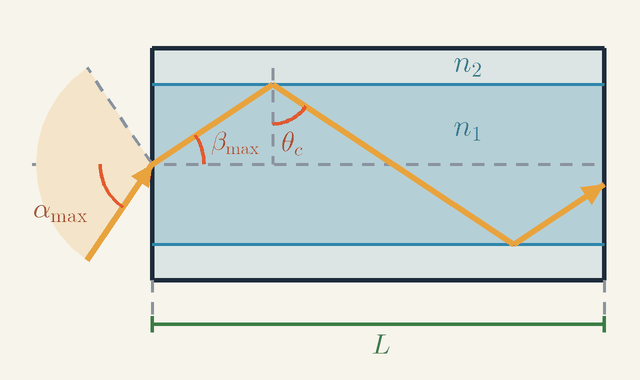
Figure 4. A step-index fibre: a core of index n1 in a cladding of index n2<n1. The ray entering at αmax bends to βmax and meets the wall at exactly θc; every ray inside the shaded cone is trapped. Not to scale: the indices differ far more than in a real fibre.Legend
n1
Refractive index of the core.
n2
Refractive index of the cladding, lower than n1.
αmax
Largest angle from the axis at which light entering the end face is still trapped.
rad
βmax
Angle from the axis, inside the core, of the ray that entered at αmax.
rad
θc
Critical angle at the core wall, sinθc=n2/n1: the extreme ray meets the wall at exactly this angle from the normal.
rad
L
Length of the fibre.
m
Figure 4 shows a step-index fibre of length L: a core of index n1 inside a cladding of index n2<n1. Light enters through the flat end face, which is perpendicular to the axis, the dashed horizontal line. The ray drawn is the extreme one that is still trapped. It enters at the angle αmax from the axis, at the edge of the shaded cone, and refracts at the end face to the angle βmax from the axis inside the core.
The core wall is parallel to the axis, so its normal is perpendicular to the axis, and the ray meets the wall at 90∘−βmax from that normal. For the extreme ray this is exactly the critical angle: θc=90∘−βmax. A ray inside the cone travels at a smaller angle to the axis, meets the wall at more than θc, and is trapped as well, bouncing from wall to wall as drawn.
Start with a bare rod. Take a long rod of the animation's glass, n=1.50, in air, with a flat end face perpendicular to its axis: the air itself plays the cladding. Can light that enters the end at any angle escape through the side?
A ray entering at an angle α from the axis refracts to β, with sinβ=sinα/1.50 by Snell's law at the end face. Even at grazing entry, α=90∘, this gives only sinβ=0.667, so β never exceeds 41.8∘. The ray then meets the side wall at 90∘−β≥48.2∘ from the wall's normal, beyond θc=41.8∘: every ray that gets in is trapped. In general the steepest ray has sinβmax=1/n, and it is trapped if it meets the wall beyond θc, that is if cosβmax≥sinθc. With sinθc=1/n this reads 1−1/n2≥1/n, or n≥2=1.414.
A bare rod leaks wherever dust or a finger touches it, because there the outside index is no longer 1. A real fibre therefore wraps its core in a cladding of slightly lower index, say n2=1.46 around n1=1.50. Now sinθc=1.46/1.50=0.973 and θc=76.7∘, so inside the core the ray may make at most βmax=13.3∘ with the axis. Snell's law at the end face, with air outside, gives sinαmax=n1sinβmax, and sinβmax=cosθc=1−n22/n12. So the end accepts only rays with sinαmax=n1cosθc=n12−n22=1.502−1.462=0.344 a cone of half-angle 20.1∘. In Figure 4 the cone is far wider, because the figure exaggerates the difference between the indices. The sine, 0.344, is called the fibre's numerical aperture.
The price of accepting a cone is that rays at different angles travel different lengths. Over L=1.00km the axial ray takes n1L/c=5.00μs. The steepest trapped ray zigzags along a path longer by the factor 1/cosβmax; since cosβmax=sinθc=n2/n1, that factor is n1/n2, and the ray takes 5.14 μs. A short pulse sent into the fibre therefore comes out smeared over 137 ns, so pulses must be at least that far apart to stay distinct: roughly 7 million per second over 1 km. Telecom fibres avoid this with cores only about 9 μm wide, which carry a single mode of the wave, and there the ray picture fails.
Limits of validity
Ray optics is a model. The paragraphs below show where it stops working.
It is the short-wavelength limit of wave optics. The band of contributing paths around a ray, met in the first section, is about λL wide over a length L: 0.7 mm for light of 500 nm over 1 m. An opening narrower than this band cuts into it, and the ray picture breaks down. A slit of width a=0.1mm, for example, spreads such a beam by about λ/a=0.005rad, or 0.3°: this is diffraction.
A single index n also assumes that the medium is linear (its response is proportional to the field), isotropic (the same in every direction) and non-absorbing. Each assumption can fail. Calcite is not isotropic: it has two indices, 1.486 and 1.658 at the extremes, so one ray entering it splits into two. In metals n is complex, and light dies out within a few tens of nanometres. Finally, a moving boundary breaks the time symmetry that conserved the frequency: a mirror receding at speed u lowers the frequency of the reflected light by a fraction of about 2u/c.
Where this leads
Fermat's principle leads into Lenses and Mirrors, where a focus is a point that many paths reach in exactly the same time. Dispersion is the subject of Prisms, Dispersion and Colour, and Brewster's angle returns in Polarization of Light. The light wave itself is described in Electromagnetic Waves, the failure of rays in Diffraction and the Double Slit, and the quantum twin of frustrated reflection in Schrödinger's Equation and Tunnelling.
In Gravity as Curved Spacetime the Sun bends starlight that grazes it by 1.75 arcseconds, as if the space around it had a refractive index n≈1+2GM/(rc2), where M is the Sun's mass and r the distance from its centre. And the stationary-phase argument of the first section, by which rays emerge from waves, is the same argument by which classical mechanics, with its principle of least action, emerges from quantum mechanics.
Key formulas
Refractive index
n=vc
The refractive index says how many times slower light travels in a material than in vacuum. As a ratio of two speeds it has no unit. It also measures how strongly a boundary bends light, because Snell's law depends only on the indices on its two sides.
Symbols
n
refractive index of the material
c
speed of light in vacuum
m/s
v
speed of light in the material
m/s
When it holds: For transparent, uniform, isotropic materials. Here v is the speed of the crests of a wave of one frequency, so n varies slightly with colour; for visible light it is above 1, for X-rays slightly below.
Example: In the animation's glass, v=3.00×10⁸/1.50=2.00×108m/s; in water, v=3.00×10⁸/1.33=2.26×108m/s.
Law of reflection
θr=θ1(reflection)
The reflected ray leaves at the same angle from the normal as the incident ray arrived, on the other side of the normal and in the same plane. The wave pattern along the surface must be the same before and after, and in the same medium that means the same angle. It is also the path of least time from the source to the eye by way of the mirror.
Symbols
θr
angle of reflection, from the normal
rad
θ1
angle of incidence, from the normal
rad
When it holds: For a smooth surface, with bumps much smaller than the wavelength. A rough surface obeys it at each tiny facet, but the facets face different ways, so the reflection is diffuse.
Example: In the animation the faint reflected ray leaves at 50∘, just as the incident ray arrived.
Snell's law of refraction
n1sinθ1=n2sinθ2
The product nsinθ is the same on both sides of the boundary. The law comes from the change of speed: the part of a wavefront that enters the slower medium first falls behind, which turns the front; equivalently, the refracted ray follows the path of least travel time. Entering a higher index, the ray bends towards the normal; leaving it, away from the normal.
Symbols
n1
refractive index of the medium the light comes from
θ1
angle of incidence, from the normal
rad
n2
refractive index of the medium the light enters
θ2
angle of refraction, from the normal
rad
When it holds: For a smooth boundary between transparent, isotropic media, at any angle for which a solution exists: if n1sinθ1>n2 there is no refracted ray (total internal reflection). Both angles are measured from the normal.
Example: Air into glass at 50∘: sinθ2=0.766/1.50=0.511, so θ2=30.7∘, as in the animation.
Critical angle
sinθc=n1n2(n1>n2)
Going from a higher index to a lower one, the refracted ray leaves farther from the normal than it arrived. At the critical angle it grazes the surface, θ2=90∘ and sinθ2=1, and Snell's law then gives this formula. At larger angles of incidence there is no refracted ray, and all the light is reflected.
Symbols
θc
critical angle, from the normal
rad
n2
lower refractive index, of the medium outside
n1
higher refractive index, of the medium the light travels in
When it holds: Only for light going from a higher to a lower index, n1>n2; from the other side Snell's law always has a solution. The reflection stops being total if another medium comes within about a wavelength of the surface.
Example: Glass into air: sinθc=1/1.50, so θc=41.8∘; the animation's 50∘ lies beyond it, so all the light is reflected. Water into air: 48.8∘.
Wavelength in a medium
λ=nλ0
The frequency is set by the source and cannot change at a boundary, because the fields on the two sides must oscillate together. Since v=fλ and the speed falls by the factor n, the wavelength falls by the same factor. Colour goes with the frequency, so light keeps its colour in water or glass.
Symbols
λ
wavelength in the medium
m
λ0
wavelength in vacuum
m
n
refractive index of the medium
When it holds: For any transparent medium at a given frequency. Because n depends on frequency, each colour shrinks by a slightly different factor.
Example: Green light of 550 nm has λ=550/1.50≈367nm in the animation's glass.
Reflectance at normal incidence
R=(n1+n2n1−n2)2(normal incidence)
The fraction of the light power that is reflected when light meets a boundary head-on. It depends only on the contrast between the two indices, not on the side the light comes from, and it follows from Maxwell's equations, which make the fields along the surface continuous. A small contrast reflects little, and with equal indices the boundary becomes invisible.
Symbols
R
fraction of the incident power that is reflected
n1
refractive index on the incident side
n2
refractive index on the other side
When it holds: Only at normal incidence on a smooth, non-absorbing surface. At other angles the fraction depends on polarisation and rises to 1 at grazing incidence; thin coatings change it through interference.
Example: Air and glass: R=(0.50/2.50)2=0.04, so 4 % is reflected at each face of a window pane.
Glossary
Ray
An idealised narrow beam, drawn as a line along the direction in which light energy travels; in a uniform medium it is straight and perpendicular to the wavefronts. The ray picture holds when apertures and surfaces are much larger than the wavelength.
Normal
The line perpendicular to a surface at the point where a ray meets it. All angles in optics are measured from the normal, not from the surface: a ray at 40° to the surface has an angle of incidence of 50°.
Plane of incidence
The plane that contains the incident ray and the normal. The reflected and refracted rays lie in the same plane, and polarisation is described relative to it: s across it, p within it.
Specular and diffuse reflection
A smooth surface reflects a parallel beam as a parallel beam (specular reflection) and forms a mirror image. A surface rough on the scale of the wavelength sends each ray off a differently tilted facet (diffuse reflection), so a page is visible from anywhere but shows no image.
Refraction
The change of direction of light where it crosses a boundary and its speed changes. A ray arriving along the normal slows down without bending, and in a uniform medium the ray stays straight.
Snell's law
The law of refraction, n1sinθ1=n2sinθ2: the product of the index and the sine of the angle is the same on both sides of the boundary. It relates the sines, not the angles themselves.
Optically denser medium
Of two media, the one with the larger refractive index, in which light is slower. It has nothing to do with mass density: olive oil floats on water, yet with n≈1.47 against 1.33 it bends light more.
Critical angle
The angle of incidence, inside the medium of higher index, at which the refracted ray just grazes the surface: sinθc=n2/n1. It is 41.8∘ from glass into air and 48.8∘ from water into air.
Total internal reflection
The complete reflection of light that meets a boundary with a lower-index medium beyond the critical angle: no refracted ray exists, and no light is lost. It guides light along optical fibres and folds it in the prisms of binoculars.
Fermat's principle
Light goes from one point to another along a path whose travel time, T=c1∫nds, is stationary: small changes of the path leave it unchanged to first order. The laws of reflection and refraction both follow from it.
Brewster's angle
The angle of incidence at which light polarised in the plane of incidence is not reflected at all, tanθB=n2/n1: 56.3∘ from air into glass. The reflected and refracted rays are then perpendicular.
Evanescent wave
The field that reaches past the surface during total internal reflection, dying away within a fraction of a wavelength and carrying no energy across. A second surface brought that close lets some light tunnel through: frustrated total internal reflection.
Quantities
n
Refractive index
How many times slower light is in the material than in vacuum, n=c/v: 1.00 for air, 1.33 for water, 1.50 for the animation's glass. In the formulas, n1 is the index of the medium the light comes from and n2 that of the other medium.
c
Speed of light in vacuum
m/s
The same for every colour and every observer, 2.998×10⁸m/s, usually rounded to 3.00×10⁸m/s.
v
Speed of light in a medium
m/s
The speed of the wave crests inside the material, v=c/n: 2.00×10⁸m/s in the animation's glass.
θ1
Angle of incidence
rad
The angle between the incoming ray and the normal, usually quoted in degrees: 50∘ (0.873rad) in the animation.
θr
Angle of reflection
rad
The angle between the reflected ray and the normal, always equal to θ1.
θ2
Angle of refraction
rad
The angle between the refracted ray and the normal, in the second medium: 30.7∘ in the animation.
θc
Critical angle
rad
The angle of incidence, on the higher-index side, beyond which all the light is reflected: 41.8∘ from glass into air.
λ0
Wavelength in vacuum
m
The wavelength the light has in vacuum, λ0=c/f; it labels the colour, from about 380 nm (violet) to 750 nm (red).
λ
Wavelength in a medium
m
The distance between crests inside the material, λ=λ0/n: shorter than in vacuum, because the wave is slower while its frequency stays the same.
R
Reflectance
The fraction of the incident light power that is reflected: 0.04 for air and glass at normal incidence, and exactly 1 beyond the critical angle.
Quiz
Beginner Light passes from air into water at a slant. What happens to it at the surface?
It speeds up and bends away from the normal
It slows down and bends towards the normal
It keeps the same speed but changes colour
It carries straight on without changing direction
Show answer
Answer: B. It slows down and bends towards the normal
Light is slower in water, so the ray swings towards the normal as it enters, like marchers slowing on mud.
Beginner Why does a straw standing in a glass of water look broken at the surface?
Light from the underwater part bends as it leaves the water
The water magnifies only the top of the straw
The straw really bends in water
Light reflects off the bottom of the glass
Show answer
Answer: A. Light from the underwater part bends as it leaves the water
Light from the submerged part refracts at the water surface, so your eye traces it back to a shifted position.
Beginner How do optical fibres keep light inside a thin glass thread?
The glass absorbs light that tries to escape
A metal coating works as a mirror
Light meets the wall at such a glancing angle that it is totally reflected back
The light travels exactly along the axis and never touches the wall
Show answer
Answer: C. Light meets the wall at such a glancing angle that it is totally reflected back
Inside the fibre the light skims the wall at a glancing angle, far from straight-on (beyond the critical angle), so it is totally reflected again and again. No mirror coating is needed: the glass core is wrapped in another glass in which light travels faster.
Intermediate Light enters glass (n = 1.5) from air at 30° to the normal. What is the angle of refraction?
45°
30°
19.5°
20°
Show answer
Answer: C. 19.5°
sin θ₂ = sin 30° / 1.5 = 0.5 / 1.5 = 0.333, so θ₂ = 19.5°. Dividing the angle itself by 1.5 (giving 20°) is a common slip.
Intermediate What is the speed of light in water (n = 1.33)?
About 2.26·10⁸ m/s
About 3.99·10⁸ m/s
3.00·10⁸ m/s, the same as in air
About 1.33·10⁸ m/s
Show answer
Answer: A. About 2.26·10⁸ m/s
v = c / n = 3.00·10⁸ / 1.33 ≈ 2.26·10⁸ m/s. Light is slower, never faster, in a material with n > 1.
Intermediate When light passes at a slant from air into glass, which quantity stays the same?
Its speed
Its wavelength
Its direction
Its frequency
Show answer
Answer: D. Its frequency
The frequency is set by the source and the field must stay in step at the surface; speed and wavelength both drop by the factor n.
Advanced Light in air hits glass (n = 1.50). At what angle of incidence does the reflected light contain no polarisation in the plane of incidence (Brewster's angle)?
41.8°
33.7°
0°, at normal incidence
56.3°
Show answer
Answer: D. 56.3°
tan θB = n₂ / n₁ = 1.50, so θB = 56.3°; then the reflected and refracted rays are perpendicular (56.3° + 33.7° = 90°). 41.8° is the critical angle (only for glass → air), 33.7° is Brewster's angle seen from inside the glass, and at normal incidence about 4 % is still reflected.
Advanced In the Huygens picture, why do wavefronts kink at the interface?
Their frequency changes at the surface
Each part of a front slows down when it enters the glass, while the rest is still in air
Reflection pushes the front backwards
The wavelength grows in the denser medium
Show answer
Answer: B. Each part of a front slows down when it enters the glass, while the rest is still in air
The part of a front that has entered the glass travels at c/n while the rest still moves at c, so the front turns; matching the fronts along the boundary gives Snell's law.
 Physics Tutor