Each colour has its own refractive index n(λ), so a prism fans white light into a spectrum and raindrops send a rainbow back at about 42°; coloured lights add, while paints subtract.
A white beam enters a glass prism and fans out into a spectrum; then sunlight enters a raindrop, reflects off its back and leaves split into colours at about 42°.
White light is a mixture of all the colours; a prism does not create colours, it only sorts them.
Glass slows violet light more than red, so violet bends the most and red the least: that sorting is dispersion.
Each raindrop sorts sunlight the same way: with the Sun behind you, a rainbow appears in the rain ahead.
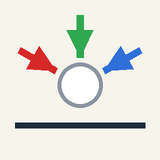
Coloured lights add up: red, green and blue together look white, which is how screens make every colour.
Step 1, white is a mixture. Sunlight looks colourless, yet it carries every colour of the rainbow at once. In 1666 Isaac Newton sent a sunbeam through a glass prism and got a band of colours, always in the same order: red, orange, yellow, green, blue, violet. That band is a spectrum.
Step 2, each colour has its own speed in glass. In empty space all colours travel equally fast, but glass holds violet back the most and red the least. Since bending comes from slowing down, violet bends the most and red the least. This sorting of colours by refraction is called dispersion. A flat window sorts them a tiny bit too, but its second face, parallel to the first, undoes the effect; a prism's tilted faces add up instead, so the fan opens wide.
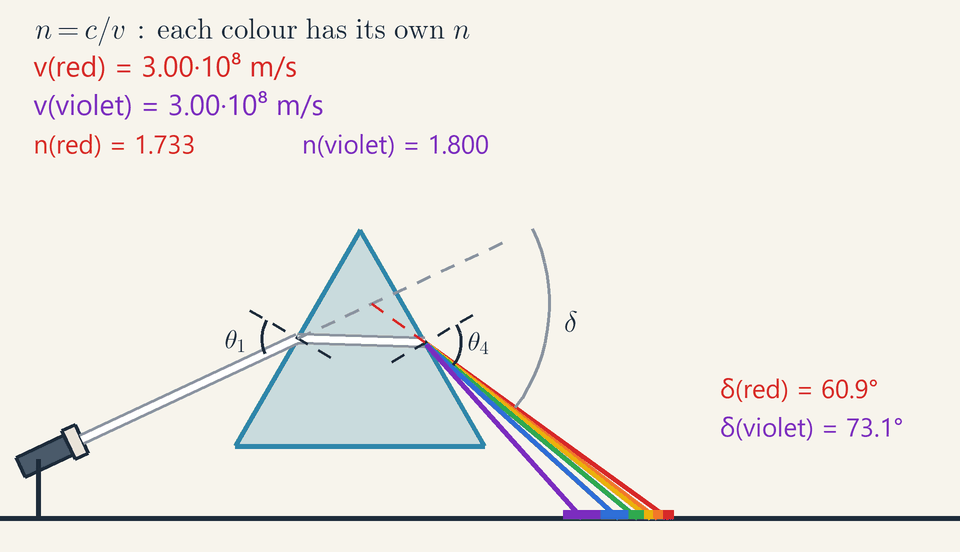
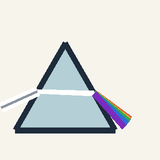
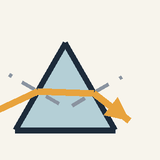
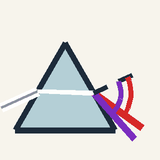
In the animation a torch shines white light into a prism: watch the beam cross the glass and fan out, painting a spectrum on the table.
Step 3, rainbows. Every raindrop works like a tiny prism with a mirror at the back: sunlight goes in, reflects off the back of the drop and comes out sorted, each colour at its own angle close to 42°. That is why a rainbow appears only with the Sun behind you and the rain in front, red on the outside of the bow.
Step 4, colours of things. A ripe tomato looks red because it swallows most colours and sends back mainly red. Lights, on the other hand, add up: red, green and blue together look white, which is how a phone screen builds every colour from three kinds of tiny dots.
Check yourself: under pure blue light, what colour does a ripe tomato look? Answer: almost black, because there is no red light for it to send back.
Intermediate
Key ideas
n depends on wavelength: nviolet>nred, so violet is slower in glass (v=c/n) and bends more.
Snell's law at each face: sinθ1=nsinθ2, then θ3=α−θ2, then sinθ4=nsinθ3.
Deviation δ=θ1+θ4−α; for a thin prism δ≈(n−1)α, so the colour spread is about Δnα.
In glass, violet light travels more slowly than red light. Light crosses empty space at c=3.00×10⁸m/s, whatever its colour. In a transparent material it is slower, at a speed v, and the refractive index says how many times slower: n=vc
Crossing a surface, light keeps its frequency f, because the far side is driven at the rate of the arriving wave; since v=fλ, it is the wavelength that shrinks, by the factor n. Colour goes with the frequency, so colours are labelled by their wavelength λ in vacuum: about 700 nm for red (f=4.3×10¹⁴Hz) and 400 nm for violet.
The index is slightly different for each colour, and that difference is dispersion. In glass and water it rises towards short wavelengths, following an empirical rule: n(λ)≈A+λ2B(Cauchy) The prism in the animation is a dense flint glass with A=1.700 and B=16000nm2, so nred=1.700+16000/7002=1.733 and nviolet=1.700+16000/4002=1.800. Water disperses less: 1.3305 for red, 1.3435 for violet. These small differences, 0.067 and 0.013, are all that separates the colours.
Two refractions in a prism
At each face, Snell's law holds with every angle measured from the normal to that face: n1sinθ1=n2sinθ2 For a prism of apex angle α in air, a ray is then followed in three steps:
sinθ1=nsinθ2
θ3=α−θ2
sinθ4=nsinθ3
The middle step is geometry: the ray inside and the two face normals form a triangle whose third angle is 180∘−α, so θ2+θ3=α. The ray turns by θ1−θ2 at the first face and by θ4−θ3 at the second, both times towards the base, so its total deviation is δ=θ1+θ4−α(prism of apex angle α)
For a thin prism, with small angles, the sines can be replaced by the angles: θ1+θ4≈n(θ2+θ3)=nα, and δ≈(n−1)α(thin prism) Two colours then separate by about (nviolet−nred)α. A window has α=0: every colour leaves parallel to the incoming beam, and the colours overlap again.
Worked example: the prism in the animation
The white beam meets the first face at θ1=55∘, and sin55∘=0.8192. For red, sinθ2=0.8192/1.733=0.4727, so θ2=28.2∘; for violet, sinθ2=0.8192/1.800=0.4551 and θ2=27.1∘. Inside the glass the paths are only 1.1∘ apart, so the animation draws one white beam there.
Both rays reach the second face at θ3=60∘−θ2: 31.8∘ for red, 32.9∘ for violet. On the way out, sinθ4=1.733⋅0.5267=0.9128 gives θ4=65.9∘ for red, and 1.800⋅0.5436=0.9785 gives 78.1∘ for violet. The deviations are δ=55∘+65.9∘−60∘=60.9∘ and 55∘+78.1∘−60∘=73.1∘, the values on the δ readouts. The 1.1∘ gap inside has grown to 12.2∘: violet leaves close to grazing, where a small change of sinθ4 makes a large change of angle.
The speed readouts drop from 3.00×10⁸m/s in air to c/n=2.998×108/1.733=1.73×108m/s for red and 1.67×10⁸m/s for violet inside the glass. The δ arc opens between the dashed straight-on direction and the red ray, and the colours land on the table in order, violet nearest the prism.
Worked example: a thin glass prism
A 10° prism of crown glass, the ordinary glass of lenses, has n=1.513 for red and 1.531 for violet. A narrow white beam crosses it almost at right angles and lands on a wall 2.0 m away. How wide is the spectrum?
With the thin-prism rule, δred≈0.513⋅10∘=5.13∘,δviolet≈0.531⋅10∘=5.31∘ The spread is 0.18∘, or 0.18⋅π/180=3.1×10−3rad, so on the wall the spectrum is about 2.0m⋅3.1×10−3=6.3mm wide, while the whole spot moves about 2.0tan5.2∘≈0.18m. An exact trace with Snell's law at 5∘ incidence gives 5.16∘ and 5.35∘: the rule is good to better than 1 %.
Cut from the animation's flint glass, the same prism gives 0.733⋅10∘=7.3∘ for red and 8.0∘ for violet: 1.4 times the deviation, but 3.7 times the spread, 0.67∘, which makes a spectrum 23 mm wide.
Raindrops and the rainbow angle
Sunlight enters a spherical raindrop at an angle of incidence θ, refracts to θ′ with sinθ=nsinθ′, reflects once off the back and refracts out, meeting the surface inside at the same θ′ each time because the drop is round. It turns by θ−θ′ on entering, by 180∘−2θ′ at the back and by θ−θ′ on leaving, 180∘+2θ−4θ′ in all, so it comes back at an angle from the direction opposite the Sun of φ=4θ′−2θ
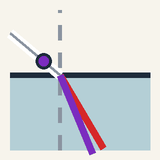
In the animation the white ray enters at θ=59.3∘ (sinθ=0.86). For red, sinθ′=0.86/1.3305=0.6464, so θ′=40.27∘ and φ=4⋅40.27∘−2⋅59.32∘=42.4∘. Violet, with n=1.3435, has θ′=39.80∘ and φ=40.6∘: the two φ readouts. Rays entering higher or lower return at smaller angles, so the light gathers near this largest angle.
Drops lying 42.4∘ from the point opposite the Sun (the shadow of your head) therefore send you red, and those at 40.6∘ send violet: red is the outer edge of the bow. The Sun must be behind you and less than 42° above the horizon, or the bow lies below the horizon.
Adding lights, subtracting paints
The eye has three kinds of colour receptors (cones), most sensitive to red, green and blue light. Lights falling on one spot add up: red plus green excites the cones much as spectral yellow at 580 nm does, so the spot looks yellow, and red, green and blue together look white. Screens build their colours from tiny red, green and blue dots in this way.
Paints, inks and filters subtract: each absorbs part of the light, and the eye receives what survives. Yellow paint absorbs blue and cyan paint absorbs red, so their mixture returns only green. An object's colour also depends on the light: under pure blue light a ripe tomato has no red to send back and looks almost black.
Common mistakes
The prism does not create colours: it sorts those already in white light, and a reversed second prism merges them back into white.
Light does not change colour in glass. Red light keeps its frequency of 4.3×10¹⁴Hz; its wavelength shrinks from 700 nm to 700/1.733=404nm, yet it is still red.
A larger index means slower light, not faster: violet, with n=1.800, crosses the glass at 1.67×10⁸m/s, red at 1.73×10⁸m/s.
The thin-prism rule needs a thin prism. For the 60° prism of the animation, (n−1)α gives 44∘ for red instead of 60.9∘, and a spread of 4.0∘ instead of 12.2∘. And nα is wrong for any prism: only the excess of n over 1 bends light.
Mixing lights is not mixing paints: red and green light make yellow, but red and green paint make a dull brown, because each paint absorbs most of what the other returns.
Where you meet it
Spectrometers spread light from stars, flames and lamps into spectra that reveal what the source is made of, and cut diamonds flash with colour because diamond has a large index, 2.42, and strong dispersion. In lenses dispersion is a nuisance: a simple lens focuses violet closer than red, and a crown lens cemented to a weaker diverging flint lens cancels most of the error, as Lenses and Mirrors and The Eye, Cameras and Telescopes show. In optical fibres it smears out short pulses. Gratings, in Diffraction and the Double Slit, sort colours by interference instead and bend red the most, the reverse of a prism.
Advanced
Key ideas
Driven bound electrons re-radiate a lagging wave: n=1+Nqe2/(2ε0m(ω02−ω2)) rises towards the UV resonance.
Signals move at the group velocity c/ng, ng=n−λdn/dλ>n: pulses spread, and n<1 for X-rays breaks nothing.
Rainbow: φ=4θ′−2θ is stationary where cos2θ=(n2−1)/3, so rays pile up at 42.4∘ (red) and 40.6∘ (violet).
Molecules scatter in proportion to ω4, so the sky is blue; colour itself is the eye's three-cone summary of a spectrum.
Why light is slower in glass
The refractive index n says how many times more slowly light travels in a material than in vacuum, and the prism shows that n depends on colour. To see why, look at what glass is made of: nuclei and bound electrons, with empty space between them in which every electric field travels at exactly c. The slower wave in glass must therefore be a combined effect. The arriving wave shakes the electrons, the shaking electrons radiate, and their radiation adds to the arriving wave. This section sets up the two pieces; the next one adds them.
In the Lorentz model each electron, of charge qe and mass m, is held in place by a spring-like force, so that left alone it would oscillate at a natural frequency ω0. The light's electric field at the electron is E0eiωt, where ω is the light's angular frequency and the physical field is the real part. Newton's second law and its steady solution are x¨+ω02x=mqeE0eiωtx=m(ω02−ω2)qeE0eiωt To get the solution, try x∝eiωt, so that x¨=−ω2x, and solve for the amplitude. The electron oscillates at the driving frequency, not at its own. Below resonance, ω<ω0, the factor ω02−ω2 is positive, so the dipole qex moves in step with the field, and its amplitude grows as ω approaches ω0.
Now take a thin slab of the material, of thickness Δz, across the beam, with N electrons per unit volume. Seen along the beam it is a flat sheet carrying a charge NqeΔz per unit area, all oscillating together in the plane of the sheet. Such a sheet radiates a plane wave on each side, with a field proportional to the velocity of its charges (a result from Electromagnetic Waves; ε0 is the permittivity of free space): Ea=−2ε0cNqeΔzx˙ Because the slab is thin, Ea is small. What matters most is its timing: it follows the velocity x˙, not the displacement x, and that shifts it by a quarter cycle.
One thin slab delays the wave
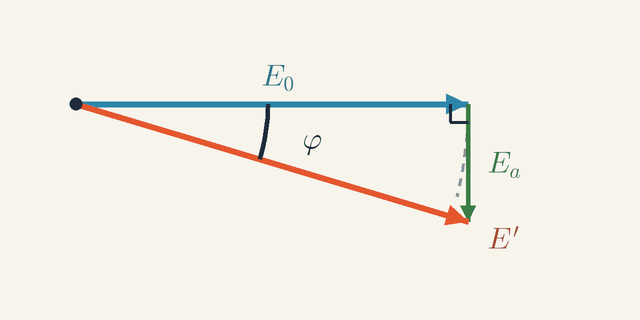
Two waves of the same frequency add like arrows. Figure 1 uses this to show how a small wave a quarter cycle behind turns into a delay of the whole wave, which is what a lower speed means.
Figure 1. The wave E0 arriving at a thin slab and the small wave Ea radiated by its electrons, a quarter cycle behind, add up to E′: almost as long as E0 but turned back by φ, which is what a delay looks like. Angle exaggerated. Not to scale.Legend
E0
Wave arriving at the slab, drawn as an arrow whose length is its amplitude and whose direction is its phase.
V/m
Ea
Wave radiated by the electrons of the slab: small, and a quarter cycle behind E0, so drawn at a right angle, clockwise.
V/m
E′
Wave beyond the slab: the sum of E0 and Ea.
V/m
φ
Angle from E0 to E′: the phase delay ω(n−1)Δz/c added by the slab, equal to ∣Ea∣/∣E0∣.
rad
In Figure 1 each wave is an arrow in the complex plane: its length is the amplitude and its direction is the phase, with the common factor eiωt left out. Beyond the slab both waves travel on at c, so the factor they pick up on the way is also common to both and is left out too. The arriving wave E0 is the horizontal arrow.
To find the direction of Ea, put the electron's motion into its formula. Since x˙=iωx, Ea=−i2ε0mc(ω02−ω2)ωNqe2ΔzE0 Below resonance the fraction is positive (the sign of qe drops out, since only qe2 appears), so Ea is E0 times a small positive number times −i. Multiplying by −i=e−iπ/2 turns an arrow a right angle clockwise, and it is the same as replacing t by t−T/4, where T is the period: the wave is a quarter cycle late. That is the short arrow Ea, pointing straight down.
Beyond the slab the two add, and their sum E′ is the diagonal. Look at the right-angled triangle. Because Ea is perpendicular to E0 and much shorter, E′ has the length of E0 to first order (the change in length is of second order in ∣Ea∣/∣E0∣), but it is turned clockwise by a small angle φ=∣Ea∣/∣E0∣. Turned clockwise means behind in phase. The figure draws φ large so that the pieces can be seen; for a thin slab it is tiny.
Now compare with what a slower wave would do. Suppose the light really crossed the slab at speed c/n. It would take nΔz/c instead of Δz/c, so it would arrive later by (n−1)Δz/c, and its arrow would be turned back by the phase φ=ω(n−1)Δz/c. For small φ, the wave beyond the slab would be multiplied by e−iφ≈1−iφ=1−ciω(n−1)Δz that is, the original wave plus a small piece a quarter cycle behind, of relative size φ: exactly the shape of E0+Ea in Figure 1. The two descriptions agree when the small pieces are equal. Setting ω(n−1)Δz/c equal to the fraction in Ea above, the factors ω, Δz and c cancel and leave n=1+2ε0m(ω02−ω2)Nqe2
This is the index of a dilute material. Each layer pulls the phase back a little, by an amount set by how strongly the electrons respond, and that depends on ω: dispersion is built into the mechanism. As a check on the size, take air with one effective electron per molecule, N=2.5×1025m−3, resonating near 100 nm. The formula gives n−1≈1×10⁻⁴, the right order of magnitude for the measured 2.9×10⁻⁴.
Below resonance: Cauchy's law and the blue sky
Visible light sits at the low-frequency end of this formula, and expanding it there gives the simple law used for prisms. Glass and water have their strong resonances in the ultraviolet, so for visible light ω is well below ω0. Figure 3, in a later section, draws the whole curve.
First name the low-frequency limit. At ω=0 the formula gives n=A, with A−1=Nqe2/(2ε0mω02), so for any ω n−1=1−ω2/ω02A−1≈(A−1)(1+ω02ω2) using 1/(1−u)≈1+u for small u. With ω=2πc/λ and the resonance wavelength λ0=2πc/ω0, the ratio ω2/ω02 equals λ02/λ2. The result is Cauchy's law, n≈A+B/λ2 with B=(A−1)λ02.
Read backwards, a measured A and B say where the resonance is. The animation's fits give λ0=16000/0.700≈150nm for the flint glass (A=1.700, B=16000nm2) and 3090/0.3242≈100nm for water (A=1.3242, B=3090nm2), both in the ultraviolet, as expected.
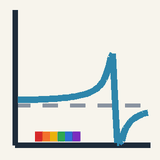
Cauchy's law also explains why a prism spreads the violet end of the spectrum more than the red. The animation's first expert graph plots n(λ) from 400 to 700 nm, with a dot for each beam colour. Its slope, dn/dλ=−2B/λ3, is −9.3×10⁻⁵nm−1 at 700 nm and −5.0×10⁻⁴nm−1 at 400 nm. Because of the cube, the curve is (7/4)3≈5.4 times steeper at the violet end.
The prism then turns each difference in index into a difference in angle. Let its apex angle be α (60° in the animation). A ray meets the first face at the angle of incidence θ1 (55°) and refracts to θ2; it meets the second face at θ3 and leaves at θ4. Snell's law at the two faces gives sinθ1=nsinθ2 and sinθ4=nsinθ3, and the triangle gives θ2+θ3=α. Now change n slightly, keeping θ1 fixed. The first relation gives ncosθ2dθ2=−sinθ2dn, and the triangle gives dθ3=−dθ2. Put both into the differential of the second relation, cosθ4dθ4=sinθ3dn+ncosθ3dθ3, and use sinθ3cosθ2+cosθ3sinθ2=sinα: dndθ4=cosθ2cosθ4sinα
For the animation's prism this is 2.4 rad per unit of n for red. For violet, whose exit ray leaves close to grazing so that cosθ4 is small, it is 4.7. Both effects favour the violet end. Per nanometre of wavelength, the exit angle changes by 2.4⋅9.3×10−5≈2.2×10⁻⁴ rad at 700 nm but by 4.7⋅5.0×10−4≈2.4×10⁻³ rad at 400 nm, about ten times more: the violet end of the fan is stretched.
The same driven electrons also radiate sideways, and this gives the sky its colour. Far below resonance the amplitude qeE0/(m(ω02−ω2)) hardly depends on ω, because ω2 is small next to ω02. An oscillating dipole radiates power in proportion to the square of its acceleration, and the acceleration is ω2x, so the radiated power grows as ω4x2, that is, as ω4. Air molecules therefore scatter sunlight in proportion to ω4 (Rayleigh scattering): (650/450)4≈4.4 times more at 450 nm than at 650 nm. The blue light scattered out of the sunbeam fills the sky, and what is left after a long path through air, as at sunset, is red.
Phase velocity and group velocity
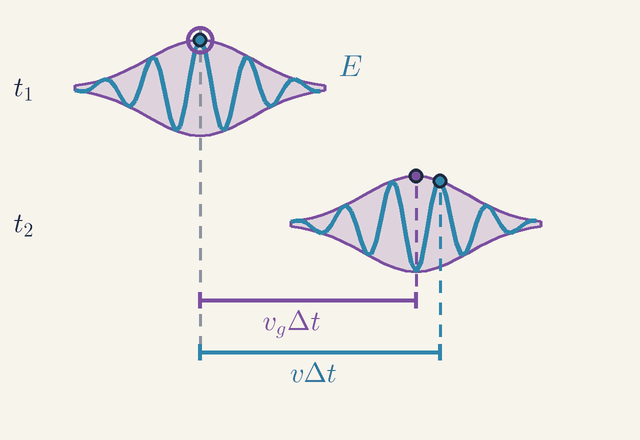
A prism separates colours in space. In a long piece of glass, dispersion also separates them in time, because a pulse does not travel at the speed of the crests inside it. Figure 2 shows the two speeds side by side.
Figure 2. A short pulse of violet light in the flint glass at two instants. The marked crest moves by vΔt, the peak of the envelope only by vgΔt, so the crests slip forward through the pulse. Not to scale: a real pulse holds far more crests.Legend
t1
First instant.
s
t2
A later instant; Δt=t2−t1.
s
E
Electric field of the pulse: the blue curve, whose crests move at the phase velocity, under a shaded envelope.
V/m
vΔt
Distance a crest travels between t1 and t2: the phase velocity v=c/n times Δt.
m
vgΔt
Distance the peak of the envelope travels in the same time: the group velocity vg=c/ng times Δt.
m
Figure 2 follows a short pulse of violet light through the flint glass, drawn at two instants t1 and t2, a time Δt apart. The blue curve is the electric field E: a train of crests under a smooth envelope, the shaded outline. The crests move at the phase velocity v=c/n, the speed of the crests of an endless wave of one frequency, so the marked crest advances vΔt, the longer blue distance. The envelope moves at a different speed, the group velocity vg, and advances only vgΔt, the shorter purple distance. Watch the peak of the envelope: at t1 the marked crest sits on it, and by t2 the crest has moved ahead of it.
The figure uses the animation's glass at 400 nm, where n=1.800 and, as computed below, the group index ng=c/vg is 2.000. In the same time the crests cross five wavelengths and the envelope only 5⋅1.800/2.000=4.5. So the crest that sat on the peak at t1 is half a wavelength ahead of it at t2, and the peak now sits on a trough. Crests keep appearing at the tail of the pulse, running forward through it, and fading at its head.
Why does the envelope have its own speed? A pulse, like any signal, is a change in the wave, and a changing wave is a mixture of neighbouring frequencies. Take just two, at ω±δω, with wavenumbers k±δk. Their sum is a wave at ω and k whose amplitude varies as cos(δωt−δkz), and that pattern moves at δω/δk. For a narrow band of frequencies this becomes vg=dkdω
In the glass k=nω/c, with n depending on ω, so dk/dω=(n+ωdn/dω)/c. Since λ=2πc/ω, a small change gives dλ/λ=−dω/ω, hence ωdn/dω=−λdn/dλ. The group index is therefore ng=vgc=n+ωdωdn=n−λdλdn
In normal dispersion n falls as λ grows, dn/dλ<0, so ng>n: pulses move more slowly than the crests inside them. With Cauchy's law, −λdn/dλ=2B/λ2 and ng=A+3B/λ2. That is 1.798 for red and 2.000 for violet in the animation's glass, against phase indices of 1.733 and 1.800.
Near a resonance: absorption and anomalous dispersion
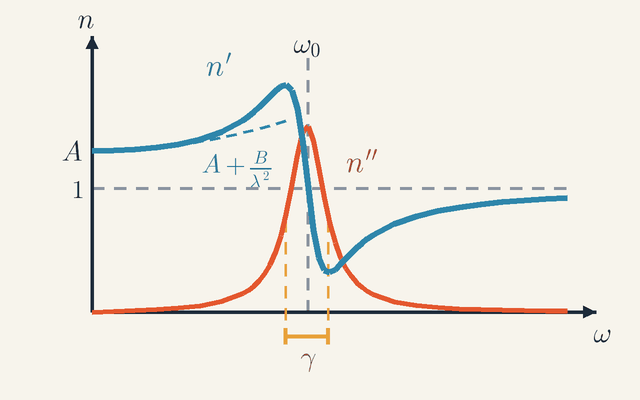
Cauchy's law is only the low-frequency tail of the oscillator's index, and near ω0 the index formula above blows up, which no real material does. Real electrons also lose energy, to collisions and to their own radiation. Model that loss by a friction term γx˙ in the equation of motion, where γ is the damping rate. The factor ω02−ω2 then becomes ω02−ω2+iγω, and the index becomes a complex number, written n=n′−in′′ with n′ and n′′ real: n=1+2ε0m(ω02−ω2+iγω)Nqe2
Figure 3. Real and imaginary parts of the damped oscillator's index n=n′−in′′ against frequency. Far below ω0, n′ rises slowly from A, as Cauchy's form says; near ω0 the absorption n′′ peaks with width γ and n′ falls through 1; far above, n′ returns to 1 from below.Legend
n
Refractive index, here a complex number n=n′−in′′; the two curves are its parts.
n′
Real part of the index: the crests move at c/n′.
n′′
Imaginary part of the index: it sets how fast the wave is absorbed.
ω
Angular frequency of the light.
rad/s
ω0
Natural frequency of the electrons: the resonance.
rad/s
γ
Damping rate; it is also the width of the absorption peak at half its height.
rad/s
A
Index at very low frequency, where n′ starts: the constant term of Cauchy's form.
A+λ2B
Cauchy's form (dashed): it follows n′ well below the resonance and fails near it.
Figure 3 plots n′ and n′′ against ω. Start at the left. At ω=0 the real part n′ starts at A and rises slowly, and the dashed Cauchy form A+B/λ2 follows it closely: this is the stretch where the prism and the rainbow live. Approaching ω0, the dashed form fails. The real part n′ climbs to a peak, falls steeply through 1 exactly at ω=ω0, dips to a minimum below 1, and then creeps back up to 1 from below. The imaginary part n′′ is almost zero away from the resonance and forms a peak centred on ω0, whose width at half its height is γ.
What n′′ means: a wave that has travelled a distance z through the material carries the factor ei(ωt−nωz/c). With n=n′−in′′ this splits into ei(ωt−n′ωz/c), a wave whose crests move at c/n′, times e−ωn′′z/c, an amplitude that shrinks with distance. So n′′ is absorption. Figure 3 shows it strong only within about γ of ω0: the material is opaque near its resonance and transparent away from it.
Across that absorption band n′ falls as the frequency rises, the steep stretch of Figure 3. This is anomalous dispersion: inside the band the order of colours a prism would give is reversed. The link between absorption and dispersion is not a quirk of the model. The Kramers–Kronig relations, which follow from causality alone (no response before its cause), make it exact: a material whose index differs from 1 must absorb somewhere in the spectrum.
At the right of Figure 3, above all resonances, the correction to n changes sign and n′ is below 1. For X-rays every electron is nearly free, and glass has n≈1−3×10⁻⁶ at 0.1 nm, so the crests travel faster than c. No signal does. Here 1−n is proportional to λ2, so −λdn/dλ=2(1−n), and the group index formula gives ng=1+3×10⁻⁶. An index below 1 also means that X-rays striking a polished surface at grazing angles under about 0.15° are totally reflected, the principle of X-ray telescope mirrors.
Real materials have several resonances. Summing their contributions gives the Sellmeier form n2=1+∑kBkλ2/(λ2−λk2), where each λk is a resonance wavelength and Bk its strength. The electronic terms lie in the ultraviolet and the terms from vibrating ions in the infrared. Between them, the group index of silica has a minimum near 1.3 µm, where pulses of slightly different wavelengths travel at the same speed: the zero-dispersion wavelength of telecom fibres.
Free electrons, as in a plasma, feel no restoring force, so ω0=0. The full treatment then gives n2=1−ωp2/ω2, with the plasma frequency ωp defined by ωp2=Nqe2/(ε0m); the dilute formula with ω0=0 gives its first-order form, n≈1−ωp2/(2ω2). Below ωp, n2 is negative and the wave cannot travel through: it is reflected. For the ionosphere's 1012 electrons per cubic metre, ωp/2π≈9MHz, so radio waves of lower frequency sent straight up come back down.
The rainbow as a stationary angle
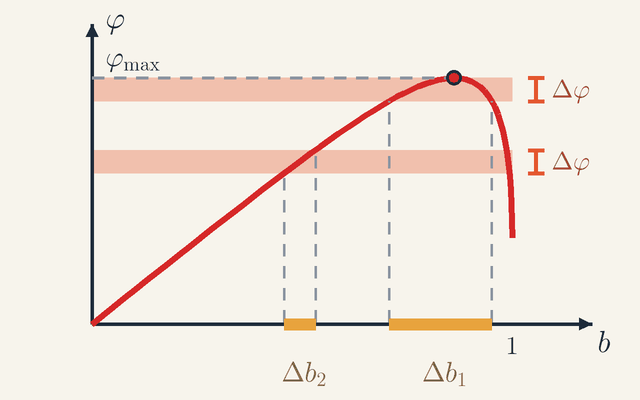
Water's index changes by only about 1% across the visible spectrum, from 1.3305 for red at 700 nm to 1.3435 for violet at 400 nm, yet a rainbow separates the colours cleanly. The reason is geometric: a drop sends the light it reflects once inside mostly in one direction, and that direction depends on n. Figure 4 shows where the preferred direction comes from.
Figure 4. Exit angle φ against impact parameter b for red light, once reflected inside a water drop. Two bands of equal height Δφ: the one at the flat top φmax is fed by a range Δb1 about three times wider than the range Δb2 that fills the lower one.Legend
b
Impact parameter of a ray: its distance from the axis of the drop in units of the radius, b=sinθ, with θ the angle of incidence.
φ
Angle between the exit ray and the antisolar direction (straight away from the Sun), φ=4θ′−2θ, with θ′ the angle of refraction.
rad
φmax
The largest exit angle, at the flat top of the curve: the rainbow angle.
rad
Δφ
Height of each shaded band: the same small range of exit angles in both.
rad
Δb1
Range of b whose rays leave in the upper band: wide, because the curve is flat there.
Δb2
Range of b on the rising slope whose rays leave in the lower band: narrow, because the curve is steep there.
Figure 4 is for red light and for the rays that enter a spherical drop, are reflected once inside and leave. Sunlight falls evenly on the drop's face. Label each ray by its impact parameter b: its distance from the axis through the centre of the drop parallel to the sunlight, in units of the drop's radius. A ray that meets the surface at the angle of incidence θ has b=sinθ, and it refracts into the drop at θ′ with sinθ=nsinθ′. Each of the two refractions turns the ray by θ−θ′ and the reflection turns it by 180∘−2θ′, so altogether it turns by 180∘+2θ−4θ′. The vertical axis is the angle φ between the exit ray and the antisolar direction, the direction straight away from the Sun; it is 180∘ minus the total turn: φ(b)=4θ′−2θ
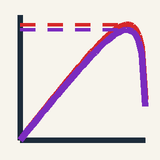
Now follow the curve. It rises from zero at the centre, b=0, where the ray goes straight in and straight back. It levels off at a maximum φmax, then falls to about 15° at the edge, b=1, where its tangent becomes vertical. The animation's second expert graph shows the top of this curve, for b from 0.5 to 1.
The two shaded bands have the same height Δφ: one on the rising slope, one at the top. Follow each band down to the b axis to see which rays end up in it. On the steep slope only a narrow range Δb2 of rays falls into the band, plus a thin sliver of edge rays near b=1, where the curve plunges back down through it. At the flat top a range Δb1 about three times wider does.
The rays must also be counted by area: those with impact parameter between b and b+db hit a ring of the drop's face whose area is proportional to bdb, so rays far from the centre count more. With this weighting the upper band collects about 40% of all the once-reflected red rays and the lower band only about 9%. That is the whole effect: where φ is stationary, many rays leave in almost the same direction, and that direction looks bright.
To find the top, set dφ/dθ=0. From φ=4θ′−2θ this needs dθ′/dθ=21. Differentiating Snell's law gives cosθdθ=ncosθ′dθ′, so at the top 2cosθ=ncosθ′. Square this and replace n2cos2θ′=n2−n2sin2θ′=n2−sin2θ. Then 4cos2θ=n2−sin2θ=n2−1+cos2θ, which gives φ=4θ′−2θ,cos2θ=3n2−1(rainbow)
For red, cos2θ=(1.33052−1)/3=0.2567, so θ=59.6∘ (b=0.862), θ′=40.4∘ and φmax=42.4∘. For violet, n=1.3435 gives b=0.855 and φmax=40.6∘. Red light thus comes back at up to 42.4° from the antisolar point and violet only up to 40.6°, so red is on the outside of the bow. The animation's ray, at b=0.86, sits almost on both maxima, which its dashed lines mark.
How sharp is the edge of the bow? Near its top, φmax−φ grows as the square of the distance from the top along the b axis. Turned round, the range of b that lands within an angle δ of the top grows only like δ, so the number of rays per unit angle grows like 1/φmax−φ as φ approaches φmax. In numbers, about a fifth of the once-reflected red rays leave within 1° of the maximum, some fifteen times more than in a 1° band around 20°. Beyond φmax none arrives at all, so the sky just inside the bow is brighter than just outside it.
Rays reflected twice inside the drop give a second bow. For them φ2=180∘+2θ−6θ′, which is stationary, now at a minimum, where cos2θ=(n2−1)/8: at 50.2° for red and 53.6° for violet. This secondary bow is fainter, because light is lost at each reflection, and its colours are reversed, with red inside. Between 42.4° and 50.2° neither kind of ray arrives, so the band of sky between the two bows is darker.
Worked problem: a flash through the flint glass
Suppose the prism's flint glass (A=1.700, B=16000nm2) is drawn into a fibre 1.00 km long, and a short flash of white light is sent in. How far apart in time do its red (700 nm) and violet (400 nm) parts arrive, and what would the ordinary phase indices predict?
Each colour travels as a pulse, so it moves at its group velocity, and the group index is the one to use. With Cauchy's law, dn/dλ=−2B/λ3, so ng=n−λdλdn=A+λ23B Here B/λ2 is 16000/7002=0.03265 for red and 16000/4002=0.1000 for violet, giving ng,red=1.700+3⋅0.03265=1.798 and ng,violet=1.700+3⋅0.1000=2.000. Each part needs t=Lng/c: 5.997μs for red and 6.671μs for violet. The delay between them is Δt=cL(ng,violet−ng,red)(ng=n−λdλdn) Δt=2.998×1081000⋅0.202=674ns
With the phase indices instead, nviolet−nred=0.1000−0.03265=0.06735 and 1000⋅0.06735/(2.998×108)=225ns, three times too little. What stretches a pulse is how fast n changes with colour, not the size of n itself. A 1 ns white flash therefore leaves the fibre as a streak about 0.67 µs long, red first. Telecom links avoid this by sending laser light only 0.1 nm wide through silica near 1.55 µm, where the spread is about 17 ps per nanometre of bandwidth per kilometre: under 2 ps per kilometre.
Limits of validity
The oscillator model is classical. Quantum mechanics keeps its form but changes its meaning: each resonance is an atomic transition from the ground state, of energy Eg, to an excited state of energy Ek, with ℏωk=Ek−Eg, and each enters with a weight called its oscillator strength. The dilute result also ignores the field of neighbouring dipoles. In a dense solid that local field changes the result to (n2−1)/(n2+2)=Nqe2/(3ε0m(ω02−ω2)), which reduces to ours when n is close to 1. Inside an absorption band the group velocity can exceed c or even turn negative. The pulse is then strongly reshaped, its peak no longer marks a signal, and the front of any signal still never outruns c.
The ray picture of the rainbow needs drops much larger than the wavelength. In smaller drops, rays that leave at the same angle by different paths interfere and add faint supernumerary bands just inside the violet. In fog, droplets about d=10 µm across blur each colour by roughly λ/d≈3∘, more than the nearly 2° between red and violet, so a fog bow is almost white.
Finally, colour is not wavelength. The eye reduces any spectrum to three cone signals, so a mixture of red and green light can match spectral yellow exactly, and no screen with three primaries can show every spectral colour.
Where this leads
The driven oscillator is the one of Damping and Resonance, now at optical frequencies, and the radiating sheet of charge belongs to Electromagnetic Waves. The rainbow's stationary angle echoes Fermat's principle from Reflection and Refraction: there the travel time is stationary, here the exit angle, and in both cases neighbouring rays reinforce one another. Colour errors of lenses and their cure return in Lenses and Mirrors and in The Eye, Cameras and Telescopes; gratings, which sort colours by interference, in Diffraction and the Double Slit; and the partial polarisation of the blue sky in Polarization of Light. The resonance frequencies themselves come from atomic energy levels, which Atomic Models: the Bohr Atom begins to explain.
Key formulas
Refractive index
n=vc
The index compares the speed of light in vacuum with its speed in a material: n=1.5 means the crests move 1.5 times more slowly than in vacuum. The slowing comes from the material's electrons, which the wave shakes and which radiate a wave lagging behind it. Their response depends on frequency, so n is slightly different for every colour.
Symbols
n
refractive index of the material for the colour considered
c
speed of light in vacuum
m/s
v
speed of the wave crests in the material (phase velocity)
m/s
When it holds: Gives the speed of the crests. A pulse travels at the group velocity c/ng, which is lower in glass; for X-rays n is slightly below 1, and no signal goes faster than c.
Example: Red light in the animation's flint glass: v=2.998×10⁸/1.733=1.73×108m/s; violet, with n=1.800, only 1.67×10⁸m/s.
Cauchy's dispersion law
n(λ)≈A+λ2B(Cauchy)
An empirical fit to the way the index of a transparent material grows towards short wavelengths. It is the start of a series expansion of the resonance formula for frequencies well below the material's ultraviolet resonances: A is the index for very long wavelengths and B measures the dispersion.
Symbols
n
refractive index at the wavelength λ
λ
wavelength in vacuum
nm
A
index in the long-wavelength limit
B
dispersion coefficient
nm2
When it holds: Good across the visible for glass and water. It fails near absorption bands, in the ultraviolet and the infrared, where the full resonance (Sellmeier) form is needed.
Example: Flint glass with A=1.700 and B=16000nm2: n=1.733 at 700 nm, 1.748 at 580 nm and 1.800 at 400 nm.
Snell's law of refraction
n1sinθ1=n2sinθ2
The wave crests on the two sides of a boundary must match along it, and both sides share one frequency, so the ray turns until nsinθ is the same on both sides. Entering the denser medium it bends towards the normal. For a prism in air apply it twice: sinθ1=nsinθ2 at entry and sinθ4=nsinθ3 at exit.
Symbols
n1
refractive index of the first medium
θ1
angle of incidence, from the normal
rad
n2
refractive index of the second medium
θ2
angle of refraction, from the normal
rad
When it holds: Holds at any smooth boundary between isotropic materials, for each colour with its own index. Leaving the denser medium, it has no solution beyond the critical angle: the light is totally reflected.
Example: Red entering the flint prism at 55∘: sinθ2=0.8192/1.733=0.4727, so θ2=28.2∘; violet bends to 27.1∘.
Deviation by a prism
δ=θ1+θ4−α(prism of apex angle α)
The ray turns by θ1−θ2 at the first face and by θ4−θ3 at the second, both times towards the base. The two inner angles add up to the apex angle, θ2+θ3=α, because they lie in a triangle with the two face normals, so the total turn is θ1+θ4−α.
Symbols
δ
angle of deviation, between incoming and outgoing directions
rad
θ1
angle of incidence on the first face
rad
θ4
angle of the emerging ray from the normal to the second face
rad
α
apex angle of the prism
rad
When it holds: Exact for a ray crossing two plane faces in the plane of the prism, without internal reflection; each colour is traced separately. For a given colour the deviation is smallest when the ray crosses the prism symmetrically.
Example: In the animation red leaves at 65.9∘: δ=55∘+65.9∘−60∘=60.9∘; violet, leaving at 78.1∘, is deviated by 73.1∘.
Deviation by a thin prism
δ≈(n−1)α(thin prism)
For small angles the sines in Snell's law can be replaced by the angles, so θ1+θ4≈n(θ2+θ3)=nα. Only the excess of n over 1 bends the light: a prism with n=1 would not deviate it at all. Two colours separate by about (nviolet−nred)α.
Symbols
δ
angle of deviation
rad
n
refractive index of the prism for that colour
α
apex angle (small)
rad
When it holds: For apex angles and angles of incidence up to about 10–15°; δ and α may be in degrees, as long as both are. For the 60° prism of the animation it gives 44∘ for red instead of 60.9∘.
Example: A 10° crown-glass prism with n=1.513 for red: δ≈0.513⋅10∘=5.13∘, and 5.31∘ for violet.
Arrival delay between two colours (group index)
Δt=cL(ng,violet−ng,red)(ng=n−λdλdn)
A flash travels at the group velocity c/ng, so crossing a length L takes Lng/c, and two colours arrive LΔng/c apart. The group index exceeds the ordinary index by −λdn/dλ: a pulse is a group of nearby wavelengths, and its envelope moves where they stay in step, which depends on how fast n changes with wavelength.
Symbols
Δt
delay between the two arrivals
s
L
length of the path in the material
m
ng,violet
group index for violet light
ng,red
group index for red light
c
speed of light in vacuum
m/s
ng
group index
n
refractive index (phase index)
λ
wavelength in vacuum
nm
dλdn
slope of the index against wavelength, negative in normal dispersion
nm−1
When it holds: Holds away from absorption bands, where a pulse keeps its shape apart from this spreading. Near a resonance the group velocity no longer gives the speed of a signal.
Example: 1.00 km of the animation's flint glass: ng=1.798 for red and 2.000 for violet, so Δt=1000⋅0.202/(2.998×108)=674ns.
Rainbow angle and the rainbow ray
φ=4θ′−2θ,cos2θ=3n2−1(rainbow)
A ray turns by θ−θ′ on entering a drop, by 180∘−2θ′ at the back and by θ−θ′ on leaving, 180∘+2θ−4θ′ in all, so it returns at φ=4θ′−2θ from the direction opposite the Sun. As the entry point moves outwards, φ rises to a maximum and falls again; at the maximum dφ/dθ=0, which with Snell's law gives cos2θ=(n2−1)/3. Rays near that angle leave almost together, so the light piles up into the bow.
Symbols
φ
angle between the returning ray and the direction opposite the Sun
rad
θ′
angle of refraction inside the drop
rad
θ
angle of incidence on the drop
rad
n
refractive index of water for that colour
When it holds: Ray optics, one internal reflection, spherical drops much larger than the wavelength; small drops add interference fringes and fog droplets blur the bow almost white. Two reflections give the secondary bow, stationary where cos2θ=(n2−1)/8.
Example: Red, n=1.3305: cos2θ=0.2567, θ=59.6∘, θ′=40.4∘, so φ=4⋅40.39∘−2⋅59.56∘=42.4∘.
Glossary
Refractive index
The ratio n=c/v of the speed of light in vacuum to its speed in a material: about 1.33 for water and 1.5–1.8 for glasses. It differs slightly from one colour to another.
Dispersion
The dependence of a wave's speed, and so of the refractive index, on wavelength. It makes a prism or a raindrop send each colour off at its own angle, and it spreads short pulses in a fibre.
Normal dispersion
The usual case in transparent materials: n rises as the wavelength falls (dn/dλ<0), so violet is slowed and bent more than red.
Anomalous dispersion
The reverse behaviour inside an absorption band, where the index falls as the frequency rises. It is anomalous only by history: the same resonance causes both kinds.
Spectrum
The band of colours obtained by sorting light by wavelength, from red (about 700 nm) through orange, yellow, green and blue to violet (about 400 nm).
Angle of deviation
The angle δ between the direction of a ray before the prism and the direction it leaves in. It is not the angle of refraction, which is measured from the normal at one face.
Thin prism
A prism with a small apex angle, for which the deviation is about (n−1)α for any small angle of incidence. A 10° crown-glass prism deviates light by about 5°.
Primary rainbow
Sunlight refracted into raindrops, reflected once inside and refracted out, concentrated on a cone of about 42° around the point opposite the Sun, red outside and violet inside. A fainter secondary bow, from two reflections, lies at 50–54° with the colours reversed.
Group velocity
The speed c/ng of a pulse or any other modulation, which carries signals and energy. In normal dispersion it is lower than the phase velocity c/n of the crests.
Additive colour mixing
Mixing lights: their effects on the eye's three kinds of cones add up. Red and green light make yellow, and red, green and blue make white, as on a screen.
Subtractive colour mixing
Mixing paints, inks or filters: each absorbs part of the light, and only what all of them return remains. Yellow and cyan paint make green.
Rayleigh scattering
Scattering of light by particles much smaller than the wavelength, such as air molecules, in proportion to ω4, that is 1/λ4. It makes the sky blue and the setting Sun red.
Quantities
n
Refractive index
Speed of light in vacuum divided by its speed in the material; here it depends on the wavelength, n(λ).
c
Speed of light in vacuum
m/s
c=2.998×10⁸m/s, the same for every colour.
v
Speed of light in the material
m/s
The speed of the wave crests (phase velocity), c/n: 1.73×10⁸m/s for red and 1.67×10⁸m/s for violet in the animation's flint glass.
λ
Wavelength in vacuum
nm
Labels the colour: about 700 nm for red, 400 nm for violet. Inside a material the wavelength is shorter, λ/n (written λ0 and λ0/n in Reflection and Refraction), while the frequency stays the same.
B
Cauchy coefficient
nm2
Sets how fast n grows towards short wavelengths in n≈A+B/λ2, where the dimensionless A is the index at long wavelengths. The animation's flint glass has A=1.700 and B=16000nm2.
θ1
Angle of incidence
rad
Angle between the incoming ray and the normal to the first face, 55∘ in the animation; every angle in Snell's law is measured from the normal. The angles θ2 and θ3 are those inside the glass and θ4 is that of the emerging ray, all measured from the normals; n1 and n2 are the indices on either side of a face.
α
Apex angle
rad
Angle between the two faces the light crosses: 60∘ for the animation's prism, 10∘ for the thin prism of the worked example.
δ
Angle of deviation
rad
Total turn of the ray, from its incoming to its outgoing direction: 60.9∘ for red and 73.1∘ for violet in the animation.
φ
Rainbow angle
rad
Angle between a ray returning from a drop and the direction opposite the Sun; its maximum, 42.4∘ for red and 40.6∘ for violet, is where the bow appears. In φ=4θ′−2θ, θ is the angle of incidence on the drop and θ′ the angle of refraction inside it.
ng
Group index
ng=n−λdn/dλ, the speed of light in vacuum divided by the speed of a pulse: 1.798 for red and 2.000 for violet in the animation's glass. Over a length L, two colours whose group indices differ by Δng arrive Δt=LΔng/c apart.
Quiz
Beginner A beam of white light passes through a glass prism. Which colour is bent the most?
Red
Green
Violet
All colours are bent equally
Show answer
Answer: C. Violet
Glass slows violet light the most, so its refractive index is the largest and it bends the most; red bends the least.
Beginner Where do the colours that come out of a prism come from?
They were already mixed together in the white light
The glass dyes the light
The glass heats the light until it glows in colours
They are reflections of coloured objects in the room
Show answer
Answer: A. They were already mixed together in the white light
White light is a mixture of all colours. The prism only separates them; a second prism turned the other way can recombine them into white.
Beginner Where must the Sun be for you to see a rainbow in a shower of rain?
Behind you
In front of you, behind the rain
Directly overhead
Anywhere, as long as it is raining
Show answer
Answer: A. Behind you
Raindrops send the coloured light back towards the Sun's side, about 42° from the point opposite the Sun. So the Sun must be behind you and the rain in front of you.
Intermediate In the same glass, red light has n = 1.51 and violet light has n = 1.53. Which statement is correct?
Violet light travels faster in the glass
Both travel at c = 3.00·10⁸ m/s
Both travel at the same speed, but violet has a higher frequency there
Red light travels faster in the glass
Show answer
Answer: D. Red light travels faster in the glass
v = c/n, so the smaller index of red gives the higher speed: about 1.99·10⁸ m/s for red against 1.96·10⁸ m/s for violet.
Intermediate A thin glass prism has an apex angle of 6° and n = 1.50 for yellow light. By about how much does it deviate a yellow ray?
9°
3°
6°
1.5°
Show answer
Answer: B. 3°
For a thin prism δ ≈ (n − 1)·α = 0.50 × 6° = 3°. Using n·α instead of (n − 1)·α gives 9°.
Intermediate A red spotlight and a green spotlight light up the same spot on a white wall. What colour does the spot look?
Brown
Yellow
White
Dark grey
Show answer
Answer: B. Yellow
Lights add: red plus green excites the red- and green-sensitive cones of the eye together, which we see as yellow. Mixing red and green paint gives a dull brown instead, because each paint absorbs part of the light.
Advanced In normal dispersion (dn/dλ < 0), how does the group index n_g = n − λ·dn/dλ compare with the phase index n?
n_g < n, so pulses outrun the phase velocity
n_g = n exactly
n_g > n, so pulses travel slower than c/n
n_g > n, so pulses travel faster than c/n
Show answer
Answer: C. n_g > n, so pulses travel slower than c/n
With dn/dλ < 0, the term −λ·dn/dλ is positive, so n_g > n and the group velocity c/n_g is lower than the phase velocity c/n: a larger index always means a lower speed.
Advanced Why does the primary rainbow appear at a sharp angle of about 42° rather than as a uniform glow?
Total internal reflection inside the drop only happens at 42°
Raindrops only let light out at 42°
Light interferes destructively at every other angle
The exit angle φ(b) has a flat maximum near 42°, so many rays leave at almost the same angle
Show answer
Answer: D. The exit angle φ(b) has a flat maximum near 42°, so many rays leave at almost the same angle
φ = 4θ′ − 2θ rises with the impact parameter, flattens where cos²θ = (n² − 1)/3 and falls again. Near this stationary point a wide range of rays leaves at nearly the same angle, so the light piles up there (a caustic). There is no total internal reflection in a spherical drop, and light leaves it at many angles.
 Physics Tutor