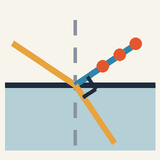
Light's electric field E vibrates across the beam, in a direction called its polarization. A polarizer passes half of unpolarized light, I1=I0/2, a second one at an angle θ passes I2=I1cos2θ, and glare reflected near Brewster's angle θB is polarized: the physics of sunglasses, LCD screens and 3D cinema.
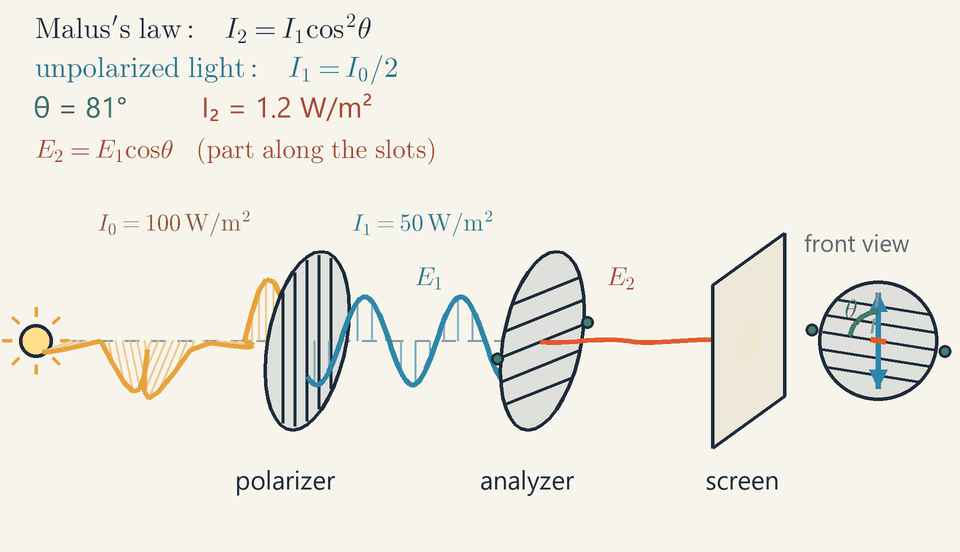
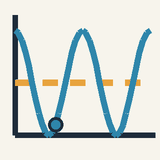
Unpolarized light crosses a fixed polarizer and then a slowly turning analyzer: the light reaching the screen fades to nothing when the two are crossed and returns as they line up again.
Light is a sideways wave; the direction it wiggles in is its polarization, and ordinary light mixes every direction.
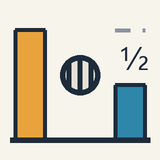
A polarizing filter passes only the wiggle along its slots, so ordinary light comes out about half as bright.
Turn a second filter: the light dims, and once the slots are crossed after a quarter turn, almost nothing gets through.
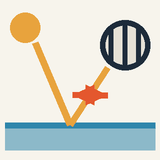
Glare from water or wet roads wiggles mostly sideways, so sunglasses with upright slots cut it.
Step 1. Tie a skipping rope to a door handle and flick your end. You can make the rope wiggle up and down, from side to side, or along any slanted line in between, while the wave itself always runs towards the door. Light is a wave of this sideways kind, and the direction in which it wiggles is called its polarization.
Step 2. A lamp or the Sun sends out light whose wiggle direction changes constantly and at random, so every direction is mixed in. Such light is called unpolarized. In the animation, the yellow wiggles leaving the lamp point every which way.
Step 3. A polarizing filter behaves like a row of narrow slots: it lets through only the part of the wiggle that lines up with the slots and swallows the rest. Behind filter 1 the blue wave wiggles only up and down, and about half of the light is gone.
Step 4. Now watch filter 2 turn. While its slots match those of filter 1, the light passes and the spot on the screen is bright. As it turns, the red wave behind it shrinks; after a quarter turn the slots are crossed and the screen goes dark. Keep turning and the light returns.
Step 5. Sunlight bouncing off a lake or a wet road comes back wiggling mostly sideways. Polarized sunglasses have upright slots, so they block much of this glare.
Check yourself: wearing polarized sunglasses, you look at the shine on a puddle and then tilt your head onto your shoulder. What happens? Answer: the glare comes back, because your slots now lie sideways, lined up with the reflected wiggle.
Intermediate
Key ideas
An ideal polarizer turns unpolarized light of intensity I0 into polarized light of intensity I1=I0/2.
Only the field component along the axis passes, E2=E1cosθ, so Malus's law gives I2=I1cos2θ.
Example: I1=50W/m2 at θ=60∘ gives 50×0.25=12.5W/m2; using cosθ would wrongly give 25 W/m².
At Brewster's angle, tanθB=n2/n1 (about 53∘ for water), reflected light is fully polarized: glare is mostly horizontal.
Light is a transverse wave
Polarized sunglasses and LCD screens depend on a property that light has and sound in air lacks. Light is an electromagnetic wave: an electric field E and a magnetic field oscillate together, each perpendicular to the other and to the beam. Its polarization is the direction along which E oscillates: vertical, horizontal or anything in between. Sound in air vibrates along its direction of travel, so it has no such direction and cannot be polarized.
Light whose field keeps one direction is linearly polarized. Sunlight and lamplight come from countless atoms emitting independently, so their direction of vibration changes at random, far faster than any instrument can follow: they are unpolarized. The glare from a wet road and the light of a blue sky are partially polarized, a mixture of the two.
An eye or a light meter registers the intensity I, the power per unit area, in watts per square metre (W/m²). It is proportional to the square of the field amplitude E0, measured in volts per metre: I=21cε0E02 where c=3.00×10⁸m/s is the speed of light and ε0=8.85×10⁻¹²F/m the permittivity of free space. Halving the amplitude divides the intensity by four.
What a polarizer does
A polarizer has a transmission axis: it passes the component of E along that axis and absorbs the component across it, so the light that leaves is linearly polarized along the axis. A common polarizing sheet is a plastic film of long polymer chains, stretched into line and soaked in iodine so that electrons can move along them. A field along the chains drives currents and is absorbed, so the transmission axis is perpendicular to the chains, not along them as a picket fence would suggest; the slots in the animation picture the axis, not the molecules.
Unpolarized light contains every direction equally. A direction at an angle φ to the axis keeps the fraction cos2φ of its intensity, which averages to one half over all directions, so an ideal polarizer passes half of the light, however it is turned. In the animation, I0=100W/m2 from the lamp becomes I1=50W/m2 behind filter 1, and the blue wave vibrates only up and down.
Malus's law
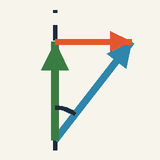
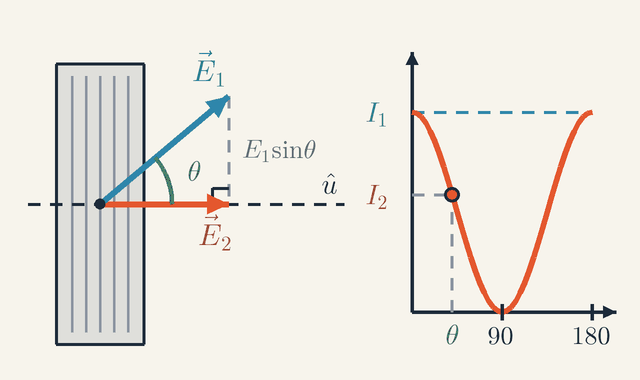
A second polarizer, the analyzer, has its axis at an angle θ to the polarization of the light reaching it. The front view in the animation splits the blue field E1 in two: the part along the axis, E1cosθ, passes as the red field E2, and the part across it, E1sinθ, is absorbed. Squaring the amplitude gives the intensity, so the working equations are:
I1=2I0(unpolarized light, ideal polarizer)
E2=E1cosθ
I2=I1cos2θ(Malus’s law)
The last one is named after Étienne-Louis Malus, who discovered in 1808 that light reflected from a window is polarized. The absorbed part, I1sin2θ, makes up the difference, since cos2θ+sin2θ=1. At 90∘ the filters are crossed and nothing passes, and because an axis turned through 180∘ is the same axis, the pattern repeats every half turn.
Worked example: the analyzer in the animation
Filter 2 turns at 22.5° per second, so θ reaches 22.5∘, 45∘ and 67.5∘ after 1, 2 and 3 s. With I1=50W/m2, Malus's law gives I2=50cos222.5∘=50⋅0.854=42.7W/m2 I2=50cos245∘=50⋅0.500=25.0W/m2 I2=50cos267.5∘=50⋅0.146=7.3W/m2 and zero at 90∘, after 4 s. These are the values on the I2 readout; in the second half of the loop they return in reverse order.
Compare the waves with the readout. At 45∘ the red wave still has cos45∘=0.71 of the blue wave's amplitude, yet it carries only half the intensity. At 60∘, reached after 2.7 s, the amplitude is halved and the intensity quartered, I2=50⋅0.25=12.5W/m2: in field units, E1=2I1/(cε0)≈194V/m becomes E2≈97V/m. In the front view, the green arc marks θ while the red arrow E2 shrinks.
Worked example: three polarizers
Two crossed polarizers, at 0∘ and 90∘, block everything. Slip a third one between them at 30∘ to the first, send in unpolarized light with I0=100W/m2, and always use the angle between neighbouring axes. The first filter passes 100/2=50W/m2. The middle one passes 50cos230∘=37.5W/m2, now polarized at 30∘. The last one, 60∘ further on, passes 37.5cos260∘=9.4W/m2.
For a middle polarizer at any angle θ, the last one is 90∘−θ from it, and cos2(90∘−θ)=sin2θ: I3=2I0cos2θsin2θ(polarizers at 0∘,θ,90∘) This equals (I0/8)sin22θ, largest at θ=45∘, where I0/8=12.5W/m2 gets through.
Adding a filter has let light through where there was none. The middle filter opens no leak: it re-polarizes the light along its own axis, which is no longer at right angles to the last one. Each polarizer resets the direction of the field.
Polarization by reflection
Light reflected from water, glass or a road is partially polarized, with E mostly parallel to the surface. At Brewster's angle θB it is completely polarized: tanθB=n1n2(Brewster’s angle) θB+θ2=90∘(reflected ⊥ refracted) Here n1 is the refractive index of the medium the light comes from, n2 that of the reflecting one and θ2 the angle of refraction: the reflected and refracted rays are then perpendicular.
From air into water (n=1.33), θB=arctan1.33=53.1∘ and θ2=36.9∘; for glass (n=1.50), θB=56.3∘. When the Sun stands 36.9∘ above a calm lake, its light meets the water at exactly 53.1∘, and the glare is horizontally polarized. Sunglasses with a vertical transmission axis block it, while the mostly unpolarized rest of the scene is only halved.
Common mistakes
Using cosθ instead of cos2θ. At 60∘ the amplitude is halved but the intensity is quartered: from I1=50W/m2 you get 12.5 W/m², not 25 W/m².
Applying Malus's law to unpolarized light, or forgetting the factor 21 at the first filter: without it the three-polarizer answer doubles to 18.75 W/m².
Measuring every angle from the first filter. Use the angle between neighbouring axes: the last of the three polarizers is 60∘ from the middle one, and taking 90∘ would wrongly give zero.
Taking the picket fence literally. A polarizing sheet absorbs the field along its chains, and a wire grid reflects the field along its wires, so the transmission axis is perpendicular to them.
Using the sine instead of the tangent for Brewster's angle: sinθB=1.33 has no solution, and arcsin(1/1.33)=48.8∘ is the critical angle for light leaving water, a different effect.
Where you meet it
Polarizing filters on sunglasses and cameras cut reflections from water and shop windows and darken a blue sky, whose light is partly polarized by scattering, most strongly 90∘ from the Sun; bees navigate by that pattern. An LCD screen holds liquid crystal between two polarizers, and each pixel sets its brightness by how far it turns the polarization, so a phone seen through polarized sunglasses goes dark at one particular tilt. 3D cinemas send the two eyes' images in different polarizations, and engineers see stress in plastic models between crossed polarizers as coloured fringes.
Reflection and Refraction gave the angles used here. Electromagnetic Waves explains why light is transverse and where I=21cε0E02 comes from, and Wave–Particle Duality introduces the photons, for which Malus's law becomes a probability cos2θ of getting through.
Advanced
Key ideas
Ex=acosωt, Ey=bcos(ωt+δ) trace an ellipse: δ=0 gives linear, a=b with δ=±π/2 circular polarization.
Unpolarized light is polarization that wanders faster than any detector; the mean of cos2φ is 21, hence I1=I0/2.
A polarizer projects: I2=I1cos2θ, a probability for each photon, so a 45∘ sheet between crossed ones passes I0/8.
Dipoles do not radiate along their axis, so at tanθB=n2/n1 only light polarized across the plane of incidence is reflected.
The field as a two-dimensional oscillator
Polarization describes how the electric field of a light wave moves across the beam. Every polarizer, reflecting surface and crystal in this lesson acts on that motion, so we start with a clear picture of it.
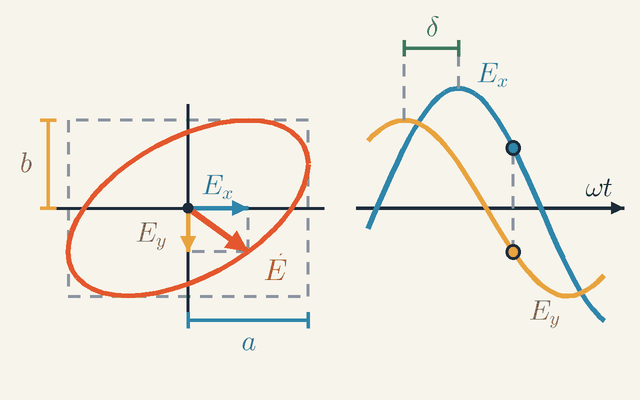
Take a wave travelling along the z axis. Its electric field E lies across the beam, in the xy plane, so it has two components, Ex and Ey. Both oscillate at the light's angular frequency ω, but each has its own amplitude, a for Ex and b for Ey, and Ey may run ahead of Ex by a phase difference δ. At a fixed point in the beam, Ex=acosωt,Ey=bcos(ωt+δ) The two components are independent of each other, so the field behaves like a two-dimensional oscillator, much as a pendulum bob can swing to and fro in any direction, or round in an ellipse.
Figure 1. One instant of the field of a wave along z. Left: the tip of E, with components Ex and Ey, goes round an ellipse that touches the sides of the box 2a×2b. Right: Ex and Ey against ωt, Ey peaking a phase δ earlier; the dots mark the instant drawn on the left.Legend
a
Amplitude of Ex: half the width of the box.
V/m
b
Amplitude of Ey: half the height of the box.
V/m
E
Electric field at the instant drawn; its tip traces the ellipse.
V/m
Ex
Component of E along x.
V/m
Ey
Component of E along y.
V/m
ωt
Phase of the wave at the point: angular frequency times time. It is the horizontal axis of the graph.
rad
δ
Phase difference between the components: Ey reaches its peak a phase δ before Ex.
rad
Figure 1 shows this motion in two ways. On the left is the plane across the beam. At each instant the tip of E sits at the point (Ex,Ey), so the two components are the shadows of the arrow on the axes. Because Ex never exceeds a and Ey never exceeds b, the tip stays inside the box of width 2a and height 2b; and because each component reaches its peak once per cycle, the curve touches all four sides of that box. On the right the same two components are plotted against the phase ωt. Here δ=60∘, so each peak of Ey comes a phase δ before the matching peak of Ex. The dots on the two curves mark the instant drawn on the left.
To find the shape of the curve, eliminate the time. Expanding the cosine gives Ey/b=cosωtcosδ−sinωtsinδ. The first equation says cosωt=Ex/a, so sinωtsinδ=(Ex/a)cosδ−Ey/b. Squaring both sides and replacing sin2ωt by 1−Ex2/a2 leaves a2Ex2+b2Ey2−ab2ExEycosδ=sin2δ
This is the equation of an ellipse. In general, then, the tip of E traces an ellipse inside the 2a by 2b box, and the three numbers a, b and δ fix its size, shape and tilt.
Two special cases have names. For δ=0 the right side is zero and the left side is a perfect square, (Ex/a−Ey/b)2=0, so Ey=(b/a)Ex: the ellipse collapses to a straight line at arctan(b/a) to the x axis. This is linear polarization. For δ=π the sign of the cross term flips and the line lies at −arctan(b/a). On the right of Figure 1 the two curves would then rise and fall together (δ=0) or in opposition (δ=π).
For a=b and δ=±π/2 the cross term vanishes and the equation becomes Ex2+Ey2=a2: the tip goes round a circle, and the light is circularly polarized. The two curves are then a quarter of a cycle apart, and the two signs of δ make the tip turn in opposite senses. Every other case is elliptical polarization. Two opposite conventions exist for calling a sense left or right, so always say whether you are looking along the beam or towards the source.
The polarization does not change how much energy the wave carries. The intensity is proportional to the average of Ex2+Ey2, and each cos2 averages to one half over a cycle, whatever its phase. So I=21cε0(a2+b2) for every δ: the polarization only decides how the field is shared between the two components. The magnetic field, of size E/c, is locked at right angles to E, so it carries no extra information. It is E that pushes on electrons, which is why polarizers and surfaces respond to its direction, and why "the polarization" always means the direction of the electric field.
A polarizer as a projection
A polarizer is a filter that lets through only one direction of the field. Seeing it as a projection tells us exactly how much light passes, and why two crossed polarizers go dark.
Figure 2. A wire-grid polarizer seen face-on, its pass axis u^ across the wires. The field E1, at the angle θ to u^, keeps its part E1cosθ and loses the part E1sinθ along the wires. Right: the passed intensity I2 against θ; the dot marks the angle drawn on the left.Legend
u^
Pass axis of the polarizer, across the wires: a unit vector.
E1
Field arriving at the polarizer, at the angle θ to u^.
V/m
E2
Field that passes: the part of E1 along u^, of size E1cosθ.
V/m
E1sinθ
Part of E1 along the wires; it does not get through.
V/m
θ
Angle between E1 and u^; marked in degrees on the graph.
rad
I1
Intensity of the light arriving at the polarizer.
W/m2
I2
Intensity that passes, I1cos2θ.
W/m2
The left of Figure 2 shows a wire-grid polarizer face-on: parallel metal wires, spaced much closer than one wavelength. Its pass axis, the unit vector u^, runs across the wires. The incoming field E1 makes the angle θ with u^, so it splits into two parts. The part along the wires, of size E1sinθ, drives electrons up and down the wires. The currents it sets up radiate a field that cancels this part beyond the grid and sends it back as a reflected wave. The part along u^, of size E1cosθ, would have to drive electrons across the wires, where they cannot travel far, so it passes almost untouched as the field E2, the horizontal arrow. A sheet polarizer works in the same way with long iodine-doped polymer chains in place of the wires; the chains absorb the blocked part instead of reflecting it.
Either way, the polarizer keeps the projection of the field on its pass axis: E2=(E1⋅u^)u^,E2=E1cosθ Intensity goes as the square of the field amplitude, so the passed intensity is I2=I1cos2θ=21I1(1+cos2θ) This is Malus's law. The second form, from cos2θ=21(1+cos2θ), shows that the curve repeats every 180∘: an axis turned half a turn is the same axis. The rest of the light, I1sin2θ, is absorbed or reflected.
The right of Figure 2 plots I2 against θ. The dashed line at the top marks I1, and the dot marks the angle drawn on the left. In the animation, filter 1 delivers I1=50W/m2 and the analyzer turns steadily, so the graph of this level traces the same curve: 50 W/m² at θ=0, 25 W/m² at 45∘, zero at 90∘ and 50 W/m² again at 180∘.
The slope says how strongly the reading reacts to a small turn of the polarization: dI2/dθ=−I1sin2θ. It is steepest at 45∘ and 135∘, where it is 50 W/m² per radian, or 0.87 W/m² per degree. Those are the best settings for detecting a small rotation of a polarization.
At 90∘, with the polarizers crossed, the curve touches zero with zero slope. An analyzer a small angle ϵ (in radians) away from crossing passes I1sin2ϵ≈I1ϵ2. One degree lets through only 3×10⁻⁴ of I1, and anywhere within 5.7∘ of crossing less than 1 % gets through; that is why the animation's screen stays dark from 3.74 s to 4.26 s. Such a flat minimum is hard to pin down by eye, so the null is best found as the midpoint between two settings, one on each side, that look equally bright.
Unpolarized light
Light from a lamp or the Sun shows no preferred direction: a single polarizer passes the same amount however it is turned. Why is that, and why is the amount exactly one half?
Such a source is a crowd of independent emitters, each starting and stopping at random. Visible sunlight spans 400 to 700 nm, a spread of about 3×10¹⁴Hz in frequency. A wave with that spread keeps one ellipse only for a time of about one over the spread, roughly 3 fs, before the direction and phase of its field drift to new values.
No detector is that fast, so every measurement averages over all directions φ of the field. A polarizer passes the fraction cos2φ of each direction, and the average over a full turn is 2π1∫02πcos2φdφ=21 So a polarizer passes half of unpolarized light, I1=I0/2, whichever way it points. In the animation that is the 50 W/m² behind filter 1, from a lamp giving I0=100W/m2. The animation models natural light in just this way, each half-wave vibrating in a random direction.
"Unpolarized" therefore describes statistics, not a special kind of wave. An equal random mixture of horizontal and vertical light gives the same result in every experiment as an equal random mixture of left- and right-circular light, so the two cannot be told apart. Four measurable intensities, the Stokes parameters, describe the polarization of any beam completely, whether it is polarized, unpolarized or in between.
Partially polarized light
Most real light is neither fully polarized nor fully unpolarized. A turning analyzer shows how much of each kind a beam contains.
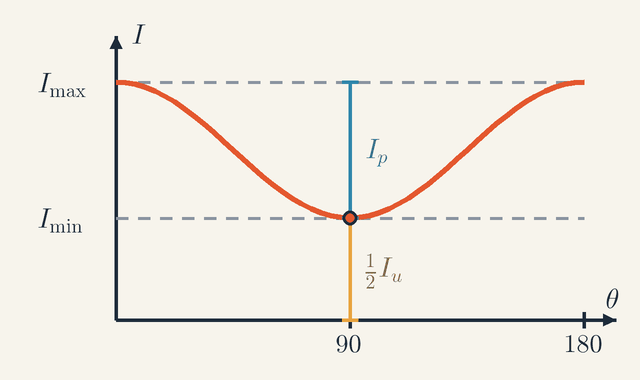
Figure 3. Partially polarized light behind a turning analyzer: a cos2θ swing of height Ip on the floor 21Iu, between Imin and Imax. The curve never reaches zero. Drawn for Iu=60 and Ip=40 in units of W/m2.Legend
I
Intensity passed by the analyzer.
W/m2
θ
Angle between the analyzer's axis and the polarized part; marked in degrees on the axis.
rad
Imax
Largest intensity, 21Iu+Ip, with the axis along the polarized part.
W/m2
Imin
Smallest intensity, 21Iu, with the axis across it.
W/m2
Ip
Polarized part of the intensity: the height of the swing.
W/m2
21Iu
Half of the unpolarized part Iu: what the analyzer always passes of it, and the floor of the curve.
W/m2
Model such a beam as the sum of an unpolarized part, of intensity Iu, and a polarized part, of intensity Ip. The two parts are independent, so their intensities simply add. Figure 3 shows what an analyzer passes as it turns through the angle θ, measured from the direction of the polarized part; it is drawn for Iu=60 and Ip=40, in W/m².
Look first at the floor of the curve. The unpolarized part always passes half of itself, 21Iu, whatever θ is, so the curve never drops below this level. On top of the floor sits the polarized part, which follows Malus's law and adds Ipcos2θ, the same swing as in Figure 2. Together, I(θ)=21Iu+Ipcos2θ The curve swings between Imax=21Iu+Ip, with the analyzer along the polarized part, and Imin=21Iu, with it across, and never reaches zero.
The depth of the swing measures how polarized the beam is. The degree of polarization is P=Imax+IminImax−Imin=Iu+IpIp because the difference of the two readings is Ip and their sum is Iu+Ip. It is the polarized fraction of the total intensity: 0 for unpolarized light, 1 for fully polarized light. For the beam of Figure 3 the analyzer reads between 30 and 70 W/m², so P=(70−30)/(70+30)=0.4.
Why reflection polarizes
Glare from water or glass is strongly polarized, and at one angle of incidence completely so. The reason lies in how the electrons of the surface radiate.
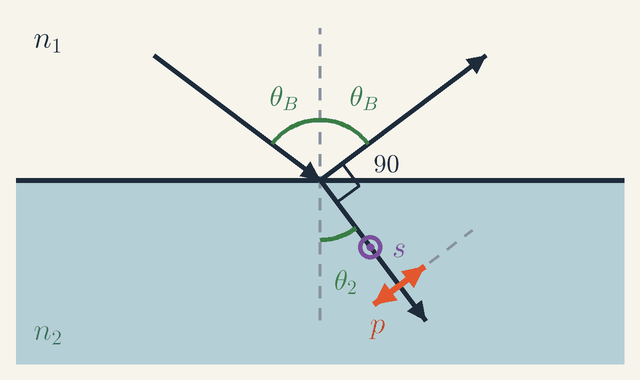
Figure 4. Light meeting water at Brewster's angle θB: the reflected and refracted rays are at right angles. The p field drives the electrons along the double arrow, pointing along the reflected ray, where a dipole cannot radiate; the s field, out of the page, radiates freely. Drawn for n2/n1=4/3.Legend
n1
Refractive index of the medium the light comes from.
n2
Refractive index of the reflecting medium.
θB
Brewster's angle: the angle of incidence, equal to the angle of reflection and measured from the normal, at which no p light is reflected; tanθB=n2/n1.
rad
θ2
Angle of refraction, measured from the normal.
rad
p
Light polarized in the plane of incidence (the page): its field drives the electrons along the double arrow, across the refracted ray.
s
Light polarized across the plane of incidence: its field points out of the page, drawn as a ring with a dot.
In Figure 4 light comes from a medium of refractive index n1 (air) and meets a second medium of index n2 (water). The angle of incidence is Brewster's angle θB, the angle of reflection is the same, and the refracted ray leaves at the angle θ2; all three are measured from the normal, the dashed vertical line. The reflected light is not bounced off the surface like a ball: it is radiated by the electrons of the second medium. Those electrons are driven by the refracted wave, so they oscillate along its field, which is always across the refracted ray.
Now split the light into its two polarizations. For s light, polarized across the plane of incidence (the page), the field points out of the page, drawn as a ring with a dot labelled s. The electrons then oscillate parallel to the surface and across the reflected ray, so they radiate towards it freely. For p light, polarized in the plane of incidence, the electrons oscillate in the page, across the refracted ray, along the double arrow labelled p.
One fact about an oscillating dipole settles the matter: it radiates in proportion to sin2α, where α is measured from its axis, so it sends nothing along that axis. At Brewster's angle the reflected ray is at right angles to the refracted ray, as the 90∘ mark in the figure shows. The double arrow p, being across the refracted ray, then points straight along the reflected direction: it is parallel to the short dashed line, which runs parallel to the reflected ray. The p electrons would have to radiate along their own axis, which they cannot, so no p light is reflected.
The right angle means θB+θ2=90∘, so sinθ2=cosθB. Putting this into Snell's law, n1sinθB=n2sinθ2, gives n1sinθB=n2cosθB, that is tanθB=n1n2 Figure 4 is drawn for n2/n1=4/3, water in air, which gives θB=53.1∘ and θ2=36.9∘.
The dipole picture explains the zero; Maxwell's equations give the whole story. For a transparent, non-magnetic surface, the fractions of the intensity reflected for the two polarizations, the reflectances, are Rs=sin2(θ1+θ2)sin2(θ1−θ2),Rp=tan2(θ1+θ2)tan2(θ1−θ2) with θ1 the angle of incidence. Rp vanishes when θ1+θ2=90∘, because the tangent in its denominator becomes infinite: the same condition as the dipole argument gave. Rs never vanishes, so the light reflected at Brewster's angle is pure s light.
For water at Brewster's angle, θ1−θ2=16.3∘ and θ1+θ2=90∘, so Rs=sin216.3∘=0.078. Unpolarized sunlight is half s light, so it loses 21Rs, or 3.9 % of its intensity, to a glare that is completely s-polarized; on a lake, that means horizontal. For glass (n2/n1=1.5) the same steps give Rs=0.148 and a loss of 7.4 %. Away from Brewster's angle the glare is only partly polarized: at 30∘ incidence on water, Rs=0.031 and Rp=0.012, so the reflected light has P=(Rs−Rp)/(Rs+Rp)=0.44.
Gas lasers make use of this zero. The windows of their tubes are tilted at Brewster's angle, so p light crosses them back and forth with no reflection loss, while s light loses a little at every pass; only p light builds up, and the laser emits linearly polarized light. Skylight is polarized for the same reason: the air molecules that scatter sunlight are dipoles driven across the Sun's rays, and a dipole sends nothing along its axis. The polarization is strongest at 90∘ from the Sun, though light scattered more than once keeps P below about 0.7 to 0.8 even in a clear sky.
Birefringence and wave plates
Some crystals do more than filter a polarization: they slow one polarization more than the other. That lets us change the phase difference δ of Figure 1, and so reshape the ellipse at will.
In a crystal whose structure differs from one direction to another, the refractive index depends on the polarization. Calcite, for example, has the two indices 1.658 and 1.486. A beam entering a calcite crystal generally splits into two beams polarized at right angles, so print seen through the crystal looks doubled. This splitting is called birefringence, or double refraction.
A wave plate is a slice of such a crystal, of thickness d, cut so that its optic axis (the crystal's special direction) lies in the face of the plate. At normal incidence the light polarized along the axis and the light polarized across it then follow the same path, but at different speeds. Over the thickness d one falls behind the other by the optical path Δnd, where Δn is the difference of the two indices. In terms of phase, with λ the wavelength in vacuum, that is δ=λ2πΔnd so the plate adds this amount to the δ of the ellipse.
A quarter-wave plate gives δ=π/2. With its axis at 45∘ to a linear polarization, it splits the field into two equal components, a=b, and puts them a quarter of a cycle apart: by the cases of Figure 1, that is circular light. Its thickness is d=λ/(4Δn); in quartz, with Δn≈0.009, it is only about 15 μm for 550 nm light.
A half-wave plate (δ=π) reverses the component across its axis, so a linear polarization at the angle α to the axis leaves at −α. It has been turned through 2α, and nothing has been absorbed. 3D-cinema glasses pair a quarter-wave plate with a linear polarizer to pass only one sense of circular light, so the left and right images stay apart even when you tilt your head.
Worked problem: rotating the polarization
Polarizers can turn a polarization as well as block it, but at a cost in intensity. This problem works out that cost and how to reduce it.
The light leaving filter 1 in the animation is vertical, with I1=50W/m2. How much of it can be made horizontal using polarizers alone?
A single horizontal sheet passes nothing, since θ=90∘. Put one extra sheet at 45∘ in front of it. Each sheet is then 45∘ from the polarization reaching it and passes the fraction cos245∘=1/2, so 50cos445∘=12.5W/m2 comes out horizontal. Counted from the lamp's I0=100W/m2, this is the I0/8 of the familiar three-polarizer case.
Now use N sheets, each turned a further 90∘/N from the one before, the last one horizontal. Each sheet receives light polarized along the previous sheet, at the angle π/(2N) to its own axis, so it passes the fraction cos2(π/2N), and IN=I1cos2N(2Nπ) Three sheets pass 21.1 W/m², ten pass 39.0 W/m².
Why does the loss shrink as sheets are added? For a small angle x, lncosx≈−x2/2. With x=π/(2N), the logarithm of cos2Nx is about −Nx2=−π2/(4N), so IN≈I1e−π2/(4N)≈I1(1−4Nπ2) Each sheet removes only a sliver, of order (π/2N)2, which shrinks like 1/N2; the N slivers together make a loss that falls like 1/N.
Keeping 90 %, or 45 W/m², takes 24 sheets, which pass 45.1 W/m²; 23 sheets give only 44.9 W/m². Infinitely many sheets would drag the polarization round with no loss at all, a classical analogue of the quantum Zeno effect. A half-wave plate with its axis at 45∘ does the whole job in one step and passes all 50 W/m², apart from small reflections at its surfaces, because it shifts a phase instead of projecting the field.
Photons and limits of validity
Malus's law was derived for waves, but light arrives as photons, and real polarizers and surfaces fall short of the ideal ones above. This section says where the simple picture holds.
In quantum terms, a photon's polarization is a two-state system: two complex amplitudes play the part of a, b and δ. A polarizer at the angle θ to a photon's polarization passes it with probability cos2θ, and a photon that passes leaves polarized along the polarizer's axis. Malus's law is the average of an enormous number of such yes-or-no events: a beam of 50 W/m² of 550 nm light carries about 1.4×10²⁰ photons per second through each square metre.
Real polarizing sheets pass only about 38 to 42 % of unpolarized light, not the ideal 50 %, and a crossed pair leaks 10−3 to 10−5 of it (crystal polarizers 10−5 to 10−6). Each type also works only over a limited band of wavelengths. Brewster's zero needs a smooth, transparent, isotropic surface: ripples spread the angles of incidence, and metals show only a shallow minimum of Rp, not a zero. Finally, the field is purely transverse only in wide beams: light focused to a spot about a wavelength across gains a field component along its direction of travel.
Where this leads
Electromagnetic Waves shows why light is transverse: in empty space Maxwell's equations allow no field along the direction of travel. Interference and Superposition adds waves with a phase difference, as Figure 1 adds two perpendicular components; but two beams polarized at right angles cannot interfere, so crossed polarizers over the two slits of Diffraction and the Double Slit wipe out the fringes. Wave–Particle Duality introduces the photons themselves, each of which passes a polarizer with the probability cos2θ described above.
Reflection and Refraction supplies the Fresnel amplitudes behind Brewster's angle, and Prisms, Dispersion and Colour the scattering that makes the sky blue. The gravitational waves of Gravity as Curved Spacetime also come in two polarizations, but 45∘ apart rather than 90∘. Such a wave stretches space along one axis while squeezing it along the perpendicular one. Turning that pattern by 90∘ only swaps stretch and squeeze, which gives the same polarization reversed, so the second, independent polarization is the one turned by 45∘.
Key formulas
Unpolarized light through an ideal polarizer
I1=2I0(unpolarized light, ideal polarizer)
Unpolarized light vibrates in every direction across the beam with equal weight. A direction at an angle φ to the axis keeps the fraction cos2φ of its intensity, and the average of cos2φ over all directions is one half. The light that leaves is linearly polarized along the axis, whichever way the polarizer is turned.
Symbols
I1
intensity behind the polarizer
W/m2
I0
intensity of the unpolarized light arriving
W/m2
When it holds: Only for truly unpolarized light and an ideal polarizer. Real sheets pass about 38 to 42 %, and partially polarized light gives a result that depends on how the polarizer is turned.
Example: The animation's lamp: I0=100W/m2 gives I1=50W/m2 behind filter 1.
Field passed by the analyzer
E2=E1cosθ
The analyzer keeps only the component of the field along its transmission axis, the projection E1cosθ; the component across the axis, E1sinθ, is absorbed. Beyond 90∘ the cosine is negative, which only means that the field points the other way along the same axis.
Symbols
E2
field amplitude after the analyzer
V/m
E1
field amplitude of the polarized light reaching the analyzer
V/m
θ
angle between the field and the analyzer's axis
rad
When it holds: For linearly polarized light meeting an ideal analyzer head-on. It gives the amplitude; the intensity needs the square.
Example:E1=194V/m (that is, I1=50W/m2) at θ=60∘: E2=194⋅0.5=97V/m.
Malus's law
I2=I1cos2θ(Malus’s law)
Intensity goes as the square of the amplitude, so projecting the field with cosθ multiplies the intensity by cos2θ. The same law reads I2=21I1(1+cos2θ), which repeats every 180∘. The rest, I1sin2θ, is absorbed, so energy balances.
Symbols
I2
intensity after the analyzer
W/m2
I1
intensity of the polarized light reaching the analyzer
W/m2
θ
angle between the polarization and the analyzer's axis
rad
When it holds: For linearly polarized light and an ideal analyzer. Unpolarized light averages to I1/2; partially polarized light never goes fully dark; real crossed sheets still leak 10−3 to 10−5 of the light.
Example:I1=50W/m2 at 60∘: I2=50⋅0.25=12.5W/m2; using cosθ would wrongly give 25 W/m².
Intensity of a light wave
I=21cε0E02
The field stores energy with density ε0E2, half of it electric and half magnetic, and carries it at the speed c. Over a cycle cos2 averages to one half, which gives the factor 21. The intensity goes as the square of the amplitude: double the field, four times the intensity.
Symbols
I
intensity (average power per unit area)
W/m2
c
speed of light in vacuum
m/s
ε0
vacuum permittivity
F/m
E0
amplitude of the electric field
V/m
When it holds: For a linearly polarized plane wave in vacuum or air. In a transparent non-magnetic medium of index n the intensity is n times larger for the same amplitude.
Example: The animation's I=50W/m2 behind filter 1 corresponds to E0=2I/(cε0)≈194V/m; full sunlight, about 1000 W/m², to roughly 870 V/m.
Brewster's angle
tanθB=n1n2(Brewster’s angle)
The reflected light is radiated by electrons of the second medium, which oscillate across the refracted ray. When the reflected and refracted rays are perpendicular, an oscillation in the plane of incidence points along the reflected direction, where a dipole sends nothing, so only light polarized across that plane is reflected. With θ2=90∘−θB, Snell's law gives n1sinθB=n2cosθB.
Symbols
θB
Brewster's angle of incidence, from the normal
rad
n2
refractive index of the reflecting medium
n1
refractive index of the medium the light comes from
When it holds: For a smooth, transparent, isotropic surface. Only the p component vanishes; the s component is still partly reflected. Metals show only a shallow minimum, not a true zero.
Example: Air into water: tanθB=1.33, so θB=53.1∘; for glass, 56.3∘.
Reflected and refracted rays at right angles
θB+θ2=90∘(reflected ⊥ refracted)
The reflected ray leaves at θB from the normal on one side of the surface and the refracted ray travels at θ2 on the other, so the angle between them is 180∘−θB−θ2. It is a right angle exactly when the two angles add up to 90∘, the geometric condition behind Brewster's angle.
Symbols
θB
angle of incidence (Brewster's angle)
rad
θ2
angle of refraction
rad
When it holds: Only at Brewster's angle; at any other angle of incidence the two angles do not add up to 90∘.
Example: Water: 53.1∘+36.9∘=90∘.
Three polarizers: a middle one between crossed sheets
I3=2I0cos2θsin2θ(polarizers at 0∘,θ,90∘)
The first polarizer passes I0/2. The middle one, at θ, passes cos2θ of that, and the last one, at 90∘−θ from the middle, passes cos2(90∘−θ)=sin2θ of what remains. The product equals (I0/8)sin22θ, largest at 45∘: the middle sheet re-polarizes the light so that the crossed last one can pass some of it.
Symbols
I3
intensity after the third polarizer
W/m2
I0
intensity of the unpolarized light arriving
W/m2
θ
angle of the middle polarizer from the first
rad
When it holds: For ideal polarizers, unpolarized light and a first and last polarizer that are crossed. At θ=0 or 90∘ nothing gets through.
Example:I0=100W/m2, θ=30∘: I3=50⋅0.75⋅0.25=9.4W/m2; at 45∘, 12.5 W/m².
Glossary
Polarization of light
The direction along which the electric field of a light wave oscillates, always across the direction of travel. Only transverse waves can be polarized: light can, sound in air cannot.
Transverse wave
A wave whose vibration is perpendicular to its direction of travel, such as light or a wave on a rope. In a longitudinal wave, such as sound in air, the vibration runs along the direction of travel, and there is no polarization.
Linear polarization
Polarization in which the field oscillates along one fixed line across the beam, also called plane polarization. The light leaving a polarizer is linearly polarized along its axis.
Circular and elliptical polarization
States in which the tip of the field turns round the beam, tracing an ellipse, or a circle when the two perpendicular components have equal amplitudes and are a quarter of a cycle apart. Circular light has no preferred axis, which is why 3D cinemas use it.
Unpolarized light
Light whose direction of vibration changes at random faster than any detector can follow, such as sunlight or lamplight. An ideal polarizer passes exactly half of it, however it is turned.
Partially polarized light
A mixture of unpolarized and polarized light, such as glare or the light of a blue sky. Seen through a turning analyzer it dims and brightens but never goes completely dark.
Polarizer
A filter that passes the field component along its transmission axis and absorbs or reflects the component across it. In a polarizing sheet the absorbing chains run across the axis, not along it.
Analyzer
A second polarizer used to examine light that is already polarized. Turning it reveals the direction of polarization: everything passes when its axis lies along that direction, nothing when the two are crossed.
Malus's law
The intensity passed by an analyzer at an angle θ to the polarization of the incoming light, I2=I1cos2θ. The cosine is squared because intensity goes as the square of the amplitude: at 60∘ a quarter passes, not a half.
Brewster's angle
The angle of incidence at which reflected light is completely polarized parallel to the surface, tanθB=n2/n1: 53.1∘ for water, 56.3∘ for glass. The reflected and refracted rays are then perpendicular.
s- and p-polarization
The two polarizations at a reflecting surface: s has the field across the plane of incidence, that is parallel to the surface, and p has it within that plane. At Brewster's angle the p reflection vanishes, while water still reflects 7.7 % of s light.
Birefringence
The dependence of the refractive index on polarization in crystals such as calcite (1.658 and 1.486) or quartz. It splits a beam in two, and it is what wave plates use to turn linear polarization into circular or to rotate it.
Quantities
I
Intensity
W/m2
The power carried by the light per unit area across the beam, which is what a light meter reads; it is proportional to the square of the field amplitude.
I0
Incident intensity
W/m2
The intensity of the unpolarized light that reaches the first polarizer: 100 W/m² in the animation.
I1
Intensity after the polarizer
W/m2
The intensity of the linearly polarized light behind the first polarizer, I0/2 for an ideal one: 50 W/m² in the animation.
I2
Intensity after the analyzer
W/m2
The intensity that gets through the analyzer, I1cos2θ: from 50 W/m² down to zero as the animation's analyzer turns to 90∘. Behind a third polarizer the intensity is called I3: 9.4 W/m² in the three-polarizer example.
E0
Electric field amplitude
V/m
The largest value of the oscillating field of a linearly polarized wave. In the animation E1≈194V/m before the analyzer, and E2 after it is half of that at 60∘.
θ
Analyzer angle
rad
The angle between the polarization of the incoming light and the analyzer's transmission axis, usually quoted in degrees: it runs from 0 to 180∘ in the animation.
ε0
Vacuum permittivity
F/m
A constant of electromagnetism, 8.85×10⁻¹²F/m, which links the field amplitude of a wave to the energy it carries. With the speed of light c=3.00×10⁸m/s it sets the intensity of a wave, I=21cε0E02.
θB
Brewster's angle
rad
The angle of incidence, measured from the normal, at which reflected light is completely polarized: 53.1∘ for water, 56.3∘ for glass.
n2
Refractive index of the reflecting medium
The index of the medium that reflects the light, 1.33 for water and 1.50 for glass; n1 is that of the medium the light comes from, 1.00 for air.
θ2
Angle of refraction
rad
The angle between the refracted ray and the normal. At Brewster's angle it equals 90∘−θB: 36.9∘ for water.
Quiz
Beginner Why can light be polarized while sound travelling through air cannot?
Light travels much faster than sound
Sound waves are too long to fit through a filter
Light vibrates across its direction of travel; sound in air vibrates along it
Sound carries no energy that a filter could stop
Show answer
Answer: C. Light vibrates across its direction of travel; sound in air vibrates along it
Polarization is the direction of a sideways vibration. Light is a transverse wave, so that direction can be selected; sound in air is longitudinal, and a vibration along the direction of travel has no sideways direction to filter.
Beginner Light from an ordinary lamp passes through one ideal polarizing filter. How much of it gets through?
About half
All of it
None of it
About a quarter
Show answer
Answer: A. About half
Lamp light vibrates in every direction across the beam. The filter keeps only the part along its axis, which on average is half of the intensity, whichever way the filter points.
Beginner You look at a lamp through two polarizing filters and turn the second one until its axis is at 90° to the first. What do you see?
The lamp looks brighter
Nothing changes
The lamp changes colour
Almost no light: the filters look dark
Show answer
Answer: D. Almost no light: the filters look dark
After the first filter the light vibrates in one direction only. The crossed second filter passes only vibrations at right angles to that, and none are left, so almost no light gets through.
Intermediate Polarized light of intensity 80 W/m² meets an analyzer whose axis is at 60° to the light's polarization. What intensity gets through?
40 W/m²
20 W/m²
60 W/m²
0 W/m²
Show answer
Answer: B. 20 W/m²
Malus's law: I = I₁·cos²θ = 80 × cos²60° = 80 × 0.25 = 20 W/m². Using cos θ instead of cos²θ gives 40 W/m², and 60 W/m² comes from using the complementary angle, 30°.
Intermediate Sunlight reflects off a calm lake (n = 1.33). At what angle of incidence is the reflected light completely polarized?
48.8°
36.9°
53.1°
45°
Show answer
Answer: C. 53.1°
tan θB = n₂/n₁ = 1.33, so θB = 53.1°; the refracted ray is then at 36.9°, and the two rays are perpendicular. 48.8° is the critical angle for light leaving water, which plays no role here.
Intermediate Glare from a lake or a wet road is mostly polarized horizontally. How should the transmission axis of polarized sunglasses point to cut it?
Vertically
Horizontally
At 45° to the horizontal
The direction does not matter
Show answer
Answer: A. Vertically
A vertical axis is crossed with the horizontally polarized glare, and cos²90° = 0 blocks it, while the rest of the scene, mostly unpolarized, still comes through at about half intensity.
Advanced Unpolarized light of intensity I₀ falls on two crossed polarizers (axes at 0° and 90°). A third polarizer, at 45°, is then slipped between them. What intensity now emerges?
Still zero: crossed polarizers block everything
I₀/8
I₀/4
I₀/2
Show answer
Answer: B. I₀/8
The first polarizer passes I₀/2. The 45° filter passes cos²45° = ½ of that, now polarized at 45°, and the last filter, again at 45° to it, passes another half: I₀/2 × ½ × ½ = I₀/8. Each polarizer projects the field anew.
Advanced Why do many 3D cinemas use circular rather than linear polarization to send a different image to each eye?
Circularly polarized light is brighter on the screen
Linear polarizers cannot pass coloured light
Circularly polarized light travels faster through the glasses
Tilting the head does not mix the two images
Show answer
Answer: D. Tilting the head does not mix the two images
With linear polarization, a head tilted by α lets sin²α of the other eye's image leak through. Left- and right-handed circular states do not depend on how the glasses are turned, so the separation survives a tilt.
 Physics Tutor