Electrons on fixed energy levels, En=−13.6eV/n2 in hydrogen: each jump between two levels emits or absorbs one photon whose energy hf equals their difference, so every atom shines in its own sharp colours, the fingerprint in its spectrum.
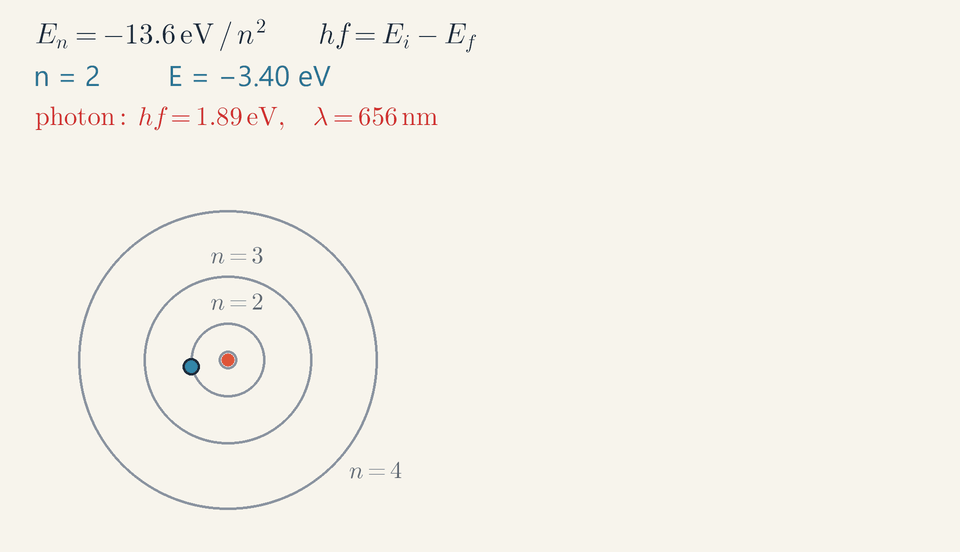
A hydrogen atom with Bohr orbits n = 1 to 4: the electron drops from n = 3 to n = 2 and emits a red photon, then absorbs an identical photon and climbs back.
A tiny solar-system atom would glow away its energy and collapse in a split second, yet real atoms are stable.
An electron can only sit on certain energy levels, like the rungs of a ladder, never in between.
Heat, flames or collisions with fast electrons lift electrons to higher levels.
Dropping to a lower level, the atom gives off one photon with exactly the energy lost: hydrogen's drop from 3 to 2 gives red light.
Every element has its own levels, so its colours are a fingerprint that tells astronomers what stars are made of.
An atom has a tiny, heavy, positive nucleus with light, negative electrons around it. Picture it as a miniature solar system, as people did around 1911, and you hit a problem: an electron circling the nucleus should keep giving off light, lose energy and spiral inwards in a split second. Yet atoms do not collapse.
Step 1. In 1913 Niels Bohr proposed that an electron may only use certain allowed orbits, like the rungs of a ladder, and gives off no light while it stays on one. Each rung has its own energy: the lowest, nearest the nucleus, has the least.
Step 2. Atoms climb to higher rungs when something hands them energy: the heat of a flame, or collisions with fast electrons in the glowing gas of a neon sign.
Step 3. An excited electron soon drops back. The energy it loses leaves as one packet of light, a photon. In the animation the electron on the third ring drops to the second and a red photon flies off. Later an identical red photon arrives, the electron swallows it and climbs back up; light of a slightly different colour would pass by untouched.
Step 4. The gaps between rungs are fixed, so each drop always gives the same colour. Hydrogen glows in a few sharp lines rather than a rainbow, and every element has its own rungs, so its lines are a fingerprint. Spread a star's light through a prism and you can read what it is made of.
The rings are only a picture: the electron is really a fuzzy cloud, not a tiny planet, but the fixed energy levels are real.
Check yourself: an electron sits on rung 4. Which single drop gives the photon with the most energy? (Straight down to rung 1.)
Intermediate
Key ideas
Bohr's rule mvr=nℏ allows only orbits rn=n2a0 (a0≈0.0529nm) with energies En=−13.6eV/n2.
A jump from level i down to level f emits one photon: hf=Ei−Ef, so λ=hc/(Ei−Ef) with hc≈1240eV⋅nm.
Example: 3→2 releases 1.89 eV, λ≈656nm (red Hα); only a 1.89 eV photon can lift the electron back from 2 to 3.
The photon carries the difference between two levels, not the value of either level; 13.6 eV frees the electron from n=1.
Atoms, light and the electronvolt
Spread through a prism, the light of glowing hydrogen is not a full rainbow but a few separate bright lines. Alpha-particle scattering showed in 1911 that an atom is mostly empty: a nucleus only 10−15 to 10−14m across holds all the positive charge and almost all the mass, while the electrons fill a region about 10−10m across. For hydrogen, one proton and one electron, two facts need explaining: its atoms are stable, and hot hydrogen glows only at a few sharp wavelengths, such as a red line at 656 nm, and it absorbs light at those same wavelengths.
Atomic energies are measured in electronvolts, 1eV=1.602×10⁻¹⁹J, the energy an electron gains across one volt. The zero is an electron at rest far from the proton, so a bound electron has a negative energy. A photon's energy and wavelength are linked by E=hc/λ, with hc≈1240eV⋅nm.
Bohr's three rules
A miniature solar system cannot work: an orbiting electron accelerates, so it should radiate, spiral into the nucleus in about 10−11s and emit a smear of colours rather than sharp lines. In 1913 Niels Bohr kept the orbit but added rules that classical physics does not contain.
The first rule is classical: the electron circles the proton, held by the Coulomb force. The second selects the orbits: the angular momentum mvr must be a whole multiple of the reduced Planck constant ℏ=h/2π≈1.055×10−34J⋅s, mvr=nℏ where n=1,2,3,… is the principal quantum number.
The third rule is the boldest: on an allowed orbit the atom is in a stationary state, and the electron does not radiate at all. Light is emitted or absorbed only in a jump between allowed orbits, as a single photon carrying the energy difference.
Radii, energies and photons
With the force balance, the angular-momentum rule fixes the radius and energy of each orbit, and a jump from a level i down to a lower level f gives one photon:
rn=n2a0
En=−n213.6eV
hf=Ei−Ef
λ=Ei−Efhc
Here a0≈0.0529nm is the Bohr radius. The radii grow as n2, in the ratio 1 : 4 : 9 : 16, while the speed falls as vn=v1/n, with v1≈2.19×10⁶m/s. The subscript f marks the final level; f alone is the photon's frequency.
The energies are negative because the electron is bound: freeing it from the ground state takes 13.6 eV, the ionisation energy of hydrogen. The levels −13.6, −3.40, −1.51 and −0.85eV crowd together and approach zero as n→∞. The force balance mv2/r=ke2/r2 also makes the kinetic energy K=21mv2 half the size of the potential energy U=−ke2/r, so that E=K+U=−K.
Worked example: the red line in the animation
The electron drops from n=3 to n=2: E3=−913.6=−1.51eV,E2=−413.6=−3.40eV hf=E3−E2=−1.51−(−3.40)=1.89eV λ=E3−E2hc=1.89eV1240eV⋅nm≈656nm This is red light, the Hα line, of frequency f=1.89eV/(4.14×10−15eV⋅s)≈4.57×1014Hz.
These are the animation's numbers. The n readout switches from 3 to 2 and the E readout from −1.51 to −3.40eV just as the red photon labelled hf leaves, and the line below them shows hf=1.89eV and λ=656nm. When an identical photon arrives, the electron absorbs it and the readouts return to 3 and −1.51eV.
The ring shrinks from r3=9a0=0.476nm to r2=4a0=0.212nm, and the electron speeds up by a factor 3/2. Its kinetic energy rises by 1.89 eV while its potential energy falls by twice as much, 3.78 eV; the net loss is the photon. One turn takes a time proportional to n3: on screen 3.0 s on n=3 against 0.9 s on n=2, in reality 1.2×10⁻¹⁵s on n=2.
Worked example: lighting a hydrogen lamp
In a discharge tube, fast electrons strike hydrogen atoms in their ground state. A collision can pass on any part of the electron's energy, but the atom accepts only exact gaps. What is the least energy that makes the tube glow red, and which lines then appear?
The red line starts on n=3, so the atom must first be lifted there: E3−E1=−1.51−(−13.6)=12.09eV An electron with 11 eV can only raise the atom to n=2 (10.2 eV), and the atom falls straight back, emitting ultraviolet at 1240/10.2≈122nm: nothing visible.
From n=3 there are two ways down: straight to n=1 (12.09 eV, 103 nm), or 3→2 (1.89 eV, 656 nm) followed by 2→1 (10.20 eV, 122 nm). Both routes release 1.89+10.20=12.09eV, and of the three lines only the red one is visible. Faster electrons reach higher levels: an atom raised to level n can emit n(n−1)/2 different lines, six from n=4, including the blue-green one at 486 nm.
Reading an energy-level diagram
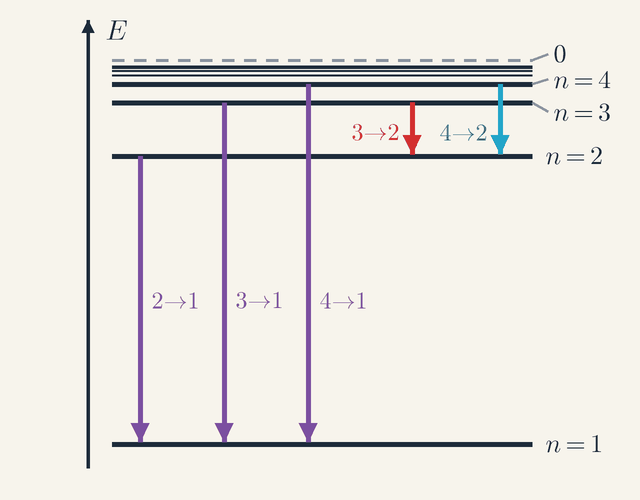
An energy-level diagram draws each level as a horizontal line at its energy, from n=1 up to the ionisation limit E=0; the expert layer of the animation shows one to scale. A downward arrow is an emission, an upward one an absorption, and the arrow's length is the photon energy: the longer the arrow, the shorter the wavelength. The rings of the atom show the opposite trend: the orbits spread apart while the levels crowd together.
Jumps ending on the same level form a series: Lyman (to n=1, ultraviolet, 122 to 91 nm), Balmer (to n=2, visible lines at 656, 486, 434 and 410 nm, converging on 365 nm) and Paschen (to n=3, infrared). One rule, found from measurements before Bohr explained it, covers them all: λ1=RH(nf21−ni21) with RH≈1.097×10⁷m−1. For Hα, RH(1/4−1/9)=1.52×106m−1, which gives 656 nm once more.
Common mistakes
The photon carries the difference between two levels: 3→2 gives 1.89 eV, not 1.51 or 3.40 eV, nor their sum, 4.91 eV.
The energy goes as 1/n2, not as 1/n: the n=2 level lies at −3.40eV, not at −6.8eV.
The radius grows as n2: the n=3 orbit is 9 times wider than the n=1 orbit, not 3 times; 27 is the ratio of their periods.
A higher orbit is slower and yet has more energy: on n=3 the kinetic energy is 1.89 eV lower than on n=2, but the potential energy is 3.78 eV higher.
A photon cannot be partly absorbed: a 2.00 eV photon passes an atom in n=2 untouched, because no level lies 2.00 eV higher. Only above 3.40 eV, where the electron is set free, can a surplus go into its kinetic energy; a colliding electron can give up just part of its energy.
Where you meet it
Every element has its own levels, so its lines are a fingerprint. Cooler gas in the Sun's outer layers absorbs its own wavelengths: hydrogen's Hα is the dark line that Fraunhofer labelled C, at 656 nm, and helium was discovered in sunlight in 1868, before anyone found it on Earth. Nebulae glow red with Hα, sodium lamps shine yellow at 589 nm, and lasers work by jumps between levels.
The photon rule comes from Photoelectric Effect; Wave–Particle Duality explains why only some orbits are allowed, and Schrödinger's Equation and Tunnelling replaces orbits by waves while keeping these energies. In Semiconductors, Diodes and LEDs the levels of many atoms merge into bands, and Radioactivity and Half-Life turns to the nucleus, whose levels lie thousands to millions of times further apart.
Advanced
Key ideas
Classically no atom is stable: charges have no stable static equilibrium, and an orbiting electron radiates and spirals in.
Minimising ℏ2/(2ma2)−ke2/a gives a0=ℏ2/(mke2)≈0.053nm and E=−13.6eV: uncertainty sets the size of atoms.
En=−13.6eV/n2 in both Bohr's and Schrödinger's theory; quantum mechanics adds n2 states per level and L=0 in the ground state.
Lyman lines (ending on n=1) are ultraviolet; Balmer lines (ending on n=2) include Hα 656 nm; all obey 1/λ=RH(1/nf2−1/ni2).
Bohr fails for many-electron atoms, line intensities and fine structure; orbits become probability clouds, and filling them builds the periodic table.
Why a classical atom cannot exist
Before quantum ideas, physicists tried to build the hydrogen atom from parts they understood: a light electron of charge −e and mass m, a heavy proton of charge +e, and the Coulomb attraction between them, of size ke2/r2 at distance r, with k=1/(4πε0). From these parts, classical physics cannot make a stable atom, for three separate reasons. Each failure points to something the new physics has to supply.
First, the charges cannot sit still. Wherever there is no charge, the electrostatic potential ϕ obeys Laplace's equation ∇2ϕ=0. A function that obeys it has no minimum and no maximum in that region: wherever it curves up in one direction, it curves down in another. So an electron at rest among fixed charges is never at the bottom of a potential well, and there is always a direction in which it can slide away. This is Earnshaw's theorem, and it means the electron must move.
Second, a moving electron cannot keep its orbit. Circular motion is accelerated motion, and an accelerating charge radiates. With centripetal acceleration v2/r, the electron loses energy at the rate (Larmor's formula) P=32c3ke2(v2/r)2 where c is the speed of light. At the observed size of the atom, 0.053 nm, the acceleration v2/r is about 9×10²²m/s2. Losing energy at this rate, the electron would spiral into the proton in about 1.6×10⁻¹¹s. On the way in its orbital frequency would rise steadily, so the atom would give out a rising sweep of light, a chirp, instead of the sharp spectral lines that are observed.
Third, classical physics cannot even say how big an atom should be. A size has to be a length built from the constants of the problem. From ke2 (in J m) and m (in kg) no length can be formed. Bringing in c gives one, ke2/(mc2)≈2.8×10−15m, but it is about 19 000 times smaller than an atom. A new constant is needed, and Planck's reduced constant ℏ=h/(2π) supplies it.
Uncertainty sets the size of the atom
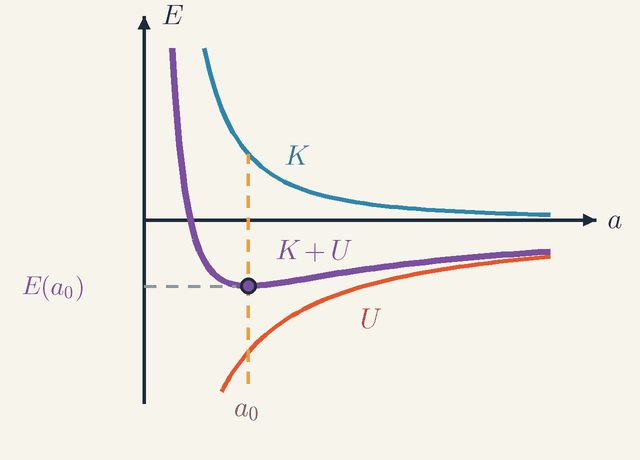
One quantum rule alone, the uncertainty principle, already explains why an atom has a definite size and roughly what that size is. The idea is a competition between two energies, and Figure 1 shows it.
Figure 1. Energy of an electron confined within a distance a of the proton. Squeezing it raises the kinetic energy K faster than the attraction lowers the potential energy U, so the total K+U has a lowest point at a0.Legend
a
Size of the region that holds the electron: how close it is kept to the proton.
m
E
Energy of the electron.
J
K
Kinetic energy forced on the electron by confinement, at least about ℏ2/(2ma2).
J
U
Potential energy of the attraction, about −ke2/a.
J
K+U
Total energy E(a) of the electron: kinetic plus potential.
J
a0
Size at which the total energy is lowest: the Bohr radius, about 0.053nm.
m
E(a0)
Lowest value of the total energy, −ke2/(2a0)≈−13.6eV.
J
Suppose the electron is kept within a distance a of the proton; a runs along the horizontal axis of Figure 1. The uncertainty principle says that a particle confined to a region of size a has a momentum spread of at least about ℏ/a. Its momentum therefore cannot be zero, and its kinetic energy K is at least about (ℏ/a)2/(2m)=ℏ2/(2ma2). This is the blue curve: it climbs as 1/a2 when a shrinks.
The potential energy of the attraction, U, is about −ke2/a: the red curve. It also grows in size as a shrinks, but only as 1/a, more slowly than K.
Now follow the purple curve, the total K+U, from right to left. At large a both terms are small and the total is close to zero. As a shrinks the attraction wins at first, so the total falls. At small a the 1/a2 rise of K overtakes the 1/a fall of U, and the total climbs steeply. In between lies a lowest point, at a=a0, where the total is E(a0). The electron settles there: that lowest point is the ground state.
To locate it, write the total as E(a)=2ma2ℏ2−ake2 At the lowest point the slope is zero: dadE=−ma3ℏ2+a2ke2=0 Multiplying by a3 and solving gives the size; putting it back into E(a) gives the energy: a0=mke2ℏ2≈0.0529nm,E(a0)=−2a0ke2≈−13.6eV At a0 the kinetic term ℏ2/(2ma02) equals ke2/(2a0), half the size of the potential term, which is why the total is −ke2/(2a0).
An argument that uses ℏ/a only as an order of magnitude cannot be exact, and landing on both the true size and the true binding energy is partly luck. The physical point is sound, though. An atom is as large as it is because squeezing the electron into less space would cost more kinetic energy than the extra attraction would pay back. The same trade-off is why solids and liquids resist compression: pushing atoms closer together would confine their electrons more tightly.
Bohr's orbits and their energies
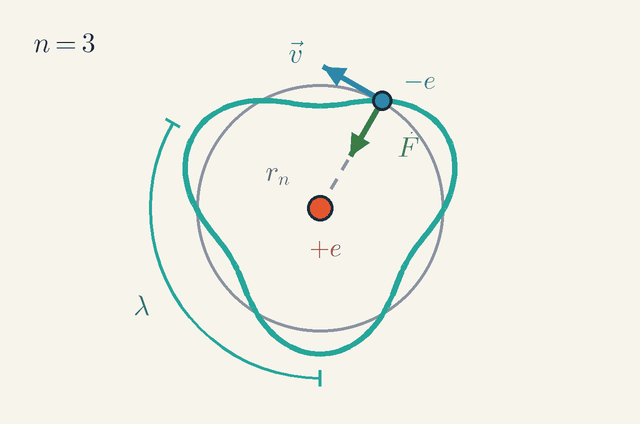
In 1913 Niels Bohr reached the same numbers by another route: he kept classical circular orbits but allowed only some of them. His radii, speeds and energies, derived below, reproduce hydrogen's spectrum. Figure 2 shows one allowed orbit with the force and velocity of the electron.
Figure 2. The orbit n=3: the Coulomb force F points along the radius rn to the nucleus, and the velocity v is tangent to the circle. The electron's wave closes on itself because exactly three wavelengths λ fit round the orbit.Legend
e
Size of the elementary charge: the nucleus carries +e, the electron −e.
C
F
Coulomb force on the electron, pointing at the nucleus.
N
v
Velocity of the electron, along the circle.
m/s
rn
Radius of the orbit: the distance from the nucleus to the electron.
m
λ
Wavelength of the electron's wave; one wavelength is the arc from one crest to the next.
m
n
Number of the orbit; n wavelengths fit round it, here n=3.
Figure 2 shows the orbit n=3. The electron, charge −e, circles the nucleus, charge +e, at radius rn, and its velocity v is tangent to the circle. The only force on it is the Coulomb attraction F, which points along the radius towards the nucleus. A force towards the centre is exactly what circular motion requires, so F alone supplies the centripetal force. The wavy line and λ come in further down.
Bohr added one rule: the angular momentum mvr can only be a whole multiple of ℏ. The two conditions are rmv2=r2ke2,mvr=nℏ,n=1,2,3,… The first is Newton's second law: mass times centripetal acceleration equals the Coulomb force. Multiplying it by r gives mv2r=ke2. Dividing this by the second condition leaves the speed, and the second condition, r=nℏ/(mv), then gives the radius: vn=nℏke2=nαc,rn=mke2n2ℏ2=n2a0 Here α=ke2/(ℏc)≈1/137 is a pure number, the fine-structure constant. The radii grow as n2, and the smallest, r1, is exactly the a0 found from the uncertainty argument. On n=1 the electron moves at c/137≈2.19×106m/s: fast, but well below the speed of light.
Bohr's angular-momentum rule looked arbitrary until de Broglie gave it a meaning in 1924, and this is the wavy line in Figure 2. An electron of momentum mv behaves as a wave of wavelength λ=h/(mv). Substituting mv=h/λ into mvr=nℏ=nh/(2π) cancels h and leaves 2πr=nλ The circumference holds a whole number of wavelengths. Only then does the wave join smoothly onto itself after one trip round, like a standing wave on a closed loop.
In Figure 2, n=3: the wavy line has exactly three crests round the circle, and the arc marked λ spans one wavelength. In numbers, r3=9a0=0.476nm, so the circumference is 2π⋅0.476nm≈2.99nm, and the electron's wavelength on this orbit is about 1.00 nm: three wavelengths fill it exactly.
Next, the energy. The force balance, written as mv2=ke2/r, gives the kinetic energy K=21mv2=21ke2/r. The potential energy is U=−ke2/r, so K=−21U; this is the virial theorem for a 1/r potential. The total is therefore E=K+U=−21ke2/r, and putting in rn gives En=−2ℏ2n2m(ke2)2=−2n2α2mc2=−n213.6eV
The energy is negative because the electron is bound: 13.6eV/n2 must be supplied to free it from level n. The middle form compares it with the electron's rest energy, mc2=511keV: the binding energy is only a fraction α2/2≈2.7×10−5 of it. That is why non-relativistic mechanics works so well here.
When the electron jumps from a level ni down to a lower level nf, it emits one photon that carries off the energy difference, hc/λ=Eni−Enf. With En=−13.6eV/n2 this becomes λ1=RH(nf21−ni21),RH=hc13.6eV≈1.097×10⁷m−1 This is the Rydberg formula. Balmer (1885) and Rydberg had found it by fitting measured lines, with RH as a number read off the data. Bohr calculated RH from m, e, h and c, and it agreed with the measured value within the accuracy of those constants. That agreement made his rules impossible to dismiss.
Reading the level diagram and the spectrum strip
The energies En are easiest to grasp as a ladder of levels, with each spectral line a jump between two rungs. Figure 3 draws that ladder to scale and shows which jumps make which series of lines; the expert layer of the animation uses the same layout.
Figure 3. The first levels of hydrogen, to scale, crowding towards the dashed limit E=0. Each arrow is one photon and its length the photon's energy: Lyman jumps (purple) end on n=1, Balmer jumps (red, blue-green) on n=2.Legend
E
Energy of the atom, measured from the ionisation limit E=0 (dashed line).
J
n
Number of the level: n=1 is the ground state.
→
A jump between two levels, as in 3→2: the electron drops from the first to the second and one photon leaves.
In Figure 3, energy E increases upwards and each horizontal line is a level, labelled by n. The dashed line at the top is E=0, the ionisation limit: an electron with more energy than this is free. Measured from the ground state, level n lies En+13.6eV=13.6eV(1−1/n2) higher, a fraction 1−1/n2 of the way up to the limit: 0, 3/4, 8/9 and 15/16 for n=1 to 4. So three quarters of the binding energy is already gone at n=2, and the higher levels crowd together just below E=0.
Each vertical arrow is one photon given out in a downward jump, labelled by the two levels it joins, as in 3→2. Because the levels are to scale, the length of an arrow is the photon energy Ei−Ef, where Ei and Ef are the energies of the initial and final levels. Jumps that end on n=1 form the Lyman series (purple): 2,3,4→1 give 10.2, 12.09 and 12.75 eV, or 122, 103 and 97 nm, all in the ultraviolet. Jumps that end on n=2 form the Balmer series: 3→2 gives 1.89 eV (red, 656 nm) and 4→2 gives 2.55 eV (blue-green, 486 nm).
Compare the arrows: every Lyman arrow is far longer than any Balmer arrow. Even the largest Balmer energy, a drop from the ionisation limit to n=2, is only 3.40 eV, far below the smallest Lyman energy, 10.2 eV, so the two series never overlap.
In the animation's diagram, a blue marker follows the electron from n=3 to n=2 and back. The spectrum strip above it covers the visible range, 380 to 700 nm, and shows the Balmer lines at 410, 434, 486 and 656 nm. They bunch towards the violet end because, as the starting level rises, 1/λ approaches the series limit RH/4, at 365 nm, just off the strip. The red line, called Hα (the 3→2 jump), lights up the moment the atom emits it.
What quantum mechanics keeps and changes
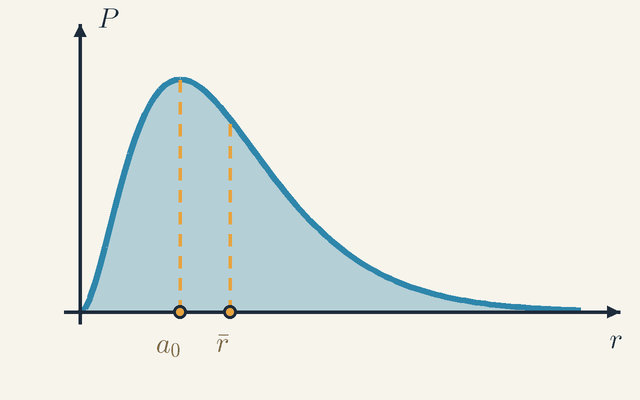
Bohr's model gets the energies right, but its picture of an electron on a sharp circular track is wrong. Quantum mechanics keeps the energies and replaces the track by a cloud of probability. Figure 4 shows that cloud for the ground state, sorted by distance from the nucleus.
Figure 4. Probability density P of finding the ground-state electron at distance r from the nucleus. It peaks at a0, the radius Bohr gave, but the mean distance rˉ=1.5a0 lies beyond the peak and the cloud has no edge.Legend
r
Distance from the nucleus.
m
P
Probability density: the chance per unit distance of finding the electron at distance r, P=4r2e−2r/a0/a03.
m−1
a0
Bohr radius: the distance at which P is largest.
m
rˉ
Mean distance of the electron from the nucleus, 1.5a0.
m
The curve P in Figure 4 is the probability per unit distance of finding the ground-state electron at distance r from the nucleus: the chance of finding it between r and r+dr is Pdr. Three features stand out. P is zero at r=0, because a thin shell of radius r has a volume that shrinks to nothing as r→0. It peaks at exactly a0, the radius Bohr gave. And it falls away to the right without ever reaching zero, so the cloud has no edge.
The mean distance, rˉ=1.5a0, lies to the right of the peak, because the tail on the right is long while the rise on the left is short. Bohr's radius survives, but only as the most probable distance, not as a path.
Schrödinger's equation for the Coulomb potential (1926) gives exactly Bohr's energies En. What changes is the description of the states. The electron is a three-dimensional standing wave, and level n contains n2 different states with the same energy. They are labelled by the orbital angular-momentum number l=0,1,…,n−1, and each l comes in 2l+1 orientations; adding them up, 1+3+5+⋯+(2n−1)=n2. The ground state has l=0: no orbital angular momentum at all, where Bohr gave it ℏ.
The electron's spin has two possible orientations, which doubles the count to 2n2: 2, 8 and 18 states for n=1, 2 and 3. Together with the exclusion principle, which allows at most one electron in each state, these counts shape the periodic table. In atoms with many electrons, states with different l no longer share one energy; once they separate, the rows of the table hold 2, 8, 8, 18, 18, 32 and 32 elements.
The same results hold for any ion with a single electron and nuclear charge Ze. Replacing ke2 by Zke2 in the formulas above gives En=−13.6eVZ2/n2 and rn=n2a0/Z. For He+, with Z=2, the ground state lies at −54.4eV.
One more correction: the nucleus is not infinitely heavy. Electron and nucleus both circle their common centre of mass, and the formulas stay the same if the electron mass m is replaced by the reduced mass μ=mM/(m+M), where M is the mass of the nucleus. For hydrogen this lowers the binding energies by 0.054 %; for deuterium, whose nucleus is twice as heavy, by only 0.027 %. Deuterium's lines therefore carry slightly more energy, and its Hα line lies 0.18 nm shorter than hydrogen's: the small shift that revealed deuterium in the early 1930s.
Worked problem: from the red line to radio waves
Bohr required his quantum rules to agree with classical physics wherever quantum effects become small: the correspondence principle. Classically, an orbiting charge radiates at its orbital frequency forb=v/(2πr), the number of trips round per second. This problem compares that frequency with the photon's, first low on the ladder and then high up.
Step 1, the orbital frequency of level n. With vn=αc/n and rn=n2a0, forb=2πrnvn=2πa0n3αc=n36.58×1015Hz
Step 2, the red line. The electron circles 2.44×10¹⁴ times a second on n=3 and 8.22×10¹⁴ times on n=2. The Hα photon of the jump 3→2 has f=c/λ=4.57×1014Hz: between the two orbital frequencies, and equal to neither. Low on the ladder, a quantum jump has no classical counterpart.
Step 3, a jump high up, from n=110 to n=109. The photon energy is hf=13.6eV(10921−11021)=2.07×10⁻⁵eV Dividing by h=4.14×10⁻¹⁵eVs gives f=5.01×10⁹Hz, and λ=c/f≈6.0cm: a radio wave. The orbital frequencies are now 5.08 GHz on n=109 and 4.94 GHz on n=110, both within 1.5 % of the photon's frequency.
Step 4, why they merge. For a step Δn=1 at large n, the energy difference is close to the slope of En with respect to n: hf≈dndEn=n32⋅13.6eV=n327.2eV And hforb=ℏαc/(a0n3) is exactly the same, because ℏ/a0=αmc, so ℏαc/a0=α2mc2=27.2eV. At large n the quantum and classical frequencies merge, as the correspondence principle demands. Jumps with Δn=2 or 3 likewise give 2forb and 3forb, the overtones that a classical elliptical orbit radiates.
Such giant atoms are real. The n=110 orbit has a radius of 1102a0≈0.64μm, the size of a small bacterium, so the atom survives only in very thin gas, where collisions are rare. In the ionised clouds around hot young stars, protons recapture electrons, which then cascade down the ladder step by step. Radio telescopes observe the resulting 5.01 GHz line, named H109α, from clouds that also glow red in Hα.
Limits of validity
Bohr's model is only a first approximation even for hydrogen, and for atoms with more than one electron it fails. Knowing where it stops tells you when the full theory is needed.
For hydrogen, relativity and the electron's spin shift the levels by relative amounts of order α2≈5×10⁻⁵; this is expected, since the electron moves at v=αc and relativistic corrections grow as (v/c)2. This fine structure splits the n=2 level by 4.5×10⁻⁵eV and turns Hα into components about 0.016 nm apart. Smaller still are the Lamb shift (4.4×10⁻⁶eV, from quantum electrodynamics) and the hyperfine splitting of the ground state (5.9×10⁻⁶eV, from the magnetic interaction of the electron and proton spins), whose 21 cm line maps hydrogen across the Galaxy.
In heavy one-electron ions the electron's speed, Zαc on the lowest orbit, approaches c, and relativity dominates. In U91+, Zα≈0.67, and the ground state is bound by about 132 keV, against Bohr's 13.6eV⋅922≈115keV.
With two or more electrons the model fails outright, as the note in the animation warns, because each electron also repels the others. For helium, ignoring that repulsion gives 2⋅(−54.4)=−108.8eV for the total energy, while the measured total is −79.0eV.
Bohr's rules also say nothing about how bright a line is or how long a level lasts before it emits (hydrogen's 2p state, with n=2 and l=1, decays in 1.6 ns). And the orbits cannot be real paths: placing the electron on a circle of radius a0 means knowing its position to within about a0, which leaves its momentum uncertain by about ℏ/a0=mv1, its entire momentum. One effect the model can safely ignore is recoil: an atom emitting Hα recoils at only 0.60 m/s, which takes just 2×10⁻⁹eV from the photon.
Where this leads
The Bohr atom is where several lessons meet. Its photon rule applies to atoms the light quanta of Photoelectric Effect and of Blackbody Radiation and the Quantum. Its force balance is Coulomb's Law inside Circular Motion. Its quantised angular momentum brings Angular Momentum and Its Conservation down to the atomic scale. Wave–Particle Duality explains the allowed orbits as standing electron waves, and Schrödinger's Equation and Tunnelling replaces orbits by wave functions while keeping En.
In Semiconductors, Diodes and LEDs the levels of a crystal's atoms merge into bands, and an LED's colour is set by a band gap just as the colour of Hα is set by E3−E2. Radioactivity and Half-Life moves to the nucleus, whose levels lie thousands to millions of times further apart. In Particles and Forces: the Standard Model, α≈1/137 returns as the strength of the electromagnetic interaction itself.
Key formulas
Bohr's quantisation of angular momentum
mvr=nℏ
Of all the circular orbits that classical mechanics allows, Bohr kept only those whose angular momentum L=mvr is a whole multiple of ℏ. This one rule picks out the radii and energies of hydrogen. Read with the electron's wavelength λ=h/(mv), it says 2πr=nλ: a whole number of wavelengths fits around the orbit.
Symbols
m
mass of the electron
kg
v
orbital speed of the electron
m/s
r
radius of the orbit
m
n
principal quantum number, 1,2,3,…
ℏ
reduced Planck constant, h/2π
J⋅s
When it holds: A postulate of the 1913 model, right in its consequences for hydrogen's energies. Quantum mechanics replaces it: the orbital angular momentum is l(l+1)ℏ with l≤n−1, so the ground state has none at all.
Example: On n=3, with r=0.476nm and v≈7.3×10⁵m/s: mvr=3ℏ≈3.16×10⁻³⁴J⋅s.
Radius of the n-th Bohr orbit
rn=n2a0
Combining the Coulomb force as the centripetal force, mv2/r=ke2/r2, with mvr=nℏ gives r=n2ℏ2/(mke2). The radii therefore grow as the square of n, in the ratio 1 : 4 : 9 : 16, starting from the Bohr radius a0.
Symbols
rn
radius of orbit n
m
n
principal quantum number
a0
Bohr radius, about 0.0529nm
m
When it holds: Hydrogen in Bohr's model; for a one-electron ion of charge Ze, rn=n2a0/Z. In quantum mechanics n2a0 is only the most probable distance for the states with l=n−1, not a sharp orbit.
Example: The animation's electron drops from r3=9a0=0.476nm to r2=4a0=0.212nm.
Energy levels of hydrogen
En=−n213.6eV
The energy on orbit n is kinetic plus potential energy; the kinetic energy is half the size of the potential energy, so En=−K. It is negative because the zero is a free electron at rest, and 13.6 eV is the energy needed to ionise the atom from n=1. The levels crowd together toward zero as n grows.
Symbols
En
energy of level n
eV
n
principal quantum number
When it holds: Hydrogen and, with a factor Z2, one-electron ions; Schrödinger's equation gives the same values. Fine structure shifts them by parts in 105, and atoms with several electrons need other methods.
Example:E2=−13.6/4=−3.40eV and E3=−13.6/9=−1.51eV, the two values on the animation's readout.
Photon energy in a quantum jump
hf=Ei−Ef
This is energy conservation for a jump: when the electron falls from level i to a lower level f, the atom loses Ei−Ef and a single photon of energy hf carries it away. Read backward, it is the condition for absorption: a photon is absorbed only if hf matches a gap exactly. The photon carries the difference between two levels, never the value of one; in electronvolts use h=4.14×10⁻¹⁵eV⋅s.
Symbols
h
Planck constant
J⋅s
f
frequency of the photon
Hz
Ei
energy of the initial (upper) level
J
Ef
energy of the final (lower) level
J
When it holds: Holds for every atom, molecule and nucleus, apart from a tiny share taken by the recoil of the atom (2×10⁻⁹eV for Hα). Bohr's model supplies the levels themselves only for one-electron atoms.
Example:3→2: hf=−1.51−(−3.40)=1.89eV, so f=1.89eV/(4.14×10−15eV⋅s)≈4.57×1014Hz.
Wavelength of the emitted light
λ=Ei−Efhc
Light of frequency f has wavelength λ=c/f, so the photon rule becomes λ=hc/(Ei−Ef). A large energy gap means a short wavelength: jumps down to n=1 release at least 10.2 eV and are ultraviolet, while the smaller jumps down to n=2 give visible light. With energies in electronvolts, hc≈1240eV⋅nm gives λ directly in nanometres.
Symbols
λ
wavelength of the photon
m
h
Planck constant
J⋅s
c
speed of light
m/s
Ei
energy of the initial (upper) level
J
Ef
energy of the final (lower) level
J
When it holds: Gives the wavelength in vacuum; in air it is about 0.03 % shorter (Hα: 656.5 nm in vacuum, 656.3 nm in air).
Dividing the level difference by hc gives the reciprocal wavelength directly, with RH=13.6eV/(hc)≈1.097×107m−1. Found from measured lines before Bohr's model existed, the formula sorts every hydrogen line into a series by its final level nf; letting ni→∞ gives the series limit, 1/λ=RH/nf2.
Symbols
λ
wavelength of the line
m
RH
Rydberg constant for hydrogen
m−1
nf
quantum number of the final (lower) level
ni
quantum number of the initial (upper) level
When it holds: Hydrogen, with ni>nf for emission (for absorption the atom climbs from nf to ni). For one-electron ions multiply by Z2; the reduced mass makes the constant slightly larger for deuterium, shortening its lines by about 0.03 %.
Example: Hα: 1/λ=RH(1/4−1/9)=1.52×106m−1, so λ≈656nm; the Balmer limit is 4/RH≈365nm.
Glossary
Nuclear atom
The picture established by alpha-particle scattering in 1911: all the positive charge and almost all the mass sit in a nucleus only 10−15 to 10−14m across, with the electrons spread over a region about 10−10m across. Classically such an atom should collapse.
Bohr model
Niels Bohr's 1913 model of hydrogen: circular orbits held by the Coulomb force, angular momentum restricted to mvr=nℏ, and light emitted or absorbed only in jumps between orbits. It gives hydrogen's energy levels correctly but fails for atoms with more than one electron.
Stationary state
A state of the atom with a definite energy that does not change in time and in which the atom does not radiate. Bohr's allowed orbits were the first example; in quantum mechanics they become standing waves.
Energy level
One of the allowed energies of a bound system, En=−13.6eV/n2 for hydrogen. Levels are negative because energy must be supplied to free the electron, and they crowd together toward zero as n grows.
Ground and excited states
The ground state is the lowest level (n=1, −13.6eV), where an atom can stay indefinitely. Any higher level is an excited state, reached by absorbing a photon or through a collision, and it decays back by emitting photons, typically within about 10−8s.
Ionisation energy
The least energy that removes the electron from an atom in its ground state: 13.6 eV for hydrogen, equal to −E1. Any energy beyond this leaves with the freed electron as kinetic energy.
Quantum jump
A transition between two levels. Going down, the atom emits one photon with hf=Ei−Ef; going up, it absorbs a photon of exactly that energy or takes the energy from a collision. Bohr's theory describes no path between the two orbits.
Emission spectrum
The wavelengths given off by a hot or electrically excited gas: for atoms, sharp bright lines rather than a continuous rainbow, one for each possible jump. Hydrogen's visible lines lie at 656, 486, 434 and 410 nm.
Absorption lines
Dark lines in a continuous spectrum, where cooler gas in front of the source has absorbed exactly its own transition wavelengths. In sunlight, hydrogen's Hα appears as a dark line at 656 nm.
Spectral series
All the lines that end on the same lower level: Lyman (nf=1, ultraviolet), Balmer (nf=2, visible) and Paschen (nf=3, infrared). Within a series the lines crowd together toward a series limit, 365 nm for Balmer.
Hydrogen-like ion
Any ion with a single electron, such as He+ or Li2+. Bohr's formulas apply with the nuclear charge Ze: En=−13.6eVZ2/n2 and rn=n2a0/Z.
Correspondence principle
The requirement that quantum results merge with classical ones when the quantum numbers are large. For hydrogen, the frequency of the photon from a jump n→n−1 approaches the electron's classical orbital frequency as n grows.
Quantities
n
Principal quantum number
The whole number 1,2,3,… that labels the allowed orbits and energy levels; n=1 is the ground state.
ℏ
Reduced Planck constant
J⋅s
h/2π≈1.055×10−34J⋅s: the quantum of angular momentum in Bohr's rule mvr=nℏ.
a0
Bohr radius
m
The radius of the ground-state orbit, ℏ2/(mke2)≈5.29×10−11m=0.0529nm: the natural length scale of atoms.
rn
Orbit radius
m
The radius of Bohr's n-th orbit, n2a0; in quantum mechanics it survives only as a most probable distance, not a path.
v
Orbital speed
m/s
The speed of the electron, of mass m=9.109×10⁻³¹kg, on orbit n, vn=αc/n: about 2.19×10⁶m/s on n=1 and slower on the higher orbits.
En
Energy of level n
eV
Kinetic plus potential energy of the electron on level n, measured from a free electron at rest, so negative for a bound state; 1eV=1.602×10⁻¹⁹J.
h
Planck constant
J⋅s
6.626×10⁻³⁴J⋅s=4.136×10⁻¹⁵eV⋅s: it links a photon's energy to its frequency, E=hf.
f
Photon frequency
Hz
The number of oscillations per second of the emitted or absorbed light; 4.57×10¹⁴Hz for Hα.
λ
Wavelength
m
The wavelength of the photon, c/f, where c=2.998×10⁸m/s is the speed of light; it is usually quoted in nanometres for atomic lines: 656 nm for Hα, 122 nm for Lyman α.
RH
Rydberg constant for hydrogen
m−1
The constant in 1/λ=RH(1/nf2−1/ni2), about 1.097×10⁷m−1; it equals 13.6eV/(hc).
Quiz
Beginner In Bohr's model, what happens when an electron drops to a lower energy level?
It emits a photon carrying the energy difference
It absorbs a photon
It falls into the nucleus
It loses part of its charge
Show answer
Answer: A. It emits a photon carrying the energy difference
The energy lost by the electron leaves the atom as one photon whose energy equals the difference between the two levels.
Beginner Why does hot hydrogen gas glow only in certain sharp colours?
The glass tube filters out the other colours
Its electron can only have certain energies, so only certain energy jumps are possible
Hydrogen atoms are too small to make other colours
Hot gases always glow red
Show answer
Answer: B. Its electron can only have certain energies, so only certain energy jumps are possible
Fixed energy levels allow only fixed energy differences, and each difference corresponds to one photon energy, that is, one colour.
Beginner In Bohr's model, on which ring does the electron move fastest?
On the outermost ring
At the same speed on every ring
Only while jumping between rings
On an inner ring, close to the nucleus
Show answer
Answer: D. On an inner ring, close to the nucleus
In Bohr's model the speed is inversely proportional to n, so the electron is fastest on the inner ring, much as inner planets orbit the Sun faster. A jump is not a quick trip along a path: Bohr's electron simply appears on the new ring (the animation slows the jump down so you can see it).
Intermediate What is the energy of the n = 2 level of hydrogen?
−6.8 eV
−3.4 eV
−13.6 eV
+3.4 eV
Show answer
Answer: B. −3.4 eV
Eₙ = −13.6 eV / n² = −13.6/4 = −3.4 eV. Dividing by n instead of n² gives −6.8 eV, and bound levels are negative.
Intermediate A hydrogen electron drops from n = 3 to n = 2. What is the energy of the emitted photon?
1.89 eV
3.40 eV
1.51 eV
4.91 eV
Show answer
Answer: A. 1.89 eV
h·f = E₃ − E₂ = −1.51 eV − (−3.40 eV) = 1.89 eV, the red Hα line at 656 nm. 3.40 eV and 1.51 eV are the sizes of the levels themselves; 4.91 eV adds them.
Intermediate How does the radius of the n = 3 orbit compare with that of the n = 1 orbit?
3 times larger
27 times larger
9 times larger
The same
Show answer
Answer: C. 9 times larger
rₙ = n²·a₀, so r₃/r₁ = 3² = 9. The factor 27 = 3³ applies to the orbital period, not the radius.
Advanced Which series of hydrogen lines lies entirely in the ultraviolet?
Balmer (ending on n = 2)
Lyman (ending on n = 1)
Paschen (ending on n = 3)
None of them
Show answer
Answer: B. Lyman (ending on n = 1)
Every Lyman photon carries at least E₂ − E₁ = 10.2 eV, i.e. λ ≤ 121.6 nm. Balmer has visible lines; Paschen lies in the infrared.
Advanced Which of these is a genuine failure of Bohr's model?
It predicts a continuous spectrum for hydrogen
It gives the wrong ionisation energy for hydrogen
It cannot handle atoms with two or more electrons, such as helium
It cannot explain the Balmer series
Show answer
Answer: C. It cannot handle atoms with two or more electrons, such as helium
Bohr's model reproduces hydrogen's levels, ionisation energy and Balmer lines, but breaks down as soon as electrons interact with each other, as in helium.
 Physics Tutor