Everything around you is built from a handful of quarks and leptons, such as the uud of a proton, held together by forces that act by trading messenger particles: a carrier of mass m reaches only about ℏ/(mc).
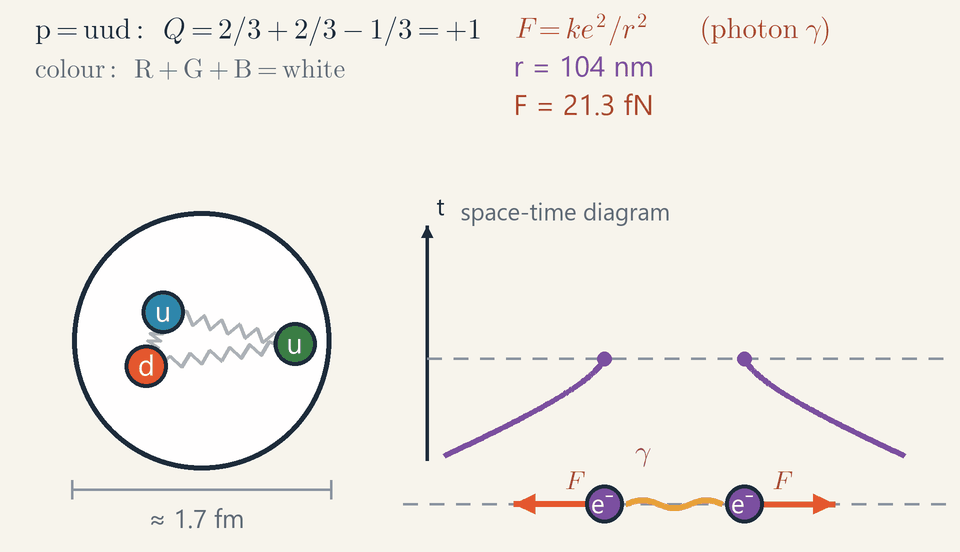
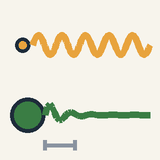
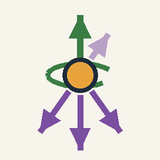
Three quarks jiggle inside a proton, held by gluons that swap their colours, while two electrons approach, exchange a photon and fly apart.
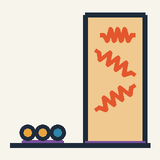
Each proton and neutron in an atom's nucleus is made of three quarks: up-up-down for a proton, up-down-down for a neutron.
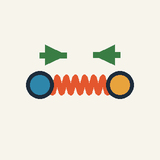
Gluons tie quarks together like rubber bands that pull harder when stretched, so a quark is never found on its own.
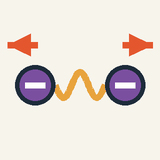
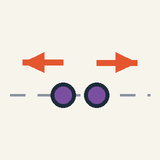
Like charges repel: two electrons push each other apart by trading photons, particles of light.
Nature has four fundamental forces: gravity, electromagnetism, the strong force and the weak force.
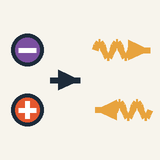
Every particle has an antimatter twin with opposite charge; when the two meet, both vanish in a flash of light.
Start with what you may already know: an atom has a tiny nucleus made of protons, which carry positive charge, and neutrons, which carry none, with negative electrons around it. For a long time these three looked like the final building blocks. They are not all final: each proton and each neutron is a little bag of three smaller particles called quarks. Two kinds are enough for ordinary matter, “up” and “down”. A proton is up-up-down; a neutron is up-down-down.
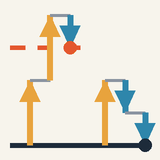
Check yourself: if one up quark in a proton turned into a down quark, what would the proton become? Answer: a neutron. This really happens in some radioactive nuclei.
What holds quarks together? Gluons, the carriers of the strong force. In the animation they are the springs between the jiggling quarks. Like rubber bands, they pull harder the farther they are stretched, so a quark can never be pulled out alone: the energy you spend creates new quarks instead. Each quark also has a “colour” (red, green or blue; just a name, not a real colour), and a hopping gluon carries colour from one quark to another, so all three colours are always present.
Electrons belong to a different family, the leptons. Two electrons are both negative, so they repel, more strongly the closer they get. On the right of the animation, two electrons slow down, trade a photon, a particle of light, at their closest point, and fly apart: this trade is how physicists picture the electric push.
Nature has just four basic forces: gravity, electromagnetism, the strong force and the weak force, which drives some radioactive decays. And every particle has an antimatter twin with the opposite charge; when the two meet, both vanish in a flash of light.
Intermediate
Key ideas
Matter: 6 quarks and 6 leptons; quark charges are +32e (u, c, t) or −31e (d, s, b), so uud has Q=+1 and udd has Q=0.
Carriers: photon (electromagnetism), 8 gluons (strong), W+, W− and Z0 (weak); a carrier of mass m gives a range R≈ℏ/(mc).
Electrons repel with F=ke2/r2: 23 fN at 100 nm, twelve times weaker at 343 nm.
About 99 % of the proton's 938 MeV/c² is field and motion energy, not quark rest mass (≈ 9 MeV/c²).
Annihilation e++e−→2γ gives two 511 keV photons; charge, baryon and lepton numbers are always conserved.
Units for the very small
Particle physicists measure energy in electronvolts: 1 eV is the energy an electron gains across one volt, 1.602×10⁻¹⁹J, and 1 MeV is a million of them. Because E=mc2, a mass can be quoted as a rest energy over c2: the electron is 0.511 MeV/c², the proton 938 MeV/c².
Lengths inside nuclei are measured in femtometres, 1fm=10−15m, and the proton in the animation is about 1.7 fm across. One constant links energy and length, ℏc≈197.3MeV⋅fm, with ℏ=h/2π: dividing it by an energy gives a distance.
Twelve particles of matter
The Standard Model sorts matter into twelve fermions, six quarks and six leptons, in three generations. The first (up and down quarks, electron and its neutrino) contains everything atoms are made of. The second (charm, strange, muon) and the third (top, bottom, tau), each with a neutrino, repeat the same charges with heavier particles.
Up-type quarks (u, c, t) carry +32e and down-type quarks (d, s, b) carry −31e, where e is the elementary charge; the electron, muon and tau carry −e and the neutrinos nothing. The two nucleons then come out right:
p=uud:Q=32+32−31=+1
n=udd:Q=32−31−31=0
Quarks carry a second kind of charge, colour, with three values named red, green and blue; the names are just labels. Only colourless combinations exist on their own: three quarks of different colours make a baryon such as the proton, and a quark with an antiquark of the matching anticolour makes a meson such as the pion π+=udˉ, of charge 32+31=+1. Together they are the hadrons. Leptons have no colour and feel no strong force.
Forces as exchanged particles
In this picture a force is the exchange of a boson, a messenger particle. The photon γ carries electromagnetism between electric charges, eight gluons carry the strong force between colour charges, and the W+, W− and Z0 carry the weak force, in which the W turns one kind of quark or lepton into another and so drives β decay. The Higgs boson, found in 2012, is a ripple of the field that gives particles their masses, not a force carrier. Gravity is not part of the model.
A carrier with mass can only travel a limited distance, so it gives a short-ranged force: R≈mcℏ=mc2ℏc,ℏc≈197.3MeV⋅fm The photon is massless, so the electric force reaches arbitrarily far and keeps the inverse-square form of Coulomb's law: F=r2ke2(photon exchange)
The W has 80.4 GeV/c², so R≈197.3/80400fm≈0.0025fm. Gluons are massless too, but colour stays locked inside hadrons; the force between neighbouring nucleons is a colourless leftover, carried mainly by pions of 140 MeV/c², so R≈197.3/140fm≈1.4fm.
Worked example: the electrons in the animation
On the right of the animation two electrons approach head-on, stop for an instant 100 nm apart and fly back out. At closest approach, with k=8.99×10⁹N⋅m2/C2, F=r2ke2=(1.00×10⁻⁷)28.99×109⋅(1.60×10−19)2≈2.3×10⁻¹⁴N that is 23 femtonewtons, the peak of 23.1 fN on the F readout when the r readout shows 100 nm.
At the start the electrons are 343 nm apart, 3.43 times farther, so the force is 3.432≈11.8 times weaker, 23.1/11.8≈1.96fN (the readout shows 2.0 fN). The red F arrows are drawn to scale, so they grow about twelvefold on the way in.
At closest approach both electrons are at rest, so the whole energy of the pair is electric potential energy, ke2/r=2.3×10−21J or 14.4 meV. At the start 4.2 meV of it is still potential and 10.2 meV is kinetic: each electron has 5.1 meV, a speed of about 42 km/s. The real encounter lasts about 8 ps, so the 9 s loop slows it down by a factor of 1012.
Worked example: annihilation in a PET scanner
A positron emission tomography (PET) scan uses a tracer, such as sugar labelled with fluorine-18, whose nucleus turns a proton into a neutron, p→n+e++νe, conserving charge (+1=0+1+0) and lepton number (0=0−1+1). The positron stops within a millimetre and meets an electron; both are almost at rest, so their total momentum is almost zero.
A single photon cannot carry away the energy, because a photon always has momentum E/c. Two photons flying apart back to back can, each with the rest energy of one particle: e++e−→γ+γ,Eγ=mec2=511keV(at rest) Here mec2=9.109×10−31⋅(2.998×108)2=8.187×10⁻¹⁴J, which is 511 keV, and the wavelength is λ=hc/E=1239.8keV⋅pm/511keV≈2.43pm, some 200 000 times shorter than green light.
A ring of detectors records both photons within a few nanoseconds; the annihilation lies on the line joining the hits. If one photon arrives 200 ps earlier, the point is cΔt/2=3.00×108⋅2×10−10/2=3cm from the middle of the line, towards that detector.
Reading the space-time diagram
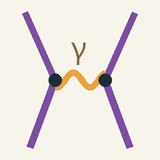
Above the electrons the intermediate layer draws a space-time diagram: position runs across, time runs upward, and a dashed line marks the present. Each electron traces a purple worldline, slanted while far apart, vertical at t=4.5s when both stand still 100 nm apart, then bending away. The steeper a worldline, the slower the particle.
The gold wiggle at that instant is the exchanged photon γ, joining two vertices (the black dots). The smooth worldlines are a classical picture; the quantum description sums interaction diagrams, each vertex being one emission or absorption.
The proton obeys a similar rule for colour. Four gluons hop during each loop, and whenever none is flying you can count one red, one green and one blue quark.
Common mistakes
The proton's mass is not the sum of its quark masses: they add up to about 9 MeV/c², the proton has 938. About 99 % is the energy of the gluon field and of the quarks' motion, via E=mc2.
The weak force is short-ranged because its carriers are heavy (R≈0.0025fm for the W), not because it is the weakest: gravity is far weaker, yet reaches arbitrarily far.
A positron and an electron at rest cannot annihilate into one photon: a photon of 1022 keV would carry momentum E/c, but the total is zero. Two back-to-back photons of 511 keV balance both.
Neutral does not mean being your own antiparticle: the antineutron has baryon number −1 and annihilates with a neutron, whereas the photon and the π0 are their own antiparticles.
Where you meet it
PET scanners use antimatter every day, and cosmic-ray muons, heavy electrons, cross every square centimetre at sea level about once a minute. The Sun shines because the weak force turns protons into neutrons in its core (see Fission, Fusion and E = mc²), and carbon dating counts β decays of carbon-14 (see Radioactivity and Half-Life).
Colliders steer particles around rings with magnets, using the circular motion of Magnetic Force on Moving Charges: R=eBp(circular accelerator) A momentum of 1 GeV/c corresponds to BR=3.336T⋅m, so protons of 7000 GeV/c in the 8.33 T bending magnets of the Large Hadron Collider move on a circle of radius R=7000⋅3.336/8.33m≈2.80km.
Advanced
Key ideas
Every symmetry brings a conservation law: shifts in space give momentum, shifts in time energy, rotations angular momentum, a quantum phase electric charge.
Local phase symmetry demands the photon; SU(3)×SU(2)×U(1) adds 8 gluons, W+, W− and Z0; the Higgs vacuum (v≈246GeV) hides part of it.
The area under F(t) is the momentum 2p carried by a virtual photon; each interaction diagram is one term of a series in α≈1/137.
Confinement: V(r)=−34αsℏc/r+σr keeps rising, so a stretched string breaks into hadrons instead of freeing a quark.
Weak decays break mirror symmetry: β electrons from aligned nuclei prefer one direction; charge, baryon and lepton numbers survive every reaction.
The range of a force and the mass of its carrier
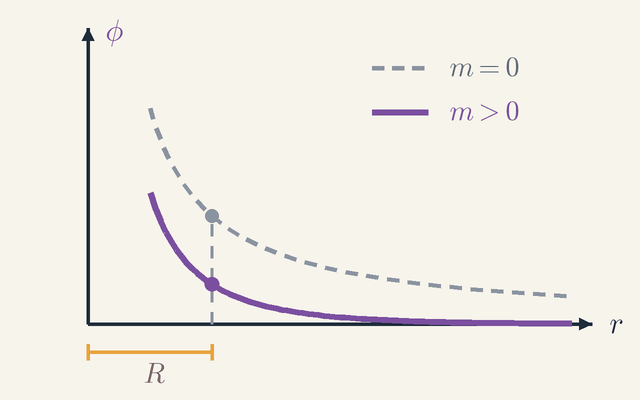
Figure 1. The field ϕ around a static source. With a massless carrier (m=0, dashed) it follows 1/r and never cuts off; with a carrier of mass m (solid) it sinks ever further below that. At r=R (dots) the solid curve is at 1/e of the dashed one.Legend
ϕ
Field of the carrier around the source; the vertical scale is arbitrary.
r
Distance from the source, drawn in units of R.
m
R
Range of the force, R=ℏ/(mc); at r=R the solid curve is at 1/e of the dashed one.
m
m
Mass of the carrier: zero for the dashed curve, positive for the solid one.
kg
Why does the electric force reach across the universe while the nuclear force stops dead after about a femtometre? This section shows that the answer is the mass of the particle that carries the force, and then turns the measured range of the nuclear force into a prediction of a particle's mass.
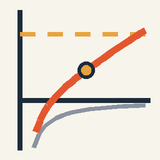
Figure 1 shows the field ϕ that a static source sets up at distance r, for two kinds of carrier. The dashed curve (m=0) is for a massless carrier. It is Coulomb's 1/r, which contains no length scale and so never cuts off. The solid curve (m>0) is for a carrier of mass m. It is the dashed curve multiplied by an extra factor that is close to 1 only very near the source and shrinks with distance, so the solid curve sinks further and further below the dashed one. Look at the two dots above the end of the bracket R: there the solid curve is down to 1/e≈0.37 of the dashed one. At 2R the ratio is 0.14, at 3R it is 0.05, and beyond a few R the field is gone for practical purposes. The length R is the range of the force; the rest of the section shows what sets it.
The contrast in nature is stark. The nuclear force between protons and neutrons fades within about 1.4 fm, while the electric force reaches arbitrarily far. In 1935 Hideki Yukawa turned that contrast into a prediction. Picture a nucleon at rest that emits a carrier of mass m. Creating the carrier breaks energy conservation by mc2. The energy–time uncertainty relation tolerates such a debt only for a time of about ℏ/(mc2), where ℏ is the reduced Planck constant; then the carrier must be absorbed again. Even at nearly the speed of light it covers at most c times that time, so the range is R≈mcℏ=mc2ℏc,ℏc≈197.3MeV⋅fm The heavier the carrier, the shorter the loan and the shorter the range. A massless carrier can be borrowed indefinitely, so its range is infinite.
The same result follows exactly when relativity and quantum mechanics are combined. A free quantum of mass m obeys E2=p2c2+m2c4. In quantum mechanics energy and momentum act on a wave as the operators iℏ∂/∂t and −iℏ∇. Putting them in place of E and p and dividing by ℏ2c2 turns the energy relation into a wave equation for the field ϕ: c21∂t2∂2ϕ−∇2ϕ+ℏ2m2c2ϕ=0 The first two terms make up the ordinary wave equation, which on its own describes waves moving at c. The third is the mass term, the only place where m enters.
Around a static point source nothing changes in time, so the first term drops out and the equation becomes ∇2ϕ=ϕ/R2, with R=ℏ/(mc). To solve it away from the source, write ϕ=u/r: for a spherically symmetric field this turns the equation into d2u/dr2=u/R2, whose solution that dies away at large r is u=e−r/R. Hence ϕ(r)∝re−r/R,R=mcℏ These are exactly the two curves of Figure 1. With m=0 the range is infinite, the exponential equals 1 and ϕ∝1/r: the dashed Coulomb curve. With a mass, e−r/R is the extra factor of the solid curve, and it kills the field beyond a few R.
Now run the argument backwards. A range of 1.4 fm calls for mc2=ℏc/R=197.3MeV⋅fm/1.4fm≈140MeV, a carrier of about 140 MeV/c². The pion, found in 1947, has just that mass. Dozens more strongly interacting particles, hadrons, followed, and quarks later explained their regular families. The table in the animation's expert layer shows the order that emerged: three generations of quarks and leptons with identical charges, differing only in mass, and the force carriers in a column of their own.
Symmetry and the origin of forces
Why these particular carriers, and why is the photon massless? The modern answer is symmetry: the forces are not added to the theory by hand but are demanded by symmetries of its laws.
The link between symmetry and conservation is older. A symmetry is a change that leaves the laws unchanged. If the laws are the same at every place, momentum is conserved; if they are the same at all times, energy is conserved; if they are the same in every direction, angular momentum is conserved. Emmy Noether proved in 1918 that this is general: every continuous symmetry of the laws brings its own conserved quantity.
Quantum mechanics adds a symmetry with no classical counterpart. A particle is described by a complex amplitude ψ, and only the probability ∣ψ∣2 is ever measured. Multiplying every amplitude by the same phase factor eiδ therefore changes nothing observable, since ∣eiδψ∣2=∣ψ∣2. Any angle δ will do, so this is a continuous symmetry, and the conserved quantity that Noether's theorem attaches to it is electric charge.
Now make the demand stronger and let the phase δ(x,t) differ from point to point and from moment to moment. The probabilities are still unchanged, but the wave equation is not. It contains derivatives of ψ, and the derivative of eiδψ picks up an extra term in the derivatives of δ. The laws can keep this local symmetry only if a new field is added whose own change cancels those extra terms exactly. That field is the electromagnetic potential, and its quantum is the photon. A mass term for this field would itself break the symmetry, so the photon must be massless, which by the previous section is why the electric force has an infinite range.
The same recipe, applied to richer symmetries, produces the other carriers. Colour symmetry, called SU(3) because it mixes the three colours, needs 32−1=8 fields: the eight gluons. The electroweak symmetry SU(2)×U(1) needs 3+1=4 fields, which appear as W+, W−, Z0 and the photon.
Hidden symmetry: the Higgs field
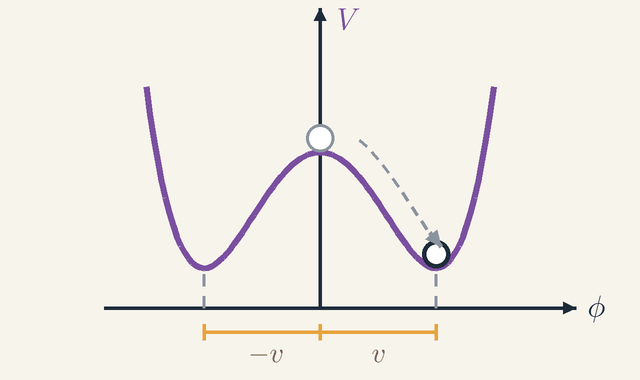
Figure 2. Cross-section of the Higgs potential energy density V against the field value ϕ. The symmetric state ϕ=0 is a hilltop (pale ball); the field rolls down (dashed) and settles at a lowest point, ϕ=±v. Turned about the V axis, the curve gives the hat. Not to scale.Legend
V
Potential energy density of the Higgs field.
J/m3
ϕ
Value of the Higgs field (one component of it), given as an energy in GeV, as is usual in particle physics.
J
v
Value of the field at the two lowest points, ϕ=±v; v≈246GeV.
J
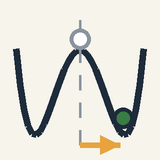
The previous section leaves a puzzle. The same symmetry that keeps the photon massless forbids mass terms for the W and Z as well, yet they are heavy, about 80 and 91 GeV/c². The way out is that the laws keep the symmetry while the vacuum, the state of lowest energy, does not. Figure 2 shows how that can happen.
Figure 2 is a cross-section of the potential energy density V of the Higgs field, plotted against the field's value ϕ (here ϕ is the Higgs field, not the field of Figure 1). The curve is symmetric: it treats +ϕ and −ϕ alike. Yet its symmetric point, ϕ=0, is a hilltop, marked by the pale ball. Any small disturbance sends the field rolling down, along the dashed path, until it comes to rest in one of the two troughs, at ϕ=+v (the dark ball) or at ϕ=−v. Now turn the curve about the vertical axis. It becomes a Mexican hat, whose trough is a whole circle of equally low points. The field must settle at one of them, so the state it picks is less symmetric than the laws, which allow every one. The distance of the trough from zero is the value v≈246GeV, and the field holds this value throughout space.
Particles moving through this everywhere-present background interact with it, and that interaction is what we measure as their mass. The W gets mWc2=gv/2≈80GeV, where g≈0.65 is the weak coupling. Each fermion gets mfc2=yfv/2, set by its own coupling yf to the field: the top quark has yt≈1, the electron only ye≈3×10⁻⁶, which is why their masses differ by a factor of some 300 000. The photon belongs to the one combination of electroweak fields that the vacuum leaves unbroken, so it stays massless.
The field itself can also ripple about its resting value v, like a ball wobbling in the trough. The quantum of that ripple is the Higgs boson, found in 2012 at 125 GeV/c².
Mirror symmetry and CP
Not every symmetry of everyday physics holds for the weak force. Mirror reflection fails, and its failure, found in 1957, was a surprise.
In that year cobalt-60 nuclei were cooled to a very low temperature and lined up in a magnetic field, so that their spins all pointed the same way. They emitted β electrons mostly in the direction opposite to the nuclear spin. Now imagine the experiment seen in a mirror perpendicular to the spin axis. The nuclei rotate in planes parallel to the mirror, so their sense of rotation, and hence their spin, is unchanged; but the electrons travelling along the axis are reversed. The mirror image would therefore show electrons leaving mostly along the spin, which never happens. The weak force can tell a process from its mirror image.
Combining the mirror with the exchange of matter and antimatter, an operation called CP, almost restores the symmetry, but not quite: neutral K and B mesons break it, kaons by about two parts in a thousand and B mesons by tens of per cent in some decays.
Some conservation laws, by contrast, have never been seen to fail. Electric charge, baryon number B (+31 for each quark, so +1 for a proton) and lepton number L (+1 for each lepton, −1 for each antilepton) hold in every reaction observed. The decay p→e++π0, for example, would conserve charge but change B from 1 to 0 and L from 0 to −1; searches show that in that channel protons outlive 1034 years, far longer than the age of the universe.
Momentum transfer and the coupling constant
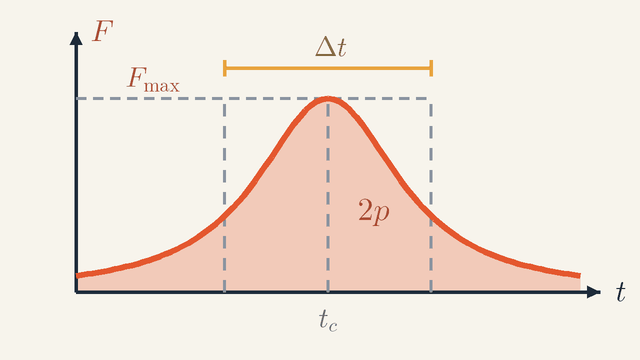
Figure 3. The force F between the two electrons of the animation against its slowed-down time t, peaking at closest approach tc. The shaded area is the momentum 2p handed over; the dashed rectangle of height Fmax and width Δt has the same area.Legend
F
Electric force between the two electrons; it is repulsive.
N
t
Time in the animation, slowed down about 1012 times.
s
tc
Moment of closest approach, in the middle of the run; the curve is symmetric about it.
s
Fmax
Largest force, reached at closest approach: 23.1 fN.
N
Δt
Width of the rectangle of height Fmax with the same area as the curve, Δt=2p/Fmax: how long the push lasts.
s
p
Momentum of one electron at the start of the run; the shaded area is 2p.
kg⋅m/s
How does exchanging a particle push two others apart? One concrete collision, between the two electrons of the animation, shows how much momentum passes between them and how long the push lasts. The same exchange picture then explains why electromagnetic calculations can be made so precise.
Figure 3 plots the force F between the two electrons against time t; it is the red graph in the animation's expert layer. Three features are worth reading off. First, the curve is symmetric about tc, the moment of closest approach, when the electrons are 100 nm apart, and it peaks there at Fmax=23.1fN. Second, at the start and the end of the run the electrons are 343 nm apart and still push each other with 1.96 fN, so the curve does not reach zero at its edges. Third, the shaded area under the curve, labelled 2p, is the impulse: the total momentum the force hands over.
Why is that area 2p? Each electron begins with momentum p directed towards the other. The repulsion slows it to rest at tc and then drives it back out, so it ends with momentum p directed away. Its momentum has changed by 2p, and by Newton's second law, F=dp/dt, the change in momentum is the area under the force–time graph: ∫Fdt=Δp=2p The dashed rectangle turns this area into a duration. It has the same area as the curve and the height Fmax, so its width is Δt=2p/Fmax. A constant push of Fmax lasting Δt would hand over the same momentum, so Δt measures how long the collision lasts: it is the width of the bump.
Now the numbers. At closest approach both electrons are at rest. Moving out from 100 nm to 343 nm, their electric potential energy falls by 10.2 meV, and the two equal electrons share it equally, so at 343 nm each has kinetic energy K=5.1meV. With the electron mass me, its momentum is p=2meK=3.9×10⁻²⁶kg⋅m/s, and the area is 2p=7.7×10⁻²⁶N⋅s. Dividing by the peak force gives Δt≈3.3ps, the real width of the bump. The animation slows time by a factor of about 1.1×10¹² (it shows 8.2 ps in 9 s), which stretches the bump to 3.7 s on screen.
The 2p is carried across by a photon, but an unusual one. In the centre-of-mass frame each electron ends with the energy it began with, so the photon delivers momentum but no energy. A free photon always has E=pc, so a photon with momentum and no energy cannot exist on its own: it is virtual, allowed only for the brief time between its emission and its absorption. Treating the electrons as following classical paths is still fair, because their reduced wavelength ℏ/p≈2.7nm at the start is far below the 100 nm closest approach.
The full quantum description is a sum of terms, each drawn as a diagram in which particle lines meet at points called vertices. One exchanged photon gives the lowest-order term. Each further photon adds two vertices, and each vertex brings a factor of the electron's charge e. Two extra factors of e make e2, which in dimensionless form, with the vacuum permittivity ε0, is the fine-structure constant α=4πε0ℏce2≈1371 Each extra photon therefore suppresses its term by roughly 1/137, and so a few terms give the electron's magnetic moment to one part in 1012.
The other forces have couplings of very different sizes: the strong coupling near 1 GeV is of order 1, so this expansion fails there; the weak coupling at nuclear energies is about 10−5; and gravity between two protons is a mere 6×10−39.
Colour, confinement and asymptotic freedom
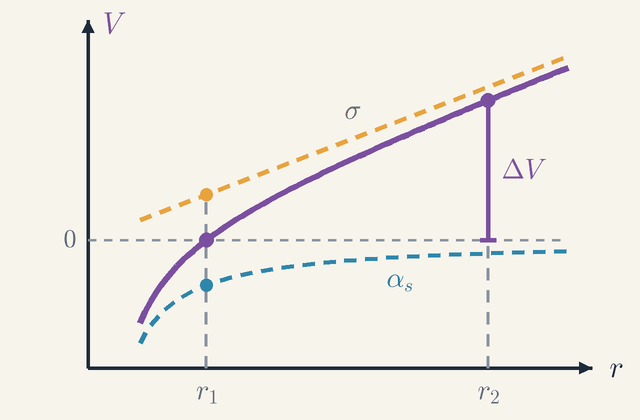
Figure 4. The Cornell potential V (solid) of a quark and an antiquark at separation r, and its two terms (dashed): the Coulomb-like one, set by αs, and the straight one, of slope σ. They cancel at r1, where V=0; stretching the pair to r2 raises V by ΔV.Legend
V
Potential energy of the quark–antiquark pair (Cornell potential).
J
r
Separation of the quark and the antiquark.
m
αs
Strong coupling; sets the depth of the Coulomb-like term.
σ
String tension: the slope of the straight term σr.
J/m
r1
Separation at which the two terms are equal in size and cancel, so V=0; about 0.3 fm.
m
r2
A separation of 1 fm, for comparison with r1.
m
ΔV
Rise of V from r1 to r2: about 0.8 GeV.
J
No quark has ever been seen on its own. The reason lies in the force between a quark and an antiquark: it resembles the electric force at short range, but at long range it stops weakening altogether.
Figure 4 plots the potential energy V of a quark and an antiquark against their separation r. The solid curve is the Cornell potential, a simple formula that fits the masses of heavy quark–antiquark pairs well: V(r)=−34rαsℏc+σr Its two terms are drawn dashed. The first, labelled αs (dashed blue), is Coulomb-like: it varies as −1/r, its depth is set by the strong coupling αs, and it dominates at short range, pulling V steeply down. The second, labelled σ (dashed gold), is a straight line whose slope σ is called the string tension; it dominates at long range and keeps rising without limit. Setting the sizes of the two terms equal, 34αsℏc/r1=σr1, gives the separation where they balance: r1=3σ4αsℏc≈0.3fm for αs=0.3 and σ≈0.9GeV/fm. Because the terms have opposite signs, they cancel there, and the solid curve crosses V=0 at r1.
Why should the energy grow in proportion to the separation? Gluons, unlike photons, carry the charge of their own force, colour, so they interact with one another. Electric field lines between two charges spread out through all of space. The colour field lines between a quark and an antiquark instead pull one another together into a narrow tube, a string, with a fixed energy per unit length. Stretching the tube by a length Δr costs the energy σΔr, and that is the straight term.
At long range, then, the attractive force, of size dV/dr, settles to the constant σ. In everyday units, σ=0.9×109⋅1.602×10−19J/10−15m≈1.4×105N, the weight of 15 tonnes, pulling on a single quark.
Pulling the pair apart therefore costs ever more energy. In Figure 4, stretching it from r1 to r2=1fm raises V by ΔV, about 0.8 GeV, the vertical bar. That is already enough to create a new light quark–antiquark pair. So the string does not set a quark free: it snaps, and the new quark and antiquark at the broken ends join the old ones to make two colourless hadrons. A quark knocked hard out of a proton shows up in a detector not as a free quark but as a narrow jet of hadrons.
The strong coupling also changes with distance, and gluon self-interaction is again the cause: it makes αs shrink at short range. Higher collision energies probe shorter distances, and αs is about 0.12 at the 91 GeV of the Z mass, 0.3 at 2 GeV, and of order 1 near 1 GeV. Two behaviours follow. Quarks struck hard, probed at short range, behave almost as free particles: this is asymptotic freedom. Slow quarks, at long range, stay bound: this is confinement. The springs in the animation are a harmonic caricature of the string: their pull grows with the stretch, while the real string's pull stays constant, yet both keep the quarks inside.
Worked problem: how heavy could the photon be?
The first section showed that only a massless carrier gives an infinite range. How sure are we that the photon is truly massless? The answer has two parts: what a small photon mass would do to the animation, and what measurements allow.
Suppose the photon had a small mass mγ. By the first section, the electrons' potential energy would gain the factor e−r/R and become ke2e−r/R/r, with Coulomb's constant k=1/(4πε0) and R=ℏ/(mγc). The force is minus the derivative of this energy with respect to r. Differentiating 1/r gives the familiar 1/r2, and differentiating e−r/R adds a second term, r/R times the first: F=r2ke2e−r/R(1+Rr) What mass would make the cut-off visible in the animation, with R equal to the 100 nm closest approach? mγc2=Rℏc=108fm197.3MeV⋅fm≈2eV At the same separations the force would be multiplied by e−1(1+1)=2/e=0.74 at 100 nm, where r/R=1, and by e−3.43(1+3.43)=4.43e−3.43=0.14 at 343 nm, where r/R=3.43. The readouts would show about 17.0 fN and 0.28 fN instead of 23.1 fN and 1.96 fN, and their ratio would grow from 11.8 to about 60.
Measurements of the magnetic field carried by the solar wind put the photon's mass below about 10−18eV/c2, so R>10−18eV197.3×106eV⋅fm≈2×1026fm=2×10¹¹m more than the distance from the Earth to the Sun. The inverse-square law therefore holds at least out to the Earth's orbit.
A heavy carrier is the opposite case. For the Z0, of 91.2 GeV/c², R=197.3/91200fm=2.2×10−18m. At the electrons' 100 nm its force is suppressed by the factor e−4.6×10¹⁰, and it becomes as strong as the electromagnetic force only in collisions near 100 GeV.
Limits of the Standard Model
The model's reach is impressive. Collisions of a few TeV probe distances of about ℏc/E≈10−19m, and at that resolution no quark or lepton has shown any size. Yet the model needs about two dozen measured inputs, masses, couplings and mixing angles that it cannot predict, and it leaves out at least four things.
Neutrino masses: oscillations, in which neutrinos change type as they travel, show that neutrinos have mass, below about 0.5 eV/c², under a millionth of the electron's; the model has none.
Dark matter: the motions of galaxies and the cosmic microwave background demand about five times more matter than atoms contain.
The matter–antimatter imbalance of the universe, far larger than the model's CP violation can produce.
Gravity: its coupling between two particles of energy E, GE2/(ℏc5), reaches order 1 only near the Planck energy, 1.2×10¹⁹GeV, some 1015 times beyond collider energies.
Where this leads
Coulomb's Law is single-photon exchange, and Electromagnetic Waves are made of photons. The range formula and annihilation rest on E2=p2c2+m2c4 from Special Relativity, the phases that generate forces are the amplitudes of Wave–Particle Duality and Schrödinger's Equation and Tunnelling, and the link between symmetry and conservation is already at work in Angular Momentum and Its Conservation. β decay in Radioactivity and Half-Life is W exchange, and the mass behind Fission, Fusion and E = mc² is mostly the energy of the gluon field and of the quarks moving in it. Gravity as Curved Spacetime describes the one force the model leaves out.
Key formulas
Charge of the proton from its quarks
p=uud:Q=32+32−31=+1
Electric charge simply adds, so the proton's charge is the sum of its quarks' charges in units of e: two up quarks at +32 and one down quark at −31. The fractions show that quarks are never seen alone, since every free particle has a whole-number charge.
Symbols
p
the proton (a particle label, not a momentum)
uud
its quark content: two up quarks and one down quark
Q
electric charge in units of the elementary charge e
When it holds: Exact, because each quark's charge is fixed and charge is conserved. The rule counts the three valence quarks; the quark–antiquark pairs that come and go inside the proton add no net charge.
Example: Turning one up quark into a down quark, as in β+ decay, gives udd with Q=+1−1=0: a neutron, while the positron takes the charge +1.
Charge of the neutron from its quarks
n=udd:Q=32−31−31=0
One up quark at +32 and two down quarks at −31 each cancel exactly, so the neutron is neutral overall although charge is spread out inside it. That inner structure shows up: the neutron has a magnetic moment, which a chargeless point particle could not have.
Symbols
n
the neutron (a particle label)
udd
its quark content: one up quark and two down quarks
Q
electric charge in units of the elementary charge e
When it holds: Holds for free and bound neutrons. A free neutron decays with a mean life of about 15 minutes, n→p+e−+νˉe, which keeps the total charge: 0=+1−1+0.
Example: The antineutron uˉdˉdˉ also has Q=−32+31+31=0, yet it is a different particle that annihilates with a neutron.
Coulomb force carried by photon exchange
F=r2ke2(photon exchange)
Two electrons repel with a force that falls off as the inverse square of their distance. In the particle picture the force is carried by exchanged photons; because the photon is massless nothing cuts the force off, and the field of each charge spreads over a sphere of area 4πr2, which gives the 1/r2.
Symbols
F
size of the force on each electron
N
k
Coulomb constant, 8.99×10⁹N⋅m2/C2
N⋅m2/C2
e
elementary charge, the charge of each electron in magnitude
C
r
distance between the electrons
m
When it holds: For charges at rest or moving slowly compared with light; fast charges also feel magnetic forces. Below about 4×10⁻¹³m, the electron's reduced Compton wavelength, quantum corrections make the force slightly stronger.
Example: The electrons in the animation: 23.1 fN at 100 nm, and 1.96 fN at 343 nm, about 12 times less.
Range of a force carried by a massive particle
R≈mcℏ=mc2ℏc,ℏc≈197.3MeV⋅fm
A carrier of mass m can only exist for about ℏ/(mc2), and even at nearly light speed it covers only about ℏ/(mc); the exact field equation gives a potential e−r/R/r that dies away beyond R. Writing it with ℏc=197.3MeV⋅fm turns a rest energy in MeV straight into a range in femtometres.
Symbols
R
range of the force
m
ℏ
reduced Planck constant, h/2π
J⋅s
m
rest mass of the exchanged carrier
kg
c
speed of light in vacuum
m/s
ℏc
a handy combination of constants, 197.3 MeV·fm
J⋅m
When it holds: An order-of-magnitude rule for exchange forces such as pion exchange between nucleons and the weak force. It does not apply to gluons: they are massless, but confinement keeps colour inside hadrons.
Example: Pion, 140 MeV/c²: R≈197.3/140≈1.4fm. W boson, 80.4 GeV/c²: R≈0.0025fm.
Electron–positron annihilation at rest
e++e−→γ+γ,Eγ=mec2=511keV(at rest)
When an electron meets its antiparticle, the positron, their whole rest energy turns into radiation. At rest the total momentum is zero, so a single photon is impossible, and two photons fly apart back to back with equal energies, each mec2. Charge (−1+1=0) and lepton number (+1−1=0) balance on both sides.
Symbols
e+
positron, the electron's antiparticle
e−
electron
γ
photon
Eγ
energy of each photon
J
me
electron mass, 9.109×10⁻³¹kg
kg
c
speed of light in vacuum
m/s
When it holds: For a pair at rest. With kinetic energy, each photon gets correspondingly more; a pair bound with parallel spins (orthopositronium) decays into three photons instead.
Example: PET scan: two 511 keV photons, each of wavelength 1239.8/511≈2.43pm.
Radius of a charged particle's path in a magnetic field
R=eBp(circular accelerator)
The magnetic force evB on a moving charge is perpendicular to its velocity, so it bends the path into a circle without changing the speed. Setting it equal to the rate at which the momentum turns, pv/R, gives R=p/(eB). With the relativistic momentum p this holds even close to the speed of light, which is why collider rings must grow with energy.
Symbols
R
radius of the circular path
m
p
momentum of the particle
kg⋅m/s
e
elementary charge, the particle's charge
C
B
magnetic field of the bending magnets
T
When it holds: For a charge e moving perpendicular to a uniform field; for a charge q replace e by q. A velocity component along the field turns the circle into a helix.
Example: Large Hadron Collider design: 7000 GeV/c in 8.33 T gives BR=7000⋅3.336=23350T⋅m, so R≈2.80km.
Cornell potential between a quark and an antiquark
V(r)=−34rαsℏc+σr
The potential energy of a heavy quark and antiquark a distance r apart. The first term is Coulomb-like, from single-gluon exchange, with the factor 34 from counting colours; the second grows without limit because the gluon field is squeezed into a tube with a fixed energy per length σ. A force that tends to the constant σ means a quark can never be pulled free.
Symbols
V
potential energy of the quark–antiquark pair
J
r
distance between the quark and the antiquark
m
αs
strong coupling constant
ℏ
reduced Planck constant
J⋅s
c
speed of light in vacuum
m/s
σ
string tension, about 0.9 GeV/fm
J/m
When it holds: An empirical fit, good for charm and bottom quark pairs between about 0.1 and 1 fm. Beyond about 1 fm the string breaks into new hadrons, and αs itself changes with distance.
Example: With αs=0.3, V rises from about −0.2GeV at 0.2 fm to about +0.8GeV at 1 fm.
Fine-structure constant
α=4πε0ℏce2≈1371
The strength of electromagnetism as a pure number: the electric energy of two electrons a distance r apart, e2/(4πε0r), divided by the quantum energy ℏc/r that goes with that distance. Both scale as 1/r, so the ratio does not depend on r. Each additional photon in an interaction diagram brings roughly one more factor α, so a few terms give very precise results.
Symbols
α
fine-structure constant
e
elementary charge
C
ε0
permittivity of free space
F/m
ℏ
reduced Planck constant
J⋅s
c
speed of light in vacuum
m/s
When it holds: Its value is 1/137.036 at low energies. At high energies it grows slowly, because virtual pairs of charged particles (electrons, muons, quarks…) screen less of the charge: about 1/128 at 91 GeV.
Example: In the ground state of hydrogen the electron moves at αc≈2.2×10⁶m/s.
Glossary
Standard Model
The theory of the known particles and of three of the four forces: twelve matter fermions, twelve force carriers (the photon, eight gluons, W+, W− and Z0) and the Higgs boson. Gravity is not part of it.
Quark
A matter particle that feels the strong force. There are six flavours (up, down, charm, strange, top, bottom) with charges +32e or −31e, each in one of three colours, and quarks are only ever found inside hadrons.
Lepton
A matter particle without colour, so it feels no strong force: the electron, muon and tau, with charge −e, and their three neutrinos, with charge 0.
Hadron
Any colourless bound state of quarks: a baryon of three quarks (the proton uud, the neutron udd) or a meson of a quark and an antiquark (the pion π+=udˉ).
Colour charge
The charge of the strong force, with three values called red, green and blue and their three anticolours. It is a label, not a visible colour: "white" means a combination in which the colours cancel.
Confinement
The rule that colour cannot be isolated. The energy of the gluon field grows by about 0.9 GeV per femtometre of separation, so a stretched string breaks into new hadrons instead of releasing a quark; at short distances the opposite holds (asymptotic freedom), and quarks struck hard behave almost as free.
Force carrier (gauge boson)
A boson whose exchange produces a force: the photon for electromagnetism, gluons for the strong force, the W and Z for the weak force. A carrier of mass m gives a range of about ℏ/(mc).
Virtual particle
An exchanged carrier that exists only between emission and absorption and does not obey the free-particle relation, for a photon E=pc. The photon swapped by the electrons of the animation carries momentum 2p but, in their centre-of-mass frame, no energy.
Antiparticle
The partner of a particle with the same mass and spin but all charges reversed: electric charge, colour, baryon and lepton number. The positron e+ is the electron's antiparticle; the antineutron differs from the neutron although both are neutral.
Annihilation
A particle and its antiparticle turning into other particles, often photons. An electron and a positron at rest give e++e−→γ+γ: two photons of 511 keV each, flying apart back to back.
Higgs field
A field that fills the vacuum with a nonzero value, set by v≈246GeV, and gives the W, the Z and the fermions their masses. Its ripples are the Higgs bosons of 125 GeV/c², discovered in 2012.
Baryon and lepton numbers
Conserved counts: baryon number B is +31 per quark and −31 per antiquark, lepton number L is +1 per lepton and −1 per antilepton. No reaction has ever been seen to change them, and searches show that the proton, the lightest baryon, lives longer than 1034 years in the channel p→e++π0.
Quantities
Q
Electric charge in units of e
A particle's charge divided by the elementary charge e=1.602×10⁻¹⁹C: +32 for an up quark, −1 for an electron, +1 for a proton.
r
Separation
m
The distance between two interacting particles; for the electrons in the animation it runs from 343 nm down to 100 nm and back.
F
Electric force
N
The repulsion between the two electrons, ke2/r2: 23.1 fN at closest approach, 1.96 fN at 343 nm. Here k=8.99×10⁹N⋅m2/C2 is the Coulomb constant and e the elementary charge.
m
Carrier mass
kg
The rest mass of an exchanged boson, usually quoted as a rest energy in MeV/c²: the pion has 140 MeV/c², or 2.5×10⁻²⁸kg.
R
Range of a force
m
The distance beyond which an exchange force dies away, about ℏ/(mc): 1.4 fm for pion exchange, 2.5×10⁻¹⁸m for the W. In the collider formula R=p/(eB) the same letter is the radius of the orbit, with p the momentum in kg·m/s and B the magnetic field in teslas: 2.80 km for 7000 GeV/c in 8.33 T.
ℏ
Reduced Planck constant
J⋅s
Planck's constant divided by 2π, 1.055×10⁻³⁴J⋅s; with the speed of light it forms ℏc=197.3MeV⋅fm.
Eγ
Photon energy
J
The energy of each annihilation photon; for a pair at rest it is mec2=511keV=8.19×10⁻¹⁴J.
α
Fine-structure constant
The strength of electromagnetism as a pure number, e2/(4πε0ℏc)≈1/137; each extra exchanged photon costs about one more factor of α.
αs
Strong coupling
The strength of the colour force, the counterpart of α: about 0.12 at the Z mass, 0.3 at 2 GeV and of order 1 near 1 GeV, so it grows towards larger distances.
σ
String tension
J/m
The energy stored per unit length of the colour field between separated quarks, about 0.9 GeV/fm or 1.4×10⁵J/m; it is also the constant force that holds them together. In the Cornell potential, V(r) is the potential energy of the pair, in joules (usually quoted in GeV).
Quiz
Beginner What is a proton made of?
One up quark and two down quarks
Two up quarks and one down quark
Two electrons and a neutron
Nothing smaller: it is a fundamental particle
Show answer
Answer: B. Two up quarks and one down quark
A proton is uud: two up quarks and one down quark, held together by gluons. One up and two down (udd) make a neutron; there are no electrons in the nucleus, and the proton is not fundamental.
Beginner Two electrons push each other apart. According to particle physics, which messenger particle do they exchange?
A gluon
A W boson
A Higgs boson
A photon
Show answer
Answer: D. A photon
The electric force between charged particles is carried by photons, the particles of light. Gluons carry the strong force between quarks, W bosons the weak force, and the Higgs boson is linked to mass, not to a force between charges.
Beginner What happens when an electron meets its antiparticle, the positron?
Both disappear and their energy comes out as light (photons)
They bounce off each other because their charges are opposite
They stick together for ever as a new, heavier particle
Nothing: matter and antimatter do not affect each other
Show answer
Answer: A. Both disappear and their energy comes out as light (photons)
A particle and its antiparticle annihilate: their mass turns into energy, usually two or more photons. Opposite charges attract rather than repel; they can briefly orbit each other (positronium), but that soon annihilates too.
Intermediate A neutron is made of one up quark (+⅔e) and two down quarks (−⅓e each). What is its electric charge?
+e
−⅓e
0
+⅓e
Show answer
Answer: C. 0
Q = ⅔ − ⅓ − ⅓ = 0. The same bookkeeping gives the proton (uud) Q = ⅔ + ⅔ − ⅓ = +1.
Intermediate The rest masses of the quarks in a proton add up to about 9 MeV/c², yet the proton's mass is 938 MeV/c². Where does most of the mass come from?
From the electrons that orbit the quarks
From the energy of the gluon field and the quarks' motion, via E = m·c²
From a Higgs boson trapped inside every proton
From the gravitational pull between the three quarks
Show answer
Answer: B. From the energy of the gluon field and the quarks' motion, via E = m·c²
About 99 % of the proton's mass is the energy of the gluon field and of the quarks' motion inside it (E = m·c²). The Higgs field gives the quarks only their small rest masses, there are no electrons inside, and gravity between quarks is utterly negligible.
Intermediate Why does the weak force act only over about 10⁻¹⁸ m, while the electric force reaches arbitrarily far?
Because the weak force is the weakest of the four forces
Because neutrinos are almost massless
Because the W and Z bosons are electrically neutral
Because its carriers, the W and Z, are very heavy, and the range is about ħ/(m·c)
Show answer
Answer: D. Because its carriers, the W and Z, are very heavy, and the range is about ħ/(m·c)
The range of a force shrinks as its carrier gets heavier: R ≈ ħ/(m·c) = 197.3 MeV·fm ÷ 80 400 MeV ≈ 0.0025 fm for the W. The photon is massless, so the electric force has no range limit. Gravity is even weaker, yet its range is infinite; and the W is charged, only the Z is neutral.
Advanced Which of these processes is forbidden by the conservation laws of the Standard Model?
n → p + e⁻ + ν̄ₑ
e⁺ + e⁻ → γ + γ
p → e⁺ + γ
μ⁻ → e⁻ + ν̄ₑ + νμ
Show answer
Answer: C. p → e⁺ + γ
p → e⁺ + γ conserves charge, but it changes the baryon number from 1 to 0 and the lepton number from 0 to −1. Neutron β decay, pair annihilation and muon decay conserve charge, B and each lepton number; searches for p → e⁺ + π⁰ show that, in this channel, protons live longer than 10³⁴ years.
Advanced According to the Cornell potential V(r) = −(4/3)·αs·ħc/r + σ·r (σ ≈ 0.9 GeV/fm), what happens if you try to pull a quark out of a proton?
The energy stored in the stretched gluon string creates a quark–antiquark pair, giving new hadrons but never a free quark
Beyond about 1 fm the force falls off as 1/r², so the quark escapes
The quark escapes and soon decays into an electron and a neutrino
The quark turns into a gluon, which leaves the proton
Show answer
Answer: A. The energy stored in the stretched gluon string creates a quark–antiquark pair, giving new hadrons but never a free quark
The linear term σ·r makes the force tend to a constant σ, so the stored energy keeps growing, by about 1 GeV per fm. Once it exceeds the cost of a quark–antiquark pair, the string breaks into colourless hadrons (jets in collider detectors). This is confinement.
 Physics Tutor