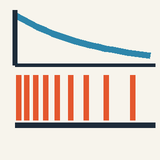
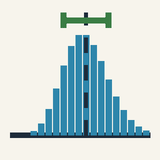
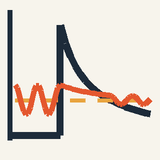
Unstable nuclei decay at random moments, yet the number N of undecayed nuclei in a large sample halves in a fixed time, the half-life T1/2: N=N0(1/2)t/T1/2.
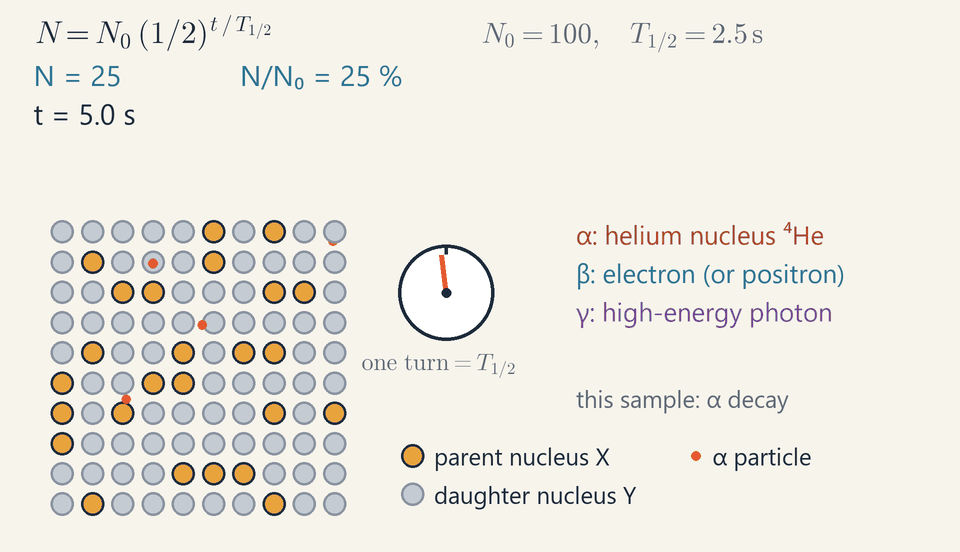
A grid of 100 radioactive nuclei: each turns grey at an unpredictable moment and emits a particle, yet half of those remaining decay in every half-life.
A nucleus is a tight cluster of protons and neutrons; the number of protons decides which element the atom is.
An unstable nucleus throws out a particle or a flash of energy and becomes a different nucleus: that is radioactive decay.
Each decay happens at a random moment, and nuclei do not age: an old nucleus is no likelier to decay than a new one.
In every half-life, half of the nuclei still left decay: 100, 50, 25, 12… so a sample fades but never suddenly runs out.
Half-lives range from split seconds to billions of years; carbon-14 (about 5,700 years) is used to date old wood and bone.
Start from the picture of the atom you already know: a tiny nucleus in the middle, made of protons and neutrons, with electrons moving around it. The number of protons is the atom's identity card. Six protons always means carbon; 92 always means uranium. Chemical reactions only rearrange the outer electrons, so they can never change that number. Only a change inside the nucleus can.
Some nuclei are unstable: they carry too much energy, or an awkward mix of protons and neutrons. Sooner or later such a nucleus throws out a tiny particle or a flash of very energetic light, leaving a different nucleus, often of another element. That is radioactive decay.
When does it happen? By pure chance. Think of glow-in-the-dark stars on a bedroom ceiling: after the lamp goes off, their atoms give back stored light one at a time, at unpredictable moments, so the glow fades gradually. Radioactive nuclei behave the same way, with one surprise: they never age. A nucleus that has waited a million years is no closer to decaying than a brand-new one.
In the animation, each gold disc is a nucleus. They turn grey one by one, each spitting out a red particle, and you cannot guess which is next. Yet the crowd is predictable: each time the clock hand makes a full turn, half of the gold nuclei still left decay. One turn, 50 remain; two turns, 25; three turns, about 12. One turn of the clock is the half-life.
Check yourself: a sample starts with 800 radioactive nuclei. How many are left after three half-lives? Answer: 800→400→200→100, so 100, not zero.
Half-lives range from a split second to billions of years. Carbon-14's, about 5,700 years, lets scientists date old wood and bone.
Intermediate
Key ideas
N=N0(1/2)t/T1/2 holds for any t, not only whole half-lives: after 2.5 half-lives, 0.52.5≈0.177 (17.7 %) is left.
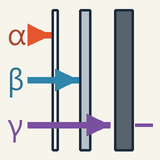
α: A−4, Z−2, stopped by paper. β−: a neutron becomes a proton, Z+1. γ: A and Z unchanged, needs thick lead.
The half-life is not half the time for everything to decay: after two half-lives a quarter is left, not nothing.
A sample of 100 nuclei typically misses the law by about ±5 after one half-life; a gram of material follows it essentially exactly.
What decays, and what we count
Radioactive decay can turn one element into another, something no chemical reaction can do. Every nucleus is labelled by two whole numbers. The atomic number Z counts its protons and fixes the element: Z=6 is carbon, Z=92 uranium. The mass number A counts all its nucleons, protons plus neutrons, so carbon-14, 614C, has 6 protons and 8 neutrons. Nuclei with the same Z but different A are isotopes of one element: carbon-12 is stable, carbon-14 radioactive.
In a sample we follow N, the number of nuclei that have not yet decayed, starting from N0 at t=0. A detector registers decays, and the number of decays per second is the activity, measured in becquerels (1 Bq is one decay per second). The letter A serves for both the mass number and the activity, so check the context; N always counts undecayed nuclei.
Halving in equal times
A radioactive nucleus does not wear out: whatever its age, its chance of surviving the next half-life T1/2 is exactly one half. In a large sample, half of the nuclei are therefore left after one half-life, half of those after the next, and so on. After n=t/T1/2 half-lives, whether n is a whole number or not, N=N0(21)t/T1/2
The chance of decaying per second is the decay constant λ, and the activity is that chance times the number of nuclei present:
λ=T1/2ln2
A=λN
So the activity halves every half-life too. To turn a measured fraction into a time, count the halvings: n=log2(N0/N), so a sample down to 1/16 of its start is four half-lives old. With T1/2 in seconds, λ comes out in s−1 and A in becquerels.
Three ways to decay
The legend of the animation names three kinds of radiation:
In α decay the nucleus emits a helium-4 nucleus of 2 protons and 2 neutrons, so A falls by 4 and Z by 2. A sheet of paper stops these heavy, doubly charged particles.
In β− decay a neutron becomes a proton and the nucleus emits an electron and an antineutrino, so Z rises by 1 at the same A; in β+ decay a proton becomes a neutron and a positron is emitted, so Z falls by 1. A few millimetres of aluminium stop β particles.
In γ emission an excited nucleus, often one just formed by α or β decay, releases a high-energy photon, and A and Z stay the same. Lead never stops γ rays completely: a centimetre of it halves a beam of 1 MeV photons.
For α decay, counting nucleons and charges gives X(A,Z)→Y(A−4,Z−2)+4He so uranium-238 (Z=92) becomes thorium-234 (Z=90). The animation's sample is an α emitter: each gold parent X that turns grey has become a daughter Y, and the red dot that flies off is its α particle.
Worked example: the sample in the animation
The animation starts with N0=100 nuclei and T1/2=2.5s, and the clock hand turns once per half-life. After one, two, three and four turns, at 2.5, 5, 7.5 and 10 s, the law gives 50, 25, 12.5 and 6.25 nuclei. The N readout shows 50, 25, 12 and 6, since a count is a whole number; the N/N0 readout shows the same numbers in per cent.
The formula works between the turns as well. At t=4.0s, t/T1/2=4.0/2.5=1.6,N=100⋅0.51.6=33.0 and the readout shows 33. Run backwards, the law gives the time at which 10 nuclei are left: n=log210=3.32 half-lives, so t=8.3s.
Fifty nuclei decay during the first turn, 25 during the second and 13 during the third: the decays thin out because fewer nuclei are left, not because the survivors have grown more stable. The animation times its decays to follow the law. A truly random sample of 100 nuclei would typically miss 50 by about 5 after one half-life, while a gram of material, with some 1021 nuclei, follows the law almost exactly.
Worked example: iodine-131 in medicine
Iodine-131, used to treat the thyroid gland, has a half-life of 8.0 days. A pharmacy prepares a capsule of 400 MBq, which the patient takes 3.0 days later. How much activity is left then, and when does a stored capsule fall below 1 % of its starting activity?
The activity is proportional to N, so it follows the same law: A=400⋅0.53.0/8.0=400⋅0.771=308MBq The pharmacy must therefore prepare about 30 % more than the dose it means to deliver. For the 1 % mark, n=log2100=6.64 half-lives, that is 53 days. After 24 days, three half-lives, (1/2)3=12.5 % is left, and after 20 days, 2.5 half-lives, 0.52.5=17.7 %.
With λ=ln2/(8.0⋅86400s)=1.00×10−6s−1, the fresh capsule, 4.0×10⁸Bq, holds N=A/λ=4.0×1014 nuclei, less than a tenth of a microgram: far too little to weigh, yet easy to detect, which is why radioactive tracers are so useful.
Reading the decay curve
Plot the readouts, N against t, and the curve starts steeply, flattens out and approaches zero without ever reaching it. A straight line from 100 nuclei at t=0 down to zero at t=2T1/2 is the classic wrong picture; at that time the real curve still holds a quarter.
The steepness of the curve is the decay rate, so the activity can be read from its slope: for the animation, about 28 nuclei per second at the start, 14 at 2.5 s and 7 at 5 s. Real counts scatter around the smooth curve, relatively more when the numbers are small.
Common mistakes
The half-life is not half the time needed for everything to decay. Each half-life removes half of what is left, so 6400 nuclei become 3200, 1600, 800 and 400 over four half-lives and never suddenly run out.
Decay is not a fixed loss per hour. A sample that loses 10 % in its first hour loses 10 % of what is left in every hour, so 0.910=0.35 of it, 35 %, remains after 10 hours.
Old nuclei are not overdue. A nucleus that has survived ten half-lives still has exactly a 50 % chance of surviving the next one.
Heat, pressure and chemistry do not change a half-life. Chemical bonds involve a few electronvolts and nuclear changes millions, so burning or dissolving a radioactive substance leaves its T1/2 practically unchanged.
Where you meet it
Radiocarbon dating uses carbon-14, with a half-life of 5,730 years. Cosmic rays keep making it, and living things take it up until they die, so wood with a quarter of the carbon-14 of a living tree is about 11,500 years old. Uranium-238, with a half-life of 4.5 billion years, decays through a chain into lead-206 and dates the oldest rocks. Medicine chooses short half-lives: technetium-99m (6.0 hours) for imaging, fluorine-18 (110 minutes) for PET scans.
Smoke detectors contain americium-241, an α emitter with a half-life of 432 years, and radon-222 (3.8 days) gives most people their largest natural dose. The next lesson, Fission, Fusion and E = mc², explains where nuclear energy comes from, and the expert level here shows why α half-lives range from microseconds to billions of years.
Advanced
Key ideas
No memory: a constant decay probability λ per unit time gives dN/dt=−λN, so N=N0e−λt and T1/2=ln2/λ.
A counter sees the activity A=λN (Bq), which falls with the same exponential; the mean life is τ=1/λ=T1/2/ln2.
Independent decays give Poisson counts: a mean of nˉ scatters by about nˉ, so the relative scatter falls as 1/nˉ.
Charge, nucleon and lepton numbers balance: n→p+e−+νˉe; three bodies share Q, so β spectra are continuous.
α decay is tunnelling through the Coulomb barrier: an exponentially small leak spreads half-lives from microseconds to 1010 years.
A constant chance per unit time
Radioactive decay rests on a single assumption: a nucleus has no memory. Whatever its age, the probability that it decays in the next short interval dt is λdt, where the decay constant λ is a fixed probability per unit time for that kind of nucleus. A nucleus formed a moment ago and one that has waited a billion years face exactly the same odds. The animated sample starts with N0=100 nuclei and has λ=0.277s−1, so each nucleus has a 0.28 % chance of decaying in the next hundredth of a second.
From this one rule follows the probability P(t) that a nucleus survives a whole time t. Cut t into m equal steps of length t/m. In each step the nucleus decays with probability λt/m, so it survives that step with probability 1−λt/m. The steps are independent, so the chances of surviving all of them multiply. Making the steps ever shorter gives P(t)=limm→∞(1−mλt)m=e−λt
The exponential is the only continuous survival law without memory. To check that it has none: a nucleus that has already lasted a time s survives a further time t with probability P(s+t)/P(s)=e−λ(s+t)/e−λs=e−λt=P(t), exactly as if it were new.
Keep two levels of description apart. The decay constant λ belongs to a single nucleus and says only how likely it is to decay. The smooth decay curve belongs to a large crowd of nuclei, and it is smooth only because the crowd is large.
Solving the decay law
Now take a sample of N identical nuclei. Each one decays in the next dt with probability λdt, so the expected number of decays is λNdt. Each decay removes one nucleus, so N changes by dN=−λNdt, that is dtdN=−λN
The rate of loss is proportional to what is left. To solve the equation, gather N on one side: dN/N=−λdt. Integrate the left side from the starting number N0 up to N, and the right side from 0 to t: ln(N/N0)=−λt. Taking the exponential of both sides, N=N0e−λt
This is N0 times the survival probability P(t) of one nucleus, as it must be: on average a fraction P(t) of the crowd survives. The exponential loses the same fraction in any two intervals of equal length, wherever they start, and that is what turns a radioactive sample into a clock.
Half-life and mean life
The half-life T1/2 is the time in which N falls to half its value. Setting N=N0/2 gives e−λT1/2=1/2; taking logarithms, λT1/2=ln2, so λ=T1/2ln2
Substituting back, e−λt=e−(ln2)t/T1/2=(1/2)t/T1/2: the halving law and the exponential are one function written in two ways. For the animation T1/2=0.693/0.277=2.50s.
The mean life τ is the average lifetime of a nucleus. A nucleus decays between t and t+dt if it first survives to t, with probability e−λt, and then decays within dt, with probability λdt. Weighting each lifetime t by this probability and integrating by parts gives τ=∫0∞tλe−λtdt=λ1=ln2T1/2≈1.44T1/2
After one mean life a fraction 1/e of the nuclei remains. For the animation τ=3.61s, when N0/e=36.8 nuclei should remain; the N readout shows 37. Why is τ longer than T1/2? The half-life is the median lifetime: half of the nuclei decay before it. The other half includes a long tail of late survivors, some lasting many half-lives, and they pull the average out to τ.
Activity
A detector does not count the nuclei that remain; it counts decays. What it measures is the decay rate −dN/dt, called the activity A and measured in becquerels (1 Bq is one decay per second). From the decay law, A=λN
Because A is proportional to N, it falls with the same exponential, A=A0e−λt with A0=λN0, and so it too is a clock. While a tree lives it keeps exchanging carbon with the air, so its share of carbon-14 stays steady; once it dies, its carbon-14 decays and is not replaced. Comparing the activity per gram of carbon in old wood with that in living wood gives A/A0, and solving (1/2)t/T1/2=A/A0 for t gives the age of the wood. In the animation the A readout of the expert layer starts at A0=27.7Bq and shows 13.9 Bq at 2.5 s, one half-life later.
Activity depends on two things: how many nuclei there are, and how unstable each one is. A gram of radium-226 is 1/226 of a mole, so it holds N=6.02×10²³/226=2.66×1021 nuclei. With T1/2=1600 years, λ=ln2/T1/2=1.37×10−11s−1 and A=λN=3.7×10¹⁰Bq, the activity that once defined the curie. A gram of uranium-238 holds about as many nuclei, but its half-life of 4.5 billion years is about three million times longer, so it is about three million times less active.
Reading the decay curve
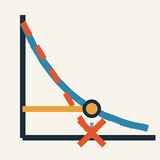
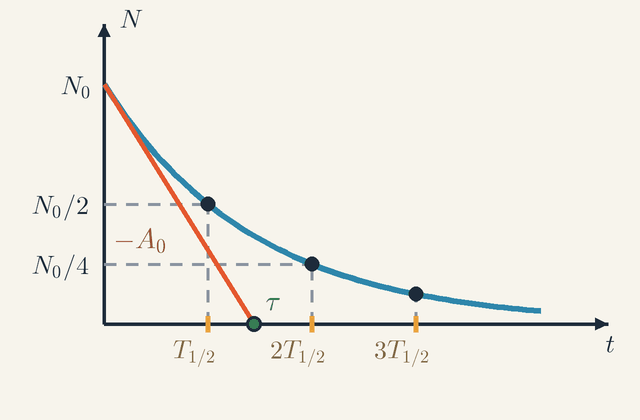
A graph of N against t shows the half-life, the mean life and the activity at a glance. Figure 1 draws it with time counted in half-lives, so the same picture serves every nuclide, from microseconds to billions of years.
Figure 1. The decay curve N=N0e−λt with time in half-lives: each step of T1/2 halves N. The tangent at t=0 has slope −A0 and meets the time axis at the mean life τ≈1.44T1/2, a little beyond the first dot.Legend
N
Number of undecayed nuclei at time t.
N0
Number of undecayed nuclei at t=0.
N0/2
Half the starting number, reached after one half-life.
N0/4
A quarter of the starting number, reached after two half-lives.
t
Time since the start of the count.
s
T1/2
Half-life: each step of this length halves N.
s
τ
Mean life 1/λ, about 1.44T1/2: where the tangent at t=0 meets the time axis.
s
A0
Activity at t=0, A0=λN0; the tangent there has slope −A0.
Bq
First look at the three dots. They sit at T1/2, 2T1/2 and 3T1/2, equally spaced along the time axis, and their heights N0/2, N0/4 and N0/8 fall by the same factor of two at each step. That is the halving law read off the graph: equal times, equal fractions.
Next look at the straight line marked −A0, the tangent to the curve at t=0. Its slope is the starting rate of change, dN/dt=−λN0=−A0. A line that starts at height N0 and falls at the rate A0 reaches the time axis after N0/A0=1/λ=τ. So the tangent lands at the mean life τ, a little beyond the first dot, because τ≈1.44T1/2. Put differently: if the sample kept decaying at its starting rate, it would be empty after one mean life.
The same construction works anywhere on the curve. At time t the tangent has slope −λN=−A and meets the axis at t+τ, one mean life later. In the animation the tangent at t=0 meets the axis at 3.6 s.
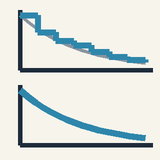
The expert graph of the animation shows the same features: the blue count follows the dashed curve N0e−λt, with markers at T1/2, 2T1/2, 3T1/2 and 4T1/2, equally spaced as in Figure 1. In the laboratory, half-lives are read from a different plot. Taking the logarithm of the decay law gives lnN=lnN0−λt, so a graph of lnN against t (or of lnA, which differs only by the constant lnλ) is a straight line of slope −λ.
Fluctuations: a sharp law from chance
The decay law gives the expected number of survivors. A real sample is a collection of independent random events, so its count scatters around that value. How large is the scatter, and why does the law still look exact for a large sample?
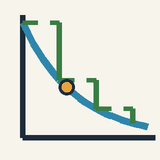
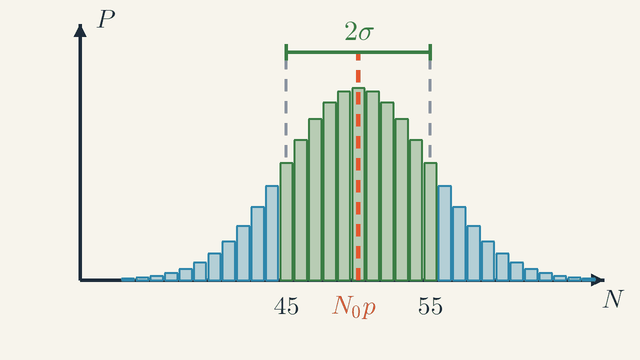
Figure 2. The chance of finding N nuclei left when 100 are watched for one half-life. Samples scatter around the mean N0p=50 with spread σ=5; the green bars, within one σ of the mean, hold about three samples in four.Legend
N
Number of nuclei still undecayed in one sample.
P
Chance that a sample has exactly this many nuclei left.
N0p
Mean of N: the starting number N0 times the survival chance p of one nucleus, here p=1/2, so 50.
σ
Standard deviation of N, σ=N0p(1−p), here 5: the bracket is 2σ wide.
Each of the N0 nuclei survives a time t independently, with the same probability p=e−λt, like N0 tosses of a biased coin. The number left is therefore binomially distributed, with mean N0p and standard deviation σ=N0p(1−p). Figure 2 plots the exact probabilities for N0=100 nuclei watched for one half-life, so that p=1/2. Each bar gives the probability P that a sample has exactly N nuclei left.
The bars are centred on the dashed line at the mean, N0p=50. The bracket marked 2σ runs from 45 to 55, one standard deviation either side of the mean, because σ=100⋅21⋅21=5. The green bars inside it add up to 73 %. So a real sample of 100 nuclei keeps 50±5 after one half-life, and about one sample in four ends up outside the range 45 to 55.
The animation shows the ideal, noise-free case instead: its k-th decay comes when the expected number of decays reaches k−21, so its staircase is the smooth law rounded to whole nuclei.
Counting experiments deal with decays rather than survivors. In a short interval only a small fraction q of the nuclei decays. The number of counts is then binomial with q≪1, so its variance N0q(1−q) is almost equal to its mean nˉ=N0q. This limit is the Poisson distribution, whose spread is nˉ. The relative uncertainty is nˉ/nˉ=1/nˉ, so 400 counts are uncertain by 5 %, and 1 % needs 10,000 counts.
The same square root explains why the decay law looks exact. The relative scatter of the survivors falls as 1/N0, and for 1021 nuclei it is about 3×10⁻¹¹. A sharp law emerges from pure chance, just as the steady pressure of a gas emerges from random molecular impacts.
Conservation laws decide what can happen
Before asking how fast a nucleus decays, ask whether it can decay at all. Charge, nucleon number and lepton number must each be the same before and after. And the decay must release energy, paid for out of mass: the products together must have less mass than the parent. The energy released, called the Q-value, is Q=(mparent−∑mproducts)c2>0
For the α decay 92238U→90234Th+24He, charge balances (92=90+2) and so does nucleon number (238=234+4). The atomic masses give Q=4.27MeV, about a million times the energy of a chemical bond.
With only two products, momentum conservation fixes how Q is shared. The parent was at rest, so the two products fly apart with momenta of equal size and opposite direction. Kinetic energy is the momentum squared divided by twice the mass, so for equal momenta the lighter particle takes the larger share, in inverse proportion to the masses. The α particle therefore takes 234/238 of Q, or 4.20 MeV. Every α particle from this decay has that same energy, so α spectra are sharp lines.
In β− decay, n→p+e−+νˉe, a neutron becomes a proton. Charge balances (0=+1−1+0), and lepton number demands the antineutrino: the electron counts +1 and the antineutrino −1, so the total stays 0. Now three bodies share Q, and they can do so in endlessly many ways. The electrons therefore have a continuous spectrum, from zero up to Q (0.78MeV for a free neutron). That continuum, which at first seemed to break energy conservation, led Pauli to propose the neutrino in 1930. Finally, γ rays come from jumps between energy levels of the nucleus, so, like α particles, they form sharp lines.
Tunnelling decides how fast
Conservation laws only say whether a decay is allowed. How fast it goes depends on something else: whether the α particle can get out of the nucleus at all. Classically it cannot; quantum mechanically it leaks out, very slowly, and the rate of that leak sets the half-life.
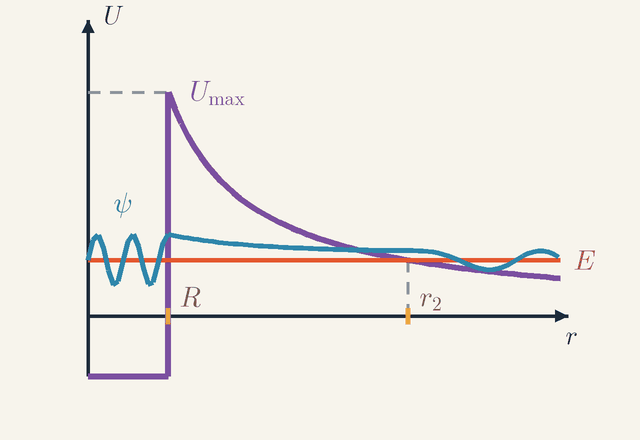
Figure 3. The potential energy U of an α particle near the daughter nucleus. Its energy E lies below the barrier, yet its wave ψ leaks through the forbidden region from R to r2 and re-emerges, smaller, outside. Not to scale.Legend
U
Potential energy of the α particle at distance r from the centre of the nucleus.
J
r
Distance from the centre of the nucleus.
m
R
Radius of the nucleus: the nuclear well lies inside it, the Coulomb barrier starts at it.
m
r2
Exit point r2=RUmax/E, where the barrier has fallen back to the energy E.
m
Umax
Height of the barrier at r=R.
J
E
Energy of the α particle, which it carries away as kinetic energy once it is far outside.
J
ψ
Wave function of the α particle along a radius: it oscillates inside, dies away across the barrier and reappears, smaller, beyond r2.
m−3/2
Figure 3 plots the potential energy U of the α particle against its distance r from the centre of the nucleus. Inside the nuclear radius R, the short-range nuclear attraction holds the particle in a deep well. Outside R only the electric repulsion of the daughter nucleus acts, U=C/r with C a positive constant. So the barrier is highest at r=R, where it reaches Umax, and falls away with distance.
Now look at the horizontal line at height E, the energy of the α particle. Energy is conserved, so E is the same everywhere; far away, where U has dropped to zero, all of it is kinetic energy. The line meets the barrier at the exit point r2, where C/r2=E. Since C=RUmax, this gives r2=RUmax/E. Between R and r2 the kinetic energy E−U would be negative, which no classical motion allows: a classical particle would rattle inside the well for ever.
The wave function ψ does not stop at the wall. Follow it from left to right in Figure 3. It oscillates inside the well, dies away exponentially across the forbidden region between R and r2, and beyond r2 oscillates again, with a smaller amplitude.
Across the barrier it falls off locally like e−κr, with κ=2mα(U−E)/ℏ, where mα is the mass of the α particle and ℏ the reduced Planck constant: the higher and wider the barrier, the more it falls. The chance of escape on each attempt is the square of the ratio of the amplitude outside to the amplitude inside. In the figure the amplitude shrinks only by a modest factor, so that the ripples outside stay visible; in a real nucleus it shrinks enormously.
Here are the real numbers for uranium-238. The α particle has an energy E of only about 4.2 MeV, far below the top of the Coulomb barrier, Umax≈28MeV, so classically it could never escape. The exit point lies r2/R=28/4.2≈6.7 times further from the centre than the surface (Figure 3, not to scale, shows 4). Bouncing to and fro inside, the particle strikes the barrier about 1021 times per second. Yet the mean life of uranium-238 is 2.0×10¹⁷s, so its decay constant is λ=1/τ=5×10−18s−1. Dividing by the number of attempts per second, each attempt succeeds with a probability of about 5×10−39, close to e−88: the square of a wave amplitude that leaks through as e−44.
Because the escape probability is an exponential, modest changes in the barrier make huge changes in the half-life. Working out the exponent shows that it grows roughly in proportion to Z/E, where Z is the charge number of the daughter nucleus: a larger charge makes the barrier higher, and a larger energy makes the forbidden region shorter. So polonium-212, emitting 8.8 MeV α particles, has a half-life of 0.3 µs, while thorium-232, at 4.0 MeV, has one of 1.4×10¹⁰ years: roughly halving the energy stretches the half-life by a factor of about 1024.
Decay chains
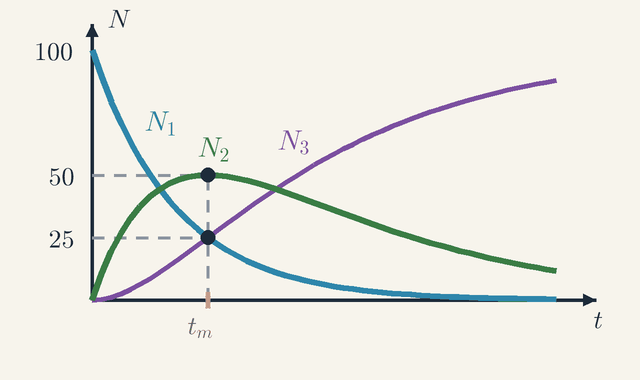
Often the daughter of a decay is itself radioactive, and a decay chain forms. The number of daughters then rises and falls, and a counter registers the decays of both. Figure 4 follows the simplest chain: parents N1, with decay constant λ1, turn into radioactive daughters N2, with decay constant λ2, which decay in turn into stable nuclei N3.
Figure 4. A chain whose daughter has twice the half-life of its parent, from 100 parents. The parents N1 fall, the daughters N2 peak at tm and then fade, and the stable nuclei N3 build up. At tm they number 25, 50 and 25.Legend
N
Number of nuclei of each kind present at time t.
N1
Parent nuclei still undecayed.
N2
Radioactive daughter nuclei present.
N3
Stable nuclei formed from the daughters, N3=N0−N1−N2.
t
Time since the start, when only parents were present.
s
tm
Time at which the daughters are most numerous.
s
The daughters have a source and a sink. They are created by the parents' decays, at the rate λ1N1, and lost through their own decays, at the rate λ2N2: dtdN2=λ1N1−λ2N2
Read the curves of Figure 4 with this equation in mind. At t=0 there are no daughters, so the sink is zero and the daughters rise exactly as fast as the parents fall. As daughters accumulate, their own decay rate λ2N2 grows, while the supply λ1N1 shrinks with the parents. Where the two are equal, dN2/dt=0: the curve of N2 turns over at the time tm, and then fades.
The stable nuclei N3 start slowly, because at first there are hardly any daughters to decay, and climb until every nucleus has ended up there. No nucleus is lost along the way, so the three numbers always add up to the starting number N0. The figure is drawn for the chain of the worked problem below: 100 parents, and a daughter that lives twice as long as its parent. At tm the curves of N1 and N3 cross at 25.
Worked problem: a radioactive daughter
Suppose the grey daughters of the animation decay into a stable nucleus with T1/2=5.0s, so that λ2=0.693/5.0=0.139s−1=λ1/2. Starting from 100 parents and no daughters: when are the daughters most numerous, how many are there, and what does a counter that registers both decays read then?
Step 1: solve for N2. Insert N1=N0e−λ1t and move λ2N2 to the left: dN2/dt+λ2N2=λ1N0e−λ1t. Multiplying both sides by eλ2t turns the left side into a single derivative, d(N2eλ2t)/dt, by the product rule. The right side becomes λ1N0e(λ2−λ1)t, which integrates directly. With N2(0)=0, N2=λ1−λ2λ1N0(e−λ2t−e−λ1t)
Step 2: use λ1=2λ2. The prefactor λ1/(λ1−λ2) is then 2, and with x=e−λ2t the second exponential is e−λ1t=x2. So N2=2N0(x−x2),x=e−λ2t
Step 3: find the maximum. As t runs from 0 to infinity, x falls from 1 to 0, and x−x2 is largest where its derivative 1−2x vanishes, at x=21. That happens after one daughter half-life, at tm=5.0s, when N2=2⋅100⋅41=50.
Step 4: the other two populations. The parents number N1=N0e−λ1t=N0x2, and the stable nuclei N3=N0−N1−N2=N0(1−x)2. The three curves of Figure 4 are therefore x2, 2(x−x2) and (1−x)2 times N0, and at x=21 they stand at 25, 50 and 25 nuclei. The N readout of the animation, which counts the parents, shows 25 at that moment, so 25 stable granddaughters have formed.
Step 5: the counter. At the peak dN2/dt=0, so the two activities are equal: λ1N1=0.277⋅25 and λ2N2=0.139⋅50 are both 6.93 Bq. A counter that registers both decays reads their sum, 13.9 Bq, twice the A readout, which shows the parent alone.
Later the parent dies out (x2 becomes negligible beside x), and N2≈2N0e−λ2t: the mixed sample fades with the daughter's 5.0 s half-life. The lesson for measurement is that the tail of a decay curve belongs to the longest-lived member of the chain.
Long-lived parents: secular equilibrium
When the parent lives far longer than the daughter, λ1≪λ2, the parent hardly changes while the daughter builds up. After a few daughter half-lives the daughter's decay rate has caught up with its supply and then stays matched to it: dN2/dt≈0, so λ2N2=λ1N1. This is secular equilibrium: the daughter is exactly as active as the parent, however few of its nuclei there are. Radon-222 (half-life 3.8 days) growing from radium-226 (1600 years) numbers only N2/N1=λ1/λ2=6.5×10−6 of the radium atoms, yet is just as active.
Limits of validity
The constancy of λ is extremely well tested, but it is not absolute. The exceptions all involve the atom's electrons, the only part of the atom that chemistry can touch. In electron capture the nucleus absorbs one of the atom's own inner electrons, so the decay rate depends slightly on how those electrons are arranged: the half-life of beryllium-7 differs by up to about 1 % between chemical environments. Stripping off every electron can transform a decay. Neutral rhenium-187 has a half-life of about 4×10¹⁰ years, the bare nucleus one of 33 years, because its β electron can then be created directly in an empty inner orbit. Otherwise temperature, pressure and chemistry change nothing measurable.
Quantum mechanics predicts slight departures from the exponential law at extremely short and extremely long times, but none has been seen in a nuclear decay. Finally, λ holds in the rest frame of the decaying particle. Seen from the laboratory, a fast particle's clock runs slow by the factor γ of special relativity: muons, with a mean life of 2.2 µs at rest, live 22 µs in the laboratory at γ=10. That is how cosmic-ray muons born high in the atmosphere reach the ground.
Where this leads
The tunnelling that sets α half-lives is worked out in Schrödinger's Equation and Tunnelling, and the accounting Q=Δmc2 drives Fission, Fusion and E = mc². The weak interaction behind β decay belongs to Particles and Forces: the Standard Model, and the stretched lifetimes of fast particles to Special Relativity. Sharp γ lines are the nuclear counterpart of the spectral lines in Atomic Models: the Bohr Atom. Constant fractional rates return in a capacitor discharging through a resistor, in Capacitors, and a sharp law built from random events is the core of Kinetic Theory of Gases.
Key formulas
Halving law
N=N0(21)t/T1/2
Every half-life leaves half of the nuclei that were present at its start, so n half-lives leave (1/2)n of them. Writing n=t/T1/2 makes the rule work at any time, not only at whole half-lives. It follows from each nucleus having the same 50 % chance of surviving each half-life, whatever its age.
Symbols
N
number of undecayed nuclei at time t
N0
number of undecayed nuclei at t=0
t
time elapsed
s
T1/2
half-life
s
When it holds: Holds on average for a sample of one radioactive nuclide that is not being replenished; t and T1/2 must be in the same unit. A small sample scatters around it, by about ±5 for 100 nuclei after one half-life.
Example: In the animation, T1/2=2.5s: at t=4.0s, N=100⋅0.51.6=33.0, and the readout shows 33.
Exponential decay law
N=N0e−λt
This is the solution of dN/dt=−λN, the law of a constant chance of decay per unit time. It is the same curve as the halving law, because e−λT1/2=1/2; base e is simply more convenient for calculus. The factor e−λt is also the probability that one given nucleus survives until t.
Symbols
N
number of undecayed nuclei at time t
N0
number of undecayed nuclei at t=0
λ
decay constant
s−1
t
time elapsed
s
When it holds: Needs a constant λ and no supply of new nuclei. The exponent λt is a pure number, so λ and t must use the same time unit.
Example: After one mean life, t=1/λ=3.61s in the animation, N=100/e=36.8; the readout shows 37.
Decay constant from the half-life
λ=T1/2ln2
Setting N=N0/2 in N=N0e−λt gives e−λT1/2=1/2, hence λT1/2=ln2≈0.693. A short half-life means a large chance of decay per second. The reciprocal of λ is the mean life τ, longer than the half-life by the factor 1/ln2≈1.44.
Symbols
λ
decay constant: probability of decay per unit time
s−1
T1/2
half-life
s
When it holds: Exact for exponential decay. To get λ in s−1, and activities in becquerels, convert the half-life to seconds first.
Each of the N nuclei decays with probability λ per second, so on average λN decays occur every second. This rate, in becquerels, is what a detector registers. It is proportional to N, so it falls with the same half-life, and the same number of nuclei is far more active when their half-life is short.
Symbols
A
activity: decays per second
Bq
λ
decay constant
s−1
N
number of undecayed nuclei
When it holds: Gives the expected rate; a count over an interval scatters by about the square root of the number counted. λ must be in s−1 for A to come out in becquerels.
Example: One gram of radium-226: N=2.66×10²¹ and λ=1.37×10⁻¹¹s−1, so A=3.7×10¹⁰Bq, the amount that defined the old unit, the curie.
Differential law of decay
dtdN=−λN
In a short time dt each nucleus decays with probability λdt, so the expected change of N is dN=−λNdt. The minus sign says that N decreases, and −dN/dt is the activity. The rate is proportional to what is left, the defining property of exponential decay.
Symbols
dtdN
rate of change of the number of undecayed nuclei
s−1
λ
decay constant
s−1
N
number of undecayed nuclei
t
time
s
When it holds: Treats N as a smooth quantity, which is fine for large samples. If the nuclide is also being produced, for example as the daughter in a chain, add the production rate: dN2/dt=λ1N1−λ2N2.
Example: At the start of the animation, dN/dt=−0.277⋅100=−27.7 nuclei per second; at t=2.5s it is half that, −13.9.
Alpha decay
X(A,Z)→Y(A−4,Z−2)+4He
The parent X emits an α particle, a helium-4 nucleus of 2 protons and 2 neutrons, and becomes a daughter Y of another element. Nucleon number and charge are conserved, so the daughter's mass number is 4 lower and its atomic number 2 lower. The energy released, Q, comes from the mass difference between the parent and the two products.
Symbols
X
parent nuclide
Y
daughter nuclide, two places earlier in the periodic table
A
mass number of the parent
Z
atomic number of the parent
4He
the α particle, a helium-4 nucleus
When it holds: Only for α decay, which is common in nuclei heavier than lead. β− decay keeps A and raises Z by 1, β+ decay lowers Z by 1, and γ emission changes neither.
Example:92238U→90234Th+24He releases Q=4.27MeV, of which the α particle carries 4.20 MeV.
Glossary
Radioactive decay
The spontaneous change of an unstable nucleus into a different one, with the emission of an α particle, a β particle or a γ photon. Its moment is random, and neither heat nor chemistry affects it noticeably.
Nuclide and isotope
A nuclide is one kind of nucleus, fixed by its atomic number Z and mass number A, such as carbon-14, 614C. Isotopes are nuclides of the same element, with the same Z but different A: chemically almost identical, yet carbon-12 is stable and carbon-14 is not.
Parent and daughter nuclei
The parent is the nucleus that decays and the daughter the one it becomes; in the animation, gold parents X turn into grey daughters Y. A daughter may itself be radioactive and continue a decay chain.
Alpha decay
Emission of an α particle, a helium-4 nucleus of two protons and two neutrons, so that A drops by 4 and Z by 2. The particles leave with one sharp energy, typically 4 to 9 MeV, and a sheet of paper stops them.
Beta decay
A neutron turns into a proton, emitting an electron and an antineutrino (β−), or a proton into a neutron, emitting a positron and a neutrino (β+). A stays the same and Z changes by one; the electrons have a continuous range of energies, and a few millimetres of aluminium stop them.
Gamma emission
An excited nucleus, often one just formed by α or β decay, drops to a lower energy level by emitting a high-energy photon. A and Z do not change; about a centimetre of lead halves a beam of 1 MeV γ rays but never stops it completely.
Ionising radiation
Radiation energetic enough to knock electrons out of atoms, which is how it damages living cells and how detectors register it. The more densely a particle ionises, the sooner it loses its energy: α particles travel only a few centimetres in air.
Half-life
The time in which, on average, half of the nuclei of a sample decay, whatever moment you start counting from. For a single nucleus it is the time after which the chance of being still undecayed has fallen to 50 %; it is not half of the time needed for everything to decay.
Exponential decay
Decrease at a rate proportional to the amount present, dN/dt=−λN, so that equal times remove equal fractions: N=N0e−λt. The same law describes a capacitor discharging and γ rays weakening in lead.
Decay chain
A sequence of decays in which each daughter is radioactive in turn; uranium-238 reaches stable lead-206 after 8 α and 6 β− decays. When the first parent lives much longer than its descendants, all members settle at the same activity (secular equilibrium).
Radiometric dating
Finding an age from how much of a radioactive nuclide is left, by solving (1/2)t/T1/2=N/N0. Carbon-14 (5,730 years) dates organic remains up to about 50,000 years old; uranium–lead dating reaches billions of years.
Quantum tunnelling
The passage of a particle through an energy barrier that it could not cross classically. It lets α particles escape from nuclei, and its steep dependence on energy spreads α half-lives from microseconds to 1010 years.
Quantities
Z
Atomic number
The number of protons in the nucleus, which fixes the element: Z=92 is uranium. It drops by 2 in α decay and changes by one in β decay.
A
Mass number
The number of nucleons, protons plus neutrons: 238 for uranium-238. It drops by 4 in α decay and is unchanged by β decay and γ emission. Not to be confused with the activity A below.
N
Number of undecayed nuclei
How many nuclei of the radioactive kind are still present at time t; not to be confused with the neutron number A−Z.
N0
Initial number of nuclei
The number of undecayed nuclei at t=0: 100 in the animation.
t
Time
s
The time elapsed since the start of the count. Days or years are often used instead, in the same unit as T1/2.
T1/2
Half-life
s
The time in which the number of undecayed nuclei halves: 2.5 s in the animation, 8.0 days for iodine-131, 4.5 billion years for uranium-238.
λ
Decay constant
s−1
The probability per unit time that one nucleus decays, λ=ln2/T1/2: 0.277s−1 in the animation.
τ
Mean life
s
The average lifetime of a nucleus, τ=1/λ=T1/2/ln2≈1.44T1/2: 3.61 s in the animation.
A
Activity
Bq
The number of decays per second, A=λN; one becquerel is one decay per second. It falls with the same half-life as N. Not to be confused with the mass number A.
Q
Decay energy (Q-value)
J
The energy released in one decay, the loss of mass times c2. It is usually quoted in MeV (1MeV=1.602×10⁻¹³J): 4.27 MeV for the α decay of uranium-238.
Quiz
Beginner A sample contains 1000 radioactive nuclei with a half-life of 1 hour. About how many are still undecayed after 2 hours?
0
500
250
125
Show answer
Answer: C. 250
After 1 hour half are left (500); after another hour half of those (250). The amount halves each time; it does not run out after two half-lives.
Beginner Can you predict when one particular radioactive nucleus will decay?
Yes, if you know how old it is
No, only the chance of decaying is known
Yes, the oldest nuclei always decay first
Only by heating it up and watching
Show answer
Answer: B. No, only the chance of decaying is known
Decay is random: every nucleus of a given kind has the same chance per second of decaying, whatever its age. Only the behaviour of large numbers is predictable.
Beginner What happens to a nucleus when it decays?
It vanishes completely, leaving nothing behind
It always splits into two equal halves
It grows larger and heavier
It emits a particle or radiation and becomes a different nucleus
Show answer
Answer: D. It emits a particle or radiation and becomes a different nucleus
The nucleus releases a particle (α or β) or a photon (γ) and, for α and β decay, turns into a nucleus of another element.
Intermediate Carbon-14 has a half-life of about 5730 years. What fraction of the original carbon-14 remains after 17 190 years?
1/8
1/3
1/6
1/9
Show answer
Answer: A. 1/8
17 190 / 5730 = 3 half-lives, so (½)³ = 1/8 remains. Answering 1/3 divides by the number of half-lives; each half-life halves what is left.
Intermediate In α decay, how do the mass number A and the atomic number Z of the nucleus change?
A decreases by 2, Z decreases by 4
A decreases by 4, Z decreases by 2
A stays the same, Z increases by 1
A decreases by 4, Z stays the same
Show answer
Answer: B. A decreases by 4, Z decreases by 2
An α particle is a helium-4 nucleus: 2 protons and 2 neutrons. Losing it lowers A by 4 and Z by 2. A unchanged with Z + 1 describes β⁻ decay.
Intermediate Which kind of radiation is stopped by a single sheet of paper?
γ rays
β particles
α particles
All three
Show answer
Answer: C. α particles
α particles are heavy and doubly charged, so they lose their energy very quickly; paper or skin stops them. β needs millimetres of aluminium, γ needs thick lead or concrete.
Advanced A nuclide has a decay constant λ = 0.0231 s⁻¹. What is its half-life?
43 s
0.016 s
15 s
30 s
Show answer
Answer: D. 30 s
T½ = ln 2 / λ = 0.693 / 0.0231 s⁻¹ = 30 s. 1/λ = 43 s is the mean lifetime τ, which is longer than the half-life by a factor 1/ln 2.
Advanced A sample contains 2.0 × 10¹² nuclei of an isotope with a half-life of 6.0 h. What is its activity?
6.4 × 10⁷ Bq
9.3 × 10⁷ Bq
2.3 × 10¹¹ Bq
3.3 × 10¹¹ Bq
Show answer
Answer: A. 6.4 × 10⁷ Bq
λ = ln 2 / (6.0 × 3600 s) = 3.21 × 10⁻⁵ s⁻¹, so A = λ·N = 6.4 × 10⁷ Bq. Forgetting ln 2 gives 9.3 × 10⁷; keeping λ in h⁻¹ gives 2.3 × 10¹¹ decays per hour, not per second.
 Physics Tutor