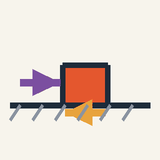
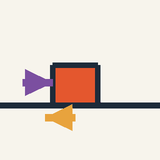
Friction f resists sliding: at rest it can reach μsN, while sliding it is μkN. On a slope of angle θ a block sliding down accelerates at a=g(sinθ−μkcosθ), whatever its mass.
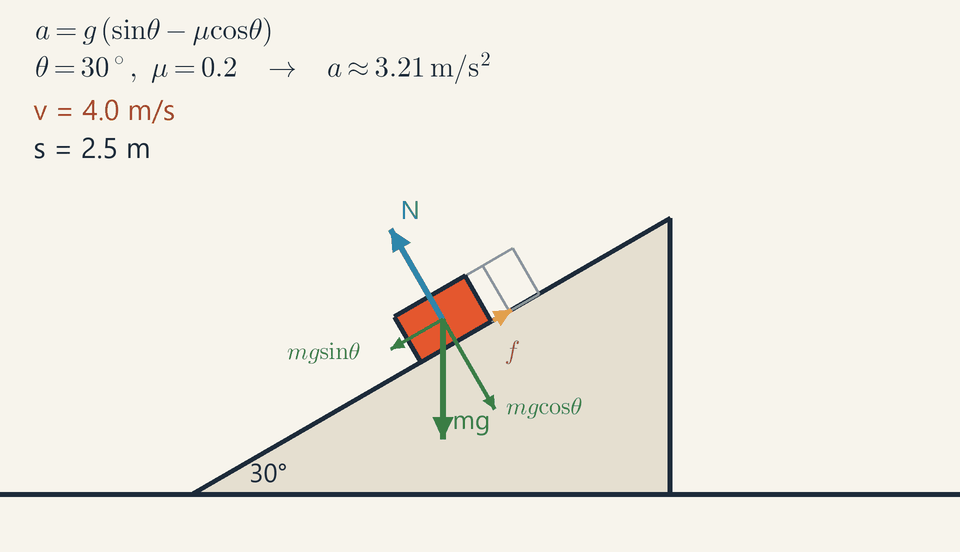
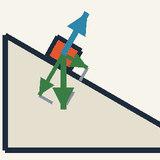
A block slides down a 30° slope with μ = 0.2. The weight mg points straight down, the normal force N is perpendicular to the slope, and friction f points up the slope.
Friction acts along the surfaces and opposes sliding, or the slide an object is about to make.
Static friction matches your push up to a limit; once sliding starts, kinetic friction is usually a little smaller.
At a steady sliding speed your push just equals the friction: no net force, as the first law says.
Friction grows with how hard the surfaces press together, f=μN, and depends on the materials.
On a slope part of the weight pulls downhill; friction holds the block back but cannot stop it on a steep enough slope.
Shove a box across the floor and it soon stops. Friction is the force that resists one surface sliding over another. It acts along the surfaces, against the sliding, or against the slide an object is about to make.
Push a heavy sofa gently and it does not move: the floor pushes back just as hard, through static friction. Push harder and harder, and at some point static friction reaches its limit and the sofa starts to slide. Once it moves, kinetic friction takes over; it is usually a little smaller, which is why starting a sofa is harder than keeping it going.
Quick check: you push a box so that it slides at a steady speed. How does your push compare with the friction? Answer: they are equal, because a steady speed means no net force.
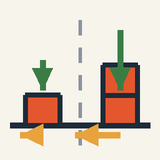
How strong is friction? It grows with how hard the surfaces are pressed together, a force called the normal force N, and depends on the materials, through a number called the coefficient of friction μ. For sliding, f=μN. A 10 kg box (weight about 98 N) sliding across a floor with μ=0.3 feels about 29 N of friction; stack a second box on top and the friction doubles.
Quick check: rubber on a dry road has μ near 0.8, a steel skate on ice near 0.02. Which needs the longer distance to stop? Answer: the skate.
On a slope, part of the weight pulls the object downhill. In the animation a block slides down a 30° slope and speeds up. The weight arrow points straight down, the support arrow (the normal force) points out of the surface, and the small friction arrow points up the slope. Friction holds the block back, but on a slope this steep it cannot stop it.
Intermediate
Key ideas
Static: fs≤μsN (only as much as needed). Kinetic: fk=μkN, usually μk<μs.
On an incline: mgsinθ along the slope, mgcosθ into it, so N=mgcosθ.
Sliding down: a=g(sinθ−μkcosθ), independent of mass; 30° and μk=0.2 give 3.21 m/s².
A resting block starts to slide when tanθ>μs.
Normal force and the two friction laws
Whether a tyre grips the road or a crate stays put on a ramp depends on the force between surfaces in contact. When two surfaces touch, that force has two parts. The normal force N is perpendicular to the surface and only as large as needed to stop the object sinking in. Friction f acts along the surface and opposes sliding. Both are measured in newtons. How much friction a given normal force can produce is set by the coefficient of friction μ, a pure number that depends on the two materials.
While the surfaces do not slip, friction is static: it takes whatever size and direction prevent slipping, up to a ceiling: fs≤μsN A box on a level floor that nobody pushes feels no friction at all. Push it with 50 N and friction answers with 50 N; only a push above the ceiling breaks it free.
Once the surfaces slide, friction is kinetic. It points against the sliding and has a definite size: fk=μkN Usually μk is a little below μs, which is why a sofa is harder to start than to keep moving. Typical values are 0.8 for rubber on a dry road, 0.3 for wood on wood and 0.02 for a skate on ice, and neither law depends much on the contact area or the speed.
Splitting the weight on a slope
On an incline at angle θ, take one axis along the slope, positive downhill, and one perpendicular to it. Then N and f lie along the axes, and only the weight mg must be split. Tilting the surface by θ tilts its perpendicular by the same angle, so the weight makes the angle θ with it. The part along the slope pulls the block downhill; the part across presses it into the surface and is balanced by the normal force:
F∥=mgsinθ
N=mgcosθ
Check the extremes: on level ground, θ=0, nothing pulls along the surface; on a vertical wall, θ=90∘, nothing presses on it. On the animation's 30° slope, sin30∘=0.5 and cos30∘≈0.866: half the weight pulls downhill, and N is 87% of the weight, not all of it.
Newton's second law along the slope
For a block sliding down, kinetic friction μkmgcosθ points up the slope. Newton's second law along the slope, ma=mgsinθ−μkmgcosθ, has the mass in every term, so it cancels: a=g(sinθ−μkcosθ) A heavy and a light block of the same material therefore slide down side by side. For a block sliding up, friction points down the slope as well, and the block slows at g(sinθ+μkcosθ).
A resting block starts to slide once the pull mgsinθ beats the most static friction can give, μsmgcosθ. Dividing both by mgcosθ leaves tanθ>μs The mass drops out again. The limiting angle, where tanθ0=μs, is the angle of repose.
Worked example: the block in the animation
The block slides from rest down a 30° slope with μk=0.2. No mass is needed, but take m=2kg to see the forces in newtons. The weight is mg=2⋅9.81=19.62N, so F∥=19.62⋅0.5=9.81N,N=19.62⋅0.866≈16.99N fk=0.2⋅16.99≈3.40N,a=29.81−3.40≈3.21m/s2 The formula gives the same without the mass: a=9.81(0.5−0.2⋅0.866)≈3.21m/s2, the value printed under it in the animation, against gsin30∘≈4.91m/s2 without friction.
With a constant, straight-line kinematics applies. After 1 s the block moves at 3.21 m/s and has slid 21⋅3.21⋅12≈1.60m; after 2 s, it moves at 6.41 m/s and has slid 6.41 m. These are the grey outlines. The slide is 7.8 m long and lasts about 2.2 s, and the readouts end near v=7.1m/s and s=7.8m, as v2=2as predicts. Without friction the block would leave the same slope at 8.7 m/s.
Worked example: a crate on a loading ramp
A 30 kg crate rests on a ramp tilted at 20°, with μs=0.5 and μk=0.4. Does it stay put, and what push along the ramp moves it up at a steady speed?
Its weight is 30⋅9.81=294.3N, so F∥=294.3⋅sin20∘≈100.7N and N=294.3⋅cos20∘≈276.6N. Since tan20∘≈0.36 is below 0.5, the crate stays put, and static friction equals the downhill pull: 100.7 N up the ramp, not the ceiling μsN≈138.3N.
At a steady speed up the ramp the net force is zero. Friction now opposes the upward sliding, so it points down the ramp, alongside the downhill pull: F=mg(sinθ+μkcosθ)=100.7+0.4⋅276.6≈211.3N Lifting the crate straight up would take its full 294 N; a frictionless ramp would cut that to 100.7 N, and friction raises it to 211 N.
Reading the force diagram
Every force arrow in the animation uses the same scale, so the diagram can be read as numbers. The green mg arrow is the diagonal of a rectangle whose sides are its two thin green components: the component down the slope is exactly half of mg, the one into the slope 87% of it, and the blue N arrow cancels the latter. The small gold f arrow, a fifth of N, cancels about a third of the downhill pull, leaving 0.5mg−0.173mg≈0.327mg as the net force.
Added together, N and f give the slope's whole force on the block. A resting block needs it to point straight up and cancel the weight; for the sliding block friction falls short, and the leftover points downhill. The readouts show the consequence: v gains 3.21 m/s every second, while s grows by 1.60 m in the first second and 4.81 m in the next.
Common mistakes
The normal force is not always the weight: on the 30° slope the 2 kg block has N≈16.99N, not 19.62 N.
Static friction is not μsN by default: the crate resting on the 20° ramp feels 100.7 N, not the 138.3 N maximum, and an unpushed box on level ground feels none.
Friction does not always point up the slope. It opposes the sliding, or the slide about to happen: for the crate pushed up the ramp it points down, so the push needs 211.3 N.
Heavier blocks do not slide faster: the mass cancels, so a 20 kg block of the same material also accelerates at 3.21 m/s² on the animation's slope.
Adding friction to the downhill pull for a block sliding down gives 9.81(0.5+0.2⋅0.866)≈6.60m/s2, which is how fast a block sliding up slows. Check sine against cosine with θ=0: on level ground nothing pulls along the surface.
Where you meet it
A rolling tyre grips through static friction, because its contact patch does not slide on the road; anti-lock brakes keep the wheels turning so that the weaker kinetic friction never takes over. Wheelchair ramps are kept to a gradient of about 1 in 12, under 5°, to keep the push needed small. Heaps of sand or gravel stand at their angle of repose, about 30–40°, and most snow avalanches start on slopes of 30–45°. Next, Work, Energy and Power shows where the energy taken by friction goes, Circular Motion shows friction holding a car on a bend, and Simple Machines: Levers, Pulleys and Gears treats the ramp, the wedge and the screw as machines.
Advanced
Key ideas
Energy alone gives the force along a smooth slope: raising W by h over a length L needs F=Wh/L=Wsinθ (Stevinus' chain).
Friction is empirical: shearing microscopic junctions turns work into heat; Areal≈N/H gives f≈μN, whatever the apparent area.
Tilting test: slipping starts at tanθ0=μs, whatever the weight; then a=g(sinθ−μkcosθ), a line below gsinθ.
Static friction is a reaction: a resting block holds for mg(sinθ−μscosθ)≤F≤mg(sinθ+μscosθ).
The simple rule fails for clean metals (they weld, μ>1), rubber, very smooth surfaces and high speeds.
The smooth slope
Start without friction, because the smooth slope fixes the two pieces of the weight that every later equation uses. A block of mass m lies on a plane tilted at the angle θ to the horizontal. Its weight mg points straight down. Split it into a part along the slope and a part across it, along the normal (the line at right angles to the surface). The weight makes the angle θ with the normal, so the part along the slope is mgsinθ and the part pressing into the surface is mgcosθ. The block neither sinks into the slope nor lifts off it, so the slope pushes back with the normal force N=mgcosθ.
The part along the slope also follows from energy alone. Push a weight W slowly up a frictionless slope of length L and height h. The push F does the work FL, and all of it becomes potential energy Wh, so F=Wh/L=Wsinθ.
Simon Stevin reached the same result in 1586 with a thought experiment: a closed loop of beads draped over a triangular wedge and hanging freely below it. The loop never starts to circulate by itself, since that would be perpetual motion, and its hanging part is symmetric and balances itself. So the many beads on the long, gentle face must pull along their face as hard as the few beads on the short, steep face. The number of beads on a face is proportional to its length L, so the pull of one bead is proportional to 1/L. Both faces rise through the same height h, so that pull is proportional to h/L, which is sinθ.
Two kinds of friction
Now roughen the surfaces. Friction is the part of the contact force that lies along the surface, and it comes in two kinds that obey different rules. Telling them apart decides every problem below.
When the surfaces slide over each other, kinetic friction is a definite force. Its size is μkN, where the kinetic coefficient μk is a pure number for the pair of materials, and to a first approximation it does not depend on how fast they slide. It points against the velocity v of one surface relative to the other. Dividing v by its length ∣v∣ gives a unit vector along the motion, so fk=−μkN∣v∣v
When the surfaces do not slide, static friction is a constraint force, like the normal force. Its size and its direction in the contact plane are whatever keeps the surfaces from slipping. The only law is a ceiling, set by the static coefficient μs: ∣fs∣≤μsN
For most pairs μs>μk. Friction is therefore not a function of velocity: at v=0 it can take any value up to μsN, and the moment sliding starts it jumps to μkN.
On the slope, measure x down the slope, so that x¨ is the acceleration down it. A block sliding down feels friction up the slope, and Newton's second law along the slope, divided by m, gives x¨=g(sinθ−μkcosθ) A block sliding up feels friction down the slope, adding to gravity: x¨=g(sinθ+μkcosθ) This x¨ is positive while the velocity x˙ is negative, so it slows the block. A block at rest needs the static friction mgsinθ up the slope, which stays under the ceiling μsmgcosθ exactly when tanθ≤μs; then the block stays at rest.
One consequence is easy to miss. If tanθ<μk, the first equation gives a negative x¨, so a block launched downhill slows and stops. It is then held by static friction: friction stops motion, but it never pushes the block back up.
Static friction adjusts to the pull
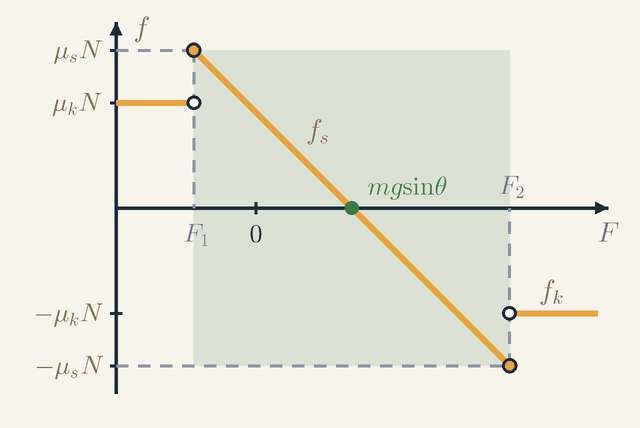
Figure 1. Friction f on a block at rest as the pull F along the slope grows, both positive up the slope. In the shaded range the block holds and f=mgsinθ−F; outside it the block slides and f drops to ±μkN. This block rests unaided, so F1<0.Legend
f
Friction along the slope, positive up the slope.
N
F
Pull along the slope, positive up the slope; a negative value pulls down the slope.
N
μsN
Largest possible static friction: the dashed ceiling the line may not cross.
N
μkN
Size of kinetic friction once the block slides.
N
mgsinθ
Weight component along the slope: the pull at which friction is zero.
N
F1
Lowest pull at which the block stays at rest, mg(sinθ−μscosθ); negative here.
N
F2
Highest pull at which the block stays at rest, mg(sinθ+μscosθ).
N
fs
Static friction: whatever balances the other forces, mgsinθ−F.
N
fk
Kinetic friction, always against the sliding: −μkN here, where the block slides up the slope.
N
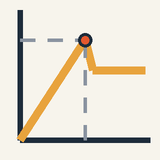
Under the static law, the size and direction of static friction are set by the other forces, not by a formula of their own. Figure 1 follows the friction f on a block that rests by itself on a gentle slope, with tanθ<μs, while a pull F along the slope is increased slowly. Both F and f are counted positive up the slope.
While the block stays at rest, x¨=0, so the forces along the slope balance: the up-slope forces f+F equal the down-slope component mgsinθ. The friction the block needs is therefore f=mgsinθ−F This is the descending line fs in Figure 1. Read it from left to right. At F=0 friction carries the whole component mgsinθ and points up the slope. It shrinks as the pull takes over the job, is zero where the line crosses the axis at F=mgsinθ (the green dot), and beyond that point it is negative: friction now points down the slope and holds the block back against the pull.
The line is allowed only between the dashed levels +μsN and −μsN. Setting f=+μsN and f=−μsN, with N=mgcosθ, gives the two ends of the allowed stretch: F1=mg(sinθ−μscosθ) F2=mg(sinθ+μscosθ) The block stays at rest for every pull from F1 to F2, the shaded range. Here F1 is negative: even a pull down the slope is resisted, until its size exceeds ∣F1∣. On a steeper slope, with tanθ>μs, F1 would be positive: the block needs at least that much pull up the slope to be held at all.
Outside the shaded range the block slides, and friction steps down from μsN to μkN, to the open circles. For pulls below F1 the block slides down, so friction +μkN points up the slope. For pulls above F2 it slides up, so friction fk=−μkN points down the slope. The rule for problems follows: decide which way the block moves, or is about to move, before writing the direction of friction into the equations.
The slide in the animation
The animation puts numbers on the sliding equation: a block released from rest on a 30° slope with μk=0.2. Its acceleration down the slope is a=g(sinθ−μkcosθ)=9.81(0.5−0.2⋅0.866)≈3.21m/s2
On the expert graph of the animation, v(t) is therefore a straight solid line of slope 3.21 m/s². Above it runs the dashed line of a frictionless slope, whose slope is gsinθ≈4.91m/s2. The two lines part by the friction term, gμkcosθ≈1.70m/s every second. The slide lasts 2.2 s, so the block ends at 7.1 m/s instead of 10.8 m/s. The area under the solid line is the distance travelled, 21⋅2.2⋅7.06≈7.8m: the length of the slide.
Where the energy goes
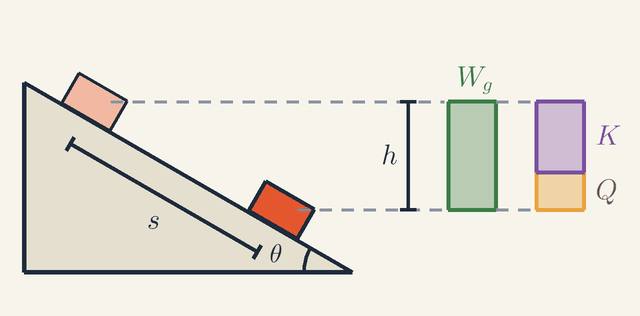
Figure 2. A block slides a distance s down the slope and so drops h=ssinθ. The bar Wg, the work of gravity, is drawn to the scale of h; friction turns the part Q into heat, and the rest becomes kinetic energy K. Drawn for μk=0.2 and θ=30∘.Legend
s
Distance the block slides along the slope.
m
h
Height the block drops: h=ssinθ.
m
θ
Angle of the slope to the horizontal.
rad
Wg
Work done by gravity, mgh=mgssinθ: the energy released.
J
Q
Heat made by friction, fks=μkmgscosθ.
J
K
Kinetic energy gained, 21mv2=Wg−Q.
J
The same slide can be followed through energy instead of forces. This shows where the energy released by gravity ends up, and it gives the final speed without needing the time.
In Figure 2 the block starts from rest at the pale position and slides a distance s to the solid one. Read the drop on the left: h=ssinθ. Gravity does the work Wg=mgh=mgssinθ, the green bar, drawn to the same height scale as h so that the two match. Friction has the constant size fk=μkN=μkmgcosθ over the same distance s, so it turns the energy Q=fks=μkmgscosθ into heat: the gold part of the second bar. The rest, the purple part, is the kinetic energy K=21mv2. This is the work–energy theorem, K=Wg−Q: 21mv2=mgs(sinθ−μkcosθ)
Dividing Q by Wg cancels m, g and s: friction takes the share Q/Wg=μkcosθ/sinθ=μkcotθ of the released energy. Here that is 0.2⋅1.732≈0.35, the gold third of the second bar. For the animation's 7.78 m slide, per kilogram of block, gravity releases 9.81⋅0.5⋅7.78≈38.2J; 13.2 J become heat and 24.9 J kinetic energy, so v=2⋅24.9≈7.06m/s, the speed the velocity graph gave.
The heat grows with the length of the path, not just with where the path starts and ends. That is why no potential energy can be defined for friction.
The friction cone
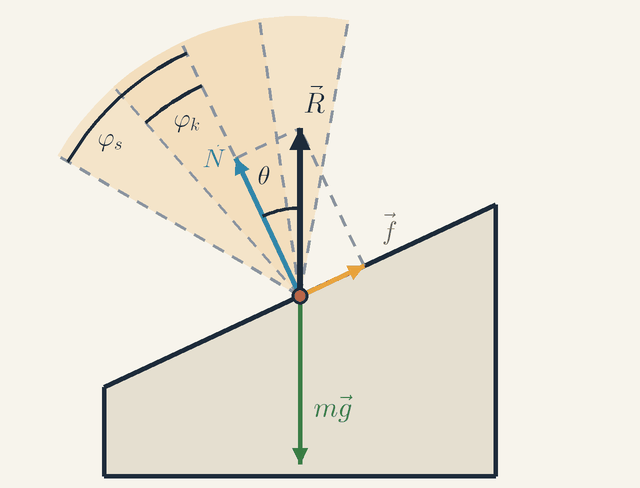
Figure 3. The contact force R=N+f on a block at rest must be vertical to cancel the weight, so it leans θ from the normal. Static friction allows R anywhere inside the cone of half-angle φs; sliding puts it on the edge of the narrower cone φk.Legend
R
Contact force of the slope on the block: N+f.
N
N
Normal force: the part of R at right angles to the slope.
N
f
Friction: the part of R along the slope, here up the slope.
N
mg
Weight, which R must cancel for the block to stay at rest.
N
θ
Angle of the slope, which is also the angle between R and the normal.
rad
φs
Half-angle of the static friction cone: tanφs=μs.
rad
φk
Half-angle of the kinetic friction cone: tanφk=μk.
rad
The two friction laws have a geometric form that turns slipping into a comparison of angles. Instead of treating N and f separately, Figure 3 draws the whole force of the slope on a resting block as one vector, the contact force R=N+f. Its part at right angles to the slope is the normal force N, and its part along the slope is the friction f; the dashed lines complete the sum. The angle φ by which R leans away from the normal has tanφ=f/N.
The static law f≤μsN therefore reads tanφ≤μs: R must lie inside the friction cone, of half-angle φs with tanφs=μs, the wide shaded region about the normal. Now look at the block at rest. Only two forces act on it, R and the weight mg, so R must point straight up. On a slope tilted by θ, a vertical line makes the angle θ with the normal, the angle marked between N and R. So the block can rest only while θ≤φs.
The steepest slope that holds the block, the angle of repose θ0, is therefore the friction angle: tanθ0=μs, which is 26.6° for μs=0.5. This gives a simple way to measure μs: tilt a board until a block on it slips. The mass does not appear, so a loaded block slips at the same angle.
Once the block slides, f=μkN exactly, so R lies on the edge of the narrower kinetic cone, of half-angle φk with tanφk=μk, the darker region inside the first. In Figure 3 the slope angle lies between the two: φk<θ<φs. The vertical R falls inside the static cone, so a block at rest stays at rest. It falls outside the kinetic cone, so the contact force on a sliding block cannot be vertical and cannot balance the weight: that block speeds up. On a slope with θ<φk it is the other way round: friction outweighs the pull of gravity along the slope, and a sliding block slows to a stop.
The best angle for a pull
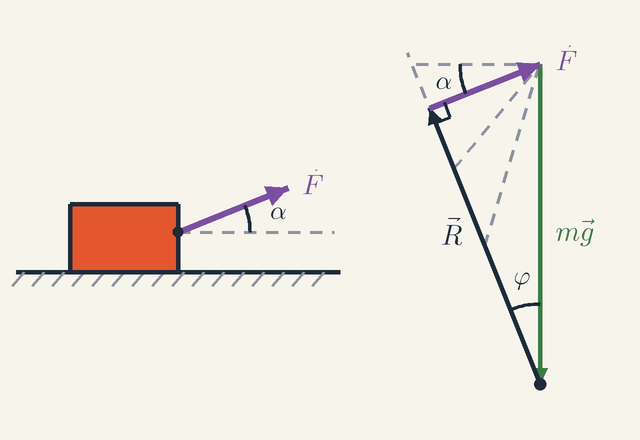
Figure 4. A crate dragged by a rope at the angle α. The pull F, the weight mg and the floor's force R close a triangle, with R leaning back by the friction angle φ. The pull is shortest when it is at right angles to R, that is, when α=φ.Legend
F
Pull of the rope; drawn is the shortest pull that balances the other two forces.
N
mg
Weight of the crate.
N
R
Force of the floor on the crate: normal force plus friction.
N
φ
Friction angle between R and the vertical: tanφ=μk.
rad
α
Angle of the rope above the horizontal.
rad
The friction angle also answers a practical question: at what angle should a rope pull to drag a heavy crate with the least force? On the left of Figure 4 a 30 kg crate slides steadily across a level floor with μk=0.4, pulled by a rope at the angle α above the horizontal.
Steady sliding means zero net force. Three forces act: the pull F, the weight mg and the floor's force R=N+f. Their sum vanishes, F+R+mg=0, so drawn head to tail they close a triangle, on the right of Figure 4.
Two sides of the triangle are already determined. The weight mg is fixed in size and direction. The direction of R is fixed too: the crate slides, so f=μkN, and R leans back from the vertical, against the motion, by the friction angle φ with tanφ=μk. Only F is free: it must start on the line of R and end at the tail of mg. The dashed lines are some of the other pulls that would also balance, each at its own α.
Finding the smallest of these pulls is now a question of geometry. The shortest line from a point to a straight line meets it at a right angle, so the smallest pull is perpendicular to R. Since R is φ from the vertical, that pull is φ from the horizontal: the best rope angle is α=φ, and then F=mgsinφ.
The algebra agrees. The rope lifts part of the load, so the floor presses up with only N=mg−Fsinα. Steady sliding needs the horizontal part of the pull to equal the friction, Fcosα=μk(mg−Fsinα), which gives F=cosα+μksinαμkmg The pull is smallest when the denominator is largest, where its derivative −sinα+μkcosα is zero, that is at tanα=μk, here α=21.8∘. Then F=109.3N, against 117.7 N for a horizontal pull, and the triangle gives the same, mgsinφ=294.3⋅sin21.8∘≈109.3N. The friction angle sets the best pulling angle.
Why friction is proportional to the load
The friction laws are empirical rules, not fundamental laws like gravitation. This section explains where they come from. Leonardo da Vinci noticed around 1500 that friction does not depend on the contact area; Guillaume Amontons stated its proportionality to the load in 1699, and Charles-Augustin de Coulomb added in 1781 that kinetic friction barely depends on speed.
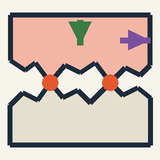
The key fact is that even polished surfaces touch only at the tips of their highest bumps. These tips squash until together they carry the load, and a squashed tip bears a pressure about equal to the hardness H of the softer material. The real contact area is therefore about Areal≈N/H. A 2 kg steel block on steel, with N≈20N and H≈2×10⁹Pa, touches over only 10−8m2, about a millionth of a 10 cm by 10 cm face. This is why the apparent area does not matter: on a larger face each tip is pressed less, but the total real area is still fixed by N.
At the tips the atoms of the two surfaces bond. Sliding must shear these junctions, which takes a force τAreal, where τ is the shear strength of the softer material. Putting the two steps together, f≈τAreal≈HτN a friction law with μ≈τ/H. For metals τ/H is roughly 1/6, about 0.2. Measured values run from about 0.1 to 1, because junctions grow as they are sheared and hard bumps plough grooves in the softer surface. The work done ends up as vibrations of the atoms in the lattice, that is, as heat. Lifting the slider over the bumps cannot be the cause, since the energy spent climbing a bump would come back as the slider drops down its far side.
Stick–slip and rolling
Two everyday effects follow: one from the gap between the two coefficients, one from avoiding sliding altogether.
Because μs>μk, a slider driven through anything springy tends to move in jerks. It sticks while the pull of the spring builds up to μsN. Then it slips, friction drops to μkN, and the slider lurches forward, slackening the spring, until it sticks again. This stick–slip motion makes doors squeak, keeps a bowed violin string vibrating, and lets faults in the Earth's crust lock for centuries and then slip in earthquakes.
A rolling wheel avoids sliding. Its contact point is momentarily at rest on the ground, so static friction acts there but does no work. Only rolling resistance remains, with coefficients near 0.001 for a train wheel and 0.01 for a car tyre.
Worked problem: the block sent back up
At the foot of the animation's slope the block moves at 7.06 m/s. A spring bumper there sends it back up at the same speed; take μk=0.2 and μs=0.3. How far up does it go, and how fast does it return?
Going up, gravity and friction both point down the slope, so the block slows at g(sinθ+μkcosθ)=9.81(0.5+0.2⋅0.866)≈6.60m/s2 At a steady deceleration the speed falls to zero after t=v/a=7.06/6.60≈1.07s, and from v2=2ad the block has climbed d=7.062/(2⋅6.60)≈3.78m up the slope.
It cannot stay there: tan30∘≈0.577 exceeds μs, so static friction cannot hold it. It slides back at the animation's 3.21 m/s² and reaches the bumper after 2⋅3.78/3.21≈1.53s, at 2⋅3.21⋅3.78≈4.9m/s.
The descent takes longer than the climb because its acceleration is smaller. Both legs cover the same d, so v2=2ad makes the returning speed 3.21/6.60≈0.70 times the launch speed, and the kinetic energy 0.49 times. The rest became heat over the 7.55 m travelled: friction of gμkcosθ≈1.70N per kilogram over 7.55 m is 12.8 J per kilogram, which matches the kinetic energy lost.
With down the slope positive, v(t) is two straight lines meeting at v=0, with slopes of 6.60 and 3.21 m/s². The velocity is continuous, but the acceleration jumps, because friction reverses with the motion. Each bounce repeats the factor 0.70, and every time in a trip is proportional to its launch speed, so each round trip lasts 0.70 times the one before. The first takes 1.07+1.53=2.60s, so the ever shorter trips form a geometric series lasting 2.60/(1−0.697)≈8.6s in all.
Limits of validity
Newton's mechanics gives way near the speed of light or on atomic scales. The friction law has no such single boundary: it fails whenever the surfaces stop behaving like an average dry pair. Clean metals in a vacuum, with no oxide layer between them, bond as one piece: μ rises above 1 and parts can weld cold, a real concern on spacecraft. Tables of μ for steel on steel really describe oxide films and grease.
Rubber flows into the roughness of the road, so its grip depends on area, speed and temperature, and racing tyres exceed μ=1. Very flat surfaces such as polished glass cling by adhesion even without a load. A skate on ice has μk≈0.02 because a thin liquid-like layer lubricates it. At high sliding speeds the contact tips flash to hundreds of degrees, and μ drops.
The point model has a limit of its own: a real block can topple instead of sliding. On a slope it tips over the lower edge once tanθ exceeds its length along the slope divided by its height, and it slips once tanθ exceeds μs. So a block more than 1/μs times as tall as it is long, twice as tall for μs=0.5, tips over before it slips.
Where this leads
In Work, Energy and Power, kinetic friction is the standard non-conservative force, its work −μkNs becoming heat. In Circular Motion, static friction holds a car on a flat bend up to v=μsgr, and banked curves reuse this lesson's components. Rotational Dynamics and Torque explains rolling: a solid ball rolls down the 30° slope at 75gsinθ≈3.50m/s2, faster than the sliding block, losing nothing to friction. Static Equilibrium and Levers handles ladders and toppling; Simple Machines: Levers, Pulleys and Gears turns the ramp into the wedge and the screw, which holds its load because its thread angle is below the friction angle; and Drag and Terminal Velocity covers fluid friction, which grows with speed.
Key formulas
Static friction: only as much as needed
fs≤μsN
While the surfaces do not slip, friction takes whatever size and direction along the surface prevent slipping, from zero up to a ceiling proportional to the normal force. The coefficient μs sets that ceiling. The inequality is the whole law: the actual value comes from Newton's laws, not from this formula.
Symbols
fs
static friction force
N
μs
coefficient of static friction
N
normal force
N
When it holds: For dry surfaces at rest relative to each other. Once fs would have to exceed μsN, slipping starts and kinetic friction takes over. It fails for clean metals in a vacuum, rubber and very smooth surfaces.
Example: A 30 kg crate on a 20° ramp: friction 100.7 N, below the ceiling 0.5⋅276.6≈138.3N, so it stays put.
Kinetic friction
fk=μkN
Once the surfaces slide, friction points against the relative velocity and has a fixed size proportional to the normal force. It hardly depends on the contact area or on the speed, because it is set by the real contact area at microscopic bumps, which grows in proportion to N. Usually μk is somewhat smaller than μs.
Symbols
fk
kinetic (sliding) friction force
N
μk
coefficient of kinetic friction
N
normal force
N
When it holds: An empirical rule for dry sliding at moderate speeds and loads. It fails for lubricated surfaces, where the resistance becomes viscous, for rubber, and at high speeds where the contacts heat up.
Example: The 2 kg block on the 30° slope: fk=0.2⋅16.99≈3.40N.
Normal force on an incline
N=mgcosθ
Only the component of the weight perpendicular to the slope presses the block onto it, and since nothing moves in that direction the normal force balances it exactly. The factor cosθ is 1 on level ground and 0 for a vertical wall, so a steeper slope presses less and offers less friction.
Symbols
N
normal force of the slope on the block
N
m
mass of the block
kg
g
free-fall acceleration
m/s2
θ
angle of the incline above the horizontal
rad
When it holds: Only when no other force has a component across the slope (no push into it, no pull away from it) and the block stays on the surface; otherwise write the balance across the slope again.
Example: A 2 kg block on a 30° slope: N=2⋅9.81⋅0.866≈16.99N, less than its 19.62 N weight.
Weight component along the slope
F∥=mgsinθ
The part of the weight along the slope pulls the block downhill. It is sinθ times the weight: zero on level ground, the full weight for a vertical drop. Energy gives the same factor: on a smooth slope, raising a weight mg by a height h along a length L takes a force mgh/L=mgsinθ.
Symbols
F∥
component of the weight along the slope, pointing downhill
N
m
mass of the block
kg
g
free-fall acceleration
m/s2
θ
angle of the incline above the horizontal
rad
When it holds: Holds in a uniform gravitational field for any incline; it is the force that friction must balance or overcome.
Example: On the animation's 30° slope it is half the weight: F∥=2⋅9.81⋅0.5=9.81N for a 2 kg block.
Acceleration of a block sliding down an incline
a=g(sinθ−μkcosθ)
Newton's second law along the slope, with mgsinθ pulling downhill and kinetic friction μkmgcosθ pointing uphill. The mass cancels, so heavy and light blocks of the same material slide down together. For a block sliding up, friction points down the slope and the minus sign becomes a plus.
Symbols
a
acceleration down the slope
m/s2
g
free-fall acceleration
m/s2
θ
angle of the incline above the horizontal
rad
μk
coefficient of kinetic friction
When it holds: Only while the block slides down. A negative result means friction wins: a block launched downhill slows and stops, and static friction then holds it; friction never pushes it back up.
Example: The animation: a=9.81(0.5−0.2⋅0.866)≈3.21m/s2, against 4.91m/s2 without friction.
Condition for slipping
tanθ>μs
A resting block slips when the downhill pull mgsinθ exceeds the most that static friction can give, μsmgcosθ. Dividing by mgcosθ leaves the tangent, so mass and gravity drop out. The angle of equality, tanθ0=μs, is the angle of repose, and tilting a board until a block slips is the simplest way to measure μs.
Symbols
θ
angle of the incline above the horizontal
rad
μs
coefficient of static friction
When it holds: For a block that can slide but does not topple; a tall, narrow block may tip over first. Real surfaces vary from spot to spot, so slipping starts over a small range of angles.
Example: With μs=0.5, slipping starts above arctan0.5≈26.6∘; the animation's 30° slope is far beyond arctan0.2≈11.3∘.
Glossary
Friction
The contact force along two touching surfaces that opposes their sliding over each other, or the slide about to happen. Dry friction between solids hardly depends on speed; the drag of a fluid does.
Normal force
The push of a surface on an object, perpendicular to the surface. It is only as large as needed to stop the object sinking in, so it equals the weight only on level ground when nothing else pushes or pulls vertically and nothing accelerates up or down. On a 30° slope it is 0.866mg.
Static friction
Friction between surfaces that do not slip. It adjusts its size and direction, from zero up to μsN, to whatever prevents slipping; a box at rest on level ground with no push feels none.
Kinetic friction
Friction between sliding surfaces, fk=μkN, directed against the relative velocity. It hardly depends on the speed or on the apparent contact area, and it is usually a little smaller than the maximum static friction.
Coefficient of friction
The ratio of friction to normal force at the point of slipping (static, μs) or while sliding (kinetic, μk), a pure number that depends on both surfaces: about 0.8 for rubber on a dry road, 0.02 for a skate on ice. Usually μs is a little larger than μk.
Inclined plane
A flat surface tilted at an angle θ to the horizontal. As a simple machine it trades force for distance: on a smooth slope, raising a weight W by a height h along a length L takes a force of only Wh/L.
Components of the weight
The two perpendicular parts into which the weight is split on a slope: mgsinθ along it and mgcosθ into it. Added as vectors they give back the whole weight; neither is a separate force.
Angle of repose
The steepest angle at which an object, or a heap of loose material, stays at rest: tanθ0=μs. For μs=0.5 it is 26.6°; dry sand settles at roughly 30–35°.
Friction cone
The set of directions the total contact force can take without slipping: a cone around the normal whose half-angle, the friction angle, is arctanμs. A body stays at rest as long as the contact force it needs lies inside the cone.
Real contact area
The tiny total area of the bump tips where two surfaces actually touch, roughly N/H for a material of hardness H. Because it grows with the load and not with the apparent area, friction is proportional to N.
Stick–slip motion
Jerky sliding in which the surfaces alternately stick and slip, because static friction exceeds kinetic friction. It makes doors squeak, keeps a bowed violin string vibrating and, on a huge scale, produces earthquakes.
Frictional heating
The conversion of work into heat at sliding contacts. Sliding friction always dissipates mechanical energy overall: in the animation it turns about 35% of the energy released by the descent into heat.
Quantities
θ
Angle of the incline
rad
The angle between the slope and the horizontal, usually quoted in degrees: the animation's slope is at 30°, that is π/6rad.
m
Mass
kg
The block's inertia. It cancels from the acceleration on a slope, so it only sets the sizes of the forces.
g
Free-fall acceleration
m/s2
About 9.81m/s2 near the Earth's surface; multiplied by the mass, it gives the weight.
W
Weight
N
The gravitational force on the block, W=mg, pointing straight down: 19.62 N for a 2 kg block.
N
Normal force
N
The surface's push perpendicular to itself; on an incline with no other forces across it, N=mgcosθ.
F∥
Weight component along the slope
N
The downhill pull mgsinθ that friction has to balance or overcome.
f
Friction force
N
The force along the surface that opposes sliding: static friction fs up to μsN, kinetic friction fk=μkN.
μ
Coefficient of friction
Friction divided by normal force for a given pair of surfaces: μs for the ceiling at rest, μk while sliding. The animation uses μ=0.2.
θ0
Angle of repose
rad
The angle at which a resting block starts to slip, tanθ0=μs: 26.6° for μs=0.5.
a
Acceleration along the slope
m/s2
For a block sliding down, g(sinθ−μkcosθ): 3.21 m/s² in the animation, 4.91 m/s² without friction.
Quiz
Beginner A 10 kg box slides across a level floor with μ_k = 0.3. What is the friction force (g = 9.81 m/s²)?
29.43 N
3 N
98.1 N
33.3 N
Show answer
Answer: A. 29.43 N
On level ground N = m·g = 98.1 N, so f = μ·N = 0.3 × 98.1 = 29.43 N.
Beginner Why is it harder to start pushing a heavy sofa than to keep it moving?
Maximum static friction is larger than kinetic friction
Kinetic friction is larger than static friction
The sofa's mass decreases once it moves
Friction disappears once the sofa moves
Show answer
Answer: A. Maximum static friction is larger than kinetic friction
Usually μ_s > μ_k, so the push needed to break the sofa free is larger than the push needed to keep it sliding.
Intermediate A 2 kg block rests on a 20° slope with μ_s = 0.6. What is the friction force on it (g = 9.81 m/s²)?
11.06 N
0 N
6.71 N
18.44 N
Show answer
Answer: C. 6.71 N
The block is at rest (tan 20° ≈ 0.36 < 0.6), so static friction exactly balances the pull down the slope: f = m·g·sinθ = 2 × 9.81 × 0.342 ≈ 6.71 N. μ_s·N = 11.06 N is only the maximum it could supply, 18.44 N is the normal force, and with 0 N the block would slide.
Intermediate What is the normal force on a 2 kg block resting on a 30° slope (g = 9.81 m/s²)?
16.99 N
9.81 N
19.62 N
11.33 N
Show answer
Answer: A. 16.99 N
N = m·g·cosθ = 2 × 9.81 × cos 30° ≈ 16.99 N. On a slope the normal force is less than the weight, 19.62 N.
Intermediate A block slides down a 30° slope with μ_k = 0.2. What is its acceleration (g = 9.81 m/s²)?
3.21 m/s²
4.91 m/s²
6.60 m/s²
7.51 m/s²
Show answer
Answer: A. 3.21 m/s²
a = g·(sinθ − μ·cosθ) = 9.81 × (0.5 − 0.2 × 0.866) ≈ 3.21 m/s². Ignoring friction gives 4.91; adding it instead of subtracting gives 6.60.
Advanced A block rests on a slope with μ_s = 0.5. Above roughly what angle will it start to slide?
26.6°
30°
60°
63.4°
Show answer
Answer: A. 26.6°
Sliding starts when tanθ > μ_s, so θ = arctan 0.5 ≈ 26.6°. This is the angle of repose.
Advanced What force parallel to the slope pushes a block up an incline at constant speed?
m·g·(sinθ + μ_k·cosθ)
m·g·(sinθ − μ_k·cosθ)
μ_k·m·g
m·g·sinθ
Show answer
Answer: A. m·g·(sinθ + μ_k·cosθ)
Moving up the slope, friction points down it, so the push must balance both m·g·sinθ and μ_k·m·g·cosθ.
Advanced Why is sliding friction nearly independent of the apparent contact area?
The real contact area at the microscopic bumps grows with the load, not with the apparent area
A larger surface has a smaller μ that exactly compensates
Air pressure pushes harder on a smaller surface
Friction depends only on the mass, never on the materials
Show answer
Answer: A. The real contact area at the microscopic bumps grows with the load, not with the apparent area
Surfaces touch only at asperities whose total area is about N / H. Spreading the load out presses each one less, so the real area, and hence friction, stays the same.
 Physics Tutor