Throws, kicks and jumps: a curved path split into two straight-line motions, a steady sideways motion with vx=v0cosθ and a free fall with vy=v0sinθ−gt.
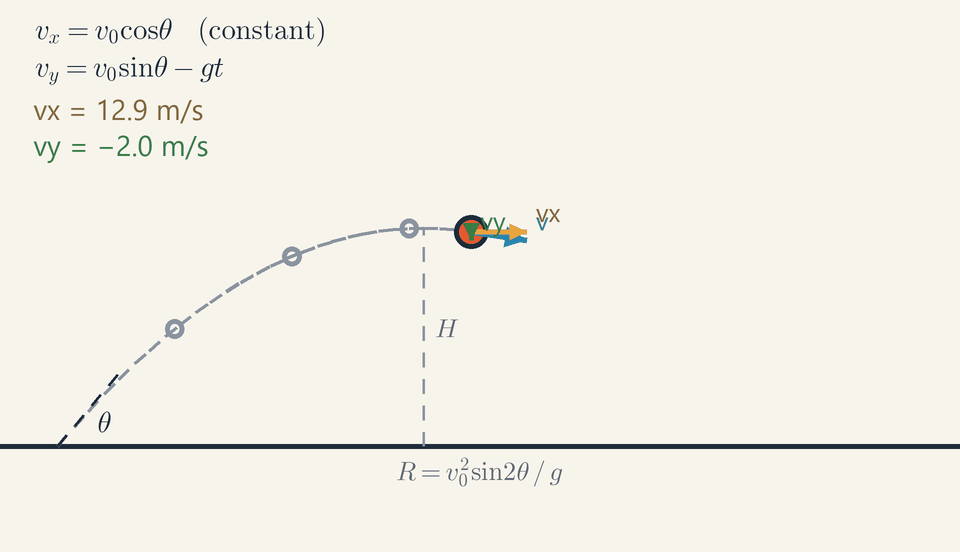
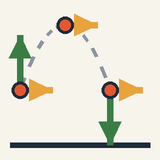
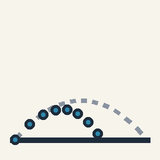
A ball launched at 50°, leaving a dashed trail. Its velocity arrow keeps the same horizontal component, while the vertical component shrinks, reverses at the top and grows on the way down.
Once thrown, a ball keeps a steady sideways speed while gravity pulls it down the whole time.
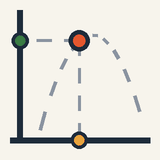
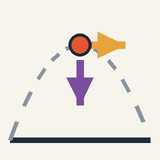
The sideways motion and the up-and-down motion happen independently of each other.
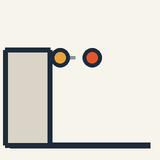
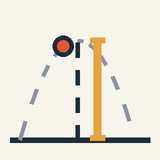
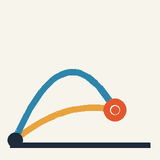
A ball rolled off a table and a ball dropped from the same height land at the same moment.
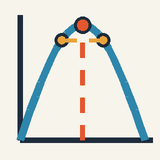
On level ground, ignoring air resistance, a 45° throw goes farthest; 30° and 60° land at the same spot.
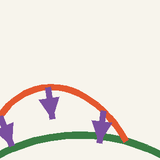
Throw fast enough and the round Earth curves away as fast as the ball falls: it is in orbit.
A projectile is anything thrown, kicked or launched that then moves under gravity alone: a basketball, a long jumper, the water from a garden hose. Its path is a curve called a parabola.
The trick is to split the motion in two. Sideways, nothing pushes or pulls the ball once it has left your hand (if we ignore the air), so it keeps the same horizontal speed. Up and down, gravity acts exactly as on a dropped ball: it adds 9.81 m/s of downward speed every second.
Throw a stone horizontally at 10 m/s from a cliff top. After 1 s it is 10 m out and has dropped about 4.9 m; after 2 s it is 20 m out and has dropped about 19.6 m.
Quick check: after 2 s, how fast is it moving forward, and how fast downward? Answer: still 10 m/s forward, and about 20 m/s downward.
Because the two motions ignore each other, a coin flicked off a table and a coin dropped from the same edge hit the floor together.
The launch angle matters. Thrown too flat, a ball lands quickly; thrown too steeply, it goes high but not far. On level ground and without air, 45° gives the longest throw, and 30° and 60° land at the same spot.
Newton pictured a cannon on a mountain firing ever faster: each ball lands farther away, until one falls exactly as fast as the round Earth curves away beneath it and never lands. That is an orbit.
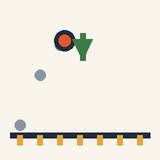
In the animation, watch the grey dots, one every half second: sideways they are always the same distance apart, while vertically the gaps shrink on the way up and grow on the way down.
Intermediate
Key ideas
Split v0: vx=v0cosθ stays constant, vy=v0sinθ−gt changes by 9.81 m/s every second.
At the top vy=0 but vx is not, so the speed there is v0cosθ; the acceleration is still g downward.
Time of flight T=2v0sinθ/g; maximum height H=(v0sinθ)2/(2g).
Range on level ground R=v02sin2θ/g, largest at θ=45∘ (Rmax=v02/g).
Axes, components and signs
A coin flicked off a table and a coin dropped from the same edge hit the floor together. Put the origin at the launch point, the x axis horizontal in the direction of the throw and the y axis vertically up. A ball launched at speed v0 and angle θ above the horizontal has a velocity that is the hypotenuse of a right triangle whose sides are the components vx=v0cosθ vy0=v0sinθ
Both are signed, in metres per second: vy>0 means rising, vy<0 falling. Going back, the speed is v=vx2+vy2. With up as positive, the vertical acceleration is −g, where g=9.81m/s2 is the size of the free-fall acceleration. Check how the angle is given: if it is measured from the vertical, sine and cosine swap places.
Two independent straight-line motions
Once the ball has left the hand, the only force on it, if we ignore the air, is its weight, straight down. Nothing pushes it sideways, so its horizontal velocity never changes: the horizontal motion is uniform. Vertically, the ball moves exactly like a ball thrown straight up at v0sinθ, the case treated in Free Fall. The two motions share only the clock.
After a time t, therefore, x=v0cosθt vy=v0sinθ−gt y=v0sinθt−21gt2
A quick test of this independence: flick a coin off a table as you drop another from the same edge. Both start with vy=0 and fall the same height, so they hit the floor together; the flicked one simply lands farther out.
Time of flight, height and range
On level ground, the time in the air, the height and the range all follow from the vertical motion plus one multiplication. The ball rises until vy=0, at t=v0sinθ/g, and the descent mirrors the climb, so it lands after twice that time. Putting the rise time into y(t) gives the maximum height, and the horizontal speed times the time of flight gives the range:
T=g2v0sinθ
H=2g(v0sinθ)2
R=gv02sin2θ
The time of flight and the height depend only on the vertical component v0sinθ. The range needs both components, R=v0cosθ⋅2v0sinθ/g, and the identity 2sinθcosθ=sin2θ tidies it up.
Which angle throws farthest? A steep launch stays up long but moves slowly sideways; a flat one is fast sideways but lands almost at once. The range, their product, is largest in between: sin2θ reaches its maximum of 1 when 2θ=90∘, so on level ground θ=45∘ is best, with Rmax=v02/g. Angles equally far above and below 45° give the same range, because sin2θ=sin(180∘−2θ): 30° and 60° land at the same spot, and so do 40° and 50°.
Worked example: the throw in the animation
The ball leaves the ground at v0=20m/s and θ=50∘. Its components are vx=20cos50∘≈12.9m/s vy0=20sin50∘≈15.3m/s
These are the values on the vx and vy readouts at launch. The ball reaches the top after t=15.3/9.81≈1.56s and lands after twice that, T≈3.12s. Then H=2⋅9.8115.322≈12.0m R=9.81202sin100∘≈40.2m and, as a check, vxT=12.9⋅3.12≈40.2m.
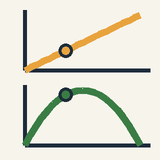
During the flight the gold vx readout stays at 12.9 m/s. The green vy readout drops by 9.81 m/s every second, passes through zero at 1.56 s, when the ball is at the top of the dashed line marked H, and reaches −15.3m/s as the ball lands. The ball comes down 40.2 m away at 20 m/s, 50° below the horizontal: the descent is the climb played backwards.
At 40° the same speed reaches the same 40.2 m, but the ball rises only 8.4 m and lands after 2.62 s. At 45° it lands at 40.8 m, just 1.5 % farther than at 50°: near the best angle, the range is forgiving.
Worked example: a shot put
An athlete releases a shot 2.0 m above the ground at 13 m/s and 40° above the horizontal. How far away, measured horizontally, does it land? The level-ground formulas do not apply, because the shot lands 2.0 m below its starting height.
The components are vx=13cos40∘≈9.96m/s and vy0=13sin40∘≈8.36m/s. The shot lands when y=−2.0m, that is when 4.905t2−8.36t−2.0=0, where 4.905 is 21g. The positive root is t=2⋅4.9058.36+8.362+4⋅4.905⋅2.0≈1.92s so the shot lands x=9.96⋅1.92≈19.1m away.
The level-ground formula would give 132sin80∘/9.81≈17.0m: the release height adds 2.1 m to the distance. The shot rises 8.362/(2⋅9.81)≈3.6m above the hand and lands at 14.4 m/s, faster than it left, because it ends lower. When the landing point is below the launch, the best angle is a little under 45°, about 42° here; athletes release flatter still, because their arms push the shot faster at flatter angles.
Reading the strobe dots and the arrows
The grey dots mark the ball every 0.5 s. Sideways they are always 12.9⋅0.5≈6.4m apart: equal distances in equal times, the signature of uniform motion. Vertically, counting from the launch point, the ball climbs 6.4, 4.0 and 1.5 m from one half-second mark to the next, then drops 0.9, 3.4 and 5.8 m. Each step is 2.45 m less upward, or more downward, than the one before, because g(0.5s)2=2.45m: the pattern of a dropped ball, started with an upward push.
The arrows tell the same story. The blue v arrow is always tangent to the dashed trail. The gold vx arrow keeps its length from launch to landing, while the green vy arrow shrinks, vanishes at the top and then grows pointing down. So the blue arrow is shortest at the top, where the speed equals vx, 12.9 m/s, and it is as long at landing as at launch.
Common mistakes
The velocity is not zero at the top. Only vy is; the ball still moves sideways at 12.9 m/s, its lowest speed of the whole flight.
Nor is the acceleration zero at the top. It is still 9.81 m/s² downward, so 0.1 s after the top vy is already −0.98m/s.
A faster sideways throw does not stay up longer. Rolled off a table 1.0 m high at 2 m/s or at 4 m/s, a ball lands after 0.45 s either way, 0.9 m or 1.8 m out.
The range needs sin2θ, not sinθ. With sin50∘ instead of sin100∘, the animation's throw would seem to land at 31.2 m, not 40.2 m.
The range formula assumes landing at the launch height. For the shot put it gives 17.0 m instead of 19.1 m.
Where you meet it
Ball games, the long jump, the jet of a hose or a fountain (each drop follows its own parabola), springboard dives and fireworks all follow these equations while the air matters little. That holds well for a heavy shot, less well for a football and not at all for a shuttlecock, a case for Drag and Terminal Velocity.
Galileo showed in 1638 that a projectile's path is a parabola, by combining a uniform horizontal motion with a uniformly accelerated fall. Newton's Laws of Motion explain why the two motions are independent. Followed far enough, the same reasoning leads to orbits: launched sideways at about 7.9 km/s, a body falls around the Earth as fast as the ground curves away, the subject of Gravitation and Orbits.
Advanced
Key ideas
Component by component, mx¨=0 and my¨=−mg: a uniform motion and a free fall that ignore each other.
Eliminating t: y=xtanθ−gx2/(2v02cos2θ); as a quadratic in tanθ it gives a low and a high shot at one target.
Drag couples x and y through ∣v∣: step it numerically, v→v+aε, r→r+vε; the arc turns lopsided.
The parabola assumes flat ground and a uniform g; over long ranges the path is an arc of an ellipse focused on the Earth's centre.
Newton's law, one component at a time
Everything in this lesson rests on one move: splitting a motion in a plane into two motions along straight lines. Put the launch point at the origin, with x horizontal and y up. The ball leaves with the speed v0 at the angle θ above the horizontal, so its launch velocity v0 has the components v0cosθ and v0sinθ. Write g=9.81m/s2 for the size of the free-fall acceleration, so that g=(0,−g) points straight down.
Once the ball is in flight, and as long as air resistance is neglected, the only force on it is its weight mg. Newton's second law reads ma=mg. Two vectors are equal only when their components are equal, so this one equation splits into two, where a dot means a derivative with respect to time: mx¨=0,my¨=−mg
Two things follow at once. The equations do not mix: y never appears in the first and x never appears in the second, so each is a straight-line problem of its own. And the mass cancels, so a marble and a cannonball launched with the same velocity follow the same path. Sideways the ball moves at a constant velocity; vertically it is in free fall.
Integrate each equation once to get the velocity, then again to get the position. Each integration brings in a constant, fixed by the state at t=0: the ball starts at the origin with the velocity components above. The result is x˙=v0cosθ,x=v0cosθt y˙=v0sinθ−gt,y=v0sinθt−21gt2
Four constants were needed: two starting coordinates and two starting velocity components. Motion in a plane always needs four starting numbers, twice as many as motion along a line.
The numbers below refer to the animation's throw: v0=20m/s at θ=50∘. Its horizontal component is vx=20cos50∘≈12.9m/s and its initial vertical component 20sin50∘≈15.3m/s.
The position as a vector sum
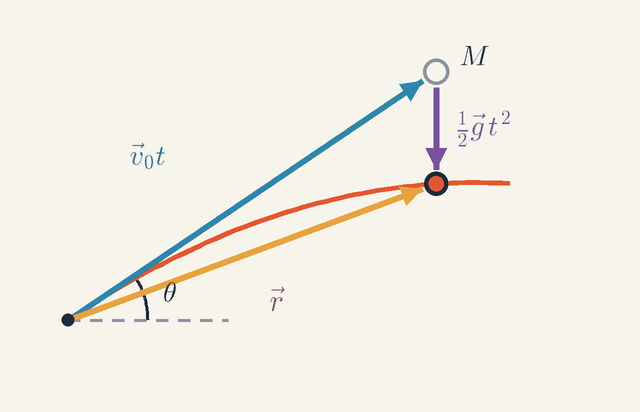
The two component results can be packed back into a single vector equation. It is worth doing, because the vector form shows at a glance how gravity pulls the ball away from the line it was aimed along.
Figure 1. The ball's position r at time t is the arrow v0t along the line of aim plus the drop 21gt2 straight down. A monkey that lets go at M at the instant of launch falls by the same drop, so the ball meets it.Legend
θ
Angle of the line of aim above the horizontal.
rad
v0t
Where the ball would be without gravity: the launch velocity times the time, along the line of aim.
m
21gt2
Drop caused by gravity: straight down, growing as t2.
m
r
Position of the ball: the arrow from the launch point to the ball.
m
M
Point on the line of aim where a monkey hangs at the instant of launch.
Figure 1 draws the equation r(t)=v0t+21gt2 Read it as two arrows placed tip to tail. The arrow v0t starts at the launch point and runs along the line of aim, at the angle θ above the horizontal. It ends where the ball would be at the time t if there were no gravity. From its tip the arrow 21gt2 points straight down: it is how far the ball has fallen below the line of aim. The position vector r, from the launch point to the ball, is the sum of the two, and the red curve is the path so far.
The first arrow grows in proportion to t, the second in proportion to t2. Early in the flight the drop is tiny compared with the distance along the line of aim; later it takes over, so the ball sinks ever faster below that line.
This settles a classic puzzle. A monkey hangs from a branch at the point M on the line of aim, and lets go at the very instant the ball is fired straight at it. Does the ball pass over the falling monkey? No. Figure 1 shows the moment when v0t has reached M. The ball is then 21gt2 below the line of aim, directly beneath M. The monkey, falling from rest for the same time t, has dropped by exactly the same distance. So the ball meets the monkey whatever the launch speed, provided it gets there before both reach the ground: gravity lowers both by the same amount, so aiming straight at the monkey is exactly right.
The velocity has the same structure, v(t)=v0+gt. Its horizontal part never changes, and its vertical part loses 9.81 m/s every second. Draw the velocity arrows of successive instants from one common point: their tips march straight down a vertical line, 4.9 m/s for every half second.
Eliminating time: the parabola
The equations so far say where the ball is at each instant. To see the shape of the path itself, remove the time.
Because x grows at the constant rate v0cosθ, the ball reaches a given x at the time t=x/(v0cosθ). Substituting this into y(t) gives the height as a function of the horizontal distance: y=xtanθ−2v02cos2θgx2
Read it term by term. The first term, xtanθ, is the line of aim. The second is the drop 21gt2 of Figure 1, now written in terms of x. Because the drop grows as x2, the path is a parabola that opens downwards.
Two landmarks follow. The ball is back at launch height where y=0: at x=0, and at the range R=gv02sin2θ where the identity 2sinθcosθ=sin2θ has been used. The top of the arc is where the path is level. The slope is dy/dx=tanθ−gx/(v02cos2θ), which vanishes at x=v02sinθcosθ/g=R/2. So the apex lies exactly halfway along, as the symmetry of a parabola requires, at the height H=v02sin2θ/(2g).
For the animation's throw the path is y=1.192x−0.02968x2, with x and y in metres. It returns to the ground at 40.2 m and peaks at 12.0 m, when x=20.1m.
Aiming at a target: two angles and the edge of reach
So far the launch was given and we asked where the ball goes. A thrower faces the reverse question: with a fixed speed, at which angle must the ball leave to hit a given target? The same trajectory equation answers it.
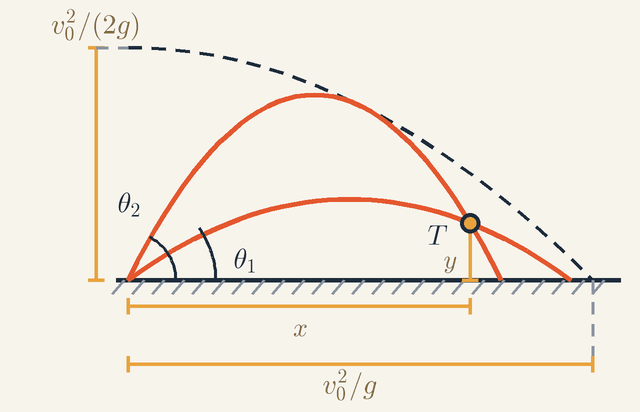
Figure 2. A target T at (x,y) is hit by a flat throw at θ1 and a lofted one at θ2, both at speed v0. The dashed parabola is the edge of reach, enclosing every point the speed v0 can reach: v02/(2g) high and v02/g wide.Legend
v0
Launch speed, the same for both throws and for the dashed parabola.
m/s
θ1
Launch angle of the flat throw.
rad
θ2
Launch angle of the lofted throw.
rad
T
The target.
x
Horizontal distance from the launch point to the target.
m
y
Height of the target above the launch point.
m
v02/(2g)
Greatest height reachable at speed v0, by a throw straight up: the top of the dashed parabola.
m
v02/g
Greatest range on level ground, reached at 45∘: where the dashed parabola meets the ground.
m
In Figure 2 the ball leaves the launch point with the speed v0 and must hit the target T, a horizontal distance x away and a height y above the launch point. Two paths do it, a flat throw at the angle θ1 and a lofted throw at θ2, and they cross at T.
To find these angles, treat θ as the unknown. The trajectory equation contains both tanθ and 1/cos2θ. The identity 1/cos2θ=1+tan2θ turns it into an equation for u=tanθ alone: y=xu−2v02gx2(1+u2) The quantity D=gx2/(2v02) is a length: the drop of a ball launched horizontally at v0 over the distance x. With it, collecting the powers of u gives a quadratic, the aiming equation: Du2−xu+(y+D)=0
A quadratic has two, one or no real roots, and each case has a meaning. Two roots: a flat and a lofted shot both hit the target, the two paths of Figure 2. A double root: the target lies exactly on the limit of reach, and only one angle gets there. No real root: the target is out of range at this speed.
The product of the two roots leads to a simple result. For any quadratic it equals the constant term divided by the coefficient of u2, here 1+y/D. On level ground, y=0, the product is 1, so tanθ1tanθ2=1 and θ2=90∘−θ1: the two angles are complementary, and throws at 30° and at 60° land at the same spot. For a target above the launch point, as in Figure 2, the product is larger than 1. Then tan(θ1+θ2)=(tanθ1+tanθ2)/(1−tanθ1tanθ2) is negative, so the two angles add up to more than 90∘.
The double root traces the limit of reach itself. It occurs when the discriminant vanishes, x2=4D(y+D). Solving for y, and putting back D=gx2/(2v02), gives the edge of reach: y=2gv02−2v02gx2
This curve, often called the safety parabola, is the dashed curve of Figure 2. Every path launched at the speed v0 touches it at one point and stays inside it, so it encloses every point the ball can reach. It stands v02/(2g) above the launch point, the height of a throw straight up, and meets the ground at v02/g. That is the largest range on level ground, reached at 45°, where sin2θ=1. At 20 m/s these lengths are 20.4 m and 40.8 m. Paths launched above 45° touch the curve during the flight, as the lofted path of Figure 2 does just past its own apex; flatter paths would touch it only if continued below the ground.
The velocity graph, and speed against height
Two more tools describe the flight without solving anything new: the graph of the vertical velocity, and a relation between speed and height that does not involve the time at all.
The expert layer of the animation plots vy(t). Because v˙y=−g is constant, the graph is a straight line of slope −g=−9.81m/s2, here from 15.3 m/s down to −15.3m/s. It crosses zero at t=15.3/9.81≈1.56s, the moment of the apex. The area under a velocity graph is the displacement, so the triangle above the axis, 21⋅1.562⋅15.32≈12.0m, is the height H. The equal triangle below the axis is the way back down, and the ball is at y=0 again at 3.12 s.
Speed and height are linked without time. Start from v˙y=−g and multiply both sides by vy=y˙. The left side becomes 21d(vy2)/dt and the right side −gdy/dt. Both sides are now time derivatives, so integrating from the launch gives vy2=v02sin2θ−2gy. The horizontal component never changes, so adding vx2=v02cos2θ to both sides gives v2=v02−2gy
The speed depends only on the height, not on the time or on the direction of motion. The ball passes each level at the same speed going up and coming down, and it lands at 20 m/s, its launch speed. At the apex v2=400−2⋅9.81⋅12.0≈165m2/s2, which is just vx2, as it must be when the ball moves horizontally. Multiplied by m/2, the relation reads 21mv2+mgy=21mv02: kinetic plus potential energy stays constant.
Curvature of the path
A parabola is not a circle, but at each point one circle fits it best, and the radius of that circle measures how sharply the path bends there. Finding it shows the two separate jobs gravity does: it turns the ball and it changes its speed.
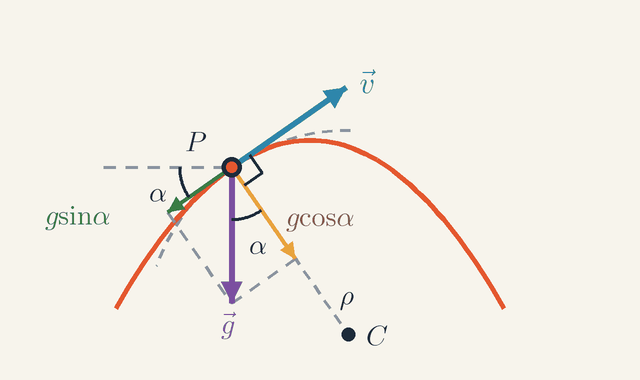
Figure 3. At a point P of the path, g splits into gsinα along the path, against v, and gcosα across it, towards the centre C of the circle that fits the path at P. Only the part across the path bends it.Legend
P
Point of the path where the velocity makes the angle α with the horizontal.
v
Velocity at P, along the path.
m/s
α
Angle between v and the horizontal; the same angle lies between g and the direction across the path.
rad
g
Acceleration of gravity, straight down.
m/s2
gsinα
Part of g along the path: it points against v while the ball rises, and changes only the speed.
m/s2
gcosα
Part of g across the path, towards C: it changes only the direction.
m/s2
ρ
Radius of curvature at P: the distance from P to C.
m
C
Centre of the circle that fits the path at P.
In Figure 3 the ball is at the point P, moving with the velocity v along the path, at the angle α above the horizontal. Split g into a part along the path and a part across it, at right angles to v; the small square at P marks that right angle. The along and across directions are just the horizontal and the vertical turned through α. Since g points down the vertical, it makes the same angle α with the across direction, as the arc between g and gcosα shows. So the part along the path is gsinα, pointing back against v while the ball rises, and the part across it is gcosα.
The two parts do different jobs. An acceleration along the velocity changes only the speed; one across the velocity changes only the direction. So only gcosα bends the path. It points to the centre C of the circle that fits the path at P, the distance ρ away. A body moving at the speed v on a circle of radius ρ needs the acceleration v2/ρ towards the centre, so gcosα=v2/ρ. With cosα=vx/v, the radius of curvature is ρ=gcosαv2=gvxv3
Because vx never changes, ρ is smallest where the speed is smallest: at the apex. There α=0, gravity lies wholly across the path, and ρ=vx2/g=12.92/9.81≈17m. At launch ρ=203/(9.81⋅12.9)≈63m. The arc is sharpest at the top.
The other part, gsinα, changes the speed. While the ball rises it points against v and slows the ball. On the way down v points below the horizontal, the part along the path points the same way as v, and the ball speeds up.
Air resistance and numerical stepping
Real balls fly through air. Drag spoils the neat formulas above, but a computer can still follow the motion step by step, and the method works for any force.
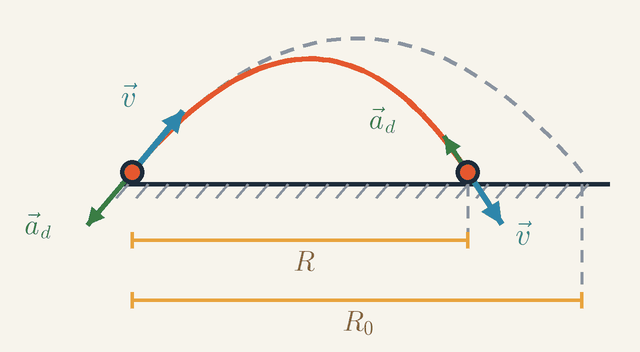
Figure 4. The animation's throw with air resistance (red) and without (dashed). In air the ball lands at R instead of R0 and comes down more steeply; the drag acceleration ad points against v and is smaller at landing, where the ball is slower.Legend
R
Range with air resistance: the distance from the launch point to the landing point.
m
R0
Range without air: where the dashed path lands.
m
v
Velocity of the ball, drawn at launch and at landing.
m/s
ad
Acceleration caused by drag: along the path, against v, of size g(v/vt)2.
m/s2
Figure 4 sets the animation's throw in air (red) beside the same throw without air (dashed). The drag force always opposes the velocity, and for a ball at everyday speeds it grows roughly as the square of the speed. Call vt the terminal speed: the speed at which drag equals the weight, reached by a ball dropped from a great height. The drag acceleration then has the size g(v/vt)2 and points against v; in vector form it is −kvv, with k=g/vt2. In Figure 4 each arrow ad points back along the path, against v, and the one at landing is the shorter, because the ball lands slower than it left.
Adding gravity, the equations of motion become x¨=−kvx˙,y¨=−g−kvy˙ with v=x˙2+y˙2. The speed contains both velocity components, so each equation now depends on the other's motion: the horizontal and vertical motions are coupled, and no formula gives the path.
It can still be followed step by step. Choose a small time step ε. From the present position and velocity compute the acceleration a, then move forward by one step, v→v+aε,r→r+vε and repeat until the ball lands. Over one short step the acceleration and the velocity hardly change, so treating them as constant makes only a small error. In this simplest scheme, the Euler method, the total error shrinks in proportion to ε: halving the step halves the error. Steps of 0.01 s already give the range below to within about 0.2 m. Nothing in the method depends on the form of the force, so it works for any force law.
The red path of Figure 4 is such a calculation, for a ball whose terminal speed is 30 m/s. The drag starts at (20/30)2≈0.44 of the weight and is down to (15.6/30)2≈0.27 of it at landing. The range R falls from R0=40.2m to 30.0 m, and the greatest height from 12.0 m to 10.1 m.
The arc is no longer symmetric. On the way up drag adds to gravity in slowing the climb; on the way down it opposes the fall. So the climb takes 1.39 s and the descent 1.48 s. Drag also keeps reducing the horizontal speed, so the ball covers more ground while climbing than while falling: the apex sits 15.9 m out, past the middle. The ball lands at 15.6 m/s, 57° below the horizontal, steeper than its 50° launch.
Drag also shifts the best angle. The angle that gives the longest range drops to about 43°, because a higher throw stays up longer and so loses more to drag. The faster the launch compared with vt, the lower the best angle.
Worked problem: two ways to hit a target
Apply the aiming equation to the target of Figure 2, with the animation's launch speed of 20 m/s. At what angles must you throw to hit a target 30 m away and 5.0 m above the launch point?
First the drop: D=gx2/(2v02)=9.81⋅900/800≈11.04m, so y+D≈16.04m. With x=30m the aiming equation reads 11.04u2−30u+16.04=0 and the quadratic formula gives u=2⋅11.0430±900−4⋅11.04⋅16.04=22.0830±13.84 so u≈0.732 or u≈1.986, that is θ≈36.2∘ or θ≈63.3∘. These are the angles θ1 and θ2 of Figure 2. They add up to 99.5°, more than 90∘, as expected for a target above the launch point.
The flight times follow from t=x/(v0cosθ): 30/(20cos36.2∘)≈1.86s for the flat shot and 30/(20cos63.3∘)≈3.34s for the lofted one. Both arrive at the same speed, 400−2⋅9.81⋅5.0≈17.4m/s, because the speed depends only on the height.
They arrive from different directions, though. The flat shot has already passed its 7.1 m apex and comes in 22° below the horizontal; the lofted one drops in at 59° from an apex 16.3 m up. This is why basketball players favour steep arcs: to a ball dropping in steeply, the hoop presents a wider opening.
Could the same throw reach a target 10 m up at that distance? The edge of reach at x=30m lies at 20.39−11.04≈9.35m. The target is above it, the aiming equation has no real root, and no angle works. A target exactly 9.35 m up is hit by a single shot. The double root is u=x/(2D), which here is tanθ=v02/(gx)≈1.36, that is θ≈53.7∘: the flat and the lofted solutions have merged into one.
Limits of validity
Everything above rests on three idealisations: a ball that behaves as a point, flat ground and a uniform pull of gravity. Each holds well for thrown balls, and each fails in a known way.
The model treats the ball as a point with no spin. A spinning ball also feels a lift force across its velocity, the Magnus effect, which curls a free kick and keeps a backspinning golf ball aloft. Drag matters when the speed is a sizeable fraction of the terminal speed, since drag divided by weight is (v/vt)2. A 7.26 kg shot has a terminal speed of about 150 m/s, so at 13 m/s its drag is under 1 % of its weight and the parabola is excellent.
Flat ground and a uniform g are approximations too. With the Earth's radius RE≈6371km, the ground curves down over the animation's 40 m by only x2/(2RE)≈0.1mm. Gravity weakens as the inverse square of the distance from the Earth's centre, so at the 12 m apex g is smaller by the fraction 2H/RE≈4×10−6.
These effects grow with the range. A launch at 1 km/s and 45°, with a vacuum range of 102 km, would come down where the ground has dropped by 0.8 km, though air would dominate long before that. The Earth's rotation shifts the landing point of the 3.1 s throw by under a centimetre, but that of a shell flying for a minute by tens of metres.
Strictly, gravity points to the Earth's centre rather than in one fixed direction, and the trajectory is an arc of an ellipse with one focus at that centre. Over a short stretch, where the directions to the centre are almost parallel, the ellipse cannot be told apart from the parabola. Launched sideways at gRE≈7.9km/s, and ignoring the air, a body falls around the Earth exactly as fast as the ground curves away beneath it: the projectile has become a satellite, and the thrown ball and the Moon obey one law.
Where this leads
Newton's Laws of Motion supply the component equations. The relation v2=v02−2gy is energy conservation, developed in Work, Energy and Power. At the apex gravity plays the part of the centripetal acceleration of Circular Motion, g=vx2/ρ. The coupled drag equations are the subject of Drag and Terminal Velocity, and Newton's cannon and the ellipse belong to Gravitation and Orbits.
A ball dropped from the window of a steadily moving train falls straight down for a passenger but traces a parabola for someone on the platform: one motion seen from two frames, as in Vectors and Relative Motion. And a charged particle in the uniform field between two charged plates follows the same parabola, with g replaced by qE/m; oscilloscope tubes and some ink-jet printers steer electrons and ink droplets this way (Electric Field and Potential).
Key formulas
Horizontal velocity component
vx=v0cosθ
The launch velocity is the hypotenuse of a right triangle whose horizontal side is v0cosθ. Once the ball has left the hand no horizontal force acts on it (air neglected), so this component never changes: the horizontal motion is uniform, and x=vxt.
Symbols
vx
horizontal component of the velocity
m/s
v0
launch speed
m/s
θ
launch angle above the horizontal
rad
When it holds: Holds throughout the flight only without air resistance; drag makes vx shrink. If the angle is measured from the vertical, use the sine instead of the cosine.
Example: The animation: vx=20cos50∘≈12.9m/s from launch to landing.
Vertical velocity component
vy=v0sinθ−gt
The vertical motion is a free fall that starts with the upward speed v0sinθ. Gravity changes it by g every second, downward: vy is positive while the ball rises, zero at the apex at t=v0sinθ/g, and negative on the way down. The minus sign comes from taking up as positive.
Symbols
vy
vertical component of the velocity at time t
m/s
v0
launch speed
m/s
θ
launch angle above the horizontal
rad
g
free-fall acceleration
m/s2
t
time since the launch
s
When it holds: Without air resistance, near the Earth's surface where g is uniform, with t counted from the launch.
Example: The animation: vy=15.3−9.81t (in m/s) is zero at 1.56 s and reaches −15.3m/s at landing, 3.12 s after the launch.
Time of flight on level ground
T=g2v0sinθ
Setting the height y=v0sinθt−21gt2 to zero gives two instants: the launch, t=0, and the landing. The climb and the descent take equal times, so T is twice the time to the apex. Only the vertical component of the launch velocity counts.
Symbols
T
time of flight, from launch to landing
s
v0
launch speed
m/s
θ
launch angle above the horizontal
rad
g
free-fall acceleration
m/s2
When it holds: Only for landing at the launch height, without air resistance. If the landing point lies a height h below the launch, take the positive root of y(t)=−h instead.
Example: The animation: T=2⋅15.3/9.81≈3.12s.
Range on level ground
R=gv02sin2θ
The range is the constant horizontal speed times the time of flight, v0cosθ⋅2v0sinθ/g, and 2sinθcosθ=sin2θ. Since sin2θ is at most 1, reached at θ=45∘, the longest throw on level ground is v02/g. Complementary angles, such as 30° and 60°, give equal ranges.
Symbols
R
range: horizontal distance from launch to landing
m
v0
launch speed
m/s
θ
launch angle above the horizontal
rad
g
free-fall acceleration
m/s2
When it holds: Level ground (landing at the launch height) and no air resistance. A launch from above the landing point goes farther; drag shortens the range and lowers the best angle.
Example: The animation: R=202sin100∘/9.81≈40.2m; at 45° it would be 40.8 m.
Maximum height
H=2g(v0sinθ)2
At the apex vy=0. Applying vy2=(v0sinθ)2−2gy to the vertical motion alone gives the height. The horizontal component plays no part: a ball thrown straight up at v0sinθ would reach the same height.
Symbols
H
maximum height above the launch point
m
v0
launch speed
m/s
θ
launch angle above the horizontal
rad
g
free-fall acceleration
m/s2
When it holds: Without air resistance. The height is measured from the launch point, not from the ground below it when the two differ.
Example: The animation: H=15.322/(2⋅9.81)≈12.0m, reached after 1.56 s.
Trajectory equation
y=xtanθ−2v02cos2θgx2
Time is eliminated from x=v0cosθt and y=v0sinθt−21gt2 by putting t=x/(v0cosθ). The result is a downward parabola: the straight line of aim y=xtanθ minus a drop that grows as x2. Rewritten with 1/cos2θ=1+tan2θ, it is a quadratic in tanθ, which gives the two angles that hit a given target.
Symbols
y
height above the launch point at the horizontal distance x
m
x
horizontal distance from the launch point
m
θ
launch angle above the horizontal
rad
g
free-fall acceleration
m/s2
v0
launch speed
m/s
When it holds: Uniform gravity, no air, launch from the origin. Over hundreds of kilometres the Earth's curvature and the weakening of g turn the path into an arc of an ellipse.
Example: The animation: y=1.192x−0.02968x2 (in metres) returns to zero at x=40.2m and peaks at 12.0 m when x=20.1m.
Glossary
Projectile
A body that, once launched, moves under gravity alone, with air resistance neglected: a thrown ball, a long jumper, a drop of water from a hose. Its acceleration is g, straight down, at every point of the flight.
Trajectory
The path a body traces through space. For a projectile in uniform gravity without air it is a downward parabola, symmetric about its highest point.
Launch angle
The angle θ between the initial velocity and the horizontal. It decides how the launch speed is shared: v0cosθ sideways and v0sinθ upward. If an angle is measured from the vertical instead, sine and cosine swap.
Velocity components
The horizontal and vertical parts vx and vy of the velocity, like the motions of the ball's shadows on the floor and on a wall. They are signed numbers, and the speed is vx2+vy2.
Independence of motions
Gravity acts only vertically, so the horizontal motion (uniform) and the vertical motion (free fall) go on as if the other did not exist. A ball rolled off a table lands at the same moment as one dropped from the same edge.
Apex
The highest point of the path, reached when vy=0. The ball still moves sideways there at vx, its lowest speed of the flight, and its acceleration is still g downward.
Time of flight
How long the projectile stays in the air. It is set by the vertical motion alone: on level ground T=2v0sinθ/g, which is 3.12 s for the animation's throw.
Range
The horizontal distance from launch to landing, in metres. On level ground it is R=v02sin2θ/g, largest at 45°; a projectile that lands lower than its launch point goes farther.
Complementary angles
Two launch angles that add up to 90°, such as 30° and 60°. On level ground they give the same range, because sin2θ=sin(180∘−2θ), but the steeper throw flies higher and longer.
Envelope of trajectories
The boundary of all the points reachable at a given launch speed, y=v02/(2g)−gx2/(2v02), also called the safety parabola. A target inside it can be hit at two angles, one on it at a single angle, one beyond it not at all.
Air resistance (drag)
The drag force of the air, pointing against the velocity and growing roughly as the square of the speed. It shortens the range, makes the descent steeper than the climb and lowers the best launch angle below 45°.
Newton's cannon
A thought experiment: a cannon on a very high mountain fires horizontally, faster and faster. At about 7.9 km/s the ball falls around the curved Earth as fast as the ground drops away and never lands: it is in orbit.
Quantities
x
Horizontal position
m
Horizontal distance from the launch point, x=v0cosθt; without air it grows at a steady rate.
y
Height
m
Height above the launch point: positive above it, negative below it, as for a shot that lands lower than it was released.
t
Time
s
Time since the launch.
v0
Launch speed
m/s
The size of the velocity at the moment of launch; 20 m/s in the animation.
θ
Launch angle
rad
The angle of the launch velocity above the horizontal, usually quoted in degrees: the animation's 50° is 0.873rad.
vx
Horizontal velocity
m/s
The horizontal component of the velocity, v0cosθ, constant during a flight without air: 12.9 m/s in the animation.
vy
Vertical velocity
m/s
The vertical component of the velocity: positive while the body rises, zero at the apex, negative while it falls. It changes by 9.81 m/s every second.
g
Free-fall acceleration
m/s2
The size of gravity's acceleration near the Earth's surface, about 9.81m/s2; with up taken as positive, the vertical acceleration is −g.
T
Time of flight
s
Time from launch to landing; on level ground 2v0sinθ/g, twice the time to the apex.
H
Maximum height
m
Height of the apex above the launch point, (v0sinθ)2/(2g); only the vertical component of the launch velocity counts.
Quiz
Beginner One ball rolls off a table at the same moment as an identical ball is dropped from the same height. Ignoring air resistance, which hits the floor first?
Both at the same time
The dropped ball
The ball that rolled off
It depends on how fast the ball rolls
Show answer
Answer: A. Both at the same time
The horizontal motion does not affect the vertical motion: both balls start with zero vertical velocity and fall the same height, so they land together.
Beginner During the flight of a projectile, ignoring air resistance, what happens to its horizontal velocity?
It stays constant
It decreases steadily
It increases steadily
It becomes zero at the highest point
Show answer
Answer: A. It stays constant
No horizontal force acts once the projectile is launched, so its horizontal velocity does not change.
Intermediate At the highest point of its path, what is the acceleration of a projectile (no air resistance)?
Zero, because the ball stops rising
9.81 m/s² straight down, the same as everywhere else on the path
9.81 m/s² horizontally, along the direction of motion
Less than 9.81 m/s², because only the horizontal velocity is left
Show answer
Answer: B. 9.81 m/s² straight down, the same as everywhere else on the path
Gravity is the only force throughout the flight, so a = g = 9.81 m/s² downward at every point, including the top. vy is zero there for an instant, but it keeps changing at 9.81 m/s every second, which is why the ball starts to fall.
Intermediate What is the velocity of a projectile at the highest point of its path?
Horizontal, equal to v₀·cos θ
Zero
Vertical, pointing down
Equal to v₀, the launch speed
Show answer
Answer: A. Horizontal, equal to v₀·cos θ
At the top the vertical component is zero, but the horizontal component v₀·cos θ is unchanged, so the velocity is horizontal.
Intermediate A ball is launched at 20 m/s at 45° over level ground. Ignoring air resistance, what is its range? (g = 9.81 m/s²)
40.8 m
20.4 m
28.8 m
81.5 m
Show answer
Answer: A. 40.8 m
R = v₀²·sin 2θ / g = 400 × sin 90° ÷ 9.81 = 400 ÷ 9.81 ≈ 40.8 m. Using sin 45° instead of sin 90° gives 28.8 m.
Advanced On level ground, a launch at 30° gives a range of 50 m. At the same speed, which other angle gives the same range?
60°
45°
15°
90°
Show answer
Answer: A. 60°
R depends on sin 2θ, and sin 60° = sin 120°, so θ = 30° and θ = 60° give equal ranges. Complementary angles always do.
Advanced A dart gun is aimed straight at a monkey hanging from a branch. The monkey lets go at the instant the dart is fired. Ignoring air resistance, and assuming the dart covers the horizontal distance to the monkey before either of them reaches the ground, what happens?
The dart passes above the falling monkey
The dart passes below the monkey unless it is fired very fast
The dart hits the monkey, whatever its launch speed
The dart hits only if the gun is aimed above the monkey
Show answer
Answer: C. The dart hits the monkey, whatever its launch speed
Without gravity the dart would fly straight to the monkey's starting position. With gravity, the dart and the monkey both fall ½·g·t² below their gravity-free positions at every instant, so they meet whatever the launch speed.
Advanced With air resistance, how does the launch angle that gives the maximum range on level ground change?
It becomes smaller than 45°
It stays exactly 45°
It becomes larger than 45°
It becomes 90°
Show answer
Answer: A. It becomes smaller than 45°
Drag penalises long flight times, so a flatter, faster trajectory wins: the optimum drops below 45°.
 Physics Tutor