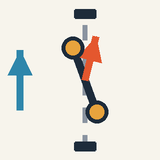
Torque is the turning effect of a force: the same push turns something more when applied farther from the pivot.
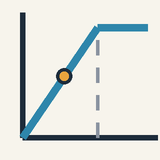
A steady twist makes a wheel spin faster and faster, just as a steady push speeds up a cart.
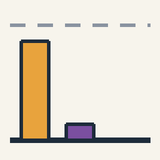
Mass far from the axle makes a wheel harder to spin up and harder to stop.
With nothing twisting it, a spinning wheel keeps turning at a steady rate.
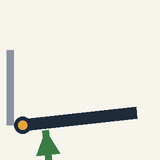
Push a door right next to its hinges and it hardly moves; push just as hard at the handle and it swings open. Turning follows rules much like Newton's laws for straight-line motion.
Step 1. The turning effect of a force is called torque. It depends on how hard you push and on how far from the pivot you push: the same force twice as far out gives twice the turning effect. That is why spanners have long handles. A push aimed straight at the hinges does not turn the door at all.
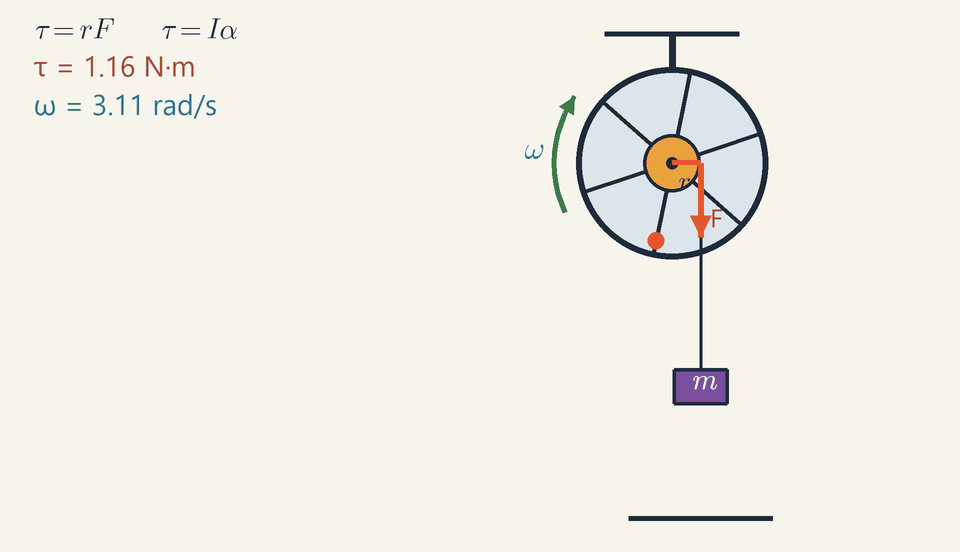
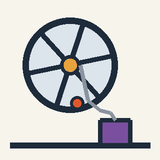
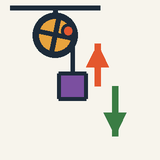
Step 2. A steady push makes a cart go faster and faster; in the same way, a steady torque makes a wheel spin faster and faster. In the animation a weight hangs from a string wound round the hub of a heavy wheel. As it falls, the string keeps twisting the wheel, and the blue bar shows the spin growing steadily.
Step 3. Mass resists changes of motion, and for turning what matters is where the mass sits. Mass far from the axle makes a wheel much harder to spin up, and harder to stop. That is why the weight in the animation falls so slowly, and why flywheels are built heavy at the rim.
Step 4. When the weight lands, the string goes slack and the twisting stops. The wheel does not stop: it keeps turning at a steady rate, just as a moving object keeps moving when no force acts. In a real machine, friction in the axle slowly brings it to rest.
Check yourself: two children push a roundabout equally hard, one at the rim and one halfway to the centre. Who gives the bigger turning effect? Answer: the one at the rim, because the same push acts twice as far from the pivot.
Intermediate
Key ideas
τ=rFsinθ (N·m): only the part of the force perpendicular to the radius turns the object.
Newton's second law for rotation: τ=Iα, where the moment of inertia I (kg·m²) plays the role of mass.
I depends on where the mass sits: 21MR2 for a uniform disc, MR2 for a thin ring.
For a weight on a string, the tension F=m(g−a) is less than mg, and a=αr.
Describing a rotation
Every point of a turning wheel turns through the same angle, yet a point on the rim moves faster than a point near the axle. A rigid body turning about a fixed axis needs one number to say where it is: the angle θ through which it has turned, measured in radians (a full turn is 2π≈6.28rad). The angular velocity ω is the rate of change of that angle, in rad/s, and the angular acceleration α is the rate of change of ω, in rad/s². In the animation the wheel turns clockwise, along the curved green arrow; take that sense as positive.
Every point of the body shares the same ω and α, but a point at distance r from the axis moves at v=ωr, with tangential acceleration a=αr. So a weight whose string unwinds from the hub without slipping moves exactly as fast as the hub's edge.
Torque: force times lever arm
Push a door at its handle, 0.80 m from the hinges, with 20 N at right angles to the door: the turning effect, or torque, is τ=0.80⋅20=16N⋅m. The same push 0.10 m from the hinges gives only 2N⋅m. In general, for a force F applied at a distance r from the axis, τ=rFsinθ where θ is the angle between the force and the radius to the point where it acts (not the angle the body has turned).
There are two equivalent readings: only the part of the force perpendicular to the radius, Fsinθ, turns the body, or the whole force acts with a lever arm d=rsinθ, the perpendicular distance from the axis to its line of action. Push the handle at 30° to the door and τ=16⋅sin30∘=8N⋅m; push straight at the hinges and nothing turns.
Torque is measured in newton metres, never in joules: it is not an energy. Torques that turn opposite ways get opposite signs.
Newton's second law for rotation
A net torque causes an angular acceleration, as a net force causes an acceleration: τ=Iα
The moment of inertia I, in kg·m², plays the part of mass. A small piece of mass m at distance s from the axis has a tangential acceleration αs, which needs a force msα and therefore a torque ms2α. Adding up the pieces gives τ=(∑ms2)α, so I=∑ms2. Each kilogram counts with the square of its distance: twice as far out, four times the resistance.
A thin ring of mass M and radius R has all its mass at the rim, so I=MR2; a solid sphere has 52MR2. The wheel in the animation is a uniform disc: I=21MR2(uniform disc) With M=10kg and R=0.40m, I=21⋅10⋅0.402=0.80kg⋅m2, half the value for a thin ring of the same mass and size.
With a constant net torque, α is constant and the equations of straight-line motion carry over, with θ, ω and α in place of x, v and a:
ω=ω0+αt
θ=θ0+ω0t+21αt2
ω2=ω02+2αΔθ
Adding up 21mv2 over the pieces, with v=ωs, gives the energy stored in the spin, the rotational kinetic energy K=21Iω2
Worked example: the wheel in the animation
A string wound round the hub, of radius r=0.12m, carries a weight m=1kg. The tension F is unknown, so write one equation for the weight (downward positive), one for the wheel and one for the string, which does not slip: mg−F=ma,Fr=Iα,a=αr Substituting F=Iα/r and a=αr into the first equation gives α=I+mr2mgr=0.80+1⋅0.1221⋅9.81⋅0.12=0.8141.177≈1.45rad/s2
So the weight accelerates at only a=αr≈0.173m/s2, the tension is F=m(g−a)≈9.64N, a little less than the weight's 9.81 N, and the torque is τ=rF≈1.16N⋅m. That is the steady value on the red τ readout; the red arrow F at the edge of the hub and the red line r show where it comes from.
The weight falls h=0.88m in t=2h/a=2⋅0.88/0.173≈3.19s. Meanwhile the blue ω readout climbs by 1.45 rad/s every second, up to ω=αt≈4.60rad/s, and the wheel turns through 0.88/0.12≈7.33rad, just over one turn. Then the string goes slack: the arrow F vanishes, the τ readout drops to zero, α=0, and ω stays at 4.60 rad/s, as the green label points out.
Worked example: braking a flywheel
An exercise bike's flywheel, a uniform disc of 8.0 kg and radius 0.20 m, spins at 30 rad/s (about 287 rpm) when the rider stops pedalling, and a felt pad rubs its rim with a friction force of 4.0 N. How long does it take to stop, and how many turns does it make?
The friction acts along the rim, so its lever arm is the full radius: I=21⋅8.0⋅0.202=0.16kg⋅m2,τ=0.20⋅4.0=0.80N⋅m Then α=−0.80/0.16=−5.0rad/s2, negative because the torque opposes the spin. The wheel stops after 30/5.0=6.0s, and ω2=ω02+2αΔθ gives Δθ=302/(2⋅5.0)=90rad, about 14.3 turns.
Energy confirms it: the wheel starts with K=21⋅0.16⋅302=72J, and friction does work τΔθ=0.80⋅90=72J against the spin, heating the pad and the rim. A ring of the same mass and radius would store 144 J and need 12 s to stop.
The wheel's free-body diagram
Three forces act on the wheel: its weight Mg=98.1N at the centre, the 9.64 N tension at the edge of the hub, and the axle's push, which must be 98.1+9.64≈107.7N upward because the centre stays put. The net force is zero, yet the net torque is not: the weight and the axle force pass through the axis and have no lever arm, so only the tension turns the wheel.
The reverse happens too. Pull a steering wheel up with 10 N on one side and down with 10 N on the other, both 0.18 m from the centre: the forces cancel, but the torques add up to 2⋅10⋅0.18=3.6N⋅m. Such a pair of forces is called a couple.
One ω means many speeds: at landing the wheel's rim moves at ωR≈1.84m/s, the weight at only ωr≈0.55m/s.
Common mistakes
Using the wheel's radius as the lever arm. The string pulls on the hub, so the lever arm is r=0.12m; using R=0.40m gives 3.85 N·m, more than three times the real torque.
Taking the tension equal to the weight mg. The weight could not then accelerate; the tension is 9.64 N, and the missing 0.17 N is exactly ma.
Thinking that only the mass matters. Moving the wheel's 10 kg out to the rim doubles I to 1.60kg⋅m2 and cuts the angular acceleration from 1.45 to about 0.73 rad/s².
Using revolutions per minute or degrees in v=ωr or K=21Iω2. These need radians: 4.60 rad/s is 44 revolutions per minute, and putting 44 into K gives about 770 J instead of 8.5 J.
Where you meet it
Spanners, door handles and bicycle pedals give a long lever arm. Engines and electric motors are rated by the torque at their shaft, a few hundred newton metres for a car engine, and gears trade angular speed for torque. Flywheels in engines and potter's wheels carry their mass in a heavy rim to smooth out an uneven drive.
This lesson builds on Circular Motion. Set the net torque to zero and you reach Static Equilibrium and Levers; follow L=Iω and you reach Angular Momentum and Its Conservation. Simple Machines: Levers, Pulleys and Gears puts these torques to work.
Advanced
Key ideas
Torque is defined through work, dW=τdθ, so τ=xFy−yFx; summed over the body, τ=Iα with I=∫s2dm.
τext=dL/dt with L=Iω: when the weight lands, τ=0 and the ω(t) graph turns flat.
Energy check without friction: mgh=21Iω2+21mv2; the wheel acts like an extra mass I/r2.
τ=Iα needs a fixed axis; in 3-D a lopsided body has L not parallel to ω, and steady spin needs a torque.
Torque defined through work
A force can push hard on a wheel and still fail to turn it, if it points straight at the axle. To describe turning we need a quantity that captures not only how hard a force pulls but also where and in which direction it acts. The cleanest way to find it is to ask how much work the force does when the body turns. Throughout, the numbers refer to the animation: a uniform disc of mass 10 kg and radius 0.40 m turns on a fixed, frictionless axle, driven by a string wound round a light hub of radius 0.12 m and carrying a 1 kg weight that falls 0.88 m.
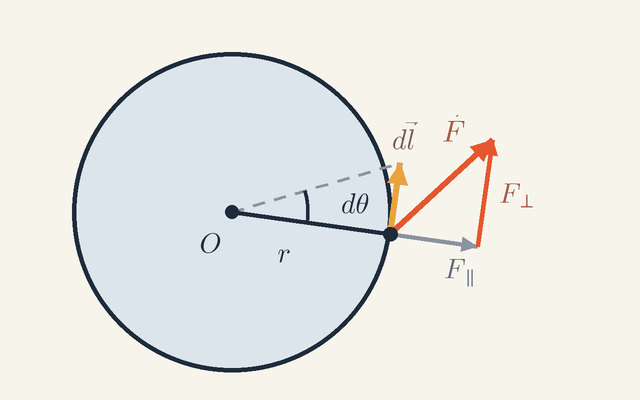
Figure 1. A force F acts at a distance r from the axis through O. In a small turn dθ the point steps by dl, at right angles to r, so only F⊥ does work: dW=F⊥rdθ. Not to scale.Legend
O
The fixed axis, seen end-on: it points out of the page.
r
Distance from the axis to the point where the force acts.
m
dθ
The small angle the body turns through.
rad
dl
Step of the point: along the tangent, at right angles to the radius, with length dl=rdθ.
m
F
Force acting at the point.
N
F⊥
Part of F along the step, at right angles to the radius: the only part that does work.
N
F∥
Part of F along the radius, at right angles to the step: it does no work.
N
Figure 1 shows a body that can turn only about a fixed axis, seen end-on at O and pointing out of the page. Its position is then given by a single number, the angle θ through which it has turned. A force F acts at a point a distance r from the axis. Let the body turn through a small angle dθ. The point moves along its circle by the short step dl. Because the turn is small, the step lies along the tangent, at right angles to the radius r, and its length is a short arc of the circle: dl=rdθ, with dθ in radians.
Now look at the two arrows drawn head to tail from the point. They split F into a part F∥ along the radius and a part F⊥ along the step. The work done by a force is its component along the displacement times the displacement. F∥ is at right angles to the step, so it does no work; F⊥ lies along the step and does all of it: dW=F⋅dl=F⊥rdθ
The factor in front of dθ is the quantity we were looking for. Define the torque about the axis as τ=rF⊥ Then the work done in a small turn is dW=τdθ: torque times angle is work, just as force times distance is.
The same product can be read another way. If φ is the angle between the radius and the force, then F⊥=Fsinφ, and rsinφ is the lever arm, the perpendicular distance from the axis to the line along which the force acts. So torque is also the whole force times its lever arm. A force aimed straight at the axis has F⊥=0 and no lever arm, so it has no torque: that is the wheel that refused to turn.
Coordinates give the same result as a formula that is easy to use. Put the axis along z through the origin. When the body turns anticlockwise through dθ, a point at (x,y) moves by dx=−ydθ and dy=xdθ. This is the step dl of Figure 1 written in components: it is at right angles to the radius and has length rdθ. A force (Fx,Fy) acting there does the work dW=Fxdx+Fydy=(xFy−yFx)dθ so τ=xFy−yFx. This is the z component of the cross product r×F, positive when the force tends to turn the body anticlockwise as seen from the +z side. Because r, x and y are all measured from the axis, the value of a torque depends on the axis chosen, so always say which axis a torque is about.
Dividing dW=τdθ by the time dt the turn takes gives the power delivered to a turning body. With the angular velocity ω=dθ/dt, P=τω the rotational twin of P=Fv.
The animation's numbers bear this out. Just before the weight lands, the string pulls with a tension T≈9.64N. On the hub, at a lever arm of 0.12 m, this is a torque τ=9.64⋅0.12≈1.16N⋅m, and the wheel turns at 4.60 rad/s, so the string delivers τω≈1.16⋅4.60≈5.3W to the wheel. At its other end, the string pulls up on the weight, which moves down at 0.553 m/s, so it takes energy from the weight at the rate Tv≈9.64⋅0.553≈5.3W. The two rates agree: a light string stores no energy and only passes it along.
Newton's second law for a turning body
Torque says how hard a body is being turned. We still need the law that says how quickly it responds, the rotational form of F=ma. We get it by applying Newton's second law to every piece of the body and adding up the results.
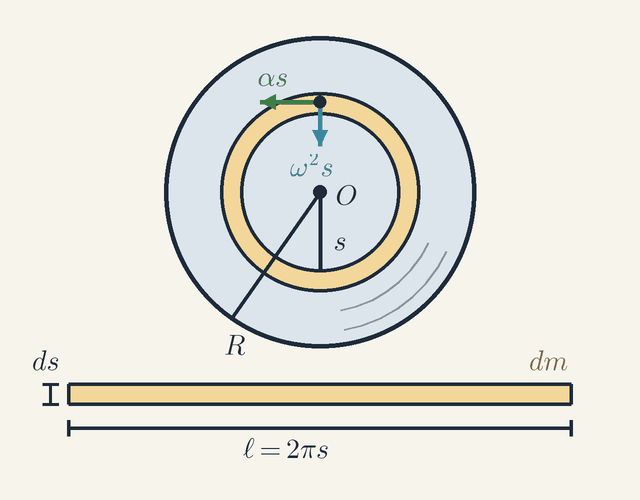
Figure 2. A uniform disc cut into thin rings. Each piece of the gold ring, at distance s from the axis, accelerates by ω2s towards O and by αs along the circle. Straightened, the ring is a strip 2πs long and ds wide. The arrows are not to scale.Legend
O
The axis through the centre, seen end-on.
R
Radius of the disc.
m
s
Distance of the gold ring from the axis.
m
ds
Width of the ring.
m
ℓ
Length of the ring cut open and straightened: its circumference 2πs.
m
dm
Mass of the ring: its area 2πsds times the mass per area M/(πR2).
kg
ω2s
Centripetal acceleration of each piece of the ring, aimed at the axis.
m/s2
αs
Tangential acceleration of each piece of the ring, along the circle.
m/s2
Figure 2 shows the pieces. Group together all the matter at the same distance s from the axis: in a disc, that is a thin ring like the gold one, of width ds and mass dm. Every piece of the ring moves on a circle of radius s, with the angular velocity ω and the angular acceleration α=dω/dt of the whole body. Its acceleration therefore has two parts, both drawn at the top of the ring: a centripetal part ω2s, aimed at the axis O, which keeps the piece on its circle, and a tangential part αs along the circle, which speeds it up.
By Newton's second law, the net force on the ring has the same two parts: its mass times each acceleration. The centripetal force points at the axis, so it has no lever arm and no torque. Only the tangential force αsdm has a torque, with lever arm s: dτ=s⋅(αsdm)=s2αdm
Now add these torques over the whole body. The net force on each piece is made of external forces and of internal forces from the other pieces. The internal forces cancel in pairs: two pieces act on each other with equal and opposite forces along the line joining them, so the two forces have the same lever arm and turn in opposite senses. Only the external torques survive, and since every piece shares the same α, it comes out of the sum: τext=(∫s2dm)α=Iα The integral I=∫s2dm is the moment of inertia. It plays the part that mass plays in F=ma, but it depends on where the mass sits, not only on how much there is: each piece counts with the square of its distance from the axis.
For the uniform disc of Figure 2, with radius R and mass M, the integral is a sum over rings. Cut the gold ring open and straighten it, as drawn below the disc: it becomes a strip of length ℓ=2πs and width ds, so its area is 2πsds. The disc's mass is spread evenly over its area πR2, so the mass per area is M/(πR2) and the ring's mass is dm=πR2M⋅2πsds=R22Msds Adding up the rings from the centre to the edge, I=∫0Rs2R22Msds=R22M⋅4R4=21MR2 This is half the value MR2 of a thin hoop of the same mass and radius, because much of the disc's mass lies close to the axis. For the animation's disc, I=21⋅10⋅0.402=0.80kg⋅m2.
The moment of inertia also depends on which axis is used. For an axis parallel to one through the centre of mass, at a distance d from it, the parallel-axis theorem gives I=Icm+Md2 To see why, write each piece's squared distance from the new axis as its squared distance from the old one, plus d2, plus a cross term. Added over the body, the cross term is proportional to the mass-weighted mean position measured from the centre of mass, and that mean is zero by the very definition of the centre of mass. Hung from a pin at its rim, the animation's disc has d=0.40m and I=0.80+10⋅0.402=2.40kg⋅m2, three times its value about the centre.
Angular momentum and the rotational dictionary
In straight-line motion, Newton's law is most general in the form F=dp/dt. Rotation has the same form once angular momentum is defined, and with it every result of one-dimensional dynamics carries over.
Each piece of the ring in Figure 2 moves at speed ωs, so its momentum is ωsdm along the circle. Its angular momentum about the axis is that momentum times its lever arm s, which is s⋅(ωs)dm. Adding over the body gives the total angular momentum, L=Iω. For a rigid body I does not change, so Iα=d(Iω)/dt and the rotation law takes the form L=Iω,τ=dtdL the twin of F=dp/dt: torque is the rate of change of angular momentum.
Kinetic energy is built the same way. A piece moving at ωs carries 21(ωs)2dm, and adding up gives K=21Iω2 The work done by the torque, ∫τdθ, equals the change of K, just as ∫Fdx equals the change of 21mv2.
The dictionary between straight-line and rotational motion is now complete: x↔θ, v↔ω, a↔α, m↔I, F↔τ, p↔L, 21mv2↔21Iω2 and Fv↔τω. The expert panel of the animation lists four of these pairs. Every result of one-dimensional dynamics carries over, the constant-acceleration equations included.
One entry has no exact twin. A body's mass is fixed, but its moment of inertia changes whenever the body changes shape, because I depends on where the mass sits. Then τ=dL/dt still holds while τ=Iα fails. That is how a skater spins faster when she pulls her arms in, although no torque acts on her: L=Iω stays the same, I falls, so ω rises.
Reading the angular-velocity graph
A graph of angular velocity against time shows the whole motion of the wheel at a glance. It is read exactly like a graph of velocity against time: the slope is the angular acceleration and the area underneath is the angle turned.
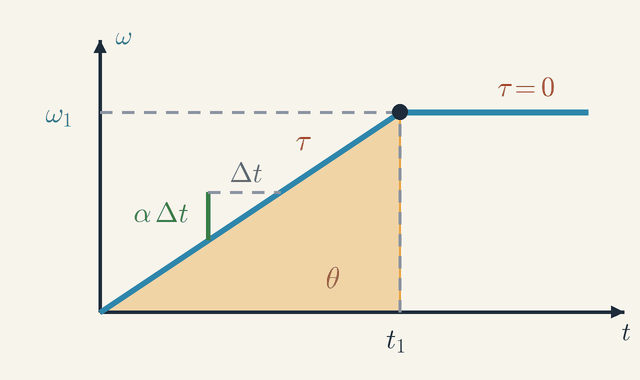
Figure 3. Angular velocity ω against time t for the animation's wheel. While the string pulls, τ is constant and ω rises with slope α; the shaded area is the angle θ turned. After the landing at t1, τ=0 and ω stays at ω1.Legend
t
Time since the weight was released.
s
ω
Angular velocity of the wheel, dθ/dt.
rad/s
t1
Time at which the weight lands.
s
ω1
Angular velocity at the landing, the largest value reached.
rad/s
Δt
A time interval: the run of the slope triangle.
s
αΔt
Rise of ω in the time Δt: the slope α times Δt.
rad/s
τ
Torque of the string on the wheel: constant while the string pulls, zero after the landing.
N⋅m
θ
Angle turned from the release to the landing: the shaded area under the line.
rad
Figure 3 is the graph the expert layer of the animation plots: ω against the time t since the weight was released. While the string pulls, its torque τ is constant, so by τ=Iα the angular acceleration is constant too, and the graph is a straight line. Look at the small slope triangle: in any time Δt, ω rises by αΔt, so the slope of the line is α=τ/I=1.16/0.80≈1.45rad/s2
Now look at the shaded triangle. Each short interval dt adds ωdt to the angle turned, so the area under the line is the angle θ. The weight lands at t1=3.19s, when the wheel has reached ω1=4.60rad/s, so θ=21⋅3.19s⋅4.60rad/s≈7.3rad The string gives an independent check. It unwinds from the hub without slipping, so 0.88 m of string off a hub of radius 0.12 m means θ=0.88/0.12≈7.33rad, the same angle. The L readout in the animation is simply I times this graph: it climbs by 1.16 kg·m²/s every second, because the slope of L(t) is the torque.
At t1 the weight lands, the string stops pulling and τ=0, as marked on the flat part of the graph. Then dL/dt=0: the line turns flat and L stays at 0.80⋅4.60≈3.68kg⋅m2/s, since there is no friction to slow the wheel. The area under the graph keeps growing, now by 4.60 rad every second. At the corner the slope jumps from 1.45 rad/s² to zero, but ω itself does not jump: a jump in ω would change L by a finite amount in no time, and that would take an infinite torque.
Energy and the effective mass
Energy conservation checks the whole calculation independently. It also gives a useful way to picture the wheel: as extra mass that the falling weight has to drag along.
After falling h=0.88m, the weight of mass m=1kg has released mgh≈8.63J. The wheel now holds 21Iω2≈8.48J and the weight 21mv2≈0.15J, so 98 % of the energy has gone into rotation. Because the string does not slip, the weight moves at the speed of the edge of the hub, v=ωr, where r=0.12m is the hub radius. Writing ω=v/r, the energy balance reads mgh=21mv2+21Iω2=21(m+r2I)v2
Seen from the string, then, the wheel behaves like an extra mass I/r2=0.80/0.122≈55.6kg that the weight has to drag along. Differentiating the balance with respect to time (the rate of change of h is v, and that of v is a) gives mgv=(m+I/r2)va, so a=m+I/r2mg The 1 kg weight has to accelerate 56.6 kg of effective mass, which is why it creeps down at only 0.17 m/s².
The hub radius is a design choice. Halve it to 0.06 m and I/r2 grows fourfold, to 222 kg, so the weight accelerates about four times more slowly. The wheel's angular acceleration α=a/r falls less, because a smaller hub turns further for each metre of string, but it still halves, to about 0.73 rad/s². In general α=I+mr2mgr which grows with r as long as mr2<I, that is up to r=I/m≈0.89m. That is beyond the wheel's own radius of 0.40 m, so for this wheel a wider hub always spins it up faster: the longer lever arm outweighs the weight's own growing share of the inertia, mr2.
Worked problem: the wheel as a yo-yo
So far the axle was fixed. A yo-yo shows the same laws at work when the axis itself moves. Tie the free end of the string to the ceiling and let the wheel fall, unwinding from its hub like a large yo-yo, with M=10kg, I=0.80kg⋅m2 and hub radius r=0.12m. How fast does it accelerate, how hard does the string pull, and how is the energy shared after a drop of 0.88 m?
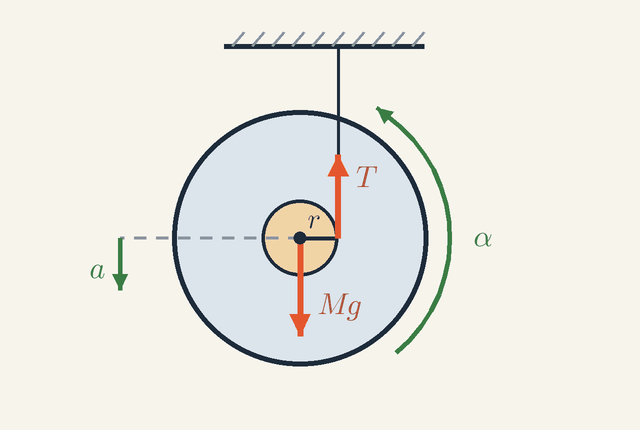
Figure 4. The wheel as a yo-yo. Forces to scale: the weight Mg at the centre and the slightly smaller pull T of the string at the hub, a distance r to the right. T turns the wheel with α; Mg−T accelerates the centre at a=αr. Acceleration arrows not to scale.Legend
Mg
Weight of the wheel, acting at its centre.
N
T
Pull of the string, acting upward at the edge of the hub.
N
r
Radius of the hub: the lever arm of T about the centre.
m
a
Acceleration of the centre, downward.
m/s2
α
Angular acceleration of the wheel, anticlockwise because the string pulls up to the right of the centre.
rad/s2
Figure 4 shows the two forces on the wheel, drawn to scale. Its weight Mg acts at the centre. The pull T of the string acts upward at the right-hand edge of the hub, a distance r from the centre, and is a little shorter than Mg. Their difference, Mg−T, accelerates the centre downward at a, the straight arrow on the left. About the centre the weight has no lever arm, so only T turns the wheel. Because it pulls up to the right of the centre, it turns the wheel anticlockwise, with the angular acceleration α shown by the curved arrow.
Can τ=Iα still be used when the axis falls? Yes, for an axis through the centre of mass that keeps its direction. In a frame falling with the centre, the wheel simply turns about a fixed axis, and the only extra force in that frame, the inertial force −Ma, acts at the centre of mass, where it has no lever arm.
The two motions are linked. The string is fixed to the ceiling, so the point of the hub where the string leaves it is momentarily at rest. The wheel turns about that point, so the centre, a distance r away, falls by r for every radian turned: a=αr.
Translation, rotation about the centre and this rolling condition give three equations for a, T and α: Mg−T=Ma,Tr=Iα,a=αr Put α=a/r into the second equation to get T=Ia/r2, then put that into the first: a=1+I/(Mr2)g=1+5.569.81≈1.50m/s2,T=M(g−a)≈83.1N and α=a/r≈12.5rad/s2. This is the effective-mass result again: the rotation adds I/r2≈55.6kg to the 10 kg that gravity pulls on. After the 0.88 m drop, v=2ah≈1.62m/s and ω=v/r≈13.5rad/s, almost three times the 4.60 rad/s reached in the animation, because now the wheel's whole weight drives it rather than a 1 kg weight.
The released energy Mgh≈86.3J splits into 21Mv2≈13.2J of translation and 21Iω2≈73.2J of rotation. Their ratio is fixed at I/(Mr2)≈5.56, whatever the height, because ω=v/r at every moment. The string pulls with 83.1 N, not the full 98.1 N weight, so a spring balance holding the string reads less than the yo-yo's weight while it falls. And at the bottom, with the string fully unwound, the wheel is still spinning, so it winds itself back up the string: that is how a yo-yo returns.
Limits of validity
The model assumes a rigid wheel, a light string that neither stretches nor slips, and a frictionless axle. Friction matters more for coasting than for spinning up. A bearing torque of 0.02 N·m is under 2 % of the string's 1.16 N·m, so it would lower α by less than 2 %. Once the weight has landed, however, it is the only torque, and it would stop the coasting wheel in Iω/τ=0.80⋅4.60/0.02≈184s, about three minutes.
Rigidity fails at high speed. The stress in a thin spinning rim is about ρv2, where ρ is the density and v the rim speed, so the rim bursts when ρv2 reaches the strength of the material. A steel rim (density 7800 kg/m³, strength near 109Pa) bursts at roughly 360 m/s. The rim in the animation moves at 4.60⋅0.40≈1.84m/s.
The scalar law τ=Iα needs a fixed axis, or an axis through the centre of mass that keeps its direction. In three dimensions torque is a vector, τ=r×F, and L is tied to ω not by a single number but by the inertia tensor, a set of nine numbers that takes the place of I.
Spun about a symmetry axis, a wheel has L parallel to ω. A lopsided wheel has L tilted away from the axle, so as the wheel turns, L sweeps round a cone, and the bearings must supply a torque dL/dt even at constant speed. That is why car wheels are balanced, and it is where gyroscopes and precession begin.
Relativistic corrections, of order v2/c2≈4×10−17 for the rim, play no part. In quantum mechanics angular momentum comes in steps of order ℏ≈1.05×10⁻³⁴J⋅s. The wheel's 3.68kg⋅m2/s is about 3.5×1034 such steps, so its spin looks perfectly continuous, but a molecule's rotation comes in discrete levels that show up in microwave spectra.
Where this leads
Set the net torque and the net force to zero and you have Static Equilibrium and Levers. Let the moment of inertia change, or let the axis tilt, and you reach Angular Momentum and Its Conservation, with skaters, Kepler's law of equal areas and the precessing gyroscope. A body hanging from a pivot feels a restoring torque from gravity and swings as a physical pendulum, with a period of 2πI/(Mgd) for small swings, where d is the distance from the pivot to the centre of mass. The disc hung from its rim, with I=2.40kg⋅m2 and d=0.40m, swings with a period of about 1.55 s; Simple Harmonic Motion develops this. The torque of a magnetic field on a current loop drives every electric motor, the subject of Motors, Generators and Transformers, and the power formula P=τω joins this lesson to Work, Energy and Power.
Key formulas
Torque of a force
τ=rFsinθ
Torque measures how strongly a force turns a body about an axis. Only the component of the force perpendicular to the radius, Fsinθ, does any turning, and it acts with the full radius r; equivalently, the whole force acts with the lever arm rsinθ. A force whose line of action passes through the axis (θ=0 or 180°) gives no torque. Choose a positive sense of rotation and give opposite torques opposite signs.
Symbols
τ
torque about the axis
N⋅m
r
distance from the axis to the point where the force acts
m
F
magnitude of the force
N
θ
angle between the radius and the force
rad
When it holds: For a force in the plane perpendicular to the axis. In three dimensions the torque is the vector τ=r×F, and only its component along the axis turns a body on a fixed axle.
Example: A 20 N push on a door handle 0.80 m from the hinges, at 30° to the door: τ=0.80⋅20⋅sin30∘=8N⋅m.
Newton's second law for rotation
τ=Iα
A net torque produces an angular acceleration, just as a net force produces an acceleration. The moment of inertia I plays the part of mass: the larger it is, the smaller the angular acceleration a given torque produces. The law follows from Newton's second law applied to every piece of the body, with the internal torques cancelling in pairs.
Symbols
τ
net external torque about the axis
N⋅m
I
moment of inertia about the same axis
kg⋅m2
α
angular acceleration
rad/s2
When it holds: For a rigid body turning about a fixed axis, or about an axis through its centre of mass that keeps its direction. Torque and moment of inertia must refer to the same axis; if the body changes shape, use τ=dL/dt instead.
Example: The wheel in the animation: α=1.16/0.80≈1.45rad/s2.
Moment of inertia of a uniform disc
I=21MR2(uniform disc)
Each piece of mass counts with the square of its distance from the axis, I=∫s2dm. A thin ring has all its mass at distance R, so I=MR2; a disc has much of its mass closer in, which halves the value. The thickness does not matter: a solid cylinder turning about its axis has the same 21MR2.
Symbols
I
moment of inertia about the disc's axis
kg⋅m2
M
mass of the disc
kg
R
radius of the disc
m
When it holds: Only for a uniform disc or solid cylinder turning about its axis of symmetry. For a parallel axis at distance d use I=Icm+Md2; a hub, spokes or a heavy rim change the value.
Example: The wheel in the animation: I=21⋅10⋅0.402=0.80kg⋅m2.
Angular velocity at constant angular acceleration
ω=ω0+αt
With a constant angular acceleration the angular velocity changes by α every second, so after a time t it has changed by αt. It is the rotational copy of v=v0+at, and a graph of ω against t is a straight line of slope α. A torque that opposes the spin makes α negative.
Symbols
ω
angular velocity at time t
rad/s
ω0
initial angular velocity, at t=0
rad/s
α
angular acceleration (constant)
rad/s2
t
time since the start
s
When it holds: Only while the net torque, and therefore α, stays constant: in the animation, until the weight lands.
Example: The animation's wheel, from rest: ω=1.445⋅3.185≈4.60rad/s when the weight lands.
Angular momentum and its rate of change
L=Iω,τ=dtdL
Angular momentum L=Iω is the rotational counterpart of momentum p=mv. The net external torque is its rate of change, just as force is the rate of change of momentum. With no external torque L stays constant: this is the conservation of angular momentum.
Symbols
L
angular momentum about the axis
kg⋅m2/s
I
moment of inertia
kg⋅m2
ω
angular velocity
rad/s
τ
net external torque about the axis
N⋅m
t
time
s
When it holds:L=Iω holds for rotation about a fixed axis or a symmetry axis. τ=dL/dt holds even when I changes, as for a skater; in three dimensions both are vectors, and L need not be parallel to ω.
Example: After the weight lands, L=0.80⋅4.60≈3.68kg⋅m2/s and stays constant, because τ=0.
Rotational kinetic energy
K=21Iω2
Each piece of a spinning body moves at v=ωs; adding up 21mv2 over all the pieces gives 21Iω2, the copy of 21mv2 with I for m and ω for v. A torque acting through an angle changes it: τΔθ=ΔK.
Symbols
K
rotational kinetic energy
J
I
moment of inertia about the axis
kg⋅m2
ω
angular velocity
rad/s
When it holds: For rotation about a fixed axis, with ω in rad/s. A body that also moves along, such as a rolling wheel, has translational energy 21Mvcm2 as well, with I then taken about the centre of mass.
Example: The animation's wheel at 4.60 rad/s: K=21⋅0.80⋅4.6042≈8.48J, out of the 8.63 J released by the weight.
Glossary
Torque
The turning effect of a force about an axis, τ=rFsinθ, also called the moment of the force. It grows with both the force and its distance from the axis, and a force aimed at the axis has none. It is measured in newton metres but is not an energy.
Lever arm
The perpendicular distance from the axis to the line of action of a force, d=rsinθ. Torque is force times lever arm: a push at a door handle 0.80 m from the hinges gives eight times the torque of the same push 0.10 m away.
Line of action
The straight line along which a force acts, extended in both directions. Sliding a force along this line changes neither its torque nor its effect on a rigid body.
Couple
Two equal and opposite forces that do not act along the same line. Their net force is zero but their torque is not: it equals one force times the distance between the two lines, about any point.
Rigid body
An idealised body whose parts keep fixed distances from one another. Turning about a fixed axis, its position is given by a single angle, and all its points share the same angular velocity.
Radian
The angle at which the arc equals the radius; a full turn is 2π rad, about 6.28 rad. The relations v=ωr and K=21Iω2 hold only with angles in radians.
Moment of inertia
A body's resistance to changes in its rotation, I=∑ms2, the rotational counterpart of mass. It depends on the axis and on where the mass sits: a thin ring has twice the moment of inertia of a uniform disc of the same mass and radius.
Newton's second law for rotation
The net external torque about an axis equals the moment of inertia times the angular acceleration, τ=Iα. Internal forces cancel in pairs and add no torque.
Parallel-axis theorem
The moment of inertia about any axis equals that about a parallel axis through the centre of mass plus Md2, where d is the distance between the axes. The animation's disc pivoted at its rim has 0.80+10⋅0.402=2.40kg⋅m2.
Rotational kinetic energy
The energy of a spinning body, K=21Iω2, the sum of 21mv2 over all its parts. In the animation the wheel ends up with 8.48 J of the 8.63 J released by the falling weight.
Angular momentum
The rotational counterpart of momentum, L=Iω for a body on a fixed axis. The net external torque is its rate of change, so without torque it stays constant.
Flywheel
A heavy wheel, usually with most of its mass in the rim, whose large moment of inertia stores rotational energy and smooths out an uneven driving torque in engines and machines.
Quantities
τ
Torque
N⋅m
The turning effect of a force about the axis; its sign gives the sense of rotation it tends to cause. In the animation, 1.16 N·m while the string pulls.
r
Distance from the axis
m
The distance from the axis to the point where the force acts. In the animation it is the hub radius, 0.12 m, where the string pulls.
F
Force
N
The applied force; in the animation, the string tension of 9.64 N.
θ
Angle between radius and force
rad
In τ=rFsinθ, the angle between the radius and the force; at θ=90∘ the torque is largest. The same letter also denotes the angle through which a body has turned.
I
Moment of inertia
kg⋅m2
The resistance to angular acceleration about a given axis; 0.80 kg·m² for the wheel in the animation.
M
Mass of the disc
kg
The mass of the rotating disc or ring, 10 kg for the wheel in the animation; for a given M, mass placed farther from the axis gives a larger I.
R
Radius of the disc
m
The outer radius of the disc or ring, 0.40 m in the animation; not to be confused with the hub radius r, 0.12 m, on which the string pulls.
ω
Angular velocity
rad/s
The rate at which the angle turned changes; one turn per second is 6.28 rad/s.
ω0
Initial angular velocity
rad/s
The angular velocity at t=0; zero for the wheel in the animation, which starts from rest.
α
Angular acceleration
rad/s2
The rate at which the angular velocity changes; 1.45 rad/s² for the wheel while the string pulls.
L
Angular momentum
kg⋅m2/s
The product Iω; its rate of change is the net external torque.
K
Rotational kinetic energy
J
The energy stored in the spin, 21Iω2.
t
Time
s
The time since the start; the weight in the animation lands after about 3.19 s.
Quiz
Beginner Why is a door handle placed far from the hinges?
So that the same push gives a bigger turning effect
To make the door lighter
So that the door closes by itself
It makes no difference; it is only tradition
Show answer
Answer: A. So that the same push gives a bigger turning effect
Torque is force times lever arm. The farther from the hinges you push, the larger the turning effect of the same force.
Beginner A heavy wheel is spun up by a falling weight, and then the weight hits the floor. What does the wheel do?
It stops at once
It keeps turning at a steady rate, slowing only through friction
It keeps speeding up
It starts turning backwards
Show answer
Answer: B. It keeps turning at a steady rate, slowing only through friction
Once the string goes slack there is no torque, so the spin rate stops changing. A spinning wheel keeps spinning unless something twists it.
Beginner Two wheels have the same mass. One has its mass at the rim, the other has it close to the axle. Which is harder to spin up?
The one with its mass near the axle
They are equally hard
The one with its mass at the rim
It depends only on how fast you want it to spin
Show answer
Answer: C. The one with its mass at the rim
Mass far from the axle moves faster for the same spin rate, so it resists changes in rotation more: its moment of inertia is larger.
Intermediate A 40 N force is applied at right angles to the end of a 0.25 m spanner. What torque does it produce?
160 N·m
40 N·m
1000 N·m
10 N·m
Show answer
Answer: D. 10 N·m
τ = r·F = 0.25 × 40 = 10 N·m. 160 N·m comes from dividing F by r, 40 N·m ignores the lever arm, and 1000 N·m uses 25 (the length in centimetres) instead of 0.25 m.
Intermediate A uniform disc has mass 4 kg and radius 0.5 m. What is its moment of inertia about its axis?
0.5 kg·m²
1 kg·m²
2 kg·m²
4 kg·m²
Show answer
Answer: A. 0.5 kg·m²
I = ½·M·R² = ½ × 4 × 0.25 = 0.5 kg·m². Forgetting the ½ gives 1 kg·m², which would be a thin ring.
Intermediate In the animation, the 1 kg weight accelerates downward at about 0.17 m/s². The string tension is:
exactly 9.81 N, equal to m·g
slightly less than 9.81 N
slightly more than 9.81 N
zero, because the weight is falling
Show answer
Answer: B. slightly less than 9.81 N
Newton's second law for the weight: m·g − F = m·a with a > 0, so F = m·(g − a) ≈ 9.64 N. If F equalled m·g, the weight would not accelerate.
Advanced With no external torque, a spinning skater pulls in her arms and her moment of inertia halves. Her angular speed:
halves
stays the same
doubles
quadruples
Show answer
Answer: C. doubles
L = I·ω is conserved, so halving I doubles ω. Her rotational kinetic energy ½·I·ω² also doubles, supplied by the work her arms do.
Advanced In the animation, the ω(t) graph turns horizontal when the weight lands. What does this express?
The tension now equals m·g
τ = dL/dt = 0, so L = I·ω is conserved
Kinetic energy is now being lost
The angular acceleration is now at its maximum
Show answer
Answer: B. τ = dL/dt = 0, so L = I·ω is conserved
With the string slack the torque vanishes, so dL/dt = 0 and the angular momentum, hence ω, stays constant.
 Physics Tutor