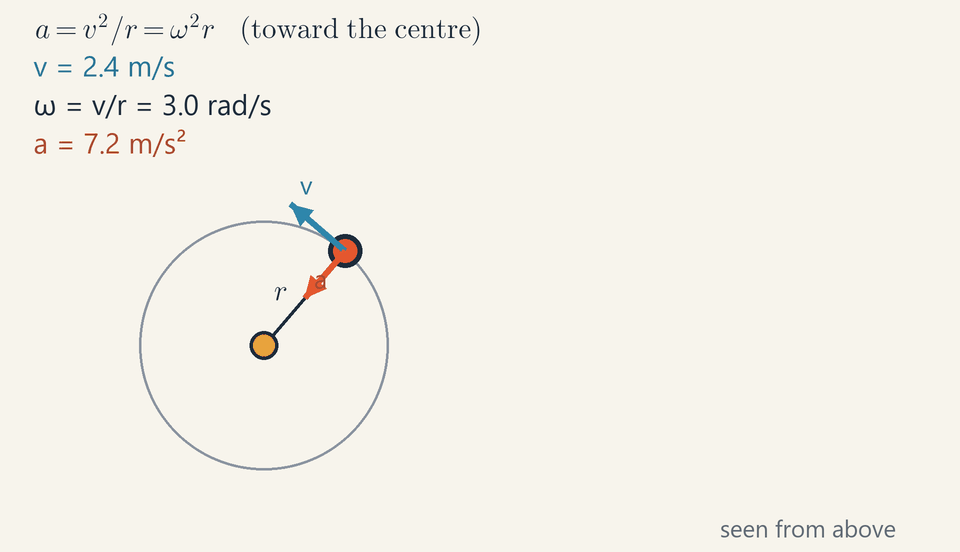
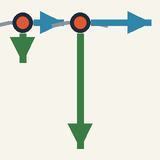
Going round a circle at a steady speed is still acceleration: the direction of motion changes all the time.
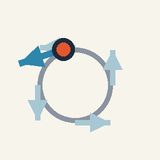
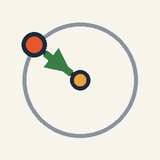
Something real must pull toward the centre: a string, the grip of the road, or gravity.
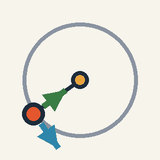
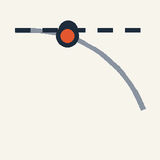
Let go and the ball flies off in a straight line along the tangent, not straight outward.
Going faster, or round a tighter bend, needs a stronger pull toward the centre.
Going round at a steady speed is still accelerating. Whirl a ball on a string, cycle round a bend, or watch the Moon circle the Earth: all of these move along a curve. Let us build the idea in four small steps.
Step 1. Velocity means speed and direction together. A ball going round at a steady speed changes direction at every moment, so its velocity keeps changing, and any change of velocity is an acceleration. A steady speed on a circle still means acceleration.
Step 2. An acceleration needs a net force. On a circle that force always points to the centre, and it is called the centripetal, or centre-seeking, force. It is not a new kind of force but a job that some real force does: for the ball it is the string pulling toward your hand, for a car on a bend the grip of the road on the tyres, for the Moon the Earth's gravity.
Step 3. Let go of the string and the pull disappears. Nothing bends the path any more, so the ball carries on the way it was heading at that instant: in a straight line along the tangent, the line that just touches the circle. In the animation the grey dots after the release sit evenly spaced on that line. The ball does not shoot straight outward; the outward tug in your hand is the ball pulling on the string.
Step 4. Going faster, or round a tighter circle, needs a stronger inward pull. That is why drivers slow down before sharp bends.
Check yourself: a satellite circles the Earth at a constant speed. Is a force acting on it, and which way does it point? Answer: yes, gravity, pointing toward the centre of the Earth.
Intermediate
Key ideas
Centripetal acceleration a=v2/r=ω2r always points to the centre, at 90° to the velocity.
v=ωr and T=2πr/v: with r=0.8m and ω=3rad/s, v=2.4m/s and a=7.2m/s2.
The net inward force F=mv2/r is supplied by a real force: tension, friction or gravity.
Doubling v on the same circle quadruples the force needed; no outward force acts on the ball.
What we measure on a circle
Seen from above, a ball on a string turns round a hand at the centre, always at the same distance from it. Put the origin at that centre. The body stays at the distance r from it, the radius, so one angle θ, counted anticlockwise from a reference line, says where it is. Angles are in radians: an angle θ cuts off an arc s=rθ, so a full turn is 2π≈6.28rad.
The angular speed ω=Δθ/Δt, in rad/s, says how fast the angle grows, and the speed v how fast the body runs along the arc. Since the arc is r times the angle, v=ωr so all the points of a turning wheel share one ω, but a point twice as far out moves twice as fast.
One turn takes the period T; the frequency f=1/T, in hertz (Hz), counts the turns per second. A turn is the arc 2πr, or the angle 2π, so T=v2πr=ω2π
Turning at a steady speed is accelerating
Velocity is a vector: a size, the speed, and a direction, which on a circle is always along the tangent. That direction turns all the time, so the velocity changes even at constant speed, and any change of velocity is an acceleration.
Draw the velocity at two instants Δt apart, tails together. Both arrows have length v, and the second has turned through the angle ωΔt, like the radius. The small arrow joining their tips is the change Δv, of length about vωΔt; as Δt shrinks it points at right angles to the velocity, toward the centre. Dividing by Δt gives a=vω, and with ω=v/r: a=rv2=ω2r
This centripetal, or centre-seeking, acceleration contains v twice: a faster body turns its velocity more quickly, and the velocity it turns is longer.
Who supplies the inward force
By Newton's second law, a body of mass m going round at a steady speed stays on the circle only if the net force on it points to the centre with size F=rmv2 This centripetal force is not a new kind of force but a job done by a real one: the string's tension for a whirled ball, road friction for a car on a flat bend, gravity for the Moon, the push of the drum wall for clothes in a spin cycle.
So draw only real forces on a free-body diagram, add their components toward the centre and set the sum equal to mv2/r; never draw an extra centripetal arrow. Which form of a to use depends on what is fixed: at the same speed a tighter circle needs more force, a∝1/r, while on a turntable, where ω is shared, the outer points need more, a∝r.
Worked example: the ball in the animation
Seen from above, a ball of mass 0.2 kg slides on a smooth horizontal table, tied by a string of length r=0.8m to a hand at the centre, and turns at ω=3.0rad/s. The table holds up its weight, so the string alone pulls it sideways: v=ωr=3.0⋅0.8=2.4m/s a=rv2=0.82.42=0.85.76=7.2m/s2 F=ma=0.2⋅7.2=1.44N
These are the readouts, v=2.4m/s, ω=3.0rad/s and a=7.2m/s2; the other form agrees, ω2r=9⋅0.8=7.2m/s2. One turn takes T=2π/3.0≈2.09s, so the 1.75 turns before the release last about 3.67 s.
Whirled overhead on the same circle at the same speed, the ball must also be held up: the string slopes downward and its tension rises to about 2.4 N, but only its horizontal part, still 1.44 N, bends the path.
Worked example: a car on a flat bend
A 1200 kg car takes a flat bend of radius 50 m at 15 m/s (54 km/h). It needs a=rv2=50152=4.5m/s2,F=ma=1200⋅4.5=5400N and only friction on the tyres can supply it. On dry asphalt the friction coefficient is about μ=0.7, so the road can give up to μmg=0.7⋅1200⋅9.81≈8240N: the car holds the bend. At the limit mv2/r=μmg, the mass cancels and vmax=μgr=0.7⋅9.81⋅50≈18.5m/s, about 67 km/h.
On a wet road, μ≈0.4 allows only about 4710 N, less than the 5400 N needed. The car runs wide because it travels straighter than the road, not because anything pushes it out. Its safe speed falls to 0.4⋅9.81⋅50≈14m/s, about 50 km/h. At 30 m/s it would need four times the force, 21,600 N, more than even a dry road can give.
Reading the arrows in the animation
The blue v arrow lies along the tangent with a fixed length and turns through 3.0 rad (about 172°) each second. The red a arrow points along the string, marked r, to the hand. The two stay at right angles, so the pull changes the direction of motion but never the speed.
Because the a arrow turns with the ball, a is not a constant vector, and the constant-acceleration equations of Motion in a Straight Line do not apply. Over half a turn the velocity reverses, from +2.4 to −2.4m/s, in T/2≈1.05s: the average acceleration is only 4.8/1.05≈4.6m/s2, since a keeps changing direction, and over a whole turn it is zero.
At the release, at the bottom of the picture, the red arrow vanishes and the a readout falls to zero; the blue arrow keeps its length and direction, and the ball runs along the dashed tangent at a steady 2.4 m/s.
Common mistakes
A steady speed is not zero acceleration: the ball keeps 2.4 m/s yet accelerates at 7.2 m/s², because its direction changes.
No outward force acts on the ball; the tug in your hand is the ball pulling on the string (Newton's third law). Released, it leaves along the tangent, and it is 1.0 m from the centre after 0.25 s only because a straight line moves away from a circle.
The centripetal force is not an extra force: on the table it is the tension itself, 1.44 N, not the tension plus another 1.44 N.
Doubling the speed does not double the force: F∝v2, so at 4.8 m/s the tension rises from 1.44 N to 5.76 N.
Use radians per second: 3.0 rad/s is about 28.6 turns per minute, and putting 28.6 into v=ωr gives 22.9 m/s instead of 2.4 m/s.
Where you meet it
Road bends, cyclists leaning into turns, banked velodromes: each time a real force supplies mv2/r. A washing machine at 1200 rpm with a drum of radius 0.25 m gives its contents about 3950 m/s², some 400 times g; the drum pushes the clothes round, but the water escapes through the holes along the tangent. A laboratory centrifuge at 10,000 rpm with a 10 cm arm reaches about 11,000 times g.
For satellites the centripetal force is gravity: the International Space Station falls round the Earth at about 8.6 m/s². These ideas lead on to Gravitation and Orbits; to Rotational Dynamics and Torque, where every point of a spinning body moves on a circle; to Simple Harmonic Motion, circular motion seen edge-on; and to Magnetic Force on Moving Charges, where magnetic fields bend charged particles into circles.
Advanced
Key ideas
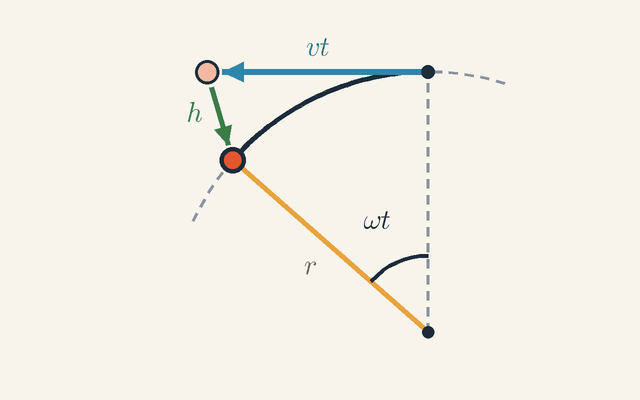
A body on a circle falls away from its tangent by h≈(vt)2/2r: free fall with a=v2/r, Newton's test of gravity on the Moon.
r=r(cosωt,sinωt) gives a=−ω2r; each shadow obeys x¨=−ω2x, simple harmonic motion.
Polar form a=(r¨−rθ˙2)r^+(rθ¨+2r˙θ˙)θ^: speeding up adds a tangential part rα.
In a rotating frame, centrifugal mω2r and Coriolis −2mω×v are pseudo forces, proportional to mass like gravity.
Position, velocity and acceleration as vectors
Differentiating the position vector gives the two central facts of circular motion: the velocity runs along the tangent, and the acceleration points at the centre with size v2/r. Working with vectors gives sizes and directions in one stroke. The numbers throughout come from the animation: a 0.2 kg ball on a smooth table, held by a string of length r=0.8m and turning at the angular speed ω=3.0rad/s, so that its speed is v=ωr=2.4m/s, its acceleration a=7.2m/s2, and the string pulls with 1.44 N.
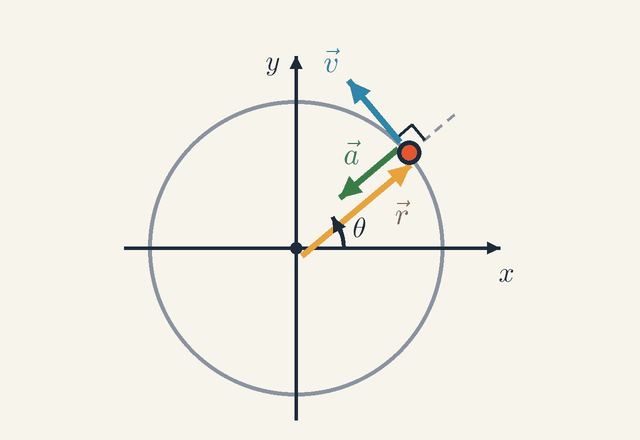
Figure 1. One instant of uniform circular motion: the body at the angle θ=ωt on a circle of radius r. Notice the right angle between v and r, and a pointing opposite to r, at the centre. The arrows have different units, so their lengths are not to scale.Legend
r
Position vector: from the centre to the body; its length is the radius r.
m
v
Velocity: along the tangent, in the direction of motion; its size is v=ωr.
m/s
a
Acceleration: opposite to r, towards the centre; its size is ω2r=v2/r.
m/s2
θ
Angle the radius has turned through from the x-axis: θ=ωt.
rad
x
Horizontal axis; the body starts on its positive side.
m
y
Vertical axis.
m
Figure 1 freezes the motion at one instant. The centre is at the origin; the body started on the positive x-axis and turns anticlockwise at the constant ω, so after a time t the radius has turned through the angle θ=ωt, marked at the centre. The position vector r runs from the centre to the body. Its length is always r, and its components are its shadows on the two axes: r(t)=r(cosωt,sinωt) The velocity v and the acceleration a belong to the body, so they are drawn from it. Look at two things: the small square between v and the dashed extension of the radius, and a, which lies on the same line as r but points the other way. (a is drawn just beside r only to keep the two arrows apart.)
To find v, differentiate each component with respect to time. By the chain rule the derivative of cosωt is −ωsinωt and that of sinωt is ωcosωt, so v=rω(−sinωt,cosωt) Differentiating once more, in the same way, a=−ω2r(cosωt,sinωt)=−ω2r
Now read the results off. The bracket in v is the bracket of r turned a quarter turn anticlockwise, and it has length 1. So v is perpendicular to the radius, which is the right angle marked in Figure 1: the velocity lies along the tangent, with size ωr. The acceleration is the position vector reversed and multiplied by ω2. It therefore points exactly at the centre, with size ω2r=v2/r, which is 7.2 m/s² for the ball.
The same result without coordinates
The derivation above assumed a steady rotation. A shorter argument uses only the fact that the distance from the centre never changes, so it also covers a body that speeds up or slows down on the circle.
The length of r is fixed, so r⋅r=r2 is a constant. Differentiate it with the product rule: 2r⋅v=0, so the velocity is perpendicular to the radius for any motion on a circle. Differentiate r⋅v=0 once more: v⋅v+r⋅a=0, that is, r⋅a=−v2. Dividing by r gives the component of a along the outward radius, −v2/r. So the inward component of the acceleration is v2/r for every motion on a circle, uniform or not.
If the speed is constant as well, the same trick applied to v⋅v=v2 gives v⋅a=0. The acceleration then has no part along the tangent, and only the inward part is left.
The velocity's own circle: the hodograph
The velocity traces a circle of its own, and it gives the most direct picture of why a=v2/r: the acceleration is to the velocity what the velocity is to the position.
Copy the v arrows of Figure 1 from many instants to one common origin; this drawing is called the hodograph. Every arrow has the same length v, and each points a quarter turn ahead of the r of its instant, so the arrows turn at the same rate ω as the radius. Their tips therefore run round a circle of radius v at the angular speed ω.
Now apply to this circle what we know about the first one. The tip of r moves at the speed ωr, and that speed is the size of v. In the same way the tip of v moves at the speed ωv, and that speed is the size of a, because the acceleration is the rate of change of the velocity. So a=ωv=v2/r.
The direction follows from the same picture. The tip of v moves along the tangent of the hodograph, a quarter turn ahead of v. Since v is already a quarter turn ahead of r, a is half a turn from r: it points at the centre. Position, velocity and acceleration are three arrows of lengths r, ωr and ω2r, each a quarter turn ahead of the one before, because each is the rate of change of the one before.
Falling round the circle
Newton saw the same acceleration in another way: a body on a circle is falling towards the centre all the time, and it never arrives because it also moves sideways. This view ties circular motion to free fall, and it led to the first test of the law of gravity.
Figure 2. From the top of the circle, a body moving freely along the tangent would reach the pale ball after a time t; the string keeps it on the circle instead. The gap h is how far it has fallen towards the centre. The time is drawn long so that the shapes can be seen.Legend
r
Radius of the circle: the length of the string.
m
ωt
Angle the radius turns through in the time t.
rad
vt
Distance the body would cover along the tangent in the time t with no string.
m
h
Gap from that free position to the real one on the circle: how far the body has fallen towards the centre.
m
Figure 2 follows the body for a time t from the top of the circle. It starts at the dot, with its velocity along the tangent, here pointing left. With no force it would move in a straight line, a distance vt along the tangent, and end at the pale ball. The string holds it on the circle instead: the radius r turns through the angle ωt, the body covers an arc of the same length rωt=vt, and it ends at the solid ball. The arrow h runs from where the body would be to where it is: that is how far it has fallen. (The time in the figure is drawn long so that the shapes can be seen; the result below is for short times.)
How long is h? The tangent line at the top is a distance r above the centre, and the real position is rcosωt above it, so the body has dropped r(1−cosωt) below the tangent line. For a short time the free position lies almost exactly above the real one, so h is almost exactly this drop and points almost straight down, at the centre. For a small angle x, cosx≈1−x2/2, and with rωt=vt, h≈r(1−cosωt)≈2r(ωt)2=2r(vt)2 Compare free fall from rest, h=21at2. The two agree if a=v2/r: the body falls towards the centre exactly as a dropped stone would with that acceleration, and its sideways motion keeps it from ever getting closer.
For the ball, in 0.1 s it would run vt=0.24m along the tangent while the radius turns through 0.3 rad. The circle is then 0.8(1−cos0.3)≈0.0357m, or 3.57 cm, below the tangent line, against 21⋅7.2⋅0.12=0.036m from the approximation.
Newton used this picture to test his law of gravity on the Moon. Its orbit has a radius R≈3.84×10⁸m, about 60.3 Earth radii, and a period T of 27.3 days. With v=2πR/T, the Moon falls towards the Earth with the acceleration a=Rv2=T24π2R≈2.72×10⁻³m/s2 If gravity weakens as the inverse square of the distance, at 60.3 Earth radii it should give g/60.32≈2.70×10−3m/s2. The two agree to within 1%: the pull that drops an apple also keeps the Moon falling round the Earth.
Shadows on the axes: simple harmonic motion
Seen from the side, circular motion becomes an oscillation. This link is why the mathematics of the circle runs through so much of physics, from springs to alternating current.
Take the x-component of a=−ω2r. It reads x¨=−ω2x, where each dot means one derivative with respect to time. That is the equation of a mass m on a spring of stiffness k, mx¨=−kx, with k/m=ω2, and the y-component gives the same equation. So the shadow of uniform circular motion on any straight line is simple harmonic motion, with the same ω and an amplitude equal to the radius.
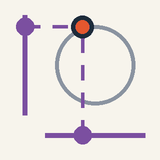
The Advanced layer of the animation shows this. The purple dots on the axes are the shadows: they slide between −0.8 and +0.8m with the period 2π/ω=2.09s. They are fastest, at 2.4 m/s, as they pass the middle, where the ball moves parallel to the axis, and they stop for an instant at the ends, where their acceleration peaks at 7.2 m/s². The x(t) and y(t) graphs are a cosine and a sine, a quarter period (0.52 s) apart.
Complex numbers say the same in one line. Write the position as z=x+iy=reiωt. Then z˙=iωz, and multiplying by i turns a complex number a quarter turn anticlockwise: the velocity is at right angles to the radius. Differentiating again gives z¨=(iω)2z=−ω2z, the centripetal acceleration. The real part, x=rcosωt, is the oscillation. An oscillation is a rotation seen edge-on, which is why eiωt is the natural language of vibrations, waves and alternating currents.
The release shows what happens when the inward pull stops. It comes at ωt=7π/2, when the ball is at (0,−r) with velocity (+v,0); from then on a=0. The x(t) graph leaves the cosine along its tangent line, with the slope 2.4 m/s, and reaches 1.2 m, or 1.5r, at the edge of the graph 0.5 s later. The y(t) graph stays at −0.8m, because the sine was at its minimum, where its slope is zero. That is Newton's first law drawn as two graphs.
Unit vectors that turn with the body
So far the speed was constant. When a body speeds up on a circle, or moves along any curve, the acceleration gains a part along the path. The cleanest way to find every part is to use unit vectors that turn with the body.
For any motion in a plane, describe the body by its distance r from the origin and its angle θ, both now free to change. At the body, define two unit vectors: r^, pointing outward along the radius, and θ^, a quarter turn ahead of it, in the direction of increasing θ (anticlockwise). Then r=rr^.
In components r^=(cosθ,sinθ) and θ^=(−sinθ,cosθ). Differentiating with the chain rule, as in the first section, dtdr^=θ˙θ^,dtdθ^=−θ˙r^ In words: as the angle grows, r^ tips towards θ^, and θ^ tips towards the centre.
Differentiate r=rr^ with the product rule. The first term is the motion outward, the second the motion round: v=r˙r^+rθ˙θ^ Differentiate again, term by term, using the two rules above: a=r¨r^+r˙θ˙θ^+r˙θ˙θ^+rθ¨θ^−rθ˙2r^ Collecting the parts along r^ and along θ^: a=(r¨−rθ˙2)r^+(rθ¨+2r˙θ˙)θ^
On a circle r is fixed, so r˙=r¨=0. What remains is an inward part −rθ˙2r^, of size rθ˙2=v2/r, and a tangential part rθ¨θ^. Write the angular acceleration as α=θ¨. Then the tangential part has size rα, and since v=rθ˙, this equals dv/dt, the rate at which the speed changes.
Speeding up on a circle
When the speed changes, the acceleration no longer points at the centre. This section shows how far it tilts, and what that means for the string.
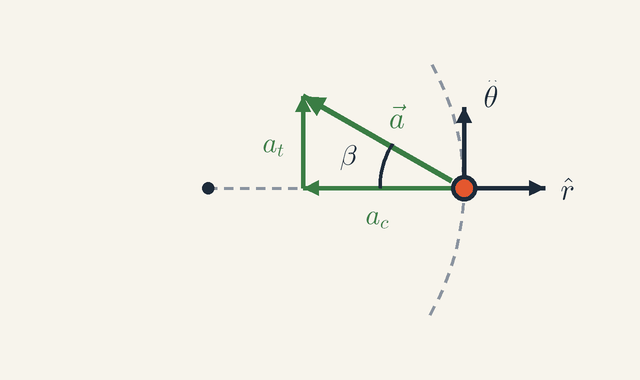
Figure 3. A body speeding up on a circle, with the unit vectors r^ and θ^ at the body. The total acceleration a is the inward part ac plus the tangential part at, so it leans forward of the line to the centre by β. Not to scale: at is drawn too large.Legend
r^
Unit vector along the radius, pointing away from the centre.
θ^
Unit vector along the tangent, in the direction of increasing θ (anticlockwise).
ac
Inward (centripetal) part of the acceleration, along −r^; its size is rθ˙2=v2/r.
m/s2
at
Tangential part of the acceleration, along θ^ while the body speeds up; its size is rα=dv/dt.
m/s2
a
Total acceleration: the vector sum of the two parts.
m/s2
β
Angle between a and the line to the centre; tanβ=at/ac.
rad
Figure 3 shows the circular case at one instant, with the body to the right of the centre. The unit vectors r^ and θ^ are drawn at the body, at right angles to each other. The acceleration has an inward part of size ac=rθ˙2=v2/r, along −r^, and a tangential part of size at=rα, along θ^ because the body is speeding up (it would point along −θ^ if the body were slowing down). Placed head to tail, the two parts add up to the total a, the long arrow from the body. So a leans forward of the line to the centre by the angle β, and the right triangle gives tanβ=at/ac,a=ac2+at2 The tangential arrow is drawn much longer than in the example that follows, so that the tilt can be seen.
Spin the ball up from rest to 3.0 rad/s in 2.0 s, at a constant α=1.5rad/s2. The tangential part stays at=rα=0.8⋅1.5=1.2m/s2 throughout, while the inward part grows as ω2 and reaches 7.2 m/s² at the end. At that moment the total acceleration is 7.22+1.22≈7.30m/s2, tilted forward by 9.5°, since tanβ=1.2/7.2. On the smooth table the string is the only sideways force, and a string can only pull along itself, so it must lean forward by that same angle: the hand leads the ball round.
Radial forces and curved paths
The general formula has two more uses. It explains why planets sweep out equal areas, and it gives the acceleration on any curved path.
The term 2r˙θ˙ matters when the distance changes during the turn. If the force is purely radial, like the Sun's gravity on a planet, the θ^ part of the acceleration must vanish. That part can be written as a single derivative (expand the right-hand side to check): rθ¨+2r˙θ˙=r1dtd(r2θ˙)=0 So r2θ˙ stays constant. Multiplied by the mass, it is the angular momentum, which is therefore conserved. Half of it, 21r2θ˙, is the rate at which the line from the Sun sweeps out area, so the same result is Kepler's law of equal areas.
Finally, close to each of its points any smooth path looks like a circle; the radius of that best-fitting circle is the radius of curvature ρ. The part of the acceleration across the path is then v2/ρ, and the part along it is dv/dt. At the top of a projectile's arc, moving horizontally at 10 m/s, gravity is the only force and it points straight across the path, so g=v2/ρ and ρ=v2/g≈10.2m.
Worked problem: the ball whirled overhead
Now take the ball off the table. Hold the string above your head and whirl the same 0.2 kg ball in a horizontal circle of radius 0.8 m at the animation's 3.0 rad/s. The string sweeps out a cone. How far below the hand does the ball circle, how long is the string, and what is its tension Fs?
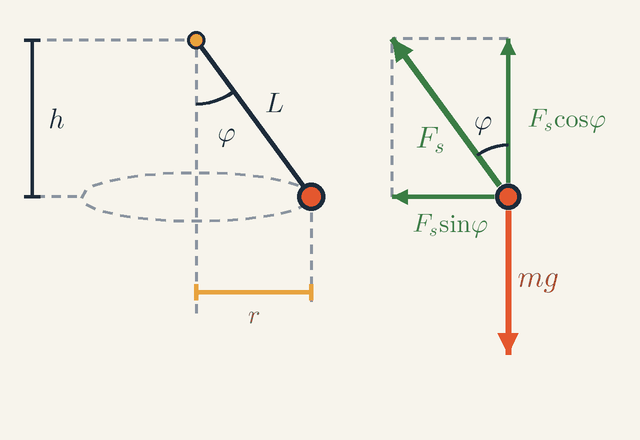
Figure 4. Left: the ball on a string of length L at the angle φ to the vertical, circling at the radius r a distance h below the hand. Right: the forces on the ball, with the tension Fs split into Fscosφ, equal to the weight mg, and Fssinφ, the centripetal force.Legend
φ
Angle between the string and the vertical.
rad
h
Depth of the ball's circle below the hand.
m
r
Radius of the ball's horizontal circle.
m
L
Length of the string.
m
Fs
Tension: the pull of the string on the ball, along the string towards the hand.
N
Fscosφ
Vertical part of the tension; it balances the weight.
N
Fssinφ
Horizontal part of the tension, towards the axis: the centripetal force mω2r.
N
mg
Weight of the ball, straight down.
N
Figure 4 shows the cone from the side, on the left, and the forces on the ball, on the right. On the left, the string of length L makes the angle φ with the vertical axis through the hand. The ball circles at the distance r from that axis, in a horizontal plane a distance h below the hand. (This h is a new length, not the fall of Figure 2.)
On the right, only two forces act on the ball: its weight mg, straight down, and the tension Fs, along the string towards the hand. Split the tension into a vertical part Fscosφ and a horizontal part Fssinφ; the angle between the string and the vertical is again φ. The ball neither rises nor sinks, so the vertical part balances the weight, and in the figure those two arrows have the same length. The horizontal part points at the axis and is the only unbalanced force, so it is the centripetal force: Fscosφ=mg,Fssinφ=mω2r
Dividing the second equation by the first removes both Fs and m: tanφ=gω2r=9.817.2≈0.734 so the string leans 36.3° from the vertical. The triangle on the left, with sides r, h and L, has the same angle φ at the hand, so tanφ=r/h as well. Setting the two expressions for tanφ equal gives h=tanφr=ω2g=99.81≈1.09m which depends only on ω, not on the mass or the radius.
What remains is the length of the string and its tension. By Pythagoras the string is L=0.82+1.092≈1.35m long. For the tension, put sinφ=r/L into the horizontal equation: Fsr/L=mω2r, so Fs=mω2L≈0.2⋅9⋅1.35≈2.43N. That is 1.24 times the weight of 1.96 N. Its horizontal part is still the 1.44 N of the table version, because the ball still needs mω2r to stay on its circle.
Three consequences surprise most people. First, h=g/ω2 shrinks to zero only as ω grows without limit, so the string is never exactly horizontal: part of the tension must always hold up the weight. Second, h cannot exceed the length of the string, so a cone needs g/ω2<L: with this string, below ω=g/L≈2.69rad/s there is no cone at all, and the ball just hangs. Third, in a vertical circle the string can only pull. At the top, gravity and the string both point at the centre, so the tension is m(v2/r−g), and it must not be negative: the ball stays on the circle only if v2/r≥g, or v≥gr≈2.80m/s. A ball passing the top at the animation's 2.4 m/s would find the string slack.
Rotating frames and pseudo forces
Everything so far was seen from the table, an inertial frame. An observer who turns with the string describes the same motion differently, and the ground under our feet is such a turning frame, which matters for the weather.
In a frame turning with the string, the ball is at rest, yet the string still pulls it inward with 1.44 N. Newton's second law survives only if you add pseudo forces, which come from the acceleration of the frame rather than from any other body. The first is the centrifugal force mω2r, outward, here exactly 1.44 N, which balances the string.
The second acts only on a body that moves in the turning frame, with velocity v in that frame: the Coriolis force −2mω×v, at right angles to that velocity, where ω is the frame's angular velocity, along the axis of rotation. After the release the turning observer sees the ball drift outward and fall behind the string, by about 30° after 0.5 s; seen from the table, it simply goes straight.
Both pseudo forces are proportional to the mass, as gravity is, so they give every body the same acceleration. Einstein made this coincidence the starting point of general relativity: in a small enough region, no experiment can tell an accelerating frame from gravity. The ground itself is a rotating frame, turning at the Earth's angular speed ωE. At the equator, at the Earth's radius RE, the centrifugal term is ωE2RE≈0.034m/s2, 0.35% of g. On a 20 m/s wind at latitude 45° the Coriolis acceleration is only about 0.002 m/s², yet acting for hours it turns large storms into cyclones.
Limits of validity
Everything here treats the body as a point and the string as massless and unstretchable. A real string stretches a little as the tension grows, so r depends slightly on ω. The frame must be inertial, but at this scale the Earth's rotation is harmless: its Coriolis effect on the ball at 2.4 m/s is at most 2ωEv≈3.5×10⁻⁴m/s2, some 20,000 times smaller than the 7.2 m/s² that the string supplies.
Near the speed of light c the momentum is γmv, where γ=1/1−v2/c2 grows without limit as v approaches c. A force at right angles to v changes only the direction of motion, not the speed, so γ stays constant and the force needed for a circle becomes γmv2/r. A charge q in a magnetic field B therefore circles at ω=qB/(γm) instead of qB/m. A slow proton in a 1.0 T field goes round 15.2 million times a second; at 10 MeV of kinetic energy γ≈1.011 and the frequency drops by about 1%, enough to fall out of step with a cyclotron's fixed-frequency voltage.
At the atomic scale classical orbits fail. An accelerating charge radiates, so an electron circling a proton would lose its energy and spiral in within about 10−11s; stable atoms need quantum mechanics.
Where this leads
When gravity supplies the centripetal force, GMm/r2=mv2/r gives orbital speeds and Kepler's third law, the subject of Gravitation and Orbits; the International Space Station, 420 km up, needs 7.66 km/s and circles the Earth in about 93 minutes. A spinning rigid body is a crowd of points sharing one ω, each with v=ωr and at=rα: that is where Rotational Dynamics and Torque begins, and the constant r2θ˙ grows into Angular Momentum and Its Conservation. The shadow picture continues in Simple Harmonic Motion. In Magnetic Force on Moving Charges, qvB=mv2/r gives the radius r=mv/(qB) used in mass spectrometers and cyclotrons, and Atomic Models: the Bohr Atom shows how quantum rules rescue the orbiting electron. The equivalence of pseudo forces and gravity returns in Gravity as Curved Spacetime.
Key formulas
Centripetal acceleration
a=rv2=ω2r
On a circle the velocity keeps its size but turns through the angle ωΔt in a time Δt, so it changes by about vωΔt, toward the centre. Dividing by Δt gives a=vω, and ω=v/r turns this into the two forms. Use v2/r when the speed is known and ω2r when the rate of turning is: at a fixed speed a tighter circle needs more acceleration, at a fixed ω a larger one does.
Symbols
a
centripetal acceleration, toward the centre
m/s2
v
speed along the circle
m/s
r
radius of the circle
m
ω
angular speed
rad/s
When it holds: Gives the inward part of the acceleration for any motion on a circle; it is the whole acceleration only when the speed is constant. A changing speed adds a tangential part dv/dt.
Example: The ball in the animation: a=2.42/0.8=7.2m/s2, the same as 3.02⋅0.8.
Speed from angular speed
v=ωr
In a time Δt the radius sweeps the angle ωΔt, and the body covers the arc rωΔt. Dividing by Δt gives the speed. All points of a turning wheel share the same ω, so their speeds grow in proportion to their distance from the axis.
Symbols
v
speed along the circle
m/s
ω
angular speed
rad/s
r
radius of the circle
m
When it holds: Only with ω in radians per second: multiply turns per minute by 2π/60 first. It holds at every instant, even while ω changes.
Example:ω=3.0rad/s and r=0.8m give v=2.4m/s; a point halfway along the string moves at 1.2 m/s.
Period of one turn
T=v2πr=ω2π
One turn covers the circumference 2πr at the speed v, or sweeps the angle 2π at the angular speed ω; either way it takes this time. The frequency, the number of turns per second, is f=1/T.
Symbols
T
period, the time for one full turn
s
r
radius of the circle
m
v
speed along the circle
m/s
ω
angular speed
rad/s
When it holds: Only for uniform circular motion, where the speed and the angular speed stay constant through the whole turn.
Example: For the ball, T=2π/3.0≈2.09s, so its 1.75 turns before the release take about 3.67 s.
Centripetal force
F=rmv2
Newton's second law applied to the centripetal acceleration: the net force toward the centre must equal mv2/r. It is not an extra force but the inward sum of real ones, such as tension, friction, gravity or a normal force. Because of the v2, doubling the speed quadruples the force needed.
Symbols
F
net force toward the centre
N
m
mass of the body
kg
v
speed along the circle
m/s
r
radius of the circle
m
When it holds: In an inertial frame, for a body small compared with r; F is the component of the net force toward the centre. Near the speed of light it becomes γmv2/r.
Example: The 0.2 kg ball on a smooth table: F=0.2⋅2.42/0.8=1.44N, all of it supplied by the string.
Position on the circle
r(t)=r(cosωt,sinωt)
The coordinates of a body on a circle centred at the origin, starting on the positive x-axis at t=0 and turning anticlockwise at a constant angular speed, so that its angle is θ=ωt. Each coordinate is a sinusoid, which is why each shadow on an axis moves in simple harmonic motion.
Symbols
r
position vector from the centre
m
r
radius of the circle
m
ω
angular speed (constant)
rad/s
t
time since the start
s
When it holds: Uniform circular motion only. For another starting angle θ0, replace ωt by ωt+θ0.
Example: After a quarter period, t=π/(2ω)≈0.52s, the ball of the animation is at (0,0.8)m.
Acceleration vector
a=−ω2r
Differentiating the position twice multiplies each coordinate by −ω2, so the acceleration is the position vector reversed and scaled. It points from the body to the centre, and its size ω2r is the centripetal acceleration. Each component obeys x¨=−ω2x, the equation of simple harmonic motion.
Symbols
a
acceleration vector
m/s2
ω
angular speed (constant)
rad/s
r
position vector from the centre
m
When it holds: Uniform circular motion about the origin. With a changing speed a tangential part appears and a no longer points at the centre.
Example: At the start the ball is at (0.8,0)m, so a=−9⋅(0.8,0)=(−7.2,0)m/s2.
Glossary
Uniform circular motion
Motion along a circle at constant speed. The speed stays fixed but the direction of the velocity turns steadily, so the body accelerates toward the centre all the time.
Tangent
The straight line that touches the circle at one point, at right angles to the radius there. The velocity always lies along it, and a body released from the circle carries on along it.
Radian
The natural unit of angle: the angle whose arc is as long as the radius, so that θ=s/r. A full turn is 2π≈6.28 rad (360°), and formulas such as v=ωr hold only with angles in radians.
Centripetal acceleration
The acceleration of a body moving on a circle, directed toward the centre, of size v2/r. It changes the direction of the velocity, not its size.
Centripetal force
The net force toward the centre that circular motion requires, mv2/r. It is a role played by real forces (tension, friction, gravity, a normal force), never an extra force to add to them.
Tangential acceleration
The part of the acceleration along the velocity, at=rα=dv/dt, present only when the speed changes. It adds to the centripetal part, so the total acceleration no longer points at the centre.
Radius of curvature
The radius ρ of the circle that best fits a curved path at a given point. Any curved motion has an acceleration v2/ρ toward that circle's centre, so the circle formulas apply locally to every curve.
Rotating frame
A frame of reference that turns, such as a merry-go-round or the Earth itself. Newton's laws hold in it only after adding pseudo forces, the centrifugal and Coriolis forces.
Centrifugal force
The outward pseudo force mω2r that appears only in a rotating frame. In a non-rotating frame no outward force acts on a whirled ball; what pulls outward on your hand is the ball tugging on the string.
Coriolis force
The sideways pseudo force −2mω×v on a body that moves relative to a rotating frame. On the rotating Earth it deflects winds and ocean currents and turns large storms into cyclones.
Simple harmonic motion
Back-and-forth motion with x¨=−ω2x. The shadow of uniform circular motion on any straight line moves in exactly this way, with the same ω and an amplitude equal to the radius.
Conical pendulum
A ball whirled on a string in a horizontal circle below the hand, so that the string sweeps out a cone. The vertical part of the tension holds up the weight, the horizontal part supplies mω2r, and the circle lies g/ω2 below the hand.
Quantities
r
Radius
m
The distance from the centre of the circle to the moving body; for the ball in the animation, the 0.8 m string.
r
Position vector
m
The arrow from the centre to the body, of length r. It turns at the angular speed ω, and the acceleration is a=−ω2r.
t
Time
s
The time since the start, when the body was on the positive x-axis; the radius has then turned through θ=ωt.
a
Acceleration vector
m/s2
The acceleration as an arrow. In uniform circular motion it points from the body to the centre, a=−ω2r, and its length is the centripetal acceleration a.
θ
Angle
rad
The angle swept by the radius from a reference line, counted positive anticlockwise. The arc covered is s=rθ.
ω
Angular speed
rad/s
The angle swept per second, Δθ/Δt, shared by every point of a turning rigid body. 3.0 rad/s is about 29 turns per minute.
v
Speed
m/s
The size of the velocity: the distance covered along the circle per second. The velocity itself points along the tangent.
T
Period
s
The time for one full turn, 2πr/v; 2.09 s for the ball in the animation.
a
Centripetal acceleration
m/s2
The size of the acceleration toward the centre, v2/r or ω2r; 7.2 m/s² for the ball in the animation.
F
Centripetal force
N
The size of the net inward force, mv2/r, supplied by tension, friction, gravity or another real force.
m
Mass
kg
The body's inertia: on the same circle at the same speed, twice the mass needs twice the inward force.
Quiz
Beginner You whirl a ball on a string in a horizontal circle and let go. Which way does the ball move just after the release?
Straight outward, away from the centre
It keeps curving round for a while, then straightens
In a straight line along the tangent, the way it was already moving
Straight toward the centre
Show answer
Answer: C. In a straight line along the tangent, the way it was already moving
Once the string stops pulling, no horizontal force acts, so the ball keeps the velocity it had at that instant. That velocity is tangent to the circle.
Beginner A car drives round a roundabout at a steady 30 km/h. Is it accelerating?
No, because its speed is constant
Yes, because its direction keeps changing
Only when the driver presses the accelerator
Only if the road is slippery
Show answer
Answer: B. Yes, because its direction keeps changing
Acceleration is any change of velocity, and velocity includes direction. Turning at constant speed is acceleration toward the centre of the turn.
Beginner What provides the inward force that keeps a car on a flat, curved road?
The engine
A centrifugal force
Friction between the tyres and the road
Air resistance
Show answer
Answer: C. Friction between the tyres and the road
On a flat road the only horizontal force from the ground is friction on the tyres; it points toward the centre of the bend. On ice it is too weak and the car slides straight on.
Intermediate A ball moves at 4 m/s on a circle of radius 2 m. What is its centripetal acceleration?
2 m/s²
8 m/s²
16 m/s²
32 m/s²
Show answer
Answer: B. 8 m/s²
a = v²/r = 16 ÷ 2 = 8 m/s². Forgetting to square v gives 2 m/s²; forgetting to divide by r gives 16 m/s².
Intermediate On the same circle, the speed of an object doubles. The inward force needed to keep it on the circle:
stays the same
doubles
quadruples
halves
Show answer
Answer: C. quadruples
F = m·v²/r depends on the square of the speed, so doubling v multiplies the force by 4.
Intermediate In uniform circular motion, what is the angle between the velocity and the acceleration?
0°
45°
180°
90°
Show answer
Answer: D. 90°
The velocity is tangent to the circle and the acceleration points to the centre, along the radius. A tangent is perpendicular to the radius, so the angle is 90°.
Advanced For r⃗(t) = r·(cos ωt, sin ωt), what is the acceleration?
−ω²·r⃗
ω²·r⃗
−ω·r⃗
Zero, because the speed is constant
Show answer
Answer: A. −ω²·r⃗
Differentiating r·cos ωt twice gives −ω²·r·cos ωt, and the same holds for r·sin ωt. So a⃗ = −ω²·r⃗: it points toward the centre, with magnitude ω²·r.
Advanced How does the x-coordinate of a point in uniform circular motion vary with time?
Linearly in t
Harmonically: x = r·cos ωt
Quadratically, like free fall
It stays constant
Show answer
Answer: B. Harmonically: x = r·cos ωt
The projection on any axis satisfies ẍ = −ω²·x, so it performs simple harmonic motion with the same angular frequency ω.
 Physics Tutor