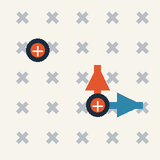
Only moving charges feel a magnetic push; a charge sitting still beside a magnet feels nothing.
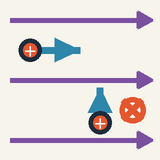
A wire carrying a current between a magnet's poles is pushed sideways: the pushes on all its moving charges add up.
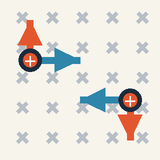
The push is at right angles to both the motion and the field; reverse the motion or the field and the push reverses.
A sideways push only turns a moving charge, never speeds it up, so it goes round a circle at a steady speed.
This push guides particles from the Sun to Earth's poles, where they light up auroras, and keeps particles circling in accelerators.
Lay a wire across the gap of a horseshoe magnet and switch on a current: the wire jumps sideways, out of the gap or deeper into it. Reverse the current and it jumps the other way. Turn the magnet round as well and it goes back to the first way.
Why does this happen? A current is nothing but electric charges on the move. A magnet pushes on every one of those moving charges, and since they cannot leave the wire, the wire is dragged along with them. A charge sitting still beside a magnet feels nothing at all: the push appears only once the charge moves.
The direction of the push is the surprising part. It is never along the motion: it acts sideways, at right angles both to the way the charge is going and to the magnetic field. A sideways push cannot make anything go faster or slower; it can only turn it, like a string whirling a ball round your head. So a charge flying freely through a magnet's field keeps turning, and its path bends into a circle.
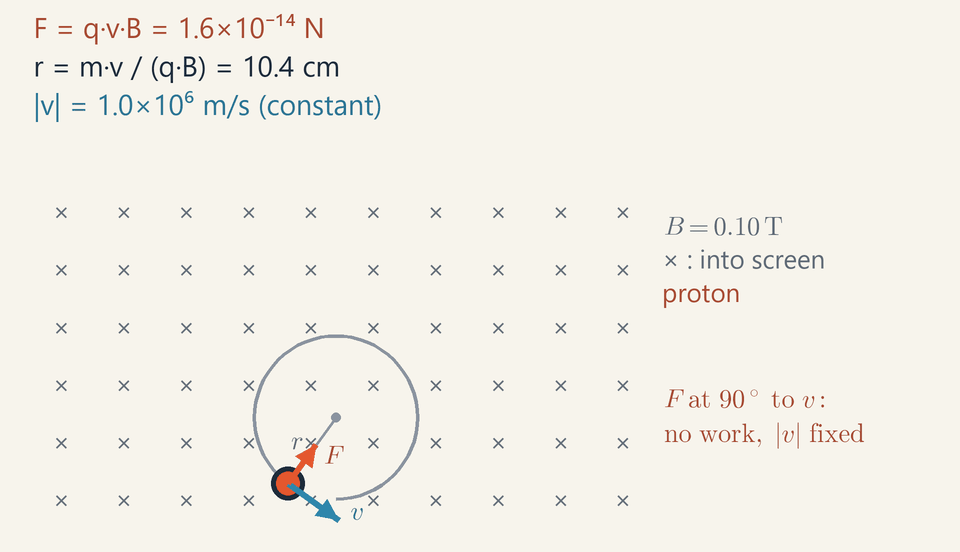
That is what the animation shows. The grey × marks are a magnetic field pointing into the screen. Follow the red charge: the blue arrow shows where it is heading, the red arrow shows the push. The push always points to the middle of the circle, and the charge never speeds up or slows down.
The same push guides particles from the Sun down towards Earth's poles, where they make the sky glow as auroras, and huge rings of magnets keep particles racing round accelerators.
Check yourself: an electron sits motionless between the poles of a strong magnet. What magnetic force acts on it? Answer: none, since only moving charges feel one.
Intermediate
Key ideas
F=qvBsinθ: largest when v is perpendicular to B, zero when the charge moves along the field lines.
Right-hand rule: fingers along v, curl towards B, thumb gives F for a positive charge; a negative charge is pushed the opposite way.
F is always perpendicular to v, so it does no work: the speed and kinetic energy stay constant.
As the centripetal force, qvB=mv2/r gives r=mv/(qB): about 10.4 cm for a proton at 106m/s in 0.10 T.
Charge, velocity and field
A magnet, however strong, exerts no magnetic force on a charge sitting still beside it. Three things set the magnetic force on a particle: its charge q, in coulombs and with its sign (+1.60×10⁻¹⁹C for a proton); its velocity v, direction included; and the magnetic field B where the particle is, measured in tesla (T). A tesla is a strong field: Earth's is 25–65 µT, a fridge magnet gives a few millitesla and an MRI scanner 1.5–3 T. The animation uses B=0.10T, about the field between the poles of a good horseshoe magnet.
On flat diagrams a cross × is the tail of an arrow flying away from you, so the grey crosses in the animation mean a field into the screen; a dot • is an arrow tip coming towards you, a field out of the screen. The angle θ is measured between v and B; the proton moves straight across the field, so θ=90∘ all the time.
The size of the force
Experiments with particle beams show that the force is proportional to the charge, the speed and the field, and that it depends on the angle between motion and field: F=qvBsinθ
Only the part of the velocity that crosses the field lines, vsinθ, counts. A charge moving along the field lines feels nothing, one crossing them at right angles feels the most, F=qvB, and at 30° it feels half of that. For a negative charge use the size of q; the sign only changes the direction.
A charge at rest feels no magnetic force at all, however strong the magnet: that is the sharpest difference from an electric field. The rule also defines the tesla: 1 T pushes with 1 N on 1 C crossing it at 1 m/s, so 1T=1N⋅s/(C⋅m)=1N/(A⋅m).
Reading the diagram: the right-hand rule
The force is at right angles both to the velocity and to the field. Its size and its direction fit into one vector equation: F=qv×B
The vector product v×B has the size vBsinθ, and its direction follows the right-hand rule: point the fingers of your right hand along v, curl them towards B, and your thumb shows the force on a positive charge. The order matters, since B×v points the opposite way.
Try it on the animation. At the bottom of the circle the proton moves to the right and the field goes into the screen, so the thumb points up, towards the centre, just like the red F arrow: the proton turns anticlockwise. Reversing the field or the velocity reverses the force; reversing both leaves it unchanged.
No work, so the path is a circle
Because F is always at right angles to v, it does no work. The kinetic energy cannot change, so neither can the speed: the ∣v∣ readout stays at 1.0×10⁶m/s. A force of fixed size that only turns the velocity is exactly what uniform circular motion needs, so the magnetic force acts as the centripetal force of Circular Motion: qvB=rmv2
Solving for the radius, and using T=2πr/v for the period and ω=2π/T for the angular frequency, gives three working formulas:
r=qBmv
T=qB2πm
ω=mqB
A faster or heavier particle runs a wider circle; a stronger field or a larger charge, a tighter one. The surprise is in the second line: the speed has cancelled, so a faster particle runs a bigger circle in exactly the same time.
Worked example: the proton in the animation
A proton has q=1.60×10⁻¹⁹C and m=1.67×10⁻²⁷kg. In the animation it moves at v=1.0×10⁶m/s straight across a field of B=0.10T, so sinθ=1: F=qvB=1.60×10−19⋅1.0×106⋅0.10=1.6×10⁻¹⁴N r=qBmv=1.60×10−19⋅0.101.67×10−27⋅1.0×106≈0.104m T=qB2πm=1.60×10−19⋅0.102π⋅1.67×10−27≈6.6×10⁻⁷s
These are the values on the readouts: F=1.6×10⁻¹⁴N, r=10.4cm and a constant ∣v∣=1.0×10⁶m/s. The real proton goes round in 0.66 µs, about 1.5 million times a second; the animation, at 4 s per turn, is slowed down some six million times.
The force looks tiny, but the mass is far tinier: the acceleration F/m≈9.6×1012m/s2 is about 1012 times g, so gravity plays no part. The blue v arrow stays tangent to the dashed circle with a fixed length, while the red F arrow lies along the grey radius r and points at the centre: always at 90° to v, it does no work.
Worked example: sorting ions by mass
A mass spectrometer weighs atoms by the size of their circles. Singly charged neon ions, with q=1.60×10⁻¹⁹C, leave the source with a spread of speeds, so they first cross a velocity selector, where an electric force qE and a magnetic force qvB push in opposite directions. Only ions with qE=qvB go straight on through a slit. With 250 V across plates 1 cm apart, E=2.5×10⁴V/m, and with B=0.25T, v=BE=0.252.5×104=1.0×10⁵m/s
In the same field, without the plates, the ions then turn through half a circle onto a detector. Neon-20 has m=3.32×10⁻²⁶kg: r20=qBmv=1.60×10−19⋅0.253.32×10−26⋅1.0×105≈0.083m
Neon-22 is 10% heavier, and at a fixed speed r is proportional to m, so r22≈0.091m. Each ion lands one diameter from the slit, at 16.6 cm and 18.3 cm, so the two isotopes arrive 1.7 cm apart. Without the selector they would blur: a neon-20 ion just 1% too fast lands 1.7 mm further out.
Common mistakes
The force is not along the field lines, as an electric force would be, but at right angles to them: the proton's 1.6×10⁻¹⁴N push points towards the centre of its circle, never into the screen.
A magnetic field cannot change a charge's speed. The proton keeps its 1.0×10⁶m/s and its 5.2 keV of kinetic energy turn after turn; accelerators add energy with electric fields and only steer with magnetic ones.
A slanting motion gets less force. At 30° to the field instead of 90°, the proton would feel only 8.0×10⁻¹⁵N, half as much.
The sign of the charge matters. An electron at the same speed is pushed the other way and circles clockwise, on a radius of about 0.057 mm, 1836 times smaller, like its mass.
Where you meet it
Auroras are the most beautiful case: charged particles from the Sun are steered along Earth's field lines into the polar regions, where they make the upper atmosphere glow. Hospital cyclotrons accelerate protons to make the isotopes used in PET scans, mass spectrometers date ancient carbon and test athletes for doping, and particle detectors read momenta from the curvature of tracks.
The same force acts on the charges drifting along a wire. If the moving charge Q in a length L of wire drifts at a speed v, the current is I=Qv/L, and the forces add up to QvB=BIL for a wire across the field: 0.025 N for 5.0 A in 5.0 cm of wire across 0.10 T. This push makes a wire jump between the poles of a horseshoe magnet and turns every electric motor, in Motors, Generators and Transformers. Moving a wire through a field pushes its charges along it instead: the start of Electromagnetic Induction.
Advanced
Key ideas
F=q(E+v×B) defines the fields; the magnetic part is perpendicular to v, so a static B never does work.
Each velocity component oscillates harmonically at ω=qB/m, so the orbit is a circle of radius r=v/ω.
The period T=2πm/(qB) does not depend on the speed: a faster particle runs a bigger circle in the same time, the cyclotron's secret.
p=qBr holds at any speed, so track curvature in a known field measures momentum; relativistically ω=qB/(γm).
A velocity along B is untouched, so orbits are helices; crossed fields add a drift E×B/B2.
The Lorentz force defines the fields
The whole lesson rests on one law, and its most important consequence is that a magnetic field can steer a charge but never speed it up. A point charge q moving with velocity v through an electric field E and a magnetic field B feels the Lorentz force F=q(E+v×B)
The law can be read backwards, as a recipe for measuring both fields with a test charge. Held still, the charge feels only qE, and that gives E. Set moving, it feels an extra force that grows with its speed and always points at right angles to its velocity. This extra force is zero for motion along one particular line, and that line is the direction of B. For any other velocity it fixes the part of B across v; a second, non-parallel velocity supplies the missing part along the first one. Two measurements therefore fix all three components of B.
The direction of the push comes from the rule for the vector product. With unit vectors x^, y^, z^ along the axes, x^×y^=z^, and the same holds for the cyclic versions y^×z^=x^ and z^×x^=y^. So a positive charge moving along +y in a field along +z is pushed along y^×z^=+x^.
Now the energy. A force changes the kinetic energy K at the rate F⋅v, the power it delivers. With the Lorentz force, dtdK=qE⋅v+qv⋅(v×B) The last term is zero, because the vector product v×B is perpendicular to v. So dK/dt=qE⋅v: only the electric field changes a particle's energy, however the magnetic field is shaped. A magnetic force can turn the velocity but never lengthen or shorten it. When a changing magnetic field seems to do work, as in a transformer, the work is done by the electric field that the change induces.
Circular motion: two coupled oscillators
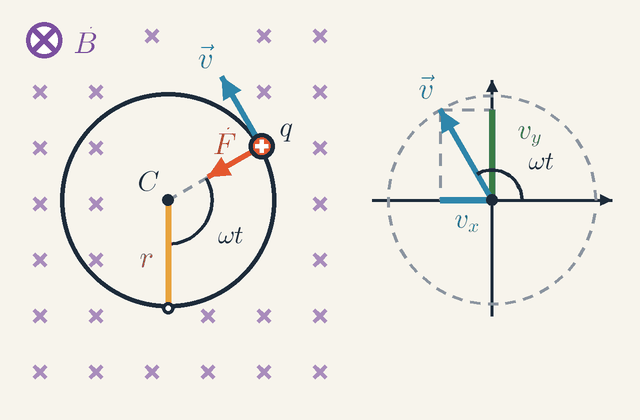
Figure 1. Left: the proton q started at the bottom of the circle and has turned through ωt about the centre C; v is tangent to the path and F points to C. Right: the same v drawn from a fixed point, an arrow of constant length also turned through ωt.Legend
C
Centre of the circle, the point (xc,yc).
r
Radius of the circle, r=mv/(qB), drawn from C to the starting point.
m
ωt
Angle turned since the start; ω=qB/m is the rate of turning.
rad
q
Charge of the particle, here a proton; the open dot is where it started.
C
v
Velocity: tangent to the circle, its length the constant speed v.
m/s
F
Magnetic force qv×B: at right angles to v, towards C.
N
B
Magnetic field, uniform and pointing into the page (the crosses).
T
vx
Component of v along x, vcosωt; negative at the moment drawn.
m/s
vy
Component of v along y, vsinωt.
m/s
The motion in a uniform magnetic field can be solved exactly. The method splits the velocity into components that drive each other, and it is worth learning for its own sake. The result, a circle run at a fixed rate, underlies everything later in the lesson.
Figure 1 sets out the geometry of the animation. The field points into the page (the crosses). With x to the right, y up and z out of the page, that is B=−Bz^. The force is at right angles to B, so it never gives the proton a velocity along z, and the motion stays in the xy-plane. On the left, follow the proton of charge q: it started at the open dot at the bottom of the circle, moving along +x, and has since turned through the angle ωt about the centre C. Its velocity v is tangent to the path, and the force F points along the radius towards C.
On the right, the same v is drawn again from a fixed point. Its shadows on the axes, the horizontal and vertical bars, are its components vx and vy. The arrow has turned through the same angle ωt from the vx axis, because the velocity stays at right angles to the radius and so turns exactly as fast as the radius does.
Now the equations. Newton's second law is mdv/dt=qv×B, with m the proton's mass. Working out the vector product with B=−Bz^ gives v×B=B(−vy,vx,0). Dividing by m and writing ω=qB/m, the two components of the law read v˙x=−ωvy,v˙y=ωvx where a dot means the rate of change in time.
Each component drives the other: vy sets how fast vx changes, and vx sets how fast vy changes. To separate them, differentiate the first equation once more and replace v˙y by the second: v¨x=−ωv˙y=−ω2vx This is the equation of simple harmonic motion with angular frequency ω, and the same steps give it for vy. The starting conditions choose the solution. At t=0 the proton moves along +x with its full speed v, so vx=v and vy=0, hence vx=vcosωt,vy=vsinωt These are the two bars on the right of Figure 1. One more integration gives the position: x=xc+ωvsinωt,y=yc−ωvcosωt The constants (xc,yc) are the point C. At t=0 these formulas put the proton at y=yc−v/ω, directly below C, as in the figure. The path is a circle of radius r=ωv=qBmv run anticlockwise when q>0. For a negative charge ω is negative, and the same formulas describe a clockwise circle of radius ∣mv/(qB)∣.
Complex numbers make the solution shorter. Combine the two components into one complex number, w=vx+ivy. The pair of equations becomes the single equation w˙=iωw, whose solution is w=veiωt: an arrow of fixed length v turning at the steady rate ω, exactly the arrow on the right of Figure 1. In vector language the same statement is v˙=ω×v with ω=−qB/m: the velocity turns (precesses) about the field direction at the rate qB/m. For q>0 the rotation vector ω points against B, here out of the page, and a rotation whose vector points at you looks anticlockwise. That is why the proton circles anticlockwise in a field pointing away from you.
Reading the velocity graphs
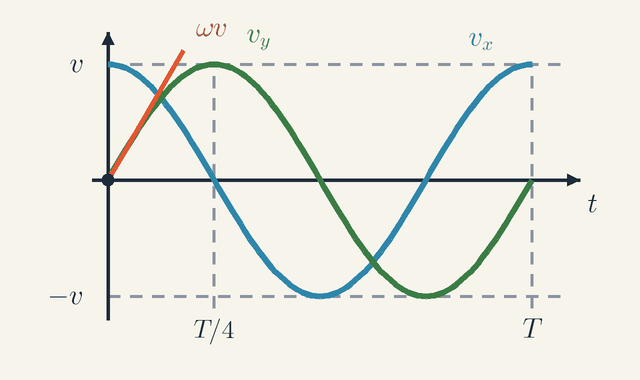
Figure 2. The components of v over one period T: vx is a cosine and vy a sine, a quarter period apart, so one peaks where the other crosses zero. The slope of vy at t=0 is ωv, the whole acceleration F/m.Legend
v
Amplitude of both curves: the constant speed.
m/s
t
Time, measured from the start.
s
T/4
A quarter of the period: vy peaks while vx crosses zero.
s
T
Period of one full turn, T=2πm/(qB).
s
vx
Velocity component along x, vcosωt.
m/s
vy
Velocity component along y, vsinωt.
m/s
ωv
Slope of vy at t=0, its steepest: equal to the acceleration F/m.
m/s2
The graphs of vx and vy against time hold the whole motion: the constant speed, the period and the force can all be read from them. Figure 2 draws the graphs of the animation's Advanced layer over one period T, the time of one full turn.
Start with the shapes. The blue curve vx is a cosine and the green curve vy a sine, both of amplitude v=1.0×10⁶m/s, the proton's speed. They are a quarter period T/4 apart: 1 s in the slowed-down animation, 0.16 µs in reality. Wherever one curve crosses zero the other is at a peak or a trough, as at the dashed line at T/4. At every instant vx2+vy2=1012m2/s2, because cos2ωt+sin2ωt=1. Both components change all the time; the speed never does.
Then the slopes. The slope of a velocity graph is an acceleration, and by Newton's second law it is the force divided by the mass. At t=0, vx is at its peak, where its graph is flat, while vy crosses zero with its steepest slope, the red line in Figure 2. That slope is ωv≈9.6×10¹²m/s2 with ω=qB/m≈9.6×106rad/s for a proton in the animation's 0.10 T. Since vx is not changing at that moment, this is the whole acceleration F/m. It points along +y, straight at the centre, which lies above the starting point. A quarter turn later the roles are swapped: vx is steepest and vy flat, because the acceleration has turned with the radius and now points along −x.
The period does not depend on the speed. The animation's purple proton starts from the same point at 1.5v and runs a circle of radius 15.7 cm instead of 10.4 cm. Its components are the same sinusoids with 1.5 times the amplitude and the same period, so it comes back to the start at the same moment as the red proton. This is the content of T=v2πr=qB2πm in which the speed has cancelled. In 0.10 T every proton moving well below the speed of light takes 0.66 µs per turn, whatever the size of its orbit.
Helices and magnetic mirrors
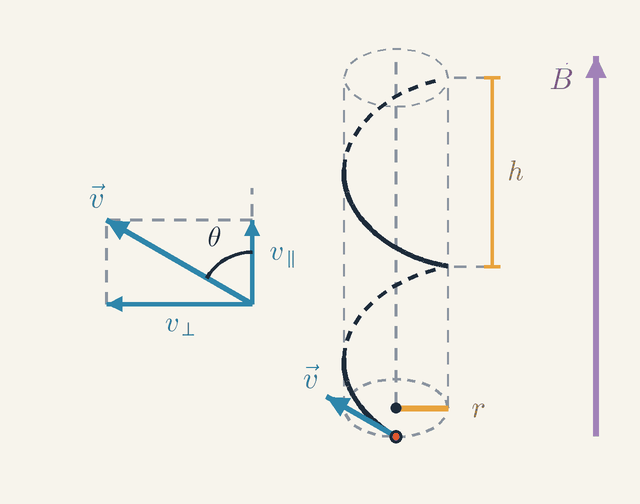
Figure 3. A proton launched at the angle θ to B winds along a helix: a circle of radius r across the field, carried along it by the unchanging v∥ and advancing h per turn. At the left, the starting velocity is split into v∥ and v⊥.Legend
θ
Angle between the starting velocity and B; 60∘ here.
rad
v
Velocity at the start; its length is the constant speed v.
m/s
v⊥
Part of v across B, vsinθ: it turns round the circle.
m/s
v∥
Part of v along B, vcosθ: it feels no force and never changes.
m/s
r
Radius of the circle, r=mv⊥/(qB).
m
h
Pitch of the helix: the distance advanced along B in one period T, h=v∥T.
m
B
Magnetic field, pointing up here.
T
So far the velocity lay across the field. The general case is a velocity at any angle to B, and it is how charged particles actually arrive in Earth's magnetic field or move in a plasma.
Figure 3 shows the result. At the left, the starting velocity v makes the angle θ with B, here 60∘, and is split into two parts: v∥=vcosθ along the field and v⊥=vsinθ across it. The two parts behave quite differently. The force qv×B is always at right angles to B, so it has no component along the field and v∥ never changes. And since the vector product of parallel vectors is zero, v∥ adds nothing to the force: the force depends on v⊥ alone. So v⊥ behaves exactly as in the previous sections. It turns round a circle of radius r=mv⊥/(qB), drawn at the foot of the helix, in the same period T.
Put the two together: the circle is carried steadily along the field, and the path is a helix. Follow it up the drawing. Each turn takes the period T, and in that time the proton advances along B by the pitch h=v∥T=2πrcotθ The second form follows from T=2πr/v⊥ and v∥/v⊥=cotθ. At 60∘ the pitch is about 3.6 times the radius. For the animation's proton, launched at 1.0×10⁶m/s at 60° to the 0.10 T field, v⊥=8.7×10⁵m/s gives a circle of radius 9.0 cm, and v∥=5.0×10⁵m/s carries it 33 cm along the field per turn.
Real fields are rarely uniform. Suppose B grows slowly along the field lines, changing little during one turn. Then the quantity mv⊥2/(2B), the kinetic energy of the circling motion divided by B, stays nearly constant. As the proton moves into a stronger field, v⊥2 must therefore grow in proportion to B. The total speed cannot change, so v∥ shrinks to make room: the helix tightens, and where v⊥ would have to exceed v, the proton stops advancing and turns back. A region of strong field acts as a mirror. Earth's field lines crowd together near the poles, so protons and electrons bounce back and forth between the hemispheres, trapped in Earth's radiation belts.
Momentum at any speed
The relations so far were derived for slow particles. Which of them survive at high speed? Because the magnetic force never changes the speed, it only turns the momentum p, and Newton's law in the form dp/dt=qv×B holds at any speed. For motion across the field it gives a circle with p=qBr where p=γmv is the relativistic momentum, γ=1/1−v2/c2 is the Lorentz factor and c is the speed of light. Since the speed is constant, so is γ, and the steps of the previous sections go through unchanged with m replaced by γm.
In practical units, a track of radius 1 m in a 1 T field belongs to a singly charged particle of momentum 0.30 GeV/c. What does change at high energy is the rate of turning, ω=qB/(γm), which falls as the energy rises. The cyclotron below has to deal with exactly this.
Crossed fields: the drift
Add a uniform electric field E at right angles to B, and the circles no longer close: they glide sideways. This case matters because it shows how a change of frame can remove an electric field, and it is the principle of the velocity selector.
The trick is to watch from a frame moving at the constant velocity vd=B2E×B At low speed, an observer moving at vd measures the electric field E′=E+vd×B. When E is at right angles to B, (E×B)×B=−B2E, so the second term is exactly −E and E′=0. In that frame only B remains, and the particle runs an ordinary circle. Back in the laboratory, that circle is carried along at the drift speed vd=E/B. The drift contains neither q nor m, so every particle, of either sign and any mass, drifts the same way at the same speed. The exact relativistic treatment gives the same result, provided E<cB, so that vd stays below the speed of light.
With E=1.0×10⁴V/m in the animation's 0.10 T, the drift speed is 1.0×10⁵m/s, and the proton's loops advance vdT=6.6cm per turn. A velocity selector uses the same balance: a particle launched at exactly vd feels electric and magnetic forces that cancel, so it goes straight through, while faster and slower particles are deflected.
Worked problem: a small cyclotron
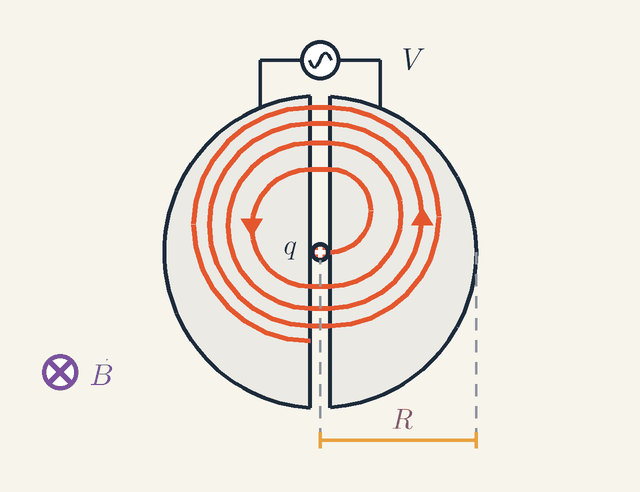
Figure 4. Top view of a cyclotron: a proton starts at the centre and spirals outwards between two hollow D-shaped electrodes, pushed on by the alternating voltage V each time it crosses the gap. Not to scale: four turns instead of the 30 of the worked problem.Legend
R
Radius of the electrodes: the largest orbit, where the protons leave.
m
B
Magnetic field, pointing into the page through both electrodes.
T
V
Alternating voltage between the two electrodes, across the gap.
V
q
Charge of the proton, shown at its starting point.
C
A cyclotron puts the speed-independence of the period to work. Because every proton in a given field takes the same time per turn, a voltage alternating at one fixed frequency can push it again and again, whatever its energy.
Figure 4 shows the machine from above. Two hollow D-shaped electrodes of radius R face each other across a narrow gap. The field B points into the page through both of them, and a source of alternating voltage V is connected across them. The proton q starts at the centre. Inside a hollow electrode there is no electric field, only B, so the proton runs a semicircle and comes back to the gap. If the voltage has reversed by then, it pushes the proton across the gap and adds the energy qV. A faster proton runs a larger semicircle, so the path spirals outwards until it reaches the rim at R, where the protons leave. The drawing shows only four turns; the machine below needs 30.
The problem. A small cyclotron uses the animation's field, B=0.10T, with electrodes of radius R=0.50m and an alternating voltage of amplitude 2.0 kV across the gap. Protons start near the centre, almost at rest. At what frequency must the voltage alternate, what energy do the protons reach, and in how many turns? Use q=1.60×10⁻¹⁹C and m=1.67×10⁻²⁷kg.
Step 1, the frequency. Each proton crosses the gap twice per turn and must find the voltage reversed every time. So the voltage must go through one full cycle per turn of the proton: it alternates at the cyclotron frequency f=2πmqB=2π⋅1.67×10−271.60×10−19⋅0.10≈1.52MHz
Step 2, the final energy. The last orbit has the radius R, so by p=qBR the protons leave with momentum p=qBR=1.60×10−19⋅0.10⋅0.50=8.0×10⁻²¹kg⋅m/s and kinetic energy K=2mp2=2⋅1.67×10−27(8.0×10⁻²¹)2≈1.92×10⁻¹⁴J≈120keV using 1eV=1.60×10⁻¹⁹J. That is a speed p/m=4.8×106m/s, 1.6% of the speed of light. The voltage does not appear in this result: the final energy is set by B and R alone, and the voltage only decides how many turns it takes to get there.
Step 3, the number of turns. A proton that crosses the gap at the peak of the voltage gains 2.0 keV per crossing, so 4.0 keV per turn. It needs 120/4.0=30 turns, which take 30 periods, about 20 µs. Since K grows by equal steps and K∝r2, the radius after n turns is Rn/30: 9.1 cm after one turn, 18.3 cm after four, 27.4 cm after nine. The animation's 10.4 cm circle, at 5.2 keV, lies between the first turn and the second.
Where the design breaks down. The machine relies on every half-turn taking the same 0.33 µs. Relativity spoils this slowly, because the true frequency of revolution is qB/(2πγm), and for a kinetic energy K, γ=1+K/(mc2), where the proton's rest energy mc2 is 938 MeV. At 120 keV, γ≈1.00013, and the frequency falls by a harmless 0.013%. At 20 MeV it would be 2.1% low. A proton circling at that energy would fall half a cycle behind the voltage within about 24 turns, and would then reach the gap just when the voltage slows it down. Cyclotrons for higher energies therefore either lower the frequency as the protons gain energy, or let the field grow towards the rim so that γm/B, and with it the period, stays constant.
Electric or magnetic: a matter of frame
Whether a force counts as electric or magnetic depends on who is watching. This section shows why, using the animation's proton.
In the laboratory the proton feels only a magnetic force. Now look from its momentary rest frame, a frame moving with it at that instant. There the proton has no velocity, so the force on it cannot be magnetic. Yet the force is real, and at low speed it is the same in both frames, so that observer must see an electric field, E′≈v×B(v≪c) For the animation's numbers its strength is vB=1.0×106⋅0.10=1.0×10⁵V/m, and qE′=1.6×10⁻¹⁴N, exactly the magnetic force qvB measured in the laboratory. A pure magnetic field in one frame is a mixture of electric and magnetic fields in another. Neither field on its own is the same for every observer; only the electromagnetic field as a whole is.
Special relativity makes this exact. Under a change of frame the two fields transform into each other, but two combinations of them take the same values for every inertial observer: E2−c2B2andE⋅B These invariants settle what a change of frame can and cannot do. A purely magnetic field has E2−c2B2<0, and since that sign is the same in every frame, no observer can see the field as purely electric. Crossed fields with E<cB also have E2−c2B2<0, and E⋅B=0, so they can always be reduced to a pure magnetic field: that is the drift frame of the section on crossed fields.
Limits of validity
Every result above treats the proton as a classical point charge that moves in a vacuum and loses no energy. This section checks each of those assumptions with numbers.
Radiation. An accelerated charge radiates, and a charge going round a circle is always accelerated. At low speed the radiated power is given by Larmor's formula, P=6πε0c3q2a2 where a is the acceleration and ε0 the permittivity of free space. For the animation's proton, with a≈9.6×10¹²m/s2, this is about 5×10⁻²⁸W. Over one turn it loses 4×10⁻¹⁹ of its energy, so its circle is exact for all practical purposes.
The loss is not always small. For particles of the same energy on circles of the same radius, the loss per turn grows as the inverse fourth power of the mass, so light particles radiate far more. Electrons in a 3 GeV storage ring, bent on a 7 m radius, lose about 1 MeV per turn as synchrotron radiation, and such rings are built to produce it as a powerful source of X-rays. A proton is 1836 times heavier than an electron, and 18364≈1013, so protons lose little even in the Large Hadron Collider, where 7 TeV protons in 8.3 T magnets bend on a radius p/(qB)≈2.8km.
Relativity. At 1.0×10⁶m/s, γ−1≈v2/(2c2)=5.6×10−6, so the non-relativistic formulas are excellent. In general, replace mv by p and m by γm, as in the section on momentum.
Quantum mechanics. In quantum theory the circling motion can only have certain energies, the Landau levels, spaced by ℏω, where ℏ is the reduced Planck constant. For the animation's proton the spacing is about 6×10⁻⁹eV, 10−12 of its 5.2 keV, far too fine to notice. For an electron in 10 T it is 1.2 meV, more than ten times the typical thermal energy at 1 K, and there the quantisation shows up, most strikingly in the quantum Hall effect.
The vacuum. Finally, all of this assumes a vacuum. In air, collisions with molecules would stop a 5 keV proton long before it completed a turn, which is why cyclotrons and storage rings are pumped empty.
Where this leads
The force qv×B runs through the rest of electromagnetism. Push a metal rod of length L across a field at speed v, and the force drives its free charges along the rod: that is the EMF ε=BLv of Electromagnetic Induction. Summed over all the moving charges in a wire carrying a current I, the same force gives F=BILsinθ on a length L of wire at the angle θ to the field, and the torque on a coil, the subjects of Motors, Generators and Transformers.
In a conductor carrying a current across a field, the sideways push piles charge up on one edge until the electric field of that charge balances it. The sign of the resulting Hall voltage tells whether the carriers are electrons or holes, as in Semiconductors, Diodes and LEDs, and Hall sensors measure magnetic fields in phones and cars.
The frame dependence of E and B belongs to Special Relativity, and fields that change in time, each creating the other, make up Electromagnetic Waves. Finally, p=qBr is how particle momenta are measured in Particles and Forces: the Standard Model, from the spirals in bubble-chamber photographs to the detectors of the Large Hadron Collider.
Key formulas
Size of the magnetic force
F=qvBsinθ
The force is proportional to the charge, the speed and the field. Only the velocity component across the field, vsinθ, counts, so motion along the field lines gives no force and motion straight across them the most. For a negative charge use the size of q: the sign changes only the direction.
Symbols
F
size of the magnetic force
N
q
charge of the particle (its size)
C
v
speed of the particle
m/s
B
magnetic field (flux density)
T
θ
angle between the velocity and the field
rad
When it holds: Gives the size only, for a point charge, using the field where the charge is; the direction comes from the right-hand rule. It holds at any speed, and an electric field, if present, adds its own force.
Example: The proton in the animation, at 1.0×10⁶m/s across 0.10 T: F=1.60×10−19⋅1.0×106⋅0.10=1.6×10⁻¹⁴N.
Magnetic force as a vector product
F=qv×B
The vector product gives the size and the direction at once: F is perpendicular to both v and B and points as the right-hand rule says for q>0, the opposite way for q<0. Because F⋅v=0, the force never does work: it turns the velocity without changing the speed. Swapping the order, B×v, would reverse the direction.
Symbols
F
magnetic force
N
q
charge, with its sign
C
v
velocity of the charge
m/s
B
magnetic field
T
When it holds: Holds for a point charge at any speed, in uniform or non-uniform fields. With an electric field present, add qE to get the Lorentz force.
Example: A proton moving along +x in a field into the screen, along −z, is pushed along x^×(−z^)=+y^: up, towards the centre of its circle, as in the animation.
Radius of the circular orbit
r=qBmv
The magnetic force qvB supplies the centripetal force mv2/r of the circular motion; solving for r gives the formula. The numerator is the momentum, so r=p/(qB): the curvature of a track in a known field measures the particle's momentum.
Symbols
r
radius of the circle
m
m
mass of the particle
kg
v
speed across the field
m/s
q
size of the charge
C
B
magnetic field
T
When it holds: For a velocity perpendicular to a uniform field; otherwise use the component vsinθ, and the path is a helix. At relativistic speeds it still holds with mv replaced by the momentum γmv.
Example: The proton in the animation: r=1.67×10−27⋅1.0×106/(1.60×10−19⋅0.10)≈0.104m, the 10.4 cm of the readout.
Cyclotron angular frequency
ω=mqB
The angle swept per second is ω=v/r, and with r=mv/(qB) the speed cancels. Every particle with the same charge-to-mass ratio turns at the same rate in a given field, whatever its speed or radius; the velocity components oscillate at this ω.
Symbols
ω
angular frequency of the circular motion
rad/s
q
size of the charge
C
B
magnetic field
T
m
mass of the particle
kg
When it holds: Speeds well below that of light. At high energy ω=qB/(γm), which falls as the energy grows.
Example: A proton in 0.10 T: ω=(1.60×10−19⋅0.10)/(1.67×10−27)≈9.6×106rad/s, so f=ω/(2π)≈1.52MHz.
Period of the circular orbit
T=qB2πm
One turn is the circumference 2πr run at the speed v, so T=2πr/v; with r=mv/(qB) the speed cancels. A faster particle runs a proportionally bigger circle and takes the same time, which is what lets a cyclotron work with a fixed-frequency voltage.
Symbols
T
period, the time for one turn
s
m
mass of the particle
kg
q
size of the charge
C
B
magnetic field
T
When it holds: As for ω: only while γ≈1. At relativistic energies the period grows in proportion to γ, so large accelerators change their frequency or their field as the particles gain energy.
Example: A proton in 0.10 T: T=2π⋅1.67×10−27/(1.60×10−19⋅0.10)≈6.6×10−7s, about 0.66 µs, for the red and the purple proton alike.
Lorentz force
F=q(E+v×B)
The complete force of the electromagnetic field on a point charge: an electric part qE that acts whether or not the charge moves, plus the magnetic part qv×B that needs motion. Measuring the force on a test charge at rest and at two non-parallel velocities defines both fields at a point. Only the electric part can change the energy: the power delivered is qE⋅v.
Symbols
F
total electromagnetic force
N
q
charge, with its sign
C
E
electric field
V/m
v
velocity of the charge
m/s
B
magnetic field
T
When it holds: Exact for a point charge at any speed, with F=dp/dt and the relativistic momentum. How the force splits into an electric and a magnetic part depends on the observer, and the small reaction force of the charge's own radiation is left out.
Example: In a velocity selector with E=2.5×10⁴V/m and B=0.25T crossed, the force vanishes for v=E/B=1.0×105m/s.
Glossary
Magnetic force
The push of a magnetic field on a moving charge, qv×B. It is at right angles to both the velocity and the field, so it turns the charge without changing its speed; a charge at rest, or moving along the field, feels none.
Lorentz force
The total force of electric and magnetic fields on a point charge, F=q(E+v×B). The electric part acts whether or not the charge moves and can change its energy; the magnetic part needs motion and does no work.
Magnetic field
The condition of space near magnets and currents that pushes on moving charges. Its direction is the line along which a charge can move without any magnetic force; on diagrams, × means a field into the page and • a field out of it.
Right-hand rule for the magnetic force
Point the fingers of your right hand along v and curl them towards B: the thumb gives the direction of v×B, the force on a positive charge. On a negative charge the force points the other way.
Vector product
The product a×b of two vectors: a vector of size absinθ, perpendicular to both, in the direction the right-hand rule gives. Swapping the order reverses it, and it is zero for parallel vectors.
Cyclotron motion
The circular motion of a charge in a uniform magnetic field, with radius r=mv/(qB) and a period that does not depend on the speed. Its frequency qB/(2πm), the cyclotron frequency, is 1.52 MHz for a proton in 0.10 T.
Helical path
The general path of a charge in a uniform field: a circle across the field combined with a steady motion along it, which the field does not affect. Particles from the Sun spiral this way along Earth's field lines into the polar regions, where they light up auroras.
Velocity selector
Crossed electric and magnetic fields in which the two forces cancel for one speed only, v=E/B. Faster or slower particles are deflected and stopped by a slit.
Mass spectrometer
An instrument that sorts ions by mass: at a known charge and speed, the radius r=mv/(qB) of an ion's circle in a magnetic field measures its mass, so different isotopes land at different places.
Cyclotron
A circular accelerator in which a magnetic field bends charged particles into a spiral while an alternating voltage kicks them twice per turn. A fixed frequency works because the time per turn does not depend on the speed, until relativity sets in.
Drift in crossed fields
In perpendicular fields E and B, the circle of a charge glides sideways at E×B/B2, of size E/B, the same for every charge and mass. In a frame moving with this drift the electric field vanishes.
Synchrotron radiation
The light emitted by charged particles bent by a magnetic field at high speed. Negligible for slow protons, it makes 3 GeV electrons bent on a 7 m radius lose about 1 MeV per turn, and storage rings use it as a bright X-ray source.
Quantities
F
Magnetic force
N
The size of the force on the moving charge, qvBsinθ; 1.6×10⁻¹⁴N for the proton in the animation.
q
Charge
C
The particle's electric charge, with its sign: +1.60×10⁻¹⁹C for a proton, the same amount negative for an electron.
v
Speed
m/s
How fast the charge moves. Only the part of the velocity across the field, vsinθ, produces a magnetic force, and the force never changes v.
B
Magnetic field (flux density)
T
The strength of the field: 1 T pushes with 1 N on 1 C crossing it at 1 m/s, so 1T=1N/(A⋅m). Earth's field is 25–65 µT; the animation uses 0.10 T.
θ
Angle between velocity and field
rad
Zero for motion along the field lines, which gives no force; 90∘ for motion straight across them, which gives the largest force.
m
Mass
kg
The particle's mass: 1.67×10⁻²⁷kg for a proton, 1836 times that of an electron. A heavier particle is turned less easily.
r
Radius of the orbit
m
The radius of the circle, mv/(qB)=p/(qB): 10.4 cm for the proton in the animation, so it measures the particle's momentum.
T
Period
s
The time for one turn, 2πm/(qB), the same at any speed: 0.66 µs for a proton in 0.10 T. Not to be confused with the tesla, the unit written upright as T.
ω
Cyclotron angular frequency
rad/s
The rate at which the velocity turns, qB/m: 9.6×10⁶rad/s for a proton in 0.10 T.
E
Electric field
V/m
The force per unit charge on a charge at rest (1V/m=1N/C). In the Lorentz force it adds qE, the only part that can change the speed.
Quiz
Beginner A charged particle sits at rest between the poles of a strong magnet. What magnetic force acts on it?
A force towards the north pole
A force towards the south pole
No force at all
A force that makes it spin
Show answer
Answer: C. No force at all
The magnetic force F = q·v·B·sin θ is zero when v = 0: only moving charges feel a magnetic force.
Beginner A charged particle moves across a uniform magnetic field. What happens to its speed?
It stays the same; only its direction changes
It increases steadily
It decreases steadily
It drops to zero
Show answer
Answer: A. It stays the same; only its direction changes
The magnetic push is always sideways to the motion, so it turns the particle without speeding it up or slowing it down.
Beginner In which direction does the magnetic push on a moving charge act?
Along the direction of motion
Opposite to the motion
Sideways, at right angles to the motion
Always straight down
Show answer
Answer: C. Sideways, at right angles to the motion
The push is perpendicular to the motion (and to the field). That is why it bends the path into a circle.
Intermediate A proton (q = 1.6 × 10⁻¹⁹ C) moves at 2.0 × 10⁶ m/s perpendicular to a 0.50 T field. What force acts on it?
6.4 × 10⁻¹³ N
1.6 × 10⁻¹⁹ N
3.2 × 10⁻¹³ N
1.6 × 10⁻¹³ N
Show answer
Answer: D. 1.6 × 10⁻¹³ N
F = q·v·B = 1.6 × 10⁻¹⁹ × 2.0 × 10⁶ × 0.50 = 1.6 × 10⁻¹³ N. Forgetting the factor 0.50 gives 3.2 × 10⁻¹³ N.
Intermediate A charged particle circles in a uniform magnetic field. If its speed is doubled, the radius of its circle:
Halves
Doubles
Quadruples
Stays the same
Show answer
Answer: B. Doubles
r = m·v/(q·B) is proportional to v, so doubling the speed doubles the radius.
Intermediate Why does a magnetic force never change the speed of a charged particle?
Because magnetic forces are always weak
Because it is always perpendicular to the velocity, so it does no work
Because the field is uniform
Because the charge is too small
Show answer
Answer: B. Because it is always perpendicular to the velocity, so it does no work
Work is F·d along the motion. A force perpendicular to the velocity does no work, so the kinetic energy and the speed stay constant.
Advanced In a cyclotron, a proton's speed doubles (non-relativistically). What happens to the time it takes to go once round?
It halves
It doubles
It stays the same
It quadruples
Show answer
Answer: C. It stays the same
T = 2π·m/(q·B) contains no v: the radius doubles along with the speed, so the time per turn is unchanged.
Advanced A positive charge moves with v = v·x̂ in a field B = B·ŷ. What is the direction of F = q·v × B?
+z
−z
+x
−y
Show answer
Answer: A. +z
x̂ × ŷ = ẑ, so for q > 0 the force points along +z, perpendicular to both v and B.
 Physics Tutor