A thin lens or a curved mirror of focal length f forms an image at the distance given by 1/f=1/do+1/di, with magnification m=−di/do; a converging lens makes it real and inverted when the object is beyond the focus, virtual, upright and enlarged when it is inside.
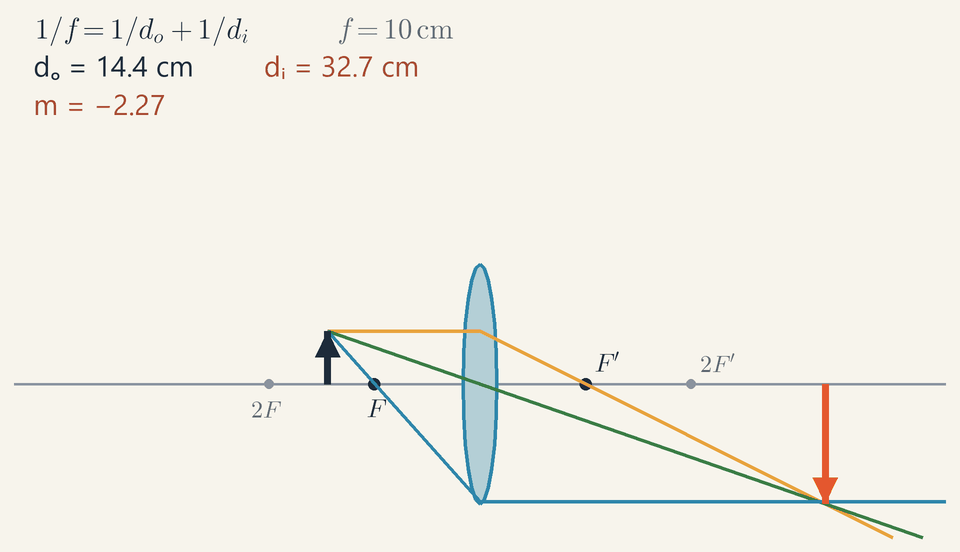
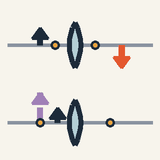
An object arrow walks towards a converging lens: its image is real and inverted beyond the focus, vanishes at the focus and becomes virtual, upright and enlarged inside it.
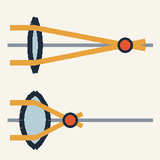
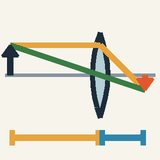
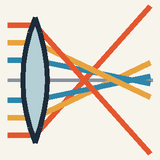
A lens thicker in the middle is converging: it brings parallel rays together at one point, the focus.
The focal length is the distance from the lens to its focus; a fatter, more curved lens has a shorter one.
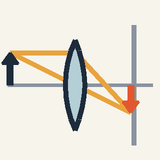
A distant object gives a small, upside-down real image that can be caught on a screen, as in a camera or the eye.
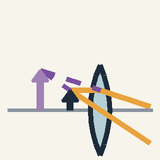
Closer than the focus, the lens shows an upright, bigger virtual image: that is a magnifying glass.
Step 1, shape decides. A magnifying glass bulges in the middle. A lens thicker in the middle than at its edges is a converging lens. Each part of it acts like a small prism: the slanted edges bend light strongly, the nearly flat middle hardly at all, so rays arriving side by side are steered towards one another.
Step 2, the focus. Parallel light, like sunlight, is gathered at one spot, the focus; that is how a magnifying glass can scorch a dot on paper. The distance from the lens to the focus is the focal length. A fatter, more curved lens bends harder and has a shorter focal length.
Step 3, real images. Rays leaving one point of an object meet again at one point behind the lens, and all those points together make an image. Hold a sheet of paper there and the picture appears on it, upside down. An image made by light that really arrives is called real; cameras and eyes use them.
In the animation the black arrow walks towards the lens. While it is far away, its red image is small and inverted; as it comes closer, the image moves away and grows. When the arrow reaches the focus, the light leaves in parallel beams and no image forms.
Step 4, virtual images. Closer than the focus, the rays leave the lens spreading apart and never meet. Your eye traces them back and sees an upright, enlarged purple image on the object's side: a magnifying glass. No light reaches that spot, so the image is called virtual, like your reflection standing behind a flat mirror.
Check yourself: a lens projects a lamp onto a wall. You move the lamp farther away. Must the wall come closer or go back? Answer: closer, because a more distant object has its image nearer the lens.
Intermediate
Key ideas
Thin lens: 1/f=1/do+1/di, m=−di/do; f=10cm and do=30cm give di=15cm, m=−0.5.
Real is positive: di>0 is a real image on a screen; di<0 is virtual, on the object's side (do=5cm gives di=−10cm).
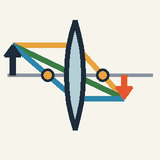
Three principal rays locate the image: parallel then through F′, straight through the centre, through F then parallel.
A concave mirror obeys the same equation with f=R/2; its real images form in front of the mirror.
Focal length, distances and signs
Held in sunlight at the right distance above a sheet of paper, a magnifying glass gathers the light into one small bright spot. A lens much thinner than the distances involved is described by one number, its focal length f. A converging lens brings rays arriving parallel to the axis, the line through its centre at right angles to it, together at the far focus F′, a distance f behind it; the near focus F lies the same distance in front. In the animation f=10cm, and the marks 2F and 2F′ are twice as far out. Opticians quote the power P=1/f instead, in dioptres (D) with f in metres: the animation's lens has P=1/(0.10m)=10D.
Light travels from left to right. The distances do of the object and di of the image are measured from the lens, the heights ho and hi upwards from the axis, and real counts as positive. A converging lens, thicker in the middle, has f>0; a diverging one, thinner in the middle, has f<0. A positive di is a real image on the far side, which a screen can catch; a negative di is a virtual image on the object's side, seen only through the lens.
The thin-lens equation
Where the image forms and how large it is follow from two equations:
f1=do1+di1
m=hohi=−dodi
The first adds reciprocals, not distances: compute 1/di=1/f−1/do, then invert the result. The second gives the magnification m, image height over object height. Its size says how much larger the image is, and a negative sign means inverted, so a real image of a real object, with both distances positive, is always inverted. For a diverging lens with f=−10cm and an object at 30 cm, 1/di=−1/10−1/30=−4/30cm−1, so di=−7.5cm and m=+0.25: a virtual, upright image a quarter of the size.
Finding the image with three rays
Every ray from the object's tip that crosses the lens reaches the image's tip, or seems to come from it. Three are easy to draw, and the animation shows them in colour:
The gold ray arrives parallel to the axis and leaves through the far focus F′.
The green ray goes straight through the centre, where the two faces are parallel.
The blue ray passes through the near focus F and leaves parallel to the axis.
Where the rays cross is the image's tip; two fix it and the third checks. With the object inside F, the blue ray starts along the dashed line from F, and the rays leave the lens spreading apart; their backward extensions meet on the object's side, at the tip of the virtual image.
The diagram also gives the equations. The green ray forms similar triangles with the object and the image, so hi/ho=−di/do. The gold ray drops from height ho at the lens to zero a distance f further on, so at the image hi=ho(1−di/f). Equating the ratios, 1−di/f=−di/do, and dividing by di gives the thin-lens equation.
Worked example: the arrow in the animation
The arrow is 5 cm tall and the lens has f=10cm. As the arrow passes do=30cm, di1=f1−do1=101−301=302cm−1 di=15cm,m=−dodi=−3015=−0.5
The image is real, inverted and half the size, hi=−2.5cm, between F′ and 2F′ where the three rays cross. These are the di and m readouts at that moment.
At the start, do=34.1cm, the image is small: di=14.2cm, m=−0.42. At 2F it is life size and sits at 2F′, with m=−1. Between 2F and F it is enlarged, as in a projector: at 14.55 cm (readout: 14.5) the readouts give di=32.0cm and m=−2.20. Near F the readout shows di→∞; at F itself the rays leave the lens parallel.
Inside F the sign flips. At 7.73 cm, di=−34.0cm and m=+4.40; at the end, do=5.45cm (readout: 5.5), di=−12.0cm and m=+2.20, an upright purple image 11 cm tall on the object's side. That is a magnifying glass. At exactly 5 cm, 1/di=1/10−1/5=−1/10, so di=−10cm and m=+2.
Curved mirrors follow the same rule
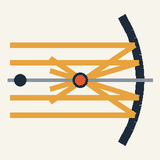
A concave mirror, curved like the inside of a spoon, converges light; a convex one spreads it. Rays parallel to the axis are reflected by a concave mirror through its focus F, halfway to its centre of curvature C: f=2R(spherical mirror)
The radius from C is the normal where a ray strikes, so a parallel ray leaves at the same angle to it on the other side. The ray, the radius and the axis form a triangle with two equal angles, which for small angles puts the crossing point halfway between C and the mirror.
The same equation and magnification apply, but the light comes back, so the real side is in front: real images (di>0) form in front of the mirror and virtual ones (di<0) behind it. A concave mirror has f=+R/2 and a convex one f=−R/2. A flat mirror, R→∞, gives di=−do and m=+1.
Worked example: a make-up mirror
A concave make-up mirror has R=60cm, so f=30cm. With your face 15 cm away, di1=301−151=−301cm−1,di=−30cm,m=−dodi=+2 The image is virtual, upright and twice life size, 30 cm behind the mirror, so your eyes see it 45 cm away, comfortable to focus on.
Now step back until your face is 90 cm from the mirror: di1=301−901=902cm−1,di=45cm,m=−9045=−0.5 The image is now real and inverted, hanging in the air 45 cm in front of the mirror, halfway between it and you: a small upside-down face, as in the bowl of a spoon. At 30 cm, the focus, you see only a blur.
Common mistakes
Forgetting to invert: 1/di=1/10−1/30=0.067cm−1 is not yet the answer; its reciprocal, 15 cm, is. Subtracting the distances, 30−10=20cm, is also wrong.
Covering half the lens does not cut off half the image: every part of the lens sends light from every object point to its image point, so the whole image stays, half as bright.
A negative image distance is not an error: do=5cm gives di=−10cm, a virtual image you can see through the lens but not on a screen.
Diverging lenses and convex mirrors have negative focal lengths: with +10cm instead of −10cm, an object at 30 cm seems to give a real image at 15 cm, not a virtual one at −7.5cm.
A mirror's real images form in front of it: the make-up mirror images a face 90 cm away 45 cm in front of the glass.
Where you meet it
A camera makes a real image on a sensor: a phone lens with f=4.0mm images a person 2.0 m away at di=4.008mm, so refocusing from a distant mountain moves it only 8 µm. A projector holds the slide just beyond F, and a magnifying glass holds the object inside F. Headlights put the bulb at the focus of a concave mirror to make a parallel beam; convex car mirrors give a wide, reduced view.
Instruments with several lenses follow in The Eye, Cameras and Telescopes; why glass bends light was covered in Reflection and Refraction, and the coloured fringes of a simple lens belong to Prisms, Dispersion and Colour.
Advanced
Key ideas
Equal times from object to image: path excess h2/2s against glass bulge h2/2R gives 1/s+n/s′=(n−1)/R for every h.
di=fdo/(do−f) is a hyperbola; measured from the foci, Newton's form xoxi=f2 gives m=−f/xo.
Object and real image are never closer than 4f (at do=di=2f, m=−1); depth is magnified by m2.
At order h4 marginal rays focus short (spherical aberration); once all times agree within a period, diffraction (1.22λ/D) rules.
Images as equal travel times
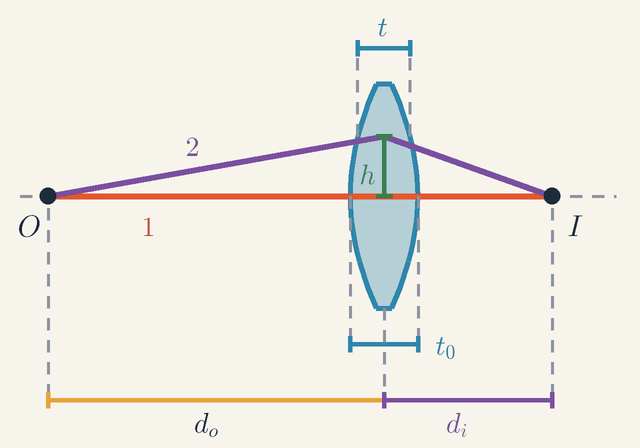
In Reflection and Refraction a ray was a path of stationary travel time: neighbouring paths take almost the same time, so their wavelets arrive in step and reinforce each other. An image is the extreme case of this. A point I is the image of a point O when every path from O through the lens to I takes the same time. All the wavelets then reach I in phase and add up to a bright point, while just beside I they arrive with a spread of phases and mostly cancel. Two points linked in this way are called conjugate. This single condition, equal times, gives every formula in this lesson, and its failure explains why real lenses fall short.
Figure 1. Two paths from O to its image I. Path 2 is longer in air than path 1 but crosses thinner glass, t instead of t0; the shape of the lens makes the two travel times equal. Not to scale.Legend
O
Object point.
I
Image point: where all the paths from O arrive at the same time.
do
Distance from O to the lens, along the axis.
m
di
Distance from the lens to I, along the axis.
m
h
Height above the axis at which path 2 crosses the lens.
m
t0
Thickness of the lens on the axis: the glass that path 1 crosses.
m
t
Thickness of the lens at height h: the glass that path 2 crosses.
m
Figure 1 compares two of the paths from O to I. Path 1 runs straight along the axis: a distance do in air to the lens, the full centre thickness t0 of glass, then di in air to the image. Path 2 crosses the lens plane at a height h above the axis. Compare the two paths piece by piece.
In air, path 2 is longer. Its first straight piece is the hypotenuse of a right triangle with sides do and h, so it exceeds do by do2+h2−do, which is about h2/2do when h is small. In the same way its second piece exceeds di by about h2/2di. In glass, path 2 is shorter: at height h the lens is only t thick, against t0 on the axis.
Geometry alone would therefore make path 2 arrive late, so the lens must hold back the light near the axis by the same amount. Glass can do this because light is n times slower in it. Light crosses a thickness t of glass in the time it would cover nt in air, so replacing that thickness of air by glass adds an optical path (n−1)t. Path 1 crosses t0−t more glass than path 2, and the two times are equal when the delay from that extra glass exactly equals the extra length of path 2 in air: (n−1)(t0−t)=21h2(do1+di1) The right side grows as h2, so t0−t must grow too: the glass must thin out away from the axis. That is why a converging lens is thickest in the middle.
A number shows how fine this balance is. With the animation's do=30cm and di=15cm, the path through h=2cm is longer by 21h2(1/do+1/di)=21⋅4⋅0.1cm=2.0mm. A lens with n=1.50 makes this up if it is 4 mm thicker at the centre than 2 cm out, since 0.50⋅4mm=2.0mm. Those 2.0 mm are about 3600 wavelengths of green light, and the lens must cancel them to within a fraction of one wavelength.
Deriving the lens equations
The same timing argument, applied first to one curved surface and then to two, gives the thin-lens equation and the lensmaker's equation. It also shows why simple spherical surfaces are good enough.
Figure 2. One spherical surface, centre C and radius R, between air and glass of index n. Path 2 meets it at height h, a sag z behind the dashed vertex plane, so it stays longer in air than path 1. Not to scale: h is exaggerated.Legend
O
Object point, in air.
I
Image point, inside the glass.
C
Centre of curvature of the surface.
R
Radius of the surface: the distance from C to the vertex, and to every point of the surface.
m
s
Object distance: from O to the vertex of the surface.
m
s′
Image distance: from the vertex to I, inside the glass.
m
h
Height above the axis at which path 2 meets the surface.
m
z
Sag: how far behind the vertex plane the surface lies at height h.
m
n
Refractive index of the glass; air has index 1.
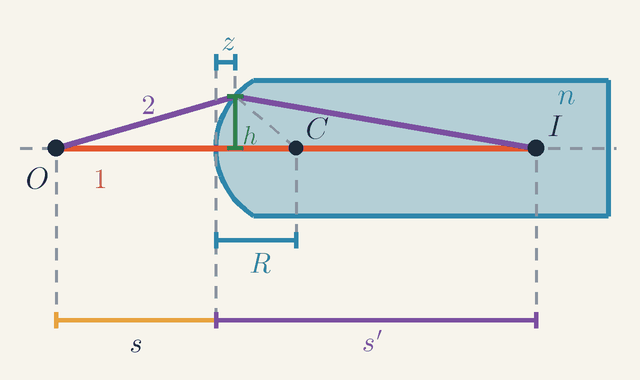
Figure 2 shows the building block: one spherical surface between air and glass of index n. Its centre of curvature is C and its radius is R; the point where it crosses the axis is its vertex. The object O is a distance s in front of the vertex, in air, and the image I a distance s′ behind it, inside the glass. As before, path 1 runs along the axis, and path 2 meets the surface at a height h that is small compared with s (the figure exaggerates it).
Three effects decide whether the two paths take the same time. First, before the surface path 2 is longer by about h2/2s, for the same reason as in Figure 1. Second, after the surface it is longer by about h2/2s′; this stretch lies in glass, so it costs an optical path nh2/2s′. Third, the surface curves away from O: at height h it lies a small distance z, its sag, behind the vertex plane (the dashed vertical line). So path 2 travels about z further in air before it enters the glass, over a stretch that path 1 crosses in glass. That saves path 2 an optical path (n−1)z.
The sag comes from the right triangle in the figure. Its hypotenuse is the radius R from C to the point where path 2 meets the surface; its sides are the height h and the distance R−z along the axis from C to the foot of h. So (R−z)2+h2=R2, which gives z=R−R2−h2. For h≪R the square root is about R−h2/2R, which leaves z≈h2/2R. The paths take equal times when the two extra lengths equal the saving: 2sh2+2s′nh2=2R(n−1)h2⇒s1+s′n=Rn−1
Every term carries the same factor h2, so it cancels. To this order the condition does not depend on the height at all: one sphere brings the rays from every height to the same point. That is why spherical surfaces, which grinding produces naturally, work.
A thin lens is two such surfaces close together, and its thickness can be treated as in Figure 1, as a delay that varies with height. First a sign rule: a radius counts as positive when its centre of curvature lies on the side the light is heading for, so a biconvex lens has R1>0 for its first surface and R2<0 for its second. Each surface removes glass in proportion to its sag, so the thickness falls off as t(h)=t0−21h2(1/R1−1/R2).
Now compare path 2 with the axial path once more. Its extra route in air costs 21h2(1/do+1/di), and the glass it avoids saves (n−1)(t0−t)=21(n−1)h2(1/R1−1/R2). The time is the same for every h only if the two are equal, and again h2 cancels: do1+di1=(n−1)(R11−R21)=f1
This line holds two laws at once. Its first and last members form the thin-lens equation, 1/do+1/di=1/f; its second and last form the lensmaker's equation, 1/f=(n−1)(1/R1−1/R2). The focal length f is the image distance of a very distant object. The left side depends only on where O and I are, the right side only on the glass and its shape, so one lens images every plane of a scene onto its own conjugate plane. The animation's lens, f=10cm, could be a symmetric one of glass with n=1.50 and R1=−R2=10cm: 0.50⋅(1/10+1/10)=1/10 per centimetre.
Newton's form and the hyperbola
How does the image move as the object approaches the lens? A graph of the thin-lens equation answers this, and measuring the distances from the foci turns the equation into its simplest form.
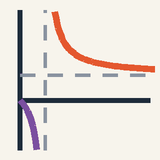
Figure 3. Image distance against object distance: a real branch (di>0) for objects beyond the focus, a virtual branch (di<0) for objects inside it, and dashed asymptotes. The shaded rectangle at do=3f has area xoxi=f2, as at any point.Legend
do
Object distance: from the object to the lens.
m
di
Image distance: positive for a real image beyond the lens, negative for a virtual one.
m
f
Focal length: it fixes both asymptotes and the vertex (2f,2f).
m
xo
Object distance measured from the focus: do−f.
m
xi
Image distance measured from the focus: di−f.
m
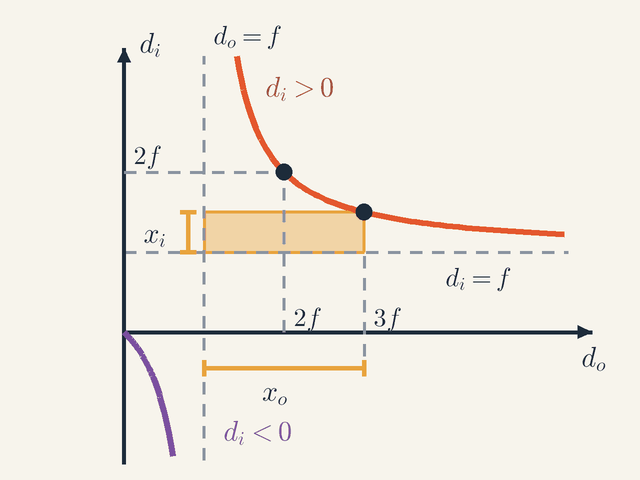
Figure 3 plots the image distance di against the object distance do, as the graph in the animation's Advanced view does. Distances follow the real-is-positive convention: di>0 is a real image on the far side of the lens, di<0 a virtual image on the object's side. Solved for the image, the thin-lens equation gives di=fdo/(do−f), a hyperbola. Its dashed asymptotes are do=f, where the denominator vanishes and the image runs off to infinity, and di=f, which the image approaches as the object recedes to infinity.
Look first at the two branches. The upper branch, marked di>0, holds the real images of objects beyond the focus. The lower branch, marked di<0, holds the virtual images of objects inside it: it hugs the asymptote do=f far below the axis and rises to the origin as do→0. The magnification is m=−di/do, the image height divided by the object height, negative when the image is inverted. The point marked at 2f is the vertex of the real branch, (2f,2f), where di=do and so m=−1: an inverted image of the same size.
Now measure both distances from the foci instead of from the lens: xo=do−f along the horizontal and xi=di−f along the vertical. Multiplying the thin-lens equation by fdodi gives dodi=fdo+fdi. Moving the right side across and adding f2 to both sides gives dodi−fdo−fdi+f2=f2, whose left side is (do−f)(di−f). This is Newton's form of the lens equation: xoxi=f2
In the figure it is the shaded rectangle. Drawn at the marked point do=3f, it has the sides xo=2f along the bottom and xi=f/2 up the side, so its area is f2. A rectangle drawn from the corner (f,f) to any other point of the curve has the same area; at the vertex it is the square f×f. The magnification takes an equally simple form. The solved equation gives di/do=f/(do−f)=f/xo, and Newton's form turns f/xo into xi/f: m=−xof=−fxi Check with the animation's object at 30 cm: xo=20cm, so xi=100/20=5cm, which again gives di=15cm, and m=−10/20=−0.5.
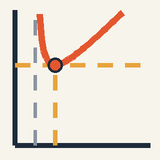
In the animation a red dot runs along the real branch. It starts at (34.1,14.2), in centimetres, passes the vertex (20,20) and leaves the top of the panel at di=60cm, when do=12cm. Once the object has passed F, a purple dot enters the virtual branch from below at di=−40cm, when do=8cm, and rises to −12cm. Continued to do→0, this branch reaches the origin, where m=−f/xo→+1: a magnifier lying on the page magnifies nothing.
The slope of the curve says how fast the image moves. Since di=f+f2/xo and xo changes exactly as do does, the slope is d(di)/d(do)=−f2/xo2=−m2. The minus sign means that as the object approaches the lens, the real image recedes from it: both move the same way in space, the image m2 times as far. So depth is magnified by m2 but height only by m. The slope is −0.25 at 30 cm and −4.84 at 14.55 cm.
Finally, the distance from object to real image is do+di=2f+xo+f2/xo. The sum xo+f2/xo is smallest at xo=f, where its derivative 1−f2/xo2 vanishes. So object and real image are never closer than 4f, reached at do=di=2f with m=−1. In the animation the gap falls from 48.2 cm to 40 cm at 2F, then grows again. The worked problem below rests on this minimum.
Mirrors and systems of lenses
Mirrors obey the same equation with one change, and a system of several lenses can be reduced to it too.
For a mirror the light comes back, so the sag counts twice. A concave mirror of radius R curves towards the object: at height h its surface lies h2/2R nearer the object than its vertex does. That shortens path 2 by h2/2R on the way in and again on the way out, while its slanted pieces add 21h2(1/do+1/di) as before. Equal times therefore need 21h2(1/do+1/di)=h2/R, that is 1/do+1/di=2/R: a mirror obeys the thin-lens equation with f=R/2. Light never enters glass, so a mirror has no dispersion and no colour error, one reason large telescopes are reflectors.
For starlight, which arrives parallel to the axis, a sphere is not quite the right shape. A paraboloid makes the times exactly equal: every point of a parabola is as far from its focus as from a fixed line, its directrix, so every reflected path from a distant star to the focus has the same length. A sphere departs from that paraboloid by about h4/8R3, the next term of its sag.
At the edge of a mirror 20 cm across with f=1.0m, so R=2.0m and h=0.10m, that is 1.6 µm. Reflection doubles it to about 3 µm of path, more than five wavelengths of visible light, so such mirrors are parabolised. Hubble's 2.4 m mirror, polished about 2 µm too flat at its edge, gave blurred images until corrective optics were fitted in 1993.
Thin lenses in contact simply add their delays, so their powers P=1/f add: P=P1+P2, in dioptres (D) when f is in metres. Two of the animation's lenses, 10 D each, make 20 D, f=5cm.
Lenses with gaps between them are taken one at a time: the image formed by one element serves as the object of the next. If the light is still converging when it reaches the next element, its object lies beyond that element; it counts as a virtual object, do<0, on the purple branch of Figure 3 continued past the origin. Paraxially, any system in air has two foci and two principal planes, the planes from which its distances are measured, and xoxi=f2 holds with its effective focal length.
Worked problem: lamp, lens and screen
This bench experiment puts the minimum gap 4f to work and measures f without having to find the focus of the lens.
Figure 4. A lamp and a screen a fixed distance L apart. The lens gives a sharp image at two positions a distance a apart; from position 1 to position 2 the distances do and di swap places.Legend
L
Distance from the lamp to the screen, kept fixed.
m
a
Shift of the lens between its two sharp positions.
m
do
Distance from the lamp to the lens at position 1, and from the lens to the screen at position 2.
m
di
Distance from the lens to the screen at position 1, and from the lamp to the lens at position 2.
m
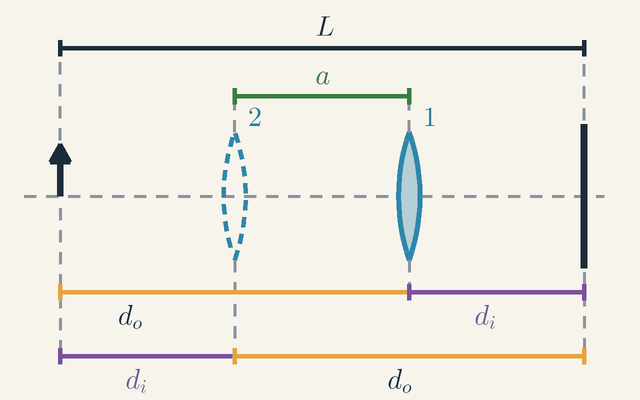
In Figure 4 a lamp, with an arrow 5 cm tall as the object, and a screen stand L=45cm apart. The animation's lens, f=10cm, slides between them. Where is the image on the screen sharp, and how does this give f?
A sharp image needs do+di=L. Putting di=L−do into the thin-lens equation and multiplying by fdo(L−do) gives fL=do(L−do), a quadratic in do: do2−Ldo+Lf=0,do=2L±L2−4Lf=245±15cm So the lens works 30 cm from the lamp, with the image 15 cm beyond it (position 1 in the figure), and 15 cm from the lamp, with the image 30 cm beyond it (position 2).
The two positions are reverses of each other, as the reversibility of light paths requires: if O is imaged onto I, then I is imaged onto O. Compare the two rows of distances in the figure: at position 2 the lens is di from the lamp and do from the screen, the same two lengths exchanged. The 5 cm arrow is imaged 2.5 cm tall with m=−0.5 at position 1, and 10 cm tall with m=−2 at position 2. The two magnifications are −di/do and −do/di, so they multiply to 1, and the object height is the geometric mean of the two image heights, 2.5⋅10=5cm.
The square root is real only if L≥4f, the minimum gap found above. At 40 cm the two positions merge at do=20cm; with the screen any closer, no position gives a sharp image.
The method also works backwards, for an unknown lens. Measure L and the shift a of the lens between its two sharp positions, the a of Figure 4, here 30−15=15cm. The two roots differ by a=L2−4Lf, so f=4LL2−a2=4⋅45452−152=10cm from two lengths measured along the bench, with no need to know from which point inside the lens to measure.
Aberrations: where equal times fail
Everything so far kept only the terms in h2. Real lenses fall short of the ideal because the next terms do not cancel, and because n depends on colour.
At order h4 the times through a spherical lens no longer agree, and the outer rays focus short of the paraxial ones, those close to the axis. This is spherical aberration. Traced exactly through the symmetric lens above, 4 cm across, parallel rays through the rim cross the axis about 7 mm before the paraxial focus, and rays at half that height about 1.6 mm before it. Halving the height cuts the shift by about four: it grows as h2. A smaller aperture and aspheric surfaces reduce it.
Because n depends on the wavelength, so does f: this is chromatic aberration. Crown glass has n=1.514 for red light and 1.522 for blue. Since 1/f∝n−1, the blue focus is closer by the ratio 0.522/0.514, about 1.5 %, which is about 1.5 mm for a 10 cm lens. An achromatic doublet adds a weaker diverging lens of flint glass. Flint spreads the colours more, so the weak flint lens cancels the colour error of the strong crown lens while taking back only part of its power. Points off the axis add further errors, coma, astigmatism and distortion, which designers balance against each other with aspheric elements.
Limits of validity
The thin-lens law assumes paraxial rays, a thickness small compared with f, and air on both sides. The last assumption fails in water, where what counts is the index of the glass relative to the water. A lens with n=1.50 then works with 1.50/1.33−1=0.13 instead of 0.50, and its focal length nearly quadruples. The cornea, the eye's strongest refracting surface, loses most of its power in the same way, because the fluid behind it has nearly the index of water: hence the blur under water without a mask.
The deepest limit is the wave nature of light. The times need only agree to within a fraction of a period, about a quarter (the Rayleigh criterion): the wavelets at the image are then nearly in step, and further polishing gains little.
What remains is diffraction. Even a perfect lens of diameter D images a point as a small disc with faint rings, the Airy disc, whose angular radius is 1.22λ/D. For the 4 cm lens and green light (550 nm) that is 1.7×10⁻⁵rad, a spot 1.7 µm in radius at its focus 10 cm away. A pupil 3 mm across gives about 0.8 arcminutes, close to the sharpest human vision. Magnifying beyond this only enlarges the blur; it reveals no new detail.
Where this leads
The Eye, Cameras and Telescopes puts these lenses to work: the eye as a lens of about 60 D, the magnifier with an angular magnification of about 25cm/f, and the telescope as an objective and an eyepiece. The dispersion behind chromatic aberration came from Prisms, Dispersion and Colour. Diffraction and the Double Slit explains the limit of resolution, and in Wave–Particle Duality single photons add their amplitudes over all paths to the image.
In Gravity as Curved Spacetime, mass acts as a lens. The Sun bends a ray grazing its edge by 1.75 arcseconds. A glass lens bends a ray more the further from the axis it passes; gravity does the opposite, since the deflection falls off as 1/b with the distance b of the ray from the centre. So there is no single focus: rays grazing the Sun meet about 550 AU away, and rays passing further out meet further still. Galaxies lensing more distant ones produce multiple images and rings.
Key formulas
Thin-lens equation
f1=do1+di1
The reciprocals of the object and image distances add up to the reciprocal of the focal length, the same for every position of the object. It follows from similar triangles in the ray diagram, or from requiring every path from an object point to its image point to take the same time. Solve it as 1/di=1/f−1/do and invert at the end; a negative result means a virtual image.
Symbols
f
focal length, positive for a converging lens or concave mirror
m
do
object distance, from the object to the lens
m
di
image distance, positive for a real image and negative for a virtual one
m
When it holds: For thin lenses and spherical mirrors with paraxial rays, in the real-is-positive convention. Thick lenses and lens systems need their distances measured from principal planes, and rays far from the axis suffer aberrations.
Example: The animation's lens, f=10cm, with do=30cm: 1/di=1/10−1/30=2/30, so di=15cm.
Magnification
m=hohi=−dodi
The ratio of image height to object height. The ray through the centre of the lens goes straight on, so it forms two similar triangles with the object and the image, and the heights are in the ratio of the distances. The minus sign records that a real image of a real object is inverted: m<0 means inverted, m>0 upright, and ∣m∣>1 enlarged.
Symbols
m
magnification
hi
image height, negative when inverted
m
ho
object height
m
di
image distance
m
do
object distance
m
When it holds: For thin lenses and mirrors with paraxial rays, and for sizes across the axis only: depth along the axis is magnified by m2.
Example: Object at 30 cm, image at 15 cm: m=−15/30=−0.5, so the 5 cm arrow gives an inverted image 2.5 cm tall.
Optical power
P=f1(dioptres, f in metres:f=10cm→P=10D)
Power is the reciprocal of the focal length: the shorter the focal length, the more strongly the lens bends light. With f in metres it comes out in dioptres, 1D=1m−1. Its use is that the powers of thin lenses in contact simply add, which is why glasses are prescribed in dioptres.
Symbols
P
optical power, in dioptres (D)
m−1
f
focal length, in metres
m
When it holds: For thin lenses: a converging lens has P>0, a diverging one P<0. Powers add only for thin lenses in contact; lenses a distance d apart combine as 1/F=1/f1+1/f2−d/(f1f2).
Example:f=10cm=0.10m gives P=10D; adding a +2.5 D reading lens makes 12.5 D, so f=8cm.
Focal length of a spherical mirror
f=2R(spherical mirror)
A ray parallel to the axis reflects off a spherical mirror at the same angle to the radius, which is the normal there, so it crosses the axis halfway between the mirror and the centre of curvature. With this focal length a mirror obeys the same equation as a thin lens, with its real images in front of it.
Symbols
f
focal length of the mirror
m
R
radius of curvature, as a length; a convex mirror has f=−R/2
m
When it holds: For paraxial rays. Rays striking far from the axis cross it closer to the mirror (spherical aberration); a parabolic mirror focuses parallel light exactly.
Example: A make-up mirror with R=60cm has f=30cm; a convex car mirror with R=2.0m has f=−R/2=−1.0m.
Lensmaker's equation
f1=(n−1)(R11−R21)(lens in air; biconvex:R1>0,R2<0)
The focal length of a thin lens follows from its glass and its shape. The curvatures 1/R1−1/R2 set how much thicker the lens is in the middle, and glass delays light by n−1 times that thickness: just enough to give every path from a point to its image the same travel time. A radius counts as positive when its centre of curvature lies on the side the light goes towards.
Symbols
f
focal length of the lens
m
n
refractive index of the glass
R1
radius of curvature of the surface the light meets first
m
R2
radius of curvature of the second surface
m
When it holds: For a thin lens in air with paraxial rays. In a medium of index nm, replace n−1 by n/nm−1; a thick lens needs a correction that depends on its thickness.
Example: Glass with n=1.50 and R1=−R2=10cm: 1/f=0.50⋅(0.10+0.10)=0.10cm−1, so f=10cm, the animation's lens.
Newton's form of the lens equation
xoxi=f2
Measure the object's distance from the near focus and the image's distance from the far focus: their product is always f2. It is the thin-lens equation rewritten, and it makes the magnification simple, m=−f/xo=−xi/f. Both distances have the same sign: an object beyond F gives an image beyond F′.
Symbols
xo
distance of the object from the near focus F, do−f
m
xi
distance of the image from the far focus F′, di−f
m
f
focal length
m
When it holds: For any lens system in air in the paraxial limit, with its effective focal length, because it needs only the positions of the two foci; this makes it the general form for thick lenses and compound systems.
Example: Object 30 cm from the animation's lens: xo=20cm, so xi=100/20=5cm, and the image is 10+5=15cm behind the lens.
Glossary
Converging lens
A lens thicker in the middle than at its edges, with f>0: it brings rays arriving parallel to the axis together at a real focus. It forms real, inverted images of objects beyond F and enlarged virtual images of objects inside it.
Diverging lens
A lens thinner in the middle than at its edges, with f<0: it spreads parallel rays as if they came from a virtual focus in front of it. Of any real object it gives a virtual, upright, reduced image.
Optical axis
The line through the centre of a lens or mirror, at right angles to it, on which its foci and centres of curvature lie. Distances along it and heights from it describe objects and images.
Focal point
The point where rays arriving parallel to the axis meet after the lens or mirror, or from which they seem to spread. A thin lens has one on each side, F and F′, at the same distance f; a spherical mirror has its focus halfway to its centre of curvature.
Real image
An image where the light really converges after the lens or mirror, so it can be caught on a screen or a sensor. A single lens or mirror makes it inverted, with a positive image distance.
Virtual image
An image from which the light only seems to come: the rays leaving the lens or mirror spread apart, and only their backward extensions meet. You can see and photograph it but not catch it on a screen, as with a magnifying glass or a flat mirror.
Principal rays
Three rays from the tip of an object that are easy to draw: parallel to the axis then through F′, straight through the centre, and through F then parallel. Any two locate the image, but all the light passing through the lens forms it.
Optical power
How strongly a lens or mirror converges light, P=1/f, in dioptres (D) with f in metres: the animation's lens, f=10cm, has 10 D. The powers of thin lenses in contact add, and a diverging lens has a negative power.
Concave and convex mirrors
A concave mirror, curved like the inside of a bowl, converges light, with f=R/2; a convex one, curved outwards, spreads it, with f=−R/2. A mirror forms its real images in front of it and its virtual images behind it.
Conjugate points
An object point and its image point. Every path of light between them through the system takes the same time, so the light from one is gathered at the other; the roles can be swapped, because light paths are reversible.
Paraxial approximation
Treating all rays as close to the axis and nearly parallel to it, so that path differences are kept only to order h2 and sinθ≈θ. The thin-lens and mirror equations hold exactly only in this limit.
Aberration
Any departure of a real lens or mirror from perfect imaging. Spherical aberration makes outer rays focus short, chromatic aberration gives each colour its own focus, and coma, astigmatism and distortion spoil points away from the axis.
Quantities
f
Focal length
m
Distance from a thin lens or mirror to its focal points: positive for converging, negative for diverging ones. The animation's lens has f=10cm.
do
Object distance
m
Distance from the object to the lens or mirror, positive for a real object in front of it: from 34.1 cm down to 5.45 cm in the animation.
di
Image distance
m
Distance from the lens or mirror to the image: positive for a real image (behind a lens, in front of a mirror), negative for a virtual one. It is 15 cm when do=30cm in the animation.
ho
Object height
m
Height of the object above the axis: the animation's arrow is 5 cm tall.
hi
Image height
m
Height of the image measured from the axis, negative when the image is inverted: −2.5cm for the arrow at 30 cm.
m
Magnification
Image height divided by object height, m=−di/do. Its size says how much larger the image is, its sign whether it is upright (m>0) or inverted (m<0).
R
Radius of curvature
m
Radius of the sphere of which a mirror or lens surface is part. Taken as a length, it gives f=+R/2 for a concave mirror and f=−R/2 for a convex one; counting R as negative for a convex mirror instead makes f=R/2 hold in both cases.
n
Refractive index
How many times slower light travels in the lens material than in vacuum, about 1.50 for ordinary glass. Together with the curvatures it sets the focal length of a lens.
xo
Object distance from the focus
m
Distance of the object from the near focus F, xo=do−f; negative when the object is inside the focal length.
xi
Image distance from the focus
m
Distance of the image from the far focus F′, xi=di−f, linked to xo by Newton's form xoxi=f2.
Quiz
Beginner A magnifying glass held in sunlight burns a small bright dot on paper. Where is the paper?
At the focus of the lens
Touching the lens
Twice as far as the focus
Anywhere, the distance does not matter
Show answer
Answer: A. At the focus of the lens
Parallel sunlight is brought together at the focus, so the dot is smallest and hottest when the paper is one focal length away.
Beginner A converging lens projects a distant tree onto a sheet of paper. What does the image on the paper look like?
Upright and larger
Upright and smaller
Upside down and smaller
There is no image on the paper
Show answer
Answer: C. Upside down and smaller
A far object forms a real image just beyond the focus: it is small and inverted, like the image inside a camera.
Beginner When you look at a small insect through a magnifying glass held close to it, the image you see is...
upright and bigger
upside down and bigger
upright and smaller
upside down and smaller
Show answer
Answer: A. upright and bigger
With the object inside the focal length, the lens makes a virtual image that is upright and enlarged.
Intermediate An object stands 30 cm from a converging lens of focal length 10 cm. Where is the image?
20 cm from the lens
15 cm from the lens
7.5 cm from the lens
40 cm from the lens
Show answer
Answer: B. 15 cm from the lens
1/dᵢ = 1/10 − 1/30 = 2/30, so dᵢ = 15 cm. Subtracting the distances (30 − 10 = 20) is a common mistake.
Intermediate A converging lens projects a sharp image of a candle onto a screen. You cover the top half of the lens with black card. What happens to the image?
The top half of the image disappears
The bottom half of the image disappears
The image becomes half as large
The whole image is still there, but dimmer
Show answer
Answer: D. The whole image is still there, but dimmer
Every part of the lens receives light from every point of the candle and sends it to the matching image point, so the uncovered half still forms the complete image; it only collects half as much light.
Intermediate What happens to the principal ray that passes through the centre of a thin lens?
It continues straight on without bending
It leaves parallel to the axis
It passes through the far focus
It is reflected back
Show answer
Answer: A. It continues straight on without bending
At the centre the two faces of a thin lens are parallel, so the ray goes straight through with negligible shift.
Advanced A shop's convex security mirror has a radius of curvature of 1.0 m. A customer stands 4.0 m in front of it. Where is the customer's image?
0.57 m in front of the mirror, inverted
0.44 m behind the mirror, upright and about 1/9 size
4.0 m behind the mirror, same size
0.50 m behind the mirror, at the focus
Show answer
Answer: B. 0.44 m behind the mirror, upright and about 1/9 size
A convex mirror has f = −R/2 = −0.50 m, so 1/dᵢ = 1/f − 1/dₒ = −2.00 − 0.25 = −2.25 m⁻¹ and dᵢ ≈ −0.44 m: a virtual image behind the mirror, with m = −dᵢ/dₒ ≈ +0.11, upright and reduced. Forgetting the sign (f = +0.50 m) gives 0.57 m and an inverted image. This reduced, wide view is why such mirrors can show a whole shop.
Advanced In the dᵢ(dₒ) graph of a converging lens, what does the vertical asymptote at dₒ = f mean physically?
The image becomes as small as possible
Rays from the object leave the lens parallel, so the image is at infinity
The image lands on the lens itself
The lens stops refracting light
Show answer
Answer: B. Rays from the object leave the lens parallel, so the image is at infinity
With the object at F, 1/dᵢ = 1/f − 1/f = 0: outgoing rays are parallel and meet only at infinity; crossing F flips the image from real to virtual.
 Physics Tutor