How the eye focuses with a power P=1/do+1/di of about 60 D while a camera moves its lens, how glasses correct short and long sight, and how magnifiers, microscopes and telescopes enlarge the angle θ under which we see things.
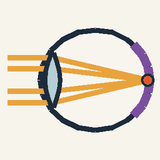
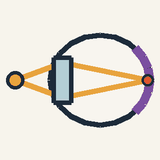
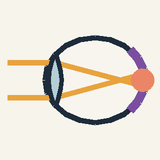
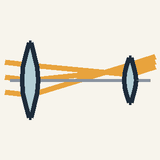
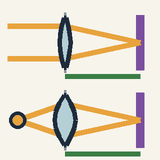
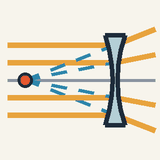
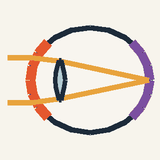
Light from far away and from a nearby lamp focuses on the retina of a healthy eye; then a too-long, short-sighted eye blurs distant light until a diverging lens moves the focus back onto the retina.
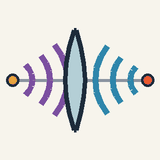
The cornea and lens bend light so that rays from each point of a scene meet again on the retina, as in a camera.
To look at something close, tiny muscles make the lens rounder and stronger: this is accommodation.
In short sight the eyeball is too long: distant light meets in front of the retina; a diverging lens puts the focus back.
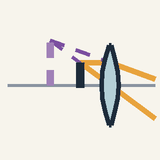
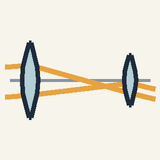
Telescopes, microscopes and magnifiers use lenses to make things look bigger: the light leaves at a wider angle.
Step 1, the eye is a camera. Light enters through the clear cornea, passes the pupil, the opening that the coloured iris widens or narrows like a camera's aperture, and goes through the lens. Cornea and lens together bend the rays so that light from each point of a scene meets again at one point on the retina, the light-sensitive screen at the back. The picture there is upside down; the brain sorts that out.
Step 2, focusing. A camera focuses by moving its lens. The eye cannot, so it changes the lens's shape: for a nearby object tiny muscles let the lens grow rounder and bend harder. This is accommodation. In the animation, watch the lens bulge as the lamp comes close. With age the lens stiffens, which is why most people need reading glasses after 45.
Step 3, short and long sight. In a short-sighted eye the eyeball is a little too long, so light from far away meets in front of the retina and spreads into a blur, while near things stay sharp. A diverging lens, thinner in the middle, spreads the light slightly first and moves the meeting point back onto the retina: watch the blurry disc shrink to a sharp dot. A long-sighted eye is too short, and a converging lens helps.
Step 4, instruments. A microscope uses two lenses: the first makes an enlarged image of a tiny object and the second magnifies that image again, so the two magnifications multiply. A telescope's big front lens collects light from a faint, distant object, and the eyepiece magnifies the image it forms.
Check yourself: a short-sighted friend lends you her glasses. Are the lenses thicker at the edges or in the middle? Answer: at the edges, because they are diverging.
Intermediate
Key ideas
Power P=1/f (dioptres, f in metres); for the eye P=1/do+1/di: about 60 D relaxed, 64 D to read at 25 cm.
Short sight is corrected with P=−1/dfar: a far point of 50 cm needs −2D glasses.
Reading glasses image the page onto the near point: P=1/0.25−1/dnear, e.g. +3D for a 1 m near point.
Glasses for short sight are prescribed with a minus sign, and reading glasses with a plus sign. Instruments are easiest to handle with the power of a lens rather than its focal length. The power is P=1/f; with f in metres it comes out in dioptres (D), so f=0.5m gives P=2D. Converging lenses have positive power and diverging lenses negative power, and thin lenses in contact simply add their powers: +3D and −1D together act like +2D.
Here the cornea and the crystalline lens are treated as one thin converging lens, the reduced eye. The object distance do and the image distance di are measured from it. A camera changes di by moving its lens. The eye cannot, because di is the lens–retina distance, 1/60m≈1.67cm in this model, so 1/di=60D.
Focusing by changing power
Written with powers, the thin-lens equation of the eye reads P=do1+di1(eye:di≈1.67cm,P≈60D)
The fixed 60 D bring parallel light together on the retina; light from a point at distance do spreads more and needs another 1/do. For a distant object 1/do→0, so the relaxed eye needs 60 D. For a book at 25 cm it needs 1/0.25+60=64D. This extra power is accommodation: the ring-shaped ciliary muscle contracts, the fibres holding the lens slacken, and the elastic lens bulges.
The most an eye can add, its amplitude of accommodation, falls with age as the lens stiffens: over 10 D in childhood, about 4 D in the mid-forties, 1 D by 60. The far point is the farthest distance seen sharply with the lens relaxed, and the near point the closest one with full accommodation. A normal young eye has them at infinity and at 25 cm or closer; instruments assume 25 cm.
How glasses correct vision
Glasses do not repair the eye; they move the object, optically, forming a virtual image of it where the eye can focus. Neglecting the gap between glasses and eye, this gives two working formulas:
Short sight:P=−dfar1
Reading glasses:P=0.25m1−dnear1
In short sight (myopia) the far point lies at a finite distance dfar. A diverging lens with f=−dfar makes parallel light spread as if it came from the far point. In long sight (hyperopia) the eyeball is too short, and in presbyopia, the stiffening of the lens with age, accommodation runs out; either way the near point recedes. A converging lens then forms the virtual image of a page at 25 cm at the near point: the 4 D that 25 cm demands, minus the 1/dnear the eye can still supply.
Worked example: the eye in the animation
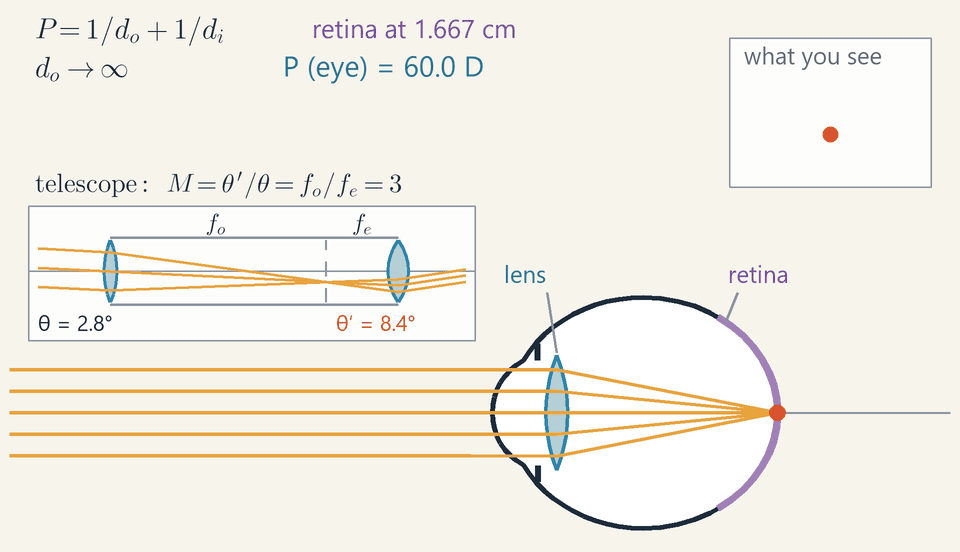
The animation starts with a normal eye, its retina di=1/60m behind the lens: the readouts show do→∞, a retina at 1.667 cm and an eye power of 60.0 D. Then the lamp comes in to 25 cm: P=0.25m1+60D=4+60=64D
The blue lens grows fatter as the power readout climbs to 64.0 D, and the gold rays still meet on the retina.
Next the eyeball lengthens, and the purple readout moves from 1.667 to 1.724 cm, which is 1/58m. The relaxed eye still has 60 D, so parallel light meets at F′, 0.57 mm in front of the new retina, and arrives there as a blur disc. Light from a distance do is now sharp only if 1/do+58=60: dfar1=60−58=2D,dfar=0.5m
That is the 50 cm far point on the purple label. The glasses' readout then ramps to −1/(0.5m)=−2D. Glasses and eye together have 60−2=58D, exactly what parallel light needs to meet 1.724 cm behind the lens, and the blurry disc in the "what you see" panel shrinks to a sharp dot.
Worked example: reading glasses at fifty
A 50-year-old can still add 1.5 D of accommodation, so her near point is at 1/1.5≈0.67m. Which glasses let her read at 25 cm, and what does she see through them?
The glasses must place the image of the page at her near point: P=0.25m1−1.5D=4−1.5=+2.5D
With her eye relaxed, the glasses add 2.5 D to its 60 D, so she sees sharply at 1/2.5=0.40m; with full accommodation she adds 2.5+1.5=4D, sharp at 25 cm. Through these glasses she sees clearly only from 25 to 40 cm, and the far wall is a blur. That is why reading glasses come off to look up, and why varifocal lenses change their power from top to bottom.
Instruments that enlarge the angle
How big something looks depends on the angle it covers at your eye: a coin at arm's length can hide the Moon. Unaided, the best you can do with a small object is bring it to the near point, 25 cm. Instruments enlarge that angle, and the angular magnification M=θ′/θ compares the angle with the instrument, θ′, to the angle without it, θ:
Magnifier:M=f25cm
Microscope:M≈foL⋅fe25cm
Telescope:M=θθ′=fefo
A magnifier lets you hold the object at its focus instead of at 25 cm, so f=5cm gives M=5. A microscope's objective makes a real image L/fo times larger, L≈16cm being the tube length, and the eyepiece magnifies that image: fo=4mm and fe=25mm give 40⋅10=400. A telescope's objective makes a small real image of a distant object in its focal plane, and the eyepiece views it from close up: fo=1.2m and fe=20mm give 60.
The inset in the animation is a telescope with fo=3fe: as the star swings out to θ=3.5∘, the θ′ readout reaches 10.4∘, about three times as much.
Common mistakes
Short-sighted eyes are not too weak but too strong for their length: the animation's long eye has the normal 60 D but needs only 58 D, so the correcting lens has negative power, −2D.
Take the reciprocal of the distance in metres: a far point of 25 cm needs −1/0.25=−4D, not −0.25D or −0.04D.
Reading glasses subtract the near-point term. For a near point of 1.0 m, P=4−1=+3D; adding the terms gives +5 D, which would keep the page sharp only between 17 and 20 cm.
Magnification multiplies angles, not image sizes. The 60-times telescope above forms an image of the Moon only 11 mm across; what grows is the angle, from 0.52° to about 30°.
More magnification does not show more detail: that is limited by the objective's width D, through θmin≈1.22λ/D, and beyond a point a telescope only enlarges the blur.
Where you meet it
Spectacles and contact lenses are prescribed in steps of 0.25 D; about a third of people worldwide are short-sighted, and nearly everyone needs reading glasses by 50. Phone cameras focus by moving a tiny lens. Binoculars marked 8×42 magnify 8 times with 42 mm objectives and send out a beam 42/8=5.25mm wide, matching a pupil opened at dusk. Why detail runs out is the subject of Diffraction and the Double Slit, and the colour fringes of cheap lenses come from dispersion, in Prisms, Dispersion and Colour.
Advanced
Key ideas
Vergences add: V′=V+P; across a gap t, V2=V1/(1−tV1), so spectacle and contact-lens powers differ.
A surface's power is (n′−n)/R: the air–cornea step gives about two thirds of the eye's 60 D, so vision blurs under water.
Retinal blur b≈AL∣P+1/dfar∣ is V-shaped in the glasses' power; a smaller pupil A flattens the V.
Points are resolved if the extreme rays' times differ by about a period: θmin≈1.22λ/D, 0.8′ for a 3 mm pupil.
Vergence: the language of lenses
Every instrument in this lesson, from spectacles to the eye itself to a telescope, is a row of lenses. The quickest way to follow light through such a row is to track one number, the vergence: how strongly the wavefronts are curved, measured in dioptres (D, one dioptre being one per metre). With it, every lens becomes a simple addition.
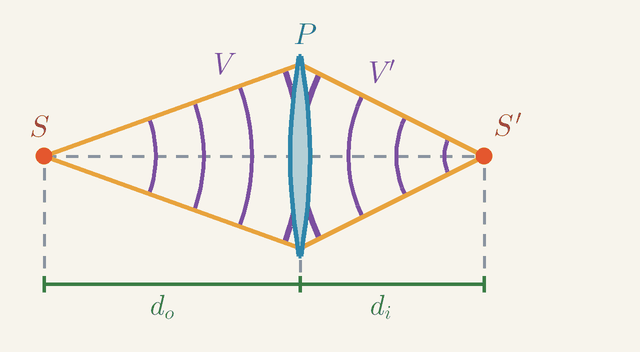
Figure 1. Light from a point S reaches the lens as wavefronts of radius do (vergence V) and leaves as fronts of radius di (vergence V′) closing in on the image S′. The lens only changes the curvature, by its power P. Not to scale.Legend
S
Point source of light.
S′
Image of S: the point where the light converges.
do
Distance from S to the lens: the radius of the arriving wavefronts.
m
di
Distance from the lens to S′: the radius of the leaving wavefronts.
m
V
Vergence of the arriving light, −1/do: negative because the fronts are spreading.
D
V′
Vergence of the leaving light, +1/di: positive because the fronts are closing in.
D
P
Power of the lens: the vergence it adds, V′=V+P.
D
Figure 1 shows light from a point source S passing through a lens to the image S′. Light spreads from S as spherical wavefronts, the purple arcs, so the fronts that reach the lens are arcs of radius do centred on S. The rays, the orange lines, cross the fronts at right angles; that is why the two edge rays run straight from S to the rim of the lens.
The vergence is the curvature of the fronts, one over their radius, with a sign that says which way they bend. Spreading light, like the light arriving from S, has V=−1/do, negative. Parallel light, from a very distant source, has V=0. Light converging on a point a distance d ahead has V=+1/d, positive.
A thin lens does exactly one thing: it adds its power P to the vergence. On the right of Figure 1 the fronts leaving the lens are arcs centred on S′, of radius di, so their vergence is V′=+1/di, and the real image forms where they shrink to a point: V′=V+P,di=V′1 With V=−1/do this is the familiar thin-lens equation, 1/do+1/di=P, written as one addition.
Take a relaxed normal eye: a single lens of 60 D with the retina 1/60 m behind it (a reduced distance, explained in the next section). A lamp 25 cm away sends light of vergence V=−1/(0.25m)=−4D into it. To converge on the retina the light must leave with V′=60D, so the eye must raise its power to P=V′−V=64D; the extra 4 D is its accommodation.
Between two lenses the vergence also changes, simply because the light travels. Light of vergence V1 is heading for a point a distance 1/V1 ahead (or coming from one behind, if V1 is negative: a virtual source). After a gap t that point is t closer, 1/V1−t ahead, and the new vergence is one over this distance: V2=1/V1−t1=1−tV1V1
This matters for spectacles, which sit about t=12mm in front of the cornea. Parallel light leaves a spectacle lens of power P with vergence P and reaches the eye with P/(1−tP), so the spectacles act like a contact lens of that power. A −8D spectacle lens gives −8/(1+0.012⋅8)=−8/1.096=−7.3D at the eye. For the animation's −2D the difference is only 0.05 D, smaller than the 0.25 D steps of a prescription, which is why the readouts ignore the gap.
Where the eye's power comes from
Where do the eye's 60 D come from? A curved boundary between two transparent media bends light by itself, without any lens, and the eye's first boundary, the front of the cornea, does most of the work. This section finds the power of a single curved surface and applies it to the eye.
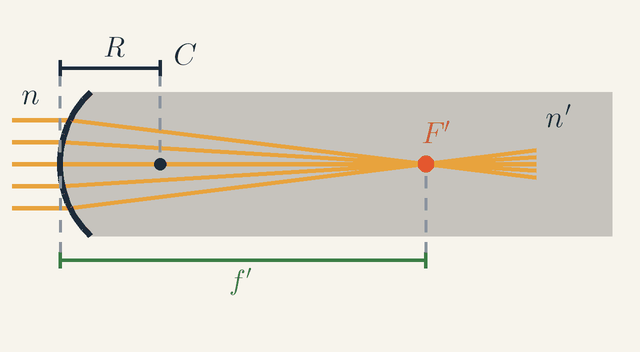
Figure 2. The front of the cornea, to scale: a surface of radius R and centre C between air, index n, and tissue, index n′. Rays parallel to the axis bend towards the normal and all meet at one point, F′, a distance f′=n′/P behind the surface.Legend
n
Refractive index in front of the surface (air).
n′
Refractive index behind the surface (corneal tissue).
R
Radius of curvature of the surface.
m
C
Centre of curvature: the centre of the sphere the surface belongs to.
F′
Point where rays parallel to the axis meet after the surface.
f′
Distance from the surface to F′: f′=n′R/(n′−n)=n′/P, with P=(n′−n)/R the power of the surface.
m
Figure 2 shows the front of the cornea, drawn to scale. The surface is part of a sphere of radius R with centre C. To its left is air, of refractive index n; to its right is corneal tissue, of index n′. Look at the rays: they arrive parallel to the axis, bend at the surface, and all cross the axis at one point, F′.
Follow one ray at a height h above the axis. The normal to the surface at that point is the radius drawn from C, and for small angles it is tilted from the axis by h/R. The ray runs parallel to the axis, so h/R is also its angle of incidence θ. Snell's law for small angles, nθ=n′θ′, gives the angle after the surface, θ′=nh/(n′R): closer to the normal, because n′>n. The ray has therefore turned towards the axis by the difference of the two angles: Rh−n′Rnh=n′Rh(n′−n)
A ray at height h that slopes towards the axis at this small angle reaches it after a distance equal to h divided by the angle: f′=n′−nn′R The height h has cancelled, so every ray close to the axis meets at the same point F′: this is what lets the surface form an image.
Writing the power of the surface as P=(n′−n)/R gives f′=n′/P, which says that in a medium of index n′ the focal distance is n′ times longer than in air. A thin lens is two such surfaces close together, and its power is the sum of their powers.
The power is largest where the index jumps most, and in the eye the biggest jump is from air to cornea. With R≈7.8mm and n′=1.376, the front surface has P=0.376/0.0078m≈48D and f′=1.376/48D≈28.5mm, the distance drawn in Figure 2. The back of the cornea faces fluid of index 1.336, a step down in index, so it takes about 6 D away. The cornea thus supplies some 42 D, more than two thirds of the eye's 60 D; the crystalline lens adds the rest and does the adjusting.
Under water, with n=1.333 in front, the front surface keeps only (1.376−1.333)/0.0078m≈5.5D. The eye loses over 40 D, far more than any accommodation can replace, and everything blurs. Goggles help because they put a layer of air back in front of the cornea.
The same formula explains a convention used throughout this lesson. The image forms in fluid of index 1.336, so the real distance from lens to retina is n′/P=1.336/60D≈22mm. The model's 1/60 m, about 17 mm, is the reduced distance: the distance in air that gives the same vergence. With reduced distances every formula can be written as if the eye were filled with air.
The blur graph: why it is a V
The expert graph of the animation plots how blurred a distant scene looks to a short-sighted eye against the power of its glasses. Its V shape follows from one pair of similar triangles, and the same result explains why squinting helps and why prescriptions come in quarter-dioptre steps.
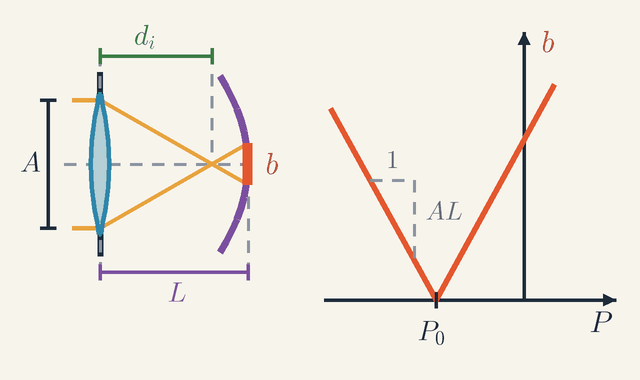
Figure 3. Left: a cone as wide as the pupil A closes at di, short of the retina at L, and spreads into a blur disc of width b. Right: b against the glasses' power P is a V of slope AL, with no blur at its tip P0. Not to scale.Legend
A
Width of the pupil, the opening that limits the cone of light.
m
di
Distance behind the lens where the cone closes: di=1/V′, with V′ the vergence leaving the lens (a reduced distance).
m
L
Distance from the lens to the retina (a reduced distance, 1/58m here).
m
b
Width of the blur disc on the retina.
m
P
Power of the glasses, on the horizontal axis of the graph.
D
P0
Power that gives no blur, −1/dfar, with dfar the far point: the cone then closes exactly on the retina.
D
AL
Slope of each branch: the blur added by one dioptre of error.
m2
The left half of Figure 3 shows where the blur comes from. The eye is the reduced eye of the last section, one lens of 60 D, but this eyeball is slightly too long: the retina sits at L=1/58m instead of 1/60 m. The eye is short-sighted. Relaxed, it sees sharply only out to its far point, dfar=0.5m, because light spreading from there, of vergence −2D, leaves the lens with 60−2=58D and closes exactly on the retina. So 1/dfar=2D.
Now let parallel light from a distant point pass glasses of power P. It leaves them with vergence P (neglecting the gap, as above), and the eye adds 60 D, so behind the lens V′=60D+P. The light enters the eye as a cone as wide as the pupil, A, and the cone closes to a point at di=1/V′, a reduced distance like L.
Look at the gap between di and L. In the figure di is shorter than L: the cone has already crossed and is opening again when it reaches the retina, where it lights a disc of width b. Similar triangles, one with base A and height di, the other with base b and height L−di, give b=AdiL−di=A∣LV′−1∣=ALP+dfar1 The middle step uses di=1/V′; the last uses LV′−1=L(V′−58D)=L(P+2D). If di were longer than L, the cone would still be closing at the retina, and the same formula would hold: that is what the absolute value is for.
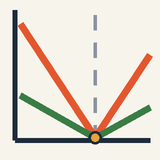
The quantity ΔV=P+1/dfar is the vergence error: how far the light entering the eye is from the vergence the relaxed eye needs. The right half of Figure 3 plots b against P. Since b is proportional to the absolute value of a quantity that grows steadily with P, the graph is a V. Its tip is at P0=−1/dfar=−2D, where di=L, the cone closes exactly on the retina and the blur vanishes. Each branch is a straight line of slope AL: each dioptre of error adds AL to the blur, the rise marked on the left branch.
The vertical b axis stands at P=0, no glasses, so the uncorrected eye, the one whose cone is drawn on the left, is the point where this axis meets the right-hand branch. In the animation the dot first climbs straight up at P=0 as the eyeball lengthens, then slides down the right-hand branch while the glasses' power ramps.
Without glasses, a 4 mm pupil gives b=0.004⋅0.01724⋅2m≈0.14mm. Seen from the lens, this disc spans the angle b/L=A∣ΔV∣=0.004⋅2=8mrad, about 27′. A sharp eye resolves 1′, so every point of a distant scene is smeared over some 27 times the finest detail the eye could otherwise see.
The left branch is over-correction. With −3D glasses the light converges behind the retina; a young eye can still focus it, but only by accommodating 1 D all day. The slope AL is proportional to the pupil, so a 2 mm pupil gives half the blur of a 4 mm one: this is why squinting helps.
Near the tip, a little blur goes unnoticed, and the range of vergence error the eye tolerates is its depth of focus. If 3′ of blur, 0.87 mrad, goes unnoticed, a 3 mm pupil tolerates an error of 0.87×10⁻³/0.003≈0.3D, which is why prescriptions come in 0.25 D steps.
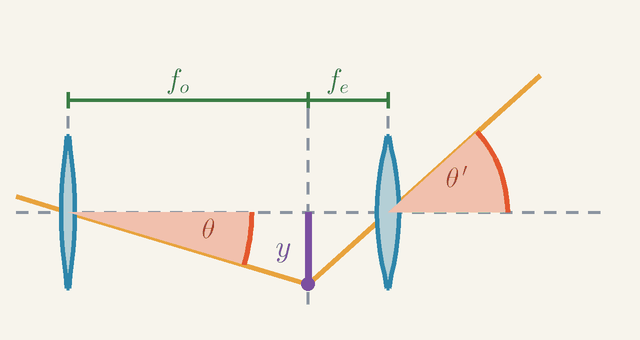
Angular magnification, derived
A telescope cannot make a star look bigger; what it enlarges is the angle between directions in the sky. This section shows that the angle grows by the ratio of the two focal lengths, then carries the idea over to the microscope.
Figure 4. Two chief rays of a telescope, each passing straight through a lens centre. The first meets the shared focal plane at the height y=fotanθ; the second leaves the eyepiece at θ′, with tanθ′=y/fe. Not to scale.Legend
fo
Focal length of the objective.
m
fe
Focal length of the eyepiece, whose focal plane is the objective's.
m
y
Height of the star's image below the axis, in the shared focal plane: y=fotanθ.
m
θ
Angle between the incoming light and the axis: the star's direction.
rad
θ′
Angle between the outgoing light and the axis: the direction in which the eye sees the star.
rad
Figure 4 follows two chief rays, rays through the centre of a lens, which pass straight through it; the angles are exaggerated. On the left, light from a star at the angle θ to the axis reaches the objective, of focal length fo. The objective forms the star's image in its focal plane, and its chief ray shows where: at the height y=fotanθ below the axis, the purple bar.
The eyepiece, of focal length fe, is placed so that its focal plane is the same plane. Light from any point of that plane therefore leaves the eyepiece as a parallel bundle, and the bundle travels in the direction of the chief ray from that point through the eyepiece centre. So the light from the star leaves at the angle θ′, with tanθ′=y/fe.
The bar y is a side of both right triangles in the figure, one with the side fo and one with fe. Dividing the two equations removes it: tanθtanθ′=fefo For small angles the tangents equal the angles, and the angular magnification is M=θ′/θ=fo/fe. In the animation's inset fo=3fe: when θ peaks at 3.5∘, θ′ peaks at 10.4∘, not 10.5∘, because it is the tangents that scale by 3. Notice also that the outgoing ray slopes the opposite way to the incoming one: the telescope shows the sky upside down.
The eyepiece also narrows each bundle in the ratio fe/fo. Light that filled an objective of width D therefore leaves as a beam M times narrower, of width D/M: the exit pupil, the spot of light behind the eyepiece where the eye is placed.
A microscope applies the same idea to a near object. The object sits just beyond the objective's focal point, a distance xo from it, and the objective forms a real, enlarged image a distance xi=fo2/xo beyond its far focal point; this is the lens equation measured from the focal points, its Newtonian form. The image is xi/fo times taller than the object. With the image at the standard distance xi=ℓ, the optical tube length, that is ℓ/fo.
The eyepiece then works as a magnifier: an image of height y in its focal plane is seen under the angle y/fe instead of the y/(0.25m) it would subtend at the usual reading distance. Together, M=foℓ⋅fe0.25m
Magnification is not resolution
Why can more magnification not reveal ever finer detail? Because every aperture spreads the light of a point into a small patch, over an angle set by the wavelength and the width of the aperture. The timing of the waves alone shows where that angle comes from.
Picture a perfect lens as a timing device: it brings the light from a point source to its image point along paths that all take the same time, so the waves arrive in step and add up. Now take a second point source, at a small angle θ from the first, and follow its light to the same image point. Its two extreme rays, through opposite edges of an aperture of width D, differ in path by Dsinθ≈Dθ, and so in travel time by Dθ/c.
Compare this delay with one period of the wave, λ/c. If it is much shorter, the second source's waves also arrive nearly in step: its image falls on the same spot, and the two sources cannot be told apart. Once the delay reaches about one period, every strip of the aperture can be paired with one half an aperture away whose waves arrive half a period later, and the pairs cancel. The second source then sends no light to the first image point, and the two images separate. So θmin≈λ/D.
A round aperture has less area near its edges than a square one, so it acts like a slightly narrower aperture, and the factor rises to 1.22: Resolution:θmin≈D1.22λ
For a 3 mm pupil and green light of 550 nm this is 1.22⋅550×10−9/0.003≈2.2×10−4rad, or 0.8′. The retina is matched to it: the cones at the centre of the fovea are about 2.5 μm apart, 0.5′ seen from the lens, so a pattern that repeats every 1′ is sampled twice per repeat, just enough to record it.
Insect compound eyes meet the same trade-off in another form. Each facet, of width D, blurs by about λ/D, while on an eye of radius r neighbouring facets point D/r apart. Small facets diffract more; large ones sample more coarsely. The two angles are equal when D=λr, the best facet width: some 23 μm for r=1mm.
A telescope's magnification only needs to lift its θmin to an angle the eye can see, and the exit pupil shows why more does not help. At magnification M the beam entering the eye is D/M wide, so the eye's own diffraction blurs it by 1.22λ/(D/M)=M⋅1.22λ/D: exactly the telescope's limit, magnified M times. Picture and blur grow together. Beyond a magnification of about twice the aperture in millimetres, the exit pupil falls below 0.5 mm and this blur exceeds about 4.6′, plainly visible: the picture grows, but no detail is added.
Worked problem: a telescope for a short-sighted eye
What happens when a short-sighted observer uses a telescope without her glasses? This problem answers it by joining the vergence rule, the blur graph and the telescope.
Build the inset's telescope with fo=300mm and fe=100mm, so M=3 and the tube, fo+fe, is 400 mm long. Hand it to the animation's −2D observer without her glasses, her eye close to the eyepiece. Her relaxed eye is sharp only for light of vergence −2D, spreading from her far point. So the +10D eyepiece must give that vergence to the light from the objective's image, a distance s in front of it: −s1+10D=−2D,s=121m=83.3mm
She slides the eyepiece 16.7 mm inwards, shortening the tube from 400 to 383.3 mm. The objective's image still has the height y=foθ, but it now sits s from the eyepiece, and the chief ray from its top through the eyepiece centre, which goes straight on into her eye, makes the angle θ′=y/s: M=sfo=fo(fe1+dfar1)=0.3⋅12=3.6
She gets 3.6 times instead of 3. In effect her eye's 2 D excess is added to the eyepiece's 10 D, making a 12 D eyepiece of focal length 83.3 mm. A long-sighted observer, whose relaxed eye needs +2D, has the opposite: an effective 8 D eyepiece, pulled out to s=125mm, and only M=0.3⋅8=2.4.
If the short-sighted observer does not refocus, she meets the blur graph again. Her 2 D error and 4 mm pupil give 27′ of blur at the eye, as in the blur section, which is about 9′ on the sky after dividing by M=3. This assumes that the exit pupil fills her 4 mm pupil, which needs an objective at least 12 mm wide.
Limits of validity
Everything above is paraxial thin-lens optics: rays close to the axis, lenses without thickness, light of one wavelength. Real eyes and instruments depart from it in three ways worth knowing.
First, aberrations. The real eye is a thick system with the faults of any lens. Spherical aberration, rays far from the axis focusing closer than those near it, grows quickly with the pupil and adds blur at night, when the pupil is wide. Chromatic aberration makes the eye about 2 D stronger for violet light than for red. A cornea curved more in one direction than the other causes astigmatism, which needs a cylindrical lens rather than a single number P.
Second, diffraction. It puts a floor under the V of Figure 3: the blur levels off near 1.22λ/A, 0.8′ for a 3 mm pupil, and below a pupil of about 2 to 3 mm a smaller pupil makes things worse, not better.
Third, the air. For telescopes on the ground, turbulence smears stars over about 1″, which is 4.85×10⁻⁶rad: the diffraction limit of an aperture only 1.22⋅550×10−9/(4.85×10−6)≈0.14m wide. Larger telescopes still gather more light, but finer detail needs adaptive optics, which reshapes the wavefront as it arrives, or a telescope in space, where the 2.4 m Hubble telescope reaches 0.06″.
Where this leads
The factor 1.22 and the dark rings around star images are worked out in Diffraction and the Double Slit, and the in-step argument is that of Interference and Superposition. Chromatic aberration and the achromatic doublet that cancels it belong to Prisms, Dispersion and Colour; the surface power (n′−n)/R rests on Reflection and Refraction, and vergence on Lenses and Mirrors. The rule θmin≈1.22λ/D holds for every wave: a 100 m radio dish at 21 cm resolves only about 9′, coarser than the naked eye, while electron microscopes, whose electrons have wavelengths of a few picometres (Wave–Particle Duality), image single atoms. Light itself as a wave is the subject of Electromagnetic Waves.
Key formulas
Power of a lens
P=f1(dioptres, f in metres)
Power is the reciprocal of the focal length, so a lens that bends light strongly, with a short focal length, has a large power. Its unit, the dioptre, is one inverse metre. Converging lenses have positive power and diverging lenses negative power, and the powers of thin lenses in contact simply add.
Symbols
P
power of the lens
D
f
focal length, in metres; negative for a diverging lens
m
When it holds: Thin lenses in air. For a thick lens or a system of lenses, f is measured from a principal plane, and lenses separated by a gap do not simply add their powers.
Example: A magnifier with f=5cm has P=1/0.05=20D; the relaxed eye, with P=60D, has f≈1.67cm.
Thin-lens equation for the eye
P=do1+di1(eye:di≈1.67cm,P≈60D)
The thin-lens equation written with powers: the lens must supply 1/do to undo the spreading of the light from the object, plus 1/di to bring it together at the image. In the eye di is fixed by the lens–retina distance, so focusing means changing P: about 60 D for distant objects, more for near ones.
Symbols
P
power of the eye, cornea and lens together
D
do
distance from the lens to the object
m
di
distance from the lens to the image, the retina
m
When it holds: Reduced-eye model: one thin lens with air on both sides. The real eye is filled with fluid of index 1.336, so its true lens–retina distance is about 22 mm; the powers are unchanged.
Example: For a book at 25 cm: P=1/0.25+60=64D, the final value on the animation's power readout.
Glasses for short sight
Short sight:P=−dfar1
A diverging lens of focal length −dfar makes parallel light from a distant object spread as if it came from the far point, the farthest place the relaxed eye can focus. The minus sign says the lens is diverging: a short-sighted eye is too strong for its length, so the glasses take power away.
Symbols
P
power of the glasses
D
dfar
distance from the eye to its far point
m
When it holds: Neglects the gap between glasses and eye. For glasses a distance t in front of the eye, P=−1/(dfar−t); the difference matters from about 4 D upwards.
Example: The animation's long eye has its far point at 50 cm: P=−1/0.5=−2D.
Reading glasses
Reading glasses:P=0.25m1−dnear1
Reading glasses take a page at 25 cm and form its virtual image at the near point, where the eye can still focus. In thin-lens terms the object is at 0.25 m and the image at −dnear, so the power is 4 D minus what the eye still supplies. The result is positive, a converging lens, whenever the near point lies beyond 25 cm.
Symbols
P
power of the reading glasses
D
dnear
near-point distance of the eye without glasses
m
When it holds: Neglects the gap between glasses and eye and assumes a reading distance of 25 cm; for another distance, replace 0.25 m by it. Through such glasses distant objects are blurred.
Example: Near point at 1.0 m: P=4−1=+3D; near point at 67 cm: P=4−1.5=+2.5D.
Magnifying glass
Magnifier:M=f25cm
Without help, the largest angle you can give a small object of height h is h/(0.25m), at the near point. A magnifier lets you put the object at its focus, where the virtual image is at infinity and the angle is h/f; the ratio of the two angles is 25cm/f.
Symbols
M
angular magnification
f
focal length of the magnifier
m
When it holds: Image at infinity, relaxed eye, small angles. With the image at the near point instead, M=1+25cm/f; simple magnifiers rarely go beyond about 10 because of aberrations.
Example:f=5cm: M=25/5=5.
Compound microscope
Microscope:M≈foL⋅fe25cm
The objective forms a real image enlarged L/fo times, where L is the distance from its back focus to that image. The eyepiece views this image as a magnifier and adds a factor 25cm/fe, and the two magnifications multiply.
Symbols
M
total angular magnification
L
tube length, about 16 cm
m
fo
focal length of the objective
m
fe
focal length of the eyepiece
m
When it holds: Focal lengths much shorter than L and the final image at infinity. Beyond about 1000 times the magnification is empty: diffraction limits detail to about half a wavelength.
Example:fo=4mm and fe=25mm: M≈(160/4)(250/25)=40⋅10=400.
Angular magnification of a telescope
Telescope:M=θθ′=fefo
The objective forms a real image of a distant object in its focal plane, at height y=fotanθ. The eyepiece shares that focal plane and sends the light out parallel at tanθ′=y/fe, so the angles grow by fo/fe: a long objective and a short eyepiece give a high magnification.
Symbols
M
angular magnification
θ′
angle of the light leaving the eyepiece
rad
θ
angle of the object seen without the telescope
rad
fo
focal length of the objective
m
fe
focal length of the eyepiece
m
When it holds: Distant objects and a telescope focused for a relaxed eye. Strictly it is the tangents of the angles that scale (3.5∘ becomes 10.4∘ for M=3), and the image is upside down.
Example:fo=1.2m and fe=20mm: M=1200/20=60.
Diffraction limit of resolution
Resolution:θmin≈D1.22λ
A perfect lens brings the light from a point to its image point along paths of equal travel time. A second point at a small angle θ is seen as separate only when its two extreme rays, from opposite edges of the aperture, differ in travel time by about one period, which happens at θ≈λ/D. A round aperture gives the factor 1.22.
Symbols
θmin
smallest angle between two resolvable points
rad
λ
wavelength of the light
m
D
diameter of the aperture: pupil or objective
m
When it holds: For a perfect, aberration-free instrument; real ones do worse, and ground-based telescopes are limited by the air to about 1″, 4.8×10⁻⁶rad.
Example: A 3 mm pupil at 550 nm: θmin=1.22⋅550×10−9/0.003≈2.2×10−4rad, or 0.8′.
Glossary
Accommodation
The eye's change of focus by changing the shape of its crystalline lens: for a near object the lens grows rounder and its power rises, by 4 D for a page at 25 cm. A camera focuses by moving its lens instead.
Near point
The closest distance an eye can see sharply, with full accommodation. It is 25 cm or less for a young adult, 25 cm being the standard value for instruments, and it recedes with age, to about 1 m by 60.
Far point
The farthest distance an eye can see sharply with its lens relaxed. It is at infinity for a normal eye and at a finite distance in short sight: 50 cm for the animation's long eye.
Short sight (myopia)
An eye too strong for its length, usually because the eyeball is too long: distant light focuses in front of the retina, while near things stay sharp. A diverging lens corrects it, P=−1/dfar.
Long sight (hyperopia)
An eye too weak for its length, usually because the eyeball is too short: the relaxed eye focuses distant light behind the retina, and a young eye must accommodate even to see far away. A converging lens corrects it.
Presbyopia
The loss of accommodation with age as the crystalline lens stiffens, which pushes the near point beyond reading distance, usually in the mid-forties. Reading glasses of power 1/(0.25m)−1/dnear make up for it.
Reduced eye
The simplest model of the eye: cornea and lens replaced by one thin lens of 60 D, with the retina 1/60m≈1.67cm behind it. The real distance is about 22 mm, because the image forms in fluid of index 1.336 rather than in air.
Vergence
The curvature of a wavefront in dioptres: −1/d for light spreading from a point at distance d, zero for parallel light, positive for converging light. A thin lens adds its power to it, V′=V+P.
Defocus blur
The disc that a point of light becomes when it converges in front of or behind the retina. Its angular size is about the pupil diameter times the vergence error, A∣ΔV∣: 8 mrad, about 27′, for a 4 mm pupil and a 2 D error.
Angular magnification
The ratio M=θ′/θ of the angle an object covers seen through an instrument to the angle it covers without one (at 25 cm for a small object). It says how much larger things look, not how large the image is.
Keplerian telescope
A telescope of two converging lenses whose focal planes coincide: the objective forms a real image there and the eyepiece views it. It gives M=fo/fe, an upside-down image and an exit beam M times narrower than the objective.
Resolution limit
The smallest angle between two point sources that an instrument can still show as two, about 1.22λ/D for a round aperture of diameter D. It comes from the wave nature of light, so no amount of magnification can beat it.
Quantities
P
Optical power
D
The bending strength of a lens, 1/f, with 1D=1m−1. Positive for converging lenses, negative for diverging ones; the relaxed eye has about 60 D.
f
Focal length
m
The distance from a thin lens to the point where parallel light meets, or seems to come from; negative for a diverging lens.
do
Object distance
m
The distance from the lens to the object looked at; do→∞ for a distant object.
di
Image distance
m
The distance from the lens to the image. In the eye it is fixed, the lens–retina distance, 1/60m≈1.67cm in the reduced eye.
dfar
Far-point distance
m
The farthest distance seen sharply with the lens relaxed: infinite for a normal eye, 50 cm for the animation's short-sighted eye.
dnear
Near-point distance
m
The closest distance seen sharply with full accommodation; 25 cm is the standard value, and it grows with age.
M
Angular magnification
How many times larger the angle under which an object is seen becomes through the instrument, θ′/θ. In the telescope formula θ is the angle under which the object is seen without the instrument and θ′ that of the light leaving the eyepiece; in the microscope formula L is the tube length, about 16 cm.
fo
Focal length of the objective
m
The focal length of the lens that faces the object: long in a telescope (1.2 m in the example), a few millimetres in a microscope.
fe
Focal length of the eyepiece
m
The focal length of the lens you look through, which acts as a magnifier on the objective's image.
θmin
Smallest resolvable angle
rad
The smallest angle between two point sources that can still be seen as two, about 1.22λ/D: 2.2×10⁻⁴rad, or 0.8′, for a 3 mm pupil. Here λ is the wavelength and D the diameter of the aperture, pupil or objective, both in metres.
Quiz
Beginner Where does the eye form a sharp image of what you are looking at?
On the cornea, at the front of the eye
On the lens, just behind the iris
On the retina, at the back of the eye
Nowhere: the brain builds the picture from scattered light
Show answer
Answer: C. On the retina, at the back of the eye
The cornea and the lens bend the light so that rays from each point of the object meet again on the retina, the light-sensitive layer that sends the picture to the brain.
Beginner To read a book held close to your face, what does your eye do?
Its lens becomes rounder and bends light more strongly
Its lens becomes flatter and bends light less
The eyeball becomes longer
The pupil moves closer to the retina
Show answer
Answer: A. Its lens becomes rounder and bends light more strongly
Light from a near object spreads out more, so the eye needs more bending power. Tiny muscles let the lens bulge: this is accommodation, shown in the animation when the lamp comes close.
Beginner A short-sighted person sees distant things blurry. Which glasses help?
Lenses that are thicker in the middle (converging)
Flat, tinted glass
Lenses that make everything look bigger
Lenses that are thinner in the middle (diverging)
Show answer
Answer: D. Lenses that are thinner in the middle (diverging)
In a short-sighted eye, light from far away meets in front of the retina. A diverging lens spreads the light a little first, so it meets further back, on the retina.
Intermediate A relaxed eye focuses distant objects with a power of 60 D. What power does it need to focus on a book 25 cm away?
60 D
64 D
56 D
85 D
Show answer
Answer: B. 64 D
P = 1/dₒ + 1/dᵢ: the retina term stays 60 D and the book adds 1/0.25 m = 4 D, so P = 64 D, the extra 4 D coming from accommodation. 85 D comes from adding 25 instead of 1/0.25, and 56 D from subtracting.
Intermediate A short-sighted person's far point is 40 cm from the eye. Neglecting the gap between glasses and eye, which lens corrects their distance vision?
+2.5 D
−0.4 D
−2.5 D
+0.4 D
Show answer
Answer: C. −2.5 D
The lens must make parallel light seem to come from the far point, so it is diverging with f = −0.40 m: P = −1/0.40 m = −2.5 D. The values ±0.4 D come from forgetting to take the reciprocal.
Intermediate Someone's near point has moved out to 1.0 m. What reading glasses let them read at 25 cm?
+3 D
−3 D
+5 D
+1 D
Show answer
Answer: A. +3 D
The glasses must form a virtual image of the page at 1.0 m: P = 1/0.25 − 1/1.0 = 4 − 1 = +3 D. +5 D adds the two terms instead of subtracting, +1 D keeps only the near-point term, and −3 D has the wrong sign: long sight needs a converging lens.
Advanced A short-sighted person wears −10.0 D spectacles 12 mm in front of the eye. What contact-lens power gives the same correction?
−10.0 D
−11.4 D
−8.9 D
−0.12 D
Show answer
Answer: C. −8.9 D
The −10 D lens makes parallel light diverge from its focus 100 mm in front of it, i.e. 112 mm in front of the eye. A contact lens must do the same from the cornea: P = −1/0.112 m ≈ −8.9 D, which is P/(1 − t·P) = −10/1.12. −10.0 D ignores the gap, −11.4 D applies the correction in the wrong direction (−10/0.88), and −0.12 D is t·P alone.
Advanced For a −2 D short-sighted eye, the retinal blur b is plotted against the power P of the glasses. What happens with −3 D glasses?
The image is sharpest of all, because a stronger lens always helps
Distant light now meets behind the retina, so b grows again unless the eye accommodates by 1 D
Nothing changes, because the blur depends only on the length of the eye
The image turns upside down
Show answer
Answer: B. Distant light now meets behind the retina, so b grows again unless the eye accommodates by 1 D
b ≈ A·L·|P + 1/d_far| is V-shaped with its minimum at P = −1/d_far = −2 D. At −3 D the vergence error is 1 D the other way. A young eye can cancel it by accommodating, but over-corrected glasses make the eyes work all the time.
 Physics Tutor