Two point charges q1 and q2 a distance r apart push or pull on each other with equal and opposite forces of size F=k∣q1q2∣/r2: repulsive for like charges, attractive for opposite ones.
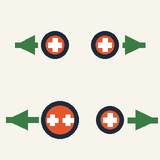
Two charged pucks are moved closer together and then apart along a track: first both positive, then one negative. The force arrows are always equal and opposite, and they grow sharply as the distance shrinks.
The push or pull between two charges grows with the amount of charge: double one charge and the force doubles.
Like charges push each other apart; opposite charges pull each other together.
Halve the distance between two charges and the push or pull becomes four times stronger.
Both objects feel the same size of force, in opposite directions.
Two charged objects push or pull on each other without touching. Coulomb's law tells us which way, and how hard.
Step 1: which way. Like charges (+ and +, or − and −) push each other apart; opposite charges (+ and −) pull each other together.
Step 2: how much charge. The more charge, the stronger the force. Double the charge on one object and the force doubles; double the charge on both and it becomes four times as strong.
Step 3: how far apart. Distance matters even more. Move two charges twice as far apart and the force drops to a quarter; three times as far and it drops to a ninth. Bring them twice as close and it becomes four times stronger. Gravity follows exactly the same "inverse square" pattern.
Step 4: the unit. Charge is measured in coulombs. One coulomb is enormous, the charge of about six billion billion electrons, so the charge on a rubbed balloon is less than a millionth of a coulomb (under one microcoulomb).
Step 5: fair shares. Both objects feel a force of the same size, in opposite directions, even if one carries much more charge than the other.
Check yourself: two small charged balls 10 cm apart push each other with a force of 8 units. How strong is the push when they are 20 cm apart? Answer: 2 units, because twice the distance gives a quarter of the force.
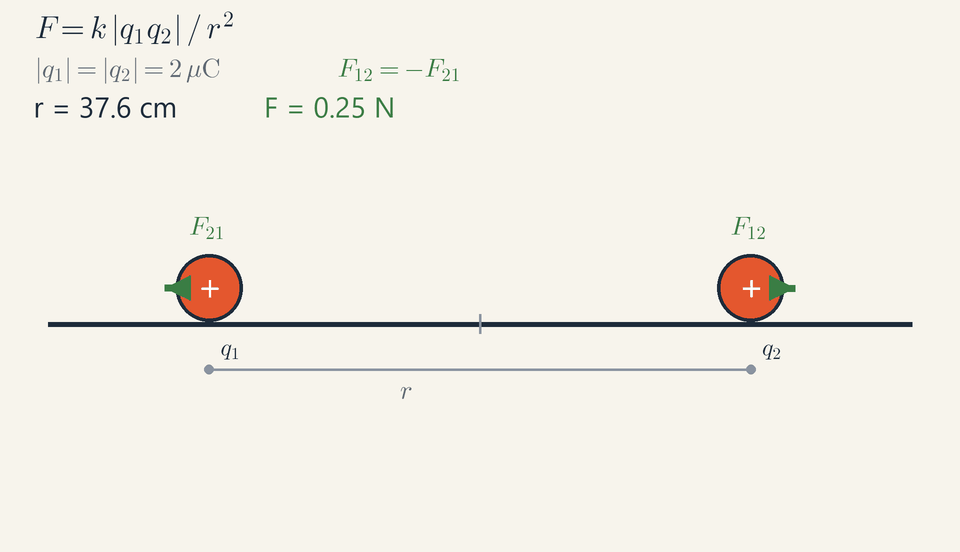
In the animation, two charged pucks slide closer together and then apart along a track. In the first half both are positive and the green arrows push them apart; in the second half one turns negative and the arrows pull them together. Watch how the arrows stay tiny when the pucks are far apart but shoot out when they come close.
Intermediate
Key ideas
Coulomb's law: F=k∣q1q2∣/r2, with k≈8.99×10⁹N⋅m2/C2.
Convert µC to C and cm to m, and measure r between the centres, not the surfaces.
F12=−F21: the two charges feel equal and opposite forces, even when the charges differ.
Charge is quantised: q=ne with e=1.602×10⁻¹⁹C.
What we measure: charge and distance
A rubbed balloon carries less than a millionth of the unit in which charge is measured. Coulomb's law links two charges and the distance between them. Charge is measured in coulombs (C) and has a sign. It comes in whole multiples of the elementary charge e=1.602×10⁻¹⁹C, the charge of a proton; an electron carries −e. A coulomb is huge, so everyday static charges are quoted in microcoulombs (1μC=10−6C) and nanocoulombs (1nC=10−9C). Each puck in the animation carries a charge of size 2 µC, about 1.25×10¹³ elementary charges.
The distance r is measured between the centres of the two bodies. The law is exact for point charges, bodies much smaller than their separation, and for uniformly charged spheres, which act from outside as if all their charge sat at the centre. Convert everything to SI units first: 2μC=2×10⁻⁶C and 15cm=0.15m.
Coulomb's law
Two point charges q1 and q2 a distance r apart push or pull on each other with a force of size F=r2k∣q1q2∣ where k is Coulomb's constant: k=4πε01≈8.99×10⁹N⋅m2/C2
The force acts along the line joining the charges: like charges repel, opposite charges attract. Its size is proportional to each charge: doubling one doubles the force, doubling both quadruples it. It also varies inversely with the square of the distance: twice as far gives a quarter of the force, three times as far a ninth, half as far four times as much. Gravity follows the same inverse-square pattern.
Here ε0≈8.85×10⁻¹²F/m is the permittivity of free space. The size of k shows how strong the electric force is: two charges of 1 C, 1 m apart, would repel with 9×10⁹N, roughly the weight of 900 000 tonnes.
Equal and opposite forces
Each charge acts on the other, and the two forces form a Newton's third law pair. With F12 the force that q1 exerts on q2 and F21 the force that q2 exerts on q1, F12=−F21 The forces are equal in size even when the charges differ, because both contain the same product q1q2: charges of 1 µC and 4 µC, 30 cm apart, each feel 8.99×109⋅4×10−12/0.302≈0.40N.
Equal forces do not mean equal motions: by Newton's second law each body accelerates at a=F/m, so a light charged bead is flung away from a heavy charged sphere that barely moves. The sign of the product gives the direction: q1q2>0 pushes the charges apart, q1q2<0 pulls them together. That is why the size formula uses ∣q1q2∣.
Worked example: the pucks in the animation
Each puck carries a charge of size 2 µC, and their separation swings between 40 cm and 15 cm. First work out the product that never changes: k∣q1q2∣=8.99×109⋅(2×10−6)2=0.03596N⋅m2 At the closest approach, r=0.15m, so F=0.1520.03596=0.02250.03596≈1.60N
At the widest separation, r=0.40m, the force is 0.03596/0.16≈0.22N. These are the extreme values on the r and F readouts. The distance changes by a factor of 40/15≈2.67 and the force by 2.672≈7.1, so the green arrows are about seven times longer at the closest approach. At 30 cm the readout passes 0.40 N, a quarter of the value at 15 cm.
After 6 s the right puck turns negative. The readouts repeat exactly, since the size depends only on ∣q1q2∣ and r, but both arrows turn round to point towards each other. Labelled F12 and F21, they always have the same length.
Worked example: two charged balls on threads
Two identical small balls of mass 2.0 g hang from one point on insulating threads, 40 cm from the point of suspension to each centre. Given equal charges, they push each other apart and settle with their centres 12 cm apart. What is the charge on each ball?
Each ball is in equilibrium under its weight mg, the tension of the thread and the horizontal Coulomb push. The thread makes an angle θ with the vertical, with sinθ=0.06/0.40=0.15, so θ≈8.6∘ and tanθ≈0.152. The vertical part of the tension balances the weight and its horizontal part the electric force, so F=mgtanθ=0.0020⋅9.81⋅0.152≈2.98×10⁻³N
Solving Coulomb's law for the charge, with q1=q2=q, gives q=rkF=0.12⋅8.99×1092.98×10−3≈6.9×10⁻⁸C Each ball carries about 69 nC, or 4.3×10¹¹ elementary charges. The electric push is only 15 % of the weight, yet it visibly holds the balls apart. If half of each charge leaked away, the force at 12 cm would drop to a quarter and the balls would sag closer together.
Several charges: forces add
With more than two charges, work out the force from each one separately, as if the others were absent, and add the results as vectors. This is the superposition principle: Fnet=∑Fi(superposition)
Put a small charge of −0.5μC midway between the pucks when they are 30 cm apart. Each puck acts on it with 8.99×109⋅2×10−6⋅0.5×10−6/0.152≈0.40N. If both pucks are positive, they pull it in opposite directions and the net force is zero. If the right puck is negative, one pulls and the other pushes, both to the left: 0.80 N in all, towards the positive puck. The expert layer moves the small charge off the line, where the sum must be drawn as a vector.
Common mistakes
Forgetting to convert units: writing 2 for each 2 µC charge makes the force 1012 times too big, and writing 15 for 15 cm makes it 10 000 times too small.
Not squaring the distance: dividing by r instead of r2 turns the 1.60 N at 15 cm into 0.24, which is not even a force (its unit is N·m).
Thinking that the bigger charge feels the bigger force: charges of 1 µC and 4 µC, 30 cm apart, both feel 0.40 N.
Measuring r between the surfaces: two spheres of radius 2 cm with surfaces 11 cm apart have centres 15 cm apart, and using 11 cm overestimates the force (15/11)2≈1.9 times.
Reading the sign as a size: +2 and −2μC at 15 cm give kq1q2/r2=−1.60N, but the minus sign only means attraction; the size is 1.60 N.
Where you meet it
Coulomb's law is at work wherever charge is moved on purpose. Laser printers and photocopiers lay a pattern of charge on a drum that picks up toner; electrostatic precipitators charge smoke particles in chimneys and collect them on plates of the opposite sign; car factories charge paint droplets so that they wrap around the car body.
Far more important is what you do not see: the electric force holds atoms and molecules together. In a hydrogen atom the proton pulls the electron, about 5.3×10⁻¹¹m away, with 8.2×10⁻⁸N, more than 1039 times their gravitational attraction. Chemistry and the stiffness of solids come from this force, tamed by the almost perfect balance of positive and negative charge in matter. Electric Field and Potential describes the same force through the field that each charge creates, and Capacitors shows how separated charges store energy.
Advanced
Key ideas
Vector form F12=kq1q2r^12/r2: the sign of q1q2 decides attraction or repulsion, and F21=−F12 is built in.
Superposition: the net force is the vector sum of the pairwise Coulomb forces; with Coulomb's law, that is all of electrostatics.
The 1/r2 law is Gauss's law: the flux E⋅4πr2=q/ε0 through any sphere around a charge is the same.
No field inside a closed charged conductor: such null tests fix the exponent at 2 to a few parts in 1016.
Valid for static charges; in a dielectric the force is divided by εr, and moving charges add magnetic forces.
The law in vector form
The Intermediate level gives the size of the force, F=k∣q1q2∣/r2, and a separate rule for its direction: like charges repel, opposite charges attract. As soon as several charges act at once, forces have to be added as vectors, so it pays to put size and direction into one formula. All this needs is a way to name positions.
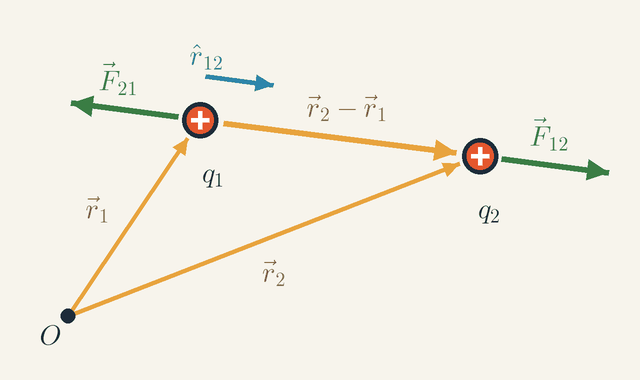
Figure 1. Two charges q1 and q2, with positions measured from an origin O. The arrow r2−r1 closes the triangle and points from q1 to q2; for like charges F12 points along r^12, and F21 is equal and opposite.Legend
q1
First charge.
C
q2
Second charge.
C
O
Origin: any fixed point from which positions are measured.
r1
Position of q1, an arrow from O.
m
r2
Position of q2, an arrow from O.
m
r2−r1
Arrow from q1 to q2; its length is the distance r between the charges.
m
r^12
Unit vector from q1 towards q2: the arrow r2−r1 divided by its length r.
F12
Force that q1 exerts on q2.
N
F21
Force that q2 exerts on q1: the same size as F12, opposite direction.
N
In Figure 1 the charges q1 and q2 sit at the positions r1 and r2, arrows drawn from an origin O. Look at the triangle formed by the three orange arrows. Going from O to q1 and then on to q2 ends where the direct arrow r2 ends, so r1+(r2−r1)=r2 and the third side, r2−r1, is an arrow from q1 to q2. It does not depend on where O is, only on where the charges are, as a force between them should.
The length of this arrow is the distance between the charges, r=∣r2−r1∣. Dividing the arrow by its own length keeps its direction and makes its length 1. The result is the unit vector (a hat marks a vector of length 1) r^12=(r2−r1)/r drawn as the short blue arrow, pointing from q1 towards q2. With it, the force that q1 exerts on q2 is F12=r2kq1q2r^12 where k≈8.99×10⁹N⋅m2/C2 is Coulomb's constant. The charges now enter with their signs, not as sizes.
The signs then take care of the direction. Both charges in Figure 1 are positive, so q1q2>0: the number in front of r^12 is positive, and F12, the green arrow on q2, points along r^12, away from q1. That is repulsion. If one charge were negative, q1q2<0 and the same formula would turn the force round, towards q1: attraction. No separate rule is needed.
Newton's third law is built in as well. The force on q1 is the same formula with the labels swapped. Swapping turns r^12 into r^21=−r^12 but leaves the product q1q2 and the distance r unchanged, so F21=−F12. In Figure 1 the green arrow F21 on q1 is as long as F12 and points the other way.
The force is also central: it acts along the line joining the charges, and its size depends only on their distance. Such a force is conservative, because the work it does between two separations does not depend on the path taken, so it has a potential energy, found in the section on energy below.
In SI units Coulomb's constant is written k=1/(4πε0), where ε0≈8.85×10⁻¹²F/m is the permittivity of free space. The factor 4π is the area of a sphere of radius 1. Placing it in k looks clumsy here, but it makes the 4π disappear from Gauss's law and from the formulas for capacitors, which are used far more often.
Charles-Augustin de Coulomb established the law in 1785 by measuring the twist of a torsion balance. Until 2019 the SI fixed k at exactly 10−7c2≈8.98755×10⁹N⋅m2/C2, where c is the speed of light. Since then the elementary charge e has an exact value and ε0 is measured instead; the measurement agrees with the old exact value to better than a part in a billion.
Superposition and the electric field
With only two charges the vector form just repackages what we already knew. Its value shows when a third charge joins them. Experiment shows that electric forces simply add: the force on a charge is the vector sum of the forces that each of the others would exert on it alone, unchanged by the presence of the rest. This principle of superposition is a second experimental fact, as basic to electrostatics as the inverse-square law itself.
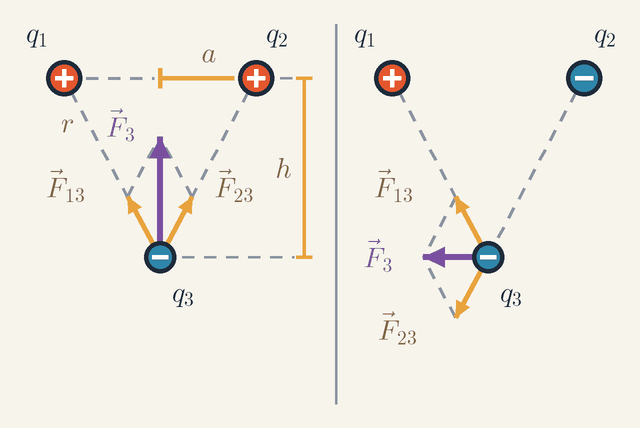
Figure 2. The forces of the two pucks on the negative charge q3, and their sum F3. Like pucks (left): the sideways parts cancel and F3 points up. Unlike pucks (right): the vertical parts cancel and F3 points towards the positive puck.Legend
q1
Charge of the left puck, positive in both panels.
C
q2
Charge of the right puck: positive in the left panel, negative in the right.
C
q3
Fixed negative charge below the pucks.
C
F13
Force of the left puck on q3.
N
F23
Force of the right puck on q3.
N
F3
Net force on q3: the vector sum F13+F23.
N
r
Distance from each puck to q3, the same for both.
m
h
Depth of q3 below the line of the pucks.
m
a
Distance from each puck to the midpoint between them: half their separation.
m
Figure 2 uses the set-up of the animation's expert layer. Two pucks, each carrying a charge of size q=2μC, slide along a straight rail. A fixed charge q3=−0.5μC sits a depth h=14cm below the rail, under the midpoint between the pucks. The figure shows the moment of closest approach, when the pucks are 15 cm apart and each is a=7.5cm from the midpoint.
Start with the force of one puck on q3. The puck, the midpoint and q3 form a right-angled triangle with the sides a and h, so each puck is the same distance from q3: r=a2+h2=0.0752+0.142≈0.159m Coulomb's law gives the size of each force, which acts along the dashed line joining the puck to q3: F=0.15928.99×109⋅2×10−6⋅0.5×10−6≈0.356N These are the gold arrows F13 and F23. They are equally long because the distances are equal; only their directions differ.
To add them, split each force into a part along the rail and a part at right angles to it. The force lies along the slanted side r of the triangle, so its part along the rail is Fa/r and its part at right angles to the rail is Fh/r.
In the left panel both pucks are positive, so each pulls the negative q3 towards itself, up and to one side. The sideways parts, Fa/r each, point in opposite directions and cancel. The upward parts, Fh/r each, add. The sum F3=F13+F23, the purple diagonal of the dashed parallelogram, therefore points straight up, with the size F3=2⋅0.356⋅0.14/0.159≈0.63N
In the right panel the right puck is negative and pushes q3 away, so F23 now points down and to the left. This time the vertical parts cancel and the sideways parts add. The sum, F3=2⋅0.356⋅0.075/0.159≈0.34N, points along the rail, towards the positive puck.
The same sums change as the pucks move. For the like pair the upward pull grows steadily as the pucks close in, from 0.17 N when they are 40 cm apart to 0.63 N at 15 cm. For the unlike pair the sideways pull, 2Fa/r=2kq∣q3∣a/(a2+h2)3/2, is largest not at the closest approach but at a=h/2, where its derivative with respect to a is zero. That is a separation of 2⋅0.14≈0.20m, and the pull there is 0.35 N. Closer pucks pull harder, but their forces also turn towards the vertical, where the unlike pair's forces cancel.
Superposition also lets us describe what the charges do to a point before anything is placed there. Put a small test charge q0 at the point and divide the total force on it by q0. The result, E=F/q0, no longer depends on the test charge: it is the electric field, measured in newtons per coulomb.
For charges qj at the positions rj, the field at the point r is E(r)=∑j∣r−rj∣3kqj(r−rj) Each term is Coulomb's law in vector form: the vector r−rj divided by the cube of its length equals the unit vector from qj to the point divided by the square of the distance. For charge spread out with a density ρ (charge per unit volume) the sum becomes a volume integral. Once the charges and their positions are known, this formula settles every electrostatic force; Gauss's law, potentials and field lines are shortcuts to the same answers.
Seen from a distance d much larger than their separation, the like pair acts as one charge of 4 µC, whose field falls as 1/d2. The unlike pair has no net charge: its two fields nearly cancel, and what remains falls faster, as 1/d3. A pair of equal and opposite charges like this is called an electric dipole.
Why the exponent is exactly 2
Nothing in the vector form forces the power of r to be 2; a law with 1/r2.01 would look much the same. The exact 2 matters because it turns into Gauss's law, one of the basic equations of electromagnetism, and because it can be tested with extraordinary precision. The key quantity is the flux. For a small flat patch of area dA that faces the field squarely, the flux is EdA, the field strength times the area. If field lines are drawn with a density proportional to E, the flux counts the lines that cross the patch.
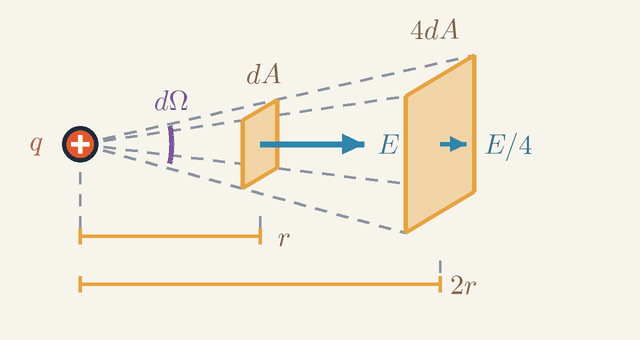
Figure 3. A narrow cone of solid angle dΩ from the charge q. At twice the distance the patch it cuts has four times the area and the field is a quarter as strong, so the flux EdA is the same through both patches.Legend
q
Point charge at the tip of the cone.
C
dΩ
Solid angle of the cone: the area it cuts from a sphere of radius 1.
sr
r
Distance from q to the nearer patch.
m
dA
Area of the nearer patch, which faces the charge squarely.
m2
E
Field of q at the nearer patch.
N/C
E/4
Field at twice the distance: a quarter of E.
N/C
Figure 3 shows how the exponent and the geometry of space fit together. A narrow cone leaves the point charge q. Its opening is measured by the solid angle dΩ: the area the cone cuts from a sphere of radius 1 centred on its tip, in steradians (a whole sphere is 4π). At the distance r the cone cuts a small patch facing the charge, of area dA=r2dΩ. At 2r the cone is twice as wide in both directions, so the patch there has four times the area, 4dA.
Now compare the fields at the two patches, the two blue arrows. Coulomb's law gives E=kq/r2 at the near patch and a quarter of that, E/4, at the far one. The flux through the near patch is EdA=(kq/r2)(r2dΩ)=kqdΩ, and the flux through the far patch, (E/4)(4dA), is the same. The r2 in the denominator of the law cancels the r2 in the area. So the flux through any patch the cone cuts depends only on the solid angle dΩ, not on how far away the patch is.
Next, surround q with a sphere of radius r centred on it. On this sphere the field has the same size everywhere and crosses the surface at right angles, so the total flux is the field times the whole area: ∮E⋅dA=r2kq⋅4πr2=ε0q The circle on the integral sign means the surface is closed. The vector dA is a patch of the surface, with length dA and pointing outwards, and the dot product keeps only the part of the field that crosses the patch. The radius has dropped out, so every sphere gets the same flux, and the 4π placed in k cancels the 4π of the sphere's area.
The shape of the surface does not matter either. Cut any closed surface around q into patches, each seen from q within some solid angle dΩ. A tilted patch is larger, but the field crosses it at a slant, and the two effects cancel, so each patch still receives the flux kqdΩ. The solid angles add up to 4π, which gives q/ε0 again. For a charge outside the surface, each thin cone enters the surface as often as it leaves it, with flux in and flux out equal: the charge contributes nothing. That is Gauss's law: the flux out of any closed surface equals the charge inside divided by ε0.
The argument works only for the exponent 2. For a force F∝1/r2+δ the flux through a sphere would vary as r−δ. It would differ between two spheres with no charge between them, as if field lines appeared or vanished in empty space.
Two consequences make the exponent measurable. First, a uniformly charged thin spherical shell acts outside as if all its charge sat at its centre, and exerts no force at all on a charge inside. To see the inside case with the idea of Figure 3, draw a thin double cone through a point inside the shell. It cuts the shell in two patches, at the distances r1 and r2. A straight line through a sphere meets it at the same angle at both ends, so the two patches are tilted alike, and their areas, and so their charges, are in the ratio r12:r22. Each patch pulls with a force proportional to its charge divided by the square of its distance, so the small near patch pulls exactly as hard as the large far one, in the opposite direction. Second, the field inside an empty closed conductor of any shape is zero, whatever charge is put on the conductor.
Looking for these zeros is a null test. Instead of measuring the force at many distances, which is hard to do precisely, one charges a closed conductor and looks for any field or charge inside it. If the exponent differed from 2, something would show up, so finding nothing is far more sensitive. Henry Cavendish did this in 1773 and found that the exponent differs from 2 by less than 0.02; a shell experiment of 1971 pushed δ below a few parts in 1016.
At atomic distances, around 10−10m, the energy levels of hydrogen, computed with the 1/r potential plus small quantum corrections, match measurement to extraordinary precision. In modern terms, an exact inverse-square law means that the photon, the particle that carries the electric force, has no mass.
Energy and the force–distance graph
Because the force changes with distance, Newton's second law gives the acceleration at each moment but not, without much work, the speed after a long push. Work and energy give it in one step, and a graph of force against distance shows where the energy comes from.
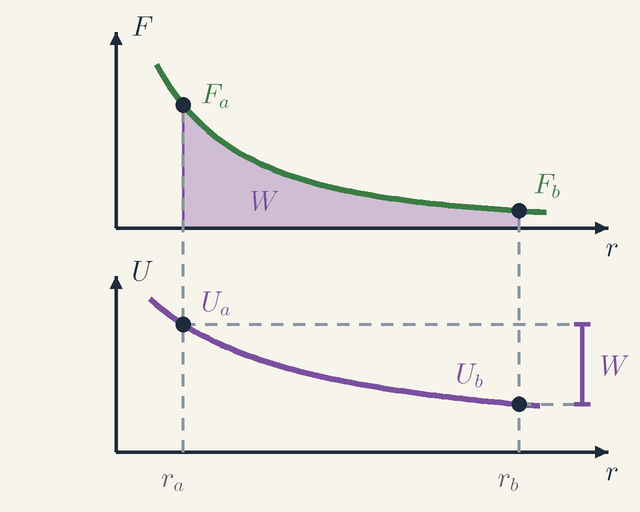
Figure 4. Force F (top) and potential energy U (bottom) of two equal like charges against their separation r. The shaded area under F from ra to rb is the work W, and it equals the drop of U from Ua to Ub.Legend
r
Separation of the charges.
m
F
Size of the repulsive force, kq2/r2.
N
U
Potential energy of the pair, kq2/r, zero at infinite separation.
J
ra
Starting separation.
m
rb
Final separation.
m
Fa
Force at ra.
N
Fb
Force at rb.
N
Ua
Potential energy at ra.
J
Ub
Potential energy at rb.
J
W
Work done by the repulsion from ra to rb: the shaded area, equal to the drop Ua−Ub.
J
Figure 4 has two graphs for the two equal charges q=2μC of the pucks, both against their separation r. The upper graph shows the size of the force, F=kq2/r2. The lower graph shows the potential energy of the pair, U=kq2/r, which the next paragraphs derive. Here kq2=8.99×109⋅(2×10−6)2≈0.03596N⋅m2. The pucks move between ra=15cm and rb=40cm. On the upper graph the dots mark Fa≈1.60N and Fb≈0.22N; on the lower graph they mark Ua≈0.240J and Ub≈0.090J.
The force curve is steepest at small r. Differentiating kq2r−2 gives the slope dF/dr=−2F/r: about −1.1N/m at 40 cm and −21N/m at 15 cm, a factor of (40/15)3≈19. The expert graph of the animation plots the same curve on ordinary axes. As the pucks swing between 40 and 15 cm, its green dot slides along it between 0.22 N and 1.60 N and shoots up at the left end. On logarithmic axes the same curve would be a straight line of slope −2, the exponent of the law.
Now the work. When the pucks move apart by a small step dr, the repulsion does the work Fdr: a thin strip of area under the upper curve. Adding the strips from ra to rb gives the shaded area W of Figure 4: W=∫rarbr2kq1q2dr=kq1q2(ra1−rb1)
The answer is one function of r taken at the start minus the same function at the end. Calling that function the potential energy, U(r)=kq1q2/r, the work is W=U(ra)−U(rb): the force does work by using up potential energy. A constant could be added to U without changing any difference; the form above makes U zero at infinite separation, where the force vanishes. Read the other way, the force is minus the slope of the energy, F=−dU/dr along the line joining the charges.
Between 15 and 40 cm the shaded area is W=0.03596⋅(1/0.15−1/0.40)≈0.150J. On the lower graph the same 0.150 J appears as the drop from Ua to Ub, marked by the bracket W: 0.240−0.090=0.150J.
The animation shows both signs. In the repelling phase, the hand that pushes the like pucks together from 40 to 15 cm does 0.150 J of work against the repulsion, and the pair stores it. In the attracting phase q1q2<0, so U is negative: it drops from −0.090 to −0.240J as the pucks approach from 40 to 15 cm, and now the field does the 0.150 J of work instead.
Worked problem: letting the pucks go
Suppose each puck has a mass of 20 g and the like-charged pair is released from rest, 15 cm apart, on the frictionless rail. Find the initial acceleration of each puck, and its speed when the pucks are 40 cm apart and when they are very far apart.
At the start each puck feels the force Fa≈1.60N, so by Newton's second law its acceleration is 1.60/0.020≈80m/s2, about eight times g. The force weakens as the pucks separate, so the acceleration is not constant and the formulas for constant acceleration do not apply. The speeds come from energy instead.
Two facts are needed. The forces on the two pucks are equal and opposite, so the total momentum stays zero; with equal masses, the pucks move with equal speeds in opposite directions about a fixed midpoint. And energy is conserved: the kinetic energy of both pucks together equals the drop of the lower curve of Figure 4 from r0=0.15m to the current separation r: 2⋅21mv2=mv2=U(r0)−U(r)
At 40 cm the drop is the 0.150 J found above, so mv2=0.150J and v=0.150/0.020≈2.74m/s. Very far away U→0, so the whole 0.240 J becomes kinetic energy: mv2=0.240J and v=0.240/0.020≈3.46m/s.
By the time the gap has grown from 15 to 40 cm, the pair has released the fraction 1−Ub/Ua=1−15/40=0.625 of its stored energy. Speed grows as the square root of kinetic energy, so the pucks already have 0.625≈0.79 of their final speed: an inverse-square push acts hard and briefly. The attracting pair runs the same film backwards: released from rest 40 cm apart, the pucks pass the 15 cm mark at 2.74 m/s each, moving towards each other.
Limits of validity
Coulomb's law is a law of charges at rest, in empty space, at ordinary distances. Each of these conditions marks a limit.
Moving charges also exert magnetic forces. For two charges moving side by side at the speed v, the magnetic force is a fraction of order v2/c2 of the electric one. In addition, when one charge moves, the change reaches the other only after the travel time r/c, 0.5 ns across 15 cm. For the pucks of the animation, slower than 0.07 m/s, v2/c2≈5×10−20; even at the 3.46 m/s of the worked problem it is only about 10−16. In an accelerator beam, by contrast, the electrons move so close to c that the magnetic attraction between them nearly cancels their electric repulsion. Charge itself is the same at any speed.
In an insulating medium the molecules polarise: their charges shift slightly, and the shifted charges partly screen the two charges from each other. The force is divided by the relative permittivity εr of the medium, about 80 for water. This is why salt dissolves. Separating a sodium ion and a chloride ion that touch, 0.28 nm apart, takes about 5 eV in vacuum but, crudely, 5/80≈0.06eV in water, only a few times the thermal energy at room temperature (0.026 eV).
Air limits how much charge a body can hold: it breaks down and sparks in fields near Emax=3MV/m. The field at the surface of a sphere of radius R carrying the charge Q is kQ/R2, so the charge cannot exceed about EmaxR2/k: 33 nC for R=1cm. Microcoulomb charges like the animation's need large spheres (2 µC needs a radius of about 8 cm) or a vacuum.
At nuclear distances the force is enormous: two protons 2 fm apart (1fm=10−15m) repel with about 58 N, the weight of a 6 kg mass, acting on a single particle. Only the short-range strong force holds nuclei together; in heavy nuclei, with many protons, the electric repulsion gains ground, which makes fission possible. Nor is the proton a point: its charge is spread over a radius of about 0.84 fm. Finally, in quantum electrodynamics, the quantum theory of the electric force, short-lived electron–positron pairs partly screen every charge. Below about 10−12m this screening thins out and the force grows slightly faster than 1/r2, an effect seen in the hydrogen spectrum.
Where this leads
The field introduced above is the main tool of Electric Field and Potential, where the energy U=kq1q2/r becomes the potential V=kQ/r, energy per unit charge, and Gauss's law gives fields without summing. Capacitors uses ε0 and εr. Gravitation has the same inverse-square form, so what Gravitation and Orbits shows about circular orbits carries over to an electron circling a nucleus in Atomic Models: the Bohr Atom. Magnetic Force on Moving Charges adds the force between moving charges, which relativity ties to this one, and Electromagnetic Waves shows how changes spread at c=1/ε0μ0, where μ0 is the magnetic constant. Particles and Forces: the Standard Model describes the electric force as the exchange of photons.
Key formulas
Coulomb's law: size of the force
F=r2k∣q1q2∣
Two point charges push or pull on each other with a force proportional to each charge and to 1/r2. The absolute value makes the formula give the size only; the force acts along the line joining the charges, pushing them apart if they are alike and pulling them together if they are opposite. The units work out: N⋅m2/C2 times C2/m2 gives N.
Symbols
F
size of the force on each charge
N
k
Coulomb's constant
N⋅m2/C2
q1
first charge
C
q2
second charge
C
r
distance between the centres of the charges
m
When it holds: Exact for point charges at rest in vacuum, and for spherically symmetric charges with r measured between their centres. Inside a medium divide by εr; for moving charges, magnetic forces must be added.
Example: The pucks in the animation, 2 µC each, 15 cm apart: F=0.03596/0.152≈1.60N; at 40 cm, 0.22 N.
Coulomb's constant
k=4πε01≈8.99×10⁹N⋅m2/C2
The constant k turns charges in coulombs and distances in metres into a force in newtons. Writing it as 1/(4πε0) puts 4π, the area of a unit sphere, into Coulomb's law, so that Gauss's law and the formulas for capacitors need none. Its huge value shows how strong the electric force is: 1 C against 1 C at 1 m would give about 9×10⁹N.
Symbols
k
Coulomb's constant
N⋅m2/C2
ε0
permittivity of free space (vacuum permittivity)
F/m
When it holds: A constant of nature for charges in vacuum. Between charges embedded in a medium of relative permittivity εr, the effective constant is k/εr.
Every free charge is a whole number of elementary charges: a proton carries +e and an electron −e. Charging a body means adding or removing electrons, and n counts them. Because e is so small, a single microcoulomb is already about six million million elementary charges, and charge looks continuous in everyday life. Since 2019 the value of e is exact by definition: 1.602176634×10⁻¹⁹C.
Symbols
e
elementary charge, the charge of a proton
C
q
charge of the body
C
n
whole number of elementary charges (negative for an excess of electrons)
When it holds: Holds for every free particle ever observed. Quarks carry ±e/3 or ±2e/3, but they are always bound into combinations whose total charge is a whole multiple of e.
Example: A charge of +1.6 nC means n=(1.6×10⁻⁹)/(1.6×10−19)=1010 electrons removed.
Equal and opposite forces (Newton's third law)
F12=−F21
F12 is the force that q1 exerts on q2, and F21 the force that q2 exerts on q1. They have the same size, because both contain the same product q1q2 and the same distance, and they point in opposite directions along the line joining the charges. Equal forces still give unequal accelerations when the masses differ.
Symbols
F12
force exerted by q1 on q2
N
F21
force exerted by q2 on q1
N
When it holds: Exact for charges at rest. For moving charges the magnetic forces need not be equal and opposite; momentum is then conserved only if the momentum carried by the field is included.
Example: Charges of 1 µC and 4 µC, 30 cm apart, each feel 0.40 N, in opposite directions.
Coulomb's law in vector form
F12=r2kq1q2r^12
The unit vector r^12 points from q1 to q2, so the formula gives the direction as well as the size. For q1q2>0 the force on q2 points away from q1 (repulsion); for q1q2<0 it points towards it (attraction). Exchanging the labels reverses r^12 but not the product, which builds in F21=−F12.
Symbols
F12
force exerted by q1 on q2
N
k
Coulomb's constant
N⋅m2/C2
q1
first charge, with its sign
C
q2
second charge, with its sign
C
r
distance between the charges
m
r^12
unit vector pointing from q1 to q2
When it holds: Point charges at rest, with the charges entered with their signs. With position vectors, r^12=(r2−r1)/r.
Example: For q1=+2μC and q2=−2μC at 15 cm, F12=−1.60Nr^12: a force of 1.60 N on q2, pointing back towards q1.
Superposition principle
Fnet=∑Fi(superposition)
The force on a charge due to several others is the vector sum of the forces each one would exert alone: a third charge does not change the force between the first two. Add the forces component by component, or as arrows placed head to tail. Dividing by the charge that feels the forces gives the same rule for electric fields.
Symbols
Fnet
net (total) force on the charge
N
Fi
force from the i-th other charge, computed as if it were alone
N
When it holds: An experimental fact in all ordinary fields. Near conductors and insulators the charges shift as others approach, so their positions must be found first; quantum effects break superposition only in fields near 1018V/m.
Example: A charge of −0.5μC midway between +2 and −2μC, 30 cm apart, feels two forces of 0.40 N in the same direction: 0.80 N towards the positive charge.
Glossary
Electric charge
The property of matter that makes bodies exert electric forces on each other. It comes in two signs, positive (protons) and negative (electrons), is conserved, and is measured in coulombs.
Quantisation of charge
Every free charge is a whole multiple of the elementary charge, q=ne with e=1.602×10⁻¹⁹C. A charge of 2 µC is about 1.25×10¹³ elementary charges, so on everyday scales charge looks continuous.
Point charge
A charged body small compared with the distances that matter, treated as if all its charge sat at one point. Seen from outside, a uniformly charged sphere behaves exactly like one.
Coulomb's law
The law of force between two point charges at rest: proportional to the product of the charges, inversely proportional to the square of their distance, and directed along the line joining them.
Inverse-square law
A law in which an effect falls off as 1/r2: twice as far gives a quarter, three times as far a ninth. Coulomb's law and Newton's law of gravitation both have this form, which is tied to the area 4πr2 of a sphere.
Attraction and repulsion
Like charges (both positive or both negative) repel each other; opposite charges attract. In the vector law the sign of the product q1q2 decides which: positive for repulsion, negative for attraction.
Action–reaction pair
The two forces that two bodies exert on each other, equal in size and opposite in direction (Newton's third law). For two charges F12=−F21, even when one charge is much larger than the other.
Superposition principle for charges
The force on a charge due to several others is the vector sum of the forces each would exert alone, and fields add in the same way. It is an experimental fact, not a logical necessity.
Electric field
The force per unit charge that a small test charge would feel at a point, E=F/q, measured in N/C. A point charge Q produces a field of size k∣Q∣/r2.
Gauss's law
The flux of the electric field through any closed surface equals the enclosed charge divided by ε0. It is the inverse-square law restated in geometric form.
Shell theorem
A uniformly charged spherical shell acts on outside charges as if its charge were at its centre, and exerts no force on charges inside it. Both statements hold only because the exponent in Coulomb's law is exactly 2.
Dielectric screening
The weakening of the force between charges embedded in an insulator, whose molecules polarise and partly cancel their fields. The force is divided by the relative permittivity εr, about 80 for water.
Quantities
F
Size of the electric force
N
The magnitude of the force that each charge exerts on the other; the signs of the charges set its direction. The pucks in the animation feel 1.60 N at 15 cm.
q
Charge
C
The amount of charge on a body, with its sign; q1 and q2 are the two charges in Coulomb's law.
r
Distance between the charges
m
The separation of the two point charges, measured between the centres of the bodies, not between their surfaces.
k
Coulomb constant
N⋅m2/C2
Sets the strength of the electric force in SI units: two charges of 1 C each, 1 m apart, would repel with about 8.99×10⁹N.
ε0
Vacuum permittivity
F/m
The constant in k=1/(4πε0), about 8.85×10⁻¹²F/m, which is the same as C2/(N⋅m2).
e
Elementary charge
C
The charge of a proton, exactly 1.602176634×10⁻¹⁹C; an electron carries −e.
n
Number of elementary charges
The whole number in q=ne: positive when electrons have been removed, negative when they have been added. For +1.6 nC, n=1010.
F12
Force of charge 1 on charge 2
N
The vector force that q1 exerts on q2, drawn on the right puck in the animation; its partner F21 acts on q1.
r^12
Unit vector from charge 1 to charge 2
A vector of length 1 pointing from q1 towards q2; it carries the direction of the force in the vector form of the law.
Fnet
Net force
N
The vector sum ∑Fi of the forces Fi that all the other charges exert on one charge, each computed as if it acted alone. For q3 in the animation it is the purple arrow: 0.63 N straight up at the closest approach of the like pair.
εr
Relative permittivity
The factor by which a medium reduces the force between charges embedded in it: 1 for vacuum, about 1.0006 for air and about 80 for water.
Quiz
Beginner A balloon rubbed on your hair becomes negatively charged. What has happened?
Protons moved from your hair to the balloon
Electrons moved from your hair to the balloon
Charge was created by friction
The balloon lost electrons
Show answer
Answer: B. Electrons moved from your hair to the balloon
Rubbing transfers electrons. The balloon gained extra electrons, so it is negative and your hair is left positive. Charge is moved, never created.
Beginner Two charged spheres are brought closer together, from 20 cm apart to 10 cm apart. What happens to the force between them?
It becomes four times stronger
It halves
It doubles
It stays the same
Show answer
Answer: A. It becomes four times stronger
The force depends on 1/r². Halving the distance multiplies the force by 2² = 4.
Beginner A positively charged rod is held near a negatively charged ball hanging on a thread. What does the ball do?
It swings away from the rod
It does not move
It swings towards the rod
It first moves away, then comes back
Show answer
Answer: C. It swings towards the rod
Opposite charges attract, so the negative ball is pulled towards the positive rod.
Intermediate What is the force between two charges of 3 µC each placed 0.3 m apart? (k = 8.99 × 10⁹ N·m²/C²)
0.27 N
2.7 N
8.99 N
0.90 N
Show answer
Answer: D. 0.90 N
F = 8.99 × 10⁹ × (3 × 10⁻⁶)² ÷ 0.3² = 8.99 × 10⁹ × 9 × 10⁻¹² ÷ 0.09 ≈ 0.90 N. Forgetting to square r gives 0.27 N.
Intermediate Charge q₁ = 1 µC and charge q₂ = 4 µC are some distance apart. How do the forces on them compare?
They are equal in size and opposite in direction
The force on q₂ is four times larger
The force on q₁ is four times larger
They are equal and point in the same direction
Show answer
Answer: A. They are equal in size and opposite in direction
Newton's third law: F₁₂ = −F₂₁. The product q₁·q₂ appears in both forces, so they are always equal in size.
Intermediate How many electrons must be removed from a neutral object to give it a charge of +1.6 nC? (e = 1.6 × 10⁻¹⁹ C)
1.6 × 10⁹
1.0 × 10¹⁹
1.0 × 10¹⁰
6.25 × 10¹⁸
Show answer
Answer: C. 1.0 × 10¹⁰
n = q / e = 1.6 × 10⁻⁹ ÷ 1.6 × 10⁻¹⁹ = 10¹⁰ electrons. 6.25 × 10¹⁸ is the number in a whole coulomb.
Advanced Two charges +q sit at (−a, 0) and (+a, 0). What is the direction of the net force on a third charge −q placed at (0, a)?
Along +x
Along −y, towards the x-axis
Along +y, away from the x-axis
Zero: the forces cancel
Show answer
Answer: B. Along −y, towards the x-axis
Each +q attracts −q along the line joining them. The x-components cancel by symmetry and the y-components add, so the net force points down towards the x-axis.
Advanced Two charges are immersed in water (εᵣ ≈ 80) at the same separation as in vacuum. How does the force between them change?
It increases about 80 times
It is unchanged
It drops to about 1/√80 of its value
It drops to about 1/80 of its value
Show answer
Answer: D. It drops to about 1/80 of its value
In a dielectric, F = q₁·q₂ / (4πε₀·εᵣ·r²): the polarised water molecules screen the charges and reduce the force by εᵣ.
 Physics Tutor