Electric charge q comes in two signs and in whole multiples of the elementary charge, q=±ne; rubbing only moves electrons from one body to another, so the total is conserved, and a charged body attracts even neutral ones by polarising them.
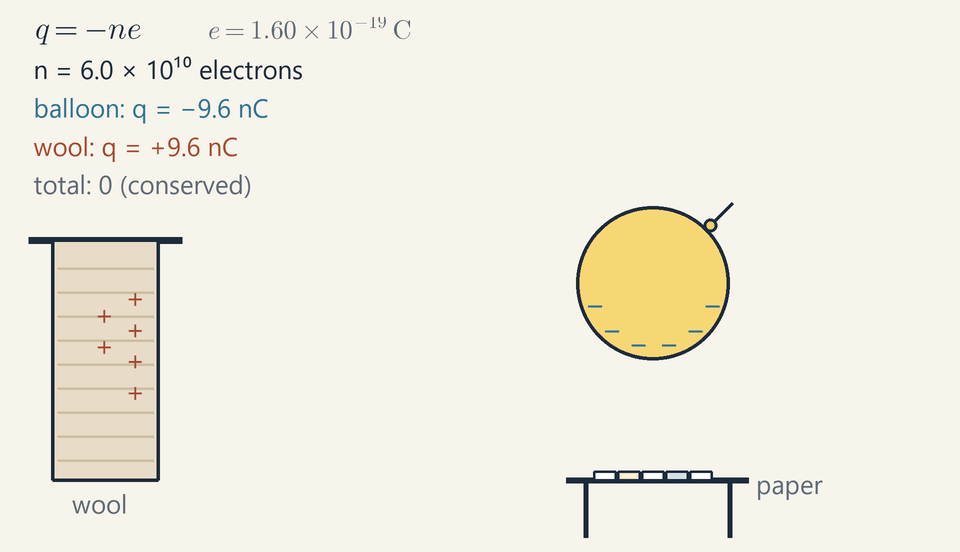
A balloon is rubbed on a wool scarf and gains electrons; held over bits of paper, it polarises them and they jump up and cling to it.
Beginner
Key ideas
Matter contains positive protons and negative electrons; an object with equal numbers of each is neutral.
Rubbing moves electrons from one material to another: the one that gains them turns negative, the one that loses them positive.
Charge is never created or destroyed, only moved: the balloon gains exactly what the wool loses.
Like charges repel and opposite charges attract; a charged object even attracts neutral things like bits of paper.
Metals let charge move freely (conductors); rubber, plastic and paper hold it in place (insulators).
Pull a wool jumper over your head in a dark room and you may see tiny sparks and hear them crackle. That is static electricity: electric charge that has built up on an object and stays put.
Step 1: two kinds of charge. Everything is made of atoms. In the middle of each atom sit protons, which carry positive charge (+); around them move much lighter electrons, which carry negative charge (−). An ordinary object has exactly as many electrons as protons, so it is neutral.
Step 2: the rule of the game. Like charges push each other away; opposite charges pull each other together.
Step 3: charging by rubbing. Some materials hold on to their electrons more tightly than others. Rub a rubber balloon on a wool scarf and electrons leave the wool for the balloon. The balloon now has extra electrons, so it is negative; the wool is short of the same number, so it is positive. No charge is made or destroyed: it only moves, and the total stays the same.
Step 4: conductors and insulators. In metals some electrons roam freely, so extra charge spreads over the whole object; these are conductors. In rubber, plastic, paper and wool the electrons stay put, so charge stays where it was put; these are insulators.
Step 5: pulling on neutral things. A charged balloon nudges the charges inside nearby paper, so the side facing it becomes slightly positive. That side is closer, so the pull wins and the paper jumps up.
Check yourself: a plastic comb gains electrons from your hair. Is the comb positive or negative? Will it attract or repel your hair? Answer: negative; attract, because your hair is now positive.
In the animation, blue electrons hop from the wool onto the balloon, leaving red plus signs behind; then bits of paper leap up to the balloon.
Intermediate
Key ideas
Charge is measured in coulombs and is quantised: q=±ne with e=1.602×10⁻¹⁹C.
In solids only electrons move: a positive object has lost electrons, a negative one has gained them.
Conservation: the total charge of an isolated system is constant, so qballoon+qwool=0 after rubbing.
Two identical conducting spheres that touch share their total charge equally: q′=(q1+q2)/2.
Induction: a nearby charge separates charges in a conductor or polarises an insulator, giving attraction without contact.
What charge is, and how it is counted
Electric charge is a property of the particles that atoms are made of. It comes in two kinds, named positive and negative by Benjamin Franklin: protons in the nucleus carry positive charge, the much lighter electrons around it negative charge, and neutrons none. Like charges repel, unlike charges attract. An atom has as many electrons as protons, so it is neutral: its net charge is zero, but it holds plenty of both kinds.
Charge is measured in coulombs (C), and static charges are usually nanocoulombs (1 nC is 10−9C) or microcoulombs. It comes in whole numbers of a smallest portion, the elementary charge: a proton carries +e and an electron −e, where e=1.602×10⁻¹⁹C so the charge of any object is q=±ne,n=0,1,2,…
In solids the nuclei stay locked in place and only electrons move, so n counts the electrons gained (sign −) or lost (sign +). One coulomb is 6.24×10¹⁸ elementary charges.
Rubbing separates charge; the total is conserved
When two different materials touch, some surface electrons move to the one that binds them more tightly; rubbing multiplies the points of contact. Rubber, PVC and polythene take electrons from wool, hair and skin, while glass loses some to silk. Such rankings, called triboelectric series, are rough guides: humidity and dirt can change them.
Rubbing does not make charge; it separates charge that was already there. In an isolated system, one that no charge enters or leaves, the total never changes: ∑q=const(isolated system) The sum is taken with signs: a negative balloon and an equally positive scarf add up to zero, as they did before they touched. No experiment has ever found this law broken.
Worked example: the balloon in the animation
In the animation the balloon is rubbed with four up-and-down strokes, and the counter climbs to n=6.0×10¹⁰ electrons; each blue minus sign that hops across stands for 1010 of them. The balloon has gained electrons, so q=−ne=−6.0×1010⋅1.602×10−19C q=−9.6×10⁻⁹C=−9.6nC
The wool has lost exactly those electrons, so it carries +9.6nC. These are the final values on the blue and red readouts; at every moment of the rubbing the two are equal and opposite, as every red plus sign left on the wool matches a blue minus sign on the balloon.
Is that a lot? A 3 g balloon contains about 1024 electrons, so only one in 17 trillion is extra. Electric forces are so strong that even this imbalance lifts paper.
Conductors and insulators
In a metal, one or two electrons per atom roam freely through the whole piece, so extra charge spreads out at once and settles on the outer surface. Such materials are conductors: metals, salty water and the human body, whose charge carriers are ions.
In insulators such as rubber, plastic, glass and dry paper, electrons stay bound to their atoms, so charge stays where it was put. That is why the animation turns the balloon's rubbed side towards the paper. A metal spoon held in your bare hand cannot be charged by rubbing: the charge escapes through you to the ground.
Connecting a conductor to the ground, which can give or take any amount of charge, is called earthing. In damp weather a water film on surfaces also leaks charge, though more slowly, so static tricks work best on dry days.
Worked example: sharing charge between spheres
When two conductors touch, electrons flow until nothing pushes them further. Identical conductors must, by symmetry, end with equal charges, and conservation fixes the total: q′=2q1+q2(identical conductors in contact)
Three identical metal spheres stand on insulating stands: A carries −12nC, B is neutral and C carries +4nC. A touches B, then B touches C. What does each sphere end with?
First contact: the total is −12nC, so A and B end with −6nC each, after 6nC/e=3.7×1010 electrons have moved from A to B. Second contact: the total is −6+4=−2nC, so B and C end with −1nC each. Check: −6−1−1=−8nC, the starting total −12+0+4. In the second contact 5nC/e=3.1×1010 electrons crossed from B to C, cancelling its +4nC and leaving it slightly negative; no positive charge travelled.
Attraction without contact: polarisation and induction
A charged object can pull on a neutral one without touching it. Bring a negative rod near a metal ball: the ball's free electrons are pushed to the far side, leaving the near side positive. This is electrostatic induction. The ball stays neutral, but its positive side is closer to the rod, and electric forces weaken with distance, so the attraction wins.
In paper, an insulator, electrons cannot travel; instead each molecule is stretched slightly into a tiny dipole, a pair of equal and opposite charges a small distance apart. The paper is polarised: positive on the face towards the balloon and negative on the far face, as the close-up shows with its + and − signs drawing apart.
The arrows on the middle bit show the contest. The mg arrow, the bit's weight, stays the same, while the green F arrow, the electric pull, grows faster and faster as the balloon comes down. When F is as long as mg, the bit takes off; the middle bit, right under the balloon, goes first. An electroscope uses induction too: a charged rod near its cap drives charge of the rod's sign into two thin leaves, which repel and spread apart.
Common mistakes
Rubbing does not create charge: the balloon's −9.6nC and the wool's +9.6nC were already there in neutral matter, and they still add up to zero.
A positive object has lost electrons, not gained protons: the wool's +9.6nC means 6.0×10¹⁰ missing electrons.
Neutral does not mean uncharged: a neutral 3 g balloon holds about 160,000 C of negative charge in its electrons, balanced exactly by its nuclei.
Attraction does not prove that a body is charged: a neutral bit of paper is attracted by either sign. Only repulsion shows that two bodies carry charges of the same sign.
Multiply by e, do not divide: 6.0×10¹⁰ electrons carry 9.6×10⁻⁹C, while dividing gives an absurd 3.7×1029C.
Where you meet it
Static electricity works in laser printers and photocopiers, whose charged drum picks up toner in the pattern of the page, in spray painting and in electrostatic precipitators, which remove over 99 % of the ash from power-station smoke. It is also a hazard: walking across a carpet on a dry day can leave about a microcoulomb on you, enough for a spark at a door handle, and fuel tankers are earthed before unloading. A lightning stroke carries some 5 to 30 C.
The next lesson, Coulomb's Law, measures the force between two charges. Electric Field and Potential, Capacitors, and Electric Current and Resistance follow charge into the space around it, into storage and into motion.
Advanced
Key ideas
Electric forces dwarf gravity (about 1036 times for two protons), so matter stays neutral to exquisite precision.
Conservation is local: ∂ρ/∂t+∇⋅J=0, so charge can only leave a region by flowing across its boundary.
A neutral body gets an induced dipole p=αE and feels F=2α∇(E2): pulled towards stronger field, whatever the sign of Q.
Near a point charge F=2αk2Q2/d5: halve d and the pull grows 32 times, so a lifting bit runs away.
In equilibrium E=0 inside a conductor, and any net or induced charge sits on its surface.
A force that almost cancels itself
Electric forces run the everyday world even though most matter looks uncharged. Two small charges q1 and q2 a distance r apart attract or repel each other with a force of size F=r2k∣q1q2∣ (Coulomb's law), where k=8.99×10⁹N⋅m2/C2. Like gravity, this force falls off as the inverse square of the distance. Unlike gravity, it is incomparably stronger.
Compare the two forces between two protons, each of charge e and mass mp, with G the gravitational constant. Both forces carry the same 1/r2, so r cancels and the ratio is the same at every distance: FgFe=Gmp2ke2≈1.2×1036
Why, then, do we so rarely notice it? Because charge comes in two signs, and matter balances them almost perfectly: the charge of an atom or molecule is zero to within one part in 1021 of e.
A rough estimate shows why the balance has to be that fine. A 1 g drop of water contains 3.3×10²³ electrons, a charge of about 5.4×10⁴C, matched by the same positive charge in its nuclei. Take one electron in a million out of each of two such drops, and place them 1 m apart. Each drop is left with q=+0.054C, and they repel with F=r2kq2≈2.6×10⁷N the weight of some 2600 tonnes.
What we do feel are leftovers. Neighbouring atoms are neutral, but at atomic distances their positive and negative charges do not sit exactly on top of each other. That small mismatch is the push of a table, the tension in a rope and the bonds of chemistry.
Quantised, invariant and conserved
Three experimental facts define what charge is. Every theory of matter has to respect all three.
First, charge is quantised: it comes only in whole multiples of the elementary charge e. Between 1909 and 1913 Robert Millikan showed this by balancing tiny charged oil drops against gravity in an electric field; every charge he measured was a whole number times e. Since 2019 the SI fixes e=1.602176634×10⁻¹⁹C exactly, and this value defines the coulomb. Quarks carry fractions, +32e or −31e, but they are never found alone. They are always bound into particles with whole charges: the proton (uud) has +e, the neutron (udd) zero.
Second, charge is invariant: it does not depend on how fast the charged particle moves. Inside a helium nucleus the protons move at a sizeable fraction of the speed of light; in a hydrogen molecule they are nearly at rest. If a proton's charge changed with its speed, one of the two gases would carry a net charge, yet both are neutral to about one part in 1020. Energy, momentum, lengths and time intervals all depend on the observer; charge does not.
Third, charge is conserved: in every process ever observed, the total charge after equals the total before. A gamma ray passing near a nucleus can turn into an electron and a positron, 0→(−e)+(+e). A free neutron decays into a proton, an electron and an antineutrino, 0→(+e)+(−e)+0. Particles appear and disappear, but the net charge does not change.
Local conservation: the continuity equation
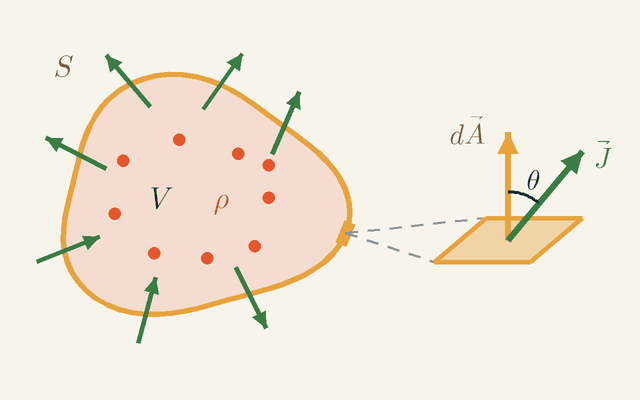
Figure 1. A fixed volume V, bounded by the closed surface S, holds charge of density ρ, and the current density J crosses S out and, on the left, in. On the enlarged patch the current out is J⋅dA=JdAcosθ, negative where charge comes in.Legend
S
Closed surface that bounds the volume V.
V
The volume inside S, held fixed.
m3
ρ
Charge per unit volume inside V (the red dots).
C/m3
J
Current density: current per unit area, pointing the way positive charge flows.
A/m2
dA
One small patch of S as a vector: its length is the patch's area dA, and it points out of V.
m2
θ
Angle between J and dA; above 90∘ where charge flows in.
rad
Conservation says more than "the total stays the same". Charge cannot vanish in one place and reappear in another; it has to travel there. This section turns that idea into an equation, and Figure 1 sets up the bookkeeping.
Figure 1 shows a fixed volume V bounded by a closed surface S. The charge inside is described by its density ρ, the charge per unit volume (the red dots). Moving charge is described by the current density J, the current per unit area, pointing the way positive charge flows. The arrows J cross S in both directions: most leave V, but the two on the left enter it.
To count what crosses S, cut it into small patches. The enlarged patch on the right has area dA, and we turn it into a vector dA of length dA, pointing out of V. Only the part of J along dA carries charge through the patch; the part parallel to the patch slides past it. So the current out through the patch is J⋅dA=JdAcosθ where θ is the angle between the two arrows of the enlarged patch. Where charge flows out, θ is below 90∘ and this term is positive; where charge flows in, θ is above 90∘ and it is negative. Summed over all patches, ∮SJ⋅dA is the net current out of V.
Now the physics. Because V is fixed, the charge inside it can change only by crossing S. So the charge inside falls exactly as fast as the net current flows out: dtd∫VρdV=−∮SJ⋅dA This is the integral form of local conservation. To turn it into a statement about single points, use the divergence theorem, which rewrites the flux out of a closed surface as a volume integral of the divergence: ∮SJ⋅dA=∫V∇⋅JdV. Since V does not move, the time derivative can go inside the integral on the left, and both sides become integrals over the same volume: ∫V(∂t∂ρ+∇⋅J)dV=0 This holds for every fixed volume, however small. An integral that vanishes over every small region can do so only if the integrand is zero at every point, so ∂t∂ρ+∇⋅J=0 This is the continuity equation. In words: wherever the charge density is falling, current is spreading out from that point.
Why insist on the local law, when the global one would keep the total just as well? Imagine charge vanishing on Earth and reappearing at the same moment on the Moon. The total would never change. But in relativity, two distant events that are simultaneous for one observer are not simultaneous for another observer moving past. That second observer would see the charge missing for a while, or present in both places at once. Only charge that flows continuously across boundaries is conserved for every observer.
The animation's q(t) graph shows the integral form at work. Draw S around the balloon. Charge crosses it only where balloon and wool touch, so the slope of the blue balloon curve is the current into the balloon. The red wool curve has the opposite slope at every instant: what one gains, the other loses. The charge changes by 9.6 nC in 3.2 s, an average current of 3.0 nA. The transfer follows the distance rubbed, so the current peaks at about 4.7 nA in mid-stroke and drops to zero at each end of a stroke, where the balloon stops and reverses.
Why a neutral body is pulled
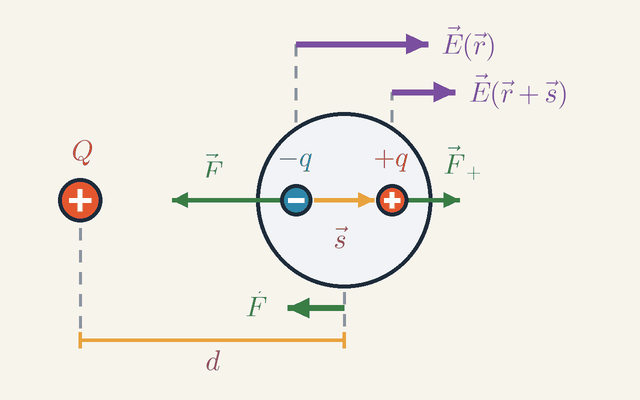
Figure 2. A neutral body near a positive charge Q is polarised: −q gathers on the near side and +q on the far side, a vector s apart. The near end sits in the stronger field, so the pull F− beats the push F+ and the net force F points towards Q. Not to scale.Legend
Q
Positive source charge.
C
d
Distance from Q to the centre of the body.
m
q
Size of each of the two charges that the field separates in the body.
C
s
Separation of the charges, from −q to +q; the dipole moment is p=qs.
m
E(r)
Field of Q at the −q end, the nearer one, at position r from Q.
N/C
E(r+s)
Field of Q at the +q end: weaker, because that end is farther from Q.
N/C
F−
Force on −q, towards Q.
N
F+
Force on +q, away from Q and smaller.
N
F
Net force on the body, F−+F+: towards Q.
N
A charged balloon picks up bits of paper that carry no net charge. How does it pull them, and how quickly does the pull grow as the balloon comes closer?
Figure 2 shows a neutral body at a distance d from a positive charge Q. The body's charges are not rigidly fixed; they can shift a little. The field of Q points away from Q, so it pushes positive charge away and draws negative charge closer. A charge −q gathers on the near side and +q on the far side, separated by the small vector s, drawn from −q to +q. The body has become an induced dipole, with dipole moment p=qs.
How large p becomes depends on how easily the charges shift. In a field that is weak compared with the fields inside atoms, it is proportional to the field, p=αE where the constant α, the polarisability, measures that ease.
Now look at the forces. Each end of the dipole feels the field where it sits. Let r be the position of the near end, measured from Q. The −q end at r sits in the field E(r) and is pulled towards Q by F−. The +q end at r+s sits farther out, in the weaker field E(r+s), and is pushed away by the smaller force F+. The two charges are equal and opposite, but the fields they sit in are not equal, so the forces do not cancel. Their sum, the net force F drawn below the body, points towards Q.
To find its size, add the two forces and expand the field across the short step s: E(r+s)≈E(r)+(s⋅∇)E, where (s⋅∇)E is the change in E over that step. Then F=q[E(r+s)−E(r)]≈(p⋅∇)E So a dipole feels a net force only where the field changes from place to place.
Next, put in p=αE. For any field, (E⋅∇)E=21∇(E2)−E×(∇×E), and an electrostatic field has no curl, ∇×E=0. Therefore F=2α∇(E2) Near a point charge, E=kQ/r2, so E2=k2Q2/r4. Its gradient points towards Q, with size 4k2Q2/r5. At the body, r=d, and the pull is F=d52αk2Q2(point charge)
Three consequences follow. First, the pull always points towards stronger field, whatever the sign of the source, because E2 ignores signs. Make Q in Figure 2 negative: E and p both reverse and the +q end becomes the nearer one, yet F still points towards Q. Second, in a uniform field E2 is the same everywhere, so there is no net force. An elongated body still turns, because it polarises most easily along its length; that is why the paper bits swing round in flight and land on one end. Third, the pull is very steep: halving d multiplies it by 25=32.
The animation's F/mg graph for the middle bit shows this steepness. When the balloon starts down at 5.6 s, the pull is 6 % of the bit's weight. It reaches a quarter at 7.0 s and more than half at 7.4 s, and it crosses the dashed line at 1 at about 7.6 s, when the bit lifts.
These readings can be compared with the point-charge law. Over the same time the distance from the balloon's centre to the bit shrinks from 80 to 52 units. For a charge at the centre, the 1/d5 law would raise the pull (80/52)5≈8.6 times; it actually grows 17 times. The reason is that the charge sits on the balloon's lower surface, whose nearest part comes almost twice as close. Once the bit lifts, the gap closes further and the pull runs away.
Conductors in equilibrium
In a conductor some charges are free to move: in a metal, electrons. They keep moving as long as any field pushes them, so once everything has settled the field inside the material is zero, E=0. Gauss's law, developed in Electric Field and Potential, then says there is no net charge anywhere inside: all excess or induced charge sits on the surface. The field just outside is perpendicular to the surface, since a component along it would still move the surface charges. Its size is E=σ/ε0, where σ is the charge per unit area of the surface and ε0=1/(4πk) is the permittivity of free space.
The same mobility explains charging by induction. Bring a charged rod near a conductor, and charge of the opposite sign gathers on the side facing it. Connect the conductor to earth: charge flows through the connection until the conductor carries a net charge opposite to the rod's, held there by the rod's attraction. Break the earth connection first, then remove the rod, and the conductor keeps that charge.
Charge crowds where the surface curves
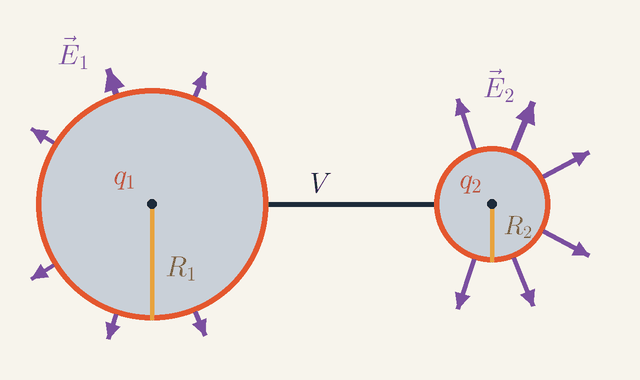
Figure 3. Two conducting spheres joined by a wire share one potential V. The larger holds more charge, yet the field at its surface is weaker: the arrows E1 and E2 are in the ratio R2:R1. Not to scale.Legend
V
Potential of the wire and of both spheres: the same everywhere on the conductor.
V
R1
Radius of the larger sphere.
m
R2
Radius of the smaller sphere.
m
q1
Charge of the larger sphere.
C
q2
Charge of the smaller sphere.
C
E1
Field just outside the larger sphere, perpendicular to its surface.
N/C
E2
Field just outside the smaller sphere: stronger, since E=V/R.
N/C
On a charged conductor the charge is not spread evenly: it piles up where the surface curves most sharply. Figure 3 shows the simplest case that makes this precise.
Figure 3 shows two conducting spheres of radii R1 and R2, the first the larger, far apart and joined by a thin wire. Together they form one conductor, so charge flows through the wire until all of it, wire and both spheres, is at one potential V. Because the spheres are far apart, each one's potential comes from its own charge alone, and a sphere of radius R holding charge q has V=kq/R. Setting the two potentials equal, kq1/R1=kq2/R2, so q2q1=R2R1 The larger sphere holds the larger charge.
Now look at the field arrows. The field at a sphere's surface is E=R2kq=RV and since V is shared, E goes as 1/R. So E2, on the small sphere, is longer than E1 in the ratio R1:R2; the arrows are drawn this way for R1=2R2. The smaller the sphere, the stronger the field at its surface, and, since E=σ/ε0, the more charge it carries per unit area.
The same holds on a single conductor of any shape: a sharp point behaves like a small sphere and a flat region like a large one. A tip with a radius of 0.1 mm on a body of radius 10 cm has a surface field about a thousand times that of the body. That is why sparks and the faint glow of corona discharge start at points and edges.
Worked problem: when does a bead jump?
This problem applies the induced-dipole force to a real object. Put the balloon's charge, Q=9.6nC, on a metal sphere of radius 1 cm on an insulating stand. Outside the sphere, its field is exactly that of a point charge Q at the centre. Below the sphere lies a light conducting bead of graphite-coated polystyrene foam, 2 mm across, with mass density ρm=20kg/m3. How close must the sphere come before the bead jumps up?
Step 1, the pull. A small conducting ball of radius a has polarisability α=4πε0a3=a3/k. Putting this into F=2αk2Q2/d5 gives F=d52kQ2a3 where d is the distance between the centres of the sphere and the bead.
Step 2, the weight. The bead's mass is its volume times its density, so mg=34πa3ρmg.
Step 3, the condition. The bead lifts when F>mg. Both sides contain a3, which cancels: d52kQ2>34πρmg Solving for d5: d5<2πρmg3kQ2
Step 4, the numbers. In SI units 3kQ2=2.5×10⁻⁶ and 2πρmg=1.23×10³, so d5<2.0×10⁻⁹m5 and d<1.8cm. The bead jumps when its centre comes within 1.8 cm of the centre of the sphere. Taking away the sphere's radius of 1 cm and the bead's of 1 mm leaves a gap of about 7 mm between the surfaces.
How the lifting distance scales
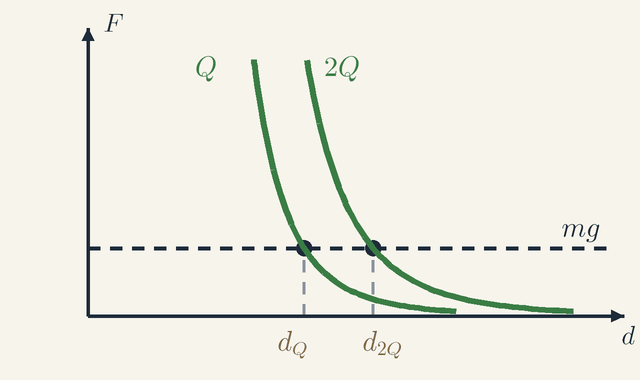
Figure 4. The pull F on the bead against its distance d from the sphere's centre, for the charges Q and 2Q, with the weight mg dashed. The bead lifts where a curve is above mg: inside dQ, or inside d2Q=22/5dQ for 2Q.Legend
d
Distance from the centre of the charged sphere to the centre of the bead.
m
F
Upward pull on the bead, F=2kQ2a3/d5, where a is the bead's radius.
N
mg
Weight of the bead (dashed line).
N
Q
Charge on the sphere; the left curve is for Q, the right one for 2Q.
C
dQ
Distance at which the pull equals the weight for the charge Q: 1.8 cm.
m
d2Q
Distance at which the pull equals the weight for the charge 2Q: 2.4 cm.
m
The worked problem gave one number. Figure 4 shows how that number moves when the charge or the bead changes, and why the bead's size drops out.
Figure 4 plots the pull F=2kQ2a3/d5 on the bead against the distance d from the sphere's centre. The pull climbs steeply as d shrinks. The weight mg does not depend on d, so it is the dashed horizontal line. The bead lifts wherever a curve runs above that line, that is, at any distance inside the crossing point. For the charge Q, the left curve, the crossing is at dQ, the 1.8 cm found above.
Now double the charge. The pull goes as Q2, so it is 4 times larger at every distance, and the right curve, for 2Q, crosses the line farther out. At the new crossing the pull must still equal mg, so 4/d2Q5=1/dQ5 and d2Q=41/5dQ=22/5dQ≈1.32dQ which is 2.4 cm. Because of the fifth power, doubling the charge gains only about a third more distance.
The bead's size does not matter, only its density, as long as the bead stays small compared with d, because a3 cancelled. A bead 32 times denser would raise the dashed line 32-fold and pull the crossing in by a factor 321/5=2, to 0.9 cm. That is inside the sphere, whose radius is 1 cm, so this bead could never lift before touching.
What happens on contact? The conducting bead takes a share of the sphere's charge, of the same sign, so it is now repelled and flung away. Paper conducts so poorly that it charges only slowly, which is why a bit of paper clings to the balloon instead.
Limits of validity
Each model in this lesson works only within a certain range.
Air insulates only up to about 3 MV/m. Above that, stray free electrons gain enough energy between collisions with molecules to knock out further electrons, and the growing avalanche is a spark.
The balloon is far from this. Its charge, spread over a rubbed patch of about 100 cm², gives a field of roughly σ/(2ε0)≈5×104V/m, some 55 times too weak; the factor 2 appears because the field of a charged insulating sheet points out on both sides. The worked problem's sphere comes much closer: its surface field, kQ/R2=8.6×105V/m with R=1cm, is within a factor of four of breakdown. At the other extreme, a lightning stroke carries 5 to 30 C, up to 2×10²⁰ electrons, across hundreds of megavolts.
Quantisation is invisible at the balloon's scale, where one electron changes the charge by one part in 6×10¹⁰. That is why charge can be treated as a continuous fluid of density ρ, as in the continuity equation.
The other models have limits of their own. The law p=αE needs fields far below those inside atoms, about 5×10¹¹V/m, and the 1/d5 law needs a body small compared with d. The triboelectric series is empirical: it is still debated whether electrons, ions or tiny bits of material carry the charge between rubbed surfaces. Finally, classical electrostatics cannot say why an electron does not fall onto a proton. That needs quantum mechanics, which begins in Atomic Models: the Bohr Atom.
Where this leads
Coulomb's Law treats the force between point charges in full. Electric Field and Potential turns fields, Gauss's law and equipotential conductors into tools; Capacitors stores separated charge; Electric Current and Resistance studies the current density J itself. Moving charges also feel magnetic forces (Magnetic Force on Moving Charges), and the continuity equation is built into Maxwell's equations (Electromagnetic Waves). Semiconductors, Diodes and LEDs treats a missing electron as a positive carrier, and Particles and Forces: the Standard Model derives charge conservation from a symmetry of nature.
Key formulas
Quantisation of charge
q=±ne,n=0,1,2,…
Charge is carried by particles: each electron has −e and each proton +e. An object's net charge is therefore the number n of electrons it has gained or lost, times e, with a minus sign for a gain and a plus sign for a loss. Charge changes in steps of e, never by a fraction of it.
Symbols
q
net charge of the object
C
n
number of electrons gained or lost (a whole number)
e
elementary charge
C
When it holds: Holds for every free particle and every object. Quarks carry ±31e or ±32e, but are always bound in whole-number combinations. For large n the steps are far too small to notice, and charge behaves as if it were continuous.
Example: The balloon in the animation gains n=6.0×10¹⁰ electrons: q=−6.0×1010⋅1.602×10−19C=−9.6nC.
Elementary charge
e=1.602×10⁻¹⁹C
The size of the charge of a single proton or electron, and the smallest charge a free particle can carry. Since 2019 the SI fixes it at exactly 1.602176634×10⁻¹⁹C, and this defines the coulomb. Its inverse says how many elementary charges make one coulomb, 6.24×10¹⁸.
Symbols
e
elementary charge
C
When it holds: The same for every electron and proton, at any speed: charge is invariant. The charges of the proton and the electron are equal in size to better than one part in 1021.
Example: A lightning stroke carrying 20 C moves 20/e=1.25×1020 electrons.
Conservation of charge
∑q=const(isolated system)
In a system that no charge enters or leaves, the sum of all charges, taken with their signs, stays the same. Charging by rubbing or contact only moves electrons from one body to another, and particle reactions create charges only in sets whose sum is zero, such as an electron with a positron.
Symbols
∑q
total charge of the system: the charges of all its parts added with their signs
C
q
charge of each part of the system
C
When it holds: Exact in every process ever observed. It also holds locally: charge leaves a region only by flowing across its boundary. For a system that is not isolated, the total changes by the net charge that has flowed in.
Example: After rubbing, qballoon+qwool=−9.6+9.6=0nC, the same total as before.
Charge sharing between identical conductors
q′=2q1+q2(identical conductors in contact)
When two conductors touch, electrons flow between them until nothing pushes them any further. For two identical conductors symmetry demands equal final charges, and conservation fixes their sum, so each ends with half the total. Add the charges with their signs before halving.
Symbols
q′
charge on each conductor after contact
C
q1
charge on the first conductor before contact
C
q2
charge on the second conductor before contact
C
When it holds: Only for identical conductors (same size and shape) that are separated far from other charges. Unequal conductors do not share equally: the larger one takes more (two distant spheres joined by a thin wire share in proportion to their radii), and insulators hardly share at all.
Example: A sphere with −12nC touches an identical neutral one: each ends with (−12+0)/2=−6nC.
Induced dipole moment
p=αE(induced dipole)
A field pushes the positive and negative charges of a neutral body in opposite directions, so the body becomes a dipole: equal and opposite charges a small distance apart. For fields that are not too strong the dipole moment is proportional to the field and points along it; the polarisability α measures how easily the body is polarised.
Symbols
p
induced dipole moment (charge times separation)
C⋅m
α
polarisability of the body
C⋅m2/V
E
electric field strength at the body
N/C
When it holds: For fields far below those inside atoms (about 5×10¹¹V/m) and a body small compared with the distance over which E changes. An elongated body polarises more along its length, so its dipole is not exactly parallel to the field and the body turns.
Example: For a conducting ball of radius 1 mm, α=4πε0a3=1.1×10⁻¹⁹C⋅m2/V; in a field of 105N/C it gets p=1.1×10⁻¹⁴C⋅m.
Force on a neutral body (induced dipole)
F=2α∇(E2)=d52αk2Q2(point charge)
The induced dipole is pulled towards stronger field, because its near end sits in a stronger field than its far end. The force depends on E2, so it is the same for a source of either sign, and it vanishes in a uniform field. Near a point charge Q, E=kQ/d2, so E2 falls as 1/d4 and its gradient as 1/d5.
Symbols
F
force on the body, towards stronger field
N
α
polarisability of the body
C⋅m2/V
∇
gradient: the rate of change in space, pointing towards the steepest increase
m−1
E
electric field strength at the body
N/C
k
Coulomb constant
N⋅m2/C2
Q
source charge
C
d
distance from the source charge to the body
m
When it holds: Needs a linear induced dipole and a body small compared with d; the second form is for a point charge, or a uniformly charged sphere seen from outside. Very close to a conductor the body's image charges add an extra pull.
Example: Halving d multiplies F by 25=32. A graphite-coated foam bead of density 20kg/m3 lifts once it is within 1.8 cm of a 9.6 nC charge.
Continuity equation (local conservation of charge)
∂t∂ρ+∇⋅J=0
If the charge density at a point falls, current must be flowing away from it: the divergence ∇⋅J is the net outflow of current per unit volume. Integrated over any volume, the equation says that the charge inside changes only by the current crossing its surface. Charge can neither appear nor vanish anywhere; it can only move.
Symbols
ρ
charge density
C/m3
t
time
s
J
current density
A/m2
∇⋅J
divergence of the current density: the net current flowing out of a small region, per unit volume
A/m3
When it holds: Exact, in every reference frame and for any kind of charge carrier; it is built into Maxwell's equations. Only local conservation agrees with relativity, where distant events that are simultaneous for one observer are not for another.
Example: While the balloon is rubbed, about 3.0 nA flows across the contact: the balloon's charge changes at −3.0nC/s and the wool's at +3.0nC/s.
Glossary
Electric charge
A property of particles that makes them push or pull on each other electrically. It comes in two kinds, positive (protons) and negative (electrons): like charges repel, unlike charges attract. An object's charge is the sum of its particles' charges with their signs, so a neutral object holds equal amounts of both.
Static electricity
Charge that has built up on an object and stays there instead of flowing, usually on an insulator after rubbing or contact. Sparks, crackling jumpers and hair that stands on end are its signs.
Quantisation of charge
Every free charge is a whole multiple of the elementary charge, q=±ne. Quarks carry thirds of e but are never found on their own.
Conservation of charge
In an isolated system the total charge, counted with signs, never changes: charging only moves electrons, and particles are created only in sets whose charges add up to zero. It also holds locally, since charge can leave a region only by flowing across its boundary.
Charging by rubbing (triboelectric effect)
The charging of two different materials that touch, made stronger by rubbing: electrons pass to the material that binds them more tightly. Rubber rubbed on wool turns negative and the wool positive, by equal amounts.
Conductor
A material in which charge moves freely: metals (free electrons), salty water and the human body (ions). Charge put on a conductor spreads over its outer surface, and in equilibrium there is no field inside it.
Insulator
A material whose electrons stay bound to their atoms, such as rubber, plastic, glass, dry wool and dry paper. Charge stays where it is put, but the material can still be polarised.
Electric polarisation
A slight separation of the positive and negative charges inside a neutral body, caused by a nearby charge. Each molecule becomes a small dipole, and the body gets opposite charges on its two faces while its total stays zero.
Electrostatic induction
The rearrangement of the free charges of a conductor by a nearby charged object: the near side takes the opposite sign, the far side the same sign. Earthing the conductor, then breaking the earth connection before removing the object, leaves it with a net charge of the opposite sign.
Earthing (grounding)
Connecting a conductor to the Earth, which can give or take any amount of charge, so that the conductor loses its excess charge. Fuel tankers and people who handle electronics are earthed to prevent sparks.
Electroscope
A simple detector of charge: a metal rod with two thin leaves at its lower end. When the rod is charged, or a charged object comes near its top, the leaves take charge of the same sign and spread apart.
Electrical breakdown (spark)
The sudden failure of an insulator in a strong field. In air above about 3 MV/m, free electrons gain enough energy to knock out more, and the avalanche makes a conducting channel; sparks, corona glow and lightning are breakdown of air.
Quantities
q
Charge
C
The net charge of an object, with its sign: negative if it has extra electrons, positive if it has lost some. The balloon in the animation ends with q=−9.6nC. In the sharing rule, q1 and q2 are the charges of two conductors before contact and q′ the charge of each after it.
e
Elementary charge
C
The size of the charge of a proton or an electron, 1.602×10⁻¹⁹C, the smallest charge a free particle can have. One coulomb is 6.24×10¹⁸ elementary charges.
n
Number of elementary charges
How many electrons an object has gained or lost, a whole number n=∣q∣/e. The balloon in the animation gains 6.0×10¹⁰.
Q
Source charge
C
The charge that produces the field acting on a neutral body, such as the balloon's; it is treated as a point charge in the force law for an induced dipole. A body at distance d (in m) from it feels a pull F (in N) that falls as 1/d5.
E
Electric field
N/C
The force the field would exert on each coulomb of a small test charge placed at a point. The same unit is written V/m; air breaks down above about 3×10⁶V/m.
k
Coulomb constant
N⋅m2/C2
The constant of the electric force law, k=1/(4πε0)=8.99×109N⋅m2/C2.
p
Electric dipole moment
C⋅m
Charge times separation for a pair of equal and opposite charges, pointing from the negative to the positive one. An induced dipole is created by the field itself, p=αE.
α
Polarisability
C⋅m2/V
How large a dipole a body acquires per unit field. For a conducting ball of radius a it is 4πε0a3, about 1.1×10⁻¹⁹C⋅m2/V for a=1mm.
ρ
Charge density
C/m3
Charge per unit volume. It treats charge as a continuous fluid, which is accurate whenever a region holds very many elementary charges. It changes with time t (in s) only where current flows in or out.
J
Current density
A/m2
The current through a unit area at right angles to the flow, pointing the way positive charge moves (against the motion of electrons). One ampere is one coulomb per second.
Quiz
Beginner After you rub a balloon on a wool scarf, the balloon is negatively charged. What is the charge on the scarf?
Positive, of the same size
Negative, of the same size
None: only the balloon is charged
Positive, but much smaller
Show answer
Answer: A. Positive, of the same size
Rubbing moves electrons from the wool to the balloon. Charge is conserved, so the wool is left with exactly as much positive charge as the balloon gained negative charge.
Beginner Why does a charged balloon pick up small bits of neutral paper?
The paper first picks up charge from the air
Gravity is weaker under the balloon
The balloon shifts the charges in the paper, so the nearer side has the opposite charge
Rubbing turns the balloon into a magnet
Show answer
Answer: C. The balloon shifts the charges in the paper, so the nearer side has the opposite charge
The balloon's charge pushes like charges in the paper slightly away and draws opposite ones closer. The nearer, oppositely charged side is attracted more strongly than the farther side is repelled. Rubbing does not turn the balloon into a magnet, and paper is not magnetic anyway.
Beginner Why can't you charge a metal spoon by rubbing it while holding it in your bare hand?
Metals contain no electrons
The charge flows away through the metal and your body
Metals can only become positive
Rubbing never moves electrons in metals
Show answer
Answer: B. The charge flows away through the metal and your body
Metals are conductors: any charge on the spoon spreads through it and leaks away through your hand and body to the ground. Held by an insulating handle, a metal can keep a charge.
Intermediate A balloon gains 5.0 × 10¹⁰ electrons. What is its charge? (e = 1.6 × 10⁻¹⁹ C)
+8.0 nC
−0.8 nC
−3.1 × 10²⁹ C
−8.0 nC
Show answer
Answer: D. −8.0 nC
q = −n·e = −5.0 × 10¹⁰ × 1.6 × 10⁻¹⁹ C = −8.0 × 10⁻⁹ C = −8.0 nC. The sign is negative because electrons were added; dividing by e instead of multiplying gives the absurd 10²⁹ C.
Intermediate Two identical metal spheres carry +6 µC and −2 µC. They are touched together and then separated. What is the charge on each?
+4 µC
+2 µC
+3 µC and −1 µC
+8 µC
Show answer
Answer: B. +2 µC
The total charge, +6 − 2 = +4 µC, is conserved. Identical conductors share it equally, so each ends with +2 µC.
Intermediate Which of these charges can an object NOT have? (e = 1.602 × 10⁻¹⁹ C)
3.204 × 10⁻¹⁹ C
−1.602 × 10⁻¹⁹ C
2.403 × 10⁻¹⁹ C
8.010 × 10⁻¹⁹ C
Show answer
Answer: C. 2.403 × 10⁻¹⁹ C
Charge is quantised: q = n·e with n a whole number. 2.403 × 10⁻¹⁹ C is 1.5·e, which is impossible; the others are 2e, −e and 5e.
Advanced A small neutral, polarisable bead is at distance d from a point charge Q. If d is halved, by what factor does the attractive force grow?
4
8
16
32
Show answer
Answer: D. 32
The induced dipole is p ∝ E ∝ 1/d², and the force p·dE/dr ∝ (1/d²)·(1/d³) = 1/d⁵. Halving d multiplies F by 2⁵ = 32. The answer 4 would hold for the force between two fixed charges.
Advanced The balloon's charge is reversed, from −Q to +Q, at the same height above the paper. What happens to the force on a neutral bit?
It stays attractive and unchanged
It becomes repulsive
It drops to zero
It doubles
Show answer
Answer: A. It stays attractive and unchanged
The induced dipole flips with the field, so the force F = (α/2)·∇(E²) depends on E², that is on Q². A neutral object is attracted by a charge of either sign.
 Physics Tutor