Angular momentum is the ‘amount of spin’: it depends on how fast something turns and how far its mass is from the axis.
With no outside twist, the amount of spin stays the same.
Pull mass in close to the axis and you spin faster; spread it out and you slow down.
Skaters, divers and gymnasts change their shape to control how fast they turn.
Sit on an office chair that turns freely, hold your arms and legs out, and get a friend to give you a gentle spin. Now pull them in tight: suddenly you whirl much faster. Nobody pushed you; you only changed your shape. Here is why, step by step.
Step 1. A spinning object carries an amount of spin, which physicists call angular momentum. It depends on how fast the object turns and on how far its mass lies from the axis: mass far out counts for a lot, mass close in counts for little.
Step 2. Like ordinary momentum, this amount of spin cannot change by itself; only a twist from outside, such as friction, can change it. So when the mass moves closer to the axis, the object must turn faster to keep the same amount of spin, and when the mass moves out again, it slows down.
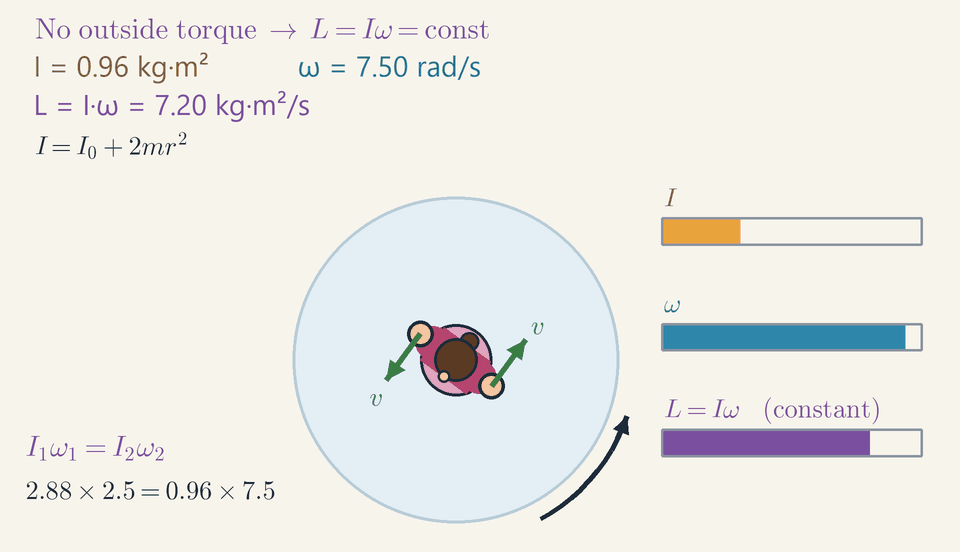
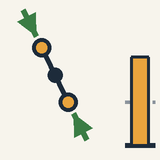
Step 3. The animation shows a figure skater from above and from the side. Arms out, she turns slowly; as she pulls them in she whirls three times faster, as the spin-speed bar shows, and spreading them again slows her down. The ice is so slippery that it hardly twists her at all.
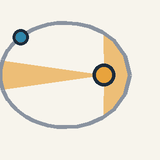
Step 4. The same rule works far beyond the ice rink. Divers tuck into a ball to somersault quickly and stretch out before they reach the water. A planet moves fastest when it swings closest to the Sun, because the Sun's pull cannot change its amount of spin around the Sun.
Check yourself: a pizza chef spins a ball of dough, and it spreads out into a wide, thin disc. What happens to how fast it turns? Answer: it slows down, because its mass has moved farther from the axis.
Intermediate
Key ideas
L=Iω (kg·m²/s); for a small mass on a circle, L=mvr.
With no external torque, L is conserved: I1ω1=I2ω2.
Skater: I falls from 2.88 to 0.96 kg·m², so ω rises from 2.5 to 7.5 rad/s and L stays 7.20 kg·m²/s.
Kinetic energy is not conserved: K=21Iω2 triples, from 9 J to 27 J, thanks to the work of her muscles.
What angular momentum measures
A skater spinning on ice turns faster when she pulls her arms in, although the slippery ice hardly twists her at all. Angular momentum L is the amount of rotation a spinning body carries; like ordinary momentum, only something outside can change it. It depends on how fast the body turns and how its mass is spread around the axis. The rate of turning is the angular velocity ω, in rad/s: one turn is 2π rad, so one turn per second is about 6.28 rad/s. Anticlockwise seen from above, the way the skater turns, counts as positive.
The spread of the mass is measured by the moment of inertia, I=∑mr2, in kg·m²: every mass times the square of its distance r from the axis, so a mass twice as far out counts four times as much. For a body turning about a fixed axis, L=Iω in kg·m²/s. For a small mass on a circle, I=mr2 and ω=v/r, so L=mvr: its momentum times its distance from the axis. Only motion around the axis counts; a mass heading straight for the axis has none.
Torque changes angular momentum
A force changes momentum; a torque changes angular momentum. The lever arm of a force is the perpendicular distance from the axis to the force's line of action. The torque of the force is the force times its lever arm, in N·m. Only torques from outside the system count: τext=dtdL Here dL/dt is the rate of change of L, the change ΔL divided by a short time Δt: a steady 2 N·m adds 2 kg·m²/s every second.
Forces between parts of the system come in equal and opposite pairs along one line, so their torques cancel: they can pass angular momentum from one part to another but never create it. With no external torque the total is fixed, whatever the system does to its shape: τext=0→I1ω1=I2ω2 Unlike mass, a moment of inertia changes whenever the body changes shape, and ω then changes in inverse proportion.
The working equations
Problems about spinning bodies use a short toolkit:
L=Iω
I=∑mr2
L=mvr(point mass on a circle)
I1ω1=I2ω2
K=21Iω2=2IL2
List every mass and its distance from the axis before and after, and work out I1 and I2. Check that nothing outside exerts a torque about the axis, then set I1ω1=I2ω2. Compute energies last, from K=L2/(2I): at fixed L the kinetic energy is inversely proportional to I.
Worked example: the skater in the animation
The animation models the skater as a body with I0=0.72kg⋅m2 plus two arms, each treated as a 3 kg mass at a distance r from the axis, so I=I0+2mr2. She starts with her arms out, at r=0.60m, turning at 2.5 rad/s, and pulls them in to r=0.20m. The ice exerts no torque about the vertical axis. I1=0.72+2⋅3⋅0.602=2.88kg⋅m2 L=I1ω1=2.88⋅2.5=7.20kg⋅m2/s I2=0.72+2⋅3⋅0.202=0.96kg⋅m2 ω2=L/I2=7.20/0.96=7.5rad/s
Her moment of inertia drops to a third, so she spins three times faster, from 0.40 to 1.19 turns per second. The gold I, blue ω and purple L readouts end the pull on these values, and the line 2.88×2.5=0.96×7.5 below the conservation law checks the product. Her kinetic energy rises from 21⋅2.88⋅2.52=9J to 21⋅0.96⋅7.52=27J; her muscles supply the 18 J difference.
The green arrows are the velocities of the arm masses, v=ωr. With the arms out, v=2.5⋅0.60=1.5m/s; with the arms in, v=7.5⋅0.20=1.5m/s again, because ω triples while r falls to a third. Her hands end up no faster; her whole body turns faster.
Worked example: a child jumps onto a merry-go-round
A merry-go-round, a uniform disc of 100 kg and radius 1.5 m on a freely turning axle, is at rest. A 30 kg child runs at 4 m/s along a line that just grazes its rim, jumps on at the edge and holds tight. How fast does it turn?
Running in a straight line, she already has angular momentum about the axis: L=mvr=30⋅4⋅1.5=180kg⋅m2/s. The disc has Id=21MR2=21⋅100⋅1.52=112.5kg⋅m2 and the child at the rim adds mR2=67.5kg⋅m2, so the total is 180kg⋅m2 and ω=L/I=180/180=1.0rad/s
The kinetic energy falls from 21⋅30⋅42=240J to 21⋅180⋅1.02=90J: as when two colliding bodies stick together, angular momentum survives the landing while 150 J becomes heat. If she then walks to the centre, her share of I drops to zero (treating her as a point), so ω=180/112.5=1.6rad/s and K=21⋅112.5⋅1.62=144J. The extra 54 J is the work she does pulling herself inward.
Reading the bars and arrows
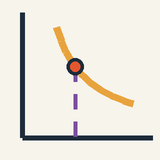
As the arms come in, the gold I bar shrinks to a third, the blue ω bar grows threefold and the purple L bar never moves: the two changing quantities trade off so that their product stays at 7.20kg⋅m2/s. Plotted against each other, ω and I lie on a hyperbola, ω=L/I.
In the loop's first 1.5 s, arms out, she turns through 3.75 rad, about 0.6 of a turn; in the 2.4 s with her arms in, through 18 rad, almost three turns. While the arms move, the green arrows tilt, inward during the pull and outward during the release, and grow to about 1.8 m/s, because the hands also move along the radius; when the arms stop, the arrows are tangent again at 1.5 m/s.
Common mistakes
Kinetic energy is not conserved when a body changes shape. If it were, a third of the moment of inertia would give only 3 times the spin, 4.33 rad/s instead of 7.5 rad/s; in fact K triples, from 9 J to 27 J.
Pulling the arms in puts no torque on the skater as a whole. Arms and torso push on each other, but these internal torques only move angular momentum around: the arms' share 2mr2ω falls from 5.40 to 1.80 kg·m²/s as the body's I0ω rises from 1.80 to 5.40.
The moment of inertia goes with the square of the distance. Bringing the arm masses to a third of their distance cuts their share 2mr2 from 2.16 to 0.24 kg·m², a ninth; the total falls only to a third because the body's part stays.
Conservation needs zero external torque about the axis. Gravity and the push of the ice are vertical and exert none about the vertical axis; the slight friction of the blade does, so real spins die away.
Where you meet it
Divers and gymnasts take off with a fixed angular momentum, tuck to turn several times faster and open out before landing. A helicopter needs a tail rotor: the engine turns the main rotor one way, and with no outside torque the body would turn the other way. Collapsing stars spin up enormously: an Earth-sized core turning once a day, shrunk to a ball 10 km in radius, would have its I cut by (6400/10)2≈4×105 and spin about five times a second, like a typical pulsar.
Next, Gravitation and Orbits turns this law into Kepler's law of equal areas: gravity exerts no torque about the Sun, so a planet moves fastest when closest to it. Atomic Models: the Bohr Atom shows angular momentum coming in whole steps.
Advanced
Key ideas
dL/dt=τext: internal forces act in pairs along one line, so their torques cancel.
At fixed L, K=L2/2I: pulling the masses in costs work W=2L2(1/I2−1/I1), the rise in kinetic energy.
A torque perpendicular to L turns it without changing its size: a fast top precesses at Ω=mgd/(Iω).
A central force exerts no torque: a planet's L is constant, so it sweeps equal areas in equal times (Kepler's second law).
Conservation of L reflects the isotropy of space; in quantum mechanics its components come in steps of ℏ.
Angular momentum as a cross product
Momentum measures how much straight-line motion a body carries. Angular momentum does the same job for motion around a point, and it stays constant whenever nothing outside twists the system. To define it, first choose a reference point O. A particle of mass m at position r from O, moving with velocity v, has momentum p=mv and angular momentum about O L=r×p
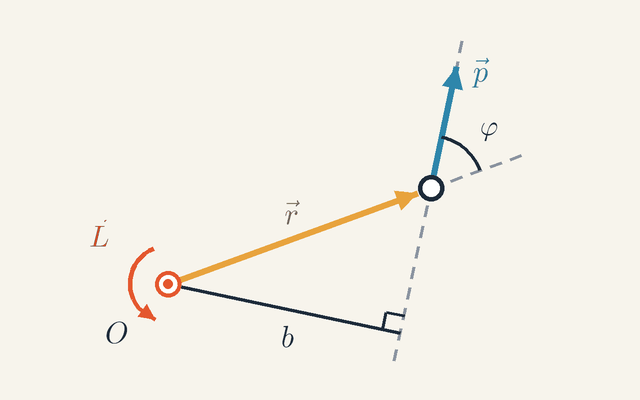
Figure 1. The angular momentum L=r×p of one particle about a point O. Notice the right triangle: its side b, the perpendicular distance from O to the line of motion, gives the size L=rpsinφ=pb. Here L points out of the page.Legend
O
Chosen point about which L is taken.
r
Position of the particle, from O to the particle.
m
p
Momentum mv of the particle, along its line of motion.
kg⋅m/s
φ
Angle between r and p, marked at the particle.
rad
b
Lever arm: perpendicular distance from O to the line of motion, b=rsinφ.
m
L
Angular momentum about O: size rpsinφ=pb, out of the page by the right-hand rule.
kg⋅m2/s
In Figure 1 the vector r runs from O to the particle, and p points along the dashed line of motion. The angle φ between them is marked at the particle, from the continuation of r round to p. A cross product of two vectors has the size of the first times the second times the sine of the angle between them, so L=rpsinφ.
Now look at the segment b. It is drawn from O to the line of motion and meets it at a right angle, so b is the shortest distance from O to that line. It closes a right triangle whose longest side is r. The triangle's angle at the particle lies between the direction back to O and the direction back along the line; these are the reverses of r and p, so that angle is φ again. The side opposite it is b=rsinφ, and therefore L=rpsinφ=pb The distance b is the lever arm of the momentum. In words: angular momentum is momentum times its lever arm.
The direction of L is at right angles to both r and p, and the right-hand rule picks which way: curl the fingers of your right hand in the sense in which the particle goes round O, and your thumb points along L. In Figure 1 the particle goes anticlockwise round O, so L points out of the page, towards you; the circled dot at O marks this. In the same way the skater, turning anticlockwise seen from above, has L pointing up.
Three consequences follow at once. First, only motion around O counts: a particle heading straight towards O or straight away from it has φ=0 or φ=π, so L=0. Second, L depends on the choice of O. A puck sliding freely at speed v has L=mvb about any point a distance b from its line, the same at every instant, and L=0 about any point on the line. Third, L measures how fast area is swept out. In a short time dt the line from O to the particle sweeps a thin triangle of area 21∣r×v∣dt, so the area swept per second is ∣r×v∣/2=L/(2m).
Torque, internal forces and conservation
What changes L? For one particle, differentiate L=r×p with the product rule, using dr/dt=v and Newton's second law, dp/dt=F: dtdL=v×mv+r×F=τ The first term is zero because the cross product of two parallel vectors vanishes, and v is parallel to mv. The second term is the torque τ=r×F of the force about O. By the same geometry as in Figure 1, its size is the force times its own lever arm, the distance from O to the line along which the force acts.
For a system of particles, add this equation over all of them. Each particle feels external forces and forces from the other particles, and the question is what the internal ones do to the total.
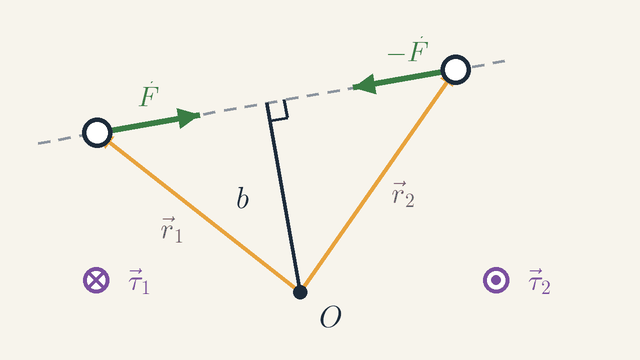
Figure 2. Two particles pull on each other with equal and opposite forces F and −F along the line joining them. Notice that both forces have the same lever arm b, so their torques τ1 and τ2 have the same size and opposite directions, and cancel.Legend
O
Point about which the torques are taken.
r1
Position of particle 1, from O.
m
r2
Position of particle 2, from O.
m
F
Force on particle 1 from particle 2, along the line joining them. Particle 2 feels −F.
N
b
Lever arm of both forces: distance from O to the line joining the particles.
m
τ1
Torque of F on particle 1 about O: size Fb, into the page.
N⋅m
τ2
Torque of −F on particle 2 about O: size Fb, out of the page.
N⋅m
Figure 2 shows one internal pair. Particle 1 feels the force F from particle 2, and particle 2 feels −F from particle 1: equal and opposite, by Newton's third law. Both forces act along the dashed line joining the two particles. This is the strong form of the third law, and gravity and contact forces obey it.
Look at the lever arms. Both forces lie on the same line, and that line is one distance b from O, so both forces have the lever arm b, whatever the positions r1 and r2 are. Their torques therefore have the same size, Fb. Their senses are opposite: F turns particle 1 clockwise round O, so τ1 points into the page, while −F turns particle 2 anticlockwise, so τ2 points out of it. The two torques cancel.
The argument works about any point and for every pair, so all internal torques drop out of the sum. What remains is dtdL=τext where L is now the total angular momentum and τext the total torque of the external forces. It is the rotational twin of dp/dt=Fext. It holds for any collection of particles, rigid or not, and it also holds about the centre of mass, even when that point accelerates.
With no external torque, L stays constant, however the system changes its shape. A diver in flight shows this: gravity acts at her centre of mass, so it has no lever arm about that point and no torque, and she keeps her angular momentum all the way to the water.
A central force: equal areas
The first payoff is in orbits. A central force is one that always points along the line to a fixed point. That line passes through the point, so the force has no lever arm about it and no torque.
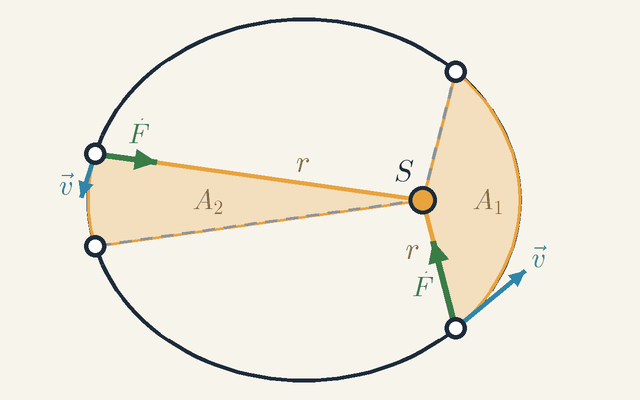
Figure 3. A planet on its orbit round the Sun S. The force F always points along the line to S, so it has no torque about S and L stays constant. The short, wide sector A1 and the long, narrow A2 are swept in equal times and have equal areas. Arrows not to scale.Legend
S
The Sun, the fixed point the force always points to.
r
Distance from S to the planet; this line sweeps out each sector.
m
F
Force on the planet, always along the line to S.
N
v
Velocity of the planet, tangent to its orbit.
m/s
A1
Area swept by the line from S to the planet in a time Δt near S.
m2
A2
Area swept in the same time Δt far from S; equal to A1.
m2
In Figure 3 the force F on the planet lies along the line r to the Sun S, so r×F=0 and the planet's angular momentum about S never changes. That has two consequences. Its direction is fixed, and because L is at right angles to both r and v, the orbit stays in one plane. Its size is fixed, so the line from S to the planet sweeps area at the steady rate L/(2m) found in the first section.
Now compare the two shaded sectors, each swept in the same time Δt. Near S the planet is fast but the line r is short, so A1 is a short, wide fan. Far from S the planet is slow but r is long, so A2 is a long, narrow slice. The area swept per second, 21vb, is the same in both places, so A1=A2, however different the shapes look. This is Kepler's second law, equal areas in equal times, which he published in 1609, nearly eighty years before Newton showed why it holds. The argument never uses the inverse-square law, so equal areas hold for every central force.
Spinning bodies: what the graphs show
Most everyday rotation is a body turning about a fixed axis, and there angular momentum takes a simple form. A small mass m at distance r from the axis moves on a circle at speed ωr, where ω is the angular velocity in rad/s. Its momentum mωr is at right angles to the radius, so its lever arm about the axis is r, and its angular momentum along the axis is mr2ω. Adding all the masses, L=∑mr2ω=Iω where I=∑mr2 is the moment of inertia. Unlike mass, I changes when the body changes shape.
The animation models the skater as a torso with I0=0.72kg⋅m2 plus two arm masses of m=3kg each at distance r from the axis, so I=I0+2mr2. The ice exerts no torque about the vertical axis, so L is fixed and ω=L/I.
The expert graphs show exactly this. L(t) is a flat line at 7.20kg⋅m2/s: its slope is the external torque, which is zero. I(t) falls from 2.88 to 0.96 kg·m² as r goes from 0.60 to 0.20 m, and ω(t)=L/I(t) rises from 2.5 to 7.5 rad/s. It does not rise evenly. It climbs slowly at first and fastest about two thirds of the way through the pull, because the same drop in I raises L/I more when I is already small; at the very end the arms slow to a stop.
Halfway in, at r=0.40m, I=0.72+2⋅3⋅0.402=1.68kg⋅m2 and ω=7.20/1.68=4.29rad/s, just over a third of the way from 2.5 to 7.5 rad/s.
The K(t) graph has exactly the shape of ω(t). The reason is K=21Iω2=21Lω: with L fixed, K is simply ω times L/2=3.6J⋅s. That gives 9 J at 2.5 rad/s and 27 J at 7.5 rad/s. The angular momentum stays the same while the kinetic energy triples.
Who pays for the extra energy
The kinetic energy rose by 27−9=18J, yet no external torque acted. The energy must come from the skater herself, through the work her arms do as they pull in.
Seen from the rink, each arm mass moves on a circle, so it needs a centripetal pull mω2r towards the axis, and her arms supply it. While the masses move inward, each pull points along their motion, so it does positive work. To count that work, keep L fixed and write K=L2/(2I). Because I=I0+2mr2, a small change dr of the radius changes I by dI=4mrdr. Then, using L/I=ω, dK=−2I2L2dI=−2mω2rdr As the arms come in, dr is negative and dK positive. The right-hand side is exactly the work of the two pulls: 2mω2r times the inward step ∣dr∣. Adding up the steps from I1 to I2, W=ΔK=2L2(I21−I11) which for the skater is 25.92⋅(1/0.96−1/2.88)=18J. Letting the arms out again takes the same 18 J back out of the spin.
The W readout counts this work as it is done. During the pull it runs slightly ahead of the rise in K, by at most 0.60 J, because the work also pays for the arm masses' motion towards the axis: kinetic energy mr˙2 for the pair, where r˙ is their radial speed. Both reach 18 J when the arms stop.
Seen from her own turning frame, the same story is told with different forces. There her arms do the same work against the centrifugal force. The arm masses moving inward also feel the Coriolis force, which acts sideways and pushes them ahead of the torso, in the direction of the spin. Held back at the shoulders, they press forward on them and spin the torso up. The torso's own angular momentum I0ω grows at the rate I0dω/dt, so that is the internal torque. At mid-pull the slope of the ω(t) graph is about 5.5rad/s2, and the torque is I0dω/dt≈0.72⋅5.5≈4.0N⋅m.
When the axis turns: precession
So far L kept its direction. But L is a vector, and a torque at right angles to it changes its direction rather than its size. This is what keeps a spinning gyroscope from toppling.
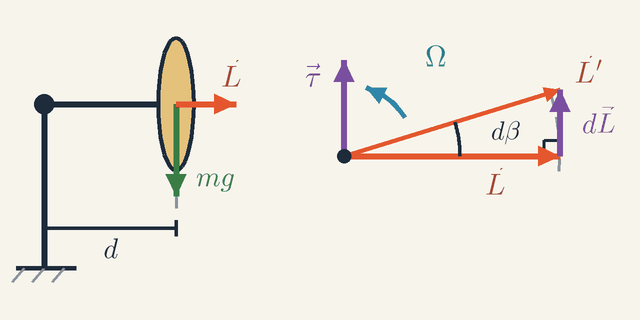
Figure 4. A wheel spinning on an axle held at one end. Left, from the side: the weight mg at distance d from the pivot. Right, from above: in a short time dt the torque τ adds dL at right angles to L, turning it through dβ without changing its length. Drawn with a large dt; not to scale.Legend
d
Distance from the pivot to the line of the weight.
m
mg
Weight of the wheel, acting at its centre.
N
L
Spin angular momentum of the wheel, along the axle.
kg⋅m2/s
τ
Torque of the weight about the pivot, τ=mgd: horizontal and at right angles to L.
N⋅m
dL
Change of L in a short time dt: dL=τdt.
kg⋅m2/s
L′
Angular momentum after dt: L+dL.
kg⋅m2/s
dβ
Angle through which L turns in dt: dβ=τdt/L.
rad
Ω
Rate at which the axle swings round, Ω=dβ/dt=τ/L.
rad/s
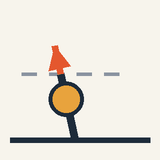
Figure 4 shows the standard example: a wheel spinning fast on a horizontal axle that is held at one end only. Its spin angular momentum L points along the axle. On the left, seen from the side, the weight mg acts at the wheel's centre, a distance d from the pivot. Its torque about the pivot has the size τ=mgd and is horizontal, at right angles to the axle. On the right, seen from above, τ stands at right angles to L.
Now apply dL/dt=τ. In a short time dt the angular momentum gains dL=τdt, parallel to the torque and so sideways to L. The new vector L′=L+dL has the same length as L to first order in dt, but it has swung through the small angle dβ=dL/L=τdt/L. (The figure draws a large dt so that the angle can be seen.) The axle follows L, so instead of falling it swings round horizontally at the rate Ω=dtdβ=Lτ In vector form, τ=Ω×L, with Ω pointing up for the anticlockwise swing in Figure 4.
The same holds for a top or a gyroscope with spin angular momentum Iω and its centre of mass a distance d from the pivot along its axis. If the axis is tilted from the vertical, the lever arm of the weight and the horizontal part of L both carry the sine of the tilt, and that factor cancels. So at any tilt Ω=Iωmgd(gyroscopic precession)
A bicycle wheel with I=0.25kg⋅m2 and a mass of 2.5 kg is spun at 40 rad/s and supported at one end of its axle, 0.20 m from the wheel's centre. It has L=0.25⋅40=10kg⋅m2/s, and its weight exerts the torque τ=2.5⋅9.81⋅0.20≈4.9N⋅m. It does not fall: it swings round at Ω=4.9/10≈0.49rad/s, once every 13 s. The Earth is a slow top: the Sun and the Moon pull on its equatorial bulge, and its axis precesses once in about 26 000 years.
One more consequence of L being a vector: it is parallel to ω only for rotation about a principal axis of the body, such as an axis of symmetry. A wheel mounted slightly tilted on its axle has L off the axle. As the wheel turns, L sweeps round the axle and so keeps changing, and by dL/dt=τ the bearings must keep supplying the torque. That is why car wheels are balanced.
Worked problem: a spin that dies away
Real ice is not frictionless. Suppose the blade exerts a steady friction torque τ=0.30N⋅m against the spin, starting from the animation's L0=7.20kg⋅m2/s. How long does the spin last, and how many turns does she make with her arms held in (I=0.96kg⋅m2), and with them held out (I=2.88kg⋅m2)?
How long: now dL/dt=−τ, so L falls at a steady rate, L(t)=7.20−0.30t, and reaches zero after T=L0/τ=24s. Her shape does not enter: in both cases the flat L(t) graph would become the same falling straight line.
How many turns: the angle does depend on her shape, because ω=L(t)/I. The angle turned is the integral of ω over the 24 s: θ=∫0TIL0−τtdt=2τIL02 This is the area of a triangle under the falling line, with height L0/I and base L0/τ. With her arms in, θ=51.84/(2⋅0.30⋅0.96)=90rad, about 14.3 turns. With her arms out, it is only 30 rad, about 4.8 turns.
Energy confirms it. The friction torque does the work τθ against the spin, and 0.30⋅90=27J and 0.30⋅30=9J are exactly her two starting kinetic energies. Pulling the arms in does not make the spin last longer; it packs three times as many turns into the same 24 s.
Limits of validity
The skater model is idealised: real arms are spread-out masses, not two points, and friction and air drag never quite vanish. The conservation law itself is sturdier than any model. The proof above used the strong form of Newton's third law, with internal forces along the lines joining the particles. Gravity and contact forces obey it; magnetic forces between moving charges need not. Yet nothing is lost, because the electromagnetic field carries angular momentum of its own, and the law holds once the field's share is counted. Circularly polarised light, for example, hands angular momentum to whatever absorbs it.
The precession formula assumes Ω≪ω, so that the spin carries almost all of the angular momentum; for the bicycle wheel the ratio is about 1 %. Spin the wheel at only 10 rad/s and Ω reaches 2.0 rad/s, a fifth of ω. The axle then visibly dips and nods as it goes round, a motion called nutation, instead of gliding smoothly.
At the atomic scale angular momentum is quantised: its component along any axis takes only values spaced by the reduced Planck constant, ℏ=1.055×10⁻³⁴J⋅s. The skater's 7.20kg⋅m2/s is about 7×1034 such steps, so the graininess is invisible. For an electron in an atom it is everything. The electron also carries an intrinsic angular momentum, its spin, with components ±ℏ/2, which is not the rotation of any little ball. Special relativity keeps L=r×p, with the relativistic momentum, and keeps its conservation.
Where this leads
Why is angular momentum conserved at all? Because space has no preferred direction. By Noether's theorem every continuous symmetry of the laws of physics brings a conserved quantity: the sameness of space from place to place gives momentum, the sameness of time gives energy, and the sameness of all directions gives angular momentum.
The law reaches far. In Gravitation and Orbits it explains equal areas, and the term L2/(2mr2) in the radial energy acts as a centrifugal barrier that keeps planets from falling into the Sun. In Atomic Models: the Bohr Atom, the rule L=nℏ fixes the energy levels of hydrogen. Spin, counted in units of ℏ, separates the matter particles of Particles and Forces: the Standard Model, with spin 1/2, from the force carriers, with spin 1. And the aligned spins of electrons make iron magnetic, as Magnetic Fields of Magnets and Currents describes.
Key formulas
Angular momentum of a spinning body
L=Iω
Each piece of a body turning at ω moves on a circle at speed ωr and contributes mr2ω; adding them gives Iω. It mirrors p=mv, with the moment of inertia in the place of mass. Its sign, or direction, follows the sense of rotation by the right-hand rule.
Symbols
L
angular momentum about the axis
kg⋅m2/s
I
moment of inertia about the same axis
kg⋅m2
ω
angular velocity
rad/s
When it holds: For rotation about a fixed axis it gives the component of L along that axis; L itself is parallel to ω only about a principal axis of the body.
Example: The skater with her arms out: L=2.88⋅2.5=7.20kg⋅m2/s.
Angular momentum of a point mass
L=mvr(point mass on a circle)
A small mass moving at speed v on a circle of radius r has momentum mv, and its angular momentum is that momentum times the radius. It is the special case I=mr2, ω=v/r of L=Iω. For other paths the radius is replaced by the lever arm of the momentum, so even straight-line motion has angular momentum.
Symbols
L
angular momentum about the centre
kg⋅m2/s
m
mass of the particle
kg
v
speed along the circle
m/s
r
radius of the circle
m
When it holds: Exactly for circular motion. For any other path use L=mvb, with b the perpendicular distance from the axis to the line of motion.
Example: A 30 kg child running at 4 m/s along a line 1.5 m from a merry-go-round's axis: L=30⋅4⋅1.5=180kg⋅m2/s.
Torque changes angular momentum
τext=dtdL
The rotational form of Newton's second law, twin of F=dp/dt: the external torque about an axis is the rate at which the angular momentum about that axis changes. Internal forces act in equal and opposite pairs along one line, so their torques cancel and drop out. For a rigid body with fixed I it reduces to τ=Iα.
Symbols
τext
total external torque about the axis
N⋅m
L
angular momentum about the same axis
kg⋅m2/s
t
time
s
When it holds: Holds for any system, rigid or not, about a fixed point or about the centre of mass, provided internal forces act along the lines joining the particles.
Example: A friction torque of 0.30 N·m removes 0.30 kg·m²/s every second, so the skater's 7.20kg⋅m2/s is gone after 24 s.
Conservation of angular momentum
τext=0→I1ω1=I2ω2
With no external torque, L cannot change, so whatever the system does to its shape, the product Iω before equals the product after. If I falls to a third, ω triples. Kinetic energy is not conserved in general: it changes by the work of the internal forces.
Symbols
τext
external torque about the axis
N⋅m
I1
moment of inertia before
kg⋅m2
ω1
angular velocity before
rad/s
I2
moment of inertia after
kg⋅m2
ω2
angular velocity after
rad/s
When it holds: Needs zero external torque about the axis in question. Forces whose line passes through the axis or runs parallel to it, such as the weight of a skater and the push of the ice, exert none; friction spoils it slowly.
Example: The skater: 2.88⋅2.5=0.96ω2, so ω2=7.5rad/s.
Rotational kinetic energy
K=21Iω2=2IL2
Each piece of mass moving at ωr has kinetic energy 21mω2r2; summing gives 21Iω2. Substituting ω=L/I gives L2/(2I), the useful form when L is conserved: the kinetic energy is then inversely proportional to I, so shrinking I raises K.
Symbols
K
kinetic energy of rotation
J
I
moment of inertia
kg⋅m2
ω
angular velocity
rad/s
L
angular momentum
kg⋅m2/s
When it holds: For rotation about a fixed axis or about the centre of mass; a body that also moves as a whole adds its translational energy 21Mvcm2.
Example: The skater: K=7.202/(2⋅2.88)=9J with her arms out and 7.202/(2⋅0.96)=27J with them in.
Work done changing the moment of inertia
W=ΔK=(2L2)(I21−I11)
At fixed L the kinetic energy depends only on I, so the work needed to change the shape is the difference of L2/(2I) between the two states. Pulling mass inward (I2<I1) costs positive work, done against the tendency of the spinning masses to fly outward; letting it out again gives the same energy back.
Symbols
W
work done by the internal forces (her muscles)
J
ΔK
change of rotational kinetic energy
J
L
angular momentum (constant)
kg⋅m2/s
I1
moment of inertia before
kg⋅m2
I2
moment of inertia after
kg⋅m2
When it holds: Only with no external torque, comparing states in which the masses are not moving toward or away from the axis; during the motion their radial kinetic energy must be added.
Example: The skater: W=21⋅7.202⋅(1/0.96−1/2.88)=18J.
Precession rate of a gyroscope
Ω=Iωmgd(gyroscopic precession)
The weight of a top, acting at its centre of mass a distance d from the pivot, exerts a torque perpendicular to the spin angular momentum Iω. That torque swings L sideways instead of tipping it over, so the axis sweeps round at Ω=τ/L. The tilt cancels, because the torque and the horizontal part of L both carry its sine. A faster spin means a slower precession.
Symbols
Ω
angular velocity of the precession
rad/s
m
mass of the top or wheel
kg
g
free-fall acceleration
m/s2
d
distance from the pivot to the centre of mass
m
I
moment of inertia about the spin axis
kg⋅m2
ω
spin angular velocity
rad/s
When it holds: Only for a fast spin, Ω≪ω, when the precession adds almost nothing to L; for slower spins the axis also nods up and down (nutation).
Example: A bicycle wheel with I=0.25kg⋅m2 and mass 2.5 kg, d=0.20m, spun at 40 rad/s: Ω=4.9/10≈0.49rad/s, one sweep in about 13 s.
Glossary
Angular momentum
The rotational counterpart of momentum. For a particle it is L=r×p about a chosen point; for a body turning about a fixed axis, L=Iω. Only an external torque can change it.
Right-hand rule for rotation
The convention that gives a rotation a direction: curl the fingers of the right hand along the motion and the thumb points along ω and L. A skater turning anticlockwise seen from above has L pointing up.
Moment of inertia
A body's resistance to changes in its rotation, I=∑mr2. It depends on how the mass is spread about the axis, not only on how much there is, and unlike mass it changes when the body changes shape.
Torque
The turning effect of a force about an axis: the force times its lever arm, in N·m. The external torque equals the rate of change of angular momentum, just as the net force equals the rate of change of momentum.
Lever arm
The perpendicular distance from the axis to the line along which a force acts or a body moves. A force or a momentum aimed straight at the axis has a zero lever arm and no turning effect; a body passing at distance b has L=mvb.
Internal torque
A torque that one part of a system exerts on another. Internal forces come in equal and opposite pairs along one line, so internal torques cancel: they move angular momentum between the parts but never change the total.
Conservation of angular momentum
With no external torque about an axis, the total angular momentum about it stays constant, I1ω1=I2ω2, whatever the system does to its shape. It holds for rigid and non-rigid bodies alike, while kinetic energy generally changes.
Central force
A force always directed toward one fixed point, like the Sun's gravity on a planet. Its line passes through that point, so it exerts no torque about it and the angular momentum about the point is conserved.
Law of equal areas
Kepler's second law: the line from the Sun to a planet sweeps equal areas in equal times. The sweep rate is L/(2m), so the law is conservation of angular momentum under a central force.
Precession
The slow swing of a spin axis under a torque perpendicular to L, which turns L without changing its size. A fast top precesses at Ω=mgd/(Iω); the Earth's axis does so once in about 26 000 years.
Principal axis
An axis about which a body's angular momentum is parallel to its angular velocity, such as a symmetry axis. A body spinning about any other axis wobbles, or needs a torque from its bearings to keep turning steadily.
Quantised angular momentum
In quantum mechanics the component of angular momentum along any axis takes only values spaced by ℏ≈1.055×10⁻³⁴J⋅s. Particles also carry an intrinsic spin; for the electron its components are ±ℏ/2.
Quantities
L
Angular momentum
kg⋅m2/s
Moment of inertia times angular velocity, Iω; for a point mass on a circle, mvr. One kg·m²/s is the same as one joule second.
I
Moment of inertia
kg⋅m2
The sum of every mass times the square of its distance from the axis: 2.88 kg·m² for the skater with her arms out, 0.96 kg·m² with them in.
ω
Angular velocity
rad/s
The angle turned per second; one turn per second is 2π≈6.28rad/s.
m
Mass
kg
The mass of a particle or of one part of a body, such as each 3 kg arm mass in the animation.
r
Distance from the axis
m
The perpendicular distance of a mass from the rotation axis; it enters the moment of inertia squared.
v
Speed on the circle
m/s
The speed of a mass moving round the axis, v=ωr: 1.5 m/s for the skater's hands, arms out or in.
τext
External torque
N⋅m
The total torque about the axis from forces outside the system; it equals the rate of change of L.
K
Rotational kinetic energy
J
The energy of rotation, 21Iω2=L2/(2I); at fixed L it is inversely proportional to I.
W
Work done by the muscles
J
The work needed to pull the masses inward at fixed L, equal to the rise in kinetic energy: 18 J for the skater.
Ω
Precession angular velocity
rad/s
The rate at which a spin axis swings round under a torque perpendicular to L, Ω=τ/L.
Quiz
Beginner A figure skater is spinning with her arms stretched out. What happens when she pulls them in close to her body?
She slows down
She spins faster
She keeps spinning at the same speed
She stops spinning
Show answer
Answer: B. She spins faster
Pulling her arms in brings mass closer to the spin axis. With nothing outside twisting her, her angular momentum stays the same, so she has to turn faster.
Beginner A diver wants to complete more somersaults before she reaches the water. What should she do once she is in the air?
Stretch out as straight as possible
Kick her legs to push against the air
Nothing: how fast she turns is fixed when she leaves the board
Tuck into a tight ball
Show answer
Answer: D. Tuck into a tight ball
Her amount of spin (angular momentum) is fixed once she leaves the board, but her turning speed is not. Tucking brings her mass closer to the axis, so she turns faster; stretching out before entry slows her down.
Intermediate A skater spins at 2 rad/s with a moment of inertia of 4 kg·m². She pulls her arms in until I = 1 kg·m². Ignoring friction, what is her new angular velocity?
0.5 rad/s
4 rad/s
8 rad/s
16 rad/s
Show answer
Answer: C. 8 rad/s
L = I·ω = 4 × 2 = 8 kg·m²/s is conserved, so ω = 8 / 1 = 8 rad/s. 4 rad/s is what you get by wrongly assuming that kinetic energy is conserved.
Intermediate Which quantity stays the same while the spinning skater pulls her arms in?
Her angular velocity ω
Her moment of inertia I
Her rotational kinetic energy
Her angular momentum L = I·ω
Show answer
Answer: D. Her angular momentum L = I·ω
No external torque acts about the spin axis, so L is conserved. I decreases, ω increases in proportion, and the kinetic energy ½·I·ω² increases because her muscles do work.
Intermediate A child stands at the edge of a merry-go-round that turns freely, then walks towards the centre. What happens to the rotation of the merry-go-round?
It speeds up
It slows down
It does not change
It reverses direction
Show answer
Answer: A. It speeds up
The total angular momentum of child plus merry-go-round is conserved. As the child moves inward, the total moment of inertia decreases, so the angular velocity increases.
Advanced At constant angular momentum, a skater's moment of inertia drops to a third of its value. What happens to her rotational kinetic energy?
It stays the same, because energy is conserved
It grows by a factor of √3
It triples, supplied by the work of her muscles
It grows by a factor of 9
Show answer
Answer: C. It triples, supplied by the work of her muscles
K = L²/(2I). With L fixed, K is inversely proportional to I, so it triples. The energy comes from her arm muscles: they supply the centripetal force on the arm masses while the masses move inward, so that force does positive work.
Advanced A fast-spinning gyroscope is supported at one end of its horizontal axle. Gravity exerts a torque on it. What does the axle do?
It falls down like a rod that is not spinning
It slowly sweeps round in a horizontal circle
It rises until it is vertical
It stays still while the spin slows down
Show answer
Answer: B. It slowly sweeps round in a horizontal circle
The torque of gravity is horizontal and perpendicular to L⃗. Since dL⃗/dt = τ⃗, it changes the direction of L⃗, not its size, so the axle sweeps round horizontally at Ω = m·g·d/(I·ω): this is precession.
Advanced A puck of mass m slides at constant velocity v along a straight line whose perpendicular distance from a point O is b. What is its angular momentum about O?
m·v·b, the same at every point of the line
Zero, because it is not moving in a circle
m·v·r, growing as its distance r from O grows
Largest at the point of closest approach, smaller elsewhere
Show answer
Answer: A. m·v·b, the same at every point of the line
L = |r⃗ × p⃗| = m·v·r·sin φ, where φ is the angle between r⃗ and v⃗, and r·sin φ is the perpendicular distance b from O to the line, the same everywhere. No force acts, so there is no torque and L stays constant: a body moving in a straight line has angular momentum about any point off its path.
 Physics Tutor