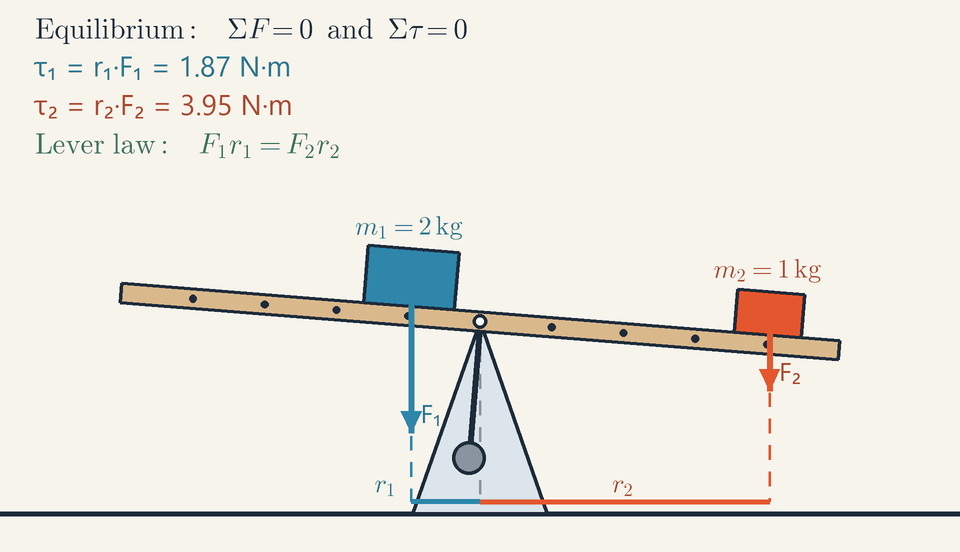
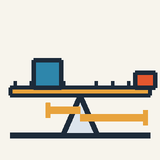
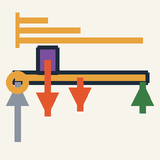
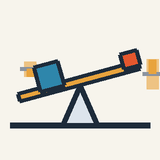
Why things stay put: the forces must cancel, ∑F=0, and so must their turning effects, ∑τ=0, on seesaws, levers, beams and objects that might tip over.
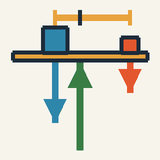
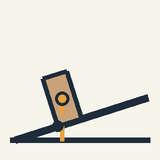
A beam balanced on a pivot carries a heavy and a light box; the heavy box slides toward the middle until the two torques are equal and the beam is level.
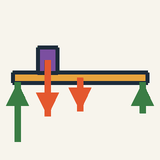
An object stays still only if all the pushes cancel and all the turning effects cancel too.
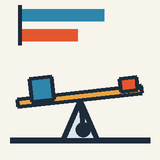
A force turns something more strongly the farther from the pivot it acts.
To balance a seesaw, the heavier one sits closer to the middle: twice as heavy, half as far.
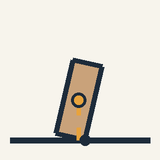
An object topples when its centre of mass moves beyond the edge of its base.
A bridge, a shelf and a balanced seesaw have one thing in common: they stay perfectly still. Physicists call this static equilibrium. Here is what it takes, step by step.
Step 1. The pushes and pulls must cancel. A book on a table is pulled down by its weight and pushed up by the table just as hard, so the net force is zero and it does not start to move.
Step 2. Cancelling forces is not enough. Push the two ends of a ruler lying on a table equally hard in opposite directions and it spins on the spot. So the turning effects must cancel too. The turning effect of a force, its torque, grows with the force and with its distance from the pivot.
Step 3. On a seesaw the heavier side wins unless it sits closer to the middle. Someone twice as heavy must sit half as far out, so that weight times distance matches on both sides. This is the law of the lever, known since Archimedes; it is how a long crowbar shifts a rock you could never lift. In the animation the heavy blue box slides toward the pivot, and at 2 marks against the light box's 4 the beam balances level.
Step 4. Every object behaves as if its whole weight acted at one point, its centre of mass. A bookcase, or a person leaning over, stays up while that point is above the base it stands on; lean further and the weight starts to turn it over.
Check yourself: a 20 kg child sits 3 m from the pivot of a seesaw. Where must a 60 kg parent sit to balance? Answer: 1 m from the pivot on the other side, three times as heavy and a third as far.
Intermediate
Key ideas
Static equilibrium needs ∑F=0 and ∑τ=0; the torque τ=rF uses the perpendicular lever arm r.
Law of the lever: m1r1=m2r2 (g cancels): 2 kg at 0.20 m balances 1 kg at 0.40 m.
∑F=0 as well: the supports carry the total weight, the beam's included.
Take torques about the point where an unknown force acts, so that force drops out.
Two conditions for equilibrium
Push both ends of a ruler equally hard in opposite directions, and it spins although the forces cancel. A rigid body, one that keeps its shape, is in static equilibrium when it stays at rest: it neither starts to slide nor starts to turn. The forces must cancel, or the centre of mass would accelerate, and so must their turning effects, the torques, or the body would start to rotate: ∑F=0,∑τ=0
In a plane the first is two equations, for horizontal and vertical components. Neither condition implies the other: two equal and opposite forces acting along different lines cancel as forces but form a couple, which is how your hands turn a steering wheel. Start every problem with a free-body diagram: the body on its own, with every external force drawn where it acts, each weight at its centre of mass and each support force at its contact.
Torque: force times lever arm
Torque measures how strongly a force turns a body about a chosen point. Take the force's line of action, the straight line along which it acts, and the perpendicular distance r from the point to that line: the lever arm. Then τ=rF(r: lever arm, perpendicular to the line of action)
The unit is the newton metre (N·m), never written as joules, because a torque is not an energy. Counter-clockwise torques count as positive. A force whose line passes through the point has no torque, however large it is: pushing a door toward its hinges does nothing. If the force acts at a distance d from the point, at an angle ϕ to the line joining them, the lever arm is dsinϕ.
The law of the lever
Put a load m1 at a distance r1 on one side of a pivot and a load m2 at r2 on the other. Each weight mg acts straight down, so its lever arm is its horizontal distance from the pivot. The two torques have opposite signs, and ∑τ=0 gives m1gr1=m2gr2(law of the lever)
The g cancels, so only masses and distances matter: twice the mass needs half the lever arm. The pivot's push has no torque about the pivot and drops out; ∑F=0 then fixes its size, the total weight it carries, the beam's own included. The law also multiplies force: 300 N pushing on a crowbar 1.2 m from its fulcrum presses with 3600 N on a stone 0.10 m from it.
Worked example: the balance in the animation
The light box, m2=1.0kg, sits r2=0.40m right of the pin, so with the beam level its clockwise torque is τ2=r2m2g=0.40⋅1.0⋅9.81=3.92N⋅m The heavy box, m1=2.0kg, balances it at r1=m1m2r2=2.01.0⋅0.40=0.20m
That is 2 of the beam's 10 cm marks against 4. There both readouts show 3.92 N·m and the beam is level: the arrow F1=19.6N is twice as long as F2=9.81N, and the lever arms r1 and r2 marked along the bottom are in the ratio 1 : 2.
At the start the heavy box sits 0.42 m out, and its 8.30 N·m beats the light box's 3.79 N·m. The beam turns counter-clockwise by about 10°, until the weighted pointer under the pin, swung toward the light side, supplies the missing 4.51 N·m. As the box slides in, τ1 falls; inside 0.20 m the light side wins, and at 0.10 m, with τ1≈1.87N⋅m, the beam leans about 4.6° the other way.
Notice that τ2 drifts between 3.79 and 3.95 N·m although its box never moves: tilting the beam changes the horizontal distance from the pin to the dashed line of its weight. The lever arm is measured perpendicular to the line of action, not along the beam.
Worked example: a painter on a plank
A uniform 20 kg plank 3.0 m long rests on trestles under its ends, and a 70 kg painter stands 1.0 m from the left end. The plank's weight, 196.2N, acts at its middle, and the painter's, 686.7N, at 1.0 m. Torques about the left trestle remove its unknown force: FR⋅3.0=686.7⋅1.0+196.2⋅1.5=981N⋅m so FR=327N, and ∑F=0 gives FL=686.7+196.2−327=556N: the trestle nearer the painter carries more.
Now move the right trestle 1.0 m inward, leaving a 1.0 m overhang, and let the painter walk out. The plank tips about that trestle when the left push falls to zero, that is, when the painter's torque about it equals the plank's, whose centre lies 0.50 m on the other side: 70d=20⋅0.50, so d=0.14m. One short step past the trestle tips the plank, which is why scaffold boards are fixed down.
Centre of mass, stability and tipping
For torques, a body's whole weight acts at one point, its centre of mass, the mass-weighted average position: xCM=∑mi∑mixi For the boxes at balance, xCM=(2.0⋅(−0.20)+1.0⋅0.40)/3.0=0: straight above the pin, which is another way of saying that the beam is level.
An equilibrium is stable if a small tilt raises the centre of mass, so that the weight turns the body back, as in the balance of the animation, whose heavy pointer keeps the centre of mass below the pin. It is unstable if a tilt lowers the centre of mass, like a pencil on its tip or a seesaw with two riders.
A body on a base topples once the vertical through its centre of mass passes outside the base. A uniform fridge 0.70 m wide and 1.80 m tall, tilted onto one edge, rocks back if released before 21.3°, where tanθ=0.70/1.80, and falls beyond it. On a ramp a uniform box tips where tanθ=w/h.
Common mistakes
Thinking that balance needs equal weights. It needs equal torques: 2.0 kg at 0.20 m balances 1.0 kg at 0.40 m.
Measuring the lever arm along the beam or the door instead of perpendicular to the line of action. A 50 N push at 30° to a door, 0.80 m from the hinges, gives 0.80⋅50⋅sin30∘=20N⋅m, not 40 N·m.
Leaving out the beam's own weight. Without the plank's 20 kg, the right trestle would seem to push 229 N instead of 327 N.
Believing that torques must be taken about the real pivot. ∑τ=0 holds about every point, so choose one where an unknown force acts.
Expecting a heavier object to tip at a steeper angle. Only the shape matters: an evenly loaded crate 0.40 m wide and 1.00 m tall tips at 21.8° whether it holds 20 kg or 200 kg.
Where you meet it
Engineers size beams and foundations with these two equations, and a tower crane balances its load with a concrete counterweight on its short arm. Your forearm is a lever: the biceps pulls about 5 cm from the elbow, so holding a 5.0 kg dumbbell 35 cm from the elbow takes about 49⋅0.35/0.05≈343N, seven times its weight. These ideas continue in Simple Machines: Levers, Pulleys and Gears, where levers trade force for distance, and in Elasticity: Hooke's Law, Stress and Strain, where real beams bend under the loads found here.
Advanced
Key ideas
In equilibrium a small trial displacement does no work: for a lever, m1gδh1=m2gδh2 gives the law of the lever.
Gravity acts at the centre of mass, ∑τ=−MgxCM: a body hung from a pin settles with its CM straight below it.
Stable if a small tilt raises the centre of mass (d2U/dθ2>0); a seesaw with riders is unstable.
Tipping: the vertical through the CM leaves the base; a uniform w×h crate on a ramp tips at tanθ=w/h.
Equilibrium as zero virtual work
Two conditions keep a rigid body at rest: the forces on it add up to zero, and so do their torques. Both follow from a single statement about work, and the same statement later decides whether an equilibrium is stable, so it is worth deriving them that way once.
Imagine moving a body at rest by a tiny amount that its supports allow: a virtual displacement, made only on paper. Add up the work that every force on the body would do during it; the total is the virtual work δW. If δW were positive for some allowed motion, the forces themselves would supply kinetic energy along it, and the body would set off that way on its own. Reversing a small displacement reverses the sign of δW, so it cannot be negative either. In equilibrium, therefore, the virtual work vanishes, to first order in the displacement, for every displacement the supports allow.
A rigid body moving in a plane has three independent small motions: a shift in each of two directions, and a turn. In a shift δs every point of the body moves by the same δs, so δW=(∑F)⋅δs, which vanishes for shifts in every direction only if ∑F=0. In a small turn δθ about any point, a force whose torque about that point is τ does the work τδθ: torque is exactly the work per radian of turn. So δW=(∑τ)δθ, which vanishes only if ∑τ=0.
Internal forces, the pushes and pulls between parts of the body, never enter. They come in equal and opposite pairs along the line joining the two parts, and a rigid body keeps that distance fixed, so the two forces of each pair do equal and opposite work.
The law of the lever, from work alone
The simplest test of the principle is a lever. Virtual work gives its law straight from weights and heights, without defining torque at all.
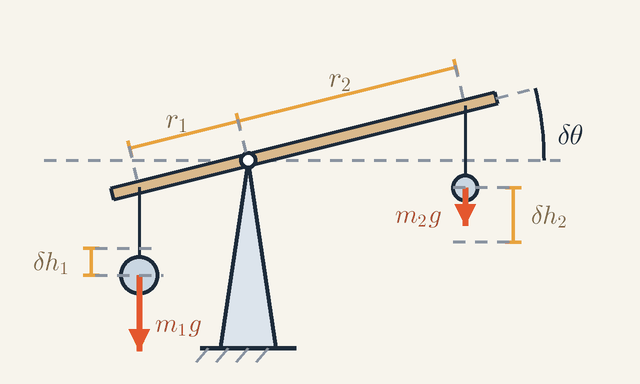
Figure 1. A balanced lever, m1r1=m2r2, given a small virtual turn δθ about its pin. Notice that load 1 drops by δh1=r1δθ while load 2 rises by δh2=r2δθ. The turn is exaggerated; not to scale.Legend
m1g
Weight of load 1, whose mass is m1.
N
m2g
Weight of load 2, whose mass is m2.
N
r1
Distance from the pin to load 1, along the beam.
m
r2
Distance from the pin to load 2, along the beam; here twice r1.
m
δθ
Small virtual turn of the beam about the pin, exaggerated in the drawing.
rad
δh1
Drop of load 1 during the turn: r1δθ.
m
δh2
Rise of load 2 during the turn: r2δθ.
m
Figure 1 shows a beam on a pin, with load 1, of mass m1, at the distance r1 on one side and load 2, of mass m2, at the distance r2 on the other. The beam is balanced, m1r1=m2r2, and we give it a small virtual turn δθ about the pin, drawn much larger than it really is. Look at the two short vertical brackets. A point of the beam at the distance r from the pin moves along an arc of length rδθ, and for a small angle that arc is practically vertical. So load 1 drops by δh1=r1δθ and load 2 rises by δh2=r2δθ.
Now add up the work. The pin does not move, so its force does no work. Gravity does work only on vertical motion: on load 1, which falls, it does +m1gδh1; on load 2, which rises, it does −m2gδh2. Setting the total to zero gives m1gr1δθ=m2gr2δθ, and dividing by gδθ leaves m1r1=m2r2. That is the law of the lever, obtained from energy bookkeeping alone.
In the animation the balanced beam carries a 2.0 kg box at r1=0.20m and a 1.0 kg box at r2=0.40m. Tilting it by 0.01 rad lowers the heavy box by 2 mm and raises the light one by 4 mm, and 2.0⋅2=1.0⋅4: what gravity gains on one side, it pays back on the other.
Why could the rule be nothing else? A balanced, frictionless lever can be turned slowly by a push as small as you like. If it balanced at any other ratio of masses and distances, turning it one way would raise the total potential energy of the loads with nothing paying for it, and the trick could be repeated without limit: a perpetual-motion machine. So the law of the lever follows from the impossibility of perpetual motion. Simon Stevin argued in this way in 1586 about the inclined plane: a closed loop of chain hung over a wedge never starts to circulate by itself.
Three equations, and any point as pivot
In practice one writes the equilibrium conditions as equations and picks the pivot that makes them easiest. This section shows why any pivot is allowed, and how many unknowns the equations can fix.
In a plane, equilibrium is three equations: ∑Fx=0, ∑Fy=0 and ∑τz=0. The torque about a point B of a force Fi applied at ri is (ri−rB)×Fi. Split the arm as (ri−rA)+(rA−rB), where A is any other point, and add over all the forces: τB=τA+(rA−rB)×∑F When the net force is zero, the second term vanishes and the torque is the same about every point. So the pivot can go wherever is convenient, usually at a support: that support's unknown force has no arm there and drops out of the torque equation.
Three equations fix at most three unknowns. A beam on two supports, or a ladder against a smooth wall, has no more than that and is called statically determinate. A four-legged table has four unknown leg forces but still only three useful equations, so it is statically indeterminate: statics alone cannot say how the load is shared, and only the slight give of the legs and the floor decides it. On an uneven floor one leg carries nothing, and the table rocks.
Three forces meet in one point
When exactly three forces hold a body still, a geometric rule fixes the direction of one of them before any equation is written. A ladder leaning on a wall is the standard example.
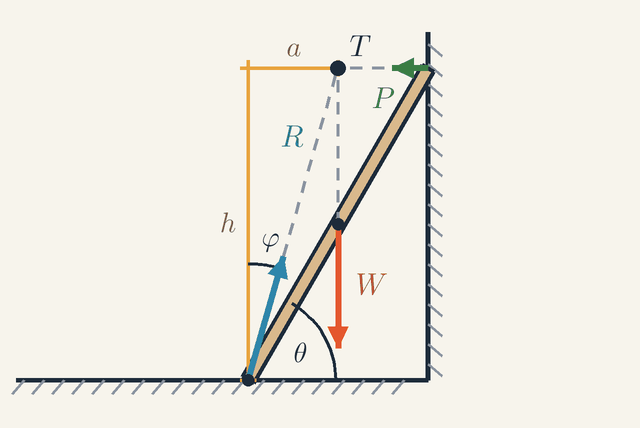
Figure 2. A uniform ladder against a smooth wall. The wall's push P and the weight W cross at T, so for zero torque the floor's reaction R must point at T too. Its lean φ from the vertical is read off the triangle with sides a and h.Legend
W
Weight of the ladder, acting at its midpoint.
N
P
Push of the wall. A smooth wall pushes only at right angles to itself, so P is horizontal.
N
R
Reaction of the floor at the foot of the ladder: the normal force and the friction added together. Its line passes through T.
N
T
Point where the lines of action of W and P cross.
θ
Angle between the ladder and the floor.
rad
φ
Angle between R and the vertical; tanφ=a/h, the friction divided by the normal force.
rad
h
Height of the top of the ladder, which is also the height of T.
m
a
Horizontal distance from the foot of the ladder to the vertical through its midpoint, which also passes through T.
m
Figure 2 shows a uniform ladder of length L and weight W, standing on the floor at the angle θ and leaning on a smooth wall. Three forces act on it. The weight W acts straight down through the midpoint. A smooth wall can push only at right angles to itself, so its push P at the top is horizontal. The floor's reaction R at the foot has, so far, an unknown direction. Follow the dashed lines of action of W and P: they cross at T, level with the top of the ladder and straight above its midpoint.
Take torques about T. Neither W nor P has a torque there, because both lines pass through T. The total torque is zero, so R must have no torque about T either, which is possible only if its line of action also passes through T. This fixes the direction of R before friction has even been mentioned. The rule is general: when exactly three non-parallel forces hold a body in equilibrium, their lines of action meet in one point.
Now split R into the normal force N, straight up, and the friction f, along the floor towards the wall. Balancing vertical forces gives N=W, and horizontal ones f=P. In Figure 2, R leans from the vertical by the angle φ, so tanφ=f/N. The same angle sits at the foot of the right triangle whose vertical side is the height of the top (and of T), h=Lsinθ, and whose horizontal side is the distance from the foot to the vertical through the midpoint, a=21Lcosθ. Hence tanφ=a/h, and Nf=ha=2tanθ1 For a uniform ladder at 60∘ to the floor this is 1/(2tan60∘)≈0.29, whatever the ladder weighs and however long it is. The ladder therefore stays up only if the coefficient of static friction at the floor is at least 0.29. A steeper ladder needs less.
Gravity acts at the centre of mass
Almost every statics problem replaces a body's weight by one force at its centre of mass. In a uniform field that replacement is exact, and it also predicts how the balance in the animation behaves.
Each part i of a body, of mass mi at the position ri from a pivot, feels the weight mig. Because g is the same for every part, it comes out of the sum: ∑ri×mig=(∑miri)×g=MrCM×g, where M is the total mass and rCM=∑miri/M. The whole weight acts at the centre of mass. With x measured horizontally from the pivot and counter-clockwise torques positive, xCM=∑mi∑mixi ∑τgravity=−MgxCM The minus sign says that a centre of mass to the right of the pivot turns the body clockwise.
Two consequences follow. A body hung from a pin settles with its centre of mass straight below the pin, where gravity has no torque. And the plumb lines from two different hanging points cross at the centre of mass, which is how it is found in practice.
Apply this to the two boxes alone. Write τ1 for the counter-clockwise torque of the heavy box, τ2 for the clockwise torque of the light one, and xCM for the boxes' centre of mass; then τ1−τ2=−(m1+m2)gxCM. The expert graph of the animation plots it against the heavy box's position x1: 4.51 N·m at x1=−0.42m, zero at x1=−m2r2/m1=−0.20m, and −2.07N⋅m at x1=−0.10m.
The line is nearly straight, with a slope close to −m1g=−19.6N⋅m per metre: each centimetre the box slides inward removes about 0.20 N·m. The plotted slope is about 5 % steeper. The boxes' centres ride some 5 cm above the pin line, so the change of tilt that comes with each shift of the box also moves them sideways a little.
This is not the total torque on the beam. The 14 kg bob on the pointer supplies an opposite torque and keeps the total at zero, which is why the beam tilts only part of the way (worked out below). The gold plumb line in the animation shows the same thing geometrically: the beam leans towards the side on which the boxes' centre of mass lies.
Stability and potential energy
An equilibrium can be like the bottom of a bowl, which the body returns to, or like the top of a hill, which it falls from. The potential energy tells the two apart.
For a body turning about a pin, the potential energy is U(θ)=MgyCM, where yCM is the height of the centre of mass. When the body turns by dθ, gravity's torque does the work τdθ, which is taken from U, so dU=−τdθ. Equilibrium, zero torque, therefore means dU/dθ=0. It is stable if d2U/dθ2>0: a tilt then raises the centre of mass, and the torque that appears pushes the body back. It is unstable if d2U/dθ2<0, and neutral if U stays constant, as for a uniform wheel on its axle.
Put the centre of mass at the distance ℓ from the pin and at the angle ψ from straight below it. Its height relative to the pin is −ℓcosψ, so U=−Mgℓcosψ and d2U/dψ2=Mgℓcosψ. This is positive at ψ=0, so hanging below the pin is stable, and negative at ψ=180∘, so balancing above it is unstable. A seesaw with two riders has its centre of mass above the pivot: it does not stay level but comes to rest on one end, held there by the ground. The balance in the animation hangs a 14 kg bob 0.19 m below the pin precisely to avoid this.
Worked problem: how far the balance tilts
With the box off-centre, the balance in the animation does not fall to one end: it settles at a definite tilt. That angle follows first from geometry, then from energy.
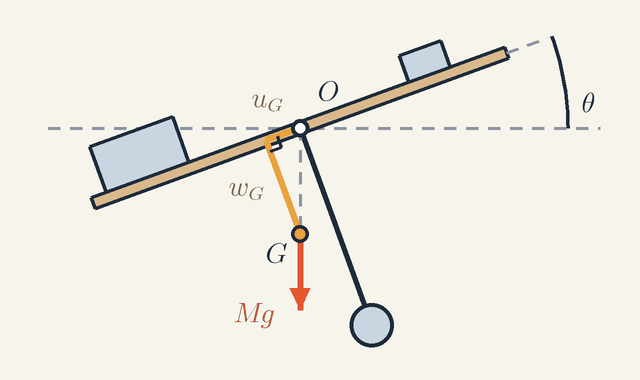
Figure 3. The balance at rest, with its centre of mass G straight below the pin O. In the right triangle with legs uG and wG the angle at G equals the tilt θ, so tanθ=uG/wG. Proportions exaggerated; not to scale.Legend
O
The pin about which the beam turns.
G
Centre of mass of the whole balance: boxes, beam, pointer and bob.
Mg
Weight of the whole balance, of total mass M, acting at G.
N
uG
Position of G along the beam, measured from the pin and positive to the right; negative here.
m
wG
Position of G across the beam, positive upward; negative here, because G is below the beam.
m
θ
Tilt of the beam from the horizontal, counter-clockwise positive. The same angle sits at G in the right triangle.
rad
Figure 3 sketches the balance with its proportions exaggerated. Use coordinates fixed to the beam and measured from the pin O: ui along the beam (positive to the right) and wi across it (positive upward). Together the parts, of masses mi, weigh like one body of mass M=∑mi at their centre of mass G, whose coordinates are uG=A/M and wG=B/M, with A=∑miui,B=∑miwi The tilt θ of the beam from the horizontal is counted counter-clockwise.
The balance is at rest when G hangs straight below O, because then the weight Mg passes through the pin and has no torque. Straight above O is also an equilibrium, but an unstable one.
In Figure 3, go from O along the beam by uG, then across it by wG, and you reach G; the plumb line from G back up to O closes a right triangle, with the right angle where uG meets wG. The angle at G equals the tilt θ. Two lines drawn at right angles to two others cross at the same angle as those do; the beam and the horizontal cross at θ, so the side wG, at right angles to the beam, and the plumb line, at right angles to the horizontal, meet at θ as well. Seen from G, uG is the opposite side and wG the adjacent one, so tanθ=wGuG=BA In the figure both uG and wG are negative, so tanθ>0: the beam has turned counter-clockwise, left side down.
The potential energy gives the same result, and it also settles stability. Turned counter-clockwise by θ, part i sits at the height uisinθ+wicosθ above the pin, so U(θ)=g(Asinθ+Bcosθ) Setting dU/dθ=g(Acosθ−Bsinθ) to zero gives tanθ=A/B once more.
Now the numbers. The boxes' centres sit 0.053 m and 0.043 m above the pin line and the bob 0.19 m below it, so B=2.0⋅0.053+1.0⋅0.043−14⋅0.19≈−2.51kg⋅m; the beam's own weight acts at the pin and adds nothing.
At the start the heavy box is at x1=−0.42m along the beam and the light one at 0.40 m, so A=2.0⋅(−0.42)+1.0⋅0.40=−0.44kg⋅m. Then tanθ=0.175 and θ=9.9∘, heavy side down, as in Figure 3. At x1=−0.10m, A=+0.20kg⋅m and θ=−4.6∘, the other side down; at x1=−0.20m, A=0 and the beam is level. As a check, the bob's clockwise torque at the start, 14⋅9.81⋅0.19sinθ≈4.51N⋅m, cancels the boxes' torque at the start of the graph.
Is this rest position stable? The second derivative is d2U/dθ2=−g(Asinθ+Bcosθ), and at the equilibrium with G below O (here B<0) it works out to gA2+B2. That is never less than g∣B∣=9.81⋅2.51=24.6N⋅m per radian, so the balance is stable wherever the box sits.
Near level θ≈A/B: sliding the box 1 cm changes A by 0.020 kg·m and tilts the beam by 0.020/2.51≈0.008rad, about 0.46°. That is the balance's sensitivity. A smaller ∣B∣, from a lighter bob or a shorter pointer, would raise it, at the price of a weaker restoring torque, g∣B∣ per radian near level. Without the bob, B=+0.15kg⋅m: G lies above the pin, the second derivative at the level position is negative, and the slightest imbalance would tip the beam right over, like a seesaw.
Tipping and sliding
A body standing on a slope can fail in two ways: it slides down, or it tips over its lower edge. Which comes first depends only on its shape and on the friction.
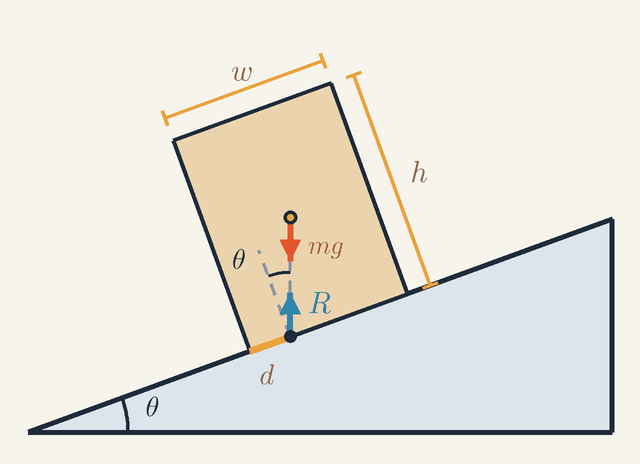
Figure 4. A uniform crate on a ramp. The contact force R balances the weight mg, so it acts on the vertical through the centre, at the distance d from the lower edge, and leans at θ from the normal. As θ grows, d shrinks; at d=0 the crate tips.Legend
w
Width of the crate's base, along the ramp.
m
h
Height of the crate.
m
θ
Angle of the ramp. The same angle lies between R and the normal to the ramp.
rad
mg
Weight of the crate, acting at its centre.
N
R
Contact force of the ramp on the crate (normal force plus friction): equal and opposite to the weight, so vertical.
N
d
Distance from the lower edge of the base to the point where R acts: d=w/2−(h/2)tanθ.
m
Figure 4 shows a uniform crate, of base w and height h, on a ramp at the angle θ. Only two forces act on it: its weight mg, at the centre, and the ramp's contact force R, the normal force and the friction over the whole base added together into one force. Two forces balance only if they are equal, opposite and on one line, so R points straight up along the vertical through the centre, and acts where that vertical meets the base.
To find that point, start from the centre, which is w/2 along the base from the lower edge and h/2 above the base. The vertical through the centre leans from the normal to the ramp by θ, so on its way down through the height h/2 it drifts (h/2)tanθ downhill. It therefore meets the base (h/2)tanθ downhill of the middle of the base, at the distance d=2w−2htanθ from the lower edge, marked d in Figure 4. As the ramp steepens, d shrinks. The contact force cannot act outside the base, so when d reaches zero it can no longer stand under the centre, and the crate tips about its lower edge: tanθ=hw(tipping of a uniform crate on a ramp)
Sliding is read off the same picture. R is vertical and the normal leans at θ from the vertical, so R leans at θ from the normal: the angle marked between R and the dashed normal in Figure 4. Its friction part divided by its normal part is therefore tanθ, and static friction can supply that only while μ≥tanθ, where μ is the coefficient of static friction. Comparing the two limits, the crate tips first if w/h<μ and slides first if μ<w/h.
A filing cabinet 0.45 m wide and 1.30 m tall has w/h≈0.35. On rubber, with μ≈0.8, it tips at 19.1°; on a wet plastic ramp with μ=0.20, it slides first, at 11.3°. For a body that is not uniform, use the real distances of its centre of mass from the lower edge and from the ramp in place of w/2 and h/2. A low centre of mass makes d shrink more slowly, which is why heavy goods are loaded low.
Limits of validity
Everything here assumes rigid bodies. Real beams bend, and in a statically indeterminate structure it is the deformations, through Hooke's law, that decide the forces. Static friction is an inequality, f≤μN: the equations give the friction a body needs, and the inequality only says whether the surfaces can supply it.
Placing the weight at the centre of mass also needs a uniform field. Gravity weakens with the height y by a fraction of about 2y/RE, where RE is the Earth's radius. In a uniform column H=800m tall, the centre of gravity, the point where the weight effectively acts, therefore sits H2/(6RE)≈1.7cm below the centre of mass: negligible for buildings. In orbit the same gradient turns a long satellite to point at the Earth, and tidal torques have turned the Moon to keep one face towards us.
Finally, statics is the limit of slow change. Move the box suddenly and the beam overshoots and swings; then τ=Iα from Rotational Dynamics and Torque takes over.
Where this leads
Virtual work runs every ideal machine in Simple Machines: Levers, Pulleys and Gears, and sagging beams lead to Elasticity: Hooke's Law, Stress and Strain. A stable equilibrium is where Simple Harmonic Motion begins: displaced slightly, a body oscillates about it with ω2=(d2U/dθ2)/I, where I is its moment of inertia about the pin. Fluids obey statics too: in Buoyancy and Archimedes' Principle a ship stays upright when, as it heels, its weight and the buoyant force form a righting couple. When the torques do not cancel, the body starts to turn, the subject of Angular Momentum and Its Conservation. Charges have their own statics, in Electric Field and Potential, with a twist: electrostatic forces alone can never hold a charge in stable equilibrium (Earnshaw's theorem).
Key formulas
Conditions for static equilibrium
∑F=0,∑τ=0
A body at rest stays at rest only if nothing makes it start to move or to turn. The net external force must vanish, or its centre of mass would accelerate, and the net torque must vanish, or it would start to rotate. Neither condition implies the other: a couple has zero net force but a torque.
Symbols
∑F
net external force; in a plane, its horizontal and vertical components separately
N
∑τ
net torque of the external forces about any chosen point
N⋅m
When it holds: For a rigid body at rest. Once ∑F=0, the torque condition holds about every point if it holds about one, so the point may be chosen freely. A deformable body needs the conditions for each of its parts.
Example: The painter on a plank: torques about the left trestle give FR=327N, and ∑F=0 then gives FL=556N.
Torque of a force
τ=rF(r: lever arm, perpendicular to the line of action)
Torque measures how strongly a force turns a body about a point: the force times its lever arm, the perpendicular distance from the point to the force's line of action. Sliding a force along its line of action does not change its torque, and a force whose line passes through the point has none. Counter-clockwise torques count as positive.
Symbols
τ
torque about the chosen point
N⋅m
r
lever arm, perpendicular to the line of action
m
F
size of the force
N
When it holds: Holds for any force in a plane. If you know the distance d to the point of application and the angle ϕ between the force and that line, the lever arm is dsinϕ, so τ=dFsinϕ.
Example: The light box in the animation, with the beam level: τ2=0.40⋅1.0⋅9.81=3.92N⋅m.
Law of the lever
m1gr1=m2gr2(law of the lever)
For a beam balanced on a pivot with a load on each side, the torques of the two weights about the pivot must be equal and opposite. The pivot's own force has no lever arm, so it does not enter. Because g appears on both sides it cancels: balance depends only on the masses and the distances.
Symbols
m1
mass of the load on one side
kg
m2
mass of the load on the other side
kg
g
free-fall acceleration
m/s2
r1
lever arm of load 1, measured horizontally from the pivot
m
r2
lever arm of load 2, measured horizontally from the pivot
m
When it holds: For a beam whose own weight acts at the pivot; otherwise add the beam's torque as a third term. The lever arms are horizontal distances, so they change when the beam tilts.
Example: In the animation 2.0 kg at 0.20 m balances 1.0 kg at 0.40 m: 2.0⋅0.20=1.0⋅0.40.
Centre of mass along a line
xCM=∑mi∑mixi
The centre of mass is the mass-weighted average position, so heavy parts pull it toward themselves. In a uniform gravitational field the whole weight acts there, and one point replaces the weights of all the parts in every torque calculation.
Symbols
xCM
position of the centre of mass
m
mi
mass of part i
kg
xi
position of the centre of mass of part i
m
When it holds: Holds for any set of masses; for a continuous body the sum becomes an integral, ∫xdm/M. Treating it as the point where the weight acts needs a uniform g.
Example: The two boxes at balance: (2.0⋅(−0.20)+1.0⋅0.40)/3.0=0, straight above the pin.
Torque of gravity on a whole body
∑τgravity=−MgxCM
Adding the torques of the weights of all the parts, −migxi, gives −g∑mixi=−MgxCM: the torque of the total weight placed at the centre of mass. The minus sign comes from the convention: a centre of mass to the right of the pivot, xCM>0, turns the body clockwise.
Symbols
∑τgravity
total torque of gravity about the pivot, counter-clockwise positive
N⋅m
M
total mass
kg
g
free-fall acceleration
m/s2
xCM
horizontal position of the centre of mass, measured from the pivot
m
When it holds: Needs a uniform gravitational field, which is excellent near the ground. xCM is a horizontal distance, so it changes when the body tilts.
Example: At the start of the animation the boxes' centre of mass is 0.153 m left of the pin: 3.0⋅9.81⋅0.153≈4.5N⋅m, counter-clockwise.
Tipping angle of a uniform crate on a ramp
tanθ=hw(tipping of a uniform crate on a ramp)
The crate tips when the vertical through its centre of mass reaches the lower edge of its base. The centre of mass lies w/2 from that edge along the ramp and h/2 above the ramp, so the line from the edge to it becomes vertical when tanθ=(w/2)/(h/2). A wider, lower crate is harder to tip.
Symbols
θ
angle of the ramp to the horizontal
rad
w
width of the base, along the ramp
m
h
height of the crate
m
When it holds: For a uniform box with enough friction not to slide first, μ>w/h; otherwise it slides when tanθ=μ. For a body that is not uniform, use the real distances of the centre of mass from the edge and from the ramp.
Example: A filing cabinet 0.45 m wide and 1.30 m tall: tanθ=0.45/1.30≈0.35, so it tips at about 19.1°.
Glossary
Static equilibrium
The state of a body that stays at rest because the forces on it cancel, ∑F=0, and so do their torques, ∑τ=0. A body moving at constant velocity without changing its rotation also satisfies both conditions, but its equilibrium is not static.
Rigid body
An idealised body whose parts keep fixed distances from one another, so it can only move as a whole and turn. Real bodies deform slightly under load, which matters when there are more supports than the equations can handle.
Free-body diagram
A sketch of one body on its own with every external force drawn where it acts: weights at the centres of mass, support forces at the contacts, tensions along the ropes. It is the first step of every statics problem.
Torque
The turning effect of a force about a point, τ=rF, in N·m. It grows with the force and with its lever arm, and its sign gives the sense of rotation (counter-clockwise positive). Also called the moment of a force.
Line of action
The straight line through the point where a force acts, along the direction of the force. Sliding a force along its line of action changes neither its torque nor its effect on equilibrium.
Lever arm
The perpendicular distance from the pivot to a force's line of action. For a weight it is a horizontal distance, which changes when a beam tilts even if the load stays at the same place on the beam.
Law of the lever
A beam on a pivot balances when the torques of its loads are equal, m1r1=m2r2: twice the mass at half the distance. Known since Archimedes, it is why a long crowbar can shift a stone far too heavy to lift.
Centre of mass
The mass-weighted average position of a body, xCM=∑mixi/∑mi. In a uniform gravitational field the whole weight acts there, so it is also the centre of gravity; it need not lie inside the material, as for a ring.
Stable, unstable and neutral equilibrium
An equilibrium is stable if a small tilt raises the centre of mass, so the body returns (d2U/dθ2>0), and unstable if a tilt lowers it, so the body falls away, like a pencil on its tip. In neutral equilibrium, such as a wheel on its axle, a tilt changes nothing.
Tipping over
A body standing on a base topples once the vertical line through its centre of mass passes outside the base. The angle depends on the shape, not on the mass: a uniform crate on a ramp tips at tanθ=w/h.
Principle of virtual work
In equilibrium, the total work of all the forces in any small displacement allowed by the supports is zero. It gives the law of the lever and the balance of any ideal machine without finding the internal forces.
Statically indeterminate structure
A body with more unknown support forces than independent equilibrium equations, such as a four-legged table: four leg forces, three equations. How the load is shared then depends on how the parts deform.
Quantities
F
Force
N
A push or pull on the body; in this lesson mostly weights mg and the forces of the supports.
τ
Torque
N⋅m
The turning effect of a force about a chosen point, counter-clockwise positive. It is never written in joules, because it is not an energy.
r
Lever arm
m
The perpendicular distance from the pivot to a force's line of action; r1 and r2 for the two loads of a lever.
mi
Mass of a part
kg
The mass of part i of a system, whose own centre of mass lies at position xi, such as m1=2.0kg and m2=1.0kg for the boxes in the animation.
M
Total mass
kg
The sum of all the masses, ∑mi; its weight Mg acts at the centre of mass.
g
Free-fall acceleration
m/s2
The weight per unit mass, about 9.81m/s2 (9.81 N/kg) near the Earth's surface. It cancels from the law of the lever.
xCM
Position of the centre of mass
m
The horizontal distance of the centre of mass from the pivot, positive to the right; the torque of gravity is −MgxCM.
θ
Angle of the incline
rad
The angle of a ramp to the horizontal (for the balance, the tilt of the beam). Usually quoted in degrees: a uniform crate tips at tanθ=w/h.
w
Width of the base
m
The width of a crate's base, measured along the ramp, in the direction in which it would tip.
h
Height
m
The height of the crate; when it is uniform, its centre of mass lies at h/2.
Quiz
Beginner A 30 kg child sits 2 m from the pivot of a seesaw. Where must a 60 kg adult sit on the other side so that the seesaw balances?
2 m from the pivot, the same distance
1 m from the pivot
4 m from the pivot
Nowhere: different weights can never balance
Show answer
Answer: B. 1 m from the pivot
The torques must be equal: 60 × g × d = 30 × g × 2, so d = 1 m. Twice as heavy means half as far from the pivot.
Beginner A shelf is in static equilibrium. What must be true?
Only the forces on it cancel
Only the turning effects on it cancel
Both the forces and the turning effects on it cancel
No forces act on it at all
Show answer
Answer: C. Both the forces and the turning effects on it cancel
If the forces did not cancel, the shelf would start to slide; if the turning effects did not cancel, it would start to rotate. Forces do act on it (its weight and its supports), but they balance in both ways.
Beginner A tall bookcase is tipped onto one bottom edge and released. When does it fall over instead of rocking back?
When its centre of mass has passed beyond the edge it rests on
As soon as it is tilted even slightly
Only when it is tilted by more than 45°
Never, if it is heavy enough
Show answer
Answer: A. When its centre of mass has passed beyond the edge it rests on
While the centre of mass is still above the base, the weight turns the bookcase back. Once the centre of mass passes the edge, the weight turns it the other way and it falls. The angle depends on its shape, not on its mass.
Intermediate A 2.0 kg box sits 0.30 m left of the pivot of a beam supported at its middle. Where must a 1.5 kg box be placed on the right for the beam to balance?
0.30 m
0.225 m
0.60 m
0.40 m
Show answer
Answer: D. 0.40 m
m₁·r₁ = m₂·r₂ gives r₂ = 2.0 × 0.30 ÷ 1.5 = 0.40 m. Inverting the ratio gives 0.225 m, which would put the lighter box closer, and it could not balance the heavier one.
Intermediate A uniform 4.0 m plank weighing 200 N rests on supports at both ends. A 600 N person stands 1.0 m from the left end. What upward force does the right support exert?
150 N
250 N
400 N
550 N
Show answer
Answer: B. 250 N
Torques about the left support: F_R × 4.0 = 600 × 1.0 + 200 × 2.0 = 1000 N·m, so F_R = 250 N. ΣF = 0 then gives the left support 800 − 250 = 550 N, more because the person stands closer to it.
Intermediate When finding the support forces on a beam, why is it convenient to take torques about one of the supports?
Because torques about other points are not zero in equilibrium
Because the beam really rotates about that support
Because the unknown force there has zero lever arm, so it drops out of the equation
Because the beam's weight acts at that support
Show answer
Answer: C. Because the unknown force there has zero lever arm, so it drops out of the equation
In equilibrium Στ = 0 about every point, so the choice is free. About a support, the force acting there has no lever arm and no torque, which leaves a single unknown in the equation.
Advanced A uniform crate 0.60 m wide and 1.20 m tall stands on a ramp whose angle is slowly increased. Friction stops it from sliding. At what angle does it tip over?
26.6°
63.4°
30.0°
45.0°
Show answer
Answer: A. 26.6°
It tips when the vertical through the centre of mass reaches the lower edge: tan θ = (w/2)/(h/2) = 0.60/1.20 = 0.5, so θ ≈ 26.6°. Using h/w instead of w/h gives 63.4°.
Advanced A beam balance hangs from a pin above its centre of mass. A small extra mass is placed on one side. What happens?
It tips until that side hits the stop: any imbalance is unstable
It stays exactly level, because the pin carries all the weight
It swings forever around the level position
It settles at a new tilt where the total centre of mass is straight below the pin
Show answer
Answer: D. It settles at a new tilt where the total centre of mass is straight below the pin
With the centre of mass below the pin, the equilibrium is stable: tilting raises the centre of mass. The beam turns until the total centre of mass, extra mass included, is again directly below the pin, so the tilt measures the imbalance.
 Physics Tutor