Power P=VI is how fast an appliance takes energy, the meter adds up the energy E=Pt in kilowatt-hours, and fuses and breakers keep the current I low enough for the wiring to stay cool.
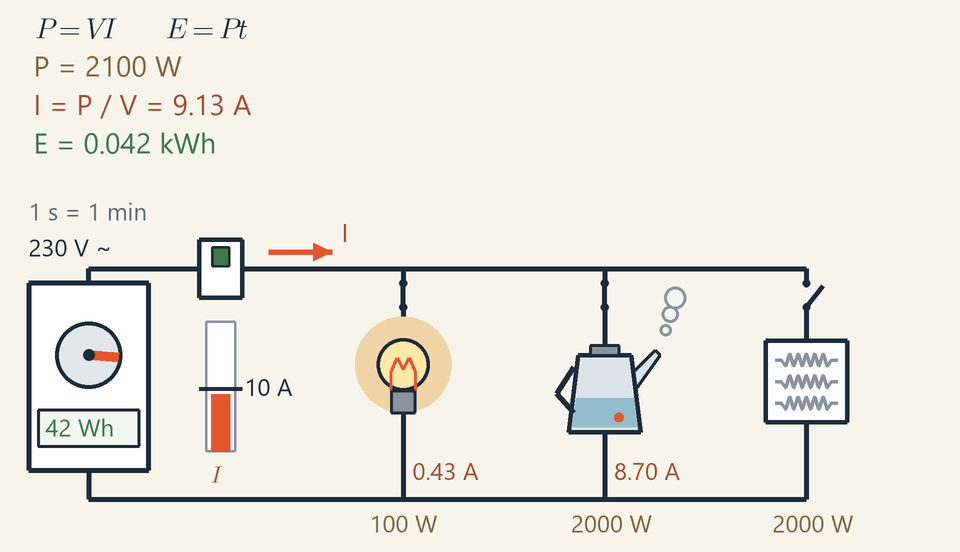
A lamp, a kettle and a heater are switched on one after another on a 230 V circuit: the current rises, the energy meter turns faster, and the overload trips the circuit breaker.
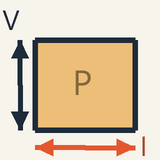
The power rating in watts says how fast an appliance uses energy: 1 W is 1 joule per second, and a 2000 W kettle works 200 times faster than a 10 W LED.
Energy = power × time, counted in kilowatt-hours: you pay for the kWh used, times the price of one kWh.
Every appliance you switch on adds to the current in the supply wires, and too much current makes them overheat.
A fuse melts, or a circuit breaker clicks off, to cut the power when the current gets too large.
An LED gives the same light as an old filament bulb with about a sixth of the power: less energy is wasted as heat.
Every appliance has a power rating, in watts (W). Power tells you how fast the appliance uses energy: one watt is one joule every second. An LED lamp uses about 10 W, a television about 100 W and a kettle about 2000 W, which is 2 kilowatts (kW).
Step 1: energy = power × time. This energy is counted in kilowatt-hours (kWh): one kWh is what a 1 kW appliance uses in an hour, a 2 kW kettle in half an hour, or a 10 W LED lamp in 100 hours.
Step 2: the bill. The meter adds up the kWh, and you pay for energy, not for power: the number of kWh times the price of one kWh. A 2 kW heater left on for 3 hours uses 2×3=6kWh; at €0.20 per kWh, that costs €1.20.
Step 3: current and safety. Every appliance you switch on draws more current through the same supply wires, and current warms wires. With too many powerful appliances on one circuit the wires could overheat, so a fuse (a thin wire that melts) or a circuit breaker (a switch that clicks off) cuts the power first.
In the animation a lamp, a kettle and a heater switch on one after another. With each one the red current bar rises and the meter's disc spins faster. When the heater joins the kettle, the bar passes the limit line and the breaker trips.
Step 4: efficiency. An old filament bulb turns most of its energy into heat; an LED gives the same light with about a sixth of the power.
Check yourself: which uses more energy, a 100 W lamp on for 10 hours or a 2000 W kettle on for 15 minutes? (Answer: the lamp, 1 kWh against 0.5 kWh.)
Intermediate
Key ideas
P=VI; with Ohm's law, P=I2R=V2/R. 1W=1J/s=1VA.
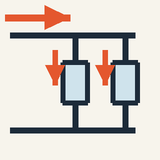
Appliances are in parallel: each gets the full mains voltage, and the supply current is I=(P1+P2+…)/V.
E=Pt; 1 kWh = 1 kW for 1 h = 3.6 MJ. The kWh is a unit of energy, not of power.
At 230 V a 2000 W kettle draws 8.70 A; a 10 A circuit can supply at most VImax=2300W.
Power: energy per second
An LED lamp left on long enough uses as much energy as a kettle switched on briefly. Power is the rate at which energy is transferred, P=E/t, in watts: 1W=1J/s. A 2000 W kettle takes 2000 joules from the mains every second, a 10 W LED lamp only 10.
The voltage V across an appliance is the energy that each coulomb of charge gives up in passing through it, 1V=1J/C, and the current I is the charge passing each second, 1A=1C/s. Their product is joules per second: P=VI
Ohm's law, V=IR, from DC Circuits and Ohm's Law, gives two more forms: P=I2R=RV2
On the mains the voltage is fixed, so by V2/R a smaller resistance takes more power: the kettle element has only 2302/2000≈26Ω, a hot 100 W lamp filament 529 Ω. For a fixed current, I2R says the larger resistance heats more, which is why supply cables are thick.
Appliances in parallel on the mains
Every socket sits between the same two wires, live and neutral, so household appliances are in parallel. Each gets the full mains voltage (230 V in Europe, 120 V in North America) whatever else is on, and the branch currents add up in the supply cable: I=VP1+P2+…
A circuit protected at Imax can therefore deliver at most VImax: 2300 W for 10 A at 230 V, 3680 W for 16 A. That is why a kitchen gets several circuits.
Energy, the kilowatt-hour and efficiency
The energy an appliance uses is its power multiplied by the time it runs: E=Pt With P in watts and t in seconds it comes out in joules; suppliers count larger units, kilowatt-hours, the energy of 1 kW for an hour: 1kWh=3.6MJ since 1000W⋅3600s=3.6×10⁶J. The meter adds up kilowatt-hours, and you pay for this energy, not for power: a 2000 W kettle used for 6 minutes and a 10 W LED left on for 20 hours both take 0.2 kWh.
The efficiency compares the useful output with the input: η=PinPuseful A kettle puts 80 to 90 % of its energy into the water, a filament lamp only about 5 % into visible light, which is why an LED needs about a sixth of the power for the same light.
Worked example: the circuit in the animation
The animation's 230 V circuit is protected by a 10 A breaker. The 100 W lamp draws 100/230=0.43A and the 2000 W kettle 2000/230=8.70A, so together I=230100+2000=9.13A just under the limit, with 2300−2100=200W to spare. The 2000 W heater then raises the current to I=230100+2000+2000=17.83A almost twice the rating.
These are the values on the I readout, while the P readout steps from 100 to 2100 to 4100 W and the red arrow I on the supply wire lengthens; the branch labels show 0.43, 8.70 and 8.70 A. The red column in the current bar stays just below the 10 A line with the kettle and shoots past it with the heater. 1.2 s later the breaker trips: P and I drop to zero, and E stops climbing.
With 1 s standing for 1 minute, the lamp has run 5.5 minutes by then, the kettle 3.5 and the heater 1.2, so in watt-hours E=60100⋅5.5+2000⋅3.5+2000⋅1.2Wh=165.8Wh the 0.166 kWh of the E readout (166 Wh in the meter window). At €0.25 per kWh this costs about 4 cents.
Worked example: a heater on an extension reel
A 1500 W fan heater runs on a 25 m extension reel with 1.0 mm² copper conductors. Its 1500/230=6.52A goes out and back through 50 m of copper of resistivity 1.7×10⁻⁸Ω⋅m. With R=ρL/A from Electric Current and Resistance, Rc=AρL=1.0×10−61.7×10−8⋅50=0.85Ω Pc=I2Rc=6.522⋅0.85≈36W
Spread along the unwound cable, 36 W is harmless; wound on the drum, the same heat, about that of a small soldering iron, is trapped and can overheat the insulation, hence the lower rating of a wound reel. The reel also drops IRc≈5.5V: by P=V2/R, 2.4 % less voltage costs about 5 % of the power, leaving roughly 1430 W.
At full rating, 4 hours an evening for 30 days uses E=1.5⋅4⋅30=180kWh, €45 at €0.25 per kWh; on the reel the meter shows about 176 kWh, 4 of them released in the reel.
Fuses, breakers and the current bar
A cable is rated for the largest current at which its Joule heating, I2R, keeps the insulation safe, around 70 °C for PVC. A fuse (a thin wire that melts) or a circuit breaker (a switch that can be reset) on the live wire cuts the current beyond that rating: it protects the cable, not the appliance.
Heating grows as the square of the current, so a moderate overload is dangerous only if it lasts, a short circuit at once. A breaker's bimetal strip, warmed like the cable, trips after seconds to minutes; its electromagnet trips within about 10 ms when a short circuit drives hundreds of amperes.
In the animation the red bar is the current through the breaker and the line is its 10 A rating: below it, the wiring could run for ever. The 17.8 A with the heater on is an overload, so the breaker waits 1.2 s, standing for 1.2 minutes, before opening.
Common mistakes
Appliances do not use up current: the 8.70 A entering the kettle through the live wire leaves through the neutral. What is used up is energy, 2000 joules a second.
A kilowatt-hour is not "kilowatts per hour" but a power multiplied by a time, an energy of 3.6 MJ: a 3 kW heater uses 1 kWh in 20 minutes.
Switching on more appliances in parallel does not raise the total resistance but lowers it: 529 Ω for the lamp alone, 25.2 Ω with the kettle, 12.9 Ω with all three, which is why the current grows.
More resistance does not always mean more heat: at fixed voltage, P=V2/R gives the 26 Ω kettle element 2000 W and the 529 Ω filament 100 W. I2R favours the larger resistance only for equal currents, as in series.
A bigger fuse is not safer: a 10 A cable fused at 30 A could carry three times its rated current, heating 32=9 times as fast, without the fuse blowing.
Where you meet it
Every electricity bill is this lesson. A fridge averaging 40 W uses about 350 kWh a year, and a device on standby at 1 W still takes 8.76 kWh; an electric car's 60 kWh battery needs about 8 hours on a 7.4 kW home charger; a 1 GW power station matches half a million kettles boiling at once.
The magnetic field around every current, which opens a breaker, is the subject of Magnetic Fields of Magnets and Currents. Motors, Generators and Transformers explains why power lines run at hundreds of kilovolts to cut I2R losses, and Semiconductors, Diodes and LEDs why an LED beats a filament.
Advanced
Key ideas
A charge dq falling through V gives up dW=Vdq, so P=VI; in a resistor it all becomes heat, I2R.
The energy enters a resistor through its surface: S=ε0c2E×B points inward and totals VI.
With AC, p=vi pulses at twice the mains frequency; its average is VrmsIrmscosφ.
The meter computes E=∫Pdt: the E(t) graph is made of straight segments whose slope is the power.
Cable heating goes as I2t: breakers trip thermally after a delay for overloads and magnetically in milliseconds for short circuits.
Power as work done on moving charge
Every appliance carries a power rating in watts, and the whole lesson rests on one formula for it, P=VI. This section derives it from the work the electric field does on the charge that passes through a component, which shows why it holds for every kind of device.
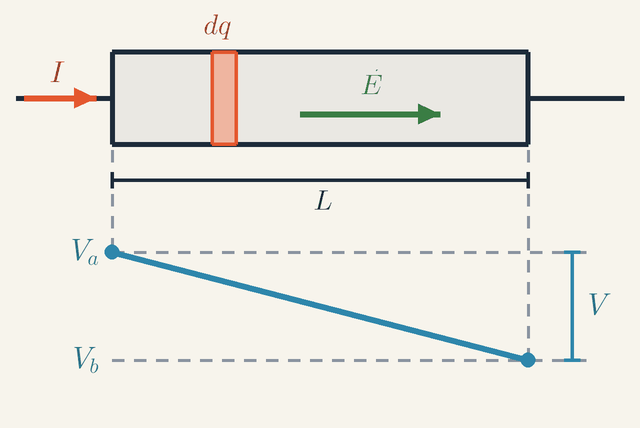
Figure 1. A uniform conductor of length L carrying the current I, with its potential drawn below to the same scale. Notice that the potential falls evenly from Va to Vb, a drop V, and that E points down the slope; the slab dq is the charge crossing a section in the time dt.Legend
I
Current entering at the end with the higher potential.
A
dq
Charge that crosses a section of the conductor in a short time dt: dq=Idt.
C
E
Electric field inside the conductor, along the current; its size is V/L.
V/m
L
Length of the conductor.
m
Va
Potential at the end where the current enters.
V
Vb
Potential at the end where the current leaves.
V
V
Drop in potential along the conductor, V=Va−Vb.
V
Figure 1 shows the simplest component, a uniform conductor of length L. The current I enters at the left end, where the potential is Va, and leaves at the right end, where it is Vb. Below the conductor, on the same horizontal scale, the potential is plotted as a height. Look at the slanting line: the potential falls evenly from Va to Vb, and the total drop is V=Va−Vb. The electric field E inside points down that slope, in the direction of the current, and because the fall is even, its size is the same everywhere: E=V/L.
Now look at the shaded slab dq. It is the charge that crosses one cross-section of the conductor in a short time dt. Current is charge per unit time, so dq=Idt. In that time a charge dq enters at the left and an equal charge leaves at the right, because charge does not pile up inside. The net effect is the same as if the slab dq had been carried the whole way from the potential Va to the potential Vb.
A difference in potential is work per unit charge: when a charge q moves through a drop V, the field does the work qV on it. So in the time dt the field does the work dW=Vdq=VIdt, and the power, which is work per unit time, is P=dtdW=Vdtdq=VI
Only the potentials of the two ends entered this argument. Inside a component that is not a straight wire the potential may fall unevenly, or even rise in places, but the work done on a charge carried from one terminal to the other still depends only on the end values. Nor does the argument care what becomes of the energy: a motor turns it into mechanical work, a battery on charge into chemical energy, an LED partly into light.
The sign needs one convention. Take V as the potential where the current enters minus the potential where it leaves. Then P=VI>0 means that the component absorbs energy from the circuit. A source drives current out of its positive terminal, so the current enters it at the lower potential, V is negative and P<0: the source delivers energy to the circuit.
In a resistor all of the work becomes heat. The current is the same at both ends, so the charges drift out as fast as they drift in and gain no kinetic energy overall. The energy the field gives them is passed on, in collisions, to the vibrating atoms of the metal.
The same result can be found point by point inside the metal. Let there be n charge carriers per unit volume, each with charge q and drift velocity v. The field pushes each one with the force qE, so it does work on it at the rate qE⋅v. Per unit volume that is nqv⋅E, and nqv is the current density j, the current per unit area of cross-section. The power released per unit volume is therefore j⋅E. Ohm's law in its local form, j=σE, where σ is the conductivity of the material, turns this into j2/σ. A wire of length L and cross-section A has the current density j=I/A, the volume AL and the resistance R=L/(σA), so P=σj2AL=I2σAL=I2R
With V=IR this also gives P=V2/R, the convenient form when the voltage is fixed, as at a socket.
Where the energy really flows
The kettle takes 2000 W from the socket. It is natural to picture that energy travelling inside the copper of the cable, carried along by the electrons. It does not, and seeing where it does travel makes the idea of a field concrete. The electrons are far too slow to carry it. Copper has about n=8.5×1028 free electrons per cubic metre, each with the charge e=1.6×10⁻¹⁹C, so the kettle's 8.70 A in a 1.5 mm² wire needs a drift speed of only v=I/(neA)≈0.43mm/s. With alternating current, which reverses 100 times a second, they merely shuffle back and forth by about 2 µm. Yet the element starts to warm the moment the switch closes. The energy travels in the electric and magnetic fields around the wires.
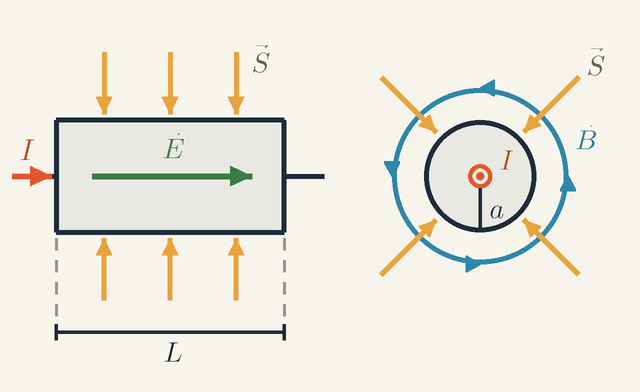
Figure 2. A resistor as a cylinder of radius a and length L, side view and end view. E runs along the current I and B circles it, so the energy flux S=ε0c2E×B points into the side at every point. Not to scale.Legend
I
Current along the axis; in the end view it comes towards you (the dot).
A
E
Electric field along the axis, of size V/L inside the metal and just outside it.
V/m
L
Length of the cylinder.
m
a
Radius of the cylinder.
m
B
Magnetic field of the current, circling the cylinder; at the surface its size is I/(2πε0c2a).
T
S
Energy flux of the field, power per unit area: it points from outside into the resistor.
W/m2
Figure 2 models the kettle's element as a plain cylindrical resistor of radius a and length L, seen from the side on the left and end-on on the right. Three fields are drawn. The first is the electric field E, which runs along the axis in the direction of the current I that it drives. Its size inside is V/L. The part of an electric field that lies along a surface is the same on both sides of it, so just outside the metal there is also a field V/L along the axis.
The second is the magnetic field B of the current, which circles the cylinder. In the end view the current comes towards you (the dot), and B goes round anticlockwise: point your right thumb along the current, and your fingers curl the way B goes. Its size at the surface follows from Ampère's law, B⋅2πa=I/(ε0c2), so B=I/(2πε0c2a). Since ε0c2=1/μ0, this is the familiar B=μ0I/(2πa).
The third is the energy flux S, the power that crosses a unit area, in watts per square metre. Wherever an electric and a magnetic field are both present, energy flows at the rate given by the Poynting vector, named after John Henry Poynting: S=ε0c2E×B
Its direction follows from the figure. E points along the axis and B goes round it, so the two are at right angles, and their cross product, at right angles to both, lies along a radius. The right-hand rule decides between inward and outward. At the top of the end view E points towards you and B points to the left, and towards you crossed with leftward points down, into the cylinder. The same holds all round, so at every point of the side S points into the resistor, as the arrows S show in both views. On the flat end faces a radial S runs along the face, so no energy enters there.
Because E and B are at right angles, the size of S is simply the product of the sizes: S=ε0c2⋅LV⋅2πε0c2aI=2πaLVI It is the same at every point of the side, whose area is 2πaL, so the total power flowing in is S⋅2πaL=VI: exactly the rate at which the resistor turns energy into heat.
So the energy enters the resistor from the space around it, through its surface. Along the supply cable, the electric field reaches across the gap between the live and the neutral wire and the magnetic field circles each wire; there S runs mostly parallel to the wires, through the insulation and the air between them, from the socket towards the kettle. Only a small inward part enters the copper, and it is the cable's own I2R loss. When the current reverses, E and B both reverse and their cross product keeps its direction, so the energy always flows towards the load. The wires guide the energy rather than carry it, and its conservation is local: the energy in any region changes only by what flows across its surface.
Alternating current: rms values
The mains supply is alternating: the voltage and the current change all the time. What, then, do the 230 V and the 2000 W on a label mean?
The voltage is sinusoidal, v=V0sinωt, with the amplitude V0 and ω=2π⋅50s−1 in Europe. In a resistor the current i=v/R follows the voltage exactly, i=I0sinωt with I0=V0/R; the two are in phase. The instantaneous power is p=vi, and with sin2x=21(1−cos2x), p(t)=V0I0sin2ωt=21V0I0(1−cos2ωt)
Read this term by term. The power never goes negative: it pulses at twice the mains frequency, 100 Hz, between 0 and V0I0. The cosine term averages to zero over each cycle, so the average power is P=21V0I0.
A steady current I would heat the same resistor at the rate I2R. It matches the alternating one when I2 equals the average of i2, which is 21I02, because sin2 averages to one half. That steady value, the square root of the mean of the square, is the rms current, Irms=I0/2; the rms voltage is likewise Vrms=V0/2. Then 21V0I0=VrmsIrms, and all the direct-current formulas, P=VI=I2R=V2/R, hold for the average power when rms values are used. That is why ratings are given as rms values: an rms current heats a resistor exactly like an equal steady current.
For the kettle, the 230 V on the label is rms, so the voltage peaks at 2302≈325V. Its rms current of 8.70 A peaks at 8.702≈12.3A, and its power swings between 0 and V0I0=4000W, averaging 2000 W.
Phase and the power factor
In a kettle the current rises and falls together with the voltage. In devices with coils or capacitors, such as motors and transformers, the current is shifted in time against the voltage, and then VrmsIrms overstates the power actually taken. Figure 3 shows how to find the real power.
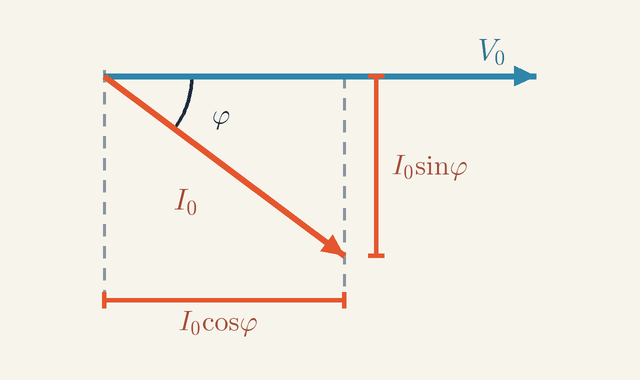
Figure 3. The voltage and the current of one load as arrows of lengths V0 and I0, the current trailing by the angle φ. Only the part I0cosφ, in step with the voltage, takes power on average; the part I0sinφ only swaps energy with the supply.Legend
V0
Amplitude of the voltage; its arrow is the reference direction.
V
I0
Amplitude of the current.
A
φ
Phase angle by which the current trails the voltage.
rad
I0cosφ
Part of the current in step with the voltage: the only part that delivers power on average.
A
I0sinφ
Part of the current a quarter of a cycle behind the voltage: its power averages to zero.
A
Write the current as i=I0sin(ωt−φ), where φ is the phase angle. A coil makes the current lag behind the voltage (φ>0, as drawn); a capacitor makes it lead (φ<0); the result below holds for both. Figure 3 draws each quantity as an arrow whose length is its amplitude and whose direction gives its phase. The voltage arrow V0 is the reference, drawn horizontal. The current arrow I0 is turned away from it by the angle φ, clockwise, because the current trails. The two lengths are in different units, volts and amperes, so only the angle between the arrows carries meaning.
Now split the current arrow into two parts, as the figure does: its part along the voltage, I0cosφ, and its part at right angles to it, I0sinφ. In formulas this is the identity for the sine of a difference: I0sin(ωt−φ)=I0cosφsinωt−I0sinφcosωt
The first part rises and falls exactly with the voltage. It behaves like the current in a resistor, so by the last section it delivers the average power 21V0I0cosφ. The second part goes as −cosωt, which is a quarter of a cycle behind the voltage. Its product with v=V0sinωt is −V0I0sinφsinωtcosωt=−21V0I0sinφsin2ωt. This is positive half of the time and negative the other half, so it averages to zero. It only moves energy back and forth: for a quarter of a cycle the device stores energy in the magnetic field of its coil (or the electric field of its capacitor), and for the next quarter it hands it back to the supply.
Adding the two products, and using cosφcos2ωt+sinφsin2ωt=cos(2ωt−φ), gives p(t)=21V0I0(cosφ−cos(2ωt−φ)) For part of each cycle this is negative, while the device returns stored energy. Its average is the constant part: P=VrmsIrmscosφ
The factor cosφ is called the power factor, and the product VrmsIrms, measured in volt-amperes (V·A), the apparent power. A motor drawing 5.0 A at 230 V with cosφ=0.8 has an apparent power of 1150 V·A but takes only 920 W. A load with a power factor of 1 would need only 4.0 A for the same 920 W, yet the cable and the breaker still carry the motor's full 5.0 A and heat as I2R accordingly. That is why suppliers charge industrial users for a poor power factor, and why factories add capacitors to cancel the lag of their motors.
The energy graph is an integral
The bill counts energy, not power. When the power changes with time, the energy is the area under the graph of power against time, its time integral, and the power is the slope of the energy: E=∫Pdt
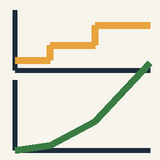
In the animation at the Advanced level, P(t) is a staircase. The lamp brings it to 100 W at 0.5 s, the kettle to 2100 W at 2.5 s and the heater to 4100 W at 4.8 s. The dashed line marks VImax=230⋅10=2300W, the most the circuit can deliver at the breaker's rated current Imax=10A. The heater's step crosses this line, the breaker trips at 6.0 s and the power drops to zero.
E(t) is the running area under the staircase, with 1 s of animation standing for 1 minute. Each step adds its height times its width: 100W⋅2min=200Wmin≈3.3Wh up to 2.5 s, then 2100W⋅2.3min=80.5Wh, reaching 83.8 Wh at 4.8 s, then 4100W⋅1.2min=82Wh, reaching 165.8 Wh at the trip. After that the graph stays flat. So the 1.2 minutes of overload add more energy than the 2.3 minutes before them. Each straight segment of E(t) climbs with a slope equal to the power at that time, and each corner marks a step of P(t); a smoothly varying power would make the graph curve.
A meter computes this integral. The older induction meter turns an aluminium disc with a torque proportional to the average of vi, that is to P, against a magnetic brake whose drag is proportional to the disc's speed. The two balance when the speed is proportional to P, so the number of turns counts E. An electronic meter samples v and i thousands of times a second, multiplies each pair and adds up the products. Both work with the instantaneous product vi, so the power factor is included automatically: they count the real power, not VrmsIrms.
Switch-on surges and distorted currents
So far every load has been a fixed resistance. Real loads are not, and two common effects make the current larger than P/V suggests, which matters for fuses and cables.
A tungsten filament's resistance grows tenfold or more as it heats from room temperature to about 2700 K. A 100 W lamp has R=V2/P=2302/100=529Ω when hot but only about 50 Ω cold. At switch-on it therefore draws 230/50≈4.6A, over 1 kW, for a fraction of a second until the filament heats up. That sudden stress is why such bulbs usually fail at the moment they are switched on.
Many phone chargers draw current only in short pulses near the peaks of the voltage, so their current is not a sine wave at all. Heating goes as i2, which weights tall, narrow pulses heavily, so their Irms exceeds P/Vrms even without any phase shift.
Cable heating and the circuit breaker
A circuit breaker protects the cable, whose insulation is damaged if it runs too hot. So the rule for when it must trip follows from how a cable warms up.
Model the cable as a body of heat capacity C whose temperature is ΔT above its surroundings. The current heats it at the rate I2R, and it loses heat to its surroundings at a rate kΔT, proportional to how much warmer it is, where k is a heat-loss coefficient in watts per kelvin. The rate of change of its stored heat, CdΔT/dt, is the difference: CdtdΔT=I2R−kΔT
At first ΔT is small, the loss is negligible and the temperature climbs at the rate I2R/C. As it rises, the loss catches up, until gain and loss balance at the final rise ΔT=I2R/k. The solution approaches this value as 1−e−t/τ, with the time constant τ=C/k, and is practically there after a few time constants, typically minutes for house wiring.
The final rise grows as I2. Cables are sized so that their rated current keeps them below the safe limit of their insulation. The overload in the animation, 17.83/10=1.78 times the rating, gives 1.782≈3.2 times the temperature rise, far beyond that limit.
The bimetal strip in the breaker is heated by the same current and has its own heat capacity and heat loss, so it is a small model of the cable: it bends and trips the breaker when its own temperature reaches a set value. The larger the overload, the higher its final temperature would be and the earlier on its rise it passes the trip point, so its delay shortens steeply as the overload grows. In a short circuit the current might reach 300 A, which heats (300/10)2=900 times as fast as 10 A. That is too fast to wait for a strip to warm, so a magnetic coil, pulled by the current itself, opens the contacts within about 10 ms, half a mains cycle.
Worked problem: the overload in a real cable
The animation assumes the full 230 V at every socket, as if the cable had no resistance. Suppose instead that the circuit's cable runs 15 m out and 15 m back, in 1.5 mm² copper. With all three appliances on, what current flows, what power does the cable take, and how much could it warm in the 1.2 minutes before the trip?
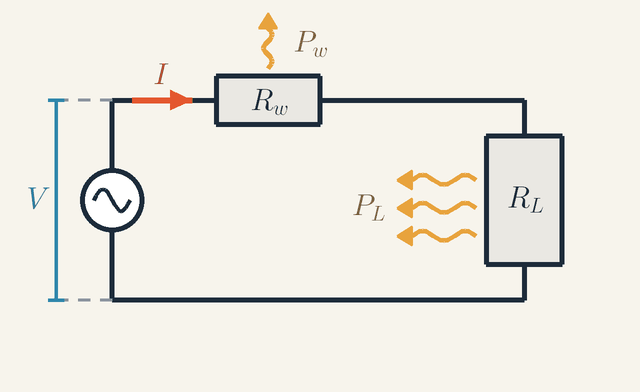
Figure 4. The worked problem as a series circuit: the supply V drives one current I through the cable Rw and the appliances RL. Both heat as I2R, so the cable's share Pw is small next to PL because Rw is small. Not to scale.Legend
V
Voltage of the supply (rms).
V
I
Current, the same all round the loop.
A
Rw
Resistance of the whole cable, both conductors, drawn in one wire.
Ω
RL
Combined resistance of the three appliances.
Ω
Pw
Power released as heat in the cable.
W
PL
Power the appliances take.
W
Figure 4 draws the situation as a series circuit. The supply V drives one current I round the loop: through the cable, whose two conductors together have the resistance Rw (drawn in a single wire), and through the three appliances, which act together as one resistance RL. Because the same I flows through both, the heat they release, Pw=I2Rw and PL=I2RL, is in the ratio of their resistances. Treat each appliance as a fixed resistance equal to its value at the rated 230 V, which is a good model for heating elements.
First the two resistances. Copper has the resistivity ρ=1.7×10⁻⁸Ωm, and the cable has a total length of 30 m and the cross-section A=1.5×10⁻⁶m2, so Rw=ρL/A=1.7×10−8⋅30/(1.5×10−6)=0.34Ω. The appliances take 4100 W together at 230 V, so RL=V2/P=2302/4100=12.90Ω.
The two are in series, so their resistances add, and the current and the cable's heating are I=RL+RwV=12.90+0.34230=17.37A Pw=I2Rw=17.372⋅0.34≈103W
The cable takes part of the voltage, 17.37⋅0.34≈5.9V, so the sockets get 230−5.9=224.1V and the appliances PL=I2RL≈3890W, not 4100 W. The cable's 103 W is 3.4 W per metre, three times the 34 W it releases at the rated 10 A, since (17.37/10)2=3.0.
Now the warming. In the 72 s before the trip the cable releases 103⋅72≈7.4kJ. Its copper has the volume 30⋅1.5×10−6=4.5×10⁻⁵m3; at 8960 kg/m³ that is a mass of 0.40 kg, and at 385 J/(kg·K) a heat capacity of 155 J/K. If no heat escaped, the copper would warm by ΔT=1557400≈48K
In reality the insulation and the wall absorb part of the heat, so the rise is smaller. Against that, copper's resistance grows by about 0.4 % per kelvin, so by up to about 19 % over a 48 K rise, which raises the heating a little. The order of magnitude is the point: tens of kelvin in about a minute, still rising, so an overload of this size must be cut within minutes.
Limits of validity
Everything above rests on simplifications. This section says where they hold.
Circuit theory treats the wires as ideal links that carry the same current all along their length at every instant. That requires a change at one end to reach the other end quickly compared with a cycle. Across a house such a change takes about a tenth of a microsecond, against a period of 20 ms at 50 Hz; put another way, the circuit must be much smaller than the wavelength c/f, which is 6000 km at 50 Hz. At radio frequencies, with wavelengths of metres, the wires radiate and the field picture takes over completely.
At 50 Hz the current also fills the conductor evenly. An alternating current is pushed towards the surface of a conductor, within a layer called the skin depth, and in copper at 50 Hz that depth is 9.2 mm, more than the 0.7 mm radius of a 1.5 mm² wire. At 1 MHz it shrinks to 65 µm, and the wire's resistance rises.
The supply is not ideal either: European mains may stray 10 % from 230 V, and by P=V2/R a kettle on 207 V gives only 2000⋅0.92=1620W. Ohm's law fails for filaments, whose resistance depends on their temperature, and for LEDs and electronics. Even copper's resistance rises by about 0.4 % per kelvin, and only superconducting cables, cooled with liquid nitrogen to 77 K, carry direct current with no resistive loss at all.
Where this leads
The magnetic field around every current is developed in Magnetic Fields of Magnets and Currents, and Electromagnetic Induction shows how the 50 Hz voltage is generated. Motors, Generators and Transformers explains why power crosses countries at 400 kV: for the same power, a thousand times the voltage means a thousandth of the current and so a millionth of the I2R loss.
The Poynting vector returns in Electromagnetic Waves, carrying sunlight's roughly 1 kW/m². Blackbody Radiation and the Quantum explains why a filament at 2700 K radiates mostly infrared, Semiconductors, Diodes and LEDs why an LED does far better, and First Law of Thermodynamics and Heat Engines why a heat pump gives three or four times more heat per kilowatt-hour than a heater.
Key formulas
Electrical power
P=VI
The voltage is the energy each coulomb gives up and the current is the number of coulombs per second, so their product is the energy per second. It holds for any component; what the energy becomes (heat, light, motion or chemical energy) depends on the device. With the current entering at the higher-potential terminal, P>0 means power absorbed.
Symbols
P
power taken by the component
W
V
voltage across the component
V
I
current through the component
A
When it holds: Exact for direct current, and for the instantaneous values p=vi of alternating current. For the average AC power use VrmsIrmscosφ.
Example: The kettle in the animation: I=P/V=2000/230=8.70A.
Power in a resistance (Joule heating)
P=I2R=RV2
Putting Ohm's law V=IR into P=VI gives the two other forms; in a resistor all of this power becomes heat. At a fixed voltage use V2/R: the smaller the resistance, the more power. At a fixed current use I2R: the larger the resistance, the more heat.
Symbols
P
power turned into heat
W
I
current through the resistance
A
R
resistance at the working temperature
Ω
V
voltage across the resistance
V
When it holds: Only for ohmic resistances, with R taken at the working temperature: a lamp filament's cold resistance is about a tenth of its hot value. With AC, use rms values.
Example: The kettle element has R=2302/2000≈26Ω; an extension reel of 0.85 Ω carrying 6.52 A wastes 6.522⋅0.85≈36W.
Supply current of appliances in parallel
I=VP1+P2+…
In parallel every appliance gets the same voltage V and draws its own current P1/V, P2/V and so on. At the junctions the branch currents add, so the supply cable carries the total power divided by the voltage. Each appliance switched on raises the current, whatever its position on the circuit.
Symbols
I
current in the supply cable
A
P1
power of the first appliance
W
P2
power of the second appliance
W
V
supply voltage, the same for every appliance
V
When it holds: For appliances in parallel on a supply that holds its voltage. With AC it holds for resistive loads such as heaters and lamps; motors and electronic devices draw more current than their power divided by the voltage.
Example: Lamp, kettle and heater in the animation: I=(100+2000+2000)/230=17.83A, far above the 10 A rating.
Energy from power and time
E=Pt
At constant power the energy used grows in proportion to the running time: power says how fast, energy how much. With P in watts and t in seconds, E is in joules; with kilowatts and hours it is in kilowatt-hours, the unit of the bill.
Symbols
E
energy used
J
P
power (constant)
W
t
running time
s
When it holds: Only while the power stays constant; otherwise integrate, E=∫Pdt.
Example: The kettle in the animation runs for 3.5 minutes before the trip: E=2000⋅210=4.2×10⁵J≈0.117kWh.
The kilowatt-hour in joules
1kWh=3.6MJ
A kilowatt-hour is 1000 joules per second kept up for 3600 seconds, so 1kWh=1000⋅3600J=3.6×10⁶J. Being a power multiplied by a time, it is a unit of energy, not of power.
Symbols
kWh
kilowatt-hour, the energy of 1 kW for 1 h
J
MJ
megajoule, 106 joules
J
When it holds: An exact conversion between two units of energy. A watt-hour (Wh) is a thousandth of a kilowatt-hour, 3600 J.
Example: The 165.8 Wh used in the animation before the trip are 0.1658⋅3.6≈0.60MJ.
Energy as the integral of power
E=∫Pdt
When the power changes, add up Pdt over every short interval: the energy is the area under the P(t) graph, and the power is the slope of the E(t) graph. An energy meter computes exactly this integral.
Symbols
E
energy delivered since the start
J
P
power at each instant
W
t
time
s
When it holds: Always; for a constant power it reduces to E=Pt. With AC, integrate the instantaneous power p=vi, or use the average power over whole cycles.
Example: The staircase in the animation, with times in minutes: E=(100⋅5.5+2000⋅3.5+2000⋅1.2)/60=165.8Wh.
Average power in an AC circuit
P=VrmsIrmscosφ
With v=V0sinωt and i=I0sin(ωt−φ), the product vi pulses at twice the mains frequency; over a cycle it averages 21V0I0cosφ, which is this formula since Vrms=V0/2 and Irms=I0/2. The power factor cosφ is 1 for heaters and filament lamps; coils and capacitors store energy and return it every cycle, which lowers it.
Symbols
P
average power over a cycle
W
Vrms
rms voltage
V
Irms
rms current
A
φ
phase angle between current and voltage
rad
When it holds: For a sinusoidal voltage and current of the same frequency. For distorted currents, such as those of electronic chargers, the average of the instantaneous product must be computed directly.
Example: The kettle: 230⋅8.70⋅1≈2000W on average, while its instantaneous power swings between 0 and 4000 W. A motor drawing 5.0 A with cosφ=0.8 takes 920 W.
Efficiency
η=PinPuseful
The fraction of the input power that comes out in the wanted form. Energy is conserved, so the rest, Pin−Puseful, does not vanish but usually ends up as heat, and η can never exceed 1.
Symbols
η
efficiency
Puseful
power delivered in the wanted form
W
Pin
electrical power taken in
W
When it holds: Defined for any device, but what counts as useful depends on the purpose: for an electric heater all the heat is useful and η≈1. A heat pump is rated differently, because it moves heat instead of producing it.
Example: A 2000 W kettle with η=0.9 puts 1800 W into the water; a 60 W filament lamp at 5 % gives 3 W of visible light.
Glossary
Electric power
The rate at which electrical energy is delivered to a component, P=VI, in watts. Power says how fast energy is used, not how much: the rating on an appliance is its power at the normal supply voltage.
Joule heating
The heating of a conductor by the current through it, at the rate I2R: collisions turn the work done by the field into random thermal motion. It is the purpose of a kettle element and a waste in a cable.
Parallel connection
Components joined between the same two wires, so that each gets the full voltage and works independently of the others. Their currents add, and every one switched on lowers the total resistance.
Kilowatt-hour
The energy of 1 kW used for 1 hour, 3.6MJ: the unit on the electricity bill. It is a power multiplied by a time, an energy, not a power and not "kilowatts per hour".
Energy meter
The device that adds up the energy delivered to a home, in kilowatt-hours, by integrating the product of voltage and current over time. Older meters do it with a turning disc, newer ones by sampling v and i electronically.
Efficiency
How much of the energy taken in comes out in the wanted form. The rest is not destroyed but mostly ends up as heat: an LED gives the same light as a filament lamp for about a sixth of the power.
Overload
A current above a circuit's rating, caused by too many appliances at once, as when the heater joins the kettle and 17.8 A flows on a 10 A circuit. The cable heats steadily, so a breaker cuts an overload after a delay.
Short circuit
A fault in which live and neutral, or live and earth, touch through almost no resistance, so that only the wiring limits the current and it can reach hundreds of amperes. It must be cut within milliseconds.
Fuse
A thin wire in a holder, in series with the live wire, that melts when the current stays above its rating and so opens the circuit. Once blown, it has to be replaced.
Circuit breaker
A switch that opens by itself on an overload (a bimetal strip, after a delay) or a short circuit (an electromagnet, at once) and can then be reset. Its rating, such as 10 A, must suit the cable it protects.
Root-mean-square value
The square root of the mean of the square of an alternating quantity; for a sine wave, the peak divided by 2. An rms current heats a resistor like a steady current of the same size, so the mains is quoted as 230 V rms, although it peaks at 325 V.
Poynting vector
The energy flux of the electromagnetic field, S=ε0c2E×B, in watts per square metre. Around a circuit it shows that the energy travels in the field outside the wires and enters a resistor through its surface.
Quantities
P
Power
W
Energy transferred per second, 1W=1J/s; for an appliance, its rating at the normal voltage, often given in kilowatts (2000 W = 2 kW).
V
Voltage
V
The energy given up by each coulomb of charge passing through a component, 1V=1J/C. Across every socket it is the mains voltage.
I
Current
A
The charge passing per second, 1A=1C/s. In a parallel circuit the supply current is the sum of the branch currents.
R
Resistance
Ω
Voltage divided by current, R=V/I: about 26 Ω for the kettle element, 529 Ω for a hot 100 W lamp filament.
E
Energy
J
Power multiplied by time; the bill counts it in kilowatt-hours, 1kWh=3.6×10⁶J. Not to be confused with the electric field E.
t
Time
s
How long the appliance runs. With t in seconds, E=Pt gives joules; with P in kilowatts and t in hours, kilowatt-hours.
Imax
Rated current of the circuit
A
The largest current the circuit may carry for as long as needed, set by its fuse or breaker. It caps the power at VImax: 2300 W for 10 A at 230 V.
Vrms
Rms voltage
V
The effective value of an alternating voltage, V0/2 for a sine wave: the steady voltage that would heat a resistor equally. The mains is 230 V rms, with a peak of 325 V. The rms current, Irms=I0/2, is defined the same way.
φ
Phase angle
rad
How far the current lags behind (or leads) the voltage in an AC circuit. Its cosine, cosφ, is the power factor: 1 for a heater, less for a motor.
η
Efficiency
Useful output power divided by input power, a number between 0 and 1, often given as a percentage.
Quiz
Beginner What does the electricity meter in a home count?
The energy used, in kilowatt-hours
The current flowing at this moment, in amperes
The voltage of the supply, in volts
The number of appliances switched on
Show answer
Answer: A. The energy used, in kilowatt-hours
The meter adds up energy, power × time, in kilowatt-hours. That total is what the bill is based on; the current and the power change from moment to moment.
Beginner Which uses more energy: a 2000 W kettle running for 3 minutes, or a 10 W LED lamp left on for 10 hours?
The kettle, because its power is much larger
The LED lamp, because it is on much longer
Both use the same energy
They cannot be compared, because watts and hours are different units
Show answer
Answer: C. Both use the same energy
Energy = power × time. Kettle: 2 kW × 0.05 h = 0.1 kWh. Lamp: 0.01 kW × 10 h = 0.1 kWh. A large power for a short time can use the same energy as a small power for a long time.
Beginner Why does a home's wiring have fuses or circuit breakers?
To keep the supply voltage steady
To measure how much energy is used
To save energy when appliances are on standby
To cut the power if the current becomes so large that the wires could overheat
Show answer
Answer: D. To cut the power if the current becomes so large that the wires could overheat
Wires heat up more as the current grows. A fuse melts, or a breaker switches off, when the current is too large, before the cable can overheat and start a fire.
Intermediate A 2300 W kettle is plugged into 230 V mains. What current does it draw?
0.1 A
10 A
1 A
100 A
Show answer
Answer: B. 10 A
P = V·I, so I = P/V = 2300 W ÷ 230 V = 10 A. Dividing the voltage by the power instead gives 0.1 A.
Intermediate A 1.5 kW heater runs for 2 hours a day for 30 days. How much energy does it use?
90 kWh
3 kWh
60 kWh
90 kW
Show answer
Answer: A. 90 kWh
E = P·t = 1.5 kW × (2 h × 30) = 1.5 × 60 = 90 kWh. 3 kWh is a single day, 60 kWh forgets the 1.5 kW, and kW is a unit of power, not of energy.
Intermediate A 230 V circuit is protected by a 10 A breaker. Which of these combinations, switched on together, trips it?
A 2000 W kettle and a 100 W lamp
A 1000 W iron and a 1000 W toaster
A 2000 W kettle and a 2000 W heater
Ten 100 W lamps
Show answer
Answer: C. A 2000 W kettle and a 2000 W heater
The circuit can supply at most V·I_max = 230 × 10 = 2300 W. Kettle and heater together take 4000 W, so I = 4000/230 ≈ 17.4 A, well above 10 A. The other combinations stay at or below 2100 W.
Advanced A heater on 230 V (rms) mains draws 8.7 A (rms). What are its average power and the peak of its instantaneous power?
2000 W average, 2000 W peak
1000 W average, 2000 W peak
2830 W average, 4000 W peak
2000 W average, 4000 W peak
Show answer
Answer: D. 2000 W average, 4000 W peak
For a resistive load P_avg = V_rms·I_rms = 230 × 8.7 ≈ 2000 W. The instantaneous power V₀·I₀·sin²ωt peaks at V₀·I₀ = 2·V_rms·I_rms ≈ 4000 W and drops to zero twice per cycle.
Advanced A 100 W, 230 V filament lamp has a resistance of 529 Ω when hot, but only about 50 Ω when cold. What happens at the moment it is switched on?
It draws less current than normal until it warms up
It briefly draws about ten times its normal current
It draws exactly its normal current, because the voltage is fixed
No current flows until the filament is hot
Show answer
Answer: B. It briefly draws about ten times its normal current
At fixed voltage I = V/R: about 230/50 ≈ 4.6 A when cold against 0.43 A when hot, so P = V²/R briefly exceeds 1 kW. This surge, which lasts a fraction of a second, is why filament bulbs often fail at switch-on.
 Physics Tutor